Order of EBNF rules does not matter
Note 1: ETH::EProg
Deck: ETH::EProg
Note Type: Horvath Cloze
GUID:
added
Note Type: Horvath Cloze
GUID:
vzp2j2|98!
Previous
Note did not exist
New Note
Front
Back
Order of EBNF rules does not matter
Field-by-field Comparison
| Field | Before | After |
|---|---|---|
| Text | Order of EBNF rules {{c1:: does not }} matter |
Note 2: ETH::EProg
Deck: ETH::EProg
Note Type: Horvath Cloze
GUID:
added
Note Type: Horvath Cloze
GUID:
w5QXs;%q{4
Previous
Note did not exist
New Note
Front
Ein Symbol (auf der RHS) wie z.B. 1, a, A in EBNF wird Terminal oder auch Literal gennant.
Back
Ein Symbol (auf der RHS) wie z.B. 1, a, A in EBNF wird Terminal oder auch Literal gennant.
Field-by-field Comparison
| Field | Before | After |
|---|---|---|
| Text | Ein Symbol (auf der RHS) wie z.B. 1, a, A in EBNF wird {{c1::Terminal}} oder auch {{c1::Literal}} gennant. |
Note 3: ETH::EProg
Deck: ETH::EProg
Note Type: Horvath Cloze
GUID:
added
Note Type: Horvath Cloze
GUID:
t;7tcil{&|
Previous
Note did not exist
New Note
Front
An EBNF rule is defined by writing a variable name wrapped in < >.
Back
An EBNF rule is defined by writing a variable name wrapped in < >.
Field-by-field Comparison
| Field | Before | After |
|---|---|---|
| Text | An EBNF rule is defined by writing a variable name wrapped in {{c1::< >}}. |
Note 4: ETH::EProg
Deck: ETH::EProg
Note Type: Horvath Cloze
GUID:
added
Note Type: Horvath Cloze
GUID:
o#o/7wH;E.
Previous
Note did not exist
New Note
Front
The convention for EBNF is that the rule being considered is written last.
Back
The convention for EBNF is that the rule being considered is written last.
Field-by-field Comparison
| Field | Before | After |
|---|---|---|
| Text | The convention for EBNF is that the rule being considered is written {{c1::last}}. |
Note 5: ETH::EProg
Deck: ETH::EProg
Note Type: Horvath Cloze
GUID:
added
Note Type: Horvath Cloze
GUID:
OJ16/M<6a6
Previous
Note did not exist
New Note
Front
An option in EBNF can be written as [E] or E | \(\epsilon\).
Back
An option in EBNF can be written as [E] or E | \(\epsilon\).
Field-by-field Comparison
| Field | Before | After |
|---|---|---|
| Text | An option in EBNF can be written as {{c1::[E]}} or {{c2::E | \(\epsilon\)}}. |
Note 6: ETH::EProg
Deck: ETH::EProg
Note Type: Horvath Cloze
GUID:
added
Note Type: Horvath Cloze
GUID:
g
Previous
Note did not exist
New Note
Front
A selection from several elements is written as A | B | C.
Back
A selection from several elements is written as A | B | C.
Field-by-field Comparison
| Field | Before | After |
|---|---|---|
| Text | A selection from several elements is written as {{c1:: A | B | C}}. |
Note 7: ETH::EProg
Deck: ETH::EProg
Note Type: Horvath Cloze
GUID:
added
Note Type: Horvath Cloze
GUID:
Ih(!XjbZQJ
Previous
Note did not exist
New Note
Front
Die Sprache einer EBNF-Beschreibung ist die Menge aller legalen Zeichenfolgen.
Back
Die Sprache einer EBNF-Beschreibung ist die Menge aller legalen Zeichenfolgen.
Field-by-field Comparison
| Field | Before | After |
|---|---|---|
| Text | Die Sprache einer EBNF-Beschreibung ist {{c1:: die Menge aller legalen Zeichenfolgen}}. |
Note 8: ETH::EProg
Deck: ETH::EProg
Note Type: Horvath Cloze
GUID:
added
Note Type: Horvath Cloze
GUID:
m)$PxVQ^IS
Previous
Note did not exist
New Note
Front
Zwei EBNF-Beschreibungen sind äquivalent falls ihre Sprachen gleich sind
Back
Zwei EBNF-Beschreibungen sind äquivalent falls ihre Sprachen gleich sind
Field-by-field Comparison
| Field | Before | After |
|---|---|---|
| Text | Zwei EBNF-Beschreibungen sind äquivalent falls {{c1:: ihre Sprachen gleich sind}} |
Note 9: ETH::EProg
Deck: ETH::EProg
Note Type: Horvath Cloze
GUID:
added
Note Type: Horvath Cloze
GUID:
wT:
Previous
Note did not exist
New Note
Front
In EBNF we can write a recursive rule by writing the rule name on both sides e.g. <A> \(\leftarrow\) A[<A>] or by writing a series of rules that result in the same.
Back
In EBNF we can write a recursive rule by writing the rule name on both sides e.g. <A> \(\leftarrow\) A[<A>] or by writing a series of rules that result in the same.
Field-by-field Comparison
| Field | Before | After |
|---|---|---|
| Text | In EBNF we can write a recursive rule by {{c1:: writing the rule name on both sides e.g. <A> \(\leftarrow\) A[<A>]}} or by {{c1:: writing a series of rules that result in the same}}. |
Note 10: ETH::EProg
Deck: ETH::EProg
Note Type: Horvath Cloze
GUID:
added
Note Type: Horvath Cloze
GUID:
z3M|&J1r.r
Previous
Note did not exist
New Note
Front
Not every EBNF language (Sprache) can be described with repetition (wiederholung).
Back
Not every EBNF language (Sprache) can be described with repetition (wiederholung).
Field-by-field Comparison
| Field | Before | After |
|---|---|---|
| Text | {{c1:: Not every }} EBNF language (Sprache) can be described with {{c2:: repetition (wiederholung)}}. |
Note 11: ETH::EProg
Deck: ETH::EProg
Note Type: Horvath Cloze
GUID:
added
Note Type: Horvath Cloze
GUID:
F405hHI@j2
Previous
Note did not exist
New Note
Front
A Java name is called an identifier.
Back
A Java name is called an identifier.
Field-by-field Comparison
| Field | Before | After |
|---|---|---|
| Text | A Java name is called an {{c1:: identifier}}. |
Note 12: ETH::EProg
Deck: ETH::EProg
Note Type: Horvath Cloze
GUID:
added
Note Type: Horvath Cloze
GUID:
zCPO7,.L4T
Previous
Note did not exist
New Note
Front
A Java identifier can only include lower- and uppercase letters and digits and may never start with digits.
Back
A Java identifier can only include lower- and uppercase letters and digits and may never start with digits.
Field-by-field Comparison
| Field | Before | After |
|---|---|---|
| Text | A Java identifier can only include {{c1:: lower- and uppercase letters and digits}} and may never start with {{c2:: digits}}. |
Note 13: ETH::EProg
Deck: ETH::EProg
Note Type: Horvath Cloze
GUID:
added
Note Type: Horvath Cloze
GUID:
gAXH/(0;9S
Previous
Note did not exist
New Note
Front
Class Cat should be declared in the file Cat.java.
Back
Class Cat should be declared in the file Cat.java.
but it does not HAVE TO be declared, as long as it is not declared as public.
Field-by-field Comparison
| Field | Before | After |
|---|---|---|
| Text | Class Cat {{c1:: should}} be declared in the file Cat.java. | |
| Extra | but it does not HAVE TO be declared, as long as it is not declared as public. |
Note 14: ETH::EProg
Deck: ETH::EProg
Note Type: Horvath Reverso
GUID:
added
Note Type: Horvath Reverso
GUID:
N/)4j!wS3C
Previous
Note did not exist
New Note
Front
Which of the following is (or are) NOT a Java keyword?
- volatile
- mod
- strictfp
- loop
- transient
- do
- use
- volatile
- mod
- strictfp
- loop
- transient
- do
- use
Back
Which of the following is (or are) NOT a Java keyword?
- volatile
- mod
- strictfp
- loop
- transient
- do
- use
- volatile
- mod
- strictfp
- loop
- transient
- do
- use
loop, use and mod
Field-by-field Comparison
| Field | Before | After |
|---|---|---|
| Front | Which of the following is (or are) NOT a Java keyword? <br><br>- volatile<br>- mod<br>- strictfp<br>- loop<br>- transient<br>- do<br>- use<br><br> | |
| Back | loop, use and mod |
Note 15: ETH::EProg
Deck: ETH::EProg
Note Type: Horvath Cloze
GUID:
added
Note Type: Horvath Cloze
GUID:
IQ4$mZs7/D
Previous
Note did not exist
New Note
Front
Primitive types include:
char
short
int
long
double
float
boolean
byte
char
short
int
long
double
float
boolean
byte
Back
Primitive types include:
char
short
int
long
double
float
boolean
byte
char
short
int
long
double
float
boolean
byte
Field-by-field Comparison
| Field | Before | After |
|---|---|---|
| Text | Primitive types include: <br>{{c1:: char}}<br>{{c6:: short}}<br>{{c2:: int}}<br>{{c3:: long }}<br>{{c4:: double}}<br>{{c7:: float}}<br>{{c5:: boolean}}<br>{{c8:: byte}} |
Note 16: ETH::EProg
Deck: ETH::EProg
Note Type: Horvath Cloze
GUID:
added
Note Type: Horvath Cloze
GUID:
e>j3maYE+y
Previous
Note did not exist
New Note
Front
Every primitive variable must be both declared and initialized before being used.
Back
Every primitive variable must be both declared and initialized before being used.
Field-by-field Comparison
| Field | Before | After |
|---|---|---|
| Text | Every primitive variable must be {{c1:: both declared and initialized}} before being used. |
Note 17: ETH::EProg
Deck: ETH::EProg
Note Type: Horvath Cloze
GUID:
added
Note Type: Horvath Cloze
GUID:
BNF`UuyO%Q
Previous
Note did not exist
New Note
Front
var is the keyword for a type inferred variable in Java
Back
var is the keyword for a type inferred variable in Java
Field-by-field Comparison
| Field | Before | After |
|---|---|---|
| Text | {{c1:: var}} is the keyword for a type inferred variable in Java |
Note 18: ETH::EProg
Deck: ETH::EProg
Note Type: Horvath Classic
GUID:
added
Note Type: Horvath Classic
GUID:
pD;qk4geEz
Previous
Note did not exist
New Note
Front
The output of the code snippet is:
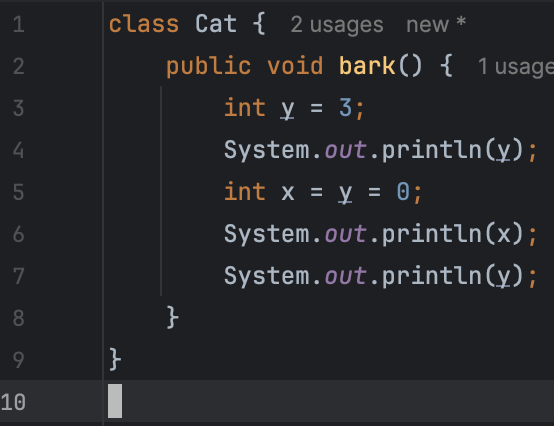
Back
The output of the code snippet is:
3
0
0
0
0
Field-by-field Comparison
| Field | Before | After |
|---|---|---|
| Front | The output of the code snippet is:<br><img src="Screenshot 2025-12-12 at 22.32.55.png"> | |
| Back | 3<br>0<br>0 |
Note 19: ETH::EProg
Deck: ETH::EProg
Note Type: Horvath Cloze
GUID:
added
Note Type: Horvath Cloze
GUID:
p$+y{A-`_b
Previous
Note did not exist
New Note
Front
Casts from int to long and double can always be implicit.
Back
Casts from int to long and double can always be implicit.
Field-by-field Comparison
| Field | Before | After |
|---|---|---|
| Text | Casts from {{c1:: int}} to long and double {{c2:: can always be implicit}}. |
Note 20: ETH::EProg
Deck: ETH::EProg
Note Type: Horvath Cloze
GUID:
added
Note Type: Horvath Cloze
GUID:
D{XXurJu$`
Previous
Note did not exist
New Note
Front
short, int, float, double, long can be initialized using hexadecimal
Back
short, int, float, double, long can be initialized using hexadecimal
possibly also other types but definitely not boolean and char
Field-by-field Comparison
| Field | Before | After |
|---|---|---|
| Text | {{c1:: short, int, float, double, long}} can be initialized using {{c2:: hexadecimal}} | |
| Extra | possibly also other types but definitely not boolean and char |
Note 21: ETH::EProg
Deck: ETH::EProg
Note Type: Horvath Cloze
GUID:
added
Note Type: Horvath Cloze
GUID:
Q=BFp=(vY3
Previous
Note did not exist
New Note
Front
The ternary operator has the following syntax: test ? valueTrue : valueFalse
Back
The ternary operator has the following syntax: test ? valueTrue : valueFalse
Field-by-field Comparison
| Field | Before | After |
|---|---|---|
| Text | The ternary operator has the following syntax: {{c1:: test ? valueTrue : valueFalse}} |
Note 22: ETH::EProg
Deck: ETH::EProg
Note Type: Horvath Cloze
GUID:
added
Note Type: Horvath Cloze
GUID:
p9%v,4EY(!
Previous
Note did not exist
New Note
Front
Values given to a method in Java are always copied.
Back
Values given to a method in Java are always copied.
Field-by-field Comparison
| Field | Before | After |
|---|---|---|
| Text | Values given to a method in Java are {{c1:: always copied}}. |
Note 23: ETH::EProg
Deck: ETH::EProg
Note Type: Horvath Cloze
GUID:
added
Note Type: Horvath Cloze
GUID:
m%x4[`&]1%
Previous
Note did not exist
New Note
Front
Only name and input types determine the signature of a method in Java.
Back
Only name and input types determine the signature of a method in Java.
Field-by-field Comparison
| Field | Before | After |
|---|---|---|
| Text | Only {{c1:: name and input types }} determine the signature of a method in Java. |
Note 24: ETH::EProg
Deck: ETH::EProg
Note Type: Horvath Classic
GUID:
added
Note Type: Horvath Classic
GUID:
eEx@10sK[?
Previous
Note did not exist
New Note
Front
What is the difference between i++ and ++i in Java?
Back
What is the difference between i++ and ++i in Java?
i++ returns the current value of i and then increments i by 1
++i first increments value of i by 1 and then returns the value
++i first increments value of i by 1 and then returns the value
Field-by-field Comparison
| Field | Before | After |
|---|---|---|
| Front | What is the difference between i++ and ++i in Java? | |
| Back | i++ returns the current value of i and then increments i by 1<br><br>++i first increments value of i by 1 and then returns the value |