Anki Deck Changes

Commit: 2d0707e4 - jessas maria

Author: lhorva <lhorva@student.ethz.ch>

Date: 2026-01-16T03:17:24+01:00

Changes: 45 note(s) changed (0 added, 45 modified, 0 deleted)

ℹ️ Cosmetic Changes Hidden: 9 note(s) had formatting-only changes and are not shown below • 1 whitespace updates • 3 HTML formatting changes • 4 mixed cosmetic changes

Note 1: ETH::A&D

Deck: ETH::A&D
Note Type: Horvath Cloze
GUID: AY}!l[d)1z
modified

Before

Front

ETH::1._Semester::A&D::09._Graph_Search::1._Depth_First_Search
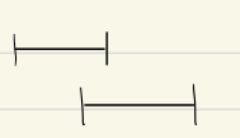
Name the impossible cases in DFS pre/post ordering for edge \((u, v)\):
  • Overlapping but not Nested Intervals: 
  • {{c2:: \(\text{pre}(u)<\text{pre}(v)<\text{post}(u)<\text{post}(v)\):  as visit(u) would call visit(v) before the recursive call ends}}
Back

ETH::1._Semester::A&D::09._Graph_Search::1._Depth_First_Search
Name the impossible cases in DFS pre/post ordering for edge \((u, v)\):
  • Overlapping but not Nested Intervals: 
  • {{c2:: \(\text{pre}(u)<\text{pre}(v)<\text{post}(u)<\text{post}(v)\):  as visit(u) would call visit(v) before the recursive call ends}}
After

Front

ETH::1._Semester::A&D::09._Graph_Search::1._Depth_First_Search
Name the impossible cases in DFS pre/post ordering for edge \((u, v)\):
  • Overlapping but not nested intervals: 
  • {{c2:: \(\text{pre}(u)<\text{pre}(v)<\text{post}(u)<\text{post}(v)\): As visit(u) would call visit(v) before the recursive call ends.  }}

Back

ETH::1._Semester::A&D::09._Graph_Search::1._Depth_First_Search
Name the impossible cases in DFS pre/post ordering for edge \((u, v)\):
  • Overlapping but not nested intervals: 
  • {{c2:: \(\text{pre}(u)<\text{pre}(v)<\text{post}(u)<\text{post}(v)\): As visit(u) would call visit(v) before the recursive call ends.  }}
Field-by-field Comparison
Field Before After
Text Name the impossible cases in DFS pre/post ordering for edge&nbsp;\((u, v)\):<br><ul><li>{{c1::Overlapping but not Nested Intervals:&nbsp;<img src="paste-b7976dbbff12de2b44594553e0c91633f59e9c05.jpg">}}</li><li>{{c2::&nbsp;\(\text{pre}(u)&lt;\text{pre}(v)&lt;\text{post}(u)&lt;\text{post}(v)\):&nbsp;<img src="paste-a6fc070f96de8bd2b8148e3891cf956fd611a0a2.jpg">&nbsp;as visit(u)&nbsp;would call visit(v) before the recursive call ends}}</li></ul> Name the impossible cases in DFS pre/post ordering for edge&nbsp;\((u, v)\):<br><ul><li>{{c1::Overlapping but not nested intervals:&nbsp;<img src="paste-b7976dbbff12de2b44594553e0c91633f59e9c05.jpg">}}</li><li>{{c2::&nbsp;\(\text{pre}(u)&lt;\text{pre}(v)&lt;\text{post}(u)&lt;\text{post}(v)\):&nbsp;As visit(u)&nbsp;would call visit(v) before the recursive call ends.&nbsp;<img src="paste-a6fc070f96de8bd2b8148e3891cf956fd611a0a2.jpg">&nbsp;}}</li></ul>
Tags: ETH::1._Semester::A&D::09._Graph_Search::1._Depth_First_Search

Note 2: ETH::A&D

Deck: ETH::A&D
Note Type: Image Occlusion-73a2c
GUID: EE{ugGOkjL
modified

Before

Front

image-occlusion:rect:left=.1725:top=.5468:angle=985:width=.3135:height=.1117:oi=1
image-occlusion:rect:left=.1923:top=.2416:width=.2286:height=.2:oi=1
image-occlusion:rect:left=.5726:top=.7584:width=.2179:height=.0701:oi=1
image-occlusion:text:left=.2051:top=.0987:text=B<-F:scale=1.:fs=.1133:oi=1
image-occlusion:text:left=.6132:top=.8338:text=G<-H:scale=.5385:fs=.1133:oi=1
image-occlusion:text:left=.1645:top=.7065:angle=989:text=E->G:scale=.6858:fs=.1133:oi=1

Back

image-occlusion:rect:left=.1725:top=.5468:angle=985:width=.3135:height=.1117:oi=1
image-occlusion:rect:left=.1923:top=.2416:width=.2286:height=.2:oi=1
image-occlusion:rect:left=.5726:top=.7584:width=.2179:height=.0701:oi=1
image-occlusion:text:left=.2051:top=.0987:text=B<-F:scale=1.:fs=.1133:oi=1
image-occlusion:text:left=.6132:top=.8338:text=G<-H:scale=.5385:fs=.1133:oi=1
image-occlusion:text:left=.1645:top=.7065:angle=989:text=E->G:scale=.6858:fs=.1133:oi=1

After

Front

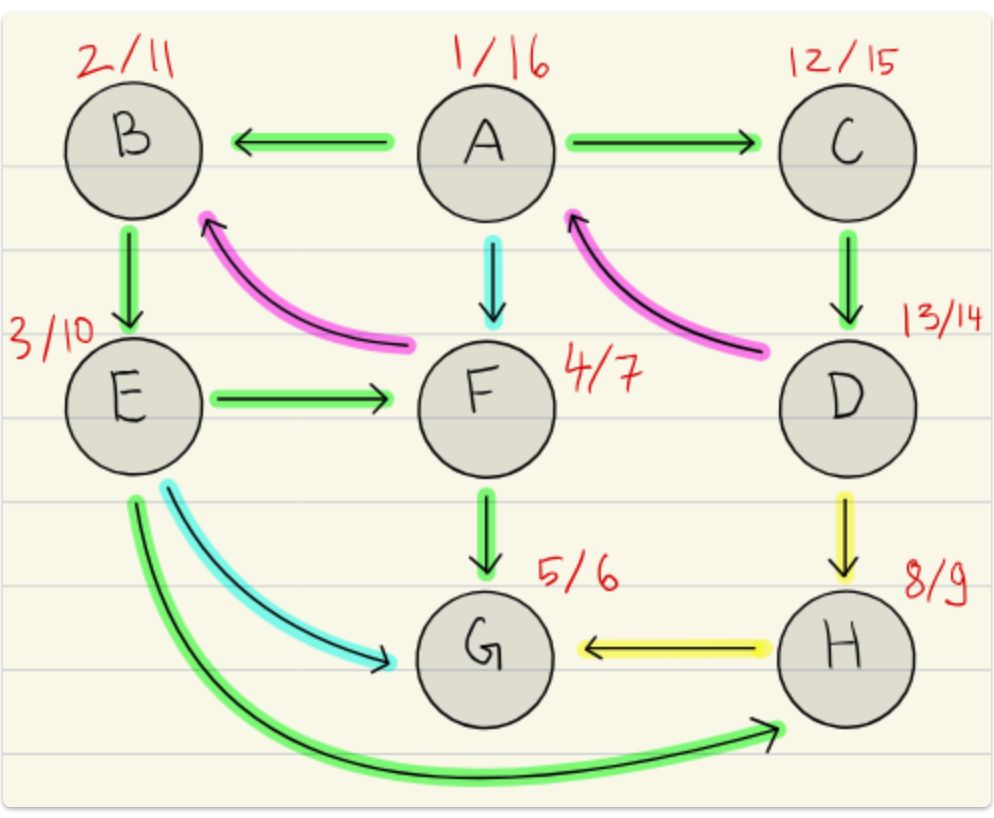
Back-, forward- or cross-edge?
image-occlusion:rect:left=.5722:top=.7727:width=.2045:height=.0564:oi=1
image-occlusion:text:left=.2943:top=.1886:angle=993:text=B←F:scale=.7864:fs=.1133:oi=1
image-occlusion:text:left=.6445:top=.7008:text=G←H:scale=.5385:fs=.1133:oi=1
image-occlusion:text:left=.2618:top=.5681:angle=989:text=E→G:scale=.6858:fs=.1133:oi=1
image-occlusion:polygon:left=.1879:top=.2465:points=.1883,.2528 .2183,.2471 .2906,.3622 .4248,.4067 .4267,.4432 .3206,.4409 .2165,.3417:oi=1
image-occlusion:polygon:left=.1513:top=.5749:points=.1517,.5846 .177,.5755 .2653,.7123 .4032,.791 .4023,.8377 .3,.8161 .1968,.7169:oi=1

Back

Back-, forward- or cross-edge?
image-occlusion:rect:left=.5722:top=.7727:width=.2045:height=.0564:oi=1
image-occlusion:text:left=.2943:top=.1886:angle=993:text=B←F:scale=.7864:fs=.1133:oi=1
image-occlusion:text:left=.6445:top=.7008:text=G←H:scale=.5385:fs=.1133:oi=1
image-occlusion:text:left=.2618:top=.5681:angle=989:text=E→G:scale=.6858:fs=.1133:oi=1
image-occlusion:polygon:left=.1879:top=.2465:points=.1883,.2528 .2183,.2471 .2906,.3622 .4248,.4067 .4267,.4432 .3206,.4409 .2165,.3417:oi=1
image-occlusion:polygon:left=.1513:top=.5749:points=.1517,.5846 .177,.5755 .2653,.7123 .4032,.791 .4023,.8377 .3,.8161 .1968,.7169:oi=1
Magenta: Back
Turquoise: Forward
Yellow: Cross
Field-by-field Comparison
Field Before After
Occlusion {{c3::image-occlusion:rect:left=.1725:top=.5468:angle=985:width=.3135:height=.1117:oi=1}}<br>{{c1::image-occlusion:rect:left=.1923:top=.2416:width=.2286:height=.2:oi=1}}<br>{{c2::image-occlusion:rect:left=.5726:top=.7584:width=.2179:height=.0701:oi=1}}<br>{{c0::image-occlusion:text:left=.2051:top=.0987:text=B<-F:scale=1.:fs=.1133:oi=1}}<br>{{c0::image-occlusion:text:left=.6132:top=.8338:text=G<-H:scale=.5385:fs=.1133:oi=1}}<br>{{c0::image-occlusion:text:left=.1645:top=.7065:angle=989:text=E->G:scale=.6858:fs=.1133:oi=1}}<br> {{c2::image-occlusion:rect:left=.5722:top=.7727:width=.2045:height=.0564:oi=1}}<br>{{c0::image-occlusion:text:left=.2943:top=.1886:angle=993:text=B←F:scale=.7864:fs=.1133:oi=1}}<br>{{c0::image-occlusion:text:left=.6445:top=.7008:text=G←H:scale=.5385:fs=.1133:oi=1}}<br>{{c0::image-occlusion:text:left=.2618:top=.5681:angle=989:text=E→G:scale=.6858:fs=.1133:oi=1}}<br>{{c1::image-occlusion:polygon:left=.1879:top=.2465:points=.1883,.2528 .2183,.2471 .2906,.3622 .4248,.4067 .4267,.4432 .3206,.4409 .2165,.3417:oi=1}}<br>{{c3::image-occlusion:polygon:left=.1513:top=.5749:points=.1517,.5846 .177,.5755 .2653,.7123 .4032,.791 .4023,.8377 .3,.8161 .1968,.7169:oi=1}}<br>
Header Back-, forward- or cross-edge?
Back Extra Magenta: Back<br>Turquoise: Forward<br>Yellow: Cross
Tags: ETH::1._Semester::A&D::09._Graph_Search::1._Depth_First_Search

Note 3: ETH::A&D

Deck: ETH::A&D
Note Type: Horvath Classic
GUID: F{a&v[Q@_W
modified

Before

Front

ETH::1._Semester::A&D::07._Graphs::1._Introduction_to_Graphs
Let \(W\) be a walk and let \(u\) be a vertex, what is \(\text{deg}_W(u)\)? (generally)

Back

ETH::1._Semester::A&D::07._Graphs::1._Introduction_to_Graphs
Let \(W\) be a walk and let \(u\) be a vertex, what is \(\text{deg}_W(u)\)? (generally)

It is the number of edges incident to \(u\) which are part of \(W\) but repetitions are included, therefore it is possible that \(\text{deg}(u) < \text{deg}_W(u)\).

After

Front

ETH::1._Semester::A&D::07._Graphs::1._Introduction_to_Graphs
Let \(W\) be a walk and let \(u\) be a vertex, what is \(\text{deg}_W(u)\)? (generally)

Back

ETH::1._Semester::A&D::07._Graphs::1._Introduction_to_Graphs
Let \(W\) be a walk and let \(u\) be a vertex, what is \(\text{deg}_W(u)\)? (generally)

The number of edges incident to \(u\) which are part of \(W\) but repetitions are included, therefore it is possible that \(\text{deg}(u) < \text{deg}_W(u)\).
Field-by-field Comparison
Field Before After
Back It is the number of edges incident to&nbsp;\(u\)&nbsp;which are part of&nbsp;\(W\)&nbsp;but&nbsp;<b>repetitions are included</b>, therefore it is possible that&nbsp;\(\text{deg}(u) &lt; \text{deg}_W(u)\). The number of edges incident to&nbsp;\(u\)&nbsp;which are part of&nbsp;\(W\)&nbsp;but&nbsp;<b>repetitions are included</b>, therefore it is possible that&nbsp;\(\text{deg}(u) &lt; \text{deg}_W(u)\).
Tags: ETH::1._Semester::A&D::07._Graphs::1._Introduction_to_Graphs

Note 4: ETH::A&D

Deck: ETH::A&D
Note Type: Horvath Cloze
GUID: GA*(aETcmb
modified

Before

Front

ETH::1._Semester::A&D::09._Graph_Search::1._Depth_First_Search
DFS Runtime: In a sparse graph adjacency list better, in a dense graph adjacency matrix is better.

Back

ETH::1._Semester::A&D::09._Graph_Search::1._Depth_First_Search
DFS Runtime: In a sparse graph adjacency list better, in a dense graph adjacency matrix is better.

\(|E| \geq |V|^2 / 10\), then DFS has the same runtime in the worst-case using adjacency matrices or lists as \(|V| + |E| \leq |V| + |V|^2 \)which is \(O(n^2)\).

After

Front

ETH::1._Semester::A&D::09._Graph_Search::1._Depth_First_Search
Which datastructure is best for DFS?

In a sparse graph an adjacency list is better, in a dense graph an adjacency matrix is better.

Back

ETH::1._Semester::A&D::09._Graph_Search::1._Depth_First_Search
Which datastructure is best for DFS?

In a sparse graph an adjacency list is better, in a dense graph an adjacency matrix is better.

\(|E| \geq |V|^2 / 10\), then DFS has the same runtime in the worst-case using adjacency matrices or lists as \(|V| + |E| \leq |V| + |V|^2 \)which is \(O(n^2)\).
Field-by-field Comparison
Field Before After
Text DFS Runtime: In a sparse graph {{c1:: adjacency list better}}, in a dense graph {{c1:: adjacency matrix is better}}. Which datastructure is best for DFS?<br><br>In a sparse graph {{c1:: an adjacency list is better}}, in a dense graph {{c1:: an adjacency matrix is better}}.
Tags: ETH::1._Semester::A&D::09._Graph_Search::1._Depth_First_Search

Note 5: ETH::A&D

Deck: ETH::A&D
Note Type: Horvath Classic
GUID: Ip_w|jj[VT
modified

Before

Front

ETH::1._Semester::A&D::07._Graphs::2._Closed_Eulerian_Walks
How can we quickly check if an Eulerian walk exists?

Back

ETH::1._Semester::A&D::07._Graphs::2._Closed_Eulerian_Walks
How can we quickly check if an Eulerian walk exists?

we can check the degrees of the vertices, an Eulerian walk exists only if at most 2 vertices have an odd degree

this is because if a vertex has an odd degree, it must either be the start point or the endpoint as otherwise we would not be able to leave from it

After

Front

ETH::1._Semester::A&D::07._Graphs::2._Closed_Eulerian_Walks
How can we quickly check whether an Eulerian walk exists?

Back

ETH::1._Semester::A&D::07._Graphs::2._Closed_Eulerian_Walks
How can we quickly check whether an Eulerian walk exists?

We can check the degrees of the vertices, an Eulerian walk exists only if at most 2 vertices have an odd degree

This is because if a vertex has an odd degree, it must either be the start point or the endpoint as otherwise we would not be able to leave from it
Field-by-field Comparison
Field Before After
Front How can we quickly check if an Eulerian walk exists? How can we quickly check whether an Eulerian walk exists?
Back we can check the degrees of the vertices, an Eulerian walk exists only if at most 2 vertices have an odd degree<br><br>this is because if a vertex has an odd degree, it must either be the start point or the endpoint as otherwise we would not be able to leave from it We can check the degrees of the vertices, an Eulerian walk exists only if at most 2 vertices have an odd degree<br><br>This is because if a vertex has an odd degree, it must either be the start point or the endpoint as otherwise we would not be able to leave from it
Tags: ETH::1._Semester::A&D::07._Graphs::2._Closed_Eulerian_Walks

Note 6: ETH::A&D

Deck: ETH::A&D
Note Type: Horvath Classic
GUID: QBdl=YAmG|
modified

Before

Front

ETH::1._Semester::A&D::09._Graph_Search::1._Depth_First_Search
Check for cycles in DFS algo:

Back

ETH::1._Semester::A&D::09._Graph_Search::1._Depth_First_Search
Check for cycles in DFS algo:

During the recursive call, if we find an adjacent vertex without a post-number, there's a back-edge (\(\implies\)the recursive call for that edge is still active...)

After

Front

ETH::1._Semester::A&D::09._Graph_Search::1._Depth_First_Search
How can we check for cycles via DFS?

Back

ETH::1._Semester::A&D::09._Graph_Search::1._Depth_First_Search
How can we check for cycles via DFS?

During the recursive call, if we find an adjacent vertex without a post-number, there's a back-edge (\(\implies\)the recursive call for that edge is still active...).
Field-by-field Comparison
Field Before After
Front Check for cycles in DFS algo: How can we check for cycles via DFS?
Back During the recursive call, if we find an adjacent vertex <b>without a post-number</b>, there's a back-edge (\(\implies\)the recursive call for that edge is still active...) During the recursive call, if we find an adjacent vertex <b>without a post-number</b>, there's a back-edge (\(\implies\)the recursive call for that edge is still active...).
Tags: ETH::1._Semester::A&D::09._Graph_Search::1._Depth_First_Search

Note 7: ETH::A&D

Deck: ETH::A&D
Note Type: Horvath Classic
GUID: chQ&(3]SWg
modified

Before

Front

ETH::1._Semester::A&D::07._Graphs::2._Closed_Eulerian_Walks
When is a closed Eulerian walk possible? 

Back

ETH::1._Semester::A&D::07._Graphs::2._Closed_Eulerian_Walks
When is a closed Eulerian walk possible? 

if and only if all vertex degrees are even

After

Front

ETH::1._Semester::A&D::07._Graphs::2._Closed_Eulerian_Walks
When is a closed Eulerian walk possible? 

Back

ETH::1._Semester::A&D::07._Graphs::2._Closed_Eulerian_Walks
When is a closed Eulerian walk possible? 

If and only if all vertex degrees are even.
Field-by-field Comparison
Field Before After
Back if and only if all vertex degrees are even If and only if all vertex degrees are even.
Tags: ETH::1._Semester::A&D::07._Graphs::2._Closed_Eulerian_Walks

Note 8: ETH::A&D

Deck: ETH::A&D
Note Type: Horvath Classic
GUID: eP)-7WD~tP
modified

Before

Front

ETH::1._Semester::A&D::07._Graphs::2._Closed_Eulerian_Walks
Runtime Determine if Eulerian walk exists?

Back

ETH::1._Semester::A&D::07._Graphs::2._Closed_Eulerian_Walks
Runtime Determine if Eulerian walk exists?

Eulerian path - \(O(n+m)\)

After

Front

ETH::1._Semester::A&D::07._Graphs::2._Closed_Eulerian_Walks
Runtime to determine whether an Eulerian walk exists?

Back

ETH::1._Semester::A&D::07._Graphs::2._Closed_Eulerian_Walks
Runtime to determine whether an Eulerian walk exists?

Eulerian path - \(O(n+m)\)
Field-by-field Comparison
Field Before After
Front <b>Runtime</b>&nbsp;Determine if Eulerian walk exists? <b>Runtime</b>&nbsp;to determine whether an Eulerian walk exists?
Tags: ETH::1._Semester::A&D::07._Graphs::2._Closed_Eulerian_Walks

Note 9: ETH::A&D

Deck: ETH::A&D
Note Type: Horvath Cloze
GUID: nmO79UYMKA
modified

Before

Front

ETH::1._Semester::A&D::09._Graph_Search::1._Depth_First_Search
DFS Pseudocode needs to include a for loop over all unmarked nodes in a graph we're not sure is connected.

Back

ETH::1._Semester::A&D::09._Graph_Search::1._Depth_First_Search
DFS Pseudocode needs to include a for loop over all unmarked nodes in a graph we're not sure is connected.

Otherwise we aren't visiting ZHKs that aren't connected to our chosen first node.
DFS(g):
    all vertices unmarked
    for u unmarked:
        visit(u)

visit(u):
    mark u
    for v adjacent to u:

After

Front

ETH::1._Semester::A&D::09._Graph_Search::1._Depth_First_Search
DFS Pseudocode needs to include a for loop over all unmarked nodes, when we're not sure whether the graph is connected.

Back

ETH::1._Semester::A&D::09._Graph_Search::1._Depth_First_Search
DFS Pseudocode needs to include a for loop over all unmarked nodes, when we're not sure whether the graph is connected.

Otherwise we aren't visiting ZHKs that aren't connected to our chosen first node.
DFS(g):
    all vertices unmarked
    for u unmarked:
        visit(u)

visit(u):
    mark u
    for v adjacent to u:

Field-by-field Comparison
Field Before After
Text DFS Pseudocode needs to include {{c1:: a for loop over all unmarked nodes}} in a graph we're not sure is connected. DFS Pseudocode needs to include {{c1:: a for loop over all unmarked nodes}}, when we're not sure whether the graph is connected.
Tags: ETH::1._Semester::A&D::09._Graph_Search::1._Depth_First_Search

Note 10: ETH::A&D

Deck: ETH::A&D
Note Type: Horvath Classic
GUID: nzhNF&3(!D
modified

Before

Front

ETH::1._Semester::A&D::08._Directed_Graphs::1._Introduction_to_Directed_Graphs
Handshake lemma in directed graphs:

Back

ETH::1._Semester::A&D::08._Directed_Graphs::1._Introduction_to_Directed_Graphs
Handshake lemma in directed graphs:

\[ \sum_{v \in V} \deg_{out}(v) = \sum_{v \in V} \deg_{in}(v) = |E| \]

After

Front

ETH::1._Semester::A&D::08._Directed_Graphs::1._Introduction_to_Directed_Graphs
What is the handshake lemma in directed graphs?

Back

ETH::1._Semester::A&D::08._Directed_Graphs::1._Introduction_to_Directed_Graphs
What is the handshake lemma in directed graphs?

\[ \sum_{v \in V} \deg_{out}(v) = \sum_{v \in V} \deg_{in}(v) = |E| \]
Field-by-field Comparison
Field Before After
Front Handshake lemma in directed graphs: What is the handshake lemma in directed graphs?
Tags: ETH::1._Semester::A&D::08._Directed_Graphs::1._Introduction_to_Directed_Graphs

Note 11: ETH::A&D

Deck: ETH::A&D
Note Type: Horvath Classic
GUID: ra?I5x|G>*
modified

Before

Front

ETH::1._Semester::A&D::07._Graphs::1._Introduction_to_Graphs
Runtime: Operations in an Adjacency Matrix:

Back

ETH::1._Semester::A&D::07._Graphs::1._Introduction_to_Graphs
Runtime: Operations in an Adjacency Matrix:

1. check if \(uv \in E\): \(O(1)\)
2. Vertex \(u\) , find all adjacent vertices in:  \(O(n)\)

After

Front

ETH::1._Semester::A&D::07._Graphs::1._Introduction_to_Graphs
Runtime of operations in an adjacency matrix?

Back

ETH::1._Semester::A&D::07._Graphs::1._Introduction_to_Graphs
Runtime of operations in an adjacency matrix?

1. Check if \(uv \in E\): \(O(1)\)
2. Vertex \(u\) , find all adjacent vertices in:  \(O(n)\)
Field-by-field Comparison
Field Before After
Front <b>Runtime</b>: Operations in an Adjacency <b>Matrix</b>: <b>Runtime of o</b>perations in an adjacency m<b>atrix?</b>
Back 1. check if&nbsp;\(uv \in E\):&nbsp;\(O(1)\)<br>2. Vertex&nbsp;\(u\)&nbsp;, find all adjacent vertices in:&nbsp;&nbsp;\(O(n)\) 1. Check if&nbsp;\(uv \in E\):&nbsp;\(O(1)\)<br>2. Vertex&nbsp;\(u\)&nbsp;, find all adjacent vertices in:&nbsp;&nbsp;\(O(n)\)
Tags: ETH::1._Semester::A&D::07._Graphs::1._Introduction_to_Graphs

Note 12: ETH::A&D

Deck: ETH::A&D
Note Type: Horvath Classic
GUID: v7@jgp_hjT
modified

Before

Front

ETH::1._Semester::A&D::09._Graph_Search::1._Depth_First_Search
Find cross edge in DFS algorithm:

Back

ETH::1._Semester::A&D::09._Graph_Search::1._Depth_First_Search
Find cross edge in DFS algorithm:

If we find vertex with both pre- and post- there's a cross edge.

After

Front

ETH::1._Semester::A&D::09._Graph_Search::1._Depth_First_Search
How can we find a cross edge via DFS?

Back

ETH::1._Semester::A&D::09._Graph_Search::1._Depth_First_Search
How can we find a cross edge via DFS?

If we find vertex with both pre- and post-values set, there's a cross edge.
Field-by-field Comparison
Field Before After
Front Find cross edge in DFS algorithm: How can we find a cross edge via DFS?
Back If we find vertex with both pre- and post- there's a cross edge. If we find vertex with both pre- and post-values set, there's a cross edge.
Tags: ETH::1._Semester::A&D::09._Graph_Search::1._Depth_First_Search

Note 13: ETH::DiskMat

Deck: ETH::DiskMat
Note Type: Horvath Cloze
GUID: Ga7Wx4Cv5Q
modified

Before

Front

ETH::1._Semester::DiskMat::6._Logic::3._Elementary_General_Concepts_in_Logic::7._Logical_Consequence_vs._Unsatisfiability
The following three statements are equivalent:
1. {{c1::\(\{F_1, \dots, F_k\} \models G\)}}
2. \((F_1 \land F_2 \land \dots F_k) \rightarrow G\) is a tautology
3. {{c3::\(\{F_1, F_2, \dots, F_k, \lnot G\}\) is unsatisfiable}}.

Back

ETH::1._Semester::DiskMat::6._Logic::3._Elementary_General_Concepts_in_Logic::7._Logical_Consequence_vs._Unsatisfiability
The following three statements are equivalent:
1. {{c1::\(\{F_1, \dots, F_k\} \models G\)}}
2. \((F_1 \land F_2 \land \dots F_k) \rightarrow G\) is a tautology
3. {{c3::\(\{F_1, F_2, \dots, F_k, \lnot G\}\) is unsatisfiable}}.

This is important for resolution calculus!

After

Front

ETH::1._Semester::DiskMat::6._Logic::3._Elementary_General_Concepts_in_Logic::7._Logical_Consequence_vs._Unsatisfiability
The following three statements are equivalent:
  1. {{c1::\(\{F_1, \dots, F_k\} \models G\)}}
  2. \((F_1 \land F_2 \land \dots F_k) \rightarrow G\) is a tautology
  3. {{c3::\(\{F_1, F_2, \dots, F_k, \lnot G\}\) is unsatisfiable}}.

Back

ETH::1._Semester::DiskMat::6._Logic::3._Elementary_General_Concepts_in_Logic::7._Logical_Consequence_vs._Unsatisfiability
The following three statements are equivalent:
  1. {{c1::\(\{F_1, \dots, F_k\} \models G\)}}
  2. \((F_1 \land F_2 \land \dots F_k) \rightarrow G\) is a tautology
  3. {{c3::\(\{F_1, F_2, \dots, F_k, \lnot G\}\) is unsatisfiable}}.

This is important for resolution calculus!
Field-by-field Comparison
Field Before After
Text The following three statements are equivalent:<br>1. {{c1::\(\{F_1, \dots, F_k\} \models G\)}}<br>2. {{c2::\((F_1 \land F_2 \land \dots F_k) \rightarrow G\)&nbsp;is a tautology}}<br>3. {{c3::\(\{F_1, F_2, \dots, F_k, \lnot G\}\)&nbsp;is unsatisfiable}}. The following three statements are equivalent:<br><ol><li>{{c1::\(\{F_1, \dots, F_k\} \models G\)}}</li><li>{{c2::\((F_1 \land F_2 \land \dots F_k) \rightarrow G\)&nbsp;is a tautology}}</li><li>{{c3::\(\{F_1, F_2, \dots, F_k, \lnot G\}\)&nbsp;is unsatisfiable}}.</li></ol>
Tags: ETH::1._Semester::DiskMat::6._Logic::3._Elementary_General_Concepts_in_Logic::7._Logical_Consequence_vs._Unsatisfiability

Note 14: ETH::DiskMat

Deck: ETH::DiskMat
Note Type: Horvath Cloze
GUID: Ic5Kv9Wm3S
modified

Before

Front

ETH::1._Semester::DiskMat::6._Logic::3._Elementary_General_Concepts_in_Logic::8._Theorems_and_Theories
An axiom \(A\) is a statement taken as true in a theory. Theorems are the statements which follow from these axioms (\(A \models T\)).

Back

ETH::1._Semester::DiskMat::6._Logic::3._Elementary_General_Concepts_in_Logic::8._Theorems_and_Theories
An axiom \(A\) is a statement taken as true in a theory. Theorems are the statements which follow from these axioms (\(A \models T\)).

After

Front

ETH::1._Semester::DiskMat::6._Logic::3._Elementary_General_Concepts_in_Logic::8._Theorems_and_Theories
An axiom \(A\) is a statement taken as true in a theory. Theorems are the statements which follow from .

Back

ETH::1._Semester::DiskMat::6._Logic::3._Elementary_General_Concepts_in_Logic::8._Theorems_and_Theories
An axiom \(A\) is a statement taken as true in a theory. Theorems are the statements which follow from .
Field-by-field Comparison
Field Before After
Text An {{c1::<i>axiom</i>&nbsp;\(A\)}} is a {{c2::statement taken as true in a theory}}. {{c3::<i>Theorems</i>}} are the statements which {{c4::follow from these axioms}} (\(A \models T\)). An {{c1::<i>axiom</i>&nbsp;\(A\)}} is a {{c2::statement taken as true in a theory}}. {{c3::<i>Theorems</i>}} are the statements which {{c4::follow from {{c1::these axioms}} (\(A \models T\))}}.
Tags: ETH::1._Semester::DiskMat::6._Logic::3._Elementary_General_Concepts_in_Logic::8._Theorems_and_Theories

Note 15: ETH::DiskMat

Deck: ETH::DiskMat
Note Type: Horvath Cloze
GUID: Ke6Tz2Pv8U
modified

Before

Front

ETH::1._Semester::DiskMat::6._Logic::3._Elementary_General_Concepts_in_Logic::8._Theorems_and_Theories
If a theorem follows from the empty set of axioms \(\emptyset\), then it's a tautology. This means that it's a theorem in any theory!

Back

ETH::1._Semester::DiskMat::6._Logic::3._Elementary_General_Concepts_in_Logic::8._Theorems_and_Theories
If a theorem follows from the empty set of axioms \(\emptyset\), then it's a tautology. This means that it's a theorem in any theory!

After

Front

ETH::1._Semester::DiskMat::6._Logic::3._Elementary_General_Concepts_in_Logic::8._Theorems_and_Theories
If a theorem follows from the empty set of axioms \(\emptyset\), then it's a tautology.

This means that it's a theorem in any theory!

Back

ETH::1._Semester::DiskMat::6._Logic::3._Elementary_General_Concepts_in_Logic::8._Theorems_and_Theories
If a theorem follows from the empty set of axioms \(\emptyset\), then it's a tautology.

This means that it's a theorem in any theory!
Field-by-field Comparison
Field Before After
Text If a theorem follows from the {{c1::empty set}} of axioms&nbsp;\(\emptyset\), then it's a {{c2::<i>tautology</i>}}. This means that {{c3::it's a theorem in any theory!}} If a theorem follows from the {{c1::empty set of axioms&nbsp;\(\emptyset\)}}, then it's a {{c2::<i>tautology</i>}}. <br><br>This means that {{c3::it's a theorem in any theory!}}
Tags: ETH::1._Semester::DiskMat::6._Logic::3._Elementary_General_Concepts_in_Logic::8._Theorems_and_Theories

Note 16: ETH::DiskMat

Deck: ETH::DiskMat
Note Type: Horvath Cloze
GUID: Oi6Kx4Tn8L
modified

Before

Front

ETH::1._Semester::DiskMat::6._Logic::4._Logical_Calculi::2._Hilbert-Style_Calculi
Derivation or inference rule: 
{{c1::\(\{F_1, \dots, F_k\} \vdash_R G\)}} if {{c2:: \(G\) can be derived from the set \(\{F_1, \dots, F_k\}\) by rule \(R\)}}.

Back

ETH::1._Semester::DiskMat::6._Logic::4._Logical_Calculi::2._Hilbert-Style_Calculi
Derivation or inference rule: 
{{c1::\(\{F_1, \dots, F_k\} \vdash_R G\)}} if {{c2:: \(G\) can be derived from the set \(\{F_1, \dots, F_k\}\) by rule \(R\)}}.

Formally, a derivation rule \(R\) is a relation from the power set of the set of formulas to the set of formulas.

After

Front

ETH::1._Semester::DiskMat::6._Logic::4._Logical_Calculi::2._Hilbert-Style_Calculi
Derivation/inference rule: 
{{c1::\(\{F_1, \dots, F_k\} \vdash_R G\)::Notation}} if {{c2:: \(G\) can be derived from the set \(\{F_1, \dots, F_k\}\) by rule \(R\)}}.

Back

ETH::1._Semester::DiskMat::6._Logic::4._Logical_Calculi::2._Hilbert-Style_Calculi
Derivation/inference rule: 
{{c1::\(\{F_1, \dots, F_k\} \vdash_R G\)::Notation}} if {{c2:: \(G\) can be derived from the set \(\{F_1, \dots, F_k\}\) by rule \(R\)}}.

Formally, a derivation rule \(R\) is a relation from the power set of the set of formulas to the set of formulas.
Field-by-field Comparison
Field Before After
Text <i>Derivation&nbsp;</i>or&nbsp;<i>inference</i>&nbsp;rule:&nbsp;<br>{{c1::\(\{F_1, \dots, F_k\} \vdash_R G\)}} if {{c2::&nbsp;\(G\)&nbsp;can be derived from the set&nbsp;\(\{F_1, \dots, F_k\}\)&nbsp;by rule&nbsp;\(R\)}}. <i>Derivation/</i><i>inference</i>&nbsp;rule:&nbsp;<br>{{c1::\(\{F_1, \dots, F_k\} \vdash_R G\)::Notation}} if {{c2::&nbsp;\(G\)&nbsp;can be derived from the set&nbsp;\(\{F_1, \dots, F_k\}\)&nbsp;by rule&nbsp;\(R\)}}.
Tags: ETH::1._Semester::DiskMat::6._Logic::4._Logical_Calculi::2._Hilbert-Style_Calculi

Note 17: ETH::DiskMat

Deck: ETH::DiskMat
Note Type: Horvath Cloze
GUID: Qk9Nz5Bw4H
modified

Before

Front

ETH::1._Semester::DiskMat::6._Logic::4._Logical_Calculi::2._Hilbert-Style_Calculi
The application of a derivation rule \(R\) to a set \(M\) of formulas means:
1. Select a subset \(N\) of \(M\) such that \(N \vdash_R G\) for some formula \(G\)
2. {{c2::Add \(G\) to the set \(M\) (i.e., replace \(M\) by \(M \cup \{G\}\))}}

Back

ETH::1._Semester::DiskMat::6._Logic::4._Logical_Calculi::2._Hilbert-Style_Calculi
The application of a derivation rule \(R\) to a set \(M\) of formulas means:
1. Select a subset \(N\) of \(M\) such that \(N \vdash_R G\) for some formula \(G\)
2. {{c2::Add \(G\) to the set \(M\) (i.e., replace \(M\) by \(M \cup \{G\}\))}}

After

Front

ETH::1._Semester::DiskMat::6._Logic::4._Logical_Calculi::2._Hilbert-Style_Calculi
The application of a derivation rule \(R\) to a set \(M\) of formulas means:
  1. Select a subset \(N\) of \(M\) such that \(N \vdash_R G\) for some formula \(G\)
  2. {{c2::Add \(G\) to the set \(M\) (i.e., replace \(M\) by \(M \cup \{G\}\))}}

Back

ETH::1._Semester::DiskMat::6._Logic::4._Logical_Calculi::2._Hilbert-Style_Calculi
The application of a derivation rule \(R\) to a set \(M\) of formulas means:
  1. Select a subset \(N\) of \(M\) such that \(N \vdash_R G\) for some formula \(G\)
  2. {{c2::Add \(G\) to the set \(M\) (i.e., replace \(M\) by \(M \cup \{G\}\))}}
Field-by-field Comparison
Field Before After
Text The <i>application of a derivation rule</i>&nbsp;\(R\)&nbsp;to a set&nbsp;\(M\)&nbsp;of formulas means:<br>1. {{c1::Select a subset&nbsp;\(N\)&nbsp;of&nbsp;\(M\)&nbsp;such that&nbsp;\(N \vdash_R G\)&nbsp;for some formula&nbsp;\(G\)}}<br>2. {{c2::Add&nbsp;\(G\)&nbsp;to the set&nbsp;\(M\)&nbsp;(i.e., replace&nbsp;\(M\)&nbsp;by&nbsp;\(M \cup \{G\}\))}} The <i>application of a derivation rule</i>&nbsp;\(R\)&nbsp;to a set&nbsp;\(M\)&nbsp;of formulas means:<br><ol><li>{{c1::Select a subset&nbsp;\(N\)&nbsp;of&nbsp;\(M\)&nbsp;such that&nbsp;\(N \vdash_R G\)&nbsp;for some formula&nbsp;\(G\)}}</li><li>{{c2::Add&nbsp;\(G\)&nbsp;to the set&nbsp;\(M\)&nbsp;(i.e., replace&nbsp;\(M\)&nbsp;by&nbsp;\(M \cup \{G\}\))}}</li></ol>
Tags: ETH::1._Semester::DiskMat::6._Logic::4._Logical_Calculi::2._Hilbert-Style_Calculi

Note 18: ETH::DiskMat

Deck: ETH::DiskMat
Note Type: Horvath Classic
GUID: lq:b}[Y<9t
modified

Before

Front

ETH::1._Semester::DiskMat::5._Algebra::7._Polynomials_as_Functions::3._Polynomial_Interpolation

Lagrange Interpolation for polynomials in a field

Back

ETH::1._Semester::DiskMat::5._Algebra::7._Polynomials_as_Functions::3._Polynomial_Interpolation

Lagrange Interpolation for polynomials in a field


Let \(\beta_i = a(\alpha_i)\) for \(i = 1, \dots, d+1\) where Then \(\alpha_i\) distinct for all \(i.\)


\(a(x)\) is given by Lagrange's Interpolation formula: \[a(x) = \sum_{i=1}^{d+1} \beta_i u_i(x)\] where the polynomial \(u_i(x)\) is: \[u_i(x) = \frac{(x - \alpha_1) \cdots (x - \alpha_{i-1})(x - \alpha_{i+1}) \cdots (x - \alpha_{d+1})}{(\alpha_i - \alpha_1) \cdots (\alpha_i - \alpha_{i-1})(\alpha_i - \alpha_{i+1}) \cdots (\alpha_i - \alpha_{d+1})}\]

Note that for \(u_i(x)\) to be well-defined, all constant terms \(\alpha_i - \alpha_j\) in the denominator must be invertible. This is guaranteed in a field since \(\alpha_i - \alpha_j \neq 0\) for \(i \neq j\) (as they are all distinct).

After

Front

ETH::1._Semester::DiskMat::5._Algebra::7._Polynomials_as_Functions::3._Polynomial_Interpolation PlsFix

How is Lagrange interpolation for polynomials in a field defined?

Back

ETH::1._Semester::DiskMat::5._Algebra::7._Polynomials_as_Functions::3._Polynomial_Interpolation PlsFix

How is Lagrange interpolation for polynomials in a field defined?


Let \(\beta_i = a(\alpha_i)\) for \(i = 1, \dots, d+1\) where Then \(\alpha_i\) distinct for all \(i.\)


\(a(x)\) is given by Lagrange's Interpolation formula: \[a(x) = \sum_{i=1}^{d+1} \beta_i u_i(x)\] where the polynomial \(u_i(x)\) is: \[u_i(x) = \frac{(x - \alpha_1) \cdots (x - \alpha_{i-1})(x - \alpha_{i+1}) \cdots (x - \alpha_{d+1})}{(\alpha_i - \alpha_1) \cdots (\alpha_i - \alpha_{i-1})(\alpha_i - \alpha_{i+1}) \cdots (\alpha_i - \alpha_{d+1})}\]

Note that for \(u_i(x)\) to be well-defined, all constant terms \(\alpha_i - \alpha_j\) in the denominator must be invertible. This is guaranteed in a field since \(\alpha_i - \alpha_j \neq 0\) for \(i \neq j\) (as they are all distinct).

Field-by-field Comparison
Field Before After
Front <p>Lagrange Interpolation for polynomials in a field</p> <p>How is Lagrange interpolation for polynomials in a field defined?</p>
Tags: ETH::1._Semester::DiskMat::5._Algebra::7._Polynomials_as_Functions::3._Polynomial_Interpolation PlsFix

Note 19: ETH::DiskMat

Deck: ETH::DiskMat
Note Type: Horvath Classic
GUID: pa$vtGEA[j
modified

Before

Front

ETH::1._Semester::DiskMat::5._Algebra::6._Polynomials_over_a_Field::3._Analogies_Between_Z_and_F[x],_Euclidean_Domains_*
Define a euclidean domain:

Back

ETH::1._Semester::DiskMat::5._Algebra::6._Polynomials_over_a_Field::3._Analogies_Between_Z_and_F[x],_Euclidean_Domains_*
Define a euclidean domain:

A euclidean domain is an integral domain  \(D\) together with a degree function \(d: D \setminus {0} \rightarrow \mathbb{N}\) such that:
  • For every \(a\) and \(b \neq 0\) in \(D\) there exist \(q\) and \(r\) such that \(a = bq + r\) and \(d(r) < d(b)\) or \(r = 0\)
  • For all nonzero \(a\) and \(b\) in \(D\), \(d(a) \leq d(ab)\).

After

Front

ETH::1._Semester::DiskMat::5._Algebra::6._Polynomials_over_a_Field::3._Analogies_Between_Z_and_F[x],_Euclidean_Domains_*
What's the definition of an Euclidean domain?

Back

ETH::1._Semester::DiskMat::5._Algebra::6._Polynomials_over_a_Field::3._Analogies_Between_Z_and_F[x],_Euclidean_Domains_*
What's the definition of an Euclidean domain?

A euclidean domain is an integral domain  \(D\) together with a degree function \(d: D \setminus {0} \rightarrow \mathbb{N}\) such that:
  • For every \(a\) and \(b \neq 0\) in \(D\) there exist \(q\) and \(r\) such that \(a = bq + r\) and \(d(r) < d(b)\) or \(r = 0\)
  • For all nonzero \(a\) and \(b\) in \(D\), \(d(a) \leq d(ab)\).
Field-by-field Comparison
Field Before After
Front Define a euclidean domain: What's the definition of an Euclidean domain?
Tags: ETH::1._Semester::DiskMat::5._Algebra::6._Polynomials_over_a_Field::3._Analogies_Between_Z_and_F[x],_Euclidean_Domains_*

Note 20: ETH::DiskMat

Deck: ETH::DiskMat
Note Type: Horvath Cloze
GUID: pjd-vCXMX,
modified

Before

Front

ETH::1._Semester::DiskMat::3._Sets,_Relations,_and_Functions::5._Partial_Order_Relations::4._Special_Elements_in_Posets
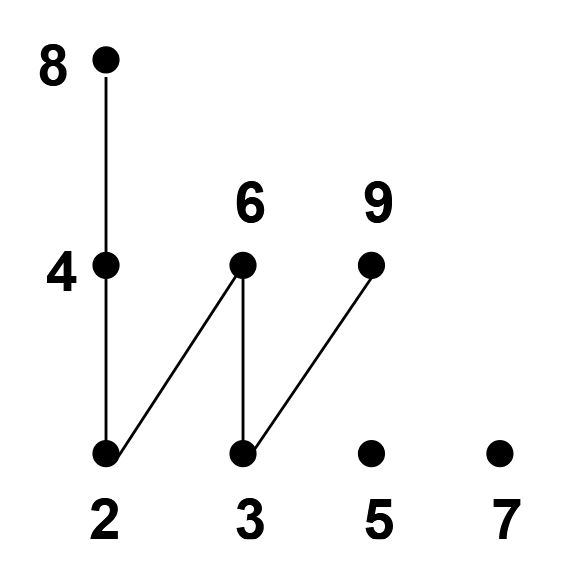
Consider the poset \((\{2, 3, 4, 5, 6, 7, 8, 9\}; |)\).
  • Minimal elements:  \(2, 3, 5, 7\) (primes)
  • Maximal elements:  \(5, 6, 7, 8, 9\)
  • Least or greatest element  There is none (not all elements comparable)

Back

ETH::1._Semester::DiskMat::3._Sets,_Relations,_and_Functions::5._Partial_Order_Relations::4._Special_Elements_in_Posets
Consider the poset \((\{2, 3, 4, 5, 6, 7, 8, 9\}; |)\).
  • Minimal elements:  \(2, 3, 5, 7\) (primes)
  • Maximal elements:  \(5, 6, 7, 8, 9\)
  • Least or greatest element  There is none (not all elements comparable)

After

Front

ETH::1._Semester::DiskMat::3._Sets,_Relations,_and_Functions::5._Partial_Order_Relations::4._Special_Elements_in_Posets
Consider the poset \((\{2, 3, 4, 5, 6, 7, 8, 9\}; |)\).
  • Minimal elements:  \(2, 3, 5, 7\) (primes)
  • Maximal elements:  \(5, 6, 7, 8, 9\)
  • Least or greatest element:  There is none (not all elements comparable)

Back

ETH::1._Semester::DiskMat::3._Sets,_Relations,_and_Functions::5._Partial_Order_Relations::4._Special_Elements_in_Posets
Consider the poset \((\{2, 3, 4, 5, 6, 7, 8, 9\}; |)\).
  • Minimal elements:  \(2, 3, 5, 7\) (primes)
  • Maximal elements:  \(5, 6, 7, 8, 9\)
  • Least or greatest element:  There is none (not all elements comparable)
Field-by-field Comparison
Field Before After
Text Consider the poset \((\{2, 3, 4, 5, 6, 7, 8, 9\}; |)\).<br><ul><li><strong>Minimal elements</strong>: {{c1::&nbsp;\(2, 3, 5, 7\)&nbsp;(primes)}}</li><li><strong>Maximal elements</strong>: {{c2::&nbsp;\(5, 6, 7, 8, 9\)}}</li><li><strong>Least or greatest element</strong>&nbsp;{{c3:: There is none (not all elements comparable)}}</li></ul><div><img src="paste-1d2f8dcd3adedbac7c91aff60842c9ece732a3a8.jpg"></div> Consider the poset \((\{2, 3, 4, 5, 6, 7, 8, 9\}; |)\).<br><ul><li><strong>Minimal elements</strong>: {{c1::&nbsp;\(2, 3, 5, 7\)&nbsp;(primes)}}</li><li><strong>Maximal elements</strong>: {{c2::&nbsp;\(5, 6, 7, 8, 9\)}}</li><li><strong>Least or greatest element:&nbsp;</strong>{{c3:: There is none (not all elements comparable)}}</li></ul><div><img src="paste-1d2f8dcd3adedbac7c91aff60842c9ece732a3a8.jpg"></div>
Tags: ETH::1._Semester::DiskMat::3._Sets,_Relations,_and_Functions::5._Partial_Order_Relations::4._Special_Elements_in_Posets

Note 21: ETH::EProg

Deck: ETH::EProg
Note Type: Horvath Classic
GUID: Bx0~E*k+P5
modified

Before

Front

ETH::1._Semester::EProg::3._Control_Structures::1._Branching
a != 0 && b / a == 3 evaluates to ???

Back

ETH::1._Semester::EProg::3._Control_Structures::1._Branching
a != 0 && b / a == 3 evaluates to ???

Works fine, as if a == 0, then it shortcircuits and results in false

After

Front

ETH::1._Semester::EProg::3._Control_Structures::1._Branching PlsFix::ClozeThatBish
a != 0 && b / a == 3 evaluates to ???

Back

ETH::1._Semester::EProg::3._Control_Structures::1._Branching PlsFix::ClozeThatBish
a != 0 && b / a == 3 evaluates to ???

Works fine, since if a == 0, it shortcircuits and simply returns false.
Field-by-field Comparison
Field Before After
Back Works fine, as if&nbsp;<b>a == 0</b>, then it shortcircuits and results in false Works fine, since if&nbsp;<b>a == 0,&nbsp;</b>it shortcircuits and simply returns false.
Tags: ETH::1._Semester::EProg::3._Control_Structures::1._Branching PlsFix::ClozeThatBish

Note 22: ETH::EProg

Deck: ETH::EProg
Note Type: Horvath Cloze
GUID: gAXH/(0;9S
modified

Before

Front

ETH::1._Semester::EProg::2._First_Java_Programs::1._From_Source_Text_to_Output
Class Cat should be declared in the file Cat.java.

Back

ETH::1._Semester::EProg::2._First_Java_Programs::1._From_Source_Text_to_Output
Class Cat should be declared in the file Cat.java.

but it does not HAVE TO be declared, as long as it is not declared as public.

After

Front

ETH::1._Semester::EProg::2._First_Java_Programs::1._From_Source_Text_to_Output
Class Cat should be declared in the file Cat.java.

Back

ETH::1._Semester::EProg::2._First_Java_Programs::1._From_Source_Text_to_Output
Class Cat should be declared in the file Cat.java.

But it does not HAVE TO be declared there, as long as it is not declared as public.
Field-by-field Comparison
Field Before After
Extra but it does not HAVE TO be declared, as long as it is not declared as public. But it does not HAVE TO be declared there, as long as it is not declared as public.
Tags: ETH::1._Semester::EProg::2._First_Java_Programs::1._From_Source_Text_to_Output

Note 23: ETH::EProg

Deck: ETH::EProg
Note Type: Horvath Cloze
GUID: v]c0VE0GBF
modified

Before

Front

ETH::1._Semester::EProg::2._First_Java_Programs::4._Casting
1 + "" results in "1" in Java.

Back

ETH::1._Semester::EProg::2._First_Java_Programs::4._Casting
1 + "" results in "1" in Java.

+ will cast anything via .toString().

After

Front

ETH::1._Semester::EProg::2._First_Java_Programs::4._Casting
1 + "" results in "1" in Java.

Back

ETH::1._Semester::EProg::2._First_Java_Programs::4._Casting
1 + "" results in "1" in Java.

+ "" will cast anything via .toString().
Field-by-field Comparison
Field Before After
Extra + will cast anything via .toString(). + "" will cast anything via .toString().
Tags: ETH::1._Semester::EProg::2._First_Java_Programs::4._Casting

Note 24: ETH::LinAlg

Deck: ETH::LinAlg
Note Type: Horvath Cloze
GUID: AA?D}V$bUJ
modified

Before

Front

ETH::1._Semester::LinAlg::3._Solving_Linear_Equations::3._Gauss-Jordan_Elimination::4._Standard_Form_and_CR_decomposition
The output of Gauss-Jordan on a matrix \(A\) is unique.

Back

ETH::1._Semester::LinAlg::3._Solving_Linear_Equations::3._Gauss-Jordan_Elimination::4._Standard_Form_and_CR_decomposition
The output of Gauss-Jordan on a matrix \(A\) is unique.

After

Front

ETH::1._Semester::LinAlg::3._Solving_Linear_Equations::3._Gauss-Jordan_Elimination::4._Standard_Form_and_CR_decomposition
The output of Gauss-Jordan on a matrix \(A\) is unique.

Back

ETH::1._Semester::LinAlg::3._Solving_Linear_Equations::3._Gauss-Jordan_Elimination::4._Standard_Form_and_CR_decomposition
The output of Gauss-Jordan on a matrix \(A\) is unique.
Field-by-field Comparison
Field Before After
Text The output of Gauss-Jordan on a matrix&nbsp;\(A\)&nbsp;is {{c1::<b>unique</b>}}. The output of Gauss-Jordan on a matrix&nbsp;\(A\)&nbsp;is {{c1::<b>unique::property?</b>}}.
Tags: ETH::1._Semester::LinAlg::3._Solving_Linear_Equations::3._Gauss-Jordan_Elimination::4._Standard_Form_and_CR_decomposition

Note 25: ETH::LinAlg

Deck: ETH::LinAlg
Note Type: Horvath Cloze
GUID: Ar}c<-r5#~
modified

Before

Front

ETH::1._Semester::LinAlg::6._Applications_of_orthogonality_and_projections::3._Orthonormal_Bases_and_Gram_Schmidt
Orthogonal matrices preserve the norm and inner product of vectors.

Back

ETH::1._Semester::LinAlg::6._Applications_of_orthogonality_and_projections::3._Orthonormal_Bases_and_Gram_Schmidt
Orthogonal matrices preserve the norm and inner product of vectors.

In other words, if \(Q \in \mathbb{R}^{n \times n}\) is orthogonal, then, for all \(x, y \in \mathbb{R}^n\) \[ ||Qx|| = ||x|| \text{ and } (Qx)^\top(Qy) = x^\top y \]

After

Front

ETH::1._Semester::LinAlg::6._Applications_of_orthogonality_and_projections::3._Orthonormal_Bases_and_Gram_Schmidt
Orthogonal matrices preserve the norm and inner product of vectors.

Back

ETH::1._Semester::LinAlg::6._Applications_of_orthogonality_and_projections::3._Orthonormal_Bases_and_Gram_Schmidt
Orthogonal matrices preserve the norm and inner product of vectors.

In other words, if \(Q \in \mathbb{R}^{n \times n}\) is orthogonal, then, for all \(x, y \in \mathbb{R}^n\):

\[ ||Qx|| = ||x|| \text{ and } (Qx)^\top(Qy) = x^\top y \]
Field-by-field Comparison
Field Before After
Extra In other words, if \(Q \in \mathbb{R}^{n \times n}\) is orthogonal, then, for all \(x, y \in \mathbb{R}^n\) \[ ||Qx|| = ||x|| \text{ and } (Qx)^\top(Qy) = x^\top y \]<br> In other words, if \(Q \in \mathbb{R}^{n \times n}\) is orthogonal, then, for all \(x, y \in \mathbb{R}^n\):<br><br>\[ ||Qx|| = ||x|| \text{ and } (Qx)^\top(Qy) = x^\top y \]<br>
Tags: ETH::1._Semester::LinAlg::6._Applications_of_orthogonality_and_projections::3._Orthonormal_Bases_and_Gram_Schmidt

Note 26: ETH::LinAlg

Deck: ETH::LinAlg
Note Type: Horvath Cloze
GUID: E^P>,?epi|
modified

Before

Front

ETH::1._Semester::LinAlg::6._Applications_of_orthogonality_and_projections::3._Orthonormal_Bases_and_Gram_Schmidt
If \(Q\) orthogonal is not square does:
  • \(Q^\top Q = I\) hold? yes
  • \(QQ^\top = I\) hold? no, the identity has holes on the diagonal

Back

ETH::1._Semester::LinAlg::6._Applications_of_orthogonality_and_projections::3._Orthonormal_Bases_and_Gram_Schmidt
If \(Q\) orthogonal is not square does:
  • \(Q^\top Q = I\) hold? yes
  • \(QQ^\top = I\) hold? no, the identity has holes on the diagonal

After

Front

ETH::1._Semester::LinAlg::6._Applications_of_orthogonality_and_projections::3._Orthonormal_Bases_and_Gram_Schmidt
If \(Q\) orthogonal is not square does:
  • \(Q^\top Q = I\) hold? Yes.
  • \(QQ^\top = I\) hold? No, the identity has holes on the diagonal.

Back

ETH::1._Semester::LinAlg::6._Applications_of_orthogonality_and_projections::3._Orthonormal_Bases_and_Gram_Schmidt
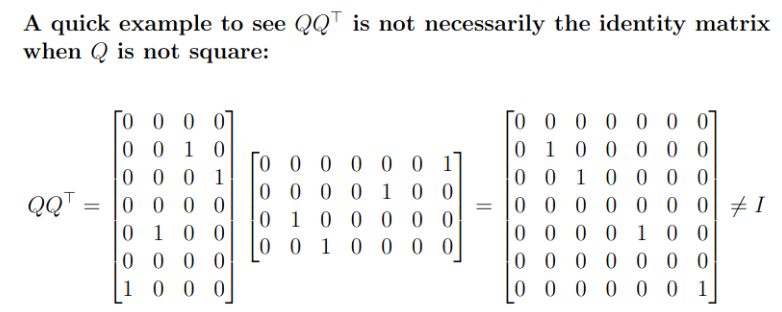
If \(Q\) orthogonal is not square does:
  • \(Q^\top Q = I\) hold? Yes.
  • \(QQ^\top = I\) hold? No, the identity has holes on the diagonal.

Field-by-field Comparison
Field Before After
Text If&nbsp;\(Q\)&nbsp;orthogonal is not square does:<br><ul><li>\(Q^\top Q = I\)&nbsp;hold? {{c1:: yes}}</li><li>\(QQ^\top = I\)&nbsp;hold? {{c2:: no, the identity has holes on the diagonal}}</li></ul> If&nbsp;\(Q\)&nbsp;orthogonal is not square does:<br><ul><li>\(Q^\top Q = I\)&nbsp;hold? {{c1:: Yes.}}</li><li>\(QQ^\top = I\)&nbsp;hold? {{c2:: No, the identity has holes on the diagonal.}}</li></ul>
Tags: ETH::1._Semester::LinAlg::6._Applications_of_orthogonality_and_projections::3._Orthonormal_Bases_and_Gram_Schmidt

Note 27: ETH::LinAlg

Deck: ETH::LinAlg
Note Type: Horvath Cloze
GUID: G1|bG=ffVu
modified

Before

Front

ETH::1._Semester::LinAlg::6._Applications_of_orthogonality_and_projections::3._Orthonormal_Bases_and_Gram_Schmidt
 Let \(Q\) be the \(m \times n\) matrix whose columns are an orthonormal basis of \(A\).

Then the projection matrix that projects to \(C(A)\) is given by  \(QQ^\top\)Proof Included

Back

ETH::1._Semester::LinAlg::6._Applications_of_orthogonality_and_projections::3._Orthonormal_Bases_and_Gram_Schmidt
 Let \(Q\) be the \(m \times n\) matrix whose columns are an orthonormal basis of \(A\).

Then the projection matrix that projects to \(C(A)\) is given by  \(QQ^\top\)Proof Included

\(A^\top A\) simplifies to \(I\) in the case where our \(A\) is orthogonal. Thus \(P = A (A^\top A)^{-1} A^\top\) simplifies to \(P = AA^\top\).

After

Front

ETH::1._Semester::LinAlg::6._Applications_of_orthogonality_and_projections::3._Orthonormal_Bases_and_Gram_Schmidt
Let \(Q\) be the \(m \times n\) matrix whose columns are an orthonormal basis of \(C(A)\).

Then the projection matrix that projects to \(C(A)\) is given by \(QQ^\top\)Proof Included

Back

ETH::1._Semester::LinAlg::6._Applications_of_orthogonality_and_projections::3._Orthonormal_Bases_and_Gram_Schmidt
Let \(Q\) be the \(m \times n\) matrix whose columns are an orthonormal basis of \(C(A)\).

Then the projection matrix that projects to \(C(A)\) is given by \(QQ^\top\)Proof Included

\(A^\top A\) simplifies to \(I\) in the case where our \(A\) is orthogonal. Thus \(P = A (A^\top A)^{-1} A^\top\) simplifies to \(P = AA^\top\).
Field-by-field Comparison
Field Before After
Text <div>&nbsp;Let \(Q\) be the \(m \times n\) matrix whose columns are an orthonormal basis of \(A\).</div><div><br></div><div>Then the projection matrix that projects to \(C(A)\) is given by {{c1::&nbsp;\(QQ^\top\)}}.&nbsp;<i>Proof Included</i></div> <div>Let \(Q\) be the \(m \times n\) matrix whose columns are an orthonormal basis of \(C(A)\).</div><div><br></div><div>Then the projection matrix that projects to \(C(A)\) is given by {{c1::\(QQ^\top\)}}.&nbsp;<i>Proof Included</i></div>
Tags: ETH::1._Semester::LinAlg::6._Applications_of_orthogonality_and_projections::3._Orthonormal_Bases_and_Gram_Schmidt

Note 28: ETH::LinAlg

Deck: ETH::LinAlg
Note Type: Horvath Cloze
GUID: J0-A1[(zwf
modified

Before

Front

ETH::1._Semester::LinAlg::6._Applications_of_orthogonality_and_projections::2._The_Set_of_all_solutions_to_a_system_of_linear_equations
We know that \(\forall x \in \mathbb{R}^n\), there exist \(x_0 \in N(A)\) and \(x_1 \in R(A)\) such that \(x = x_0 + x_1 \) and \(x_1^\top x_0 = 0\) as \(N(A) = C(A^\top)^\perp\) are orthogonal complements.

Back

ETH::1._Semester::LinAlg::6._Applications_of_orthogonality_and_projections::2._The_Set_of_all_solutions_to_a_system_of_linear_equations
We know that \(\forall x \in \mathbb{R}^n\), there exist \(x_0 \in N(A)\) and \(x_1 \in R(A)\) such that \(x = x_0 + x_1 \) and \(x_1^\top x_0 = 0\) as \(N(A) = C(A^\top)^\perp\) are orthogonal complements.

After

Front

ETH::1._Semester::LinAlg::6._Applications_of_orthogonality_and_projections::2._The_Set_of_all_solutions_to_a_system_of_linear_equations
We know that \(\forall x \in \mathbb{R}^n\), there exist \(x_0 \in N(A)\) and \(x_1 \in R(A)\) such that \(x = x_0 + x_1 \) and \(x_1^\top x_0 = 0\) as \(N(A) = C(A^\top)^\perp\) are orthogonal complements.

Back

ETH::1._Semester::LinAlg::6._Applications_of_orthogonality_and_projections::2._The_Set_of_all_solutions_to_a_system_of_linear_equations
We know that \(\forall x \in \mathbb{R}^n\), there exist \(x_0 \in N(A)\) and \(x_1 \in R(A)\) such that \(x = x_0 + x_1 \) and \(x_1^\top x_0 = 0\) as \(N(A) = C(A^\top)^\perp\) are orthogonal complements.
Field-by-field Comparison
Field Before After
Text We know that \(\forall x \in \mathbb{R}^n\), there exist {{c1::\(x_0 \in N(A)\)}} and {{c1::\(x_1 \in R(A)\)}} such that \(x = {{c1:: x_0 + x_1 }}\) and {{c1::\(x_1^\top x_0 = 0\)}} as {{c1::\(N(A) = C(A^\top)^\perp\)&nbsp;are orthogonal complements}}. We know that \(\forall x \in \mathbb{R}^n\), there exist {{c1::\(x_0 \in N(A)\)}} and {{c1::\(x_1 \in R(A)\)}} such that \(x = {{c2:: x_0 + x_1 }}\) and {{c3::\(x_1^\top x_0 = 0\)}} as {{c3::\(N(A) = C(A^\top)^\perp\)&nbsp;are orthogonal complements}}.
Tags: ETH::1._Semester::LinAlg::6._Applications_of_orthogonality_and_projections::2._The_Set_of_all_solutions_to_a_system_of_linear_equations

Note 29: ETH::LinAlg

Deck: ETH::LinAlg
Note Type: Horvath Classic
GUID: Pf1R]`4ql<
modified

Before

Front

ETH::1._Semester::LinAlg::3._Solving_Linear_Equations::3._Gauss-Jordan_Elimination::4._Standard_Form_and_CR_decomposition
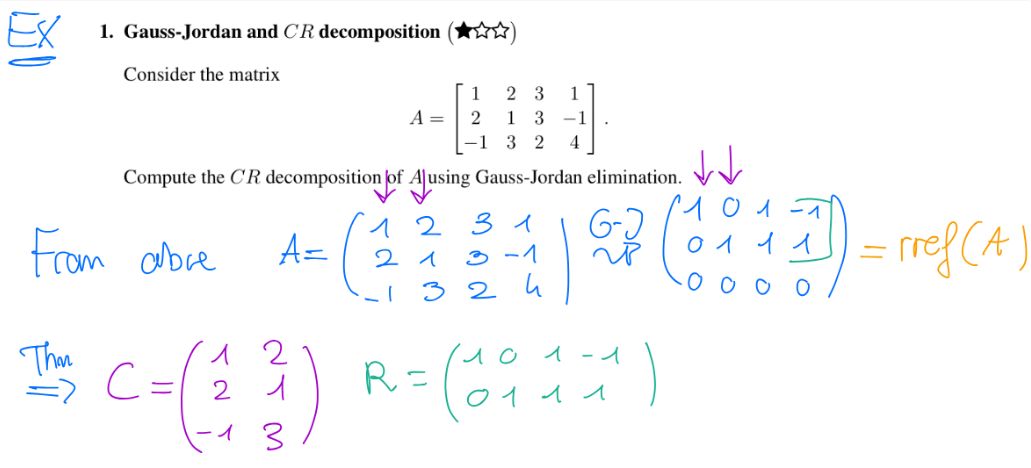
How do we find the CR-Decomposition from RREF

Back

ETH::1._Semester::LinAlg::3._Solving_Linear_Equations::3._Gauss-Jordan_Elimination::4._Standard_Form_and_CR_decomposition
How do we find the CR-Decomposition from RREF

For \(R\) result of RREF on \(A\), \(R\) in \(\text{RREF}(j_1, j_2, \dots, j_r)\) where \(R = \begin{bmatrix} R’ \in r \times n \\ 0 \in (m - r) \times n \end{bmatrix}\).
  1. This \(R’\) is the \(R’\) from the CR decomposition (non-zero rows).
  2. And \(C\) is the submatrix taking only \(j_1, j_2, \dots, j_r\) (independent columns).

After

Front

ETH::1._Semester::LinAlg::3._Solving_Linear_Equations::3._Gauss-Jordan_Elimination::4._Standard_Form_and_CR_decomposition
How can we find the CR-Decomposition from RREF?

Back

ETH::1._Semester::LinAlg::3._Solving_Linear_Equations::3._Gauss-Jordan_Elimination::4._Standard_Form_and_CR_decomposition
How can we find the CR-Decomposition from RREF?

For \(R\) result of RREF on \(A\), \(R\) in \(\text{RREF}(j_1, j_2, \dots, j_r)\) where \(R = \begin{bmatrix} R’ \in r \times n \\ 0 \in (m - r) \times n \end{bmatrix}\).
  1. This \(R’\) is the \(R’\) from the CR decomposition (non-zero rows).
  2. And \(C\) is the submatrix taking only \(j_1, j_2, \dots, j_r\) (independent columns).
Field-by-field Comparison
Field Before After
Front How do we find the CR-Decomposition from RREF How can we find the CR-Decomposition from RREF?
Tags: ETH::1._Semester::LinAlg::3._Solving_Linear_Equations::3._Gauss-Jordan_Elimination::4._Standard_Form_and_CR_decomposition

Note 30: ETH::LinAlg

Deck: ETH::LinAlg
Note Type: Horvath Cloze
GUID: cX#._>C>2&
modified

Before

Front

ETH::1._Semester::LinAlg::6._Applications_of_orthogonality_and_projections::2._The_Set_of_all_solutions_to_a_system_of_linear_equations
Certificate of no solutions:\[ \{x \in \mathbb{R}^n \ | \ Ax = b \} = \emptyset\]is equivalent to 
\[{{c1:: \{z \in \mathbb{R}^m \ | \ A^\top z = 0, b^\top z = 1 \} \not = \emptyset }}\]
Note that we don’t need it to be  \(1\), it just has to be \(\neq 0\).

Back

ETH::1._Semester::LinAlg::6._Applications_of_orthogonality_and_projections::2._The_Set_of_all_solutions_to_a_system_of_linear_equations
Certificate of no solutions:\[ \{x \in \mathbb{R}^n \ | \ Ax = b \} = \emptyset\]is equivalent to 
\[{{c1:: \{z \in \mathbb{R}^m \ | \ A^\top z = 0, b^\top z = 1 \} \not = \emptyset }}\]
Note that we don’t need it to be  \(1\), it just has to be \(\neq 0\).

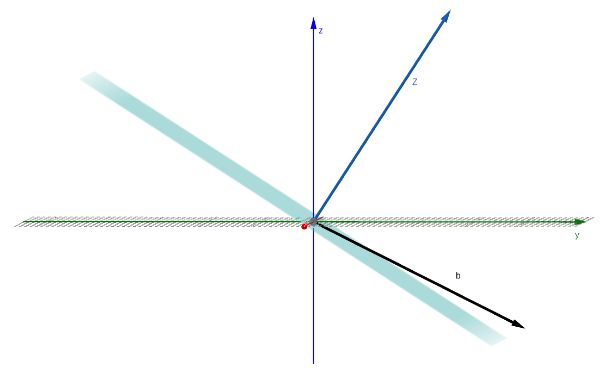
In words: our LSE \(Ax = b\) does not have any solutions if and only if there exists a vector \(z\) that is orthogonal to all columns of \(A\) but not orthogonal to \(b\).


The blue vector \(z\) is orthogonal to all in \(C(A)\), the blue subspace.
If \(b\) is not orthogonal to \(z\), this means that it cannot possibly be in the subspace, it must be slightly above/below it. Therefore \(b \not \in C(A)\) and thus there's no solution.

After

Front

ETH::1._Semester::LinAlg::6._Applications_of_orthogonality_and_projections::2._The_Set_of_all_solutions_to_a_system_of_linear_equations
Certificate of no solutions:\[ \{x \in \mathbb{R}^n \ | \ Ax = b \} = \emptyset\]is equivalent to:

\[{{c1:: \{z \in \mathbb{R}^m \ | \ A^\top z = 0, b^\top z = 1 \} \not = \emptyset }}\]
Note that we don’t need it to be  \(1\), it just has to be \(\neq 0\).

Back

ETH::1._Semester::LinAlg::6._Applications_of_orthogonality_and_projections::2._The_Set_of_all_solutions_to_a_system_of_linear_equations
Certificate of no solutions:\[ \{x \in \mathbb{R}^n \ | \ Ax = b \} = \emptyset\]is equivalent to:

\[{{c1:: \{z \in \mathbb{R}^m \ | \ A^\top z = 0, b^\top z = 1 \} \not = \emptyset }}\]
Note that we don’t need it to be  \(1\), it just has to be \(\neq 0\).

In words: our LSE \(Ax = b\) does not have any solutions if and only if there exists a vector \(z\) that is orthogonal to all columns of \(A\) but not orthogonal to \(b\).


The blue vector \(z\) is orthogonal to all in \(C(A)\), the blue subspace.
If \(b\) is not orthogonal to \(z\), this means that it cannot possibly be in the subspace, it must be slightly above/below it. Therefore \(b \not \in C(A)\) and thus there's no solution.
Field-by-field Comparison
Field Before After
Text <div><b>Certificate</b> of no solutions:\[ \{x \in \mathbb{R}^n \ | \ Ax = b \} = \emptyset\]is&nbsp;<b>equivalent to</b>&nbsp;</div>\[{{c1:: \{z \in \mathbb{R}^m \ | \ A^\top z = 0, b^\top z = 1 \} \not = \emptyset }}\]<div>Note that we don’t need it to be &nbsp;\(1\), it just has to be \(\neq 0\).</div> <div><b>Certificate</b> of no solutions:\[ \{x \in \mathbb{R}^n \ | \ Ax = b \} = \emptyset\]is&nbsp;<b>equivalent to:</b></div><br>\[{{c1:: \{z \in \mathbb{R}^m \ | \ A^\top z = 0, b^\top z = 1 \} \not = \emptyset }}\]<div>Note that we don’t need it to be &nbsp;\(1\), it just has to be \(\neq 0\).</div>
Tags: ETH::1._Semester::LinAlg::6._Applications_of_orthogonality_and_projections::2._The_Set_of_all_solutions_to_a_system_of_linear_equations

Note 31: ETH::LinAlg

Deck: ETH::LinAlg
Note Type: Horvath Cloze
GUID: hA*w;Q$Ce1
modified

Before

Front

ETH::1._Semester::LinAlg::6._Applications_of_orthogonality_and_projections::2._The_Set_of_all_solutions_to_a_system_of_linear_equations
Let \(A \in \mathbb{R}^{m \times n}\). Let \(x, y \in C(A^\top)\). We have that \[ Ax = Ay \Leftrightarrow x = y \]

Back

ETH::1._Semester::LinAlg::6._Applications_of_orthogonality_and_projections::2._The_Set_of_all_solutions_to_a_system_of_linear_equations
Let \(A \in \mathbb{R}^{m \times n}\). Let \(x, y \in C(A^\top)\). We have that \[ Ax = Ay \Leftrightarrow x = y \]

This is because \(x, y\) have unique decompositions into the two fundamental subspaces. \[ Ax = Ay \Leftrightarrow x - y \in N(A) \Leftrightarrow \](this holds as \(\implies A(x - y) = 0\)).\[x^\top(x - y) = 0 = y^\top(x - y) \Leftrightarrow\]because of orthogonality of the subspaces\[ (x - y)^\top(x - y) = 0 \]and from this follows that \(||x - y||^2 = 0 \implies x - y = 0\).

After

Front

ETH::1._Semester::LinAlg::6._Applications_of_orthogonality_and_projections::2._The_Set_of_all_solutions_to_a_system_of_linear_equations
Let \(A \in \mathbb{R}^{m \times n}\) and \(x, y \in C(A^\top)\).

We have: \[ Ax = Ay \Leftrightarrow x = y \]

Back

ETH::1._Semester::LinAlg::6._Applications_of_orthogonality_and_projections::2._The_Set_of_all_solutions_to_a_system_of_linear_equations
Let \(A \in \mathbb{R}^{m \times n}\) and \(x, y \in C(A^\top)\).

We have: \[ Ax = Ay \Leftrightarrow x = y \]

This is because \(x, y\) have unique decompositions into the two fundamental subspaces. \[ Ax = Ay \Leftrightarrow x - y \in N(A) \Leftrightarrow \](this holds as \(\implies A(x - y) = 0\)).

\[x^\top(x - y) = 0 = y^\top(x - y) \Leftrightarrow\]because of orthogonality of the subspaces\[ (x - y)^\top(x - y) = 0 \]and from this follows that \(||x - y||^2 = 0 \implies x - y = 0\).
Field-by-field Comparison
Field Before After
Text Let \(A \in \mathbb{R}^{m \times n}\). Let \(x, y \in C(A^\top)\). We have that \[ {{c1::Ax = Ay}} \Leftrightarrow {{c2:: x = y }}\] Let \(A \in \mathbb{R}^{m \times n}\)&nbsp;and&nbsp;\(x, y \in C(A^\top)\). <br><br>We have:&nbsp;\[ {{c1::Ax = Ay}} \Leftrightarrow {{c2:: x = y }}\]
Extra This is because \(x, y\) have unique decompositions into the two fundamental subspaces. \[ Ax = Ay \Leftrightarrow x - y \in N(A) \Leftrightarrow \](this holds as \(\implies A(x - y) = 0\)).\[x^\top(x - y) = 0 = y^\top(x - y) \Leftrightarrow\]because of orthogonality of the subspaces\[ (x - y)^\top(x - y) = 0 \]and from this follows that \(||x - y||^2 = 0 \implies x - y = 0\). This is because \(x, y\) have unique decompositions into the two fundamental subspaces. \[ Ax = Ay \Leftrightarrow x - y \in N(A) \Leftrightarrow \](this holds as \(\implies A(x - y) = 0\)).<br><br>\[x^\top(x - y) = 0 = y^\top(x - y) \Leftrightarrow\]because of orthogonality of the subspaces\[ (x - y)^\top(x - y) = 0 \]and from this follows that \(||x - y||^2 = 0 \implies x - y = 0\).
Tags: ETH::1._Semester::LinAlg::6._Applications_of_orthogonality_and_projections::2._The_Set_of_all_solutions_to_a_system_of_linear_equations

Note 32: ETH::LinAlg

Deck: ETH::LinAlg
Note Type: Horvath Classic
GUID: kDU~f+!zJB
modified

Before

Front

ETH::1._Semester::LinAlg::6._Applications_of_orthogonality_and_projections::2._The_Set_of_all_solutions_to_a_system_of_linear_equations
Certificate of no solutions:
Given \(P = \{x \in \mathbb{R}^n \mid Ax = b \}\)we have: \(P = \{ x \in \mathbb{R}^3 \ | \ x_1 + 2x_2 - x_3 = 1, 2x_1 + 4x_2 - 2x_3 = 0\}\)

Give the system \(D\) and the answer:

Back

ETH::1._Semester::LinAlg::6._Applications_of_orthogonality_and_projections::2._The_Set_of_all_solutions_to_a_system_of_linear_equations
Certificate of no solutions:
Given \(P = \{x \in \mathbb{R}^n \mid Ax = b \}\)we have: \(P = \{ x \in \mathbb{R}^3 \ | \ x_1 + 2x_2 - x_3 = 1, 2x_1 + 4x_2 - 2x_3 = 0\}\)

Give the system \(D\) and the answer:

The system \(D = \{ z \in \mathbb{R}^m | A^\top z = 0, b^\top z = 1 \}\) is then \[ D = \{ z \in \mathbb{R}^2 \ | \quad \begin{align} \ z_1 + 2z_2 = 0, \\ 2z_1 + 4z_2 = 0, \\ -z_1 - 2z_2 = 0, \\ z_1 = 1 \end{align} \quad \} \]one equation for each column of \(A\).
\(P = \emptyset\) and \(D \neq \emptyset\) because \(z = (1, -\frac{1}{2})^\top \in D\).

After

Front

ETH::1._Semester::LinAlg::6._Applications_of_orthogonality_and_projections::2._The_Set_of_all_solutions_to_a_system_of_linear_equations
Certificate of no solutions:
Given \(P = \{x \in \mathbb{R}^n \mid Ax = b \}\) we have: 

\(P = \left\{ x \in \mathbb{R}^3 \;\middle|\; \begin{aligned} x_1 + 2x_2 - x_3 &= 1 \\ 2x_1 + 4x_2 - 2x_3 &= 0 \end{aligned} \right\}\)

Provide the system \(D\) and the answer.

Back

ETH::1._Semester::LinAlg::6._Applications_of_orthogonality_and_projections::2._The_Set_of_all_solutions_to_a_system_of_linear_equations
Certificate of no solutions:
Given \(P = \{x \in \mathbb{R}^n \mid Ax = b \}\) we have: 

\(P = \left\{ x \in \mathbb{R}^3 \;\middle|\; \begin{aligned} x_1 + 2x_2 - x_3 &= 1 \\ 2x_1 + 4x_2 - 2x_3 &= 0 \end{aligned} \right\}\)

Provide the system \(D\) and the answer.

The system \(D = \{ z \in \mathbb{R}^m | A^\top z = 0, b^\top z = 1 \}\) then is: \[D = \left\{ z \in \mathbb{R}^2 \;\middle|\; \begin{aligned} z_1 + 2z_2 &= 0 \\ 2z_1 + 4z_2 &= 0 \\ -z_1 - 2z_2 &= 0 \\ z_1 &= 1 \end{aligned} \right\}\]One equation per each column of \(A\).
\(P = \emptyset\) and \(D \neq \emptyset\) because \(z = (1, -\frac{1}{2})^\top \in D\).
Field-by-field Comparison
Field Before After
Front <b>Certificate</b>&nbsp;of no solutions:<br>Given&nbsp;\(P = \{x \in \mathbb{R}^n \mid Ax = b \}\)we have:&nbsp;\(P = \{ x \in \mathbb{R}^3 \ | \ x_1 + 2x_2 - x_3 = 1, 2x_1 + 4x_2 - 2x_3 = 0\}\)<br><br>Give the system&nbsp;\(D\)&nbsp;and the answer: <b>Certificate</b>&nbsp;of no solutions:<br>Given&nbsp;\(P = \{x \in \mathbb{R}^n \mid Ax = b \}\)&nbsp;we have:&nbsp;<br><br>\(P = \left\{ x \in \mathbb{R}^3 \;\middle|\; \begin{aligned} x_1 + 2x_2 - x_3 &amp;= 1 \\ 2x_1 + 4x_2 - 2x_3 &amp;= 0 \end{aligned} \right\}\)<br><br>Provide the system&nbsp;\(D\)&nbsp;and the answer.
Back The system&nbsp;\(D = \{ z \in \mathbb{R}^m | A^\top z = 0, b^\top z = 1 \}\)&nbsp;is then&nbsp;\[ D = \{ z \in \mathbb{R}^2 \ | \quad \begin{align} \ z_1 + 2z_2 = 0, \\ 2z_1 + 4z_2 = 0, \\ -z_1 - 2z_2 = 0, \\ z_1 = 1 \end{align} \quad \} \]one equation for each column of&nbsp;\(A\).<br>\(P = \emptyset\)&nbsp;and&nbsp;\(D \neq \emptyset\)&nbsp;because&nbsp;\(z = (1, -\frac{1}{2})^\top \in D\). The system&nbsp;\(D = \{ z \in \mathbb{R}^m | A^\top z = 0, b^\top z = 1 \}\)&nbsp;then is:&nbsp;\[D = \left\{ z \in \mathbb{R}^2 \;\middle|\; \begin{aligned} z_1 + 2z_2 &amp;= 0 \\ 2z_1 + 4z_2 &amp;= 0 \\ -z_1 - 2z_2 &amp;= 0 \\ z_1 &amp;= 1 \end{aligned} \right\}\]One equation per each column of&nbsp;\(A\).<br>\(P = \emptyset\)&nbsp;and&nbsp;\(D \neq \emptyset\)&nbsp;because&nbsp;\(z = (1, -\frac{1}{2})^\top \in D\).
Tags: ETH::1._Semester::LinAlg::6._Applications_of_orthogonality_and_projections::2._The_Set_of_all_solutions_to_a_system_of_linear_equations

Note 33: ETH::LinAlg

Deck: ETH::LinAlg
Note Type: Horvath Cloze
GUID: mdTBSy$[M4
modified

Before

Front

ETH::1._Semester::LinAlg::6._Applications_of_orthogonality_and_projections::3._Orthonormal_Bases_and_Gram_Schmidt
Vectors \(q_1, \dots, q_n \in \mathbb{R}^m\) are orthonormal if they are orthogonal and have norm \(1\).In other words, for all \(i, j \in \{1, \dots, n\}\) \[ q_i^\top q_j = {{c1::\delta_{ij} }}\]

Back

ETH::1._Semester::LinAlg::6._Applications_of_orthogonality_and_projections::3._Orthonormal_Bases_and_Gram_Schmidt
Vectors \(q_1, \dots, q_n \in \mathbb{R}^m\) are orthonormal if they are orthogonal and have norm \(1\).In other words, for all \(i, j \in \{1, \dots, n\}\) \[ q_i^\top q_j = {{c1::\delta_{ij} }}\]

After

Front

ETH::1._Semester::LinAlg::6._Applications_of_orthogonality_and_projections::3._Orthonormal_Bases_and_Gram_Schmidt
Vectors \(q_1, \dots, q_n \in \mathbb{R}^m\) are orthonormal if they are orthogonal and have norm \(1\).

In other words, for all \(i, j \in \{1, \dots, n\}\): \[ q_i^\top q_j = {{c1::\delta_{ij} }}\]

Back

ETH::1._Semester::LinAlg::6._Applications_of_orthogonality_and_projections::3._Orthonormal_Bases_and_Gram_Schmidt
Vectors \(q_1, \dots, q_n \in \mathbb{R}^m\) are orthonormal if they are orthogonal and have norm \(1\).

In other words, for all \(i, j \in \{1, \dots, n\}\): \[ q_i^\top q_j = {{c1::\delta_{ij} }}\]
Field-by-field Comparison
Field Before After
Text Vectors \(q_1, \dots, q_n \in \mathbb{R}^m\) are orthonormal if {{c1::they are orthogonal and have norm \(1\)}}.In other words, for all \(i, j \in \{1, \dots, n\}\) \[ q_i^\top q_j = {{c1::\delta_{ij} }}\] Vectors \(q_1, \dots, q_n \in \mathbb{R}^m\) are orthonormal if {{c1::they are orthogonal and have norm \(1\)}}. <br><br>In other words, for all \(i, j \in \{1, \dots, n\}\): \[ q_i^\top q_j = {{c1::\delta_{ij} }}\]
Tags: ETH::1._Semester::LinAlg::6._Applications_of_orthogonality_and_projections::3._Orthonormal_Bases_and_Gram_Schmidt

Note 34: ETH::LinAlg

Deck: ETH::LinAlg
Note Type: Horvath Cloze
GUID: nte!7ERw=M
modified

Before

Front

ETH::1._Semester::LinAlg::6._Applications_of_orthogonality_and_projections::3._Orthonormal_Bases_and_Gram_Schmidt
Gram Schmidt Algorithm:
  1. {{c2::Normalise \(a_1\) to get \(q_1 = \frac{a_1}{||a_1||}\)}}.
  2. For \(k = 2, \dots, n\) set {{c1:: \[\begin{align*} q'_k =& a_k - \sum_{i = 1}^{k - 1} (a_k^\top q_i)q_i \\ q_k =& \frac{q_k'}{||q'_k} \end{align*}\]}}

Back

ETH::1._Semester::LinAlg::6._Applications_of_orthogonality_and_projections::3._Orthonormal_Bases_and_Gram_Schmidt
Gram Schmidt Algorithm:
  1. {{c2::Normalise \(a_1\) to get \(q_1 = \frac{a_1}{||a_1||}\)}}.
  2. For \(k = 2, \dots, n\) set {{c1:: \[\begin{align*} q'_k =& a_k - \sum_{i = 1}^{k - 1} (a_k^\top q_i)q_i \\ q_k =& \frac{q_k'}{||q'_k} \end{align*}\]}}

After

Front

ETH::1._Semester::LinAlg::6._Applications_of_orthogonality_and_projections::3._Orthonormal_Bases_and_Gram_Schmidt
Gram-Schmidt Algorithm:
  1. {{c2::Normalise \(a_1\) to get \(q_1 = \frac{a_1}{||a_1||}\)}}.
  2. For \(k = 2, \dots, n\) set {{c1:: \[\begin{align*} q'_k =& a_k - \sum_{i = 1}^{k - 1} (a_k^\top q_i)q_i \\ q_k =& \frac{q_k'}{||q'_k} \end{align*}\]}}

Back

ETH::1._Semester::LinAlg::6._Applications_of_orthogonality_and_projections::3._Orthonormal_Bases_and_Gram_Schmidt
Gram-Schmidt Algorithm:
  1. {{c2::Normalise \(a_1\) to get \(q_1 = \frac{a_1}{||a_1||}\)}}.
  2. For \(k = 2, \dots, n\) set {{c1:: \[\begin{align*} q'_k =& a_k - \sum_{i = 1}^{k - 1} (a_k^\top q_i)q_i \\ q_k =& \frac{q_k'}{||q'_k} \end{align*}\]}}
Field-by-field Comparison
Field Before After
Text Gram Schmidt Algorithm:<br><ol><li>{{c2::Normalise \(a_1\) to get \(q_1 = \frac{a_1}{||a_1||}\)}}.</li><li>For \(k = 2, \dots, n\) set {{c1::&nbsp;\[\begin{align*} q'_k =&amp; a_k - \sum_{i = 1}^{k - 1} (a_k^\top q_i)q_i \\ q_k =&amp; \frac{q_k'}{||q'_k} \end{align*}\]}}</li></ol> Gram-Schmidt Algorithm:<br><ol><li>{{c2::Normalise \(a_1\) to get \(q_1 = \frac{a_1}{||a_1||}\)}}.</li><li>For \(k = 2, \dots, n\) set {{c1::&nbsp;\[\begin{align*} q'_k =&amp; a_k - \sum_{i = 1}^{k - 1} (a_k^\top q_i)q_i \\ q_k =&amp; \frac{q_k'}{||q'_k} \end{align*}\]}}</li></ol>
Tags: ETH::1._Semester::LinAlg::6._Applications_of_orthogonality_and_projections::3._Orthonormal_Bases_and_Gram_Schmidt

Note 35: ETH::LinAlg

Deck: ETH::LinAlg
Note Type: Horvath Cloze
GUID: pskZUSUMW=
modified

Before

Front

ETH::1._Semester::LinAlg::6._Applications_of_orthogonality_and_projections::2._The_Set_of_all_solutions_to_a_system_of_linear_equations
Applications of the Certificate of no solutions:

Assume \(A \in \mathbb{R}^{m \times n}\) has linearly independent rows.
Since the rows are linearly independent, the only solution to \(z^\top A = 0\) is  \(z = 0\). Hence \(z^\top b = 0 \neq 1\).

Thus there is always a solution for the \(P\).

Back

ETH::1._Semester::LinAlg::6._Applications_of_orthogonality_and_projections::2._The_Set_of_all_solutions_to_a_system_of_linear_equations
Applications of the Certificate of no solutions:

Assume \(A \in \mathbb{R}^{m \times n}\) has linearly independent rows.
Since the rows are linearly independent, the only solution to \(z^\top A = 0\) is  \(z = 0\). Hence \(z^\top b = 0 \neq 1\).

Thus there is always a solution for the \(P\).

After

Front

ETH::1._Semester::LinAlg::6._Applications_of_orthogonality_and_projections::2._The_Set_of_all_solutions_to_a_system_of_linear_equations
Applications of the Certificate of no solutions:

Assume \(A \in \mathbb{R}^{m \times n}\) has linearly independent rows.

Since the rows are linearly independent, the only solution to \(z^\top A = 0\) is \(z = 0\). Hence \(z^\top b = 0 \neq 1\).

Thus \(P\) always contains a solution.

Back

ETH::1._Semester::LinAlg::6._Applications_of_orthogonality_and_projections::2._The_Set_of_all_solutions_to_a_system_of_linear_equations
Applications of the Certificate of no solutions:

Assume \(A \in \mathbb{R}^{m \times n}\) has linearly independent rows.

Since the rows are linearly independent, the only solution to \(z^\top A = 0\) is \(z = 0\). Hence \(z^\top b = 0 \neq 1\).

Thus \(P\) always contains a solution.
Field-by-field Comparison
Field Before After
Text Applications of the Certificate of no solutions:<br><br>Assume&nbsp;\(A \in \mathbb{R}^{m \times n}\) has <b>linearly independent rows</b>.<br>Since {{c1::the rows are linearly independent}}, the only solution to \(z^\top A = 0\) is {{c1::&nbsp;\(z = 0\)}}. Hence {{c1::\(z^\top b = 0 \neq 1\)}}.<br><br>Thus {{c1::there is always a solution for the \(P\)}}. Applications of the Certificate of no solutions:<br><br>Assume&nbsp;\(A \in \mathbb{R}^{m \times n}\) has <b>linearly independent rows</b>.<br><br>Since {{c1::the rows are linearly independent}}, the only solution to \(z^\top A = 0\) is {{c2::\(z = 0\)}}. Hence {{c2::\(z^\top b = 0 \neq 1\)}}.<br><br>Thus {{c3::\(P\)&nbsp;always contains a solution}}.
Tags: ETH::1._Semester::LinAlg::6._Applications_of_orthogonality_and_projections::2._The_Set_of_all_solutions_to_a_system_of_linear_equations

Note 36: ETH::LinAlg

Deck: ETH::LinAlg
Note Type: Horvath Classic
GUID: zXO6NKX&n3
modified

Before

Front

ETH::1._Semester::LinAlg::4._The_Three_Fundamental_Subspaces::3._Computing_the_three_fundamental_subspaces::2._Row_Space
Proof that the row space of \(A\) and \(MA\) is the same for \(M\) invertible:

Back

ETH::1._Semester::LinAlg::4._The_Three_Fundamental_Subspaces::3._Computing_the_three_fundamental_subspaces::2._Row_Space
Proof that the row space of \(A\) and \(MA\) is the same for \(M\) invertible:

\(\textbf{R}(A) = \textbf{C}(A^\top) \overset{!}{=} \textbf{C}(A^\top M^\top) = \textbf{C}((MA)^\top) = \textbf{R}(MA)\)

where ! holds because:

After

Front

ETH::1._Semester::LinAlg::4._The_Three_Fundamental_Subspaces::3._Computing_the_three_fundamental_subspaces::2._Row_Space
Prove that the row space of \(A\) and \(MA\) is the same for \(M\) invertible!

Back

ETH::1._Semester::LinAlg::4._The_Three_Fundamental_Subspaces::3._Computing_the_three_fundamental_subspaces::2._Row_Space
Prove that the row space of \(A\) and \(MA\) is the same for \(M\) invertible!

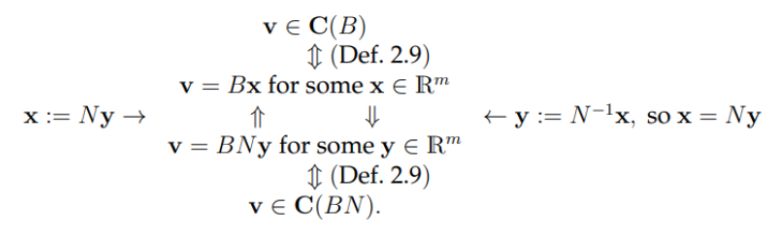
\(\textbf{R}(A) = \textbf{C}(A^\top) \overset{!}{=} \textbf{C}(A^\top M^\top) = \textbf{C}((MA)^\top) = \textbf{R}(MA)\)

where ! holds because:
Field-by-field Comparison
Field Before After
Front Proof that the row space of&nbsp;\(A\)&nbsp;and&nbsp;\(MA\)&nbsp;is the same for&nbsp;\(M\)&nbsp;invertible: Prove that the row space of&nbsp;\(A\)&nbsp;and&nbsp;\(MA\)&nbsp;is the same for&nbsp;\(M\)&nbsp;invertible!
Tags: ETH::1._Semester::LinAlg::4._The_Three_Fundamental_Subspaces::3._Computing_the_three_fundamental_subspaces::2._Row_Space
↑ Top