Note 1: ETH::1. Semester::A&D
Deck: ETH::1. Semester::A&DNote Type: Horvath OcclusioGUID: EE{ugGOkjL
modified
Before
Front
ETH::1._Semester::A&D::09._Graph_Search::1._Depth_First_Search
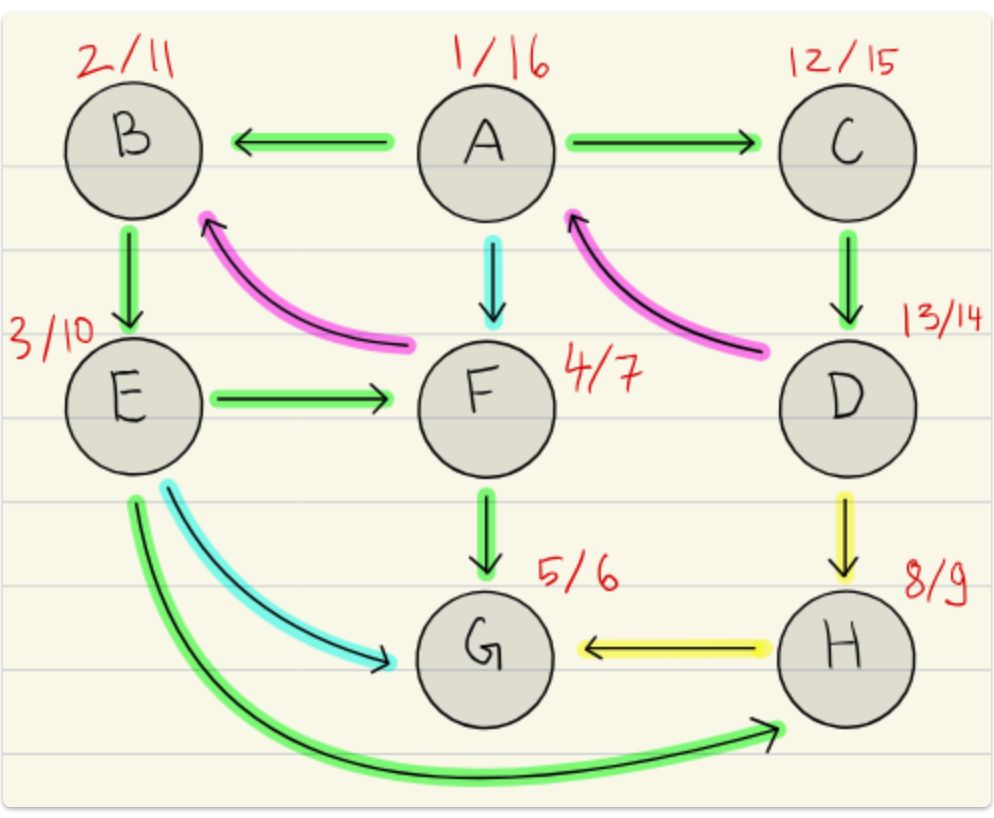
Back-, forward- or cross-edge?
image-occlusion:rect:left=.5722:top=.7727:width=.2045:height=.0564:oi=1 image-occlusion:text:left=.2943:top=.1886:angle=993:text=B←F:scale=.7864:fs=.1133:oi=1 image-occlusion:text:left=.6445:top=.7008:text=G←H:scale=.5385:fs=.1133:oi=1 image-occlusion:text:left=.2618:top=.5681:angle=989:text=E→G:scale=.6858:fs=.1133:oi=1 image-occlusion:polygon:left=.1879:top=.2465:points=.1883,.2528 .2183,.2471 .2906,.3622 .4248,.4067 .4267,.4432 .3206,.4409 .2165,.3417:oi=1 image-occlusion:polygon:left=.1513:top=.5749:points=.1517,.5846 .177,.5755 .2653,.7123 .4032,.791 .4023,.8377 .3,.8161 .1968,.7169:oi=1
Back
ETH::1._Semester::A&D::09._Graph_Search::1._Depth_First_Search
Back-, forward- or cross-edge?
image-occlusion:rect:left=.5722:top=.7727:width=.2045:height=.0564:oi=1 image-occlusion:text:left=.2943:top=.1886:angle=993:text=B←F:scale=.7864:fs=.1133:oi=1 image-occlusion:text:left=.6445:top=.7008:text=G←H:scale=.5385:fs=.1133:oi=1 image-occlusion:text:left=.2618:top=.5681:angle=989:text=E→G:scale=.6858:fs=.1133:oi=1 image-occlusion:polygon:left=.1879:top=.2465:points=.1883,.2528 .2183,.2471 .2906,.3622 .4248,.4067 .4267,.4432 .3206,.4409 .2165,.3417:oi=1 image-occlusion:polygon:left=.1513:top=.5749:points=.1517,.5846 .177,.5755 .2653,.7123 .4032,.791 .4023,.8377 .3,.8161 .1968,.7169:oi=1
Magenta: Back
Toggle Masks
After
Front
ETH::1._Semester::A&D::09._Graph_Search::1._Depth_First_Search
Back-, forward- or cross-edge?
image-occlusion:rect:left=.5722:top=.7727:width=.2045:height=.0564:oi=1 image-occlusion:text:left=.2943:top=.1886:angle=993:text=B←F:scale=.7864:fs=.1133:oi=1 image-occlusion:text:left=.6445:top=.7008:text=G←H:scale=.5385:fs=.1133:oi=1 image-occlusion:text:left=.2618:top=.5681:angle=989:text=E→G:scale=.6858:fs=.1133:oi=1 image-occlusion:polygon:left=.1879:top=.2465:points=.1883,.2528 .2183,.2471 .2906,.3622 .4248,.4067 .4267,.4432 .3206,.4409 .2165,.3417:oi=1 image-occlusion:polygon:left=.1513:top=.5749:points=.1517,.5846 .177,.5755 .2653,.7123 .4032,.791 .4023,.8377 .3,.8161 .1968,.7169:oi=1
Back
ETH::1._Semester::A&D::09._Graph_Search::1._Depth_First_Search
Back-, forward- or cross-edge?
image-occlusion:rect:left=.5722:top=.7727:width=.2045:height=.0564:oi=1 image-occlusion:text:left=.2943:top=.1886:angle=993:text=B←F:scale=.7864:fs=.1133:oi=1 image-occlusion:text:left=.6445:top=.7008:text=G←H:scale=.5385:fs=.1133:oi=1 image-occlusion:text:left=.2618:top=.5681:angle=989:text=E→G:scale=.6858:fs=.1133:oi=1 image-occlusion:polygon:left=.1879:top=.2465:points=.1883,.2528 .2183,.2471 .2906,.3622 .4248,.4067 .4267,.4432 .3206,.4409 .2165,.3417:oi=1 image-occlusion:polygon:left=.1513:top=.5749:points=.1517,.5846 .177,.5755 .2653,.7123 .4032,.791 .4023,.8377 .3,.8161 .1968,.7169:oi=1
Magenta: Back
Toggle Masks
Tags:
ETH::1._Semester::A&D::09._Graph_Search::1._Depth_First_Search
Note 2: ETH::1. Semester::A&D
Deck: ETH::1. Semester::A&DNote Type: Horvath OcclusioGUID: GKG~Tp?e4l
modified
Before
Front
ETH::1._Semester::A&D::05._Data_Structures::1._ADT_List
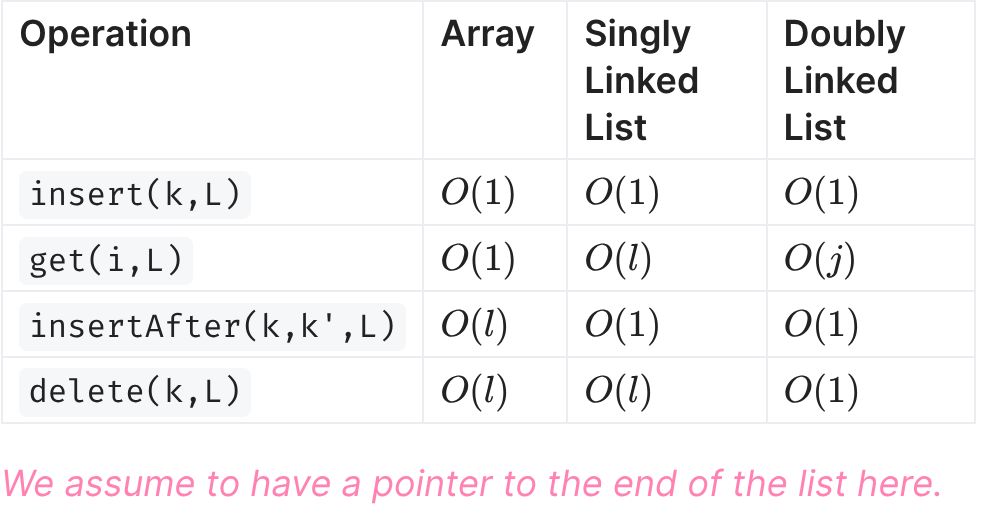
Note that the key parameter of insertAfter and delete in lists refers to the actual node, not it's value.
image-occlusion:rect:left=.592:top=.4403:width=.0786:height=.0963:oi=1 image-occlusion:rect:left=.5847:top=.571:width=.0859:height=.0963:oi=1 image-occlusion:rect:left=.444:top=.6983:width=.0786:height=.0963:oi=1 image-occlusion:rect:left=.7912:top=.313:width=.0859:height=.1101:oi=1 image-occlusion:rect:left=.5884:top=.313:width=.0822:height=.1032:oi=1 image-occlusion:rect:left=.4404:top=.5641:width=.0932:height=.1032:oi=1 image-occlusion:rect:left=.7912:top=.5779:width=.0859:height=.0894:oi=1 image-occlusion:rect:left=.4367:top=.3061:width=.0895:height=.117:oi=1 image-occlusion:rect:left=.4367:top=.4472:width=.0895:height=.0963:oi=1 image-occlusion:rect:left=.7839:top=.6983:width=.0968:height=.0963:oi=1 image-occlusion:rect:left=.5879:top=.6944:width=.0749:height=.1042:oi=1 image-occlusion:rect:left=.7912:top=.4403:width=.0822:height=.1101:oi=1
Back
ETH::1._Semester::A&D::05._Data_Structures::1._ADT_List
Note that the key parameter of insertAfter and delete in lists refers to the actual node, not it's value.
image-occlusion:rect:left=.592:top=.4403:width=.0786:height=.0963:oi=1 image-occlusion:rect:left=.5847:top=.571:width=.0859:height=.0963:oi=1 image-occlusion:rect:left=.444:top=.6983:width=.0786:height=.0963:oi=1 image-occlusion:rect:left=.7912:top=.313:width=.0859:height=.1101:oi=1 image-occlusion:rect:left=.5884:top=.313:width=.0822:height=.1032:oi=1 image-occlusion:rect:left=.4404:top=.5641:width=.0932:height=.1032:oi=1 image-occlusion:rect:left=.7912:top=.5779:width=.0859:height=.0894:oi=1 image-occlusion:rect:left=.4367:top=.3061:width=.0895:height=.117:oi=1 image-occlusion:rect:left=.4367:top=.4472:width=.0895:height=.0963:oi=1 image-occlusion:rect:left=.7839:top=.6983:width=.0968:height=.0963:oi=1 image-occlusion:rect:left=.5879:top=.6944:width=.0749:height=.1042:oi=1 image-occlusion:rect:left=.7912:top=.4403:width=.0822:height=.1101:oi=1
Toggle Masks
After
Front
ETH::1._Semester::A&D::05._Data_Structures::1._ADT_List
Note that the key parameter of insertAfter and delete in lists refers to the actual node, not it's value.
image-occlusion:rect:left=.592:top=.4403:width=.0786:height=.0963:oi=1 image-occlusion:rect:left=.5847:top=.571:width=.0859:height=.0963:oi=1 image-occlusion:rect:left=.444:top=.6983:width=.0786:height=.0963:oi=1 image-occlusion:rect:left=.7912:top=.313:width=.0859:height=.1101:oi=1 image-occlusion:rect:left=.5884:top=.313:width=.0822:height=.1032:oi=1 image-occlusion:rect:left=.4404:top=.5641:width=.0932:height=.1032:oi=1 image-occlusion:rect:left=.7912:top=.5779:width=.0859:height=.0894:oi=1 image-occlusion:rect:left=.4367:top=.3061:width=.0895:height=.117:oi=1 image-occlusion:rect:left=.4367:top=.4472:width=.0895:height=.0963:oi=1 image-occlusion:rect:left=.7839:top=.6983:width=.0968:height=.0963:oi=1 image-occlusion:rect:left=.5879:top=.6944:width=.0749:height=.1042:oi=1 image-occlusion:rect:left=.7912:top=.4403:width=.0822:height=.1101:oi=1
Back
ETH::1._Semester::A&D::05._Data_Structures::1._ADT_List
Note that the key parameter of insertAfter and delete in lists refers to the actual node, not it's value.
image-occlusion:rect:left=.592:top=.4403:width=.0786:height=.0963:oi=1 image-occlusion:rect:left=.5847:top=.571:width=.0859:height=.0963:oi=1 image-occlusion:rect:left=.444:top=.6983:width=.0786:height=.0963:oi=1 image-occlusion:rect:left=.7912:top=.313:width=.0859:height=.1101:oi=1 image-occlusion:rect:left=.5884:top=.313:width=.0822:height=.1032:oi=1 image-occlusion:rect:left=.4404:top=.5641:width=.0932:height=.1032:oi=1 image-occlusion:rect:left=.7912:top=.5779:width=.0859:height=.0894:oi=1 image-occlusion:rect:left=.4367:top=.3061:width=.0895:height=.117:oi=1 image-occlusion:rect:left=.4367:top=.4472:width=.0895:height=.0963:oi=1 image-occlusion:rect:left=.7839:top=.6983:width=.0968:height=.0963:oi=1 image-occlusion:rect:left=.5879:top=.6944:width=.0749:height=.1042:oi=1 image-occlusion:rect:left=.7912:top=.4403:width=.0822:height=.1101:oi=1
Toggle Masks
Tags:
ETH::1._Semester::A&D::05._Data_Structures::1._ADT_List
Note 3: ETH::1. Semester::A&D
Deck: ETH::1. Semester::A&DNote Type: Horvath OcclusioGUID: KoR^|Dl^:[
modified
Before
Front
ETH::1._Semester::A&D::02._Asymptotic_Notation::3._O-Notation
image-occlusion:rect:left=.0993:top=.1668:width=.1045:height=.5974 image-occlusion:rect:left=.2342:top=.1117:width=.0565:height=.6158 image-occlusion:rect:left=.3241:top=.1209:width=.1087:height=.625 image-occlusion:rect:left=.4651:top=.0933:width=.1252:height=.6709 image-occlusion:rect:left=.6206:top=.0933:width=.0687:height=.6618 image-occlusion:rect:left=.7196:top=.1393:width=.0656:height=.6158 image-occlusion:rect:left=.8101:top=.1393:width=.068:height=.579 image-occlusion:rect:left=.908:top=.1393:width=.0711:height=.5515
Back
ETH::1._Semester::A&D::02._Asymptotic_Notation::3._O-Notation
image-occlusion:rect:left=.0993:top=.1668:width=.1045:height=.5974 image-occlusion:rect:left=.2342:top=.1117:width=.0565:height=.6158 image-occlusion:rect:left=.3241:top=.1209:width=.1087:height=.625 image-occlusion:rect:left=.4651:top=.0933:width=.1252:height=.6709 image-occlusion:rect:left=.6206:top=.0933:width=.0687:height=.6618 image-occlusion:rect:left=.7196:top=.1393:width=.0656:height=.6158 image-occlusion:rect:left=.8101:top=.1393:width=.068:height=.579 image-occlusion:rect:left=.908:top=.1393:width=.0711:height=.5515
Toggle Masks
After
Front
ETH::1._Semester::A&D::02._Asymptotic_Notation::3._O-Notation
image-occlusion:rect:left=.0993:top=.1668:width=.1045:height=.5974 image-occlusion:rect:left=.2342:top=.1117:width=.0565:height=.6158 image-occlusion:rect:left=.3241:top=.1209:width=.1087:height=.625 image-occlusion:rect:left=.4651:top=.0933:width=.1252:height=.6709 image-occlusion:rect:left=.6206:top=.0933:width=.0687:height=.6618 image-occlusion:rect:left=.7196:top=.1393:width=.0656:height=.6158 image-occlusion:rect:left=.8101:top=.1393:width=.068:height=.579 image-occlusion:rect:left=.908:top=.1393:width=.0711:height=.5515
Back
ETH::1._Semester::A&D::02._Asymptotic_Notation::3._O-Notation
image-occlusion:rect:left=.0993:top=.1668:width=.1045:height=.5974 image-occlusion:rect:left=.2342:top=.1117:width=.0565:height=.6158 image-occlusion:rect:left=.3241:top=.1209:width=.1087:height=.625 image-occlusion:rect:left=.4651:top=.0933:width=.1252:height=.6709 image-occlusion:rect:left=.6206:top=.0933:width=.0687:height=.6618 image-occlusion:rect:left=.7196:top=.1393:width=.0656:height=.6158 image-occlusion:rect:left=.8101:top=.1393:width=.068:height=.579 image-occlusion:rect:left=.908:top=.1393:width=.0711:height=.5515
Toggle Masks
Tags:
ETH::1._Semester::A&D::02._Asymptotic_Notation::3._O-Notation
Note 4: ETH::1. Semester::A&D
Deck: ETH::1. Semester::A&DNote Type: Horvath OcclusioGUID: QGU[QMk!u8
modified
Before
Front
ETH::1._Semester::A&D::03._Searching_Algorithms
image-occlusion:rect:left=.264:top=.1517:width=.4676:height=.1291:oi=1 image-occlusion:rect:left=.264:top=.3156:width=.4709:height=.1018:oi=1 image-occlusion:rect:left=.264:top=.4472:width=.472:height=.1043:oi=1 image-occlusion:rect:left=.2662:top=.5764:width=.5576:height=.1067:oi=1 image-occlusion:rect:left=.2662:top=.713:width=.4577:height=.1042:oi=1 image-occlusion:rect:left=.2695:top=.8446:width=.5401:height=.1018:oi=1
Back
ETH::1._Semester::A&D::03._Searching_Algorithms
image-occlusion:rect:left=.264:top=.1517:width=.4676:height=.1291:oi=1 image-occlusion:rect:left=.264:top=.3156:width=.4709:height=.1018:oi=1 image-occlusion:rect:left=.264:top=.4472:width=.472:height=.1043:oi=1 image-occlusion:rect:left=.2662:top=.5764:width=.5576:height=.1067:oi=1 image-occlusion:rect:left=.2662:top=.713:width=.4577:height=.1042:oi=1 image-occlusion:rect:left=.2695:top=.8446:width=.5401:height=.1018:oi=1
Toggle Masks
After
Front
ETH::1._Semester::A&D::03._Searching_Algorithms
image-occlusion:rect:left=.264:top=.1517:width=.4676:height=.1291:oi=1 image-occlusion:rect:left=.264:top=.3156:width=.4709:height=.1018:oi=1 image-occlusion:rect:left=.264:top=.4472:width=.472:height=.1043:oi=1 image-occlusion:rect:left=.2662:top=.5764:width=.5576:height=.1067:oi=1 image-occlusion:rect:left=.2662:top=.713:width=.4577:height=.1042:oi=1 image-occlusion:rect:left=.2695:top=.8446:width=.5401:height=.1018:oi=1
Back
ETH::1._Semester::A&D::03._Searching_Algorithms
image-occlusion:rect:left=.264:top=.1517:width=.4676:height=.1291:oi=1 image-occlusion:rect:left=.264:top=.3156:width=.4709:height=.1018:oi=1 image-occlusion:rect:left=.264:top=.4472:width=.472:height=.1043:oi=1 image-occlusion:rect:left=.2662:top=.5764:width=.5576:height=.1067:oi=1 image-occlusion:rect:left=.2662:top=.713:width=.4577:height=.1042:oi=1 image-occlusion:rect:left=.2695:top=.8446:width=.5401:height=.1018:oi=1
Toggle Masks
Tags:
ETH::1._Semester::A&D::03._Searching_Algorithms
Note 5: ETH::1. Semester::DiskMat
Deck: ETH::1. Semester::DiskMatNote Type: Horvath ClozeGUID: d7Vy2Qw5Hn
modified
Before
Front
ETH::1._Semester::DiskMat::6._Logic::2._Proof_Systems::3._Discussion
A proof system is always restricted to a certain type of mathematical statement .
Back
ETH::1._Semester::DiskMat::6._Logic::2._Proof_Systems::3._Discussion
A proof system is always restricted to a certain type of mathematical statement .
There is no universal proof system.
After
Front
ETH::1._Semester::DiskMat::6._Logic::2._Proof_Systems::3._Discussion
A proof system is always restricted to a certain type of mathematical statement .
Back
ETH::1._Semester::DiskMat::6._Logic::2._Proof_Systems::3._Discussion
A proof system is always restricted to a certain type of mathematical statement .
Field-by-field Comparison
Field
Before
After
Extra There is no universal proof system.
Tags:
ETH::1._Semester::DiskMat::6._Logic::2._Proof_Systems::3._Discussion
Note 6: ETH::1. Semester::EProg
Deck: ETH::1. Semester::EProgNote Type: Horvath OcclusioGUID: CQXH/$kZu4
modified
Before
Front
ETH::1._Semester::EProg::2._First_Java_Programs::4._Casting
image-occlusion:rect:left=.2281:top=.3427:width=.0814:height=.2045:oi=1 image-occlusion:rect:left=.3053:top=.345:width=.1142:height=.2067:oi=1 image-occlusion:rect:left=.1625:top=.5221:width=.0693:height=.2181:oi=1 image-occlusion:rect:left=.1625:top=.713:width=.0711:height=.2135:oi=1 image-occlusion:rect:left=.2312:top=.7107:width=.0778:height=.2135:oi=1 image-occlusion:rect:left=.3016:top=.5426:width=.1185:height=.1954:oi=1
Back
ETH::1._Semester::EProg::2._First_Java_Programs::4._Casting
image-occlusion:rect:left=.2281:top=.3427:width=.0814:height=.2045:oi=1 image-occlusion:rect:left=.3053:top=.345:width=.1142:height=.2067:oi=1 image-occlusion:rect:left=.1625:top=.5221:width=.0693:height=.2181:oi=1 image-occlusion:rect:left=.1625:top=.713:width=.0711:height=.2135:oi=1 image-occlusion:rect:left=.2312:top=.7107:width=.0778:height=.2135:oi=1 image-occlusion:rect:left=.3016:top=.5426:width=.1185:height=.1954:oi=1
Toggle Masks
After
Front
ETH::1._Semester::EProg::2._First_Java_Programs::4._Casting
image-occlusion:rect:left=.2281:top=.3427:width=.0814:height=.2045:oi=1 image-occlusion:rect:left=.3053:top=.345:width=.1142:height=.2067:oi=1 image-occlusion:rect:left=.1625:top=.5221:width=.0693:height=.2181:oi=1 image-occlusion:rect:left=.1625:top=.713:width=.0711:height=.2135:oi=1 image-occlusion:rect:left=.2312:top=.7107:width=.0778:height=.2135:oi=1 image-occlusion:rect:left=.3016:top=.5426:width=.1185:height=.1954:oi=1
Back
ETH::1._Semester::EProg::2._First_Java_Programs::4._Casting
image-occlusion:rect:left=.2281:top=.3427:width=.0814:height=.2045:oi=1 image-occlusion:rect:left=.3053:top=.345:width=.1142:height=.2067:oi=1 image-occlusion:rect:left=.1625:top=.5221:width=.0693:height=.2181:oi=1 image-occlusion:rect:left=.1625:top=.713:width=.0711:height=.2135:oi=1 image-occlusion:rect:left=.2312:top=.7107:width=.0778:height=.2135:oi=1 image-occlusion:rect:left=.3016:top=.5426:width=.1185:height=.1954:oi=1
Toggle Masks
Tags:
ETH::1._Semester::EProg::2._First_Java_Programs::4._Casting
Note 7: ETH::1. Semester::EProg
Deck: ETH::1. Semester::EProgNote Type: Horvath OcclusioGUID: IdA(dVgMPN
modified
Before
Front
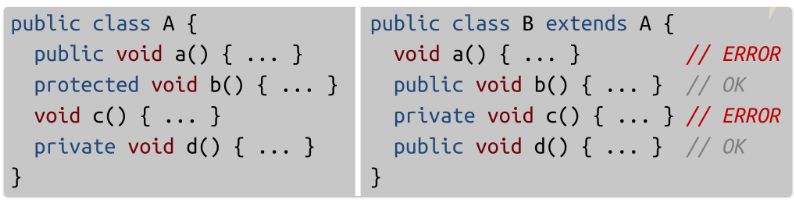
ETH::1._Semester::EProg::10._Inheritance::1._Visibility
image-occlusion:rect:left=.8594:top=.1808:width=.1308:height=.1517:oi=1 image-occlusion:rect:left=.8584:top=.3622:width=.1308:height=.1369:oi=1 image-occlusion:rect:left=.8603:top=.5139:width=.127:height=.1295:oi=1 image-occlusion:rect:left=.8603:top=.6582:width=.1232:height=.1332:oi=1
Back
ETH::1._Semester::EProg::10._Inheritance::1._Visibility
image-occlusion:rect:left=.8594:top=.1808:width=.1308:height=.1517:oi=1 image-occlusion:rect:left=.8584:top=.3622:width=.1308:height=.1369:oi=1 image-occlusion:rect:left=.8603:top=.5139:width=.127:height=.1295:oi=1 image-occlusion:rect:left=.8603:top=.6582:width=.1232:height=.1332:oi=1
Toggle Masks
After
Front
ETH::1._Semester::EProg::10._Inheritance::1._Visibility
image-occlusion:rect:left=.8594:top=.1808:width=.1308:height=.1517:oi=1 image-occlusion:rect:left=.8584:top=.3622:width=.1308:height=.1369:oi=1 image-occlusion:rect:left=.8603:top=.5139:width=.127:height=.1295:oi=1 image-occlusion:rect:left=.8603:top=.6582:width=.1232:height=.1332:oi=1
Back
ETH::1._Semester::EProg::10._Inheritance::1._Visibility
image-occlusion:rect:left=.8594:top=.1808:width=.1308:height=.1517:oi=1 image-occlusion:rect:left=.8584:top=.3622:width=.1308:height=.1369:oi=1 image-occlusion:rect:left=.8603:top=.5139:width=.127:height=.1295:oi=1 image-occlusion:rect:left=.8603:top=.6582:width=.1232:height=.1332:oi=1
Toggle Masks
Tags:
ETH::1._Semester::EProg::10._Inheritance::1._Visibility
Note 8: ETH::1. Semester::EProg
Deck: ETH::1. Semester::EProgNote Type: Horvath OcclusioGUID: gef_5DD5?n
modified
Before
Front
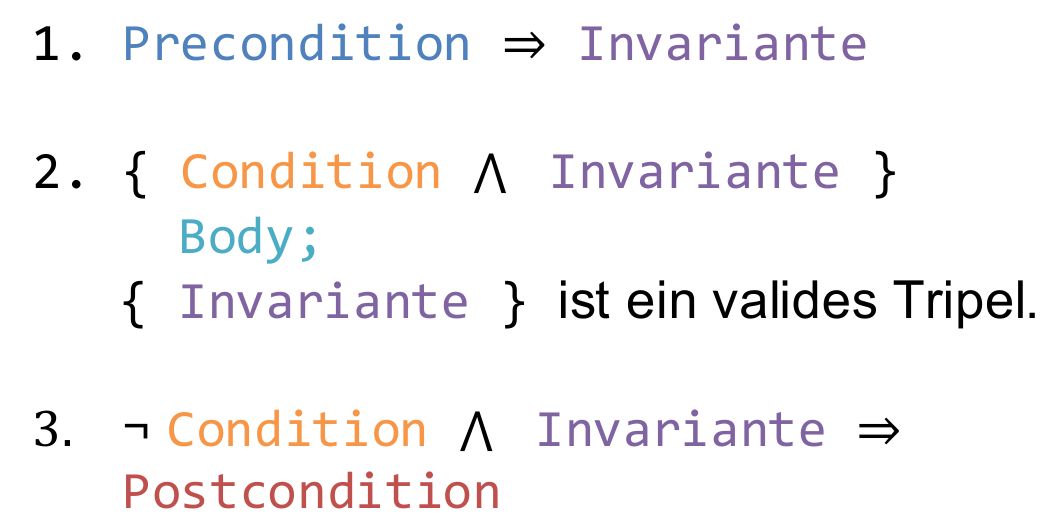
ETH::1._Semester::EProg::5._Logisches_Schliessen
image-occlusion:rect:left=.1151:top=.2639:width=.8709:height=.3659 image-occlusion:rect:left=.0974:top=.7498:width=.7647:height=.2279 image-occlusion:rect:left=.1151:top=.018:width=.6997:height=.126
Back
ETH::1._Semester::EProg::5._Logisches_Schliessen
image-occlusion:rect:left=.1151:top=.2639:width=.8709:height=.3659 image-occlusion:rect:left=.0974:top=.7498:width=.7647:height=.2279 image-occlusion:rect:left=.1151:top=.018:width=.6997:height=.126
Toggle Masks
After
Front
ETH::1._Semester::EProg::5._Logisches_Schliessen
image-occlusion:rect:left=.1151:top=.2639:width=.8709:height=.3659 image-occlusion:rect:left=.0974:top=.7498:width=.7647:height=.2279 image-occlusion:rect:left=.1151:top=.018:width=.6997:height=.126
Back
ETH::1._Semester::EProg::5._Logisches_Schliessen
image-occlusion:rect:left=.1151:top=.2639:width=.8709:height=.3659 image-occlusion:rect:left=.0974:top=.7498:width=.7647:height=.2279 image-occlusion:rect:left=.1151:top=.018:width=.6997:height=.126
Toggle Masks
Tags:
ETH::1._Semester::EProg::5._Logisches_Schliessen
Note 9: ETH::2. Semester::DDCA
Deck: ETH::2. Semester::DDCANote Type: Horvath ClassicGUID: AJ~67I*]U=
added
Previous
Note did not exist
New Note
Front
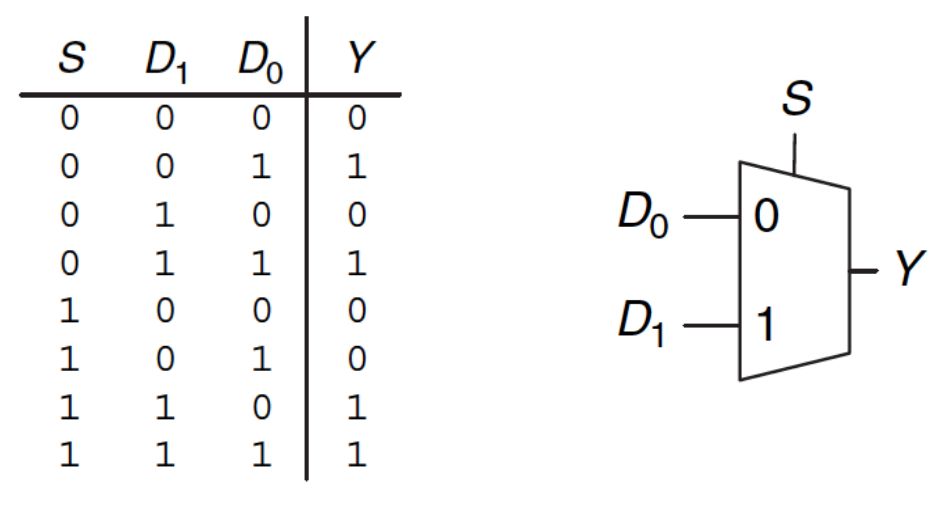
ETH::2._Semester::DDCA::02._Combinational_Logic::6._Combinational_Building_Blocks_used_in_Modern_Computers::2._Multiplexer_(MUX)
How does a multiplexer/selector work?
Back
ETH::2._Semester::DDCA::02._Combinational_Logic::6._Combinational_Building_Blocks_used_in_Modern_Computers::2._Multiplexer_(MUX)
How does a multiplexer/selector work?
Selects one of the \(N\) inputs to connect it to the output, based on the value of a \(\log_2 N\)-bit control input called select.
Example: 2-to-1 MUX
Field-by-field Comparison
Field
Before
After
Front How does a multiplexer/selector work?
Back <div>Selects one of the \(N\) inputs to connect it to the output, based on the value of a \(\log_2 N\)-bit control input called select.</div><div><br></div><div>Example: 2-to-1 MUX</div><div><br></div><div><img src="paste-8208411dc677e909d56e87886f8feebb89586c22.jpg"><br></div>
Tags:
ETH::2._Semester::DDCA::02._Combinational_Logic::6._Combinational_Building_Blocks_used_in_Modern_Computers::2._Multiplexer_(MUX)
Note 10: ETH::2. Semester::DDCA
Deck: ETH::2. Semester::DDCANote Type: Horvath ClozeGUID: Bkh_O*c@~J
added
Previous
Note did not exist
New Note
Front
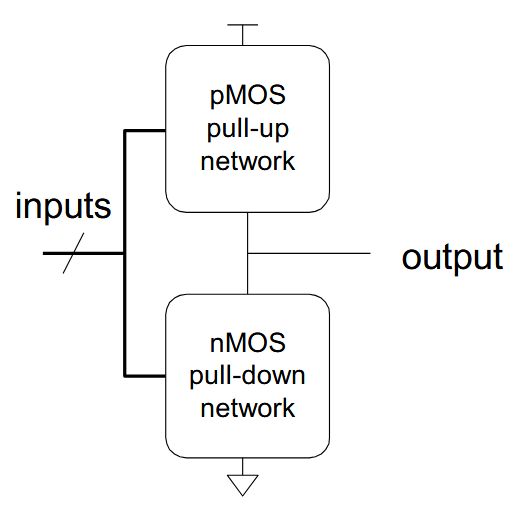
ETH::2._Semester::DDCA::02._Combinational_Logic::2._Logic_Gates
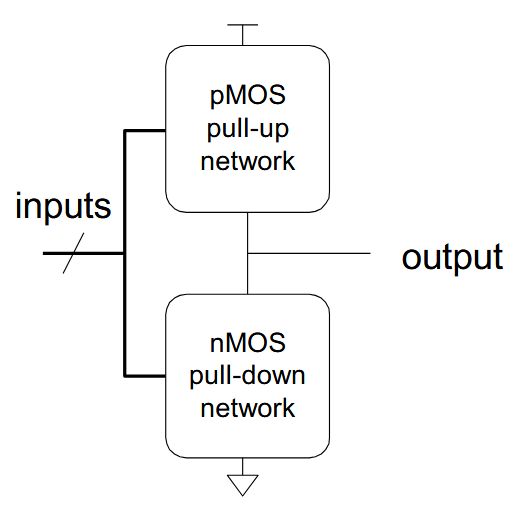
If both networks are OFF at the same time, the output is floating → undefined .
Back
ETH::2._Semester::DDCA::02._Combinational_Logic::2._Logic_Gates
If both networks are OFF at the same time, the output is floating → undefined .
Field-by-field Comparison
Field
Before
After
Text <img src="paste-a3eb18d4f8b16544780bf296d94ae3cb0386642d.jpg"><br><br>
<div>If both networks are OFF at the same time, {{c1::the output is <strong>floating</strong> → undefined}}.</div>
Tags:
ETH::2._Semester::DDCA::02._Combinational_Logic::2._Logic_Gates
Note 11: ETH::2. Semester::DDCA
Deck: ETH::2. Semester::DDCANote Type: Horvath ClassicGUID: C#j%f~ZG_/
added
Previous
Note did not exist
New Note
Front
ETH::2._Semester::DDCA::02._Combinational_Logic::2._Logic_Gates
What's static power consumption?
Back
ETH::2._Semester::DDCA::02._Combinational_Logic::2._Logic_Gates
What's static power consumption?
Power used when signals do not change.
Field-by-field Comparison
Field
Before
After
Front What's static power consumption?
Back Power used when signals do not change.
Tags:
ETH::2._Semester::DDCA::02._Combinational_Logic::2._Logic_Gates
Note 12: ETH::2. Semester::DDCA
Deck: ETH::2. Semester::DDCANote Type: Horvath ClassicGUID: C=t{~$lGP^
added
Previous
Note did not exist
New Note
Front
ETH::2._Semester::DDCA::02._Combinational_Logic::2._Logic_Gates
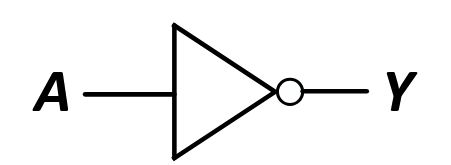
What is this?
Back
ETH::2._Semester::DDCA::02._Combinational_Logic::2._Logic_Gates
What is this?
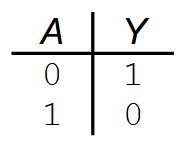
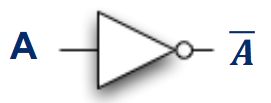
A NOT gate/inverter.
The bubble indicates inversion.
Field-by-field Comparison
Field
Before
After
Front What is this?<br><img src="paste-ac931ff5d7f389ff58099975d1f3a0ad8ab4c537.jpg">
Back A NOT gate/inverter.<br><br><img src="paste-0ad43f42d4ff2676978fd7a8c28ab976a068e58b.jpg"><br><br>The bubble indicates inversion.
Tags:
ETH::2._Semester::DDCA::02._Combinational_Logic::2._Logic_Gates
Note 13: ETH::2. Semester::DDCA
Deck: ETH::2. Semester::DDCANote Type: Horvath ClozeGUID: GIu2UZfi4!
added
Previous
Note did not exist
New Note
Front
ETH::2._Semester::DDCA::02._Combinational_Logic::4._Boolean_Logic_Equations
What does the "functional" in functional specification signify?
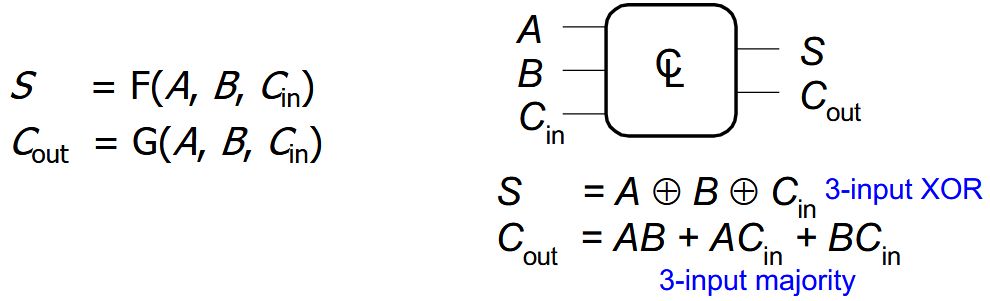
Unique mapping from input values to output values The same input values produce the same output value every time. No memory (output does not depend on past input values)
Back
ETH::2._Semester::DDCA::02._Combinational_Logic::4._Boolean_Logic_Equations
What does the "functional" in functional specification signify?
Unique mapping from input values to output values The same input values produce the same output value every time. No memory (output does not depend on past input values) Example: Full 1-bit adder
Field-by-field Comparison
Field
Before
After
Text What does the "functional" in functional specification signify?<br><ol><li>{{c1::Unique mapping from input values to output values}}<br></li><li>{{c1::The same input values produce the same output value every time.}}<br></li><li>{{c1::No memory (output does not depend on past input values)}}<br></li></ol>
Extra Example: Full 1-bit adder<br><br><img src="paste-b9d2e36783cfe71ff832f7489428344e8584afc2.jpg">
Tags:
ETH::2._Semester::DDCA::02._Combinational_Logic::4._Boolean_Logic_Equations
Note 14: ETH::2. Semester::DDCA
Deck: ETH::2. Semester::DDCANote Type: Horvath ClozeGUID: GJkgZHl?j0
added
Previous
Note did not exist
New Note
Front
ETH::2._Semester::DDCA::02._Combinational_Logic::3._Combinational_Logic_Circuits
Combinational Logic, as opposed to Sequential Logic, is memoryless .
Back
ETH::2._Semester::DDCA::02._Combinational_Logic::3._Combinational_Logic_Circuits
Combinational Logic, as opposed to Sequential Logic, is memoryless .
Outputs are strictly dependent on the combination of input values that are being applied to circuit right now .
Field-by-field Comparison
Field
Before
After
Text Combinational Logic, as opposed to Sequential Logic, is {{c1::memoryless}}.
Extra Outputs are strictly dependent on the combination of input values that are being applied to circuit <i>right now</i>.
Tags:
ETH::2._Semester::DDCA::02._Combinational_Logic::3._Combinational_Logic_Circuits
Note 15: ETH::2. Semester::DDCA
Deck: ETH::2. Semester::DDCANote Type: Horvath ClozeGUID: G]my!kE8:8
added
Previous
Note did not exist
New Note
Front
ETH::2._Semester::DDCA::02._Combinational_Logic::3._Combinational_Logic_Circuits
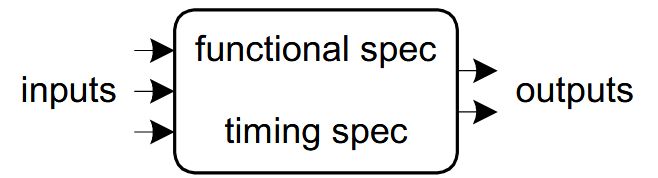
A logic circuit is composed of:
Inputs Outputs Functional specification Timing specification
Back
ETH::2._Semester::DDCA::02._Combinational_Logic::3._Combinational_Logic_Circuits
A logic circuit is composed of:
Inputs Outputs Functional specification Timing specification
Field-by-field Comparison
Field
Before
After
Text A logic circuit is composed of:<br><ol><li>{{c1::Inputs}}</li><li>{{c1::Outputs}}</li><li>{{c2::Functional specification}}</li><li>{{c3::Timing specification}}</li></ol>
Extra <img src="paste-92c3c73e08e660520d9f65d0f54f42a8bf80bc71.jpg">
Tags:
ETH::2._Semester::DDCA::02._Combinational_Logic::3._Combinational_Logic_Circuits
Note 16: ETH::2. Semester::DDCA
Deck: ETH::2. Semester::DDCANote Type: Horvath ClassicGUID: GouO^Q1^%L
added
Previous
Note did not exist
New Note
Front
ETH::2._Semester::DDCA::02._Combinational_Logic::5._Using_Boolean_Equations_to_Represent_a_Logic_Circuit
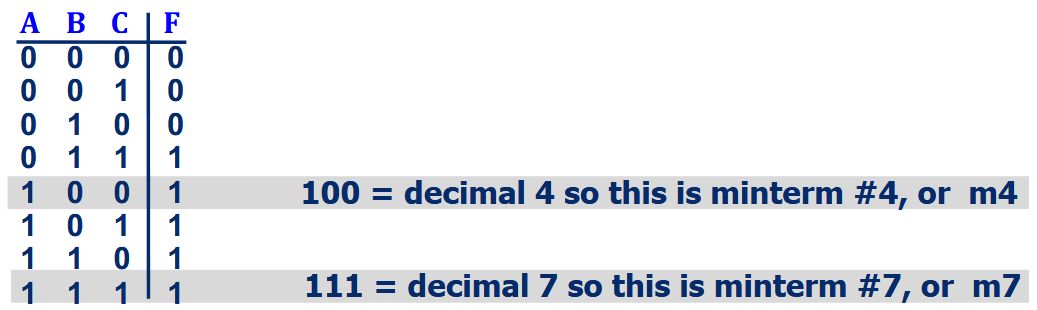
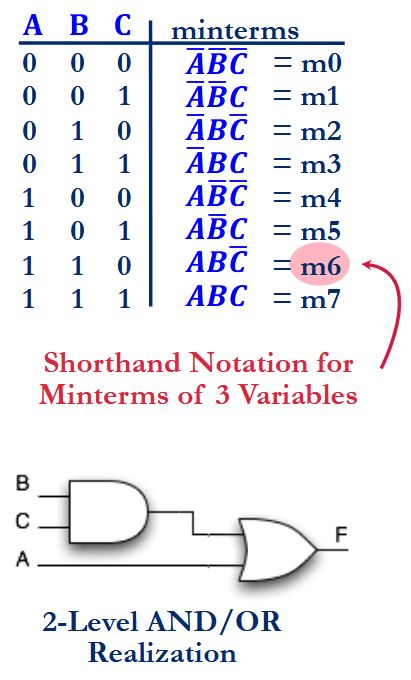
How can the number of a certain minterm be determined without counting lines?
Back
ETH::2._Semester::DDCA::02._Combinational_Logic::5._Using_Boolean_Equations_to_Represent_a_Logic_Circuit
How can the number of a certain minterm be determined without counting lines?
Field-by-field Comparison
Field
Before
After
Front How can the number of a certain minterm be determined without counting lines?
Back <img src="paste-c687a7cf6e844ba5e3892dff413f47956b4cdd9e.jpg">
Tags:
ETH::2._Semester::DDCA::02._Combinational_Logic::5._Using_Boolean_Equations_to_Represent_a_Logic_Circuit
Note 17: ETH::2. Semester::DDCA
Deck: ETH::2. Semester::DDCANote Type: Horvath ClozeGUID: GqtZXys=xR
added
Previous
Note did not exist
New Note
Front
ETH::2._Semester::DDCA::02._Combinational_Logic::2._Logic_Gates
We construct basic logical units out of individual MOS transistors. logic gates .
Back
ETH::2._Semester::DDCA::02._Combinational_Logic::2._Logic_Gates
We construct basic logical units out of individual MOS transistors. logic gates .
They implement simple Boolean functions.
Field-by-field Comparison
Field
Before
After
Text We construct basic logical units out of individual MOS transistors. <br><br>These logical units are called {{c1::logic gates}}.
Extra They implement simple Boolean functions.
Tags:
ETH::2._Semester::DDCA::02._Combinational_Logic::2._Logic_Gates
Note 18: ETH::2. Semester::DDCA
Deck: ETH::2. Semester::DDCANote Type: Horvath ClassicGUID: H*(W2@+xH+
added
Previous
Note did not exist
New Note
Front
ETH::2._Semester::DDCA::02._Combinational_Logic::1._Transistors
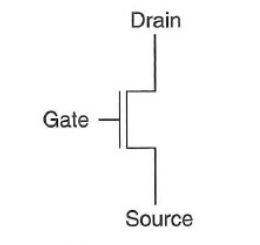
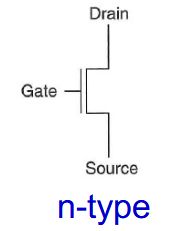
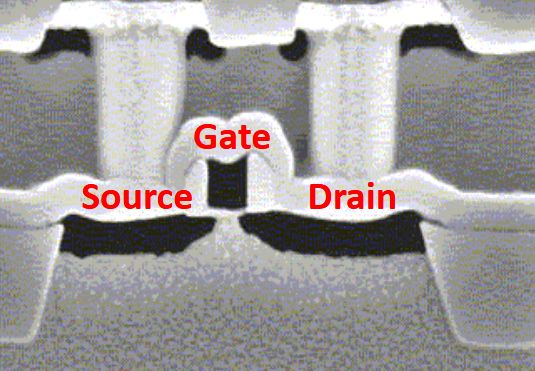
Which type of MOS transistor is this?
Back
ETH::2._Semester::DDCA::02._Combinational_Logic::1._Transistors
Which type of MOS transistor is this?
n-type
Field-by-field Comparison
Field
Before
After
Front Which type of MOS transistor is this?<br><br><img src="paste-7d05867b68f61a963efe3a0b6c769cddefc12b2f.jpg">
Back n-type
Tags:
ETH::2._Semester::DDCA::02._Combinational_Logic::1._Transistors
Note 19: ETH::2. Semester::DDCA
Deck: ETH::2. Semester::DDCANote Type: Horvath ClassicGUID: I4o5RfJsK*
added
Previous
Note did not exist
New Note
Front
ETH::2._Semester::DDCA::02._Combinational_Logic::4._Boolean_Logic_Equations
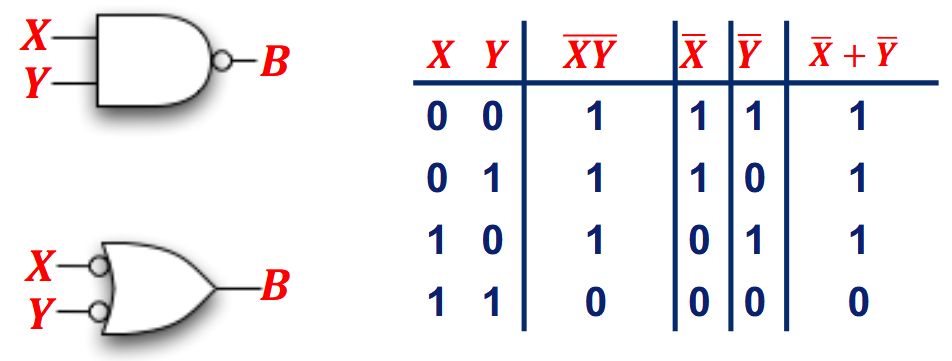
How can we build NAND from OR and NOT?
Back
ETH::2._Semester::DDCA::02._Combinational_Logic::4._Boolean_Logic_Equations
How can we build NAND from OR and NOT?
NAND is equivalent to OR with inputs complemented.
\(B=\overline{(XY)}=\overline X + \overline Y\)
Field-by-field Comparison
Field
Before
After
Front How can we build NAND from OR and NOT?
Back NAND is equivalent to OR with inputs complemented.<br><br>\(B=\overline{(XY)}=\overline X + \overline Y\)<br><br><img src="paste-7f18a7c0dd30adae86b576c7e3bd558fb91d3c4b.jpg">
Tags:
ETH::2._Semester::DDCA::02._Combinational_Logic::4._Boolean_Logic_Equations
Note 20: ETH::2. Semester::DDCA
Deck: ETH::2. Semester::DDCANote Type: Horvath ClassicGUID: IC[#R`$GWE
added
Previous
Note did not exist
New Note
Front
ETH::2._Semester::DDCA::02._Combinational_Logic::2._Logic_Gates
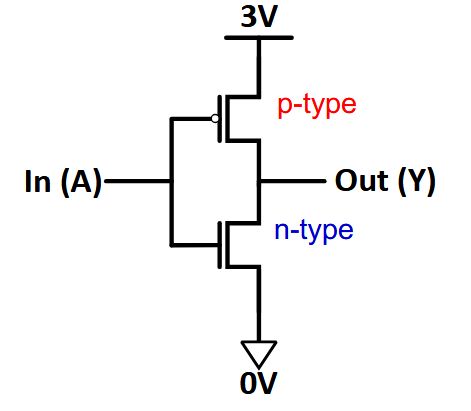
What does this circuit do?
Back
ETH::2._Semester::DDCA::02._Combinational_Logic::2._Logic_Gates
What does this circuit do?
This is the CMOS NOT Gate.
Why do we call it NOT?
If A = 0V then Y = 3V If A = 3V then Y = 0V
Field-by-field Comparison
Field
Before
After
Front What does this circuit do?<br><br><img src="paste-1ea8562646d826a66676f32131724f1287dda84a.jpg">
Back This is the CMOS NOT Gate.<br><br>Why do we call it NOT?<br><ul><li>If A = 0V then Y = 3V</li><li>If A = 3V then Y = 0V</li></ul>
Tags:
ETH::2._Semester::DDCA::02._Combinational_Logic::2._Logic_Gates
Note 21: ETH::2. Semester::DDCA
Deck: ETH::2. Semester::DDCANote Type: Horvath ClassicGUID: Isdz`E|.1(
added
Previous
Note did not exist
New Note
Front
ETH::2._Semester::DDCA::02._Combinational_Logic::2._Logic_Gates
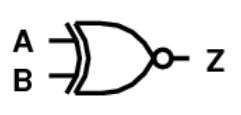
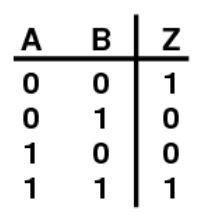
Which gate is this?
Back
ETH::2._Semester::DDCA::02._Combinational_Logic::2._Logic_Gates
Which gate is this?
XNOR
Field-by-field Comparison
Field
Before
After
Front Which gate is this?<br><br><img src="paste-09155718b2466228b1738f667e96bcb1c72971dd.jpg">
Back XNOR<br><br><img src="paste-262457139ca95f4bd8cd623aa4e060bfe53567df.jpg">
Tags:
ETH::2._Semester::DDCA::02._Combinational_Logic::2._Logic_Gates
Note 22: ETH::2. Semester::DDCA
Deck: ETH::2. Semester::DDCANote Type: Horvath ClozeGUID: J!BC_~c^Tq
added
Previous
Note did not exist
New Note
Front
ETH::2._Semester::DDCA::02._Combinational_Logic::1._Transistors
On the p-type transistor, the circuit is closed when the gate is supplied with 0V .
Back
ETH::2._Semester::DDCA::02._Combinational_Logic::1._Transistors
On the p-type transistor, the circuit is closed when the gate is supplied with 0V .
Field-by-field Comparison
Field
Before
After
Text On the p-type transistor, the circuit is closed when the gate is supplied with {{c1::0V}}.
Extra <img src="paste-283d91233870ed31439a32297a5e66d269bfc534.jpg">
Tags:
ETH::2._Semester::DDCA::02._Combinational_Logic::1._Transistors
Note 23: ETH::2. Semester::DDCA
Deck: ETH::2. Semester::DDCANote Type: Horvath ClozeGUID: J$BvIDQ[e=
added
Previous
Note did not exist
New Note
Front
ETH::2._Semester::DDCA::02._Combinational_Logic::1._Transistors
If the gate of an n-type transistor is supplied with a high voltage, the connection from source to drain acts like a piece of wire (i.e., the circuit is closed) .
Back
ETH::2._Semester::DDCA::02._Combinational_Logic::1._Transistors
If the gate of an n-type transistor is supplied with a high voltage, the connection from source to drain acts like a piece of wire (i.e., the circuit is closed) .
Depending on the technology, high voltage can range from 0.3V to 3V.
Field-by-field Comparison
Field
Before
After
Text If the gate of an n-type transistor is supplied with {{c1::a high}} voltage, the connection from source to drain acts like {{c2::a piece of wire (i.e., the circuit is closed)}}.
Extra Depending on the technology, high voltage can range from 0.3V to 3V.
Tags:
ETH::2._Semester::DDCA::02._Combinational_Logic::1._Transistors
Note 24: ETH::2. Semester::DDCA
Deck: ETH::2. Semester::DDCANote Type: Horvath ClassicGUID: JWeqr#]4c
added
Previous
Note did not exist
New Note
Front
ETH::2._Semester::DDCA::02._Combinational_Logic::5._Using_Boolean_Equations_to_Represent_a_Logic_Circuit
How can we convert from the Minterm expansion of \(F\) to the Maxterm expansion of \(\overline F\)?
Back
ETH::2._Semester::DDCA::02._Combinational_Logic::5._Using_Boolean_Equations_to_Represent_a_Logic_Circuit
How can we convert from the Minterm expansion of \(F\) to the Maxterm expansion of \(\overline F\)?
Rewrite in Maxterm form, using the same indices as \(F\).
Field-by-field Comparison
Field
Before
After
Front How can we convert from the Minterm expansion of \(F\) to the Maxterm expansion of \(\overline F\)?
Back Rewrite in Maxterm form, using the same indices as \(F\).<br>\[\begin{array}{r l c r l}
\text{E.g., } F(A,B,C) & = \sum m(3,4,5,6,7) & \longrightarrow & \overline{F}(A,B,C) & = \prod M(3,4,5,6,7) \\
& = \prod M(0,1,2) & \longrightarrow & & = \sum m(0,1,2)
\end{array}\]<br>
Tags:
ETH::2._Semester::DDCA::02._Combinational_Logic::5._Using_Boolean_Equations_to_Represent_a_Logic_Circuit
Note 25: ETH::2. Semester::DDCA
Deck: ETH::2. Semester::DDCANote Type: Horvath ClassicGUID: KEEa>PCXE`
added
Previous
Note did not exist
New Note
Front
ETH::2._Semester::DDCA::02._Combinational_Logic::2._Logic_Gates
What's the formula for energy consumption?
Back
ETH::2._Semester::DDCA::02._Combinational_Logic::2._Logic_Gates
What's the formula for energy consumption?
Power * Time
Field-by-field Comparison
Field
Before
After
Front What's the formula for energy consumption?
Back Power * Time
Tags:
ETH::2._Semester::DDCA::02._Combinational_Logic::2._Logic_Gates
Note 26: ETH::2. Semester::DDCA
Deck: ETH::2. Semester::DDCANote Type: Horvath ClozeGUID: L)2IfSjkLM
added
Previous
Note did not exist
New Note
Front
ETH::2._Semester::DDCA::02._Combinational_Logic::1._Transistors
On the n-type transistor, the circuit is closed when the gate is supplied with 3V .
Back
ETH::2._Semester::DDCA::02._Combinational_Logic::1._Transistors
On the n-type transistor, the circuit is closed when the gate is supplied with 3V .
Field-by-field Comparison
Field
Before
After
Text On the n-type transistor, the circuit is closed when the gate is supplied with {{c1::3V}}.
Extra <img src="paste-58a159d5191f269f58343aa3187998262875b89e.jpg">
Tags:
ETH::2._Semester::DDCA::02._Combinational_Logic::1._Transistors
Note 27: ETH::2. Semester::DDCA
Deck: ETH::2. Semester::DDCANote Type: Horvath ClassicGUID: Lk!m/FJd3!
added
Previous
Note did not exist
New Note
Front
ETH::2._Semester::DDCA::02._Combinational_Logic::5._Using_Boolean_Equations_to_Represent_a_Logic_Circuit
How can we convert from Maxterm to Minterm?
Back
ETH::2._Semester::DDCA::02._Combinational_Logic::5._Using_Boolean_Equations_to_Represent_a_Logic_Circuit
How can we convert from Maxterm to Minterm?
Rewrite maxterm shorthand using minterm shorthand Replace maxterm indices with the indices not already used E.g., \(F(A,B,C) = \prod M(0,1,2) = \sum m(3,4,5,6,7)\)
Field-by-field Comparison
Field
Before
After
Front How can we convert from Maxterm to Minterm?
Back <ol><li>Rewrite maxterm shorthand using minterm shorthand</li><li>Replace maxterm indices with the indices not already used<br></li></ol>E.g., \(F(A,B,C) = \prod M(0,1,2) = \sum m(3,4,5,6,7)\)
Tags:
ETH::2._Semester::DDCA::02._Combinational_Logic::5._Using_Boolean_Equations_to_Represent_a_Logic_Circuit
Note 28: ETH::2. Semester::DDCA
Deck: ETH::2. Semester::DDCANote Type: Horvath ClozeGUID: Lyr2I#>S6v
added
Previous
Note did not exist
New Note
Front
ETH::2._Semester::DDCA::02._Combinational_Logic::6._Combinational_Building_Blocks_used_in_Modern_Computers::1._Decoder
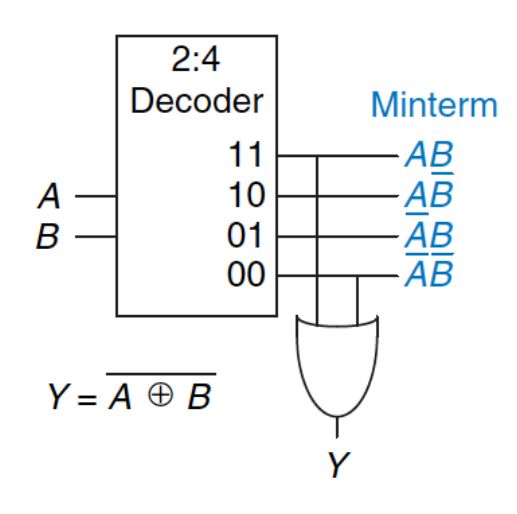
Decoders can be combined with OR gates to build logic functions.
Back
ETH::2._Semester::DDCA::02._Combinational_Logic::6._Combinational_Building_Blocks_used_in_Modern_Computers::1._Decoder
Decoders can be combined with OR gates to build logic functions.
Field-by-field Comparison
Field
Before
After
Text Decoders can be combined with {{c1::OR gates}} to build logic functions.
Extra <img src="paste-4b9926a6c0a612f21c80818ed3d3a9b2c1965b52.jpg">
Tags:
ETH::2._Semester::DDCA::02._Combinational_Logic::6._Combinational_Building_Blocks_used_in_Modern_Computers::1._Decoder
Note 29: ETH::2. Semester::DDCA
Deck: ETH::2. Semester::DDCANote Type: Horvath ClozeGUID: MH2*~,1ehe
added
Previous
Note did not exist
New Note
Front
ETH::2._Semester::DDCA::02._Combinational_Logic::4._Boolean_Logic_Equations
\(X \bullet Y + X \bullet \overline{Y} = X \)
Back
ETH::2._Semester::DDCA::02._Combinational_Logic::4._Boolean_Logic_Equations
\(X \bullet Y + X \bullet \overline{Y} = X \)
Field-by-field Comparison
Field
Before
After
Text \(X \bullet Y + X \bullet \overline{Y} = {{c1::X}}\)
Tags:
ETH::2._Semester::DDCA::02._Combinational_Logic::4._Boolean_Logic_Equations
Note 30: ETH::2. Semester::DDCA
Deck: ETH::2. Semester::DDCANote Type: Horvath ClassicGUID: MWmGMTiH]o
added
Previous
Note did not exist
New Note
Front
ETH::2._Semester::DDCA::02._Combinational_Logic::5._Using_Boolean_Equations_to_Represent_a_Logic_Circuit
Back
ETH::2._Semester::DDCA::02._Combinational_Logic::5._Using_Boolean_Equations_to_Represent_a_Logic_Circuit
What is an implicant?
A product (AND) of literals.
Field-by-field Comparison
Field
Before
After
Front What is an implicant?
Back A product (AND) of literals.<br><br>\((A \cdot B \cdot \overline{C}) \text{ , } (\overline{A} \cdot C) \text{ , } (B \cdot \overline{C})\)
Tags:
ETH::2._Semester::DDCA::02._Combinational_Logic::5._Using_Boolean_Equations_to_Represent_a_Logic_Circuit
Note 31: ETH::2. Semester::DDCA
Deck: ETH::2. Semester::DDCANote Type: Horvath ClozeGUID: Nr/WO;(0{4
added
Previous
Note did not exist
New Note
Front
ETH::2._Semester::DDCA::02._Combinational_Logic::6._Combinational_Building_Blocks_used_in_Modern_Computers::2._Multiplexer_(MUX)
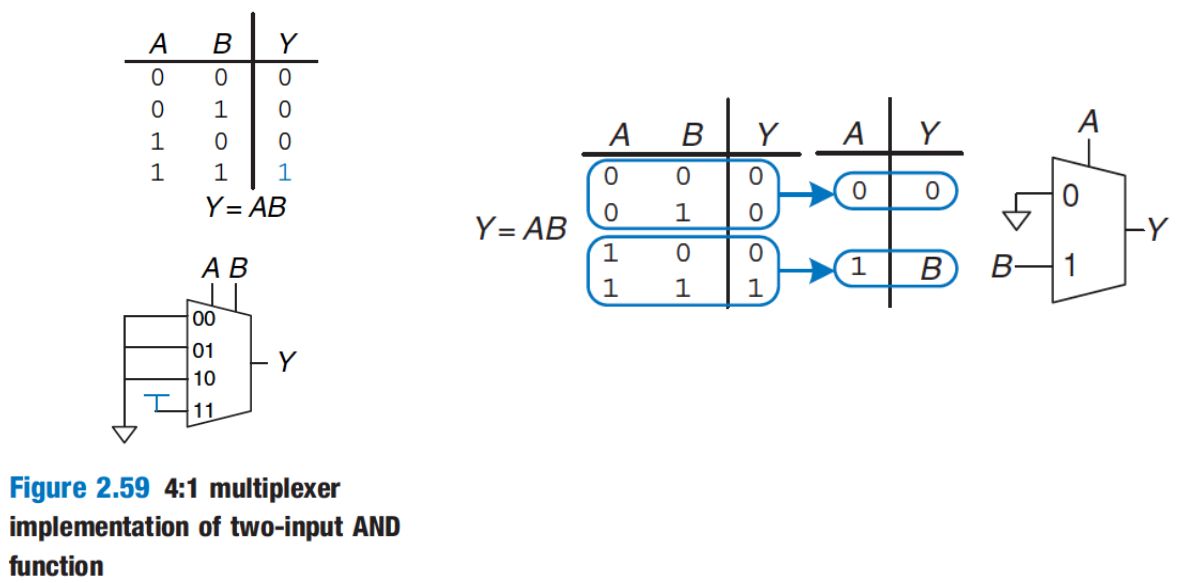
Multiplexers can be used as "lookup tables" to perform logic functions .
Back
ETH::2._Semester::DDCA::02._Combinational_Logic::6._Combinational_Building_Blocks_used_in_Modern_Computers::2._Multiplexer_(MUX)
Multiplexers can be used as "lookup tables" to perform logic functions .
Field-by-field Comparison
Field
Before
After
Text Multiplexers can be used as {{c1::"lookup tables" to perform logic functions}}.
Extra <img src="paste-a0643b754113ab32abc6e5adfed855ac37f050e3.jpg">
Tags:
ETH::2._Semester::DDCA::02._Combinational_Logic::6._Combinational_Building_Blocks_used_in_Modern_Computers::2._Multiplexer_(MUX)
Note 32: ETH::2. Semester::DDCA
Deck: ETH::2. Semester::DDCANote Type: Horvath ClassicGUID: P2t5@m8Q~.
added
Previous
Note did not exist
New Note
Front
ETH::2._Semester::DDCA::02._Combinational_Logic::2._Logic_Gates
What gate is this?
Back
ETH::2._Semester::DDCA::02._Combinational_Logic::2._Logic_Gates
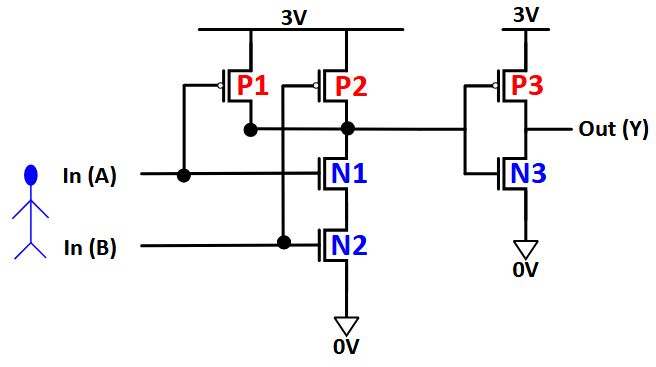
What gate is this?
This is the CMOS AND Gate.
Field-by-field Comparison
Field
Before
After
Front What gate is this?<br><br><img src="paste-2ad6d40fa1eb42fa0ccdeb5a2af1449399f4157c.jpg">
Back This is the CMOS AND Gate.<br><br><img src="paste-3ec26993d5dc59b7a394208bdd22963894227581.jpg">
Tags:
ETH::2._Semester::DDCA::02._Combinational_Logic::2._Logic_Gates
Note 33: ETH::2. Semester::DDCA
Deck: ETH::2. Semester::DDCANote Type: Horvath ClozeGUID: Q+Ol+3O^DB
added
Previous
Note did not exist
New Note
Front
ETH::2._Semester::DDCA::02._Combinational_Logic::2._Logic_Gates
Series connections are slower than parallel connections.
Back
ETH::2._Semester::DDCA::02._Combinational_Logic::2._Logic_Gates
Series connections are slower than parallel connections.
More resistance on the wire.
Field-by-field Comparison
Field
Before
After
Text Series connections are {{c1::slower::Speed}} than parallel connections.
Extra More resistance on the wire.
Tags:
ETH::2._Semester::DDCA::02._Combinational_Logic::2._Logic_Gates
Note 34: ETH::2. Semester::DDCA
Deck: ETH::2. Semester::DDCANote Type: Horvath ClozeGUID: QSB?1}FgZ9
added
Previous
Note did not exist
New Note
Front
ETH::2._Semester::DDCA::02._Combinational_Logic::2._Logic_Gates
p -type transistors are good at pulling up the voltage.
Back
ETH::2._Semester::DDCA::02._Combinational_Logic::2._Logic_Gates
p -type transistors are good at pulling up the voltage.
Field-by-field Comparison
Field
Before
After
Text <b>p</b>-type transistors are good at pulling {{c1::u<b>p</b>}} the voltage.
Tags:
ETH::2._Semester::DDCA::02._Combinational_Logic::2._Logic_Gates
Note 35: ETH::2. Semester::DDCA
Deck: ETH::2. Semester::DDCANote Type: Horvath ClassicGUID: c>-yp[Ry[S
added
Previous
Note did not exist
New Note
Front
ETH::2._Semester::DDCA::02._Combinational_Logic::2._Logic_Gates
How can we make an AND gate?
Back
ETH::2._Semester::DDCA::02._Combinational_Logic::2._Logic_Gates
How can we make an AND gate?
We make an AND gate using one NAND gate and one NOT gate:
Field-by-field Comparison
Field
Before
After
Front How can we make an AND gate?
Back We make an AND gate using one NAND gate and one NOT gate:<br><br><img src="paste-0596c472398ba477eff721024a309ad41e750430.jpg">
Tags:
ETH::2._Semester::DDCA::02._Combinational_Logic::2._Logic_Gates
Note 36: ETH::2. Semester::DDCA
Deck: ETH::2. Semester::DDCANote Type: Horvath ClozeGUID: cRGP4XGmZM
added
Previous
Note did not exist
New Note
Front
ETH::2._Semester::DDCA::02._Combinational_Logic::5._Using_Boolean_Equations_to_Represent_a_Logic_Circuit
Product of Sums is equivalent to CNF .
Back
ETH::2._Semester::DDCA::02._Combinational_Logic::5._Using_Boolean_Equations_to_Represent_a_Logic_Circuit
Product of Sums is equivalent to CNF .
This is also the DeMorgan of SOP of \(\overline F\).
Field-by-field Comparison
Field
Before
After
Text Product of Sums is equivalent to {{c1::CNF}}.
Extra This is also the DeMorgan of SOP of \(\overline F\).
Tags:
ETH::2._Semester::DDCA::02._Combinational_Logic::5._Using_Boolean_Equations_to_Represent_a_Logic_Circuit
Note 37: ETH::2. Semester::DDCA
Deck: ETH::2. Semester::DDCANote Type: Horvath ClassicGUID: e1dy/}l($w
added
Previous
Note did not exist
New Note
Front
ETH::2._Semester::DDCA::02._Combinational_Logic::2._Logic_Gates
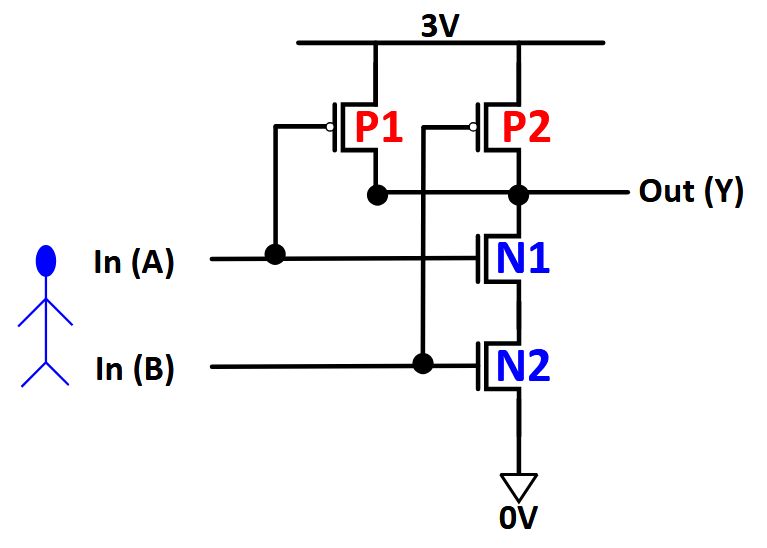
What does this circuit do?
Back
ETH::2._Semester::DDCA::02._Combinational_Logic::2._Logic_Gates
What does this circuit do?
It's the CMOS NAND Gate.
P1 and P2 are in parallel ; only one must be ON to pull up the output to 3V. N1 and N2 are connected in series ; both must be ON to pull down the output to 0V.
Field-by-field Comparison
Field
Before
After
Front What does this circuit do?<br><br><img src="paste-bccbffeadc7963887cae6412e8d018f79008f8a4.jpg">
Back It's the CMOS NAND Gate.<br><br><img src="paste-cc6b665cdbfe3838f2f72c3f5c383b6787057523.jpg"><br><div><ul><li>P1 and P2 are <b>in parallel</b>; only one must be ON to pull up the output to 3V.</li><li>N1 and N2 are connected <b>in series</b>; both must be ON to pull down the output to 0V.</li></ul></div>
Tags:
ETH::2._Semester::DDCA::02._Combinational_Logic::2._Logic_Gates
Note 38: ETH::2. Semester::DDCA
Deck: ETH::2. Semester::DDCANote Type: Horvath ClassicGUID: eh2^a;u=sR
added
Previous
Note did not exist
New Note
Front
ETH::2._Semester::DDCA::02._Combinational_Logic::5._Using_Boolean_Equations_to_Represent_a_Logic_Circuit
How can we convert the expansion of \(F\) to the expansion of \(\overline F\)?
Back
ETH::2._Semester::DDCA::02._Combinational_Logic::5._Using_Boolean_Equations_to_Represent_a_Logic_Circuit
How can we convert the expansion of \(F\) to the expansion of \(\overline F\)?
\[\begin{array}{r l c r l}
\text{E.g., } F(A,B,C) & = \sum m(3,4,5,6,7) & \longrightarrow & \overline{F}(A,B,C) & = \sum m(0,1,2) \\
& = \prod M(0,1,2) & \longrightarrow & & = \prod M(3,4,5,6,7)
\end{array}\]
Field-by-field Comparison
Field
Before
After
Front How can we convert the expansion of \(F\) to the expansion of \(\overline F\)?
Back \[\begin{array}{r l c r l}
\text{E.g., } F(A,B,C) & = \sum m(3,4,5,6,7) & \longrightarrow & \overline{F}(A,B,C) & = \sum m(0,1,2) \\
& = \prod M(0,1,2) & \longrightarrow & & = \prod M(3,4,5,6,7)
\end{array}\]<br>
Tags:
ETH::2._Semester::DDCA::02._Combinational_Logic::5._Using_Boolean_Equations_to_Represent_a_Logic_Circuit
Note 39: ETH::2. Semester::DDCA
Deck: ETH::2. Semester::DDCANote Type: Horvath ClassicGUID: hQ)3[a]Xq<
added
Previous
Note did not exist
New Note
Front
ETH::2._Semester::DDCA::02._Combinational_Logic::2._Logic_Gates
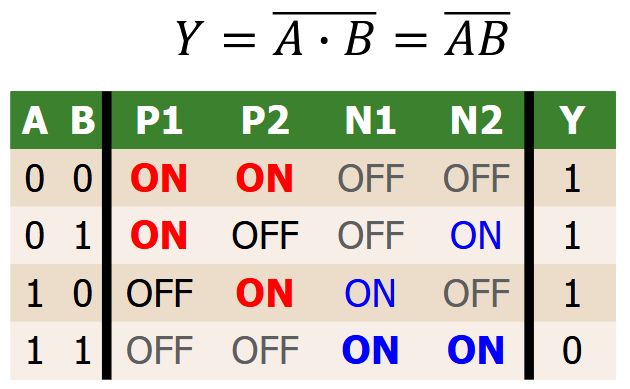
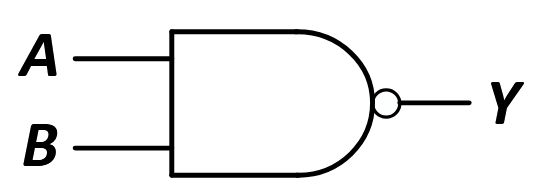
What gates is this?
Back
ETH::2._Semester::DDCA::02._Combinational_Logic::2._Logic_Gates
What gates is this?
The CMOS NAND Gate.
Field-by-field Comparison
Field
Before
After
Front What gates is this?<br><br><img src="paste-b6777165efef100cab46f26906ce60b1d5d3a866.jpg">
Back The CMOS NAND Gate.<br><br><img src="paste-953f00465848000258867b4eb3678f8b985d22d1.jpg">
Tags:
ETH::2._Semester::DDCA::02._Combinational_Logic::2._Logic_Gates
Note 40: ETH::2. Semester::DDCA
Deck: ETH::2. Semester::DDCANote Type: Horvath ClozeGUID: jylgnWO`cY
added
Previous
Note did not exist
New Note
Front
ETH::2._Semester::DDCA::02._Combinational_Logic::2._Logic_Gates
If both networks are ON at the same time, there is a short circuit → likely incorrect operation .
Back
ETH::2._Semester::DDCA::02._Combinational_Logic::2._Logic_Gates
If both networks are ON at the same time, there is a short circuit → likely incorrect operation .
Field-by-field Comparison
Field
Before
After
Text <img src="paste-a3eb18d4f8b16544780bf296d94ae3cb0386642d.jpg"><br><br><div>If both networks are ON at the same time, there is {{c1::a <strong>short circuit</strong> → likely incorrect operation}}.</div>
Tags:
ETH::2._Semester::DDCA::02._Combinational_Logic::2._Logic_Gates
Note 41: ETH::2. Semester::DDCA
Deck: ETH::2. Semester::DDCANote Type: Horvath ClozeGUID: kjuyg1m}9]
added
Previous
Note did not exist
New Note
Front
ETH::2._Semester::DDCA::02._Combinational_Logic::4._Boolean_Logic_Equations
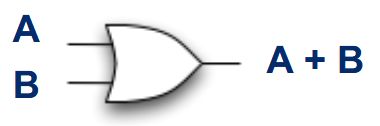
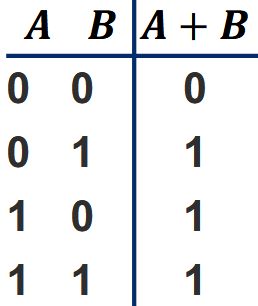
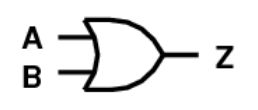
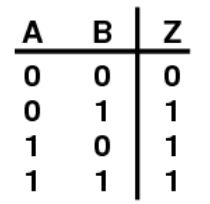
\(A+B\) signifies "A or B" .
Back
ETH::2._Semester::DDCA::02._Combinational_Logic::4._Boolean_Logic_Equations
\(A+B\) signifies "A or B" .
Field-by-field Comparison
Field
Before
After
Text \(A+B\) signifies {{c1::"A or B"}}.
Extra <img src="paste-e9d93adb6e4be16c829b5ca7bc0873cb10bfaaad.jpg"><br><img src="paste-98398b7664b21c58363c0b63982187f6bc6981aa.jpg">
Tags:
ETH::2._Semester::DDCA::02._Combinational_Logic::4._Boolean_Logic_Equations
Note 42: ETH::2. Semester::DDCA
Deck: ETH::2. Semester::DDCANote Type: Horvath ClassicGUID: l:L$hWai[V
added
Previous
Note did not exist
New Note
Front
ETH::2._Semester::DDCA::02._Combinational_Logic::2._Logic_Gates
Which gate is this?
Back
ETH::2._Semester::DDCA::02._Combinational_Logic::2._Logic_Gates
Which gate is this?
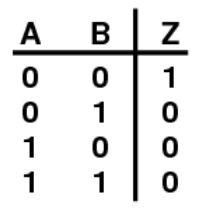
NOR
Field-by-field Comparison
Field
Before
After
Front Which gate is this?<br><br><img src="paste-2ddd8398d7ccd94313aad36079863d4f5ef4cd1f.jpg">
Back NOR<br><br><img src="paste-6304f984df50a0b8281ed5bff64f29273cd05051.jpg">
Tags:
ETH::2._Semester::DDCA::02._Combinational_Logic::2._Logic_Gates
Note 43: ETH::2. Semester::DDCA
Deck: ETH::2. Semester::DDCANote Type: Horvath ClassicGUID: lJFlk8]f26
added
Previous
Note did not exist
New Note
Front
ETH::2._Semester::DDCA::02._Combinational_Logic::4._Boolean_Logic_Equations
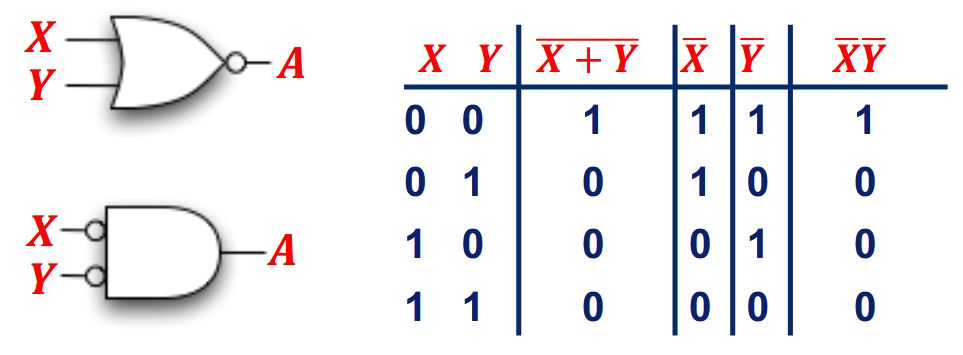
How can we build NOR from NOT and AND?
Back
ETH::2._Semester::DDCA::02._Combinational_Logic::4._Boolean_Logic_Equations
How can we build NOR from NOT and AND?
NOR is equivalent to AND with inputs complemented.
\(A=\overline{(X+Y)}=\overline X \space\overline Y\)
Field-by-field Comparison
Field
Before
After
Front How can we build NOR from NOT and AND?
Back NOR is equivalent to AND with inputs complemented.<br><br>\(A=\overline{(X+Y)}=\overline X \space\overline Y\)<br><br><img src="paste-4f2a2ce8e54cf095a8c32b10eb76d836070ebd30.jpg">
Tags:
ETH::2._Semester::DDCA::02._Combinational_Logic::4._Boolean_Logic_Equations
Note 44: ETH::2. Semester::DDCA
Deck: ETH::2. Semester::DDCANote Type: Horvath ClozeGUID: lSt^W77c/I
added
Previous
Note did not exist
New Note
Front
ETH::2._Semester::DDCA::02._Combinational_Logic::1._Transistors
By combining:
Conductors (M etal) Insulators (O xide) S emiconductorsWe get a Transistor (MOS) .
Back
ETH::2._Semester::DDCA::02._Combinational_Logic::1._Transistors
By combining:
Conductors (M etal) Insulators (O xide) S emiconductorsWe get a Transistor (MOS) .
Field-by-field Comparison
Field
Before
After
Text <div><strong>By combining:</strong></div>
<ol><li>{{c1::Conductors (<strong>M</strong>etal)}}<br></li>
<li>{{c2::Insulators (<strong>O</strong>xide)}}<br></li>
<li>{{c3::<strong>S</strong>emiconductors}}<br></li></ol>
<div><strong>We get a </strong>{{c4::Transistor (MOS)}}.</div>
Extra <img src="paste-f9e68afc631519419a56d36751cdb4d5779e1ac1.jpg">
Tags:
ETH::2._Semester::DDCA::02._Combinational_Logic::1._Transistors
Note 45: ETH::2. Semester::DDCA
Deck: ETH::2. Semester::DDCANote Type: Horvath ClassicGUID: m7qIFy%!oi
added
Previous
Note did not exist
New Note
Front
ETH::2._Semester::DDCA::02._Combinational_Logic::5._Using_Boolean_Equations_to_Represent_a_Logic_Circuit
Back
ETH::2._Semester::DDCA::02._Combinational_Logic::5._Using_Boolean_Equations_to_Represent_a_Logic_Circuit
What is a minterm?
A product (AND) that includes all input variables.
Field-by-field Comparison
Field
Before
After
Front What is a minterm?
Back A product (AND) that includes all input variables.<br><br>\((A \cdot B \cdot \overline{C}) \text{ , } (\overline{A} \cdot \overline{B} \cdot C) \text{ , } (\overline{A} \cdot B \cdot \overline{C})\)
Tags:
ETH::2._Semester::DDCA::02._Combinational_Logic::5._Using_Boolean_Equations_to_Represent_a_Logic_Circuit
Note 46: ETH::2. Semester::DDCA
Deck: ETH::2. Semester::DDCANote Type: Horvath ClozeGUID: n!oY_a%~!Q
added
Previous
Note did not exist
New Note
Front
ETH::2._Semester::DDCA::02._Combinational_Logic::1._Transistors
If the gate of the n-type transistor is supplied with zero voltage, the connection between the source and drain is broken (i.e., the circuit is open) .
Back
ETH::2._Semester::DDCA::02._Combinational_Logic::1._Transistors
If the gate of the n-type transistor is supplied with zero voltage, the connection between the source and drain is broken (i.e., the circuit is open) .
Field-by-field Comparison
Field
Before
After
Text If the gate of the n-type transistor is supplied with {{c1::zero}} voltage, the connection between the source and drain is {{c2::broken (i.e., the circuit is open)}}.
Tags:
ETH::2._Semester::DDCA::02._Combinational_Logic::1._Transistors
Note 47: ETH::2. Semester::DDCA
Deck: ETH::2. Semester::DDCANote Type: Horvath ClozeGUID: nGy?>L{vz*
added
Previous
Note did not exist
New Note
Front
ETH::2._Semester::DDCA::02._Combinational_Logic::6._Combinational_Building_Blocks_used_in_Modern_Computers::2._Multiplexer_(MUX)
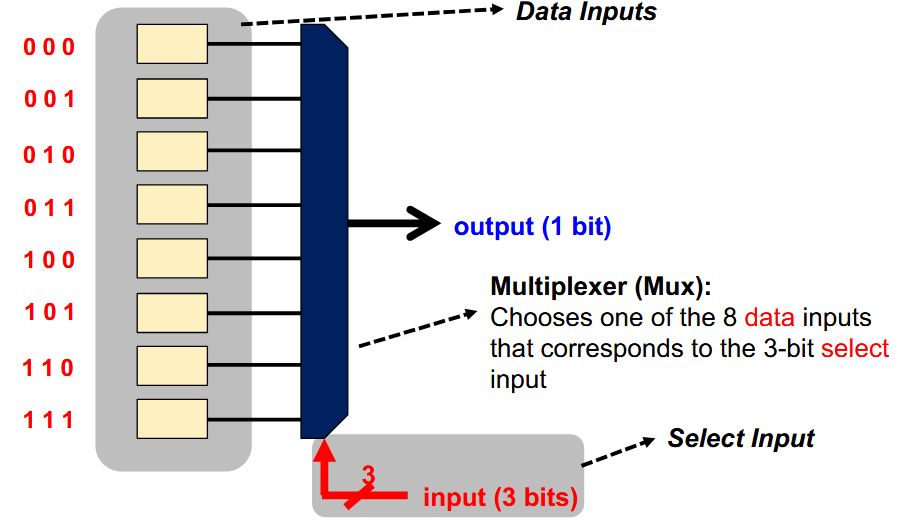
A 3-LUT can implement any 3-bit input function .
Back
ETH::2._Semester::DDCA::02._Combinational_Logic::6._Combinational_Building_Blocks_used_in_Modern_Computers::2._Multiplexer_(MUX)
A 3-LUT can implement any 3-bit input function .
(LUT = Lookup Table)
Field-by-field Comparison
Field
Before
After
Text A 3-LUT can implement {{c1::any 3-bit input function}}.
Extra (LUT = Lookup Table)<br><br><img src="paste-5ef924f9dd1bae5892f2b78cbd64716dc1471cf4.jpg">
Tags:
ETH::2._Semester::DDCA::02._Combinational_Logic::6._Combinational_Building_Blocks_used_in_Modern_Computers::2._Multiplexer_(MUX)
Note 48: ETH::2. Semester::DDCA
Deck: ETH::2. Semester::DDCANote Type: Horvath ClozeGUID: n]Q[NPQ}z>
added
Previous
Note did not exist
New Note
Front
ETH::2._Semester::DDCA::02._Combinational_Logic::2._Logic_Gates
Modern computers use both n-type and p-type transistors, i.e. Complementary MOS (CMOS) technology .
Back
ETH::2._Semester::DDCA::02._Combinational_Logic::2._Logic_Gates
Modern computers use both n-type and p-type transistors, i.e. Complementary MOS (CMOS) technology .
Field-by-field Comparison
Field
Before
After
Text Modern computers use both n-type and p-type transistors, i.e. {{c1::Complementary MOS (CMOS) technology}}.
Tags:
ETH::2._Semester::DDCA::02._Combinational_Logic::2._Logic_Gates
Note 49: ETH::2. Semester::DDCA
Deck: ETH::2. Semester::DDCANote Type: Horvath ClassicGUID: na4nPYvDI]
added
Previous
Note did not exist
New Note
Front
ETH::2._Semester::DDCA::02._Combinational_Logic::6._Combinational_Building_Blocks_used_in_Modern_Computers::1._Decoder
Back
ETH::2._Semester::DDCA::02._Combinational_Logic::6._Combinational_Building_Blocks_used_in_Modern_Computers::1._Decoder
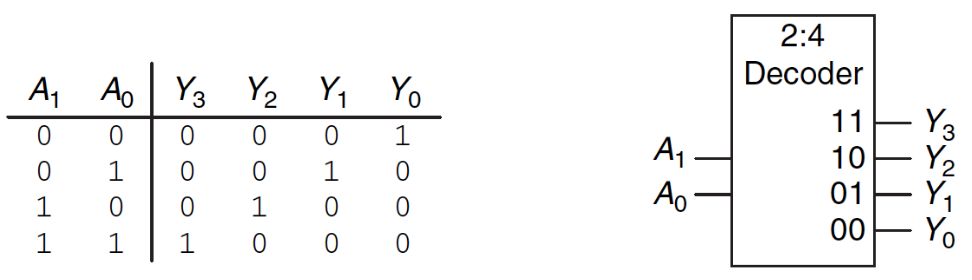
How does a decoder work?
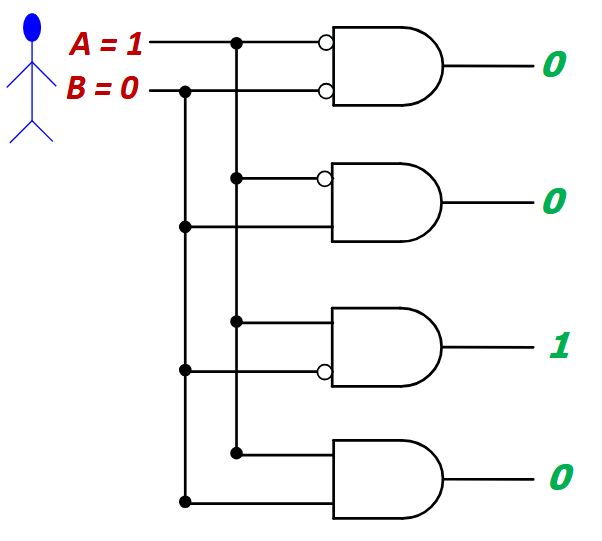
\(n\) inputs and \(2^n\) outputs Exactly one of the outputs is 1 and all the rest are 0s The output that is logically 1 is the output corresponding to the input pattern that the logic circuit is expected to detect A decoder is an "input pattern detector".
Example: 2-to-4 decoder
Field-by-field Comparison
Field
Before
After
Front How does a decoder work?
Back <ol><li>\(n\) inputs and \(2^n\) outputs</li><li>Exactly one of the outputs is 1 and all the rest are 0s</li><li>The output that is logically 1 is the output corresponding to the input pattern that the logic circuit is expected to detect</li></ol><div>A decoder is an "input pattern detector".<br></div><div><br></div><div>Example: 2-to-4 decoder</div><div><img src="paste-41f427073aea6bbe436440d617e8ed5e4b95a46e.jpg"><br></div>
Tags:
ETH::2._Semester::DDCA::02._Combinational_Logic::6._Combinational_Building_Blocks_used_in_Modern_Computers::1._Decoder
Note 50: ETH::2. Semester::DDCA
Deck: ETH::2. Semester::DDCANote Type: Horvath ClozeGUID: oFt2FboU]G
added
Previous
Note did not exist
New Note
Front
ETH::2._Semester::DDCA::02._Combinational_Logic::4._Boolean_Logic_Equations
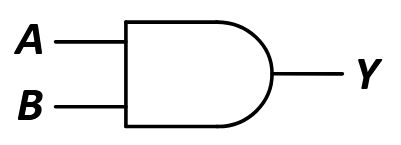
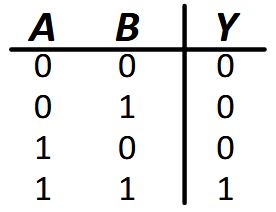
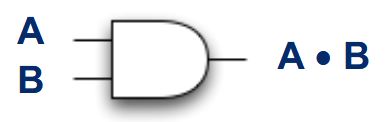
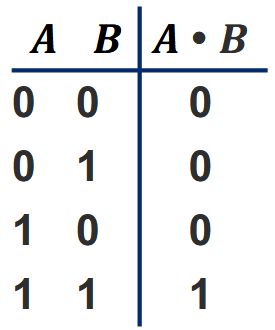
\(A\bullet B\) signifies "A and B" .
Back
ETH::2._Semester::DDCA::02._Combinational_Logic::4._Boolean_Logic_Equations
\(A\bullet B\) signifies "A and B" .
Field-by-field Comparison
Field
Before
After
Text \(A\bullet B\) signifies {{c1::"A and B"}}.
Extra <img src="paste-2a88f83499c002bb4aefd9f0fb723e34a306acc2.jpg"><br><img src="paste-5243b849a82a96a61d8a2a0cb57382d5d754be34.jpg">
Tags:
ETH::2._Semester::DDCA::02._Combinational_Logic::4._Boolean_Logic_Equations
Note 51: ETH::2. Semester::DDCA
Deck: ETH::2. Semester::DDCANote Type: Horvath ClozeGUID: oJl`_}4^pa
added
Previous
Note did not exist
New Note
Front
ETH::2._Semester::DDCA::02._Combinational_Logic::4._Boolean_Logic_Equations
\(X + \overline{X} \bullet Y = X \)
Back
ETH::2._Semester::DDCA::02._Combinational_Logic::4._Boolean_Logic_Equations
\(X + \overline{X} \bullet Y = X \)
Field-by-field Comparison
Field
Before
After
Text \(X + \overline{X} \bullet Y = {{c1::X}}\)
Tags:
ETH::2._Semester::DDCA::02._Combinational_Logic::4._Boolean_Logic_Equations
Note 52: ETH::2. Semester::DDCA
Deck: ETH::2. Semester::DDCANote Type: Horvath ClassicGUID: oUzmIp%E`>
added
Previous
Note did not exist
New Note
Front
ETH::2._Semester::DDCA::02._Combinational_Logic::2._Logic_Gates
What's the formula for dynamic power consumption?
Back
ETH::2._Semester::DDCA::02._Combinational_Logic::2._Logic_Gates
What's the formula for dynamic power consumption?
\(C\cdot V^2\cdot f\)
Field-by-field Comparison
Field
Before
After
Front What's the formula for dynamic power consumption?
Back \(C\cdot V^2\cdot f\)<br><br>\(C =\) capacitance of the circuit (wires and gates)<br>\(V =\) supply voltage<br>\(f =\) charging frequency of the capacitor
Tags:
ETH::2._Semester::DDCA::02._Combinational_Logic::2._Logic_Gates
Note 53: ETH::2. Semester::DDCA
Deck: ETH::2. Semester::DDCANote Type: Horvath ClozeGUID: o`-s)9=Wl[
added
Previous
Note did not exist
New Note
Front
ETH::2._Semester::DDCA::02._Combinational_Logic::6._Combinational_Building_Blocks_used_in_Modern_Computers::2._Multiplexer_(MUX)
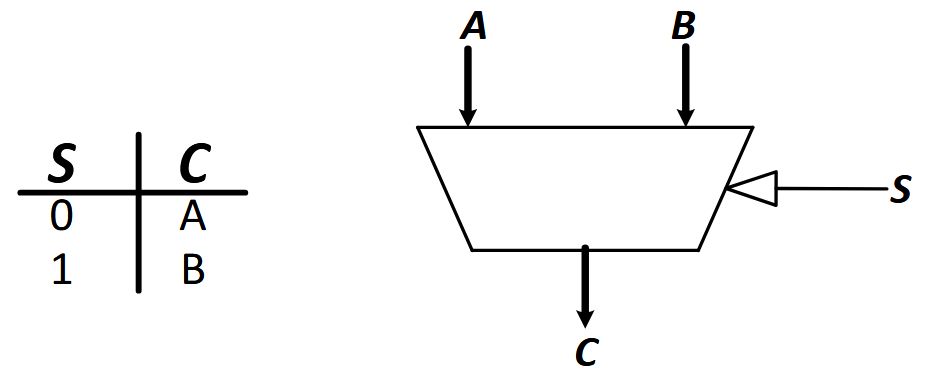
The output C of a MUX is always connected to either the input A or the input B .
Back
ETH::2._Semester::DDCA::02._Combinational_Logic::6._Combinational_Building_Blocks_used_in_Modern_Computers::2._Multiplexer_(MUX)
The output C of a MUX is always connected to either the input A or the input B .
Output value depends on the value of the select line S.
Field-by-field Comparison
Field
Before
After
Text The output C of a MUX is always connected to {{c1::either the input A or the input B}}.
Extra Output value depends on the value of the select line S.<br><br><img src="paste-4208651bb851c0f85958e6a1f06734edf09d758c.jpg">
Tags:
ETH::2._Semester::DDCA::02._Combinational_Logic::6._Combinational_Building_Blocks_used_in_Modern_Computers::2._Multiplexer_(MUX)
Note 54: ETH::2. Semester::DDCA
Deck: ETH::2. Semester::DDCANote Type: Horvath ClassicGUID: p2iMO-L)D:
added
Previous
Note did not exist
New Note
Front
ETH::2._Semester::DDCA::02._Combinational_Logic::1._Transistors
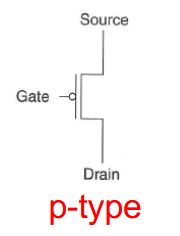
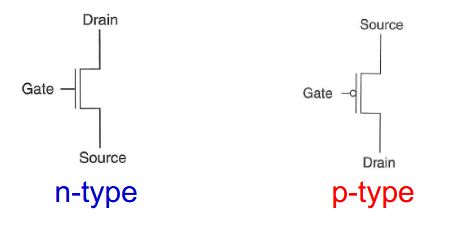
Which type of MOS transistor is this?
Back
ETH::2._Semester::DDCA::02._Combinational_Logic::1._Transistors
Which type of MOS transistor is this?
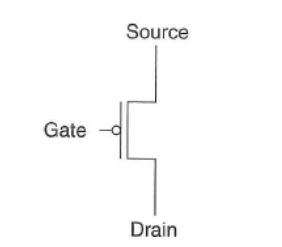
p-type
Field-by-field Comparison
Field
Before
After
Front Which type of MOS transistor is this?<br><br><img src="paste-c2def2ad64ef59d3bc9ea12d95969214b321c975.jpg">
Back p-type
Tags:
ETH::2._Semester::DDCA::02._Combinational_Logic::1._Transistors
Note 55: ETH::2. Semester::DDCA
Deck: ETH::2. Semester::DDCANote Type: Horvath ClozeGUID: p8m/.jeCY9
added
Previous
Note did not exist
New Note
Front
ETH::2._Semester::DDCA::02._Combinational_Logic::2._Logic_Gates
When transistors are in series, the network is ON only if all transistors are ON .
Back
ETH::2._Semester::DDCA::02._Combinational_Logic::2._Logic_Gates
When transistors are in series, the network is ON only if all transistors are ON .
Field-by-field Comparison
Field
Before
After
Text When transistors are in series, the network is ON only if {{c1::all transistors are ON}}.
Tags:
ETH::2._Semester::DDCA::02._Combinational_Logic::2._Logic_Gates
Note 56: ETH::2. Semester::DDCA
Deck: ETH::2. Semester::DDCANote Type: Horvath ClozeGUID: pJ5WeT=%X,
added
Previous
Note did not exist
New Note
Front
ETH::2._Semester::DDCA::02._Combinational_Logic::3._Combinational_Logic_Circuits
Functional specification describes the relationship between inputs and outputs .
Back
ETH::2._Semester::DDCA::02._Combinational_Logic::3._Combinational_Logic_Circuits
Functional specification describes the relationship between inputs and outputs .
Field-by-field Comparison
Field
Before
After
Text Functional specification describes {{c1::the relationship between inputs and outputs}}.
Tags:
ETH::2._Semester::DDCA::02._Combinational_Logic::3._Combinational_Logic_Circuits
Note 57: ETH::2. Semester::DDCA
Deck: ETH::2. Semester::DDCANote Type: Horvath ClozeGUID: q)+B1jCKdJ
added
Previous
Note did not exist
New Note
Front
ETH::2._Semester::DDCA::02._Combinational_Logic::3._Combinational_Logic_Circuits
Timing specification describes the delay between inputs changing and outputs responding .
Back
ETH::2._Semester::DDCA::02._Combinational_Logic::3._Combinational_Logic_Circuits
Timing specification describes the delay between inputs changing and outputs responding .
Field-by-field Comparison
Field
Before
After
Text Timing specification describes {{c1::the delay between inputs changing and outputs responding}}.
Tags:
ETH::2._Semester::DDCA::02._Combinational_Logic::3._Combinational_Logic_Circuits
Note 58: ETH::2. Semester::DDCA
Deck: ETH::2. Semester::DDCANote Type: Horvath ClassicGUID: q1yvsXE,ua
added
Previous
Note did not exist
New Note
Front
ETH::2._Semester::DDCA::02._Combinational_Logic::2._Logic_Gates
Which gate is this?
Back
ETH::2._Semester::DDCA::02._Combinational_Logic::2._Logic_Gates
Which gate is this?
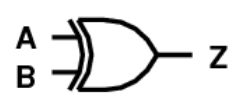
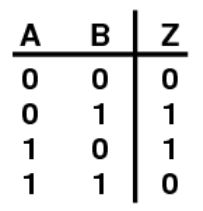
XOR
Field-by-field Comparison
Field
Before
After
Front Which gate is this?<br><br><img src="paste-7d4535880d22382faf2a469bb62f36d71ac1ecd9.jpg">
Back XOR<br><br><img src="paste-fbcccd66f0a26a44febf8dcce68a686e6461715e.jpg">
Tags:
ETH::2._Semester::DDCA::02._Combinational_Logic::2._Logic_Gates
Note 59: ETH::2. Semester::DDCA
Deck: ETH::2. Semester::DDCANote Type: Horvath ClozeGUID: qq
added
Previous
Note did not exist
New Note
Front
ETH::2._Semester::DDCA::02._Combinational_Logic::4._Boolean_Logic_Equations
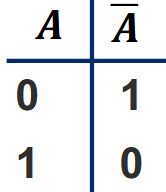
\(\overline A\) signifies "not A" .
Back
ETH::2._Semester::DDCA::02._Combinational_Logic::4._Boolean_Logic_Equations
\(\overline A\) signifies "not A" .
Field-by-field Comparison
Field
Before
After
Text \(\overline A\) signifies {{c1::"not A"}}.
Extra <img src="paste-d885cebb297fd9ce2e11b004403626df910ecefb.jpg"><br><img src="paste-276f415400a598a88e43cf6a665f2766498f5ec1.jpg">
Tags:
ETH::2._Semester::DDCA::02._Combinational_Logic::4._Boolean_Logic_Equations
Note 60: ETH::2. Semester::DDCA
Deck: ETH::2. Semester::DDCANote Type: Horvath ClozeGUID: rJHb8Hi/z_
added
Previous
Note did not exist
New Note
Front
ETH::2._Semester::DDCA::02._Combinational_Logic::5._Using_Boolean_Equations_to_Represent_a_Logic_Circuit
Sum of Products Form is equivalent to DNF/minterm expansion .
Back
ETH::2._Semester::DDCA::02._Combinational_Logic::5._Using_Boolean_Equations_to_Represent_a_Logic_Circuit
Sum of Products Form is equivalent to DNF/minterm expansion .
Field-by-field Comparison
Field
Before
After
Text Sum of Products Form is equivalent to {{c1::DNF/minterm expansion}}.
Extra <img src="paste-49bc2215747c5b28dbf9a8675f61e9ebdb61648d.jpg">
Tags:
ETH::2._Semester::DDCA::02._Combinational_Logic::5._Using_Boolean_Equations_to_Represent_a_Logic_Circuit
Note 61: ETH::2. Semester::DDCA
Deck: ETH::2. Semester::DDCANote Type: Horvath ClassicGUID: rKhGk@]2@!
added
Previous
Note did not exist
New Note
Front
ETH::2._Semester::DDCA::02._Combinational_Logic::2._Logic_Gates
What is dynamic power consumption?
Back
ETH::2._Semester::DDCA::02._Combinational_Logic::2._Logic_Gates
What is dynamic power consumption?
Power used to charge capacitance as signals change (0 <==> 1).
Field-by-field Comparison
Field
Before
After
Front What is dynamic power consumption?
Back Power used to charge capacitance as signals change (0 <==> 1).
Tags:
ETH::2._Semester::DDCA::02._Combinational_Logic::2._Logic_Gates
Note 62: ETH::2. Semester::DDCA
Deck: ETH::2. Semester::DDCANote Type: Horvath ClozeGUID: rUfqRU)=~O
added
Previous
Note did not exist
New Note
Front
ETH::2._Semester::DDCA::02._Combinational_Logic::4._Boolean_Logic_Equations
\((X + \overline{Y}) \bullet Y = X \bullet Y \)
Back
ETH::2._Semester::DDCA::02._Combinational_Logic::4._Boolean_Logic_Equations
\((X + \overline{Y}) \bullet Y = X \bullet Y \)
Field-by-field Comparison
Field
Before
After
Text \((X + \overline{Y}) \bullet Y ={{c1:: X \bullet Y}}\)
Tags:
ETH::2._Semester::DDCA::02._Combinational_Logic::4._Boolean_Logic_Equations
Note 63: ETH::2. Semester::DDCA
Deck: ETH::2. Semester::DDCANote Type: Horvath ClassicGUID: rpAXFA;B;z
added
Previous
Note did not exist
New Note
Front
ETH::2._Semester::DDCA::02._Combinational_Logic::1._Transistors
What are the two types of MOS transistors?
Back
ETH::2._Semester::DDCA::02._Combinational_Logic::1._Transistors
What are the two types of MOS transistors?
Field-by-field Comparison
Field
Before
After
Front What are the two types of MOS transistors?
Back <img src="paste-38750c04faf9612e70d859133acd28c824b5e12a.jpg">
Tags:
ETH::2._Semester::DDCA::02._Combinational_Logic::1._Transistors
Note 64: ETH::2. Semester::DDCA
Deck: ETH::2. Semester::DDCANote Type: Horvath ClassicGUID: r|D(YkEEE$
added
Previous
Note did not exist
New Note
Front
ETH::2._Semester::DDCA::02._Combinational_Logic::5._Using_Boolean_Equations_to_Represent_a_Logic_Circuit
Back
ETH::2._Semester::DDCA::02._Combinational_Logic::5._Using_Boolean_Equations_to_Represent_a_Logic_Circuit
What is a maxterm?
A sum (OR) that includes all input variables.
Field-by-field Comparison
Field
Before
After
Front What is a maxterm?
Back A sum (OR) that includes all input variables.<br><br>\((A + \overline{B} + \overline{C}) \text{ , } (\overline{A} + B + \overline{C}) \text{ , } (A + B + \overline{C})\)
Tags:
ETH::2._Semester::DDCA::02._Combinational_Logic::5._Using_Boolean_Equations_to_Represent_a_Logic_Circuit
Note 65: ETH::2. Semester::DDCA
Deck: ETH::2. Semester::DDCANote Type: Horvath ClozeGUID: sKY>s3R]!/
added
Previous
Note did not exist
New Note
Front
ETH::2._Semester::DDCA::02._Combinational_Logic::2._Logic_Gates
n -type transistors are good at pulling down the voltage.
Back
ETH::2._Semester::DDCA::02._Combinational_Logic::2._Logic_Gates
n -type transistors are good at pulling down the voltage.
Field-by-field Comparison
Field
Before
After
Text <b>n</b>-type transistors are good at pulling {{c1::dow<b>n</b>}} the voltage.
Tags:
ETH::2._Semester::DDCA::02._Combinational_Logic::2._Logic_Gates
Note 66: ETH::2. Semester::DDCA
Deck: ETH::2. Semester::DDCANote Type: Horvath ClozeGUID: sbwM<`YNbS
added
Previous
Note did not exist
New Note
Front
ETH::2._Semester::DDCA::02._Combinational_Logic::2._Logic_Gates
To get from voltages to binary values, we can:
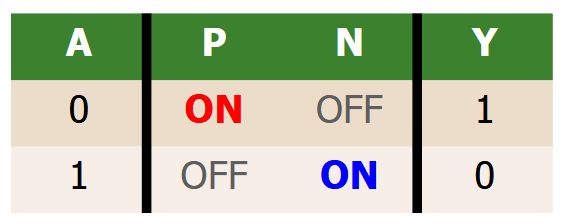
Interpret 0V as logical (binary) 0 value Interpret 3V as logical (binary) 1 value
Back
ETH::2._Semester::DDCA::02._Combinational_Logic::2._Logic_Gates
To get from voltages to binary values, we can:
Interpret 0V as logical (binary) 0 value Interpret 3V as logical (binary) 1 value In the case of the CMOS NOT Gate we then get:
Field-by-field Comparison
Field
Before
After
Text To get from voltages to binary values, we can:<br><ol><li>{{c1::Interpret 0V as logical (binary) 0 value}}</li><li>{{c2::Interpret 3V as logical (binary) 1 value}}</li></ol>
Extra In the case of the CMOS NOT Gate we then get:<br><br><img src="paste-8bcf6f5a5119256afed57796735aa3578f88b21e.jpg"><br><img src="paste-1ea8562646d826a66676f32131724f1287dda84a.jpg">
Tags:
ETH::2._Semester::DDCA::02._Combinational_Logic::2._Logic_Gates
Note 67: ETH::2. Semester::DDCA
Deck: ETH::2. Semester::DDCANote Type: Horvath ClassicGUID: tP[&0m}1Mi
added
Previous
Note did not exist
New Note
Front
ETH::2._Semester::DDCA::02._Combinational_Logic::2._Logic_Gates
What's the critical rule for the networks in a CMOS Gate?
Back
ETH::2._Semester::DDCA::02._Combinational_Logic::2._Logic_Gates
What's the critical rule for the networks in a CMOS Gate?
Exactly one network should be ON, and the other network should be OFF at any given time!
If both networks are ON at the same time, there is a short circuit → likely incorrect operation. If both networks are OFF at the same time, the output is floating → undefined.
Field-by-field Comparison
Field
Before
After
Front What's the critical rule for the networks in a CMOS Gate?<br><br><img src="paste-73917895a320d3ecb9ef27c6b1a82a66e418278e.jpg">
Back Exactly one network should be ON, and the other network should be OFF at any given time!<br><div><ul><li>If both networks are ON at the same time, there is a <strong>short circuit</strong> → likely incorrect operation.</li><li>If both networks are OFF at the same time, the output is <strong>floating</strong> → undefined.</li></ul></div>
Tags:
ETH::2._Semester::DDCA::02._Combinational_Logic::2._Logic_Gates
Note 68: ETH::2. Semester::DDCA
Deck: ETH::2. Semester::DDCANote Type: Horvath ClozeGUID: vK&i;bo$O;
added
Previous
Note did not exist
New Note
Front
ETH::2._Semester::DDCA::02._Combinational_Logic::2._Logic_Gates
MOS transistors are imperfect switches.
Back
ETH::2._Semester::DDCA::02._Combinational_Logic::2._Logic_Gates
MOS transistors are imperfect switches.
pMOS transistors pass I's well but 0's poorly (holes carry charge).
Field-by-field Comparison
Field
Before
After
Text MOS transistors are {{c1::imperfect}} switches.
Extra pMOS transistors pass I's well but 0's poorly (holes carry charge).<br>nMOS transistors pass 0's well but I's poorly (electrons carry charge).<br><br>This is why AND is built with NAND + NOT.
Tags:
ETH::2._Semester::DDCA::02._Combinational_Logic::2._Logic_Gates
Note 69: ETH::2. Semester::DDCA
Deck: ETH::2. Semester::DDCANote Type: Horvath ClassicGUID: vw*z~aw+{D
added
Previous
Note did not exist
New Note
Front
ETH::2._Semester::DDCA::02._Combinational_Logic::5._Using_Boolean_Equations_to_Represent_a_Logic_Circuit
Convert this function to canonical form:
Back
ETH::2._Semester::DDCA::02._Combinational_Logic::5._Using_Boolean_Equations_to_Represent_a_Logic_Circuit
Convert this function to canonical form:
\(\begin{aligned} F(A,B,C) &= \sum m(3,4,5,6,7) \\ &= m3 + m4 + m5 + m6 + m7 \end{aligned}\)
Field-by-field Comparison
Field
Before
After
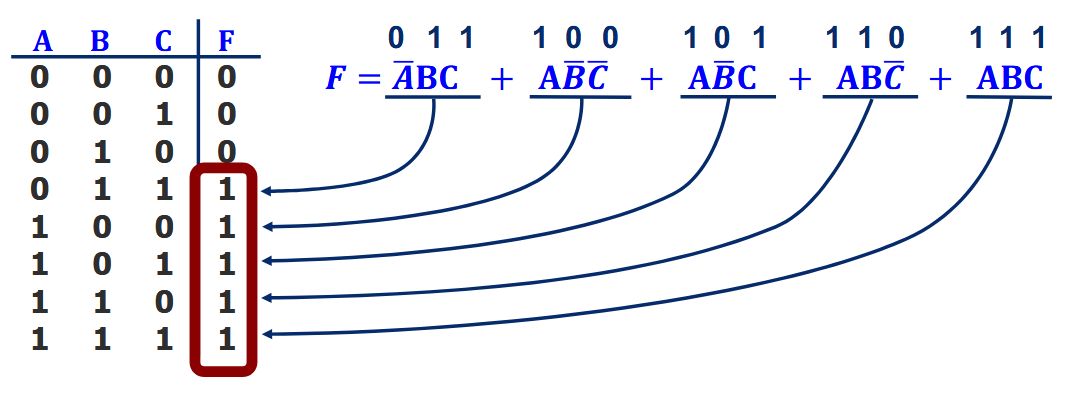
Front Convert this function to canonical form:<br><br><img src="paste-e22b6a65df1ec4c9f35c5bf2af9104214c84683f.jpg">
Back \(\begin{aligned} F(A,B,C) &= \sum m(3,4,5,6,7) \\ &= m3 + m4 + m5 + m6 + m7 \end{aligned}\)<br><br>\(F = \overline{A}BC + A\overline{B}\overline{C} + A\overline{B}C + AB\overline{C} + ABC\)<br><br>Not that this isn't minimal form! \(\Rightarrow F = A + BC\)
Tags:
ETH::2._Semester::DDCA::02._Combinational_Logic::5._Using_Boolean_Equations_to_Represent_a_Logic_Circuit
Note 70: ETH::2. Semester::DDCA
Deck: ETH::2. Semester::DDCANote Type: Horvath ClassicGUID: w&0_XH~|nL
added
Previous
Note did not exist
New Note
Front
ETH::2._Semester::DDCA::02._Combinational_Logic::2._Logic_Gates
Which gate is this?
Back
ETH::2._Semester::DDCA::02._Combinational_Logic::2._Logic_Gates
Which gate is this?
OR
Field-by-field Comparison
Field
Before
After
Front Which gate is this?<br><img src="paste-b40d93ca272769316a76dd3bc8a249b2fae10128.jpg">
Back OR<br><br><img src="paste-6e4c2dfe3e807b8506390c3ddfbe974380e318d2.jpg">
Tags:
ETH::2._Semester::DDCA::02._Combinational_Logic::2._Logic_Gates
Note 71: ETH::2. Semester::DDCA
Deck: ETH::2. Semester::DDCANote Type: Horvath ClassicGUID: wfjJW35xJe
added
Previous
Note did not exist
New Note
Front
ETH::2._Semester::DDCA::02._Combinational_Logic::2._Logic_Gates
Which gate is this?
Back
ETH::2._Semester::DDCA::02._Combinational_Logic::2._Logic_Gates
Which gate is this?
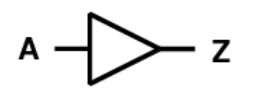
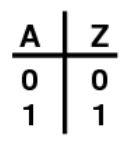
Buffer
Field-by-field Comparison
Field
Before
After
Front Which gate is this?<br><br><img src="paste-ec6272f8168e59f9e10c0a00d75245c19c05bf8d.jpg">
Back Buffer<br><br><img src="paste-a84f4ec12787c4f030593835d9c2ce773bf394d6.jpg">
Tags:
ETH::2._Semester::DDCA::02._Combinational_Logic::2._Logic_Gates
Note 72: ETH::2. Semester::DDCA
Deck: ETH::2. Semester::DDCANote Type: Horvath ClassicGUID: x,YN;U)u48
added
Previous
Note did not exist
New Note
Front
ETH::2._Semester::DDCA::02._Combinational_Logic::2._Logic_Gates
What's the formula for static power consumption?
Back
ETH::2._Semester::DDCA::02._Combinational_Logic::2._Logic_Gates
What's the formula for static power consumption?
\(V\cdot I_\text{leakage}\)
Field-by-field Comparison
Field
Before
After
Front What's the formula for static power consumption?
Back \(V\cdot I_\text{leakage}\)<br><br>(supply voltage * leakage current)
Tags:
ETH::2._Semester::DDCA::02._Combinational_Logic::2._Logic_Gates
Note 73: ETH::2. Semester::DDCA
Deck: ETH::2. Semester::DDCANote Type: Horvath ClozeGUID: xJUzR))XQ)
added
Previous
Note did not exist
New Note
Front
ETH::2._Semester::DDCA::02._Combinational_Logic::2._Logic_Gates
When transistors are in parallel, the network is ON if one of the transistors is ON .
Back
ETH::2._Semester::DDCA::02._Combinational_Logic::2._Logic_Gates
When transistors are in parallel, the network is ON if one of the transistors is ON .
Field-by-field Comparison
Field
Before
After
Text When transistors are in parallel, the network is ON if {{c1::one of the transistors is ON}}.
Tags:
ETH::2._Semester::DDCA::02._Combinational_Logic::2._Logic_Gates
Note 74: ETH::2. Semester::DDCA
Deck: ETH::2. Semester::DDCANote Type: Horvath ClozeGUID: y$t0Kq)TQh
added
Previous
Note did not exist
New Note
Front
ETH::2._Semester::DDCA::02._Combinational_Logic::6._Combinational_Building_Blocks_used_in_Modern_Computers::1._Decoder
The decoder is useful in determining how to interpret a bit pattern.
Back
ETH::2._Semester::DDCA::02._Combinational_Logic::6._Combinational_Building_Blocks_used_in_Modern_Computers::1._Decoder
The decoder is useful in determining how to interpret a bit pattern.
Field-by-field Comparison
Field
Before
After
Text The {{c1::decoder}} is useful in determining how to interpret a bit pattern.
Extra <img src="paste-1ce8f7a9f880338a7d797182beb4be144fe192e6.jpg">
Tags:
ETH::2._Semester::DDCA::02._Combinational_Logic::6._Combinational_Building_Blocks_used_in_Modern_Computers::1._Decoder
Note 75: ETH::2. Semester::DDCA
Deck: ETH::2. Semester::DDCANote Type: Horvath ClassicGUID: {Na1}u5VN
added
Previous
Note did not exist
New Note
Front
ETH::2._Semester::DDCA::02._Combinational_Logic::5._Using_Boolean_Equations_to_Represent_a_Logic_Circuit
How can we convert from Minterm to Maxterm?
Back
ETH::2._Semester::DDCA::02._Combinational_Logic::5._Using_Boolean_Equations_to_Represent_a_Logic_Circuit
How can we convert from Minterm to Maxterm?
Rewrite minterm shorthand using maxterm shorthand Replace minterm indices with the indices not already used E.g., \(F(A,B,C) = \sum m(3,4,5,6,7) = \prod M(0,1,2)\)
Field-by-field Comparison
Field
Before
After
Front How can we convert from Minterm to Maxterm?
Back <ol><li>Rewrite minterm shorthand using maxterm shorthand</li><li>Replace minterm indices with the indices not already used</li></ol>E.g., \(F(A,B,C) = \sum m(3,4,5,6,7) = \prod M(0,1,2)\)
Tags:
ETH::2._Semester::DDCA::02._Combinational_Logic::5._Using_Boolean_Equations_to_Represent_a_Logic_Circuit