Note 1: ETH::A&D
Deck: ETH::A&D
Note Type: Algorithms
GUID: F^nhYx>fXl
modified
Before
Back
ETH::1._Semester::A&D::11._Minimum_Spanning_Trees::1._Boruvka's_Algorithm PlsFix::AD_Algo
Runtime of
Boruvka
Runtime:
Approach: Add all vertices to the set of components (so every vertex has its own component). As long as the size of the components set is greater than 1, connect each component to the one with the cheapest edge.
Uses: Find MST in weighted, undirected graph
?
After
Back
ETH::1._Semester::A&D::11._Minimum_Spanning_Trees::1._Boruvka's_Algorithm PlsFix::AD_Algo
Runtime of
Boruvka
Runtime:
Approach: Add all vertices to the set of components (so every vertex has its own component). As long as the size of the components set is greater than 1, connect each component to the one with the cheapest edge.
Uses: Find MST in weighted, undirected graph
?
Field-by-field Comparison
| Field |
Before |
After |
| Approach |
|
<ol><li>For Boruvka, we start with the set of edges \(F = \emptyset\). We treat each of the <em>isolated vertices</em> of the graph as it’s <em>own connected component</em>.</li><li>Each vertex marks it’s cheapest outgoing edge as a <em>safe edge</em> (making use of the cut property). We add these to \(F\).</li></ol><ul><li>Note that some of the edges might be chosen by both adjacent vertices, we still only add them once.<br><img src="paste-053ccf0acc6d560628bd8518b928a0d6c2687cb1.jpg"></li></ul><ol><li>Now, repeat by finding the cheapest outgoing edge for each component. Do this until all are connected.</li><li>\(F\) constitutes the edges of the MST.</li></ol> |
Tags:
ETH::1._Semester::A&D::11._Minimum_Spanning_Trees::1._Boruvka's_Algorithm
PlsFix::AD_Algo
Note 2: ETH::A&D
Deck: ETH::A&D
Note Type: Horvath Classic
GUID: mMw-t6k&nH
modified
Before
Front
DUPLICATE ETH::1._Semester::A&D::11._Minimum_Spanning_Trees::1._Boruvka's_Algorithm
Describe the steps of Boruvka's Algorithm:
Back
DUPLICATE ETH::1._Semester::A&D::11._Minimum_Spanning_Trees::1._Boruvka's_Algorithm
Describe the steps of Boruvka's Algorithm:
- For Boruvka, we start with the set of edges \(F = \emptyset\). We treat each of the isolated vertices of the graph as it’s own connected component.
- Each vertex marks it’s cheapest outgoing edge as a safe edge (making use of the cut property). We add these to \(F\).
- Note that some of the edges might be chosen by both adjacent vertices, we still only add them once._
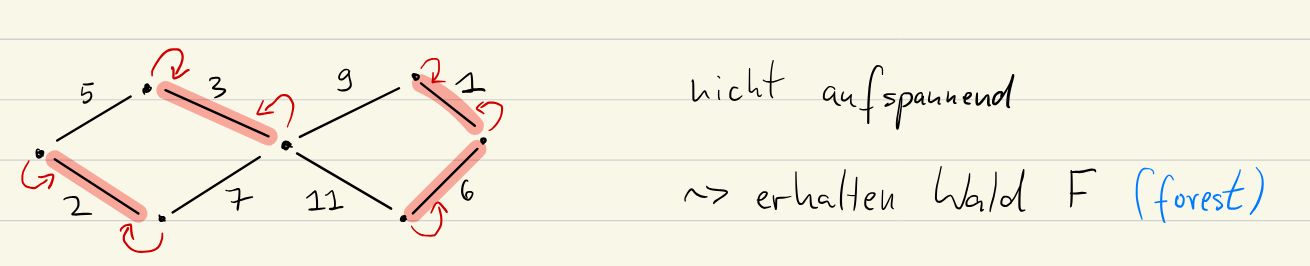
- Now, repeat by finding the cheapest outgoing edge for each component. Do this until all are connected.
- \(F\) constitutes the edges of the MST.
After
Front
ETH::1._Semester::A&D::11._Minimum_Spanning_Trees::1._Boruvka's_Algorithm PlsFix::DUPLICATE
Describe the steps of Boruvka's Algorithm:
Back
ETH::1._Semester::A&D::11._Minimum_Spanning_Trees::1._Boruvka's_Algorithm PlsFix::DUPLICATE
Describe the steps of Boruvka's Algorithm:
- For Boruvka, we start with the set of edges \(F = \emptyset\). We treat each of the isolated vertices of the graph as it’s own connected component.
- Each vertex marks it’s cheapest outgoing edge as a safe edge (making use of the cut property). We add these to \(F\).
- Note that some of the edges might be chosen by both adjacent vertices, we still only add them once.
- Now, repeat by finding the cheapest outgoing edge for each component. Do this until all are connected.
- \(F\) constitutes the edges of the MST.
Field-by-field Comparison
| Field |
Before |
After |
| Back |
<ol><br><li>For Boruvka, we start with the set of edges \(F = \emptyset\). We treat each of the <em>isolated vertices</em> of the graph as it’s <em>own connected component</em>.</li><li>Each vertex marks it’s cheapest outgoing edge as a <em>safe edge</em> (making use of the cut property). We add these to \(F\).</li></ol><ul><li>Note that some of the edges might be chosen by both adjacent vertices, we still only add them once._<br><img src="paste-053ccf0acc6d560628bd8518b928a0d6c2687cb1.jpg"></li></ul><ol><li>Now, repeat by finding the cheapest outgoing edge for each component. Do this until all are connected.</li><li>\(F\) constitutes the edges of the MST.</li></ol> |
<ol><br><li>For Boruvka, we start with the set of edges \(F = \emptyset\). We treat each of the <em>isolated vertices</em> of the graph as it’s <em>own connected component</em>.</li><li>Each vertex marks it’s cheapest outgoing edge as a <em>safe edge</em> (making use of the cut property). We add these to \(F\).</li></ol><ul><li>Note that some of the edges might be chosen by both adjacent vertices, we still only add them once.<br><img src="paste-053ccf0acc6d560628bd8518b928a0d6c2687cb1.jpg"></li></ul><ol><li>Now, repeat by finding the cheapest outgoing edge for each component. Do this until all are connected.</li><li>\(F\) constitutes the edges of the MST.</li></ol> |
Tags:
DUPLICATE
ETH::1._Semester::A&D::11._Minimum_Spanning_Trees::1._Boruvka's_Algorithm
PlsFix::DUPLICATE
Note 3: ETH::A&D
Deck: ETH::A&D
Note Type: Horvath Classic
GUID: N@-]h|e+xG
modified
Before
Front
ETH::1._Semester::A&D::07._Graphs::1._Introduction_to_Graphs PlsFix::ClozeThatBish
How can we represent a graph and what are the runtimes of common operations in them?
Back
ETH::1._Semester::A&D::07._Graphs::1._Introduction_to_Graphs PlsFix::ClozeThatBish
How can we represent a graph and what are the runtimes of common operations in them?
1. Adjacency matrix
check if \(uv \in E \rightarrow O(1)\)
given a vertex \(u\) we can find all adjacent vertices in \(O(n)\)
2. Adjacency lists
check if \(uv \in E \rightarrow O(1 + \min\{\text{deg}(u), \text{deg}(v) \})\) (we have to check the smaller of the two adjacency lists
given a vertex \(u\) we can find all adjacent vertices in \(O(1+\text{deg}(u) )\)
After
Front
ETH::1._Semester::A&D::07._Graphs::1._Introduction_to_Graphs
Runtime: Operations in an Adjacency List:
Back
ETH::1._Semester::A&D::07._Graphs::1._Introduction_to_Graphs
Runtime: Operations in an Adjacency List:
1. Check if \(uv \in E \): \(O(1 + \min\{\text{deg}(u), \text{deg}(v) \})\) (we have to check the smaller of the two adjacency lists
2. Vertex \(u\), find all adjacent vertices: \(O(1+\text{deg}(u) )\)
Field-by-field Comparison
| Field |
Before |
After |
| Front |
How can we represent a graph and what are the runtimes of common operations in them? |
<b>Runtime</b>: Operations in an Adjacency <b>List</b>: |
| Back |
<b>1. Adjacency matrix</b><br>check if \(uv \in E \rightarrow O(1)\)<br>given a vertex \(u\) we can find all adjacent vertices in \(O(n)\) <br><b>2. Adjacency lists<br></b>check if \(uv \in E \rightarrow O(1 + \min\{\text{deg}(u), \text{deg}(v) \})\) (we have to check the smaller of the two adjacency lists<br>given a vertex \(u\) we can find all adjacent vertices in \(O(1+\text{deg}(u) )\) |
1. Check if \(uv \in E \): \(O(1 + \min\{\text{deg}(u), \text{deg}(v) \})\) (we have to check the smaller of the two adjacency lists<br>2. Vertex \(u\), find all adjacent vertices: \(O(1+\text{deg}(u) )\) |
Tags:
PlsFix::ClozeThatBish
ETH::1._Semester::A&D::07._Graphs::1._Introduction_to_Graphs
Note 4: ETH::A&D
Deck: ETH::A&D
Note Type: Horvath Classic
GUID: mabS@W|F#G
modified
Before
Front
ETH::1._Semester::A&D::08._Directed_Graphs::2._Topological_Sorting PlsFix::ClozeThatBish
Intuitively describe a topological sorting of a directed graph.
Back
ETH::1._Semester::A&D::08._Directed_Graphs::2._Topological_Sorting PlsFix::ClozeThatBish
Intuitively describe a topological sorting of a directed graph.
it is a sorting of the vertices of a directed graph, which we can build from the back by always finding a vertex which has no succeeding vertices, remove it from the graph and add it to the front of our topologically sorted list.
This is not possible if there is a directed cycle in the graph.
The resulting list can be useful for example when we interpret all preceeding nodes as requirements for the succeeding node, then the topological sort is a valid way to fulfill these requirements
After
Front
ETH::1._Semester::A&D::08._Directed_Graphs::2._Topological_Sorting
Explain how to find a topological order (high-level):
Back
ETH::1._Semester::A&D::08._Directed_Graphs::2._Topological_Sorting
Explain how to find a topological order (high-level):
it is a sorting of the vertices of a directed graph, which we can build from the back by always finding a vertex which has no succeeding vertices, remove it from the graph and add it to the front of our topologically sorted list.
This is not possible if there is a directed cycle in the graph.
Field-by-field Comparison
| Field |
Before |
After |
| Front |
Intuitively describe a topological sorting of a directed graph. |
Explain how to find a topological order (high-level): |
| Back |
it is a sorting of the vertices of a directed graph, which we can build from the back by always finding a vertex which has no succeeding vertices, remove it from the graph and add it to the front of our topologically sorted list.<br><br>This is not possible if there is a directed cycle in the graph.<br><br>The resulting list can be useful for example when we interpret all preceeding nodes as requirements for the succeeding node, then the topological sort is a valid way to fulfill these requirements |
it is a sorting of the vertices of a directed graph, which we can build from the back by always finding a vertex which has no succeeding vertices, remove it from the graph and add it to the front of our topologically sorted list.<br><br>This is not possible if there is a directed cycle in the graph. |
Tags:
PlsFix::ClozeThatBish
ETH::1._Semester::A&D::08._Directed_Graphs::2._Topological_Sorting
Note 5: ETH::A&D
Deck: ETH::A&D
Note Type: Horvath Classic
GUID: M?qP8s.,s4
added
Previous
Note did not exist
New Note
Front
ETH::1._Semester::A&D::07._Graphs::1._Introduction_to_Graphs
How can we represent a graph?
Back
ETH::1._Semester::A&D::07._Graphs::1._Introduction_to_Graphs
How can we represent a graph?
1. Adjacency matrix
2. Adjacency lists
Field-by-field Comparison
| Field |
Before |
After |
| Front |
|
How can we represent a graph? |
| Back |
|
<b>1. </b>Adjacency<b> matrix<br>2. </b>Adjacency<b> lists</b> |
Tags:
ETH::1._Semester::A&D::07._Graphs::1._Introduction_to_Graphs
Note 6: ETH::A&D
Deck: ETH::A&D
Note Type: Horvath Classic
GUID: ra?I5x|G>*
added
Previous
Note did not exist
New Note
Front
ETH::1._Semester::A&D::07._Graphs::1._Introduction_to_Graphs
Runtime: Operations in an Adjacency Matrix:
Back
ETH::1._Semester::A&D::07._Graphs::1._Introduction_to_Graphs
Runtime: Operations in an Adjacency Matrix:
1. check if \(uv \in E\): \(O(1)\)
2. Vertex \(u\) , find all adjacent vertices in: \(O(n)\)
Field-by-field Comparison
| Field |
Before |
After |
| Front |
|
<b>Runtime</b>: Operations in an Adjacency <b>Matrix</b>: |
| Back |
|
1. check if \(uv \in E\): \(O(1)\)<br>2. Vertex \(u\) , find all adjacent vertices in: \(O(n)\) |
Tags:
ETH::1._Semester::A&D::07._Graphs::1._Introduction_to_Graphs
Note 7: ETH::DiskMat
Deck: ETH::DiskMat
Note Type: Horvath Cloze
GUID: ykM`*q&]Lu
modified
Before
Front
ETH::1._Semester::DiskMat::2._Math._Reasoning,_Proofs,_and_a_First_Approach_to_Logic::3._A_First_Introduction_to_Propositional_Logic::3._Logical_Equivalence_and_some_Basic_Laws PlsFix::ClozeThatBish
What does it mean for two formulas \(F\) and \(G\) to be logically equivalent (\(F \equiv G\))?
Back
ETH::1._Semester::DiskMat::2._Math._Reasoning,_Proofs,_and_a_First_Approach_to_Logic::3._A_First_Introduction_to_Propositional_Logic::3._Logical_Equivalence_and_some_Basic_Laws PlsFix::ClozeThatBish
What does it mean for two formulas \(F\) and \(G\) to be logically equivalent (\(F \equiv G\))?
\(F \equiv G\) means they correspond to the same function, i.e., their truth values are equal for all truth assignments to the propositional symbols appearing in \(F\) or \(G\).
After
Front
ETH::1._Semester::DiskMat::2._Math._Reasoning,_Proofs,_and_a_First_Approach_to_Logic::3._A_First_Introduction_to_Propositional_Logic::3._Logical_Equivalence_and_some_Basic_Laws
\(F \equiv G\) means they correspond to the same function, i.e., their truth values are equal for all truth assignments to the propositional symbols appearing in \(F\) or \(G\).
Back
ETH::1._Semester::DiskMat::2._Math._Reasoning,_Proofs,_and_a_First_Approach_to_Logic::3._A_First_Introduction_to_Propositional_Logic::3._Logical_Equivalence_and_some_Basic_Laws
\(F \equiv G\) means they correspond to the same function, i.e., their truth values are equal for all truth assignments to the propositional symbols appearing in \(F\) or \(G\).
Field-by-field Comparison
| Field |
Before |
After |
| Text |
What does it mean for two formulas \(F\) and \(G\) to be logically equivalent (\(F \equiv G\))? |
{{c2::\(F \equiv G\)}} means {{c1:: they correspond to the same function}}, i.e., {{c3:: their truth values are equal for <strong>all</strong> truth assignments to the propositional symbols appearing in \(F\) or \(G\)}}. |
| Extra |
\(F \equiv G\) means they correspond to the same function, i.e., their truth values are equal for <strong>all</strong> truth assignments to the propositional symbols appearing in \(F\) or \(G\). |
|
Tags:
PlsFix::ClozeThatBish
ETH::1._Semester::DiskMat::2._Math._Reasoning,_Proofs,_and_a_First_Approach_to_Logic::3._A_First_Introduction_to_Propositional_Logic::3._Logical_Equivalence_and_some_Basic_Laws
Note 8: ETH::DiskMat
Deck: ETH::DiskMat
Note Type: Horvath Cloze
GUID: lNUw/[p~+9
modified
Before
Front
ETH::1._Semester::DiskMat::2._Math._Reasoning,_Proofs,_and_a_First_Approach_to_Logic::3._A_First_Introduction_to_Propositional_Logic::6._Tautologies_and_Satisfiability PlsFix::ClozeThatBish
What is a tautology in propositional logic?
Back
ETH::1._Semester::DiskMat::2._Math._Reasoning,_Proofs,_and_a_First_Approach_to_Logic::3._A_First_Introduction_to_Propositional_Logic::6._Tautologies_and_Satisfiability PlsFix::ClozeThatBish
What is a tautology in propositional logic?
A formula \(F\) is a tautology (or valid) if it is true for all truth assignments of the involved propositional symbols. Denoted as \(\models F\) or \(\top\).
After
Front
ETH::1._Semester::DiskMat::2._Math._Reasoning,_Proofs,_and_a_First_Approach_to_Logic::3._A_First_Introduction_to_Propositional_Logic::6._Tautologies_and_Satisfiability
A formula \(F\) is a tautology (or valid) if it is true for all truth assignments of the involved propositional symbols. Denoted as \(\models F\) or \(\top\).
Back
ETH::1._Semester::DiskMat::2._Math._Reasoning,_Proofs,_and_a_First_Approach_to_Logic::3._A_First_Introduction_to_Propositional_Logic::6._Tautologies_and_Satisfiability
A formula \(F\) is a tautology (or valid) if it is true for all truth assignments of the involved propositional symbols. Denoted as \(\models F\) or \(\top\).
Field-by-field Comparison
| Field |
Before |
After |
| Text |
What is a tautology in propositional logic? |
A formula \(F\) is a {{c1:: tautology (or valid)}} if it {{c2:: is true for <strong>all</strong> truth assignments of the involved propositional symbols}}. Denoted as {{c3:: \(\models F\) or \(\top\)}}. |
| Extra |
A formula \(F\) is a tautology (or valid) if it is true for <strong>all</strong> truth assignments of the involved propositional symbols. Denoted as \(\models F\) or \(\top\). |
|
Tags:
PlsFix::ClozeThatBish
ETH::1._Semester::DiskMat::2._Math._Reasoning,_Proofs,_and_a_First_Approach_to_Logic::3._A_First_Introduction_to_Propositional_Logic::6._Tautologies_and_Satisfiability
Note 9: ETH::DiskMat
Deck: ETH::DiskMat
Note Type: Horvath Cloze
GUID: dNOrR*l4!S
modified
Before
Front
ETH::1._Semester::DiskMat::2._Math._Reasoning,_Proofs,_and_a_First_Approach_to_Logic::3._A_First_Introduction_to_Propositional_Logic::6._Tautologies_and_Satisfiability PlsFix::ClozeThatBish
What does it mean for a formula to be satisfiable?
Back
ETH::1._Semester::DiskMat::2._Math._Reasoning,_Proofs,_and_a_First_Approach_to_Logic::3._A_First_Introduction_to_Propositional_Logic::6._Tautologies_and_Satisfiability PlsFix::ClozeThatBish
What does it mean for a formula to be satisfiable?
A formula \(F\) is satisfiable if it is true for at least one truth assignment of the involved propositional symbols.
After
Front
ETH::1._Semester::DiskMat::2._Math._Reasoning,_Proofs,_and_a_First_Approach_to_Logic::3._A_First_Introduction_to_Propositional_Logic::6._Tautologies_and_Satisfiability
A formula \(F\) is satisfiable if it is true for at least one truth assignment of the involved propositional symbols.
Back
ETH::1._Semester::DiskMat::2._Math._Reasoning,_Proofs,_and_a_First_Approach_to_Logic::3._A_First_Introduction_to_Propositional_Logic::6._Tautologies_and_Satisfiability
A formula \(F\) is satisfiable if it is true for at least one truth assignment of the involved propositional symbols.
Field-by-field Comparison
| Field |
Before |
After |
| Text |
What does it mean for a formula to be satisfiable? |
A formula \(F\) is {{c1:: satisfiable}} if it {{c2:: is true for <strong>at least one</strong> truth assignment of the involved propositional symbols}}. |
| Extra |
A formula \(F\) is satisfiable if it is true for <strong>at least one</strong> truth assignment of the involved propositional symbols. |
|
Tags:
PlsFix::ClozeThatBish
ETH::1._Semester::DiskMat::2._Math._Reasoning,_Proofs,_and_a_First_Approach_to_Logic::3._A_First_Introduction_to_Propositional_Logic::6._Tautologies_and_Satisfiability
Note 10: ETH::DiskMat
Deck: ETH::DiskMat
Note Type: Horvath Cloze
GUID: Q;AJBWzP3u
modified
Before
Front
ETH::1._Semester::DiskMat::2._Math._Reasoning,_Proofs,_and_a_First_Approach_to_Logic::3._A_First_Introduction_to_Propositional_Logic::6._Tautologies_and_Satisfiability PlsFix::ClozeThatBish
What does it mean for a formula to be unsatisfiable?
Back
ETH::1._Semester::DiskMat::2._Math._Reasoning,_Proofs,_and_a_First_Approach_to_Logic::3._A_First_Introduction_to_Propositional_Logic::6._Tautologies_and_Satisfiability PlsFix::ClozeThatBish
What does it mean for a formula to be unsatisfiable?
A formula is unsatisfiable if it is never true under any truth assignment. Denoted as \(\perp\).
After
Front
ETH::1._Semester::DiskMat::2._Math._Reasoning,_Proofs,_and_a_First_Approach_to_Logic::3._A_First_Introduction_to_Propositional_Logic::6._Tautologies_and_Satisfiability
A formula is unsatisfiable if it is never true under any truth assignment. Denoted as \(\perp\).
Back
ETH::1._Semester::DiskMat::2._Math._Reasoning,_Proofs,_and_a_First_Approach_to_Logic::3._A_First_Introduction_to_Propositional_Logic::6._Tautologies_and_Satisfiability
A formula is unsatisfiable if it is never true under any truth assignment. Denoted as \(\perp\).
Field-by-field Comparison
| Field |
Before |
After |
| Text |
What does it mean for a formula to be unsatisfiable? |
A formula is {{c1:: unsatisfiable}} if it {{c2:: is <strong>never</strong> true under any truth assignment. Denoted as \(\perp\)}}. |
| Extra |
A formula is unsatisfiable if it is <strong>never</strong> true under any truth assignment. Denoted as \(\perp\). |
|
Tags:
PlsFix::ClozeThatBish
ETH::1._Semester::DiskMat::2._Math._Reasoning,_Proofs,_and_a_First_Approach_to_Logic::3._A_First_Introduction_to_Propositional_Logic::6._Tautologies_and_Satisfiability
Note 11: ETH::DiskMat
Deck: ETH::DiskMat
Note Type: Horvath Cloze
GUID: Pi%FwZEpJz
modified
Before
Front
ETH::1._Semester::DiskMat::2._Math._Reasoning,_Proofs,_and_a_First_Approach_to_Logic::3._A_First_Introduction_to_Propositional_Logic::6._Tautologies_and_Satisfiability PlsFix::ClozeThatBish
How are tautologies related to logical consequence (implication)?
Back
ETH::1._Semester::DiskMat::2._Math._Reasoning,_Proofs,_and_a_First_Approach_to_Logic::3._A_First_Introduction_to_Propositional_Logic::6._Tautologies_and_Satisfiability PlsFix::ClozeThatBish
How are tautologies related to logical consequence (implication)?
For any formulas \(F\) and \(G\), \(F \rightarrow G\) is a tautology if and only if \(F \models G\).
After
Front
ETH::1._Semester::DiskMat::2._Math._Reasoning,_Proofs,_and_a_First_Approach_to_Logic::3._A_First_Introduction_to_Propositional_Logic::6._Tautologies_and_Satisfiability
For any formulas \(F\) and \(G\), \(F \rightarrow G\) is a tautology if and only if \(F \models G\).
Back
ETH::1._Semester::DiskMat::2._Math._Reasoning,_Proofs,_and_a_First_Approach_to_Logic::3._A_First_Introduction_to_Propositional_Logic::6._Tautologies_and_Satisfiability
For any formulas \(F\) and \(G\), \(F \rightarrow G\) is a tautology if and only if \(F \models G\).
Field-by-field Comparison
| Field |
Before |
After |
| Text |
How are tautologies related to logical consequence (implication)? |
For any formulas \(F\) and \(G\), {{c1::\(F \rightarrow G\)}} is a tautology <strong>if and only if</strong> {{c2::\(F \models G\)}}. |
| Extra |
For any formulas \(F\) and \(G\), \(F \rightarrow G\) is a tautology <strong>if and only if</strong> \(F \models G\). |
|
Tags:
PlsFix::ClozeThatBish
ETH::1._Semester::DiskMat::2._Math._Reasoning,_Proofs,_and_a_First_Approach_to_Logic::3._A_First_Introduction_to_Propositional_Logic::6._Tautologies_and_Satisfiability
Note 12: ETH::DiskMat
Deck: ETH::DiskMat
Note Type: Horvath Cloze
GUID: HTIS
modified
Before
Front
ETH::1._Semester::DiskMat::3._Sets,_Relations,_and_Functions::4._Equivalence_Relations::1._Definition_of_Equivalence_Relations PlsFix::ClozeThatBish
What are the two trivial equivalence relations on a set \(A\)?
Back
ETH::1._Semester::DiskMat::3._Sets,_Relations,_and_Functions::4._Equivalence_Relations::1._Definition_of_Equivalence_Relations PlsFix::ClozeThatBish
What are the two trivial equivalence relations on a set \(A\)?
1. Complete relation \(A \times A\) → single equivalence class \(A\)
2. Identity relation → equivalence classes are all singletons \(\{a\}\)
After
Front
ETH::1._Semester::DiskMat::3._Sets,_Relations,_and_Functions::4._Equivalence_Relations::1._Definition_of_Equivalence_Relations
What are the two trivial equivalence relations on a set \(A\)?
1. Complete relation \(A \times A\) → single equivalence class \(A\)
2. {{c2:: Identity relation → equivalence classes are all singletons \(\{a\}\)}}
Back
ETH::1._Semester::DiskMat::3._Sets,_Relations,_and_Functions::4._Equivalence_Relations::1._Definition_of_Equivalence_Relations
What are the two trivial equivalence relations on a set \(A\)?
1. Complete relation \(A \times A\) → single equivalence class \(A\)
2. {{c2:: Identity relation → equivalence classes are all singletons \(\{a\}\)}}
Field-by-field Comparison
| Field |
Before |
After |
| Text |
What are the two trivial equivalence relations on a set \(A\)? |
What are the two trivial equivalence relations on a set \(A\)?<br><br>1. {{c1:: <strong>Complete relation</strong> \(A \times A\) → single equivalence class \(A\)}}<br>2. {{c2:: <strong>Identity relation</strong> → equivalence classes are all singletons \(\{a\}\)}} |
| Extra |
1. <strong>Complete relation</strong> \(A \times A\) → single equivalence class \(A\)
2. <strong>Identity relation</strong> → equivalence classes are all singletons \(\{a\}\) |
|
Tags:
PlsFix::ClozeThatBish
ETH::1._Semester::DiskMat::3._Sets,_Relations,_and_Functions::4._Equivalence_Relations::1._Definition_of_Equivalence_Relations
Note 13: ETH::DiskMat
Deck: ETH::DiskMat
Note Type: Horvath Cloze
GUID: qnpI?yoaky
modified
Before
Front
ETH::1._Semester::DiskMat::3._Sets,_Relations,_and_Functions::5._Partial_Order_Relations::1._Definition PlsFix::ClozeThatBish
What three properties must a relation have to be a partial order?
Back
ETH::1._Semester::DiskMat::3._Sets,_Relations,_and_Functions::5._Partial_Order_Relations::1._Definition PlsFix::ClozeThatBish
What three properties must a relation have to be a partial order?
1. Reflexive
2. Antisymmetric
3. Transitive
After
Front
ETH::1._Semester::DiskMat::3._Sets,_Relations,_and_Functions::5._Partial_Order_Relations::1._Definition
What three properties must a relation have to be a partial order:
1. Reflexive
2. Antisymmetric
3. Transitive
Back
ETH::1._Semester::DiskMat::3._Sets,_Relations,_and_Functions::5._Partial_Order_Relations::1._Definition
What three properties must a relation have to be a partial order:
1. Reflexive
2. Antisymmetric
3. Transitive
Field-by-field Comparison
| Field |
Before |
After |
| Text |
What three properties must a relation have to be a partial order? |
What three properties must a relation have to be a partial order:<br>1. {{c1:: <b>Reflexive</b>}}<br>2. {{c2:: <b>Antisymmetric</b>}}<br>3. {{c3:: <b>Transitive</b>}} |
| Extra |
1. <strong>Reflexive</strong>
2. <strong>Antisymmetric</strong>
3. <strong>Transitive</strong> |
|
Tags:
PlsFix::ClozeThatBish
ETH::1._Semester::DiskMat::3._Sets,_Relations,_and_Functions::5._Partial_Order_Relations::1._Definition
Note 14: ETH::DiskMat
Deck: ETH::DiskMat
Note Type: Horvath Cloze
GUID: v
modified
Before
Front
ETH::1._Semester::DiskMat::3._Sets,_Relations,_and_Functions::6._Functions PlsFix::ClozeThatBish
What two properties must a relation \(f: A \to B\) have to be a function?
Back
ETH::1._Semester::DiskMat::3._Sets,_Relations,_and_Functions::6._Functions PlsFix::ClozeThatBish
What two properties must a relation \(f: A \to B\) have to be a function?
1.
Totally defined: \(\forall a \in A \ \exists b \in B : a \ f \ b\)
2.
Well-defined: \(\forall a \in A \ \forall b, b' \in B : (a \ f \ b \land a \ f \ b' \rightarrow b = b')\)
After
Front
ETH::1._Semester::DiskMat::3._Sets,_Relations,_and_Functions::6._Functions
What two properties must a relation \(f: A \to B\) have to be a function?
1. Totally defined: \(\forall a \in A \ \exists b \in B : a \ f \ b\)
2. Well-defined: \(\forall a \in A \ \forall b, b' \in B : (a \ f \ b \land a \ f \ b' \rightarrow b = b')\)
Back
ETH::1._Semester::DiskMat::3._Sets,_Relations,_and_Functions::6._Functions
What two properties must a relation \(f: A \to B\) have to be a function?
1. Totally defined: \(\forall a \in A \ \exists b \in B : a \ f \ b\)
2. Well-defined: \(\forall a \in A \ \forall b, b' \in B : (a \ f \ b \land a \ f \ b' \rightarrow b = b')\)
Field-by-field Comparison
| Field |
Before |
After |
| Text |
What two properties must a relation \(f: A \to B\) have to be a function? |
What two properties must a relation \(f: A \to B\) have to be a function?<br><br>1. {{c1:: <strong>Totally defined</strong>: \(\forall a \in A \ \exists b \in B : a \ f \ b\) }}<br>2. {{c2:: <strong>Well-defined</strong>: \(\forall a \in A \ \forall b, b' \in B : (a \ f \ b \land a \ f \ b' \rightarrow b = b')\)}} |
| Extra |
1. <strong>Totally defined</strong>: \(\forall a \in A \ \exists b \in B : a \ f \ b\)
2. <strong>Well-defined</strong>: \(\forall a \in A \ \forall b, b' \in B : (a \ f \ b \land a \ f \ b' \rightarrow b = b')\)<br><div><br></div> |
|
Tags:
PlsFix::ClozeThatBish
ETH::1._Semester::DiskMat::3._Sets,_Relations,_and_Functions::6._Functions
Note 15: ETH::DiskMat
Deck: ETH::DiskMat
Note Type: Horvath Cloze
GUID: G2]R~8h{q4
modified
Before
Front
ETH::1._Semester::DiskMat::3._Sets,_Relations,_and_Functions::7._Countable_and_Uncountable_Sets::3._Important_Countable_Sets PlsFix::ClozeThatBish
What operations preserve countability?
Back
ETH::1._Semester::DiskMat::3._Sets,_Relations,_and_Functions::7._Countable_and_Uncountable_Sets::3._Important_Countable_Sets PlsFix::ClozeThatBish
What operations preserve countability?
Let \(A\) and \(A_i\) for \(i \in \mathbb{N}\) be countable sets. Then:
- (i) \(A^n\) (\(n\)-tuples) is countable
- (ii) \(\bigcup_{i\in \mathbb{N}} A_i\) (countable union) is countable
- (iii) \(A^*\) (finite sequences) is countable
After
Front
ETH::1._Semester::DiskMat::3._Sets,_Relations,_and_Functions::7._Countable_and_Uncountable_Sets::3._Important_Countable_Sets
What operations preserve countability?
Let \(A\) and \(A_i\) for \(i \in \mathbb{N}\) be countable sets. Then:
- (i) \(A^n\) (\(n\)-tuples) is countable
- (ii) \(\bigcup_{i\in \mathbb{N A_i\) (countable union) is countable }}
- (iii) \(A^*\) (finite sequences) is countable
Back
ETH::1._Semester::DiskMat::3._Sets,_Relations,_and_Functions::7._Countable_and_Uncountable_Sets::3._Important_Countable_Sets
What operations preserve countability?
Let \(A\) and \(A_i\) for \(i \in \mathbb{N}\) be countable sets. Then:
- (i) \(A^n\) (\(n\)-tuples) is countable
- (ii) \(\bigcup_{i\in \mathbb{N A_i\) (countable union) is countable }}
- (iii) \(A^*\) (finite sequences) is countable
Field-by-field Comparison
| Field |
Before |
After |
| Text |
What operations preserve countability? |
What operations preserve countability?<br><br>Let \(A\) and \(A_i\) for \(i \in \mathbb{N}\) be countable sets. Then: <div> - (i) {{c1::\(A^n\) (\(n\)-tuples) is countable }}</div><div> - (ii) {{c2::\(\bigcup_{i\in \mathbb{N}} A_i\) (countable union) is countable }}</div><div> - (iii) {{c3::\(A^*\) (finite sequences) is countable}}</div> |
| Extra |
Let \(A\) and \(A_i\) for \(i \in \mathbb{N}\) be countable sets. Then: <div> - (i) \(A^n\) (\(n\)-tuples) is countable </div><div> - (ii) \(\bigcup_{i\in \mathbb{N}} A_i\) (countable union) is countable </div><div> - (iii) \(A^*\) (finite sequences) is countable</div> |
|
Tags:
PlsFix::ClozeThatBish
ETH::1._Semester::DiskMat::3._Sets,_Relations,_and_Functions::7._Countable_and_Uncountable_Sets::3._Important_Countable_Sets
Note 16: ETH::DiskMat
Deck: ETH::DiskMat
Note Type: Horvath Cloze
GUID: pjd-vCXMX,
modified
Before
Front
ETH::1._Semester::DiskMat::3._Sets,_Relations,_and_Functions::5._Partial_Order_Relations::4._Special_Elements_in_Posets PlsFix::ClozeThatBish
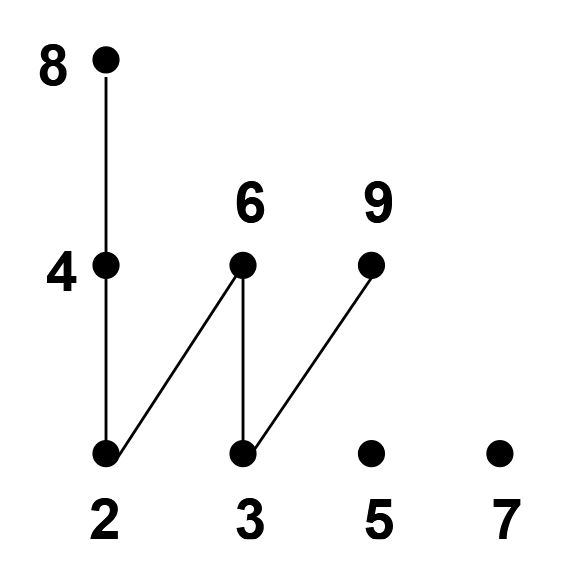
In the poset \((\{2, 3, 4, 5, 6, 7, 8, 9\}; |)\), identify the minimal and maximal elements.
Back
ETH::1._Semester::DiskMat::3._Sets,_Relations,_and_Functions::5._Partial_Order_Relations::4._Special_Elements_in_Posets PlsFix::ClozeThatBish
In the poset \((\{2, 3, 4, 5, 6, 7, 8, 9\}; |)\), identify the minimal and maximal elements.
- Minimal elements: \(2, 3, 5, 7\) (primes)
- Maximal elements: \(5, 6, 7, 8, 9\)
- No least or greatest element (not all elements comparable)
After
Front
ETH::1._Semester::DiskMat::3._Sets,_Relations,_and_Functions::5._Partial_Order_Relations::4._Special_Elements_in_Posets
In the poset \((\{2, 3, 4, 5, 6, 7, 8, 9\}; |)\), identify the minimal and maximal elements.
- Minimal elements: \(2, 3, 5, 7\) (primes)
- Maximal elements: \(5, 6, 7, 8, 9\)
- Least or greatest element There is none (not all elements comparable)
Back
ETH::1._Semester::DiskMat::3._Sets,_Relations,_and_Functions::5._Partial_Order_Relations::4._Special_Elements_in_Posets
In the poset \((\{2, 3, 4, 5, 6, 7, 8, 9\}; |)\), identify the minimal and maximal elements.
- Minimal elements: \(2, 3, 5, 7\) (primes)
- Maximal elements: \(5, 6, 7, 8, 9\)
- Least or greatest element There is none (not all elements comparable)
Field-by-field Comparison
| Field |
Before |
After |
| Text |
In the poset \((\{2, 3, 4, 5, 6, 7, 8, 9\}; |)\), identify the minimal and maximal elements. |
In the poset \((\{2, 3, 4, 5, 6, 7, 8, 9\}; |)\), identify the minimal and maximal elements.<br><ul><li><strong>Minimal elements</strong>: {{c1:: \(2, 3, 5, 7\) (primes)}}</li><li><strong>Maximal elements</strong>: {{c2:: \(5, 6, 7, 8, 9\)}}</li><li><strong>Least or greatest element</strong> {{c3:: There is none (not all elements comparable)}}</li></ul><div><img src="paste-1d2f8dcd3adedbac7c91aff60842c9ece732a3a8.jpg"></div> |
| Extra |
<ul>
<li><strong>Minimal elements</strong>: \(2, 3, 5, 7\) (primes)</li>
<li><strong>Maximal elements</strong>: \(5, 6, 7, 8, 9\)</li>
<li><strong>No least or greatest element</strong> (not all elements comparable)</li>
</ul><div><img src="paste-1d2f8dcd3adedbac7c91aff60842c9ece732a3a8.jpg"><br></div> |
|
Tags:
PlsFix::ClozeThatBish
ETH::1._Semester::DiskMat::3._Sets,_Relations,_and_Functions::5._Partial_Order_Relations::4._Special_Elements_in_Posets
Note 17: ETH::DiskMat
Deck: ETH::DiskMat
Note Type: Horvath Cloze
GUID: pL:[)Gqs`_
modified
Before
Front
ETH::1._Semester::DiskMat::3._Sets,_Relations,_and_Functions::6._Functions PlsFix::ClozeThatBish
For \(f: \mathbb{R} \to \mathbb{R}\) with \(f(x) = x^2\), what are:
1. The range of \(f\)
2. The preimage of \([4, 9]\)
Back
ETH::1._Semester::DiskMat::3._Sets,_Relations,_and_Functions::6._Functions PlsFix::ClozeThatBish
For \(f: \mathbb{R} \to \mathbb{R}\) with \(f(x) = x^2\), what are:
1. The range of \(f\)
2. The preimage of \([4, 9]\)
1. Range: \(\mathbb{R}^{\geq 0}\) (non-negative reals)
2. Preimage of \([4, 9]\): \([-3, -2] \cup [2, 3]\)
After
Front
ETH::1._Semester::DiskMat::3._Sets,_Relations,_and_Functions::6._Functions
For \(f: \mathbb{R} \to \mathbb{R}\) with \(f(x) = x^2\), what are:
1. Range: {{c1::\(\mathbb{R}^{\geq 0}\) (non-negative reals)}}
2. Preimage of \([4, 9]\): \([-3, -2] \cup [2, 3]\)
Back
ETH::1._Semester::DiskMat::3._Sets,_Relations,_and_Functions::6._Functions
For \(f: \mathbb{R} \to \mathbb{R}\) with \(f(x) = x^2\), what are:
1. Range: {{c1::\(\mathbb{R}^{\geq 0}\) (non-negative reals)}}
2. Preimage of \([4, 9]\): \([-3, -2] \cup [2, 3]\)
Field-by-field Comparison
| Field |
Before |
After |
| Text |
For \(f: \mathbb{R} \to \mathbb{R}\) with \(f(x) = x^2\), what are:
<br>1. The range of \(f\)
<br>2. The preimage of \([4, 9]\) |
For \(f: \mathbb{R} \to \mathbb{R}\) with \(f(x) = x^2\), what are:
<br>1. <strong>Range</strong>: {{c1::\(\mathbb{R}^{\geq 0}\) (non-negative reals)}}<br>2. <strong>Preimage of \([4, 9]\)</strong>: {{c2::\([-3, -2] \cup [2, 3]\)}} |
| Extra |
1. <strong>Range</strong>: \(\mathbb{R}^{\geq 0}\) (non-negative reals)
<br>2. <strong>Preimage of \([4, 9]\)</strong>: \([-3, -2] \cup [2, 3]\) |
|
Tags:
PlsFix::ClozeThatBish
ETH::1._Semester::DiskMat::3._Sets,_Relations,_and_Functions::6._Functions
Note 18: ETH::DiskMat
Deck: ETH::DiskMat
Note Type: Horvath Cloze
GUID: IH=>J8$0Y%
modified
Before
Front
ETH::1._Semester::DiskMat::3._Sets,_Relations,_and_Functions::3._Relations::2._Representations_of_Relations PlsFix::ClozeThatBish
What are the three ways to represent a relation on finite sets?
Back
ETH::1._Semester::DiskMat::3._Sets,_Relations,_and_Functions::3._Relations::2._Representations_of_Relations PlsFix::ClozeThatBish
What are the three ways to represent a relation on finite sets?
1. Set notation (subset of \(A \times B\))
2. Boolean matrix (1 if \((a,b) \in \rho\), 0 otherwise)
3. Directed graph (nodes are elements, edges are relations)
After
Front
ETH::1._Semester::DiskMat::3._Sets,_Relations,_and_Functions::3._Relations::2._Representations_of_Relations
What are the three ways to represent a relation on finite sets?
1. Set notation (subset of \(A \times B\))
2. Boolean matrix (1 if \((a,b) \in \rho\), 0 otherwise)
3. Directed graph (nodes are elements, edges are relations)
Back
ETH::1._Semester::DiskMat::3._Sets,_Relations,_and_Functions::3._Relations::2._Representations_of_Relations
What are the three ways to represent a relation on finite sets?
1. Set notation (subset of \(A \times B\))
2. Boolean matrix (1 if \((a,b) \in \rho\), 0 otherwise)
3. Directed graph (nodes are elements, edges are relations)
Field-by-field Comparison
| Field |
Before |
After |
| Text |
What are the three ways to represent a relation on finite sets? |
What are the three ways to represent a relation on finite sets?<br><br>1. {{c1:: <strong>Set notation</strong> (subset of \(A \times B\))}}<br>2. {{c2:: <strong>Boolean matrix</strong> (1 if \((a,b) \in \rho\), 0 otherwise)}}<br>3. {{c3:: <strong>Directed graph</strong> (nodes are elements, edges are relations)}} |
| Extra |
1. <strong>Set notation</strong> (subset of \(A \times B\))
2. <strong>Boolean matrix</strong> (1 if \((a,b) \in \rho\), 0 otherwise)
3. <strong>Directed graph</strong> (nodes are elements, edges are relations) |
|
Tags:
PlsFix::ClozeThatBish
ETH::1._Semester::DiskMat::3._Sets,_Relations,_and_Functions::3._Relations::2._Representations_of_Relations
Note 19: ETH::DiskMat
Deck: ETH::DiskMat
Note Type: Horvath Classic
GUID: dK0`$S[9VD
modified
Before
Front
ETH::1._Semester::DiskMat::2._Math._Reasoning,_Proofs,_and_a_First_Approach_to_Logic::3._A_First_Introduction_to_Propositional_Logic PlsFix::ClozeThatBish
List all three pairs of related but distinct logical symbols and their types.
Back
ETH::1._Semester::DiskMat::2._Math._Reasoning,_Proofs,_and_a_First_Approach_to_Logic::3._A_First_Introduction_to_Propositional_Logic PlsFix::ClozeThatBish
List all three pairs of related but distinct logical symbols and their types.
1. \(\equiv\) (formula→statement), \(\leftrightarrow\) (formula→formula), \(\Leftrightarrow\) (statement→statement)
2. \(\models\) (formula→statement), \(\rightarrow\) (formula→formula), \(\Rightarrow\) (statement→statement)
After
Front
ETH::1._Semester::DiskMat::2._Math._Reasoning,_Proofs,_and_a_First_Approach_to_Logic::3._A_First_Introduction_to_Propositional_Logic
List all types of symbols meaning equivalence:
Back
ETH::1._Semester::DiskMat::2._Math._Reasoning,_Proofs,_and_a_First_Approach_to_Logic::3._A_First_Introduction_to_Propositional_Logic
List all types of symbols meaning equivalence:
Equivalences- \(\equiv\) (formula→statement)
- \(\leftrightarrow\) (formula→formula)
- \(\Leftrightarrow\) (statement→statement)
Field-by-field Comparison
| Field |
Before |
After |
| Front |
List all three pairs of related but distinct logical symbols and their types. |
List all types of symbols meaning equivalence: |
| Back |
1. \(\equiv\) (formula→statement), \(\leftrightarrow\) (formula→formula), \(\Leftrightarrow\) (statement→statement)
2. \(\models\) (formula→statement), \(\rightarrow\) (formula→formula), \(\Rightarrow\) (statement→statement) |
<b>Equivalences</b><br><ul><li>\(\equiv\) (formula→statement)</li><li>\(\leftrightarrow\) (formula→formula)</li><li>\(\Leftrightarrow\) (statement→statement)</li></ul> |
Tags:
PlsFix::ClozeThatBish
ETH::1._Semester::DiskMat::2._Math._Reasoning,_Proofs,_and_a_First_Approach_to_Logic::3._A_First_Introduction_to_Propositional_Logic
Note 20: ETH::DiskMat
Deck: ETH::DiskMat
Note Type: Horvath Cloze
GUID: wV8Y&j0xY.
modified
Before
Front
ETH::1._Semester::DiskMat::2._Math._Reasoning,_Proofs,_and_a_First_Approach_to_Logic::3._A_First_Introduction_to_Propositional_Logic::1._Logical_Constants,_Operators,_and_Formulas PlsFix::ClozeThatBish
Name the binding strengths of PL tokens in order.
Back
ETH::1._Semester::DiskMat::2._Math._Reasoning,_Proofs,_and_a_First_Approach_to_Logic::3._A_First_Introduction_to_Propositional_Logic::1._Logical_Constants,_Operators,_and_Formulas PlsFix::ClozeThatBish
Name the binding strengths of PL tokens in order.
- unary operators (NOT)
- quantifiers (for all and exists)
- operators (AND, OR)
- Implication
After
Front
ETH::1._Semester::DiskMat::2._Math._Reasoning,_Proofs,_and_a_First_Approach_to_Logic::3._A_First_Introduction_to_Propositional_Logic::1._Logical_Constants,_Operators,_and_Formulas
Name the binding strengths of PL tokens in order:
- unary operators (NOT)
- quantifiers (for all and exists)
- operators (AND, OR)
- Implication
Back
ETH::1._Semester::DiskMat::2._Math._Reasoning,_Proofs,_and_a_First_Approach_to_Logic::3._A_First_Introduction_to_Propositional_Logic::1._Logical_Constants,_Operators,_and_Formulas
Name the binding strengths of PL tokens in order:
- unary operators (NOT)
- quantifiers (for all and exists)
- operators (AND, OR)
- Implication
Field-by-field Comparison
| Field |
Before |
After |
| Text |
Name the binding strengths of PL tokens in order. |
Name the binding strengths of PL tokens in order:<br><ol><li>{{c1:: unary operators (NOT)}}</li><li>{{c2:: quantifiers (for all and exists)}}</li><li>{{c3:: operators (AND, OR)}}</li><li>{{c4:: Implication}}</li></ol> |
| Extra |
- unary operators (NOT)<br> - quantifiers (for all and exists)<br> - operators (AND, OR)<br> - Implication |
|
Tags:
PlsFix::ClozeThatBish
ETH::1._Semester::DiskMat::2._Math._Reasoning,_Proofs,_and_a_First_Approach_to_Logic::3._A_First_Introduction_to_Propositional_Logic::1._Logical_Constants,_Operators,_and_Formulas
Note 21: ETH::DiskMat
Deck: ETH::DiskMat
Note Type: Horvath Cloze
GUID: ujCuoEmotl
modified
Before
Front
ETH::1._Semester::DiskMat::4._Number_Theory::3._Factorization_into_Primes::2._Proof_of_the_Fundamental_Theorem_of_Arithmetic_* PlsFix::ClozeThatBish
If a prime divides a product, what can we conclude? (Lemma 4.7)
Back
ETH::1._Semester::DiskMat::4._Number_Theory::3._Factorization_into_Primes::2._Proof_of_the_Fundamental_Theorem_of_Arithmetic_* PlsFix::ClozeThatBish
If a prime divides a product, what can we conclude? (Lemma 4.7)
If \(p\) is a prime which divides the product \(x_1 x_2 \dots x_n\) of some integers, then \(p\) divides at least one of them:
\[p | (x_1 x_2 \dots x_n) \Rightarrow \exists i \ p | x_i\]
After
Front
ETH::1._Semester::DiskMat::4._Number_Theory::3._Factorization_into_Primes::2._Proof_of_the_Fundamental_Theorem_of_Arithmetic_*
If \(p\) is a prime which divides the product \(x_1 x_2 \dots x_n\) of some integers, then \(p\) divides at least one of them: \[p | (x_1 x_2 \dots x_n) \Rightarrow \exists i \ p | x_i\]
Back
ETH::1._Semester::DiskMat::4._Number_Theory::3._Factorization_into_Primes::2._Proof_of_the_Fundamental_Theorem_of_Arithmetic_*
If \(p\) is a prime which divides the product \(x_1 x_2 \dots x_n\) of some integers, then \(p\) divides at least one of them: \[p | (x_1 x_2 \dots x_n) \Rightarrow \exists i \ p | x_i\]
Field-by-field Comparison
| Field |
Before |
After |
| Text |
If a prime divides a product, what can we conclude? (Lemma 4.7) |
If \(p\) is a prime which divides the product \(x_1 x_2 \dots x_n\) of some integers, then \(p\) {{c1:: divides at least one of them: \[p | (x_1 x_2 \dots x_n) \Rightarrow \exists i \ p | x_i\]}}<br> |
| Extra |
If \(p\) is a prime which divides the product \(x_1 x_2 \dots x_n\) of some integers, then \(p\) divides at least one of them:
\[p | (x_1 x_2 \dots x_n) \Rightarrow \exists i \ p | x_i\] |
|
Tags:
PlsFix::ClozeThatBish
ETH::1._Semester::DiskMat::4._Number_Theory::3._Factorization_into_Primes::2._Proof_of_the_Fundamental_Theorem_of_Arithmetic_*
Note 22: ETH::DiskMat
Deck: ETH::DiskMat
Note Type: Horvath Cloze
GUID: nizWAJt?$u
modified
Before
Front
ETH::1._Semester::DiskMat::4._Number_Theory::5._Congruences_and_Modular_Arithmetic::2._Modular_Arithmetic PlsFix::ClozeThatBish
What are the two key properties of the remainder function \(R_m\)? (Lemma 4.16)
Back
ETH::1._Semester::DiskMat::4._Number_Theory::5._Congruences_and_Modular_Arithmetic::2._Modular_Arithmetic PlsFix::ClozeThatBish
What are the two key properties of the remainder function \(R_m\)? (Lemma 4.16)
(i) \(a \equiv_m R_m(a)\) (the remainder represents the equivalence class)
(ii) \(a \equiv_m b \Longleftrightarrow R_m(a) = R_m(b)\) (congruence iff same remainder)
After
Front
ETH::1._Semester::DiskMat::4._Number_Theory::5._Congruences_and_Modular_Arithmetic::2._Modular_Arithmetic
What are the two key properties of the remainder function \(R_m\)? (Lemma 4.16)
(i) \(a \equiv_m R_m(a)\) (the remainder represents the equivalence class)
(ii) \(a \equiv_m b \Longleftrightarrow R_m(a) = R_m(b)\) (congruence iff same remainder)
Back
ETH::1._Semester::DiskMat::4._Number_Theory::5._Congruences_and_Modular_Arithmetic::2._Modular_Arithmetic
What are the two key properties of the remainder function \(R_m\)? (Lemma 4.16)
(i) \(a \equiv_m R_m(a)\) (the remainder represents the equivalence class)
(ii) \(a \equiv_m b \Longleftrightarrow R_m(a) = R_m(b)\) (congruence iff same remainder)
Field-by-field Comparison
| Field |
Before |
After |
| Text |
What are the two key properties of the remainder function \(R_m\)? (Lemma 4.16) |
What are the two key properties of the remainder function \(R_m\)? (Lemma 4.16)<br><br><strong>(i)</strong> {{c1:: \(a \equiv_m R_m(a)\) (the remainder represents the equivalence class)}}<br><b>(ii)</b> {{c2:: \(a \equiv_m b \Longleftrightarrow R_m(a) = R_m(b)\) (congruence iff same remainder)}} |
| Extra |
<strong>(i)</strong> \(a \equiv_m R_m(a)\) (the remainder represents the equivalence class)
<strong>(ii)</strong> \(a \equiv_m b \Longleftrightarrow R_m(a) = R_m(b)\) (congruence iff same remainder) |
|
Tags:
PlsFix::ClozeThatBish
ETH::1._Semester::DiskMat::4._Number_Theory::5._Congruences_and_Modular_Arithmetic::2._Modular_Arithmetic
Note 23: ETH::DiskMat
Deck: ETH::DiskMat
Note Type: Horvath Cloze
GUID: xWhw%ncc|4
modified
Before
Front
ETH::1._Semester::DiskMat::4._Number_Theory::5._Congruences_and_Modular_Arithmetic::1._Modular_Congruences PlsFix::ClozeThatBish
Verify that \(\equiv_m\) is reflexive, symmetric, and transitive.
Back
ETH::1._Semester::DiskMat::4._Number_Theory::5._Congruences_and_Modular_Arithmetic::1._Modular_Congruences PlsFix::ClozeThatBish
Verify that \(\equiv_m\) is reflexive, symmetric, and transitive.
- Reflexive: \(a \equiv_m a\) since \(m | (a - a) = 0\) ✓
- Symmetric: \(a \equiv_m b \Rightarrow m | (a-b) \Rightarrow m | (b-a) \Rightarrow b \equiv_m a\) ✓
- Transitive: If \(m | (a-b)\) and \(m | (b-c)\), then \(m | (a-b+b-c) = (a-c)\) ✓
After
Front
ETH::1._Semester::DiskMat::4._Number_Theory::5._Congruences_and_Modular_Arithmetic::1._Modular_Congruences
Verify that \(\equiv_m\) is reflexive, symmetric, and transitive.
- Reflexive: \(a \equiv_m a\) since \(m | (a - a) = 0\) ✓
- Symmetric: \(a \equiv_m b \Rightarrow m | (a-b) \Rightarrow m | (b-a) \Rightarrow b \equiv_m a\) ✓
- Transitive: If \(m | (a-b)\) and \(m | (b-c)\), then \(m | (a-b+b-c) = (a-c)\) ✓
Back
ETH::1._Semester::DiskMat::4._Number_Theory::5._Congruences_and_Modular_Arithmetic::1._Modular_Congruences
Verify that \(\equiv_m\) is reflexive, symmetric, and transitive.
- Reflexive: \(a \equiv_m a\) since \(m | (a - a) = 0\) ✓
- Symmetric: \(a \equiv_m b \Rightarrow m | (a-b) \Rightarrow m | (b-a) \Rightarrow b \equiv_m a\) ✓
- Transitive: If \(m | (a-b)\) and \(m | (b-c)\), then \(m | (a-b+b-c) = (a-c)\) ✓
Field-by-field Comparison
| Field |
Before |
After |
| Text |
Verify that \(\equiv_m\) is reflexive, symmetric, and transitive. |
Verify that \(\equiv_m\) is reflexive, symmetric, and transitive.<br><ul><li><strong>Reflexive</strong>: {{c1:: \(a \equiv_m a\) since \(m | (a - a) = 0\) ✓}}</li><li><strong>Symmetric</strong>: {{c2:: \(a \equiv_m b \Rightarrow m | (a-b) \Rightarrow m | (b-a) \Rightarrow b \equiv_m a\) ✓}}</li><li><strong>Transitive</strong>: {{c3:: If \(m | (a-b)\) and \(m | (b-c)\), then \(m | (a-b+b-c) = (a-c)\) ✓}}</li></ul> |
| Extra |
<ul>
<li><strong>Reflexive</strong>: \(a \equiv_m a\) since \(m | (a - a) = 0\) ✓</li>
<li><strong>Symmetric</strong>: \(a \equiv_m b \Rightarrow m | (a-b) \Rightarrow m | (b-a) \Rightarrow b \equiv_m a\) ✓</li>
<li><strong>Transitive</strong>: If \(m | (a-b)\) and \(m | (b-c)\), then \(m | (a-b+b-c) = (a-c)\) ✓</li>
</ul> |
|
Tags:
PlsFix::ClozeThatBish
ETH::1._Semester::DiskMat::4._Number_Theory::5._Congruences_and_Modular_Arithmetic::1._Modular_Congruences
Note 24: ETH::DiskMat
Deck: ETH::DiskMat
Note Type: Horvath Cloze
GUID: O?~Mb}~!3:
modified
Before
Front
ETH::1._Semester::DiskMat::2._Math._Reasoning,_Proofs,_and_a_First_Approach_to_Logic::6._Some_Proof_Patterns::04._Modus_Ponens
Proof method: "Modus Ponens"
Back
ETH::1._Semester::DiskMat::2._Math._Reasoning,_Proofs,_and_a_First_Approach_to_Logic::6._Some_Proof_Patterns::04._Modus_Ponens
Proof method: "Modus Ponens"
1. Find a suitable statement \(R\)
2. Prove \(R\)
3. Prove \(R \implies S\)
After
Front
ETH::1._Semester::DiskMat::2._Math._Reasoning,_Proofs,_and_a_First_Approach_to_Logic::6._Some_Proof_Patterns::04._Modus_Ponens
Proof method: "Modus Ponens"
1.
Find a suitable statement \(R\)2. Prove \(R\)
3. Prove \(R \implies S\)
Back
ETH::1._Semester::DiskMat::2._Math._Reasoning,_Proofs,_and_a_First_Approach_to_Logic::6._Some_Proof_Patterns::04._Modus_Ponens
Proof method: "Modus Ponens"
1.
Find a suitable statement \(R\)2. Prove \(R\)
3. Prove \(R \implies S\)
Field-by-field Comparison
| Field |
Before |
After |
| Text |
Proof method: "Modus Ponens" |
Proof method: "Modus Ponens"<br>1. {{c1:: Find a suitable statement \(R\)}}<div>2. {{c2:: Prove \(R\)}}</div><div>3. {{c3:: Prove \(R \implies S\)}}</div> |
| Extra |
1. Find a suitable statement \(R\)<div>2. Prove \(R\)</div><div>3. Prove \(R \implies S\)</div> |
|
Tags:
ETH::1._Semester::DiskMat::2._Math._Reasoning,_Proofs,_and_a_First_Approach_to_Logic::6._Some_Proof_Patterns::04._Modus_Ponens
Note 25: ETH::DiskMat
Deck: ETH::DiskMat
Note Type: Horvath Cloze
GUID: xDDC{82KOB
modified
Before
Front
ETH::1._Semester::DiskMat::2._Math._Reasoning,_Proofs,_and_a_First_Approach_to_Logic::6._Some_Proof_Patterns::06._Proofs_by_Contradiction
Proof method: Proof by Contradiction
Back
ETH::1._Semester::DiskMat::2._Math._Reasoning,_Proofs,_and_a_First_Approach_to_Logic::6._Some_Proof_Patterns::06._Proofs_by_Contradiction
Proof method: Proof by Contradiction
1. Find a suitable statement \( T\)
2. Prove that \( T \) is false
3. Assume that \( S \) is false and prove that \( T \) is true (-> contradiction)
After
Front
ETH::1._Semester::DiskMat::2._Math._Reasoning,_Proofs,_and_a_First_Approach_to_Logic::6._Some_Proof_Patterns::06._Proofs_by_Contradiction
Proof method: Proof by Contradiction
Back
ETH::1._Semester::DiskMat::2._Math._Reasoning,_Proofs,_and_a_First_Approach_to_Logic::6._Some_Proof_Patterns::06._Proofs_by_Contradiction
Proof method: Proof by Contradiction
Field-by-field Comparison
| Field |
Before |
After |
| Extra |
1. Find a suitable statement \( T\)<div>2. Prove that \( T \) is false</div><div>3. Assume that \( S \) is false and prove that \( T \) is true (-> contradiction)</div> |
1. {{c1:: Find a suitable statement \( T\)}}<div>2. {{c2:: Prove that \( T \) is false}}</div><div>3. {{c3:: Assume that \( S \) is false and prove that \( T \) is true (-> contradiction)}}</div> |
Tags:
ETH::1._Semester::DiskMat::2._Math._Reasoning,_Proofs,_and_a_First_Approach_to_Logic::6._Some_Proof_Patterns::06._Proofs_by_Contradiction
Note 26: ETH::DiskMat
Deck: ETH::DiskMat
Note Type: Horvath Cloze
GUID: vi7xPhAi#`
modified
Before
Front
ETH::1._Semester::DiskMat::5._Algebra::2._Monoids_and_Groups::1._Neutral_Elements PlsFix::ClozeThatBish
A left neutral element (or identity element) of an algebra \(\langle S; * \rangle\) is an element \(e\) such that \(e * a = a\) for all \(a \in S\).
A right neutral element satisfies \(a * e = a\) for all \(a \in S\).
If \(e * a = a * e = a\) for all \(a \in S\), then \(e\) is simply called a neutral element.
Back
ETH::1._Semester::DiskMat::5._Algebra::2._Monoids_and_Groups::1._Neutral_Elements PlsFix::ClozeThatBish
A left neutral element (or identity element) of an algebra \(\langle S; * \rangle\) is an element \(e\) such that \(e * a = a\) for all \(a \in S\).
A right neutral element satisfies \(a * e = a\) for all \(a \in S\).
If \(e * a = a * e = a\) for all \(a \in S\), then \(e\) is simply called a neutral element.
After
Front
ETH::1._Semester::DiskMat::5._Algebra::2._Monoids_and_Groups::1._Neutral_Elements
If \(e * a = a * e = a\) for all \(a \in S\), then \(e\) is simply called a neutral element or identity element.
Back
ETH::1._Semester::DiskMat::5._Algebra::2._Monoids_and_Groups::1._Neutral_Elements
If \(e * a = a * e = a\) for all \(a \in S\), then \(e\) is simply called a neutral element or identity element.
Field-by-field Comparison
| Field |
Before |
After |
| Text |
<p>A {{c1::left neutral element}} (or {{c1::identity element}}) of an algebra \(\langle S; * \rangle\) is an element \({{c2::e}}\) such that {{c3::\(e * a = a\)}} for all \({{c4::a}} \in S\).</p>
<p>A {{c1::right neutral element}} satisfies {{c2::\(a * e = a\)}} for all \({{c3::a}} \in S\).</p>
<p>If {{c2::\(e * a = a * e = a\)}} for all \({{c3::a}} \in S\), then \({{c4::e}}\) is simply called a {{c1::neutral element}}.</p> |
<p>If {{c2::\(e * a = a * e = a\)}} for all \(a \in S\), then \(e\) is simply called a {{c1::neutral element or identity element}}.</p> |
Tags:
PlsFix::ClozeThatBish
ETH::1._Semester::DiskMat::5._Algebra::2._Monoids_and_Groups::1._Neutral_Elements
Note 27: ETH::DiskMat
Deck: ETH::DiskMat
Note Type: Horvath Cloze
GUID: j]Gy^>$7h+
modified
Before
Front
ETH::1._Semester::DiskMat::5._Algebra::3._The_Structure_of_Groups::3._Subgroups
For \(H\) to be a subgroup, the neutral element must be in \(H\): \(e \in H\).
and
be mapped to from the neutral: \(\varphi(e) = e'\).
Back
ETH::1._Semester::DiskMat::5._Algebra::3._The_Structure_of_Groups::3._Subgroups
For \(H\) to be a subgroup, the neutral element must be in \(H\): \(e \in H\).
and
be mapped to from the neutral: \(\varphi(e) = e'\).
After
Front
ETH::1._Semester::DiskMat::5._Algebra::3._The_Structure_of_Groups::3._Subgroups
For \(H\) to be a subgroup, the neutral element must be in \(H\): \(e \in H\).
Back
ETH::1._Semester::DiskMat::5._Algebra::3._The_Structure_of_Groups::3._Subgroups
For \(H\) to be a subgroup, the neutral element must be in \(H\): \(e \in H\).
Field-by-field Comparison
| Field |
Before |
After |
| Text |
<p>For \(H\) to be a subgroup, the {{c1::neutral element}} must be in \(H\): {{c1::\(e \in H\)}}.</p> and {{c1::be mapped to from the neutral: \(\varphi(e) = e'\)}}. |
<p>For \(H\) to be a subgroup, the {{c1::neutral element}} must be in \(H\): {{c1::\(e \in H\)}}.</p> |
Tags:
ETH::1._Semester::DiskMat::5._Algebra::3._The_Structure_of_Groups::3._Subgroups
Note 28: ETH::DiskMat
Deck: ETH::DiskMat
Note Type: Horvath Classic
GUID: HR>/;ZN2^c
added
Previous
Note did not exist
New Note
Front
ETH::1._Semester::DiskMat::2._Math._Reasoning,_Proofs,_and_a_First_Approach_to_Logic::3._A_First_Introduction_to_Propositional_Logic
List all types of symbols meaning implication:
Back
ETH::1._Semester::DiskMat::2._Math._Reasoning,_Proofs,_and_a_First_Approach_to_Logic::3._A_First_Introduction_to_Propositional_Logic
List all types of symbols meaning implication:
Implications- \(\models\) (formula→statement)
- \(\rightarrow\) (formula→formula)
- \(\Rightarrow\) (statement→statement)
Field-by-field Comparison
| Field |
Before |
After |
| Front |
|
List all types of symbols meaning implication: |
| Back |
|
<b>Implications</b><br><ul><li>\(\models\) (formula→statement)</li><li>\(\rightarrow\) (formula→formula)</li><li>\(\Rightarrow\) (statement→statement)</li></ul> |
Tags:
ETH::1._Semester::DiskMat::2._Math._Reasoning,_Proofs,_and_a_First_Approach_to_Logic::3._A_First_Introduction_to_Propositional_Logic
Note 29: ETH::DiskMat
Deck: ETH::DiskMat
Note Type: Horvath Cloze
GUID: xelDz|Gp*?
added
Previous
Note did not exist
New Note
Front
ETH::1._Semester::DiskMat::5._Algebra::2._Monoids_and_Groups::1._Neutral_Elements
A right (left) neutral element is an elements such that for all \(a \in G\), \(a*e = a\) (\(e*a = a\)).
Back
ETH::1._Semester::DiskMat::5._Algebra::2._Monoids_and_Groups::1._Neutral_Elements
A right (left) neutral element is an elements such that for all \(a \in G\), \(a*e = a\) (\(e*a = a\)).
Field-by-field Comparison
| Field |
Before |
After |
| Text |
|
<div>A {{c1::right (left) neutral element}} is an elements such that for all \(a \in G\), {{c2:: \(a*e = a\) (\(e*a = a\))}}.</div> |
Tags:
ETH::1._Semester::DiskMat::5._Algebra::2._Monoids_and_Groups::1._Neutral_Elements
Note 30: ETH::LinAlg
Deck: ETH::LinAlg
Note Type: Horvath Cloze
GUID: j0~h}Ph2E;
modified
Before
Front
ETH::1._Semester::LinAlg::2._Matrices::2._Matrices_and_linear_transformations::1._Matrix_transformations
What does the linearity axiom say and how can it be interpreted?
Back
ETH::1._Semester::LinAlg::2._Matrices::2._Matrices_and_linear_transformations::1._Matrix_transformations
What does the linearity axiom say and how can it be interpreted?
for a function \(T: \mathbb{R}^n \rightarrow \mathbb{R}^m / \ T: \mathbb{R}^n \rightarrow \mathbb{R}\)
the following is true: \(T(\lambda_1x_1 + \lambda_2x_2) = \lambda_1T(x_1) + \lambda_2T(x_2)\)
this can be interpreted:
i) \(T(x+x') = T(x) + T(x')\) and
ii) \(T(\lambda x) = \lambda T(x)\)
After
Front
ETH::1._Semester::LinAlg::2._Matrices::2._Matrices_and_linear_transformations::1._Matrix_transformations
What does the linearity axiom say and how can it be interpreted for a function \(T: \mathbb{R}^n \rightarrow \mathbb{R}^m / \ T: \mathbb{R}^n \rightarrow \mathbb{R}\):
i) \(T(x+x') = T(x) + T(x')\)
ii) \(T(\lambda x) = \lambda T(x)\)
Back
ETH::1._Semester::LinAlg::2._Matrices::2._Matrices_and_linear_transformations::1._Matrix_transformations
What does the linearity axiom say and how can it be interpreted for a function \(T: \mathbb{R}^n \rightarrow \mathbb{R}^m / \ T: \mathbb{R}^n \rightarrow \mathbb{R}\):
i) \(T(x+x') = T(x) + T(x')\)
ii) \(T(\lambda x) = \lambda T(x)\)
Field-by-field Comparison
| Field |
Before |
After |
| Text |
What does the linearity axiom say and how can it be interpreted? |
What does the linearity axiom say and how can it be interpreted for a function \(T: \mathbb{R}^n \rightarrow \mathbb{R}^m / \ T: \mathbb{R}^n \rightarrow \mathbb{R}\):<br><br>i) {{c1:: \(T(x+x') = T(x) + T(x')\)}}<br>ii) {{c2:: \(T(\lambda x) = \lambda T(x)\)}} |
| Extra |
for a function \(T: \mathbb{R}^n \rightarrow \mathbb{R}^m / \ T: \mathbb{R}^n \rightarrow \mathbb{R}\)<br><br>the following is true: \(T(\lambda_1x_1 + \lambda_2x_2) = \lambda_1T(x_1) + \lambda_2T(x_2)\)<br><br>this can be interpreted: <br>i) \(T(x+x') = T(x) + T(x')\) and<br>ii) \(T(\lambda x) = \lambda T(x)\) |
|
Tags:
ETH::1._Semester::LinAlg::2._Matrices::2._Matrices_and_linear_transformations::1._Matrix_transformations
Note 31: ETH::LinAlg
Deck: ETH::LinAlg
Note Type: Horvath Classic
GUID: e`7dX^~/:X
added
Previous
Note did not exist
New Note
Front
ETH::1._Semester::LinAlg::2._Matrices::2._Matrices_and_linear_transformations::1._Matrix_transformations
For a function \(T: \mathbb{R}^n \rightarrow \mathbb{R}^m / \ T: \mathbb{R}^n \rightarrow \mathbb{R}\) the linearity axiom is:
Back
ETH::1._Semester::LinAlg::2._Matrices::2._Matrices_and_linear_transformations::1._Matrix_transformations
For a function \(T: \mathbb{R}^n \rightarrow \mathbb{R}^m / \ T: \mathbb{R}^n \rightarrow \mathbb{R}\) the linearity axiom is:
\(T(\lambda_1x_1 + \lambda_2x_2) = \lambda_1T(x_1) + \lambda_2T(x_2)\)
Field-by-field Comparison
| Field |
Before |
After |
| Front |
|
For a function \(T: \mathbb{R}^n \rightarrow \mathbb{R}^m / \ T: \mathbb{R}^n \rightarrow \mathbb{R}\) the linearity axiom is: |
| Back |
|
\(T(\lambda_1x_1 + \lambda_2x_2) = \lambda_1T(x_1) + \lambda_2T(x_2)\) |
Tags:
ETH::1._Semester::LinAlg::2._Matrices::2._Matrices_and_linear_transformations::1._Matrix_transformations