Note 1: ETH::2. Semester::A&W
Deck: ETH::2. Semester::A&W
Note Type: Horvath Cloze
GUID: B)MZlGZ#hJ
added
Previous
Note did not exist
New Note
Front
ETH::2._Semester::A&W::1._Graphentheorie::5._Kreise::4._Das_Travelling_Salesman_Problem
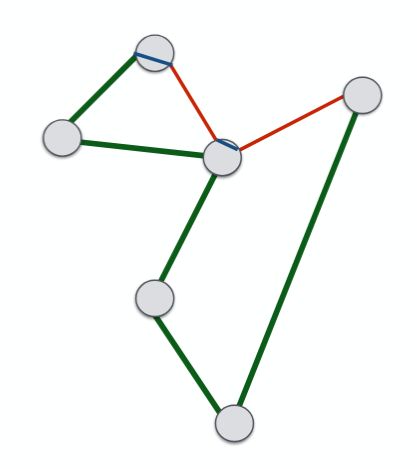
Algorithmus Metrisches TSP
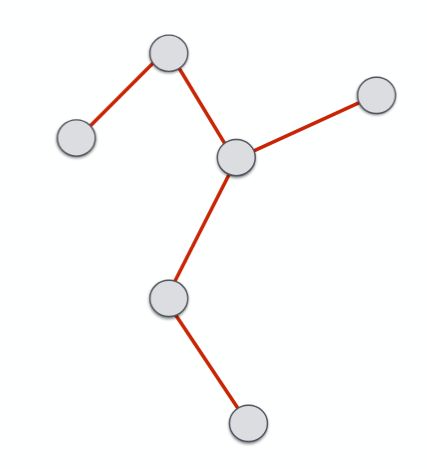
- {{c1::Bestimme minimalen Spannbaum T
es gilt: \( \ell(T) \leq \text{opt}(K_n, \ell) \)}}
Back
ETH::2._Semester::A&W::1._Graphentheorie::5._Kreise::4._Das_Travelling_Salesman_Problem
Algorithmus Metrisches TSP
- {{c1::Bestimme minimalen Spannbaum T
es gilt: \( \ell(T) \leq \text{opt}(K_n, \ell) \)}}
Field-by-field Comparison
| Field |
Before |
After |
| Text |
|
Algorithmus Metrisches TSP<br><ol>
<li>{{c1::Bestimme minimalen Spannbaum T
<br>es gilt: \( \ell(T) \leq \text{opt}(K_n, \ell) \)}}<br></li>
</ol> |
| Extra |
|
<img src="paste-641f5394fed98c15cac88c22e6c65b1cc44e558c.jpg"> |
Tags:
ETH::2._Semester::A&W::1._Graphentheorie::5._Kreise::4._Das_Travelling_Salesman_Problem
Note 2: ETH::2. Semester::A&W
Deck: ETH::2. Semester::A&W
Note Type: Horvath Cloze
GUID: CKz#W`~;R+
added
Previous
Note did not exist
New Note
Front
ETH::2._Semester::A&W::1._Graphentheorie::6._Matchings::1._Algorithmen
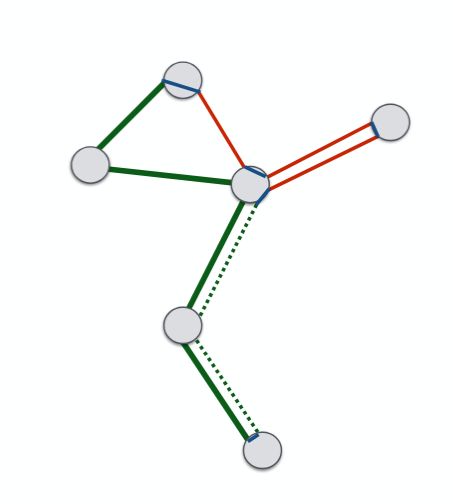
Ein M-augmentierender Pfad ist ein Pfad, der abwechselnd Kanten aus \( M \) und nicht aus \( M \) enthält und der in von \( M \) nicht überdeckten Knoten beginnt und endet.
Back
ETH::2._Semester::A&W::1._Graphentheorie::6._Matchings::1._Algorithmen
Ein M-augmentierender Pfad ist ein Pfad, der abwechselnd Kanten aus \( M \) und nicht aus \( M \) enthält und der in von \( M \) nicht überdeckten Knoten beginnt und endet.
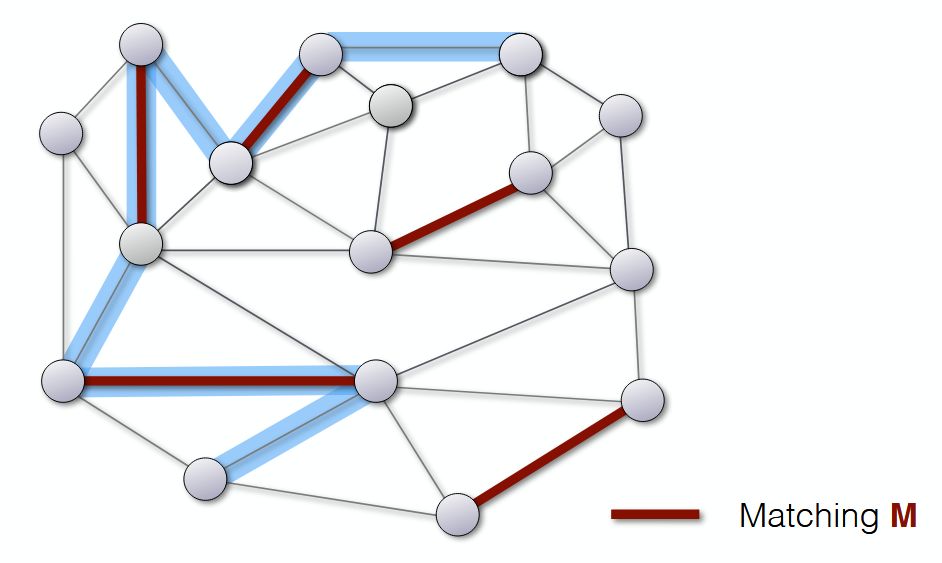
\( \Rightarrow \) durch Tauschen entlang \( M \) können wir das Matching vergrössern
Field-by-field Comparison
| Field |
Before |
After |
| Text |
|
Ein {{c1::M-augmentierender Pfad}} ist ein Pfad, der a{{c2::bwechselnd Kanten aus \( M \) und nicht aus \( M \) enthält und der in von \( M \) nicht überdeckten Knoten beginnt und endet}}. |
| Extra |
|
<img src="paste-850ba08194aede94db8dc7ec7b55167195dfdd9b.jpg"><br><br>\( \Rightarrow \) durch Tauschen entlang \( M \) können wir das Matching vergrössern |
Tags:
ETH::2._Semester::A&W::1._Graphentheorie::6._Matchings::1._Algorithmen
Note 3: ETH::2. Semester::A&W
Deck: ETH::2. Semester::A&W
Note Type: Horvath Cloze
GUID: DVs)|{g]G9
added
Previous
Note did not exist
New Note
Front
ETH::2._Semester::A&W::1._Graphentheorie::6._Matchings
Ein Matching \( M \subseteq E \) ist ein inklusionsmaximales Matching, wenn es kein Matching \( M' \) gibt mit \( M \subseteq M' \) und \( |M'| > |M| \).
Back
ETH::2._Semester::A&W::1._Graphentheorie::6._Matchings
Ein Matching \( M \subseteq E \) ist ein inklusionsmaximales Matching, wenn es kein Matching \( M' \) gibt mit \( M \subseteq M' \) und \( |M'| > |M| \).
Field-by-field Comparison
| Field |
Before |
After |
| Text |
|
Ein Matching \( M \subseteq E \) ist ein {{c1::inklusionsmaximales Matching}}, wenn es kein Matching \( M' \) gibt mit \( M \subseteq M' \) und \( |M'| > |M| \). |
| Extra |
|
<img src="paste-39fe19f01b4a05cae1c0abb0c84fc0b8c7b15819.jpg"> |
Tags:
ETH::2._Semester::A&W::1._Graphentheorie::6._Matchings
Note 4: ETH::2. Semester::A&W
Deck: ETH::2. Semester::A&W
Note Type: Horvath Cloze
GUID: GqP(r@WnwP
added
Previous
Note did not exist
New Note
Front
ETH::2._Semester::A&W::1._Graphentheorie::6._Matchings::1._Algorithmen
Jedes Matching, das nicht (kardinalitäts-)maximal ist, besitzt einen augmentierenden Pfad.
Back
ETH::2._Semester::A&W::1._Graphentheorie::6._Matchings::1._Algorithmen
Jedes Matching, das nicht (kardinalitäts-)maximal ist, besitzt einen augmentierenden Pfad.
(Berge, 1957)
Field-by-field Comparison
| Field |
Before |
After |
| Text |
|
Jedes Matching, das nicht {{c2::(kardinalitäts-)maximal}} ist, besitzt {{c1::einen augmentierenden Pfad}}. |
| Extra |
|
(Berge, 1957) |
Tags:
ETH::2._Semester::A&W::1._Graphentheorie::6._Matchings::1._Algorithmen
Note 5: ETH::2. Semester::A&W
Deck: ETH::2. Semester::A&W
Note Type: Horvath Cloze
GUID: H7w#BRLdfN
added
Previous
Note did not exist
New Note
Front
ETH::2._Semester::A&W::1._Graphentheorie::6._Matchings::1._Algorithmen
Seien \( M \), \( M' \) beliebige Matchings.
Betrachte den Teilgraphen mit Kantenmenge \( M \oplus M' \).
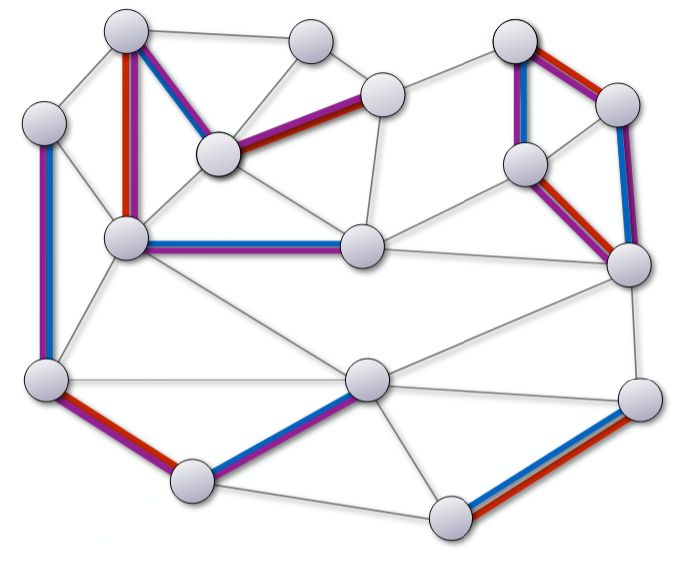
Jeder Knoten hat Grad \( \leq 2 \) \( \Rightarrow \) Kollektion von Pfaden und Kreisen.
Jeder Pfad/Kreis
wechselt ab zwischen Kanten aus \( M \) und \( M' \).
Back
ETH::2._Semester::A&W::1._Graphentheorie::6._Matchings::1._Algorithmen
Seien \( M \), \( M' \) beliebige Matchings.
Betrachte den Teilgraphen mit Kantenmenge \( M \oplus M' \).
Jeder Knoten hat Grad \( \leq 2 \) \( \Rightarrow \) Kollektion von Pfaden und Kreisen.
Jeder Pfad/Kreis
wechselt ab zwischen Kanten aus \( M \) und \( M' \).
Field-by-field Comparison
| Field |
Before |
After |
| Text |
|
Seien \( M \), \( M' \) beliebige Matchings.<br><br>Betrachte den Teilgraphen mit Kantenmenge \( M \oplus M' \).<br><br><img src="paste-cc44e8340a8f8763aaf527b7d1b156aa7f47f9df.jpg"><br><br>Jeder Knoten hat Grad \( \leq 2 \) \( \Rightarrow \) Kollektion von Pfaden und Kreisen.<br><br>Jeder Pfad/Kreis {{c1::wechselt ab zwischen Kanten aus \( M \) und \( M' \)}}. |
Tags:
ETH::2._Semester::A&W::1._Graphentheorie::6._Matchings::1._Algorithmen
Note 6: ETH::2. Semester::A&W
Deck: ETH::2. Semester::A&W
Note Type: Horvath Cloze
GUID: H7xH5/ww4&
added
Previous
Note did not exist
New Note
Front
ETH::2._Semester::A&W::1._Graphentheorie::6._Matchings::1._Algorithmen
Seien \( M \), \( M' \) beliebige Matchings.
Betrachte den Teilgraphen mit Kantenmenge \( M \oplus M' \).
Falls \( |M| < |M'| \), so
gibt es mindestens einen Pfad mit Start- und Endkante in \( M' \).
Back
ETH::2._Semester::A&W::1._Graphentheorie::6._Matchings::1._Algorithmen
Seien \( M \), \( M' \) beliebige Matchings.
Betrachte den Teilgraphen mit Kantenmenge \( M \oplus M' \).
Falls \( |M| < |M'| \), so
gibt es mindestens einen Pfad mit Start- und Endkante in \( M' \).
Field-by-field Comparison
| Field |
Before |
After |
| Text |
|
Seien \( M \), \( M' \) beliebige Matchings.<br><br>Betrachte den Teilgraphen mit Kantenmenge \( M \oplus M' \).<br><br><img src="paste-cc44e8340a8f8763aaf527b7d1b156aa7f47f9df.jpg"><br><br>Falls \( |M| < |M'| \), so {{c1::gibt es mindestens einen Pfad mit Start- und Endkante in \( M' \)}}. |
Tags:
ETH::2._Semester::A&W::1._Graphentheorie::6._Matchings::1._Algorithmen
Note 7: ETH::2. Semester::A&W
Deck: ETH::2. Semester::A&W
Note Type: Horvath Classic
GUID: IHUC^;MAy=
added
Previous
Note did not exist
New Note
Front
ETH::2._Semester::A&W::1._Graphentheorie::6._Matchings::1._Algorithmen
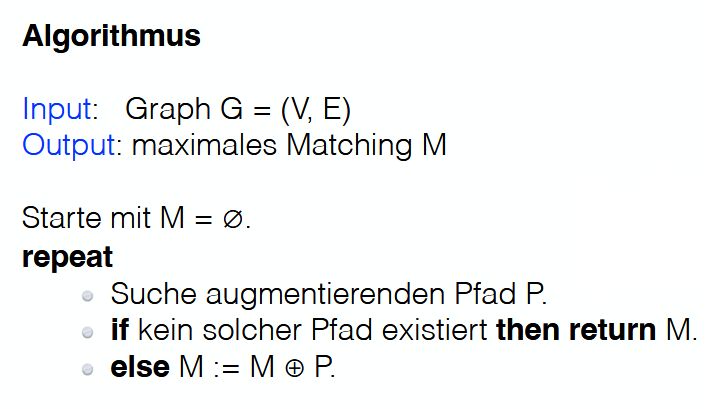
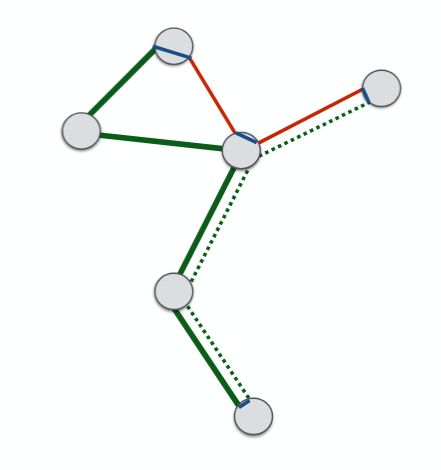
Wie funktioniert der Algorithmus um ein maximales Matching zu finden?
Back
ETH::2._Semester::A&W::1._Graphentheorie::6._Matchings::1._Algorithmen
Wie funktioniert der Algorithmus um ein maximales Matching zu finden?
Field-by-field Comparison
| Field |
Before |
After |
| Front |
|
Wie funktioniert der Algorithmus um ein maximales Matching zu finden? |
| Back |
|
<img src="paste-603d92158db76fe0cf95c48cd8fa952586427e35.jpg"> |
Tags:
ETH::2._Semester::A&W::1._Graphentheorie::6._Matchings::1._Algorithmen
Note 8: ETH::2. Semester::A&W
Deck: ETH::2. Semester::A&W
Note Type: Horvath Cloze
GUID: I^ycWZ1kyO
added
Previous
Note did not exist
New Note
Front
ETH::2._Semester::A&W::1._Graphentheorie::6._Matchings
Eine Kantenmenge \( M \subseteq E \) heisst Matching in einem Graphen \( G = (V, E) \), falls kein Knoten des Graphen zu mehr als einer Kante aus \( M \) inzident ist.
Back
ETH::2._Semester::A&W::1._Graphentheorie::6._Matchings
Eine Kantenmenge \( M \subseteq E \) heisst Matching in einem Graphen \( G = (V, E) \), falls kein Knoten des Graphen zu mehr als einer Kante aus \( M \) inzident ist.
Field-by-field Comparison
| Field |
Before |
After |
| Text |
|
Eine Kantenmenge \( M \subseteq E \) heisst {{c1::Matching}} in einem Graphen \( G = (V, E) \), falls {{c2::kein Knoten des Graphen zu mehr als einer Kante aus \( M \) inzident ist}}. |
| Extra |
|
<img src="paste-27f550ed98b572d19e75e40306715efea5feaa52.jpg"> |
Tags:
ETH::2._Semester::A&W::1._Graphentheorie::6._Matchings
Note 9: ETH::2. Semester::A&W
Deck: ETH::2. Semester::A&W
Note Type: Horvath Cloze
GUID: JVeUN}f6Q)
added
Previous
Note did not exist
New Note
Front
ETH::2._Semester::A&W::1._Graphentheorie::6._Matchings
Ein Matching \( M \) heisst perfektes Matching, wenn {{c2::jeder Knoten durch genau eine Kante aus \( M \) überdeckt wird, oder, anders ausgedrückt, wenn \( |M| = \frac{|V|}{2}\)}}.
Back
ETH::2._Semester::A&W::1._Graphentheorie::6._Matchings
Ein Matching \( M \) heisst perfektes Matching, wenn {{c2::jeder Knoten durch genau eine Kante aus \( M \) überdeckt wird, oder, anders ausgedrückt, wenn \( |M| = \frac{|V|}{2}\)}}.
Field-by-field Comparison
| Field |
Before |
After |
| Text |
|
Ein Matching \( M \) heisst {{c1::perfektes Matching}}, wenn {{c2::jeder Knoten durch genau eine Kante aus \( M \) überdeckt wird, oder, anders ausgedrückt, wenn \( |M| = \frac{|V|}{2}\)}}. |
| Extra |
|
<img src="paste-d8961d32b11f438abf76338eca8e230d62925040.jpg"> |
Tags:
ETH::2._Semester::A&W::1._Graphentheorie::6._Matchings
Note 10: ETH::2. Semester::A&W
Deck: ETH::2. Semester::A&W
Note Type: Horvath Cloze
GUID: MUe?Oo4Oj9
added
Previous
Note did not exist
New Note
Front
ETH::2._Semester::A&W::1._Graphentheorie::6._Matchings::1._Algorithmen
Seien \( M \), \( M' \) beliebige Matchings.
Betrachte den Teilgraphen mit Kantenmenge \( M \oplus M' \).
Jeder Knoten hat Grad \( \leq 2 \) \( \Rightarrow \)
Kollektion von Pfaden und Kreisen.
Back
ETH::2._Semester::A&W::1._Graphentheorie::6._Matchings::1._Algorithmen
Seien \( M \), \( M' \) beliebige Matchings.
Betrachte den Teilgraphen mit Kantenmenge \( M \oplus M' \).
Jeder Knoten hat Grad \( \leq 2 \) \( \Rightarrow \)
Kollektion von Pfaden und Kreisen.
Field-by-field Comparison
| Field |
Before |
After |
| Text |
|
Seien \( M \), \( M' \) beliebige Matchings.<br><br>Betrachte den Teilgraphen mit Kantenmenge \( M \oplus M' \).<br><br><img src="paste-cc44e8340a8f8763aaf527b7d1b156aa7f47f9df.jpg"><br><br>Jeder Knoten hat Grad \( \leq 2 \) \( \Rightarrow \) {{c1::Kollektion von Pfaden und Kreisen.}} |
Tags:
ETH::2._Semester::A&W::1._Graphentheorie::6._Matchings::1._Algorithmen
Note 11: ETH::2. Semester::A&W
Deck: ETH::2. Semester::A&W
Note Type: Horvath Cloze
GUID: Ogv;,*^ce|
added
Previous
Note did not exist
New Note
Front
ETH::2._Semester::A&W::1._Graphentheorie::6._Matchings::1._Algorithmen
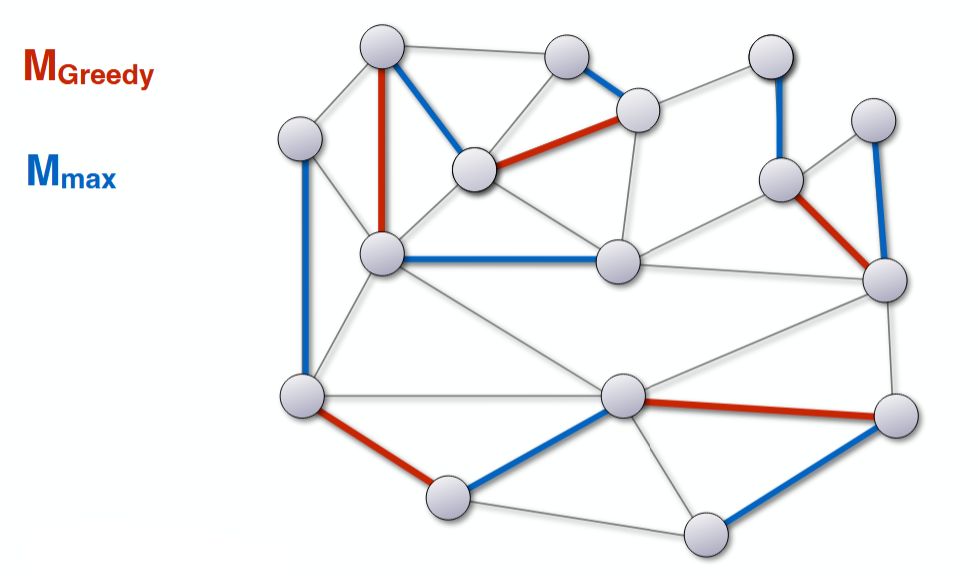
Für jede Kante in \( M_{\text{max}} \) gilt:
Mindestens einer der beiden Endpunkte wird von einer Kante aus \( M_{\text{Greedy \) überdeckt}}
Back
ETH::2._Semester::A&W::1._Graphentheorie::6._Matchings::1._Algorithmen
Für jede Kante in \( M_{\text{max}} \) gilt:
Mindestens einer der beiden Endpunkte wird von einer Kante aus \( M_{\text{Greedy \) überdeckt}}
(Denn sonst könnten wir die Kante zu \( M_{\text{Greedy}} \) hinzufügen.)
Field-by-field Comparison
| Field |
Before |
After |
| Text |
|
<img src="paste-889d732e37d44fee9ae8a068d3fc03393243ad71.jpg"><br><br>Für jede Kante in \( M_{\text{max}} \) gilt: {{c1::Mindestens einer der beiden Endpunkte wird von einer Kante aus \( M_{\text{Greedy}} \) überdeckt}} |
| Extra |
|
(Denn sonst könnten wir die Kante zu \( M_{\text{Greedy}} \) hinzufügen.) |
Tags:
ETH::2._Semester::A&W::1._Graphentheorie::6._Matchings::1._Algorithmen
Note 12: ETH::2. Semester::A&W
Deck: ETH::2. Semester::A&W
Note Type: Horvath Classic
GUID: c5fl4-coX%
added
Previous
Note did not exist
New Note
Front
ETH::2._Semester::A&W::1._Graphentheorie::6._Matchings
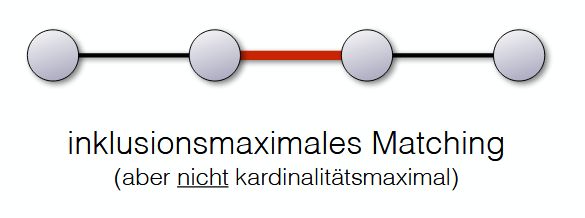
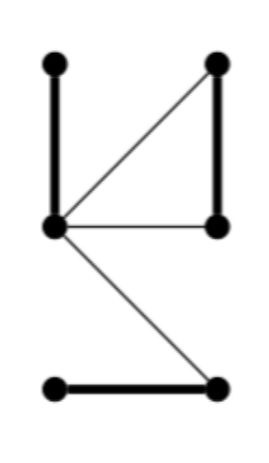
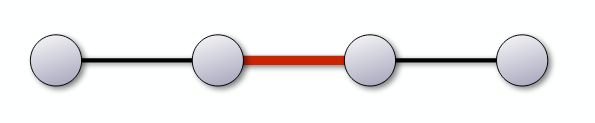
Inklusionsmaximal? Kardinalitätsmaximal?
Back
ETH::2._Semester::A&W::1._Graphentheorie::6._Matchings
Inklusionsmaximal? Kardinalitätsmaximal?
Inklusionsmaximal, aber nicht kardinalitätsmaximal.
Field-by-field Comparison
| Field |
Before |
After |
| Front |
|
Inklusionsmaximal? Kardinalitätsmaximal?<br><br><img src="paste-c92063f9edcf9395a64a0f98a4e75d9b799a7e96.jpg"> |
| Back |
|
Inklusionsmaximal, aber <b>nicht </b>kardinalitätsmaximal. |
Tags:
ETH::2._Semester::A&W::1._Graphentheorie::6._Matchings
Note 13: ETH::2. Semester::A&W
Deck: ETH::2. Semester::A&W
Note Type: Horvath Cloze
GUID: cF!WjeyLtp
added
Previous
Note did not exist
New Note
Front
ETH::2._Semester::A&W::1._Graphentheorie::6._Matchings::1._Algorithmen
Jede Kante in \( M_{\text{Greedy}} \) kann höchstens
zwei Kanten aus \( M_{\text{max \)}} überdecken.
Back
ETH::2._Semester::A&W::1._Graphentheorie::6._Matchings::1._Algorithmen
Jede Kante in \( M_{\text{Greedy}} \) kann höchstens
zwei Kanten aus \( M_{\text{max \)}} überdecken.
Field-by-field Comparison
| Field |
Before |
After |
| Text |
|
<img src="paste-889d732e37d44fee9ae8a068d3fc03393243ad71.jpg"><br><br>Jede Kante in \( M_{\text{Greedy}} \) kann höchstens {{c1::zwei Kanten aus \( M_{\text{max}} \)}} überdecken. |
Tags:
ETH::2._Semester::A&W::1._Graphentheorie::6._Matchings::1._Algorithmen
Note 14: ETH::2. Semester::A&W
Deck: ETH::2. Semester::A&W
Note Type: Horvath Classic
GUID: d.,>6R>r~$
added
Previous
Note did not exist
New Note
Front
ETH::2._Semester::A&W::1._Graphentheorie::6._Matchings
Inklusionsmaximal? Kardinalitätsmaximal?

Back
ETH::2._Semester::A&W::1._Graphentheorie::6._Matchings
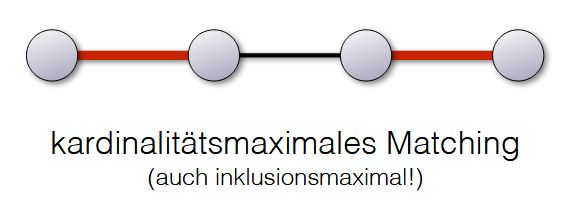
Inklusionsmaximal? Kardinalitätsmaximal?
Sowohl als auch.
Field-by-field Comparison
| Field |
Before |
After |
| Front |
|
Inklusionsmaximal? Kardinalitätsmaximal?<br><br><img src="paste-1c043fe23a61a601f7b9e593a2f000999cd25223.jpg"> |
| Back |
|
Sowohl als auch. |
Tags:
ETH::2._Semester::A&W::1._Graphentheorie::6._Matchings
Note 15: ETH::2. Semester::A&W
Deck: ETH::2. Semester::A&W
Note Type: Horvath Cloze
GUID: e}S|+cs>4(
added
Previous
Note did not exist
New Note
Front
ETH::2._Semester::A&W::1._Graphentheorie::6._Matchings
Ein Matching \( M \subseteq E \) ist ein (kardinalitäts-)maximales Matching, wenn es kein Matching \( M' \) gibt mit \( |M'| > |M| \).
Back
ETH::2._Semester::A&W::1._Graphentheorie::6._Matchings
Ein Matching \( M \subseteq E \) ist ein (kardinalitäts-)maximales Matching, wenn es kein Matching \( M' \) gibt mit \( |M'| > |M| \).
Field-by-field Comparison
| Field |
Before |
After |
| Text |
|
Ein Matching \( M \subseteq E \) ist ein {{c1::(kardinalitäts-)maximales Matching}}, wenn es kein Matching \( M' \) gibt mit \( |M'| > |M| \). |
| Extra |
|
<img src="paste-d0e1a5d14e56086ade35de91d3f9d24735c3b022.jpg"> |
Tags:
ETH::2._Semester::A&W::1._Graphentheorie::6._Matchings
Note 16: ETH::2. Semester::A&W
Deck: ETH::2. Semester::A&W
Note Type: Horvath Cloze
GUID: hg(o2Y=`t[
added
Previous
Note did not exist
New Note
Front
ETH::2._Semester::A&W::1._Graphentheorie::5._Kreise::4._Das_Travelling_Salesman_Problem
Beim metrischen TSP kann man aus einem MST eine 2-Approximation ableiten.
Back
ETH::2._Semester::A&W::1._Graphentheorie::5._Kreise::4._Das_Travelling_Salesman_Problem
Beim metrischen TSP kann man aus einem MST eine 2-Approximation ableiten.
Field-by-field Comparison
| Field |
Before |
After |
| Text |
|
Beim metrischen TSP kann man aus einem MST {{c1::eine 2-Approximation ableiten}}. |
| Extra |
|
<img src="paste-88fa2cc2c5de6613ed4e7539a244423b92a17f8c.jpg"> |
Tags:
ETH::2._Semester::A&W::1._Graphentheorie::5._Kreise::4._Das_Travelling_Salesman_Problem
Note 17: ETH::2. Semester::A&W
Deck: ETH::2. Semester::A&W
Note Type: Horvath Cloze
GUID: l>Oe@{]%}N
added
Previous
Note did not exist
New Note
Front
ETH::2._Semester::A&W::1._Graphentheorie::6._Matchings
Ein Knoten \( v \) wird von \( M \) überdeckt, falls es eine Kante \( e \in M \) gibt, die \( v \) enthält.
Back
ETH::2._Semester::A&W::1._Graphentheorie::6._Matchings
Ein Knoten \( v \) wird von \( M \) überdeckt, falls es eine Kante \( e \in M \) gibt, die \( v \) enthält.
Field-by-field Comparison
| Field |
Before |
After |
| Text |
|
Ein Knoten \( v \) wird von \( M \) {{c1::überdeckt}}, falls {{c2::es eine Kante \( e \in M \) gibt, die \( v \) enthält}}. |
Tags:
ETH::2._Semester::A&W::1._Graphentheorie::6._Matchings
Note 18: ETH::2. Semester::A&W
Deck: ETH::2. Semester::A&W
Note Type: Horvath Cloze
GUID: nG2&=wX5V/
added
Previous
Note did not exist
New Note
Front
ETH::2._Semester::A&W::1._Graphentheorie::5._Kreise::4._Das_Travelling_Salesman_Problem
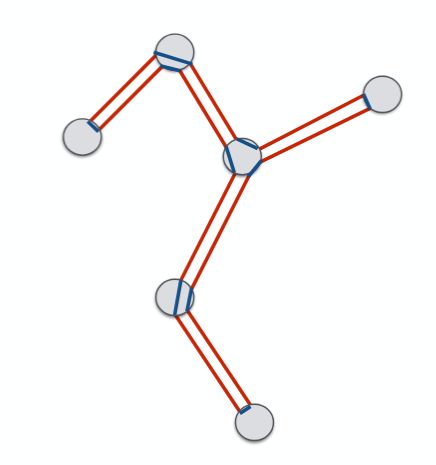
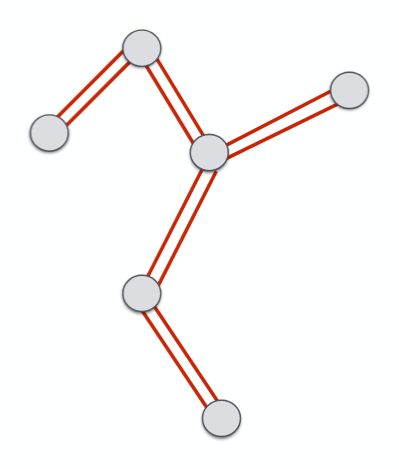
Algorithmus Metrisches TSP
- Bestimme minimalen Spannbaum T
es gilt: \( \ell(T) \leq \text{opt}(K_n, \ell) \)
- verdopple alle Kanten von T
es gilt: \( 2\ell(T) \leq 2\text{opt}(K_n, \ell) \)
- bestimme Eulertour W
es gilt: \( \ell(W) = 2\ell(T) \leq 2\text{opt}(K_n, \ell) \)
- durchlaufe W, mit Abkürzungen, so dass jeder Knoten nur einmal besucht wird \( \Rightarrow \) Hamiltonkreis C
Back
ETH::2._Semester::A&W::1._Graphentheorie::5._Kreise::4._Das_Travelling_Salesman_Problem
Algorithmus Metrisches TSP
- Bestimme minimalen Spannbaum T
es gilt: \( \ell(T) \leq \text{opt}(K_n, \ell) \)
- verdopple alle Kanten von T
es gilt: \( 2\ell(T) \leq 2\text{opt}(K_n, \ell) \)
- bestimme Eulertour W
es gilt: \( \ell(W) = 2\ell(T) \leq 2\text{opt}(K_n, \ell) \)
- durchlaufe W, mit Abkürzungen, so dass jeder Knoten nur einmal besucht wird \( \Rightarrow \) Hamiltonkreis C
Field-by-field Comparison
| Field |
Before |
After |
| Text |
|
Algorithmus Metrisches TSP<br><ol>
<li>Bestimme minimalen Spannbaum T
<br>es gilt: \( \ell(T) \leq \text{opt}(K_n, \ell) \)
</li>
<li>verdopple alle Kanten von T
<br>es gilt: \( 2\ell(T) \leq 2\text{opt}(K_n, \ell) \)
</li>
<li>bestimme Eulertour W
<br>es gilt: \( \ell(W) = 2\ell(T) \leq 2\text{opt}(K_n, \ell) \)
</li>
<li>{{c1::durchlaufe W, mit Abkürzungen, so dass jeder Knoten nur einmal besucht wird \( \Rightarrow \) Hamiltonkreis C}}<br></li>
</ol> |
| Extra |
|
<img src="paste-c4954fcd19f1482f5526247c42e2f198e454fdb2.jpg"><img src="paste-444cfbd1f58717d912e4326ff6bf8735179fd2c9.jpg"> |
Tags:
ETH::2._Semester::A&W::1._Graphentheorie::5._Kreise::4._Das_Travelling_Salesman_Problem
Note 19: ETH::2. Semester::A&W
Deck: ETH::2. Semester::A&W
Note Type: Horvath Cloze
GUID: nu1#7ym9)6
added
Previous
Note did not exist
New Note
Front
ETH::2._Semester::A&W::1._Graphentheorie::6._Matchings::1._Algorithmen
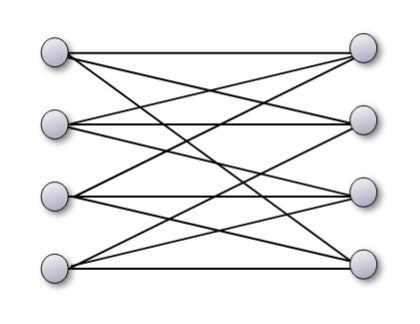
Für alle \( k \) gilt: jeder \( k \)-reguläre bipartite Graph enthält ein perfektes Matching.
Back
ETH::2._Semester::A&W::1._Graphentheorie::6._Matchings::1._Algorithmen
Für alle \( k \) gilt: jeder \( k \)-reguläre bipartite Graph enthält ein perfektes Matching.
(Frobenius, 1917)
Es gilt sogar: Der Graph ist die Vereinigung von perfekten Matchings.
Field-by-field Comparison
| Field |
Before |
After |
| Text |
|
Für alle \( k \) gilt: jeder \( k \)-reguläre <b>bipartite </b>Graph enthält {{c1::ein perfektes Matching}}. |
| Extra |
|
(Frobenius, 1917)<br><br>Es gilt sogar: Der Graph ist die Vereinigung von perfekten Matchings.<br><br><img src="paste-50a81ea762963336ac472c790ce9019abb90b75a.jpg"> |
Tags:
ETH::2._Semester::A&W::1._Graphentheorie::6._Matchings::1._Algorithmen
Note 20: ETH::2. Semester::A&W
Deck: ETH::2. Semester::A&W
Note Type: Horvath Cloze
GUID: r>Tf(u(!Au
added
Previous
Note did not exist
New Note
Front
ETH::2._Semester::A&W::1._Graphentheorie::6._Matchings::1._Algorithmen
In \( k \)-regulären bipartiten Graphen kann man in Zeit \( O(|E|) \) ein perfektes Matching bestimmen.
Back
ETH::2._Semester::A&W::1._Graphentheorie::6._Matchings::1._Algorithmen
In \( k \)-regulären bipartiten Graphen kann man in Zeit \( O(|E|) \) ein perfektes Matching bestimmen.
Field-by-field Comparison
| Field |
Before |
After |
| Text |
|
In \( k \)-regulären bipartiten Graphen kann man in Zeit \( O({{c1::|E|}}) \) ein perfektes Matching bestimmen. |
Tags:
ETH::2._Semester::A&W::1._Graphentheorie::6._Matchings::1._Algorithmen
Note 21: ETH::2. Semester::A&W
Deck: ETH::2. Semester::A&W
Note Type: Horvath Cloze
GUID: ri^3U#yh0U
added
Previous
Note did not exist
New Note
Front
ETH::2._Semester::A&W::1._Graphentheorie::6._Matchings::1._Algorithmen
In bipartiten Graphen kann man in Zeit \( O(|V| \cdot |E|) \) ein perfektes Matching bestimmen.
Back
ETH::2._Semester::A&W::1._Graphentheorie::6._Matchings::1._Algorithmen
In bipartiten Graphen kann man in Zeit \( O(|V| \cdot |E|) \) ein perfektes Matching bestimmen.
Field-by-field Comparison
| Field |
Before |
After |
| Text |
|
In bipartiten Graphen kann man in Zeit \( O({{c1::|V| \cdot |E|}}) \) ein perfektes Matching bestimmen. |
Tags:
ETH::2._Semester::A&W::1._Graphentheorie::6._Matchings::1._Algorithmen
Note 22: ETH::2. Semester::A&W
Deck: ETH::2. Semester::A&W
Note Type: Horvath Cloze
GUID: s{Ib,xkL@y
added
Previous
Note did not exist
New Note
Front
ETH::2._Semester::A&W::1._Graphentheorie::6._Matchings::1._Algorithmen
Konzept der augmentierenden Pfade:
\( O(|V| \cdot |E|) \) für bipartite Graphen
Back
ETH::2._Semester::A&W::1._Graphentheorie::6._Matchings::1._Algorithmen
Konzept der augmentierenden Pfade:
\( O(|V| \cdot |E|) \) für bipartite Graphen
Field-by-field Comparison
| Field |
Before |
After |
| Text |
|
Konzept der augmentierenden Pfade:
\( O({{c1::|V| \cdot |E|}}) \) für bipartite Graphen |
Tags:
ETH::2._Semester::A&W::1._Graphentheorie::6._Matchings::1._Algorithmen
Note 23: ETH::2. Semester::A&W
Deck: ETH::2. Semester::A&W
Note Type: Horvath Cloze
GUID: u4aYu(*H,t
added
Previous
Note did not exist
New Note
Front
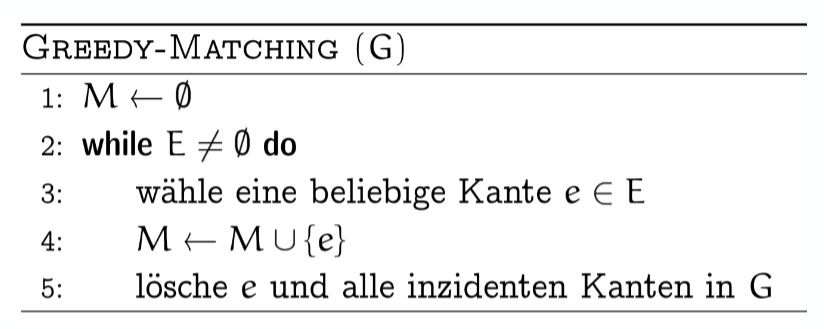
ETH::2._Semester::A&W::1._Graphentheorie::6._Matchings::1._Algorithmen
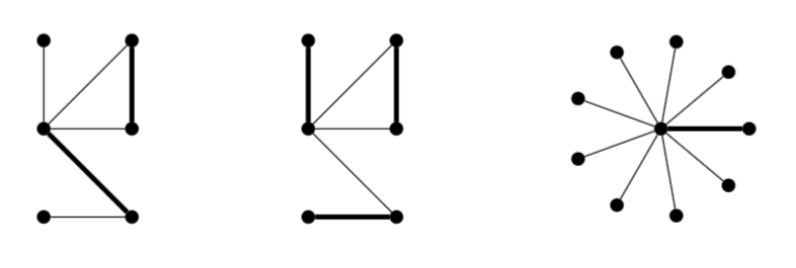
Mit einem Greedy-Algorithmus kann man in Zeit \( O(|E|) \) ein inklusionsmaximales Matching \( M_{\text{Greedy}} \) bestimmen mit
\[{{c2:: |M_{\text{Greedy} }| \geq |M_{\text{max} }| / 2, }}\]
wobei \( M_{\text{max}} \) ein kardinalitätsmaximales Matching ist.
Back
ETH::2._Semester::A&W::1._Graphentheorie::6._Matchings::1._Algorithmen
Mit einem Greedy-Algorithmus kann man in Zeit \( O(|E|) \) ein inklusionsmaximales Matching \( M_{\text{Greedy}} \) bestimmen mit
\[{{c2:: |M_{\text{Greedy} }| \geq |M_{\text{max} }| / 2, }}\]
wobei \( M_{\text{max}} \) ein kardinalitätsmaximales Matching ist.
Field-by-field Comparison
| Field |
Before |
After |
| Text |
|
Mit einem Greedy-Algorithmus kann man in Zeit \( O({{c1::|E|}}) \) ein {{c3::inklusionsmaximales}} Matching \( M_{\text{Greedy}} \) bestimmen mit<br>\[{{c2:: |M_{\text{Greedy} }| \geq |M_{\text{max} }| / 2, }}\]<br>wobei \( M_{\text{max}} \) ein kardinalitätsmaximales Matching ist. |
| Extra |
|
<img src="paste-c9d69f99b463de3d9a2fdc1655ef17bfb37850cc.jpg"> |
Tags:
ETH::2._Semester::A&W::1._Graphentheorie::6._Matchings::1._Algorithmen
Note 24: ETH::2. Semester::A&W
Deck: ETH::2. Semester::A&W
Note Type: Horvath Cloze
GUID: u_Z|D!/cJ.
added
Previous
Note did not exist
New Note
Front
ETH::2._Semester::A&W::1._Graphentheorie::6._Matchings::1._Algorithmen
State of the Art Matching:
- \( O({{c1::|E|^{1+o(1)} }}) \) für bipartite Graphen
- \( O({{c2::|V|^{1/2} \cdot |E|}}) \) für generelle Graphen
Back
ETH::2._Semester::A&W::1._Graphentheorie::6._Matchings::1._Algorithmen
State of the Art Matching:
- \( O({{c1::|E|^{1+o(1)} }}) \) für bipartite Graphen
- \( O({{c2::|V|^{1/2} \cdot |E|}}) \) für generelle Graphen
Field-by-field Comparison
| Field |
Before |
After |
| Text |
|
State of the Art Matching:<br><ul><li>\( O({{c1::|E|^{1+o(1)} }}) \) für bipartite Graphen
</li><li>\( O({{c2::|V|^{1/2} \cdot |E|}}) \) für generelle Graphen</li></ul> |
Tags:
ETH::2._Semester::A&W::1._Graphentheorie::6._Matchings::1._Algorithmen
Note 25: ETH::2. Semester::A&W
Deck: ETH::2. Semester::A&W
Note Type: Horvath Cloze
GUID: v>ZS_mrhEk
added
Previous
Note did not exist
New Note
Front
ETH::2._Semester::A&W::1._Graphentheorie::6._Matchings::1._Algorithmen
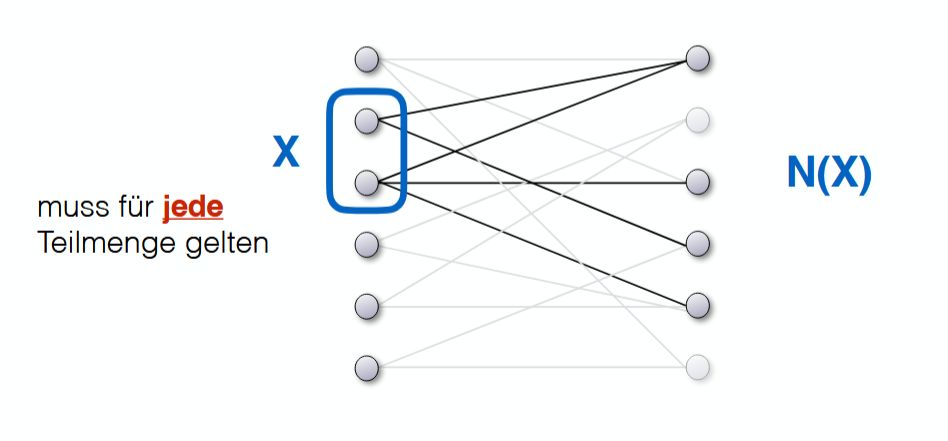
Ein bipartiter Graph \( G = (A \uplus B, E) \) enthält ein Matching \( M \) der Kardinalität \( |M| = |A| \iff \forall X \subseteq A : |X| \leq |N(X)| \).
Back
ETH::2._Semester::A&W::1._Graphentheorie::6._Matchings::1._Algorithmen
Ein bipartiter Graph \( G = (A \uplus B, E) \) enthält ein Matching \( M \) der Kardinalität \( |M| = |A| \iff \forall X \subseteq A : |X| \leq |N(X)| \).
(Hall, Heiratssatz)
Field-by-field Comparison
| Field |
Before |
After |
| Text |
|
Ein bipartiter Graph \( G = (A \uplus B, E) \) enthält ein Matching \( M \) der Kardinalität \({{c2:: |M| = |A|}} \iff {{c1::\forall X \subseteq A : |X| \leq |N(X)| }}\). |
| Extra |
|
(Hall, Heiratssatz)<br><br><img src="paste-fa014177da99d4899dd0eae35ae8300b5833a7c0.jpg"> |
Tags:
ETH::2._Semester::A&W::1._Graphentheorie::6._Matchings::1._Algorithmen
Note 26: ETH::2. Semester::A&W
Deck: ETH::2. Semester::A&W
Note Type: Horvath Cloze
GUID: w/1nCgk
added
Previous
Note did not exist
New Note
Front
ETH::2._Semester::A&W::1._Graphentheorie::5._Kreise::4._Das_Travelling_Salesman_Problem
Algorithmus Metrisches TSP
- Bestimme minimalen Spannbaum T
es gilt: \( \ell(T) \leq \text{opt}(K_n, \ell) \)
- verdopple alle Kanten von T
es gilt: \( 2\ell(T) \leq 2\text{opt}(K_n, \ell) \)
- {{c1::bestimme Eulertour W
es gilt: \( \ell(W) = 2\ell(T) \leq 2\text{opt}(K_n, \ell) \)}}
Back
ETH::2._Semester::A&W::1._Graphentheorie::5._Kreise::4._Das_Travelling_Salesman_Problem
Algorithmus Metrisches TSP
- Bestimme minimalen Spannbaum T
es gilt: \( \ell(T) \leq \text{opt}(K_n, \ell) \)
- verdopple alle Kanten von T
es gilt: \( 2\ell(T) \leq 2\text{opt}(K_n, \ell) \)
- {{c1::bestimme Eulertour W
es gilt: \( \ell(W) = 2\ell(T) \leq 2\text{opt}(K_n, \ell) \)}}
Field-by-field Comparison
| Field |
Before |
After |
| Text |
|
Algorithmus Metrisches TSP<br><ol>
<li>Bestimme minimalen Spannbaum T
<br>es gilt: \( \ell(T) \leq \text{opt}(K_n, \ell) \)
</li>
<li>verdopple alle Kanten von T
<br>es gilt: \( 2\ell(T) \leq 2\text{opt}(K_n, \ell) \)
</li>
<li>{{c1::bestimme Eulertour W
<br>es gilt: \( \ell(W) = 2\ell(T) \leq 2\text{opt}(K_n, \ell) \)}}<br></li>
</ol> |
| Extra |
|
<img src="paste-7bca0484fe2b0a0d3a7347f759ea92bf180a2f1b.jpg"> |
Tags:
ETH::2._Semester::A&W::1._Graphentheorie::5._Kreise::4._Das_Travelling_Salesman_Problem
Note 27: ETH::2. Semester::A&W
Deck: ETH::2. Semester::A&W
Note Type: Horvath Cloze
GUID: yzE(j~BcIc
added
Previous
Note did not exist
New Note
Front
ETH::2._Semester::A&W::1._Graphentheorie::5._Kreise::4._Das_Travelling_Salesman_Problem
Algorithmus Metrisches TSP
- Bestimme minimalen Spannbaum T
es gilt: \( \ell(T) \leq \text{opt}(K_n, \ell) \)
- {{c1::verdopple alle Kanten von T
es gilt: \( 2\ell(T) \leq 2\text{opt}(K_n, \ell) \)}}
Back
ETH::2._Semester::A&W::1._Graphentheorie::5._Kreise::4._Das_Travelling_Salesman_Problem
Algorithmus Metrisches TSP
- Bestimme minimalen Spannbaum T
es gilt: \( \ell(T) \leq \text{opt}(K_n, \ell) \)
- {{c1::verdopple alle Kanten von T
es gilt: \( 2\ell(T) \leq 2\text{opt}(K_n, \ell) \)}}
Field-by-field Comparison
| Field |
Before |
After |
| Text |
|
Algorithmus Metrisches TSP<br><ol>
<li>Bestimme minimalen Spannbaum T
<br>es gilt: \( \ell(T) \leq \text{opt}(K_n, \ell) \)
</li>
<li>{{c1::verdopple alle Kanten von T
<br>es gilt: \( 2\ell(T) \leq 2\text{opt}(K_n, \ell) \)}}<br></li>
</ol> |
| Extra |
|
<img src="paste-84a09d1fa73f259c867fdda63dca7a2062a733e4.jpg"> |
Tags:
ETH::2._Semester::A&W::1._Graphentheorie::5._Kreise::4._Das_Travelling_Salesman_Problem
Note 28: ETH::2. Semester::A&W
Deck: ETH::2. Semester::A&W
Note Type: Horvath Cloze
GUID: z:DWoLKD{}
added
Previous
Note did not exist
New Note
Front
ETH::2._Semester::A&W::1._Graphentheorie::6._Matchings::1._Algorithmen
In \( 2^k \)-regulären bipartiten Graphen kann man in Zeit \( O(|E|) \) ein perfektes Matching bestimmen.
Back
ETH::2._Semester::A&W::1._Graphentheorie::6._Matchings::1._Algorithmen
In \( 2^k \)-regulären bipartiten Graphen kann man in Zeit \( O(|E|) \) ein perfektes Matching bestimmen.
Field-by-field Comparison
| Field |
Before |
After |
| Text |
|
In \( 2^k \)-regulären bipartiten Graphen kann man in Zeit \( O({{c1::|E|}}) \) ein perfektes Matching bestimmen. |
Tags:
ETH::2._Semester::A&W::1._Graphentheorie::6._Matchings::1._Algorithmen