Explain how unions works in the optimised Union-Find:
Note 1: ETH::1. Semester::A&D
Deck: ETH::1. Semester::A&D
Note Type: Horvath Classic
GUID:
modified
Note Type: Horvath Classic
GUID:
FS|421SN1o
Before
Front
Back
Explain how unions works in the optimised Union-Find:
Arrays:
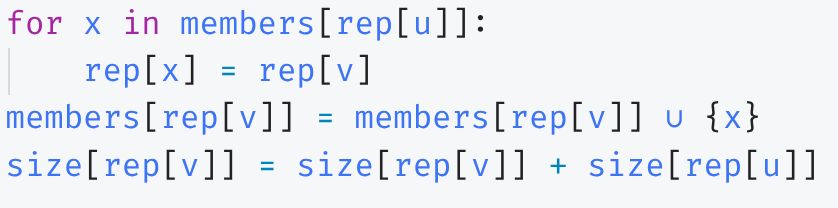
We update the reps, then the membership lists and finally the size
- rep, where rep[v] gives the representative of \(v\).
- members, where members[rep[v]] which contains all members of the ZHK of \(v\)
- rank, where rank[rep[v]] contains the size of the ZHK of \(v\).
We always merge the smaller ZHK into the bigger to minimise updates.
We update the reps, then the membership lists and finally the size
After
Front
Explain how union works in the optimised Union-Find:
Back
Explain how union works in the optimised Union-Find:
Arrays:
We update the reps, then the membership lists and finally the size.
- rep, where rep[v] gives the representative of \(v\).
- members, where members[rep[v]] which contains all members of the ZHK of \(v\)
- rank, where rank[rep[v]] contains the size of the ZHK of \(v\).
We always merge the smaller ZHK into the bigger to minimise updates.
We update the reps, then the membership lists and finally the size.
Field-by-field Comparison
| Field | Before | After |
|---|---|---|
| Front | Explain how union |
Explain how union works in the optimised <b>Union-Find:</b> |
| Back | Arrays:<br><ul><li><b>rep</b>, where <b>rep[v]</b> gives the representative of \(v\).</li><li><b>members</b>, where <b>members[rep[v]] </b>which contains all members of the ZHK of \(v\)<br></li><li><b>rank</b>, where <b>rank[rep[v]]</b> contains the size of the ZHK of \(v\).</li></ul><div>We always merge the smaller ZHK into the bigger to minimise updates.</div><img src="paste-5129796b3ae6c46edebbaae726a47f0c892c2435.jpg"><br>We update the reps, then the membership lists and finally the size | Arrays:<br><ul><li><b>rep</b>, where <b>rep[v]</b> gives the representative of \(v\).</li><li><b>members</b>, where <b>members[rep[v]] </b>which contains all members of the ZHK of \(v\)<br></li><li><b>rank</b>, where <b>rank[rep[v]]</b> contains the size of the ZHK of \(v\).</li></ul><div>We always merge the smaller ZHK into the bigger to minimise updates.</div><img src="paste-5129796b3ae6c46edebbaae726a47f0c892c2435.jpg"><br>We update the reps, then the membership lists and finally the size. |
Note 2: ETH::1. Semester::A&D
Deck: ETH::1. Semester::A&D
Note Type: Algorithms
GUID:
modified
Note Type: Algorithms
GUID:
T?I`@dy&K
Before
Front
Runtime of Kruskal's Algorithm?
Back
Runtime of Kruskal's Algorithm?
\(O(|E| \log |E| + |V| \log |V|)\)
Outer loop: Iterate \(|E|\) times at most:
Inner loop: find and union take \(O(\log |V|)\) per call amortised, thus \(O(|V| \log |V|)\) total.
This requires the Union Find Datastructure
Outer loop: Iterate \(|E|\) times at most:
Inner loop: find and union take \(O(\log |V|)\) per call amortised, thus \(O(|V| \log |V|)\) total.
This requires the Union Find Datastructure
After
Front
Runtime of Kruskal's Algorithm?
Back
Runtime of Kruskal's Algorithm?
\(O(|E| \log |E| + |V| \log |V|)\)
Outer loop: Iterate \(|E|\) times at most:
Inner loop: find and union take \(O(\log |V|)\) per call amortised, thus \(O(|V| \log |V|)\) total.
This requires the Union Find datastructure.
Outer loop: Iterate \(|E|\) times at most:
Inner loop: find and union take \(O(\log |V|)\) per call amortised, thus \(O(|V| \log |V|)\) total.
This requires the Union Find datastructure.
Field-by-field Comparison
| Field | Before | After |
|---|---|---|
| Extra Info | This requires the Union Find |
This requires the Union Find datastructure. |
Note 3: ETH::1. Semester::A&D
Deck: ETH::1. Semester::A&D
Note Type: Horvath Classic
GUID:
modified
Note Type: Horvath Classic
GUID:
wxuX$c!)%k
Before
Front
A graph with this DP table from F-W:
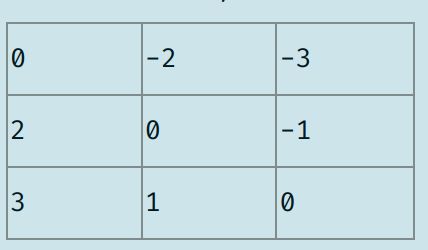
contains ___ negative cycles.
contains ___ negative cycles.
Back
A graph with this DP table from F-W:
contains ___ negative cycles.
contains ___ negative cycles.
no (there is no diagonal \(< 0\))
After
Front
A graph with this DP table from Floyd-Warshall:
contains ___ negative cycles.
contains ___ negative cycles.
Back
A graph with this DP table from Floyd-Warshall:
contains ___ negative cycles.
contains ___ negative cycles.
no (there is no diagonal \(< 0\))
Field-by-field Comparison
| Field | Before | After |
|---|---|---|
| Front | A graph with this DP table from F |
A graph with this DP table from Floyd-Warshall:<br><img src="paste-deae0d6c4a31dc3e71c5f654f12387c82b186739.jpg"><br>contains ___ negative cycles. |
Note 4: ETH::1. Semester::EProg
Deck: ETH::1. Semester::EProg
Note Type: Horvath Cloze
GUID:
modified
Note Type: Horvath Cloze
GUID:
El$[?h8w;k
Before
Front
Attribute access modifiers:
- default: package scoped, only available in same package.
- public: by everyone
- private: only accessible from within the object itself (not shared with other instances, unlike static)
- static:: no initialisation needed, can be accessed through Math.PI
- final: prevents overwriting, like const
- protected: only by this class and subclasses
Back
Attribute access modifiers:
- default: package scoped, only available in same package.
- public: by everyone
- private: only accessible from within the object itself (not shared with other instances, unlike static)
- static:: no initialisation needed, can be accessed through Math.PI
- final: prevents overwriting, like const
- protected: only by this class and subclasses
After
Front
Attribute access modifiers:
- default: package scoped, only available in same package.
- public: by everyone
- private: only accessible from within the object itself (not shared with other instances, unlike static)
- static: no initialisation needed, can be accessed through Math.PI
- final: prevents overwriting, like const
- protected: only by this class and subclasses
Back
Attribute access modifiers:
- default: package scoped, only available in same package.
- public: by everyone
- private: only accessible from within the object itself (not shared with other instances, unlike static)
- static: no initialisation needed, can be accessed through Math.PI
- final: prevents overwriting, like const
- protected: only by this class and subclasses
Field-by-field Comparison
| Field | Before | After |
|---|---|---|
| Text | Attribute access modifiers:<br><ul><li>default: {{c1:: package scoped, only available in same package.}}</li><li>public: {{c2:: by everyone}}</li><li>private: {{c3:: only accessible from within the object itself (not shared with other instances, unlike static)}}</li><li>static: |
Attribute access modifiers:<br><ul><li>default: {{c1:: package scoped, only available in same package.}}</li><li>public: {{c2:: by everyone}}</li><li>private: {{c3:: only accessible from within the object itself (not shared with other instances, unlike static)}}</li><li>static: {{c4:: no initialisation needed, can be accessed through <b>Math.PI</b>}}<br></li><li>final: {{c5:: prevents overwriting, like const}}</li><li>protected: {{c6:: only by this class and subclasses}}</li></ul> |
Note 5: ETH::1. Semester::EProg
Deck: ETH::1. Semester::EProg
Note Type: Horvath Cloze
GUID:
modified
Note Type: Horvath Cloze
GUID:
F$o5lV^z=H
Before
Front
Note that a class can implement multiple interfaces.
If a method is defined in multiple of those interfaces, it of course has to implemented only once.
Back
Note that a class can implement multiple interfaces.
If a method is defined in multiple of those interfaces, it of course has to implemented only once.
After
Front
Note that a class can implement multiple interfaces.
If a method is defined in multiple of those interfaces, it of course has to be implemented only once.
Back
Note that a class can implement multiple interfaces.
If a method is defined in multiple of those interfaces, it of course has to be implemented only once.
Field-by-field Comparison
| Field | Before | After |
|---|---|---|
| Text | <div>Note that a class can<b> </b>{{c1::<b>implement multiple interfaces</b>}}.</div><div>If a method is defined in {{c1::multiple of those interfaces}}, it {{c1::of course has to implemented only once}}.</div> | <div>Note that a class can<b> </b>{{c1::<b>implement multiple interfaces</b>}}.</div><div>If a method is defined in {{c1::multiple of those interfaces}}, it {{c1::of course has to be implemented only once}}.</div> |
Note 6: ETH::1. Semester::EProg
Deck: ETH::1. Semester::EProg
Note Type: Horvath Cloze
GUID:
modified
Note Type: Horvath Cloze
GUID:
G]t&7SvtKp
Before
Front
In a dynamic dispatch, the this still refers to the dynamic type, thus even if the method is in a superclass, it will always try to use the "most overriden" method.
Back
In a dynamic dispatch, the this still refers to the dynamic type, thus even if the method is in a superclass, it will always try to use the "most overriden" method.
After
Front
In a dynamic dispatch, the "this"-keyword still refers to the dynamic type, thus even if the method is in a superclass, it will always try to use the "most overriden" method.
Back
In a dynamic dispatch, the "this"-keyword still refers to the dynamic type, thus even if the method is in a superclass, it will always try to use the "most overriden" method.
Field-by-field Comparison
| Field | Before | After |
|---|---|---|
| Text | In a dynamic dispatch, the this still refers to the dynamic type, thus {{c1:: even if the method is in a superclass, it will always try to use the "most overriden" method}}. | In a dynamic dispatch, the "this"-keyword still refers to the dynamic type, thus {{c1:: even if the method is in a superclass, it will always try to use the "most overriden" method}}. |
Note 7: ETH::1. Semester::EProg
Deck: ETH::1. Semester::EProg
Note Type: Horvath Classic
GUID:
modified
Note Type: Horvath Classic
GUID:
HNxps|u:&w
Before
Front
Enums are special classes, they are initialised like this:
Back
Enums are special classes, they are initialised like this:
public enum Status {
SUBMITTED,
PAID,
...
}
SUBMITTED,
PAID,
...
}
After
Front
How are enums initialized?
Back
How are enums initialized?
public enum Status {
SUBMITTED,
PAID,
...
}
SUBMITTED,
PAID,
...
}
Field-by-field Comparison
| Field | Before | After |
|---|---|---|
| Front | How are enums initialized? |
Note 8: ETH::1. Semester::EProg
Deck: ETH::1. Semester::EProg
Note Type: Horvath Cloze
GUID:
modified
Note Type: Horvath Cloze
GUID:
Hz_:Sp*X(y
Before
Front
class A {
    public int x = 5;
}

class B extends A {
    public int y = 6;
    public int test() { return 0; }
}

A a1 = new B(1);
B.y; //  leads to a compile error, as A doesn't have x
B.test() //  leads to a compile error, as A doesn't have test()
Back
class A {
    public int x = 5;
}

class B extends A {
    public int y = 6;
    public int test() { return 0; }
}

A a1 = new B(1);
B.y; //  leads to a compile error, as A doesn't have x
B.test() //  leads to a compile error, as A doesn't have test()
After
Front
class A {
    public int x = 5;
}

class B extends A {
    public int y = 6;
    public int test() { return 0; }
public B(int i) {
super();
}}
A a1 = new B(1);

a1.y; //  leads to a compile error, as A doesn't have x

a1.test(); //
leads to a compile error, as A doesn't have test()Back
class A {
    public int x = 5;
}

class B extends A {
    public int y = 6;
    public int test() { return 0; }
public B(int i) {
super();
}}
A a1 = new B(1);

a1.y; //  leads to a compile error, as A doesn't have x

a1.test(); //
leads to a compile error, as A doesn't have test()Field-by-field Comparison
| Field | Before | After |
|---|---|---|
| Text | <pre><code>class A {
public int x = 5;
}
class B extends A {
public int y = 6;
public int test() { return 0; } |
<pre><code>class A { public int x = 5; } class B extends A { public int y = 6; public int test() { return 0; }</code></pre><pre><code><div> public B(int i) {<br> super();<br> }</div></code></pre><pre><span style="font-family: "Liberation Sans";">}</span><br></pre><code> A a1 = new B(1); <br>a1.y; // {{c1:: leads to a compile error, as A doesn't have x}} <br>a1.test(); // </code>{{c2:: leads to a compile error, as A doesn't have test()}} |
Note 9: ETH::1. Semester::EProg
Deck: ETH::1. Semester::EProg
Note Type: Horvath Classic
GUID:
modified
Note Type: Horvath Classic
GUID:
gK8R,r`Ne1
Before
Front
Java Modulo operator a % b expression
Back
Java Modulo operator a % b expression
(a / b) * b + (a % b) = a (with a / b being division with rest)
In general, if the a is negative, the result is negative.
After
Front
How is a % b defined in Java?
Back
How is a % b defined in Java?
(a / b) * b + (a % b) = a (with a / b being division with rest)
In general, if the a is negative, the result is negative.
Field-by-field Comparison
| Field | Before | After |
|---|---|---|
| Front | How is a % b defined in Java? |