Runtime of Johnson's Algorithm?
Note 1: ETH::A&D
Deck: ETH::A&D
Note Type: Algorithms
GUID:
modified
Note Type: Algorithms
GUID:
DeJ!2ph{Al
Before
Front
Back
Runtime of Johnson's Algorithm?
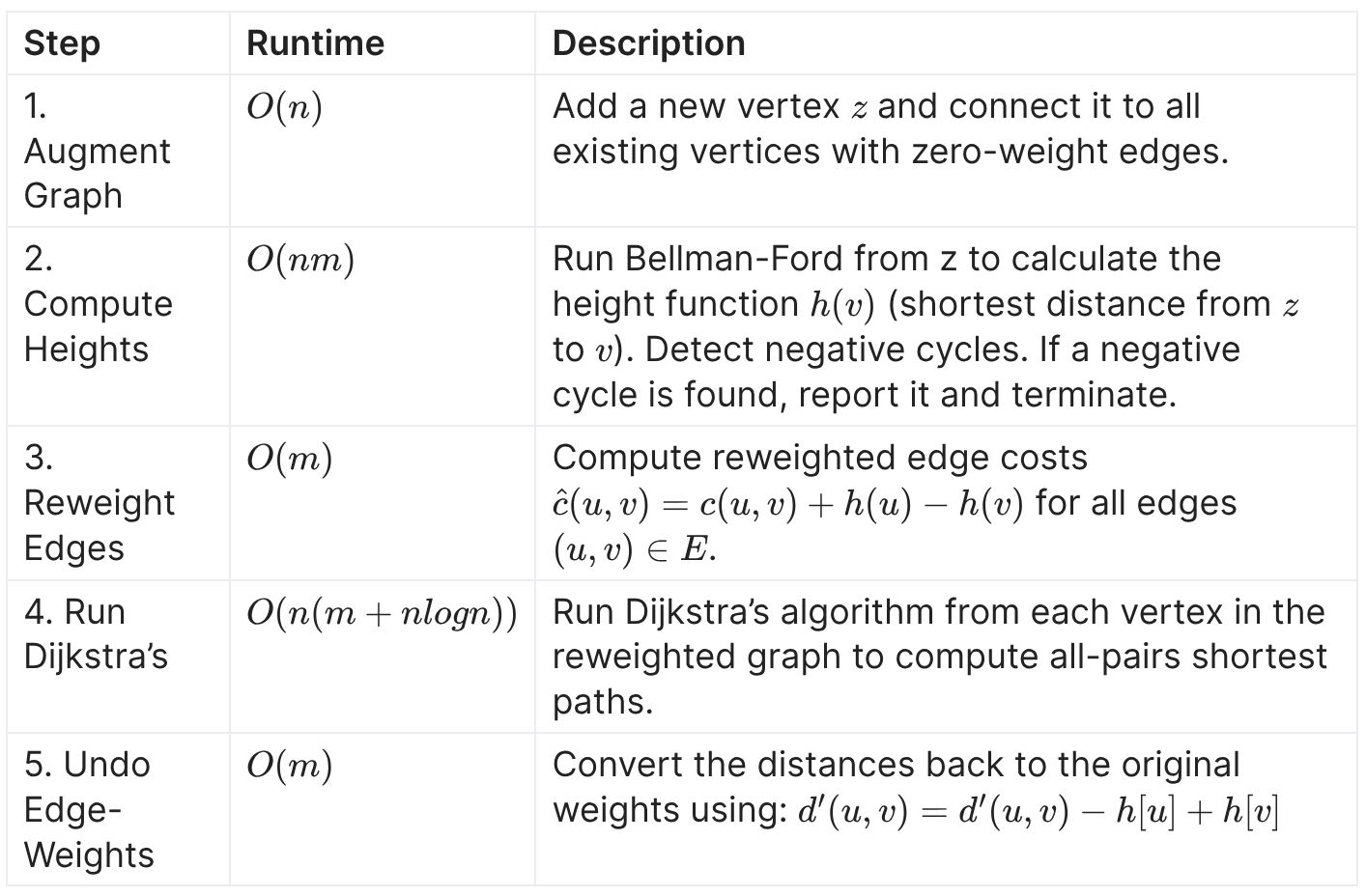
\(O(|V| \cdot (|V| + |E|) \log |V|)\) (running dijkstra's n times, but allows negatives)
After
Front
Runtime of Johnson's Algorithm?
Back
Runtime of Johnson's Algorithm?
\(O(|V| \cdot (|V| + |E|) \log |V|)\) (running dijkstra's n times, but allows negatives)
Field-by-field Comparison
| Field | Before | After |
|---|---|---|
| Approach | <ol><li><b>Add a New Vertex:</b><ul><li>Add a new vertex s to the graph and connect it to all vertices with zero-weight edges. </li>
</ul></li><li><b>Run Bellman-Ford</b>:<ul><li>Use the Bellman-Ford algorithm starting from s to compute the shortest distance h[v] from s to each vertex v.</li><li>If a negative-weight cycle is detected, stop.</li></ul></li><li><b>Reweight Edges</b>: <ul><li>For each edge u → v with weight w(u, v), reweight it as: w′(u, v) = w(u, v) + h[u] − h[v]</li><li>This ensures all edge weights are non-negative.</li>
</ul> </li><li><b>Run Dijkstra’s Algorithm:</b><ul><li>For each vertex v, use Dijkstra’s algorithm to compute the shortest paths to all other vertices.</li>
</ul></li><li><b>Adjust Back</b>:<ul><li>Convert the distances back to the original weights using: d′(u, v) = d′(u, v) − h[u] + h[v]</li>
</ul></li><li><b>End:</b></li><ul><li>The resulting shortest path distances between all pairs of vertices are valid.</li></ul></ol><div>The overall higher cost allows us to run pre-computation steps like B |
<ol><li><b>Add a New Vertex:</b><ul><li>Add a new vertex s to the graph and connect it to all vertices with zero-weight edges. </li> </ul></li><li><b>Run Bellman-Ford</b>:<ul><li>Use the Bellman-Ford algorithm starting from s to compute the shortest distance h[v] from s to each vertex v.</li><li>If a negative-weight cycle is detected, stop.</li></ul></li><li><b>Reweight Edges</b>: <ul><li>For each edge u → v with weight w(u, v), reweight it as: w′(u, v) = w(u, v) + h[u] − h[v]</li><li>This ensures all edge weights are non-negative.</li> </ul> </li><li><b>Run Dijkstra’s Algorithm:</b><ul><li>For each vertex v, use Dijkstra’s algorithm to compute the shortest paths to all other vertices.</li> </ul></li><li><b>Adjust Back</b>:<ul><li>Convert the distances back to the original weights using: d′(u, v) = d′(u, v) − h[u] + h[v]</li> </ul></li><li><b>End:</b></li><ul><li>The resulting shortest path distances between all pairs of vertices are valid.</li></ul></ol><div>The overall higher cost allows us to run pre-computation steps like Bellman-Ford for "free".</div> |
Note 2: ETH::A&D
Deck: ETH::A&D
Note Type: Horvath Cloze
GUID:
modified
Note Type: Horvath Cloze
GUID:
hsaD+h{~n8
Before
Front
Reweighting in Johnson's algorithm:
- We add a vertex \(s\) and add a 0 cost edge from it to all vertices.
- We then run B-F which determines the height of each vertex by the d[v] from start vertex \(s\)
Back
Reweighting in Johnson's algorithm:
- We add a vertex \(s\) and add a 0 cost edge from it to all vertices.
- We then run B-F which determines the height of each vertex by the d[v] from start vertex \(s\)
After
Front
Reweighting in Johnson's algorithm:
- We add a vertex \(s\) and add a 0 cost edge from it to all vertices.
- We then run Bellman-Ford which determines the height of each vertex by the d[v] from start vertex \(s\)
Back
Reweighting in Johnson's algorithm:
- We add a vertex \(s\) and add a 0 cost edge from it to all vertices.
- We then run Bellman-Ford which determines the height of each vertex by the d[v] from start vertex \(s\)
Field-by-field Comparison
| Field | Before | After |
|---|---|---|
| Text | Reweighting in Johnson's algorithm:<br><ol><li>We {{c1::add a vertex \(s\)}} and {{c1::add a 0 cost edge from it to all vertices}}.</li><li>We then {{c2::run B |
Reweighting in Johnson's algorithm:<br><ol><li>We {{c1::add a vertex \(s\)}} and {{c1::add a 0 cost edge from it to all vertices}}.</li><li>We then {{c2::run Bellman-Ford which determines the height of each vertex by the d[v] from start vertex \(s\)}} </li></ol> |
Note 3: ETH::LinAlg
Deck: ETH::LinAlg
Note Type: Horvath Cloze
GUID:
modified
Note Type: Horvath Cloze
GUID:
G9![k&wZRU
Before
Front
Given a symmetric matrix \(A \in \mathbb{R}^{n \times n}\) the Rayleigh Quotient defined for \(x \in \mathbb{R}^n \setminus {0}\), as \[ R(x) = {{c1::\frac{x^\top Ax}{x^\top x} }}\]attains it’s
- maximum at \(R(v_{\text{max) = \lambda_{\text{max}}\)}}
- minimum at \(R(v_{\text{min) = \lambda_{\text{min}}\)}}
where \(\lambda_{\text{max\) and \(\lambda_{\text{min}}\) are respectively the largest and smallest eigenvalues of \(A\) and \(v_{\text{max}}\) and \(v_{\text{min}}\) their associated eigenvectors}}.
Back
Given a symmetric matrix \(A \in \mathbb{R}^{n \times n}\) the Rayleigh Quotient defined for \(x \in \mathbb{R}^n \setminus {0}\), as \[ R(x) = {{c1::\frac{x^\top Ax}{x^\top x} }}\]attains it’s
- maximum at \(R(v_{\text{max) = \lambda_{\text{max}}\)}}
- minimum at \(R(v_{\text{min) = \lambda_{\text{min}}\)}}
where \(\lambda_{\text{max\) and \(\lambda_{\text{min}}\) are respectively the largest and smallest eigenvalues of \(A\) and \(v_{\text{max}}\) and \(v_{\text{min}}\) their associated eigenvectors}}.
After
Front
Given a symmetric matrix \(A \in \mathbb{R}^{n \times n}\) the Rayleigh Quotient defined for \(x \in \mathbb{R}^n \setminus {0}\), as \[ R(x) = {{c1::\frac{x^\top Ax}{x^\top x} }}\]attains it’s
- maximum at {{c2::\(R(v_{\text{max} }) = \lambda_{\text{max} }\)}}
- minimum at {{c2::\(R(v_{\text{min} }) = \lambda_{\text{min} } \)}}
where {{c2::\(\lambda_{\text{max} }\) and \(\lambda_{\text{min} }\) are respectively the largest and smallest eigenvalues of \(A\) and \(v_{\text{max} }\) and \(v_{\text{min} }\) their associated eigenvectors}}.
Back
Given a symmetric matrix \(A \in \mathbb{R}^{n \times n}\) the Rayleigh Quotient defined for \(x \in \mathbb{R}^n \setminus {0}\), as \[ R(x) = {{c1::\frac{x^\top Ax}{x^\top x} }}\]attains it’s
- maximum at {{c2::\(R(v_{\text{max} }) = \lambda_{\text{max} }\)}}
- minimum at {{c2::\(R(v_{\text{min} }) = \lambda_{\text{min} } \)}}
where {{c2::\(\lambda_{\text{max} }\) and \(\lambda_{\text{min} }\) are respectively the largest and smallest eigenvalues of \(A\) and \(v_{\text{max} }\) and \(v_{\text{min} }\) their associated eigenvectors}}.
Field-by-field Comparison
| Field | Before | After |
|---|---|---|
| Text | <div>Given a symmetric matrix \(A \in \mathbb{R}^{n \times n}\) the Rayleigh Quotient defined for \(x \in \mathbb{R}^n \setminus {0}\), as \[ R(x) = {{c1::\frac{x^\top Ax}{x^\top x} }}\]attains it’s</div><div><ul><li> |
<div>Given a symmetric matrix \(A \in \mathbb{R}^{n \times n}\) the Rayleigh Quotient defined for \(x \in \mathbb{R}^n \setminus {0}\), as \[ R(x) = {{c1::\frac{x^\top Ax}{x^\top x} }}\]attains it’s</div><div><ul><li>maximum at {{c2::\(R(v_{\text{max} }) = \lambda_{\text{max} }\)}}</li><li>minimum at {{c2::\(R(v_{\text{min} }) = \lambda_{\text{min} } \)}}</li></ul><div>where {{c2::\(\lambda_{\text{max} }\) and \(\lambda_{\text{min} }\) are respectively the largest and smallest eigenvalues of \(A\) and \(v_{\text{max} }\) and \(v_{\text{min} }\) their associated eigenvectors}}.</div></div><blockquote><ul> </ul></blockquote> |
Note 4: ETH::LinAlg
Deck: ETH::LinAlg
Note Type: Horvath Cloze
GUID:
modified
Note Type: Horvath Cloze
GUID:
M;:>m2mzC#
Before
Front
Let \(A \in \mathbb{R}^{m \times n}\). Then \(N(A) = N(A^\top A)\). Proof Included
Back
Let \(A \in \mathbb{R}^{m \times n}\). Then \(N(A) = N(A^\top A)\). Proof Included
\(N(A) = N(A^\top A)\) holds because:
- if \(x \in N(A)\) then \(Ax = 0 \implies A^\top Ax = A \cdot 0 \implies A^\top A x = 0\).
- if \(x \in N(A^\top A)\) then \(A^\top A x = 0\), which means \[ 0 = x^\top 0 = x^\top A^\top Ax = (Ax)^\top(Ax) = ||Ax||^2 \implies Ax = 0 \]
After
Front
Let \(A \in \mathbb{R}^{m \times n}\). Then \(N(A) = {{c1::N(A^\top A)::\text{another nullspace} }}\). Proof Included
Back
Let \(A \in \mathbb{R}^{m \times n}\). Then \(N(A) = {{c1::N(A^\top A)::\text{another nullspace} }}\). Proof Included
\(N(A) = N(A^\top A)\) holds because:
- if \(x \in N(A)\) then \(Ax = 0 \implies A^\top Ax = A \cdot 0 \implies A^\top A x = 0\).
- if \(x \in N(A^\top A)\) then \(A^\top A x = 0\), which means \[ 0 = x^\top 0 = x^\top A^\top Ax = (Ax)^\top(Ax) = ||Ax||^2 \implies Ax = 0 \]
Field-by-field Comparison
| Field | Before | After |
|---|---|---|
| Text | Let \(A \in \mathbb{R}^{m \times n}\). Then \(N(A) = {{c1::N(A^\top A)}}\). <i>Proof Included</i> | Let \(A \in \mathbb{R}^{m \times n}\). Then \(N(A) = {{c1::N(A^\top A)::\text{another nullspace} }}\). <i>Proof Included</i> |
Note 5: ETH::LinAlg
Deck: ETH::LinAlg
Note Type: Horvath Cloze
GUID:
modified
Note Type: Horvath Cloze
GUID:
OYJ^1jnB1-
Before
Front
Real antisymmetric matrices always have imaginary (or zero) eigenvalues.
Back
Real antisymmetric matrices always have imaginary (or zero) eigenvalues.
After
Front
Real antisymmetric matrices always have imaginary (or zero) eigenvalues.
Back
Real antisymmetric matrices always have imaginary (or zero) eigenvalues.
Antisymmetric means \(A^T=-A\).
Field-by-field Comparison
| Field | Before | After |
|---|---|---|
| Extra | Antisymmetric means \(A^T=-A\). |
Note 6: ETH::LinAlg
Deck: ETH::LinAlg
Note Type: Horvath Cloze
GUID:
modified
Note Type: Horvath Cloze
GUID:
Pa)fnn7&WJ
Before
Front
\(A \in \mathbb{R}^{n \times n}\) arbitrary non-symmetric has rank \(n - \dim(N(A))\) so it's \(n\) minus the geometric multiplicity of \(\lambda = 0\) .
Back
\(A \in \mathbb{R}^{n \times n}\) arbitrary non-symmetric has rank \(n - \dim(N(A))\) so it's \(n\) minus the geometric multiplicity of \(\lambda = 0\) .
After
Front
\(A \in \mathbb{R}^{n \times n}\) arbitrary non-symmetric has rank \(n - \dim(N(A))\) so it's \(n\) minus the geometric multiplicity of \(\lambda = 0\) .
Back
\(A \in \mathbb{R}^{n \times n}\) arbitrary non-symmetric has rank \(n - \dim(N(A))\) so it's \(n\) minus the geometric multiplicity of \(\lambda = 0\) .
Field-by-field Comparison
| Field | Before | After |
|---|---|---|
| Text | \(A \in \mathbb{R}^{n \times n}\) arbitrary non-symmetric has rank {{c1:: |
\(A \in \mathbb{R}^{n \times n}\) arbitrary non-symmetric has rank {{c1:: \(n - \dim(N(A))\) so it's \(n\) minus the geometric multiplicity of \(\lambda = 0\) ::in terms of multiplicities}}. |
Note 7: ETH::LinAlg
Deck: ETH::LinAlg
Note Type: Horvath Cloze
GUID:
modified
Note Type: Horvath Cloze
GUID:
d9#?3c)V#_
Before
Front
Let \(A \in \mathbb{R}^{n \times n}\) be a symmetric matrix and \(\lambda \in \mathbb{C}\) be an eigenvalue of \(A\), then {{c1::\(\lambda \in \mathbb{R}\):: property of the EW}}. Proof Included
Back
Let \(A \in \mathbb{R}^{n \times n}\) be a symmetric matrix and \(\lambda \in \mathbb{C}\) be an eigenvalue of \(A\), then {{c1::\(\lambda \in \mathbb{R}\):: property of the EW}}. Proof Included
Proof \(v \in \mathbb{C}^n\) be EV of \(\lambda\). Thus we have \(Av = \lambda v\). Since \(A\) is symmetric we have \(A^ = A\). \[\begin{align} \overline{\lambda}||v||^2 &= \overline{\lambda} v^*v \\ &= (\lambda v)^*v \\ &= (Av)^*v = v^*A^*v \\ &= v^* Av \text{ (uses } A^* = A \text{) } \\ &= v^*\lambda v \\ &= \lambda ||v||^2 \end{align}\]Since \(v \neq 0\), then \(||v|| \neq 0\) and so \(\lambda = \overline{\lambda}\) thus \(\lambda \in \mathbb{R}\).
After
Front
Let \(A \in \mathbb{R}^{n \times n}\) be a symmetric matrix and \(\lambda \in \mathbb{C}\) be an eigenvalue of \(A\), then {{c1::\(\lambda \in \mathbb{R}\)::property of the EW}}. Proof Included
Back
Let \(A \in \mathbb{R}^{n \times n}\) be a symmetric matrix and \(\lambda \in \mathbb{C}\) be an eigenvalue of \(A\), then {{c1::\(\lambda \in \mathbb{R}\)::property of the EW}}. Proof Included
Proof \(v \in \mathbb{C}^n\) be EV of \(\lambda\). Thus we have \(Av = \lambda v\). Since \(A\) is symmetric we have \(A^ = A\). \[\begin{align} \overline{\lambda}||v||^2 &= \overline{\lambda} v^*v \\ &= (\lambda v)^*v \\ &= (Av)^*v = v^*A^*v \\ &= v^* Av \text{ (uses } A^* = A \text{) } \\ &= v^*\lambda v \\ &= \lambda ||v||^2 \end{align}\]Since \(v \neq 0\), then \(||v|| \neq 0\) and so \(\lambda = \overline{\lambda}\) thus \(\lambda \in \mathbb{R}\).
Field-by-field Comparison
| Field | Before | After |
|---|---|---|
| Text | Let \(A \in \mathbb{R}^{n \times n}\) be a symmetric matrix and \(\lambda \in \mathbb{C}\) be an eigenvalue of \(A\), then {{c1::\(\lambda \in \mathbb{R}\):: |
Let \(A \in \mathbb{R}^{n \times n}\) be a symmetric matrix and \(\lambda \in \mathbb{C}\) be an eigenvalue of \(A\), then {{c1::\(\lambda \in \mathbb{R}\)::property of the EW}}. <i>Proof Included</i> |
Note 8: ETH::LinAlg
Deck: ETH::LinAlg
Note Type: Horvath Cloze
GUID:
modified
Note Type: Horvath Cloze
GUID:
dZ)aTr>2eb
Before
Front
Given a real matrix \(A \in \mathbb{R}^{n \times n}\), the non-zero eigenvalues of \(A^\top A\) are the same ones of \(AA^\top\). Proof Included
Back
Given a real matrix \(A \in \mathbb{R}^{n \times n}\), the non-zero eigenvalues of \(A^\top A\) are the same ones of \(AA^\top\). Proof Included
Shared EWs: For \((A\top A)v_k = \lambda_k v_k\) we get \(AA^\top A v_k = \lambda_k Av_k\) and thus \(Av_k\) EV and \(\lambda_k\) is an EW of \(AA^\top\).
Orthogonality: For \(j \neq k\) we have \((Av_j)^\top (Av_k) = v_j^\top A^\top Av_k = v_j^\top \lambda_k v_k = \lambda_k v_j^\top v_k = 0\)
Orthogonality: For \(j \neq k\) we have \((Av_j)^\top (Av_k) = v_j^\top A^\top Av_k = v_j^\top \lambda_k v_k = \lambda_k v_j^\top v_k = 0\)
After
Front
Given a real matrix \(A \in \mathbb{R}^{n \times n}\), the non-zero eigenvalues of \(A^\top A\) are the same ones of \(AA^\top\). Proof Included
Back
Given a real matrix \(A \in \mathbb{R}^{n \times n}\), the non-zero eigenvalues of \(A^\top A\) are the same ones of \(AA^\top\). Proof Included
Shared EWs: For \((A^\top A)v_k = \lambda_k v_k\) we get \(AA^\top A v_k = \lambda_k Av_k\) and thus \(Av_k\) EV and \(\lambda_k\) is an EW of \(AA^\top\).
Orthogonality: For \(j \neq k\) we have \((Av_j)^\top (Av_k) = v_j^\top A^\top Av_k = v_j^\top \lambda_k v_k = \lambda_k v_j^\top v_k = 0\)
Orthogonality: For \(j \neq k\) we have \((Av_j)^\top (Av_k) = v_j^\top A^\top Av_k = v_j^\top \lambda_k v_k = \lambda_k v_j^\top v_k = 0\)
Field-by-field Comparison
| Field | Before | After |
|---|---|---|
| Extra | <b>Shared EWs:</b> For \((A\top A)v_k = \lambda_k v_k\) we get \(AA^\top A v_k = \lambda_k Av_k\) and thus \(Av_k\) EV and \(\lambda_k\) is an EW of \(AA^\top\).<br><br><b>Orthogonality:</b> For \(j \neq k\) we have \((Av_j)^\top (Av_k) = v_j^\top A^\top Av_k = v_j^\top \lambda_k v_k = \lambda_k v_j^\top v_k = 0\)<div></div><div></div> | <b>Shared EWs:</b> For \((A^\top A)v_k = \lambda_k v_k\) we get \(AA^\top A v_k = \lambda_k Av_k\) and thus \(Av_k\) EV and \(\lambda_k\) is an EW of \(AA^\top\).<br><br><b>Orthogonality:</b> For \(j \neq k\) we have \((Av_j)^\top (Av_k) = v_j^\top A^\top Av_k = v_j^\top \lambda_k v_k = \lambda_k v_j^\top v_k = 0\)<div></div><div></div> |
Note 9: ETH::LinAlg
Deck: ETH::LinAlg
Note Type: Horvath Cloze
GUID:
modified
Note Type: Horvath Cloze
GUID:
fILs=r`j+*
Before
Front
Spectral Theorem: Any symmetric matrix \(A \in \mathbb{R}^{n \times n}\) has \(n\) real eigenvalues and {{c1::an orthonormal basis of \(\mathbb{R}^{n \times n}\) consisting of it's eigenvectors :: EV}}.
Back
Spectral Theorem: Any symmetric matrix \(A \in \mathbb{R}^{n \times n}\) has \(n\) real eigenvalues and {{c1::an orthonormal basis of \(\mathbb{R}^{n \times n}\) consisting of it's eigenvectors :: EV}}.
After
Front
Spectral Theorem: Any symmetric matrix \(A \in \mathbb{R}^{n \times n}\) has \(n\) real eigenvalues and {{c1::an orthonormal basis of \(\mathbb{R}^{n \times n}\) consisting of it's eigenvectors::EV}}.
Back
Spectral Theorem: Any symmetric matrix \(A \in \mathbb{R}^{n \times n}\) has \(n\) real eigenvalues and {{c1::an orthonormal basis of \(\mathbb{R}^{n \times n}\) consisting of it's eigenvectors::EV}}.
Field-by-field Comparison
| Field | Before | After |
|---|---|---|
| Text | <b>Spectral Theorem: </b>Any symmetric matrix \(A \in \mathbb{R}^{n \times n}\) has {{c1::\(n\) real eigenvalues |
<b>Spectral Theorem: </b>Any symmetric matrix \(A \in \mathbb{R}^{n \times n}\) has {{c1::\(n\) real eigenvalues::EW}} and {{c1::an orthonormal basis of \(\mathbb{R}^{n \times n}\) consisting of it's eigenvectors::EV}}. |
Note 10: ETH::LinAlg
Deck: ETH::LinAlg
Note Type: Horvath Cloze
GUID:
modified
Note Type: Horvath Cloze
GUID:
jn6
Before
Front
Let \(A \in \mathbb{R}^{n \times n}\) be a symmetric matrix and \(\lambda_1 \neq \lambda_2 \in \mathbb{R}\) be two distinct eigenvalues of \(A\) with corresponding eigenvectors \(v_1, v_2\): \(v_1\) and \(v_2\) are orthogonal. Proof Included
Back
Let \(A \in \mathbb{R}^{n \times n}\) be a symmetric matrix and \(\lambda_1 \neq \lambda_2 \in \mathbb{R}\) be two distinct eigenvalues of \(A\) with corresponding eigenvectors \(v_1, v_2\): \(v_1\) and \(v_2\) are orthogonal. Proof Included
Proof \(\lambda_1 v_1 ^\top v_2 = (Av_1)^\top v_2 = v_1^\top A ^\top v_2 = v_1^\top (Av_2) = \lambda_2 v_1^\top v_2\) Thus \(v_1^\top v_2\) must be \(0\).
After
Front
Let \(A \in \mathbb{R}^{n \times n}\) be a symmetric matrix and \(\lambda_1,\lambda_2 \in \mathbb{R}\) be two distinct eigenvalues of \(A\) with corresponding eigenvectors \(v_1, v_2\):
\(v_1\) and \(v_2\) are orthogonal. Proof Included
Back
Let \(A \in \mathbb{R}^{n \times n}\) be a symmetric matrix and \(\lambda_1,\lambda_2 \in \mathbb{R}\) be two distinct eigenvalues of \(A\) with corresponding eigenvectors \(v_1, v_2\):
\(v_1\) and \(v_2\) are orthogonal. Proof Included
Proof \(\lambda_1 v_1 ^\top v_2 = (Av_1)^\top v_2 = v_1^\top A ^\top v_2 = v_1^\top (Av_2) = \lambda_2 v_1^\top v_2\) Thus \(v_1^\top v_2\) must be \(0\).
Field-by-field Comparison
| Field | Before | After |
|---|---|---|
| Text | <div>Let \(A \in \mathbb{R}^{n \times n}\) be a symmetric matrix and \(\lambda_1 |
<div>Let \(A \in \mathbb{R}^{n \times n}\) be a symmetric matrix and \(\lambda_1,\lambda_2 \in \mathbb{R}\) be two {{c2::distinct}} eigenvalues of \(A\) with corresponding eigenvectors \(v_1, v_2\):</div><div><br></div><div>\(v_1\) and \(v_2\) are {{c1::orthogonal:: property}}. <i>Proof Included</i></div> |
Note 11: ETH::LinAlg
Deck: ETH::LinAlg
Note Type: Horvath Cloze
GUID:
modified
Note Type: Horvath Cloze
GUID:
jo;...VEEI
Before
Front
A matrix has a complete set of real eigenvectors if all its eigenvalues are real and the geometric multiplicities are the same as the algebraic multiplicities of all it's eigenvalues .
Back
A matrix has a complete set of real eigenvectors if all its eigenvalues are real and the geometric multiplicities are the same as the algebraic multiplicities of all it's eigenvalues .
Example \(I\) has eigenvalue \(1\) with geometric multiplicity \(n\) (\(\dim(N(I - 1 \cdot I)) = n\)) and algebraic multiplicity \(n\) (As the characteristic polynomial of \(I\), \(P(z) = (z - 1)(z - 1) \dots (z - 1)\) with that repeated \(n\) times).
After
Front
A matrix has a complete set of real eigenvectors if all its eigenvalues are real and the geometric multiplicities are the same as the algebraic multiplicities of all it's eigenvalues.
Back
A matrix has a complete set of real eigenvectors if all its eigenvalues are real and the geometric multiplicities are the same as the algebraic multiplicities of all it's eigenvalues.
Example \(I\) has eigenvalue \(1\) with geometric multiplicity \(n\) (\(\dim(N(I - 1 \cdot I)) = n\)) and algebraic multiplicity \(n\) (As the characteristic polynomial of \(I\), \(P(z) = (z - 1)(z - 1) \dots (z - 1)\) with that repeated \(n\) times).
Field-by-field Comparison
| Field | Before | After |
|---|---|---|
| Text | A matrix has a <b>complete set of real eigenvectors</b> if {{c1::all its eigenvalues are real and the geometric multiplicities are the same as the algebraic multiplicities of all it's eigenvalues |
A matrix has a <b>complete set of real eigenvectors</b> if {{c1::all its eigenvalues are real and the geometric multiplicities are the same as the algebraic multiplicities of all it's eigenvalues::in terms of multiplicities}}. |
Note 12: ETH::LinAlg
Deck: ETH::LinAlg
Note Type: Horvath Cloze
GUID:
modified
Note Type: Horvath Cloze
GUID:
qn2vol8}8V
Before
Front
Every symmetric matrix \(A \in \mathbb{R}^{n \times n}\) has a real eigenvalue \(\lambda\).
Back
Every symmetric matrix \(A \in \mathbb{R}^{n \times n}\) has a real eigenvalue \(\lambda\).
After
Front
Every symmetric matrix \(A \in \mathbb{R}^{n \times n}\) has a real eigenvalue \(\lambda\).
Back
Every symmetric matrix \(A \in \mathbb{R}^{n \times n}\) has a real eigenvalue \(\lambda\).
Field-by-field Comparison
| Field | Before | After |
|---|---|---|
| Text | Every symmetric matrix \(A \in \mathbb{R}^{n \times n}\) has {{c1::a real eigenvalue \(\lambda\):: |
Every symmetric matrix \(A \in \mathbb{R}^{n \times n}\) has {{c1::a real eigenvalue \(\lambda\)::existence}}. |
Note 13: ETH::LinAlg
Deck: ETH::LinAlg
Note Type: Horvath Cloze
GUID:
modified
Note Type: Horvath Cloze
GUID:
qr+Ln*lsd_
Before
Front
Any symmetric matrix has only real eigenvalues.
Back
Any symmetric matrix has only real eigenvalues.
After
Front
Any symmetric matrix has only real eigenvalues.
Back
Any symmetric matrix has only real eigenvalues.
Field-by-field Comparison
| Field | Before | After |
|---|---|---|
| Text | Any symmetric matrix has {{c1:: |
Any symmetric matrix has {{c1::only real eigenvalues::fact about the EWs}}. |
Note 14: ETH::LinAlg
Deck: ETH::LinAlg
Note Type: Horvath Cloze
GUID:
modified
Note Type: Horvath Cloze
GUID:
qs3_-P{w4Q
Before
Front
Similar matrices \(A\) and \(B = S^{-1}AS\) have the same eigenvalues .
Back
Similar matrices \(A\) and \(B = S^{-1}AS\) have the same eigenvalues .
After
Front
Similar matrices \(A\) and \(B = S^{-1}AS\) have the same eigenvalues.
Back
Similar matrices \(A\) and \(B = S^{-1}AS\) have the same eigenvalues.
Field-by-field Comparison
| Field | Before | After |
|---|---|---|
| Text | Similar matrices \(A\) and \(B = S^{-1}AS\) have {{c1::the same eigenvalues |
Similar matrices \(A\) and \(B = S^{-1}AS\) have {{c1::the same eigenvalues::shared property}}. |
Note 15: ETH::LinAlg
Deck: ETH::LinAlg
Note Type: Horvath Cloze
GUID:
modified
Note Type: Horvath Cloze
GUID:
s,(|c|R^[@
Before
Front
- If \(m = n\) (\(A\) is square), the system \(Ax = b\) is called square. Typically solvable.
- If \(m < n\) (A is a wide matrix), the system \(Ax = b\) is called underdetermined. These are typically solvable.
- If \(m > n\) (A is a tall matrix) the system \(Ax = b\) is called overdetermined. Typically not solvable.
Back
- If \(m = n\) (\(A\) is square), the system \(Ax = b\) is called square. Typically solvable.
- If \(m < n\) (A is a wide matrix), the system \(Ax = b\) is called underdetermined. These are typically solvable.
- If \(m > n\) (A is a tall matrix) the system \(Ax = b\) is called overdetermined. Typically not solvable.
(Undetermined because there are more variables than equations.)
After
Front
- If \(m = n\) (\(A\) is square), the system \(Ax = b\) is called square. Typically solvable.
- If \(m < n\) (A is a wide matrix), the system \(Ax = b\) is called underdetermined. These are typically solvable.
- If \(m > n\) (A is a tall matrix) the system \(Ax = b\) is called overdetermined. Typically not solvable.
Back
- If \(m = n\) (\(A\) is square), the system \(Ax = b\) is called square. Typically solvable.
- If \(m < n\) (A is a wide matrix), the system \(Ax = b\) is called underdetermined. These are typically solvable.
- If \(m > n\) (A is a tall matrix) the system \(Ax = b\) is called overdetermined. Typically not solvable.
(Undetermined because there are more variables than equations.)
Field-by-field Comparison
| Field | Before | After |
|---|---|---|
| Text | <ol><li>If \(m = n\) (\(A\) is square), the system \(Ax = b\) is called square. Typically solvable. </li><li>If \(m < n\) (A is a wide matrix), the system \(Ax = b\) is called {{c1::underdetermined}}. These are {{c1::typically solvable:: |
<ol><li>If \(m = n\) (\(A\) is square), the system \(Ax = b\) is called square. Typically solvable. </li><li>If \(m < n\) (A is a wide matrix), the system \(Ax = b\) is called {{c1::underdetermined}}. These are {{c1::typically solvable::solvability}}. </li><li>If \(m > n\) (A is a tall matrix) the system \(Ax = b\) is called {{c2::overdetermined}}. Typically {{c2::not solvable::solvability}}.</li></ol> |
Note 16: ETH::LinAlg
Deck: ETH::LinAlg
Note Type: Horvath Cloze
GUID:
modified
Note Type: Horvath Cloze
GUID:
tQtZJZ|Ls+
Before
Front
Given a real matrix \(A \in \mathbb{R}^{n \times n}\), the non-zero eigenvalues of \(A^\top A\) are the same ones of \(AA^\top\).
Both matrices are symmetric and PSD.
Proof Included
Back
Given a real matrix \(A \in \mathbb{R}^{n \times n}\), the non-zero eigenvalues of \(A^\top A\) are the same ones of \(AA^\top\).
Both matrices are symmetric and PSD.
Proof Included
Proof \(G = AA^\top\) and \(G = A^\top A\) are PSD.
- \(x^\top G x = x^\top (A^\top A ) x = (Ax)^\top (Ax) = ||Ax||^2 \geq 0\)
- \(x^\top G x = x^\top AA^\top x = (A^\top x)^\top (A^\top x) = ||A^\top x||^2 \geq 0\)
After
Front
Given a real matrix \(A \in \mathbb{R}^{n \times n}\), the non-zero eigenvalues of \(A^\top A\) are the same ones as of \(AA^\top\).
Both matrices are symmetric and PSD.
Proof Included
Back
Given a real matrix \(A \in \mathbb{R}^{n \times n}\), the non-zero eigenvalues of \(A^\top A\) are the same ones as of \(AA^\top\).
Both matrices are symmetric and PSD.
Proof Included
Proof \(G = AA^\top\) and \(G = A^\top A\) are PSD.
- \(x^\top G x = x^\top (A^\top A ) x = (Ax)^\top (Ax) = ||Ax||^2 \geq 0\)
- \(x^\top G x = x^\top AA^\top x = (A^\top x)^\top (A^\top x) = ||A^\top x||^2 \geq 0\)
Field-by-field Comparison
| Field | Before | After |
|---|---|---|
| Text | <div>Given a real matrix \(A \in \mathbb{R}^{n \times n}\), the non-zero eigenvalues of \(A^\top A\) are the same ones of \(AA^\top\).</div><div>Both matrices are {{c3::<em>symmetric</em> and <i>PSD</i>}}.</div><div><i>Proof Included</i><br></div> | <div>Given a real matrix \(A \in \mathbb{R}^{n \times n}\), the non-zero eigenvalues of \(A^\top A\) are the same ones as of \(AA^\top\).</div><div><br></div><div>Both matrices are {{c3::<em>symmetric</em> and <i>PSD</i>}}.</div><div><i>Proof Included</i><br></div> |