Note 1: ETH::2. Semester::A&W
Deck: ETH::2. Semester::A&W
Note Type: Horvath Occlusio
GUID:
added
Note Type: Horvath Occlusio
GUID:
e}`+YBit[=
Previous
Note did not exist
New Note
Front
Back
Field-by-field Comparison
| Field | Before | After |
|---|---|---|
| Occlusion | {{c1::image-occlusion:rect:left=.185:top=.3015:width=.5356:height=.2727:oi=1}}<br>{{c2::image-occlusion:rect:left=.1834:top=.5902:width=.8127:height=.365:oi=1}}<br> | |
| Image | <img src="paste-58c8522fa35a336ff842fea7bd9c0c4bc1289935.jpg"> |
Note 2: ETH::2. Semester::DDCA
Deck: ETH::2. Semester::DDCA
Note Type: Horvath Cloze
GUID:
added
Note Type: Horvath Cloze
GUID:
AG/0U&~#@P
Previous
Note did not exist
New Note
Front
\(N\) locations require \(\log_2 N\) address bits.
Back
\(N\) locations require \(\log_2 N\) address bits.
log[#locations]
Field-by-field Comparison
| Field | Before | After |
|---|---|---|
| Text | \(N\) locations require {{c1::\(\log_2 N\)}} address bits. | |
| Extra | log[#locations] |
Note 3: ETH::2. Semester::DDCA
Deck: ETH::2. Semester::DDCA
Note Type: Horvath Classic
GUID:
modified
Note Type: Horvath Classic
GUID:
D[owgbdJ
Before
Front
What is this?
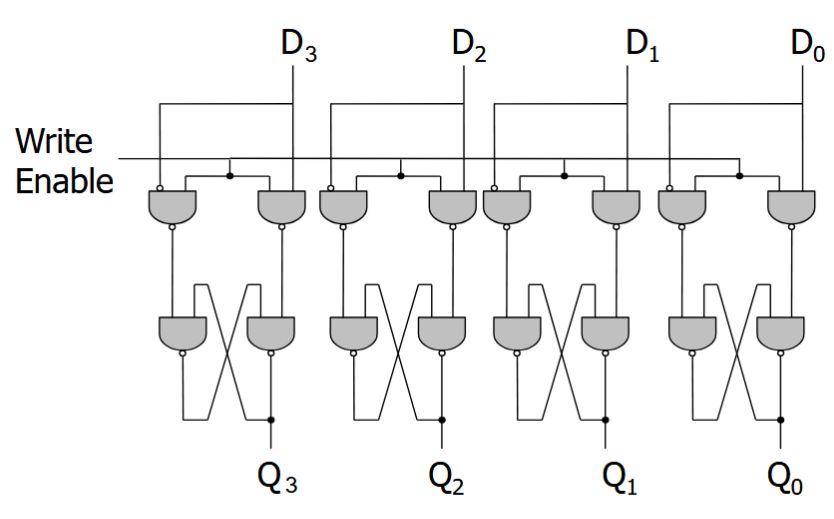
Back
What is this?
Here we have a register, or a structure that stores more than one bit and can be read from and written to.
Note that there is a single WE signal for all latches for simultaneous writes.
This register holds 4 bits, and its data is referenced as Q[3:0].
Note that there is a single WE signal for all latches for simultaneous writes.
This register holds 4 bits, and its data is referenced as Q[3:0].
After
Front
What is this?
Back
What is this?
Here we have a register.
- It's a structure that stores more than one bit and can be read from and written to.
- Note that there is a single WE signal for all latches for simultaneous writes.
- This register holds 4 bits, and its data is referenced as Q[3:0].
Field-by-field Comparison
| Field | Before | After |
|---|---|---|
| Back | Here we have a register |
Here we have a <b>register.</b><br><ul><li>It's a structure that stores more than one bit and can be read from and written to.</li><li>Note that there is a single WE signal for all latches for simultaneous writes.</li><li>This register holds 4 bits, and its data is referenced as Q[3:0].</li></ul> |
Note 4: ETH::2. Semester::DDCA
Deck: ETH::2. Semester::DDCA
Note Type: Horvath Classic
GUID:
modified
Note Type: Horvath Classic
GUID:
J}Cp1R>RJL
Before
Front
What is this functionally?
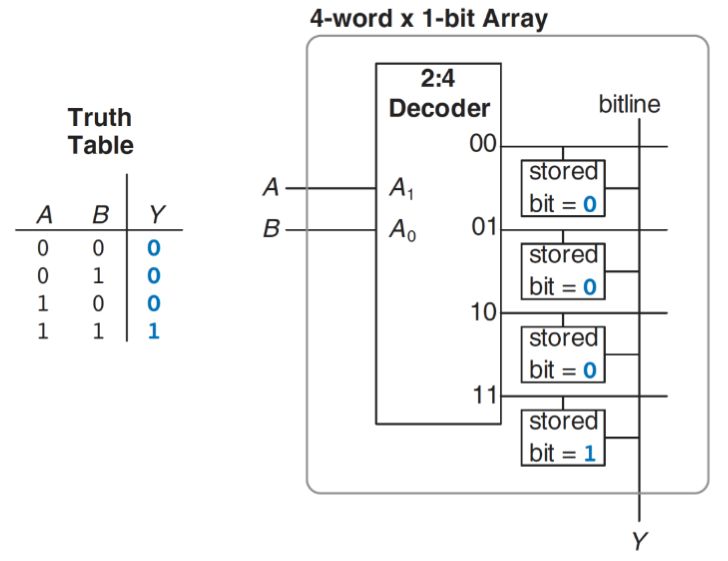
Back
What is this functionally?
A memory-bassed lookup table.
After
Front
What is this functionally?
Back
What is this functionally?
A memory-based lookup table.
Field-by-field Comparison
| Field | Before | After |
|---|---|---|
| Back | A memory-bas |
A memory-based lookup table. |
Note 5: ETH::2. Semester::DDCA
Deck: ETH::2. Semester::DDCA
Note Type: Horvath Classic
GUID:
modified
Note Type: Horvath Classic
GUID:
g-~*^Ki!(:
Before
Front
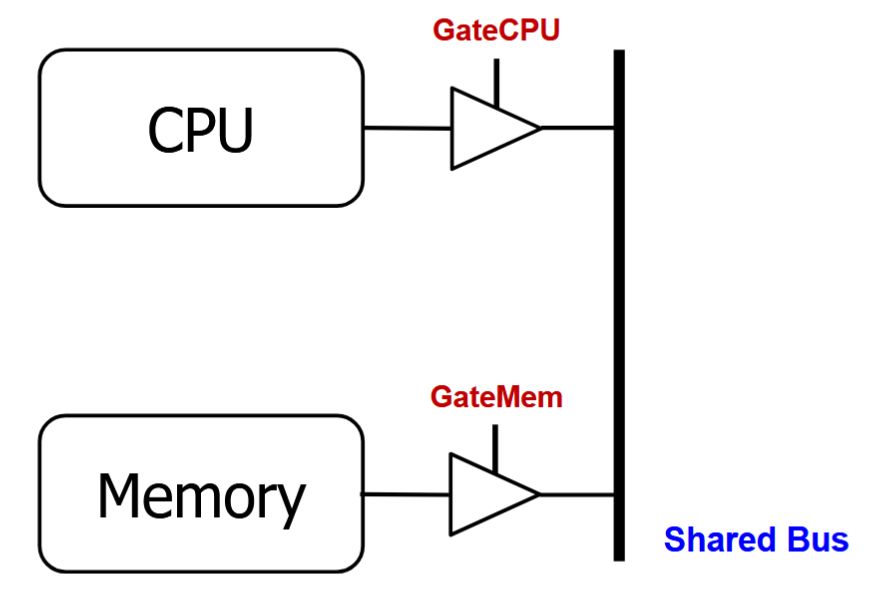
Imagine a wire connecting the CPU and memory. At any time only the CPU or the memory can place a value on the wire, both not both.
How do we model this as a circuit?
How do we model this as a circuit?
Back
Imagine a wire connecting the CPU and memory. At any time only the CPU or the memory can place a value on the wire, both not both.
How do we model this as a circuit?
How do we model this as a circuit?
You can have two tri-state buffers: one driven by CPU, the other memory; and ensure at most one is enabled at any time.
After
Front
How do we model a BUS as a circuit?
Back
How do we model a BUS as a circuit?
You can have two tri-state buffers: one driven by CPU, the other memory; and ensure at most one is enabled at any time.
Field-by-field Comparison
| Field | Before | After |
|---|---|---|
| Front | How do we model a BUS as a circuit? | |
| Back | You can have two tri-state buffers: one driven by CPU, the other memory; and ensure at most one is enabled at any time.<br><br><img src="paste-3e60268fdf3d3d4e9613807017fd11ee2dd4909f.jpg"> |
Note 6: ETH::2. Semester::DDCA
Deck: ETH::2. Semester::DDCA
Note Type: Horvath Cloze
GUID:
modified
Note Type: Horvath Cloze
GUID:
vK&i;bo$O;
Before
Front
MOS transistors are imperfect switches.
Back
MOS transistors are imperfect switches.
pMOS transistors pass I's well but 0's poorly (holes carry charge).
nMOS transistors pass 0's well but I's poorly (electrons carry charge).
This is why AND is built with NAND + NOT.
nMOS transistors pass 0's well but I's poorly (electrons carry charge).
This is why AND is built with NAND + NOT.
After
Front
MOS transistors are imperfect switches.
- pMOS transistors pass I's well but 's poorly (holes carry charge).
- nMOS transistors pass 0's well but I's poorly (electrons carry charge).
Back
MOS transistors are imperfect switches.
- pMOS transistors pass I's well but 's poorly (holes carry charge).
- nMOS transistors pass 0's well but I's poorly (electrons carry charge).
This is why AND is built with NAND + NOT.
Field-by-field Comparison
| Field | Before | After |
|---|---|---|
| Text | MOS transistors are |
MOS transistors are imperfect switches.<br><ul><li>pMOS transistors pass {{c1::I}}'s well but {{c10}}'s poorly {{c1::(holes carry charge)}}.</li><li>nMOS transistors pass {{c1::0}}'s well but {{c1::I}}'s poorly {{c1::(electrons carry charge)}}.</li></ul> |
| Extra | This is why AND is built with NAND + NOT. |
Note 7: ETH::2. Semester::DDCA
Deck: ETH::2. Semester::DDCA
Note Type: Horvath Cloze
GUID:
modified
Note Type: Horvath Cloze
GUID:
yixUKU?m~)
Before
Front
Essence of Simplification
Find two-element subsets of the ON-set where only one variable changes its value. This single varying variable can be eliminated!
Find two-element subsets of the ON-set where only one variable changes its value. This single varying variable can be eliminated!
Back
Essence of Simplification
Find two-element subsets of the ON-set where only one variable changes its value. This single varying variable can be eliminated!
Find two-element subsets of the ON-set where only one variable changes its value. This single varying variable can be eliminated!
After
Front
Essence of Simplification (Uniting Theorem)
Find two-element subsets of the ON-set where only one variable changes its value. This single varying variable can be eliminated!
Find two-element subsets of the ON-set where only one variable changes its value. This single varying variable can be eliminated!
Back
Essence of Simplification (Uniting Theorem)
Find two-element subsets of the ON-set where only one variable changes its value. This single varying variable can be eliminated!
Find two-element subsets of the ON-set where only one variable changes its value. This single varying variable can be eliminated!
Field-by-field Comparison
| Field | Before | After |
|---|---|---|
| Text | Essence of Simplification<br><br>Find two-element subsets of the ON-set where only one variable changes its value. This single varying variable can be {{c1::eliminated}}! | Essence of Simplification (Uniting Theorem)<br><br>Find two-element subsets of the ON-set where only one variable changes its value. This single varying variable can be {{c1::eliminated}}! |
Note 8: ETH::2. Semester::PProg
Deck: ETH::2. Semester::PProg
Note Type: Horvath Cloze
GUID:
modified
Note Type: Horvath Cloze
GUID:
d%A(hxXDuk
Before
Front
The execution order is non-deterministic.
Back
The execution order is non-deterministic.
After
Front
The execution order is non-deterministic.
Back
The execution order is non-deterministic.
The OS-Scheduler depends on all currently running processes.
Field-by-field Comparison
| Field | Before | After |
|---|---|---|
| Extra | The OS-Scheduler depends on all currently running processes. |
Note 9: ETH::2. Semester::PProg
Deck: ETH::2. Semester::PProg
Note Type: Horvath Cloze
GUID:
added
Note Type: Horvath Cloze
GUID:
w&_kd{VSwY
Previous
Note did not exist
New Note
Front
A critical section is a section of code that must be executed by only one thread or process at a time because it accesses shared resources.
Back
A critical section is a section of code that must be executed by only one thread or process at a time because it accesses shared resources.
Ex: IO, file writing/reading, incrementing global counter
Field-by-field Comparison
| Field | Before | After |
|---|---|---|
| Text | A critical section is {{c1::a section of code that must be executed by only one thread or process at a time because it accesses shared resources}}. | |
| Extra | Ex: IO, file writing/reading, incrementing global counter |