Anki Deck Changes

Commit: 687cbc79 - es is zum daschiaßn

Author: lhorva <lhorva@student.ethz.ch>

Date: 2026-03-24T15:42:32+01:00

Changes: 32 note(s) changed (30 added, 2 modified, 0 deleted)

Note 1: ETH::2. Semester::A&W

Deck: ETH::2. Semester::A&W
Note Type: Horvath Cloze
GUID: A-7$#*Ia_p
added

Previous

Note did not exist

New Note

Front

ETH::2._Semester::A&W::2._Wahrscheinlichkeitstheorie_und_randomisierte_Algorithmen::2._Bedingte_Wahrscheinlichkeiten
Seien \(A\) und \(B\) Ereignisse mit \(\Pr[B] > 0\).

Die bedingte Wahrscheinlichkeit \(\Pr[A|B]\) von \(A\) gegeben \(B\) ist definiert durch \[\Pr[A|B] := {{c1::\frac{\Pr[A \cap B]}{\Pr[B]} }}.\]

Back

ETH::2._Semester::A&W::2._Wahrscheinlichkeitstheorie_und_randomisierte_Algorithmen::2._Bedingte_Wahrscheinlichkeiten
Seien \(A\) und \(B\) Ereignisse mit \(\Pr[B] > 0\).

Die bedingte Wahrscheinlichkeit \(\Pr[A|B]\) von \(A\) gegeben \(B\) ist definiert durch \[\Pr[A|B] := {{c1::\frac{\Pr[A \cap B]}{\Pr[B]} }}.\]
Field-by-field Comparison
Field Before After
Text Seien \(A\) und \(B\) Ereignisse mit \(\Pr[B] &gt; 0\). <br><br> Die bedingte Wahrscheinlichkeit \(\Pr[A|B]\) von \(A\) gegeben \(B\) ist definiert durch \[\Pr[A|B] := {{c1::\frac{\Pr[A \cap B]}{\Pr[B]} }}.\]
Tags: ETH::2._Semester::A&W::2._Wahrscheinlichkeitstheorie_und_randomisierte_Algorithmen::2._Bedingte_Wahrscheinlichkeiten

Note 2: ETH::2. Semester::A&W

Deck: ETH::2. Semester::A&W
Note Type: Horvath Cloze
GUID: I(y+n3Ez0R
added

Previous

Note did not exist

New Note

Front

ETH::2._Semester::A&W::2._Wahrscheinlichkeitstheorie_und_randomisierte_Algorithmen::2._Bedingte_Wahrscheinlichkeiten
Seien \(A_1, \ldots, A_n\) paarweise disjunkte Ereignisse und sei \(B \subseteq A_1 \cup \cdots \cup A_n\).

Dann gilt: \[\Pr[B] = {{c1::\sum_{i=1}^{n} \Pr[B|A_i] \cdot \Pr[A_i]}}.\]

Back

ETH::2._Semester::A&W::2._Wahrscheinlichkeitstheorie_und_randomisierte_Algorithmen::2._Bedingte_Wahrscheinlichkeiten
Seien \(A_1, \ldots, A_n\) paarweise disjunkte Ereignisse und sei \(B \subseteq A_1 \cup \cdots \cup A_n\).

Dann gilt: \[\Pr[B] = {{c1::\sum_{i=1}^{n} \Pr[B|A_i] \cdot \Pr[A_i]}}.\]

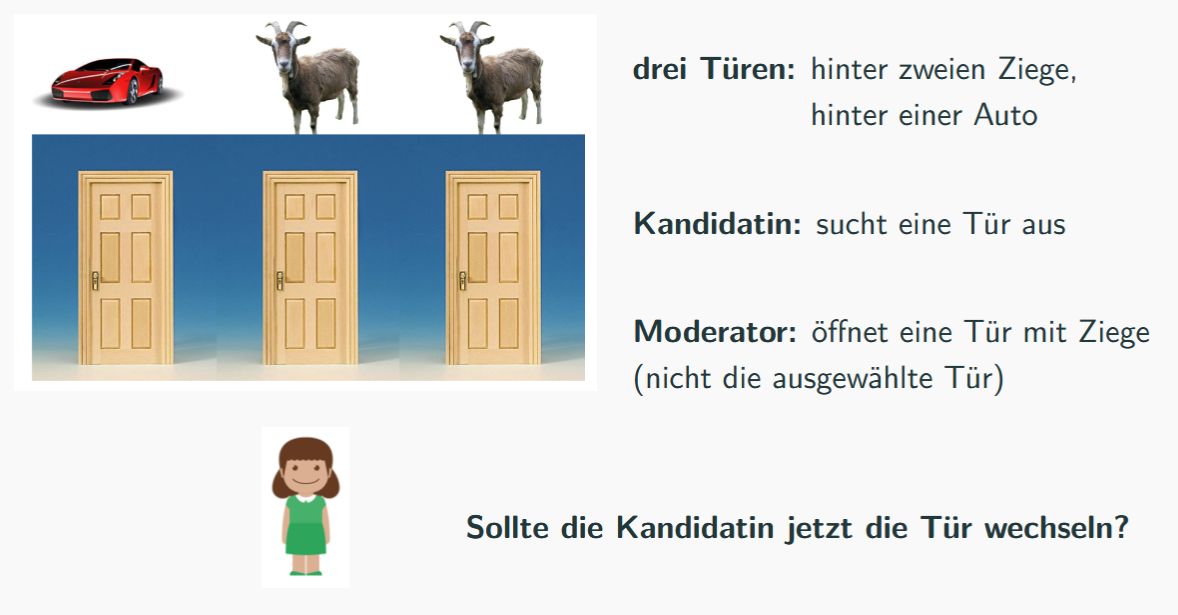
Satz von der totalen Wahrscheinlichkeit

Beispiel: Ziegenproblem
Field-by-field Comparison
Field Before After
Text Seien \(A_1, \ldots, A_n\) paarweise disjunkte Ereignisse und sei \(B \subseteq A_1 \cup \cdots \cup A_n\). <br><br> Dann gilt:&nbsp;\[\Pr[B] = {{c1::\sum_{i=1}^{n} \Pr[B|A_i] \cdot \Pr[A_i]}}.\]
Extra Satz von der totalen Wahrscheinlichkeit<br><br><b>Beispiel: Ziegenproblem</b><br><img src="paste-fe1bd74214a82f2008614d31f66a80c281f1f024.jpg">
Tags: ETH::2._Semester::A&W::2._Wahrscheinlichkeitstheorie_und_randomisierte_Algorithmen::2._Bedingte_Wahrscheinlichkeiten

Note 3: ETH::2. Semester::A&W

Deck: ETH::2. Semester::A&W
Note Type: Horvath Cloze
GUID: htE!5%59G$
added

Previous

Note did not exist

New Note

Front

ETH::2._Semester::A&W::2._Wahrscheinlichkeitstheorie_und_randomisierte_Algorithmen::2._Bedingte_Wahrscheinlichkeiten
Seien \(A_1, \ldots, A_n\) Ereignisse.

Falls \(\Pr[A_1 \cap \cdots \cap A_n] > 0\), so gilt: \[\Pr[A_1 \cap \cdots \cap A_n] = {{c1::\Pr[A_1] \cdot \Pr[A_2|A_1] \cdot \Pr[A_3|A_1 \cap A_2] \cdots \Pr[A_n|A_1 \cap \cdots \cap A_{n-1}]}}.\]

Back

ETH::2._Semester::A&W::2._Wahrscheinlichkeitstheorie_und_randomisierte_Algorithmen::2._Bedingte_Wahrscheinlichkeiten
Seien \(A_1, \ldots, A_n\) Ereignisse.

Falls \(\Pr[A_1 \cap \cdots \cap A_n] > 0\), so gilt: \[\Pr[A_1 \cap \cdots \cap A_n] = {{c1::\Pr[A_1] \cdot \Pr[A_2|A_1] \cdot \Pr[A_3|A_1 \cap A_2] \cdots \Pr[A_n|A_1 \cap \cdots \cap A_{n-1}]}}.\]

Multiplikationssatz

Beispiel: Geburtstagsproblem
Betrachte einen Raum mit \(m\) Personen.
Was ist die Wahrscheinlichkeit, dass zwei Personen am gleichen Tag Geburtstag haben?
Field-by-field Comparison
Field Before After
Text Seien \(A_1, \ldots, A_n\) Ereignisse. <br><br> Falls \(\Pr[A_1 \cap \cdots \cap A_n] &gt; 0\), so gilt:&nbsp;\[\Pr[A_1 \cap \cdots \cap A_n] = {{c1::\Pr[A_1] \cdot \Pr[A_2|A_1] \cdot \Pr[A_3|A_1 \cap A_2] \cdots \Pr[A_n|A_1 \cap \cdots \cap A_{n-1}]}}.\]
Extra Multiplikationssatz<br><br><b>Beispiel: Geburtstagsproblem</b><br>Betrachte einen Raum mit&nbsp;\(m\)&nbsp;Personen.<br>Was ist die Wahrscheinlichkeit, dass zwei Personen am gleichen Tag Geburtstag haben?
Tags: ETH::2._Semester::A&W::2._Wahrscheinlichkeitstheorie_und_randomisierte_Algorithmen::2._Bedingte_Wahrscheinlichkeiten

Note 4: ETH::2. Semester::PProg

Deck: ETH::2. Semester::PProg
Note Type: Horvath Cloze
GUID: Am
added

Previous

Note did not exist

New Note

Front

ETH::2._Semester::PProg::11._Parallel_Algorithms::3._Parallel_algorithms
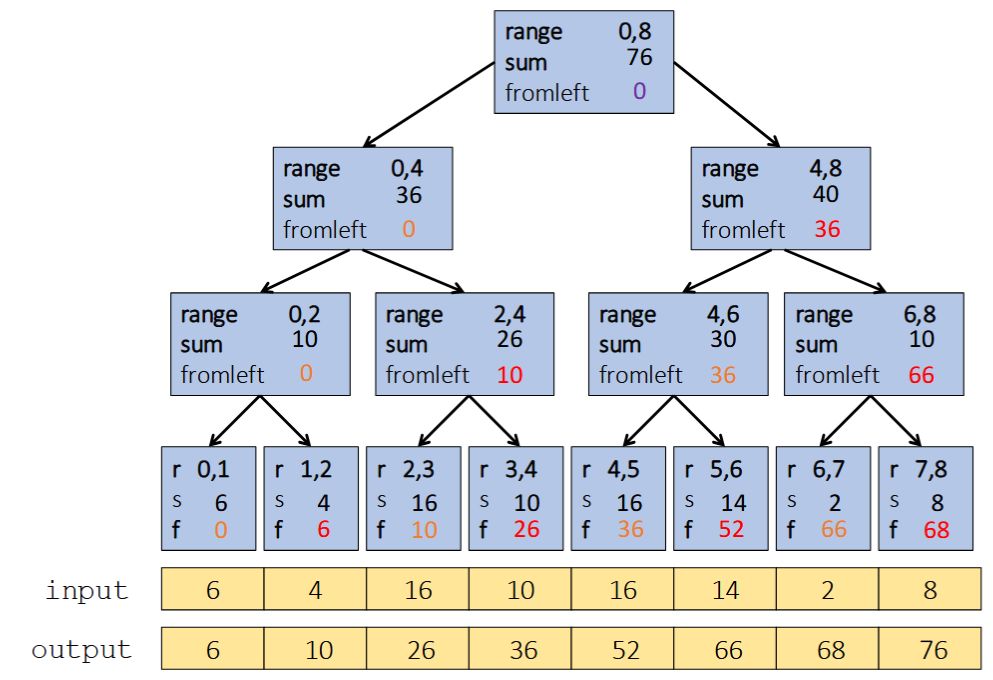
Parallel prefix-sum

The parallel-prefix algorithm does two passes:
  1. First pass builds a tree bottom-up: the "up" pass
  2. Second pass traverses the tree top-down: the "down" pass

Back

ETH::2._Semester::PProg::11._Parallel_Algorithms::3._Parallel_algorithms
Parallel prefix-sum

The parallel-prefix algorithm does two passes:
  1. First pass builds a tree bottom-up: the "up" pass
  2. Second pass traverses the tree top-down: the "down" pass

Each pass has \(O(n)\) work and \(O(\log n)\) span
So in total there is \(O(n)\) work and \(O(\log n)\) span
So like with array summing, parallelism is \(n / \log n\)


Field-by-field Comparison
Field Before After
Text <b>Parallel prefix-sum</b> <br><br> The parallel-prefix algorithm does two passes:<br><ol><li> First pass {{c1::builds a tree bottom-up: the "up" pass}}</li><li> Second pass {{c1::traverses the tree top-down: the "down" pass}}</li></ol>
Extra Each pass has&nbsp;\(O(n)\)&nbsp;work and&nbsp;\(O(\log n)\)&nbsp;span<br>So in total there is&nbsp;\(O(n)\)&nbsp;work and&nbsp;\(O(\log n)\)&nbsp;span<br>So like with array summing, parallelism is&nbsp;\(n / \log n\)<br><br><div><img src="paste-c29833901d0bef4bf829b08f15583acc2ac94c68.jpg"><br></div>
Tags: ETH::2._Semester::PProg::11._Parallel_Algorithms::3._Parallel_algorithms

Note 5: ETH::2. Semester::PProg

Deck: ETH::2. Semester::PProg
Note Type: Horvath Cloze
GUID: DFp@RgOWZ7
added

Previous

Note did not exist

New Note

Front

ETH::2._Semester::PProg::10._Parallel_Algorithms::1._Task_graphs_and_performance_measures
Parallelism in DAG = \(T_1 / T_\infty\)
  • How much parallelism exist in the task graph
  • Gives an upper bound on how much speedup we can get

Back

ETH::2._Semester::PProg::10._Parallel_Algorithms::1._Task_graphs_and_performance_measures
Parallelism in DAG = \(T_1 / T_\infty\)
  • How much parallelism exist in the task graph
  • Gives an upper bound on how much speedup we can get

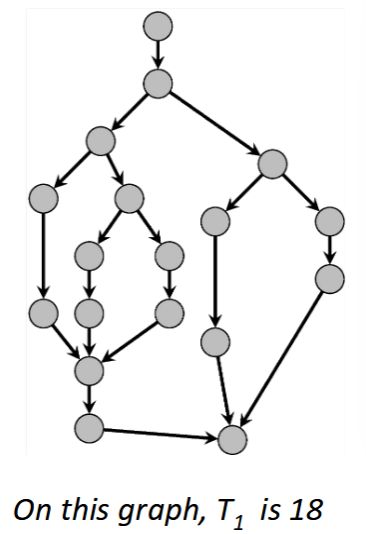
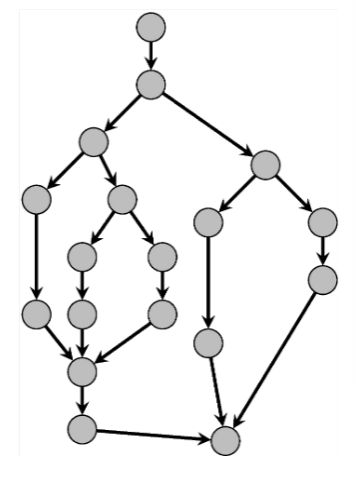
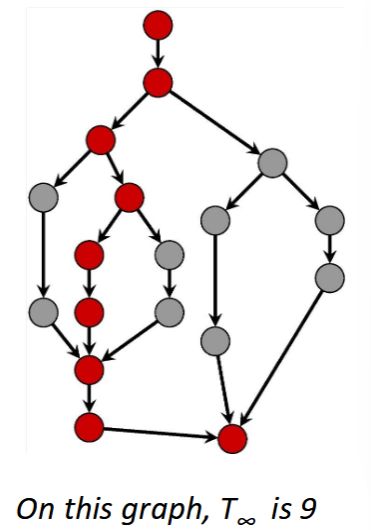
On this graph: \(T_1 / T_\infty = 18 / 9 = 2\)

This means that even with infinite cores and threads, the best possible speedup is 2.

Bottleneck is the span – DAG structure does not allow more parallelism.
Field-by-field Comparison
Field Before After
Text Parallelism in DAG = \({{c1::T_1 / T_\infty}}\) <ul> <li>How much parallelism exist in the task graph</li> <li>Gives an upper bound on how much speedup we can get</li> </ul>
Extra <img src="paste-ec818a1d799c2a19ea6cad709291b848ccaa132c.jpg" style="float: right;">On this graph: \(T_1 / T_\infty = 18 / 9 = 2\) <br><br> This means that even with infinite cores and threads, the best possible speedup is 2.<br><br> Bottleneck is the span – DAG structure does not allow more parallelism.
Tags: ETH::2._Semester::PProg::10._Parallel_Algorithms::1._Task_graphs_and_performance_measures

Note 6: ETH::2. Semester::PProg

Deck: ETH::2. Semester::PProg
Note Type: Horvath Cloze
GUID: I>a
added

Previous

Note did not exist

New Note

Front

ETH::2._Semester::PProg::11._Parallel_Algorithms::2._Parallel_patterns
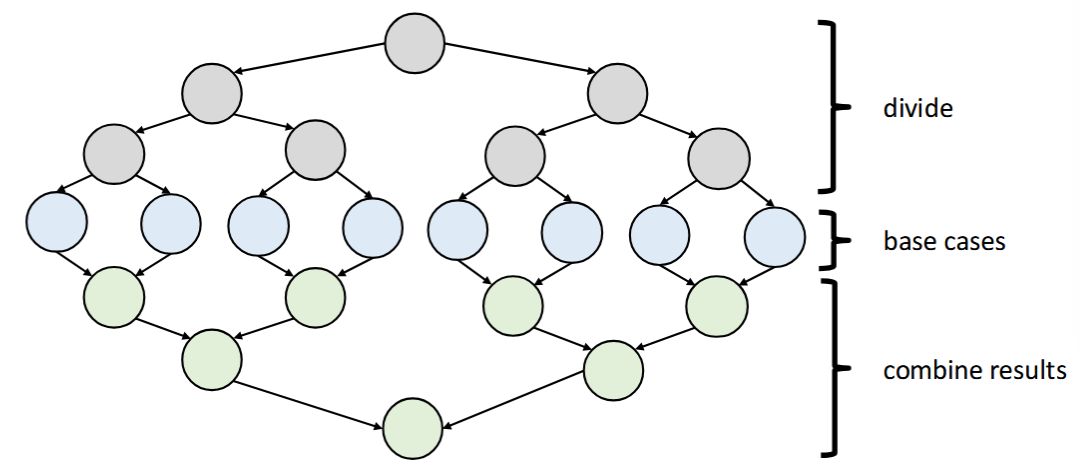
Reduction always achieve \(O(\log n)\) parallel time.

Back

ETH::2._Semester::PProg::11._Parallel_Algorithms::2._Parallel_patterns
Reduction always achieve \(O(\log n)\) parallel time.
Field-by-field Comparison
Field Before After
Text Reduction always achieve \(O({{c1::\log n}})\) parallel time.
Tags: ETH::2._Semester::PProg::11._Parallel_Algorithms::2._Parallel_patterns

Note 7: ETH::2. Semester::PProg

Deck: ETH::2. Semester::PProg
Note Type: Horvath Cloze
GUID: IExk};lu~_
modified

Before

Front

ETH::2._Semester::PProg::Terminology
A map operates on each element of a collection independently to create a new collection of the same size.

Back

ETH::2._Semester::PProg::Terminology
A map operates on each element of a collection independently to create a new collection of the same size.

For instance vector addition that computes the sum of a collection of tuples (containing the nth element of both vectors).

After

Front

ETH::2._Semester::PProg::11._Parallel_Algorithms::2._Parallel_patterns ETH::2._Semester::PProg::Terminology
A map operates on each element of a collection independently to create a new collection of the same size.

Back

ETH::2._Semester::PProg::11._Parallel_Algorithms::2._Parallel_patterns ETH::2._Semester::PProg::Terminology
A map operates on each element of a collection independently to create a new collection of the same size.

For instance vector addition that computes the sum of a collection of tuples (containing the n-th element of both vectors).
Field-by-field Comparison
Field Before After
Text A {{c1::map}} operates on {{c2::each element of a collection independently}} to create a {{c3::new collection of the same size}}. A {{c1::map}} operates on {{c2::each element of a collection independently}} to create {{c2::a new collection of the same size}}.
Extra For instance vector addition that computes the sum of a collection of tuples (containing the nth element of both vectors). For instance vector addition that computes the sum of a collection of tuples (containing the n-th element of both vectors).
Tags: ETH::2._Semester::PProg::Terminology ETH::2._Semester::PProg::11._Parallel_Algorithms::2._Parallel_patterns

Note 8: ETH::2. Semester::PProg

Deck: ETH::2. Semester::PProg
Note Type: Horvath Cloze
GUID: IU~eZh[{|t
added

Previous

Note did not exist

New Note

Front

ETH::2._Semester::PProg::10._Parallel_Algorithms::1._Task_graphs_and_performance_measures
\(T_1\) in DAG: work (total amount of work) = The sum of the time cost of all nodes in graph

Back

ETH::2._Semester::PProg::10._Parallel_Algorithms::1._Task_graphs_and_performance_measures
\(T_1\) in DAG: work (total amount of work) = The sum of the time cost of all nodes in graph

(As if we executed graph sequentially (\(p=1\)).)

Field-by-field Comparison
Field Before After
Text \(T_1\)&nbsp;in DAG: <strong>work</strong> (total amount of work) = {{c1::The sum of the time cost of all nodes in graph}}
Extra (As if we executed graph sequentially (\(p=1\)).)<br><br><img src="paste-cc5039f2b639a958b8652ea182decb023fb2b3fa.jpg">
Tags: ETH::2._Semester::PProg::10._Parallel_Algorithms::1._Task_graphs_and_performance_measures

Note 9: ETH::2. Semester::PProg

Deck: ETH::2. Semester::PProg
Note Type: Horvath Cloze
GUID: MOPb-=%nM*
added

Previous

Note did not exist

New Note

Front

ETH::2._Semester::PProg::10._Parallel_Algorithms::1._Task_graphs_and_performance_measures
The ForkJoin Framework gives an expected-time guarantee of asymptotically optimal!

Back

ETH::2._Semester::PProg::10._Parallel_Algorithms::1._Task_graphs_and_performance_measures
The ForkJoin Framework gives an expected-time guarantee of asymptotically optimal!
Field-by-field Comparison
Field Before After
Text The ForkJoin Framework gives an expected-time guarantee of {{c1::asymptotically optimal}}!
Tags: ETH::2._Semester::PProg::10._Parallel_Algorithms::1._Task_graphs_and_performance_measures

Note 10: ETH::2. Semester::PProg

Deck: ETH::2. Semester::PProg
Note Type: Horvath Classic
GUID: N&-I&(}AW,
added

Previous

Note did not exist

New Note

Front

ETH::2._Semester::PProg::10._Parallel_Algorithms::1._Task_graphs_and_performance_measures
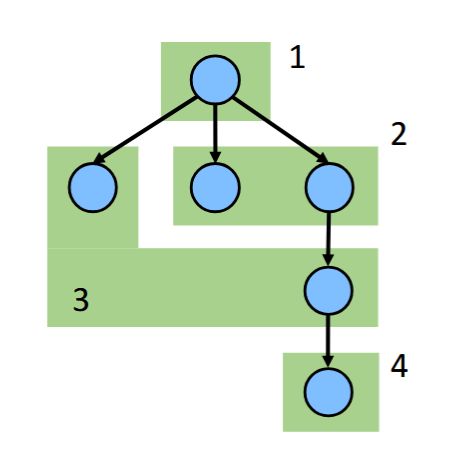
What is \(T_2\) for this graph?

Back

ETH::2._Semester::PProg::10._Parallel_Algorithms::1._Task_graphs_and_performance_measures
What is \(T_2\) for this graph?


\(T_2\) will be 4 with this scheduling (we have 4 time steps)
Field-by-field Comparison
Field Before After
Front What is&nbsp;\(T_2\)&nbsp;for this graph?<br><br><img src="paste-efb4078bb29155e5f01b879ea926a36846ce956f.jpg">
Back \(T_2\) will be 4 with this scheduling (we have 4 time steps)
Tags: ETH::2._Semester::PProg::10._Parallel_Algorithms::1._Task_graphs_and_performance_measures

Note 11: ETH::2. Semester::PProg

Deck: ETH::2. Semester::PProg
Note Type: Horvath Cloze
GUID: N]|Ip8DGl(
added

Previous

Note did not exist

New Note

Front

ETH::2._Semester::PProg::10._Parallel_Algorithms::1._Task_graphs_and_performance_measures
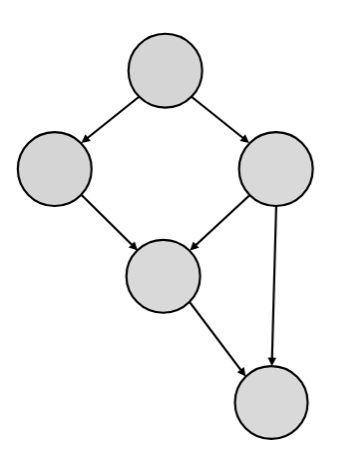
A program execution using fork and join can be seen as a DAG.

Back

ETH::2._Semester::PProg::10._Parallel_Algorithms::1._Task_graphs_and_performance_measures
A program execution using fork and join can be seen as a DAG.

Nodes: Units of work
  • FJ: tasks; Cilk: finer-grained strands
Edges: Dependencies
  • Source must finish before destination starts (logical completion, not immediate termination)
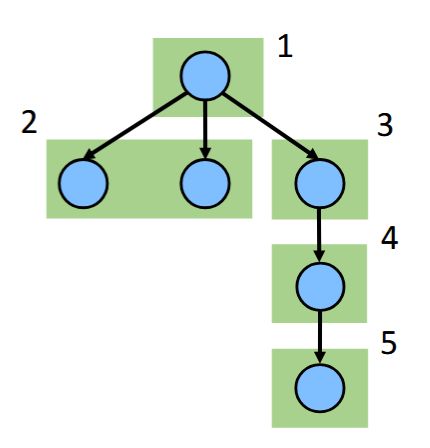
The DAG does not depict "who is running when", but rather "who must finish before what"
Field-by-field Comparison
Field Before After
Text A program execution using fork and join can be seen as a {{c1::DAG}}.
Extra <img src="paste-5f03284709dc83297ef59e92187f035b0919be20.jpg" style="float: right;">Nodes: Units of work<br><ul><li>FJ: tasks; Cilk: finer-grained strands</li></ul>Edges: Dependencies<br><ul><li>Source must finish before destination starts (logical completion, not immediate termination)</li></ul><div>The DAG does not depict "who is running when", but rather "who must finish before what"<br></div>
Tags: ETH::2._Semester::PProg::10._Parallel_Algorithms::1._Task_graphs_and_performance_measures

Note 12: ETH::2. Semester::PProg

Deck: ETH::2. Semester::PProg
Note Type: Horvath Cloze
GUID: O8.pdZ.QQ~
added

Previous

Note did not exist

New Note

Front

ETH::2._Semester::PProg::11._Parallel_Algorithms::2._Parallel_patterns
Maps achieve \(O(\log n)\) 

Back

ETH::2._Semester::PProg::11._Parallel_Algorithms::2._Parallel_patterns
Maps achieve \(O(\log n)\) 

via Divide & Conquer
Field-by-field Comparison
Field Before After
Text Maps achieve&nbsp;\(O({{c1::\log n}})\)&nbsp;
Extra via Divide &amp; Conquer
Tags: ETH::2._Semester::PProg::11._Parallel_Algorithms::2._Parallel_patterns

Note 13: ETH::2. Semester::PProg

Deck: ETH::2. Semester::PProg
Note Type: Horvath Cloze
GUID: PNcAc+sAUB
added

Previous

Note did not exist

New Note

Front

ETH::2._Semester::PProg::10._Parallel_Algorithms::1._Task_graphs_and_performance_measures
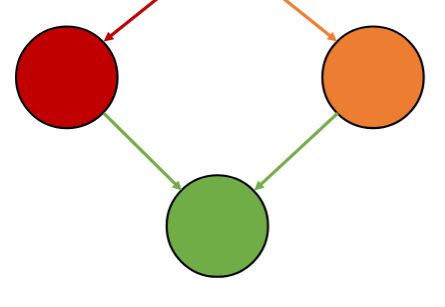
A join after a fork creates a node with two incoming edges:
  • One from the forked task that just finished
  • One from the continuation of the original task (which was waiting for the forked task to complete)

Back

ETH::2._Semester::PProg::10._Parallel_Algorithms::1._Task_graphs_and_performance_measures
A join after a fork creates a node with two incoming edges:
  • One from the forked task that just finished
  • One from the continuation of the original task (which was waiting for the forked task to complete)


The continuation does not execute until both branches leading into the join node are complete.
Field-by-field Comparison
Field Before After
Text A join after a fork creates a node with two incoming edges:<br><ul><li>One from {{c1::the forked task that just finished}}</li><li>One from {{c2::the continuation of the original task (which was waiting for the forked task to complete)}}</li></ul>
Extra <img src="paste-1ce0eec3f1632895953635ebfd77d792ac16328e.jpg"><br><br>The continuation does not execute until both branches&nbsp;leading into the join node are complete.
Tags: ETH::2._Semester::PProg::10._Parallel_Algorithms::1._Task_graphs_and_performance_measures

Note 14: ETH::2. Semester::PProg

Deck: ETH::2. Semester::PProg
Note Type: Horvath Classic
GUID: RiW}{]O2lc
added

Previous

Note did not exist

New Note

Front

ETH::2._Semester::PProg::10._Parallel_Algorithms::1._Task_graphs_and_performance_measures
What is this?

Back

ETH::2._Semester::PProg::10._Parallel_Algorithms::1._Task_graphs_and_performance_measures
What is this?


Fork-Join.
Field-by-field Comparison
Field Before After
Front What is this?<br><br><img src="paste-3f79db399d4701fc72b0abef0f7f3c31514ad444.jpg">
Back Fork-Join.
Tags: ETH::2._Semester::PProg::10._Parallel_Algorithms::1._Task_graphs_and_performance_measures

Note 15: ETH::2. Semester::PProg

Deck: ETH::2. Semester::PProg
Note Type: Horvath Cloze
GUID: bHemC#>81}
added

Previous

Note did not exist

New Note

Front

ETH::2._Semester::PProg::10._Parallel_Algorithms::1._Task_graphs_and_performance_measures
Intuition from the DAG:
  • A wide task graph → higher potential parallelism (shorter \(T_\infty\))
  • A deep task graph → more sequential dependencies (longer \(T_\infty\), less speedup)

Back

ETH::2._Semester::PProg::10._Parallel_Algorithms::1._Task_graphs_and_performance_measures
Intuition from the DAG:
  • A wide task graph → higher potential parallelism (shorter \(T_\infty\))
  • A deep task graph → more sequential dependencies (longer \(T_\infty\), less speedup)

Speedup is limited by the ratio \(T_1 / T_\infty\) (work versus critical path → Amdahl's law).

Parallelism is limited by dependencies.
Field-by-field Comparison
Field Before After
Text Intuition from the DAG:<br><ul><li>A wide task graph → {{c1::higher potential parallelism (shorter \(T_\infty\))}}</li><li> A deep task graph → {{c1::more sequential dependencies (longer \(T_\infty\), less speedup)}}</li></ul>
Extra Speedup is limited by the ratio \(T_1 / T_\infty\) (work versus critical path → Amdahl's law).<br><br> Parallelism is limited by dependencies.
Tags: ETH::2._Semester::PProg::10._Parallel_Algorithms::1._Task_graphs_and_performance_measures

Note 16: ETH::2. Semester::PProg

Deck: ETH::2. Semester::PProg
Note Type: Horvath Cloze
GUID: cl@Oy)/+yX
added

Previous

Note did not exist

New Note

Front

ETH::2._Semester::PProg::10._Parallel_Algorithms::1._Task_graphs_and_performance_measures
Designing parallel algorithms is about decreasing span without increasing work too much.

Back

ETH::2._Semester::PProg::10._Parallel_Algorithms::1._Task_graphs_and_performance_measures
Designing parallel algorithms is about decreasing span without increasing work too much.

  1. Amdahl's Law describes the limit of speedup due to sequential parts of a program
  2. \(T_\infty\) (span) in the DAG is the practical representation of the "sequential fraction" in Amdahl's Law
  3. \(T_\infty\) is the fundamental cause of the speedup limit - it represents the longest sequential dependency
  4. If we reduce \(T_\infty\), we get closer to ideal speedup
Field-by-field Comparison
Field Before After
Text Designing parallel algorithms is about {{c1::decreasing span without increasing work too much}}.
Extra <ol><li>Amdahl's Law describes the limit of speedup due to sequential parts of a program</li> <li>\(T_\infty\) (span) in the DAG is the practical representation of the "sequential fraction" in Amdahl's Law</li> <li>\(T_\infty\) is the fundamental cause of the speedup limit - it represents the longest sequential dependency</li> <li>If we reduce \(T_\infty\), we get closer to ideal speedup</li></ol>
Tags: ETH::2._Semester::PProg::10._Parallel_Algorithms::1._Task_graphs_and_performance_measures

Note 17: ETH::2. Semester::PProg

Deck: ETH::2. Semester::PProg
Note Type: Horvath Cloze
GUID: ho0vHdt>P=
added

Previous

Note did not exist

New Note

Front

ETH::2._Semester::PProg::11._Parallel_Algorithms::2._Parallel_patterns
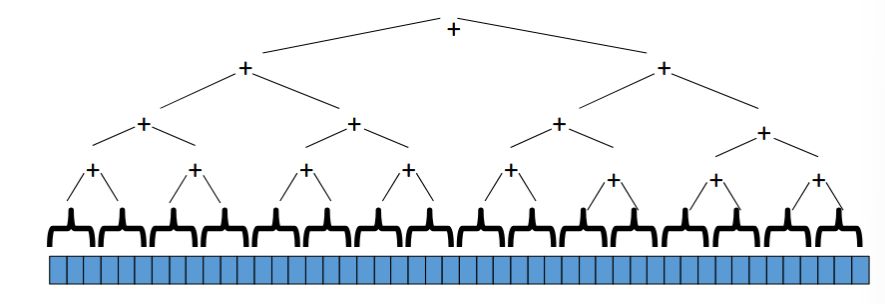
Summing an array:
  • Sequential: \(O(n)\) (= \(T_1\))
  • Parallel: \(O(\log n)\) (= \(T_\infty\), span)
  • Parallelism: \(O(n / \log n)\)

Back

ETH::2._Semester::PProg::11._Parallel_Algorithms::2._Parallel_patterns
Summing an array:
  • Sequential: \(O(n)\) (= \(T_1\))
  • Parallel: \(O(\log n)\) (= \(T_\infty\), span)
  • Parallelism: \(O(n / \log n)\)

Field-by-field Comparison
Field Before After
Text Summing an array: <ul> <li>Sequential: \(O(n)\) (= \(T_1\))</li> <li>Parallel: \(O(\log n)\) (= \(T_\infty\), span)</li> <li>Parallelism: \(O({{c1::n / \log n}})\)</li> </ul>
Extra <img src="paste-8fcca64d16a4056baa4d178ffd68b0a3f33dc2a2.jpg">
Tags: ETH::2._Semester::PProg::11._Parallel_Algorithms::2._Parallel_patterns

Note 18: ETH::2. Semester::PProg

Deck: ETH::2. Semester::PProg
Note Type: Horvath Classic
GUID: hysV}fw8F.
added

Previous

Note did not exist

New Note

Front

ETH::2._Semester::PProg::10._Parallel_Algorithms::1._Task_graphs_and_performance_measures
What is \(T_2\) for this graph?

Back

ETH::2._Semester::PProg::10._Parallel_Algorithms::1._Task_graphs_and_performance_measures
What is \(T_2\) for this graph?


\(T_2\) will be 5 with this scheduling (we have 5 time steps)
Field-by-field Comparison
Field Before After
Front What is&nbsp;\(T_2\)&nbsp;for this graph?<br><br><img src="paste-954e8266e90e2ada1c35e6797835e04782c95786.jpg">
Back \(T_2\) will be 5 with this scheduling (we have 5 time steps)
Tags: ETH::2._Semester::PProg::10._Parallel_Algorithms::1._Task_graphs_and_performance_measures

Note 19: ETH::2. Semester::PProg

Deck: ETH::2. Semester::PProg
Note Type: Horvath Cloze
GUID: m+e%70x&jD
added

Previous

Note did not exist

New Note

Front

ETH::2._Semester::PProg::10._Parallel_Algorithms::1._Task_graphs_and_performance_measures
\(T_p\) in DAG: execution time on p threads
  • We can control p by configuring the thread pool (ForkJoinPool(p))
  • We cannot control \(T_p\) - it depends on:
    • Task dependencies in the DAG
    • Work distribution and load balancing
    • Thread contention and scheduling by the JVM/OS

Back

ETH::2._Semester::PProg::10._Parallel_Algorithms::1._Task_graphs_and_performance_measures
\(T_p\) in DAG: execution time on p threads
  • We can control p by configuring the thread pool (ForkJoinPool(p))
  • We cannot control \(T_p\) - it depends on:
    • Task dependencies in the DAG
    • Work distribution and load balancing
    • Thread contention and scheduling by the JVM/OS

Field-by-field Comparison
Field Before After
Text \(T_p\)&nbsp;in DAG: execution time on p threads <ul> <li>We can control p by {{c1::configuring the thread pool (<code>ForkJoinPool(p)</code>)}}</li> <li>We cannot control \(T_p\) - it depends on: <ul> <li>{{c2::Task dependencies in the DAG}}</li> <li>{{c2::Work distribution and load balancing}}</li> <li>{{c2::Thread contention and scheduling by the JVM/OS}}</li> </ul> </li> </ul>
Extra <img src="paste-125fa8fd92151f941d37430303d0eece6fee7355.jpg">
Tags: ETH::2._Semester::PProg::10._Parallel_Algorithms::1._Task_graphs_and_performance_measures

Note 20: ETH::2. Semester::PProg

Deck: ETH::2. Semester::PProg
Note Type: Horvath Cloze
GUID: n1QrJ:]#vj
added

Previous

Note did not exist

New Note

Front

ETH::2._Semester::PProg::10._Parallel_Algorithms::1._Task_graphs_and_performance_measures
FJ work stealing scheduler: \(T_p = O(T_1 / p + T_\infty)\)

Back

ETH::2._Semester::PProg::10._Parallel_Algorithms::1._Task_graphs_and_performance_measures
FJ work stealing scheduler: \(T_p = O(T_1 / p + T_\infty)\)
Field-by-field Comparison
Field Before After
Text FJ work stealing scheduler: \(T_p = {{c1::O(T_1 / p + T_\infty)}}\)
Tags: ETH::2._Semester::PProg::10._Parallel_Algorithms::1._Task_graphs_and_performance_measures

Note 21: ETH::2. Semester::PProg

Deck: ETH::2. Semester::PProg
Note Type: Horvath Cloze
GUID: nZp7%Bxh_j
added

Previous

Note did not exist

New Note

Front

ETH::2._Semester::PProg::11._Parallel_Algorithms::2._Parallel_patterns
For parallelism, balanced trees are generally better than lists so that we can get to all the data exponentially faster (\(O(\log n)\) vs. \(O(n)\)).

Back

ETH::2._Semester::PProg::11._Parallel_Algorithms::2._Parallel_patterns
For parallelism, balanced trees are generally better than lists so that we can get to all the data exponentially faster (\(O(\log n)\) vs. \(O(n)\)).

Trees have the same flexibility as lists compared to arrays.
Field-by-field Comparison
Field Before After
Text For parallelism, balanced trees are generally {{c1::better::better/worse}} than lists so that {{c1::we can get to all the data exponentially faster (\(O(\log n)\) vs. \(O(n)\))}}.
Extra Trees have the same flexibility as lists compared to arrays.
Tags: ETH::2._Semester::PProg::11._Parallel_Algorithms::2._Parallel_patterns

Note 22: ETH::2. Semester::PProg

Deck: ETH::2. Semester::PProg
Note Type: Horvath Occlusio
GUID: n^z!&uCe{+
added

Previous

Note did not exist

New Note

Front

ETH::2._Semester::PProg::11._Parallel_Algorithms::3._Parallel_algorithms
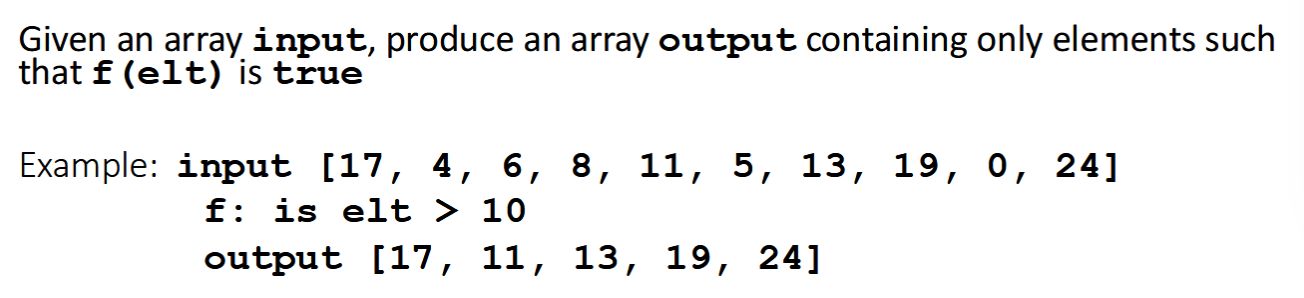
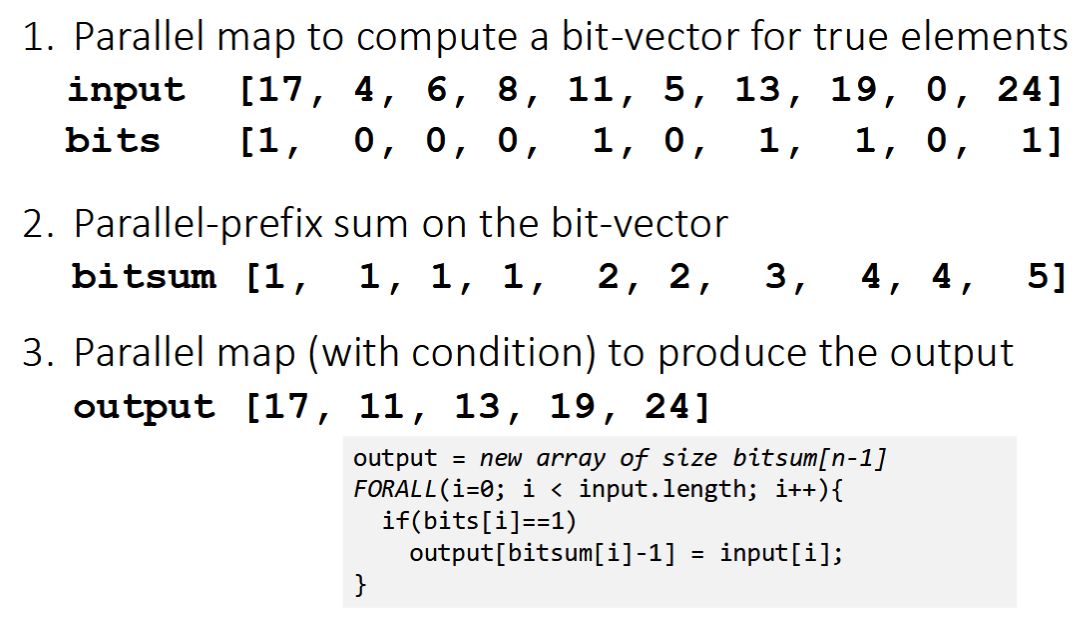
Pack

image-occlusion:rect:left=.057:top=.0000:width=.9345:height=.9956
image-occlusion:rect:left=.057:top=.515:width=.9323:height=.4768
image-occlusion:rect:left=.057:top=.309:width=.9345:height=.6905

Back

ETH::2._Semester::PProg::11._Parallel_Algorithms::3._Parallel_algorithms
Pack

image-occlusion:rect:left=.057:top=.0000:width=.9345:height=.9956
image-occlusion:rect:left=.057:top=.515:width=.9323:height=.4768
image-occlusion:rect:left=.057:top=.309:width=.9345:height=.6905

First two steps can be combined into one pass
  • Just using a different base case for the prefix sum
  • No effect on asymptotic complexity
Can also combine third step into the down pass of the prefix sum
  • Again no effect on asymptotic complexity
Analysis: \(O(n)\) work, \(O(\log n)\) span
  • 2 or 3 passes, but 3 is a constant
Field-by-field Comparison
Field Before After
Occlusion {{c1::image-occlusion:rect:left=.057:top=.0000:width=.9345:height=.9956}}<br>{{c3::image-occlusion:rect:left=.057:top=.515:width=.9323:height=.4768}}<br>{{c2::image-occlusion:rect:left=.057:top=.309:width=.9345:height=.6905}}<br>
Image <img src="paste-72833918aa508ef6829e1acb81a9c42f64683e8e.jpg">
Header <b>Pack<br></b><img src="paste-73d6ad67e165e0912c727f94b284851f7906443d.jpg"><b><br></b>
Back Extra First two steps can be combined into one pass <ul> <li>Just using a different base case for the prefix sum</li> <li>No effect on asymptotic complexity</li> </ul> Can also combine third step into the down pass of the prefix sum <ul> <li>Again no effect on asymptotic complexity</li> </ul> Analysis: \(O(n)\) work, \(O(\log n)\) span <ul> <li>2 or 3 passes, but 3 is a constant</li> </ul>
Tags: ETH::2._Semester::PProg::11._Parallel_Algorithms::3._Parallel_algorithms

Note 23: ETH::2. Semester::PProg

Deck: ETH::2. Semester::PProg
Note Type: Horvath Cloze
GUID: o3b/S}:de9
added

Previous

Note did not exist

New Note

Front

ETH::2._Semester::PProg::10._Parallel_Algorithms::1._Task_graphs_and_performance_measures
DAG bounds to execution time

Lower bound:
  • Work law: \(T_p \geq T_1 / p\)
  • Span law: \(T_p \geq T_\infty\)
  • \(T_p \geq \max(T_1 / p,\ T_\infty)\) -> no scheduler can do better than this

Back

ETH::2._Semester::PProg::10._Parallel_Algorithms::1._Task_graphs_and_performance_measures
DAG bounds to execution time

Lower bound:
  • Work law: \(T_p \geq T_1 / p\)
  • Span law: \(T_p \geq T_\infty\)
  • \(T_p \geq \max(T_1 / p,\ T_\infty)\) -> no scheduler can do better than this
Field-by-field Comparison
Field Before After
Text <b>DAG bounds to execution time</b> <br><br> Lower bound: <ul> <li>Work law: \(T_p \geq {{c1::T_1 / p}}\)</li> <li>Span law: \(T_p \geq{{c2:: T_\infty}}\)</li> <li>\(T_p \geq {{c3::\max(T_1 / p,\ T_\infty)}}\) -&gt; no scheduler can do better than this</li> </ul>
Tags: ETH::2._Semester::PProg::10._Parallel_Algorithms::1._Task_graphs_and_performance_measures

Note 24: ETH::2. Semester::PProg

Deck: ETH::2. Semester::PProg
Note Type: Horvath Cloze
GUID: p%2wWlRz`X
added

Previous

Note did not exist

New Note

Front

ETH::2._Semester::PProg::10._Parallel_Algorithms::1._Task_graphs_and_performance_measures
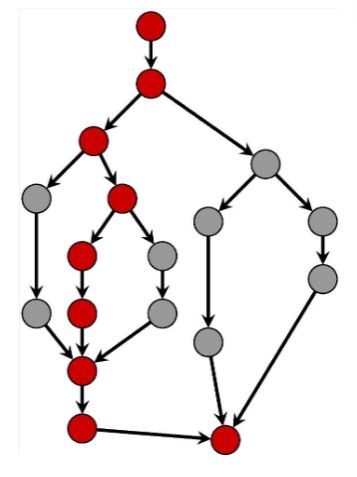
\(T_\infty\) in DAG: span, critical path length =Longest chain of dependent operations in the DAG

Back

ETH::2._Semester::PProg::10._Parallel_Algorithms::1._Task_graphs_and_performance_measures
\(T_\infty\) in DAG: span, critical path length =Longest chain of dependent operations in the DAG

Best possible time using infinite cores.

Field-by-field Comparison
Field Before After
Text \(T_\infty\)&nbsp;in DAG: span, critical path length ={{c1::Longest chain of dependent operations in the DAG}}
Extra Best possible time using infinite cores.<br><br><img src="paste-0aec79257628a646eb122ec687c1502a3a7b665e.jpg">
Tags: ETH::2._Semester::PProg::10._Parallel_Algorithms::1._Task_graphs_and_performance_measures

Note 25: ETH::2. Semester::PProg

Deck: ETH::2. Semester::PProg
Note Type: Horvath Classic
GUID: ph|&WP$lM$
added

Previous

Note did not exist

New Note

Front

ETH::2._Semester::PProg::11._Parallel_Algorithms::3._Parallel_algorithms
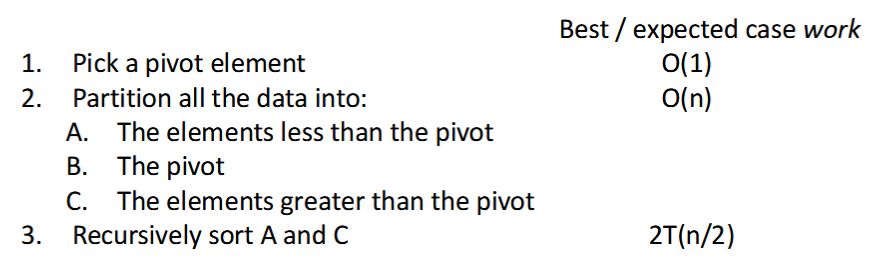
For Quicksort, we partition all the data into:
  1. The elements less than the pivot
  2. The pivot
  3. The elements greater than the pivot
How can this be parallelized?

Back

ETH::2._Semester::PProg::11._Parallel_Algorithms::3._Parallel_algorithms
For Quicksort, we partition all the data into:
  1. The elements less than the pivot
  2. The pivot
  3. The elements greater than the pivot
How can this be parallelized?

This is just two packs!
  • We know a pack is \(O(n)\) work, \(O(\log n)\) span
  • Pack elements less than pivot into left side of aux array
  • Pack elements greater than pivot into right side of aux array
  • Put pivot between them and recursively sort
  • With a little more cleverness, can do both packs at once but no effect on asymptotic complexity
With \(O(\log n)\) span for partition, the total span for quicksort is \(T(n) = O(\log n) + 1T(n/2) = O(\log^2 n)\).
Parallelism is \(O(n \log n) / O(\log^2 n) = O(n / \log n)\).
Field-by-field Comparison
Field Before After
Front For Quicksort, we partition all the data into: <ol type="A"> <li>The elements less than the pivot</li> <li>The pivot</li> <li>The elements greater than the pivot</li> </ol><div>How can this be parallelized?</div>
Back This is just two packs! <ul> <li>We know a pack is \(O(n)\) work, \(O(\log n)\) span</li> <li>Pack elements less than pivot into left side of <code>aux</code> array</li> <li>Pack elements greater than pivot into right side of <code>aux</code> array</li> <li>Put pivot between them and recursively sort</li> <li>With a little more cleverness, can do both packs at once but no effect on asymptotic complexity</li> </ul> With \(O(\log n)\) span for partition, the total span for quicksort is&nbsp;\(T(n) = O(\log n) + 1T(n/2) = O(\log^2 n)\).<br> Parallelism is \(O(n \log n) / O(\log^2 n) = O(n / \log n)\).
Tags: ETH::2._Semester::PProg::11._Parallel_Algorithms::3._Parallel_algorithms

Note 26: ETH::2. Semester::PProg

Deck: ETH::2. Semester::PProg
Note Type: Horvath Cloze
GUID: q>;I#@SD]P
added

Previous

Note did not exist

New Note

Front

ETH::2._Semester::PProg::10._Parallel_Algorithms::1._Task_graphs_and_performance_measures
The DAG captures task dependencies and potential parallelism but does not tell us actual execution time.

Back

ETH::2._Semester::PProg::10._Parallel_Algorithms::1._Task_graphs_and_performance_measures
The DAG captures task dependencies and potential parallelism but does not tell us actual execution time.
Field-by-field Comparison
Field Before After
Text The DAG captures task dependencies and potential parallelism but does not tell us {{c1::actual execution time}}.
Tags: ETH::2._Semester::PProg::10._Parallel_Algorithms::1._Task_graphs_and_performance_measures

Note 27: ETH::2. Semester::PProg

Deck: ETH::2. Semester::PProg
Note Type: Horvath Cloze
GUID: s!p!];uFf;
added

Previous

Note did not exist

New Note

Front

ETH::2._Semester::PProg::10._Parallel_Algorithms::1._Task_graphs_and_performance_measures
DAG bounds to execution time

Upper bound:
  • Parallelizable work: \(T_1 / p\)
  • DAG dependencies: \(O(T_\infty)\)
  • \(T_p \leq T_1 / p + O(T_\infty)\)

Back

ETH::2._Semester::PProg::10._Parallel_Algorithms::1._Task_graphs_and_performance_measures
DAG bounds to execution time

Upper bound:
  • Parallelizable work: \(T_1 / p\)
  • DAG dependencies: \(O(T_\infty)\)
  • \(T_p \leq T_1 / p + O(T_\infty)\)
Field-by-field Comparison
Field Before After
Text <b>DAG bounds to execution time<br></b><br>Upper bound: <ul> <li>Parallelizable work: \({{c1::T_1 / p}}\)</li> <li>DAG dependencies: \({{c2::O(T_\infty)}}\)</li> <li>\(T_p \leq {{c3::T_1 / p + O(T_\infty)}}\)</li> </ul>
Tags: ETH::2._Semester::PProg::10._Parallel_Algorithms::1._Task_graphs_and_performance_measures

Note 28: ETH::2. Semester::PProg

Deck: ETH::2. Semester::PProg
Note Type: Horvath Cloze
GUID: v[!T>xgF*P
added

Previous

Note did not exist

New Note

Front

ETH::2._Semester::PProg::10._Parallel_Algorithms::1._Task_graphs_and_performance_measures
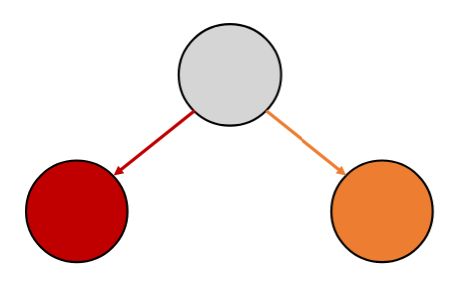
A fork ends a node and creates two outgoing edges:
  • One to a new forked task
  • One to the continuation of the current task

Back

ETH::2._Semester::PProg::10._Parallel_Algorithms::1._Task_graphs_and_performance_measures
A fork ends a node and creates two outgoing edges:
  • One to a new forked task
  • One to the continuation of the current task


May execute in parallel if worker thread is available.
Field-by-field Comparison
Field Before After
Text A fork ends a node and creates two outgoing edges:<br><ul><li>One to {{c1::a new forked task}}</li><li>One to {{c1::the continuation of the current task}}</li></ul>
Extra <img src="paste-cea411eff84adb49b099f7aa3bad8e51a3f80d02.jpg"><br><br>May execute in parallel if worker thread is available.
Tags: ETH::2._Semester::PProg::10._Parallel_Algorithms::1._Task_graphs_and_performance_measures

Note 29: ETH::2. Semester::PProg

Deck: ETH::2. Semester::PProg
Note Type: Horvath Classic
GUID: v{zd#AU<}W
added

Previous

Note did not exist

New Note

Front

ETH::2._Semester::PProg::11._Parallel_Algorithms::3._Parallel_algorithms
How can we parallelize Quicksort?

Back

ETH::2._Semester::PProg::11._Parallel_Algorithms::3._Parallel_algorithms
How can we parallelize Quicksort?


Easy: Do the two recursive calls in parallel
  • Work: unchanged of course \(O(n \log n)\)
  • Span: now \(T(n) = O(n) + 1T(n/2) = O(n)\)
  • So parallelism (i.e., work / span) is \(O(\log n)\)
Field-by-field Comparison
Field Before After
Front How can we parallelize Quicksort?<br><br><img src="paste-2e1c682cea6540c1e39b1511df2d33cbcc697698.jpg">
Back Easy: Do the two recursive calls in parallel <ul> <li>Work: unchanged of course \(O(n \log n)\)</li> <li>Span: now \(T(n) = O(n) + 1T(n/2) = O(n)\)</li> <li>So parallelism (i.e., work / span) is \(O(\log n)\)</li> </ul>
Tags: ETH::2._Semester::PProg::11._Parallel_Algorithms::3._Parallel_algorithms

Note 30: ETH::2. Semester::PProg

Deck: ETH::2. Semester::PProg
Note Type: Horvath Cloze
GUID: wCX~7qsg+^
added

Previous

Note did not exist

New Note

Front

ETH::2._Semester::PProg::11._Parallel_Algorithms::2._Parallel_patterns
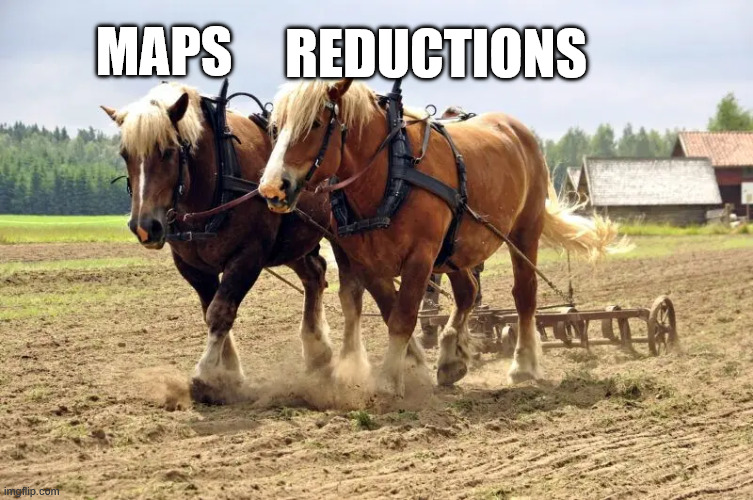
Maps and reductions are the "work horses" of parallel programming.

Back

ETH::2._Semester::PProg::11._Parallel_Algorithms::2._Parallel_patterns
Maps and reductions are the "work horses" of parallel programming.


Maps & Reductions
1971, colorized
Field-by-field Comparison
Field Before After
Text Maps and reductions are the "{{c1::work horses}}" of parallel programming.
Extra <img src="ang6c4.jpg"><br>Maps &amp; Reductions<br>1971, colorized
Tags: ETH::2._Semester::PProg::11._Parallel_Algorithms::2._Parallel_patterns

Note 31: ETH::2. Semester::PProg

Deck: ETH::2. Semester::PProg
Note Type: Horvath Cloze
GUID: xKm4/Le-}J
modified

Before

Front

ETH::2._Semester::PProg::Terminology
Reductions produce a single answer from a collection via an associative operator. Examples: max, count, rightmost, sum.

Back

ETH::2._Semester::PProg::Terminology
Reductions produce a single answer from a collection via an associative operator. Examples: max, count, rightmost, sum.

After

Front

ETH::2._Semester::PProg::11._Parallel_Algorithms::2._Parallel_patterns ETH::2._Semester::PProg::Terminology
Reductions produce a single answer from a collection via an associative operator

Back

ETH::2._Semester::PProg::11._Parallel_Algorithms::2._Parallel_patterns ETH::2._Semester::PProg::Terminology
Reductions produce a single answer from a collection via an associative operator

Examples: max, count, rightmost, sum.
Field-by-field Comparison
Field Before After
Text {{c1::Reductions}} produce a {{c2::single answer}} from a collection via an {{c3::associative operator}}. Examples: {{c4::max, count, rightmost, sum}}. {{c1::Reductions}} produce {{c2::a single answer from a collection via an associative operator}}.&nbsp;
Extra Examples: max, count, rightmost, sum.
Tags: ETH::2._Semester::PProg::Terminology ETH::2._Semester::PProg::11._Parallel_Algorithms::2._Parallel_patterns

Note 32: ETH::2. Semester::PProg

Deck: ETH::2. Semester::PProg
Note Type: Horvath Cloze
GUID: xV0+_,SfYQ
added

Previous

Note did not exist

New Note

Front

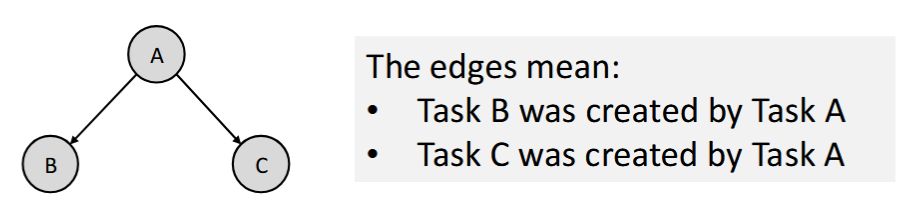
ETH::2._Semester::PProg::10._Parallel_Algorithms::1._Task_graphs_and_performance_measures
Tasks:
  1. Execute code
  2. Spawn other tasks (= start in JT, submit in ExS, fork in FJ)
  3. Wait for results from other tasks (= join in JT and FJ, get in ExS)

Back

ETH::2._Semester::PProg::10._Parallel_Algorithms::1._Task_graphs_and_performance_measures
Tasks:
  1. Execute code
  2. Spawn other tasks (= start in JT, submit in ExS, fork in FJ)
  3. Wait for results from other tasks (= join in JT and FJ, get in ExS)

A graph is formed based on spawning tasks:

Field-by-field Comparison
Field Before After
Text Tasks:<br><ol><li>Execute code</li><li>{{c1::Spawn other tasks (= start in JT, submit in ExS, fork in FJ)}}</li><li>{{c2::Wait for results from other tasks (= join in JT and FJ, get in ExS)}}</li></ol>
Extra A graph is formed based on spawning tasks:<br><br><img src="paste-49c881948e5bf3f307be6ad2f1a2946538f4da1a.jpg">
Tags: ETH::2._Semester::PProg::10._Parallel_Algorithms::1._Task_graphs_and_performance_measures
↑ Top