Anki Deck Changes

Commit: 734573ee - geht scho

Author: lhorva <lhorva@student.ethz.ch>

Date: 2026-05-01T00:55:39+02:00

Changes: 9 note(s) changed (0 added, 9 modified, 0 deleted)

ℹ️ Cosmetic Changes Hidden: 3 note(s) had formatting-only changes and are not shown below • 1 HTML formatting changes • 1 mixed cosmetic changes

Note 1: ETH::2. Semester::A&W

Deck: ETH::2. Semester::A&W
Note Type: Horvath Cloze
GUID: w;X(,bh1:N
modified

Before

Front

ETH::2._Semester::A&W::2._Wahrscheinlichkeitstheorie_und_randomisierte_Algorithmen::8._Randomisierte_Algorithmen::3._Primzahltest
Die multiplikative Gruppe modulo \(n\) ist\[\mathbb{Z}_n^* := {{c1::\{a \in [n-1] \mid \mathrm{ggT}(a, n) = 1\} }}\]mit Multiplikation mod \(n\). Sie ist eine Gruppe der Ordnung\[\varphi(n) := {{c2::|\mathbb{Z}_n^*|}}\quad\text{(eulersche Phi-Funktion)}.\]Spezialfälle:
  • \(n\) prim: \(\mathbb{Z}_n^* = [n-1]\) und \(\varphi(n) = n - 1\).
  • \(n = p^2\), \(p\) prim: \(\varphi(n) = p(p-1) = n - \sqrt{n}\).
Back

ETH::2._Semester::A&W::2._Wahrscheinlichkeitstheorie_und_randomisierte_Algorithmen::8._Randomisierte_Algorithmen::3._Primzahltest
Die multiplikative Gruppe modulo \(n\) ist\[\mathbb{Z}_n^* := {{c1::\{a \in [n-1] \mid \mathrm{ggT}(a, n) = 1\} }}\]mit Multiplikation mod \(n\). Sie ist eine Gruppe der Ordnung\[\varphi(n) := {{c2::|\mathbb{Z}_n^*|}}\quad\text{(eulersche Phi-Funktion)}.\]Spezialfälle:
  • \(n\) prim: \(\mathbb{Z}_n^* = [n-1]\) und \(\varphi(n) = n - 1\).
  • \(n = p^2\), \(p\) prim: \(\varphi(n) = p(p-1) = n - \sqrt{n}\).
Beispiele: \(\mathbb{Z}_9^* = \{1, 2, 4, 5, 7, 8\}\), \(\varphi(9) = 6\). \(\mathbb{Z}_7^* = \{1, 2, 3, 4, 5, 6\}\), \(\varphi(7) = 6\).

Konsequenz für den \(p^2\)-Fall beim Euklid-Test: \(\frac{|\mathbb{Z}_n^*|}{n-1} \approx 1 - \frac{1}{\sqrt{n}}\), die Fehlerrate ist also fast \(1\).

After

Front

ETH::2._Semester::A&W::2._Wahrscheinlichkeitstheorie_und_randomisierte_Algorithmen::8._Randomisierte_Algorithmen::3._Primzahltest
Die multiplikative Gruppe modulo \(n\) ist\[\mathbb{Z}_n^* := {{c1::\{a \in [n-1] \mid \mathrm{ggT}(a, n) = 1\} }}\]mit Multiplikation mod \(n\). Sie ist eine Gruppe der Ordnung\[\varphi(n) := {{c2::|\mathbb{Z}_n^*|}}\quad\text{(eulersche Phi-Funktion)}.\]Spezialfälle:
  • \(n\) prim: \(\mathbb{Z}_n^* = [n-1]\) und \(\varphi(n) = n - 1\).
  • \(n = p^2\), \(p\) prim: \(\varphi(n) = {{c4::p(p-1) = n - \sqrt{n} }}\).

Back

ETH::2._Semester::A&W::2._Wahrscheinlichkeitstheorie_und_randomisierte_Algorithmen::8._Randomisierte_Algorithmen::3._Primzahltest
Die multiplikative Gruppe modulo \(n\) ist\[\mathbb{Z}_n^* := {{c1::\{a \in [n-1] \mid \mathrm{ggT}(a, n) = 1\} }}\]mit Multiplikation mod \(n\). Sie ist eine Gruppe der Ordnung\[\varphi(n) := {{c2::|\mathbb{Z}_n^*|}}\quad\text{(eulersche Phi-Funktion)}.\]Spezialfälle:
  • \(n\) prim: \(\mathbb{Z}_n^* = [n-1]\) und \(\varphi(n) = n - 1\).
  • \(n = p^2\), \(p\) prim: \(\varphi(n) = {{c4::p(p-1) = n - \sqrt{n} }}\).

Beispiele: \(\mathbb{Z}_9^* = \{1, 2, 4, 5, 7, 8\}\), \(\varphi(9) = 6\). \(\mathbb{Z}_7^* = \{1, 2, 3, 4, 5, 6\}\), \(\varphi(7) = 6\).

Konsequenz für den \(p^2\)-Fall beim Euklid-Test: \(\frac{|\mathbb{Z}_n^*|}{n-1} \approx 1 - \frac{1}{\sqrt{n}}\), die Fehlerrate ist also fast \(1\).
Field-by-field Comparison
Field Before After
Text Die <b>multiplikative Gruppe modulo \(n\)</b> ist\[\mathbb{Z}_n^* := {{c1::\{a \in [n-1] \mid \mathrm{ggT}(a, n) = 1\} }}\]mit Multiplikation mod \(n\). Sie ist eine Gruppe der Ordnung\[\varphi(n) := {{c2::|\mathbb{Z}_n^*|}}\quad\text{(eulersche Phi-Funktion)}.\]Spezialfälle:<ul><li>\(n\) prim: \(\mathbb{Z}_n^* = [n-1]\) und \(\varphi(n) = {{c3::n - 1}}\).</li><li>\(n = p^2\), \(p\) prim: \(\varphi(n) = {{c4::p(p-1) = n - \sqrt{n}}}\).</li></ul> Die <b>multiplikative Gruppe modulo \(n\)</b> ist\[\mathbb{Z}_n^* := {{c1::\{a \in [n-1] \mid \mathrm{ggT}(a, n) = 1\} }}\]mit Multiplikation mod \(n\). Sie ist eine Gruppe der Ordnung\[\varphi(n) := {{c2::|\mathbb{Z}_n^*|}}\quad\text{(eulersche Phi-Funktion)}.\]Spezialfälle:<ul><li>\(n\) prim: \(\mathbb{Z}_n^* = [n-1]\) und \(\varphi(n) = {{c3::n - 1}}\).</li><li>\(n = p^2\), \(p\) prim: \(\varphi(n) = {{c4::p(p-1) = n - \sqrt{n} }}\).</li></ul>
Tags: ETH::2._Semester::A&W::2._Wahrscheinlichkeitstheorie_und_randomisierte_Algorithmen::8._Randomisierte_Algorithmen::3._Primzahltest

Note 2: ETH::2. Semester::PProg

Deck: ETH::2. Semester::PProg
Note Type: Horvath Cloze
GUID: CR2my^EB=I
modified

Before

Front

ETH::2._Semester::PProg::12._Shared_Memory_Concurrency::1._Memory_Reordering
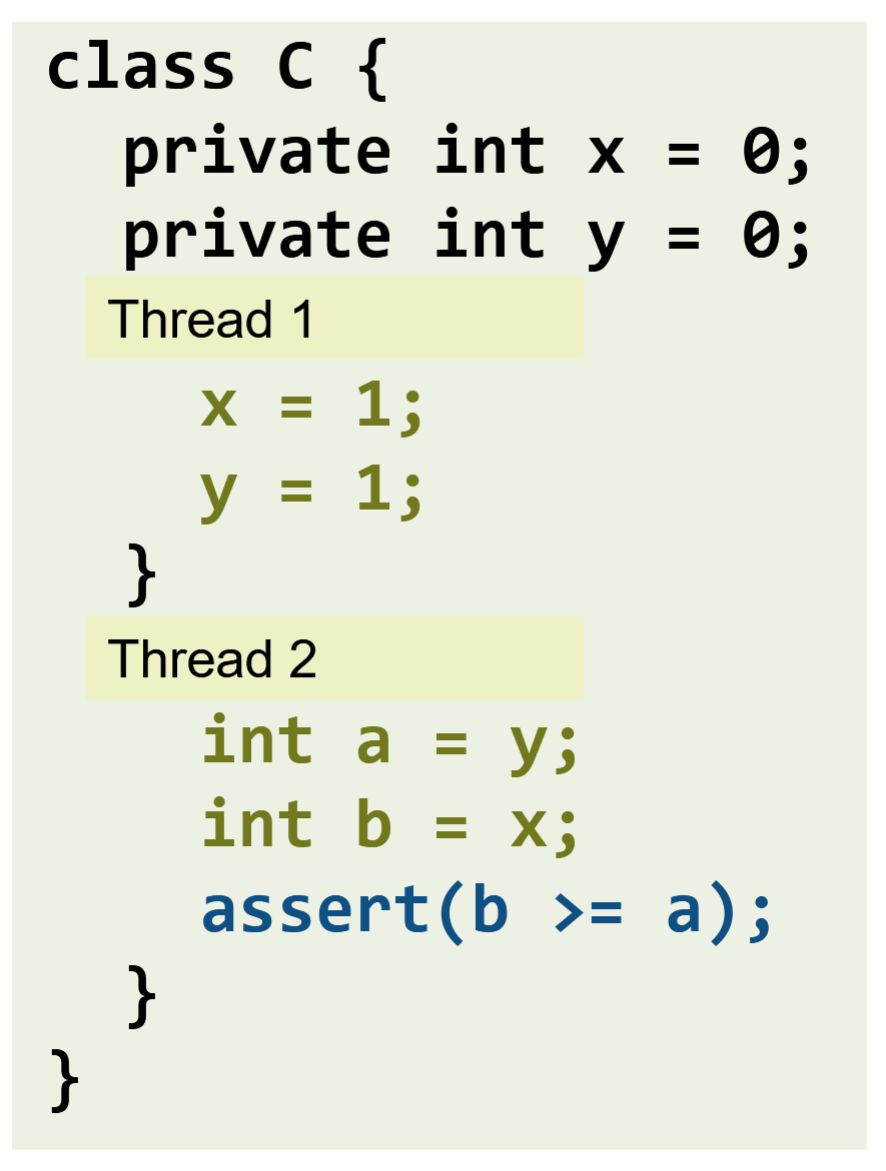
In the classic example with \(x{=}1;\,y{=}1\) (Thread 1) and \(a{=}y;\,b{=}x\) (Thread 2), every possible interleaving satisfies: \(b \geq a\) is always true. This proof technique is called proof by exhaustion (full enumeration of interleavings).

Back

ETH::2._Semester::PProg::12._Shared_Memory_Concurrency::1._Memory_Reordering
In the classic example with \(x{=}1;\,y{=}1\) (Thread 1) and \(a{=}y;\,b{=}x\) (Thread 2), every possible interleaving satisfies: \(b \geq a\) is always true. This proof technique is called proof by exhaustion (full enumeration of interleavings).

Yet the assertion assert(b >= a) can still fail in practice: pure interleaving reasoning ignores memory reordering by the compiler and the hardware.

After

Front

ETH::2._Semester::PProg::12._Shared_Memory_Concurrency::1._Memory_Reordering


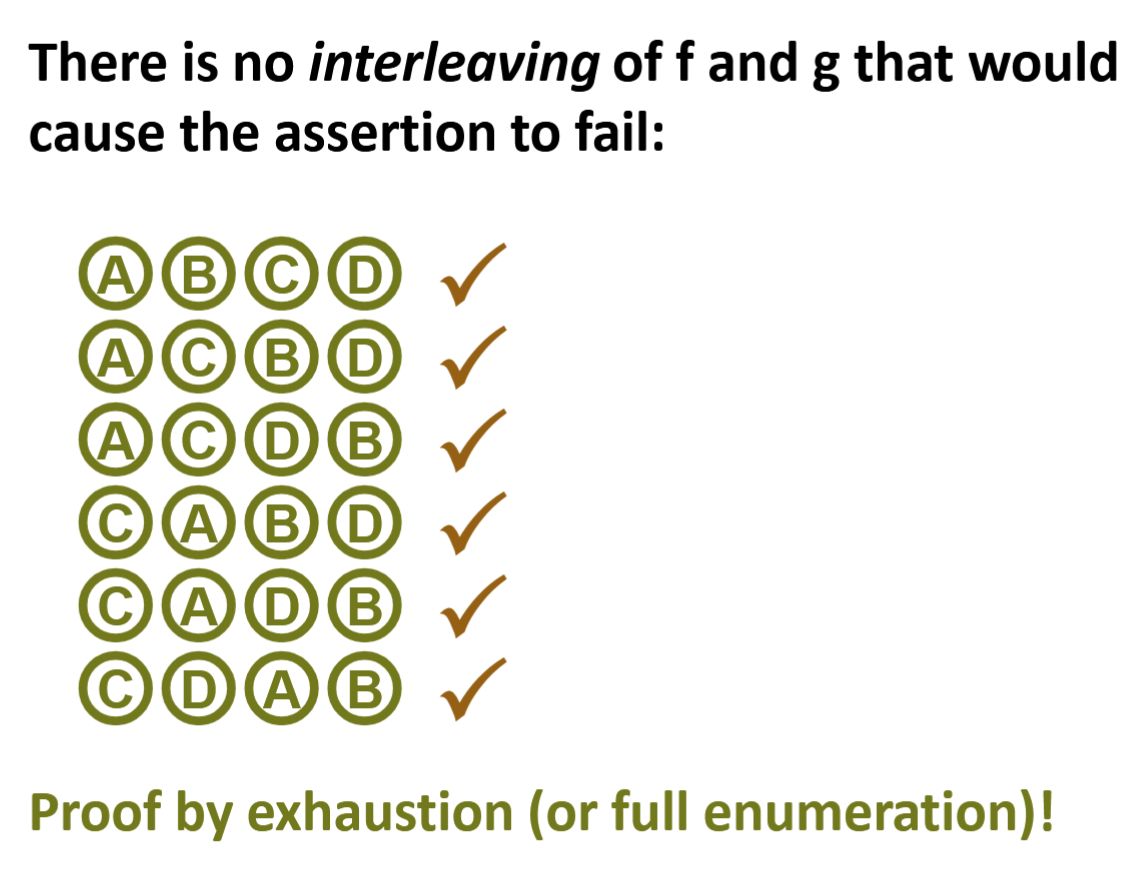
Here, every possible interleaving satisfies: \(b \geq a\) is always true

Back

ETH::2._Semester::PProg::12._Shared_Memory_Concurrency::1._Memory_Reordering


Here, every possible interleaving satisfies: \(b \geq a\) is always true


Yet the assertion assert(b >= a) can still fail in practice: pure interleaving reasoning ignores memory reordering by the compiler and the hardware.
Field-by-field Comparison
Field Before After
Text In the classic example with \(x{=}1;\,y{=}1\) (Thread 1) and \(a{=}y;\,b{=}x\) (Thread 2), every possible interleaving satisfies: {{c1::\(b \geq a\) is always true}}. This proof technique is called {{c2::proof by exhaustion (full enumeration of interleavings)}}. <img src="paste-1925d81ffd7a50429c7275b05887e92bbb5006ee.jpg" width="427"><br><br>Here, every possible interleaving satisfies: {{c1::\(b \geq a\) is always true}}.&nbsp;
Extra Yet the assertion <code>assert(b &gt;= a)</code> can still fail in practice: pure interleaving reasoning ignores <b>memory reordering</b> by the compiler and the hardware. <img src="paste-f46eba5d409ddfa50ca5ce5c8024928be6a86d8e.jpg"><br><br>Yet the assertion <code>assert(b &gt;= a)</code> can still fail in practice: pure interleaving reasoning ignores <b>memory reordering</b> by the compiler and the hardware.
Tags: ETH::2._Semester::PProg::12._Shared_Memory_Concurrency::1._Memory_Reordering

Note 3: ETH::2. Semester::PProg

Deck: ETH::2. Semester::PProg
Note Type: Horvath Cloze
GUID: T+YN#N>,$x
modified

Before

Front

ETH::2._Semester::PProg::12._Shared_Memory_Concurrency::1._Memory_Reordering
Modern multiprocessors do not enforce a global ordering of all instructions for two main reasons: pipelining (processors execute parts of multiple instructions simultaneously and may reorder them internally) and per-processor local caches (loads and stores become visible to other processors only after some delay).

Back

ETH::2._Semester::PProg::12._Shared_Memory_Concurrency::1._Memory_Reordering
Modern multiprocessors do not enforce a global ordering of all instructions for two main reasons: pipelining (processors execute parts of multiple instructions simultaneously and may reorder them internally) and per-processor local caches (loads and stores become visible to other processors only after some delay).

What exactly is guaranteed varies a lot across architectures (x86 vs ARM vs POWER vs Alpha …).

After

Front

ETH::2._Semester::PProg::12._Shared_Memory_Concurrency::1._Memory_Reordering
Modern multiprocessors do not enforce a global ordering of all instructions for two main reasons:
  1. Pipelining (processors execute parts of multiple instructions simultaneously and may reorder them internally).
  2. Per-processor local caches (loads and stores become visible to other processors only after some delay).

Back

ETH::2._Semester::PProg::12._Shared_Memory_Concurrency::1._Memory_Reordering
Modern multiprocessors do not enforce a global ordering of all instructions for two main reasons:
  1. Pipelining (processors execute parts of multiple instructions simultaneously and may reorder them internally).
  2. Per-processor local caches (loads and stores become visible to other processors only after some delay).

What exactly is guaranteed varies a lot across architectures (x86 vs ARM vs POWER vs Alpha …).
Field-by-field Comparison
Field Before After
Text Modern multiprocessors do not enforce a global ordering of all instructions for two main reasons: {{c1::pipelining (processors execute parts of multiple instructions simultaneously and may reorder them internally)}} and {{c2::per-processor local caches (loads and stores become visible to other processors only after some delay)}}. Modern multiprocessors do not enforce a global ordering of all instructions for two main reasons: <br><ol><li>{{c1::Pipelining (processors execute parts of multiple instructions simultaneously and may reorder them internally)}}.</li><li>{{c2::Per-processor local caches (loads and stores become visible to other processors only after some delay)}}.</li></ol>
Tags: ETH::2._Semester::PProg::12._Shared_Memory_Concurrency::1._Memory_Reordering

Note 4: ETH::2. Semester::PProg

Deck: ETH::2. Semester::PProg
Note Type: Horvath Cloze
GUID: VKeMFH&qvc
modified

Before

Front

ETH::2._Semester::PProg::12._Shared_Memory_Concurrency::1._Memory_Reordering
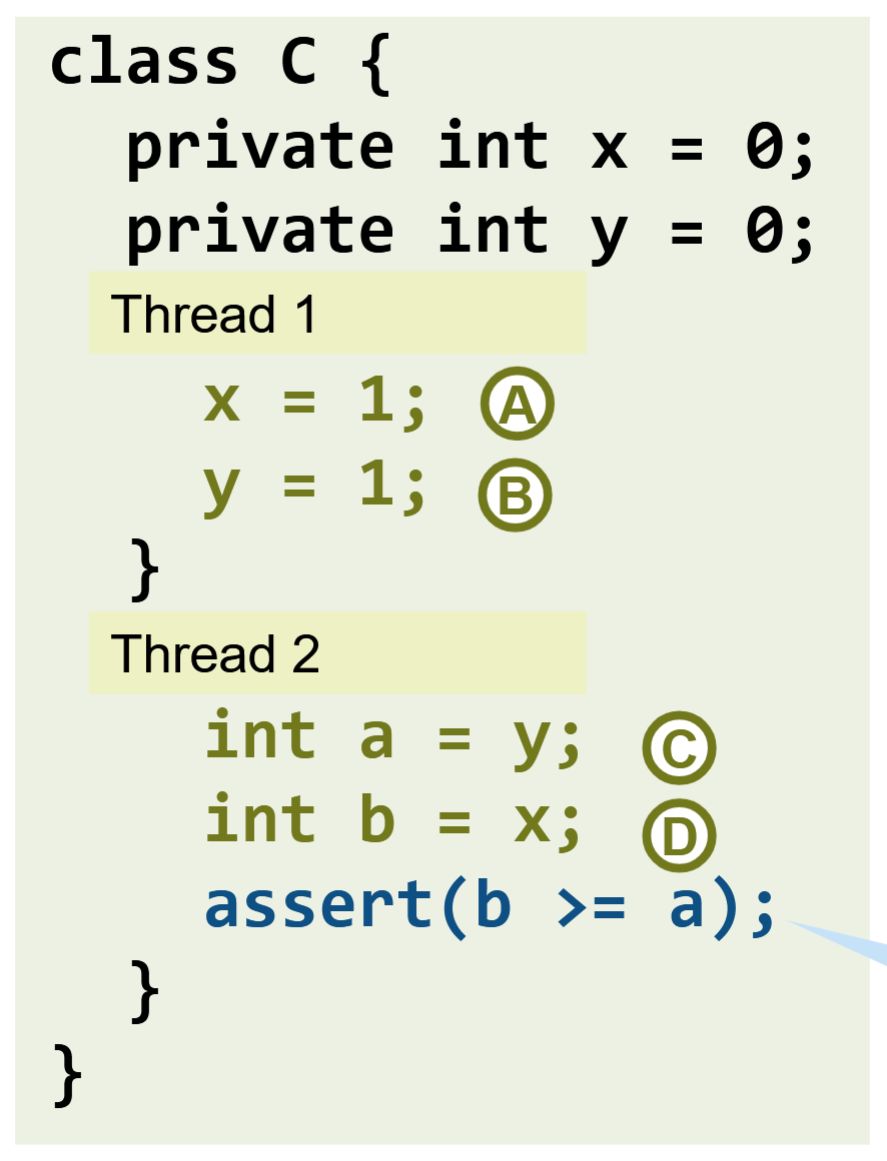
A proof by contradiction that assert(b >= a) cannot fail (assuming sequential program order) uses the relation happened before together with its property of transitivity.

Back

ETH::2._Semester::PProg::12._Shared_Memory_Concurrency::1._Memory_Reordering
A proof by contradiction that assert(b >= a) cannot fail (assuming sequential program order) uses the relation happened before together with its property of transitivity.

Assume \(b{<}a\); this forces \(a{=}1\) and \(b{=}0\), which produces a cyclic happened before chain - contradiction.

The proof relies on programs executing in program order; precisely this assumption breaks in practice due to reordering.

After

Front

ETH::2._Semester::PProg::12._Shared_Memory_Concurrency::1._Memory_Reordering


A proof by contradiction that assert(b >= a) cannot fail (assuming sequential program order) uses the relation happened before together with its property of transitivity.

Back

ETH::2._Semester::PProg::12._Shared_Memory_Concurrency::1._Memory_Reordering


A proof by contradiction that assert(b >= a) cannot fail (assuming sequential program order) uses the relation happened before together with its property of transitivity.

Assume \(b<a\); this forces \(a=1\) and \(b=0\), which produces a cyclic happened before chain - contradiction.

The proof relies on programs executing in program order; precisely this assumption breaks in practice due to reordering.
Field-by-field Comparison
Field Before After
Text A proof by contradiction that <code>assert(b &gt;= a)</code> cannot fail (assuming sequential program order) uses the relation {{c1::<i>happened before</i>}} together with its property of {{c2::transitivity}}. <img src="paste-cdd64ab0bfec31d2a02fc961d4e1421ca0b35599.jpg" width="349"><br><br>A proof by contradiction that <code>assert(b &gt;= a)</code> cannot fail (assuming sequential program order) uses the relation {{c1::<i>happened before</i>}} together with its property of {{c2::transitivity}}.
Extra Assume \(b{&lt;}a\); this forces \(a{=}1\) and \(b{=}0\), which produces a cyclic <i>happened before</i> chain - contradiction.<br><br>The proof relies on programs executing in program order; precisely this assumption breaks in practice due to reordering. Assume \(b&lt;a\); this forces \(a=1\) and \(b=0\), which produces a cyclic <i>happened before</i> chain - contradiction.<br><br>The proof relies on programs executing in program order; precisely this assumption breaks in practice due to reordering.
Tags: ETH::2._Semester::PProg::12._Shared_Memory_Concurrency::1._Memory_Reordering

Note 5: ETH::2. Semester::PProg

Deck: ETH::2. Semester::PProg
Note Type: Horvath Cloze
GUID: |2|f7e7DL}
modified

Before

Front

ETH::2._Semester::PProg::12._Shared_Memory_Concurrency::1._Memory_Reordering
Number of interleavings for 2 threads with \(k\) statements each: {{c1::\(\binom{2k}{k} = O\!\left(\dfrac{4^k}{\sqrt{2k} }\right) \)}}.

Back

ETH::2._Semester::PProg::12._Shared_Memory_Concurrency::1._Memory_Reordering
Number of interleavings for 2 threads with \(k\) statements each: {{c1::\(\binom{2k}{k} = O\!\left(\dfrac{4^k}{\sqrt{2k} }\right) \)}}.

Derivation: the merged trace has length \(2k\). Once we fix which \(k\) of the \(2k\) positions belong to thread 1, the interleaving is determined (sampling without replacement).

After

Front

ETH::2._Semester::PProg::12._Shared_Memory_Concurrency::1._Memory_Reordering
Number of interleavings for 2 threads with \(k\) statements each: {{c1::\[\binom{2k}{k} = O\!\left(\dfrac{4^k}{\sqrt{2k} }\right) \]}}

Back

ETH::2._Semester::PProg::12._Shared_Memory_Concurrency::1._Memory_Reordering
Number of interleavings for 2 threads with \(k\) statements each: {{c1::\[\binom{2k}{k} = O\!\left(\dfrac{4^k}{\sqrt{2k} }\right) \]}}

Derivation: the merged trace has length \(2k\). Once we fix which \(k\) of the \(2k\) positions belong to thread 1, the interleaving is determined (sampling without replacement).
Field-by-field Comparison
Field Before After
Text Number of interleavings for 2 threads with \(k\) statements each: {{c1::\(\binom{2k}{k} = O\!\left(\dfrac{4^k}{\sqrt{2k} }\right) \)}}. Number of interleavings for 2 threads with \(k\) statements each: {{c1::\[\binom{2k}{k} = O\!\left(\dfrac{4^k}{\sqrt{2k} }\right) \]}}
Tags: ETH::2._Semester::PProg::12._Shared_Memory_Concurrency::1._Memory_Reordering

Note 6: ETH::2. Semester::PProg

Deck: ETH::2. Semester::PProg
Note Type: Horvath Cloze
GUID: ~d57MCW=Q9
modified

Before

Front

ETH::2._Semester::PProg::12._Shared_Memory_Concurrency::1._Memory_Reordering
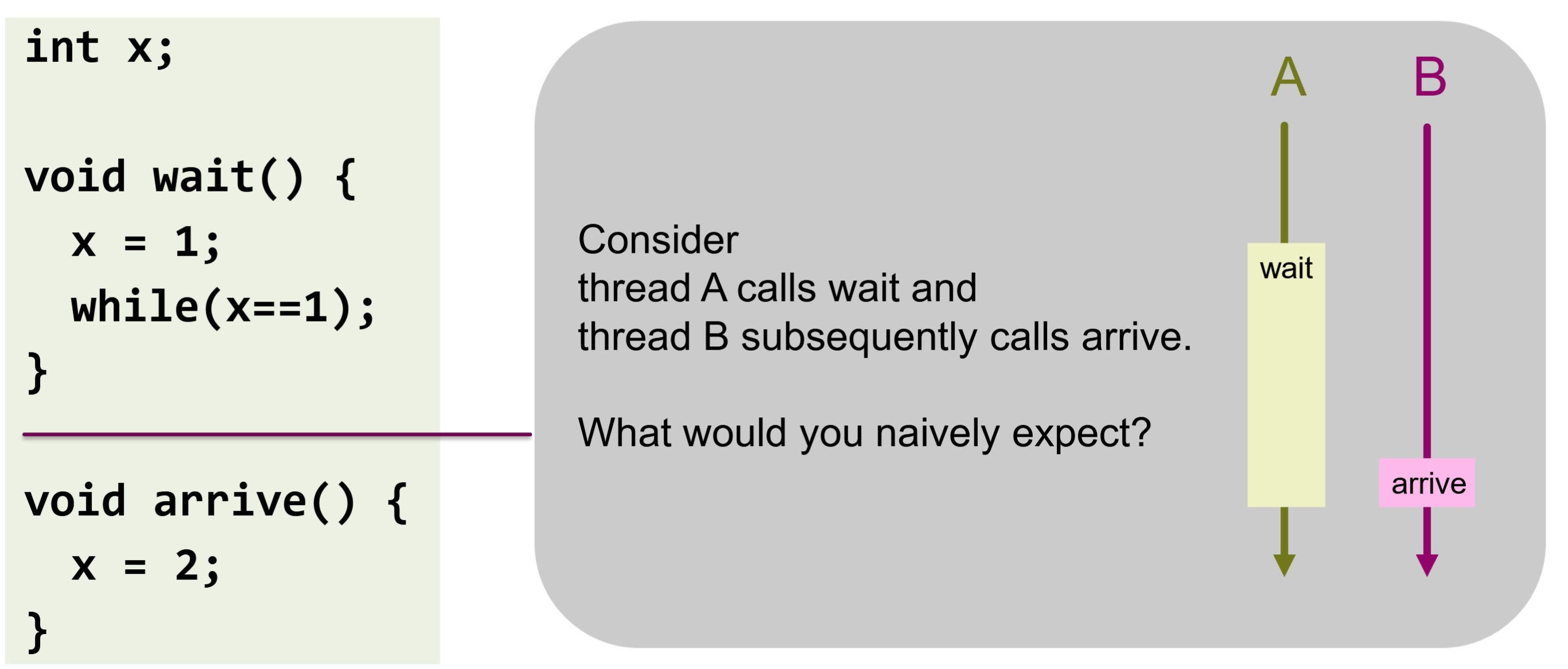
For the home-made rendezvous
void wait()  { x = 1; while(x==1); }
void arrive(){ x = 2; }
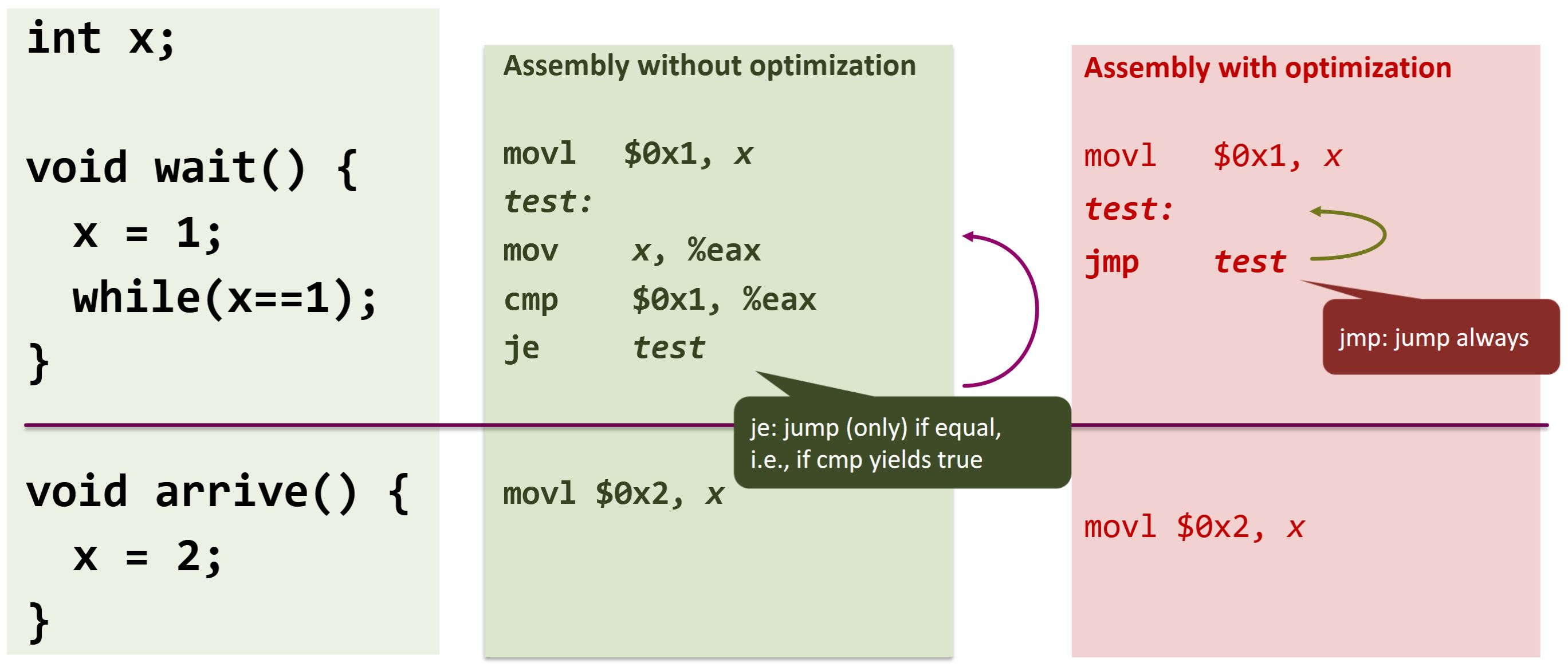
GCC with optimisations compiles the loop into an infinite loop (jmp test without ever reloading x).

Back

ETH::2._Semester::PProg::12._Shared_Memory_Concurrency::1._Memory_Reordering
For the home-made rendezvous
void wait()  { x = 1; while(x==1); }
void arrive(){ x = 2; }
GCC with optimisations compiles the loop into an infinite loop (jmp test without ever reloading x).

Reason: the compiler hoists the read of x out of the loop (register hoisting) because, from its sequential view, x is not modified inside the loop. Writes from other threads are invisible to it.

Fix: volatile or a lock.

After

Front

ETH::2._Semester::PProg::12._Shared_Memory_Concurrency::1._Memory_Reordering
For the home-made rendezvous

GCC with optimisations compiles the loop into an infinite loop (jmp test without ever reloading x).

Back

ETH::2._Semester::PProg::12._Shared_Memory_Concurrency::1._Memory_Reordering
For the home-made rendezvous

GCC with optimisations compiles the loop into an infinite loop (jmp test without ever reloading x).


Reason: the compiler hoists the read of x out of the loop (register hoisting) because, from its sequential view, x is not modified inside the loop. Writes from other threads are invisible to it.

Fix: volatile or a lock.
Field-by-field Comparison
Field Before After
Text For the home-made rendezvous <pre>void wait() { x = 1; while(x==1); } void arrive(){ x = 2; }</pre> GCC with optimisations compiles the loop into {{c1::an infinite loop (<code>jmp test</code> without ever reloading <code>x</code>)}}. For the home-made rendezvous <pre><img src="paste-2349a9fad720b636b583c4c000aeaf8d4d9ff717.jpg"><br></pre> GCC with optimisations compiles the loop into {{c1::an infinite loop (<code>jmp test</code> without ever reloading <code>x</code>)}}.
Extra Reason: the compiler hoists the read of <code>x</code> out of the loop (register hoisting) because, from its sequential view, <code>x</code> is not modified inside the loop. Writes from other threads are invisible to it.<br><br>Fix: <code>volatile</code> or a lock. <img src="paste-a8cc80880ddd292ccc4c8ec8b899edede0f2ebb5.jpg"><br><br>Reason: the compiler hoists the read of <code>x</code> out of the loop (register hoisting) because, from its sequential view, <code>x</code> is not modified inside the loop. Writes from other threads are invisible to it.<br><br>Fix: <code>volatile</code> or a lock.
Tags: ETH::2._Semester::PProg::12._Shared_Memory_Concurrency::1._Memory_Reordering
↑ Top