Note 1: ETH::2. Semester::Analysis
Deck: ETH::2. Semester::Analysis
Note Type: Horvath Cloze
GUID: A`LI|/WiN!
added
Previous
Note did not exist
New Note
Front
ETH::2._Semester::Analysis::4._Funktionen::3._Grenzwerte
Wir nehmen an, es gelte \(\lim_{x \to c} f(x) = K (\neq \pm\infty)\), \(\lim_{x \to c} g(x) = L (\neq \pm\infty)\) und \(A\) sei eine beliebige feste Zahl. Dann gilt:
- \(\lim_{x \to c}(f(x) + g(x)) = K + L\)
- \(\lim_{x \to c}(f(x) - g(x)) = K - L\)
- \(\lim_{x \to c}(f(x) \cdot g(x)) = K \cdot L\)
- \(\lim_{x \to c}(A \cdot f(x)) = A \cdot K\)
- Falls \(L \neq 0\), haben wir \(\lim_{x \to c}(f(x)/g(x)) = K/L\)
Back
ETH::2._Semester::Analysis::4._Funktionen::3._Grenzwerte
Wir nehmen an, es gelte \(\lim_{x \to c} f(x) = K (\neq \pm\infty)\), \(\lim_{x \to c} g(x) = L (\neq \pm\infty)\) und \(A\) sei eine beliebige feste Zahl. Dann gilt:
- \(\lim_{x \to c}(f(x) + g(x)) = K + L\)
- \(\lim_{x \to c}(f(x) - g(x)) = K - L\)
- \(\lim_{x \to c}(f(x) \cdot g(x)) = K \cdot L\)
- \(\lim_{x \to c}(A \cdot f(x)) = A \cdot K\)
- Falls \(L \neq 0\), haben wir \(\lim_{x \to c}(f(x)/g(x)) = K/L\)
Field-by-field Comparison
| Field |
Before |
After |
| Text |
|
Wir nehmen an, es gelte \(\lim_{x \to c} f(x) = K (\neq \pm\infty)\), \(\lim_{x \to c} g(x) = L (\neq \pm\infty)\) und \(A\) sei eine beliebige feste Zahl. Dann gilt: <br><ol><li>\(\lim_{x \to c}(f(x) + g(x)) = {{c1:: K + L}}\)</li><li>\(\lim_{x \to c}(f(x) - g(x)) = {{c1::K - L}}\) </li><li>\(\lim_{x \to c}(f(x) \cdot g(x)) = {{c2::K \cdot L}}\) </li><li>\(\lim_{x \to c}(A \cdot f(x)) = {{c2::A \cdot K}}\) </li><li>Falls {{c3::\(L \neq 0\)}}, haben wir \(\lim_{x \to c}(f(x)/g(x)) = {{c3::K/L}}\)</li></ol> |
Tags:
ETH::2._Semester::Analysis::4._Funktionen::3._Grenzwerte
Note 2: ETH::2. Semester::Analysis
Deck: ETH::2. Semester::Analysis
Note Type: Horvath Cloze
GUID: BYMIpKIF1M
added
Previous
Note did not exist
New Note
Front
ETH::2._Semester::Analysis::4._Funktionen::1._Grundlagen
Eine Funktion \(f : \mathbb{R} \rightarrow \mathbb{R}\) ist ungerade falls gilt {{c2::\(\forall x \in \mathbb{R} \ \ f(-x) = -f(x)\) }}
Back
ETH::2._Semester::Analysis::4._Funktionen::1._Grundlagen
Eine Funktion \(f : \mathbb{R} \rightarrow \mathbb{R}\) ist ungerade falls gilt {{c2::\(\forall x \in \mathbb{R} \ \ f(-x) = -f(x)\) }}
\(x^3\) (ungerade Potenzen) sind zum Beispiel ungerade, oder \(\sin(x)\)
Field-by-field Comparison
| Field |
Before |
After |
| Text |
|
Eine Funktion \(f : \mathbb{R} \rightarrow \mathbb{R}\) ist {{c1::ungerade}} falls gilt {{c2::\(\forall x \in \mathbb{R} \ \ f(-x) = -f(x)\) }} |
| Extra |
|
\(x^3\) (ungerade Potenzen) sind zum Beispiel ungerade, oder \(\sin(x)\) |
Tags:
ETH::2._Semester::Analysis::4._Funktionen::1._Grundlagen
Note 3: ETH::2. Semester::Analysis
Deck: ETH::2. Semester::Analysis
Note Type: Horvath Cloze
GUID: EWO(x#WDV|
added
Previous
Note did not exist
New Note
Front
ETH::2._Semester::Analysis::4._Funktionen::3._Grenzwerte
Es sei \(f : \mathbb{D}(f) \to \mathbb{R}\), es sei \(x_0 \in \mathbb{R}\) und es gelte \[{{c1::\mathbb{D}(f) \cap (x_0 - \delta,\, x_0 + \delta) \neq \emptyset \quad \forall \delta > 0}}\]Dann ist \(L \in \mathbb{R}\) der Grenzwert/Limes von \(f(x)\) an der Stelle \(x_0\), falls gilt \[{{c2::\forall \varepsilon > 0 \;\exists \delta > 0 \quad \text{ so dass} \quad x \in \mathbb{D}(f) \cap (x_0 - \delta,\, x_0 + \delta) \;\Rightarrow\; |f(x) - L| < \varepsilon}}\]
Back
ETH::2._Semester::Analysis::4._Funktionen::3._Grenzwerte
Es sei \(f : \mathbb{D}(f) \to \mathbb{R}\), es sei \(x_0 \in \mathbb{R}\) und es gelte \[{{c1::\mathbb{D}(f) \cap (x_0 - \delta,\, x_0 + \delta) \neq \emptyset \quad \forall \delta > 0}}\]Dann ist \(L \in \mathbb{R}\) der Grenzwert/Limes von \(f(x)\) an der Stelle \(x_0\), falls gilt \[{{c2::\forall \varepsilon > 0 \;\exists \delta > 0 \quad \text{ so dass} \quad x \in \mathbb{D}(f) \cap (x_0 - \delta,\, x_0 + \delta) \;\Rightarrow\; |f(x) - L| < \varepsilon}}\]
Beachte, dass die Funktion nicht unbedingt an der Stelle \(x_0\) des Grenzwerts definiert sein muss (siehe Sprungstelle, Definitionslücke).
Field-by-field Comparison
| Field |
Before |
After |
| Text |
|
Es sei \(f : \mathbb{D}(f) \to \mathbb{R}\), es sei \(x_0 \in \mathbb{R}\) und es gelte \[{{c1::\mathbb{D}(f) \cap (x_0 - \delta,\, x_0 + \delta) \neq \emptyset \quad \forall \delta > 0}}\]Dann ist \(L \in \mathbb{R}\) der Grenzwert/Limes von \(f(x)\) an der Stelle \(x_0\), falls gilt \[{{c2::\forall \varepsilon > 0 \;\exists \delta > 0 \quad \text{ so dass} \quad x \in \mathbb{D}(f) \cap (x_0 - \delta,\, x_0 + \delta) \;\Rightarrow\; |f(x) - L| < \varepsilon}}\] |
| Extra |
|
<div>Beachte, dass die Funktion nicht unbedingt an der Stelle \(x_0\) des Grenzwerts definiert sein muss (siehe Sprungstelle, Definitionslücke).</div> |
Tags:
ETH::2._Semester::Analysis::4._Funktionen::3._Grenzwerte
Note 4: ETH::2. Semester::Analysis
Deck: ETH::2. Semester::Analysis
Note Type: Horvath Cloze
GUID: FAt?WT^?8#
added
Previous
Note did not exist
New Note
Front
ETH::2._Semester::Analysis::4._Funktionen::1._Grundlagen
Es sei \(f: \mathbb{D}(f) \rightarrow \mathbb{R}\) mit \(\mathbb{D}(f) \neq \emptyset\) und es sei weiters \(D' \subset \mathcal{D}(f)\).
Dann kann man die Einschränkung/Restriktion von \(f\) auf \(D'\) betrachten, die Funktion \[ f\mid_{D'} : D' \rightarrow \mathbb{R} \text{ mit } {{c1::f\mid_{D'}(x) = f(x) \forall x \in D' }}\]
Back
ETH::2._Semester::Analysis::4._Funktionen::1._Grundlagen
Es sei \(f: \mathbb{D}(f) \rightarrow \mathbb{R}\) mit \(\mathbb{D}(f) \neq \emptyset\) und es sei weiters \(D' \subset \mathcal{D}(f)\).
Dann kann man die Einschränkung/Restriktion von \(f\) auf \(D'\) betrachten, die Funktion \[ f\mid_{D'} : D' \rightarrow \mathbb{R} \text{ mit } {{c1::f\mid_{D'}(x) = f(x) \forall x \in D' }}\]
Man beachte, dass \(f\) und \(f\mid_{D'}\) a priori zwei verschiedene Funktionen sind.
Beispiel \(\overline{f} : \mathbb{R}^+_0 \rightarrow \mathbb{R}^+_0\) \(f(x) = x^2\) ist bijektiv.
Field-by-field Comparison
| Field |
Before |
After |
| Text |
|
Es sei \(f: \mathbb{D}(f) \rightarrow \mathbb{R}\) mit \(\mathbb{D}(f) \neq \emptyset\) und es sei weiters \(D' \subset \mathcal{D}(f)\).<br>Dann kann man die Einschränkung/Restriktion von \(f\) auf \(D'\) betrachten, die Funktion \[ f\mid_{D'} : D' \rightarrow \mathbb{R} \text{ mit } {{c1::f\mid_{D'}(x) = f(x) \forall x \in D' }}\] |
| Extra |
|
Man beachte, dass \(f\) und \(f\mid_{D'}\) a priori zwei verschiedene Funktionen sind.
<br><br><b>Beispiel</b> \(\overline{f} : \mathbb{R}^+_0 \rightarrow \mathbb{R}^+_0\) \(f(x) = x^2\) ist bijektiv. |
Tags:
ETH::2._Semester::Analysis::4._Funktionen::1._Grundlagen
Note 5: ETH::2. Semester::Analysis
Deck: ETH::2. Semester::Analysis
Note Type: Horvath Cloze
GUID: H~>w5z&KSZ
added
Previous
Note did not exist
New Note
Front
ETH::2._Semester::Analysis::4._Funktionen::1._Grundlagen
Sei \(f: X \rightarrow Y\) und \(g: Y \rightarrow Z\). \[ g \circ f : X \rightarrow Z \text{ mit } (g \circ f)(x) = g(f(x)) \]
Back
ETH::2._Semester::Analysis::4._Funktionen::1._Grundlagen
Sei \(f: X \rightarrow Y\) und \(g: Y \rightarrow Z\). \[ g \circ f : X \rightarrow Z \text{ mit } (g \circ f)(x) = g(f(x)) \]
\(f\) ist die innere und \(g\) die äußere Funktion.
Field-by-field Comparison
| Field |
Before |
After |
| Text |
|
Sei \(f: X \rightarrow Y\) und \(g: Y \rightarrow Z\). \[ g \circ f : X \rightarrow Z \text{ mit } (g \circ f)(x) = {{c1::g(f(x)) }}\] |
| Extra |
|
\(f\) ist die innere und \(g\) die äußere Funktion. |
Tags:
ETH::2._Semester::Analysis::4._Funktionen::1._Grundlagen
Note 6: ETH::2. Semester::Analysis
Deck: ETH::2. Semester::Analysis
Note Type: Horvath Cloze
GUID: IWY(~?%X0)
added
Previous
Note did not exist
New Note
Front
ETH::2._Semester::Analysis::4._Funktionen::3._Grenzwerte
Es sei \(f : \mathbb{D}(f) \to \mathbb{R}\). Dann gilt \[ \lim_{x \to x_o} f(x) = L \] genau dann, wenn {{c1::für jede konvergente Folge \((x_n)_{n \in \mathbb{N}_0}\) welche gegen \(x_0\) konvergiert gilt \[ \lim_{n \to \infty} f(x_n) = L \]}}
Back
ETH::2._Semester::Analysis::4._Funktionen::3._Grenzwerte
Es sei \(f : \mathbb{D}(f) \to \mathbb{R}\). Dann gilt \[ \lim_{x \to x_o} f(x) = L \] genau dann, wenn {{c1::für jede konvergente Folge \((x_n)_{n \in \mathbb{N}_0}\) welche gegen \(x_0\) konvergiert gilt \[ \lim_{n \to \infty} f(x_n) = L \]}}
Field-by-field Comparison
| Field |
Before |
After |
| Text |
|
Es sei \(f : \mathbb{D}(f) \to \mathbb{R}\). Dann gilt \[ \lim_{x \to x_o} f(x) = L \] genau dann, wenn {{c1::für jede konvergente Folge \((x_n)_{n \in \mathbb{N}_0}\) welche gegen \(x_0\) konvergiert gilt \[ \lim_{n \to \infty} f(x_n) = L \]}} |
Tags:
ETH::2._Semester::Analysis::4._Funktionen::3._Grenzwerte
Note 7: ETH::2. Semester::Analysis
Deck: ETH::2. Semester::Analysis
Note Type: Horvath Cloze
GUID: IZ]eCute5j
added
Previous
Note did not exist
New Note
Front
ETH::2._Semester::Analysis::4._Funktionen::1._Grundlagen
Es sei \(f: \mathcal{D}(f) \rightarrow \mathcal{R}\) mit \(\mathcal{D}(f) \neq \emptyset\). Dann heißt \(f\) nach oben beschränkt, falls \(M \in \mathbb{R}\) existiert mit {{c1::\(f(x) \le M\) \(\forall x \in \mathbb{D}(f)\)}}.
Back
ETH::2._Semester::Analysis::4._Funktionen::1._Grundlagen
Es sei \(f: \mathcal{D}(f) \rightarrow \mathcal{R}\) mit \(\mathcal{D}(f) \neq \emptyset\). Dann heißt \(f\) nach oben beschränkt, falls \(M \in \mathbb{R}\) existiert mit {{c1::\(f(x) \le M\) \(\forall x \in \mathbb{D}(f)\)}}.
Field-by-field Comparison
| Field |
Before |
After |
| Text |
|
Es sei \(f: \mathcal{D}(f) \rightarrow \mathcal{R}\) mit \(\mathcal{D}(f) \neq \emptyset\). Dann heißt \(f\) nach oben beschränkt, falls \(M \in \mathbb{R}\) existiert mit {{c1::\(f(x) \le M\) \(\forall x \in \mathbb{D}(f)\)}}. |
Tags:
ETH::2._Semester::Analysis::4._Funktionen::1._Grundlagen
Note 8: ETH::2. Semester::Analysis
Deck: ETH::2. Semester::Analysis
Note Type: Horvath Cloze
GUID: I{b?`Sx;Iu
added
Previous
Note did not exist
New Note
Front
ETH::2._Semester::Analysis::4._Funktionen::3._Grenzwerte
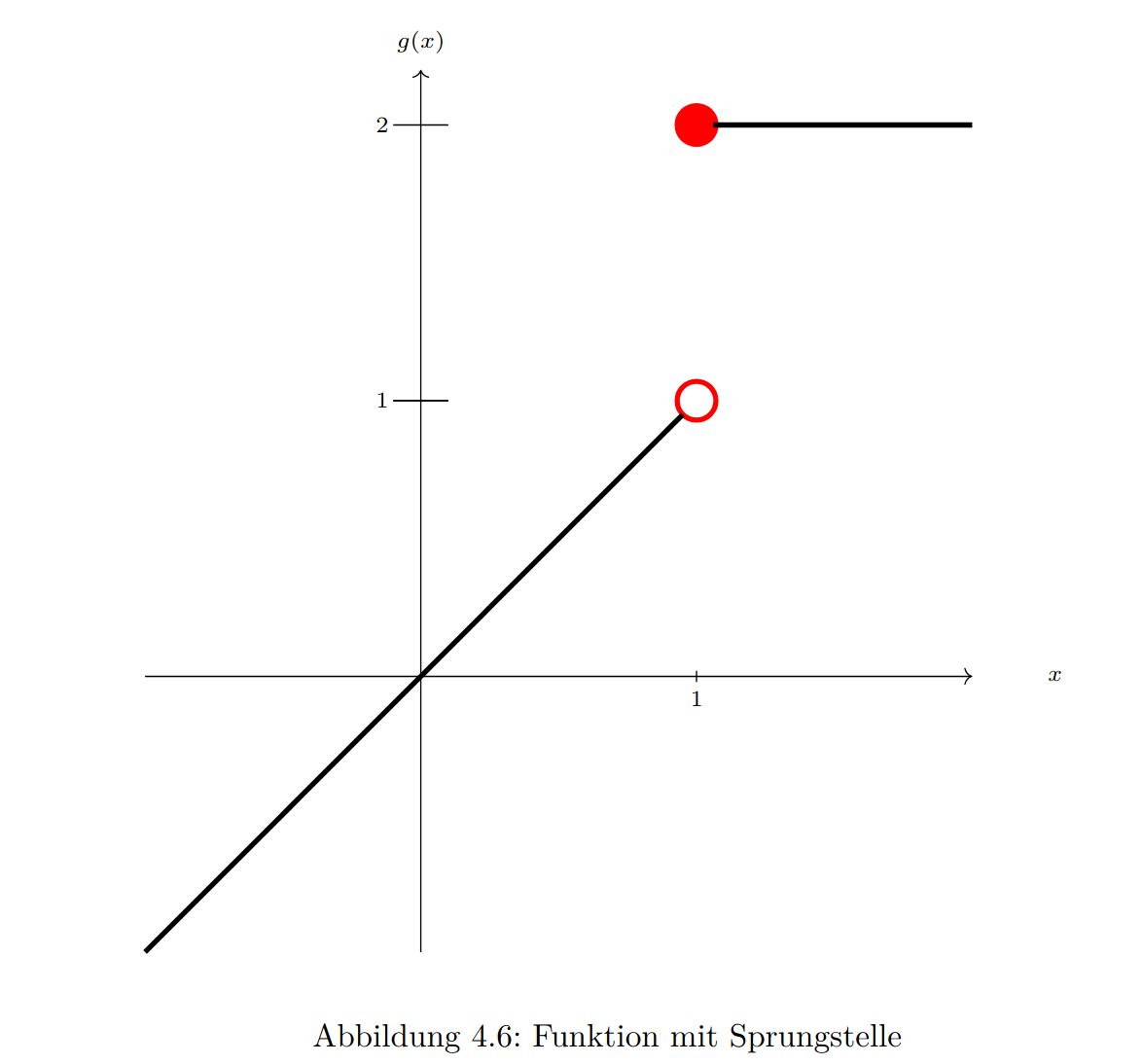
Dieser Graph hat eine
Sprungstelle.
Back
ETH::2._Semester::Analysis::4._Funktionen::3._Grenzwerte
Dieser Graph hat eine
Sprungstelle.
Field-by-field Comparison
| Field |
Before |
After |
| Text |
|
<img src="paste-adb95d561c8a12aaf2130a27752a6e38a11b5da6.jpg"><br>Dieser Graph hat eine {{c1::Sprungstelle}}. |
Tags:
ETH::2._Semester::Analysis::4._Funktionen::3._Grenzwerte
Note 9: ETH::2. Semester::Analysis
Deck: ETH::2. Semester::Analysis
Note Type: Horvath Cloze
GUID: L[+Q`BU{%J
added
Previous
Note did not exist
New Note
Front
ETH::2._Semester::Analysis::4._Funktionen::3._Grenzwerte
Falls gilt \[{{c1:: \forall \epsilon > 0 \ \exists M > 0 \ \ \text{s.d. } \ \forall x \in X (x > M \implies |f(x) - L| < \epsilon) }}\] hat \(f\) für \(x\) {{c2::gegen unendlich den Grenzwert L, \(\lim_{x \to \infty} f(x) = L\)}}
Back
ETH::2._Semester::Analysis::4._Funktionen::3._Grenzwerte
Falls gilt \[{{c1:: \forall \epsilon > 0 \ \exists M > 0 \ \ \text{s.d. } \ \forall x \in X (x > M \implies |f(x) - L| < \epsilon) }}\] hat \(f\) für \(x\) {{c2::gegen unendlich den Grenzwert L, \(\lim_{x \to \infty} f(x) = L\)}}
Das gleiche gilt für \(- \infty\) wenn \(x < -M \implies |f(x) - L| < \epsilon\).
Field-by-field Comparison
| Field |
Before |
After |
| Text |
|
Falls gilt \[{{c1:: \forall \epsilon > 0 \ \exists M > 0 \ \ \text{s.d. } \ \forall x \in X (x > M \implies |f(x) - L| < \epsilon) }}\] hat \(f\) für \(x\) {{c2::gegen unendlich den Grenzwert L, \(\lim_{x \to \infty} f(x) = L\)}} |
| Extra |
|
Das gleiche gilt für \(- \infty\) wenn \(x < -M \implies |f(x) - L| < \epsilon\). |
Tags:
ETH::2._Semester::Analysis::4._Funktionen::3._Grenzwerte
Note 10: ETH::2. Semester::Analysis
Deck: ETH::2. Semester::Analysis
Note Type: Horvath Cloze
GUID: LsNwdXtM
added
Previous
Note did not exist
New Note
Front
ETH::2._Semester::Analysis::4._Funktionen::2._Properties
Jede streng monotone Funktion ist injektiv.
Proof Included
Back
ETH::2._Semester::Analysis::4._Funktionen::2._Properties
Jede streng monotone Funktion ist injektiv.
Proof Included
Proof: Nehme an wir haben eine streng monotone Funktion \(f\) die nicht injektiv ist.
- Dann gilt \(\exists x_1, x_2 \in \mathbb{D}\) sodass \(f(x_1) = f(x_2)\) weil nicht injektiv.
- Aber oBdA \(x_1 < x_2 \implies f(x_1) < f(x_2)\) was ein Widerspruch ist.
Field-by-field Comparison
| Field |
Before |
After |
| Text |
|
<div>Jede {{c1::<b>streng monotone</b>::eigenschaft<b>}}</b> Funktion ist {{c2::<b>injektiv</b>::funktionseigenschaft<b>}}</b>.</div><div><br></div><div><i>Proof Included</i><br></div> |
| Extra |
|
<b>Proof</b>: Nehme an wir haben eine streng monotone Funktion \(f\) die nicht injektiv ist.<br><ul><li>Dann gilt \(\exists x_1, x_2 \in \mathbb{D}\) sodass \(f(x_1) = f(x_2)\) weil nicht injektiv.</li><li>Aber oBdA \(x_1 < x_2 \implies f(x_1) < f(x_2)\) was ein Widerspruch ist.</li></ul> |
Tags:
ETH::2._Semester::Analysis::4._Funktionen::2._Properties
Note 11: ETH::2. Semester::Analysis
Deck: ETH::2. Semester::Analysis
Note Type: Horvath Cloze
GUID: PHrI|uE-?!
added
Previous
Note did not exist
New Note
Front
ETH::2._Semester::Analysis::4._Funktionen::1._Grundlagen
Wir betrachten eine Funktion \(f : X = \mathbb{D}(f) \subset \mathbb{R} \to \mathbb{R}\). Diese Funktion nennen wir monoton wachsend falls gilt \[\forall x_1, x_2 \in X \quad (x_1 < x_2 \Rightarrow f(x_1) \leq f(x_2))\]
Back
ETH::2._Semester::Analysis::4._Funktionen::1._Grundlagen
Wir betrachten eine Funktion \(f : X = \mathbb{D}(f) \subset \mathbb{R} \to \mathbb{R}\). Diese Funktion nennen wir monoton wachsend falls gilt \[\forall x_1, x_2 \in X \quad (x_1 < x_2 \Rightarrow f(x_1) \leq f(x_2))\]
Field-by-field Comparison
| Field |
Before |
After |
| Text |
|
Wir betrachten eine Funktion \(f : X = \mathbb{D}(f) \subset \mathbb{R} \to \mathbb{R}\). Diese Funktion nennen wir {{c1::monoton wachsend}} falls gilt \[\forall x_1, x_2 \in X \quad {{c1::(x_1 < x_2 \Rightarrow f(x_1) \leq f(x_2))}}\]<br> |
Tags:
ETH::2._Semester::Analysis::4._Funktionen::1._Grundlagen
Note 12: ETH::2. Semester::Analysis
Deck: ETH::2. Semester::Analysis
Note Type: Horvath Cloze
GUID: Qm*4lRQfS&
added
Previous
Note did not exist
New Note
Front
ETH::2._Semester::Analysis::4._Funktionen::3._Grenzwerte
Es gelte \(\mathbb{D}(f) \cap [x_0,\, x_0 + \delta) \neq \emptyset \;\forall \delta > 0\).
Falls gilt \(\forall \varepsilon > 0 \;\exists \delta > 0\) \[{{c1::x \in \mathbb{D}(f) \cap [x_0,\, x_0 + \delta) \;\Rightarrow\; |f(x) - L| < \varepsilon }}\] hat \(f\) in \(x_0\) den rechtsseitigen Grenzwert \(L\), d.h. \[\lim_{\substack{x \ge x_0 \\ x \to x_0 f(x) = L\]}}
Back
ETH::2._Semester::Analysis::4._Funktionen::3._Grenzwerte
Es gelte \(\mathbb{D}(f) \cap [x_0,\, x_0 + \delta) \neq \emptyset \;\forall \delta > 0\).
Falls gilt \(\forall \varepsilon > 0 \;\exists \delta > 0\) \[{{c1::x \in \mathbb{D}(f) \cap [x_0,\, x_0 + \delta) \;\Rightarrow\; |f(x) - L| < \varepsilon }}\] hat \(f\) in \(x_0\) den rechtsseitigen Grenzwert \(L\), d.h. \[\lim_{\substack{x \ge x_0 \\ x \to x_0 f(x) = L\]}}
Field-by-field Comparison
| Field |
Before |
After |
| Text |
|
Es gelte \(\mathbb{D}(f) \cap [x_0,\, x_0 + \delta) \neq \emptyset \;\forall \delta > 0\).<br>Falls gilt \(\forall \varepsilon > 0 \;\exists \delta > 0\) \[{{c1::x \in \mathbb{D}(f) \cap [x_0,\, x_0 + \delta) \;\Rightarrow\; |f(x) - L| < \varepsilon }}\] hat \(f\) in \(x_0\) {{c2::den rechtsseitigen Grenzwert \(L\), d.h. \[\lim_{\substack{x \ge x_0 \\ x \to x_0}} f(x) = L\]}} |
Tags:
ETH::2._Semester::Analysis::4._Funktionen::3._Grenzwerte
Note 13: ETH::2. Semester::Analysis
Deck: ETH::2. Semester::Analysis
Note Type: Horvath Cloze
GUID: Qu5m]scS(K
added
Previous
Note did not exist
New Note
Front
ETH::2._Semester::Analysis::4._Funktionen::3._Grenzwerte
Falls gilt \[{{c1:: \forall N > 0 \ \exists \delta > 0 \text{ s.d. } \ \forall x \in C \ (0 < |x - c| < \delta \implies f(x) > N) }}\] hat \(f\) in \(c\) {{c2::den uneigentlichen Grenzwert \(\infty\) d.h. \(\lim_{x \to c} f(x) = \infty\)}}.
Back
ETH::2._Semester::Analysis::4._Funktionen::3._Grenzwerte
Falls gilt \[{{c1:: \forall N > 0 \ \exists \delta > 0 \text{ s.d. } \ \forall x \in C \ (0 < |x - c| < \delta \implies f(x) > N) }}\] hat \(f\) in \(c\) {{c2::den uneigentlichen Grenzwert \(\infty\) d.h. \(\lim_{x \to c} f(x) = \infty\)}}.
Das gleiche kann auch \(f(x) < -N\) für \(-\infty\) gelten.
Field-by-field Comparison
| Field |
Before |
After |
| Text |
|
Falls gilt \[{{c1:: \forall N > 0 \ \exists \delta > 0 \text{ s.d. } \ \forall x \in C \ (0 < |x - c| < \delta \implies f(x) > N) }}\] hat \(f\) in \(c\) {{c2::den uneigentlichen Grenzwert \(\infty\) d.h. \(\lim_{x \to c} f(x) = \infty\)}}. |
| Extra |
|
<div>Das gleiche kann auch \(f(x) < -N\) für \(-\infty\) gelten.</div> |
Tags:
ETH::2._Semester::Analysis::4._Funktionen::3._Grenzwerte
Note 14: ETH::2. Semester::Analysis
Deck: ETH::2. Semester::Analysis
Note Type: Horvath Cloze
GUID: RbV0%n~J,_
added
Previous
Note did not exist
New Note
Front
ETH::2._Semester::Analysis::4._Funktionen::3._Grenzwerte
Limes: Es gelte\(\lim_{x \to x_0} f(x) = 0\).
Darf \(x_0\) in \(f\) eingesetzt werden, so muss der Funktionswert bei \(x_0\) den Grenzwert annehmen, \(f(x_0) = L\).
Back
ETH::2._Semester::Analysis::4._Funktionen::3._Grenzwerte
Limes: Es gelte\(\lim_{x \to x_0} f(x) = 0\).
Darf \(x_0\) in \(f\) eingesetzt werden, so muss der Funktionswert bei \(x_0\) den Grenzwert annehmen, \(f(x_0) = L\).
Darf es nicht eingesetzt werden, so können wir a priori keine Aussage über den Funktionswert an \(x_0\) machen.
Field-by-field Comparison
| Field |
Before |
After |
| Text |
|
<b>Limes</b>: Es gelte\(\lim_{x \to x_0} f(x) = 0\).<br>Darf \(x_0\) in \(f\) eingesetzt werden, so muss der <b>Funktionswert</b> bei \(x_0\) {{c1::den Grenzwert annehmen, \(f(x_0) = L\)}}. |
| Extra |
|
<div>Darf es nicht eingesetzt werden, so können wir a priori keine Aussage über den Funktionswert an \(x_0\) machen.</div> |
Tags:
ETH::2._Semester::Analysis::4._Funktionen::3._Grenzwerte
Note 15: ETH::2. Semester::Analysis
Deck: ETH::2. Semester::Analysis
Note Type: Horvath Cloze
GUID: c3%x=hbv:-
added
Previous
Note did not exist
New Note
Front
ETH::2._Semester::Analysis::4._Funktionen::3._Grenzwerte
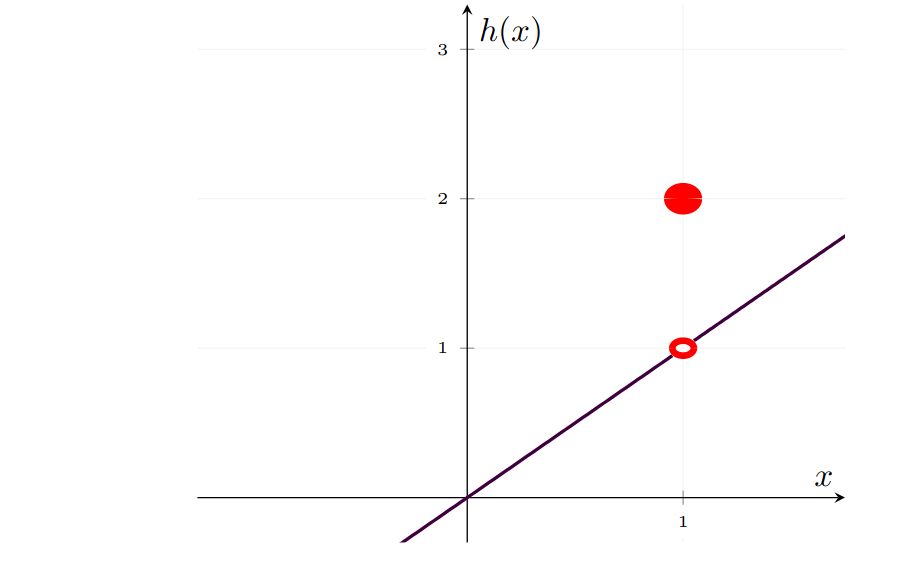
Dieser Graph hat eine
Unstetigkeitsstelle.
Back
ETH::2._Semester::Analysis::4._Funktionen::3._Grenzwerte
Dieser Graph hat eine
Unstetigkeitsstelle.
Field-by-field Comparison
| Field |
Before |
After |
| Text |
|
<img src="paste-3d2c61362ab5626c8266c5488e4dd2c038bda742.jpg"><br>Dieser Graph hat eine {{c1::Unstetigkeitsstelle}}. |
Tags:
ETH::2._Semester::Analysis::4._Funktionen::3._Grenzwerte
Note 16: ETH::2. Semester::Analysis
Deck: ETH::2. Semester::Analysis
Note Type: Horvath Cloze
GUID: c|j*pzzKo=
added
Previous
Note did not exist
New Note
Front
ETH::2._Semester::Analysis::4._Funktionen::3._Grenzwerte
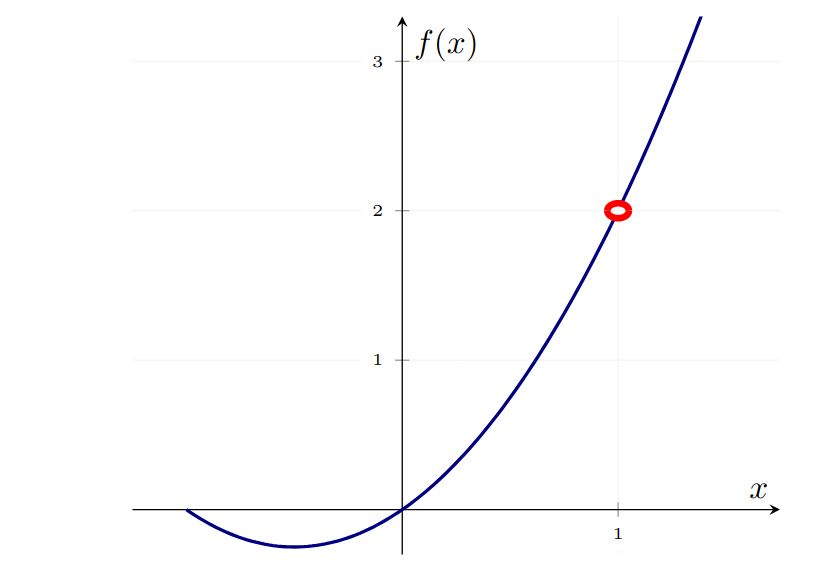
Dieser Graph hat eine
Definitionslücke.
Back
ETH::2._Semester::Analysis::4._Funktionen::3._Grenzwerte
Dieser Graph hat eine
Definitionslücke.
Field-by-field Comparison
| Field |
Before |
After |
| Text |
|
<img src="paste-081c174be1eabf211b062a7b72b593fff65d5254.jpg"><br>Dieser Graph hat eine {{c1::Definitionslücke}}. |
Tags:
ETH::2._Semester::Analysis::4._Funktionen::3._Grenzwerte
Note 17: ETH::2. Semester::Analysis
Deck: ETH::2. Semester::Analysis
Note Type: Horvath Cloze
GUID: e0d^/ml1oV
added
Previous
Note did not exist
New Note
Front
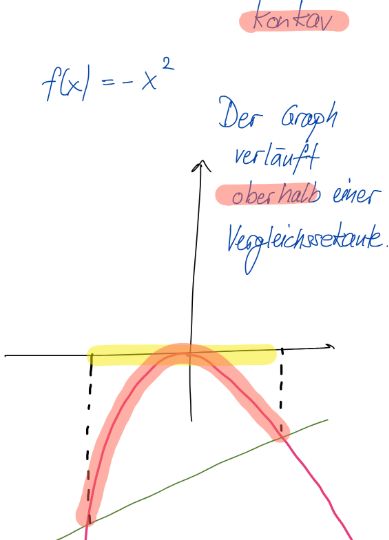
ETH::2._Semester::Analysis::4._Funktionen::2._Properties
Der Graph einer Funktion heißt rechtsgekrümmt (Konkav) falls der Graph eine Rechtskurve vollführt / über der Sekante verläuft.
Back
ETH::2._Semester::Analysis::4._Funktionen::2._Properties
Der Graph einer Funktion heißt rechtsgekrümmt (Konkav) falls der Graph eine Rechtskurve vollführt / über der Sekante verläuft.
Field-by-field Comparison
| Field |
Before |
After |
| Text |
|
<div>Der Graph einer Funktion heißt {{c1::rechtsgekrümmt (Konkav)}} falls {{c2::der Graph eine Rechtskurve vollführt / über der Sekante verläuft}}.</div> |
| Extra |
|
<img src="paste-edc34525556e3c75e7fb4ac76976f56ff4d07bb8.jpg"> |
Tags:
ETH::2._Semester::Analysis::4._Funktionen::2._Properties
Note 18: ETH::2. Semester::Analysis
Deck: ETH::2. Semester::Analysis
Note Type: Horvath Cloze
GUID: g:V@k_wqKg
added
Previous
Note did not exist
New Note
Front
ETH::2._Semester::Analysis::4._Funktionen::1._Grundlagen
Eine Funktion \(f : \mathbb{R} \rightarrow \mathbb{R}\) ist gerade falls gilt {{c2:: \(\forall x \in \mathbb{R} \ \ f(-x) = f(x)\) }}.
Back
ETH::2._Semester::Analysis::4._Funktionen::1._Grundlagen
Eine Funktion \(f : \mathbb{R} \rightarrow \mathbb{R}\) ist gerade falls gilt {{c2:: \(\forall x \in \mathbb{R} \ \ f(-x) = f(x)\) }}.
\(\cos(x)\) oder gerade Potenzen
Field-by-field Comparison
| Field |
Before |
After |
| Text |
|
Eine Funktion \(f : \mathbb{R} \rightarrow \mathbb{R}\) ist {{c1::gerade}} falls gilt {{c2:: \(\forall x \in \mathbb{R} \ \ f(-x) = f(x)\) }}. |
| Extra |
|
\(\cos(x)\) oder gerade Potenzen |
Tags:
ETH::2._Semester::Analysis::4._Funktionen::1._Grundlagen
Note 19: ETH::2. Semester::Analysis
Deck: ETH::2. Semester::Analysis
Note Type: Horvath Cloze
GUID: i(,PgxQOhB
added
Previous
Note did not exist
New Note
Front
ETH::2._Semester::Analysis::4._Funktionen::1._Grundlagen
Falls eine Abbildung \(f: X \rightarrow Y\) bijektiv ist, gibt es eine eindeutige Funktion \(g: Y \rightarrow X\) mit der Eigenschaft \[ g \circ f = \text{id}_X \text{ und } f \circ g = \text{id}_Y \]
Back
ETH::2._Semester::Analysis::4._Funktionen::1._Grundlagen
Falls eine Abbildung \(f: X \rightarrow Y\) bijektiv ist, gibt es eine eindeutige Funktion \(g: Y \rightarrow X\) mit der Eigenschaft \[ g \circ f = \text{id}_X \text{ und } f \circ g = \text{id}_Y \]
Diese Funktion nennt man Inverse (Umkehrfunktion) und wird mit \(f^{-1}\) bezeichnet.
Field-by-field Comparison
| Field |
Before |
After |
| Text |
|
Falls eine Abbildung \(f: X \rightarrow Y\) {{c1::<b>bijektiv</b>}} ist, gibt es {{c2::eine <b>eindeutige</b> Funktion \(g: Y \rightarrow X\)}} mit der Eigenschaft \[{{c3:: g \circ f }} = \text{id}_X \text{ und } {{c3::f \circ g}} = \text{id}_Y \] |
| Extra |
|
Diese Funktion nennt man Inverse (Umkehrfunktion) und wird mit \(f^{-1}\) bezeichnet. |
Tags:
ETH::2._Semester::Analysis::4._Funktionen::1._Grundlagen
Note 20: ETH::2. Semester::Analysis
Deck: ETH::2. Semester::Analysis
Note Type: Horvath Cloze
GUID: jKmAIMv))S
added
Previous
Note did not exist
New Note
Front
ETH::2._Semester::Analysis::4._Funktionen::3._Grenzwerte
- Vertikale Asymptote -> Funktionswert gegen {{c2::\(\infty\) für \(x \to c \in \mathbb{R}\)}}
- Horizontale Asymptote -> Funktionswert gegen {{c2::\(c \in \mathbb{R}\) aber \(x \to \infty\)}}
Back
ETH::2._Semester::Analysis::4._Funktionen::3._Grenzwerte
- Vertikale Asymptote -> Funktionswert gegen {{c2::\(\infty\) für \(x \to c \in \mathbb{R}\)}}
- Horizontale Asymptote -> Funktionswert gegen {{c2::\(c \in \mathbb{R}\) aber \(x \to \infty\)}}
Field-by-field Comparison
| Field |
Before |
After |
| Text |
|
<ol><li>{{c1::Vertikale}} Asymptote -> Funktionswert gegen {{c2::\(\infty\) für \(x \to c \in \mathbb{R}\)}}</li><li>{{c1::Horizontale}} Asymptote -> Funktionswert gegen {{c2::\(c \in \mathbb{R}\) aber \(x \to \infty\)}}</li></ol> |
Tags:
ETH::2._Semester::Analysis::4._Funktionen::3._Grenzwerte
Note 21: ETH::2. Semester::Analysis
Deck: ETH::2. Semester::Analysis
Note Type: Horvath Cloze
GUID: lH60#y9B27
added
Previous
Note did not exist
New Note
Front
ETH::2._Semester::Analysis::4._Funktionen::3._Grenzwerte
Limes Definition: Wir können auch \(x_0\) als Argument ausschließen, in dem wir den Grenzwert anders definieren:
\[ \forall \epsilon > 0 \ \exists \delta > 0 \text{ so dass für alle } x \in \mathbb{D}(f)\] \[ 0 < |x - x_0| < \delta \implies | f(x) - L| < \epsilon \]
Back
ETH::2._Semester::Analysis::4._Funktionen::3._Grenzwerte
Limes Definition: Wir können auch \(x_0\) als Argument ausschließen, in dem wir den Grenzwert anders definieren:
\[ \forall \epsilon > 0 \ \exists \delta > 0 \text{ so dass für alle } x \in \mathbb{D}(f)\] \[ 0 < |x - x_0| < \delta \implies | f(x) - L| < \epsilon \]
Da gilt \(0 < |x - x_0|\) kann \(x\) nicht den Wert \(x_0\) annehmen.
Field-by-field Comparison
| Field |
Before |
After |
| Text |
|
<b>Limes Definition: </b>Wir können auch \(x_0\) als Argument ausschließen, in dem wir den Grenzwert anders definieren:<br>\[ \forall \epsilon > 0 \ \exists \delta > 0 \text{ so dass für alle } x \in \mathbb{D}(f)\] \[{{c1:: 0 < |x - x_0| < \delta \implies | f(x) - L| < \epsilon }}\] |
| Extra |
|
Da gilt \(0 < |x - x_0|\) kann \(x\) nicht den Wert \(x_0\) annehmen. |
Tags:
ETH::2._Semester::Analysis::4._Funktionen::3._Grenzwerte
Note 22: ETH::2. Semester::Analysis
Deck: ETH::2. Semester::Analysis
Note Type: Horvath Cloze
GUID: m~Qy+3M%C[
added
Previous
Note did not exist
New Note
Front
ETH::2._Semester::Analysis::4._Funktionen::1._Grundlagen
Es sei \(X \neq \emptyset\) eine beliebige Menge.
Dann ist die {{c1::Identitätsfunktion \(\text{id}_X\) }} definiert als \[ {{c2:: \text{id}_X(x) = x \ \ \forall x \in X }} \]
Back
ETH::2._Semester::Analysis::4._Funktionen::1._Grundlagen
Es sei \(X \neq \emptyset\) eine beliebige Menge.
Dann ist die {{c1::Identitätsfunktion \(\text{id}_X\) }} definiert als \[ {{c2:: \text{id}_X(x) = x \ \ \forall x \in X }} \]
Field-by-field Comparison
| Field |
Before |
After |
| Text |
|
Es sei \(X \neq \emptyset\) eine beliebige Menge.<br>Dann ist die {{c1::Identitätsfunktion \(\text{id}_X\) }} definiert als \[ {{c2:: \text{id}_X(x) = x \ \ \forall x \in X }} \] |
Tags:
ETH::2._Semester::Analysis::4._Funktionen::1._Grundlagen
Note 23: ETH::2. Semester::Analysis
Deck: ETH::2. Semester::Analysis
Note Type: Horvath Cloze
GUID: t70~XZk{wJ
added
Previous
Note did not exist
New Note
Front
ETH::2._Semester::Analysis::4._Funktionen::1._Grundlagen
Eine Funktion \(f: D \rightarrow R\) hat {{c1::einen Definitionsbereich \(\text{domain}(f) = \mathbb{D}(f) = D\)}} und {{c2::einen Wertebereich \(\text{range/image}(f) = R\)}}.
Back
ETH::2._Semester::Analysis::4._Funktionen::1._Grundlagen
Eine Funktion \(f: D \rightarrow R\) hat {{c1::einen Definitionsbereich \(\text{domain}(f) = \mathbb{D}(f) = D\)}} und {{c2::einen Wertebereich \(\text{range/image}(f) = R\)}}.
Der Input heißt unabhängige Variable (Argument) und der Output abhängige Variable.
Field-by-field Comparison
| Field |
Before |
After |
| Text |
|
Eine Funktion \(f: {{c1::D}} \rightarrow {{c2::R}}\) hat {{c1::einen Definitionsbereich \(\text{domain}(f) = \mathbb{D}(f) = D\)}} und {{c2::einen Wertebereich \(\text{range/image}(f) = R\)}}. |
| Extra |
|
<div>Der Input heißt unabhängige Variable (Argument) und der Output abhängige Variable.</div> |
Tags:
ETH::2._Semester::Analysis::4._Funktionen::1._Grundlagen
Note 24: ETH::2. Semester::Analysis
Deck: ETH::2. Semester::Analysis
Note Type: Horvath Cloze
GUID: v3-XLkXr9;
added
Previous
Note did not exist
New Note
Front
ETH::2._Semester::Analysis::4._Funktionen::3._Grenzwerte
Der Grenzwert L einer Funktion ist eindeutig bestimmt.
Back
ETH::2._Semester::Analysis::4._Funktionen::3._Grenzwerte
Der Grenzwert L einer Funktion ist eindeutig bestimmt.
Field-by-field Comparison
| Field |
Before |
After |
| Text |
|
<div>Der Grenzwert L einer Funktion ist {{c1::eindeutig bestimmt}}.</div> |
Tags:
ETH::2._Semester::Analysis::4._Funktionen::3._Grenzwerte
Note 25: ETH::2. Semester::Analysis
Deck: ETH::2. Semester::Analysis
Note Type: Horvath Cloze
GUID: x_+o+alk&1
added
Previous
Note did not exist
New Note
Front
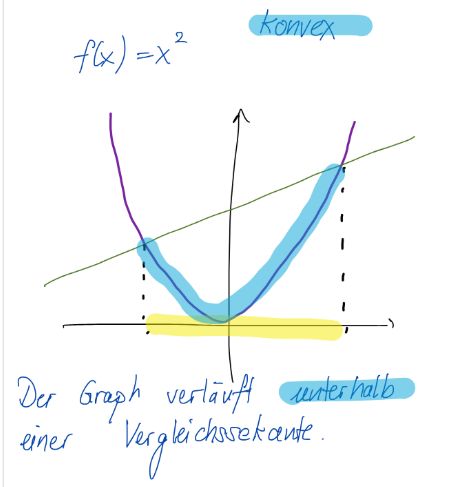
ETH::2._Semester::Analysis::4._Funktionen::2._Properties
Der Graph einer Funktion heißt linksgekrümmt (Konvex) falls der Graph eine Linkskurve vollführt / der graph unterhalb der Sekante ist.
Back
ETH::2._Semester::Analysis::4._Funktionen::2._Properties
Der Graph einer Funktion heißt linksgekrümmt (Konvex) falls der Graph eine Linkskurve vollführt / der graph unterhalb der Sekante ist.
Field-by-field Comparison
| Field |
Before |
After |
| Text |
|
<div>Der Graph einer Funktion heißt {{c2::linksgekrümmt (<b>Konvex</b>)}} falls der Graph {{c1::eine Linkskurve vollführt / der graph unterhalb der Sekante ist}}.</div> |
| Extra |
|
<img src="paste-28ea56b2fdd62b76344f74620876652372b2a8f4.jpg"> |
Tags:
ETH::2._Semester::Analysis::4._Funktionen::2._Properties
Note 26: ETH::2. Semester::PProg
Deck: ETH::2. Semester::PProg
Note Type: Horvath Cloze
GUID: m7?!UWmaST
modified
Before
Front
ETH::2._Semester::PProg::Terminology
Throughput is an evaluation metric for pipelines that measures the amount of workthat can be done by a pipeline in a given period of time.
Back
ETH::2._Semester::PProg::Terminology
Throughput is an evaluation metric for pipelines that measures the amount of workthat can be done by a pipeline in a given period of time.
e.g. CPU instructions
After
Front
ETH::2._Semester::PProg::Terminology
Throughput is an evaluation metric for pipelines that measures the amount of work that can be done by a pipeline in a given period of time.
Back
ETH::2._Semester::PProg::Terminology
Throughput is an evaluation metric for pipelines that measures the amount of work that can be done by a pipeline in a given period of time.
e.g. CPU instructions
Field-by-field Comparison
| Field |
Before |
After |
| Text |
{{c1::Throughput}} is an evaluation metric for pipelines that measures {{c2::the amount of work}}that can be done by a pipeline in a {{c3::given period of time}}. |
{{c1::Throughput}} is an evaluation metric for pipelines that measures {{c2::the amount of work that can be done by a pipeline in a given period of time}}. |
Tags:
ETH::2._Semester::PProg::Terminology