Differences between Subarray vs. Subsequence vs. Subset:
subarray: continous partition of the original
subsequence: non-continous partition
subset any subset (order does not matter)
Back
ETH::1._Semester::A&D::06._Dynamic_Programming
Differences between Subarray vs. Subsequence vs. Subset:
subarray: continous partition of the original
subsequence: non-continous partition
subset any subset (order does not matter)
After
Front
ETH::1._Semester::A&D::06._Dynamic_Programming
Differences between Subarray vs. Subsequence vs. Subset:
Subarray: continous partition of the original
Subsequence: non-continous partition
Subset: any subset (order does not matter)
Back
ETH::1._Semester::A&D::06._Dynamic_Programming
Differences between Subarray vs. Subsequence vs. Subset:
Subarray: continous partition of the original
Subsequence: non-continous partition
Subset: any subset (order does not matter)
Field-by-field Comparison
Field
Before
After
Text
Differences between Subarray vs. Subsequence vs. Subset:<br><ul><li><b>subarray</b>: {{c1:: continous partition of the original}}</li><li><b>subsequence</b>: {{c2:: non-continous partition}}</li><li><b>subset</b> {{c3:: any subset (order does not matter)}}</li></ul>
Differences between Subarray vs. Subsequence vs. Subset:<br><ul><li><b>Subarray</b>: {{c1:: continous partition of the original}}</li><li><b>Subsequence</b>: {{c2:: non-continous partition}}</li><li><b>Subset:</b> {{c3:: any subset (order does not matter)}}</li></ul>
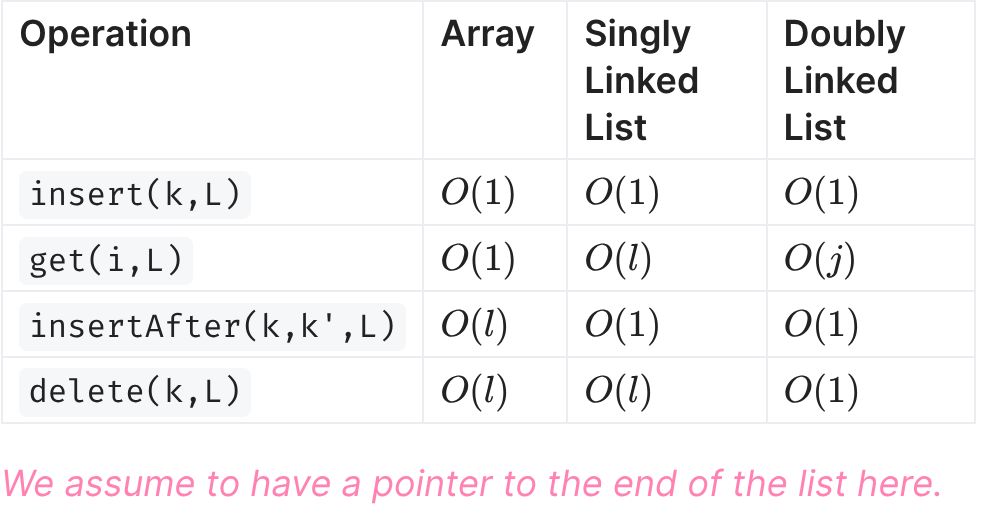
In a singly and doubly linked list, the operation:
Insert is \(\Theta(1)\) as we know the memory address of the final element in the list and just have to set the null pointer to the new keys address. Without this pointer it's \(\Theta(l)\).
Get is \(\Theta(i)\) very slow as we need to traverse the entire list up to i
insertAfter is \(O(1)\) if we get the memory address of the element to insert after.
delete is: SLL: {{c4::\(\Theta(l)\) as we need to find the previous element and change it's pointer}.} DLL: \(O(1)\) we know the address of the previous element and then just edit it's pointer.
In a singly and doubly linked list, the operation:
Insert is \(\Theta(1)\) as we know the memory address of the final element in the list and just have to set the null pointer to the new keys address. Without this pointer it's \(\Theta(l)\).
Get is \(\Theta(i)\) very slow as we need to traverse the entire list up to i
insertAfter is \(O(1)\) if we get the memory address of the element to insert after.
delete is: SLL: {{c4::\(\Theta(l)\) as we need to find the previous element and change it's pointer}.} DLL: \(O(1)\) we know the address of the previous element and then just edit it's pointer.
In a singly and doubly linked list, the operation:
Insert is \(\Theta(1)\) as we know the memory address of the final element in the list and just have to set the null pointer to the new keys address. Without this pointer it's \(\Theta(l)\).
Get is \(\Theta(i)\) very slow as we need to traverse the entire list up to i
insertAfter is \(O(1)\) if we get the memory address of the element to insert after.
delete is: SLL: \(\Theta(l)\) as we need to find the previous element and change it's pointer. DLL: \(O(1)\) we know the address of the previous element and then just edit it's pointer.
In a singly and doubly linked list, the operation:
Insert is \(\Theta(1)\) as we know the memory address of the final element in the list and just have to set the null pointer to the new keys address. Without this pointer it's \(\Theta(l)\).
Get is \(\Theta(i)\) very slow as we need to traverse the entire list up to i
insertAfter is \(O(1)\) if we get the memory address of the element to insert after.
delete is: SLL: \(\Theta(l)\) as we need to find the previous element and change it's pointer. DLL: \(O(1)\) we know the address of the previous element and then just edit it's pointer.
Field-by-field Comparison
Field
Before
After
Text
In a <b>singly</b> and <b>doubly linked list</b>, the operation:<br><ul><li><b>Insert</b> is {{c1::\(\Theta(1)\) as we know the memory address of the final element in the list and just have to set the null pointer to the new keys address. Without this pointer it's \(\Theta(l)\). }}<br></li><li><b>Get</b> is {{c2::\(\Theta(i)\) very slow as we need to traverse the entire list up to <b>i</b>}}<br></li><li><b>insertAfter</b> is {{c3:: \(O(1)\) if we get the memory address of the element to insert after.}}<br></li><li><b>delete</b> is:<br> SLL: {{c4::\(\Theta(l)\) as we need to find the previous element and change it's pointer}.}<br> DLL: {{c5:: \(O(1)\) we know the address of the previous element and then just edit it's pointer.}}</li></ul>
In a <b>singly</b> and <b>doubly linked list</b>, the operation:<br><ul><li><b>Insert</b> is {{c1::\(\Theta(1)\) as we know the memory address of the final element in the list and just have to set the null pointer to the new keys address. Without this pointer it's \(\Theta(l)\). }}<br></li><li><b>Get</b> is {{c2::\(\Theta(i)\) very slow as we need to traverse the entire list up to <b>i</b>}}<br></li><li><b>insertAfter</b> is {{c3:: \(O(1)\) if we get the memory address of the element to insert after.}}<br></li><li><b>delete</b> is:<br> SLL: {{c4::\(\Theta(l)\) as we need to find the previous element and change it's pointer.}}<br> DLL: {{c5:: \(O(1)\) we know the address of the previous element and then just edit it's pointer.}}</li></ul>
Steps of giving a DP solution:<br><ol><li>{{c1::Define the DP table (dimensions, index, range; meaning of entry): ex: <b>DP[1..n+1][1..k+1]</b>}}</li><li>{{c2::Computation of Entry (Base Case, recursive formula, pay attention to bounds!)}}</li><li>{{c3::Calculation Order (what depends on what entries, what variable incremented first)}}</li><li>{{c4::Extract Solution (How to get final solution out)}}</li><li>{{c5::Running time proof}}</li></ol>
Steps of giving a DP solution:<br><ol><li>{{c1::Define the DP table (dimensions, index, range; meaning of entry): ex: <b>DP[1..n+1][1..k+1]</b>}}</li><li>{{c2::Computation of entries (Base case, recursive formula, pay attention to bounds!)}}</li><li>{{c3::Order of calculation (what depends on what entries, what variable incremented first)}}</li><li>{{c4::Extracting the solution}}</li><li>{{c5::Runtime}}</li></ol>
The term \(B - b_i\) can become negative. Instead of accessing an invalid index, return "false" (the neutral element for OR), since you can't achieve a negative sum.
Field-by-field Comparison
Field
Before
After
Text
When writing the recursion, make sure that if the index {{c1:: goes out of bound, you specify the "neutral"}}.
When writing a recursion which accesses an index that could go out of bounds, make sure to {{c1::return a neutral value instead of crashing}}.
Extra
For subset sum, we take \(DP[i-1][B - b_i]\), where if we don't check \(B - b_i\) might go negative and thus oob.
Example: Subset Sum<br><br>Recursion: \(DP[i][B] = DP[i-1][B] \lor DP[i-1][B - b_i]\)<br><br>The term \(B - b_i\) can become negative. Instead of accessing an invalid index, return "false" (the neutral element for OR), since you can't achieve a negative sum.
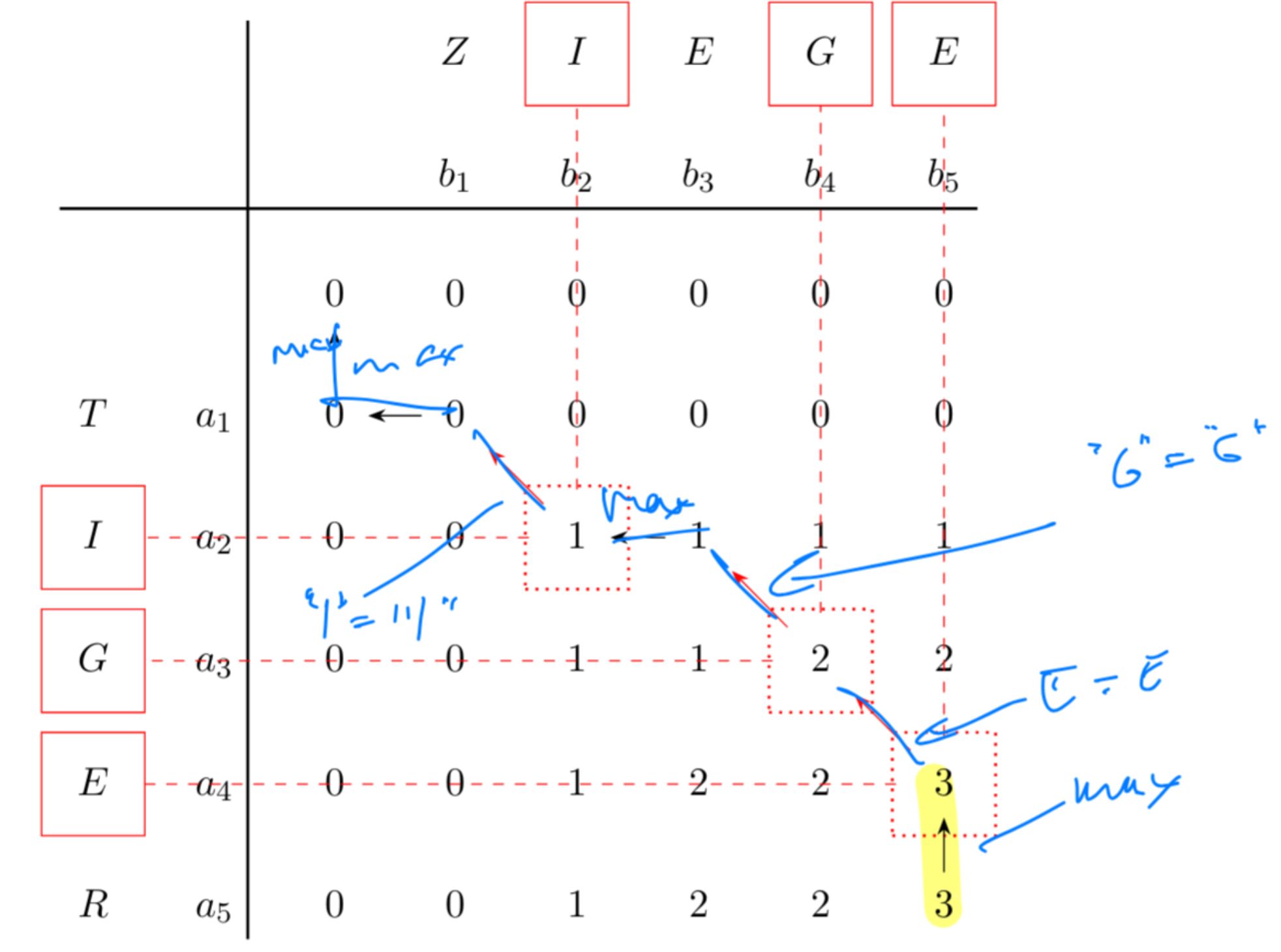
Backtracking can find the solution of the problem from the DP table. From the recursion and it's behaviour we find the "path"
After
Front
ETH::1._Semester::A&D::06._Dynamic_Programming
What is "backtracking" in DP problems?
Back
ETH::1._Semester::A&D::06._Dynamic_Programming
What is "backtracking" in DP problems?
Once the DP table is filled, backtracking reconstructs the actual solution (not just the optimal value) by tracing which choices led to each cell.
Field-by-field Comparison
Field
Before
After
Front
Backtracking in DP Problems
What is "backtracking" in DP problems?
Back
Backtracking can find the solution of the problem from the DP table. From the recursion and it's behaviour we find the "path"<br><br><img src="paste-c186a33203c3cb874cfeb7870ee1a4c5d52bf205.jpg">
Once the DP table is filled, backtracking reconstructs the actual solution (not just the optimal value) by tracing which choices led to each cell.<br><br><img src="paste-c186a33203c3cb874cfeb7870ee1a4c5d52bf205.jpg">
set the inner loop variable to be the array's inner variable:
for j in ...: for i in ...: DP[j][i]
Otherwise we have to jump DP[i].length elements each time we want to access the next element
After
Front
ETH::1._Semester::A&D::06._Dynamic_Programming
How to speed up array access for a DP-array
Back
ETH::1._Semester::A&D::06._Dynamic_Programming
How to speed up array access for a DP-array
Row-Major vs. Column Major Access:
Set the inner loop variable to be the array's inner variable:
for j in ...: for i in ...: DP[j][i]
Otherwise we have to jump DP[i].length elements each time we want to access the next element.
Field-by-field Comparison
Field
Before
After
Front
how to speed up array access to DP-Array
How to speed up array access for a DP-array
Back
<b>Row-Major</b> vs. <b>Column Major</b> Access:<br><br>set the inner loop variable to be the array's inner variable:<br><br>for j in ...:<br> for i in ...:<br> DP[j][i]<br><br>Otherwise we have to jump DP[i].length elements each time we want to access the next element
<b>Row-Major</b> vs. <b>Column Major</b> Access:<br><br>Set the inner loop variable to be the array's inner variable:<br><br>for j in ...:<br> for i in ...:<br> DP[j][i]<br><br>Otherwise we have to jump DP[i].length elements each time we want to access the next element.
Uncountability Proof by Complement (with example \([0,1] \setminus \mathbb{Q}\):
Find \(B\) uncountable such that \(A \subseteq B\).
Show that \(B \backslash A\) countable which proves that \(A\) uncountable.
You have to prove this implication in the exam:
Assume \(A\) is countable towards contradiction.
We have shown that \(B \ \backslash \ A\) is countable.
Thus \(A \cup (B \ \backslash \ A)\) also countable (Theorem 3.22: Union of countable is countable).
But \(A \cup (B \ \backslash \ A) = B\) which is uncountable - contradiction!
Verwende \(\mathbb{R}\) oder \([0,1]\) statt \({0, 1}^\infty\) falls einfacher.
Beispiel mit \([0,1] \setminus \mathbb{Q}\):
We know \([0,1]\) is uncountable.
By definition \([0, 1] \setminus \mathbb{Q} \subseteq [0,1]\) and \([0,1] \setminus ([0,1] \setminus \mathbb{Q})\) which is equal to \(\mathbb{Q} \cap [0,1]\). Thus \(\mathbb{Q} \cap [0,1] \subseteq \mathbb{Q}\) and by Lemma 3.15 \(\mathbb{Q} \cap [0,1] \preceq \mathbb{Q}\) (subset is dominated).
Uncountability Proof by Complement (with example \([0,1] \setminus \mathbb{Q}\)):
Find \(B\) uncountable such that \(A \subseteq B\).
Show that \(B \backslash A\) countable which proves that \(A\) uncountable.
You have to prove this implication in the exam:
Assume \(A\) is countable towards contradiction.
We have shown that \(B \ \backslash \ A\) is countable.
Thus \(A \cup (B \ \backslash \ A)\) also countable (Theorem 3.22: Union of countable is countable).
But \(A \cup (B \ \backslash \ A) = B\) which is uncountable - contradiction!
Verwende \(\mathbb{R}\) oder \([0,1]\) statt \({0, 1}^\infty\) falls einfacher.
Beispiel mit \([0,1] \setminus \mathbb{Q}\):
We know \([0,1]\) is uncountable.
By definition \([0, 1] \setminus \mathbb{Q} \subseteq [0,1]\) and \([0,1] \setminus ([0,1] \setminus \mathbb{Q})\) which is equal to \(\mathbb{Q} \cap [0,1]\). Thus \(\mathbb{Q} \cap [0,1] \subseteq \mathbb{Q}\) and by Lemma 3.15 \(\mathbb{Q} \cap [0,1] \preceq \mathbb{Q}\) (subset is dominated).
Which elements generate \(\mathbb{Z}_n\)? Also proof
\(\mathbb{Z}_n\) is generated by all \(a \in \mathbb{Z}_n\) for which \(\gcd(n, a) = 1\) (all elements coprime to \(n\)).
Proof idea:
- If \(\mathbb{Z}_n = \langle a \rangle\), then \(1 \in \langle a \rangle\)
- This means \(au \equiv_n 1\) for some \(u\)
- By Bézout's identity, this implies \(\gcd(a, n) = 1\) (since \(\gcd\) must divide both \(au-qn\) and 1).
Which elements generate \(\mathbb{Z}_n\)? How can this be proven?
\(\mathbb{Z}_n\) is generated by all \(a \in \mathbb{Z}_n\) for which \(\gcd(n, a) = 1\) (all elements coprime to \(n\)).
Proof idea:
- If \(\mathbb{Z}_n = \langle a \rangle\), then \(1 \in \langle a \rangle\)
- This means \(au \equiv_n 1\) for some \(u\)
- By Bézout's identity, this implies \(\gcd(a, n) = 1\) (since \(\gcd\) must divide both \(au-qn\) and 1).
Field-by-field Comparison
Field
Before
After
Front
<p>Which elements generate \(\mathbb{Z}_n\)? Also proof</p>
<p>Which elements generate \(\mathbb{Z}_n\)? How can this be proven?</p>
What are the three ways to represent a relation on finite sets?
Set notation (subset of \(A \times B\))
Boolean matrix (1 if \((a,b) \in \rho\), 0 otherwise)
Directed graph (nodes are elements, edges are relations)
Field-by-field Comparison
Field
Before
After
Text
What are the three ways to represent a relation on finite sets?<br><br>1. {{c1:: <strong>Set notation</strong> (subset of \(A \times B\))}}<br>2. {{c2:: <strong>Boolean matrix</strong> (1 if \((a,b) \in \rho\), 0 otherwise)}}<br>3. {{c3:: <strong>Directed graph</strong> (nodes are elements, edges are relations)}}
What are the three ways to represent a relation on finite sets?<br><ol><li>{{c1:: <strong>Set notation</strong> (subset of \(A \times B\))}}</li><li>{{c2:: <strong>Boolean matrix</strong> (1 if \((a,b) \in \rho\), 0 otherwise)}}</li><li>{{c3:: <strong>Directed graph</strong> (nodes are elements, edges are relations)}}</li></ol>
The Diffie-Hellman Key-Agreement selects two public values:
a large prime \(p\)
a basis \(g\), which is then exponentiated
Field-by-field Comparison
Field
Before
After
Text
The Diffie-Hellman Key-Agreement selects two public values:<br><ol><li>{{c1:: a large prime \(p\)}}</li><li>{{c2:: basis \(g\) which is then exponentiated}}</li></ol>
The Diffie-Hellman Key-Agreement selects two public values:<br><ol><li>{{c1:: a large prime \(p\)}}</li><li>{{c2:: a basis \(g\), which is then exponentiated}}</li></ol>
What is the number of subgroups of \(\mathbb{Z}_n\)?
it is the number of divisors of \(n\) (as the order of each subgroup divides the group order (which is n here) by Lagrange). if \(n\) is written \(n = p_1^{e_1} \times p_2^{e_2} \times ... \times p_k^{e_k}\) then it is \(\prod_{i=1}^k (e_i+1)\)
What is the number of subgroups of \(\mathbb{Z}_n\)?
The number of divisors of \(n\) (as the order of each subgroup divides the group order (which is n here) by Lagrange).
If \(n\) is written \(n = p_1^{e_1} \times p_2^{e_2} \times ... \times p_k^{e_k}\) then it is \(\prod_{i=1}^k (e_i+1)\)
Field-by-field Comparison
Field
Before
After
Back
it is the number of divisors of \(n\) (as the order of each subgroup divides the group order (which is n here) by Lagrange). <br>if \(n\) is written \(n = p_1^{e_1} \times p_2^{e_2} \times ... \times p_k^{e_k}\) then it is \(\prod_{i=1}^k (e_i+1)\)
The number of divisors of \(n\) (as the order of each subgroup divides the group order (which is n here) by Lagrange). <br><br>If \(n\) is written \(n = p_1^{e_1} \times p_2^{e_2} \times ... \times p_k^{e_k}\) then it is \(\prod_{i=1}^k (e_i+1)\)
Funktion verifizieren: Zeige dass \(f\) well-defined und total ist, und \(f(b) \in A\) für alle \(b\).
Injektivität beweisen: Zeige \(f(b) = f(b’) \ \implies b = b’\) oder direkt \(b \not = b’ \ \implies \ f(b) \not = f(b’)\).
Schluss: We now know \(\{0, 1\}^\infty \preceq A\) as there's an injection. Annahme \(A \preceq \mathbb{N} \implies \{0, 1\}^\infty \preceq \mathbb{N}\) via transitivity -> Contradiction. Thus \(A\) is uncountable: \(\lnot (A \preceq\mathbb{N})\).
Funktion verifizieren: Zeige dass \(f\) well-defined und total ist, und \(f(b) \in A\) für alle \(b\).
Injektivität beweisen: Zeige \(f(b) = f(b’) \ \implies b = b’\) oder direkt \(b \not = b’ \ \implies \ f(b) \not = f(b’)\).
Schluss: We now know \(\{0, 1\}^\infty \preceq A\) as there's an injection. Annahme \(A \preceq \mathbb{N} \implies \{0, 1\}^\infty \preceq \mathbb{N}\) via transitivity -> Contradiction. Thus \(A\) is uncountable: \(\lnot (A \preceq\mathbb{N})\).
Field-by-field Comparison
Field
Before
After
Back
<ul>
<li><em>Injektion finden</em>: Konstruiere \(f : {0, 1}^\infty \rightarrow A$, sodass $b \not = b’ \ \implies f(b) \not = f(b’)\)</li>
<li><em>Funktion verifizieren</em>: Zeige dass \(f\) <em>well-defined</em> und <em>total</em> ist, und \(f(b) \in A\) für alle \(b\).</li>
<li><em>Injektivität beweisen</em>: Zeige \(f(b) = f(b’) \ \implies b = b’\) oder direkt \(b \not = b’ \ \implies \ f(b) \not = f(b’)\).</li>
<li><em>Schluss</em>: We now know \(\{0, 1\}^\infty \preceq A\) as there's an injection.<br>Annahme \(A \preceq \mathbb{N} \implies \{0, 1\}^\infty \preceq \mathbb{N}\) via transitivity -> Contradiction. Thus \(A\) is uncountable: \(\lnot (A \preceq\mathbb{N})\).</li></ul>
<ul>
<li><em>Injektion finden</em>: Konstruiere \(f : {0, 1}^\infty \rightarrow A\), sodass \(b \not = b’ \ \implies f(b) \not = f(b’)\).</li>
<li><em>Funktion verifizieren</em>: Zeige dass \(f\) <em>well-defined</em> und <em>total</em> ist, und \(f(b) \in A\) für alle \(b\).</li>
<li><em>Injektivität beweisen</em>: Zeige \(f(b) = f(b’) \ \implies b = b’\) oder direkt \(b \not = b’ \ \implies \ f(b) \not = f(b’)\).</li>
<li><em>Schluss</em>: We now know \(\{0, 1\}^\infty \preceq A\) as there's an injection.<br>Annahme \(A \preceq \mathbb{N} \implies \{0, 1\}^\infty \preceq \mathbb{N}\) via transitivity -> Contradiction. Thus \(A\) is uncountable: \(\lnot (A \preceq\mathbb{N})\).</li></ul>
What is the number of generators of \(\mathbb{Z}_n^*\)?
1. verify that \(\mathbb{Z}_n^*\)is cyclic (iff n = 2, 4, \(p^e\), \(2p^e\), with \(e \ge 1\) and \(p\) is an odd prime) 2. if \(\mathbb{Z}_n^*\) is cyclic then it is isomorphic to \(\mathbb{Z}_{\varphi(n)}^+\) (by lemma) 3. the number of generators of \(\mathbb{Z}_{\varphi(n)}^+\) is \(\varphi(\varphi(n))\) as it is the number of coprime elements of the group
What is the number of generators of \(\mathbb{Z}_n^*\)?
1. Verify that \(\mathbb{Z}_n^*\)is cyclic (iff n = 2, 4, \(p^e\), \(2p^e\), with \(e \ge 1\) and \(p\) is an odd prime) 2. If \(\mathbb{Z}_n^*\) is cyclic then it is isomorphic to \(\mathbb{Z}_{\varphi(n)}^+\) (by lemma) 3. The number of generators of \(\mathbb{Z}_{\varphi(n)}^+\) is \(\varphi(\varphi(n))\) as it is the number of coprime elements of the group.
Field-by-field Comparison
Field
Before
After
Back
1. verify that \(\mathbb{Z}_n^*\)is cyclic (iff n = 2, 4, \(p^e\), \(2p^e\), with \(e \ge 1\) and \(p\) is an odd prime)<br>2. if \(\mathbb{Z}_n^*\) is cyclic then it is isomorphic to \(\mathbb{Z}_{\varphi(n)}^+\) (by lemma) <br>3. the number of generators of \(\mathbb{Z}_{\varphi(n)}^+\) is \(\varphi(\varphi(n))\) as it is the number of coprime elements of the group
1. Verify that \(\mathbb{Z}_n^*\)is cyclic (iff n = 2, 4, \(p^e\), \(2p^e\), with \(e \ge 1\) and \(p\) is an odd prime)<br>2. If \(\mathbb{Z}_n^*\) is cyclic then it is isomorphic to \(\mathbb{Z}_{\varphi(n)}^+\) (by lemma) <br>3. The number of generators of \(\mathbb{Z}_{\varphi(n)}^+\) is \(\varphi(\varphi(n))\) as it is the number of coprime elements of the group.
For DHKE, both Alice and Bob choose \(x_A, x_B\) (their private keys) at random.
They then compute {{c2:: \(y_A := R_p(g^{x_A})\) and \(y_B\) analogously, which are their public keys}} which is sent over the network to their partner.
The other {{c3:: then exponentiates by their private key to get the shared key \(k_{AB} \equiv_p y_B^{x_A} \equiv_p g^{x_B \cdot x_A} \equiv_p y_A^{x_B}\)}}.
For DHKE, both Alice and Bob choose \(x_A, x_B\) (their private keys) at random.
They then compute {{c2:: \(y_A := R_p(g^{x_A})\) and \(y_B\) analogously, which are their public keys}} which is sent over the network to their partner.
The other {{c3:: then exponentiates by their private key to get the shared key \(k_{AB} \equiv_p y_B^{x_A} \equiv_p g^{x_B \cdot x_A} \equiv_p y_A^{x_B}\)}}.
For Diffie-Hellman key agreement, both Alice and Bob choose \(x_A, x_B\) (their private keys) at random.
They then compute {{c2:: \(y_A := R_p(g^{x_A})\) and \(y_B\) analogously, which are their public keys}} which is sent over the network to their partner.
The other {{c3:: then exponentiates by their private key to get the shared key \(k_{AB} \equiv_p y_B^{x_A} \equiv_p g^{x_B \cdot x_A} \equiv_p y_A^{x_B}\)}}.
For Diffie-Hellman key agreement, both Alice and Bob choose \(x_A, x_B\) (their private keys) at random.
They then compute {{c2:: \(y_A := R_p(g^{x_A})\) and \(y_B\) analogously, which are their public keys}} which is sent over the network to their partner.
The other {{c3:: then exponentiates by their private key to get the shared key \(k_{AB} \equiv_p y_B^{x_A} \equiv_p g^{x_B \cdot x_A} \equiv_p y_A^{x_B}\)}}.
Field-by-field Comparison
Field
Before
After
Text
For DHKE, both Alice and Bob {{c1:: choose \(x_A, x_B\) (their private keys) at random}}.<br><br>They then compute {{c2:: \(y_A := R_p(g^{x_A})\) and \(y_B\) analogously, which are their public keys}} which is {{c2:: sent over the network to their partner}}.<br><br>The other {{c3:: then exponentiates by their private key to get the shared key \(k_{AB} \equiv_p y_B^{x_A} \equiv_p g^{x_B \cdot x_A} \equiv_p y_A^{x_B}\)}}.
For Diffie-Hellman key agreement, both Alice and Bob {{c1:: choose \(x_A, x_B\) (their private keys) at random}}.<br><br>They then compute {{c2:: \(y_A := R_p(g^{x_A})\) and \(y_B\) analogously, which are their public keys}} which is {{c2:: sent over the network to their partner}}.<br><br>The other {{c3:: then exponentiates by their private key to get the shared key \(k_{AB} \equiv_p y_B^{x_A} \equiv_p g^{x_B \cdot x_A} \equiv_p y_A^{x_B}\)}}.
The columns of \(A\) are independent if and only if \(x = 0\) is the only vector for which \(Ax = 0\).
Field-by-field Comparison
Field
Before
After
Text
The columns of \(A\) are independent if and only if {{c1::\(x = 0\) is the only vector for which \(Ax = 0\)}} (Linear combination view).
The columns of \(A\) are independent if and only if {{c1::\(x = 0\) is the only vector for which \(Ax = 0\)::Linear combination view}}.
The independent columns of \(A\) {{c1::span the columns space \(\textbf{C}(A)\) of \(A\)}}. Lemma 2.11
Proven by induction, adding elements that are a linear combination of other ones doesn't change span, thus we can iteratively remove the dependent columns.
The independent columns of \(A\), {{c1::span the column space \(\textbf{C}(A)\) of \(A\)}}.
Proven by induction, adding elements that are a linear combination of other ones doesn't change span, thus we can iteratively remove the dependent columns.
Lemma 2.11
Field-by-field Comparison
Field
Before
After
Text
The {{c2::independent}} columns of \(A\) {{c1::span the columns space \(\textbf{C}(A)\) of \(A\)}}. Lemma 2.11
The {{c2::independent}} columns of \(A\), {{c1::span the column space \(\textbf{C}(A)\) of \(A\)}}.
Extra
Proven by induction, adding elements that are a linear combination of other ones doesn't change span, thus we can iteratively remove the dependent columns.
Proven by induction, adding elements that are a linear combination of other ones doesn't change span, thus we can iteratively remove the dependent columns.<br><br>Lemma 2.11