Anki Deck Changes

Commit: 85a7491c - Add explanation

Author: Jonas B <65017752+Scr1pting@users.noreply.github.com>

Date: 2026-01-13T21:23:23+01:00

Changes: 8 note(s) changed (0 added, 8 modified, 0 deleted)

ℹ️ Cosmetic Changes Hidden: 2 note(s) had formatting-only changes and are not shown below • 2 HTML formatting changes

Note 1: ETH::DiskMat

Deck: ETH::DiskMat
Note Type: Horvath Classic
GUID: A+Li^bwkLL
modified

Before

Front

ETH::1._Semester::DiskMat::3._Sets,_Relations,_and_Functions::5._Partial_Order_Relations::5._Meet,_Join,_and_Lattices
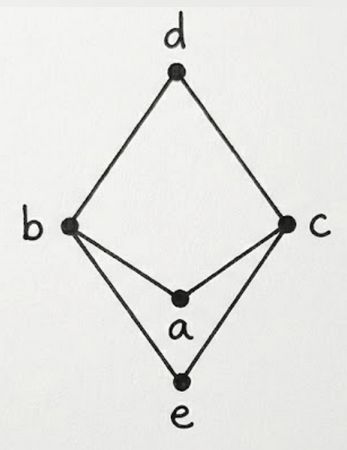
Is this a lattice?


Back

ETH::1._Semester::DiskMat::3._Sets,_Relations,_and_Functions::5._Partial_Order_Relations::5._Meet,_Join,_and_Lattices
Is this a lattice?


No, as \(\{b, e\}\) do not have a greatest lower bound. Both \(a\) and \(e\) would fit, but there isn't a greatest one.

After

Front

ETH::1._Semester::DiskMat::3._Sets,_Relations,_and_Functions::5._Partial_Order_Relations::5._Meet,_Join,_and_Lattices
Is this a lattice?


Back

ETH::1._Semester::DiskMat::3._Sets,_Relations,_and_Functions::5._Partial_Order_Relations::5._Meet,_Join,_and_Lattices
Is this a lattice?


No, as \(\{a, e\}\) does not have a greatest lower bound. Both \(a\) and \(e\) would fit, but there isn't a greatest one.
Field-by-field Comparison
Field Before After
Back No, as&nbsp;\(\{b, e\}\)&nbsp;do not have a greatest lower bound. Both&nbsp;\(a\)&nbsp;and&nbsp;\(e\)&nbsp;would fit, but there isn't a&nbsp;<b>greatest</b>&nbsp;one. No, as&nbsp;\(\{a, e\}\)&nbsp;does not have a greatest lower bound. Both&nbsp;\(a\)&nbsp;and&nbsp;\(e\)&nbsp;would fit, but there isn't a&nbsp;<b>greatest</b>&nbsp;one.
Tags: ETH::1._Semester::DiskMat::3._Sets,_Relations,_and_Functions::5._Partial_Order_Relations::5._Meet,_Join,_and_Lattices

Note 2: ETH::DiskMat

Deck: ETH::DiskMat
Note Type: Horvath Classic
GUID: Cug/az1F}r
modified

Before

Front

ETH::1._Semester::DiskMat::3._Sets,_Relations,_and_Functions::7._Countable_and_Uncountable_Sets::4._Uncountability_of_{0,_1}^∞
Uncountability Proof by Complement (with example \([0,1] \setminus \mathbb{Q}\)):

Back

ETH::1._Semester::DiskMat::3._Sets,_Relations,_and_Functions::7._Countable_and_Uncountable_Sets::4._Uncountability_of_{0,_1}^∞
Uncountability Proof by Complement (with example \([0,1] \setminus \mathbb{Q}\)):

  • Find \(B\) uncountable such that \(A \subseteq B\).
  • Show that \(B \backslash A\) countable which proves that \(A\) uncountable.
  • You have to prove this implication in the exam:
    • Assume \(A\) is countable towards contradiction.
    • We have shown that \(B \ \backslash \ A\) is countable.
    • Thus \(A \cup (B \ \backslash \ A)\) also countable (Theorem 3.22: Union of countable is countable).
    • But \(A \cup (B \ \backslash \ A) = B\) which is uncountable - contradiction!

Verwende \(\mathbb{R}\) oder \([0,1]\) statt \({0, 1}^\infty\) falls einfacher.

Beispiel mit \([0,1] \setminus \mathbb{Q}\):
  • We know \([0,1]\) is uncountable.
  • By definition \([0, 1] \setminus \mathbb{Q} \subseteq [0,1]\) and \([0,1] \setminus ([0,1] \setminus \mathbb{Q})\) which is equal to \(\mathbb{Q} \cap [0,1]\). Thus \(\mathbb{Q} \cap [0,1] \subseteq \mathbb{Q}\) and by Lemma 3.15 \(\mathbb{Q} \cap [0,1] \preceq \mathbb{Q}\) (subset is dominated). 
  • Hence \(\mathbb{Q} \cap [0,1] \preceq \mathbb{N}\) (by transitivity). 
  • Therefore \(\mathbb{Q} \cap [0,1] = [0,1] \setminus ([0,1] \setminus \mathbb{Q})\) countable and thus \([0,1] \setminus \mathbb{Q}\) uncountable (by complement trick).

After

Front

ETH::1._Semester::DiskMat::3._Sets,_Relations,_and_Functions::7._Countable_and_Uncountable_Sets::4._Uncountability_of_{0,_1}^∞
Uncountability Proof by Complement (with example \([0,1] \setminus \mathbb{Q}\)):

Back

ETH::1._Semester::DiskMat::3._Sets,_Relations,_and_Functions::7._Countable_and_Uncountable_Sets::4._Uncountability_of_{0,_1}^∞
Uncountability Proof by Complement (with example \([0,1] \setminus \mathbb{Q}\)):

  • Find \(B\) uncountable such that \(A \subseteq B\).
  • Show that \(B \backslash A\) countable which proves that \(A\) uncountable.
  • You have to prove this implication in the exam:
    • Assume \(A\) is countable towards contradiction.
    • We have shown that \(B \ \backslash \ A\) is countable.
    • Thus \(A \cup (B \ \backslash \ A)\) also countable (Theorem 3.22: Union of countable is countable).
    • But \(A \cup (B \ \backslash \ A) \supseteq B\), which is uncountable - contradiction!

Verwende \(\mathbb{R}\) oder \([0,1]\) statt \(\{0, 1\}^\infty\) falls einfacher.

Beispiel mit \([0,1] \setminus \mathbb{Q}\):
  • We know \([0,1]\) is uncountable.
  • By definition \([0, 1] \setminus \mathbb{Q} \subseteq [0,1]\) and \([0,1] \setminus ([0,1] \setminus \mathbb{Q})\) which is equal to \(\mathbb{Q} \cap [0,1]\). Thus \(\mathbb{Q} \cap [0,1] \subseteq \mathbb{Q}\) and by Lemma 3.15 \(\mathbb{Q} \cap [0,1] \preceq \mathbb{Q}\) (subset is dominated). 
  • Hence \(\mathbb{Q} \cap [0,1] \preceq \mathbb{N}\) (by transitivity). 
  • Therefore \(\mathbb{Q} \cap [0,1] = [0,1] \setminus ([0,1] \setminus \mathbb{Q})\) countable and thus \([0,1] \setminus \mathbb{Q}\) uncountable (by complement trick).
Field-by-field Comparison
Field Before After
Back <ul> <li>Find \(B\) uncountable such that \(A \subseteq B\).</li> <li>Show that \(B \backslash A\) <b>countable</b> which proves that \(A\) <b>uncountable</b>.</li></ul><ul> <li>You have to <b>prove this implication</b> in the exam:<ul> <li>Assume \(A\) is <b>countable</b> towards contradiction.</li> <li>We have shown that \(B \ \backslash \ A\) is <b>countable</b>.</li> <li>Thus \(A \cup (B \ \backslash \ A)\) also countable (Theorem 3.22: Union of countable is countable).</li> <li>But \(A \cup (B \ \backslash \ A) = B\) which is <b>uncountable</b> - <b>contradiction</b>! </li> </ul> </li></ul> <div><br></div> Verwende \(\mathbb{R}\) oder \([0,1]\) statt \({0, 1}^\infty\) falls einfacher.<br><br>Beispiel mit&nbsp;\([0,1] \setminus \mathbb{Q}\):<br><ul><li>We know&nbsp;\([0,1]\)&nbsp;is uncountable.</li><li>By definition&nbsp;\([0, 1] \setminus \mathbb{Q} \subseteq [0,1]\)&nbsp;and&nbsp;\([0,1] \setminus ([0,1] \setminus \mathbb{Q})\)&nbsp;which is equal to&nbsp;\(\mathbb{Q} \cap [0,1]\). Thus&nbsp;\(\mathbb{Q} \cap [0,1] \subseteq \mathbb{Q}\)&nbsp;and by Lemma 3.15&nbsp;\(\mathbb{Q} \cap [0,1] \preceq \mathbb{Q}\)&nbsp;(subset is dominated).&nbsp;</li><li>Hence&nbsp;\(\mathbb{Q} \cap [0,1] \preceq \mathbb{N}\)&nbsp;(by transitivity).&nbsp;</li><li>Therefore&nbsp;\(\mathbb{Q} \cap [0,1] = [0,1] \setminus ([0,1] \setminus \mathbb{Q})\)&nbsp;countable and thus&nbsp;\([0,1] \setminus \mathbb{Q}\)&nbsp;uncountable (by complement trick).</li></ul> <ul> <li>Find \(B\) uncountable such that \(A \subseteq B\).</li> <li>Show that \(B \backslash A\) <b>countable</b> which proves that \(A\) <b>uncountable</b>.</li></ul><ul> <li>You have to <b>prove this implication</b> in the exam:<ul> <li>Assume \(A\) is <b>countable</b> towards contradiction.</li> <li>We have shown that \(B \ \backslash \ A\) is <b>countable</b>.</li> <li>Thus \(A \cup (B \ \backslash \ A)\) also countable (Theorem 3.22: Union of countable is countable).</li> <li>But \(A \cup (B \ \backslash \ A) \supseteq B\), which is <b>uncountable</b> - <b>contradiction</b>! </li> </ul> </li></ul> <div><br></div> Verwende \(\mathbb{R}\) oder \([0,1]\) statt \(\{0, 1\}^\infty\) falls einfacher.<br><br>Beispiel mit&nbsp;\([0,1] \setminus \mathbb{Q}\):<br><ul><li>We know&nbsp;\([0,1]\)&nbsp;is uncountable.</li><li>By definition&nbsp;\([0, 1] \setminus \mathbb{Q} \subseteq [0,1]\)&nbsp;and&nbsp;\([0,1] \setminus ([0,1] \setminus \mathbb{Q})\)&nbsp;which is equal to&nbsp;\(\mathbb{Q} \cap [0,1]\). Thus&nbsp;\(\mathbb{Q} \cap [0,1] \subseteq \mathbb{Q}\)&nbsp;and by Lemma 3.15&nbsp;\(\mathbb{Q} \cap [0,1] \preceq \mathbb{Q}\)&nbsp;(subset is dominated).&nbsp;</li><li>Hence&nbsp;\(\mathbb{Q} \cap [0,1] \preceq \mathbb{N}\)&nbsp;(by transitivity).&nbsp;</li><li>Therefore&nbsp;\(\mathbb{Q} \cap [0,1] = [0,1] \setminus ([0,1] \setminus \mathbb{Q})\)&nbsp;countable and thus&nbsp;\([0,1] \setminus \mathbb{Q}\)&nbsp;uncountable (by complement trick).</li></ul>
Tags: ETH::1._Semester::DiskMat::3._Sets,_Relations,_and_Functions::7._Countable_and_Uncountable_Sets::4._Uncountability_of_{0,_1}^∞

Note 3: ETH::DiskMat

Deck: ETH::DiskMat
Note Type: Horvath Classic
GUID: Jt5Wm9Nq3R
modified

Before

Front

ETH::1._Semester::DiskMat::6._Logic::3._Elementary_General_Concepts_in_Logic::3._Semantics::Interpretation
Restrictions on the universe \(U\)

Back

ETH::1._Semester::DiskMat::6._Logic::3._Elementary_General_Concepts_in_Logic::3._Semantics::Interpretation
Restrictions on the universe \(U\)

  • cannot be empty
  • not necessarily a set

After

Front

ETH::1._Semester::DiskMat::6._Logic::3._Elementary_General_Concepts_in_Logic::3._Semantics::Interpretation
Restrictions on the universe \(U\)

Back

ETH::1._Semester::DiskMat::6._Logic::3._Elementary_General_Concepts_in_Logic::3._Semantics::Interpretation
Restrictions on the universe \(U\)

  • cannot be empty
  • not necessarily a set (can be the universe of all sets, which is a proper class, for example)
Field-by-field Comparison
Field Before After
Back <ul><li><b>cannot be empty</b></li><li>not necessarily a&nbsp;<i>set</i></li></ul> <ul><li><b>cannot be empty</b></li><li>not necessarily a&nbsp;<i>set&nbsp;</i>(can be the universe of all sets, which is a proper class, for example)</li></ul>
Tags: ETH::1._Semester::DiskMat::6._Logic::3._Elementary_General_Concepts_in_Logic::3._Semantics::Interpretation

Note 4: ETH::DiskMat

Deck: ETH::DiskMat
Note Type: Horvath Cloze
GUID: Yt9Xy7Rn3W
modified

Before

Front

ETH::1._Semester::DiskMat::6._Logic::6._Predicate_Logic_(First-order_Logic)::1._Syntax
A predicate symbol is of the form {{c2::\(P_i^{(k)}\) with \(i, k \in \mathbb{N}\)}}, where \(k\) denotes the number of arguments of the predicate.

Back

ETH::1._Semester::DiskMat::6._Logic::6._Predicate_Logic_(First-order_Logic)::1._Syntax
A predicate symbol is of the form {{c2::\(P_i^{(k)}\) with \(i, k \in \mathbb{N}\)}}, where \(k\) denotes the number of arguments of the predicate.

After

Front

ETH::1._Semester::DiskMat::6._Logic::6._Predicate_Logic_(First-order_Logic)::1._Syntax
A predicate symbol is of the form {{c2::\(P_i^{(k)}\) with \(i, k \in \mathbb{N}\)}}, where \(k\) denotes the number of arguments of the predicate (the arity).

Back

ETH::1._Semester::DiskMat::6._Logic::6._Predicate_Logic_(First-order_Logic)::1._Syntax
A predicate symbol is of the form {{c2::\(P_i^{(k)}\) with \(i, k \in \mathbb{N}\)}}, where \(k\) denotes the number of arguments of the predicate (the arity).
Field-by-field Comparison
Field Before After
Text A {{c1::<i>predicate symbol</i>}} is of the form {{c2::\(P_i^{(k)}\)&nbsp;with&nbsp;\(i, k \in \mathbb{N}\)}}, where {{c2::\(k\)&nbsp;denotes the number of arguments of the predicate}}. A {{c1::<i>predicate symbol</i>}} is of the form {{c2::\(P_i^{(k)}\)&nbsp;with&nbsp;\(i, k \in \mathbb{N}\)}}, where {{c2::\(k\)&nbsp;denotes the number of arguments of the predicate (the arity)}}.
Tags: ETH::1._Semester::DiskMat::6._Logic::6._Predicate_Logic_(First-order_Logic)::1._Syntax

Note 5: ETH::DiskMat

Deck: ETH::DiskMat
Note Type: Horvath Cloze
GUID: rkyD`Rw*Nl
modified

Before

Front

ETH::1._Semester::DiskMat::6._Logic::6._Predicate_Logic_(First-order_Logic)::7._Normal_Forms
We are allowed to swap quantifier order in a formula if:
  • they are of the same type
  • the variables don't appear nested together

Back

ETH::1._Semester::DiskMat::6._Logic::6._Predicate_Logic_(First-order_Logic)::7._Normal_Forms
We are allowed to swap quantifier order in a formula if:
  • they are of the same type
  • the variables don't appear nested together

After

Front

ETH::1._Semester::DiskMat::6._Logic::6._Predicate_Logic_(First-order_Logic)::7._Normal_Forms
We are allowed to swap quantifier order in a formula if:
  • they are of the same type
  • the variables never appear in the same predicate

Back

ETH::1._Semester::DiskMat::6._Logic::6._Predicate_Logic_(First-order_Logic)::7._Normal_Forms
We are allowed to swap quantifier order in a formula if:
  • they are of the same type
  • the variables never appear in the same predicate
Field-by-field Comparison
Field Before After
Text We are allowed to swap quantifier order in a formula if:<br><ul><li>{{c1:: they are of the same type}}</li><li>{{c2:: the variables don't appear nested together}}</li></ul> We are allowed to swap quantifier order in a formula if:<br><ul><li>{{c1:: they are of the same type}}</li><li>{{c2:: the variables never appear in the same predicate}}</li></ul>
Tags: ETH::1._Semester::DiskMat::6._Logic::6._Predicate_Logic_(First-order_Logic)::7._Normal_Forms

Note 6: ETH::DiskMat

Deck: ETH::DiskMat
Note Type: Horvath Cloze
GUID: w99%AgTdDZ
modified

Before

Front

ETH::1._Semester::DiskMat::6._Logic::6._Predicate_Logic_(First-order_Logic)::6._Substitution_of_Bound_Variables
Rectified form:
  • no variable occurs both as a bound and as a free variable
  • all variables appearing after the quantifiers are distinct

Back

ETH::1._Semester::DiskMat::6._Logic::6._Predicate_Logic_(First-order_Logic)::6._Substitution_of_Bound_Variables
Rectified form:
  • no variable occurs both as a bound and as a free variable
  • all variables appearing after the quantifiers are distinct

After

Front

ETH::1._Semester::DiskMat::6._Logic::6._Predicate_Logic_(First-order_Logic)::6._Substitution_of_Bound_Variables
Rectified form:
  • no variable occurs both as a bound and as a free variable
  • all quantifiers use distinct variable names

Back

ETH::1._Semester::DiskMat::6._Logic::6._Predicate_Logic_(First-order_Logic)::6._Substitution_of_Bound_Variables
Rectified form:
  • no variable occurs both as a bound and as a free variable
  • all quantifiers use distinct variable names
Field-by-field Comparison
Field Before After
Text <b>Rectified</b>&nbsp;form:<br><ul><li>{{c1::<b>no</b>&nbsp;variable occurs&nbsp;<b>both as a bound and as a free</b>&nbsp;variable}}</li><li>{{c2::<b>all</b>&nbsp;variables appearing&nbsp;<b>after the quantifiers</b>&nbsp;are distinct}}</li></ul> <b>Rectified</b>&nbsp;form:<br><ul><li>{{c1::<b>no</b>&nbsp;variable occurs&nbsp;<b>both as a bound and as a free</b>&nbsp;variable}}</li><li>{{c2::<b>all</b><b>&nbsp;quantifiers</b>&nbsp;use distinct variable names}}</li></ul>
Tags: ETH::1._Semester::DiskMat::6._Logic::6._Predicate_Logic_(First-order_Logic)::6._Substitution_of_Bound_Variables
↑ Top