How does the number of ZHK's change in Boruvka's for each round?
Note 1: ETH::A&D
Deck: ETH::A&D
Note Type: Horvath Classic
GUID:
modified
Note Type: Horvath Classic
GUID:
Qv/bX3RU0v
Before
Front
Back
How does the number of ZHK's change in Boruvka's for each round?
The number of component halves in each round, thus \(\log |V|\) iterations worst case.
After
Front
How does the number of ZHK's change in Boruvka's for each round?
Back
How does the number of ZHK's change in Boruvka's for each round?
The number of components halves in each round, thus \(\log |V|\) iterations worst case.
Field-by-field Comparison
| Field | Before | After |
|---|---|---|
| Back | The number of component halves in each round, thus \(\log |V|\) iterations worst case. | The number of components halves in each round, thus \(\log |V|\) iterations worst case. |
Note 2: ETH::A&D
Deck: ETH::A&D
Note Type: Algorithms
GUID:
modified
Note Type: Algorithms
GUID:
hL7UB-)y6N
Before
Front
Runtime of Floyd-Warshall?
Back
Runtime of Floyd-Warshall?
\(O(|V|^3)\)
After
Front
Runtime of Floyd-Warshall?
Back
Runtime of Floyd-Warshall?
\(O(|V|^3)\)
Field-by-field Comparison
| Field | Before | After |
|---|---|---|
| Requirements | No negative cycles | No negative cycles. |
| Use Case | All |
All pairs shortest path |
Note 3: ETH::DiskMat
Deck: ETH::DiskMat
Note Type: Horvath Cloze
GUID:
modified
Note Type: Horvath Cloze
GUID:
Dy6Zv8Tp2B
Before
Front
For formulas \(F\) and \(H\), where \(x\) does not occur free in \(H\), we have:
- \((\forall x \, F) \land H\) \( \equiv\) \( \forall x \, (F \land H)\)
- \((\forall x \, F) \lor H \) \(\equiv\) \(\forall x \, (F \lor H)\)
- \((\exists x \, F) \land H \) \(\equiv\) \(\exists x \, (F \land H)\)
- \((\exists x \, F) \lor H\) \(\equiv\) \(\exists x \, (F \lor H)\)
- \((\forall x \, F) \land H\) \( \equiv\) \( \forall x \, (F \land H)\)
- \((\forall x \, F) \lor H \) \(\equiv\) \(\forall x \, (F \lor H)\)
- \((\exists x \, F) \land H \) \(\equiv\) \(\exists x \, (F \land H)\)
- \((\exists x \, F) \lor H\) \(\equiv\) \(\exists x \, (F \lor H)\)
Back
For formulas \(F\) and \(H\), where \(x\) does not occur free in \(H\), we have:
- \((\forall x \, F) \land H\) \( \equiv\) \( \forall x \, (F \land H)\)
- \((\forall x \, F) \lor H \) \(\equiv\) \(\forall x \, (F \lor H)\)
- \((\exists x \, F) \land H \) \(\equiv\) \(\exists x \, (F \land H)\)
- \((\exists x \, F) \lor H\) \(\equiv\) \(\exists x \, (F \lor H)\)
- \((\forall x \, F) \land H\) \( \equiv\) \( \forall x \, (F \land H)\)
- \((\forall x \, F) \lor H \) \(\equiv\) \(\forall x \, (F \lor H)\)
- \((\exists x \, F) \land H \) \(\equiv\) \(\exists x \, (F \land H)\)
- \((\exists x \, F) \lor H\) \(\equiv\) \(\exists x \, (F \lor H)\)
After
Front
For formulas \(F\) and \(H\), where \(x\) does not occur free in \(H\), we have:
- \((\forall x \, F) \land H\) \( \equiv\) \( \forall x \, (F \land H)\)
- \((\forall x \, F) \lor H \) \(\equiv\) \(\forall x \, (F \lor H)\)
- \((\exists x \, F) \land H \) \(\equiv\) \(\exists x \, (F \land H)\)
- \((\exists x \, F) \lor H\) \(\equiv\) \(\exists x \, (F \lor H)\)
Back
For formulas \(F\) and \(H\), where \(x\) does not occur free in \(H\), we have:
- \((\forall x \, F) \land H\) \( \equiv\) \( \forall x \, (F \land H)\)
- \((\forall x \, F) \lor H \) \(\equiv\) \(\forall x \, (F \lor H)\)
- \((\exists x \, F) \land H \) \(\equiv\) \(\exists x \, (F \land H)\)
- \((\exists x \, F) \lor H\) \(\equiv\) \(\exists x \, (F \lor H)\)
Field-by-field Comparison
| Field | Before | After |
|---|---|---|
| Text | For formulas \(F\) and \(H\), where \(x\) <b>does not occur free</b> in \(H\), we have:<br> |
For formulas \(F\) and \(H\), where \(x\) <b>does not occur free</b> in \(H\), we have:<br><ol><li>{{c1::\((\forall x \, F) \land H\)}} \( \equiv\) {{c2::\( \forall x \, (F \land H)\)}}</li><li>{{c3::\((\forall x \, F) \lor H \)}} \(\equiv\) {{c4::\(\forall x \, (F \lor H)\)}}</li><li>{{c5::\((\exists x \, F) \land H \)}} \(\equiv\) {{c6:: \(\exists x \, (F \land H)\)}}</li><li>{{c7::\((\exists x \, F) \lor H\)}} \(\equiv\) {{c8:: \(\exists x \, (F \lor H)\)}}</li></ol> |
Note 4: ETH::DiskMat
Deck: ETH::DiskMat
Note Type: Horvath Cloze
GUID:
modified
Note Type: Horvath Cloze
GUID:
fd?4%T(3|z
Before
Front
A function is injective (or one-to-one) if for \(a \ne b\) we have \(f(a) \ne f(b)\), i.e. no "collisions"
Back
A function is injective (or one-to-one) if for \(a \ne b\) we have \(f(a) \ne f(b)\), i.e. no "collisions"
Example: \(f(x) = x\), counterexample: \(f(x) = x^2, x \in \mathbb{R}\)
After
Front
A function is injective (or one-to-one) if for \(a \ne b\) we have \(f(a) \ne f(b)\), i.e. no "collisions".
Back
A function is injective (or one-to-one) if for \(a \ne b\) we have \(f(a) \ne f(b)\), i.e. no "collisions".
Example: \(f(x) = x\), counterexample: \(f(x) = x^2, x \in \mathbb{R}\)
Field-by-field Comparison
| Field | Before | After |
|---|---|---|
| Text | A function is {{c1::injective (or one-to-one)}} if {{c2::for \(a \ne b\) we have \(f(a) \ne f(b)\), i.e. no "collisions"}} | A function is {{c1::injective (or one-to-one)}} if {{c2::for \(a \ne b\) we have \(f(a) \ne f(b)\), i.e. no "collisions"}}. |
Note 5: ETH::DiskMat
Deck: ETH::DiskMat
Note Type: Horvath Cloze
GUID:
modified
Note Type: Horvath Cloze
GUID:
ujCuoEmotl
Before
Front
If \(p\) is a prime which divides the product \(x_1 x_2 \dots x_n\) of some integers, then \(p\) divides at least one of them: \[p | (x_1 x_2 \dots x_n) \Rightarrow \exists i \ p | x_i\]
Back
If \(p\) is a prime which divides the product \(x_1 x_2 \dots x_n\) of some integers, then \(p\) divides at least one of them: \[p | (x_1 x_2 \dots x_n) \Rightarrow \exists i \ p | x_i\]
After
Front
If \(p\) is a prime which divides the product \(x_1 x_2 \dots x_n\) of some integers, then \(p\) divides at least one of them: \[p | (x_1 x_2 \dots x_n) \Rightarrow \exists i \ p | x_i\]
Back
If \(p\) is a prime which divides the product \(x_1 x_2 \dots x_n\) of some integers, then \(p\) divides at least one of them: \[p | (x_1 x_2 \dots x_n) \Rightarrow \exists i \ p | x_i\]
Field-by-field Comparison
| Field | Before | After |
|---|---|---|
| Text | If \(p\) is a prime which divides the product \(x_1 x_2 \dots x_n\) of some integers, then \(p\) {{c1:: |
If \(p\) is a prime which divides the product \(x_1 x_2 \dots x_n\) of some integers, then \(p\) {{c1::divides at least one of them: \[p | (x_1 x_2 \dots x_n) \Rightarrow \exists i \ p | x_i\]}}<br> |
Note 6: ETH::LinAlg
Deck: ETH::LinAlg
Note Type: Horvath Cloze
GUID:
modified
Note Type: Horvath Cloze
GUID:
CPAR6ayFL2
Before
Front
\(A \in \mathbb{R}^{n \times n}\) needs to {{c1:: have \(n\) eigenvectors that form a basis of \(\mathbb{R}^n\)}} to be diagonalisable.
Back
\(A \in \mathbb{R}^{n \times n}\) needs to {{c1:: have \(n\) eigenvectors that form a basis of \(\mathbb{R}^n\)}} to be diagonalisable.
\[ A = V \Lambda V^{-1} \]where \(\Lambda\) is a *diagonal* matrix with \(\Lambda_{ii} = \lambda_i\) (and \(\Lambda_{ij} = 0\) for all \(i \neq j\)).
After
Front
\(A \in \mathbb{R}^{n \times n}\) needs to {{c1:: have \(n\) eigenvectors that form a basis of \(\mathbb{R}^n\)}} to be diagonalisable.
Back
\(A \in \mathbb{R}^{n \times n}\) needs to {{c1:: have \(n\) eigenvectors that form a basis of \(\mathbb{R}^n\)}} to be diagonalisable.
\[ A = V \Lambda V^{-1} \]where \(\Lambda\) is a diagonal matrix with \(\Lambda_{ii} = \lambda_i\) (and \(\Lambda_{ij} = 0\) for all \(i \neq j\)).
Field-by-field Comparison
| Field | Before | After |
|---|---|---|
| Extra | \[ A = V \Lambda V^{-1} \]where \(\Lambda\) is a |
\[ A = V \Lambda V^{-1} \]where \(\Lambda\) is a <b>diagonal</b> matrix with \(\Lambda_{ii} = \lambda_i\) (and \(\Lambda_{ij} = 0\) for all \(i \neq j\)). |
Note 7: ETH::LinAlg
Deck: ETH::LinAlg
Note Type: Horvath Cloze
GUID:
modified
Note Type: Horvath Cloze
GUID:
EVK,*aoX3m
Before
Front
The eigenvectors of an eigenvalue are those and exactly those vectors \(v \neq 0\) in \(v \in N(A - \lambda I)\) .
Back
The eigenvectors of an eigenvalue are those and exactly those vectors \(v \neq 0\) in \(v \in N(A - \lambda I)\) .
After
Front
The eigenvectors of an eigenvalue are those and exactly those vectors \(v \neq 0\) in \(v \in N(A - \lambda I)\).
Back
The eigenvectors of an eigenvalue are those and exactly those vectors \(v \neq 0\) in \(v \in N(A - \lambda I)\).
Field-by-field Comparison
| Field | Before | After |
|---|---|---|
| Text | The <b>eigenvectors</b> of an eigenvalue are <b>those and exactly those</b> vectors {{c1::\(v \neq 0\)}} in {{c1::\(v \in N(A - \lambda I)\) |
The <b>eigenvectors</b> of an eigenvalue are <b>those and exactly those</b> vectors {{c1::\(v \neq 0\)}} in {{c1::\(v \in N(A - \lambda I)\)::subspace}}. |
Note 8: ETH::LinAlg
Deck: ETH::LinAlg
Note Type: Horvath Cloze
GUID:
modified
Note Type: Horvath Cloze
GUID:
K-XRXZqOV,
Before
Front
If \(AB = BA\) then \(A,B\) share an EV .
Back
If \(AB = BA\) then \(A,B\) share an EV .
Assume \(AB = BA\).
If \(\lambda, v\) an EW-EV pair of \(A\) then \(A(Bv) = (AB)v = B(Av) = \lambda Bv\) thus \(Bv\) is an eigenvector of \(A\).
Then \(Bv\) is a multiple of some \(v\) of that EW \(\lambda\) (easiest to see for \(A\) complete set of real EVs) \(\implies\) \(Bv = \lambda'v\) thus that \(v\) is also an EV of \(B\)
If \(\lambda, v\) an EW-EV pair of \(A\) then \(A(Bv) = (AB)v = B(Av) = \lambda Bv\) thus \(Bv\) is an eigenvector of \(A\).
Then \(Bv\) is a multiple of some \(v\) of that EW \(\lambda\) (easiest to see for \(A\) complete set of real EVs) \(\implies\) \(Bv = \lambda'v\) thus that \(v\) is also an EV of \(B\)
After
Front
If \(AB = BA\), then \(A,B\) share an EV.
Back
If \(AB = BA\), then \(A,B\) share an EV.
Assume \(AB = BA\).
If \(\lambda, v\) an EW-EV pair of \(A\) then \(A(Bv) = (AB)v = B(Av) = \lambda Bv\) thus \(Bv\) is an eigenvector of \(A\).
Then \(Bv\) is a multiple of some \(v\) of that EW \(\lambda\) (easiest to see for \(A\) complete set of real EVs) \(\implies\) \(Bv = \lambda'v\) thus that \(v\) is also an EV of \(B\).
If \(\lambda, v\) an EW-EV pair of \(A\) then \(A(Bv) = (AB)v = B(Av) = \lambda Bv\) thus \(Bv\) is an eigenvector of \(A\).
Then \(Bv\) is a multiple of some \(v\) of that EW \(\lambda\) (easiest to see for \(A\) complete set of real EVs) \(\implies\) \(Bv = \lambda'v\) thus that \(v\) is also an EV of \(B\).
Field-by-field Comparison
| Field | Before | After |
|---|---|---|
| Text | If \(AB = BA\) then {{c1:: |
If \(AB = BA\), then {{c1::\(A,B\) share an EV::EVs of A, B}}. |
| Extra | Assume \(AB = BA\).<br><br>If \(\lambda, v\) an EW-EV pair of \(A\) then \(A(Bv) = (AB)v = B(Av) = \lambda Bv\) thus \(Bv\) is an eigenvector of \(A\).<br>Then \(Bv\) is a multiple of some \(v\) of that EW \(\lambda\) (easiest to see for \(A\) complete set of real EVs) \(\implies\) \(Bv = \lambda'v\) thus that \(v\) is also an EV of \(B\) | Assume \(AB = BA\).<br><br>If \(\lambda, v\) an EW-EV pair of \(A\) then \(A(Bv) = (AB)v = B(Av) = \lambda Bv\) thus \(Bv\) is an eigenvector of \(A\).<br><br>Then \(Bv\) is a multiple of some \(v\) of that EW \(\lambda\) (easiest to see for \(A\) complete set of real EVs) \(\implies\) \(Bv = \lambda'v\) thus that \(v\) is also an EV of \(B\). |
Note 9: ETH::LinAlg
Deck: ETH::LinAlg
Note Type: Horvath Cloze
GUID:
modified
Note Type: Horvath Cloze
GUID:
KAa7x3sA#0
Before
Front
The eigenvalues of \(A + B\) are not the eigenvalues of \(A\) plus those of \(B\).
Back
The eigenvalues of \(A + B\) are not the eigenvalues of \(A\) plus those of \(B\).
They aren't correlated.
After
Front
The eigenvalues of \(A + B\) are not correlated.
Back
The eigenvalues of \(A + B\) are not correlated.
Field-by-field Comparison
| Field | Before | After |
|---|---|---|
| Text | The eigenvalues of \(A + B\) are {{c1::<b>not</b> |
The eigenvalues of \(A + B\) are {{c1::<b>not</b> correlated}}. |
| Extra |
Note 10: ETH::LinAlg
Deck: ETH::LinAlg
Note Type: Horvath Classic
GUID:
modified
Note Type: Horvath Classic
GUID:
Lr(&c[;1SI
Before
Front
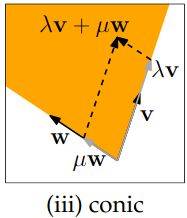
An linear combination of \(\lambda_1\textbf{v}_1 + \lambda_2\textbf{v}_2 + \dots + \lambda_n\textbf{v}_n\) is conic if
Back
An linear combination of \(\lambda_1\textbf{v}_1 + \lambda_2\textbf{v}_2 + \dots + \lambda_n\textbf{v}_n\) is conic if
\(\lambda_j \geq 0\) for \(j = 1, 2, \dots, n\)
After
Front
A linear combination of \(\lambda_1\textbf{v}_1 + \lambda_2\textbf{v}_2 + \dots + \lambda_n\textbf{v}_n\) is conic if
Back
A linear combination of \(\lambda_1\textbf{v}_1 + \lambda_2\textbf{v}_2 + \dots + \lambda_n\textbf{v}_n\) is conic if
\(\lambda_j \geq 0\) for \(j = 1, 2, \dots, n\)
Field-by-field Comparison
| Field | Before | After |
|---|---|---|
| Front | A |
A linear combination of \(\lambda_1\textbf{v}_1 + \lambda_2\textbf{v}_2 + \dots + \lambda_n\textbf{v}_n\) is <b>conic</b> if |
Note 11: ETH::LinAlg
Deck: ETH::LinAlg
Note Type: Horvath Cloze
GUID:
modified
Note Type: Horvath Cloze
GUID:
doaX+*9B4:
Before
Front
For an eigenvalue \(\lambda\) of \(M\), \(\lambda + c\) is a real eigenvalue of the matrix \(M + cI\).
Back
For an eigenvalue \(\lambda\) of \(M\), \(\lambda + c\) is a real eigenvalue of the matrix \(M + cI\).
Intuitively this makes sense as by adding \(cI\) were increasing the values on the diagonal, meaning we have to increase the value of \(\lambda\) by the same amount so it makes \(0\) again.
After
Front
For an eigenvalue \(\lambda\) of \(M\), \(\lambda + c\) is a real eigenvalue of the matrix \(M + cI\).
Back
For an eigenvalue \(\lambda\) of \(M\), \(\lambda + c\) is a real eigenvalue of the matrix \(M + cI\).
Intuitively this makes sense as by adding \(cI\) we're increasing the values on the diagonal, meaning we have to increase the value of \(\lambda\) by the same amount so that we get \(0\) again.
Field-by-field Comparison
| Field | Before | After |
|---|---|---|
| Extra | Intuitively this makes sense as by adding \(cI\) were increasing the values on the diagonal, meaning we have to increase the value of \(\lambda\) by the same amount so |
Intuitively this makes sense as by adding \(cI\) we're increasing the values on the diagonal, meaning we have to increase the value of \(\lambda\) by the same amount so that we get \(0\) again. |
Note 12: ETH::LinAlg
Deck: ETH::LinAlg
Note Type: Horvath Cloze
GUID:
modified
Note Type: Horvath Cloze
GUID:
krdY1rh*f]
Before
Front
If \(AB = BA\) then they share an EV and thus \(A + B\) also has that EV .
Back
If \(AB = BA\) then they share an EV and thus \(A + B\) also has that EV .
If both \(A\) and \(B\) share an EV:
\((A + B)v = Av + Bv = \lambda v + \lambda' v = (\lambda + \lambda')v\) then \(A + B\) also has that EV.
\((A + B)v = Av + Bv = \lambda v + \lambda' v = (\lambda + \lambda')v\) then \(A + B\) also has that EV.
After
Front
If \(AB = BA\) then they share an EV and thus \(A + B\) also has that EV.
Back
If \(AB = BA\) then they share an EV and thus \(A + B\) also has that EV.
If both \(A\) and \(B\) share an EV:
\((A + B)v = Av + Bv = \lambda v + \lambda' v = (\lambda + \lambda')v\) then \(A + B\) also has that EV.
\((A + B)v = Av + Bv = \lambda v + \lambda' v = (\lambda + \lambda')v\) then \(A + B\) also has that EV.
Field-by-field Comparison
| Field | Before | After |
|---|---|---|
| Text | If \(AB = BA\) {{c1::then they share an EV and thus \(A + B\) also has that EV |
If \(AB = BA\) {{c1::then they share an EV and thus \(A + B\) also has that EV::sum}}. |
Note 13: ETH::LinAlg
Deck: ETH::LinAlg
Note Type: Horvath Classic
GUID:
modified
Note Type: Horvath Classic
GUID:
lh.Ty3ypWO
Before
Front
How do we find a basis for the row space \(R(A) = C(A^\top)\)?
Back
How do we find a basis for the row space \(R(A) = C(A^\top)\)?
The first \(r\) columns of \(R^\top\) where \(R\) is the RREF of \(A\) form a basis of the row space (the non-zero rows). In particular \(\dim(\textbf{R}(A)) = r\)
This works because as noted before, multiplying by and invertible matrix \(M\) does not change the row-space of \(MA\) on the left.
After
Front
How do we find a basis for the row space \(R(A) = C(A^\top)\)?
Back
How do we find a basis for the row space \(R(A) = C(A^\top)\)?
The first \(r\) columns of \(R^\top\) where \(R\) is the RREF of \(A\) form a basis of the row space (the non-zero rows). In particular \(\dim(\textbf{R}(A)) = r\)
This works because as noted before, multiplying by an invertible matrix \(M\) does not change the row-space of \(MA\) on the left.
Field-by-field Comparison
| Field | Before | After |
|---|---|---|
| Back | The first \(r\) columns of \(R^\top\) where \(R\) is the RREF of \(A\) form a basis of the row space (the non-zero rows). In particular \(\dim(\textbf{R}(A)) = r\)<br><br><div>This works because as noted before, multiplying by an |
The first \(r\) columns of \(R^\top\) where \(R\) is the RREF of \(A\) form a basis of the row space (the non-zero rows). In particular \(\dim(\textbf{R}(A)) = r\)<br><br><div>This works because as noted before, multiplying by an invertible matrix \(M\) does not change the row-space of \(MA\) on the left.</div> |
Note 14: ETH::LinAlg
Deck: ETH::LinAlg
Note Type: Horvath Cloze
GUID:
modified
Note Type: Horvath Cloze
GUID:
pk}0Q0,75,
Before
Front
The trace is commutative
Back
The trace is commutative
This makes sense as addition is element-wise.
After
Front
The trace is commutative.
Back
The trace is commutative.
This makes sense as addition is element-wise.
Field-by-field Comparison
| Field | Before | After |
|---|---|---|
| Text | The trace is {{c1::commutative}} | The trace is {{c1::commutative}}. |
Note 15: ETH::LinAlg
Deck: ETH::LinAlg
Note Type: Horvath Cloze
GUID:
modified
Note Type: Horvath Cloze
GUID:
rvqzRY-*GX
Before
Front
A diagonal matrix \(D\) has eigenvalues which are the diagonals and a full set of eigenvectors \(e_1, \dots, e_n\).
Back
A diagonal matrix \(D\) has eigenvalues which are the diagonals and a full set of eigenvectors \(e_1, \dots, e_n\).
After
Front
A diagonal matrix \(D\) has eigenvalues which are the diagonals and a full set of eigenvectors \(e_1, \dots, e_n\).
Back
A diagonal matrix \(D\) has eigenvalues which are the diagonals and a full set of eigenvectors \(e_1, \dots, e_n\).
Field-by-field Comparison
| Field | Before | After |
|---|---|---|
| Text | A diagonal matrix \(D\) has eigenvalues {{c1::which are the diagonals |
A diagonal matrix \(D\) has eigenvalues {{c1::which are the diagonals::where are they?}} and {{c1::a full set of eigenvectors \(e_1, \dots, e_n\)::EVs?}}. |
Note 16: ETH::LinAlg
Deck: ETH::LinAlg
Note Type: Horvath Cloze
GUID:
modified
Note Type: Horvath Cloze
GUID:
s},fJ+;VIc
Before
Front
\(A\) has an EW \(0\) \(\Longleftrightarrow\)\(A\) is not invertible Proof Included
Back
\(A\) has an EW \(0\) \(\Longleftrightarrow\)\(A\) is not invertible Proof Included
We know the EVs are in the \(N(A - \lambda I)\) because they solve the formula \(Av = \lambda v \implies Av - \lambda v \)\(= 0 \implies (A - \lambda I)v = 0\). Thus \(v\) is in the nullspace of \((A - \lambda I)\).
If \(A\) is not invertible, then it will have an EV of \(0\), which means that there is an EV solving \((A - 0 \cdot I)v = 0 \implies Av = 0\). Thus \(v \neq 0\) is in the nullspace of \(A\), i.e. the nullspace is not empty.
After
Front
\(A\) has an EW \(0\) \(\Longleftrightarrow\)\(A\) is not invertible Proof Included
Back
\(A\) has an EW \(0\) \(\Longleftrightarrow\)\(A\) is not invertible Proof Included
We know the EVs are in the \(N(A - \lambda I)\) because they solve the formula \(Av = \lambda v \implies Av - \lambda v \)\(= 0 \implies (A - \lambda I)v = 0\). Thus \(v\) is in the nullspace of \((A - \lambda I)\).
If \(A\) is not invertible, then it will have an EV of \(0\), which means that there is an EV solving \((A - 0 \cdot I)v = 0 \implies Av = 0\). Thus \(v \neq 0\) is in the nullspace of \(A\), i.e. the nullspace is not empty.
Field-by-field Comparison
| Field | Before | After |
|---|---|---|
| Text | {{c1::\(A\) has an EW \(0\)}} \(\Longleftrightarrow\){{c2::\(A\) is not invertible}}<i> Proof Included</i> | {{c1::\(A\) has an EW \(0\)::EW}} \(\Longleftrightarrow\){{c2::\(A\) is not invertible}}<i> Proof Included</i> |
Note 17: ETH::LinAlg
Deck: ETH::LinAlg
Note Type: Horvath Cloze
GUID:
modified
Note Type: Horvath Cloze
GUID:
ww{@M/WDmP
Before
Front
\(A\) and \(A^\top\) share eigenvalues not eigenvectors .
Back
\(A\) and \(A^\top\) share eigenvalues not eigenvectors .
After
Front
\(A\) and \(A^\top\) share eigenvalues not eigenvectors.
Back
\(A\) and \(A^\top\) share eigenvalues not eigenvectors.
Field-by-field Comparison
| Field | Before | After |
|---|---|---|
| Text | <div>\(A\) and \(A^\top\) share {{c1::eigenvalues <b>not eigenvectors</b> |
<div>\(A\) and \(A^\top\) share {{c1::eigenvalues <b>not eigenvectors</b>::EWs, EVs}}.</div> |
Note 18: ETH::LinAlg
Deck: ETH::LinAlg
Note Type: Horvath Cloze
GUID:
modified
Note Type: Horvath Cloze
GUID:
y;U[Cn>&)o
Before
Front
Let \(P\) be the projection matrix onto the subspace \(U \subset \mathbb{R}^n\). Then \(P\) has two eigenvalues, \(0\) and \(1\).
Back
Let \(P\) be the projection matrix onto the subspace \(U \subset \mathbb{R}^n\). Then \(P\) has two eigenvalues, \(0\) and \(1\).
After
Front
Let \(P\) be the projection matrix onto the subspace \(U \subset \mathbb{R}^n\). Then \(P\) has two eigenvalues, \(0\) and \(1\).
Back
Let \(P\) be the projection matrix onto the subspace \(U \subset \mathbb{R}^n\). Then \(P\) has two eigenvalues, \(0\) and \(1\).
Field-by-field Comparison
| Field | Before | After |
|---|---|---|
| Text | Let \(P\) be the <i>projection matrix</i> onto the subspace \(U \subset \mathbb{R}^n\). Then \(P\) has {{c1::two eigenvalues, \(0\) and \(1\):: |
Let \(P\) be the <i>projection matrix</i> onto the subspace \(U \subset \mathbb{R}^n\). Then \(P\) has {{c1::two eigenvalues, \(0\) and \(1\)::EW, EVs, and a complete set of real eigenvectors}}. |