What is the pseudoinverse in the case where \(A \in \mathbb{R}^{n \times m}\) has neither full column nor full row rank?
Note 1: ETH::LinAlg
Deck: ETH::LinAlg
Note Type: Horvath Classic
GUID:
added
Note Type: Horvath Classic
GUID:
E.Y/B(ySb^
Previous
Note did not exist
New Note
Front
Back
What is the pseudoinverse in the case where \(A \in \mathbb{R}^{n \times m}\) has neither full column nor full row rank?
We have to solve both projecting and finding \(||x||^2\) with the smallest norm at once.
We decompose \(A = CR'\) where \(C\) has full column and \(R'\) full row-rank.
Then \(A^\dagger = R^\dagger C^\dagger\).
We decompose \(A = CR'\) where \(C\) has full column and \(R'\) full row-rank.
Then \(A^\dagger = R^\dagger C^\dagger\).
Field-by-field Comparison
| Field | Before | After |
|---|---|---|
| Front | What is the pseudoinverse in the case where \(A \in \mathbb{R}^{n \times m}\) has neither full column nor full row rank? | |
| Back | We have to solve both projecting and finding \(||x||^2\) with the smallest norm at once.<br>We decompose \(A = CR'\) where \(C\) has full column and \(R'\) full row-rank.<br>Then \(A^\dagger = R^\dagger C^\dagger\). |
Note 2: ETH::LinAlg
Deck: ETH::LinAlg
Note Type: Horvath Cloze
GUID:
added
Note Type: Horvath Cloze
GUID:
FjSbP7PsTQ
Previous
Note did not exist
New Note
Front
\(A^\dagger A\) is the projection matrix on \(C(A^\top)\)
Back
\(A^\dagger A\) is the projection matrix on \(C(A^\top)\)
Field-by-field Comparison
| Field | Before | After |
|---|---|---|
| Text | \(A^\dagger A\) is {{c1::the projection matrix on \(C(A^\top)\)}} |
Note 3: ETH::LinAlg
Deck: ETH::LinAlg
Note Type: Horvath Cloze
GUID:
added
Note Type: Horvath Cloze
GUID:
K9{>JhFX!.
Previous
Note did not exist
New Note
Front
\((A^\top)^\dagger = (A^\dagger)^\top \)
Back
\((A^\top)^\dagger = (A^\dagger)^\top \)
Field-by-field Comparison
| Field | Before | After |
|---|---|---|
| Text | \((A^\top)^\dagger = {{c1:: (A^\dagger)^\top }}\) |
Note 4: ETH::LinAlg
Deck: ETH::LinAlg
Note Type: Horvath Cloze
GUID:
added
Note Type: Horvath Cloze
GUID:
Md-#o7w$ub
Previous
Note did not exist
New Note
Front
For \(A \in \mathbb{R}^{m \times n}\) with \(\text{rank}(A) = m\), the pseudo-inverse \(A^\dagger \in \mathbb{R}^{n \times m}\) is a right inverse of \(A\): \[ A A^\dagger = I \]Proof Included
Back
For \(A \in \mathbb{R}^{m \times n}\) with \(\text{rank}(A) = m\), the pseudo-inverse \(A^\dagger \in \mathbb{R}^{n \times m}\) is a right inverse of \(A\): \[ A A^\dagger = I \]Proof Included
Proof Since \(A^\top\) has full column rank, \(((A^\top)^\top A^\top) = AA^\top\) is invertible: \(AA^\dagger = AA^\top(A A^\top)^{-1} = I\).
Field-by-field Comparison
| Field | Before | After |
|---|---|---|
| Text | For \(A \in \mathbb{R}^{m \times n}\) with \(\text{rank}(A) = m\), the <b>pseudo-inverse</b> \(A^\dagger \in \mathbb{R}^{n \times m}\) is {{c1::a right inverse}} of \(A\): \[ {{c1:: A A^\dagger = I }}\]<i>Proof Included</i> | |
| Extra | <div><b>Proof</b> Since \(A^\top\) has full column rank, \(((A^\top)^\top A^\top) = AA^\top\) is invertible: \(AA^\dagger = AA^\top(A A^\top)^{-1} = I\).</div> |
Note 5: ETH::LinAlg
Deck: ETH::LinAlg
Note Type: Horvath Cloze
GUID:
added
Note Type: Horvath Cloze
GUID:
Nu?3UH(7q
Previous
Note did not exist
New Note
Front
Given \(A \in \mathbb{R}^{m \times n}\) (can have any rank) and a vector \(b \in \mathbb{R}^m\), the unique solution to \[ \min_{x \in \mathbb{R}^n} ||x||^2 \] such that \(A^\top Ax = A^\top b\) is given by {{c2::\(\hat{x} = A^\dagger b\)}}.
Back
Given \(A \in \mathbb{R}^{m \times n}\) (can have any rank) and a vector \(b \in \mathbb{R}^m\), the unique solution to \[ \min_{x \in \mathbb{R}^n} ||x||^2 \] such that \(A^\top Ax = A^\top b\) is given by {{c2::\(\hat{x} = A^\dagger b\)}}.
Field-by-field Comparison
| Field | Before | After |
|---|---|---|
| Text | Given \(A \in \mathbb{R}^{m \times n}\) (can have any rank) and a vector \(b \in \mathbb{R}^m\), the {{c1::<b>unique</b>}}<b> </b>solution to \[ \min_{x \in \mathbb{R}^n} ||x||^2 \] such that {{c1::\(A^\top Ax = A^\top b\)}} is given by {{c2::\(\hat{x} = A^\dagger b\)}}. |
Note 6: ETH::LinAlg
Deck: ETH::LinAlg
Note Type: Horvath Cloze
GUID:
added
Note Type: Horvath Cloze
GUID:
P+IBIpS^<+
Previous
Note did not exist
New Note
Front
\(A^\dagger A\) is symmetric
Back
\(A^\dagger A\) is symmetric
Field-by-field Comparison
| Field | Before | After |
|---|---|---|
| Text | \(A^\dagger A\) is {{c1:: symmetric :: property }} |
Note 7: ETH::LinAlg
Deck: ETH::LinAlg
Note Type: Horvath Classic
GUID:
added
Note Type: Horvath Classic
GUID:
P/y(FM1x:V
Previous
Note did not exist
New Note
Front
Why is the pseudoinverse (for \(A\) with full row-rank) \(A^\top (AA^\top)^{-1}\)?
Back
Why is the pseudoinverse (for \(A\) with full row-rank) \(A^\top (AA^\top)^{-1}\)?
It uses the multiplication by \(A^\top\) to choose an \(\hat{x}\) that lies in the row-space, thus minimising the norm.
Field-by-field Comparison
| Field | Before | After |
|---|---|---|
| Front | Why is the pseudoinverse (for \(A\) with full row-rank) \(A^\top (AA^\top)^{-1}\)? | |
| Back | It uses the multiplication by \(A^\top\) to choose an \(\hat{x}\) that lies in the row-space, thus minimising the norm. |
Note 8: ETH::LinAlg
Deck: ETH::LinAlg
Note Type: Horvath Cloze
GUID:
added
Note Type: Horvath Cloze
GUID:
PCBMoNL{vn
Previous
Note did not exist
New Note
Front
The nullspace of \(A\) \(N(A) \) is equal to the nullspace of \(N(A^\dagger)\). Proof Included
Back
The nullspace of \(A\) \(N(A) \) is equal to the nullspace of \(N(A^\dagger)\). Proof Included
Intuitively this holds as \(A^\dagger\) projects onto the \(C(A)\).
Thus anything in \(C(A)^\bot = N(A^\top)\) is projected to \(0\). In other words, \(\forall x \in C(A^\top)^\bot = N(A^\top)\) we have \(A^\dagger x = 0\).
We conclude that \(N(A) = C(A^\top)^\bot = N(A^\dagger)\).
Thus anything in \(C(A)^\bot = N(A^\top)\) is projected to \(0\). In other words, \(\forall x \in C(A^\top)^\bot = N(A^\top)\) we have \(A^\dagger x = 0\).
We conclude that \(N(A) = C(A^\top)^\bot = N(A^\dagger)\).
Field-by-field Comparison
| Field | Before | After |
|---|---|---|
| Text | The <b>nullspace of </b>\(A\) \(N(A) \) is equal to {{c1:: the nullspace of \(N(A^\dagger)\)}}. <i>Proof Included</i> | |
| Extra | Intuitively this holds as \(A^\dagger\) projects onto the \(C(A)\).<br><br>Thus anything in \(C(A)^\bot = N(A^\top)\) is projected to \(0\). In other words, \(\forall x \in C(A^\top)^\bot = N(A^\top)\) we have \(A^\dagger x = 0\).<br>We conclude that \(N(A) = C(A^\top)^\bot = N(A^\dagger)\). |
Note 9: ETH::LinAlg
Deck: ETH::LinAlg
Note Type: Horvath Cloze
GUID:
added
Note Type: Horvath Cloze
GUID:
QGIRdw&4iR
Previous
Note did not exist
New Note
Front
For \(A \in \mathbb{R}^{m \times n}\) with \(\text{rank}(A) = n\), the pseudoinverse \(A^\dagger\) is a left inverse of \(A\), meaning \[ A^\dagger A = I \]Proof Included
Back
For \(A \in \mathbb{R}^{m \times n}\) with \(\text{rank}(A) = n\), the pseudoinverse \(A^\dagger\) is a left inverse of \(A\), meaning \[ A^\dagger A = I \]Proof Included
Proof: Since \(A\) has full column rank, \(A^\top A\) invertible and then \(A^\dagger A = ((A^\top A)^{-1} A^\top)A\) \(= (A^\top A)^{-1} (A^\top A) = I\).
Field-by-field Comparison
| Field | Before | After |
|---|---|---|
| Text | For \(A \in \mathbb{R}^{m \times n}\) with \(\text{rank}(A) = n\), the pseudoinverse \(A^\dagger\) is {{c1::a left inverse}} of \(A\), meaning \[{{c1:: A^\dagger A = I }}\]<i>Proof Included</i> | |
| Extra | <b>Proof: </b>Since \(A\) has full column rank, \(A^\top A\) invertible and then \(A^\dagger A = ((A^\top A)^{-1} A^\top)A\) \(= (A^\top A)^{-1} (A^\top A) = I\). |
Note 10: ETH::LinAlg
Deck: ETH::LinAlg
Note Type: Horvath Cloze
GUID:
added
Note Type: Horvath Cloze
GUID:
b-hsvze>Y9
Previous
Note did not exist
New Note
Front
For \(A \in \mathbb{R}^{m \times n}\) with \(\text{rank}(A) = n\), we define the pseudo-inverse \(A^\dagger \in \mathbb{R}^{n \times m}\) as \[ A^\dagger = {{c1::(A^\top A)^{-1} A^\top }}\]
Back
For \(A \in \mathbb{R}^{m \times n}\) with \(\text{rank}(A) = n\), we define the pseudo-inverse \(A^\dagger \in \mathbb{R}^{n \times m}\) as \[ A^\dagger = {{c1::(A^\top A)^{-1} A^\top }}\]
Field-by-field Comparison
| Field | Before | After |
|---|---|---|
| Text | For \(A \in \mathbb{R}^{m \times n}\) with \(\text{rank}(A) = n\), we define the <b>pseudo-inverse</b> \(A^\dagger \in \mathbb{R}^{n \times m}\) as \[ A^\dagger = {{c1::(A^\top A)^{-1} A^\top }}\] |
Note 11: ETH::LinAlg
Deck: ETH::LinAlg
Note Type: Horvath Classic
GUID:
added
Note Type: Horvath Classic
GUID:
dle9WT5o|g
Previous
Note did not exist
New Note
Front
What is the pseudoinverse in the case where \(A \in \mathbb{R}^{n \times m}\) has independent rows?
Back
What is the pseudoinverse in the case where \(A \in \mathbb{R}^{n \times m}\) has independent rows?
Because \(rank(A) = r = m\) and thus \(n \geq m\)
We know \(x = x_r + x_n\) for \(x_r \in R(A)\) and \(x_n \in N(A)\) thus we pick \(x = x_r + 0\) to get the smallest norm.
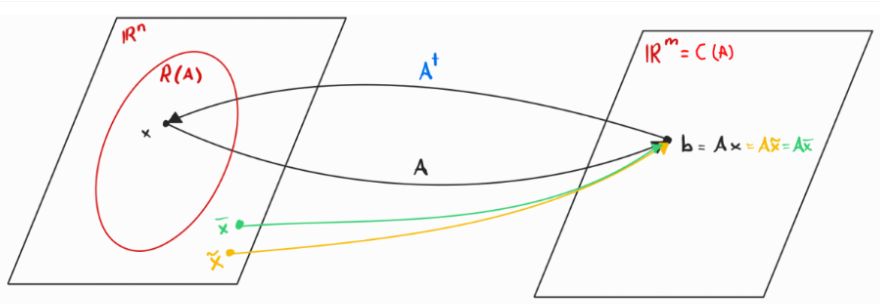
- \(C(A)\)spans \(\mathbb{R}^m\) (columns span the space)
- \(R(A) \subseteq\) \(\mathbb{R}^n\)
We know \(x = x_r + x_n\) for \(x_r \in R(A)\) and \(x_n \in N(A)\) thus we pick \(x = x_r + 0\) to get the smallest norm.
Field-by-field Comparison
| Field | Before | After |
|---|---|---|
| Front | What is the pseudoinverse in the case where \(A \in \mathbb{R}^{n \times m}\) has independent rows? | |
| Back | Because \(rank(A) = r = m\) and thus \(n \geq m\)<ul><li>\(C(A)\)spans \(\mathbb{R}^m\) (columns span the space)</li><li>\(R(A) \subseteq\) \(\mathbb{R}^n\)</li></ul>There could be multiple \(x \in \mathbb{R}^n\) that map to \(T_A(x) = b\). We pick the one with the smallest norm \(||x||^2\).<br>We know \(x = x_r + x_n\) for \(x_r \in R(A)\) and \(x_n \in N(A)\) thus we pick \(x = x_r + 0\) to get the smallest norm.<br><br><div> <img src="paste-4707a6f9abbe720721f1a4ab781ab8c8fda3c76a.jpg"></div> |
Note 12: ETH::LinAlg
Deck: ETH::LinAlg
Note Type: Horvath Classic
GUID:
added
Note Type: Horvath Classic
GUID:
f?EhyxxJ04
Previous
Note did not exist
New Note
Front
Rewrite \(A^\dagger = R^\dagger C^\dagger\) in terms of A, R, C:
Back
Rewrite \(A^\dagger = R^\dagger C^\dagger\) in terms of A, R, C:
\(A^\dagger = R^\top {(RR^\top)}^{-1} {(C^\top C)}^{-1} C^\top =\) \(R^\top {(C^\top C R R^\top)}^{-1} C^\top =\) \(R^\top {(C^\top A R^\top)}^{-1}C^\top\).
Field-by-field Comparison
| Field | Before | After |
|---|---|---|
| Front | Rewrite \(A^\dagger = R^\dagger C^\dagger\) in terms of A, R, C: | |
| Back | \(A^\dagger = R^\top {(RR^\top)}^{-1} {(C^\top C)}^{-1} C^\top =\) \(R^\top {(C^\top C R R^\top)}^{-1} C^\top =\) \(R^\top {(C^\top A R^\top)}^{-1}C^\top\). |
Note 13: ETH::LinAlg
Deck: ETH::LinAlg
Note Type: Horvath Cloze
GUID:
added
Note Type: Horvath Cloze
GUID:
oX/3/jm{Ku
Previous
Note did not exist
New Note
Front
For a full row rank matrix \(A\), the unique solution to\[{{c1:: \min_{x \in \mathbb{R}^n} ||x||^2 \text{ s.t. } Ax = b}}\] is given by the vector \(\hat{x} = A^\dagger b\). This \(\hat{x}\) is in \(C(A^\top)\). Proof Included
Back
For a full row rank matrix \(A\), the unique solution to\[{{c1:: \min_{x \in \mathbb{R}^n} ||x||^2 \text{ s.t. } Ax = b}}\] is given by the vector \(\hat{x} = A^\dagger b\). This \(\hat{x}\) is in \(C(A^\top)\). Proof Included
Proof
By Lemma 6.4.5 we only need to show that \(\hat{x} = A^\dagger b\) satisfies \(A \hat{x} = b\) and that \(\hat{x} \in C(A^\top)\).
- \(A\hat{x} = AA^\dagger b = AA^\top (AA^\top)^{-1}b = b\)
- \(\hat{x} = A^\dagger b = A^\top ((AA^\top)^{-1} b) = A^\top y\) for some \(y\) thus \(x \in C(A^\top)\).
Field-by-field Comparison
| Field | Before | After |
|---|---|---|
| Text | <div>For a <b>full row rank</b> matrix \(A\), the unique solution to\[{{c1:: \min_{x \in \mathbb{R}^n} ||x||^2 \text{ s.t. } Ax = b}}\] is given by the vector \(\hat{x} = A^\dagger b\). This \(\hat{x}\) is in {{c1:: \(C(A^\top)\)}}. <i>Proof Included</i></div> | |
| Extra | <div><strong>Proof</strong> </div><div>By Lemma 6.4.5 we only need to show that \(\hat{x} = A^\dagger b\) satisfies \(A \hat{x} = b\) and that \(\hat{x} \in C(A^\top)\).</div><div><ul><li>\(A\hat{x} = AA^\dagger b = AA^\top (AA^\top)^{-1}b = b\) </li><li>\(\hat{x} = A^\dagger b = A^\top ((AA^\top)^{-1} b) = A^\top y\) for some \(y\) thus \(x \in C(A^\top)\).</li></ul></div> |
Note 14: ETH::LinAlg
Deck: ETH::LinAlg
Note Type: Horvath Cloze
GUID:
added
Note Type: Horvath Cloze
GUID:
os3Z8p7:x,
Previous
Note did not exist
New Note
Front
We can compute the pseudoinverse from the any full rank (not just CR) factorisation of \(A\).
Back
We can compute the pseudoinverse from the any full rank (not just CR) factorisation of \(A\).
Note to Lorenz: Leave the "the" in, it's for maximum confusion .
Field-by-field Comparison
| Field | Before | After |
|---|---|---|
| Text | We can compute the pseudoinverse from the {{c1:: any full rank (not just CR)}} factorisation of \(A\). | |
| Extra | <i>Note to Lorenz</i>: Leave the "<i>the</i>" in, it's for maximum confusion . |
Note 15: ETH::LinAlg
Deck: ETH::LinAlg
Note Type: Horvath Classic
GUID:
added
Note Type: Horvath Classic
GUID:
p:TgRlDdKr
Previous
Note did not exist
New Note
Front
What is the pseudoinverse in the case where \(A \in \mathbb{R}^{n \times m}\) has independent columns?
Back
What is the pseudoinverse in the case where \(A \in \mathbb{R}^{n \times m}\) has independent columns?
Because \(rank(A) = r = n\) and thus \(m \geq n\)
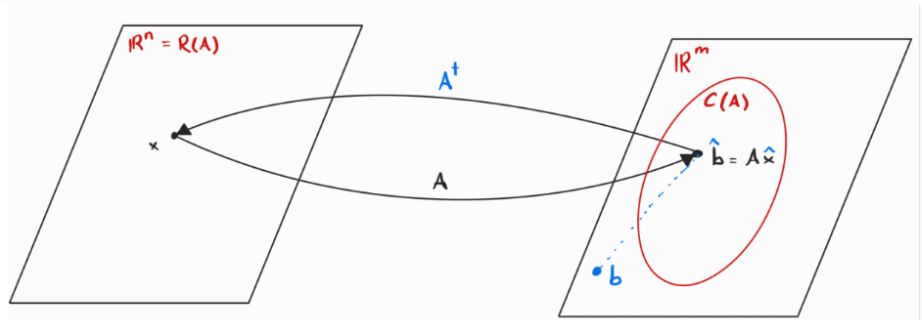
- \(R(A)\) spans \(\mathbb{R}^n\)(rows span the space)
- \(C(A) \subseteq\) \(\mathbb{R}^m\) (as \(A\) is not necessarily square)
We therefore first project into \(b\) into \(C(A)\) and then invert, which is Least Squares
Field-by-field Comparison
| Field | Before | After |
|---|---|---|
| Front | What is the pseudoinverse in the case where \(A \in \mathbb{R}^{n \times m}\) has independent columns? | |
| Back | Because \(rank(A) = r = n\) and thus \(m \geq n\)<br><ul><li>\(R(A)\) spans \(\mathbb{R}^n\)(rows span the space)</li><li>\(C(A) \subseteq\) \(\mathbb{R}^m\) (as \(A\) is not necessarily square)</li></ul><div>We therefore first project into \(b\) into \(C(A)\) and then invert, which is <b>Least Squares</b></div><br><div> <img src="paste-455009459e5a5c70fa5574bdbcedcfb838341523.jpg"></div> |
Note 16: ETH::LinAlg
Deck: ETH::LinAlg
Note Type: Horvath Cloze
GUID:
added
Note Type: Horvath Cloze
GUID:
tjub=34aze
Previous
Note did not exist
New Note
Front
\(AA^\dagger\) is symmetric
Back
\(AA^\dagger\) is symmetric
Field-by-field Comparison
| Field | Before | After |
|---|---|---|
| Text | \(AA^\dagger\) is{{c1:: symmetric :: property }} |
Note 17: ETH::LinAlg
Deck: ETH::LinAlg
Note Type: Horvath Cloze
GUID:
added
Note Type: Horvath Cloze
GUID:
ve7Q_/^p1y
Previous
Note did not exist
New Note
Front
For \(A \in \mathbb{R}^{m \times n}\) with \(\text{rank}(A) = m\), we define the pseudo-inverse \(A^\dagger \in \mathbb{R}^{n \times m}\) as \[ A^\dagger = {{c1::A^\top (A A^\top)^{-1} }}\]
Back
For \(A \in \mathbb{R}^{m \times n}\) with \(\text{rank}(A) = m\), we define the pseudo-inverse \(A^\dagger \in \mathbb{R}^{n \times m}\) as \[ A^\dagger = {{c1::A^\top (A A^\top)^{-1} }}\]
For an \(A\) with full column-rank, we basically define, \(A^\dagger\) as the transpose of the pseudoinverse of the transpose:

Field-by-field Comparison
| Field | Before | After |
|---|---|---|
| Text | For \(A \in \mathbb{R}^{m \times n}\) with \(\text{rank}(A) = m\), we define the <b>pseudo-inverse</b> \(A^\dagger \in \mathbb{R}^{n \times m}\) as \[ A^\dagger = {{c1::A^\top (A A^\top)^{-1} }}\] | |
| Extra | For an \(A\) with full column-rank, we basically define, \(A^\dagger\) as the transpose of the pseudoinverse of the transpose:<br><img src="paste-ea3dc98b302c74b79fb2bafc8b144f36da289e16.jpg"><br><br> |
Note 18: ETH::LinAlg
Deck: ETH::LinAlg
Note Type: Horvath Cloze
GUID:
added
Note Type: Horvath Cloze
GUID:
v~twgkx^)U
Previous
Note did not exist
New Note
Front
For \(A \in \mathbb{R}^{m \times n}\) with \(\text{rank}(A) = r\) and CR decomposition \(A = CR\), we define the pseudoinverse \(A^\dagger\) as \[ A^\dagger = R^\dagger C^\dagger \]
Back
For \(A \in \mathbb{R}^{m \times n}\) with \(\text{rank}(A) = r\) and CR decomposition \(A = CR\), we define the pseudoinverse \(A^\dagger\) as \[ A^\dagger = R^\dagger C^\dagger \]
We can rewrite this as \(A^\dagger = R^\top {(RR^\top)}^{-1} {(C^\top C)}^{-1} C^\top =\) \(R^\top {(C^\top C R R^\top)}^{-1} C^\top =\) \(R^\top {(C^\top A R^\top)}^{-1}C^\top\).
Field-by-field Comparison
| Field | Before | After |
|---|---|---|
| Text | For \(A \in \mathbb{R}^{m \times n}\) with \(\text{rank}(A) = r\) and CR decomposition \(A = CR\), we define the pseudoinverse \(A^\dagger\) as \[ A^\dagger = {{c1::R^\dagger C^\dagger }}\]<br> | |
| Extra | We can rewrite this as \(A^\dagger = R^\top {(RR^\top)}^{-1} {(C^\top C)}^{-1} C^\top =\) \(R^\top {(C^\top C R R^\top)}^{-1} C^\top =\) \(R^\top {(C^\top A R^\top)}^{-1}C^\top\). |
Note 19: ETH::LinAlg
Deck: ETH::LinAlg
Note Type: Horvath Cloze
GUID:
added
Note Type: Horvath Cloze
GUID:
x|?8Eu84o6
Previous
Note did not exist
New Note
Front
\(AA^\dagger\) is the projection matrix on \(C(A)\).
Back
\(AA^\dagger\) is the projection matrix on \(C(A)\).
Field-by-field Comparison
| Field | Before | After |
|---|---|---|
| Text | \(AA^\dagger\) is {{c1:: the projection matrix on \(C(A)\)}}. |