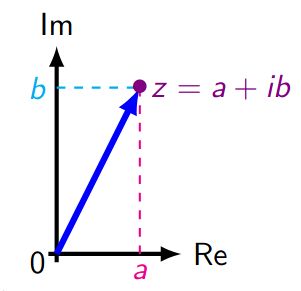
In der Polarform wird \(z = a + ib\) als {{c1:: \(r \cdot e^{i \varphi}\)}} dargestellt wo \(|z| = r \ge 0\) und \(\varphi \in (-\pi, \pi]\) der Polarwinkel \(\arg(z)\) (Argument) ist.
Note 1: ETH::2. Semester::Analysis
Deck: ETH::2. Semester::Analysis
Note Type: Horvath Cloze
GUID:
modified
Note Type: Horvath Cloze
GUID:
lXTKG=dq,E
Before
Front
Back
In der Polarform wird \(z = a + ib\) als {{c1:: \(r \cdot e^{i \varphi}\)}} dargestellt wo \(|z| = r \ge 0\) und \(\varphi \in (-\pi, \pi]\) der Polarwinkel \(\arg(z)\) (Argument) ist.
After
Front
In der Polarform wird \(z = a + ib\) als {{c1:: \(r \cdot e^{i \varphi}\)}} dargestellt wo \(r = |z| \ge 0\) und \(\varphi \in (-\pi, \pi]\) der Polarwinkel \(\arg(z)\) (Argument) ist.
Back
In der Polarform wird \(z = a + ib\) als {{c1:: \(r \cdot e^{i \varphi}\)}} dargestellt wo \(r = |z| \ge 0\) und \(\varphi \in (-\pi, \pi]\) der Polarwinkel \(\arg(z)\) (Argument) ist.
Field-by-field Comparison
| Field | Before | After |
|---|---|---|
| Text | In der Polarform wird \(z = a + ib\) als {{c1:: \(r \cdot e^{i \varphi}\)}} dargestellt wo {{c1:: \( |
In der Polarform wird \(z = a + ib\) als {{c1:: \(r \cdot e^{i \varphi}\)}} dargestellt wo {{c1:: \(r = |z| \ge 0\) und \(\varphi \in (-\pi, \pi]\) der Polarwinkel \(\arg(z)\) (Argument) ist::Def. r und Winkel}}. |
Note 2: ETH::2. Semester::Analysis
Deck: ETH::2. Semester::Analysis
Note Type: Horvath Cloze
GUID:
modified
Note Type: Horvath Cloze
GUID:
r!b0]VV~/_
Before
Front
Wenn \(\lim a_n = 0\) eine Nullfolge ist, so gilt, dass du dumm bist, die Implikation gilt nur in die Gegenrichtung.
Back
Wenn \(\lim a_n = 0\) eine Nullfolge ist, so gilt, dass du dumm bist, die Implikation gilt nur in die Gegenrichtung.

Ein Gegenbeispiel ist die Harmonische Reihe, \(1/n \) ist eine Nullfolge, aber \(\sum a_n\) konvergiert nicht.
After
Front
Wenn \(\lim a_n = 0\) eine Nullfolge ist, so gilt, dass du dumm bist, die Implikation gilt nur in die Gegenrichtung.
Back
Wenn \(\lim a_n = 0\) eine Nullfolge ist, so gilt, dass du dumm bist, die Implikation gilt nur in die Gegenrichtung.
Ein Gegenbeispiel ist die Harmonische Reihe, \(1/n \) ist eine Nullfolge, aber \(\sum a_n\) konvergiert nicht.
Field-by-field Comparison
| Field | Before | After |
|---|---|---|
| Text | Wenn \(\lim a_n = 0\) eine Nullfolge ist, so gilt, dass {{c1::du dumm bist, die Implikation gilt nur in die Gegenrichtung |
Wenn \(\lim a_n = 0\) eine Nullfolge ist, so gilt, dass {{c1::du dumm bist, die Implikation gilt nur in die Gegenrichtung}}. |
Note 3: ETH::2. Semester::Analysis
Deck: ETH::2. Semester::Analysis
Note Type: Horvath Cloze
GUID:
modified
Note Type: Horvath Cloze
GUID:
y,{,Qv+x2]
Before
Front
Eine Folge nennen wir streng monoton fallend / streng monoton wachsend falls sie monoton wächst / fällt und \(m > n\) für alle Glieder.
Back
Eine Folge nennen wir streng monoton fallend / streng monoton wachsend falls sie monoton wächst / fällt und \(m > n\) für alle Glieder.
After
Front
Eine Folge nennen wir streng monoton fallend (wachsend) falls sie monoton fällt (wächst) und \(a_m > a_n\) für alle \(m > n\).
Back
Eine Folge nennen wir streng monoton fallend (wachsend) falls sie monoton fällt (wächst) und \(a_m > a_n\) für alle \(m > n\).
Field-by-field Comparison
| Field | Before | After |
|---|---|---|
| Text | <div>Eine Folge nennen wir streng monoton fallend |
<div>Eine Folge nennen wir streng monoton fallend (wachsend) falls sie monoton fällt (wächst) und {{c1::\(a_m > a_n\) für alle \(m > n\)}}.</div> |
Note 4: ETH::2. Semester::PProg
Deck: ETH::2. Semester::PProg
Note Type: Horvath Cloze
GUID:
modified
Note Type: Horvath Cloze
GUID:
ra,}:cOf]y
Before
Front
Amdahl's Law looks at how execution time varies as we add more workers .
Back
Amdahl's Law looks at how execution time varies as we add more workers .
After
Front
Amdahl's Law looks at how execution time varies as we add more workers.
Back
Amdahl's Law looks at how execution time varies as we add more workers.
Field-by-field Comparison
| Field | Before | After |
|---|---|---|
| Text | Amdahl's Law looks at {{c1::how execution time varies as we add more workers |
Amdahl's Law looks at {{c1::how execution time varies as we add more workers::the effects on which variable}}. |