Note 1: ETH::DiskMat
Note Type: Basic (with MathJax)
GUID:
ykM`*q&]Lu
Previous
Note did not exist
New Note
Front
Back
\(F \equiv G\) means they correspond to the same function, i.e., their truth values are equal for all truth assignments to the propositional symbols appearing in \(F\) or \(G\).
Field-by-field Comparison
| Field | Before | After |
|---|---|---|
| Front | What does it mean for two formulas \(F\) and \(G\) to be logically equivalent (\(F \equiv G\))? | |
| Back | \(F \equiv G\) means they correspond to the same function, i.e., their truth values are equal for <strong>all</strong> truth assignments to the propositional symbols appearing in \(F\) or \(G\). |
Note 2: ETH::DiskMat
Note Type: Basic (with MathJax)
GUID:
lNUw/[p~+9
Previous
Note did not exist
New Note
Front
Back
A formula \(F\) is a tautology (or valid) if it is true for all truth assignments of the involved propositional symbols. Denoted as \(\models F\) or \(\top\).
Field-by-field Comparison
| Field | Before | After |
|---|---|---|
| Front | What is a tautology in propositional logic? | |
| Back | A formula \(F\) is a tautology (or valid) if it is true for <strong>all</strong> truth assignments of the involved propositional symbols. Denoted as \(\models F\) or \(\top\). |
Note 3: ETH::DiskMat
Note Type: Basic (with MathJax)
GUID:
dNOrR*l4!S
Previous
Note did not exist
New Note
Front
Back
A formula \(F\) is satisfiable if it is true for at least one truth assignment of the involved propositional symbols.
Field-by-field Comparison
| Field | Before | After |
|---|---|---|
| Front | What does it mean for a formula to be satisfiable? | |
| Back | A formula \(F\) is satisfiable if it is true for <strong>at least one</strong> truth assignment of the involved propositional symbols. |
Note 4: ETH::DiskMat
Note Type: Basic (with MathJax)
GUID:
Q;AJBWzP3u
Previous
Note did not exist
New Note
Front
Back
A formula is unsatisfiable if it is never true under any truth assignment. Denoted as \(\perp\).
Field-by-field Comparison
| Field | Before | After |
|---|---|---|
| Front | What does it mean for a formula to be unsatisfiable? | |
| Back | A formula is unsatisfiable if it is <strong>never</strong> true under any truth assignment. Denoted as \(\perp\). |
Note 5: ETH::DiskMat
Note Type: Basic (with MathJax)
GUID:
fYNR0,>|4R
Previous
Note did not exist
New Note
Front
Back
\(G\) is a logical consequence of \(F\) if for all truth assignments where \(F\) evaluates to \(1\), \(G\) also evaluates to \(1\).
Field-by-field Comparison
| Field | Before | After |
|---|---|---|
| Front | What does \(F \models G\) mean (logical consequence)? | |
| Back | \(G\) is a logical consequence of \(F\) if for all truth assignments where \(F\) evaluates to \(1\), \(G\) also evaluates to \(1\). |
Note 6: ETH::DiskMat
Note Type: Basic (with MathJax)
GUID:
L}28Y2#qgD
Previous
Note did not exist
New Note
Front
Back
- \(\equiv\): links formulas to statements (not part of PL itself)
- \(\leftrightarrow\): formula → formula (part of PL)
- \(\Leftrightarrow\): statement → statement
Field-by-field Comparison
| Field | Before | After |
|---|---|---|
| Front | What's the difference between \(\equiv\), \(\leftrightarrow\), and \(\Leftrightarrow\)? | |
| Back | <ul> <li>\(\equiv\): links formulas to statements (not part of PL itself)</li> <li>\(\leftrightarrow\): formula → formula (part of PL)</li> <li>\(\Leftrightarrow\): statement → statement</li> </ul> |
Note 7: ETH::DiskMat
Note Type: Basic (with MathJax)
GUID:
Bd%?U@FpLL
Previous
Note did not exist
New Note
Front
Back
A function \(U^k \rightarrow \{0, 1\}\) that assigns each element of \(U^k\) to a truth value.
Field-by-field Comparison
| Field | Before | After |
|---|---|---|
| Front | What is a \(k\)-ary predicate on universe \(U\)? | |
| Back | A function \(U^k \rightarrow \{0, 1\}\) that assigns each element of \(U^k\) to a truth value. |
Note 8: ETH::DiskMat
Note Type: Basic (with MathJax)
GUID:
Auz&g~bS8q
Previous
Note did not exist
New Note
Front
Back
\(\lnot \forall x P(x) \equiv \exists x \lnot P(x)\)
Field-by-field Comparison
| Field | Before | After |
|---|---|---|
| Front | What is \(\lnot \forall x P(x)\) equivalent to? | |
| Back | \(\lnot \forall x P(x) \equiv \exists x \lnot P(x)\) |
Note 9: ETH::DiskMat
Note Type: Basic (with MathJax)
GUID:
exf+nqtlh=
Previous
Note did not exist
New Note
Front
Back
\(\lnot \exists x P(x) \equiv \forall x \lnot P(x)\)
Field-by-field Comparison
| Field | Before | After |
|---|---|---|
| Front | What is \(\lnot \exists x P(x)\) equivalent to? | |
| Back | \(\lnot \exists x P(x) \equiv \forall x \lnot P(x)\) |
Note 10: ETH::DiskMat
Note Type: Basic (with MathJax)
GUID:
bDWd}.?.!o
Previous
Note did not exist
New Note
Front
Back
\(\forall x P(x) \land \forall x Q(x) \equiv \forall x (P(x) \land Q(x))\)
Field-by-field Comparison
| Field | Before | After |
|---|---|---|
| Front | How does \(\forall\) distribute over \(\land\)? | |
| Back | \(\forall x P(x) \land \forall x Q(x) \equiv \forall x (P(x) \land Q(x))\) |
Note 11: ETH::DiskMat
Note Type: Basic (with MathJax)
GUID:
lY*59pTngJ
Previous
Note did not exist
New Note
Front
Back
\(\exists x (P(x) \land Q(x)) \models \exists x P(x) \land \exists x Q(x)\)
(Note: This is logical consequence, NOT equivalence. The reverse doesn't hold!)
Field-by-field Comparison
| Field | Before | After |
|---|---|---|
| Front | What is the relationship between \(\exists x (P(x) \land Q(x))\) and \(\exists x P(x) \land \exists x Q(x)\)? | |
| Back | \(\exists x (P(x) \land Q(x)) \models \exists x P(x) \land \exists x Q(x)\) <br> (Note: This is logical consequence, NOT equivalence. The reverse doesn't hold!) |
Note 12: ETH::DiskMat
Note Type: Basic (with MathJax)
GUID:
P02nk|&p.d
Previous
Note did not exist
New Note
Front
Back
- \(A \land A \equiv A\)
- \(A \lor A \equiv A\)
Field-by-field Comparison
| Field | Before | After |
|---|---|---|
| Front | What are the idempotence laws in propositional logic? | |
| Back | <ul> <li>\(A \land A \equiv A\)</li> <li>\(A \lor A \equiv A\)</li> </ul> |
Note 13: ETH::DiskMat
Note Type: Basic (with MathJax)
GUID:
fs1LiNLiNF
Previous
Note did not exist
New Note
Front
Back
- \(A \land B \equiv B \land A\)
- \(A \lor B \equiv B \lor A\)
Field-by-field Comparison
| Field | Before | After |
|---|---|---|
| Front | What are the commutativity laws for \(\land\) and \(\lor\)? | |
| Back | <ul> <li>\(A \land B \equiv B \land A\)</li> <li>\(A \lor B \equiv B \lor A\)</li> </ul> |
Note 14: ETH::DiskMat
Note Type: Basic (with MathJax)
GUID:
hsa`$jP&p8
Previous
Note did not exist
New Note
Front
Back
- \((A \land B) \land C \equiv A \land (B \land C)\)
- \((A \lor B) \lor C \equiv A \lor (B \lor C)\)
Field-by-field Comparison
| Field | Before | After |
|---|---|---|
| Front | What are the associativity laws for \(\land\) and \(\lor\)? | |
| Back | <ul> <li>\((A \land B) \land C \equiv A \land (B \land C)\)</li> <li>\((A \lor B) \lor C \equiv A \lor (B \lor C)\)</li> </ul> |
Note 15: ETH::DiskMat
Note Type: Basic (with MathJax)
GUID:
F}3e(}*Ue#
Previous
Note did not exist
New Note
Front
Back
- \(A \land (A \lor B) \equiv A\)
- \(A \lor (A \land B) \equiv A\)
Field-by-field Comparison
| Field | Before | After |
|---|---|---|
| Front | What are the absorption laws in propositional logic? | |
| Back | <ul> <li>\(A \land (A \lor B) \equiv A\)</li> <li>\(A \lor (A \land B) \equiv A\)</li> </ul> |
Note 16: ETH::DiskMat
Note Type: Basic (with MathJax)
GUID:
z>oucv;uc6
Previous
Note did not exist
New Note
Front
Back
- \(A \land (B \lor C) \equiv (A \land B) \lor (A \land C)\) (distributing \(\land\) over \(\lor\))
- \(A \lor (B \land C) \equiv (A \lor B) \land (A \lor C)\) (distributing \(\lor\) over \(\land\))
Field-by-field Comparison
| Field | Before | After |
|---|---|---|
| Front | What are both distributive laws in propositional logic? | |
| Back | <ul> <li>\(A \land (B \lor C) \equiv (A \land B) \lor (A \land C)\) (distributing \(\land\) over \(\lor\))</li> <li>\(A \lor (B \land C) \equiv (A \lor B) \land (A \lor C)\) (distributing \(\lor\) over \(\land\))</li> </ul> |
Note 17: ETH::DiskMat
Note Type: Basic (with MathJax)
GUID:
B)Cal)+#sy
Previous
Note did not exist
New Note
Front
Back
- \(\lnot(A \land B) \equiv \lnot A \lor \lnot B\)
- \(\lnot(A \lor B) \equiv \lnot A \land \lnot B\)
Field-by-field Comparison
| Field | Before | After |
|---|---|---|
| Front | What are De Morgan's laws? | |
| Back | <ul> <li>\(\lnot(A \land B) \equiv \lnot A \lor \lnot B\)</li> <li>\(\lnot(A \lor B) \equiv \lnot A \land \lnot B\)</li> </ul> |
Note 18: ETH::DiskMat
Note Type: Basic (with MathJax)
GUID:
D5|(#{I..o
Previous
Note did not exist
New Note
Front
Back
\(\lnot \lnot A \equiv A\)
Field-by-field Comparison
| Field | Before | After |
|---|---|---|
| Front | What is the double negation law? | |
| Back | \(\lnot \lnot A \equiv A\) |
Note 19: ETH::DiskMat
Note Type: Basic (with MathJax)
GUID:
p~hk22.~%D
Previous
Note did not exist
New Note
Front
Back
A formula \(F\) is a tautology if and only if \(\lnot F\) is unsatisfiable.
Field-by-field Comparison
| Field | Before | After |
|---|---|---|
| Front | What is the relationship between tautologies and unsatisfiable formulas? | |
| Back | A formula \(F\) is a tautology <strong>if and only if</strong> \(\lnot F\) is unsatisfiable. |
Note 20: ETH::DiskMat
Note Type: Basic (with MathJax)
GUID:
Pi%FwZEpJz
Previous
Note did not exist
New Note
Front
Back
For any formulas \(F\) and \(G\), \(F \rightarrow G\) is a tautology if and only if \(F \models G\).
Field-by-field Comparison
| Field | Before | After |
|---|---|---|
| Front | How are tautologies related to logical consequence (implication)? | |
| Back | For any formulas \(F\) and \(G\), \(F \rightarrow G\) is a tautology <strong>if and only if</strong> \(F \models G\). |
Note 21: ETH::DiskMat
Note Type: Basic (with MathJax)
GUID:
A0$~M#^-(C
Previous
Note did not exist
New Note
Front
Back
If \(F\) is valid, then \(G\) is also valid. (Logical consequence preserves validity)
Field-by-field Comparison
| Field | Before | After |
|---|---|---|
| Front | If \(F \models G\) in predicate logic, what can we conclude about validity? | |
| Back | If \(F\) is valid, then \(G\) is also valid. (Logical consequence preserves validity) |
Note 22: ETH::DiskMat
Note Type: Basic (with MathJax)
GUID:
LXd]$6O4Sv
Previous
Note did not exist
New Note
Front
Back
\((A \rightarrow B) \land (B \rightarrow C) \models A \rightarrow C\)
Field-by-field Comparison
| Field | Before | After |
|---|---|---|
| Front | What is the transitivity property of implication? | |
| Back | \((A \rightarrow B) \land (B \rightarrow C) \models A \rightarrow C\) |
Note 23: ETH::DiskMat
Note Type: Basic (with MathJax)
GUID:
y;`2Cs<0nK
Previous
Note did not exist
New Note
Front
Back
\(A \land (A \rightarrow B) \models B\)
(If \(A\) is true and \(A\) implies \(B\), then \(B\) is true)
Field-by-field Comparison
| Field | Before | After |
|---|---|---|
| Front | What is the modus ponens logical rule? | |
| Back | \(A \land (A \rightarrow B) \models B\) <br> (If \(A\) is true and \(A\) implies \(B\), then \(B\) is true) |
Note 24: ETH::DiskMat
Note Type: Basic (with MathJax)
GUID:
BCPARdin7?
Previous
Note did not exist
New Note
Front
Back
For every \(k\) we have: \[(A_1 \lor \dots \lor A_k) \land (A_1 \rightarrow B) \land \dots \land (A_k \rightarrow B) \models B\]
(If at least one case occurs, and all cases imply \(B\), then \(B\) holds)
Field-by-field Comparison
| Field | Before | After |
|---|---|---|
| Front | What is the logical rule for case distinction? | |
| Back | For every \(k\) we have: \[(A_1 \lor \dots \lor A_k) \land (A_1 \rightarrow B) \land \dots \land (A_k \rightarrow B) \models B\] <br> (If at least one case occurs, and all cases imply \(B\), then \(B\) holds) |
Note 25: ETH::DiskMat
Note Type: Basic (with MathJax)
GUID:
Bg7Ck0wym~
Previous
Note did not exist
New Note
Front
Back
- \((\lnot A \rightarrow B) \land \lnot B \models A\)
- Alternative: \((A \lor B) \land \lnot B \models A\)
(If assuming \(\lnot A\) leads to something false, then \(A\) must be true)
Field-by-field Comparison
| Field | Before | After |
|---|---|---|
| Front | What is the logical rule for proof by contradiction? | |
| Back | <ul> <li>\((\lnot A \rightarrow B) \land \lnot B \models A\)</li> <li>Alternative: \((A \lor B) \land \lnot B \models A\)</li> </ul> <br> (If assuming \(\lnot A\) leads to something false, then \(A\) must be true) |
Note 26: ETH::DiskMat
Note Type: Basic (with MathJax)
GUID:
F:~PC*C^u=
Previous
Note did not exist
New Note
Front
Back
If a set of \(n\) objects is partitioned into \(k < n\) sets, then at least one of those sets contains at least \(\lceil \frac{n}{k} \rceil\) objects.
(If you have more pigeons than holes, at least one hole must contain multiple pigeons)
Field-by-field Comparison
| Field | Before | After |
|---|---|---|
| Front | What is the Pigeonhole Principle? | |
| Back | If a set of \(n\) objects is partitioned into \(k < n\) sets, then at least one of those sets contains at least \(\lceil \frac{n}{k} \rceil\) objects. <br> (If you have more pigeons than holes, at least one hole must contain multiple pigeons) |
Note 27: ETH::DiskMat
Note Type: Basic (with MathJax)
GUID:
uBR/x3yn=f
Previous
Note did not exist
New Note
Front
Back
For the universe \(\mathbb{N}\) and an arbitrary unary predicate \(P\): \[P(0) \land \forall n (P(n) \rightarrow P(n+1)) \Rightarrow \forall n P(n)\]
(If the base case holds and the induction step holds, then the property holds for all natural numbers)
Field-by-field Comparison
| Field | Before | After |
|---|---|---|
| Front | What is the Principle of Mathematical Induction? | |
| Back | For the universe \(\mathbb{N}\) and an arbitrary unary predicate \(P\): \[P(0) \land \forall n (P(n) \rightarrow P(n+1)) \Rightarrow \forall n P(n)\] <br> (If the base case holds and the induction step holds, then the property holds for all natural numbers) |
Note 28: ETH::DiskMat
Note Type: Basic (with MathJax)
GUID:
Ks+2SPij4{
Previous
Note did not exist
New Note
Front
Back
An indirect proof assumes that \(T\) is false and proves that \(S\) is false under this assumption. This works because \(\lnot B \rightarrow \lnot A \models A \rightarrow B\).
Field-by-field Comparison
| Field | Before | After |
|---|---|---|
| Front | How does an indirect proof of \(S \Rightarrow T\) work? | |
| Back | An indirect proof assumes that \(T\) is <strong>false</strong> and proves that \(S\) is <strong>false</strong> under this assumption. This works because \(\lnot B \rightarrow \lnot A \models A \rightarrow B\). |
Note 29: ETH::DiskMat
Note Type: Basic (with MathJax)
GUID:
cxm4}mrmBE
Previous
Note did not exist
New Note
Front
Back
1. Find a suitable mathematical statement \(R\)
2. Prove \(R\)
3. Prove \(R \Rightarrow S\)
Field-by-field Comparison
| Field | Before | After |
|---|---|---|
| Front | Describe the three steps of a modus ponens proof of statement \(S\). | |
| Back | 1. Find a suitable mathematical statement \(R\) <br>2. Prove \(R\) <br>3. Prove \(R \Rightarrow S\) |
Note 30: ETH::DiskMat
Note Type: Basic (with MathJax)
GUID:
FQ(ROCHF--
Previous
Note did not exist
New Note
Front
Back
1. Find a finite list \(R_1, \ldots, R_k\) of mathematical statements (the cases)
2. Prove that at least one of \(R_i\) is true (at least one case occurs)
3. Prove that \(R_i \Rightarrow S\) for \(i = 1, \ldots, k\)
Field-by-field Comparison
| Field | Before | After |
|---|---|---|
| Front | Describe the three steps of a case distinction proof of statement \(S\). | |
| Back | 1. Find a finite list \(R_1, \ldots, R_k\) of mathematical statements (the cases)<br>2. Prove that at least one of \(R_i\) is true (at least one case occurs)<br>3. Prove that \(R_i \Rightarrow S\) for \(i = 1, \ldots, k\) |
Note 31: ETH::DiskMat
Note Type: Basic (with MathJax)
GUID:
ox}#N|#u(e
Previous
Note did not exist
New Note
Front
Back
1. Find a suitable statement \(T\)
2. Prove that \(T\) is false
3. Assume \(S\) is false and prove that \(T\) is true (a contradiction)
Field-by-field Comparison
| Field | Before | After |
|---|---|---|
| Front | Describe the three steps of a proof by contradiction of statement \(S\). | |
| Back | 1. Find a suitable statement \(T\) <br>2. Prove that \(T\) is false <br>3. Assume \(S\) is false and prove that \(T\) is true (a contradiction) |
Note 32: ETH::DiskMat
Note Type: Basic (with MathJax)
GUID:
P1
Previous
Note did not exist
New Note
Front
Back
- Constructive: Exhibits an explicit \(a\) for which \(S_a\) is true
- Non-constructive: Proves existence without constructing a specific example
Field-by-field Comparison
| Field | Before | After |
|---|---|---|
| Front | What is the difference between a constructive and non-constructive existence proof? | |
| Back | <ul> <li><strong>Constructive</strong>: Exhibits an explicit \(a\) for which \(S_a\) is true</li> <li><strong>Non-constructive</strong>: Proves existence without constructing a specific example</li> </ul> |
Note 33: ETH::DiskMat
Note Type: Basic (with MathJax)
GUID:
tm%60;MTzw
Previous
Note did not exist
New Note
Front
Back
A proof that \(S_x\) is not true for all \(x \in X\) by exhibiting an \(a\) (called a counterexample) such that \(S_a\) is false.
Field-by-field Comparison
| Field | Before | After |
|---|---|---|
| Front | What is a proof by counterexample? | |
| Back | A proof that \(S_x\) is <strong>not</strong> true for all \(x \in X\) by exhibiting an \(a\) (called a counterexample) such that \(S_a\) is <strong>false</strong>. |
Note 34: ETH::DiskMat
Note Type: Basic (with MathJax)
GUID:
sjn:t.?:uH
Previous
Note did not exist
New Note
Front
Back
1. Basis Step: Prove \(P(0)\) (or \(P(1)\) or \(P(k)\) depending on universe) 2. Induction Step: Prove that for any arbitrary \(n\), \(P(n) \Rightarrow P(n+1)\) (assuming \(P(n)\) as the induction hypothesis)
Field-by-field Comparison
| Field | Before | After |
|---|---|---|
| Front | What are the two steps of a proof by induction? | |
| Back | 1. <strong>Basis Step</strong>: Prove \(P(0)\) (or \(P(1)\) or \(P(k)\) depending on universe) 2. <strong>Induction Step</strong>: Prove that for any arbitrary \(n\), \(P(n) \Rightarrow P(n+1)\) (assuming \(P(n)\) as the induction hypothesis) |
Note 35: ETH::DiskMat
Note Type: Basic (with MathJax)
GUID:
jZ$Sm[y:;|
Previous
Note did not exist
New Note
Front
Back
The number of elements of \(A\), denoted \(|A|\).
Field-by-field Comparison
| Field | Before | After |
|---|---|---|
| Front | What is the cardinality of a finite set \(A\)? | |
| Back | The number of elements of \(A\), denoted \(|A|\). |
Note 36: ETH::DiskMat
Note Type: Basic (with MathJax)
GUID:
I~OaC$m;X=
Previous
Note did not exist
New Note
Front
Back
\[A = B \overset{\text{def}}{\Longleftrightarrow} \forall x (x \in A \leftrightarrow x \in B)\]
Field-by-field Comparison
| Field | Before | After |
|---|---|---|
| Front | Give the formal definition of set equality. | |
| Back | \[A = B \overset{\text{def}}{\Longleftrightarrow} \forall x (x \in A \leftrightarrow x \in B)\] |
Note 37: ETH::DiskMat
Note Type: Basic (with MathJax)
GUID:
C+
Previous
Note did not exist
New Note
Front
Back
\[(a, b) \overset{\text{def}}{=} \{\{a\}, \{a, b\}\}\]
Field-by-field Comparison
| Field | Before | After |
|---|---|---|
| Front | How are ordered pairs \((a, b)\) formally defined in set theory? | |
| Back | \[(a, b) \overset{\text{def}}{=} \{\{a\}, \{a, b\}\}\] |
Note 38: ETH::DiskMat
Note Type: Basic (with MathJax)
GUID:
z?HLQ7,LxY
Previous
Note did not exist
New Note
Front
Back
\[A \subseteq B \overset{\text{def}}{\Longleftrightarrow} \forall x (x \in A \rightarrow x \in B)\]
Field-by-field Comparison
| Field | Before | After |
|---|---|---|
| Front | Give the formal definition of subset (\(A \subseteq B\)). | |
| Back | \[A \subseteq B \overset{\text{def}}{\Longleftrightarrow} \forall x (x \in A \rightarrow x \in B)\] |
Note 39: ETH::DiskMat
Note Type: Basic (with MathJax)
GUID:
i;]362(]mf
Previous
Note did not exist
New Note
Front
Back
For any sets \(a\) and \(b\), \(\{a\} = \{b\} \Longrightarrow a = b\)
Field-by-field Comparison
| Field | Before | After |
|---|---|---|
| Front | If two singleton sets are equal, what can we conclude about their elements? | |
| Back | For any sets \(a\) and \(b\), \(\{a\} = \{b\} \Longrightarrow a = b\) |
Note 40: ETH::DiskMat
Note Type: Basic (with MathJax)
GUID:
oo]q?8DZqo
Previous
Note did not exist
New Note
Front
Back
\[A = B \Longleftrightarrow (A \subseteq B) \land (B \subseteq A)\]
(To prove equality, show mutual subset inclusion)
Field-by-field Comparison
| Field | Before | After |
|---|---|---|
| Front | How can we prove two sets are equal using subsets? | |
| Back | \[A = B \Longleftrightarrow (A \subseteq B) \land (B \subseteq A)\] <br> (To prove equality, show mutual subset inclusion) |
Note 41: ETH::DiskMat
Note Type: Basic (with MathJax)
GUID:
edP*JP.YY1
Previous
Note did not exist
New Note
Front
Back
Yes: \[(A \subseteq B) \land (B \subseteq C) \Rightarrow A \subseteq C\]
Field-by-field Comparison
| Field | Before | After |
|---|---|---|
| Front | Is the subset relation transitive? | |
| Back | Yes: \[(A \subseteq B) \land (B \subseteq C) \Rightarrow A \subseteq C\] |
Note 42: ETH::DiskMat
Note Type: Basic (with MathJax)
GUID:
zK&m+p6p[M
Previous
Note did not exist
New Note
Front
Back
- \(A \cup B \overset{\text{def}}{=} \{x \ | \ x \in A \lor x \in B\}\)
- \(A \cap B \overset{\text{def}}{=} \{x \ | \ x \in A \land x \in B\}\)
Field-by-field Comparison
| Field | Before | After |
|---|---|---|
| Front | Give the formal definitions of union and intersection. | |
| Back | <ul> <li>\(A \cup B \overset{\text{def}}{=} \{x \ | \ x \in A \lor x \in B\}\)</li> <li>\(A \cap B \overset{\text{def}}{=} \{x \ | \ x \in A \land x \in B\}\)</li> </ul> |
Note 43: ETH::DiskMat
Note Type: Basic (with MathJax)
GUID:
LBWc+/kB&L
Previous
Note did not exist
New Note
Front
Back
\[B \setminus A \overset{\text{def}}{=} \{x \in B \ | \ x \not\in A\}\] (Elements in \(B\) that are not in \(A\))
Field-by-field Comparison
| Field | Before | After |
|---|---|---|
| Front | Give the formal definition of set difference \(B \setminus A\). | |
| Back | \[B \setminus A \overset{\text{def}}{=} \{x \in B \ | \ x \not\in A\}\] (Elements in \(B\) that are not in \(A\)) |
Note 44: ETH::DiskMat
Note Type: Basic (with MathJax)
GUID:
o[h]hYy%u}
Previous
Note did not exist
New Note
Front
Back
\(\forall A (\emptyset \subseteq A)\) - The empty set is a subset of every set.
Field-by-field Comparison
| Field | Before | After |
|---|---|---|
| Front | What is the relationship between the empty set and all other sets? | |
| Back | \(\forall A (\emptyset \subseteq A)\) - The empty set is a subset of every set. |
Note 45: ETH::DiskMat
Note Type: Basic (with MathJax)
GUID:
D8=8u.)-}S
Previous
Note did not exist
New Note
Front
Back
\[\mathcal{P}(A) \overset{\text{def}}{=} \{S \ | \ S \subseteq A\}\] The set of all subsets of \(A\).
Field-by-field Comparison
| Field | Before | After |
|---|---|---|
| Front | What is the power set \(\mathcal{P}(A)\) of a set \(A\)? | |
| Back | \[\mathcal{P}(A) \overset{\text{def}}{=} \{S \ | \ S \subseteq A\}\] The set of all subsets of \(A\). |
Note 46: ETH::DiskMat
Note Type: Basic (with MathJax)
GUID:
I}5HhmCO#y
Previous
Note did not exist
New Note
Front
Back
\(|\mathcal{P}(A)| = 2^k\) (hence the alternative notation \(2^A\))
Field-by-field Comparison
| Field | Before | After |
|---|---|---|
| Front | What is the cardinality of the power set of a finite set with cardinality \(k\)? | |
| Back | \(|\mathcal{P}(A)| = 2^k\) (hence the alternative notation \(2^A\)) |
Note 47: ETH::DiskMat
Note Type: Basic (with MathJax)
GUID:
q+.5DlE?)<
Previous
Note did not exist
New Note
Front
Back
\[A \times B = \{(a, b) \ | \ a \in A \land b \in B\}\] The set of all ordered pairs with first component from \(A\) and second from \(B\).
Field-by-field Comparison
| Field | Before | After |
|---|---|---|
| Front | Give the formal definition of Cartesian product \(A \times B\). | |
| Back | \[A \times B = \{(a, b) \ | \ a \in A \land b \in B\}\] The set of all ordered pairs with first component from \(A\) and second from \(B\). |
Note 48: ETH::DiskMat
Note Type: Basic (with MathJax)
GUID:
x9yn[)SlRq
Previous
Note did not exist
New Note
Front
Back
\(|A \times B| = |A| \cdot |B|\)
Field-by-field Comparison
| Field | Before | After |
|---|---|---|
| Front | What is the cardinality of \(A \times B\) for finite sets? | |
| Back | \(|A \times B| = |A| \cdot |B|\) |
Note 49: ETH::DiskMat
Note Type: Basic (with MathJax)
GUID:
cAb(&A1O)c
Previous
Note did not exist
New Note
Front
Back
No, it's NOT associative.
- \(\bigtimes_{i=1}^3 A_i\) gives \((a_1, a_2, a_3)\)
- \((A_1 \times A_2) \times A_3\) gives \(((a_1, a_2), a_3)\)
Field-by-field Comparison
| Field | Before | After |
|---|---|---|
| Front | Is the Cartesian product associative? Give an example. | |
| Back | <strong>No</strong>, it's NOT associative. <ul> <li>\(\bigtimes_{i=1}^3 A_i\) gives \((a_1, a_2, a_3)\)</li> <li>\((A_1 \times A_2) \times A_3\) gives \(((a_1, a_2), a_3)\)</li> </ul> |
Note 50: ETH::DiskMat
Note Type: Basic (with MathJax)
GUID:
M
Previous
Note did not exist
New Note
Front
Back
- \(A \cap A = A\)
- \(A \cup A = A\)
Field-by-field Comparison
| Field | Before | After |
|---|---|---|
| Front | What are the idempotence laws for sets? | |
| Back | <ul> <li>\(A \cap A = A\)</li> <li>\(A \cup A = A\)</li> </ul> |
Note 51: ETH::DiskMat
Note Type: Basic (with MathJax)
GUID:
hYntlvvIQu
Previous
Note did not exist
New Note
Front
Back
- \(A \cap B = B \cap A\)
- \(A \cup B = B \cup A\)
Field-by-field Comparison
| Field | Before | After |
|---|---|---|
| Front | What are the commutativity laws for sets? | |
| Back | <ul> <li>\(A \cap B = B \cap A\)</li> <li>\(A \cup B = B \cup A\)</li> </ul> |
Note 52: ETH::DiskMat
Note Type: Basic (with MathJax)
GUID:
cI`JIkx,*[
Previous
Note did not exist
New Note
Front
Back
- \(A \cap (B \cap C) = (A \cap B) \cap C\)
- \(A \cup (B \cup C) = (A \cup B) \cup C\)
Field-by-field Comparison
| Field | Before | After |
|---|---|---|
| Front | What are the associativity laws for sets? | |
| Back | <ul> <li>\(A \cap (B \cap C) = (A \cap B) \cap C\)</li> <li>\(A \cup (B \cup C) = (A \cup B) \cup C\)</li> </ul> |
Note 53: ETH::DiskMat
Note Type: Basic (with MathJax)
GUID:
FAcYlLV)Q#
Previous
Note did not exist
New Note
Front
Back
- \(A \cap (A \cup B) = A\)
- \(A \cup (A \cap B) = A\)
Field-by-field Comparison
| Field | Before | After |
|---|---|---|
| Front | What are the absorption laws for sets? | |
| Back | <ul> <li>\(A \cap (A \cup B) = A\)</li> <li>\(A \cup (A \cap B) = A\)</li> </ul> |
Note 54: ETH::DiskMat
Note Type: Basic (with MathJax)
GUID:
zX4AzKz1,)
Previous
Note did not exist
New Note
Front
Back
- \(A \cap (B \cup C) = (A \cap B) \cup (A \cap C)\)
- \(A \cup (B \cap C) = (A \cup B) \cap (A \cup C)\)
Field-by-field Comparison
| Field | Before | After |
|---|---|---|
| Front | What are the distributive laws for sets? | |
| Back | <ul> <li>\(A \cap (B \cup C) = (A \cap B) \cup (A \cap C)\)</li> <li>\(A \cup (B \cap C) = (A \cup B) \cap (A \cup C)\)</li> </ul> |
Note 55: ETH::DiskMat
Note Type: Basic (with MathJax)
GUID:
eMixId]]vy
Previous
Note did not exist
New Note
Front
Back
\[A \subseteq B \iff A \cap B = A \iff A \cup B = B\]
Field-by-field Comparison
| Field | Before | After |
|---|---|---|
| Front | How can we characterize the subset relation using union and intersection? | |
| Back | \[A \subseteq B \iff A \cap B = A \iff A \cup B = B\] |
Note 56: ETH::DiskMat
Note Type: Basic (with MathJax)
GUID:
yl]2udZDYh
Previous
Note did not exist
New Note
Front
Back
A subset of \(A \times B\). If \(A = B\), then \(\rho\) is called a relation on \(A\).
Field-by-field Comparison
| Field | Before | After |
|---|---|---|
| Front | What is a binary relation from set \(A\) to set \(B\)? | |
| Back | A subset of \(A \times B\). If \(A = B\), then \(\rho\) is called a relation <strong>on</strong> \(A\). |
Note 57: ETH::DiskMat
Note Type: Basic (with MathJax)
GUID:
z&#Z_j.A(t
Previous
Note did not exist
New Note
Front
Back
\[\text{id}_A = \{(a, a) \ | \ a \in A\}\]
Field-by-field Comparison
| Field | Before | After |
|---|---|---|
| Front | What is the identity relation \(\text{id}_A\) on set \(A\)? | |
| Back | \[\text{id}_A = \{(a, a) \ | \ a \in A\}\] |
Note 58: ETH::DiskMat
Note Type: Basic (with MathJax)
GUID:
Joth6W.E([
Previous
Note did not exist
New Note
Front
Back
\(2^{|A \times A|} = 2^{|A|^2}\) (because \(\rho \subseteq A \times A\))
Field-by-field Comparison
| Field | Before | After |
|---|---|---|
| Front | How many distinct relations are possible on a finite set \(A\) with \(|A|\) elements? | |
| Back | \(2^{|A \times A|} = 2^{|A|^2}\) (because \(\rho \subseteq A \times A\)) |
Note 59: ETH::DiskMat
Note Type: Basic (with MathJax)
GUID:
C*B}W{!59&
Previous
Note did not exist
New Note
Front
Back
\[\hat{\rho} \overset{\text{def}}{=} \{(b,a) \ | \ (a, b) \in \rho\} \subseteq B \times A\]
Field-by-field Comparison
| Field | Before | After |
|---|---|---|
| Front | Give the formal definition of the inverse \(\hat{\rho}\) of a relation \(\rho \subseteq A \times B\). | |
| Back | \[\hat{\rho} \overset{\text{def}}{=} \{(b,a) \ | \ (a, b) \in \rho\} \subseteq B \times A\] |
Note 60: ETH::DiskMat
Note Type: Basic (with MathJax)
GUID:
C:,kb=SDJG
Previous
Note did not exist
New Note
Front
Back
- Matrix: The transpose of the matrix
- Graph: Reversing the direction of all edges
Field-by-field Comparison
| Field | Before | After |
|---|---|---|
| Front | How does the inverse of a relation appear in matrix and graph representations? | |
| Back | <ul> <li><strong>Matrix</strong>: The transpose of the matrix</li> <li><strong>Graph</strong>: Reversing the direction of all edges</li> </ul> |
Note 61: ETH::DiskMat
Note Type: Basic (with MathJax)
GUID:
zRN1V|E{mK
Previous
Note did not exist
New Note
Front
Back
\[\rho \circ \sigma \overset{\text{def}}{=} \{(a, c) \ | \ \exists b ((a, b) \in \rho \land (b, c) \in \sigma)\}\]
Field-by-field Comparison
| Field | Before | After |
|---|---|---|
| Front | Give the formal definition of composition \(\rho \circ \sigma\) where \(\rho: A \to B\) and \(\sigma: B \to C\). | |
| Back | \[\rho \circ \sigma \overset{\text{def}}{=} \{(a, c) \ | \ \exists b ((a, b) \in \rho \land (b, c) \in \sigma)\}\] |
Note 62: ETH::DiskMat
Note Type: Basic (with MathJax)
GUID:
QHq8d__[K&
Previous
Note did not exist
New Note
Front
Back
- Matrix: Matrix multiplication
- Graph: Natural composition - there's a path from \(a\) to \(c\) if there's a path \(a \to b\) in graph 1 and \(b \to c\) in graph 2
Field-by-field Comparison
| Field | Before | After |
|---|---|---|
| Front | How is composition of relations represented in matrix and graph form? | |
| Back | <ul> <li><strong>Matrix</strong>: Matrix multiplication</li> <li><strong>Graph</strong>: Natural composition - there's a path from \(a\) to \(c\) if there's a path \(a \to b\) in graph 1 and \(b \to c\) in graph 2</li> </ul> |
Note 63: ETH::DiskMat
Note Type: Basic (with MathJax)
GUID:
gK5yW[0/~7
Previous
Note did not exist
New Note
Front
Back
Yes: \(\rho \circ (\sigma \circ \phi) = (\rho \circ \sigma) \circ \phi\)
Field-by-field Comparison
| Field | Before | After |
|---|---|---|
| Front | Is composition of relations associative? | |
| Back | Yes: \(\rho \circ (\sigma \circ \phi) = (\rho \circ \sigma) \circ \phi\) |
Note 64: ETH::DiskMat
Note Type: Basic (with MathJax)
GUID:
fll?FK2HQW
Previous
Note did not exist
New Note
Front
Back
Let \(\rho: A \to B\) and \(\sigma: B \to C\). Then: \[\widehat{\rho \sigma} = \hat{\sigma}\hat{\rho}\] (The inverse of a composition reverses the order)
Field-by-field Comparison
| Field | Before | After |
|---|---|---|
| Front | How does the inverse of a composition of relations behave? | |
| Back | Let \(\rho: A \to B\) and \(\sigma: B \to C\). Then: \[\widehat{\rho \sigma} = \hat{\sigma}\hat{\rho}\] (The inverse of a composition reverses the order) |
Note 65: ETH::DiskMat
Note Type: Basic (with MathJax)
GUID:
cMp-bYX->s
Previous
Note did not exist
New Note
Front
Back
When \(a \ \rho \ a\) is true for all \(a \in A\), i.e., \(\text{id} \subseteq \rho\)
Field-by-field Comparison
| Field | Before | After |
|---|---|---|
| Front | When is a relation \(\rho\) on set \(A\) reflexive? | |
| Back | When \(a \ \rho \ a\) is true for all \(a \in A\), i.e., \(\text{id} \subseteq \rho\) |
Note 66: ETH::DiskMat
Note Type: Basic (with MathJax)
GUID:
l&wZTwi1Sq
Previous
Note did not exist
New Note
Front
Back
When \(a \ \not\rho \ a\) is true for all \(a \in A\), i.e., \(\rho \cap \text{id} = \emptyset\)
Field-by-field Comparison
| Field | Before | After |
|---|---|---|
| Front | When is a relation \(\rho\) on set \(A\) irreflexive? | |
| Back | When \(a \ \not\rho \ a\) is true for all \(a \in A\), i.e., \(\rho \cap \text{id} = \emptyset\) |
Note 67: ETH::DiskMat
Note Type: Basic (with MathJax)
GUID:
Qzp().;[`~
Previous
Note did not exist
New Note
Front
Back
When \(a \ \rho \ b \Longleftrightarrow b \ \rho \ a\) for all \(a, b \in A\), i.e., \(\rho = \hat{\rho}\)
Field-by-field Comparison
| Field | Before | After |
|---|---|---|
| Front | When is a relation \(\rho\) on set \(A\) symmetric? | |
| Back | When \(a \ \rho \ b \Longleftrightarrow b \ \rho \ a\) for all \(a, b \in A\), i.e., \(\rho = \hat{\rho}\) |
Note 68: ETH::DiskMat
Note Type: Basic (with MathJax)
GUID:
yvfeO9PXGk
Previous
Note did not exist
New Note
Front
Back
The matrix is symmetric (equals its own transpose).
Field-by-field Comparison
| Field | Before | After |
|---|---|---|
| Front | How does symmetry of a relation appear in matrix representation? | |
| Back | The matrix is symmetric (equals its own transpose). |
Note 69: ETH::DiskMat
Note Type: Basic (with MathJax)
GUID:
n{BL(`.1n2
Previous
Note did not exist
New Note
Front
Back
When \(a \ \rho \ b \land b \ \rho \ a \Longleftrightarrow a = b\) for all \(a, b \in A\), i.e., \(\rho \cap \hat{\rho} \subseteq \text{id}\)
Field-by-field Comparison
| Field | Before | After |
|---|---|---|
| Front | When is a relation \(\rho\) on set \(A\) antisymmetric? | |
| Back | When \(a \ \rho \ b \land b \ \rho \ a \Longleftrightarrow a = b\) for all \(a, b \in A\), i.e., \(\rho \cap \hat{\rho} \subseteq \text{id}\) |
Note 70: ETH::DiskMat
Note Type: Basic (with MathJax)
GUID:
tmXe!J(6@%
Previous
Note did not exist
New Note
Front
Back
NO! Antisymmetry is NOT the negation of symmetry. They are independent properties.
Field-by-field Comparison
| Field | Before | After |
|---|---|---|
| Front | Is antisymmetric the negation of symmetric? | |
| Back | <strong>NO!</strong> Antisymmetry is NOT the negation of symmetry. They are independent properties. |
Note 71: ETH::DiskMat
Note Type: Basic (with MathJax)
GUID:
D0bP}6KO$]
Previous
Note did not exist
New Note
Front
Back
There is not a single cycle of length 2 (no edge from \(a\) to \(b\) AND from \(b\) to \(a\)).
Field-by-field Comparison
| Field | Before | After |
|---|---|---|
| Front | How does antisymmetry appear in graph representation? | |
| Back | There is not a single cycle of length 2 (no edge from \(a\) to \(b\) AND from \(b\) to \(a\)). |
Note 72: ETH::DiskMat
Note Type: Basic (with MathJax)
GUID:
p|78(#x<7
Previous
Note did not exist
New Note
Front
Back
When \(a \ \rho \ b \land b \ \rho \ c \Rightarrow a \ \rho \ c\) for all \(a, b, c \in A\).
Field-by-field Comparison
| Field | Before | After |
|---|---|---|
| Front | When is a relation \(\rho\) on set \(A\) transitive? | |
| Back | When \(a \ \rho \ b \land b \ \rho \ c \Rightarrow a \ \rho \ c\) for all \(a, b, c \in A\). |
Note 73: ETH::DiskMat
Note Type: Basic (with MathJax)
GUID:
GoF!ZP7[i!
Previous
Note did not exist
New Note
Front
Back
A relation \(\rho\) is transitive if and only if \(\rho^2 \subseteq \rho\).
(If all two-step paths are already direct edges, the relation is transitive)
Field-by-field Comparison
| Field | Before | After |
|---|---|---|
| Front | How can we test if a relation is transitive using composition? | |
| Back | A relation \(\rho\) is transitive <strong>if and only if</strong> \(\rho^2 \subseteq \rho\). <br> (If all two-step paths are already direct edges, the relation is transitive) |
Note 74: ETH::DiskMat
Note Type: Basic (with MathJax)
GUID:
vHNwBT2PnJ
Previous
Note did not exist
New Note
Front
Back
\[\rho^{*} = \bigcup_{n \in \mathbb{N} \setminus \{0\}} \rho^n\] The "reachability relation" - \((a,b) \in \rho^*\) iff there's a path of finite length from \(a\) to \(b\) in \(\rho\).
Field-by-field Comparison
| Field | Before | After |
|---|---|---|
| Front | What is the transitive closure \(\rho^*\) of a relation \(\rho\)? | |
| Back | \[\rho^{*} = \bigcup_{n \in \mathbb{N} \setminus \{0\}} \rho^n\] The "reachability relation" - \((a,b) \in \rho^*\) iff there's a path of finite length from \(a\) to \(b\) in \(\rho\). |
Note 75: ETH::DiskMat
Note Type: Basic (with MathJax)
GUID:
LWf)m2..vK
Previous
Note did not exist
New Note
Front
Back
1. Reflexive 2. Symmetric 3. Transitive
Field-by-field Comparison
| Field | Before | After |
|---|---|---|
| Front | What three properties must a relation have to be an equivalence relation? | |
| Back | 1. <span style="color: rgb(255, 255, 255);"><b>Reflexive</b></span> 2. <b>Symmetric</b> 3. <b>Transitive</b> |
Note 76: ETH::DiskMat
Note Type: Basic (with MathJax)
GUID:
x^Wv3;n[%Q
Previous
Note did not exist
New Note
Front
Back
\[[a]_{\theta} \overset{\text{def}}{=} \{b \in A \ | \ b \ \theta \ a\}\] The set of all elements equivalent to \(a\).
Field-by-field Comparison
| Field | Before | After |
|---|---|---|
| Front | What is the equivalence class \([a]_\theta\) of element \(a\) under equivalence relation \(\theta\)? | |
| Back | \[[a]_{\theta} \overset{\text{def}}{=} \{b \in A \ | \ b \ \theta \ a\}\] The set of all elements equivalent to \(a\). |
Note 77: ETH::DiskMat
Note Type: Basic (with MathJax)
GUID:
HTIS
Previous
Note did not exist
New Note
Front
Back
1. Complete relation \(A \times A\) → single equivalence class \(A\) 2. Identity relation → equivalence classes are all singletons \(\{a\}\)
Field-by-field Comparison
| Field | Before | After |
|---|---|---|
| Front | What are the two trivial equivalence relations on a set \(A\)? | |
| Back | 1. <strong>Complete relation</strong> \(A \times A\) → single equivalence class \(A\) 2. <strong>Identity relation</strong> → equivalence classes are all singletons \(\{a\}\) |
Note 78: ETH::DiskMat
Note Type: Basic (with MathJax)
GUID:
y+%Du@ss=x
Previous
Note did not exist
New Note
Front
Back
The intersection of two equivalence relations (on the same set) is also an equivalence relation.
Field-by-field Comparison
| Field | Before | After |
|---|---|---|
| Front | If we intersect two equivalence relations, what do we get? | |
| Back | The intersection of two equivalence relations (on the same set) is also an equivalence relation. |
Note 79: ETH::DiskMat
Note Type: Basic (with MathJax)
GUID:
op#z.)
Previous
Note did not exist
New Note
Front
Back
A set \(\{S_i \ | \ i \in \mathcal{I}\}\) of mutually disjoint subsets that cover \(A\):
- \(S_i \cap S_j = \emptyset\) for \(i \neq j\)
- \(\bigcup_{i \in \mathcal{I}} S_i = A\)
Field-by-field Comparison
| Field | Before | After |
|---|---|---|
| Front | What is a partition of a set \(A\)? | |
| Back | A set \(\{S_i \ | \ i \in \mathcal{I}\}\) of mutually disjoint subsets that cover \(A\): <ul> <li>\(S_i \cap S_j = \emptyset\) for \(i \neq j\)</li> <li>\(\bigcup_{i \in \mathcal{I}} S_i = A\)</li> </ul> |
Note 80: ETH::DiskMat
Note Type: Basic (with MathJax)
GUID:
GV.6~{1l[p
Previous
Note did not exist
New Note
Front
Back
\[A / \theta \overset{\text{def}}{=} \{[a]_{\theta} \ | \ a \in A\}\] The set of all equivalence classes of \(\theta\) on \(A\) (also called "\(A\) modulo \(\theta\)" or "\(A\) mod \(\theta\)").
Field-by-field Comparison
| Field | Before | After |
|---|---|---|
| Front | What is the quotient set \(A / \theta\)? | |
| Back | \[A / \theta \overset{\text{def}}{=} \{[a]_{\theta} \ | \ a \in A\}\] The set of all equivalence classes of \(\theta\) on \(A\) (also called "\(A\) modulo \(\theta\)" or "\(A\) mod \(\theta\)"). |
Note 81: ETH::DiskMat
Note Type: Basic (with MathJax)
GUID:
LTXK//3RaH
Previous
Note did not exist
New Note
Front
Back
The set \(A / \theta\) of equivalence classes of an equivalence relation \(\theta\) on \(A\) is a partition of \(A\).
(Equivalence classes are disjoint and cover the entire set)
Field-by-field Comparison
| Field | Before | After |
|---|---|---|
| Front | What important property do equivalence classes have? | |
| Back | The set \(A / \theta\) of equivalence classes of an equivalence relation \(\theta\) on \(A\) is a partition of \(A\). <br> (Equivalence classes are disjoint and cover the entire set) |
Note 82: ETH::DiskMat
Note Type: Basic (with MathJax)
GUID:
F2
Previous
Note did not exist
New Note
Front
Back
Let \(A = \mathbb{Z} \times (\mathbb{Z} \setminus \{0\})\) and \((a, b) \sim (c,d) \overset{\text{def}}{\Longleftrightarrow} ad = bc\)
Then: \(\mathbb{Q} \overset{\text{def}}{=} (\mathbb{Z} \times (\mathbb{Z} \setminus \{0\})) / \sim\)
Field-by-field Comparison
| Field | Before | After |
|---|---|---|
| Front | How are the rational numbers \(\mathbb{Q}\) defined using equivalence relations? | |
| Back | Let \(A = \mathbb{Z} \times (\mathbb{Z} \setminus \{0\})\) and \((a, b) \sim (c,d) \overset{\text{def}}{\Longleftrightarrow} ad = bc\) <br> Then: \(\mathbb{Q} \overset{\text{def}}{=} (\mathbb{Z} \times (\mathbb{Z} \setminus \{0\})) / \sim\) |
Note 83: ETH::DiskMat
Note Type: Basic (with MathJax)
GUID:
qnpI?yoaky
Previous
Note did not exist
New Note
Front
Back
1. Reflexive 2. Antisymmetric 3. Transitive
Field-by-field Comparison
| Field | Before | After |
|---|---|---|
| Front | What three properties must a relation have to be a partial order? | |
| Back | 1. <strong>Reflexive</strong> 2. <strong>Antisymmetric</strong> 3. <strong>Transitive</strong> |
Note 84: ETH::DiskMat
Note Type: Basic (with MathJax)
GUID:
dQBgAq4%4R
Previous
Note did not exist
New Note
Front
Back
Replace the symmetry condition with an antisymmetry condition.
Field-by-field Comparison
| Field | Before | After |
|---|---|---|
| Front | What is the key difference between a partial order and an equivalence relation? | |
| Back | Replace the <strong>symmetry</strong> condition with an <strong>antisymmetry</strong> condition. |
Note 85: ETH::DiskMat
Note Type: Basic (with MathJax)
GUID:
v2<,m(`1YY
Previous
Note did not exist
New Note
Front
Back
When \(a \preceq b\) or \(b \preceq a\). Otherwise they are incomparable.
Field-by-field Comparison
| Field | Before | After |
|---|---|---|
| Front | When are two elements \(a\) and \(b\) comparable in a poset \((A; \preceq)\)? | |
| Back | When \(a \preceq b\) <strong>or</strong> \(b \preceq a\). Otherwise they are <strong>incomparable</strong>. |
Note 86: ETH::DiskMat
Note Type: Basic (with MathJax)
GUID:
w%|YnPf>o2
Previous
Note did not exist
New Note
Front
Back
When any two elements of \(A\) are comparable.
Field-by-field Comparison
| Field | Before | After |
|---|---|---|
| Front | When is a poset \((A; \preceq)\) totally ordered (linearly ordered)? | |
| Back | When <strong>any two elements</strong> of \(A\) are comparable. |
Note 87: ETH::DiskMat
Note Type: Basic (with MathJax)
GUID:
xZLvO#5j~[
Previous
Note did not exist
New Note
Front
Back
When \(a \prec b\) and there exists no \(c\) with \(a \prec c \prec b\) (i.e., \(b\) is the direct successor of \(a\)).
Field-by-field Comparison
| Field | Before | After |
|---|---|---|
| Front | When does element \(b\) <strong>cover</strong> element \(a\) in a poset \((A; \preceq)\)? | |
| Back | When \(a \prec b\) and there exists <strong>no</strong> \(c\) with \(a \prec c \prec b\) (i.e., \(b\) is the direct successor of \(a\)). |
Note 88: ETH::DiskMat
Note Type: Basic (with MathJax)
GUID:
u}}Ht+=)aT
Previous
Note did not exist
New Note
Front
Back
A directed graph whose vertices are labeled with elements of \(A\) and where there is an edge from \(a\) to \(b\) if and only if \(b\) covers \(a\).
Field-by-field Comparison
| Field | Before | After |
|---|---|---|
| Front | What is a Hasse diagram of a poset \((A; \preceq)\)? | |
| Back | A directed graph whose vertices are labeled with elements of \(A\) and where there is an edge from \(a\) to \(b\) <strong>if and only if</strong> \(b\) <strong>covers</strong> \(a\). |
Note 89: ETH::DiskMat
Note Type: Basic (with MathJax)
GUID:
Q,]Hshe7A7
Previous
Note did not exist
New Note
Front
Back
The set \(A \times B\) with relation \(\leq\) defined by: \[(a_1, b_1) \leq (a_2, b_2) \overset{\text{def}}{\Longleftrightarrow} a_1 \preceq a_2 \land b_1 \sqsubseteq b_2\]
Field-by-field Comparison
| Field | Before | After |
|---|---|---|
| Front | How is the direct product \((A; \preceq) \times (B; \sqsubseteq)\) defined? | |
| Back | The set \(A \times B\) with relation \(\leq\) defined by: \[(a_1, b_1) \leq (a_2, b_2) \overset{\text{def}}{\Longleftrightarrow} a_1 \preceq a_2 \land b_1 \sqsubseteq b_2\] |
Note 90: ETH::DiskMat
Note Type: Basic (with MathJax)
GUID:
ujG*JDz|2[
Previous
Note did not exist
New Note
Front
Back
\((A; \preceq) \times (B;\sqsubseteq)\) is also a poset.
(The direct product preserves the poset structure)
Field-by-field Comparison
| Field | Before | After |
|---|---|---|
| Front | If we take the direct product of two posets, what do we get? | |
| Back | \((A; \preceq) \times (B;\sqsubseteq)\) is also a poset. <br> (The direct product preserves the poset structure) |
Note 91: ETH::DiskMat
Note Type: Basic (with MathJax)
GUID:
tBd|.5x#E:
Previous
Note did not exist
New Note
Front
Back
\[(a_1, b_1) \leq_{\text{lex}} (a_2, b_2) \overset{\text{def}}{\Longleftrightarrow} a_1 \preceq a_2 \lor (a_1 = a_2 \land b_1 \sqsubseteq b_2)\]
Field-by-field Comparison
| Field | Before | After |
|---|---|---|
| Front | How is the lexicographic order \(\leq_{\text{lex}}\) on \(A \times B\) defined? | |
| Back | \[(a_1, b_1) \leq_{\text{lex}} (a_2, b_2) \overset{\text{def}}{\Longleftrightarrow} a_1 \preceq a_2 \lor (a_1 = a_2 \land b_1 \sqsubseteq b_2)\] |
Note 92: ETH::DiskMat
Note Type: Basic (with MathJax)
GUID:
O[H(W]T@Fv
Previous
Note did not exist
New Note
Front
Back
When both \((A; \preceq)\) and \((B; \sqsubseteq)\) are totally ordered.
Field-by-field Comparison
| Field | Before | After |
|---|---|---|
| Front | When is the lexicographic order on \(A \times B\) totally ordered? | |
| Back | When <strong>both</strong> \((A; \preceq)\) and \((B; \sqsubseteq)\) are totally ordered. |
Note 93: ETH::DiskMat
Note Type: Basic (with MathJax)
GUID:
cm^dke)Enb
Previous
Note did not exist
New Note
Front
Back
- Minimal: No \(b\) exists with \(b \prec a\) (could be multiple minimal elements)
- Least: \(a \preceq b\) for all \(b \in A\) (unique if it exists)
Field-by-field Comparison
| Field | Before | After |
|---|---|---|
| Front | What's the difference between a minimal element and the least element in a poset? | |
| Back | <ul> <li><strong>Minimal</strong>: No \(b\) exists with \(b \prec a\) (could be multiple minimal elements)</li> <li><strong>Least</strong>: \(a \preceq b\) for <strong>all</strong> \(b \in A\) (unique if it exists)</li> </ul> |
Note 94: ETH::DiskMat
Note Type: Basic (with MathJax)
GUID:
wv2_);uy$2
Previous
Note did not exist
New Note
Front
Back
When \(a \preceq b\) for all \(b \in S\).
Field-by-field Comparison
| Field | Before | After |
|---|---|---|
| Front | When is \(a \in A\) a lower bound of subset \(S \subseteq A\) in poset \((A; \preceq)\)? | |
| Back | When \(a \preceq b\) for <strong>all</strong> \(b \in S\). |
Note 95: ETH::DiskMat
Note Type: Basic (with MathJax)
GUID:
o(LvZ=h%lv
Previous
Note did not exist
New Note
Front
Back
The greatest element (by the relation, not just integer ordering) of the set of all lower bounds of \(S\). Also called the infimum.
Field-by-field Comparison
| Field | Before | After |
|---|---|---|
| Front | What is the greatest lower bound (glb) of a subset \(S\) in a poset? | |
| Back | The <strong>greatest element</strong> (by the relation, not just integer ordering) of the set of all lower bounds of \(S\). Also called the <strong>infimum</strong>. |
Note 96: ETH::DiskMat
Note Type: Basic (with MathJax)
GUID:
g^6j,^Okg0
Previous
Note did not exist
New Note
Front
Back
When it is totally ordered AND every non-empty subset of \(A\) has a least element.
Field-by-field Comparison
| Field | Before | After |
|---|---|---|
| Front | When is a poset \((A; \preceq)\) well-ordered? | |
| Back | When it is <strong>totally ordered</strong> AND every non-empty subset of \(A\) has a <strong>least element</strong>. |
Note 97: ETH::DiskMat
Note Type: Basic (with MathJax)
GUID:
t4rUQSlGPE
Previous
Note did not exist
New Note
Front
Back
Infinite posets. (Every totally ordered finite poset is automatically well-ordered)
Field-by-field Comparison
| Field | Before | After |
|---|---|---|
| Front | For what types of posets is well-ordering primarily of interest? | |
| Back | <strong>Infinite posets</strong>. (Every totally ordered finite poset is automatically well-ordered) |
Note 98: ETH::DiskMat
Note Type: Basic (with MathJax)
GUID:
e#X:3>sc!d
Previous
Note did not exist
New Note
Front
Back
- Meet (\(a \land b\)): The greatest lower bound of \(\{a, b\}\)
- Join (\(a \lor b\)): The least upper bound of \(\{a, b\}\)
Field-by-field Comparison
| Field | Before | After |
|---|---|---|
| Front | What are the meet and join of elements \(a\) and \(b\) in a poset? | |
| Back | <ul> <li><strong>Meet</strong> (\(a \land b\)): The greatest lower bound of \(\{a, b\}\)</li> <li><strong>Join</strong> (\(a \lor b\)): The least upper bound of \(\{a, b\}\)</li> </ul> |
Note 99: ETH::DiskMat
Note Type: Basic (with MathJax)
GUID:
x`!R>+ily=
Previous
Note did not exist
New Note
Front
Back
A poset \((A; \preceq)\) in which every pair of elements has a meet and join.
Field-by-field Comparison
| Field | Before | After |
|---|---|---|
| Front | What is a lattice? | |
| Back | A poset \((A; \preceq)\) in which <strong>every pair</strong> of elements has a meet and join. |
Note 100: ETH::DiskMat
Note Type: Basic (with MathJax)
GUID:
u*{HjaX,5R
Previous
Note did not exist
New Note
Front
Back
- Meet: The gcd (greatest common divisor)
- Join: The lcm (least common multiple)
Example: \(6 \land 8 = 2\), \(6 \lor 8 = 24\)
Field-by-field Comparison
| Field | Before | After |
|---|---|---|
| Front | In the lattice \((\{1,2,3,4,5,6,8,12,24\}; |)\), what are the meet and join for two examples of pairs of numbers? | |
| Back | <ul> <li><strong>Meet</strong>: The gcd (greatest common divisor)</li> <li><strong>Join</strong>: The lcm (least common multiple)</li> </ul> <br> Example: \(6 \land 8 = 2\), \(6 \lor 8 = 24\) |
Note 101: ETH::DiskMat
Note Type: Basic (with MathJax)
GUID:
v
Previous
Note did not exist
New Note
Front
Back
1. Totally defined: \(\forall a \in A \ \exists b \in B : a \ f \ b\) 2. Well-defined: \(\forall a \in A \ \forall b, b' \in B : (a \ f \ b \land a \ f \ b' \rightarrow b = b')\)
Field-by-field Comparison
| Field | Before | After |
|---|---|---|
| Front | What two properties must a relation \(f: A \to B\) have to be a function? | |
| Back | 1. <strong>Totally defined</strong>: \(\forall a \in A \ \exists b \in B : a \ f \ b\) 2. <strong>Well-defined</strong>: \(\forall a \in A \ \forall b, b' \in B : (a \ f \ b \land a \ f \ b' \rightarrow b = b')\) |
Note 102: ETH::DiskMat
Note Type: Basic (with MathJax)
GUID:
mIeYx_[A>*
Previous
Note did not exist
New Note
Front
Back
\(B^A\)
Field-by-field Comparison
| Field | Before | After |
|---|---|---|
| Front | What notation denotes the set of all functions \(A \to B\)? | |
| Back | \(B^A\) |
Note 103: ETH::DiskMat
Note Type: Basic (with MathJax)
GUID:
P-/!|^T*.(
Previous
Note did not exist
New Note
Front
Back
A relation from \(A\) to \(B\) that satisfies only the well-defined property (condition 2), NOT necessarily totally defined.
Field-by-field Comparison
| Field | Before | After |
|---|---|---|
| Front | What is a partial function \(A \to B\)? | |
| Back | A relation from \(A\) to \(B\) that satisfies only the <strong>well-defined</strong> property (condition 2), NOT necessarily totally defined. |
Note 104: ETH::DiskMat
Note Type: Basic (with MathJax)
GUID:
P.B9cv;^*B
Previous
Note did not exist
New Note
Front
Back
\[f(S) \overset{\text{def}}{=} \{f(a) \ | \ a \in S\}\]
Field-by-field Comparison
| Field | Before | After |
|---|---|---|
| Front | What is the image \(f(S)\) of a subset \(S \subseteq A\) under function \(f: A \to B\)? | |
| Back | \[f(S) \overset{\text{def}}{=} \{f(a) \ | \ a \in S\}\] |
Note 105: ETH::DiskMat
Note Type: Basic (with MathJax)
GUID:
QJpd=j`ODU
Previous
Note did not exist
New Note
Front
Back
The subset \(f(A)\) of \(B\), also denoted \(\text{Im}(f)\).
Field-by-field Comparison
| Field | Before | After |
|---|---|---|
| Front | What is the image (or range) of a function \(f: A \to B\)? | |
| Back | The subset \(f(A)\) of \(B\), also denoted \(\text{Im}(f)\). |
Note 106: ETH::DiskMat
Note Type: Basic (with MathJax)
GUID:
cF5:Gfp+}y
Previous
Note did not exist
New Note
Front
Back
\[f^{-1}(T) \overset{\text{def}}{=} \{a \in A \ | \ f(a) \in T\}\] The set of values in \(A\) that map into \(T\).
Field-by-field Comparison
| Field | Before | After |
|---|---|---|
| Front | What is the preimage \(f^{-1}(T)\) of a subset \(T \subseteq B\)? | |
| Back | \[f^{-1}(T) \overset{\text{def}}{=} \{a \in A \ | \ f(a) \in T\}\] The set of values in \(A\) that map into \(T\). |
Note 107: ETH::DiskMat
Note Type: Basic (with MathJax)
GUID:
AluZ0L@#]a
Previous
Note did not exist
New Note
Front
Back
For \(a \neq a'\) we have \(f(a) \neq f(a')\). No two distinct values are mapped to the same function value (no "collisions").
Field-by-field Comparison
| Field | Before | After |
|---|---|---|
| Front | What does it mean for a function \(f: A \to B\) to be injective (one-to-one)? | |
| Back | For \(a \neq a'\) we have \(f(a) \neq f(a')\). No two distinct values are mapped to the same function value (no "collisions"). |
Note 108: ETH::DiskMat
Note Type: Basic (with MathJax)
GUID:
Y4t
Previous
Note did not exist
New Note
Front
Back
\(f(A) = B\), i.e., for every \(b \in B\), \(b = f(a)\) for some \(a \in A\). Every value in the codomain is taken on.
Field-by-field Comparison
| Field | Before | After |
|---|---|---|
| Front | What does it mean for a function \(f: A \to B\) to be surjective (onto)? | |
| Back | \(f(A) = B\), i.e., for every \(b \in B\), \(b = f(a)\) for some \(a \in A\). Every value in the codomain is taken on. |
Note 109: ETH::DiskMat
Note Type: Basic (with MathJax)
GUID:
ucznaYpcB%
Previous
Note did not exist
New Note
Front
Back
It is both injective and surjective.
Field-by-field Comparison
| Field | Before | After |
|---|---|---|
| Front | What does it mean for a function to be bijective? | |
| Back | It is both <strong>injective</strong> and <strong>surjective</strong>. |
Note 110: ETH::DiskMat
Note Type: Basic (with MathJax)
GUID:
f[+}!o@v9|
Previous
Note did not exist
New Note
Front
Back
When the function is bijective. The inverse (as a relation) is called the inverse function, denoted \(f^{-1}\).
Field-by-field Comparison
| Field | Before | After |
|---|---|---|
| Front | When does a function have an inverse function? | |
| Back | When the function is <strong>bijective</strong>. The inverse (as a relation) is called the inverse function, denoted \(f^{-1}\). |
Note 111: ETH::DiskMat
Note Type: Basic (with MathJax)
GUID:
N>8-!q7YcU
Previous
Note did not exist
New Note
Front
Back
\[(g \circ f)(a) = g(f(a))\] Critical: \(f\) is applied FIRST, then \(g\) (read right to left!)
Field-by-field Comparison
| Field | Before | After |
|---|---|---|
| Front | How is the composition \(g \circ f\) of functions \(f: A \to B\) and \(g: B \to C\) defined? | |
| Back | \[(g \circ f)(a) = g(f(a))\] <strong>Critical</strong>: \(f\) is applied <strong>FIRST</strong>, then \(g\) (read right to left!) |
Note 112: ETH::DiskMat
Note Type: Basic (with MathJax)
GUID:
gQ[WUgT90D
Previous
Note did not exist
New Note
Front
Back
\(f\) is applied FIRST, then \(g\). The order of letters (left to right) is OPPOSITE to the order of application (right to left).
Field-by-field Comparison
| Field | Before | After |
|---|---|---|
| Front | In the composition \(g \circ f\), which function is applied first? | |
| Back | \(f\) is applied FIRST, then \(g\). The order of letters (left to right) is <strong>OPPOSITE</strong> to the order of application (right to left). |
Note 113: ETH::DiskMat
Note Type: Basic (with MathJax)
GUID:
x9H_WtVg+E
Previous
Note did not exist
New Note
Front
Back
Yes: \((h \circ g) \circ f = h \circ (g \circ f)\)
Field-by-field Comparison
| Field | Before | After |
|---|---|---|
| Front | Is function composition associative? | |
| Back | Yes: \((h \circ g) \circ f = h \circ (g \circ f)\) |
Note 114: ETH::DiskMat
Note Type: Basic (with MathJax)
GUID:
COIPD#JUBC
Previous
Note did not exist
New Note
Front
Back
When there exists a bijection \(A \to B\).
Field-by-field Comparison
| Field | Before | After |
|---|---|---|
| Front | When are two sets \(A\) and \(B\) equinumerous (\(A \sim B\))? | |
| Back | When there exists a <strong>bijection</strong> \(A \to B\). |
Note 115: ETH::DiskMat
Note Type: Basic (with MathJax)
GUID:
HhPtl[(/Am
Previous
Note did not exist
New Note
Front
Back
When \(A \sim C\) for some subset \(C \subseteq B\), or equivalently, when there exists an injection \(A \to B\).
Field-by-field Comparison
| Field | Before | After |
|---|---|---|
| Front | When does set \(B\) dominate set \(A\) (denoted \(A \preceq B\))? | |
| Back | When \(A \sim C\) for some subset \(C \subseteq B\), or equivalently, when there exists an <strong>injection</strong> \(A \to B\). |
Note 116: ETH::DiskMat
Note Type: Basic (with MathJax)
GUID:
yBtcC{e:]{
Previous
Note did not exist
New Note
Front
Back
\(A \preceq \mathbb{N}\) (i.e., there exists an injection \(A \to \mathbb{N}\))
Field-by-field Comparison
| Field | Before | After |
|---|---|---|
| Front | What does it mean for a set \(A\) to be countable? | |
| Back | \(A \preceq \mathbb{N}\) (i.e., there exists an injection \(A \to \mathbb{N}\)) |
Note 117: ETH::DiskMat
Note Type: Basic (with MathJax)
GUID:
y,yASV&n3a
Previous
Note did not exist
New Note
Front
Back
The relation \(\sim\) (equinumerous) is an equivalence relation.
(It is reflexive, symmetric, and transitive)
Field-by-field Comparison
| Field | Before | After |
|---|---|---|
| Front | What kind of relation is equinumerosity (\(\sim\))? | |
| Back | The relation \(\sim\) (equinumerous) is an <strong>equivalence relation</strong>. <br> (It is reflexive, symmetric, and transitive) |
Note 118: ETH::DiskMat
Note Type: Basic (with MathJax)
GUID:
eGuh+*a7
Previous
Note did not exist
New Note
Front
Back
Yes: \(A \preceq B \land B \preceq C \Rightarrow A \preceq C\)
(If \(A\) injects into \(B\) and \(B\) injects into \(C\), then \(A\) injects into \(C\))
Field-by-field Comparison
| Field | Before | After |
|---|---|---|
| Front | Is the "dominates" relation (\(\preceq\)) transitive? | |
| Back | Yes: \(A \preceq B \land B \preceq C \Rightarrow A \preceq C\) <br> (If \(A\) injects into \(B\) and \(B\) injects into \(C\), then \(A\) injects into \(C\)) |
Note 119: ETH::DiskMat
Note Type: Basic (with MathJax)
GUID:
f-!N^|LEoU
Previous
Note did not exist
New Note
Front
Back
For sets \(A\) and \(B\): \[A \preceq B \land B \preceq A \quad \Rightarrow \quad A \sim B\] If there's an injection \(f: A \to B\) and an injection \(g: B \to A\), then there's a bijection between \(A\) and \(B\).
Field-by-field Comparison
| Field | Before | After |
|---|---|---|
| Front | If two sets each dominate the other, what can we conclude? | |
| Back | For sets \(A\) and \(B\): \[A \preceq B \land B \preceq A \quad \Rightarrow \quad A \sim B\] If there's an injection \(f: A \to B\) and an injection \(g: B \to A\), then there's a bijection between \(A\) and \(B\).<div><br></div><div>Bernstein-Schröder Theorem</div> |
Note 120: ETH::DiskMat
Note Type: Basic (with MathJax)
GUID:
n_mr4ry^xv
Previous
Note did not exist
New Note
Front
Back
\(A\) is countable if and only if \(A \sim \mathbb{N}\) or \(A \sim \mathbf{n}\) for some \(n \in \mathbb{N}\) (i.e., \(A\) is finite or equinumerous with \(\mathbb{N}\)).
Conclusion: No cardinality level exists between finite and countably infinite.
Field-by-field Comparison
| Field | Before | After |
|---|---|---|
| Front | What are the two types of countable sets? | |
| Back | \(A\) is countable <strong>if and only if</strong> \(A \sim \mathbb{N}\) or \(A \sim \mathbf{n}\) for some \(n \in \mathbb{N}\) (i.e., \(A\) is finite or equinumerous with \(\mathbb{N}\)). <br> <strong>Conclusion</strong>: No cardinality level exists between finite and countably infinite. |
Note 121: ETH::DiskMat
Note Type: Basic (with MathJax)
GUID:
pZ<5~uzq9f
Previous
Note did not exist
New Note
Front
Back
Yes, the set \(\{0, 1\}^* = \{\epsilon, 0, 1, 00, 01, 10, 11, 000, \ldots\}\) of finite binary sequences is countable.
Field-by-field Comparison
| Field | Before | After |
|---|---|---|
| Front | Is the set of all finite binary sequences countable? | |
| Back | Yes, the set \(\{0, 1\}^* = \{\epsilon, 0, 1, 00, 01, 10, 11, 000, \ldots\}\) of finite binary sequences is <strong>countable</strong>. |
Note 122: ETH::DiskMat
Note Type: Basic (with MathJax)
GUID:
LdYCF$3P>i
Previous
Note did not exist
New Note
Front
Back
Yes, the set \(\mathbb{N} \times \mathbb{N}\) (= \(\mathbb{N}^2\)) of ordered pairs of natural numbers is countable.
Field-by-field Comparison
| Field | Before | After |
|---|---|---|
| Front | Is \(\mathbb{N} \times \mathbb{N}\) countable? | |
| Back | Yes, the set \(\mathbb{N} \times \mathbb{N}\) (= \(\mathbb{N}^2\)) of ordered pairs of natural numbers is <strong>countable</strong>. |
Note 123: ETH::DiskMat
Note Type: Basic (with MathJax)
GUID:
oafmfH$<;[
Previous
Note did not exist
New Note
Front
Back
The Cartesian product \(A \times B\) of two countable sets is also countable: \[A \preceq \mathbb{N} \land B \preceq \mathbb{N} \Rightarrow A \times B \preceq \mathbb{N}\]
Field-by-field Comparison
| Field | Before | After |
|---|---|---|
| Front | If two sets are countable, what about their Cartesian product? | |
| Back | The Cartesian product \(A \times B\) of two countable sets is also countable: \[A \preceq \mathbb{N} \land B \preceq \mathbb{N} \Rightarrow A \times B \preceq \mathbb{N}\] |
Note 124: ETH::DiskMat
Note Type: Basic (with MathJax)
GUID:
AOBg=yO4_)
Previous
Note did not exist
New Note
Front
Back
Yes, the rational numbers \(\mathbb{Q}\) are countable. They correspond to (a, b) tuples which can be mapped bijectively to the natural numbers.
Field-by-field Comparison
| Field | Before | After |
|---|---|---|
| Front | Are the rational numbers \(\mathbb{Q}\) countable? | |
| Back | Yes, the rational numbers \(\mathbb{Q}\) are <strong>countable</strong>. They correspond to (a, b) tuples which can be mapped bijectively to the natural numbers. |
Note 125: ETH::DiskMat
Note Type: Basic (with MathJax)
GUID:
G2]R~8h{q4
Previous
Note did not exist
New Note
Front
Back
Let \(A\) and \(A_i\) for \(i \in \mathbb{N}\) be countable sets. Then:
Field-by-field Comparison
| Field | Before | After |
|---|---|---|
| Front | What operations preserve countability? | |
| Back | Let \(A\) and \(A_i\) for \(i \in \mathbb{N}\) be countable sets. Then: <div> - (i) \(A^n\) (\(n\)-tuples) is countable </div><div> - (ii) \(\bigcup_{i\in \mathbb{N}} A_i\) (countable union) is countable </div><div> - (iii) \(A^*\) (finite sequences) is countable</div> |
Note 126: ETH::DiskMat
Note Type: Basic (with MathJax)
GUID:
L;:^L}E1n*
Previous
Note did not exist
New Note
Front
Back
The set of semi-infinite binary sequences, or equivalently, the set of functions \(\mathbb{N} \to \{0,1\}\).
Field-by-field Comparison
| Field | Before | After |
|---|---|---|
| Front | What is the set \(\{0, 1\}^{\infty}\)? | |
| Back | The set of semi-infinite binary sequences, or equivalently, the set of functions \(\mathbb{N} \to \{0,1\}\). |
Note 127: ETH::DiskMat
Note Type: Basic (with MathJax)
GUID:
JjXfbTUxG|
Previous
Note did not exist
New Note
Front
Back
No, the set \(\{0,1\}^{\infty}\) is uncountable.
(Proven by Cantor's diagonalization argument)
Field-by-field Comparison
| Field | Before | After |
|---|---|---|
| Front | Is the set of infinite binary sequences countable? | |
| Back | No, the set \(\{0,1\}^{\infty}\) is <strong>uncountable</strong>. <br> (Proven by Cantor's diagonalization argument) |
Note 128: ETH::DiskMat
Note Type: Basic (with MathJax)
GUID:
Ka?d&yqaWX
Previous
Note did not exist
New Note
Front
Back
A function for which there exists a program that, for every \(n \in \mathbb{N}\), when given \(n\) as input, outputs \(f(n)\).
Field-by-field Comparison
| Field | Before | After |
|---|---|---|
| Front | What is a computable function \(f: \mathbb{N} \to \{0, 1\}\)? | |
| Back | A function for which there exists a program that, for every \(n \in \mathbb{N}\), when given \(n\) as input, outputs \(f(n)\). |
Note 129: ETH::DiskMat
Note Type: Basic (with MathJax)
GUID:
ED/iJI~Uhm
Previous
Note did not exist
New Note
Front
Back
Yes, there exist uncomputable functions \(\mathbb{N} \to \{0, 1\}\).
Proof idea: Programs are finite bitstrings (\(\{0,1\}^*\) is countable), but functions \(\mathbb{N} \to \{0,1\}\) are uncountable.
Field-by-field Comparison
| Field | Before | After |
|---|---|---|
| Front | Do uncomputable functions exist? | |
| Back | Yes, there exist <strong>uncomputable</strong> functions \(\mathbb{N} \to \{0, 1\}\). <br> <strong>Proof idea</strong>: Programs are finite bitstrings (\(\{0,1\}^*\) is countable), but functions \(\mathbb{N} \to \{0,1\}\) are uncountable. |
Note 130: ETH::DiskMat
Note Type: Basic (with MathJax)
GUID:
s]+I0[)5QL
Previous
Note did not exist
New Note
Front
Back
The function \(f(n) = (-1)^n \lceil n/2 \rceil\) is a bijection \(\mathbb{N} \to \mathbb{Z}\).
Maps: \(0 \mapsto 0, 1 \mapsto 1, 2 \mapsto -1, 3 \mapsto 2, 4 \mapsto -2, \ldots\)
Field-by-field Comparison
| Field | Before | After |
|---|---|---|
| Front | Show that \(\mathbb{Z}\) is countable by exhibiting a bijection with \(\mathbb{N}\). | |
| Back | The function \(f(n) = (-1)^n \lceil n/2 \rceil\) is a bijection \(\mathbb{N} \to \mathbb{Z}\). <br> Maps: \(0 \mapsto 0, 1 \mapsto 1, 2 \mapsto -1, 3 \mapsto 2, 4 \mapsto -2, \ldots\) |
Note 131: ETH::DiskMat
Note Type: Basic (with MathJax)
GUID:
IW0P%oipLx
Previous
Note did not exist
New Note
Front
Back
- \([0] = \{\ldots, -6, -3, 0, 3, 6, \ldots\}\)
- \([1] = \{\ldots, -5, -2, 1, 4, 7, \ldots\}\)
- \([2] = \{\ldots, -4, -1, 2, 5, 8, \ldots\}\)
Field-by-field Comparison
| Field | Before | After |
|---|---|---|
| Front | What are the equivalence classes of \(\equiv_3\) on \(\mathbb{Z}\)? | |
| Back | <ul> <li>\([0] = \{\ldots, -6, -3, 0, 3, 6, \ldots\}\)</li> <li>\([1] = \{\ldots, -5, -2, 1, 4, 7, \ldots\}\)</li> <li>\([2] = \{\ldots, -4, -1, 2, 5, 8, \ldots\}\)</li> </ul> |
Note 132: ETH::DiskMat
Note Type: Basic (with MathJax)
GUID:
cCH0IEV{bD
Previous
Note did not exist
New Note
Front
Back
\(\equiv_{15}\) (equivalence modulo 15)
Field-by-field Comparison
| Field | Before | After |
|---|---|---|
| Front | What is \(\equiv_5 \cap \equiv_3\) (as equivalence relations on \(\mathbb{Z}\))? | |
| Back | \(\equiv_{15}\) (equivalence modulo 15) |
Note 133: ETH::DiskMat
Note Type: Basic (with MathJax)
GUID:
K>1Kv;vQr=
Previous
Note did not exist
New Note
Front
Back
Because \(\{2, 3\} \not\subseteq \{3, 4\}\) and \(\{3, 4\} \not\subseteq \{2, 3\}\) (they are incomparable).
Field-by-field Comparison
| Field | Before | After |
|---|---|---|
| Front | Why is \((\mathcal{P}(\{1,2,3\}); \subseteq)\) NOT totally ordered? | |
| Back | Because \(\{2, 3\} \not\subseteq \{3, 4\}\) and \(\{3, 4\} \not\subseteq \{2, 3\}\) (they are incomparable). |
Note 134: ETH::DiskMat
Note Type: Basic (with MathJax)
GUID:
z(I@k-aq<%
Previous
Note did not exist
New Note
Front
Back
Because \(2 \nmid 3\) and \(3 \nmid 2\) (they are incomparable).
Field-by-field Comparison
| Field | Before | After |
|---|---|---|
| Front | Why is \((\mathbb{N}; |)\) NOT totally ordered? | |
| Back | Because \(2 \nmid 3\) and \(3 \nmid 2\) (they are incomparable). |
Note 135: ETH::DiskMat
Note Type: Basic (with MathJax)
GUID:
pjd-vCXMX,
Previous
Note did not exist
New Note
Front
Back
- Minimal elements: \(2, 3, 5, 7\) (primes)
- Maximal elements: \(5, 6, 7, 8, 9\)
- No least or greatest element (not all elements comparable)
Field-by-field Comparison
| Field | Before | After |
|---|---|---|
| Front | In the poset \((\{2, 3, 4, 5, 6, 7, 8, 9\}; |)\), identify the minimal and maximal elements. | |
| Back | <ul> <li><strong>Minimal elements</strong>: \(2, 3, 5, 7\) (primes)</li> <li><strong>Maximal elements</strong>: \(5, 6, 7, 8, 9\)</li> <li><strong>No least or greatest element</strong> (not all elements comparable)</li> </ul> |
Note 136: ETH::DiskMat
Note Type: Basic (with MathJax)
GUID:
kK>xp?~?KO
Previous
Note did not exist
New Note
Front
Back
\(2\) is a lower bound (and the greatest lower bound/glb) of \(\{4, 6, 8\}\).
Field-by-field Comparison
| Field | Before | After |
|---|---|---|
| Front | In \((\{2, 3, 4, 5, 6, 7, 8, 9\}; |)\), what is the glb of \(\{4, 6, 8\}\)? | |
| Back | \(2\) is a lower bound (and the greatest lower bound/glb) of \(\{4, 6, 8\}\). |
Note 137: ETH::DiskMat
Note Type: Basic (with MathJax)
GUID:
c_0QUK~Q5x
Previous
Note did not exist
New Note
Front
Back
The grand-parenthood relation.
Field-by-field Comparison
| Field | Before | After |
|---|---|---|
| Front | If \(\phi\) is the parenthood relation on the set \(H\) of all humans, what is \(\phi^2\)? | |
| Back | The grand-parenthood relation. |
Note 138: ETH::DiskMat
Note Type: Basic (with MathJax)
GUID:
zKQ!xV
Previous
Note did not exist
New Note
Front
Back
A finite set never has the same cardinality as one of its proper subsets. An infinite set can (e.g., \(\mathbb{N} \sim \mathbb{O}\) where \(\mathbb{O}\) is the set of odd numbers).
Field-by-field Comparison
| Field | Before | After |
|---|---|---|
| Front | What fundamental property distinguishes finite from infinite sets regarding proper subsets? | |
| Back | A <strong>finite</strong> set never has the same cardinality as one of its proper subsets. An <strong>infinite</strong> set can (e.g., \(\mathbb{N} \sim \mathbb{O}\) where \(\mathbb{O}\) is the set of odd numbers). |
Note 139: ETH::DiskMat
Note Type: Basic (with MathJax)
GUID:
pL:[)Gqs`_
Previous
Note did not exist
New Note
Front
1. The range of \(f\)
2. The preimage of \([4, 9]\)
Back
1. The range of \(f\)
2. The preimage of \([4, 9]\)
1. Range: \(\mathbb{R}^{\geq 0}\) (non-negative reals)
2. Preimage of \([4, 9]\): \([-3, -2] \cup [2, 3]\)
Field-by-field Comparison
| Field | Before | After |
|---|---|---|
| Front | For \(f: \mathbb{R} \to \mathbb{R}\) with \(f(x) = x^2\), what are: <br>1. The range of \(f\) <br>2. The preimage of \([4, 9]\) | |
| Back | 1. <strong>Range</strong>: \(\mathbb{R}^{\geq 0}\) (non-negative reals) <br>2. <strong>Preimage of \([4, 9]\)</strong>: \([-3, -2] \cup [2, 3]\) |
Note 140: ETH::DiskMat
Note Type: Basic (with MathJax)
GUID:
gJ{V;%|BlB
Previous
Note did not exist
New Note
Front
Back
- \(\mathbf{0} = \emptyset\)
- \(\mathbf{1} = \{\emptyset\}\)
- \(\mathbf{2} = \{\emptyset, \{\emptyset\}\}\)
- Successor: \(s(\mathbf{n}) = \mathbf{n} \cup \{\mathbf{n}\}\)
Field-by-field Comparison
| Field | Before | After |
|---|---|---|
| Front | How can we construct the first few natural numbers using only the empty set? | |
| Back | <ul> <li>\(\mathbf{0} = \emptyset\)</li> <li>\(\mathbf{1} = \{\emptyset\}\)</li> <li>\(\mathbf{2} = \{\emptyset, \{\emptyset\}\}\)</li> <li>Successor: \(s(\mathbf{n}) = \mathbf{n} \cup \{\mathbf{n}\}\)</li> </ul> |
Note 141: ETH::DiskMat
Note Type: Basic (with MathJax)
GUID:
CQ?58^>q$U
Previous
Note did not exist
New Note
Front
Back
The variable must be replaced by a specific constant from the universe for any interpretation. Without a quantifier, \(x\) is not bound and requires a concrete value.
Field-by-field Comparison
| Field | Before | After |
|---|---|---|
| Front | What happens when a formula in predicate logic has a free variable (no quantifier)? | |
| Back | The variable must be replaced by a <strong>specific constant</strong> from the universe for any interpretation. Without a quantifier, \(x\) is not bound and requires a concrete value. |
Note 142: ETH::DiskMat
Note Type: Basic (with MathJax)
GUID:
dr%1xX~#D@
Previous
Note did not exist
New Note
Front
Back
- Propositional Logic: About truth assignments to symbols
- Predicate Logic: About interpretations (universe, predicates, and constants)
Field-by-field Comparison
| Field | Before | After |
|---|---|---|
| Front | How does satisfiability differ between propositional logic and predicate logic? | |
| Back | <ul> <li><strong>Propositional Logic</strong>: About truth assignments to symbols</li> <li><strong>Predicate Logic</strong>: About interpretations (universe, predicates, and constants)</li> </ul> |
Note 143: ETH::DiskMat
Note Type: Basic (with MathJax)
GUID:
G3^gV5vRZ#
Previous
Note did not exist
New Note
Front
Back
If \(S \Rightarrow T\) and \(T \Rightarrow U\) are both true, then \(S \Rightarrow U\) is also true (transitivity of implication).
Field-by-field Comparison
| Field | Before | After |
|---|---|---|
| Front | What is the principle behind composing proofs (Definition 2.12)? | |
| Back | If \(S \Rightarrow T\) and \(T \Rightarrow U\) are both true, then \(S \Rightarrow U\) is also true (transitivity of implication). |
Note 144: ETH::DiskMat
Note Type: Basic (with MathJax)
GUID:
IH=>J8$0Y%
Previous
Note did not exist
New Note
Front
Back
1. Set notation (subset of \(A \times B\)) 2. Boolean matrix (1 if \((a,b) \in \rho\), 0 otherwise) 3. Directed graph (nodes are elements, edges are relations)
Field-by-field Comparison
| Field | Before | After |
|---|---|---|
| Front | What are the three ways to represent a relation on finite sets? | |
| Back | 1. <strong>Set notation</strong> (subset of \(A \times B\)) 2. <strong>Boolean matrix</strong> (1 if \((a,b) \in \rho\), 0 otherwise) 3. <strong>Directed graph</strong> (nodes are elements, edges are relations) |
Note 145: ETH::DiskMat
Note Type: Basic (with MathJax)
GUID:
g#t(8{VF+8
Previous
Note did not exist
New Note
Front
Back
- On \(\mathbb{N}\): YES (if \(a | b\) and \(b | a\), then \(a = b\))
- On \(\mathbb{Z}\): NO (e.g., \(2 | -2\) and \(-2 | 2\) but \(2 \neq -2\))
Field-by-field Comparison
| Field | Before | After |
|---|---|---|
| Front | Is the divisibility relation \(|\) antisymmetric on \(\mathbb{N}\)? On \(\mathbb{Z}\)? | |
| Back | <ul> <li><strong>On \(\mathbb{N}\)</strong>: YES (if \(a | b\) and \(b | a\), then \(a = b\))</li> <li><strong>On \(\mathbb{Z}\)</strong>: NO (e.g., \(2 | -2\) and \(-2 | 2\) but \(2 \neq -2\))</li> </ul> |
Note 146: ETH::DiskMat
Note Type: Basic (with MathJax)
GUID:
C%dvo%-J^R
Previous
Note did not exist
New Note
Front
Back
- \(\mathbb{N}\): YES (every non-empty subset has a least element)
- \(\mathbb{Z}\): NO (e.g., \(\mathbb{Z}\) itself has no least element)
Field-by-field Comparison
| Field | Before | After |
|---|---|---|
| Front | Is \(\mathbb{N}\) well-ordered by \(\leq\)? What about \(\mathbb{Z}\)? | |
| Back | <ul> <li><strong>\(\mathbb{N}\)</strong>: YES (every non-empty subset has a least element)</li> <li><strong>\(\mathbb{Z}\)</strong>: NO (e.g., \(\mathbb{Z}\) itself has no least element)</li> </ul> |
Note 147: ETH::DiskMat
Note Type: Basic (with MathJax)
GUID:
lN0x
Previous
Note did not exist
New Note
Front
Back
YES, any subset of a well-ordered set is well-ordered (by the same relation).
Field-by-field Comparison
| Field | Before | After |
|---|---|---|
| Front | If \((A; \preceq)\) is well-ordered, is every subset of \(A\) also well-ordered? | |
| Back | <strong>YES</strong>, any subset of a well-ordered set is well-ordered (by the same relation). |
Note 148: ETH::DiskMat
Note Type: Basic (with MathJax)
GUID:
dK0`$S[9VD
Previous
Note did not exist
New Note
Front
Back
1. \(\equiv\) (formula→statement), \(\leftrightarrow\) (formula→formula), \(\Leftrightarrow\) (statement→statement) 2. \(\models\) (formula→statement), \(\rightarrow\) (formula→formula), \(\Rightarrow\) (statement→statement)
Field-by-field Comparison
| Field | Before | After |
|---|---|---|
| Front | List all three pairs of related but distinct logical symbols and their types. | |
| Back | 1. \(\equiv\) (formula→statement), \(\leftrightarrow\) (formula→formula), \(\Leftrightarrow\) (statement→statement) 2. \(\models\) (formula→statement), \(\rightarrow\) (formula→formula), \(\Rightarrow\) (statement→statement) |
Note 149: ETH::DiskMat
Note Type: Basic (with MathJax)
GUID:
Pg13FEy@4+
Previous
Note did not exist
New Note
Front
Back
1. Direct proof 2. Indirect proof (contraposition) 3. Modus ponens 4. Case distinction 5. Contradiction 6. Existence proof 7. Induction
Field-by-field Comparison
| Field | Before | After |
|---|---|---|
| Front | What are the 7 main proof patterns covered in the course? | |
| Back | 1. Direct proof 2. Indirect proof (contraposition) 3. Modus ponens 4. Case distinction 5. Contradiction 6. Existence proof 7. Induction |
Note 150: ETH::DiskMat
Note Type: Basic (with MathJax)
GUID:
N-`M!,:KwP
Previous
Note did not exist
New Note
Front
Back
YES - the identity relation is both symmetric and antisymmetric. The properties are independent, not mutually exclusive.
Field-by-field Comparison
| Field | Before | After |
|---|---|---|
| Front | Can a relation be both symmetric and antisymmetric? | |
| Back | <strong>YES</strong> - the identity relation is both symmetric and antisymmetric. The properties are <strong>independent</strong>, not mutually exclusive. |
Note 151: ETH::DiskMat
Note Type: Basic (with MathJax)
GUID:
.H2xW-FA|
Previous
Note did not exist
New Note
Front
Back
Countable: \(\mathbb{N}\), \(\mathbb{Z}\), \(\mathbb{Q}\), \(\{0,1\}^*\) Uncountable: \(\mathbb{R}\), \(\{0,1\}^{\infty}\)
Field-by-field Comparison
| Field | Before | After |
|---|---|---|
| Front | Which of the following are countable: \(\mathbb{N}\), \(\mathbb{Z}\), \(\mathbb{Q}\), \(\mathbb{R}\), \(\{0,1\}^*\), \(\{0,1\}^{\infty}\)? | |
| Back | <strong>Countable</strong>: \(\mathbb{N}\), \(\mathbb{Z}\), \(\mathbb{Q}\), \(\{0,1\}^*\) <strong>Uncountable</strong>: \(\mathbb{R}\), \(\{0,1\}^{\infty}\) |
Note 152: ETH::DiskMat
Note Type: Discrete Mathematics Card
GUID:
A>Qb$tT})[
Previous
Note did not exist
New Note
Front
Back
Field-by-field Comparison
| Field | Before | After |
|---|---|---|
| Front | Is the interval \([0, 1]\) countable or uncountable? What does this imply for \(\mathbb{R}\)? | |
| Back | The interval is uncountable by Cantor's diagonal argument, thus \(\mathbb{R}\) is too. |
Note 153: ETH::DiskMat
Note Type: Discrete Mathematics Card
GUID:
mYt/;(B,2|
Previous
Note did not exist
New Note
Front
Back
Field-by-field Comparison
| Field | Before | After |
|---|---|---|
| Front | How is the countability of the power set of any set related to the countability of that set? | |
| Back | \[\mathbb{N} \prec \mathcal{P}(\mathbb{N}) \prec \mathcal{P}(\mathcal{P}(\mathbb{N}))\] |
Note 154: ETH::DiskMat
Note Type: Discrete Mathematics Card
GUID:
y7i@2u]aPf
Previous
Note did not exist
New Note
Front
Back
- Equivalence relation
- Partial order relation
Field-by-field Comparison
| Field | Before | After |
|---|---|---|
| Front | What properties does the relation \(=\) satisfy? | |
| Back | <ul><li>Equivalence relation</li><li>Partial order relation</li></ul><div>As it's reflexive, transitive, symmetric and antisymmetric.</div> |
Note 155: ETH::DiskMat
Note Type: Discrete Mathematics Card
GUID:
wV8Y&j0xY.
Previous
Note did not exist
New Note
Front
Back
- quantifiers (for all and exists)
- operators (AND, OR)
- Implication
Field-by-field Comparison
| Field | Before | After |
|---|---|---|
| Front | Name the binding strengths of PL tokens in order. | |
| Back | - unary operators (NOT)<br> - quantifiers (for all and exists)<br> - operators (AND, OR)<br> - Implication | |
| Tags | #ch2 |
Note 156: ETH::DiskMat
Note Type: Basic (with MathJax)
GUID:
JwxvW*##[%
Previous
Note did not exist
New Note
Front
Back
\[a | b \overset{\text{def}}{\Longleftrightarrow} \exists c \in \mathbb{Z} \ b = ac\] \(a\) is a divisor of \(b\), \(b\) is a multiple of \(a\), and \(c\) is the quotient.
Field-by-field Comparison
| Field | Before | After |
|---|---|---|
| Front | Give the formal definition of "\(a\) divides \(b\)" (denoted \(a | b\)). | |
| Back | \[a | b \overset{\text{def}}{\Longleftrightarrow} \exists c \in \mathbb{Z} \ b = ac\] \(a\) is a divisor of \(b\), \(b\) is a multiple of \(a\), and \(c\) is the quotient. |
Note 157: ETH::DiskMat
Note Type: Basic (with MathJax)
GUID:
Kz0bW-z|V:
Previous
Note did not exist
New Note
Front
Back
- Every non-zero integer is a divisor of \(0\)
- \(1\) and \(-1\) are divisors of every integer
Field-by-field Comparison
| Field | Before | After |
|---|---|---|
| Front | What are the trivial divisors that apply to all integers? | |
| Back | <ul> <li>Every non-zero integer is a divisor of \(0\)</li> <li>\(1\) and \(-1\) are divisors of every integer</li> </ul> |
Note 158: ETH::DiskMat
Note Type: Basic (with MathJax)
GUID:
fIw1$@c
Previous
Note did not exist
New Note
Front
Back
\[p \ \text{prime} \overset{\text{def}}{\Longleftrightarrow} p > 1 \land \forall d \ ((d > 1) \land (d | p) \rightarrow d = p)\] A prime is greater than 1 and its only positive divisors are 1 and itself.
Field-by-field Comparison
| Field | Before | After |
|---|---|---|
| Front | Give the formal definition of a prime number \(p\). | |
| Back | \[p \ \text{prime} \overset{\text{def}}{\Longleftrightarrow} p > 1 \land \forall d \ ((d > 1) \land (d | p) \rightarrow d = p)\] A prime is greater than 1 and its only positive divisors are 1 and itself. |
Note 159: ETH::DiskMat
Note Type: Basic (with MathJax)
GUID:
eJRzdkys-%
Previous
Note did not exist
New Note
Front
Back
An integer greater than 1 that is not prime (i.e., it has divisors other than 1 and itself).
Field-by-field Comparison
| Field | Before | After |
|---|---|---|
| Front | What is a composite number? | |
| Back | An integer greater than 1 that is <strong>not prime</strong> (i.e., it has divisors other than 1 and itself). |
Note 160: ETH::DiskMat
Note Type: Basic (with MathJax)
GUID:
BMW]cGxx90
Previous
Note did not exist
New Note
Front
Back
\[d | a \land d | b \land \forall c \ ((c | a \land c | b) \rightarrow c | d)\] \(d\) divides both \(a\) and \(b\), AND every common divisor of \(a\) and \(b\) divides \(d\).
Field-by-field Comparison
| Field | Before | After |
|---|---|---|
| Front | Give the formal definition of a greatest common divisor \(d\) of integers \(a\) and \(b\) (not both 0). | |
| Back | \[d | a \land d | b \land \forall c \ ((c | a \land c | b) \rightarrow c | d)\] \(d\) divides both \(a\) and \(b\), AND every common divisor of \(a\) and \(b\) divides \(d\). |
Note 161: ETH::DiskMat
Note Type: Basic (with MathJax)
GUID:
d:5GF4yFOm
Previous
Note did not exist
New Note
Front
Back
The unique positive greatest common divisor of \(a\) and \(b\).
Field-by-field Comparison
| Field | Before | After |
|---|---|---|
| Front | What is \(\text{gcd}(a, b)\)? | |
| Back | The <strong>unique positive</strong> greatest common divisor of \(a\) and \(b\). |
Note 162: ETH::DiskMat
Note Type: Basic (with MathJax)
GUID:
C5}BF3R%Qa
Previous
Note did not exist
New Note
Front
Back
When \(\text{gcd}(a, b) = 1\).
Field-by-field Comparison
| Field | Before | After |
|---|---|---|
| Front | When are two integers \(a\) and \(b\) called relatively prime (or coprime)? | |
| Back | When \(\text{gcd}(a, b) = 1\). |
Note 163: ETH::DiskMat
Note Type: Basic (with MathJax)
GUID:
dJ#.`ol9+u
Previous
Note did not exist
New Note
Front
Back
\[(a, b) \overset{\text{def}}{=} \{ ua + vb \ | \ u, v \in \mathbb{Z}\}\] and \[(a) \overset{\text{def}}{=} \{ ua \ | \ u \in \mathbb{Z}\}\] The set of all integer linear combinations of \(a\) and \(b\).
Field-by-field Comparison
| Field | Before | After |
|---|---|---|
| Front | What is the ideal \((a, b)\) generated by integers \(a\) and \(b\) and just \(a\)? | |
| Back | \[(a, b) \overset{\text{def}}{=} \{ ua + vb \ | \ u, v \in \mathbb{Z}\}\] and \[(a) \overset{\text{def}}{=} \{ ua \ | \ u \in \mathbb{Z}\}\] The set of all integer linear combinations of \(a\) and \(b\). |
Note 164: ETH::DiskMat
Note Type: Basic (with MathJax)
GUID:
r.P@LlU$vR
Previous
Note did not exist
New Note
Front
Back
\[a | l \land b | l \land \forall m \ ((a | m \land b | m) \rightarrow l | m)\] \(l\) is a common multiple of \(a\) and \(b\) which divides every common multiple of \(a\) and \(b\).
Field-by-field Comparison
| Field | Before | After |
|---|---|---|
| Front | Give the formal definition of the least common multiple \(\text{lcm}(a, b)\). | |
| Back | \[a | l \land b | l \land \forall m \ ((a | m \land b | m) \rightarrow l | m)\] \(l\) is a common multiple of \(a\) and \(b\) which divides every common multiple of \(a\) and \(b\). |
Note 165: ETH::DiskMat
Note Type: Basic (with MathJax)
GUID:
pI:![>}CgZ
Previous
Note did not exist
New Note
Front
Back
\[a \equiv_m b \overset{\text{def}}{\Longleftrightarrow} m | (a - b)\] Also written as \(a \equiv b \pmod{m}\).
Field-by-field Comparison
| Field | Before | After |
|---|---|---|
| Front | Give the formal definition of "\(a\) is congruent to \(b\) modulo \(m\)". | |
| Back | \[a \equiv_m b \overset{\text{def}}{\Longleftrightarrow} m | (a - b)\] Also written as \(a \equiv b \pmod{m}\). |
Note 166: ETH::DiskMat
Note Type: Basic (with MathJax)
GUID:
M,heUX>`7o
Previous
Note did not exist
New Note
Front
Back
The smallest non-negative integer \(n \in \mathbb{N}\) for which \(x \equiv_m n\). Equivalently, the remainder when \(x\) is divided by \(m\) (so \(0 \leq R_m(x) < m\)).
Field-by-field Comparison
| Field | Before | After |
|---|---|---|
| Front | What is \(R_m(x)\)? | |
| Back | The smallest <strong>non-negative</strong> integer \(n \in \mathbb{N}\) for which \(x \equiv_m n\). Equivalently, the remainder when \(x\) is divided by \(m\) (so \(0 \leq R_m(x) < m\)). |
Note 167: ETH::DiskMat
Note Type: Basic (with MathJax)
GUID:
l7;;$C9=2
Previous
Note did not exist
New Note
Front
Back
The unique solution \(x \in \mathbb{Z}_m\) to the congruence equation \(ax \equiv_m 1\), where \(\text{gcd}(a, m) = 1\). Denoted \(a^{-1} \pmod{m}\) or \(1/a \pmod{m}\).
Field-by-field Comparison
| Field | Before | After |
|---|---|---|
| Front | What is the multiplicative inverse of \(a\) modulo \(m\)? | |
| Back | The unique solution \(x \in \mathbb{Z}_m\) to the congruence equation \(ax \equiv_m 1\), where \(\text{gcd}(a, m) = 1\). Denoted \(a^{-1} \pmod{m}\) or \(1/a \pmod{m}\). |
Note 168: ETH::DiskMat
Note Type: Basic (with MathJax)
GUID:
C-&-kW&(OI
Previous
Note did not exist
New Note
Front
Back
\[\pi : \mathbb{R} \rightarrow \mathbb{N}\] For any real \(x\), \(\pi(x)\) is the number of primes \(\leq x\).
Field-by-field Comparison
| Field | Before | After |
|---|---|---|
| Front | What is the prime counting function \(\pi(x)\)? | |
| Back | \[\pi : \mathbb{R} \rightarrow \mathbb{N}\] For any real \(x\), \(\pi(x)\) is the number of primes \(\leq x\). |
Note 169: ETH::DiskMat
Note Type: Basic (with MathJax)
GUID:
LkLLT.l%2!
Previous
Note did not exist
New Note
Front
Back
For all integers \(a\) and \(d \neq 0\), there exist unique integers \(q\) and \(r\) satisfying: \[a = dq + r \quad \text{and} \quad 0 \leq r < |d|\] (\(r\) is the remainder, \(q\) is the quotient)
Field-by-field Comparison
| Field | Before | After |
|---|---|---|
| Front | State the Euclidean Division Theorem. | |
| Back | For all integers \(a\) and \(d \neq 0\), there exist <strong>unique</strong> integers \(q\) and \(r\) satisfying: \[a = dq + r \quad \text{and} \quad 0 \leq r < |d|\] (\(r\) is the remainder, \(q\) is the quotient) |
Note 170: ETH::DiskMat
Note Type: Basic (with MathJax)
GUID:
x-z%Jc>A>g
Previous
Note did not exist
New Note
Front
Back
For any integers \(m, n\) and \(q\): \[\text{gcd}(m, n - qm) = \text{gcd}(m, n)\] This is the key property for Euclid's algorithm: \[\text{gcd}(m, R_m(n)) = \text{gcd}(m, n)\]
Field-by-field Comparison
| Field | Before | After |
|---|---|---|
| Front | How does the GCD change when we subtract a multiple? (Lemma 4.2) | |
| Back | For any integers \(m, n\) and \(q\): \[\text{gcd}(m, n - qm) = \text{gcd}(m, n)\] This is the key property for Euclid's algorithm: \[\text{gcd}(m, R_m(n)) = \text{gcd}(m, n)\] |
Note 171: ETH::DiskMat
Note Type: Basic (with MathJax)
GUID:
m4Zf%s#mN4
Previous
Note did not exist
New Note
Front
Back
For \(a, b \in \mathbb{Z}\), there exists \(d \in \mathbb{Z}\) such that \((a, b) = (d)\).
Every ideal can be generated by a single integer.
Field-by-field Comparison
| Field | Before | After |
|---|---|---|
| Front | What important property do ideals in \(\mathbb{Z}\) have? (Lemma 4.3) | |
| Back | For \(a, b \in \mathbb{Z}\), there exists \(d \in \mathbb{Z}\) such that \((a, b) = (d)\). <br> <strong>Every ideal</strong> can be generated by a <strong>single integer</strong>. |
Note 172: ETH::DiskMat
Note Type: Basic (with MathJax)
GUID:
v]O5De@N,S
Previous
Note did not exist
New Note
Front
Back
Let \(a, b \in \mathbb{Z}\) (not both 0). If \((a, b) = (d)\), then \(d\) is a greatest common divisor of \(a\) and \(b\).
Field-by-field Comparison
| Field | Before | After |
|---|---|---|
| Front | How is the GCD related to ideals? (Lemma 4.4) | |
| Back | Let \(a, b \in \mathbb{Z}\) (not both 0). If \((a, b) = (d)\), then \(d\) is a greatest common divisor of \(a\) and \(b\). |
Note 173: ETH::DiskMat
Note Type: Basic (with MathJax)
GUID:
C~9^NhSK^q
Previous
Note did not exist
New Note
Front
Back
For \(a, b \in \mathbb{Z}\) (not both 0), there exist \(u, v \in \mathbb{Z}\) such that: \[\text{gcd}(a, b) = ua + vb\] The GCD can be expressed as an integer linear combination.
Field-by-field Comparison
| Field | Before | After |
|---|---|---|
| Front | State Bézout's identity (Corollary 4.5). | |
| Back | For \(a, b \in \mathbb{Z}\) (not both 0), there exist \(u, v \in \mathbb{Z}\) such that: \[\text{gcd}(a, b) = ua + vb\] The GCD can be expressed as an integer linear combination. |
Note 174: ETH::DiskMat
Note Type: Basic (with MathJax)
GUID:
OAo>])E_~&
Previous
Note did not exist
New Note
Front
Back
Every positive integer can be written uniquely (up to the order of factors) as the product of primes: \[x = \prod p_i^{e_i}\]
Field-by-field Comparison
| Field | Before | After |
|---|---|---|
| Front | State the Fundamental Theorem of Arithmetic (Theorem 4.6). | |
| Back | Every positive integer can be written <strong>uniquely</strong> (up to the order of factors) as the product of primes: \[x = \prod p_i^{e_i}\] |
Note 175: ETH::DiskMat
Note Type: Basic (with MathJax)
GUID:
ujCuoEmotl
Previous
Note did not exist
New Note
Front
Back
If \(p\) is a prime which divides the product \(x_1 x_2 \dots x_n\) of some integers, then \(p\) divides at least one of them: \[p | (x_1 x_2 \dots x_n) \Rightarrow \exists i \ p | x_i\]
Field-by-field Comparison
| Field | Before | After |
|---|---|---|
| Front | If a prime divides a product, what can we conclude? (Lemma 4.7) | |
| Back | If \(p\) is a prime which divides the product \(x_1 x_2 \dots x_n\) of some integers, then \(p\) divides at least one of them: \[p | (x_1 x_2 \dots x_n) \Rightarrow \exists i \ p | x_i\] |
Note 176: ETH::DiskMat
Note Type: Basic (with MathJax)
GUID:
o(Dzb)&qjz
Previous
Note did not exist
New Note
Front
Back
There are infinitely many primes.
Field-by-field Comparison
| Field | Before | After |
|---|---|---|
| Front | How many primes exist? (Theorem 4.9) | |
| Back | There are <strong>infinitely many</strong> primes. |
Note 177: ETH::DiskMat
Note Type: Basic (with MathJax)
GUID:
K]-MS+TT
Previous
Note did not exist
New Note
Front
Back
Every composite integer \(n\) has a prime divisor \(\leq \sqrt{n}\).
Therefore, to test if \(n\) is prime, we only need to check divisibility by primes up to \(\sqrt{n}\).
Field-by-field Comparison
| Field | Before | After |
|---|---|---|
| Front | What shortcut exists for testing whether \(n\) is prime? (Lemma 4.12) | |
| Back | Every composite integer \(n\) has a prime divisor \(\leq \sqrt{n}\). <br> Therefore, to test if \(n\) is prime, we only need to check divisibility by primes up to \(\sqrt{n}\). |
Note 178: ETH::DiskMat
Note Type: Basic (with MathJax)
GUID:
OzF|Oem
Previous
Note did not exist
New Note
Front
Back
For any \(m > 1\), \(\equiv_m\) is an equivalence relation on \(\mathbb{Z}\) (reflexive, symmetric, and transitive).
Field-by-field Comparison
| Field | Before | After |
|---|---|---|
| Front | What kind of relation is \(\equiv_m\)? (Lemma 4.13) | |
| Back | For any \(m > 1\), \(\equiv_m\) is an <strong>equivalence relation</strong> on \(\mathbb{Z}\) (reflexive, symmetric, and transitive). |
Note 179: ETH::DiskMat
Note Type: Basic (with MathJax)
GUID:
HhW@G6`v-^
Previous
Note did not exist
New Note
Front
Back
\[a + c \equiv_m b + d \quad \text{and} \quad ac \equiv_m bd\] Both addition and multiplication are preserved under congruence.
Field-by-field Comparison
| Field | Before | After |
|---|---|---|
| Front | If \(a \equiv_m b\) and \(c \equiv_m d\), what operations are preserved? (Lemma 4.14) | |
| Back | \[a + c \equiv_m b + d \quad \text{and} \quad ac \equiv_m bd\] Both addition and multiplication are preserved under congruence. |
Note 180: ETH::DiskMat
Note Type: Basic (with MathJax)
GUID:
iQE!&/N&9W
Previous
Note did not exist
New Note
Front
Back
Let \(f(x_1, \dots, x_k)\) be a polynomial with integer coefficients, and let \(m \geq 1\). If \(a_i \equiv_m b_i\) for \(1 \leq i \leq k\), then: \[f(a_1, \dots, a_k) \equiv_m f(b_1, \dots, b_k)\]
Field-by-field Comparison
| Field | Before | After |
|---|---|---|
| Front | How do polynomials behave under modular reduction? (Corollary 4.15) | |
| Back | Let \(f(x_1, \dots, x_k)\) be a polynomial with integer coefficients, and let \(m \geq 1\). If \(a_i \equiv_m b_i\) for \(1 \leq i \leq k\), then: \[f(a_1, \dots, a_k) \equiv_m f(b_1, \dots, b_k)\] |
Note 181: ETH::DiskMat
Note Type: Basic (with MathJax)
GUID:
nizWAJt?$u
Previous
Note did not exist
New Note
Front
Back
(i) \(a \equiv_m R_m(a)\) (the remainder represents the equivalence class) (ii) \(a \equiv_m b \Longleftrightarrow R_m(a) = R_m(b)\) (congruence iff same remainder)
Field-by-field Comparison
| Field | Before | After |
|---|---|---|
| Front | What are the two key properties of the remainder function \(R_m\)? (Lemma 4.16) | |
| Back | <strong>(i)</strong> \(a \equiv_m R_m(a)\) (the remainder represents the equivalence class) <strong>(ii)</strong> \(a \equiv_m b \Longleftrightarrow R_m(a) = R_m(b)\) (congruence iff same remainder) |
Note 182: ETH::DiskMat
Note Type: Basic (with MathJax)
GUID:
pmg@X@cPde
Previous
Note did not exist
New Note
Front
Back
\[R_m(f(a_1, \dots, a_k)) = R_m(f(R_m(a_1), \dots, R_m(a_k)))\] We can first reduce each argument modulo \(m\), then evaluate the polynomial.
Field-by-field Comparison
| Field | Before | After |
|---|---|---|
| Front | How can we simplify \(R_m(f(a_1, \dots, a_k))\) for a polynomial \(f\)? (Corollary 4.17) | |
| Back | \[R_m(f(a_1, \dots, a_k)) = R_m(f(R_m(a_1), \dots, R_m(a_k)))\] We can first reduce each argument modulo \(m\), then evaluate the polynomial. |
Note 183: ETH::DiskMat
Note Type: Basic (with MathJax)
GUID:
c]m^c+1P3C
Previous
Note did not exist
New Note
Front
Back
The equation \(ax \equiv_m 1\) has a unique solution \(x \in \mathbb{Z}_m\) if and only if \(\text{gcd}(a, m) = 1\).
Field-by-field Comparison
| Field | Before | After |
|---|---|---|
| Front | When does \(ax \equiv_m 1\) have a solution? (Lemma 4.18) | |
| Back | The equation \(ax \equiv_m 1\) has a <strong>unique</strong> solution \(x \in \mathbb{Z}_m\) <strong>if and only if</strong> \(\text{gcd}(a, m) = 1\). |
Note 184: ETH::DiskMat
Note Type: Basic (with MathJax)
GUID:
eApiqwS~J~
Previous
Note did not exist
New Note
Front
Back
Let \(m_1, m_2, \dots, m_r\) be pairwise relatively prime integers and let \(M = \prod_{i=1}^{r} m_i\). For every list \(a_1, \dots, a_r\) with \(0 \leq a_i < m_i\), the system \[\begin{align} x &\equiv_{m_1} a_1 \\ x &\equiv_{m_2} a_2 \\ &\vdots \\ x &\equiv_{m_r} a_r \end{align}\] has a unique solution \(x\) satisfying \(0 \leq x < M\).
Field-by-field Comparison
| Field | Before | After |
|---|---|---|
| Front | State the Chinese Remainder Theorem (Theorem 4.19). | |
| Back | Let \(m_1, m_2, \dots, m_r\) be <strong>pairwise relatively prime</strong> integers and let \(M = \prod_{i=1}^{r} m_i\). For every list \(a_1, \dots, a_r\) with \(0 \leq a_i < m_i\), the system \[\begin{align} x &\equiv_{m_1} a_1 \\ x &\equiv_{m_2} a_2 \\ &\vdots \\ x &\equiv_{m_r} a_r \end{align}\] has a <strong>unique solution</strong> \(x\) satisfying \(0 \leq x < M\). |
Note 185: ETH::DiskMat
Note Type: Basic (with MathJax)
GUID:
OdIrp%Y_=t
Previous
Note did not exist
New Note
Front
Back
\[\text{gcd}(a,b) = \prod_i p_i^{\min(e_i, f_i)}\] \[\text{lcm}(a,b) = \prod_i p_i^{\max(e_i, f_i)}\]
Field-by-field Comparison
| Field | Before | After |
|---|---|---|
| Front | Given prime factorizations \(a = \prod_i p_i^{e_i}\) and \(b = \prod_i p_i^{f_i}\), express \(\text{gcd}(a,b)\) and \(\text{lcm}(a,b)\). | |
| Back | \[\text{gcd}(a,b) = \prod_i p_i^{\min(e_i, f_i)}\] \[\text{lcm}(a,b) = \prod_i p_i^{\max(e_i, f_i)}\] |
Note 186: ETH::DiskMat
Note Type: Basic (with MathJax)
GUID:
f2h|0dA&t[
Previous
Note did not exist
New Note
Front
Back
\[\text{gcd}(a,b) \cdot \text{lcm}(a,b) = ab\] This follows from \(\min(e_i, f_i) + \max(e_i, f_i) = e_i + f_i\).
Field-by-field Comparison
| Field | Before | After |
|---|---|---|
| Front | What is the relationship between \(\text{gcd}(a,b)\), \(\text{lcm}(a,b)\), and \(ab\)? | |
| Back | \[\text{gcd}(a,b) \cdot \text{lcm}(a,b) = ab\] This follows from \(\min(e_i, f_i) + \max(e_i, f_i) = e_i + f_i\). |
Note 187: ETH::DiskMat
Note Type: Basic (with MathJax)
GUID:
CCL,(oU]OH
Previous
Note did not exist
New Note
Front
Back
There are \(m\) equivalence classes: \([0], [1], \dots, [m-1]\).
The set \(\mathbb{Z}_m = \{0, 1, \dots, m-1\}\) contains the canonical representative from each class.
Field-by-field Comparison
| Field | Before | After |
|---|---|---|
| Front | How many equivalence classes does \(\equiv_m\) have, and what are they? | |
| Back | There are \(m\) equivalence classes: \([0], [1], \dots, [m-1]\). <br> The set \(\mathbb{Z}_m = \{0, 1, \dots, m-1\}\) contains the canonical representative from each class. |
Note 188: ETH::DiskMat
Note Type: Basic (with MathJax)
GUID:
p/iwJ8wlG.
Previous
Note did not exist
New Note
Front
Back
This is part of the definition of GCD - it's not just the largest common divisor by magnitude, but also the one that is divisible by all other common divisors. This makes it "greatest" in the divisibility ordering, not just in size.
Field-by-field Comparison
| Field | Before | After |
|---|---|---|
| Front | Why must every common divisor of \(a\) and \(b\) also divide \(\text{gcd}(a,b)\)? | |
| Back | This is part of the definition of GCD - it's not just the largest common divisor by magnitude, but also the one that is divisible by all other common divisors. This makes it "greatest" in the divisibility ordering, not just in size. |
Note 189: ETH::DiskMat
Note Type: Basic (with MathJax)
GUID:
n,]J2Y;mka
Previous
Note did not exist
New Note
Front
Back
If \(\text{gcd}(a, m) = 1\), then \(ua + vm = 1\) for some \(u, v\). This means \(ua = 1 - vm\), so \(ua \equiv_m 1\), making \(u\) the multiplicative inverse of \(a\) modulo \(m\).
Field-by-field Comparison
| Field | Before | After |
|---|---|---|
| Front | Why is Bézout's identity useful for finding modular inverses? | |
| Back | If \(\text{gcd}(a, m) = 1\), then \(ua + vm = 1\) for some \(u, v\). This means \(ua = 1 - vm\), so \(ua \equiv_m 1\), making \(u\) the multiplicative inverse of \(a\) modulo \(m\). |
Note 190: ETH::DiskMat
Note Type: Basic (with MathJax)
GUID:
g|p?@3JwCd
Previous
Note did not exist
New Note
Front
Back
If \(d | a\) and \(d | m\), then \(d | ax\) for any \(x\). But \(d \nmid 1\), so \(ax\) can never be congruent to \(1\) modulo \(m\).
See bezouts identity on why there is no solution ax - ym = 1.
Field-by-field Comparison
| Field | Before | After |
|---|---|---|
| Front | Why does \(ax \equiv_m 1\) have no solution when \(\text{gcd}(a, m) = d > 1\)? | |
| Back | If \(d | a\) and \(d | m\), then \(d | ax\) for any \(x\). But \(d \nmid 1\), so \(ax\) can never be congruent to \(1\) modulo \(m\).<br><br>See bezouts identity on why there is no solution ax - ym = 1. |
Note 191: ETH::DiskMat
Note Type: Basic (with MathJax)
GUID:
jaM!qS&))E
Previous
Note did not exist
New Note
Front
Back
Every integer has exactly one prime factorization if we don't care about the order of factors. For example, \(12 = 2^2 \cdot 3 = 3 \cdot 2 \cdot 2 = 2 \cdot 3 \cdot 2\) are all the same factorization, just written differently.
Field-by-field Comparison
| Field | Before | After |
|---|---|---|
| Front | What does "unique up to order" mean in the Fundamental Theorem of Arithmetic? | |
| Back | Every integer has exactly one prime factorization if we don't care about the order of factors. For example, \(12 = 2^2 \cdot 3 = 3 \cdot 2 \cdot 2 = 2 \cdot 3 \cdot 2\) are all the same factorization, just written differently. |
Note 192: ETH::DiskMat
Note Type: Basic (with MathJax)
GUID:
p$|niq~.{F
Previous
Note did not exist
New Note
Front
Back
Because \(\text{gcd}(m, n) = \text{gcd}(m, R_m(n))\). We repeatedly replace the larger number with its remainder when divided by the smaller, preserving the GCD while reducing the problem size. Eventually we reach \(\text{gcd}(d, 0) = d\).
Field-by-field Comparison
| Field | Before | After |
|---|---|---|
| Front | Why does Euclid's algorithm work? (Based on Lemma 4.2) | |
| Back | Because \(\text{gcd}(m, n) = \text{gcd}(m, R_m(n))\). We repeatedly replace the larger number with its remainder when divided by the smaller, preserving the GCD while reducing the problem size. Eventually we reach \(\text{gcd}(d, 0) = d\). |
Note 193: ETH::DiskMat
Note Type: Basic (with MathJax)
GUID:
yYxXL_?YQ>
Previous
Note did not exist
New Note
Front
Back
If \(\text{gcd}(m_i, m_j) = d > 1\), then the system could be inconsistent (e.g., \(x \equiv 0 \pmod{6}\) and \(x \equiv 1 \pmod{4}\) has no solution) or have multiple solutions (destroying uniqueness).
Field-by-field Comparison
| Field | Before | After |
|---|---|---|
| Front | Why does the Chinese Remainder Theorem require \(m_1, \dots, m_r\) to be <strong>pairwise relatively prime</strong>? | |
| Back | If \(\text{gcd}(m_i, m_j) = d > 1\), then the system could be <strong>inconsistent</strong> (e.g., \(x \equiv 0 \pmod{6}\) and \(x \equiv 1 \pmod{4}\) has no solution) or have <strong>multiple solutions</strong> (destroying uniqueness). |
Note 194: ETH::DiskMat
Note Type: Basic (with MathJax)
GUID:
mA6Xn.z1Ap
Previous
Note did not exist
New Note
Front
Back
\(\mathbb{Z}_m\) is the set of canonical representatives from \(\mathbb{Z} / \equiv_m\). Each element of \(\mathbb{Z}_m\) represents one of the \(m\) equivalence classes of integers congruent modulo \(m\).
Field-by-field Comparison
| Field | Before | After |
|---|---|---|
| Front | How does \(\mathbb{Z}_m = \{0, 1, \dots, m-1\}\) relate to equivalence classes of modulo? | |
| Back | \(\mathbb{Z}_m\) is the set of <strong>canonical representatives</strong> from \(\mathbb{Z} / \equiv_m\). Each element of \(\mathbb{Z}_m\) represents one of the \(m\) equivalence classes of integers congruent modulo \(m\). |
Note 195: ETH::DiskMat
Note Type: Basic (with MathJax)
GUID:
xWhw%ncc|4
Previous
Note did not exist
New Note
Front
Back
- Reflexive: \(a \equiv_m a\) since \(m | (a - a) = 0\) ✓
- Symmetric: \(a \equiv_m b \Rightarrow m | (a-b) \Rightarrow m | (b-a) \Rightarrow b \equiv_m a\) ✓
- Transitive: If \(m | (a-b)\) and \(m | (b-c)\), then \(m | (a-b+b-c) = (a-c)\) ✓
Field-by-field Comparison
| Field | Before | After |
|---|---|---|
| Front | Verify that \(\equiv_m\) is reflexive, symmetric, and transitive. | |
| Back | <ul> <li><strong>Reflexive</strong>: \(a \equiv_m a\) since \(m | (a - a) = 0\) ✓</li> <li><strong>Symmetric</strong>: \(a \equiv_m b \Rightarrow m | (a-b) \Rightarrow m | (b-a) \Rightarrow b \equiv_m a\) ✓</li> <li><strong>Transitive</strong>: If \(m | (a-b)\) and \(m | (b-c)\), then \(m | (a-b+b-c) = (a-c)\) ✓</li> </ul> |
Note 196: ETH::DiskMat
Note Type: Discrete Mathematics Card
GUID:
dN@QTW15&g
Previous
Note did not exist
New Note
Front
Back
Field-by-field Comparison
| Field | Before | After |
|---|---|---|
| Front | Are we allowed to assume that the inverse of the inverse of a relation is simply the relation itself? | |
| Back | No, we need to prove it every time. |
Note 197: ETH::DiskMat
Note Type: Discrete Mathematics Card
GUID:
jAR2Tu9;l8
Previous
Note did not exist
New Note
Front
Back
It's only allowed when the formula is actually a tautology (or unsatisfiable), i.e. true or false under all interpretations!
For example, in $U = \mathbb{N}$, $x \geq 0 \land x = 5 \implies \top \land x = 5 \implies x = 5$ but this is wrong as $x \geq 0$ is only equivalent to $\top$ in this specific universe. We instead can just write the implication directly.
Field-by-field Comparison
| Field | Before | After |
|---|---|---|
| Front | When is writing \(\top\) or \(\perp\) allowed in formulas (proof steps for example)? | |
| Back | We are not allowed to use $\top$ or $\perp$ in formulas, to replace statement that are `true` or `false` under our interpretation.<br><br>It's only allowed when the formula is actually a tautology (or unsatisfiable), i.e. true or false under <b>all</b> interpretations!<br><br>For example, in $U = \mathbb{N}$, $x \geq 0 \land x = 5 \implies \top \land x = 5 \implies x = 5$ but this is wrong as $x \geq 0$ is only equivalent to $\top$ in this specific universe. We instead can just write the implication directly. |
Note 198: ETH::DiskMat
Note Type: Discrete Mathematics Card
GUID:
juXB+9W`+)
Previous
Note did not exist
New Note
Front
Back
The proof technique is important. Replacing a neutral element by something it's equal is often a smart move.
Proof: This is an important result for the exam:
Since \(p \mid a\) and \(q \mid a\), we have:
Field-by-field Comparison
| Field | Before | After |
|---|---|---|
| Front | Does \( p | a \land q | a \land \gcd(p, q) = 1 \implies pq | a \) hold? | |
| Back | Yes, but this has to be reproven before using.<br><br>The proof technique is important. Replacing a neutral element by something it's equal is often a smart move.<br> <b>Proof:</b> This is an important result for the exam: <div>\[p \mid a \land q \mid a \land \gcd(p, q) = 1 \implies pq \mid a\]</div> Which is the same as saying \(\exists k \in \mathbb{Z}\) such that \(a = pq \cdot k\). <br> Since \(p \mid a\) and \(q \mid a\), we have: <div>\[\exists k, k' \in \mathbb{Z} \text{ such that } a = pk \land a = qk'\]</div> Since \(\gcd(p, q) = 1\), by Bézout's identity: <div>\[\exists u, v \in \mathbb{Z} \text{ such that } 1 = pu + qv\]</div> Now we can write: <div>\[\begin{align} a &= 1 \cdot a \\ &= a \cdot (pu + qv) \\ &= pua + qva \\ &= pu \cdot qk' + qv \cdot pk \\ &= pq(uk' + vk') \end{align}\]</div> Thus \(pq \mid a\). \(\square\) |
Note 199: ETH::DiskMat
Note Type: Discrete Mathematics Card
GUID:
HZ}7IYAhX9
Previous
Note did not exist
New Note
Front
Back
- \(R_7(n) = 3\)
- \(R_{11}(n) = 5\)
- Find \(11^{-1} \pmod{7} = 2\) (since \(11 \cdot 2 = 22 \equiv 1 \pmod{7}\))
- Find \(7^{-1} \pmod{11} = 8\) (since \(7 \cdot 8 = 56 \equiv 1 \pmod{11}\))
- Calculate: \(x = 3 \cdot 11 \cdot 2 + 5 \cdot 7 \cdot 8 = 66 + 280 = 346 \equiv 38 \pmod{77}\)
- Therefore \(R_{77}(n) = 38\)
Field-by-field Comparison
| Field | Before | After |
|---|---|---|
| Front | How can we use the CRT to decompose remainders like \(R_{77}(n)\)? | |
| Back | We can decompose \(77 = 11 \cdot 7\) and then calculate:<br><ul><li>\(R_7(n) = 3\)</li><li>\(R_{11}(n) = 5\)</li></ul>Then to find the result mod 77, we use the CRT.<br><ol><li>Find \(11^{-1} \pmod{7} = 2\) (since \(11 \cdot 2 = 22 \equiv 1 \pmod{7}\))</li><li>Find \(7^{-1} \pmod{11} = 8\) (since \(7 \cdot 8 = 56 \equiv 1 \pmod{11}\))</li><li>Calculate: \(x = 3 \cdot 11 \cdot 2 + 5 \cdot 7 \cdot 8 = 66 + 280 = 346 \equiv 38 \pmod{77}\)</li><li>Therefore \(R_{77}(n) = 38\)</li></ol> |
Note 200: ETH::DiskMat
Note Type: Cloze (with MathJax)
GUID:
kfsN#[8n@)
Previous
Note did not exist
New Note
Front
Back
de Morgan rules
Field-by-field Comparison
| Field | Before | After |
|---|---|---|
| Text | {{c1::\( \neg (A \land B) \)}} \( \equiv \) {{c2::\( \neg A \lor \neg B \)}}<br> | |
| Extra | de Morgan rules |
Note 201: ETH::DiskMat
Note Type: Cloze (with MathJax)
GUID:
%-v5b-!x=
Previous
Note did not exist
New Note
Front
Back
De Morgan rules
Field-by-field Comparison
| Field | Before | After |
|---|---|---|
| Text | {{c1::\( \neg (A \lor B) \) }} \( \equiv \) {{c2::\( \neg A \land \neg B\)}}<br> | |
| Extra | De Morgan rules |
Note 202: ETH::DiskMat
Note Type: Basic (with MathJax)
GUID:
z;jp`Lcv<(
Previous
Note did not exist
New Note
Front
Back
propositional: only values of \(\{0,1\}\), finite
Field-by-field Comparison
| Field | Before | After |
|---|---|---|
| Front | What is the difference between propositional and predicate logic? | |
| Back | propositional: only values of \(\{0,1\}\), finite<div>predicate: any values in our universe, infinite</div> |
Note 203: ETH::DiskMat
Note Type: Basic (with MathJax)
GUID:
J!|K;g5R$4
Previous
Note did not exist
New Note
Front
Back
A k-ary predicate on \( U \) is a function \( U^k \rightarrow \{0,1\}\).
Field-by-field Comparison
| Field | Before | After |
|---|---|---|
| Front | What is a predicate? | |
| Back | A k-ary predicate on \( U \) is a function \( U^k \rightarrow \{0,1\}\).<div>It's like a function that takes any number of arguments, but only returns boolean results.</div> |
Note 204: ETH::DiskMat
Note Type: Basic (with MathJax)
GUID:
HV{[!>wU0*
Previous
Note did not exist
New Note
Front
Back
A formula F (propositional logic) is a tautology/valid if it is true for all truth combinations of the involved symbols, so if it is always true. Symbol: \( \top \)
Field-by-field Comparison
| Field | Before | After |
|---|---|---|
| Front | What is a tautology? | |
| Back | A formula F (propositional logic) is a tautology/valid if it is true for all truth combinations of the involved symbols, so if it is always true. Symbol: \( \top \) |
Note 205: ETH::DiskMat
Note Type: Basic (with MathJax)
GUID:
rz^&c?ddI>
Previous
Note did not exist
New Note
Front
Back
\( F \models G\) if G is always true if F is true, but not necessarily false when F is false. (No causality!)
Field-by-field Comparison
| Field | Before | After |
|---|---|---|
| Front | G is a <i>logical conse</i><i>qence </i>of F. What does that mean? | |
| Back | \( F \models G\) if G is always true if F is true, but not necessarily false when F is false. (No causality!)<br> |
Note 206: ETH::DiskMat
Note Type: Basic (with MathJax)
GUID:
FDfn]bHyB6
Previous
Note did not exist
New Note
Front
Back
A universe is the non-empty set that we work within. Examples: \( \mathbb{N}, \mathbb{R}, \{ 0,1,2,3,6 \} \)
Field-by-field Comparison
| Field | Before | After |
|---|---|---|
| Front | Predicate logic: universe | |
| Back | A universe is the non-empty set that we work within. Examples: \( \mathbb{N}, \mathbb{R}, \{ 0,1,2,3,6 \} \) |
Note 207: ETH::DiskMat
Note Type: Basic (with MathJax)
GUID:
tg<_s~pb{P
Previous
Note did not exist
New Note
Front
Back
Idea: If \( S \implies T \) and \( T \implies U \) are both true, then \( S \implies U \) is also true.
Field-by-field Comparison
| Field | Before | After |
|---|---|---|
| Front | Proof method: "Composition of Implications" | |
| Back | Idea: If \( S \implies T \) and \( T \implies U \) are both true, then \( S \implies U \) is also true. |
Note 208: ETH::DiskMat
Note Type: Basic (with MathJax)
GUID:
y)
Previous
Note did not exist
New Note
Front
Back
Direct proof of \( S \implies T \): assume S and prove T under that assumption
Field-by-field Comparison
| Field | Before | After |
|---|---|---|
| Front | Proof method: "Direct Proof of an Implication" | |
| Back | Direct proof of \( S \implies T \): assume S and prove T under that assumption |
Note 209: ETH::DiskMat
Note Type: Basic (with MathJax)
GUID:
mW<[l@|LPN
Previous
Note did not exist
New Note
Front
Back
Indirect proof of \( S \implies T \): Assume T is false, prove that S is false.
Field-by-field Comparison
| Field | Before | After |
|---|---|---|
| Front | <i>Proof method:</i> "Indirect Proof of an Implication" | |
| Back | Indirect proof of \( S \implies T \): Assume T is false, prove that S is false.<div><br></div><div>Follows from \( (\neg B \to \neg A) \models (A \to B) \)</div> |
Note 210: ETH::DiskMat
Note Type: Basic (with MathJax)
GUID:
O?~Mb}~!3:
Previous
Note did not exist
New Note
Front
Back
1. Find a suitable statement \(R\)
Field-by-field Comparison
| Field | Before | After |
|---|---|---|
| Front | Proof method: "Modus Ponens" | |
| Back | 1. Find a suitable statement \(R\)<div>2. Prove \(R\)</div><div>3. Prove \(R \implies S\)</div> |
Note 211: ETH::DiskMat
Note Type: Basic (with MathJax)
GUID:
j0f>T
Previous
Note did not exist
New Note
Front
Back
1. Find a finite list \( R_1, \ldots, R_k\) of statements (cases)
Field-by-field Comparison
| Field | Before | After |
|---|---|---|
| Front | Proof method: "Case Distinction" | |
| Back | 1. Find a finite list \( R_1, \ldots, R_k\) of statements (cases)<div>2. Prove that one case applies for the situation (prove one \(R_i\))</div><div>3. Prove \( R_i \implies S\) for \(i = 1, \ldots, k\)</div><div><br></div><div>Basically, show for all cases that they are correct.</div> |
Note 212: ETH::DiskMat
Note Type: Basic (with MathJax)
GUID:
H5-[+SLX3[
Previous
Note did not exist
New Note
Front
Back
The number of elements in the set, written as \( |A| \).
Field-by-field Comparison
| Field | Before | After |
|---|---|---|
| Front | Cardinality of a set | |
| Back | The number of elements in the set, written as \( |A| \). |
Note 213: ETH::DiskMat
Note Type: Basic (with MathJax)
GUID:
xDDC{82KOB
Previous
Note did not exist
New Note
Front
Back
1. Find a suitable statement \( T\)
Field-by-field Comparison
| Field | Before | After |
|---|---|---|
| Front | Proof method: Proof by Contradiction | |
| Back | 1. Find a suitable statement \( T\)<div>2. Prove that \( T \) is false</div><div>3. Assume that \( S \) is false and prove that \( T \) is true (-> contradiction)</div> |
Note 214: ETH::DiskMat
Note Type: Basic (with MathJax)
GUID:
y+DFM]G]@{
Previous
Note did not exist
New Note
Front
Back
We just want to prove that there exists a \( x \) such that a statement \( S_x \) is true. (e.g. There exists a prime number such that \( n - 10\) and \( n + 10\) are also prime.)
Field-by-field Comparison
| Field | Before | After |
|---|---|---|
| Front | Proof method: Existence Proof | |
| Back | We just want to prove that there exists a \( x \) such that a statement \( S_x \) is true. (e.g. There exists a prime number such that \( n - 10\) and \( n + 10\) are also prime.) <div><br></div><div><i>constructive: </i>We know the x.</div><div><i>non-constructive: </i>We know that x has to exist, but we don't know its value.</div> |
Note 215: ETH::DiskMat
Note Type: Basic (with MathJax)
GUID:
uO0tm0+UFa
Previous
Note did not exist
New Note
Front
Back
If a set of \( n \) objects is divided into \( k < n\) sets, then at least one of the sets contains at least \( \left \lceil{\frac{n}{k}}\right \rceil\) objects.
Field-by-field Comparison
| Field | Before | After |
|---|---|---|
| Front | Proof method: Pigeonhole Principle | |
| Back | If a set of \( n \) objects is divided into \( k < n\) sets, then at least one of the sets contains at least \( \left \lceil{\frac{n}{k}}\right \rceil\) objects.<div><br></div><div>Informally: If there are more objects than sets, there is a set with more than one object in it.</div> |
Note 216: ETH::DiskMat
Note Type: Basic (with MathJax)
GUID:
ih~tka$0AQ
Previous
Note did not exist
New Note
Front
Back
Special case of constructive existence proofs. By finding a counter example \( x\) such that \(S_x\) is not true, we can prove that \( S_i \) isn't always true.
Field-by-field Comparison
| Field | Before | After |
|---|---|---|
| Front | Proof method: Proofs by counterexample | |
| Back | Special case of constructive existence proofs. By finding a counter example \( x\) such that \(S_x\) is not true, we can prove that \( S_i \) isn't always true. |
Note 217: ETH::DiskMat
Note Type: Cloze (with MathJax)
GUID:
f?mV5JRdT{
Previous
Note did not exist
New Note
Front
Back
Example: \( \ge, \le \) are reflexive, while \( <, > \) are not.
Field-by-field Comparison
| Field | Before | After |
|---|---|---|
| Text | A relation ρ on a set A is called {{c1::reflexive}} if {{c2::\( a \ \rho \ a\) is true for all \( a \in A\), i.e. if \( \text{id} \subseteq \rho\).}} | |
| Extra | Example: \( \ge, \le \) are reflexive, while \( <, > \) are not. |
Note 218: ETH::DiskMat
Note Type: Cloze (with MathJax)
GUID:
yJ}kX&Y9Od
Previous
Note did not exist
New Note
Front
Back
Examples: \( \equiv_m\), marriage
Field-by-field Comparison
| Field | Before | After |
|---|---|---|
| Text | A relation ρ on a set A is called {{c1::symmetric}} if {{c2::\( a \ \rho \ b \iff b \ \rho \ a\) is true, i.e. if \( \rho = \hat{\rho}\)}} | |
| Extra | Examples: \( \equiv_m\), marriage |
Note 219: ETH::DiskMat
Note Type: Cloze (with MathJax)
GUID:
s[dJ]w
Previous
Note did not exist
New Note
Front
Back
Example: \( \le, \ge\) and the division relation: \( a \mid b \wedge b \mid a \implies a = b\)
Field-by-field Comparison
| Field | Before | After |
|---|---|---|
| Text | A relation ρ on a set A is called {{c2::antisymmetric}} if {{c1::\( a \ \rho \ b \wedge b \ \rho \ a \implies a = b\) is true, i.e. if \( \rho \cap \hat{\rho} \subseteq \text{id}\)}} | |
| Extra | Example: \( \le, \ge\) and the division relation: \( a \mid b \wedge b \mid a \implies a = b\) |
Note 220: ETH::DiskMat
Note Type: Cloze (with MathJax)
GUID:
H!j|tU4T~6
Previous
Note did not exist
New Note
Front
Back
Examples: \( \le, \ge, <, |, \equiv_m\)
Field-by-field Comparison
| Field | Before | After |
|---|---|---|
| Text | A relation is {{c1::transitive}} if {{c2::\((a \ \rho \ b \wedge b \ \rho \ c) \implies a \ \rho \ c \) is true.}} | |
| Extra | Examples: \( \le, \ge, <, |, \equiv_m\) |
Note 221: ETH::DiskMat
Note Type: Cloze (with MathJax)
GUID:
C;65zxNGcG
Previous
Note did not exist
New Note
Front
Back
Example: Inverse of parent relation is childhood relation. Also written as \( \rho^{-1}\)
Field-by-field Comparison
| Field | Before | After |
|---|---|---|
| Text | The {{c2::inverse relation}} is {{c1::\( a \ \rho \ b \iff b \ \hat{\rho} \ a\)}}. | |
| Extra | Example: Inverse of parent relation is childhood relation. Also written as \( \rho^{-1}\) |
Note 222: ETH::DiskMat
Note Type: Cloze (with MathJax)
GUID:
fd?4%T(3|z
Previous
Note did not exist
New Note
Front
Back
Example: \(f(x) = x\), counterexample: \(f(x) = x^2, x \in \mathbb{R}\)
Field-by-field Comparison
| Field | Before | After |
|---|---|---|
| Text | A function is {{c1::injective (or one-to-one)}} if {{c2::for \(a \ne b\) we have \(f(a) \ne f(b)\), i.e. no "collisions"}} | |
| Extra | Example: \(f(x) = x\), counterexample: \(f(x) = x^2, x \in \mathbb{R}\) |
Note 223: ETH::DiskMat
Note Type: Cloze (with MathJax)
GUID:
l];xKGd{%I
Previous
Note did not exist
New Note
Front
Back
Field-by-field Comparison
| Field | Before | After |
|---|---|---|
| Text | A function \( f: A \rightarrow B\) is {{c1::surjective (or onto)}} if {{c2::\( \forall b \ \exists a \ , b = f(a)\), i.e. every value is taken}} |
Note 224: ETH::DiskMat
Note Type: Cloze (with MathJax)
GUID:
dt/TXCWYbv
Previous
Note did not exist
New Note
Front
Back
Field-by-field Comparison
| Field | Before | After |
|---|---|---|
| Text | A function is {{c1::bijective (one-to-one correspondence)}} if it is {{c2::both injective and surjective.}} |
Note 225: ETH::DiskMat
Note Type: Cloze (with MathJax)
GUID:
u3RL+}XGYF
Previous
Note did not exist
New Note
Front
Back
Field-by-field Comparison
| Field | Before | After |
|---|---|---|
| Text | The {{c2::power set of a set \(A\), denoted \(\mathcal{P}(A)\)}}, is {{c1::the set of all subsets of \(A\)}}. |
Note 226: ETH::DiskMat
Note Type: Cloze (with MathJax)
GUID:
vnO
Previous
Note did not exist
New Note
Front
Back
Example: \(\equiv_m \)
Field-by-field Comparison
| Field | Before | After |
|---|---|---|
| Text | {{c1::Equivalence relation}} is a relation on a set \(A\) that is<div>{{c2::<div>* reflexive</div><div>* symmetric</div><div>* transitive</div>}}<br></div> | |
| Extra | Example: \(\equiv_m \) |
Note 227: ETH::DiskMat
Note Type: Cloze (with MathJax)
GUID:
s(DE`)q*(T
Previous
Note did not exist
New Note
Front
Back
Examples: \(\leq, \geq\)
Field-by-field Comparison
| Field | Before | After |
|---|---|---|
| Text | {{c1::A partial order}} on a set \(A\) is a relation that is<div>{{c2::<div>* reflexive</div><div>* antisymmetric</div><div>* transitive</div>}}<br></div> | |
| Extra | Examples: \(\leq, \geq\) |
Note 228: ETH::DiskMat
Note Type: Cloze (with MathJax)
GUID:
IL3~+k+|$5
Previous
Note did not exist
New Note
Front
Back
Denoted \((A; \preceq)\)
Field-by-field Comparison
| Field | Before | After |
|---|---|---|
| Text | A set together with a partial order \(\preceq\) is called {{c1::a partially ordered set or simply poset.}} | |
| Extra | Denoted \((A; \preceq)\) |
Note 229: ETH::DiskMat
Note Type: Cloze (with MathJax)
GUID:
x/&wX)sTYn
Previous
Note did not exist
New Note
Front
Back
Field-by-field Comparison
| Field | Before | After |
|---|---|---|
| Text | {{c1::An algebra (also: algebraic structure, \( \Omega\)-algebra)}} is a pair \(\langle S, \Omega \rangle\) {{c2::where S is a set and \(\Omega = (\omega_1, \ldots, \omega_n)\) is a list of operations on S.}} |
Note 230: ETH::DiskMat
Note Type: Basic (with MathJax)
GUID:
C6/[-jy07I
Previous
Note did not exist
New Note
Front
Back
carrier (of the algebra)
Field-by-field Comparison
| Field | Before | After |
|---|---|---|
| Front | In an algebra \(\langle S, \Omega \rangle\), how is S usually called? | |
| Back | carrier (of the algebra) |
Note 231: ETH::DiskMat
Note Type: Cloze (with MathJax)
GUID:
N$(b/mcC}}
Previous
Note did not exist
New Note
Front
Back
Difference to group: Inverse missing
Field-by-field Comparison
| Field | Before | After |
|---|---|---|
| Text | {{c1::A <b>monoid</b>}}<b> </b>is an algebra {{c2::\( \langle S; *, e \rangle\) where \(*\) is associative and \(e\) is the neutral element.}} | |
| Extra | Difference to group: Inverse missing |
Note 232: ETH::DiskMat
Note Type: Cloze (with MathJax)
GUID:
Fa&qY%lL0q
Previous
Note did not exist
New Note
Front
Back
Example: direct superior in a company
Field-by-field Comparison
| Field | Before | After |
|---|---|---|
| Text | In a poset \( ( A; \preceq )\), \(b\) <b>covers</b> \(a\) if {{c1::\(a \prec b\) and there does not exist a \(c\) with \(a \prec c \land c \prec b \), so no elements are between \(a\) and \(b\).}} | |
| Extra | Example: direct superior in a company |
Note 233: ETH::DiskMat
Note Type: Cloze (with MathJax)
GUID:
s4qU[:Rl0m
Previous
Note did not exist
New Note
Front
Back
Example: \((\mathbb{Z}; \ge)\)
Field-by-field Comparison
| Field | Before | After |
|---|---|---|
| Text | A poset \((A; \preceq)\) is called {{c2::<b>totally ordered</b> (also: linearly ordered) by \(\preceq\)}} if {{c1::any two elements of the poset are comparable.}} | |
| Extra | Example: \((\mathbb{Z}; \ge)\) |
Note 234: ETH::DiskMat
Note Type: Cloze (with MathJax)
GUID:
F:9iVjG>$B
Previous
Note did not exist
New Note
Front
Back
Field-by-field Comparison
| Field | Before | After |
|---|---|---|
| Text | Special elements in posets: \((A; \preceq)\) is a poset, \( S \subseteq A\).<div>\(a \in A\) is a {{c1::<b>minimal (maximal) element</b> of \(A\)}} if {{c2::there exists no \(b \in A\) with \(b \prec a\) (\(b \succ a \) )}}<br></div> |
Note 235: ETH::DiskMat
Note Type: Cloze (with MathJax)
GUID:
y4s0XCy@A
Previous
Note did not exist
New Note
Front
Back
Field-by-field Comparison
| Field | Before | After |
|---|---|---|
| Text | Special elements in posets: \((A; \preceq)\) is a poset.<div>\(a \in A\) is the {{c1::<b>least (greatest) element</b> of \(A\)}} if {{c2::\(a \preceq b\) (\(a \succeq b) \) for all \(b \in A\)}}</div> |
Note 236: ETH::DiskMat
Note Type: Cloze (with MathJax)
GUID:
D`/l5%ja#*
Previous
Note did not exist
New Note
Front
Back
Note that a is not necessarily in the subset S (difference to the least and greatest elements).
Field-by-field Comparison
| Field | Before | After |
|---|---|---|
| Text | Special elements in posets: \((A; \preceq)\) is a poset, \( S \subseteq A\).<div>\(a \in A\) is a {{c1::<b>lower (upper) bound</b> of \(S\)}} if {{c2::\(b \preceq a\) (\(b \succeq a) \) for all \(b \in S\)}}</div> | |
| Extra | Note that a is not necessarily in the subset S (difference to the least and greatest elements). |
Note 237: ETH::DiskMat
Note Type: Cloze (with MathJax)
GUID:
yF7brLJQxE
Previous
Note did not exist
New Note
Front
Back
Field-by-field Comparison
| Field | Before | After |
|---|---|---|
| Text | Special elements in posets: \((A; \preceq)\) is a poset, \( S \subseteq A\).<div>\(a \in A\) is the {{c1::<b>greatest lower (least upper) bound</b> of \(S\)}} if {{c2::\(a\) is the greatest (least) element of the set of all lower (upper) bounds of \(S\). }}</div> |
Note 238: ETH::DiskMat
Note Type: Cloze (with MathJax)
GUID:
B/hV
Previous
Note did not exist
New Note
Front
Back
Every totally ordered finite poset \(\rightarrow\) well-ordered
Infinite counterexample \((\mathbb{Z}; \le)\)
Field-by-field Comparison
| Field | Before | After |
|---|---|---|
| Text | A poset \((A;\preceq)\) is <b>well-ordered </b>if {{c1::it is totally ordered and every non-empty subset has a least element.}} | |
| Extra | Every totally ordered finite poset \(\rightarrow\) well-ordered<div>Infinite example: \((\mathbb{N}; \le)\)<br>Infinite counterexample \((\mathbb{Z}; \le)\)</div> |
Note 239: ETH::DiskMat
Note Type: Cloze (with MathJax)
GUID:
Gw~6}3;R1[
Previous
Note did not exist
New Note
Front
Back
Field-by-field Comparison
| Field | Before | After |
|---|---|---|
| Text | \((A;\preceq)\) is a poset. If \(\{a,b\}\) have a {{c2::greatest lower bound}}, then it is called the {{c1::<b>meet </b>of \(a\) and \(b\) (also denoted \(a \land b\)).}}<br> |
Note 240: ETH::DiskMat
Note Type: Cloze (with MathJax)
GUID:
otWm4$@-u8
Previous
Note did not exist
New Note
Front
Back
Field-by-field Comparison
| Field | Before | After |
|---|---|---|
| Text | \((A;\preceq)\) is a poset. If \(\{a,b\}\) have a {{c2::least upper bound}}, then it is called the {{c1::<b>join </b>of \(a\) and \(b\) (also denoted \(a \lor b\)).}} |
Note 241: ETH::DiskMat
Note Type: Cloze (with MathJax)
GUID:
I+oWgzW/bK
Previous
Note did not exist
New Note
Front
Back
Examples: \((\mathbb{N}; \le), \ (\mathcal{P}(S); \subseteq)\)
Field-by-field Comparison
| Field | Before | After |
|---|---|---|
| Text | A poset in which {{c2::every pair of elements has a meet and a join}} is called a {{c1::lattice}}. | |
| Extra | Examples: \((\mathbb{N}; \le), \ (\mathcal{P}(S); \subseteq)\) |
Note 242: ETH::DiskMat
Note Type: Cloze (with MathJax)
GUID:
udpmH`a[=Y
Previous
Note did not exist
New Note
Front
Back
Example: \(f(x) = x^2\), the range of \(f\) is \(\mathbb{R}^{\ge 0}\)
Field-by-field Comparison
| Field | Before | After |
|---|---|---|
| Text | The {{c2::subset \(f(A)\) of \(B\)}} is called the {{c1::<b>image</b> (also: range) of \(f\)}} and is also denoted \(Im(f)\). | |
| Extra | Example: \(f(x) = x^2\), the range of \(f\) is \(\mathbb{R}^{\ge 0}\) |
Note 243: ETH::DiskMat
Note Type: Cloze (with MathJax)
GUID:
E6{tZ_2cBJ
Previous
Note did not exist
New Note
Front
Back
Example: \(f(x) = x^2\), the preimage of \([4,9]\) is \([-3,-2] \cup [2,3]\)
Field-by-field Comparison
| Field | Before | After |
|---|---|---|
| Text | For a subset \(T\) of \(B\), the {{c1::<b>preimage </b>(in Linalg: Urbild) of \(T\), denoted \(f^{-1}(T)\)}}, is {{c2::the set of values in \(A\) that map into \(T\).}} | |
| Extra | Example: \(f(x) = x^2\), the preimage of \([4,9]\) is \([-3,-2] \cup [2,3]\) |
Note 244: ETH::DiskMat
Note Type: Cloze (with MathJax)
GUID:
Lfk_~v/e2Q
Previous
Note did not exist
New Note
Front
Back
Example: \(f: \mathbb{N} \rightarrow \mathbb{Z} = (-1)^n \lceil n/2 \rceil\)
Field-by-field Comparison
| Field | Before | After |
|---|---|---|
| Text | Two sets \(A, B\) are {{c1::<b>equinumerous </b>(denoted \(A \sim B\))}} if {{c2::there exists a bijection \(A \rightarrow B\).}} | |
| Extra | Example: \(f: \mathbb{N} \rightarrow \mathbb{Z} = (-1)^n \lceil n/2 \rceil\) |
Note 245: ETH::DiskMat
Note Type: Cloze (with MathJax)
GUID:
IhW:&11Iid
Previous
Note did not exist
New Note
Front
Back
Example: \(f(x): \mathbb{N} \rightarrow \mathbb{R} = x\)
Field-by-field Comparison
| Field | Before | After |
|---|---|---|
| Text | The set \(B\) {{c1::<b>dominates</b> (denoted \(A \preceq B\))}} if {{c2::there exists an injective function \(A \rightarrow B\).}} | |
| Extra | Example: \(f(x): \mathbb{N} \rightarrow \mathbb{R} = x\) |
Note 246: ETH::DiskMat
Note Type: Cloze (with MathJax)
GUID:
L,+=h7*qew
Previous
Note did not exist
New Note
Front
Back
Field-by-field Comparison
| Field | Before | After |
|---|---|---|
| Text | A set \(A\) is called <b>countable </b>if and only if {{c1::it is finite or\(A \sim \mathbb{N}\)}}, and <b>uncountable</b> otherwise. |
Note 247: ETH::DiskMat
Note Type: Basic (with MathJax)
GUID:
lLOgs0U=^u
Previous
Note did not exist
New Note
Front
Back
Yes. A possible injection to \(\mathbb{N}\) is to add a "1" at the beginning of each sequence and interpret it in binary.
Field-by-field Comparison
| Field | Before | After |
|---|---|---|
| Front | Is the set \(\{0,1\}^*\) (finite binary sequences) countable? | |
| Back | Yes. A possible injection to \(\mathbb{N}\) is to add a "1" at the beginning of each sequence and interpret it in binary. |
Note 248: ETH::DiskMat
Note Type: Basic (with MathJax)
GUID:
K(.[83d?32
Previous
Note did not exist
New Note
Front
Back
No. This can be proven by Cantor's diagonalization argument.
Field-by-field Comparison
| Field | Before | After |
|---|---|---|
| Front | Is the set \(\{0,1\}^\infty\) (semi-infinite binary sequences) countable? | |
| Back | No. This can be proven by Cantor's diagonalization argument. |
Note 249: ETH::DiskMat
Note Type: Cloze (with MathJax)
GUID:
Am`UxH.Oyx
Previous
Note did not exist
New Note
Front
Back
\(\forall a \ne 0 \rightarrow a \mid 0\) and \(\forall a \quad 1 \mid a \land -1 \mid a\)
Field-by-field Comparison
| Field | Before | After |
|---|---|---|
| Text | \(a \mid b\) means that {{c1::\(a\) divides \(b\), that is, there exists a \(c \in \mathbb{Z}\) such that \(b = ac\)}}<br> | |
| Extra | \(\forall a \ne 0 \rightarrow a \mid 0\) and \(\forall a \quad 1 \mid a \land -1 \mid a\)<br> |
Note 250: ETH::DiskMat
Note Type: Cloze (with MathJax)
GUID:
AFt:;I:*/e
Previous
Note did not exist
New Note
Front
Back
Field-by-field Comparison
| Field | Before | After |
|---|---|---|
| Text | {{c1::\(a \mod m\)}} is the same as {{c2::\(R_m(a)\)}}<br> |
Note 251: ETH::DiskMat
Note Type: Cloze (with MathJax)
GUID:
K4Ll=rR|5+
Previous
Note did not exist
New Note
Front
Back
Field-by-field Comparison
| Field | Before | After |
|---|---|---|
| Text | \(a \equiv_m b \stackrel{\text{def}}{\iff}\) {{c1::\(m \mid (a-b)\)}}<br> |
Note 252: ETH::DiskMat
Note Type: Cloze (with MathJax)
GUID:
Fh4R-ccO%^
Previous
Note did not exist
New Note
Front
Back
Field-by-field Comparison
| Field | Before | After |
|---|---|---|
| Text | The equation \(ax \equiv_m 1\) has a unique solution \(x \in \mathbb{Z}_m\) if and only if {{c1::\(\gcd(a,m) = 1\).}} This \(x\) is then called the {{c2::multiplicative inverse of \(a \mod m\)}}. |
Note 253: ETH::DiskMat
Note Type: Cloze (with MathJax)
GUID:
gyJPNg>H@A
Previous
Note did not exist
New Note
Front
Back
Field-by-field Comparison
| Field | Before | After |
|---|---|---|
| Text | The direct product of \(n\) groups \(\langle G_1; *_1 \rangle, \ldots, \langle G_n; *_n \rangle\) is {{c1::the algebra \(\langle G_1 \times \cdots \times G_n; \star\rangle\)}}. The operation \(\star\) is component-wise. |
Note 254: ETH::DiskMat
Note Type: Cloze (with MathJax)
GUID:
vt:Wqzxx@@
Previous
Note did not exist
New Note
Front
Back
Trivial subgroups: \(\{e\}, G\)
Field-by-field Comparison
| Field | Before | After |
|---|---|---|
| Text | A subgroup \(H\) of a group \(G\) is {{c1::a subset \(H \subseteq G\) which is a group in itself (closed with respect to all operations, <b>inverses</b> exist).}} | |
| Extra | Trivial subgroups: \(\{e\}, G\) |
Note 255: ETH::DiskMat
Note Type: Cloze (with MathJax)
GUID:
l]y7c-.I]L
Previous
Note did not exist
New Note
Front
Back
\(\text{ord}(e) = 1\) in any group
Field-by-field Comparison
| Field | Before | After |
|---|---|---|
| Text | The order of an element \(a\) in a group (denoted \(\text{ord}(a)\)) is {{c1::the smallest \(m \ge 1\) such that \(a^m = e\). If such an \(m\) does not exist, \(\text{ord}(a) = \infty\)}} | |
| Extra | \(\text{ord}(e) = 1\) in any group<br> |
Note 256: ETH::DiskMat
Note Type: Cloze (with MathJax)
GUID:
o1a(R_.1]i
Previous
Note did not exist
New Note
Front
Back
Field-by-field Comparison
| Field | Before | After |
|---|---|---|
| Text | For a finite group \(G\), we call \(|G|\) the {{c1::order of \(G\)}}. |
Note 257: ETH::DiskMat
Note Type: Cloze (with MathJax)
GUID:
LFnfauD_]7
Previous
Note did not exist
New Note
Front
Back
Examples:
\(\langle \mathbb{Z}_n;\oplus\rangle\) (cyclic for every \(n\), 1 is a generator)
\(\langle\mathbb{Z}_n; +,-,0\rangle\)(infinite cyclic group with generators 1 and -1)
Field-by-field Comparison
| Field | Before | After |
|---|---|---|
| Text | A group \(G = \langle g \rangle\) generated by an element \(g \in G\) is called {{c1::cyclic}}, and \(g\) is called {{c1::a <b>generator</b> of \(G\)}}. | |
| Extra | Examples:<br>\(\langle \mathbb{Z}_n;\oplus\rangle\) (cyclic for every \(n\), 1 is a generator)<br>\(\langle\mathbb{Z}_n; +,-,0\rangle\)(infinite cyclic group with generators 1 and -1) |
Note 258: ETH::DiskMat
Note Type: Cloze (with MathJax)
GUID:
PLw>#T/cN`
Previous
Note did not exist
New Note
Front
Back
Field-by-field Comparison
| Field | Before | After |
|---|---|---|
| Text | Lagrange's theorem: If \(G\) is a finite group and \(H\) is a subgroup, then {{c1::the order of \(H\) divides the order of \(G\), i.e. \(|H|\) divides \(|G|\).}} |
Note 259: ETH::DiskMat
Note Type: Cloze (with MathJax)
GUID:
j5a}0B}`Qc
Previous
Note did not exist
New Note
Front
Back
As they are coprime, they are invertible. Thus its the set of units.
Field-by-field Comparison
| Field | Before | After |
|---|---|---|
| Text | The group \(\mathbb{Z}^*_m\) contains all numbers \(a \in \mathbb{Z}_m\) that are {{c1::coprime to \(m\), that is, \(\gcd(a,m) = 1\).}} | |
| Extra | As they are coprime, they are invertible. Thus its the set of units. |
Note 260: ETH::DiskMat
Note Type: Cloze (with MathJax)
GUID:
hU:-C(Wl{v
Previous
Note did not exist
New Note
Front
Back
Example: \(\mathbb{Z}_{18}^* = \{1,5,7,11,13,17\}\), so \(\varphi(18) = 6\)
Field-by-field Comparison
| Field | Before | After |
|---|---|---|
| Text | The Euler function \(\varphi: \mathbb{Z}^+ \rightarrow \mathbb{Z}^+\) (also called Euler's totient function) is defined as {{c1::the cardinality of \(\mathbb{Z}^*_m\).}} | |
| Extra | Example: \(\mathbb{Z}_{18}^* = \{1,5,7,11,13,17\}\), so \(\varphi(18) = 6\) |
Note 261: ETH::DiskMat
Note Type: Cloze (with MathJax)
GUID:
s[Y-0E4#sz
Previous
Note did not exist
New Note
Front
- \(\langle R, +, -, 0 \rangle\) is a commutative group
- \(\langle R, \cdot, 1 \rangle\) is a monoid
- \( a(b+c) = (ab) + (ac), (b+c)a = (ba) + (ca)\) (left and right distributive laws)
Back
- \(\langle R, +, -, 0 \rangle\) is a commutative group
- \(\langle R, \cdot, 1 \rangle\) is a monoid
- \( a(b+c) = (ab) + (ac), (b+c)a = (ba) + (ca)\) (left and right distributive laws)
Examples: \(\mathbb{Z}, \mathbb{R}\)
Field-by-field Comparison
| Field | Before | After |
|---|---|---|
| Text | {{c1::A ring \(\langle R, +, -, 0, \cdot, 1 \rangle\)}} is an algebra with the properties that<br><ul><li>{{c2::\(\langle R, +, -, 0 \rangle\) is a commutative group}}<br></li><li>{{c3::\(\langle R, \cdot, 1 \rangle\) is a monoid}}</li><li>{{c4::\( a(b+c) = (ab) + (ac), (b+c)a = (ba) + (ca)\) (left and right distributive laws)}}</li></ul> | |
| Extra | Examples: \(\mathbb{Z}, \mathbb{R}\) |
Note 262: ETH::DiskMat
Note Type: Cloze (with MathJax)
GUID:
Pq[u}J3gBK
Previous
Note did not exist
New Note
Front
Back
Field-by-field Comparison
| Field | Before | After |
|---|---|---|
| Text | A ring is called {{c1::commutative}} if {{c2::\(ab = ba\).}} |
Note 263: ETH::DiskMat
Note Type: Cloze (with MathJax)
GUID:
QS$4YdV.SM
Previous
Note did not exist
New Note
Front
Back
Example: Units of \(\mathbb{Z}\) are \(-1, 1\)
Field-by-field Comparison
| Field | Before | After |
|---|---|---|
| Text | An element \(u\) of a ring is called a {{c1::unit}} if \(u\) {{c2::is invertible, so \(uu^{-1} = u^{-1}u = 1\).}} | |
| Extra | Example: Units of \(\mathbb{Z}\) are \(-1, 1\) |
Note 264: ETH::DiskMat
Note Type: Cloze (with MathJax)
GUID:
H+<9!8uj.@
Previous
Note did not exist
New Note
Front
Back
Field-by-field Comparison
| Field | Before | After |
|---|---|---|
| Text | The set of units of \(R\) is denoted by {{c1::\(R^*\)}} |
Note 265: ETH::DiskMat
Note Type: Cloze (with MathJax)
GUID:
I1&*hbv&c,
Previous
Note did not exist
New Note
Front
Back
Examples: \(\mathbb{Z}, \mathbb{R}\)
Field-by-field Comparison
| Field | Before | After |
|---|---|---|
| Text | An {{c1::integral domain}} is a {{c2::commutative ring without zerodivisors (\( \forall a \ \forall b \quad ab = 0 \rightarrow a = 0 \lor b = 0\) ).}} | |
| Extra | Examples: \(\mathbb{Z}, \mathbb{R}\)<div>Counterexample: \(\mathbb{Z}_m, m\) not prime</div> |
Note 266: ETH::DiskMat
Note Type: Cloze (with MathJax)
GUID:
J!)tsK,]3<
Previous
Note did not exist
New Note
Front
Back
Example: \(\mathbb{R}\), but not \(\mathbb{Z}\)
Field-by-field Comparison
| Field | Before | After |
|---|---|---|
| Text | A {{c1::field (<i>Körper</i>)}} is {{c2::a nontrivial commutative ring \(F\) in which every nonzero element is a unit, so \(F^* = F \backslash \{0\}\)}} | |
| Extra | Example: \(\mathbb{R}\), but not \(\mathbb{Z}\) |
Note 267: ETH::DiskMat
Note Type: Cloze (with MathJax)
GUID:
l.
Previous
Note did not exist
New Note
Front
Back
Field-by-field Comparison
| Field | Before | After |
|---|---|---|
| Text | \(\mathbb{Z}_p\) is a field if and only if {{c1::\(p\) is prime.}}<br> |
Note 268: ETH::DiskMat
Note Type: Cloze (with MathJax)
GUID:
m?%j+
Previous
Note did not exist
New Note
Front
Back
Example: \(x^4 + x^3 + x + 1\) in GF(2)\([x]\) has root 1.
Field-by-field Comparison
| Field | Before | After |
|---|---|---|
| Text | A {{c1::root (also: zero)}} of \(a(x) \in \mathbb{R}[x]\) is {{c2::an element \(y \in \mathbb{R}\) for which \(a(y) = 0\).}} | |
| Extra | Example: \(x^4 + x^3 + x + 1\) in GF(2)\([x]\) has root 1. |
Note 269: ETH::DiskMat
Note Type: Cloze (with MathJax)
GUID:
v[{@yotn>*
Previous
Note did not exist
New Note
Front
Back
Field-by-field Comparison
| Field | Before | After |
|---|---|---|
| Text | In a field F, \(y \in F\) is a root of \(a(x)\) if and only if {{c1::\(x - y\) divides \(a(x)\) or \(a(y) = 0\)}} |
Note 270: ETH::DiskMat
Note Type: Cloze (with MathJax)
GUID:
G)?a@}6F-&
Previous
Note did not exist
New Note
Front
Back
Example: All elements in \(\mathbb{R}\) are invertible. Thus, 2 is also invertible.
Field-by-field Comparison
| Field | Before | After |
|---|---|---|
| Text | The idea of {{c2::Universal Instantiation}} is that {{c1::if a statement is true for all elements, it is also true for a particular element, so \(\forall x F \models F[x/t]\).}} | |
| Extra | Example: All elements in \(\mathbb{R}\) are invertible. Thus, 2 is also invertible. |
Note 271: ETH::DiskMat
Note Type: Cloze (with MathJax)
GUID:
E8|8/h)Gv3
Previous
Note did not exist
New Note
Front
Back
Field-by-field Comparison
| Field | Before | After |
|---|---|---|
| Text | Predicate logic: A formula in {{c2::prenex form}} has {{c1::all quantifiers in front and none afterwards. }} |
Note 272: ETH::DiskMat
Note Type: Cloze (with MathJax)
GUID:
Ho{|wl$$tb
Previous
Note did not exist
New Note
Front
Back
Example: 5 is a prime number.
Field-by-field Comparison
| Field | Before | After |
|---|---|---|
| Text | A <i>mathematical statement</i> (also <i>proposition</i>) is {{c1::a statement that is true or false in a mathematical sense}}. | |
| Extra | Example: 5 is a prime number. |
Note 273: ETH::DiskMat
Note Type: Cloze (with MathJax)
GUID:
yIRK71/G/r
Previous
Note did not exist
New Note
Front
Back
Example: Collatz conjecture.
Field-by-field Comparison
| Field | Before | After |
|---|---|---|
| Text | A mathematical statement not known, but believed, to be true or false is called {{c1::<i>conjecture</i>}}. | |
| Extra | Example: Collatz conjecture. |
Note 274: ETH::DiskMat
Note Type: Cloze (with MathJax)
GUID:
G.~PQ_U#Td
Previous
Note did not exist
New Note
Front
Back
Example: All right angles are equal to each other.
Field-by-field Comparison
| Field | Before | After |
|---|---|---|
| Text | An <i>axiom</i> or <i>postulate</i> is {{c1::a statement that is taken to be true}}. | |
| Extra | Example: All right angles are equal to each other. |
Note 275: ETH::DiskMat
Note Type: Cloze (with MathJax)
GUID:
ul?W)H}T|L
Previous
Note did not exist
New Note
Front
Back
Field-by-field Comparison
| Field | Before | After |
|---|---|---|
| Text | An {{c2::expression using the propositional symbols \(A, B, C, \dots\) and logical operators \(\land, \lor, \lnot, \ldots\)}} is called a {{c1::<i>formula</i> (of propositional logic)}}. |
Note 276: ETH::DiskMat
Note Type: Cloze (with MathJax)
GUID:
N2+?o9|%9:
Previous
Note did not exist
New Note
Front
Back
Example: \(A \land B \models A \lor B\)
Field-by-field Comparison
| Field | Before | After |
|---|---|---|
| Text | In <b>propositional logic</b>, a formula \(G\) is a <i>logical consequence</i> of a formula \(F\) {{c1::if for all truth assignments to the propositional symbols appearing in \(F\) or \(G\), the truth value of \(G\) is \(1\) if the truth value of \(F\) is \(1\)}}. This is denoted with \(F \models G\). | |
| Extra | Example: \(A \land B \models A \lor B\) |
Note 277: ETH::DiskMat
Note Type: Cloze (with MathJax)
GUID:
FBp54}[I*C
Previous
Note did not exist
New Note
Front
Back
Field-by-field Comparison
| Field | Before | After |
|---|---|---|
| Text | \(\models F\) means that \(F\) is a {{c1::tautology}}. |
Note 278: ETH::DiskMat
Note Type: Cloze (with MathJax)
GUID:
z8F6Pa3U/=
Previous
Note did not exist
New Note
Front
Back
Example: \(\text{prime}(x)=\begin{cases}1 & \text{if } x \text{ is prime}\\0 & \text{else}\end{cases}\)
Field-by-field Comparison
| Field | Before | After |
|---|---|---|
| Text | A \(k\)-ary <i>predicate</i> \(P\) on \(U\) is a {{c1::function \(U^k \to \{0, 1\}\)}}. | |
| Extra | Example: \(\text{prime}(x)=\begin{cases}1 & \text{if } x \text{ is prime}\\0 & \text{else}\end{cases}\) |
Note 279: ETH::DiskMat
Note Type: Cloze (with MathJax)
GUID:
qScQPkEg%q
Previous
Note did not exist
New Note
Front
Back
(so we can't prove/disprove it)
Field-by-field Comparison
| Field | Before | After |
|---|---|---|
| Text | A logical formula is generally <i>not</i> a mathematical statement, because {{c1::the truth value depends on the interpretation of the symbols}}. | |
| Extra | (so we can't prove/disprove it) |
Note 280: ETH::DiskMat
Note Type: Cloze (with MathJax)
GUID:
IAwcb*
Previous
Note did not exist
New Note
Front
- Find a finite list \(R_1,\ldots,R_k\) of mathematical statements, the cases.
- Prove that at least one of the \(R_i\) is true (at least one case occurs).
- Prove \(R_i \implies S\) for \(i = 1,\ldots,k\).
Back
- Find a finite list \(R_1,\ldots,R_k\) of mathematical statements, the cases.
- Prove that at least one of the \(R_i\) is true (at least one case occurs).
- Prove \(R_i \implies S\) for \(i = 1,\ldots,k\).
Field-by-field Comparison
| Field | Before | After |
|---|---|---|
| Text | A proof of \(S\) by <i>case distinction</i> has three steps:<br><ol><li>{{c1::Find a finite list \(R_1,\ldots,R_k\) of mathematical statements, the cases.}}<br></li><li>{{c2::Prove that at least one of the \(R_i\) is true (at least one case occurs).}}<br></li><li>{{c3::Prove \(R_i \implies S\) for \(i = 1,\ldots,k\).}}<br></li></ol> |
Note 281: ETH::DiskMat
Note Type: Cloze (with MathJax)
GUID:
Ni(5U1m?zz
Previous
Note did not exist
New Note
Front
Back
Field-by-field Comparison
| Field | Before | After |
|---|---|---|
| Text | Russell's Paradox proposes the (problematic) set \(R=\) {{c1::\(\{ A \mid A \notin A\}\)}}. |
Note 282: ETH::DiskMat
Note Type: Cloze (with MathJax)
GUID:
cAOL5`!9R2
Previous
Note did not exist
New Note
Front
Back
Field-by-field Comparison
| Field | Before | After |
|---|---|---|
| Text | \(2^A\) is an alternatively used notation that denotes {{c1::the power set of \(A\), so \(\mathcal{P}(A))\)}}. |
Note 283: ETH::DiskMat
Note Type: Cloze (with MathJax)
GUID:
lU;|P?yhpq
Previous
Note did not exist
New Note
Front
Back
Field-by-field Comparison
| Field | Before | After |
|---|---|---|
| Text | The <b>Cartesian product </b>\(A \times B\) of sets \(A, B\) is {{c1::the set of all ordered pairs with the first component from \(A\) and the second component from \(B\): \(A\times B = \{(a,b)\mid a\in A \land b \in B\}\)}}. |
Note 284: ETH::DiskMat
Note Type: Cloze (with MathJax)
GUID:
K,;}YIg:-h
Previous
Note did not exist
New Note
Front
Back
Field-by-field Comparison
| Field | Before | After |
|---|---|---|
| Text | A <b>relation </b>\(\rho\) from a set \(A\) to a set \(B\) (also called an \((A,B)\)-relation) is {{c1::a subset of \(A\times B\).}} If \(A = B\), then \(\rho\) is called {{c1::a <i>relation on</i> \(A\).}} |
Note 285: ETH::DiskMat
Note Type: Basic (with MathJax)
GUID:
s7*HAj`,kR
Previous
Note did not exist
New Note
Front
Back
\(=, \ne, \le, \ge, <, >, \mid, \dots\)
Field-by-field Comparison
| Field | Before | After |
|---|---|---|
| Front | Name four examples for (binary) relations as defined in Discrete Mathematics. | |
| Back | \(=, \ne, \le, \ge, <, >, \mid, \dots\) |
Note 286: ETH::DiskMat
Note Type: Cloze (with MathJax)
GUID:
hnJOhm[6,3
Previous
Note did not exist
New Note
Front
Back
Field-by-field Comparison
| Field | Before | After |
|---|---|---|
| Text | The <b>transitive closure </b>of a relation \(\rho\) on a set \(A\), denoted \(\rho^*\), is defined as {{c1::\(\rho^* = \bigcup_{n\in\mathbb{N}\setminus \{0\} } \rho^n\)}}. |
Note 287: ETH::DiskMat
Note Type: Cloze (with MathJax)
GUID:
Amp7wwZ8FK
Previous
Note did not exist
New Note
Front
Back
Field-by-field Comparison
| Field | Before | After |
|---|---|---|
| Text | For a poset \((A;\preceq)\), two elements \(a,b\) are <b>comparable</b> if {{c1::\(a \preceq b\) or \(b \preceq a\),}} otherwise they are <b>incomparable</b>. |
Note 288: ETH::DiskMat
Note Type: Cloze (with MathJax)
GUID:
iYX;e6S}74
Previous
Note did not exist
New Note
Front
Back
Field-by-field Comparison
| Field | Before | After |
|---|---|---|
| Text | The <i>Hasse diagram</i> of a poset \((A; \preceq)\) is {{c1::the directed graph whose vertices are the elements of \(A\) and where there is an edge from \(a\) to \(b\) if and only if \(b\) covers \(a\).}} |
Note 289: ETH::DiskMat
Note Type: Cloze (with MathJax)
GUID:
i!L>3&eKRo
Previous
Note did not exist
New Note
Front
{{c1::1. (totally defined) \(\forall a\in A \; \exists b \in B \quad a \mathop{f} b\)
2. (well-defined) \(\forall a\in A \; \forall b, b' \in B \quad (a \mathop{f} b \land a\mathop{f}b' \to b = b')\)}}
Back
{{c1::1. (totally defined) \(\forall a\in A \; \exists b \in B \quad a \mathop{f} b\)
2. (well-defined) \(\forall a\in A \; \forall b, b' \in B \quad (a \mathop{f} b \land a\mathop{f}b' \to b = b')\)}}
Field-by-field Comparison
| Field | Before | After |
|---|---|---|
| Text | A <b>function</b> \(f: A\to B\) from a <i>domain</i> \(A\) to a <i>codomain</i> \(B\) is {{c1::a relation from \(A\) to \(B\)}} with the special properties:<br>{{c1::1. (totally defined) \(\forall a\in A \; \exists b \in B \quad a \mathop{f} b\)<br>2. (well-defined) \(\forall a\in A \; \forall b, b' \in B \quad (a \mathop{f} b \land a\mathop{f}b' \to b = b')\)}} |
Note 290: ETH::DiskMat
Note Type: Cloze (with MathJax)
GUID:
IMA[MEvc,-
Previous
Note did not exist
New Note
Front
Back
Field-by-field Comparison
| Field | Before | After |
|---|---|---|
| Text | The set of all functions \(A\to B\) is denoted as {{c1::\(B^A\).}} |
Note 291: ETH::DiskMat
Note Type: Cloze (with MathJax)
GUID:
Byvb`08=9%
Previous
Note did not exist
New Note
Front
Back
Field-by-field Comparison
| Field | Before | After |
|---|---|---|
| Text | A <b>partial function </b>\(A \to B\) is a relation from \(A\) to \(B\) such that{{c1::\(\forall a \in A \; \forall b,b' \in B \; (a \mathop{f} b \land a\mathop{f} b' \to b = b')\) (well-defined).}} |
Note 292: ETH::DiskMat
Note Type: Cloze (with MathJax)
GUID:
H?B
Previous
Note did not exist
New Note
Front
Back
Field-by-field Comparison
| Field | Before | After |
|---|---|---|
| Text | A function \(f:\mathbb{N}\to\{0,1\}\) is called <b>computable</b> if {{c1::there is a computer program that, for every \(n\in\mathbb{N}\), when given \(n\) as input, outputs \(f(n)\).}} |
Note 293: ETH::DiskMat
Note Type: Cloze (with MathJax)
GUID:
gZmXpTb$!?
Previous
Note did not exist
New Note
Front
Back
Field-by-field Comparison
| Field | Before | After |
|---|---|---|
| Text | There are <i>uncomputable functions</i> \(\mathbb{N} \to \{0, 1\}\) because {{c1::the set of functions \(\mathbb{N} \to \{0, 1\}\) is uncountable (<i>Cantor's diagonalization argument</i>), but the set of programs \(\{0, 1\}^*\) computing them is countable.}} |
Note 294: ETH::DiskMat
Note Type: Cloze (with MathJax)
GUID:
q%i_)pDyvo
Previous
Note did not exist
New Note
Front
Back
Field-by-field Comparison
| Field | Before | After |
|---|---|---|
| Text | A prominent example for an uncomputable function is {{c1::the <i>Halting problem</i>}}<i>.</i> |
Note 295: ETH::DiskMat
Note Type: Basic (with MathJax)
GUID:
EL>#%*1JZ?
Previous
Note did not exist
New Note
Front
Back
- Proof by contradiction: Assume a bijection to \(\mathbb{N}\) exists.
- That means there exists for each \(n\in \mathbb{N}\) a corresponding sequence of 0 and 1s, and vice-versa.
- We now construct a new sequence \(\alpha\) of 0s and 1s, by always taking the \(i\)-th bit from the \(i\)-th sequence, and inverting it.
- This new sequence does not agree with every existing sequence in at least one place.
- However, there is no \(n\in\mathbb{N}\) such that \(\alpha = f(n)\) since \(\alpha\) disagrees with every \(f(n)\) in at least one place.
- Thus, no bijection to \(\mathbb{N}\) exists, which means \(\{0,1\}^\infty\) is uncountable.
Field-by-field Comparison
| Field | Before | After |
|---|---|---|
| Front | Sketch step-by-step how <b>Cantor's diagonalization argument</b> can be used to prove that the set \(\{0,1\}^\infty\) is uncountable. | |
| Back | <ul><li>Proof by contradiction: Assume a bijection to \(\mathbb{N}\) exists.</li><li>That means there exists for each \(n\in \mathbb{N}\) a corresponding sequence of 0 and 1s, and vice-versa.</li><li>We now construct a new sequence \(\alpha\) of 0s and 1s, by always taking the \(i\)-th bit from the \(i\)-th sequence, and inverting it.</li><li>This new sequence does not agree with every existing sequence in at least one place.</li><li>However, there is no \(n\in\mathbb{N}\) such that \(\alpha = f(n)\) since \(\alpha\) disagrees with every \(f(n)\) in at least one place.</li><li>Thus, no bijection to \(\mathbb{N}\) exists, which means \(\{0,1\}^\infty\) is uncountable.</li></ul> |
Note 296: ETH::DiskMat
Note Type: Cloze (with MathJax)
GUID:
INFuk<;]fv
Previous
Note did not exist
New Note
Front
Back
Field-by-field Comparison
| Field | Before | After |
|---|---|---|
| Text | An integer greater than \(1\) that is not a prime is called {{c1::composite}}. |
Note 297: ETH::DiskMat
Note Type: Basic (with MathJax)
GUID:
q_~/j+G,$p
Previous
Note did not exist
New Note
Front
Back
Every positive integer can be written uniquely as the product of primes.
Field-by-field Comparison
| Field | Before | After |
|---|---|---|
| Front | What is the <i>fundamental theorem of arithmetic</i>? | |
| Back | Every positive integer can be written uniquely as the product of primes. |
Note 298: ETH::DiskMat
Note Type: Cloze (with MathJax)
GUID:
Pz>]O?kRm)
Previous
Note did not exist
New Note
Front
Back
Field-by-field Comparison
| Field | Before | After |
|---|---|---|
| Text | It follow from the respective definitions that \(\gcd(a,b) \times \text{lcm}(a,b) =\) {{c1:: \(ab\)}}. |
Note 299: ETH::DiskMat
Note Type: Cloze (with MathJax)
GUID:
s&thqL60qD
Previous
Note did not exist
New Note
Front
Back
Field-by-field Comparison
| Field | Before | After |
|---|---|---|
| Text | For \(a,b,m\in\mathbb{Z}\) with \(m\ge1\), we say that \(a\) is <i>congruent to </i>\(b\) <i>modulo </i>\(m\) if {{c1:: \(m\) divides \(a-b\)}}. Written as an expression:{{c1:: \(a\equiv_mb \iff m \mid (a-b)\).}} |
Note 300: ETH::DiskMat
Note Type: Cloze (with MathJax)
GUID:
K.T&n8s7:q
Previous
Note did not exist
New Note
Front
Back
Field-by-field Comparison
| Field | Before | After |
|---|---|---|
| Text | A group or monoid \(\langle G;* \rangle\) is called <i>commutative</i> or <i>abelian</i> if {{c1::\(a * b = b * a\) for all \(a,b \in G\)}}. |
Note 301: ETH::DiskMat
Note Type: Cloze (with MathJax)
GUID:
Od*A$z}#*`
Previous
Note did not exist
New Note
Front
\(\psi(a*b) = \psi(a)\star\psi(b)\).
If \(\psi\) is a bijection from \(G\) to \(H\), then it is called an isomorphism.
Back
\(\psi(a*b) = \psi(a)\star\psi(b)\).
If \(\psi\) is a bijection from \(G\) to \(H\), then it is called an isomorphism.
Field-by-field Comparison
| Field | Before | After |
|---|---|---|
| Text | For two groups \(\langle G;*;\widehat{};e\rangle\)and \(\langle H;\star;\sim;e'\rangle\), a function \(\psi: G\to H\) is called a <i>group homomorphism</i> if for all \(a\) and \(b\):<br>{{c1::\(\psi(a*b) = \psi(a)\star\psi(b)\)}}.<br>If \(\psi\) is {{c2::a bijection from \(G\) to \(H\)}}, then it is called an <i>isomorphism</i>. |
Note 302: ETH::DiskMat
Note Type: Cloze (with MathJax)
GUID:
Ot[i#kJ>s<
Previous
Note did not exist
New Note
Front
Back
Field-by-field Comparison
| Field | Before | After |
|---|---|---|
| Text | If for two groups \(G\) and \(H\) there is a function \(\psi: G\to H\) which is an isomorphism, then we say that {{c1::\(G\) and \(H\) are <i>isomorphic</i>}} and we write this as {{c1::\(G \simeq H\)}}. |
Note 303: ETH::DiskMat
Note Type: Cloze (with MathJax)
GUID:
Do3{r5T{`.
Previous
Note did not exist
New Note
Front
Back
Field-by-field Comparison
| Field | Before | After |
|---|---|---|
| Text | Diffie-Hellman is used to {{c1::securely create a shared secret between two parties over a public channel::do what?}}. |
Note 304: ETH::DiskMat
Note Type: Cloze (with MathJax)
GUID:
OR;0HVwMqM
Previous
Note did not exist
New Note
Front
Back
Field-by-field Comparison
| Field | Before | After |
|---|---|---|
| Text | Both RSA and Diffie-Hellman use {{c1::modular exponentiation}} for their main operation. |
Note 305: ETH::DiskMat
Note Type: Basic (with MathJax)
GUID:
uCGhOduc{_
Previous
Note did not exist
New Note
Front
Back
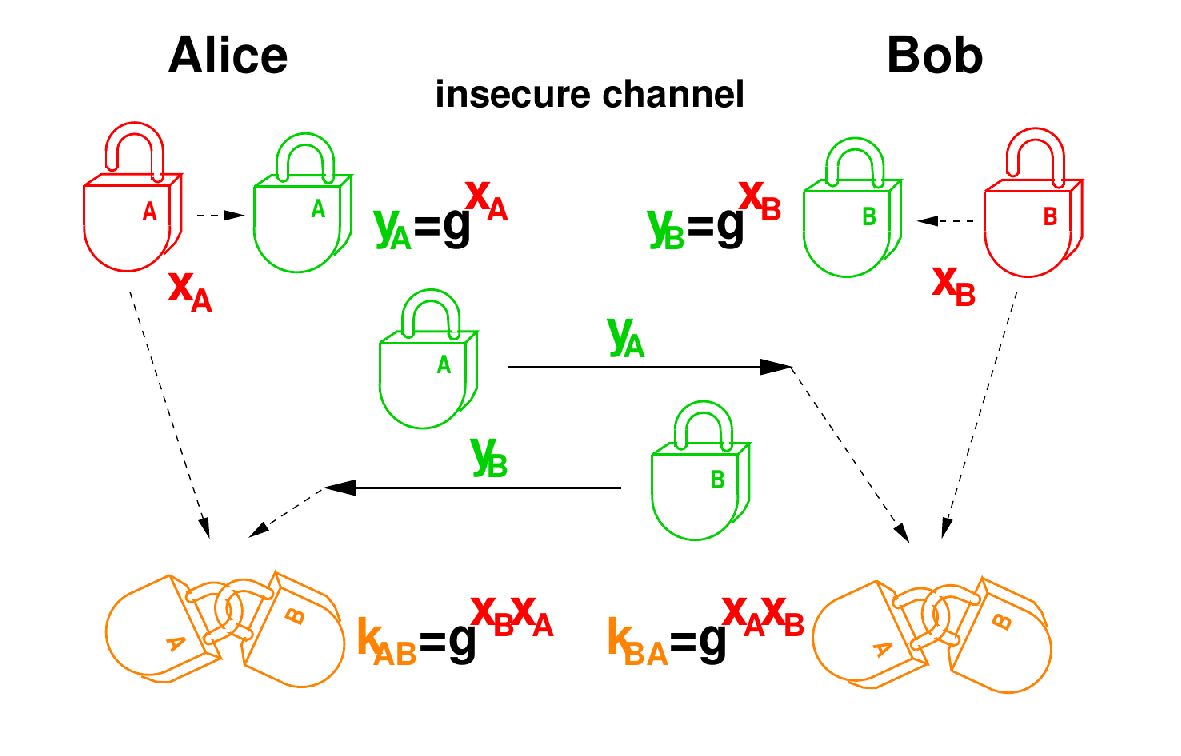
Field-by-field Comparison
| Field | Before | After |
|---|---|---|
| Front | Explain the mechanical analog of the Diffie-Hellman protocol. | |
| Back | <img src="paste-39931b24c512906843c903f461b7c1cc9f5a6685.jpg"> |
Note 306: ETH::DiskMat
Note Type: Cloze (with MathJax)
GUID:
NfXydu*6p1
Previous
Note did not exist
New Note
Front
Back
Field-by-field Comparison
| Field | Before | After |
|---|---|---|
| Text | An <i>operation</i> on a set \(S\) is {{c1::a function \(S^n \to S\), where \(n \ge 0\) is called the <i>arity</i> of the operation::what (include arity)?}}. |
Note 307: ETH::DiskMat
Note Type: Cloze (with MathJax)
GUID:
vpgCC{U)O3
Previous
Note did not exist
New Note
Front
Back
Field-by-field Comparison
| Field | Before | After |
|---|---|---|
| Text | A cyclic group of order \(n\) {{c1::is isomorphic to \(\langle \mathbb{Z}_n,\oplus)\), and hence commutative::has which useful property?}}. |
Note 308: ETH::DiskMat
Note Type: Cloze (with MathJax)
GUID:
zjw2>4!xI
Previous
Note did not exist
New Note
Front
Back
Field-by-field Comparison
| Field | Before | After |
|---|---|---|
| Text | \(\mathbb{Z}_m^* \stackrel{\text{def}}{=}\) {{c1::\(\{a\in \mathbb{Z}_m \mid \gcd(a,m) = 1\}\)}} |
Note 309: ETH::DiskMat
Note Type: Cloze (with MathJax)
GUID:
sQoa!PVGy1
Previous
Note did not exist
New Note
Front
Back
Not all element in Zm have an inverse, something which Zm* guarantees by bezout.
Field-by-field Comparison
| Field | Before | After |
|---|---|---|
| Text | \(\mathbb{Z}_m^*\) is useful compared to \(\mathbb{Z}_m\)because {{c1::\(\mathbb{Z}_m\)is not a group with respect to multiplication modulo \(m\), but we would like to have this for building RSA}}. | |
| Extra | Not all element in Zm have an inverse, something which Zm* guarantees by bezout. |
Note 310: ETH::DiskMat
Note Type: Cloze (with MathJax)
GUID:
i!A>I-](&
Previous
Note did not exist
New Note
Front
Back
This theorem is used for RSA.
Field-by-field Comparison
| Field | Before | After |
|---|---|---|
| Text | The Fermat-Euler theorem states that for all \(m\ge 2\) and all \(a\) with \(\gcd(a,m) = 1\),{{c1:: \[a^{\varphi(m)} \equiv_m 1\]and so in particular, for every prime \(p\) and every \(a\) not divisible by \(p\): \(a^{p-1} \equiv_p 1\).}} | |
| Extra | This theorem is used for RSA. |
Note 311: ETH::DiskMat
Note Type: Cloze (with MathJax)
GUID:
wxOSFQju/Y
Previous
Note did not exist
New Note
Front
Back
Field-by-field Comparison
| Field | Before | After |
|---|---|---|
| Text | For any prime \(p\), the Euler totient function \(\varphi(p)\) is equal to {{c1::\(p-1\)}}. |
Note 312: ETH::DiskMat
Note Type: Cloze (with MathJax)
GUID:
p1NkGJ>_F5
Previous
Note did not exist
New Note
Front
Back
Example: the characteristic of \(\langle \mathbb{Z}_m;\oplus,\ominus,0,\odot,1\rangle\)is \(m\).
Field-by-field Comparison
| Field | Before | After |
|---|---|---|
| Text | The <i>characteristic</i> of a ring is {{c1::the order of \(1\) in the additive group if it is finite, and 0 if it is infinite.}} | |
| Extra | Example: the characteristic of \(\langle \mathbb{Z}_m;\oplus,\ominus,0,\odot,1\rangle\)is \(m\). |
Note 313: ETH::DiskMat
Note Type: Cloze (with MathJax)
GUID:
grl{%W],MK
Previous
Note did not exist
New Note
Front
Back
Field-by-field Comparison
| Field | Before | After |
|---|---|---|
| Text | An element \(a\ne0\) of a commutative ring \(R\) is called a <i>zerodivisor</i> if {{c1:: \(ab=0\) for some \(b\ne0\) in \(R\)}}. |
Note 314: ETH::DiskMat
Note Type: Cloze (with MathJax)
GUID:
z`P{~ta];p
Previous
Note did not exist
New Note
Front
Back
Field-by-field Comparison
| Field | Before | After |
|---|---|---|
| Text | The degree of the polynomial \(0\) is defined as {{c1::\(-\infty\)}}. |
Note 315: ETH::DiskMat
Note Type: Basic-e0c2b
GUID:
e+8V~0_GeE
Previous
Note did not exist
New Note
Front
Back
Show that if \(a \not= b\) then under that assumption, if \(f(a) = f(b)\) we get a contradiction as this implies \(a = b\).
Example: \(f(x) = 2x\), then if \(a \not = b\) then if \(f(a) = f(b) \ \implies \ 2a = 2b\). This however \( \ \implies a = b\).
Field-by-field Comparison
| Field | Before | After |
|---|---|---|
| Front | How do I show the injectivity of a function? | |
| Back | Show that if \(a \not= b\) then under that assumption, if \(f(a) = f(b)\) we get a contradiction as this implies \(a = b\).<br><br><b>Example: </b>\(f(x) = 2x\), then if \(a \not = b\) then if \(f(a) = f(b) \ \implies \ 2a = 2b\). This however \( \ \implies a = b\). |
Note 316: ETH::DiskMat
Note Type: Basic-e0c2b
GUID:
E7<;U^~bFt
Previous
Note did not exist
New Note
Front
Back
As $9^{10} \equiv_{11} 1$ (see Fermat little theorem and 11 prime), we can reduce the exponent modulo $10$ (see Lagrange's theorem in chapter 5). Thus $R_{11}(9^{2024}) = R_{11}(9^{4}) = R_{11}(-2^{4}) = 5$.
For this to work however, we need the *number and the order of the group* (modulo remainder) to be *coprime*, i.e. $\gcd(9, 11) = 1$.
Field-by-field Comparison
| Field | Before | After |
|---|---|---|
| Front | Reduce \(R_{11}(9^{2024})\) | |
| Back | As $9^{10} \equiv_{11} 1$ (see Fermat little theorem and 11 prime), we can reduce the exponent modulo $10$ (see Lagrange's theorem in chapter 5). Thus $R_{11}(9^{2024}) = R_{11}(9^{4}) = R_{11}(-2^{4}) = 5$.<br><br>For this to work however, we need the *number and the order of the group* (modulo remainder) to be *coprime*, i.e. $\gcd(9, 11) = 1$.<div>If the modulus itself is prime then it always works and the order of the element can be used to reduce the exponent as 9^{11-1} = 1 by FLT.</div> |
Note 317: ETH::DiskMat
Note Type: Cloze-4da8d
GUID:
h:Z}faoBcQ
Previous
Note did not exist
New Note
Front
Back
Field-by-field Comparison
| Field | Before | After |
|---|---|---|
| Text | We can reduce the exponent \(a^m\) modulo \(n\) by {{c1::the \(\text{ord}(a)\)}} iff. {{c2::\(\gcd(a, n) = 1\), i.e. \(a\) and \(n\) are coprime}}. |
Note 318: ETH::DiskMat
Note Type: Basic-e0c2b
GUID:
gg+,r$i,o
Previous
Note did not exist
New Note
Front
Back
The group ℤ*_m is cyclic if and only if:
• \(m = 2\)
• \(m = 4\)
• \(m = p^e\) (where p is an odd prime and \(e ≥ 1\))
• \(m = 2p^e\) (where p is an odd prime and \(e ≥ 1\)) Example: Is \(\mathbb{Z}^*_{19}\) cyclic? What is a generator? Yes, \(\mathbb{Z}^*_{19}\) is cyclic (since \(19\) is an odd prime).
2 is a generator.
Powers of 2: 2, 4, 8, 16, 13, 7, 14, 9, 18, 17, 15, 11, 3, 6, 12, 5, 10, 1
Other generators: 3, 10, 13, 14, 15
Field-by-field Comparison
| Field | Before | After |
|---|---|---|
| Front | For what \(m\) is \(\mathbb{Z}^*_m\) cyclic? (Theorem 5.15) | |
| Back | The group ℤ*_m is cyclic if and only if:<br>• \(m = 2\)<br>• \(m = 4\)<br>• \(m = p^e\) (where p is an odd prime and \(e ≥ 1\))<br>• \(m = 2p^e\) (where p is an odd prime and \(e ≥ 1\)) Example: Is \(\mathbb{Z}^*_{19}\) cyclic? What is a generator? Yes, \(\mathbb{Z}^*_{19}\) is cyclic (since \(19\) is an odd prime).<br><br>2 is a generator.<br><br>Powers of 2: 2, 4, 8, 16, 13, 7, 14, 9, 18, 17, 15, 11, 3, 6, 12, 5, 10, 1<br><br>Other generators: 3, 10, 13, 14, 15 |
Note 319: ETH::DiskMat
Note Type: Basic-e0c2b
GUID:
sXwCtB@o/s
Previous
Note did not exist
New Note
Front
Back
All \(a \in \mathbb{Z}_n\) such that \(\gcd(a, n) = 1\).
Field-by-field Comparison
| Field | Before | After |
|---|---|---|
| Front | What \(a \in \mathbb{Z}_n\) generate \(\mathbb{Z}_n\)? | |
| Back | All \(a \in \mathbb{Z}_n\) such that \(\gcd(a, n) = 1\). |
Note 320: ETH::DiskMat
Note Type: Basic-e0c2b
GUID:
q+Di!TuDdT
Previous
Note did not exist
New Note
Front
Back
\(n\) has \(\# _ {\text{div}(n)} = \prod_{i = 1}^m (e_i + 1)\) divisors.
Field-by-field Comparison
| Field | Before | After |
|---|---|---|
| Front | How many divisors does \(n\) expressed as a factor of prime numbers \(n = \prod_{i = 1}^m p_i^{e_i}\) have? | |
| Back | \(n\) has \(\# _ {\text{div}(n)} = \prod_{i = 1}^m (e_i + 1)\) divisors. |
Note 321: ETH::DiskMat
Note Type: Basic-e0c2b
GUID:
d_Wm7Nf:G2
Previous
Note did not exist
New Note
Front
Back
We need to state that this is allowed by the fundamental theorem of arithmetic.
Field-by-field Comparison
| Field | Before | After |
|---|---|---|
| Front | What do we need to state before using the decomposition of an \(n \in \mathbb{Z}\) into prime factors? | |
| Back | We need to state that this is allowed by the fundamental theorem of arithmetic. |
Note 322: ETH::DiskMat
Note Type: Basic-e0c2b
GUID:
H*J4QbU35P
Previous
Note did not exist
New Note
Front
Back
I can do:
- \(a \equiv_n b\) and then \(a^x \equiv_n b^x\)
- \(a \equiv_n b\) and \(c \equiv_n d\) and then doing \(a^c \equiv_n b^d\)
Field-by-field Comparison
| Field | Before | After |
|---|---|---|
| Front | What exponentiation operation is valid in modular arithmetic? | |
| Back | I can do:<br><ul><li>\(a \equiv_n b\) and then \(a^x \equiv_n b^x\)<br></li></ul><div>What is illegal is:</div><div><ul><li>\(a \equiv_n b\) and \(c \equiv_n d\) and then doing \(a^c \equiv_n b^d\)</li></ul></div> |
Note 323: ETH::DiskMat
Note Type: Cloze-4da8d
GUID:
zkj+2s}Km%
Previous
Note did not exist
New Note
Front
Back
\(\text{gcd}(m, n - qm) = \text{gcd}(m,n) \), which is why reduction modulo \(m\) preserves the gcd, which is what makes Euclid's algorithm work.
Field-by-field Comparison
| Field | Before | After |
|---|---|---|
| Text | The gcd does <b>not</b> change if we {{c1:: subract a multiple of the first number from the second}}. | |
| Back Extra | \(\text{gcd}(m, n - qm) = \text{gcd}(m,n) \), which is why reduction modulo \(m\) preserves the gcd, which is what makes Euclid's algorithm work. |
Note 324: ETH::DiskMat
Note Type: Cloze (with MathJax)
GUID:
vi7xPhAi#`
Previous
Note did not exist
New Note
Front
A left neutral element (or identity element) of an algebra \(\langle S; * \rangle\) is an element \(e\) such that \(e * a = a\) for all \(a \in S\).
A right neutral element satisfies \(a * e = a\) for all \(a \in S\).
If \(e * a = a * e = a\) for all \(a \in S\), then \(e\) is simply called a neutral element.
Back
A left neutral element (or identity element) of an algebra \(\langle S; * \rangle\) is an element \(e\) such that \(e * a = a\) for all \(a \in S\).
A right neutral element satisfies \(a * e = a\) for all \(a \in S\).
If \(e * a = a * e = a\) for all \(a \in S\), then \(e\) is simply called a neutral element.
Field-by-field Comparison
| Field | Before | After |
|---|---|---|
| Text | <p>A {{c1::left neutral element}} (or {{c1::identity element}}) of an algebra \(\langle S; * \rangle\) is an element \({{c2::e}}\) such that {{c3::\(e * a = a\)}} for all \({{c4::a}} \in S\).</p> <p>A {{c1::right neutral element}} satisfies {{c2::\(a * e = a\)}} for all \({{c3::a}} \in S\).</p> <p>If {{c2::\(e * a = a * e = a\)}} for all \({{c3::a}} \in S\), then \({{c4::e}}\) is simply called a {{c1::neutral element}}.</p> |
Note 325: ETH::DiskMat
Note Type: Cloze (with MathJax)
GUID:
c.BJE1FC)A
Previous
Note did not exist
New Note
Front
A binary operation \(*\) on a set \(S\) is associative if \(a * (b * c) = (a * b) * c\) for all \(a, b, c\) in \(S\).
Back
A binary operation \(*\) on a set \(S\) is associative if \(a * (b * c) = (a * b) * c\) for all \(a, b, c\) in \(S\).
Field-by-field Comparison
| Field | Before | After |
|---|---|---|
| Text | <p>A binary operation \(*\) on a set \(S\) is {{c1::associative}} if {{c2::\(a * (b * c) = (a * b) * c\)}} for all \({{c3::a, b, c}}\) in \(S\).</p> |
Note 326: ETH::DiskMat
Note Type: Cloze (with MathJax)
GUID:
qi1M.
Previous
Note did not exist
New Note
Front
When an operation is associative, \(a_1 * a_2 * \dots * a_n\) is independent of the order of execution.
Back
When an operation is associative, \(a_1 * a_2 * \dots * a_n\) is independent of the order of execution.
Field-by-field Comparison
| Field | Before | After |
|---|---|---|
| Text | <p>When an operation is associative, \(a_1 * a_2 * \dots * a_n\) is {{c1::independent of the order of execution}}.</p> |
Note 327: ETH::DiskMat
Note Type: Basic (with MathJax)
GUID:
D0k7OAp
Previous
Note did not exist
New Note
Front
Back
Lemma 5.1: If \(\langle S; * \rangle\) has both a left and a right neutral element, then they are equal.
Field-by-field Comparison
| Field | Before | After |
|---|---|---|
| Front | What happens if there is a left and right neutral element in a group? | |
| Back | <p><strong>Lemma 5.1</strong>: If \(\langle S; * \rangle\) has both a left and a right neutral element, then they are <strong>equal</strong>.</p> |
Note 328: ETH::DiskMat
Note Type: Basic (with MathJax)
GUID:
uFN2l+&cfr
Previous
Note did not exist
New Note
Front
Can there be more than one neutral element?
Back
Can there be more than one neutral element?
\(\langle S; * \rangle\) can have at most one neutral element.
There can be a distinct left and right neutral though.
Field-by-field Comparison
| Field | Before | After |
|---|---|---|
| Front | <p>Can there be more than one neutral element?</p> | |
| Back | <p>\(\langle S; * \rangle\) can have <strong>at most one neutral element</strong>.</p><p><br></p><p>There can be a distinct left and right neutral though.</p> |
Note 329: ETH::DiskMat
Note Type: Basic (with MathJax)
GUID:
u${[$*iYrd
Previous
Note did not exist
New Note
Front
Does the uniqueness of the neutral element imply that a group is abelian (commutative)?
I.e. does a*e = e*a mean G is abelian?
Back
Does the uniqueness of the neutral element imply that a group is abelian (commutative)?
I.e. does a*e = e*a mean G is abelian?
No! The uniqueness of the neutral element does not imply commutativity.
Counterexample: The identity matrix \(I_3\) is the unique neutral element for the group of \(3 \times 3\) real matrices under multiplication. We have \(A \cdot I_3 = I_3 \cdot A\) for all matrices \(A\), even though matrix multiplication is not commutative in general.
Field-by-field Comparison
| Field | Before | After |
|---|---|---|
| Front | <p>Does the uniqueness of the neutral element imply that a group is abelian (commutative)?</p><br><br>I.e. does a*e = e*a mean G is abelian? | |
| Back | <p><strong>No!</strong> The uniqueness of the neutral element does <strong>not</strong> imply commutativity.</p><br><p><strong>Counterexample</strong>: The identity matrix \(I_3\) is the unique neutral element for the group of \(3 \times 3\) real matrices under multiplication. We have \(A \cdot I_3 = I_3 \cdot A\) for all matrices \(A\), even though matrix multiplication is <strong>not commutative</strong> in general.</p> |
Note 330: ETH::DiskMat
Note Type: Basic (with MathJax)
GUID:
lzYGHiH>1u
Previous
Note did not exist
New Note
Front
Give an example of a binary operation that is not associative and demonstrate why.
Back
Give an example of a binary operation that is not associative and demonstrate why.
Exponentiation on the integers is not associative.
Example:
- \((2^3)^2 = 8^2 = 64\)
- \(2^{(3^2)} = 2^9 = 512\)
Since \((2^3)^2 \neq 2^{(3^2)}\), exponentiation is not associative.
Field-by-field Comparison
| Field | Before | After |
|---|---|---|
| Front | <p>Give an example of a binary operation that is <strong>not</strong> associative and demonstrate why.</p> | |
| Back | <p><strong>Exponentiation</strong> on the integers is not associative.</p> <p><strong>Example</strong>:<br> - \((2^3)^2 = 8^2 = 64\)<br> - \(2^{(3^2)} = 2^9 = 512\)</p> <p>Since \((2^3)^2 \neq 2^{(3^2)}\), exponentiation is not associative.</p> |
Note 331: ETH::DiskMat
Note Type: Cloze (with MathJax)
GUID:
u`Y+W
Previous
Note did not exist
New Note
Front
A left inverse element of \(a\) in \(\langle S; *, e \rangle\) is an element \(b\) such that \(b * a = e\).
Back
A left inverse element of \(a\) in \(\langle S; *, e \rangle\) is an element \(b\) such that \(b * a = e\).
Field-by-field Comparison
| Field | Before | After |
|---|---|---|
| Text | <p>A {{c1::left inverse element}} of \(a\) in \(\langle S; *, e \rangle\) is an element \({{c2::b}}\) such that {{c3::\(b * a = e\)}}.</p> |
Note 332: ETH::DiskMat
Note Type: Cloze (with MathJax)
GUID:
iltVkN7$2X
Previous
Note did not exist
New Note
Front
A right inverse element of \(a\) in \(\langle S; *, e \rangle\) is an element \(b\) such that \(a * b = e\).
Back
A right inverse element of \(a\) in \(\langle S; *, e \rangle\) is an element \(b\) such that \(a * b = e\).
Field-by-field Comparison
| Field | Before | After |
|---|---|---|
| Text | <p>A {{c1::right inverse element}} of \(a\) in \(\langle S; *, e \rangle\) is an element \({{c2::b}}\) such that {{c3::\(a * b = e\)}}.</p> |
Note 333: ETH::DiskMat
Note Type: Cloze (with MathJax)
GUID:
s`dg
Previous
Note did not exist
New Note
Front
If both \(b * a = e\) and \(a * b = e\), then \(b\) is simply called an inverse of \(a\).
Back
If both \(b * a = e\) and \(a * b = e\), then \(b\) is simply called an inverse of \(a\).
Field-by-field Comparison
| Field | Before | After |
|---|---|---|
| Text | <p>If both {{c1::\(b * a = e\)}} and {{c2::\(a * b = e\)}}, then \({{c3::b}}\) is simply called an {{c4::inverse}} of \(a\).</p> |
Note 334: ETH::DiskMat
Note Type: Basic (with MathJax)
GUID:
C}sy0oyJ5m
Previous
Note did not exist
New Note
Front
Lemma about uniqueness of the inverse:
Back
Lemma about uniqueness of the inverse:
Lemma 5.2: In a monoid \(\langle M; *, e \rangle\), if \(a \in M\) has a left inverse and a right inverse, then they are equal. In particular, \(a\) has at most one inverse.
Field-by-field Comparison
| Field | Before | After |
|---|---|---|
| Front | <p>Lemma about uniqueness of the inverse:</p> | |
| Back | <p><strong>Lemma 5.2</strong>: In a monoid \(\langle M; *, e \rangle\), if \(a \in M\) has a left inverse and a right inverse, then they are <strong>equal</strong>. In particular, \(a\) has <strong>at most one inverse</strong>.</p> |
Note 335: ETH::DiskMat
Note Type: Cloze (with MathJax)
GUID:
Ma#P3o/Xx{
Previous
Note did not exist
New Note
Front
A group is an algebra \(\langle G; *, \widehat{\ \ }, e \rangle\) satisfying three axioms: G1 (associativity), G2 (neutral element), and G3 (inverse elements).
Back
A group is an algebra \(\langle G; *, \widehat{\ \ }, e \rangle\) satisfying three axioms: G1 (associativity), G2 (neutral element), and G3 (inverse elements).
Field-by-field Comparison
| Field | Before | After |
|---|---|---|
| Text | <p>A {{c1::group}} is an algebra \(\langle G; *, \widehat{\ \ }, e \rangle\) satisfying {{c2::three}} axioms: {{c3::G1 (associativity)}}, {{c4::G2 (neutral element)}}, and {{c5::G3 (inverse elements)}}.</p> |
Note 336: ETH::DiskMat
Note Type: Cloze (with MathJax)
GUID:
GE_=q.pKz`
Previous
Note did not exist
New Note
Front
Group axiom G1 states that the operation \(*\) is associative: \(a * (b * c) = (a * b) * c\) for all \(a, b, c\) in \(G\).
Back
Group axiom G1 states that the operation \(*\) is associative: \(a * (b * c) = (a * b) * c\) for all \(a, b, c\) in \(G\).
Field-by-field Comparison
| Field | Before | After |
|---|---|---|
| Text | <p>Group axiom <strong>G1</strong> states that the operation \(*\) is {{c1::associative}}: {{c2::\(a * (b * c) = (a * b) * c\)}} for all \(a, b, c\) in \(G\).</p> |
Note 337: ETH::DiskMat
Note Type: Cloze (with MathJax)
GUID:
FZV7*~vSAW
Previous
Note did not exist
New Note
Front
Group axiom G2 states that \(e\) is a neutral element: \(a * e = e * a = a\) for all \(a\) in \(G\).
Back
Group axiom G2 states that \(e\) is a neutral element: \(a * e = e * a = a\) for all \(a\) in \(G\).
Field-by-field Comparison
| Field | Before | After |
|---|---|---|
| Text | <p>Group axiom <strong>G2</strong> states that {{c1::\(e\) is a neutral element: \(a * e = e * a = a\)}} for all \(a\) in \(G\).</p> |
Note 338: ETH::DiskMat
Note Type: Cloze (with MathJax)
GUID:
C&Xw,j%hGf
Previous
Note did not exist
New Note
Front
Group axiom G3 states that {{c1::every element \(a\) in \(G\) has an inverse element \(\widehat{a}\) such that \(a * \widehat{a} = \widehat{a} * a = e\)}}.
Back
Group axiom G3 states that {{c1::every element \(a\) in \(G\) has an inverse element \(\widehat{a}\) such that \(a * \widehat{a} = \widehat{a} * a = e\)}}.
Field-by-field Comparison
| Field | Before | After |
|---|---|---|
| Text | <p>Group axiom {{c2::<strong>G3</strong>}} states that {{c1::every element \(a\) in \(G\) has an inverse element \(\widehat{a}\) such that \(a * \widehat{a} = \widehat{a} * a = e\)}}.</p> |
Note 339: ETH::DiskMat
Note Type: Cloze (with MathJax)
GUID:
oFF!4
Previous
Note did not exist
New Note
Front
A group \(\langle G; * \rangle\) (or monoid) is called commutative or abelian if \(a * b = b * a\) for all \(a, b \in G\).
Back
A group \(\langle G; * \rangle\) (or monoid) is called commutative or abelian if \(a * b = b * a\) for all \(a, b \in G\).
Field-by-field Comparison
| Field | Before | After |
|---|---|---|
| Text | <p>A group \(\langle G; * \rangle\) (or monoid) is called {{c1::commutative}} or {{c1::abelian}} if {{c2::\(a * b = b * a\)}} for all \({{c3::a, b}} \in G\).</p> |
Note 340: ETH::DiskMat
Note Type: Cloze (with MathJax)
GUID:
xH`d$W-97_
Previous
Note did not exist
New Note
Front
In a Group:
\(\widehat{(\widehat{a})} =\) \(a\) (inverse of inverse is the original element). This is a property from a Lemma.
Back
In a Group:
\(\widehat{(\widehat{a})} =\) \(a\) (inverse of inverse is the original element). This is a property from a Lemma.
Field-by-field Comparison
| Field | Before | After |
|---|---|---|
| Text | <p>In a Group:<br> \(\widehat{(\widehat{a})} =\){{c1:: \(a\) }} {{c1:: (inverse of inverse is the original element)}}. This is a property from a Lemma.</p> |
Note 341: ETH::DiskMat
Note Type: Cloze (with MathJax)
GUID:
C18gm]huq&
Previous
Note did not exist
New Note
Front
In a Group:
{{c1:: \(\widehat{a * b}\) }} = {{c2:: \(\widehat{b} * \widehat{a}\)}} This is a property from a Lemma.
Back
In a Group:
{{c1:: \(\widehat{a * b}\) }} = {{c2:: \(\widehat{b} * \widehat{a}\)}} This is a property from a Lemma.
Field-by-field Comparison
| Field | Before | After |
|---|---|---|
| Text | <p>In a Group:<br> {{c1:: \(\widehat{a * b}\) }} = {{c2:: \(\widehat{b} * \widehat{a}\)}} This is a property from a Lemma.</p> |
Note 342: ETH::DiskMat
Note Type: Cloze (with MathJax)
GUID:
G|6fl[78G`
Previous
Note did not exist
New Note
Front
To prove \(\langle G; * \rangle\) is a group, you need to prove three axioms:
- G1 (associativity)
- G2 (neutral element) G2' -> you only need to prove existence of a right neutral element (not a full two-sided neutral).
- G3 (inverse) G3' -> you only need to prove the existence of a right inverse
Back
To prove \(\langle G; * \rangle\) is a group, you need to prove three axioms:
- G1 (associativity)
- G2 (neutral element) G2' -> you only need to prove existence of a right neutral element (not a full two-sided neutral).
- G3 (inverse) G3' -> you only need to prove the existence of a right inverse
Field-by-field Comparison
| Field | Before | After |
|---|---|---|
| Text | <p>To prove \(\langle G; * \rangle\) is a group, you need to prove three axioms:<br> - {{c2::G1 (associativity)}}<br> - {{c3::G2 (neutral element) G2' -> you only need to prove existence of a right neutral element (not a full two-sided neutral).}}<br> - {{c4::G3 (inverse) G3' -> you only need to prove the existence of a right inverse}}</p> |
Note 343: ETH::DiskMat
Note Type: Cloze (with MathJax)
GUID:
s*8T*K?3f=
Previous
Note did not exist
New Note
Front
A function \(f: A \rightarrow A\) has a left inverse if and only if \(f\) is injective.
Back
A function \(f: A \rightarrow A\) has a left inverse if and only if \(f\) is injective.
Field-by-field Comparison
| Field | Before | After |
|---|---|---|
| Text | <p>A function \(f: A \rightarrow A\) has a {{c1::left inverse}} if and only if \(f\) is {{c2::injective}}.</p> |
Note 344: ETH::DiskMat
Note Type: Cloze (with MathJax)
GUID:
Mqpm#lUsGl
Previous
Note did not exist
New Note
Front
A function \(f: A \rightarrow A\) has a right inverse if and only if \(f\) is surjective.
Back
A function \(f: A \rightarrow A\) has a right inverse if and only if \(f\) is surjective.
Field-by-field Comparison
| Field | Before | After |
|---|---|---|
| Text | <p>A function \(f: A \rightarrow A\) has a {{c1::right inverse}} if and only if \(f\) is {{c2::surjective}}.</p> |
Note 345: ETH::DiskMat
Note Type: Cloze (with MathJax)
GUID:
HM@g5s7n?R
Previous
Note did not exist
New Note
Front
A function \(f: A \rightarrow A\) has an inverse \(f^{-1}\) if and only if \(f\) is bijective.
Back
A function \(f: A \rightarrow A\) has an inverse \(f^{-1}\) if and only if \(f\) is bijective.
Field-by-field Comparison
| Field | Before | After |
|---|---|---|
| Text | <p>A function \(f: A \rightarrow A\) has an {{c1::inverse}} \(f^{-1}\) if and only if \(f\) is {{c2::bijective}}.</p> |
Note 346: ETH::DiskMat
Note Type: Cloze (with MathJax)
GUID:
HbBihH#d!&
Previous
Note did not exist
New Note
Front
The direct product of \(n\) groups \(\langle G_1; *_1 \rangle, \dots, \langle G_n; *_n \rangle\) is the algebra \(\langle G_1 \times \dots \times G_n; \star \rangle\) where the operation \(\star\) is component-wise.
Back
The direct product of \(n\) groups \(\langle G_1; *_1 \rangle, \dots, \langle G_n; *_n \rangle\) is the algebra \(\langle G_1 \times \dots \times G_n; \star \rangle\) where the operation \(\star\) is component-wise.
Field-by-field Comparison
| Field | Before | After |
|---|---|---|
| Text | <p>The {{c1::direct product}} of \(n\) groups \(\langle G_1; *_1 \rangle, \dots, \langle G_n; *_n \rangle\) is the algebra {{c2::\(\langle G_1 \times \dots \times G_n; \star \rangle\)}} where the operation \(\star\) is {{c3::component-wise}}.</p> |
Note 347: ETH::DiskMat
Note Type: Basic (with MathJax)
GUID:
F5|a$AQwO,
Previous
Note did not exist
New Note
Front
Give an example of a direct product of groups and explain its structure.
Back
Give an example of a direct product of groups and explain its structure.
The group \(\langle \mathbb{Z}_5; \oplus \rangle \times \langle \mathbb{Z}_7; \oplus \rangle\):
- Carrier: \(\mathbb{Z}_5 \times \mathbb{Z}_7\)
- Neutral element: \((0, 0)\)
- Operation is component-wise: \((a, b) \star (c, d) = (a \oplus_5 c, b \oplus_7 d)\)
By the Chinese Remainder Theorem, this group is isomorphic to \(\langle \mathbb{Z}_{35}; \oplus \rangle\).
Field-by-field Comparison
| Field | Before | After |
|---|---|---|
| Front | <p>Give an example of a direct product of groups and explain its structure.</p> | |
| Back | <p>The group \(\langle \mathbb{Z}_5; \oplus \rangle \times \langle \mathbb{Z}_7; \oplus \rangle\):<br> - Carrier: \(\mathbb{Z}_5 \times \mathbb{Z}_7\)<br> - Neutral element: \((0, 0)\)<br> - Operation is component-wise: \((a, b) \star (c, d) = (a \oplus_5 c, b \oplus_7 d)\)</p> <p>By the <strong>Chinese Remainder Theorem</strong>, this group is isomorphic to \(\langle \mathbb{Z}_{35}; \oplus \rangle\).</p> |
Note 348: ETH::DiskMat
Note Type: Cloze (with MathJax)
GUID:
6o/GG^(~_
Previous
Note did not exist
New Note
Front
In a group, the left cancellation law states: \(a = b\) \(\Leftrightarrow\) \(ca = cb\).
Back
In a group, the left cancellation law states: \(a = b\) \(\Leftrightarrow\) \(ca = cb\).
Field-by-field Comparison
| Field | Before | After |
|---|---|---|
| Text | <p>In a group, the {{c1::left cancellation}} law states: \(a = b\) {{c2::\(\Leftrightarrow\)}} {{c3::\(ca = cb\)}}.</p> |
Note 349: ETH::DiskMat
Note Type: Cloze (with MathJax)
GUID:
DPl{@]cnAw
Previous
Note did not exist
New Note
Front
In a group, the right cancellation law states: \(a = b\) \(\Leftrightarrow\) \(ac = bc\).
Back
In a group, the right cancellation law states: \(a = b\) \(\Leftrightarrow\) \(ac = bc\).
Field-by-field Comparison
| Field | Before | After |
|---|---|---|
| Text | <p>In a group, the {{c1::right cancellation}} law states: \(a = b\) {{c2::\(\Leftrightarrow\)}} {{c3::\(ac = bc\)}}.</p> |
Note 350: ETH::DiskMat
Note Type: Cloze (with MathJax)
GUID:
uO>&}CGJV*
Previous
Note did not exist
New Note
Front
In a group's operation table, every row and every column must contain every element exactly once.
Back
In a group's operation table, every row and every column must contain every element exactly once.
Field-by-field Comparison
| Field | Before | After |
|---|---|---|
| Text | <p>In a group's operation table, every {{c1::row}} and every {{c1::column}} must contain {{c2::every element exactly once}}.</p> |
Note 351: ETH::DiskMat
Note Type: Cloze (with MathJax)
GUID:
qo:})x5a6`
Previous
Note did not exist
New Note
Front
In a group, the equations \(a * x = b\) and \(x * a = b\) have unique solutions for all \(a, b\) (property G3(v)).
Back
In a group, the equations \(a * x = b\) and \(x * a = b\) have unique solutions for all \(a, b\) (property G3(v)).
Field-by-field Comparison
| Field | Before | After |
|---|---|---|
| Text | <p>In a group, the equations \({{c1::a * x = b}}\) and \({{c2::x * a = b}}\) have {{c3::unique solutions}} for all \(a, b\) (property G3(v)).</p> |
Note 352: ETH::DiskMat
Note Type: Cloze (with MathJax)
GUID:
lx/&=nJI{d
Previous
Note did not exist
New Note
Front
The inverse in a group with addition is denoted \(-a\), and the inverse in a group with multiplication is denoted {{c2::\(a^{-1}\)}}.
If the operation is addition, the neutral element is usually denoted \(0\). If the operation is multiplication, the neutral element is denoted \(1\).
Back
The inverse in a group with addition is denoted \(-a\), and the inverse in a group with multiplication is denoted {{c2::\(a^{-1}\)}}.
If the operation is addition, the neutral element is usually denoted \(0\). If the operation is multiplication, the neutral element is denoted \(1\).
Field-by-field Comparison
| Field | Before | After |
|---|---|---|
| Text | <p>The inverse in a group with addition is denoted {{c1::\(-a\)}}, and the inverse in a group with multiplication is denoted {{c2::\(a^{-1}\)}}.</p> <p>If the operation is addition, the neutral element is usually denoted {{c3::\(0\)}}. If the operation is multiplication, the neutral element is denoted {{c4::\(1\)}}.</p> |
Note 353: ETH::DiskMat
Note Type: Cloze (with MathJax)
GUID:
oIQZcTr*H#
Previous
Note did not exist
New Note
Front
For two groups \(\langle G; *, \widehat{\ \ }, e \rangle\) and \(\langle H; \star, \tilde{\ \ }, e' \rangle\), a function \(\psi: G \rightarrow H\) is called a group homomorphism if for all \(a\) and \(b\): \[.
This means the operation can be applied before or after the function with the same result.
Back
For two groups \(\langle G; *, \widehat{\ \ }, e \rangle\) and \(\langle H; \star, \tilde{\ \ }, e' \rangle\), a function \(\psi: G \rightarrow H\) is called a group homomorphism if for all \(a\) and \(b\): \[.
This means the operation can be applied before or after the function with the same result.
Field-by-field Comparison
| Field | Before | After |
|---|---|---|
| Text | <p>For two groups \(\langle G; *, \widehat{\ \ }, e \rangle\) and \(\langle H; \star, \tilde{\ \ }, e' \rangle\), a function \(\psi: G \rightarrow H\) is called a {{c1::group homomorphism}} if {{c2:: for all \(a\) and \(b\): \[{{c2::\psi(a * b) = \psi(a) \star \psi(b)}}\]}}.</p> <p>This means the operation can be applied {{c3::before or after}} the function with the same result.</p> |
Note 354: ETH::DiskMat
Note Type: Cloze (with MathJax)
GUID:
oh?4Rvv7tZ
Previous
Note did not exist
New Note
Front
If \(\psi: G \rightarrow H\) is a bijection and a homomorphism, then it is called an isomorphism, and we say that \(G\) and \(H\) are isomorphic and write \(G \simeq H\).
Back
If \(\psi: G \rightarrow H\) is a bijection and a homomorphism, then it is called an isomorphism, and we say that \(G\) and \(H\) are isomorphic and write \(G \simeq H\).
Field-by-field Comparison
| Field | Before | After |
|---|---|---|
| Text | <p>If \(\psi: G \rightarrow H\) is a {{c1::bijection}} and a homomorphism, then it is called an {{c2::isomorphism}}, and we say that \(G\) and \(H\) are {{c2::isomorphic}} and write {{c2::\(G \simeq H\)}}.</p> |
Note 355: ETH::DiskMat
Note Type: Cloze (with MathJax)
GUID:
mH2hUq)MAg
Previous
Note did not exist
New Note
Front
Lemma 5.5(i): A group homomorphism \(\psi: G \rightarrow H\) maps the neutral element to the neutral element: \(\psi(e) = e'\).
Back
Lemma 5.5(i): A group homomorphism \(\psi: G \rightarrow H\) maps the neutral element to the neutral element: \(\psi(e) = e'\).
Field-by-field Comparison
| Field | Before | After |
|---|---|---|
| Text | <p><strong>Lemma 5.5(i)</strong>: A group homomorphism \(\psi: G \rightarrow H\) maps the neutral element to {{c1::the neutral element: \(\psi(e) = e'\)}}.</p> |
Note 356: ETH::DiskMat
Note Type: Cloze (with MathJax)
GUID:
MUE8!)s%
Previous
Note did not exist
New Note
Front
Lemma 5.5(ii): A group homomorphism \(\psi: G \rightarrow H\) maps inverses to {{c1::inverses: \(\psi(\widehat{a}) = \widetilde{\psi(a)}\)}} for all \(a\).
Back
Lemma 5.5(ii): A group homomorphism \(\psi: G \rightarrow H\) maps inverses to {{c1::inverses: \(\psi(\widehat{a}) = \widetilde{\psi(a)}\)}} for all \(a\).
Field-by-field Comparison
| Field | Before | After |
|---|---|---|
| Text | <p><strong>Lemma 5.5(ii)</strong>: A group homomorphism \(\psi: G \rightarrow H\) maps inverses to {{c1::inverses: \(\psi(\widehat{a}) = \widetilde{\psi(a)}\)}} for all \(a\).</p> |
Note 357: ETH::DiskMat
Note Type: Basic (with MathJax)
GUID:
C8cvZ0}Mn#
Previous
Note did not exist
New Note
Front
Give an example of a group homomorphism involving the logarithm function.
Back
Give an example of a group homomorphism involving the logarithm function.
The logarithm function is a group homomorphism from \(\langle \mathbb{R}^{>0}; \cdot \rangle\) to \(\langle \mathbb{R}; + \rangle\) because: \[\log(a \cdot b) = \log a + \log b\]
It's also an isomorphism because the logarithm is bijective on positive reals.
Field-by-field Comparison
| Field | Before | After |
|---|---|---|
| Front | <p>Give an example of a group homomorphism involving the logarithm function.</p> | |
| Back | <p>The logarithm function is a group homomorphism from \(\langle \mathbb{R}^{>0}; \cdot \rangle\) to \(\langle \mathbb{R}; + \rangle\) because: \[\log(a \cdot b) = \log a + \log b\]</p> <p>It's also an <strong>isomorphism</strong> because the logarithm is bijective on positive reals.</p> |
Note 358: ETH::DiskMat
Note Type: Basic (with MathJax)
GUID:
FMdIN{F>5c
Previous
Note did not exist
New Note
Front
Is the projection of points from \(\mathbb{R}^3\) to \(\mathbb{R}^2\) a homomorphism? Is it an isomorphism?
Back
Is the projection of points from \(\mathbb{R}^3\) to \(\mathbb{R}^2\) a homomorphism? Is it an isomorphism?
The projection is a homomorphism (it preserves the group operation of vector addition).
However, it is not an isomorphism because it's not a bijection (not injective - many 3D points project to the same 2D point).
Field-by-field Comparison
| Field | Before | After |
|---|---|---|
| Front | <p>Is the projection of points from \(\mathbb{R}^3\) to \(\mathbb{R}^2\) a homomorphism? Is it an isomorphism?</p> | |
| Back | <p>The projection is a <strong>homomorphism</strong> (it preserves the group operation of vector addition).</p> <p>However, it is <strong>not an isomorphism</strong> because it's not a bijection (not injective - many 3D points project to the same 2D point).</p> |
Note 359: ETH::DiskMat
Note Type: Cloze (with MathJax)
GUID:
zKcmqH!B|+
Previous
Note did not exist
New Note
Front
To prove \(\phi: G \rightarrow H\) is an isomorphism, you must verify two main properties:
- \(\phi\) is a homomorphism
- \(\phi\) is a bijection.
Back
To prove \(\phi: G \rightarrow H\) is an isomorphism, you must verify two main properties:
- \(\phi\) is a homomorphism
- \(\phi\) is a bijection.
Field-by-field Comparison
| Field | Before | After |
|---|---|---|
| Text | <p>To prove \(\phi: G \rightarrow H\) is an {{c2:: isomorphism}}, you must verify two main properties:<br /> - \(\phi\) is a {{c1::homomorphism}}<br /> - \(\phi\) is a {{c1::bijection}}.</p> |
Note 360: ETH::DiskMat
Note Type: Cloze (with MathJax)
GUID:
Mz.H046~kk
Previous
Note did not exist
New Note
Front
To verify the homomorphism property, check that: \(\phi(g_1 \cdot g_2) = \phi(g_1) + \phi(g_2)\) for all \(g_1, g_2\) in \(G\).
Back
To verify the homomorphism property, check that: \(\phi(g_1 \cdot g_2) = \phi(g_1) + \phi(g_2)\) for all \(g_1, g_2\) in \(G\).
Field-by-field Comparison
| Field | Before | After |
|---|---|---|
| Text | <p>To verify the {{c1::homomorphism property}}, check that: {{c2::\(\phi(g_1 \cdot g_2) = \phi(g_1) + \phi(g_2)\)}} for all \(g_1, g_2\) in \(G\).</p> |
Note 361: ETH::DiskMat
Note Type: Basic (with MathJax)
GUID:
bzpi*}NRv1
Previous
Note did not exist
New Note
Front
Does every homomorphism have to be injective? Give an example.
Back
Does every homomorphism have to be injective? Give an example.
No, homomorphisms do not need to be injective.
Example: We could map all elements of \(G\) to the neutral element \(e'\) in \(H\). This satisfies the homomorphism property: \[\psi(a * b) = e' = e' \star e' = \psi(a) \star \psi(b)\] but is clearly not injective.
Field-by-field Comparison
| Field | Before | After |
|---|---|---|
| Front | <p>Does every homomorphism have to be injective? Give an example.</p> | |
| Back | <p><strong>No</strong>, homomorphisms do not need to be injective.</p> <p><strong>Example</strong>: We could map all elements of \(G\) to the neutral element \(e'\) in \(H\). This satisfies the homomorphism property: \[\psi(a * b) = e' = e' \star e' = \psi(a) \star \psi(b)\] but is clearly not injective.</p> |
Note 362: ETH::DiskMat
Note Type: Cloze (with MathJax)
GUID:
pL8pp7+)x{
Previous
Note did not exist
New Note
Front
For a homomorphism \(h: G \rightarrow H\), the kernel \(\ker h\) is the set of all elements mapped to the neutral element (essentially the nullspace).
Back
For a homomorphism \(h: G \rightarrow H\), the kernel \(\ker h\) is the set of all elements mapped to the neutral element (essentially the nullspace).
Field-by-field Comparison
| Field | Before | After |
|---|---|---|
| Text | <p>For a homomorphism \(h: G \rightarrow H\), the {{c1::kernel \(\ker h\)}} is the set of all elements mapped to the {{c2::neutral element}} (essentially the {{c2::nullspace}}).</p> |
Note 363: ETH::DiskMat
Note Type: Cloze (with MathJax)
GUID:
BA!Uj{h&4e
Previous
Note did not exist
New Note
Front
For a homomorphism \(h: G \rightarrow H\), the {{c1::image \(\text{im} h\)}} is the set of all elements in \(H\) that are mapped to by some element in \(G\).
Back
For a homomorphism \(h: G \rightarrow H\), the {{c1::image \(\text{im} h\)}} is the set of all elements in \(H\) that are mapped to by some element in \(G\).
Field-by-field Comparison
| Field | Before | After |
|---|---|---|
| Text | <p>For a homomorphism \(h: G \rightarrow H\), the {{c1::image \(\text{im} h\)}} is the {{c2::set of all elements in \(H\) that are mapped to by some element in \(G\)}}.</p> |
Note 364: ETH::DiskMat
Note Type: Basic (with MathJax)
GUID:
B7f%iVC#KH
Previous
Note did not exist
New Note
Front
What does it mean intuitively for two groups to be isomorphic?
Back
What does it mean intuitively for two groups to be isomorphic?
Two groups are isomorphic if they have the same structure - they "behave identically" even if they look different.
Analogy: Like two jigsaw puzzles that look completely different, but use the same cutout pattern. The same piece goes into the same place on both puzzles.
The bijection between them preserves all group operations and relationships.
Field-by-field Comparison
| Field | Before | After |
|---|---|---|
| Front | <p>What does it mean intuitively for two groups to be isomorphic?</p> | |
| Back | <p>Two groups are isomorphic if they have the <strong>same structure</strong> - they "behave identically" even if they look different.</p> <p><strong>Analogy</strong>: Like two jigsaw puzzles that look completely different, but use the same cutout pattern. The same piece goes into the same place on both puzzles.</p> <p>The bijection between them preserves all group operations and relationships.</p> |
Note 365: ETH::DiskMat
Note Type: Basic (with MathJax)
GUID:
p$?:uS#|X
Previous
Note did not exist
New Note
Front
In a homomorphism \(\psi: G \rightarrow H\), does it matter whether you apply the operation before or after applying the function?
Back
In a homomorphism \(\psi: G \rightarrow H\), does it matter whether you apply the operation before or after applying the function?
No, it doesn't matter! That's exactly what defines a homomorphism:
\[\psi(a *_G b) = \psi(a) *_H \psi(b)\]
You get the same result whether you:
- First operate in \(G\), then map to \(H\), OR
- First map both elements to \(H\), then operate in \(H\)
Field-by-field Comparison
| Field | Before | After |
|---|---|---|
| Front | <p>In a homomorphism \(\psi: G \rightarrow H\), does it matter whether you apply the operation before or after applying the function?</p> | |
| Back | <p><strong>No</strong>, it doesn't matter! That's exactly what defines a homomorphism:</p> <p>\[\psi(a *_G b) = \psi(a) *_H \psi(b)\]</p> <p>You get the same result whether you:<br> - First operate in \(G\), then map to \(H\), OR<br> - First map both elements to \(H\), then operate in \(H\)</p> |
Note 366: ETH::DiskMat
Note Type: Cloze (with MathJax)
GUID:
.d,WRJq.}
Previous
Note did not exist
New Note
Front
A subset \(H \subseteq G\) of a group is called a subgroup if \(H\) is: closed with respect to all operations (operation, neutral, inverse).
Back
A subset \(H \subseteq G\) of a group is called a subgroup if \(H\) is: closed with respect to all operations (operation, neutral, inverse).
Field-by-field Comparison
| Field | Before | After |
|---|---|---|
| Text | <p>A subset \(H \subseteq G\) of a group is called a {{c1::subgroup}} if \(H\) is: {{c2::closed with respect to all operations (operation, neutral, inverse)}}.</p> |
Note 367: ETH::DiskMat
Note Type: Cloze (with MathJax)
GUID:
j]Gy^>$7h+
Previous
Note did not exist
New Note
Front
For \(H\) to be a subgroup, the neutral element must be in \(H\): \(e \in H\).
Back
For \(H\) to be a subgroup, the neutral element must be in \(H\): \(e \in H\).
Field-by-field Comparison
| Field | Before | After |
|---|---|---|
| Text | <p>For \(H\) to be a subgroup, the {{c1::neutral element}} must be in \(H\): {{c1::\(e \in H\)}}.</p> |
Note 368: ETH::DiskMat
Note Type: Cloze (with MathJax)
GUID:
N9}Teh]+={
Previous
Note did not exist
New Note
Front
For \(H\) to be a subgroup, it must have closure under inverses: {{c2:: \(\widehat{a} \in H\) for all \(a \in H\)}}.
Back
For \(H\) to be a subgroup, it must have closure under inverses: {{c2:: \(\widehat{a} \in H\) for all \(a \in H\)}}.
Field-by-field Comparison
| Field | Before | After |
|---|---|---|
| Text | <p>For \(H\) to be a subgroup, it must have {{c1::closure under inverses}}: {{c2:: \(\widehat{a} \in H\) for all \({{c3::a \in H}}\)}}.</p> |
Note 369: ETH::DiskMat
Note Type: Cloze (with MathJax)
GUID:
CL8*F@7NV5
Previous
Note did not exist
New Note
Front
For any group \(G\), there exist two trivial subgroups:
- {{c2::The set \(\{e\}\) (containing only the neutral element)}}
- \(G\) itself
Back
For any group \(G\), there exist two trivial subgroups:
- {{c2::The set \(\{e\}\) (containing only the neutral element)}}
- \(G\) itself
Field-by-field Comparison
| Field | Before | After |
|---|---|---|
| Text | <!-- Card 38: Trivial Subgroups (Cloze) --> <p>For any group \(G\), there exist two trivial subgroups:<br /> - {{c2::The set \(\{e\}\) (containing only the neutral element)}}<br /> - {{c3::\(G\) itself}}</p> |
Note 370: ETH::DiskMat
Note Type: Basic (with MathJax)
GUID:
xp_U|[rM*4
Previous
Note did not exist
New Note
Front
List all subgroups of \(\mathbb{Z}_{12}\).
Back
List all subgroups of \(\mathbb{Z}_{12}\).
The subgroups of \(\mathbb{Z}_{12}\) are:
- \(\{0\}\) (trivial subgroup)
- \(\{0, 6\}\)
- \(\{0, 4, 8\}\)
- \(\{0, 3, 6, 9\}\)
- \(\{0, 2, 4, 6, 8, 10\}\)
- \(\mathbb{Z}_{12}\) (trivial subgroup - the whole group)
Field-by-field Comparison
| Field | Before | After |
|---|---|---|
| Front | <p>List all subgroups of \(\mathbb{Z}_{12}\).</p> | |
| Back | <p>The subgroups of \(\mathbb{Z}_{12}\) are:<br> - \(\{0\}\) (trivial subgroup)<br> - \(\{0, 6\}\)<br> - \(\{0, 4, 8\}\)<br> - \(\{0, 3, 6, 9\}\)<br> - \(\{0, 2, 4, 6, 8, 10\}\)<br> - \(\mathbb{Z}_{12}\) (trivial subgroup - the whole group)</p> |
Note 371: ETH::DiskMat
Note Type: Basic (with MathJax)
GUID:
hgLWI9eF!L
Previous
Note did not exist
New Note
Front
Why is closure important when verifying that \(H\) is a subgroup of \(G\)?
Back
Why is closure important when verifying that \(H\) is a subgroup of \(G\)?
Closure ensures that when you apply operations within \(H\), you stay within \(H\).
Without closure:
- \(a * b\) might not be in \(H\) (operation closure)
- \(\widehat{a}\) might not be in \(H\) (inverse closure)
- The neutral element \(e\) might not be in \(H\)
If \(H\) lacks closure, it cannot form a group on its own.
Field-by-field Comparison
| Field | Before | After |
|---|---|---|
| Front | <p>Why is closure important when verifying that \(H\) is a subgroup of \(G\)?</p> | |
| Back | <p>Closure ensures that when you apply operations within \(H\), you <strong>stay within</strong> \(H\).</p> <p>Without closure:<br> - \(a * b\) might not be in \(H\) (operation closure)<br> - \(\widehat{a}\) might not be in \(H\) (inverse closure)<br> - The neutral element \(e\) might not be in \(H\)</p> <p>If \(H\) lacks closure, it cannot form a group on its own.</p> |
Note 372: ETH::DiskMat
Note Type: Cloze (with MathJax)
GUID:
PI2pek)9t%
Previous
Note did not exist
New Note
Front
In a group, \(a^0\) is defined as the identity element \(e\).
Back
In a group, \(a^0\) is defined as the identity element \(e\).
Field-by-field Comparison
| Field | Before | After |
|---|---|---|
| Text | <p>In a group, \({{c1::a^0}}\) is defined as the {{c2::identity element}} \({{c3::e}}\).</p> |
Note 373: ETH::DiskMat
Note Type: Cloze (with MathJax)
GUID:
G#]T4?!iZs
Previous
Note did not exist
New Note
Front
In a group, for \(n \geq 1\), the positive power is defined recursively: {{c1::\(a^n = \cdot a^{n-1}\)}}.
Back
In a group, for \(n \geq 1\), the positive power is defined recursively: {{c1::\(a^n = \cdot a^{n-1}\)}}.
Field-by-field Comparison
| Field | Before | After |
|---|---|---|
| Text | <p>In a group, for \(n \geq 1\), the positive power is defined recursively: {{c1::\(a^n = \cdot a^{n-1}\)}}.</p> |
Note 374: ETH::DiskMat
Note Type: Basic (with MathJax)
GUID:
jbk$(]c7J_
Previous
Note did not exist
New Note
Front
What is the order of \(\text{ord}(a)\) for \(a \in G\) in a group?
Back
What is the order of \(\text{ord}(a)\) for \(a \in G\) in a group?
Let \(G\) be a group and let \(a\) be an element of \(G\). The order of \(a\), denoted \(\text{ord}(a)\), is the least \(m \geq 1\) such that \(a^m = e\), if such an \(m\) exists: \[\text{ord}(a) = \min \{n \geq 1 \ | \ a^n = e\} \cup \{\infty\}\]
If no such \(m\) exists, \(G\)0 is said to be infinite, written \(G\)1.
Field-by-field Comparison
| Field | Before | After |
|---|---|---|
| Front | <p>What is the order of \(\text{ord}(a)\) for \(a \in G\) in a group?</p> | |
| Back | <p>Let \(G\) be a group and let \(a\) be an element of \(G\). The order of \(a\), denoted \(\text{ord}(a)\), is the least \(m \geq 1\) such that \(a^m = e\), if such an \(m\) exists: \[\text{ord}(a) = \min \{n \geq 1 \ | \ a^n = e\} \cup \{\infty\}\]</p> <p>If no such \(m\) exists, \(G\)0 is said to be infinite, written \(G\)1.</p> |
Note 375: ETH::DiskMat
Note Type: Cloze (with MathJax)
GUID:
uaVso1SVrk
Previous
Note did not exist
New Note
Front
If no \(m\) exists, such that \(a^m = e\) in a group, the order \(\text{ord}(a)\) of \(a\) is {{c1:: said to be infinite, written \(\text{ord}(a) = \infty\)}}.
Back
If no \(m\) exists, such that \(a^m = e\) in a group, the order \(\text{ord}(a)\) of \(a\) is {{c1:: said to be infinite, written \(\text{ord}(a) = \infty\)}}.
Field-by-field Comparison
| Field | Before | After |
|---|---|---|
| Text | <p>If {{c2:: no \(m\) exists, such that \(a^m = e\) in a group}}, the order \(\text{ord}(a)\) of \(a\) is {{c1:: said to be infinite, written \(\text{ord}(a) = \infty\)}}.</p> |
Note 376: ETH::DiskMat
Note Type: Cloze (with MathJax)
GUID:
HI{+|nsE+a
Previous
Note did not exist
New Note
Front
The order \(\text{ord}(e)\) of \(e \in G\) is 1 by definition.
Back
The order \(\text{ord}(e)\) of \(e \in G\) is 1 by definition.
Field-by-field Comparison
| Field | Before | After |
|---|---|---|
| Text | <p>The order \(\text{ord}(e)\) of \(e \in G\) is {{c1:: 1 by definition}}.</p> |
Note 377: ETH::DiskMat
Note Type: Cloze (with MathJax)
GUID:
hJb:YVj|nK
Previous
Note did not exist
New Note
Front
If {{c2:: the order \(\text{ord}(a)\) of \(a \in G\) is 2}}, a is it's own self-inverse.
Back
If {{c2:: the order \(\text{ord}(a)\) of \(a \in G\) is 2}}, a is it's own self-inverse.
Field-by-field Comparison
| Field | Before | After |
|---|---|---|
| Text | <p>If {{c2:: the order \(\text{ord}(a)\) of \(a \in G\) is 2}}, {{c1:: a is it's own self-inverse}}.</p> |
Note 378: ETH::DiskMat
Note Type: Cloze (with MathJax)
GUID:
m=x|N12mNI
Previous
Note did not exist
New Note
Front
If {{c2:: the order \(\text{ord}(a)\) of \(a \in G\) is \(|G|\)}}, it has "volle Ordung".
Back
If {{c2:: the order \(\text{ord}(a)\) of \(a \in G\) is \(|G|\)}}, it has "volle Ordung".
Field-by-field Comparison
| Field | Before | After |
|---|---|---|
| Text | <p>If {{c2:: the order \(\text{ord}(a)\) of \(a \in G\) is \(|G|\)}}, {{c1:: it has "volle Ordung"}}.</p> |
Note 379: ETH::DiskMat
Note Type: Cloze (with MathJax)
GUID:
PU}Z|agcHs
Previous
Note did not exist
New Note
Front
For a finite group \(G\), \(|G|\) is called the order of \(G\).
Back
For a finite group \(G\), \(|G|\) is called the order of \(G\).
Field-by-field Comparison
| Field | Before | After |
|---|---|---|
| Text | <p>For a finite group \(G\), {{c1::\(|G|\)}} is called the {{c2::order of \(G\)}}.</p> |
Note 380: ETH::DiskMat
Note Type: Basic (with MathJax)
GUID:
hAzQO,E_+E
Previous
Note did not exist
New Note
Front
What is the order of elements in finite groups.
Back
What is the order of elements in finite groups.
Lemma 5.6: In a finite group \(G\), every element has a finite order.
(This doesn't hold for infinite groups - elements can have infinite order.)
Field-by-field Comparison
| Field | Before | After |
|---|---|---|
| Front | <p>What is the order of elements in finite groups.</p> | |
| Back | <p><strong>Lemma 5.6</strong>: In a <strong>finite group</strong> \(G\), every element has a <strong>finite order</strong>.</p> <p>(This doesn't hold for infinite groups - elements can have infinite order.)</p> |
Note 381: ETH::DiskMat
Note Type: Basic (with MathJax)
GUID:
cV1b,==V*(
Previous
Note did not exist
New Note
Front
Give an example of an element with infinite order.
Back
Give an example of an element with infinite order.
In the group \(\langle \mathbb{Z}; + \rangle\), any integer \(a \neq 0\) has infinite order.
Explanation: The carrier \(\mathbb{Z}\) is infinite, and we never "loop around" to reach \(0\) by repeatedly adding a non-zero integer. For any \(n \geq 1\), we have \(na \neq 0\) if \(a \neq 0\).
Field-by-field Comparison
| Field | Before | After |
|---|---|---|
| Front | <p>Give an example of an element with infinite order.</p> | |
| Back | <p>In the group \(\langle \mathbb{Z}; + \rangle\), any integer \(a \neq 0\) has <strong>infinite order</strong>.</p> <p><strong>Explanation</strong>: The carrier \(\mathbb{Z}\) is infinite, and we never "loop around" to reach \(0\) by repeatedly adding a non-zero integer. For any \(n \geq 1\), we have \(na \neq 0\) if \(a \neq 0\).</p> |
Note 382: ETH::DiskMat
Note Type: Cloze (with MathJax)
GUID:
hx=y:u%$sF
Previous
Note did not exist
New Note
Front
Front
By what can we reduce the exponent of an element in a finite order Group?
Back
In a group \(G\) of finite order, for \(a \in G\): \[a^m = a^{{{c1::R_{\text{ord}(a)}(m)}}}\]
This holds because {{c2::\(a^m = a^{m + \text{ord}(a)} = a^m \cdot a^{\text{ord}(a)} = a^m \cdot e = a^m\)}}.
Back
Front
By what can we reduce the exponent of an element in a finite order Group?
Back
In a group \(G\) of finite order, for \(a \in G\): \[a^m = a^{{{c1::R_{\text{ord}(a)}(m)}}}\]
This holds because {{c2::\(a^m = a^{m + \text{ord}(a)} = a^m \cdot a^{\text{ord}(a)} = a^m \cdot e = a^m\)}}.
Field-by-field Comparison
| Field | Before | After |
|---|---|---|
| Text | <h1>Front</h1> <p>By what can we reduce the exponent of an element in a <strong>finite order</strong> Group?</p> <h1>Back</h1> <p>In a group \(G\) of finite order, for \(a \in G\): \[a^m = a^{{{c1::R_{\text{ord}(a)}(m)}}}\]</p> <p>This holds because {{c2::\(a^m = a^{m + \text{ord}(a)} = a^m \cdot a^{\text{ord}(a)} = a^m \cdot e = a^m\)}}.</p> |
Note 383: ETH::DiskMat
Note Type: Basic (with MathJax)
GUID:
N,%,xCUm($
Previous
Note did not exist
New Note
Front
What is the group generated by a, denoted \(\langle a \rangle\) defined as?
Back
What is the group generated by a, denoted \(\langle a \rangle\) defined as?
For a group \(G\) and \(a \in G\), the group generated by \(a\), denoted \(\langle a \rangle\), is defined as: \[\langle a \rangle \ \overset{\text{def}}{=} \ \{a^n \ | \ n \in \mathbb{Z}\}\]
This is a group, the smallest subgroup of \(G\) containing the element \(a\).
For finite groups: \(\langle a \rangle = \{e, a, a^2, \dots, a^{\text{ord}(a)-1}\}\).
Field-by-field Comparison
| Field | Before | After |
|---|---|---|
| Front | <p>What is the group <em>generated by a</em>, denoted \(\langle a \rangle\) defined as?</p> | |
| Back | <p>For a group \(G\) and \(a \in G\), the group generated by \(a\), denoted \(\langle a \rangle\), is defined as: \[\langle a \rangle \ \overset{\text{def}}{=} \ \{a^n \ | \ n \in \mathbb{Z}\}\]</p> <p>This is a group, the smallest subgroup of \(G\) containing the element \(a\).</p> <p>For finite groups: \(\langle a \rangle = \{e, a, a^2, \dots, a^{\text{ord}(a)-1}\}\).</p> |
Note 384: ETH::DiskMat
Note Type: Cloze (with MathJax)
GUID:
vRto[%;el{
Previous
Note did not exist
New Note
Front
The smallest subgroup of a group \(G\) containing \(a \in G\) is the group generated by \(a\), \(\langle a \rangle\).
Back
The smallest subgroup of a group \(G\) containing \(a \in G\) is the group generated by \(a\), \(\langle a \rangle\).
Field-by-field Comparison
| Field | Before | After |
|---|---|---|
| Text | <p>The {{c2:: smallest}} subgroup of a group \(G\) containing \(a \in G\) is {{c1:: the group <em>generated by \(a\)</em>, \(\langle a \rangle\)}}.</p> |
Note 385: ETH::DiskMat
Note Type: Cloze (with MathJax)
GUID:
H*rUl{%/Iu
Previous
Note did not exist
New Note
Front
We denote the group generated by \(a\) as \(\langle a \rangle\).
Back
We denote the group generated by \(a\) as \(\langle a \rangle\).
Field-by-field Comparison
| Field | Before | After |
|---|---|---|
| Text | <p>We denote the {{c2:: group generated}} by \(a\) as {{c1:: \(\langle a \rangle\)}}.</p> |
Note 386: ETH::DiskMat
Note Type: Basic (with MathJax)
GUID:
G3,dI)){d{
Previous
Note did not exist
New Note
Front
Which elements generate \(\mathbb{Z}_n\)?
Back
Which elements generate \(\mathbb{Z}_n\)?
\(\mathbb{Z}_n\) is generated by all \(a \in \mathbb{Z}_n\) for which \(\gcd(n, a) = 1\) (all elements coprime to \(n\)).
Proof idea:
- If \(\mathbb{Z}_n = \langle a \rangle\), then \(1 \in \langle a \rangle\)
- This means \(au \equiv_n 1\) for some \(u\)
- By Bézout's identity, this implies \(\gcd(a, n) = 1\)
Field-by-field Comparison
| Field | Before | After |
|---|---|---|
| Front | <p>Which elements generate \(\mathbb{Z}_n\)?</p> | |
| Back | <p>\(\mathbb{Z}_n\) is generated by <strong>all \(a \in \mathbb{Z}_n\) for which \(\gcd(n, a) = 1\)</strong> (all elements coprime to \(n\)).</p> <p><strong>Proof idea</strong>:<br> - If \(\mathbb{Z}_n = \langle a \rangle\), then \(1 \in \langle a \rangle\)<br> - This means \(au \equiv_n 1\) for some \(u\)<br> - By Bézout's identity, this implies \(\gcd(a, n) = 1\)</p> |
Note 387: ETH::DiskMat
Note Type: Cloze (with MathJax)
GUID:
op}IVwoXF>
Previous
Note did not exist
New Note
Front
A group \(G = \) \(\langle g \rangle\) generated by an element \(g\) is called cyclic.
Back
A group \(G = \) \(\langle g \rangle\) generated by an element \(g\) is called cyclic.
Field-by-field Comparison
| Field | Before | After |
|---|---|---|
| Text | <p>A group \(G = \) {{c2:: \(\langle g \rangle\) generated by an element}} \(g\) is called {{c1::cyclic}}.</p> |
Note 388: ETH::DiskMat
Note Type: Cloze (with MathJax)
GUID:
rMrK0z!nVO
Previous
Note did not exist
New Note
Front
In a cyclic group \(\langle g \rangle\), associativity is inherited from the parent group \(G\).
Back
In a cyclic group \(\langle g \rangle\), associativity is inherited from the parent group \(G\).
Field-by-field Comparison
| Field | Before | After |
|---|---|---|
| Text | <p>In a cyclic group \(\langle g \rangle\), {{c1::associativity}} is {{c2::inherited}} from the parent group \({{c3::G}}\).</p> |
Note 389: ETH::DiskMat
Note Type: Cloze (with MathJax)
GUID:
KE]BoQ-4oe
Previous
Note did not exist
New Note
Front
The neutral element is always in \(\langle g \rangle\) because \(g^0 = e\).
Back
The neutral element is always in \(\langle g \rangle\) because \(g^0 = e\).
Field-by-field Comparison
| Field | Before | After |
|---|---|---|
| Text | <p>The {{c1::neutral element}} is always in \(\langle g \rangle\) because {{c2::\(g^0 = e\)}}.</p> |
Note 390: ETH::DiskMat
Note Type: Cloze (with MathJax)
GUID:
Q~CcPI;l0U
Previous
Note did not exist
New Note
Front
In a cyclic group, the inverse of \(a^n\) is {{c2::\(a^{-n}\)}}.
Back
In a cyclic group, the inverse of \(a^n\) is {{c2::\(a^{-n}\)}}.
Field-by-field Comparison
| Field | Before | After |
|---|---|---|
| Text | <p>In a cyclic group, the {{c1::inverse}} of \(a^n\) is {{c2::\(a^{-n}\)}}.</p> |
Note 391: ETH::DiskMat
Note Type: Cloze (with MathJax)
GUID:
Gdk~1PL`6=
Previous
Note did not exist
New Note
Front
A cyclic group can have more than one generator.
Back
A cyclic group can have more than one generator.
Field-by-field Comparison
| Field | Before | After |
|---|---|---|
| Text | <p>A cyclic group can have {{c1::more than one}} {{c2::generator}}.</p> |
Note 392: ETH::DiskMat
Note Type: Basic (with MathJax)
GUID:
JOM4&m6Z&$
Previous
Note did not exist
New Note
Front
What is a cyclic group of order \(n\) isomorphic to?
Back
What is a cyclic group of order \(n\) isomorphic to?
Theorem 5.7: A cyclic group of order \(n\) is isomorphic to \(\langle \mathbb{Z}_n; \oplus \rangle\) (and hence abelian).
This means all cyclic groups of the same order have the same structure.
Field-by-field Comparison
| Field | Before | After |
|---|---|---|
| Front | <p>What is a cyclic group of order \(n\) isomorphic to?</p> | |
| Back | <p><strong>Theorem 5.7</strong>: A cyclic group of order \(n\) is <strong>isomorphic</strong> to \(\langle \mathbb{Z}_n; \oplus \rangle\) (and hence <strong>abelian</strong>).</p> <p>This means all cyclic groups of the same order have the same structure.</p> |
Note 393: ETH::DiskMat
Note Type: Basic (with MathJax)
GUID:
eS{U|$mPp_
Previous
Note did not exist
New Note
Front
What is a special property of the group \(\langle \mathbb{Z}_n; \oplus \rangle\) for all \(n\)?
Back
What is a special property of the group \(\langle \mathbb{Z}_n; \oplus \rangle\) for all \(n\)?
It is abelian!
Field-by-field Comparison
| Field | Before | After |
|---|---|---|
| Front | <p>What is a special property of the group \(\langle \mathbb{Z}_n; \oplus \rangle\) for all \(n\)?</p> | |
| Back | <p>It is <strong>abelian</strong>!</p> |
Note 394: ETH::DiskMat
Note Type: Cloze (with MathJax)
GUID:
EDPL:,`:xZ
Previous
Note did not exist
New Note
Front
The group {{c2:: \(\langle \mathbb{Z}_n; \oplus \rangle\)}} is generated by \(1\).
Back
The group {{c2:: \(\langle \mathbb{Z}_n; \oplus \rangle\)}} is generated by \(1\).
Field-by-field Comparison
| Field | Before | After |
|---|---|---|
| Text | <p>The group {{c2:: \(\langle \mathbb{Z}_n; \oplus \rangle\)}} is generated by {{c1:: \(1\)}}.</p> |
Note 395: ETH::DiskMat
Note Type: Cloze (with MathJax)
GUID:
zK!1=,UI{i
Previous
Note did not exist
New Note
Front
All generators of {{c2:: \(\langle \mathbb{Z}_n; \oplus \rangle\)}} are coprime to \(n\).
Back
All generators of {{c2:: \(\langle \mathbb{Z}_n; \oplus \rangle\)}} are coprime to \(n\).
Field-by-field Comparison
| Field | Before | After |
|---|---|---|
| Text | <p>All generators of {{c2:: \(\langle \mathbb{Z}_n; \oplus \rangle\)}} are {{c1:: <strong>coprime</strong> to \(n\)}}.</p> |
Note 396: ETH::DiskMat
Note Type: Basic (with MathJax)
GUID:
m+a(a1n4{R
Previous
Note did not exist
New Note
Front
State Lagrange's Theorem (Theorem 5.8).
Back
State Lagrange's Theorem (Theorem 5.8).
Theorem 5.8 (Lagrange's Theorem): Let \(G\) be a finite group and let \(H\) be a subgroup of \(G\). Then the order of \(H\) divides the order of \(G\), i.e., \(|H|\) divides \(|G|\).
Written: \(|H| \ | \ |G|\)
Field-by-field Comparison
| Field | Before | After |
|---|---|---|
| Front | <p>State Lagrange's Theorem (Theorem 5.8).</p> | |
| Back | <p><strong>Theorem 5.8 (Lagrange's Theorem)</strong>: Let \(G\) be a finite group and let \(H\) be a subgroup of \(G\). Then the order of \(H\) <strong>divides</strong> the order of \(G\), i.e., \(|H|\) divides \(|G|\).</p> <p>Written: \(|H| \ | \ |G|\)</p> |
Note 397: ETH::DiskMat
Note Type: Basic (with MathJax)
GUID:
D:fQHHFS8g
Previous
Note did not exist
New Note
Front
State Corollary 5.9 about the relationship between element order and group order for a finite group \(G\).
Back
State Corollary 5.9 about the relationship between element order and group order for a finite group \(G\).
Corollary 5.9: For a finite group \(G\), the order of every element divides the group order, i.e., \(\text{ord}(a)\) divides \(|G|\) for every \(a \in G\).
Proof: \(\langle a \rangle\) is a subgroup of \(G\) of order \(\text{ord}(a)\), which by Lagrange's Theorem must divide \(|G|\).
Field-by-field Comparison
| Field | Before | After |
|---|---|---|
| Front | <p>State Corollary 5.9 about the relationship between element order and group order for a finite group \(G\).</p> | |
| Back | <p><strong>Corollary 5.9</strong>: For a finite group \(G\), the order of every element <strong>divides</strong> the group order, i.e., \(\text{ord}(a)\) divides \(|G|\) for every \(a \in G\).</p> <p><strong>Proof</strong>: \(\langle a \rangle\) is a subgroup of \(G\) of order \(\text{ord}(a)\), which by Lagrange's Theorem must divide \(|G|\).</p> |
Note 398: ETH::DiskMat
Note Type: Cloze (with MathJax)
GUID:
eQKQ_hr,6l
Previous
Note did not exist
New Note
Front
We have the order {{c1::\(\text{ord}(a)\)}} = \(|\langle a \rangle|\).
Back
We have the order {{c1::\(\text{ord}(a)\)}} = \(|\langle a \rangle|\).
Field-by-field Comparison
| Field | Before | After |
|---|---|---|
| Text | <p>We have the order {{c1::\(\text{ord}(a)\)}} = {{c2::\(|\langle a \rangle|\)}}.</p> |
Note 399: ETH::DiskMat
Note Type: Basic (with MathJax)
GUID:
f_%oe]V2X6
Previous
Note did not exist
New Note
Front
State Corollary 5.10 about raising elements to the power of the group order.
Back
State Corollary 5.10 about raising elements to the power of the group order.
Corollary 5.10: Let \(G\) be a finite group. Then \(a^{|G|} = e\) for every \(a \in G\).
Proof: By Corollary 5.9, \(|G| = k \cdot \text{ord}(a)\) for some \(k\). Thus: \[a^{|G|} = a^{k \cdot \text{ord}(a)} = (a^{\text{ord}(a)})^k = e^k = e\]
Field-by-field Comparison
| Field | Before | After |
|---|---|---|
| Front | <p>State Corollary 5.10 about raising elements to the power of the group order.</p> | |
| Back | <p><strong>Corollary 5.10</strong>: Let \(G\) be a finite group. Then \(a^{|G|} = e\) for every \(a \in G\).</p> <p><strong>Proof</strong>: By Corollary 5.9, \(|G| = k \cdot \text{ord}(a)\) for some \(k\). Thus: \[a^{|G|} = a^{k \cdot \text{ord}(a)} = (a^{\text{ord}(a)})^k = e^k = e\]</p> |
Note 400: ETH::DiskMat
Note Type: Basic (with MathJax)
GUID:
jngIBgkHz<
Previous
Note did not exist
New Note
Front
State Corollary 5.11 about groups of prime order (what property, waht does each element satisfy).
Back
State Corollary 5.11 about groups of prime order (what property, waht does each element satisfy).
Corollary 5.11: Every group of prime order is cyclic, and in such a group every element except the neutral element is a generator.
Proof: Only \(1 | p\) and \(p | p\) for \(p\) prime. So for \(a \in G\), either \(\text{ord}(a) = 1\) (meaning \(a = e\)) or \(\text{ord}(a) = p\) (meaning \(a\) generates the whole group).
Field-by-field Comparison
| Field | Before | After |
|---|---|---|
| Front | <p>State Corollary 5.11 about groups of prime order (what property, waht does each element satisfy).</p> | |
| Back | <p><strong>Corollary 5.11</strong>: Every group of <strong>prime order</strong> is cyclic, and in such a group <strong>every element except the neutral element is a generator</strong>.</p> <p><strong>Proof</strong>: Only \(1 | p\) and \(p | p\) for \(p\) prime. So for \(a \in G\), either \(\text{ord}(a) = 1\) (meaning \(a = e\)) or \(\text{ord}(a) = p\) (meaning \(a\) generates the whole group).</p> |
Note 401: ETH::DiskMat
Note Type: Basic (with MathJax)
GUID:
c
Previous
Note did not exist
New Note
Front
For what order is every group cyclic?
Back
For what order is every group cyclic?
If the order of the group is prime, it is cyclic!
Field-by-field Comparison
| Field | Before | After |
|---|---|---|
| Front | <p>For what order is every group cyclic?</p> | |
| Back | <p>If the <strong>order of the group</strong> is <strong>prime</strong>, it is cyclic!</p> |
Note 402: ETH::DiskMat
Note Type: Cloze (with MathJax)
GUID:
S^AYekncO
Previous
Note did not exist
New Note
Front
We use {{c1::\(\langle \mathbb{Z}_n; \oplus \rangle\)}} as our standard notation for cyclic groups of order \(n\).
Back
We use {{c1::\(\langle \mathbb{Z}_n; \oplus \rangle\)}} as our standard notation for cyclic groups of order \(n\).
Field-by-field Comparison
| Field | Before | After |
|---|---|---|
| Text | <p>We use {{c1::\(\langle \mathbb{Z}_n; \oplus \rangle\)}} as our standard notation for cyclic groups of order \(n\).</p> |
Note 403: ETH::DiskMat
Note Type: Cloze (with MathJax)
GUID:
tm=T&mwo5w
Previous
Note did not exist
New Note
Front
The group denoted by \(\mathbb{Z}_n\) is always meant in conjunction with the operation \(\oplus\) modulo \(n\).
Back
The group denoted by \(\mathbb{Z}_n\) is always meant in conjunction with the operation \(\oplus\) modulo \(n\).
Field-by-field Comparison
| Field | Before | After |
|---|---|---|
| Text | <p>The group denoted by \(\mathbb{Z}_n\) is always meant in conjunction with the operation {{c2::\(\oplus\) modulo \(n\)}}.</p> |
Note 404: ETH::DiskMat
Note Type: Cloze (with MathJax)
GUID:
zqVqxXe~xC
Previous
Note did not exist
New Note
Front
The group \(\mathbb{Z}_n\) also only contains the positive numbers up to \(n\) \(\{0, 1, 2, \dots, n-1\}\), as the negatives \(\{-n+1, \dots, -2, -1\}\) are equal to a positive number \(\equiv_n\).
Back
The group \(\mathbb{Z}_n\) also only contains the positive numbers up to \(n\) \(\{0, 1, 2, \dots, n-1\}\), as the negatives \(\{-n+1, \dots, -2, -1\}\) are equal to a positive number \(\equiv_n\).
Field-by-field Comparison
| Field | Before | After |
|---|---|---|
| Text | <p>The group \(\mathbb{Z}_n\) also {{c3::only contains the positive numbers up to \(n\)}} \(\{0, 1, 2, \dots, n-1\}\), as the negatives \(\{-n+1, \dots, -2, -1\}\) are equal to a positive number \(\equiv_n\).</p> |
Note 405: ETH::DiskMat
Note Type: Cloze (with MathJax)
GUID:
k3`On,s-[c
Previous
Note did not exist
New Note
Front
The generators of \(\langle \mathbb{Z}_n; \oplus \rangle\) are all \(g \in \mathbb{Z}_n\) for which \(\gcd(g, n) = 1\) (i.e., \(g\) is coprime to \(n\)).
The group \(\langle \mathbb{Z}_n; \oplus \rangle\) is cyclic for every \(n\), where \(1\) is always a generator.
Back
The generators of \(\langle \mathbb{Z}_n; \oplus \rangle\) are all \(g \in \mathbb{Z}_n\) for which \(\gcd(g, n) = 1\) (i.e., \(g\) is coprime to \(n\)).
The group \(\langle \mathbb{Z}_n; \oplus \rangle\) is cyclic for every \(n\), where \(1\) is always a generator.
Field-by-field Comparison
| Field | Before | After |
|---|---|---|
| Text | <p>The generators of \(\langle \mathbb{Z}_n; \oplus \rangle\) are all \(g \in \mathbb{Z}_n\) for which {{c1::\(\gcd(g, n) = 1\)}} (i.e., \(g\) is {{c2::coprime}} to \(n\)).</p> <p>The group \(\langle \mathbb{Z}_n; \oplus \rangle\) is cyclic for every \(n\), where {{c3::\(1\)}} is always a generator.</p> |
Note 406: ETH::DiskMat
Note Type: Basic (with MathJax)
GUID:
omy86HKbVn
Previous
Note did not exist
New Note
Front
Is \(\langle \mathbb{Z}_n; \oplus \rangle\) abelian (commutative)?
Back
Is \(\langle \mathbb{Z}_n; \oplus \rangle\) abelian (commutative)?
Yes, \(\langle \mathbb{Z}_n; \oplus \rangle\) is abelian because addition modulo \(n\) is commutative: \[a \oplus b = (a + b) \bmod n = (b + a) \bmod n = b \oplus a\]
Field-by-field Comparison
| Field | Before | After |
|---|---|---|
| Front | <p>Is \(\langle \mathbb{Z}_n; \oplus \rangle\) abelian (commutative)?</p> | |
| Back | <p><strong>Yes</strong>, \(\langle \mathbb{Z}_n; \oplus \rangle\) is <strong>abelian</strong> because addition modulo \(n\) is commutative: \[a \oplus b = (a + b) \bmod n = (b + a) \bmod n = b \oplus a\]</p> |
Note 407: ETH::DiskMat
Note Type: Cloze (with MathJax)
GUID:
sxW-Trt$`+
Previous
Note did not exist
New Note
Front
Front
\(\mathbb{Z}_m^*\) is defined as?
Back
\[ \overset{\text{def}}{=} \ \{a \in \mathbb{Z}_m \ | \ \gcd(a, m) = 1\} \]
This is the set of all elements in \(\mathbb{Z}_m\) that are coprime to \(m\).
Back
Front
\(\mathbb{Z}_m^*\) is defined as?
Back
\[ \overset{\text{def}}{=} \ \{a \in \mathbb{Z}_m \ | \ \gcd(a, m) = 1\} \]
This is the set of all elements in \(\mathbb{Z}_m\) that are coprime to \(m\).
Field-by-field Comparison
| Field | Before | After |
|---|---|---|
| Text | <h1>Front</h1> <p>\(\mathbb{Z}_m^*\) is defined as?</p> <h1>Back</h1> <p>\[ \overset{\text{def}}{=} \ \{a \in \mathbb{Z}_m \ | \ \gcd(a, m) = 1\} \]</p> <p>This is the set of all elements in \(\mathbb{Z}_m\) that are {{c2::coprime}} to \(m\).</p> |
Note 408: ETH::DiskMat
Note Type: Cloze (with MathJax)
GUID:
q|}rXYFly~
Previous
Note did not exist
New Note
Front
The Euler function \(\varphi: \mathbb{Z}^+ \rightarrow \mathbb{Z}^+\) is defined as {{c2::the cardinality of \(\mathbb{Z}_m^*\): \[\varphi(m) = |\mathbb{Z}_m^*|\]}}.
Back
The Euler function \(\varphi: \mathbb{Z}^+ \rightarrow \mathbb{Z}^+\) is defined as {{c2::the cardinality of \(\mathbb{Z}_m^*\): \[\varphi(m) = |\mathbb{Z}_m^*|\]}}.
Field-by-field Comparison
| Field | Before | After |
|---|---|---|
| Text | <p>The {{c1::Euler function}} \(\varphi: \mathbb{Z}^+ \rightarrow \mathbb{Z}^+\) is defined as {{c2::the cardinality of \(\mathbb{Z}_m^*\): \[\varphi(m) = |\mathbb{Z}_m^*|\]}}.</p> |
Note 409: ETH::DiskMat
Note Type: Cloze (with MathJax)
GUID:
G&Y|dtr7^k
Previous
Note did not exist
New Note
Front
Front
If the prime factorization of \(m\) is \(m = \prod_{i=1}^r p_i^{e_i}\) then \(\varphi(m)\) is?
Back
\[\varphi(m) = \prod_{i=1}^r (p_i - 1)p_i^{e_i - 1}\]
For a prime \(p\) and \(e \geq 1\): \[\varphi(p^e) = {{c2::p^{e-1}(p-1)}}\]
This comes from the fact that for prime \(p\) and \(e \geq 1\) we have \[ \varphi(p^e) = p^{e-1}(p - 1) \]since exactly every \[\varphi(p^e) = {{c2::p^{e-1}(p-1)}}\]0th integer in \[\varphi(p^e) = {{c2::p^{e-1}(p-1)}}\]1 contains a factor \[\varphi(p^e) = {{c2::p^{e-1}(p-1)}}\]2 and thus \[\varphi(p^e) = {{c2::p^{e-1}(p-1)}}\]3 elements don't contain a factor \[\varphi(p^e) = {{c2::p^{e-1}(p-1)}}\]4, i.e. are in \[\varphi(p^e) = {{c2::p^{e-1}(p-1)}}\]5.
Since the \[\varphi(p^e) = {{c2::p^{e-1}(p-1)}}\]6's are pairwise relatively prime (obviously) by the CRT we have that \[\varphi(p^e) = {{c2::p^{e-1}(p-1)}}\]7. This holds as the CRT allows us to establish a bijection between each \[\varphi(p^e) = {{c2::p^{e-1}(p-1)}}\]8 and a unique tuple \[\varphi(p^e) = {{c2::p^{e-1}(p-1)}}\]9 where \[ \varphi(p^e) = p^{e-1}(p - 1) \]0.
Back
Front
If the prime factorization of \(m\) is \(m = \prod_{i=1}^r p_i^{e_i}\) then \(\varphi(m)\) is?
Back
\[\varphi(m) = \prod_{i=1}^r (p_i - 1)p_i^{e_i - 1}\]
For a prime \(p\) and \(e \geq 1\): \[\varphi(p^e) = {{c2::p^{e-1}(p-1)}}\]
This comes from the fact that for prime \(p\) and \(e \geq 1\) we have \[ \varphi(p^e) = p^{e-1}(p - 1) \]since exactly every \[\varphi(p^e) = {{c2::p^{e-1}(p-1)}}\]0th integer in \[\varphi(p^e) = {{c2::p^{e-1}(p-1)}}\]1 contains a factor \[\varphi(p^e) = {{c2::p^{e-1}(p-1)}}\]2 and thus \[\varphi(p^e) = {{c2::p^{e-1}(p-1)}}\]3 elements don't contain a factor \[\varphi(p^e) = {{c2::p^{e-1}(p-1)}}\]4, i.e. are in \[\varphi(p^e) = {{c2::p^{e-1}(p-1)}}\]5.
Since the \[\varphi(p^e) = {{c2::p^{e-1}(p-1)}}\]6's are pairwise relatively prime (obviously) by the CRT we have that \[\varphi(p^e) = {{c2::p^{e-1}(p-1)}}\]7. This holds as the CRT allows us to establish a bijection between each \[\varphi(p^e) = {{c2::p^{e-1}(p-1)}}\]8 and a unique tuple \[\varphi(p^e) = {{c2::p^{e-1}(p-1)}}\]9 where \[ \varphi(p^e) = p^{e-1}(p - 1) \]0.
Field-by-field Comparison
| Field | Before | After |
|---|---|---|
| Text | <h1>Front</h1> <p>If the prime factorization of \(m\) is \(m = \prod_{i=1}^r p_i^{e_i}\) then \(\varphi(m)\) is?</p> <h1>Back</h1> <p>\[\varphi(m) = \prod_{i=1}^r (p_i - 1)p_i^{e_i - 1}\]</p> <p>For a prime \(p\) and \(e \geq 1\): \[\varphi(p^e) = {{c2::p^{e-1}(p-1)}}\]</p> <p>This comes from the fact that for prime \(p\) and \(e \geq 1\) we have \[ \varphi(p^e) = p^{e-1}(p - 1) \]since exactly every \[\varphi(p^e) = {{c2::p^{e-1}(p-1)}}\]0th integer in \[\varphi(p^e) = {{c2::p^{e-1}(p-1)}}\]1 contains a factor \[\varphi(p^e) = {{c2::p^{e-1}(p-1)}}\]2 and thus \[\varphi(p^e) = {{c2::p^{e-1}(p-1)}}\]3 elements don't contain a factor \[\varphi(p^e) = {{c2::p^{e-1}(p-1)}}\]4, i.e. are in \[\varphi(p^e) = {{c2::p^{e-1}(p-1)}}\]5.<br> Since the \[\varphi(p^e) = {{c2::p^{e-1}(p-1)}}\]6's are pairwise relatively prime (obviously) by the CRT we have that \[\varphi(p^e) = {{c2::p^{e-1}(p-1)}}\]7. This holds as the CRT allows us to establish a bijection between each \[\varphi(p^e) = {{c2::p^{e-1}(p-1)}}\]8 and a unique tuple \[\varphi(p^e) = {{c2::p^{e-1}(p-1)}}\]9 where \[ \varphi(p^e) = p^{e-1}(p - 1) \]0.</p> |
Note 410: ETH::DiskMat
Note Type: Basic (with MathJax)
GUID:
eJwT]j&5OY
Previous
Note did not exist
New Note
Front
Why do we need \(\mathbb{Z}_m^*\) for multiplication, rather than just using \(\mathbb{Z}_m\)?
Back
Why do we need \(\mathbb{Z}_m^*\) for multiplication, rather than just using \(\mathbb{Z}_m\)?
\(\mathbb{Z}_m\) (with \(\oplus\)) is not a group with respect to multiplication modulo \(m\) because elements that are not coprime to \(m\) don't have a multiplicative inverse.
For example, in \(\mathbb{Z}_6\), the element \(2\) has no multiplicative inverse because \(\gcd(2, 6) = 2 \neq 1\).
Thus we need \(\mathbb{Z}_m^*\) (elements coprime to \(m\)) to form a group with \(\odot\) (multiplication mod \(\oplus\)0).
Field-by-field Comparison
| Field | Before | After |
|---|---|---|
| Front | <p>Why do we need \(\mathbb{Z}_m^*\) for multiplication, rather than just using \(\mathbb{Z}_m\)?</p> | |
| Back | <p>\(\mathbb{Z}_m\) (with \(\oplus\)) is <strong>not a group</strong> with respect to multiplication modulo \(m\) because elements that are <strong>not coprime</strong> to \(m\) don't have a <strong>multiplicative inverse</strong>.</p> <p>For example, in \(\mathbb{Z}_6\), the element \(2\) has no multiplicative inverse because \(\gcd(2, 6) = 2 \neq 1\).</p> <p>Thus we need \(\mathbb{Z}_m^*\) (elements coprime to \(m\)) to form a group with \(\odot\) (multiplication mod \(\oplus\)0).</p> |
Note 411: ETH::DiskMat
Note Type: Basic (with MathJax)
GUID:
ivOfI913lL
Previous
Note did not exist
New Note
Front
Is \(\mathbb{Z}_m^*\) a group?.
Back
Is \(\mathbb{Z}_m^*\) a group?.
Theorem 5.13: \(\langle \mathbb{Z}_m^*; \odot, \text{ }^{-1}, 1 \rangle\) is a group.
Proof idea: For \(a, b \in \mathbb{Z}_m^*\), if \(\gcd(a, m) = 1\) and \(\gcd(b, m) = 1\), then \(\gcd(ab, m) = 1\). Thus the group is closed under multiplication.
Field-by-field Comparison
| Field | Before | After |
|---|---|---|
| Front | <p>Is \(\mathbb{Z}_m^*\) a group?.</p> | |
| Back | <p><strong>Theorem 5.13</strong>: \(\langle \mathbb{Z}_m^*; \odot, \text{ }^{-1}, 1 \rangle\) is a <strong>group</strong>.</p> <p><strong>Proof idea</strong>: For \(a, b \in \mathbb{Z}_m^*\), if \(\gcd(a, m) = 1\) and \(\gcd(b, m) = 1\), then \(\gcd(ab, m) = 1\). Thus the group is closed under multiplication.</p> |
Note 412: ETH::DiskMat
Note Type: Basic (with MathJax)
GUID:
FSUY[I=V>]
Previous
Note did not exist
New Note
Front
State Fermat's Little Theorem (Corollary 5.14) (both totient and prime):
Back
State Fermat's Little Theorem (Corollary 5.14) (both totient and prime):
Corollary 5.14 (Fermat's Little Theorem): For all \(m \geq 2\) and all \(a\) with \(\gcd(a, m) = 1\): \[a^{\varphi(m)} \equiv_m 1\]
In particular, for every prime \(p\) and every \(a\) not divisible by \(p\): \[a^{p-1} \equiv_p 1\]
Proof: This follows from Corollary 5.10 (\(a^{|G|} = e\)) since the order of \(\mathbb{Z}_m^*\) is \[a^{p-1} \equiv_p 1\]0 (and \[a^{p-1} \equiv_p 1\]1 for prime \[a^{p-1} \equiv_p 1\]2).
Field-by-field Comparison
| Field | Before | After |
|---|---|---|
| Front | <p>State Fermat's Little Theorem (Corollary 5.14) (both totient and prime):</p> | |
| Back | <p><strong>Corollary 5.14 (Fermat's Little Theorem)</strong>: For all \(m \geq 2\) and all \(a\) with \(\gcd(a, m) = 1\): \[a^{\varphi(m)} \equiv_m 1\]</p> <p>In particular, for every prime \(p\) and every \(a\) not divisible by \(p\): \[a^{p-1} \equiv_p 1\]</p> <p><strong>Proof</strong>: This follows from Corollary 5.10 (\(a^{|G|} = e\)) since the order of \(\mathbb{Z}_m^*\) is \[a^{p-1} \equiv_p 1\]0 (and \[a^{p-1} \equiv_p 1\]1 for prime \[a^{p-1} \equiv_p 1\]2).</p> |
Note 413: ETH::DiskMat
Note Type: Basic (with MathJax)
GUID:
m5H0_vW**A
Previous
Note did not exist
New Note
Front
Compute \(\varphi(60)\) using the prime factorization method.
Back
Compute \(\varphi(60)\) using the prime factorization method.
First, find the prime factorization: \(60 = 2^2 \cdot 3 \cdot 5\)
\[\varphi(60) = \varphi(2^2) \cdot \varphi(3) \cdot \varphi(5)\]
\[= 2^{2-1}(2-1) \cdot 3^{1-1}(3-1) \cdot 5^{1-1}(5-1)\]
\[= 2 \cdot 1 \cdot 1 \cdot 2 \cdot 1 \cdot 4 = 2 \cdot 2 \cdot 4 = 16\]
So \(\varphi(60) = 16\).
Field-by-field Comparison
| Field | Before | After |
|---|---|---|
| Front | <p>Compute \(\varphi(60)\) using the prime factorization method.</p> | |
| Back | <p>First, find the prime factorization: \(60 = 2^2 \cdot 3 \cdot 5\)</p> <p>\[\varphi(60) = \varphi(2^2) \cdot \varphi(3) \cdot \varphi(5)\]</p> <p>\[= 2^{2-1}(2-1) \cdot 3^{1-1}(3-1) \cdot 5^{1-1}(5-1)\]</p> <p>\[= 2 \cdot 1 \cdot 1 \cdot 2 \cdot 1 \cdot 4 = 2 \cdot 2 \cdot 4 = 16\]</p> <p>So \(\varphi(60) = 16\).</p> |
Note 414: ETH::DiskMat
Note Type: Basic (with MathJax)
GUID:
PjfIvXynOi
Previous
Note did not exist
New Note
Front
Which group operations work for \(\mathbb{Z}_m\) and \(\mathbb{Z}_m^*\)?
Back
Which group operations work for \(\mathbb{Z}_m\) and \(\mathbb{Z}_m^*\)?
| \(\mathbb{Z}_m\) | \(\mathbb{Z}_m^*\) | |
|---|---|---|
| \(\oplus\) | Yes (forms a group) | No |
| \(\odot\) | No | Yes (forms a group) |
Key point: \(\mathbb{Z}_m\) with addition \(\oplus\) is a group. \(\mathbb{Z}_m^*\) (coprime elements) with multiplication \(\odot\) is a group.
Field-by-field Comparison
| Field | Before | After |
|---|---|---|
| Front | <p>Which group operations work for \(\mathbb{Z}_m\) and \(\mathbb{Z}_m^*\)?</p> | |
| Back | <table> <thead> <tr> <th></th> <th>\(\mathbb{Z}_m\)</th> <th>\(\mathbb{Z}_m^*\)</th> </tr> </thead> <tbody> <tr> <td>\(\oplus\)</td> <td><strong>Yes</strong> (forms a group)</td> <td>No</td> </tr> <tr> <td>\(\odot\)</td> <td>No</td> <td><strong>Yes</strong> (forms a group)</td> </tr> </tbody> </table> <p><strong>Key point</strong>: \(\mathbb{Z}_m\) with addition \(\oplus\) is a group. \(\mathbb{Z}_m^*\) (coprime elements) with multiplication \(\odot\) is a group.</p> |
Note 415: ETH::DiskMat
Note Type: Cloze (with MathJax)
GUID:
IL*Um}/|aF
Previous
Note did not exist
New Note
Front
A ring is called commutative if multiplication is commutative: \(ab = ba\).
Back
A ring is called commutative if multiplication is commutative: \(ab = ba\).
Field-by-field Comparison
| Field | Before | After |
|---|---|---|
| Text | <p>A ring is called {{c1::commutative}} if {{c2::multiplication is commutative}}: {{c2::\(ab = ba\)}}.</p> |
Note 416: ETH::DiskMat
Note Type: Cloze (with MathJax)
GUID:
grVf##]DMH
Previous
Note did not exist
New Note
Front
Lemma 5.17(4): If a ring \(R\) is non-trivial (has more than one element), then \(1 \neq 0\).
Back
Lemma 5.17(4): If a ring \(R\) is non-trivial (has more than one element), then \(1 \neq 0\).
Field-by-field Comparison
| Field | Before | After |
|---|---|---|
| Text | <p><strong>Lemma 5.17(4)</strong>: If a ring \(R\) is {{c1::non-trivial (has more than one element)}}, then {{c2::\(1 \neq 0\)}}.</p> |
Note 417: ETH::DiskMat
Note Type: Cloze (with MathJax)
GUID:
qFQ3yDTc>-
Previous
Note did not exist
New Note
Front
An element \(u\) of a ring \(R\) is called a unit if \(u\) is invertible.
Back
An element \(u\) of a ring \(R\) is called a unit if \(u\) is invertible.
Field-by-field Comparison
| Field | Before | After |
|---|---|---|
| Text | <p>An element \(u\) of a ring \(R\) is called a {{c1::unit}} if \(u\) is {{c2::invertible}}.</p> |
Note 418: ETH::DiskMat
Note Type: Basic (with MathJax)
GUID:
nf).~SMKa%
Previous
Note did not exist
New Note
Front
If \(uv = vu = 1\) for some \(v \in R\) (we write \(v = u^{-1}\)), then \(u\) is a?
Back
If \(uv = vu = 1\) for some \(v \in R\) (we write \(v = u^{-1}\)), then \(u\) is a?
Unit.
Example The units of \(\mathbb{Z}\) are \(-1\) and \(1\). Therefore \(\mathbb{Z}^* = \{-1, 1\}\). In contrast, \(\mathbb{R}^* = \mathbb{R} \backslash \{0\}\), as we can divide any two numbers.
The set of units of \(R\) is denoted by \(R^*\).
Field-by-field Comparison
| Field | Before | After |
|---|---|---|
| Front | <p>If \(uv = vu = 1\) for some \(v \in R\) (we write \(v = u^{-1}\)), then \(u\) is a?</p> | |
| Back | <p>Unit.</p> <p><strong>Example</strong> The units of \(\mathbb{Z}\) are \(-1\) and \(1\). Therefore \(\mathbb{Z}^* = \{-1, 1\}\). In contrast, \(\mathbb{R}^* = \mathbb{R} \backslash \{0\}\), as we can divide any two numbers.</p> <p>The set of units of \(R\) is denoted by \(R^*\).</p> |
Note 419: ETH::DiskMat
Note Type: Cloze (with MathJax)
GUID:
cAat^jY(>E
Previous
Note did not exist
New Note
Front
The set of units of \(R\) is denoted by \(R^*\) and \(R^*\) is a group. This holds as we can easily see that every element of \(R^*\) has an inverse by definition. Thus the axiom \(G3\) holds.
Back
The set of units of \(R\) is denoted by \(R^*\) and \(R^*\) is a group. This holds as we can easily see that every element of \(R^*\) has an inverse by definition. Thus the axiom \(G3\) holds.
Field-by-field Comparison
| Field | Before | After |
|---|---|---|
| Text | <p>The {{c1::set of units}} of \(R\) is denoted by {{c2::\(R^*\)}} and {{c3::\(R^*\) is a group. This holds as we can easily see that every element of \(R^*\) has an inverse by definition. Thus the axiom \(G3\) holds}}.</p> |
Note 420: ETH::DiskMat
Note Type: Basic (with MathJax)
GUID:
IY+[tV3KDj
Previous
Note did not exist
New Note
Front
State Lemma 5.18 about the units of a ring.
Back
State Lemma 5.18 about the units of a ring.
Lemma 5.18: For a ring \(R\), \(R^*\) is a group (the multiplicative group of units of \(R\)).
Proof idea: Every element of \(R^*\) has an inverse by definition, so axiom G3 holds. The other group axioms (associativity, neutral element) are inherited from the ring.
Field-by-field Comparison
| Field | Before | After |
|---|---|---|
| Front | <p>State Lemma 5.18 about the units of a ring.</p> | |
| Back | <p><strong>Lemma 5.18</strong>: For a ring \(R\), \(R^*\) is a <strong>group</strong> (the multiplicative group of units of \(R\)).</p> <p><strong>Proof idea</strong>: Every element of \(R^*\) has an inverse by definition, so axiom <strong>G3</strong> holds. The other group axioms (associativity, neutral element) are inherited from the ring.</p> |
Note 421: ETH::DiskMat
Note Type: Cloze (with MathJax)
GUID:
GVPq@0w6qO
Previous
Note did not exist
New Note
Front
For \(a, b\) in a commutative ring \(R\), we say that \(a\) divides \(b\), denoted \(a \ | \ b\), if there exists a \(c \in R\) such that \(b = ac\).
Back
For \(a, b\) in a commutative ring \(R\), we say that \(a\) divides \(b\), denoted \(a \ | \ b\), if there exists a \(c \in R\) such that \(b = ac\).
Field-by-field Comparison
| Field | Before | After |
|---|---|---|
| Text | <p>For \(a, b\) in a <strong>commutative</strong> ring \(R\), we say that {{c1::\(a\) divides \(b\), denoted \(a \ | \ b\)}}, if {{c2:: there exists a \(c \in R\) such that \(b = ac\)}}.</p> |
Note 422: ETH::DiskMat
Note Type: Basic (with MathJax)
GUID:
k}1~03snwg
Previous
Note did not exist
New Note
Front
In a ring, \(d\) is a gcd of \(a\) and \(b\) if:
Back
In a ring, \(d\) is a gcd of \(a\) and \(b\) if:
For any ring elements \(a\) and \(b\) in \(R\) (not both \(0\)), a ring element \(d\) is called a greatest common divisor of \(a\) and \(b\) if:
- \(d\) divides both \(a\) and \(a\)0
- Every common divisor of \(a\)1 and \(a\)2 divides \(a\)3
Formally: \[d \ | \ a \ \land \ d \ | \ b \ \land \ \forall c ((c \ | \ a \ \land \ c \ | \ b) \rightarrow c \ | \ d)\]
Field-by-field Comparison
| Field | Before | After |
|---|---|---|
| Front | <p>In a ring, \(d\) is a gcd of \(a\) and \(b\) if:</p> | |
| Back | <p>For any ring elements \(a\) and \(b\) in \(R\) (not both \(0\)), a ring element \(d\) is called a greatest common divisor of \(a\) and \(b\) if:<br> - \(d\) divides both \(a\) and \(a\)0<br> - Every common divisor of \(a\)1 and \(a\)2 divides \(a\)3</p> <p>Formally: \[d \ | \ a \ \land \ d \ | \ b \ \land \ \forall c ((c \ | \ a \ \land \ c \ | \ b) \rightarrow c \ | \ d)\]</p> |
Note 423: ETH::DiskMat
Note Type: Basic (with MathJax)
GUID:
L41@,Ff0ne
Previous
Note did not exist
New Note
Front
What are the units of \(\mathbb{Z}\) and \(\mathbb{R}\)?
Back
What are the units of \(\mathbb{Z}\) and \(\mathbb{R}\)?
- Units of \(\mathbb{Z}\): \(\mathbb{Z}^* = \{-1, 1\}\) (only elements with multiplicative inverse in \(\mathbb{Z}\))
- Units of \(\mathbb{R}\): \(\mathbb{R}^* = \mathbb{R} \setminus \{0\}\) (all non-zero reals have multiplicative inverse)
Field-by-field Comparison
| Field | Before | After |
|---|---|---|
| Front | <p>What are the units of \(\mathbb{Z}\) and \(\mathbb{R}\)?</p> | |
| Back | <ul> <li><strong>Units of \(\mathbb{Z}\)</strong>: \(\mathbb{Z}^* = \{-1, 1\}\) (only elements with multiplicative inverse in \(\mathbb{Z}\))</li> <li><strong>Units of \(\mathbb{R}\)</strong>: \(\mathbb{R}^* = \mathbb{R} \setminus \{0\}\) (all non-zero reals have multiplicative inverse)</li> </ul> |
Note 424: ETH::DiskMat
Note Type: Basic (with MathJax)
GUID:
K$Y):x!SG=
Previous
Note did not exist
New Note
Front
What is the characteristic of \(\mathbb{Z}_m\)?
Back
What is the characteristic of \(\mathbb{Z}_m\)?
The characteristic of \(\mathbb{Z}_m\) is \(m\).
Explanation: The characteristic is the order of \(1\) in the additive group. In \(\mathbb{Z}_m\), adding \(1\) to itself \(m\) times gives: \[\underbrace{1 + 1 + \cdots + 1}_{m \text{ times}} = m \equiv_m 0\]
So \(\text{ord}(1) = m\).
Field-by-field Comparison
| Field | Before | After |
|---|---|---|
| Front | <p>What is the characteristic of \(\mathbb{Z}_m\)?</p> | |
| Back | <p>The characteristic of \(\mathbb{Z}_m\) is <strong>\(m\)</strong>.</p> <p><strong>Explanation</strong>: The characteristic is the order of \(1\) in the additive group. In \(\mathbb{Z}_m\), adding \(1\) to itself \(m\) times gives: \[\underbrace{1 + 1 + \cdots + 1}_{m \text{ times}} = m \equiv_m 0\]</p> <p>So \(\text{ord}(1) = m\).</p> |
Note 425: ETH::DiskMat
Note Type: Cloze (with MathJax)
GUID:
om)==wk?k1
Previous
Note did not exist
New Note
Front
An integral domain \(D\) is a (nontrivial, \(0 \neq 1\)) commutative ring without c3:
Back
An integral domain \(D\) is a (nontrivial, \(0 \neq 1\)) commutative ring without c3:
Field-by-field Comparison
| Field | Before | After |
|---|---|---|
| Text | <p>An {{c1::integral domain \(D\)}} is a {{c2::(nontrivial, \(0 \neq 1\)) commutative ring without c3::zerodivisors (\(ab = 0 \implies a = 0 \lor b = 0\))}}:</p> |
Note 426: ETH::DiskMat
Note Type: Basic (with MathJax)
GUID:
v9=<1hp!B8
Previous
Note did not exist
New Note
Front
What is a zerodivisor?
Back
What is a zerodivisor?
A zerodivisor \(a \in R, a \neq 0\) in a commutative ring such that \(ab = ba = 0\) for \(b \neq 0\).
Field-by-field Comparison
| Field | Before | After |
|---|---|---|
| Front | <p>What is a zerodivisor?</p> | |
| Back | <p>A zerodivisor \(a \in R, a \neq 0\) in a commutative ring such that \(ab = ba = 0\) for \(b \neq 0\).</p> |
Note 427: ETH::DiskMat
Note Type: Basic (with MathJax)
GUID:
s>%Mz^.26_
Previous
Note did not exist
New Note
Front
Name a zerodivisor in a Ring.
Back
Name a zerodivisor in a Ring.
\(2\) is a zerodivisor of \(\mathbb_{Z}_4\), as \(2*2 = 0\).
Field-by-field Comparison
| Field | Before | After |
|---|---|---|
| Front | <p>Name a zerodivisor in a Ring.</p> | |
| Back | <p>\(2\) is a zerodivisor of \(\mathbb_{Z}_4\), as \(2*2 = 0\).</p> |
Note 428: ETH::DiskMat
Note Type: Basic (with MathJax)
GUID:
QJze`vq8.0
Previous
Note did not exist
New Note
Front
Which of the following are integral domains: \(\mathbb{Z}, \mathbb{Q}, \mathbb{R}, \mathbb{C}, \mathbb{Z}_6, \mathbb{Z}_7\)?
Back
Which of the following are integral domains: \(\mathbb{Z}, \mathbb{Q}, \mathbb{R}, \mathbb{C}, \mathbb{Z}_6, \mathbb{Z}_7\)?
Integral domains: \(\mathbb{Z}, \mathbb{Q}, \mathbb{R}, \mathbb{C}, \mathbb{Z}_7\) (where \(7\) is prime)
Not integral domains: \(\mathbb{Z}_6\) (since \(6\) is not prime)
Explanation: \(\mathbb{Z}_m\) is an integral domain if and only if \(m\) is prime. For \(\mathbb{Z}_6\), we have \(2 \cdot 3 \equiv_6 0\), so \(2\) and \(3\) are zerodivisors.
Field-by-field Comparison
| Field | Before | After |
|---|---|---|
| Front | <p>Which of the following are integral domains: \(\mathbb{Z}, \mathbb{Q}, \mathbb{R}, \mathbb{C}, \mathbb{Z}_6, \mathbb{Z}_7\)?</p> | |
| Back | <p><strong>Integral domains</strong>: \(\mathbb{Z}, \mathbb{Q}, \mathbb{R}, \mathbb{C}, \mathbb{Z}_7\) (where \(7\) is prime)</p> <p><strong>Not integral domains</strong>: \(\mathbb{Z}_6\) (since \(6\) is not prime)</p> <p><strong>Explanation</strong>: \(\mathbb{Z}_m\) is an integral domain if and only if \(m\) is prime. For \(\mathbb{Z}_6\), we have \(2 \cdot 3 \equiv_6 0\), so \(2\) and \(3\) are zerodivisors.</p> |
Note 429: ETH::DiskMat
Note Type: Basic (with MathJax)
GUID:
wY#5P^[
Previous
Note did not exist
New Note
Front
State Lemma 5.20 about division in integral domains: (The quotient has what property?)
Back
State Lemma 5.20 about division in integral domains: (The quotient has what property?)
Lemma 5.20: In an integral domain, if \(a | b\) (i.e., \(b = ac\) for some \(c\)), then \(c\) is unique and is denoted by \(c = b/a\) (the quotient).
Explanation: If \(b = ac_1\) and \(b = ac_2\), then \(a(c_1 - c_2) = 0\). Since \(a \neq 0\) in an integral domain, we must have \(c_1 - c_2 = 0\), so \(b = ac\)0.
Field-by-field Comparison
| Field | Before | After |
|---|---|---|
| Front | <p>State Lemma 5.20 about division in integral domains: (The quotient has what property?)</p> | |
| Back | <p><strong>Lemma 5.20</strong>: In an integral domain, if \(a | b\) (i.e., \(b = ac\) for some \(c\)), then \(c\) is <strong>unique</strong> and is denoted by \(c = b/a\) (the quotient).</p> <p><strong>Explanation</strong>: If \(b = ac_1\) and \(b = ac_2\), then \(a(c_1 - c_2) = 0\). Since \(a \neq 0\) in an integral domain, we must have \(c_1 - c_2 = 0\), so \(b = ac\)0.</p> |
Note 430: ETH::DiskMat
Note Type: Cloze (with MathJax)
GUID:
AR?8CyMux0
Previous
Note did not exist
New Note
Front
Front
What is a polynomial over a commutative ring?
Back
A polynomial \(a(x)\) over a commutative ring \(R\) in the indeterminate \(x\) is a formal expression of the form: \[ a(x) = {{c2::a_d x^d + a_{d-1}x^{d-1} + \cdots + a_1 x + a_0}} = \sum_{i=0}^d a_i x^i \] for some non-negative integer \(d\), with \(a_i \in R\).
The set of polynomials in \(x\) over \(R\) is denoted \(R[x]\).
Back
Front
What is a polynomial over a commutative ring?
Back
A polynomial \(a(x)\) over a commutative ring \(R\) in the indeterminate \(x\) is a formal expression of the form: \[ a(x) = {{c2::a_d x^d + a_{d-1}x^{d-1} + \cdots + a_1 x + a_0}} = \sum_{i=0}^d a_i x^i \] for some non-negative integer \(d\), with \(a_i \in R\).
The set of polynomials in \(x\) over \(R\) is denoted \(R[x]\).
Field-by-field Comparison
| Field | Before | After |
|---|---|---|
| Text | <h1>Front</h1> <p>What is a polynomial over a commutative ring?</p> <h1>Back</h1> <p>A polynomial \(a(x)\) over a commutative ring \(R\) in the indeterminate \(x\) is a formal expression of the form: \[ a(x) = {{c2::a_d x^d + a_{d-1}x^{d-1} + \cdots + a_1 x + a_0}} = \sum_{i=0}^d a_i x^i \] for some non-negative integer \(d\), with \(a_i \in R\).</p> <p>The set of polynomials in \(x\) over \(R\) is denoted {{c4::\(R[x]\)}}.</p> |
Note 431: ETH::DiskMat
Note Type: Cloze (with MathJax)
GUID:
pGj91UD)+)
Previous
Note did not exist
New Note
Front
The degree of \(a(x)\), denoted \(\deg(a(x))\), is the greatest \(i\) for which \(a_i \neq 0\).
Back
The degree of \(a(x)\), denoted \(\deg(a(x))\), is the greatest \(i\) for which \(a_i \neq 0\).
Field-by-field Comparison
| Field | Before | After |
|---|---|---|
| Text | <p>The {{c1::degree of \(a(x)\), denoted \(\deg(a(x))\)}}, is the {{c3::greatest \(i\) for which \(a_i \neq 0\)}}.</p> |
Note 432: ETH::DiskMat
Note Type: Cloze (with MathJax)
GUID:
L~%b?8X(+<
Previous
Note did not exist
New Note
Front
The polynomial \(0\) (all \(a_i\) are \(0\)) is defined to have degree \(-\infty\).
Back
The polynomial \(0\) (all \(a_i\) are \(0\)) is defined to have degree \(-\infty\).
Field-by-field Comparison
| Field | Before | After |
|---|---|---|
| Text | <p>The polynomial {{c1::\(0\) (all \(a_i\) are \(0\))}} is defined to have degree {{c2::\(-\infty\)}}.</p> |
Note 433: ETH::DiskMat
Note Type: Cloze (with MathJax)
GUID:
u8U)|c~>_!
Previous
Note did not exist
New Note
Front
The degree of the sum of two polynomials is at most the maximum (can be smaller if the biggest coefficients cancel) of their degrees.
Back
The degree of the sum of two polynomials is at most the maximum (can be smaller if the biggest coefficients cancel) of their degrees.
Field-by-field Comparison
| Field | Before | After |
|---|---|---|
| Text | <p>The degree of the sum of two polynomials is {{c2::at most the maximum (can be smaller if the biggest coefficients cancel)}} of their degrees.</p> |
Note 434: ETH::DiskMat
Note Type: Cloze (with MathJax)
GUID:
jlIbESSBdv
Previous
Note did not exist
New Note
Front
The degree of the product of two polynomials is at most the sum of their degrees.
Back
The degree of the product of two polynomials is at most the sum of their degrees.
Field-by-field Comparison
| Field | Before | After |
|---|---|---|
| Text | <p>The degree of the {{c1::product}} of two polynomials is {{c2::at most the sum}} of their degrees.</p> |
Note 435: ETH::DiskMat
Note Type: Cloze (with MathJax)
GUID:
p9^,`U1Fb;
Previous
Note did not exist
New Note
Front
The degree of the product of two polynomials is equal to the sum of their degrees if \(R\) is an integral domain.
Back
The degree of the product of two polynomials is equal to the sum of their degrees if \(R\) is an integral domain.
Field-by-field Comparison
| Field | Before | After |
|---|---|---|
| Text | <p>The degree of the product of two polynomials is {{c1::equal}} to the sum of their degrees if \(R\) is an {{c2::integral domain}}.</p> |
Note 436: ETH::DiskMat
Note Type: Basic (with MathJax)
GUID:
Q9H=Tu9vHf
Previous
Note did not exist
New Note
Front
For any commutative ring \(R\), \(R[x]\) is a?
Back
For any commutative ring \(R\), \(R[x]\) is a?
Theorem 5.21: For any commutative ring \(R\), \(R[x]\) is a commutative ring.
Field-by-field Comparison
| Field | Before | After |
|---|---|---|
| Front | <p>For any <em>commutative ring</em> \(R\), \(R[x]\) is a?</p> | |
| Back | <p><strong>Theorem 5.21</strong>: For any <strong>commutative</strong> ring \(R\), \(R[x]\) is a <strong>commutative ring</strong>.</p> |
Note 437: ETH::DiskMat
Note Type: Cloze (with MathJax)
GUID:
ymyo>YcM?L
Previous
Note did not exist
New Note
Front
Lemma 5.22(1): If \(D\) is an integral domain, then \(D[x]\) is also an integral domain.
Back
Lemma 5.22(1): If \(D\) is an integral domain, then \(D[x]\) is also an integral domain.
Field-by-field Comparison
| Field | Before | After |
|---|---|---|
| Text | <p><strong>Lemma 5.22(1)</strong>: If \(D\) is an {{c1::integral domain}}, then {{c2::\(D[x]\) is also an integral domain}}.</p> |
Note 438: ETH::DiskMat
Note Type: Basic (with MathJax)
GUID:
pgge?~JRZ-
Previous
Note did not exist
New Note
Front
Lemma 5.22(2): In \(D[x]\) where \(D\) is an integral domain, the degree of the product of two polynomials is?
Back
Lemma 5.22(2): In \(D[x]\) where \(D\) is an integral domain, the degree of the product of two polynomials is?
The degree of their product is exactly the sum (not just at most) of their degrees.
This holds because \(ab \neq 0\) for all \(a,b \neq 0\) in an integral domain (no zerodivisors).
Field-by-field Comparison
| Field | Before | After |
|---|---|---|
| Front | <p><strong>Lemma 5.22(2)</strong>: In \(D[x]\) where \(D\) is an integral domain, the degree of the product of two polynomials is?</p> | |
| Back | <p>The degree of their product is exactly the sum (not just at most) of their degrees.</p> <p>This holds because \(ab \neq 0\) for all \(a,b \neq 0\) in an integral domain (no zerodivisors).</p> |
Note 439: ETH::DiskMat
Note Type: Cloze (with MathJax)
GUID:
s$,Xim%,O5
Previous
Note did not exist
New Note
Front
Lemma 5.22(3): The units of \(D[x]\) are the constant polynomials that are units of \(D\): \(D[x]^* = D^*\).
Back
Lemma 5.22(3): The units of \(D[x]\) are the constant polynomials that are units of \(D\): \(D[x]^* = D^*\).
Field-by-field Comparison
| Field | Before | After |
|---|---|---|
| Text | <p><strong>Lemma 5.22(3)</strong>: The {{c1::units of \(D[x]\)}} are the {{c2::constant polynomials that are units of \(D\): \(D[x]^* = D^*\)}}.</p> |
Note 440: ETH::DiskMat
Note Type: Cloze (with MathJax)
GUID:
Mc|AR7cj;b
Previous
Note did not exist
New Note
Front
A polynomial \(a(x)\) is called monic if the leading coefficient is \(1\).
Back
A polynomial \(a(x)\) is called monic if the leading coefficient is \(1\).
Field-by-field Comparison
| Field | Before | After |
|---|---|---|
| Text | <p>A polynomial \(a(x)\) is called {{c1::monic}} if the {{c2::leading coefficient is \(1\)}}.</p> |
Note 441: ETH::DiskMat
Note Type: Basic (with MathJax)
GUID:
Po:;E1|!W;
Previous
Note did not exist
New Note
Front
A polynomial \(a(x) \in F[x]\) with degree at least \(1\) is called irreducible if it is divisible only by:
Back
A polynomial \(a(x) \in F[x]\) with degree at least \(1\) is called irreducible if it is divisible only by:
- Constant polynomials (\(\deg = 0\))
- Constant multiples \(a(x)\) (itself)
Field-by-field Comparison
| Field | Before | After |
|---|---|---|
| Front | <p>A polynomial \(a(x) \in F[x]\) with degree at least \(1\) is called irreducible if it is divisible only by:</p> | |
| Back | <ul> <li>Constant polynomials (\(\deg = 0\))</li> <li>Constant multiples \(a(x)\) (itself)</li> </ul> |
Note 442: ETH::DiskMat
Note Type: Basic (with MathJax)
GUID:
I#?[mJ!qfu
Previous
Note did not exist
New Note
Front
How can you check if a polynomial of degree \(d\) is irreducible?
Back
How can you check if a polynomial of degree \(d\) is irreducible?
To check if a polynomial of degree \(d\) is irreducible, check all monic irreducible polynomials of degree \(\leq d/2\) as possible divisors.
Why \(d/2\)? If \(a(x) = b(x) \cdot c(x)\) where \(b\) and \(c\) are non-constant, then \(\deg(b) + \deg(c) = \deg(a) = d\). So at least one of \(b\) or \(c\) has degree \(\leq d/2\).
Field-by-field Comparison
| Field | Before | After |
|---|---|---|
| Front | <p>How can you check if a polynomial of degree \(d\) is irreducible?</p> | |
| Back | <p>To check if a polynomial of degree \(d\) is irreducible, check all <strong>monic irreducible</strong> polynomials of degree \(\leq d/2\) as possible divisors.</p> <p><strong>Why \(d/2\)?</strong> If \(a(x) = b(x) \cdot c(x)\) where \(b\) and \(c\) are non-constant, then \(\deg(b) + \deg(c) = \deg(a) = d\). So at least one of \(b\) or \(c\) has degree \(\leq d/2\).</p> |
Note 443: ETH::DiskMat
Note Type: Basic (with MathJax)
GUID:
f1r3O.O4h,
Previous
Note did not exist
New Note
Front
What is the GCD in a polynomial Field
Back
What is the GCD in a polynomial Field
The monic polynomial \(g(x)\) of largest degree such that \(g(x) \ | \ a(x)\) and \(g(x) \ | \ b(x)\) is called the greatest common divisor of \(a(x)\) and \(b(x)\), denoted \(\gcd(a(x), b(x))\).
Field-by-field Comparison
| Field | Before | After |
|---|---|---|
| Front | <p>What is the GCD in a polynomial Field</p> | |
| Back | <p>The <em>monic</em> polynomial \(g(x)\) of <em>largest degree</em> such that \(g(x) \ | \ a(x)\) and \(g(x) \ | \ b(x)\) is called the <em>greatest common divisor</em> of \(a(x)\) and \(b(x)\), denoted \(\gcd(a(x), b(x))\).</p> |
Note 444: ETH::DiskMat
Note Type: Basic (with MathJax)
GUID:
j`(x0/xzRV
Previous
Note did not exist
New Note
Front
If \(b(x)\) divides \(a(x)\), then so does:
Back
If \(b(x)\) divides \(a(x)\), then so does:
\(v \cdot b(x)\) for any nonzero \(v \in F\).
This holds because if \(a(x) = b(x) \cdot c(x)\), then \(a(x) = vb(x) \cdot (v^{-1} c(x))\).
Field-by-field Comparison
| Field | Before | After |
|---|---|---|
| Front | <p>If \(b(x)\) divides \(a(x)\), then so does:</p> | |
| Back | <p>\(v \cdot b(x)\) for any nonzero \(v \in F\).</p> <p>This holds because if \(a(x) = b(x) \cdot c(x)\), then \(a(x) = vb(x) \cdot (v^{-1} c(x))\).</p> |
Note 445: ETH::DiskMat
Note Type: Basic (with MathJax)
GUID:
By5dw(#>1%
Previous
Note did not exist
New Note
Front
Euclidian Division of polynomials in a Field:
Back
Euclidian Division of polynomials in a Field:
Theorem 5.25: Let \(F\) be a field. For any \(a(x)\) and \(b(x) \neq 0\) in \(F[x]\), there exists a unique \(q(x)\) (quotient) and unique \(r(x)\) (remainder) such that: \[ a(x) = b(x) \cdot q(x) + r(x) \quad \text{and} \quad \deg(r(x)) < \deg(b(x)) \]
This is analogous to integer division with remainder.
Field-by-field Comparison
| Field | Before | After |
|---|---|---|
| Front | <p>Euclidian Division of polynomials in a Field:</p> | |
| Back | <p><strong>Theorem 5.25</strong>: Let \(F\) be a field. For any \(a(x)\) and \(b(x) \neq 0\) in \(F[x]\), there exists a <strong>unique</strong> \(q(x)\) (quotient) and <strong>unique</strong> \(r(x)\) (remainder) such that: \[ a(x) = b(x) \cdot q(x) + r(x) \quad \text{and} \quad \deg(r(x)) < \deg(b(x)) \]</p> <p>This is analogous to integer division with remainder.</p> |
Note 446: ETH::DiskMat
Note Type: Basic (with MathJax)
GUID:
u1$>B^csAD
Previous
Note did not exist
New Note
Front
How do you perform polynomial division when the divisor is not monic (e.g., in \(\text{GF}(7)[x]\))?
Back
How do you perform polynomial division when the divisor is not monic (e.g., in \(\text{GF}(7)[x]\))?
If dividing by a non-monic polynomial like \(4x + 2\) in \(\text{GF}(7)[x]\):
- Find the multiplicative inverse of the leading coefficient in the field
- For \(4\) in \(\text{GF}(7)\): \(4 \cdot 2 \equiv_7 1\), so \(4^{-1} = 2\)
- Multiply the polynomial by this inverse to make it monic
- \(2 \cdot (4x + 2) = 8x + 4 \equiv_7 x + 4\)
- Now divide by the monic polynomial
Example: \(3x^2 + 6x + 5\) divided by \(4x + 2\) becomes \(3x^2 + 6x + 5\) divided by \(\text{GF}(7)[x]\)0 (after multiplying by \(\text{GF}(7)[x]\)1).
Field-by-field Comparison
| Field | Before | After |
|---|---|---|
| Front | <p>How do you perform polynomial division when the divisor is not monic (e.g., in \(\text{GF}(7)[x]\))?</p> | |
| Back | <p>If dividing by a non-monic polynomial like \(4x + 2\) in \(\text{GF}(7)[x]\):</p> <ol> <li>Find the multiplicative inverse of the leading coefficient in the field</li> <li>For \(4\) in \(\text{GF}(7)\): \(4 \cdot 2 \equiv_7 1\), so \(4^{-1} = 2\)</li> <li>Multiply the polynomial by this inverse to make it monic</li> <li>\(2 \cdot (4x + 2) = 8x + 4 \equiv_7 x + 4\)</li> <li>Now divide by the monic polynomial</li> </ol> <p><strong>Example</strong>: \(3x^2 + 6x + 5\) divided by \(4x + 2\) becomes \(3x^2 + 6x + 5\) divided by \(\text{GF}(7)[x]\)0 (after multiplying by \(\text{GF}(7)[x]\)1).</p> |
Note 447: ETH::DiskMat
Note Type: Basic (with MathJax)
GUID:
xkr{;Hl0wh
Previous
Note did not exist
New Note
Front
How do you find the GCD of two polynomials?
Back
How do you find the GCD of two polynomials?
To find \(\gcd(a(x), b(x))\):
- Find a common factor \((x - \alpha)\) using the roots method:
- Try all possible elements of the field to find roots
- If \(\alpha\) is a root of both, then \((x - \alpha)\) is a common factor
- Use division with remainder to reduce to smaller polynomials
- Repeat the process on the smaller polynomials
- Important: Don't just find all roots and multiply! A root might be repeated (e.g., \((x+1)^2\)), and you'd miss the higher multiplicity
Example: For \(a(x) = (x+1)(x+1)(x+2)\), the GCD with another polynomial might be \((x+1)^2\), not just \((x+1)\).
Field-by-field Comparison
| Field | Before | After |
|---|---|---|
| Front | <p>How do you find the GCD of two polynomials?</p> | |
| Back | <p>To find \(\gcd(a(x), b(x))\):</p> <ol> <li>Find a common factor \((x - \alpha)\) using the <strong>roots method</strong>:</li> <li>Try all possible elements of the field to find roots</li> <li>If \(\alpha\) is a root of both, then \((x - \alpha)\) is a common factor</li> <li>Use <strong>division with remainder</strong> to reduce to smaller polynomials</li> <li>Repeat the process on the smaller polynomials</li> <li><strong>Important</strong>: Don't just find all roots and multiply! A root might be repeated (e.g., \((x+1)^2\)), and you'd miss the higher multiplicity</li> </ol> <p><strong>Example</strong>: For \(a(x) = (x+1)(x+1)(x+2)\), the GCD with another polynomial might be \((x+1)^2\), not just \((x+1)\).</p> |
Note 448: ETH::DiskMat
Note Type: Basic (with MathJax)
GUID:
dy9U=xZ%`c
Previous
Note did not exist
New Note
Front
What does polynomial evaluation preserve?
Back
What does polynomial evaluation preserve?
Lemma 5.28: Polynomial evaluation is compatible with the ring operations:
- If \(c(x) = a(x) + b(x)\) then \(c(\alpha) = a(\alpha) + b(\alpha)\) for any \(\alpha\)
- If \(c(x) = a(x) \cdot b(x)\) then \(c(\alpha) = a(\alpha) \cdot b(\alpha)\) for any \(\alpha\)
Field-by-field Comparison
| Field | Before | After |
|---|---|---|
| Front | <p>What does polynomial evaluation preserve?</p> | |
| Back | <p><strong>Lemma 5.28</strong>: Polynomial evaluation is compatible with the ring operations:<br> - If \(c(x) = a(x) + b(x)\) then \(c(\alpha) = a(\alpha) + b(\alpha)\) for any \(\alpha\)<br> - If \(c(x) = a(x) \cdot b(x)\) then \(c(\alpha) = a(\alpha) \cdot b(\alpha)\) for any \(\alpha\)</p> |
Note 449: ETH::DiskMat
Note Type: Cloze (with MathJax)
GUID:
EXrM_MIDyC
Previous
Note did not exist
New Note
Front
Let \(a(x) \in R[x]\). An element \(\alpha \in R\) for which \(a(\alpha) = 0\) is called a root of \(a(x)\).
Back
Let \(a(x) \in R[x]\). An element \(\alpha \in R\) for which \(a(\alpha) = 0\) is called a root of \(a(x)\).
Field-by-field Comparison
| Field | Before | After |
|---|---|---|
| Text | <p>Let \(a(x) \in R[x]\). An element \(\alpha \in R\) for which {{c1::\(a(\alpha) = 0\) is called a root of \(a(x)\)}}.</p> |
Note 450: ETH::DiskMat
Note Type: Basic (with MathJax)
GUID:
Pj+hP=zmjl
Previous
Note did not exist
New Note
Front
\(\alpha \in F\) is a root of \(a(x)\) if and only if:
Back
\(\alpha \in F\) is a root of \(a(x)\) if and only if:
\((x - \alpha)\) divides \(a(x)\).
Corollary: An irreducible polynomial of degree \(\geq 2\) has no roots.
Field-by-field Comparison
| Field | Before | After |
|---|---|---|
| Front | <p>\(\alpha \in F\) is a root of \(a(x)\) <em>if and only if</em>:</p> | |
| Back | <p>\((x - \alpha)\) divides \(a(x)\).</p> <p><strong>Corollary</strong>: An <strong>irreducible</strong> polynomial of degree \(\geq 2\) has <strong>no roots</strong>.</p> |
Note 451: ETH::DiskMat
Note Type: Cloze (with MathJax)
GUID:
s2,pAWT0;U
Previous
Note did not exist
New Note
Front
An irreducible polynomial of degree \(\geq 2\) has no roots.
Back
An irreducible polynomial of degree \(\geq 2\) has no roots.
Field-by-field Comparison
| Field | Before | After |
|---|---|---|
| Text | <p>An <strong>irreducible</strong> polynomial of degree \(\geq 2\) has {{c1:: <strong>no roots</strong>}}.</p> |
Note 452: ETH::DiskMat
Note Type: Basic (with MathJax)
GUID:
D=/jeb&[,)
Previous
Note did not exist
New Note
Front
When is a polynomial of degree \(2\) or \(3\) irreducible?
Back
When is a polynomial of degree \(2\) or \(3\) irreducible?
Corollary 5.30: A polynomial \(a(x)\) of degree \(2\) or \(3\) over a field \(F\) is irreducible if and only if it has no root.
Important: This doesn't work for polynomials of higher degrees! A degree \(4\) polynomial might be the product of two irreducible degree \(2\) polynomials, each with no roots.
Field-by-field Comparison
| Field | Before | After |
|---|---|---|
| Front | <p>When is a polynomial of degree \(2\) or \(3\) irreducible?</p> | |
| Back | <p><strong>Corollary 5.30</strong>: A polynomial \(a(x)\) of degree \(2\) or \(3\) over a field \(F\) is irreducible <strong>if and only if</strong> it has <strong>no root</strong>.</p> <p><strong>Important</strong>: This doesn't work for polynomials of higher degrees! A degree \(4\) polynomial might be the product of two irreducible degree \(2\) polynomials, each with no roots.</p> |
Note 453: ETH::DiskMat
Note Type: Basic (with MathJax)
GUID:
GO/(AI35~Q
Previous
Note did not exist
New Note
Front
If we want to use roots to check that a polynomial is irreducible, it has to have?
Back
If we want to use roots to check that a polynomial is irreducible, it has to have?
Degree \(2\) or \(3\).
Important: This doesn't work for polynomials of higher degrees! A degree \(4\) polynomial might be the product of two irreducible degree \(2\) polynomials, each with no roots.
Field-by-field Comparison
| Field | Before | After |
|---|---|---|
| Front | <p>If we want to use roots to check that a polynomial is irreducible, it has to have?</p> | |
| Back | <p>Degree \(2\) or \(3\).</p> <p><strong>Important</strong>: This doesn't work for polynomials of higher degrees! A degree \(4\) polynomial might be the product of two irreducible degree \(2\) polynomials, each with no roots.</p> |
Note 454: ETH::DiskMat
Note Type: Basic (with MathJax)
GUID:
J*162N]zbU
Previous
Note did not exist
New Note
Front
State Theorem 5.31 about the number of roots a polynomial can have.
Back
State Theorem 5.31 about the number of roots a polynomial can have.
Theorem 5.31: For a field \(F\), a nonzero polynomial \(a(x) \in F[x]\) of degree \(d\) has at most \(d\) roots.
Field-by-field Comparison
| Field | Before | After |
|---|---|---|
| Front | <p>State Theorem 5.31 about the number of roots a polynomial can have.</p> | |
| Back | <p><strong>Theorem 5.31</strong>: For a field \(F\), a nonzero polynomial \(a(x) \in F[x]\) of degree \(d\) has <strong>at most \(d\) roots</strong>.</p> |
Note 455: ETH::DiskMat
Note Type: Basic (with MathJax)
GUID:
C$zk7TjRBE
Previous
Note did not exist
New Note
Front
A polynomial \(a(x) \in F[x]\) of degree at most \(d\) is uniquely determined by:
Back
A polynomial \(a(x) \in F[x]\) of degree at most \(d\) is uniquely determined by:
By any \(d + 1\) values of \(a(x)\), i.e., by \(a(\alpha_1), \dots, a(\alpha_{d+1})\) for any distinct \(\alpha_1, \dots, \alpha_{d+1} \in F\).
This is the basis for polynomial interpolation.
Field-by-field Comparison
| Field | Before | After |
|---|---|---|
| Front | <p>A polynomial \(a(x) \in F[x]\) of degree <strong>at most \(d\)</strong> is <strong>uniquely determined</strong> by:</p> | |
| Back | <p>By any \(d + 1\) values of \(a(x)\), i.e., by \(a(\alpha_1), \dots, a(\alpha_{d+1})\) for any <strong>distinct</strong> \(\alpha_1, \dots, \alpha_{d+1} \in F\).</p> <p>This is the basis for polynomial interpolation.</p> |
Note 456: ETH::DiskMat
Note Type: Cloze (with MathJax)
GUID:
lq:b}[Y<9t
Previous
Note did not exist
New Note
Front
Front
Lagrange Interpolation for polynomials in a Field
Back
Let \(\beta_i = a(\alpha_i)\) for \(i = 1, \dots, d+1\).
Then \(a(x)\) is given by Lagrange's Interpolation formula: \[a(x) = \sum_{i=1}^{d+1} \beta_i u_i(x)\] where the polynomial \(u_i(x)\) is: \[u_i(x) = \frac{{{c2::(x - \alpha_1) \cdots (x - \alpha_{i-1})(x - \alpha_{i+1}) \cdots (x - \alpha_{d+1})}}}{{{c3::(\alpha_i - \alpha_1) \cdots (\alpha_i - \alpha_{i-1})(\alpha_i - \alpha_{i+1}) \cdots (\alpha_i - \alpha_{d+1})}}}\]
Note that for \(u_i(x)\) to be well-defined, all constant terms \(\alpha_i - \alpha_j\) in the denominator must be invertible. This is guaranteed in a field since \(a_i - a_j \neq 0\) for \(i \neq j\) (as they are all distinct).
Back
Front
Lagrange Interpolation for polynomials in a Field
Back
Let \(\beta_i = a(\alpha_i)\) for \(i = 1, \dots, d+1\).
Then \(a(x)\) is given by Lagrange's Interpolation formula: \[a(x) = \sum_{i=1}^{d+1} \beta_i u_i(x)\] where the polynomial \(u_i(x)\) is: \[u_i(x) = \frac{{{c2::(x - \alpha_1) \cdots (x - \alpha_{i-1})(x - \alpha_{i+1}) \cdots (x - \alpha_{d+1})}}}{{{c3::(\alpha_i - \alpha_1) \cdots (\alpha_i - \alpha_{i-1})(\alpha_i - \alpha_{i+1}) \cdots (\alpha_i - \alpha_{d+1})}}}\]
Note that for \(u_i(x)\) to be well-defined, all constant terms \(\alpha_i - \alpha_j\) in the denominator must be invertible. This is guaranteed in a field since \(a_i - a_j \neq 0\) for \(i \neq j\) (as they are all distinct).
Field-by-field Comparison
| Field | Before | After |
|---|---|---|
| Text | <h1>Front</h1> <p>Lagrange Interpolation for polynomials in a Field</p> <h1>Back</h1> <p>Let \(\beta_i = a(\alpha_i)\) for \(i = 1, \dots, d+1\).</p> <p>Then \(a(x)\) is given by Lagrange's Interpolation formula: \[a(x) = \sum_{i=1}^{d+1} \beta_i u_i(x)\] where the polynomial \(u_i(x)\) is: \[u_i(x) = \frac{{{c2::(x - \alpha_1) \cdots (x - \alpha_{i-1})(x - \alpha_{i+1}) \cdots (x - \alpha_{d+1})}}}{{{c3::(\alpha_i - \alpha_1) \cdots (\alpha_i - \alpha_{i-1})(\alpha_i - \alpha_{i+1}) \cdots (\alpha_i - \alpha_{d+1})}}}\]</p> <p>Note that for \(u_i(x)\) to be well-defined, all constant terms \(\alpha_i - \alpha_j\) in the denominator must be invertible. This is guaranteed in a field since \(a_i - a_j \neq 0\) for \(i \neq j\) (as they are all distinct).</p> |
Note 457: ETH::DiskMat
Note Type: Basic (with MathJax)
GUID:
B|?G*=z[c4
Previous
Note did not exist
New Note
Front
Why is a polynomial of degree \(d\) uniquely determined by \(d + 1\) values of \(a(x)\)?
Back
Why is a polynomial of degree \(d\) uniquely determined by \(d + 1\) values of \(a(x)\)?
This \(a(x)\) is unique since if there was another \(a'(x)\) then \(a(x) - a'(x)\) would have at most degree \(d\) and thus at most \(d\) roots. But since \(a(x) - a'(x)\) has the same \(d + 1\) roots, it's \(0 \implies a(x) = a'(x)\).
Field-by-field Comparison
| Field | Before | After |
|---|---|---|
| Front | <p>Why is a polynomial of degree \(d\) <strong>uniquely</strong> determined by \(d + 1\) values of \(a(x)\)?</p> | |
| Back | <p>This \(a(x)\) is unique since if there was another \(a'(x)\) then \(a(x) - a'(x)\) would have at most degree \(d\) and thus at most \(d\) roots. But since \(a(x) - a'(x)\) has the same \(d + 1\) roots, it's \(0 \implies a(x) = a'(x)\).</p> |
Note 458: ETH::DiskMat
Note Type: Cloze (with MathJax)
GUID:
oPaK;$.R2B
Previous
Note did not exist
New Note
Front
An irreducible polynomial of degree \(\geq 2\) has no roots in the field.
Proof: If it had a root \(\alpha\), then \((x - \alpha)\) would divide it by Lemma 5.29, contradicting irreducibility.
Back
An irreducible polynomial of degree \(\geq 2\) has no roots in the field.
Proof: If it had a root \(\alpha\), then \((x - \alpha)\) would divide it by Lemma 5.29, contradicting irreducibility.
Field-by-field Comparison
| Field | Before | After |
|---|---|---|
| Text | <p>An {{c1::irreducible}} polynomial of degree {{c2::\(\geq 2\)}} has {{c3::no roots}} in the field.</p> <p><strong>Proof</strong>: If it had a root \(\alpha\), then \((x - \alpha)\) would divide it by Lemma 5.29, contradicting irreducibility.</p> |
Note 459: ETH::DiskMat
Note Type: Cloze (with MathJax)
GUID:
y&2ryUB}aI
Previous
Note did not exist
New Note
Front
A ring \(R\) is a field if and only if {{c1:: \(\langle R \setminus \{0\}; \cdot, \text{ }^{-1}, 1 \rangle\) is an abelian group}}.
Back
A ring \(R\) is a field if and only if {{c1:: \(\langle R \setminus \{0\}; \cdot, \text{ }^{-1}, 1 \rangle\) is an abelian group}}.
Field-by-field Comparison
| Field | Before | After |
|---|---|---|
| Text | <p>A ring \(R\) is a field if and only if {{c1:: \(\langle R \setminus \{0\}; \cdot, \text{ }^{-1}, 1 \rangle\) is an abelian group}}.</p> |
Note 460: ETH::DiskMat
Note Type: Basic (with MathJax)
GUID:
q]nbKvbP{^
Previous
Note did not exist
New Note
Front
In a field, you can:
Back
In a field, you can:
- add
- subtract
- multiply
- divide by any nonzero element.
You can divide as in a field, the multiplicative monoid is also a group (without \(0\), thus \(0\) cannot be divided by - no inverse).
Field-by-field Comparison
| Field | Before | After |
|---|---|---|
| Front | <p>In a field, you can:</p> | |
| Back | <ul> <li>add</li> <li>subtract</li> <li>multiply</li> <li><em>divide</em> by any nonzero element.</li> </ul> <p>You can divide as in a field, the multiplicative monoid is also a <em>group</em> (without \(0\), thus \(0\) cannot be divided by - no inverse).</p> |
Note 461: ETH::DiskMat
Note Type: Basic (with MathJax)
GUID:
Gt)<8bFII>
Previous
Note did not exist
New Note
Front
Which of the following are fields: \(\mathbb{Z}, \mathbb{Q}, \mathbb{R}, \mathbb{C}, \mathbb{Z}_5, \mathbb{Z}_6, R[x]\)?
Back
Which of the following are fields: \(\mathbb{Z}, \mathbb{Q}, \mathbb{R}, \mathbb{C}, \mathbb{Z}_5, \mathbb{Z}_6, R[x]\)?
Fields: \(\mathbb{Q}, \mathbb{R}, \mathbb{C}, \mathbb{Z}_5\) (where \(5\) is prime)
Not fields:
- \(\mathbb{Z}\) (not all nonzero elements have multiplicative inverse, e.g., \(2\))
- \(\mathbb{Z}_6\) (since \(6\) is not prime, e.g., \(2\) has no inverse)
- \(R[x]\) for any ring \(R\) (polynomials don't have multiplicative inverses)
Field-by-field Comparison
| Field | Before | After |
|---|---|---|
| Front | <p>Which of the following are fields: \(\mathbb{Z}, \mathbb{Q}, \mathbb{R}, \mathbb{C}, \mathbb{Z}_5, \mathbb{Z}_6, R[x]\)?</p> | |
| Back | <p><strong>Fields</strong>: \(\mathbb{Q}, \mathbb{R}, \mathbb{C}, \mathbb{Z}_5\) (where \(5\) is prime)</p> <p><strong>Not fields</strong>:<br> - \(\mathbb{Z}\) (not all nonzero elements have multiplicative inverse, e.g., \(2\))<br> - \(\mathbb{Z}_6\) (since \(6\) is not prime, e.g., \(2\) has no inverse)<br> - \(R[x]\) for any ring \(R\) (polynomials don't have multiplicative inverses)</p> |
Note 462: ETH::DiskMat
Note Type: Basic (with MathJax)
GUID:
QUR}wUg]J-
Previous
Note did not exist
New Note
Front
State Theorem 5.23 about when \(\mathbb{Z}_p\) is a field.
Back
State Theorem 5.23 about when \(\mathbb{Z}_p\) is a field.
Theorem 5.23: \(\mathbb{Z}_p\) is a field if and only if \(p\) is prime.
Explanation: When \(p\) is prime, every non-zero element is coprime to \(p\) and thus has a multiplicative inverse. When \(p\) is composite, there exist elements without inverses (the factors of \(p\)).
Field-by-field Comparison
| Field | Before | After |
|---|---|---|
| Front | <p>State Theorem 5.23 about when \(\mathbb{Z}_p\) is a field.</p> | |
| Back | <p><strong>Theorem 5.23</strong>: \(\mathbb{Z}_p\) is a field <strong>if and only if</strong> \(p\) is prime.</p> <p><strong>Explanation</strong>: When \(p\) is prime, every non-zero element is coprime to \(p\) and thus has a multiplicative inverse. When \(p\) is composite, there exist elements without inverses (the factors of \(p\)).</p> |
Note 463: ETH::DiskMat
Note Type: Cloze (with MathJax)
GUID:
t$?o*APa?u
Previous
Note did not exist
New Note
Front
We denote the field with \(p\) elements (where \(p\) is prime) by {{c2::\(\text{GF}(p)\) rather than \(\mathbb{Z}_p\)}}.
Back
We denote the field with \(p\) elements (where \(p\) is prime) by {{c2::\(\text{GF}(p)\) rather than \(\mathbb{Z}_p\)}}.
Field-by-field Comparison
| Field | Before | After |
|---|---|---|
| Text | <p>We denote the {{c1:: field with \(p\) elements (where \(p\) is prime)}} by {{c2::\(\text{GF}(p)\) rather than \(\mathbb{Z}_p\)}}.</p> |
Note 464: ETH::DiskMat
Note Type: Basic (with MathJax)
GUID:
zic@0yO~I[
Previous
Note did not exist
New Note
Front
When is a field an integral domain?
Back
When is a field an integral domain?
Theorem 5.24: A field is always an integral domain.
Proof idea: If \(ab = 0\) in a field and \(a \neq 0\), then \(a\) has an inverse \(a^{-1}\). Multiplying both sides by \(a^{-1}\) gives \(b = a^{-1} \cdot 0 = 0\).
Field-by-field Comparison
| Field | Before | After |
|---|---|---|
| Front | <p>When is a field an integral domain?</p> | |
| Back | <p><strong>Theorem 5.24</strong>: A field is <strong>always</strong> an <strong>integral domain</strong>.</p> <p><strong>Proof idea</strong>: If \(ab = 0\) in a field and \(a \neq 0\), then \(a\) has an inverse \(a^{-1}\). Multiplying both sides by \(a^{-1}\) gives \(b = a^{-1} \cdot 0 = 0\).</p> |
Note 465: ETH::DiskMat
Note Type: Basic (with MathJax)
GUID:
q?95w$fJDO
Previous
Note did not exist
New Note
Front
What is \(F[x]_{m(x)}\)?
Back
What is \(F[x]_{m(x)}\)?
Let \(m(x)\) be a polynomial of degree \(d\) over \(F\). Then: \[F[x]_{m(x)} \ \overset{\text{def}}{=} \ \{a(x) \in F[x] \ | \ \deg(a(x)) < d\}\]
This is the set of all polynomials over \(F\) with degree strictly less than \(d\).
Field-by-field Comparison
| Field | Before | After |
|---|---|---|
| Front | <p>What is \(F[x]_{m(x)}\)?</p> | |
| Back | <p>Let \(m(x)\) be a polynomial of degree \(d\) over \(F\). Then: \[F[x]_{m(x)} \ \overset{\text{def}}{=} \ \{a(x) \in F[x] \ | \ \deg(a(x)) < d\}\]</p> <p>This is the set of all polynomials over \(F\) with <strong>degree strictly less than \(d\)</strong>.</p> |
Note 466: ETH::DiskMat
Note Type: Cloze (with MathJax)
GUID:
FjP~)Df]`o
Previous
Note did not exist
New Note
Front
All polynomials in \(F[x]_{m(x)}\)? have {{c1:: degree \(< \text{deg}(m(x))\)}}.
Back
All polynomials in \(F[x]_{m(x)}\)? have {{c1:: degree \(< \text{deg}(m(x))\)}}.
Field-by-field Comparison
| Field | Before | After |
|---|---|---|
| Text | <p>All polynomials in \(F[x]_{m(x)}\)? have {{c1:: degree \(< \text{deg}(m(x))\)}}.</p> |
Note 467: ETH::DiskMat
Note Type: Basic (with MathJax)
GUID:
q[i&,qVWc9
Previous
Note did not exist
New Note
Front
What is modular congruence in a field?
Back
What is modular congruence in a field?
\[a(x) \equiv_{m(x)} b(x) \quad \overset{\text{def}}{\Leftrightarrow} \quad m(x) \ | \ (a(x) - b(x))\]
Field-by-field Comparison
| Field | Before | After |
|---|---|---|
| Front | <p>What is modular congruence in a field?</p> | |
| Back | <p>\[a(x) \equiv_{m(x)} b(x) \quad \overset{\text{def}}{\Leftrightarrow} \quad m(x) \ | \ (a(x) - b(x))\]</p> |
Note 468: ETH::DiskMat
Note Type: Basic (with MathJax)
GUID:
OkpH]*vEZ%
Previous
Note did not exist
New Note
Front
What are the equivalence classes modulo \(m(x)\) in a polynomial field.
Back
What are the equivalence classes modulo \(m(x)\) in a polynomial field.
Lemma 5.33: Congruence modulo \(m(x)\) is an equivalence relation on \(F[x]\), and each equivalence class has a unique representation of degree less than \(\deg(m(x))\).
Field-by-field Comparison
| Field | Before | After |
|---|---|---|
| Front | <p>What are the equivalence classes modulo \(m(x)\) in a polynomial field.</p> | |
| Back | <p><strong>Lemma 5.33</strong>: Congruence modulo \(m(x)\) is an <strong>equivalence relation</strong> on \(F[x]\), and each equivalence class has a <strong>unique representation</strong> of degree less than \(\deg(m(x))\).</p> |
Note 469: ETH::DiskMat
Note Type: Basic (with MathJax)
GUID:
r3)589~fN6
Previous
Note did not exist
New Note
Front
What is the cardinality of \(F[x]_{m(x)}\)?
Back
What is the cardinality of \(F[x]_{m(x)}\)?
Lemma 5.34: Let \(F\) be a finite field with \(q\) elements and let \(m(x)\) be a polynomial of degree \(d\) over \(F\). Then: \[|F[x]_{m(x)}| = q^d\]
Explanation: Each polynomial has \(d\) coefficients, and each coefficient can be any of \(q\) elements from \(F\).
Field-by-field Comparison
| Field | Before | After |
|---|---|---|
| Front | <p>What is the cardinality of \(F[x]_{m(x)}\)?</p> | |
| Back | <p><strong>Lemma 5.34</strong>: Let \(F\) be a finite field with \(q\) elements and let \(m(x)\) be a polynomial of degree \(d\) over \(F\). Then: \[|F[x]_{m(x)}| = q^d\]</p> <p><strong>Explanation</strong>: Each polynomial has \(d\) coefficients, and each coefficient can be any of \(q\) elements from \(F\).</p> |
Note 470: ETH::DiskMat
Note Type: Basic (with MathJax)
GUID:
E3nG0q}H>n
Previous
Note did not exist
New Note
Front
Is \(F[x]_{m(x)}\) a monoid, group, ring, field?
Back
Is \(F[x]_{m(x)}\) a monoid, group, ring, field?
Lemma 5.35: \(F[x]_{m(x)}\) is a ring with respect to addition and multiplication modulo \(m(x)\).
Field-by-field Comparison
| Field | Before | After |
|---|---|---|
| Front | <p>Is \(F[x]_{m(x)}\) a monoid, group, ring, field?</p> | |
| Back | <p><strong>Lemma 5.35</strong>: \(F[x]_{m(x)}\) is a <strong>ring</strong> with respect to addition and multiplication modulo \(m(x)\).</p> |
Note 471: ETH::DiskMat
Note Type: Basic (with MathJax)
GUID:
jyS*[vJ/iH
Previous
Note did not exist
New Note
Front
When does an element of \(F[x]_{m(x)}\) have an inverse?
Back
When does an element of \(F[x]_{m(x)}\) have an inverse?
Lemma 5.36: The congruence equation \[a(x)b(x) \equiv_{m(x)} 1\] for a given \(a(x)\) has a solution \(b(x) \in F[x]_{m(x)}\) if and only if \(\gcd(a(x), m(x)) = 1\). The solution is unique.
In other words: \[ F[x]_{m(x)}^* = \{a(x) \in F[x]_{m(x)} \ | \ \gcd(a(x), m(x)) = 1\} \]
This is analogous to \(\mathbb{Z}_m^*\).
Field-by-field Comparison
| Field | Before | After |
|---|---|---|
| Front | <p>When does an element of \(F[x]_{m(x)}\) have an inverse?</p> | |
| Back | <p><strong>Lemma 5.36</strong>: The congruence equation \[a(x)b(x) \equiv_{m(x)} 1\] for a given \(a(x)\) has a solution \(b(x) \in F[x]_{m(x)}\) <strong>if and only if</strong> \(\gcd(a(x), m(x)) = 1\). The solution is <strong>unique</strong>.</p> <p>In other words: \[ F[x]_{m(x)}^* = \{a(x) \in F[x]_{m(x)} \ | \ \gcd(a(x), m(x)) = 1\} \]</p> <p>This is analogous to \(\mathbb{Z}_m^*\).</p> |
Note 472: ETH::DiskMat
Note Type: Cloze (with MathJax)
GUID:
CX)J6e_z}-
Previous
Note did not exist
New Note
Front
\(F[x]_{m(x)}\) is equal {{c2::to \(F[x]_{m(x)}^* \setminus \{0\}\)}} iff \(m(x)\) is irreducible.
Back
\(F[x]_{m(x)}\) is equal {{c2::to \(F[x]_{m(x)}^* \setminus \{0\}\)}} iff \(m(x)\) is irreducible.
Field-by-field Comparison
| Field | Before | After |
|---|---|---|
| Text | <p>\(F[x]_{m(x)}\) is equal {{c2::to \(F[x]_{m(x)}^* \setminus \{0\}\)}} iff {{c1:: \(m(x)\) is irreducible}}.</p> |
Note 473: ETH::DiskMat
Note Type: Basic (with MathJax)
GUID:
nIuNPsEb_k
Previous
Note did not exist
New Note
Front
State Theorem 5.37 about when \(F[x]_{m(x)}\) is a field.
Back
State Theorem 5.37 about when \(F[x]_{m(x)}\) is a field.
Theorem 5.37: The ring \(F[x]_{m(x)}\) is a field if and only if \(m(x)\) is irreducible.
Explanation: If \(m(x)\) is irreducible, then \(\gcd(a(x), m(x)) = 1\) for all non-zero \(a(x)\) in \(F[x]_{m(x)}\), so all elements (except \(0\)) are units.
Field-by-field Comparison
| Field | Before | After |
|---|---|---|
| Front | <p>State Theorem 5.37 about when \(F[x]_{m(x)}\) is a field.</p> | |
| Back | <p><strong>Theorem 5.37</strong>: The ring \(F[x]_{m(x)}\) is a field <strong>if and only if</strong> \(m(x)\) is <strong>irreducible</strong>.</p> <p><strong>Explanation</strong>: If \(m(x)\) is irreducible, then \(\gcd(a(x), m(x)) = 1\) for all non-zero \(a(x)\) in \(F[x]_{m(x)}\), so all elements (except \(0\)) are units.</p> |
Note 474: ETH::DiskMat
Note Type: Basic (with MathJax)
GUID:
wJ,ON3lFCv
Previous
Note did not exist
New Note
Front
Give an example of an extension field constructed from polynomials.
Back
Give an example of an extension field constructed from polynomials.
\(\mathbb{R}[x]_{x^2+1}\) is a field, isomorphic to \(\mathbb{C\) (the complex numbers).
Explanation: \(x^2 + 1\) is irreducible over \(\mathbb{R}\) (no real roots). Elements of \(\mathbb{R}[x]_{x^2+1}\) are of the form \(a + bx\) where \(x^2 = -1\), which corresponds exactly to complex numbers \(a + bi\).
There are no other extension fields on \(\mathbb{R}\) that aren't isomorphic to \(\mathbb{C}\).
Field-by-field Comparison
| Field | Before | After |
|---|---|---|
| Front | <p>Give an example of an extension field constructed from polynomials.</p> | |
| Back | <p>\(\mathbb{R}[x]_{x^2+1}\) is a field, <strong>isomorphic to \(\mathbb{C\)</strong> (the complex numbers).</p> <p><strong>Explanation</strong>: \(x^2 + 1\) is irreducible over \(\mathbb{R}\) (no real roots). Elements of \(\mathbb{R}[x]_{x^2+1}\) are of the form \(a + bx\) where \(x^2 = -1\), which corresponds exactly to complex numbers \(a + bi\).</p> <p>There are no other extension fields on \(\mathbb{R}\) that aren't isomorphic to \(\mathbb{C}\).</p> |
Note 475: ETH::DiskMat
Note Type: Basic (with MathJax)
GUID:
o)+^3Q.5-H
Previous
Note did not exist
New Note
Front
When does an irreducible polynomial exist in \(\text{GF}(p)[x]\)?
Back
When does an irreducible polynomial exist in \(\text{GF}(p)[x]\)?
For every prime \(p\) and every \(d > 1\), there exists an irreducible polynomial of degree \(d\) in \(\text{GF}(p)[x]\).
In particular, there exists a finite field with \(p^d\) elements.
Field-by-field Comparison
| Field | Before | After |
|---|---|---|
| Front | <p>When does an irreducible polynomial exist in \(\text{GF}(p)[x]\)?</p> | |
| Back | <p>For every prime \(p\) and every \(d > 1\), there exists an <strong>irreducible polynomial</strong> of degree \(d\) in \(\text{GF}(p)[x]\).</p> <p>In particular, there exists a <strong>finite field</strong> with \(p^d\) elements.</p> |
Note 476: ETH::DiskMat
Note Type: Basic (with MathJax)
GUID:
u7I279IY#p
Previous
Note did not exist
New Note
Front
When is there a finite field with \(q\) elements?
Back
When is there a finite field with \(q\) elements?
\(\text{GF}(q)\) is only finite if and only if \(q\) is a power of a prime, i.e. \(q = p^k\) for \(p\) prime.
Any two fields of the same size \(q\) are isomorphic.
Field-by-field Comparison
| Field | Before | After |
|---|---|---|
| Front | <p>When is there a finite field with \(q\) elements?</p> | |
| Back | <p>\(\text{GF}(q)\) is only finite <em>if and only if</em> \(q\) is a <em>power</em> of a prime, i.e. \(q = p^k\) for \(p\) prime.</p> <p>Any two fields of the same size \(q\) are isomorphic.</p> |
Note 477: ETH::DiskMat
Note Type: Basic (with MathJax)
GUID:
vx[#sC8q?V
Previous
Note did not exist
New Note
Front
What property does every finite field \(\text{GF}(q)\) have (and what does \(q\) satisfy)?
Back
What property does every finite field \(\text{GF}(q)\) have (and what does \(q\) satisfy)?
Theorem 5.40: The multiplicative group of every finite field \(\text{GF}(q)\) is cyclic (as \(q\) is a power of a prime, if \(\text{GF}(q)\) is cyclic).
This group has order \(q - 1\) and \(\varphi(q-1)\) generators.
Field-by-field Comparison
| Field | Before | After |
|---|---|---|
| Front | <p>What property does every finite field \(\text{GF}(q)\) have (and what does \(q\) satisfy)?</p> | |
| Back | <p><strong>Theorem 5.40</strong>: The multiplicative group of every finite field \(\text{GF}(q)\) is cyclic (as \(q\) is a power of a prime, if \(\text{GF}(q)\) is cyclic).</p> <p>This group has order \(q - 1\) and \(\varphi(q-1)\) generators.</p> |
Note 478: ETH::DiskMat
Note Type: Cloze (with MathJax)
GUID:
NJ8=)_1qP|
Previous
Note did not exist
New Note
Front
An \((n,k)\)-encoding function \(E\) is an {{c2::injective function \(E: \mathcal{A}^k \rightarrow \mathcal{A}^n\) where \(n > k\)}}.
Back
An \((n,k)\)-encoding function \(E\) is an {{c2::injective function \(E: \mathcal{A}^k \rightarrow \mathcal{A}^n\) where \(n > k\)}}.
Field-by-field Comparison
| Field | Before | After |
|---|---|---|
| Text | <p>An {{c1::\((n,k)\)-encoding function}} \(E\) is an {{c2::injective function \(E: \mathcal{A}^k \rightarrow \mathcal{A}^n\) where \(n > k\)}}.</p> |
Note 479: ETH::DiskMat
Note Type: Cloze (with MathJax)
GUID:
jTx~;>i=Aw
Previous
Note did not exist
New Note
Front
An encoding function maps \(k\) information symbols to $n encoded symbols.
Back
An encoding function maps \(k\) information symbols to $n encoded symbols.
Field-by-field Comparison
| Field | Before | After |
|---|---|---|
| Text | <p>An encoding function maps {{c1::\(k\) information symbols}} to ${{c3::n encoded symbols}}.</p> |
Note 480: ETH::DiskMat
Note Type: Cloze (with MathJax)
GUID:
z)u:>M_Ael
Previous
Note did not exist
New Note
Front
The {{c2::output \((c_0, \dots, c_{n-1})\)}} of an encoding function is called a codeword.
Back
The {{c2::output \((c_0, \dots, c_{n-1})\)}} of an encoding function is called a codeword.
Field-by-field Comparison
| Field | Before | After |
|---|---|---|
| Text | <p>The {{c2::output \((c_0, \dots, c_{n-1})\)}} of an encoding function is called a {{c1::codeword}}.</p> |
Note 481: ETH::DiskMat
Note Type: Cloze (with MathJax)
GUID:
dU/F
Previous
Note did not exist
New Note
Front
The set \(\mathcal{C} = {{c1::\text{Im}(E)}}\) is called the set of codewords.
Back
The set \(\mathcal{C} = {{c1::\text{Im}(E)}}\) is called the set of codewords.
Field-by-field Comparison
| Field | Before | After |
|---|---|---|
| Text | <p>The set \(\mathcal{C} = {{c1::\text{Im}(E)}}\) is called the {{c2::set of codewords}}.</p> |
Note 482: ETH::DiskMat
Note Type: Cloze (with MathJax)
GUID:
do;Stqp
Previous
Note did not exist
New Note
Front
An \((n,k)\)-error-correcting code over the alphabet \(\mathcal{A}\) with \(|\mathcal{A}| = q\) is a subset of \(\mathcal{A}^n\) of cardinality \(q^k\).
Back
An \((n,k)\)-error-correcting code over the alphabet \(\mathcal{A}\) with \(|\mathcal{A}| = q\) is a subset of \(\mathcal{A}^n\) of cardinality \(q^k\).
Field-by-field Comparison
| Field | Before | After |
|---|---|---|
| Text | <p>An \((n,k)\)-error-correcting code over the alphabet \(\mathcal{A}\) with \(|\mathcal{A}| = q\) is a subset of \(\mathcal{A}^n\) of cardinality {{c1::\(q^k\)}}.</p> |
Note 483: ETH::DiskMat
Note Type: Basic (with MathJax)
GUID:
A9?srsv3Y:
Previous
Note did not exist
New Note
Front
What is the \((n, k)\)-error correcting code over the alphabet \(\mathcal{A}\) with $|\mathcal{A}| = q?
Back
What is the \((n, k)\)-error correcting code over the alphabet \(\mathcal{A}\) with $|\mathcal{A}| = q?
It's a subset of \(\mathcal{A}^n\) of cardinality \(q^k\).
Field-by-field Comparison
| Field | Before | After |
|---|---|---|
| Front | <p>What is the \((n, k)\)-error correcting code over the alphabet \(\mathcal{A}\) with $|\mathcal{A}| = q?</p> | |
| Back | <p>It's a subset of \(\mathcal{A}^n\) of cardinality \(q^k\).</p> |
Note 484: ETH::DiskMat
Note Type: Cloze (with MathJax)
GUID:
mT06zMA!$%
Previous
Note did not exist
New Note
Front
The Hamming distance between two strings of equal length over a finite alphabet \(\mathcal{A}\) is the number of positions at which the two strings differ.
Back
The Hamming distance between two strings of equal length over a finite alphabet \(\mathcal{A}\) is the number of positions at which the two strings differ.
Field-by-field Comparison
| Field | Before | After |
|---|---|---|
| Text | <p>The {{c1::Hamming distance}} between two strings of equal length over a finite alphabet \(\mathcal{A}\) is the {{c2::number of positions at which the two strings differ}}.</p> |
Note 485: ETH::DiskMat
Note Type: Cloze (with MathJax)
GUID:
bx_roOuYn/
Previous
Note did not exist
New Note
Front
The Hamming weight of a string in a finite alphabet \(\mathcal{A}\) is the number of positions at which the string is non-zero.
Back
The Hamming weight of a string in a finite alphabet \(\mathcal{A}\) is the number of positions at which the string is non-zero.
Field-by-field Comparison
| Field | Before | After |
|---|---|---|
| Text | <p>The {{c1::Hamming weight}} of a string in a finite alphabet \(\mathcal{A}\) is the {{c2::number of positions at which the string is non-zero}}.</p> |
Note 486: ETH::DiskMat
Note Type: Cloze (with MathJax)
GUID:
np*2077JVj
Previous
Note did not exist
New Note
Front
The minimum distance of an error-correcting code \(\mathcal{C}\), denoted \(d_{\min}(\mathcal{C})\), is the minimum of the Hamming distance between any two codewords.
Back
The minimum distance of an error-correcting code \(\mathcal{C}\), denoted \(d_{\min}(\mathcal{C})\), is the minimum of the Hamming distance between any two codewords.
Field-by-field Comparison
| Field | Before | After |
|---|---|---|
| Text | <p>The minimum distance of an error-correcting code \(\mathcal{C}\), denoted \(d_{\min}(\mathcal{C})\), is the {{c3::minimum of the Hamming distance}} between any two codewords.</p> |
Note 487: ETH::DiskMat
Note Type: Basic (with MathJax)
GUID:
jYfc^7cMcd
Previous
Note did not exist
New Note
Front
When is a decoding function \(t\)-error correcting?
Back
When is a decoding function \(t\)-error correcting?
A decoding function \(D\) is \(t\)-error-correcting for encoding function \(E\) if for any \((a_0, \dots, a_{k-1})\): \[D((r_0, \dots, r_{n-1})) = (a_0, \dots, a_{k-1})\] for any \((r_0, \dots, r_{n-1})\) with Hamming distance at most \(t\) from \(E((a_0, \dots, a_{k-1}))\).
In other words, every codeword with a maximum of \(t\) errors, is correctly decoded.
A code is \(t\)-error-correcting if there exists \(D\)0 and \(D\)1 with \(D\)2 where \(D\)3 is \(D\)4-error-correcting.
Field-by-field Comparison
| Field | Before | After |
|---|---|---|
| Front | <p>When is a decoding function \(t\)-error correcting?</p> | |
| Back | <p>A decoding function \(D\) is \(t\)-error-correcting for encoding function \(E\) if for any \((a_0, \dots, a_{k-1})\): \[D((r_0, \dots, r_{n-1})) = (a_0, \dots, a_{k-1})\] for any \((r_0, \dots, r_{n-1})\) with Hamming distance at most \(t\) from \(E((a_0, \dots, a_{k-1}))\).</p> <p><em>In other words</em>, every codeword with a maximum of \(t\) errors, is correctly decoded.</p> <p>A code is \(t\)-error-correcting if there exists \(D\)0 and \(D\)1 with \(D\)2 where \(D\)3 is \(D\)4-error-correcting.</p> |
Note 488: ETH::DiskMat
Note Type: Basic (with MathJax)
GUID:
h3KTs;Sad%
Previous
Note did not exist
New Note
Front
A code \(\mathcal{C}\) with minimum distance \(d\) is \(t\)-error correcting if and only if:
Back
A code \(\mathcal{C}\) with minimum distance \(d\) is \(t\)-error correcting if and only if:
\(d \geq 2t + 1\).
Intuition: To correct \(t\) errors, codewords must be at least \(2t + 1\) apart (so that even with \(t\) errors, the received word is closer to the correct codeword than to any other).
If they were only \(2t\) apart for each codeword, then there would be a tie.
Field-by-field Comparison
| Field | Before | After |
|---|---|---|
| Front | <p>A code \(\mathcal{C}\) with minimum distance \(d\) is \(t\)-error correcting if and only if:</p> | |
| Back | <p>\(d \geq 2t + 1\).</p> <p><strong>Intuition</strong>: To correct \(t\) errors, codewords must be at least \(2t + 1\) apart (so that even with \(t\) errors, the received word is closer to the correct codeword than to any other).</p> <p>If they were only \(2t\) apart for each codeword, then there would be a <strong>tie</strong>.</p> |
Note 489: ETH::DiskMat
Note Type: Basic (with MathJax)
GUID:
u%LA!tL]Sb
Previous
Note did not exist
New Note
Front
What is a polynomial based encoding function?
Back
What is a polynomial based encoding function?
Theorem 5.42: Let \(\mathcal{A} = \text{GF}(q)\) and let \(\alpha_0, \dots, \alpha_{n-1}\) be arbitrary distinct elements of \(\text{GF}(q)\). Encode by polynomial evaluation: \[E((a_0, \dots, a_{k-1})) = (a(\alpha_0), \dots, a(\alpha_{n-1}))\] where \(a(x)\) is the polynomial with coefficients \((a_0, \dots, a_{k-1})\).
The code has minimum distance \(d_{\min} = n - k + 1\).
Key property: The polynomial can be interpolated from any \(k\) values by Lagrangian interpolation. Two codewords cannot agree at \(k\) positions (else they'd be equal), so they disagree in at least \(n - k + 1\) positions.
Field-by-field Comparison
| Field | Before | After |
|---|---|---|
| Front | <p>What is a polynomial based encoding function?</p> | |
| Back | <p><strong>Theorem 5.42</strong>: Let \(\mathcal{A} = \text{GF}(q)\) and let \(\alpha_0, \dots, \alpha_{n-1}\) be arbitrary distinct elements of \(\text{GF}(q)\). Encode by polynomial evaluation: \[E((a_0, \dots, a_{k-1})) = (a(\alpha_0), \dots, a(\alpha_{n-1}))\] where \(a(x)\) is the polynomial with coefficients \((a_0, \dots, a_{k-1})\).</p> <p>The code has minimum distance \(d_{\min} = n - k + 1\).</p> <p><strong>Key property</strong>: The polynomial can be interpolated from any \(k\) values by Lagrangian interpolation. Two codewords cannot agree at \(k\) positions (else they'd be equal), so they disagree in at least \(n - k + 1\) positions.</p> |
Note 490: ETH::DiskMat
Note Type: Basic (with MathJax)
GUID:
n|SJ_Z2SP!
Previous
Note did not exist
New Note
Front
What is the minimum distance of two codewords in a polynomial code?
Back
What is the minimum distance of two codewords in a polynomial code?
The code has minimum distance \(d_{\min} = n - k + 1\).
Field-by-field Comparison
| Field | Before | After |
|---|---|---|
| Front | <p>What is the minimum distance of two codewords in a polynomial code?</p> | |
| Back | <p>The code has minimum distance \(d_{\min} = n - k + 1\).</p> |
Note 491: ETH::DiskMat
Note Type: Cloze (with MathJax)
GUID:
yK:4+{Du_V
Previous
Note did not exist
New Note
Front
A codeword \(c\) of length \(n\) in a polynomial code with degree \(k-1\) can be interpolated from any \(k\) values by Lagrangian interpolation.
Back
A codeword \(c\) of length \(n\) in a polynomial code with degree \(k-1\) can be interpolated from any \(k\) values by Lagrangian interpolation.
Field-by-field Comparison
| Field | Before | After |
|---|---|---|
| Text | <p>A codeword \(c\) of length \(n\) in a <em>polynomial code</em> with degree \(k-1\) can be interpolated from {{c1:: <em>any \(k\) values</em> by Lagrangian interpolation}}.</p> |
Note 492: ETH::DiskMat
Note Type: Cloze (with MathJax)
GUID:
GJW/OqN_%q
Previous
Note did not exist
New Note
Front
Two codewords in a polynomial code with degree \(k-1\) cannot agree at \(k\) positions (else they'd be equal), so they disagree in at least \(n - k + 1\) positions.
Back
Two codewords in a polynomial code with degree \(k-1\) cannot agree at \(k\) positions (else they'd be equal), so they disagree in at least \(n - k + 1\) positions.
Field-by-field Comparison
| Field | Before | After |
|---|---|---|
| Text | <p>Two codewords in a <em>polynomial code</em> with degree \(k-1\) cannot agree at {{c1:: \(k\) positions (else they'd be equal)}}, so they disagree in {{c2:: at least \(n - k + 1\) positions}}.</p> |
Note 493: ETH::DiskMat
Note Type: Basic-e0c2b
GUID:
oo(x.D7C(:
Previous
Note did not exist
New Note
Front
Back
Left cancellation law: \(a * b = a * c \ \implies \ b = c\)
Field-by-field Comparison
| Field | Before | After |
|---|---|---|
| Front | What is the left cancellation law in a group? | |
| Back | Left cancellation law: \(a * b = a * c \ \implies \ b = c\) |
Note 494: ETH::DiskMat
Note Type: Cloze-4da8d
GUID:
zDSrp9w@De
Previous
Note did not exist
New Note
Front
Back
Field-by-field Comparison
| Field | Before | After |
|---|---|---|
| Text | In a group, the equation \(a * x = b\) has {{c1:: a unique solution \(x\)}} for any \(a\) and \(b\) {{c1:: (So does the equation \(x * a = b\))}}. |
Note 495: ETH::DiskMat
Note Type: Cloze-4da8d
GUID:
Fl3HSpM`6f
Previous
Note did not exist
New Note
Front
Back
Field-by-field Comparison
| Field | Before | After |
|---|---|---|
| Text | When proving \(H\) is {{c2:: a subgroup}}, we have to prove the {{c1:: <b>closure</b> of \(H\)}}. |
Note 496: ETH::DiskMat
Note Type: Basic-e0c2b
GUID:
Ak;RI/ADAm
Previous
Note did not exist
New Note
Front
Back
We have to prove the map is:
- well-defined
- The image of \(\phi\) lies entirely within \(H\)
- homomorphism-property \(\phi(g_1 \cdot g_2) = \phi(g_1) \cdot \phi(g_2)\)
- injectivity
- surjectivity
Field-by-field Comparison
| Field | Before | After |
|---|---|---|
| Front | Steps to proving an isomorphism \(\phi: G \rightarrow H\): | |
| Back | We have to prove the map is:<br><ul><li>well-defined</li><li>The image of \(\phi\) lies entirely within \(H\)</li><li>homomorphism-property \(\phi(g_1 \cdot g_2) = \phi(g_1) \cdot \phi(g_2)\)</li><li>injectivity</li><li>surjectivity</li></ul> |
Note 497: ETH::DiskMat
Note Type: Cloze-4da8d
GUID:
.@%aS+kuV
Previous
Note did not exist
New Note
Front
Back
The zero (neutral of additive group) pulls all other elements to 0 by multiplication.
\(0a=(0+0)a=0a+0a\) and thus \(0a - 0a = 0a \implies 0 = 0a\)
Field-by-field Comparison
| Field | Before | After |
|---|---|---|
| Text | In any ring \(\langle R; +, -, 0, \cdot, 1 \rangle\), and for all \(a, b \in R\) \(a0 =\) {{c1::\(0a = 0\)}}. | |
| Back Extra | The zero (neutral of additive group) pulls all other elements to 0 by multiplication.<br><br>\(0a=(0+0)a=0a+0a\) and thus \(0a - 0a = 0a \implies 0 = 0a\) |
Note 498: ETH::DiskMat
Note Type: Cloze-4da8d
GUID:
c/L6mH(n[?
Previous
Note did not exist
New Note
Front
Back
Proof: \(ab+(−a)b=(a+(−a))b=0⋅b=0\)
Field-by-field Comparison
| Field | Before | After |
|---|---|---|
| Text | In any ring \(\langle R; +, -, 0, \cdot, 1 \rangle\), and for all \(a, b \in R\) \((-a)b =\) {{c1::\(-(ab)\)}}. | |
| Back Extra | Proof: \(ab+(−a)b=(a+(−a))b=0⋅b=0\)<br><br><div>Since \((−a)b\) satisfies \(ab+(−a)b=0\), we have \((−a)b=−(ab\)). </div> |
Note 499: ETH::DiskMat
Note Type: Cloze-4da8d
GUID:
Pmsd]lM3W/
Previous
Note did not exist
New Note
Front
Back
\((−a)(−b)=−(a(−b))=−(−(ab))=ab\)
Field-by-field Comparison
| Field | Before | After |
|---|---|---|
| Text | In any ring \(\langle R; +, -, 0, \cdot, 1 \rangle\), and for all \(a, b \in R\) \((-a)(-b) = \) {{c1::\(ab\)}}. | |
| Back Extra | \((−a)(−b)=−(a(−b))=−(−(ab))=ab\) |
Note 500: ETH::DiskMat
Note Type: Cloze-4da8d
GUID:
px2&&RIh%e
Previous
Note did not exist
New Note
Front
Back
Field-by-field Comparison
| Field | Before | After |
|---|---|---|
| Text | In any ring \(\langle R; +, -, 0, \cdot, 1 \rangle\), if it's non trivial (more than one element) {{c1:: \(1 \neq 0\)}} | |
| Back Extra | <div>If \(1=0\), then for all \(a \in R\) : \(a=1⋅a=0⋅a=0\)</div><div><br></div><div>So the ring would be trivial (only contains 0). </div> |
Note 501: ETH::DiskMat
Note Type: Cloze-4da8d
GUID:
tNw~Zi`Up.
Previous
Note did not exist
New Note
Front
Back
Field-by-field Comparison
| Field | Before | After |
|---|---|---|
| Text | <div>In any commutative ring: If \(a \ | \ b\) and \(b \ | \ c\) then {{c1:: \(a \ | \ c\), i.e. the relation | is transitive}}.</div> |
Note 502: ETH::DiskMat
Note Type: Cloze-4da8d
GUID:
rU5OFOfB=/
Previous
Note did not exist
New Note
Front
Back
Field-by-field Comparison
| Field | Before | After |
|---|---|---|
| Text | <div>In any commutative ring, if \(a \ | \ b\) then {{c1:: \(a \ | \ bc\)}} for all \(c\).</div> |
Note 503: ETH::DiskMat
Note Type: Cloze-4da8d
GUID:
pVXp%#QpPg
Previous
Note did not exist
New Note
Front
Back
Field-by-field Comparison
| Field | Before | After |
|---|---|---|
| Text | In any commutative ring, if \(a \ | \ b\) and \(a \ | \ c\), then {{c1:: \(a \ | \ (b + c)\)}}. |
Note 504: ETH::DiskMat
Note Type: Cloze-4da8d
GUID:
wN=e)I[rpJ
Previous
Note did not exist
New Note
Front
Back
Field-by-field Comparison
| Field | Before | After |
|---|---|---|
| Text | Every polynomial of degree {{c1:: 1}} is {{c2:: irreducible}}. |
Note 505: ETH::DiskMat
Note Type: Cloze-4da8d
GUID:
l^=&ux},*9
Previous
Note did not exist
New Note
Front
Back
Field-by-field Comparison
| Field | Before | After |
|---|---|---|
| Text | Every polynomial of degree {{c1:: 2}} is either {{c2:: irreducible or the product of two polynomials degree 1}}. |
Note 506: ETH::DiskMat
Note Type: Cloze-4da8d
GUID:
o>U!Pt@-U1
Previous
Note did not exist
New Note
Front
Back
Field-by-field Comparison
| Field | Before | After |
|---|---|---|
| Text | Every polynomial of degree {{c1:: 3}} is {{c2:: either irreducible, or it has at least a factor of degree 1}}. |
Note 507: ETH::DiskMat
Note Type: Cloze-4da8d
GUID:
tpZRO@D#F:
Previous
Note did not exist
New Note
Front
Back
Field-by-field Comparison
| Field | Before | After |
|---|---|---|
| Text | Every polynomial of degree {{c1:: 4}} is {{c2:: either irreducible or it has a factor of degree 1 or irreducible factor of degree 2}}. |
Note 508: ETH::DiskMat
Note Type: Basic-e0c2b
GUID:
cl$26mU5(,
Previous
Note did not exist
New Note
Front
Back
A zerodivisor is an element \(a \neq 0\) in a commutative ring for which there exists a \(b \neq 0\) such that \(ab = 0\).
This is commonly encountered for the polynomial rings formed over \(\text{GF}[x]_{m(x)}\) with \(m(x)\) not irreducible (i.e. it's not a field).
Field-by-field Comparison
| Field | Before | After |
|---|---|---|
| Front | What is a zerodivisor and in which structure do they exist? | |
| Back | A <b>zerodivisor</b> is an element \(a \neq 0\) in a <b>commutative ring</b> for which there exists a \(b \neq 0\) such that \(ab = 0\).<br><br>This is commonly encountered for the polynomial rings formed over \(\text{GF}[x]_{m(x)}\) with \(m(x)\) not irreducible (i.e. it's not a field). |