Runtime of Johnson's Algorithm?
Note 1: ETH::A&D
Deck: ETH::A&D
Note Type: Algorithms
GUID:
added
Note Type: Algorithms
GUID:
DeJ!2ph{Al
Previous
Note did not exist
New Note
Front
Back
Runtime of Johnson's Algorithm?
\(O(|V| \cdot (|V| + |E|) \log |V|)\) (running dijkstra's n times, but allows negatives)
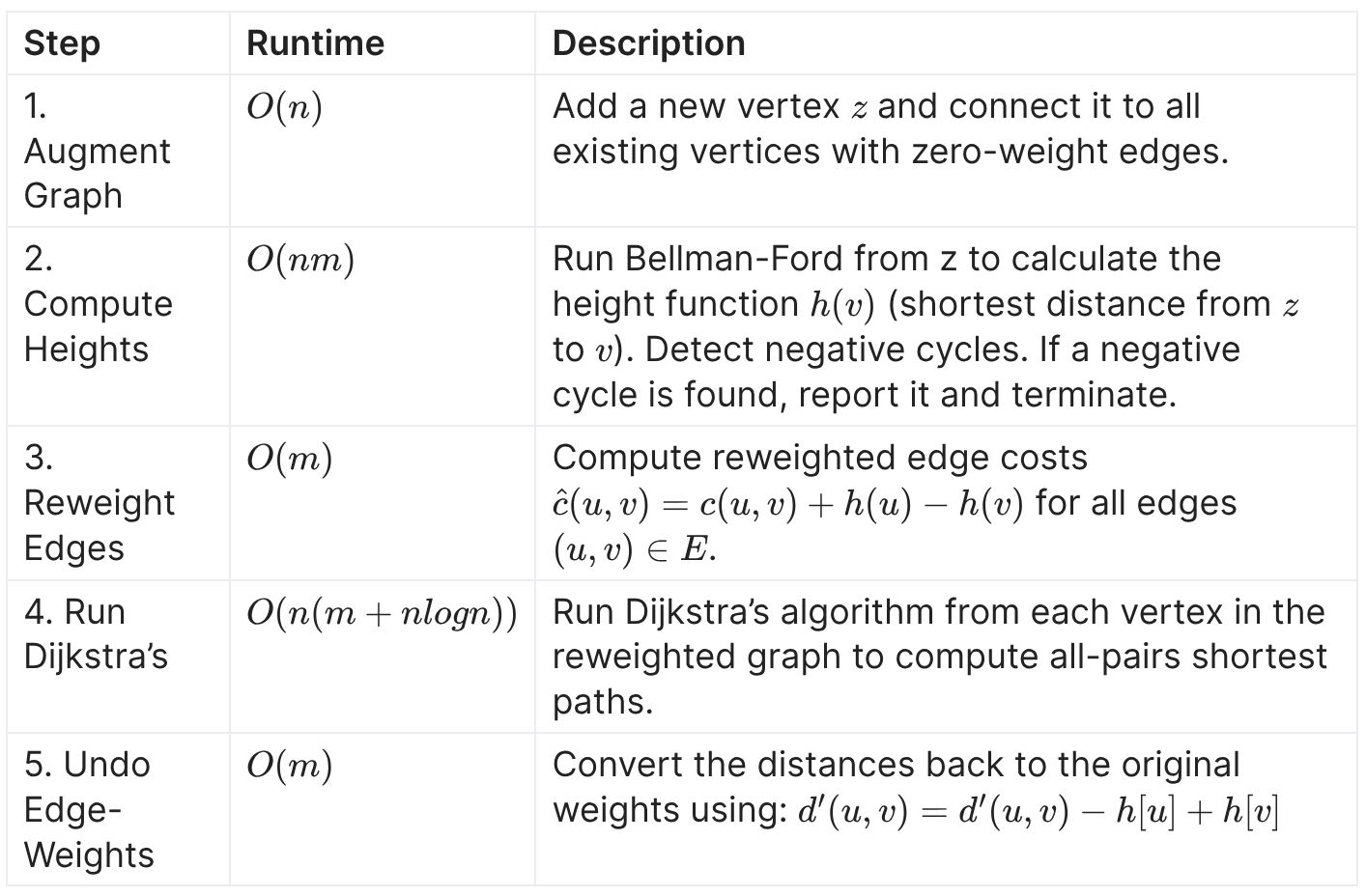
Field-by-field Comparison
| Field | Before | After |
|---|---|---|
| Name | Johnson's Algorithm | |
| Runtime | \(O(|V| \cdot (|V| + |E|) \log |V|)\) (running dijkstra's n times, but allows negatives)<br><img src="paste-b0103885454d02688fec99eb8383f57710d89f68.jpg"> | |
| Requirements | No negative cycles | |
| Approach | <ol><li><b>Add a New Vertex:</b><ul><li>Add a new vertex s to the graph and connect it to all vertices with zero-weight edges. </li> </ul></li><li><b>Run Bellman-Ford</b>:<ul><li>Use the Bellman-Ford algorithm starting from s to compute the shortest distance h[v] from s to each vertex v.</li><li>If a negative-weight cycle is detected, stop.</li></ul></li><li><b>Reweight Edges</b>: <ul><li>For each edge u → v with weight w(u, v), reweight it as: w′(u, v) = w(u, v) + h[u] − h[v]</li><li>This ensures all edge weights are non-negative.</li> </ul> </li><li><b>Run Dijkstra’s Algorithm:</b><ul><li>For each vertex v, use Dijkstra’s algorithm to compute the shortest paths to all other vertices.</li> </ul></li><li><b>Adjust Back</b>:<ul><li>Convert the distances back to the original weights using: d′(u, v) = d′(u, v) − h[u] + h[v]</li> </ul></li><li><b>End:</b></li><ul><li>The resulting shortest path distances between all pairs of vertices are valid.</li></ul></ol><div>The overall higher cost allows us to run pre-computation steps like B-F for "free"</div> | |
| Use Case | All Pairs Shortest Path |
Note 2: ETH::A&D
Deck: ETH::A&D
Note Type: Horvath Cloze
GUID:
added
Note Type: Horvath Cloze
GUID:
GsU2XikyZ:
Previous
Note did not exist
New Note
Front
We use Johnsons over F-W, when the graph is sparse, like in a tree.
Back
We use Johnsons over F-W, when the graph is sparse, like in a tree.
Then the \(|E|\) doesn't matter much in comparison to F-Ws \(|V|^3\).
Field-by-field Comparison
| Field | Before | After |
|---|---|---|
| Text | We use <b>Johnsons</b> over <b>F-W</b>, when the graph is {{c1:: sparse, like in a tree}}. | |
| Extra | Then the \(|E|\) doesn't matter much in comparison to F-Ws \(|V|^3\). |
Note 3: ETH::A&D
Deck: ETH::A&D
Note Type: Horvath Classic
GUID:
added
Note Type: Horvath Classic
GUID:
baz0GGlXM[
Previous
Note did not exist
New Note
Front
Why does naively adding the lowest-edge weight not work for Johnson's?
Back
Why does naively adding the lowest-edge weight not work for Johnson's?
We need the cost of the paths to stay the same relative to each other.
If we add a constant to each edge, long (length-wise) paths are penalised more. This means that the ordering of all paths by cost changes.
If we add a constant to each edge, long (length-wise) paths are penalised more. This means that the ordering of all paths by cost changes.
Field-by-field Comparison
| Field | Before | After |
|---|---|---|
| Front | Why does naively adding the lowest-edge weight not work for Johnson's? | |
| Back | We need the cost of the paths to stay the same relative to each other.<br><br>If we add a constant to each edge, long (length-wise) paths are penalised more. This means that the ordering of all paths by cost changes. |
Note 4: ETH::A&D
Deck: ETH::A&D
Note Type: Horvath Cloze
GUID:
added
Note Type: Horvath Cloze
GUID:
ePS|dQ=3Ic
Previous
Note did not exist
New Note
Front
F-W implementation java, use 10000 or other high values but not Integer.MAX_VALUE.
Back
F-W implementation java, use 10000 or other high values but not Integer.MAX_VALUE.
Otherwise you might get an overflow.
Field-by-field Comparison
| Field | Before | After |
|---|---|---|
| Text | <b>F-W</b> implementation java, use {{c1::10000 or other high values but not <b>Integer.MAX_VALUE</b>}}. | |
| Extra | Otherwise you might get an overflow. |
Note 5: ETH::A&D
Deck: ETH::A&D
Note Type: Algorithms
GUID:
added
Note Type: Algorithms
GUID:
hL7UB-)y6N
Previous
Note did not exist
New Note
Front
Runtime of Floyd-Warshall?
Back
Runtime of Floyd-Warshall?
\(O(|V|^3)\)
Field-by-field Comparison
| Field | Before | After |
|---|---|---|
| Name | Floyd-Warshall | |
| Runtime | \(O(|V|^3)\) | |
| Requirements | No negative cycles | |
| Approach | <ol><li><b>Initialise</b>: distance matrix D D[i][j] is the weight of the edge from \(i \rightarrow j\) if it exists, \(\infty\) otherwise<br></li><li><b>Iterate over intermediate</b>: for each vertex \(k\) update D[i][j] = min(D[i][j], D[i][k] + D[k][j]). for all intermediate k from 1,...,n</li></ol><div><br></div><div>The final distance matrix D contains the shortest path from any i to j.</div><div><br></div><div><i>Note that this can also be done using a 3d DP table, the 2d is just optimised.</i><br></div> | |
| Pseudocode | <img src="paste-f6965d427f4a2df5b61ba8dd2ee9c0f0a90baaf6.jpg"><br><div><b>Important</b>: Use a value like 10000 instead of Integer.MAX_VALUE in Java, as you get <b>overflows</b> otherwise.</div> | |
| Use Case | All Pairs Shortest Path |
Note 6: ETH::A&D
Deck: ETH::A&D
Note Type: Horvath Cloze
GUID:
added
Note Type: Horvath Cloze
GUID:
hsaD+h{~n8
Previous
Note did not exist
New Note
Front
Reweighting in Johnson's algorithm:
- We add a vertex \(s\) and add a 0 cost edge from it to all vertices.
- We then run B-F which determines the height of each vertex by the d[v] from start vertex \(s\)
Back
Reweighting in Johnson's algorithm:
- We add a vertex \(s\) and add a 0 cost edge from it to all vertices.
- We then run B-F which determines the height of each vertex by the d[v] from start vertex \(s\)
Field-by-field Comparison
| Field | Before | After |
|---|---|---|
| Text | Reweighting in Johnson's algorithm:<br><ol><li>We {{c1::add a vertex \(s\)}} and {{c1::add a 0 cost edge from it to all vertices}}.</li><li>We then {{c2::run B-F which determines the height of each vertex by the d[v] from start vertex \(s\)}} </li></ol> |
Note 7: ETH::A&D
Deck: ETH::A&D
Note Type: Horvath Classic
GUID:
added
Note Type: Horvath Classic
GUID:
j+9WeY4$!x
Previous
Note did not exist
New Note
Front
Explain why reweighting in Johnson's algorithm works:
Back
Explain why reweighting in Johnson's algorithm works:
Assigns a height \(h(v)\) to each vertex. The new cost is then \(\hat{c}(u, v) = c(u, v) + h(u) - h(v)\).
For a path \(P = (s, v_1, v_2, \dots, v_n, t)\) the cost \(\hat{c}(P) = \hat{c}(s, v_1) + \hat{c}(v_1, v_2) + \dots + \hat{c}(v_n, t)\) the costs cancel out in pairs: \(c(s, v_1) + h(s) - h(v_1) + c(v_1, v_2) + h(v_1) - h(v_2) + \dots + c(v_n, t) + h(v_n) - h(t)\) gives \(= c(P) + h(s) - h(t)\), which satisfies our requirements that the ordering stay the same.
For a path \(P = (s, v_1, v_2, \dots, v_n, t)\) the cost \(\hat{c}(P) = \hat{c}(s, v_1) + \hat{c}(v_1, v_2) + \dots + \hat{c}(v_n, t)\) the costs cancel out in pairs: \(c(s, v_1) + h(s) - h(v_1) + c(v_1, v_2) + h(v_1) - h(v_2) + \dots + c(v_n, t) + h(v_n) - h(t)\) gives \(= c(P) + h(s) - h(t)\), which satisfies our requirements that the ordering stay the same.
Field-by-field Comparison
| Field | Before | After |
|---|---|---|
| Front | Explain <b>why</b> reweighting in Johnson's algorithm works: | |
| Back | Assigns a height \(h(v)\) to each vertex. The new cost is then \(\hat{c}(u, v) = c(u, v) + h(u) - h(v)\).<br><br>For a path \(P = (s, v_1, v_2, \dots, v_n, t)\) the cost \(\hat{c}(P) = \hat{c}(s, v_1) + \hat{c}(v_1, v_2) + \dots + \hat{c}(v_n, t)\) the costs cancel out in pairs: \(c(s, v_1) + h(s) - h(v_1) + c(v_1, v_2) + h(v_1) - h(v_2) + \dots + c(v_n, t) + h(v_n) - h(t)\) gives \(= c(P) + h(s) - h(t)\), which satisfies our requirements that the ordering stay the same. |
Note 8: ETH::A&D
Deck: ETH::A&D
Note Type: Horvath Cloze
GUID:
added
Note Type: Horvath Cloze
GUID:
jBru?ce!L0
Previous
Note did not exist
New Note
Front
We use F-W over Johnsons, when the graph is very dense \(|E| = \Theta(|V|^2)\).
Back
We use F-W over Johnsons, when the graph is very dense \(|E| = \Theta(|V|^2)\).
Then the \(n \cdot (n + m) \) becomes \(n \cdot (n + n^2)\) which is \(O(n^3)\).
Field-by-field Comparison
| Field | Before | After |
|---|---|---|
| Text | We use <b>F-W</b> over <b>Johnsons</b>, when the graph is {{c1:: very dense \(|E| = \Theta(|V|^2)\)}}. | |
| Extra | Then the \(n \cdot (n + m) \) becomes \(n \cdot (n + n^2)\) which is \(O(n^3)\). |
Note 9: ETH::A&D
Deck: ETH::A&D
Note Type: Horvath Classic
GUID:
added
Note Type: Horvath Classic
GUID:
o5O]N!`p|^
Previous
Note did not exist
New Note
Front
Floyd-Warshall, when is there a negative cycle?
Back
Floyd-Warshall, when is there a negative cycle?
There exists a negative cycle \(\Leftrightarrow \exists v \in V \ : \ d^n_{v \rightarrow v} < 0\)
In words: If there exists a path from a vertex to itself with negative weight (passing through any other vertex, i.e. \(n\)th iteration of the outer loop), then there exists a negative cycle that contains this vertex.
We can perform a negative cycle check at the end, by going over all diagonals.
Field-by-field Comparison
| Field | Before | After |
|---|---|---|
| Front | Floyd-Warshall, when is there a negative cycle? | |
| Back | <div>There exists a negative cycle \(\Leftrightarrow \exists v \in V \ : \ d^n_{v \rightarrow v} < 0\)</div><div><br></div> <div>In words: If there exists a path from a vertex to itself with negative weight (passing through any other vertex, i.e. \(n\)th iteration of the outer loop), then there exists a negative cycle that contains this vertex.</div><br><div>We can perform a negative cycle check at the end, by going over all diagonals.</div> |
Note 10: ETH::DiskMat
Deck: ETH::DiskMat
Note Type: Horvath Classic
GUID:
added
Note Type: Horvath Classic
GUID:
CJsa&>C5sO
Previous
Note did not exist
New Note
Front
Kruskal's Algorithm can be executed in \(O(|E| + |V|\log|V|)\) time?
Back
Kruskal's Algorithm can be executed in \(O(|E| + |V|\log|V|)\) time?
no, we need to sort the edges which takes at least \(|E| \log |E|\) time.
Field-by-field Comparison
| Field | Before | After |
|---|---|---|
| Front | Kruskal's Algorithm can be executed in \(O(|E| + |V|\log|V|)\) time? | |
| Back | no, we need to sort the edges which takes at least \(|E| \log |E|\) time. |
Note 11: ETH::DiskMat
Deck: ETH::DiskMat
Note Type: Horvath Classic
GUID:
added
Note Type: Horvath Classic
GUID:
Fn+W}!cgj0
Previous
Note did not exist
New Note
Front
If we know that shortest paths have a length of max \(h\), runtime of algo to find them?
Back
If we know that shortest paths have a length of max \(h\), runtime of algo to find them?
We can find them in \(O(h|E|)\) using B-F since we only need to relax \(h\) times.
Field-by-field Comparison
| Field | Before | After |
|---|---|---|
| Front | If we know that shortest paths have a length of max \(h\), runtime of algo to find them? | |
| Back | We can find them in \(O(h|E|)\) using B-F since we only need to relax \(h\) times. |
Note 12: ETH::DiskMat
Deck: ETH::DiskMat
Note Type: Horvath Cloze
GUID:
added
Note Type: Horvath Cloze
GUID:
Mv|.Tnx#vx
Previous
Note did not exist
New Note
Front
A graph with distinct ege weights has one unique MST.
Back
A graph with distinct ege weights has one unique MST.
There is one unique safe-edge.
Field-by-field Comparison
| Field | Before | After |
|---|---|---|
| Text | A graph with {{c1::distinct ege weights}} has {{c2::one unique MST}}. | |
| Extra | There is one unique safe-edge. |
Note 13: ETH::DiskMat
Deck: ETH::DiskMat
Note Type: Horvath Classic
GUID:
added
Note Type: Horvath Classic
GUID:
Qv/bX3RU0v
Previous
Note did not exist
New Note
Front
How does the number of ZHK's change in Boruvka's for each round?
Back
How does the number of ZHK's change in Boruvka's for each round?
The number of component halves in each round, thus \(\log |V|\) iterations worst case.
Field-by-field Comparison
| Field | Before | After |
|---|---|---|
| Front | How does the number of ZHK's change in Boruvka's for each round? | |
| Back | The number of component halves in each round, thus \(\log |V|\) iterations worst case. |
Note 14: ETH::DiskMat
Deck: ETH::DiskMat
Note Type: Horvath Classic
GUID:
added
Note Type: Horvath Classic
GUID:
k%duL(GzS|
Previous
Note did not exist
New Note
Front
In every connected graph \(G\), when executing Kruskal using Union-Find, the representative repr[u] changes \(O(\dots)\) times:
Back
In every connected graph \(G\), when executing Kruskal using Union-Find, the representative repr[u] changes \(O(\dots)\) times:
\(O(\log_2 |V|)\), as we always at least double the size of the representative (we merge smaller into bigger, and repr[u] changes if it's the smaller one).
Field-by-field Comparison
| Field | Before | After |
|---|---|---|
| Front | In every connected graph \(G\), when executing Kruskal using Union-Find, the representative <b>repr[u]</b> changes \(O(\dots)\) times: | |
| Back | \(O(\log_2 |V|)\), as we always at least double the size of the representative (we merge smaller into bigger, and repr[u] changes if it's the smaller one). |
Note 15: ETH::DiskMat
Deck: ETH::DiskMat
Note Type: Horvath Cloze
GUID:
added
Note Type: Horvath Cloze
GUID:
s0knxb/
Previous
Note did not exist
New Note
Front
The height \(h(v)\) in Johnson's Algorithm is always negative \(\leq 0\).
Back
The height \(h(v)\) in Johnson's Algorithm is always negative \(\leq 0\).
Field-by-field Comparison
| Field | Before | After |
|---|---|---|
| Text | The height \(h(v)\) in Johnson's Algorithm is {{c1::always negative \(\leq 0\)}}. |
Note 16: ETH::DiskMat
Deck: ETH::DiskMat
Note Type: Horvath Classic
GUID:
added
Note Type: Horvath Classic
GUID:
wxuX$c!)%k
Previous
Note did not exist
New Note
Front
A graph with this DP table from F-W:
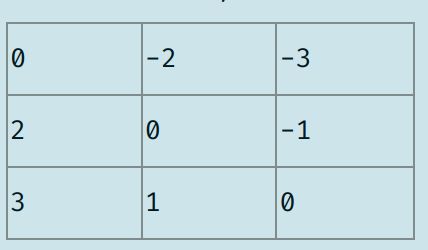
contains ___ negative cycles.
contains ___ negative cycles.
Back
A graph with this DP table from F-W:
contains ___ negative cycles.
contains ___ negative cycles.
no (there is no diagonal \(< 0\))
Field-by-field Comparison
| Field | Before | After |
|---|---|---|
| Front | A graph with this DP table from F-W:<br><img src="paste-deae0d6c4a31dc3e71c5f654f12387c82b186739.jpg"><br>contains ___ negative cycles. | |
| Back | <b>no</b> (there is no diagonal \(< 0\)) |