Anki Deck Changes

Commit: b4e107a9 - add shortest path cards

Author: obrhubr <obrhubr@gmail.com>

Date: 2025-12-23T22:44:33+01:00

Changes: 19 note(s) changed (14 added, 5 modified, 0 deleted)

ℹ️ Cosmetic Changes Hidden: 4 note(s) had formatting-only changes and are not shown below • 2 HTML formatting changes

Note 1: ETH::A&D

Deck: ETH::A&D
Note Type: Algorithms
GUID: u%cN;v|jjQ
modified

Before

Front

Back

ETH::1._Semester::A&D::09._Graph_Search::2._Breadth_First_Search
Runtime of
BFS

Runtime: {{c1::\( \mathcal{O}(|E| + |V|) \)}}

Approach:

Uses:
?


The runtime of BFS:
  1. each loop we take \(O(1 + \deg(u))\) time (go through the vertex \(u\)'s edges
  2. We loop a total of \(|V|\) times (we visit each edge max. 1 time)
After

Front

Back

ETH::1._Semester::A&D::09._Graph_Search::2._Breadth_First_Search
Runtime of
BFS

Runtime: {{c1::\( \mathcal{O}(|E| + |V|) \)}}

Approach:

Uses:
?


Field-by-field Comparison
Field Before After
Extra Info The runtime of BFS:<br><ol><li>each loop we take \(O(1 + \deg(u))\)&nbsp;time (go through the vertex&nbsp;\(u\)'s edges</li><li>We loop a total of&nbsp;\(|V|\)&nbsp;times (we visit each edge max. 1 time)</li></ol>
Tags: ETH::1._Semester::A&D::09._Graph_Search::2._Breadth_First_Search

Note 2: ETH::A&D

Deck: ETH::A&D
Note Type: Horvath Cloze
GUID: e=wgvK*bB^
added

Previous

Note did not exist

New Note

Front

ETH::1._Semester::A&D::09._Graph_Search::2._Breadth_First_Search
The shortest walk is always a path.

Back

ETH::1._Semester::A&D::09._Graph_Search::2._Breadth_First_Search
The shortest walk is always a path.

This is due to the triangle inequality, given that no negative cycles exist.
Field-by-field Comparison
Field Before After
Text The shortest walk is always {{c1::a path}}.
Extra This is due to the triangle inequality, given that no negative cycles exist.
Tags: ETH::1._Semester::A&D::09._Graph_Search::2._Breadth_First_Search

Note 3: ETH::A&D

Deck: ETH::A&D
Note Type: Horvath Classic
GUID: rL+,fn.ulX
added

Previous

Note did not exist

New Note

Front

ETH::1._Semester::A&D::09._Graph_Search::2._Breadth_First_Search
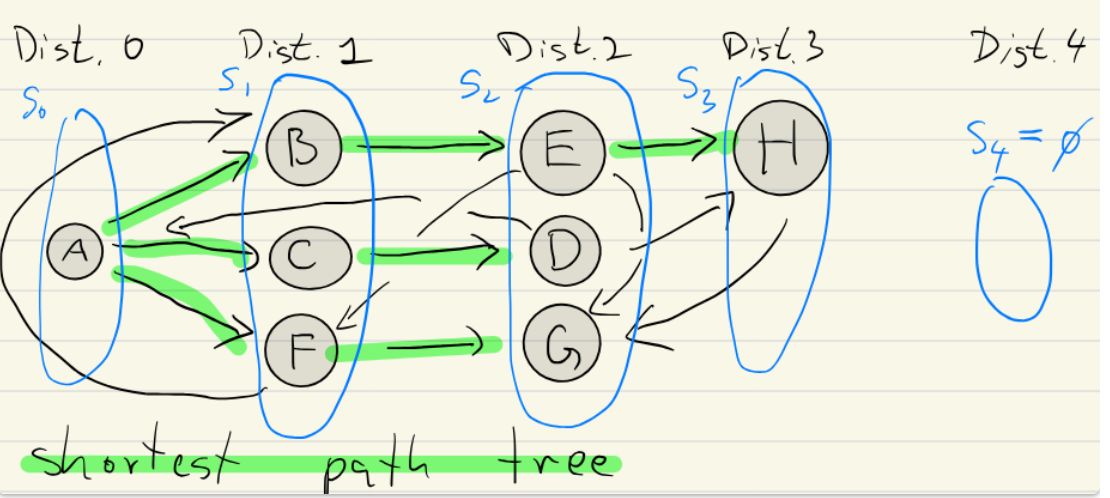
The shortest path tree output by BFS is:

Back

ETH::1._Semester::A&D::09._Graph_Search::2._Breadth_First_Search
The shortest path tree output by BFS is:

A tree from the start-vertex with levels, for each distance:

Field-by-field Comparison
Field Before After
Front The shortest path tree output by BFS is:
Back A tree from the start-vertex with levels, for each distance:<br><br><img src="paste-4c913ffd2f874833dce2fab6c179871903517c76.jpg">
Tags: ETH::1._Semester::A&D::09._Graph_Search::2._Breadth_First_Search

Note 4: ETH::A&D

Deck: ETH::A&D
Note Type: Algorithms
GUID: y@l`JCIJ<4
added

Previous

Note did not exist

New Note

Front

ETH::1._Semester::A&D::09._Graph_Search::2._Breadth_First_Search
Runtime of BFS (Breadth First Search)?

Back

ETH::1._Semester::A&D::09._Graph_Search::2._Breadth_First_Search
Runtime of BFS (Breadth First Search)?

\(O(|V|+|E|)\) (Adjacency List)
The runtime of BFS:
  1. each loop we take \(O(1 + \deg(u))\) time (go through the vertex \(u\)'s edges
  2. We loop a total of \(|V|\) times (we visit each edge max. 1 time)
Field-by-field Comparison
Field Before After
Name BFS (Breadth First Search)
Runtime \(O(|V|+|E|)\)&nbsp;(Adjacency List)
Requirements Directed Graph ((negative) cycles accepted, as "shortest" (not cheapest) path not affected)
Approach <b>BFS</b>&nbsp;looks for the shortest paths (not cheapest) in a graph.<br><ol><li><b>Initialisation:</b> <ul> <li>Set the distance to all vertices to \(\infty\) in the <code>d[v]</code> array. Set the <code>d[s] = 0</code>.</li> <li>Initialise a Queue \(Q\) with \(s\)</li> <li>Set the dictionary <code>parent = {}</code></li> </ul> </li> <li><b>Exploration:</b><ul> <li>Dequeue the first element in the queue \(v\)</li> <li>For all <em>adjacent nodes</em> \(u\) with distance \(= \infty\) (not visited yet):<ul> <li>Set the distance <code>d[u] = d[v] + 1</code></li> <li>add \(u\) to the queue</li> <li>Set the <code>parent[u] = v</code>.</li> </ul> </li> </ul> </li> <li><b>Return:</b> We return the distances and the <i>shortest path tree</i></li></ol>
Pseudocode <img src="paste-4fbaff6bb07ad8ff63a53ac2e179914e1c8cac2b.jpg">
Use Case Shortest Path in a directed graph
Extra Info The runtime of BFS:<br><ol><li>each loop we take&nbsp;\(O(1 + \deg(u))\)&nbsp;time (go through the vertex&nbsp;\(u\)'s edges</li><li>We loop a total of&nbsp;\(|V|\)&nbsp;times (we visit each edge max. 1 time)</li></ol>
Tags: ETH::1._Semester::A&D::09._Graph_Search::2._Breadth_First_Search

Note 5: ETH::A&D

Deck: ETH::A&D
Note Type: Horvath Classic
GUID: L#@+crYi2-
added

Previous

Note did not exist

New Note

Front

ETH::1._Semester::A&D::09._Graph_Search::2._Breadth_First_Search
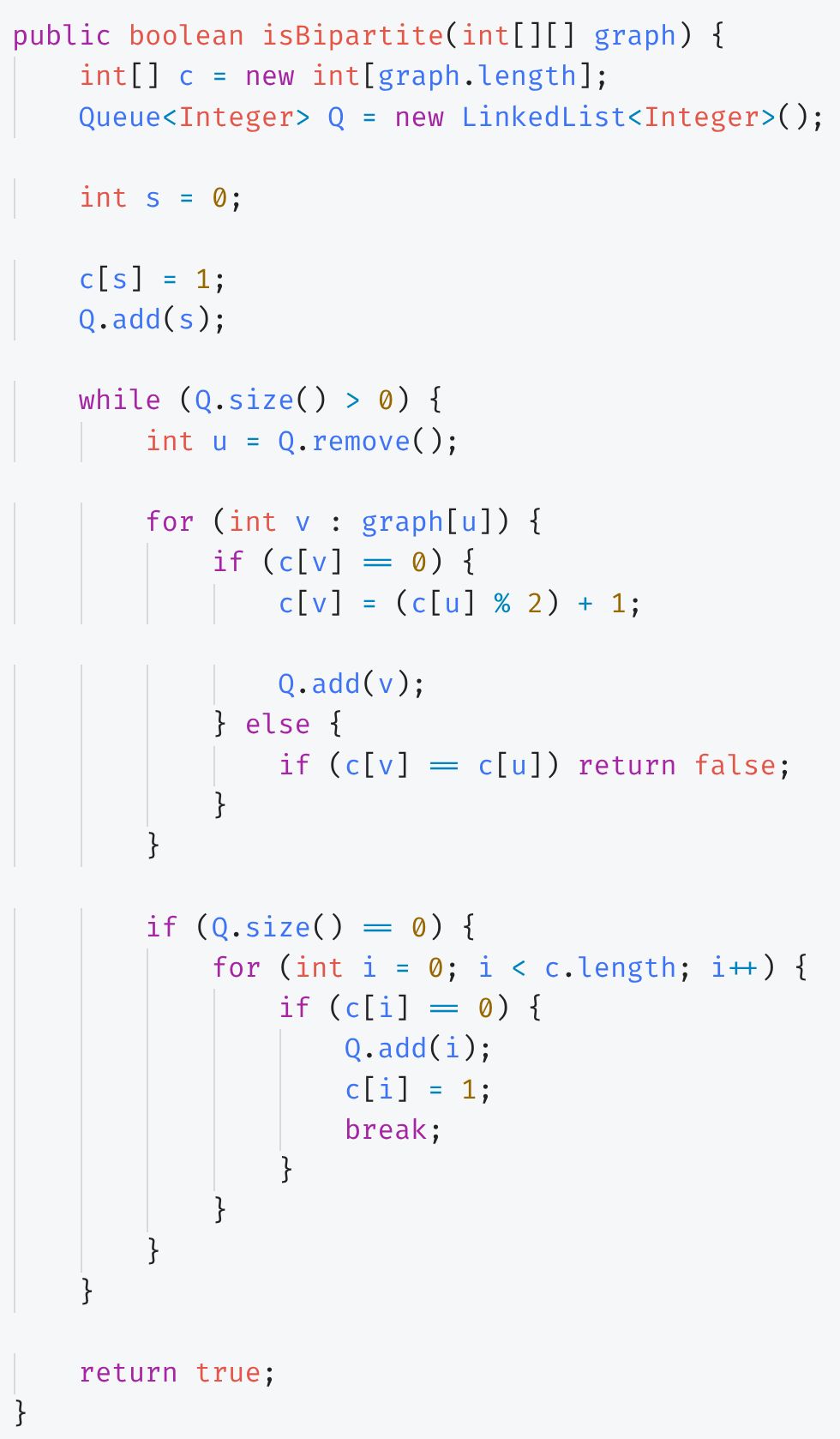
Bipartite Test with BFS:

Back

ETH::1._Semester::A&D::09._Graph_Search::2._Breadth_First_Search
Bipartite Test with BFS:

We substitute bipartite for two-colourable. 

While traversing the tree, in each layer, we colour all vertices with the same. If we then encounter a vertex with the same colour during traversal, it's not two-colourable.

Field-by-field Comparison
Field Before After
Front Bipartite Test with BFS:
Back We substitute bipartite for two-colourable.&nbsp;<br><br>While traversing the tree, <b>in each layer</b>, we <b>colour all vertices with the same</b>. If we then <b>encounter </b>a vertex with the<b> same colour</b> during traversal, it's <b>not two-colourable</b>.<br><br><img src="paste-c8749f8e54bcf6eb4c7cd1ac37ca03ea43e15fd6.jpg">
Tags: ETH::1._Semester::A&D::09._Graph_Search::2._Breadth_First_Search

Note 6: ETH::A&D

Deck: ETH::A&D
Note Type: Horvath Classic
GUID: PF|EmWOMd:
added

Previous

Note did not exist

New Note

Front

ETH::1._Semester::A&D::10._Shortest_Paths
Cost of a walk in a weighted graph \(G = (V, E, c)\):

Back

ETH::1._Semester::A&D::10._Shortest_Paths
Cost of a walk in a weighted graph \(G = (V, E, c)\):

sum of the weight of it's edges: \(\sum_{i = 0}^{l - 1} c(v_i, v_i+1)\)
Field-by-field Comparison
Field Before After
Front Cost of a walk in a weighted graph&nbsp;\(G = (V, E, c)\):
Back sum of the weight of it's edges:&nbsp;\(\sum_{i = 0}^{l - 1} c(v_i, v_i+1)\)
Tags: ETH::1._Semester::A&D::10._Shortest_Paths

Note 7: ETH::A&D

Deck: ETH::A&D
Note Type: Horvath Classic
GUID: vE[;wMoI5.
added

Previous

Note did not exist

New Note

Front

ETH::1._Semester::A&D::10._Shortest_Paths
Optimal substructure of cheapest paths:

Back

ETH::1._Semester::A&D::10._Shortest_Paths
Optimal substructure of cheapest paths:

A cheapest path in a weighted graph (without negative cycles) has the optimal substructure property: any subpath is itself the cheapest path between it's endpoints.
Field-by-field Comparison
Field Before After
Front Optimal substructure of cheapest paths:
Back A cheapest path in a weighted graph (without negative cycles) has the optimal substructure property: <i>any subpath is itself the cheapest path between it's endpoints</i>.
Tags: ETH::1._Semester::A&D::10._Shortest_Paths

Note 8: ETH::A&D

Deck: ETH::A&D
Note Type: Horvath Cloze
GUID: yX`f0NZg((
added

Previous

Note did not exist

New Note

Front

ETH::1._Semester::A&D::10._Shortest_Paths
The triangle inequality in a weighted graph is \(d(u, v) \leq d(u, w) + d(w, v)\)

Back

ETH::1._Semester::A&D::10._Shortest_Paths
The triangle inequality in a weighted graph is \(d(u, v) \leq d(u, w) + d(w, v)\)

This holds as if the path through \(w\) was actually cheaper, then \(d(u, v)\) would be wrong.

Does not hold in graphs with negative cycles.
Field-by-field Comparison
Field Before After
Text The {{c1::<b>triangle inequality</b>}} in a weighted graph is {{c2::\(d(u, v) \leq d(u, w) + d(w, v)\)}}
Extra This holds as if the path through&nbsp;\(w\)&nbsp;was actually cheaper, then \(d(u, v)\)&nbsp;would be wrong.<br><br>Does not hold in graphs with negative cycles.
Tags: ETH::1._Semester::A&D::10._Shortest_Paths

Note 9: ETH::A&D

Deck: ETH::A&D
Note Type: Algorithms
GUID: z{8WPibSbC
added

Previous

Note did not exist

New Note

Front

ETH::1._Semester::A&D::10._Shortest_Paths::1._Dijkstra's_Algorithm
Runtime of Dijkstra's Algorithm?

Back

ETH::1._Semester::A&D::10._Shortest_Paths::1._Dijkstra's_Algorithm
Runtime of Dijkstra's Algorithm?

\(O((|E| + |V|) \log |V|)\) (or \(O(|V|^2)\)

The runtime is calculated from \(O(n + (\#\text{extract-min} + \#\text{decrease-key}) \cdot \log n)\)  which gives \(O((n + m) \cdot \log n)\).
Field-by-field Comparison
Field Before After
Name Dijkstra's Algorithm
Runtime \(O((|E| + |V|) \log |V|)\)&nbsp;(or&nbsp;\(O(|V|^2)\)<br><br>The runtime is calculated from \(O(n + (\#\text{extract-min} + \#\text{decrease-key}) \cdot \log n)\)&nbsp; which gives \(O((n + m) \cdot \log n)\).
Requirements No negative edge-weights (to make sure that we don't need to go back)
Approach Vertices are considered in&nbsp;<i>increasing</i>&nbsp;order of their distances from the source.<br><br>Recurrence:\[ d(s, v_k) = \min_{(v_i, v_k) \in E, i &lt; k} \{ d(s, v_i) + c(v_i, v_k) \} \]<br><ol><li>Add start vertex&nbsp;\(s\)&nbsp;to prioqueue with dist 0 and set all other dists to&nbsp;\(\infty\)</li><li>Pop Cheapest Vertex&nbsp;\(v\)&nbsp;from Priority Queue</li><li>For each neighbour&nbsp;\(u\): if distance (= current_distance +&nbsp;\(w(v\rightarrow u)\)) &lt; distance to&nbsp;\(u\)&nbsp;then overwrite and push new distance to queue.<br>Current vertex is marked as visited and not revisited again.</li></ol>
Pseudocode <img src="paste-38d6665cd236d4094cec91025d07594c2e082538.jpg">
Use Case Cheapest Path in Weighted graph with non-negative edge costs
Tags: ETH::1._Semester::A&D::10._Shortest_Paths::1._Dijkstra's_Algorithm

Note 10: ETH::A&D

Deck: ETH::A&D
Note Type: Horvath Cloze
GUID: q@6d+^{0gK
added

Previous

Note did not exist

New Note

Front

ETH::1._Semester::A&D::10._Shortest_Paths::1._Dijkstra's_Algorithm
In Dijkstra's after visiting vertex \(v\), the distance \(d(v)\) is never updated anymore.

Back

ETH::1._Semester::A&D::10._Shortest_Paths::1._Dijkstra's_Algorithm
In Dijkstra's after visiting vertex \(v\), the distance \(d(v)\) is never updated anymore.

No negative edges means there's no shorter way (we consider in increasing distance order).

With negative weights, a longer path through an unvisited vertex could later turn out to be shorter due to a negative edge.
Field-by-field Comparison
Field Before After
Text In Dijkstra's after visiting vertex&nbsp;\(v\), the distance&nbsp;\(d(v)\)&nbsp;is {{c1:: never updated anymore}}.
Extra No negative edges means there's no shorter way (we consider in increasing distance order).<br><br>With negative weights, a longer path through an unvisited vertex could later turn out to be shorter due to a negative edge.
Tags: ETH::1._Semester::A&D::10._Shortest_Paths::1._Dijkstra's_Algorithm

Note 11: ETH::A&D

Deck: ETH::A&D
Note Type: Horvath Classic
GUID: gm7WcQEU/C
added

Previous

Note did not exist

New Note

Front

ETH::1._Semester::A&D::10._Shortest_Paths::1._Dijkstra's_Algorithm
When do we want Dijkstra's with an array?

Back

ETH::1._Semester::A&D::10._Shortest_Paths::1._Dijkstra's_Algorithm
When do we want Dijkstra's with an array?

In very dense graphs\(|E| > \frac{|V|^2}{\log |V|}\), Dijkstra's is faster on an array than in a minHeap.

Extract_min takes \(O(|V|)\) with an array (\(O(\log |V|)\) in a MinHeap) -> array implementation runtime: \(O(|V|^2 + |E|) = O(|V|^2)\) for \(|E| = \Theta(|V|^2)\) (there are at most \(|V|^2\) edges in a graph).

If we plug in |E| > ... into the log runtime we see it's faster.
Field-by-field Comparison
Field Before After
Front When do we want Dijkstra's with an array?
Back In very dense graphs\(|E| &gt; \frac{|V|^2}{\log |V|}\), Dijkstra's is <b>faster on an array than in a minHeap</b>.<br><br><div>Extract_min takes \(O(|V|)\) with an array (\(O(\log |V|)\) in a MinHeap) -&gt; array implementation runtime:&nbsp;\(O(|V|^2 + |E|) = O(|V|^2)\) for \(|E| = \Theta(|V|^2)\) (there are at most \(|V|^2\) edges in a graph).</div><div><br></div><div>If we plug in |E| &gt; ... into the log runtime we see it's faster.</div>
Tags: ETH::1._Semester::A&D::10._Shortest_Paths::1._Dijkstra's_Algorithm

Note 12: ETH::A&D

Deck: ETH::A&D
Note Type: Algorithms
GUID: t:15}v~LmN
added

Previous

Note did not exist

New Note

Front

ETH::1._Semester::A&D::10._Shortest_Paths::2._Bellman-Ford_Algorithm
Runtime of Bellman-Ford?

Back

ETH::1._Semester::A&D::10._Shortest_Paths::2._Bellman-Ford_Algorithm
Runtime of Bellman-Ford?

\(O(|V| \cdot |E|)\) (uses DP)

We iterate over all edges in the "relaxation" thus the time complexity of that step is \(O(m)\) (the actual check is \(O(1)\)).
As we relax \(n - 1\) (or \(n\) for negative cycle check) times, the total runtime is \(O(n \cdot m)\).
Field-by-field Comparison
Field Before After
Name Bellman-Ford
Runtime \(O(|V| \cdot |E|)\)&nbsp;(uses DP)<br><br>We iterate over all edges in the "relaxation" thus the time complexity of that step is \(O(m)\)&nbsp;(the actual check is \(O(1)\)).<br>As we relax&nbsp;\(n - 1\)&nbsp;(or&nbsp;\(n\)&nbsp;for negative cycle check) times, the total runtime is \(O(n \cdot m)\).
Requirements Negative-edges allowed (neg. cycles detected) in a directed, weighted graph.
Approach <ol> <li><b>Initialize</b>:<br>Set the distance to the source vertex as 0 and to all other vertices as infinity.</li> <li><b>Relax Edges</b>: <br>Repeat for V − 1 iterations (where V is the number of vertices):<br>For each edge, update the distance to its destination vertex if the distance through the edge is smaller than the current distance.</li> <li><b>Check for Negative Cycles</b>: <br>Check all edges to see if a shorter path can still be found. If so, the graph contains a negative- weight cycle.</li> <li><b>End</b>: <br>If no negative-weight cycle is found, the algorithm outputs the shortest paths.</li></ol><img src="paste-95017d19365697a9f94b52394c6bdb999dfc81d1.jpg"><br><br>(quicker to implement the edge-based approach, but there's also a vertex based approach)
Pseudocode <img src="paste-46ff4f85bab3ae924d9ef2c955277d49fc616cc6.jpg">
Use Case Find cheapest path in graphs with negative edges.
Tags: ETH::1._Semester::A&D::10._Shortest_Paths::2._Bellman-Ford_Algorithm

Note 13: ETH::A&D

Deck: ETH::A&D
Note Type: Horvath Classic
GUID: o[gwr|.}+m
added

Previous

Note did not exist

New Note

Front

ETH::1._Semester::A&D::10._Shortest_Paths::2._Bellman-Ford_Algorithm
What is a relaxation in Bellman-Ford?

Back

ETH::1._Semester::A&D::10._Shortest_Paths::2._Bellman-Ford_Algorithm
What is a relaxation in Bellman-Ford?

We "relax" an edge when \(d[u] + c(u, v) < d[v]\). In other words, we currently say that there is a path from \(s \rightarrow u\) and \(u \rightarrow v\) such that it's shorter than \(s \rightarrow v\).

This means that our current upper-bound for the shortest distance to \(v\) (\(d[v]\)), is too high as it violates the triangle inequality. Thus we updated ("relax") the edge.
Field-by-field Comparison
Field Before After
Front What is a relaxation in Bellman-Ford?
Back We "relax" an edge when \(d[u] + c(u, v) &lt; d[v]\). In other words, we currently say that there is a path from \(s \rightarrow u\) and \(u \rightarrow v\) such that it's shorter than \(s \rightarrow v\).<br><br>This means that our <b>current upper-bound</b> for the shortest distance to&nbsp;\(v\)&nbsp;(\(d[v]\)), is too high as it violates the triangle inequality. Thus we updated ("relax") the edge.
Tags: ETH::1._Semester::A&D::10._Shortest_Paths::2._Bellman-Ford_Algorithm

Note 14: ETH::A&D

Deck: ETH::A&D
Note Type: Horvath Classic
GUID: eoess%f:7$
added

Previous

Note did not exist

New Note

Front

ETH::1._Semester::A&D::10._Shortest_Paths::2._Bellman-Ford_Algorithm
How does Bellman-Ford detect negative cycles?

Back

ETH::1._Semester::A&D::10._Shortest_Paths::2._Bellman-Ford_Algorithm
How does Bellman-Ford detect negative cycles?

We relax the edges one more time after \(n-1\) times. If the distance to an edge decreased, there's a negative cycle reachable from \(s\).
Field-by-field Comparison
Field Before After
Front How does Bellman-Ford detect negative cycles?
Back We relax the edges one more time after&nbsp;\(n-1\)&nbsp;times. If the distance to an edge decreased, there's a negative cycle reachable from&nbsp;\(s\).
Tags: ETH::1._Semester::A&D::10._Shortest_Paths::2._Bellman-Ford_Algorithm

Note 15: ETH::A&D

Deck: ETH::A&D
Note Type: Horvath Classic
GUID: bNHf:CUBWH
added

Previous

Note did not exist

New Note

Front

ETH::1._Semester::A&D::10._Shortest_Paths::2._Bellman-Ford_Algorithm
Bellman-Ford optimisation in a DAG?

Back

ETH::1._Semester::A&D::10._Shortest_Paths::2._Bellman-Ford_Algorithm
Bellman-Ford optimisation in a DAG?

In an acyclic graph, topological sorting is already an algorithm that gives us the most-efficient order to calculate the cost in.

Because we can be sure that any predecessors already have the correct \(l\)-good bound distance (guaranteed by topo-sort, no backedges), we can simply relax once.

Thus we can compute the correct cheapest path in one "relaxation": \(O(|E|)\).
Therefore with toposort: \(O(|V| + |E|)\)
Field-by-field Comparison
Field Before After
Front Bellman-Ford optimisation in a DAG?
Back In an acyclic graph, <b>topological sorting</b> is already an algorithm that gives us the most-efficient order to <b>calculate the cost in</b>.<br><br>Because we can be sure that any predecessors already have the correct&nbsp;\(l\)-good bound distance (guaranteed by topo-sort, no backedges), we can simply relax once.<br><br>Thus we can compute the correct cheapest path in one "relaxation":&nbsp;\(O(|E|)\).<br>Therefore with toposort:&nbsp;\(O(|V| + |E|)\)
Tags: ETH::1._Semester::A&D::10._Shortest_Paths::2._Bellman-Ford_Algorithm
↑ Top