Anki Deck Changes

Commit: b65cda89 - sigh

Author: lhorva <lhorva@student.ethz.ch>

Date: 2026-02-23T02:35:39+01:00

Changes: 8 note(s) changed (0 added, 8 modified, 0 deleted)

ℹ️ Cosmetic Changes Hidden: 2 note(s) had formatting-only changes and are not shown below • 1 HTML formatting changes • 1 mixed cosmetic changes

Note 1: ETH::2. Semester::A&W

Deck: ETH::2. Semester::A&W
Note Type: Horvath Cloze
GUID: qxv9Kn78l1
modified

Before

Front

ETH::2._Semester::A&W::1._Graphentheorie::4._Zusammenhang::3._Block-Zerlegung
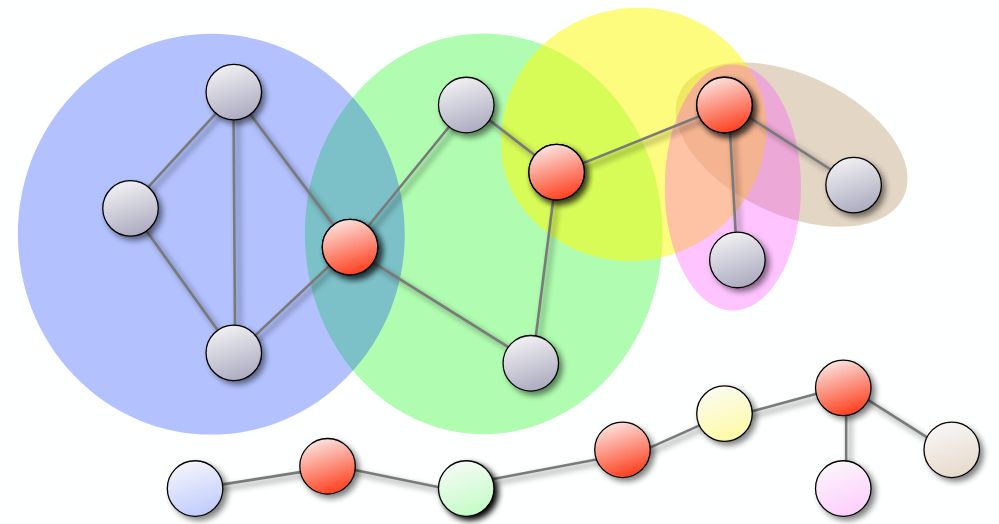
Sei \(G = (V, E)\) ein zusammenhängender Graph.

Der Block-Graph von \(G\) ist der bipartite Graph \(T = (A \uplus B, E_T)\) mit
  1. \(A = {{c1::\{\text{Artikulationsknoten von } G\} }}\).
  2. \(B = {{c2::\{\text{Blöcke von } G\} }}\).
  3. \(\forall a \in A, b \in B : \){{c3::\(\{a, b\} \in E_T \iff a\) inzident zu einer Kante in \(b\).}}
Back

ETH::2._Semester::A&W::1._Graphentheorie::4._Zusammenhang::3._Block-Zerlegung
Sei \(G = (V, E)\) ein zusammenhängender Graph.

Der Block-Graph von \(G\) ist der bipartite Graph \(T = (A \uplus B, E_T)\) mit
  1. \(A = {{c1::\{\text{Artikulationsknoten von } G\} }}\).
  2. \(B = {{c2::\{\text{Blöcke von } G\} }}\).
  3. \(\forall a \in A, b \in B : \){{c3::\(\{a, b\} \in E_T \iff a\) inzident zu einer Kante in \(b\).}}

After

Front

ETH::2._Semester::A&W::1._Graphentheorie::4._Zusammenhang::3._Block-Zerlegung
Sei \(G = (V, E)\) ein zusammenhängender Graph.

Der Block-Graph von \(G\) ist der bipartite Graph \(T = (A \uplus B, E_T)\) mit
  1. \(A = {{c1::\{\text{Artikulationsknoten von } G\} }}\).
  2. \(B = {{c2::\{\text{Blöcke von } G\} }}\).
  3. \(\forall a \in A, b \in B : \) {{c3::\(\{a, b\} \in E_T \iff a\) inzident zu einer Kante in \(b\).}}

Back

ETH::2._Semester::A&W::1._Graphentheorie::4._Zusammenhang::3._Block-Zerlegung
Sei \(G = (V, E)\) ein zusammenhängender Graph.

Der Block-Graph von \(G\) ist der bipartite Graph \(T = (A \uplus B, E_T)\) mit
  1. \(A = {{c1::\{\text{Artikulationsknoten von } G\} }}\).
  2. \(B = {{c2::\{\text{Blöcke von } G\} }}\).
  3. \(\forall a \in A, b \in B : \) {{c3::\(\{a, b\} \in E_T \iff a\) inzident zu einer Kante in \(b\).}}

Field-by-field Comparison
Field Before After
Text Sei \(G = (V, E)\) ein zusammenhängender Graph. <br><br>Der {{c4::Block-Graph}}&nbsp;von \(G\) ist der bipartite Graph \(T = (A \uplus B, E_T)\) mit<br><ol><li>\(A = {{c1::\{\text{Artikulationsknoten von } G\} }}\). </li><li>\(B = {{c2::\{\text{Blöcke von } G\} }}\). </li><li>\(\forall a \in A, b \in B : \){{c3::\(\{a, b\} \in E_T \iff a\)&nbsp;inzident zu einer Kante in \(b\).}}</li></ol> Sei \(G = (V, E)\) ein zusammenhängender Graph. <br><br>Der {{c4::Block-Graph}}&nbsp;von \(G\) ist der bipartite Graph \(T = (A \uplus B, E_T)\) mit<br><ol><li>\(A = {{c1::\{\text{Artikulationsknoten von } G\} }}\). </li><li>\(B = {{c2::\{\text{Blöcke von } G\} }}\). </li><li>\(\forall a \in A, b \in B : \)&nbsp;{{c3::\(\{a, b\} \in E_T \iff a\)&nbsp;inzident zu einer Kante in \(b\).}}</li></ol>
Tags: ETH::2._Semester::A&W::1._Graphentheorie::4._Zusammenhang::3._Block-Zerlegung

Note 2: ETH::2. Semester::PProg

Deck: ETH::2. Semester::PProg
Note Type: Horvath Cloze
GUID: DiKJq81cx0
modified

Before

Front

ETH::2._Semester::PProg::Terminology
A program has a race condition if, during any possible execution with the same inputs, its observable behaviour (results, output, ...) may change if events happen in different order. Events here are typically scheduler interactions causing different interleavings, but could also be, e.g. changing network latency. Race condition is often used interchangeably with data race.

Back

ETH::2._Semester::PProg::Terminology
A program has a race condition if, during any possible execution with the same inputs, its observable behaviour (results, output, ...) may change if events happen in different order. Events here are typically scheduler interactions causing different interleavings, but could also be, e.g. changing network latency. Race condition is often used interchangeably with data race.

After

Front

ETH::2._Semester::PProg::01._Introduction ETH::2._Semester::PProg::Terminology
A program has a race condition if, during any possible execution with the same inputs, its observable behaviour (results, output, ...) may change if events happen in different order

Back

ETH::2._Semester::PProg::01._Introduction ETH::2._Semester::PProg::Terminology
A program has a race condition if, during any possible execution with the same inputs, its observable behaviour (results, output, ...) may change if events happen in different order

Events here are typically scheduler interactions causing different interleavings, but could also be, e.g. changing network latency.

Race condition is often used interchangeably with data race.
Field-by-field Comparison
Field Before After
Text A program has a {{c1::race condition}} if, during any possible execution with the same inputs, its {{c2::observable behaviour (results, output, ...)}} may change if {{c3::events happen in different order}}. Events here are typically {{c4::scheduler interactions causing different interleavings}}, but could also be, e.g. changing network latency. {{c1::Race condition}} is often used interchangeably with {{c5::data race}}. A program has a {{c1::race condition}} if, {{c2::during any possible execution with the same inputs, its observable behaviour (results, output, ...) may change if events happen in different order}}.&nbsp;
Extra Events here are typically scheduler interactions causing different interleavings, but could also be, e.g. changing network latency. <br><br>Race condition is often used interchangeably with data race.
Tags: ETH::2._Semester::PProg::Terminology ETH::2._Semester::PProg::01._Introduction

Note 3: ETH::2. Semester::PProg

Deck: ETH::2. Semester::PProg
Note Type: Horvath Cloze
GUID: J>(cyk?,KH
modified

Before

Front

ETH::2._Semester::PProg::Terminology
Mutual exclusion means preventing more than one thread from being in a critical section, i.e. to execute a piece of code, at a given moment in time.

Back

ETH::2._Semester::PProg::Terminology
Mutual exclusion means preventing more than one thread from being in a critical section, i.e. to execute a piece of code, at a given moment in time.

After

Front

ETH::2._Semester::PProg::01._Introduction ETH::2._Semester::PProg::Terminology
Mutual exclusion means preventing more than one thread from being in a critical section, i.e. to execute a piece of code, at a given moment in time.

Back

ETH::2._Semester::PProg::01._Introduction ETH::2._Semester::PProg::Terminology
Mutual exclusion means preventing more than one thread from being in a critical section, i.e. to execute a piece of code, at a given moment in time.
Field-by-field Comparison
Field Before After
Text {{c1::Mutual exclusion}} means preventing {{c2::more than one thread}} from being in a critical section, i.e. to execute a piece of code, at a {{c3::given moment in time}}. {{c1::Mutual exclusion}} means preventing {{c2::more than one thread from being in a critical section, i.e. to execute a piece of code, at a given moment in time}}.
Tags: ETH::2._Semester::PProg::Terminology ETH::2._Semester::PProg::01._Introduction

Note 4: ETH::2. Semester::PProg

Deck: ETH::2. Semester::PProg
Note Type: Horvath Cloze
GUID: J?RC.oYL|l
modified

Before

Front

ETH::2._Semester::PProg::Terminology
Synchronisation is some form of orchestration via threads. Typically used to prevent bad interleavings.

Back

ETH::2._Semester::PProg::Terminology
Synchronisation is some form of orchestration via threads. Typically used to prevent bad interleavings.

After

Front

ETH::2._Semester::PProg::01._Introduction ETH::2._Semester::PProg::Terminology
Synchronisation is some form of orchestration via threads

Back

ETH::2._Semester::PProg::01._Introduction ETH::2._Semester::PProg::Terminology
Synchronisation is some form of orchestration via threads

Typically used to prevent bad interleavings.
Field-by-field Comparison
Field Before After
Text {{c1::Synchronisation}} is some form of {{c2::orchestration via threads}}. Typically used to {{c3::prevent bad interleavings}}. {{c1::Synchronisation}} is {{c2::some form of orchestration via threads}}.&nbsp;
Extra Typically used to prevent bad interleavings.
Tags: ETH::2._Semester::PProg::Terminology ETH::2._Semester::PProg::01._Introduction

Note 5: ETH::2. Semester::PProg

Deck: ETH::2. Semester::PProg
Note Type: Horvath Cloze
GUID: O&WdPAf/N%
modified

Before

Front

ETH::2._Semester::PProg::Terminology
Deadlock is circular waiting/blocking (no instructions are executed/CPU time is used) between threads, so that the system (union of all threads) cannot make any progress anymore.

Back

ETH::2._Semester::PProg::Terminology
Deadlock is circular waiting/blocking (no instructions are executed/CPU time is used) between threads, so that the system (union of all threads) cannot make any progress anymore.

After

Front

ETH::2._Semester::PProg::01._Introduction ETH::2._Semester::PProg::Terminology
Deadlock is circular waiting/blocking (no instructions are executed/CPU time is used) between threads, so that the system (union of all threads) cannot make any progress anymore.

Back

ETH::2._Semester::PProg::01._Introduction ETH::2._Semester::PProg::Terminology
Deadlock is circular waiting/blocking (no instructions are executed/CPU time is used) between threads, so that the system (union of all threads) cannot make any progress anymore.
Field-by-field Comparison
Field Before After
Text {{c1::Deadlock}} is {{c2::circular waiting/blocking}} (no instructions are executed/CPU time is used) between threads, so that the system (union of all threads) {{c3::cannot make any progress anymore}}. {{c1::Deadlock}} is {{c2::circular waiting/blocking (no instructions are executed/CPU time is used) between threads, so that the system (union of all threads) cannot make any progress anymore}}.
Tags: ETH::2._Semester::PProg::Terminology ETH::2._Semester::PProg::01._Introduction

Note 6: ETH::2. Semester::PProg

Deck: ETH::2. Semester::PProg
Note Type: Horvath Cloze
GUID: vP9^d+kmz!
modified

Before

Front

ETH::2._Semester::PProg::Terminology
A livelock is a situation in which all threads starve by infinitely often trying to enter a critical section, but never succeeding. Similar to a deadlock, the system makes no real progress, although the threads execute statements/use CPU time.

Back

ETH::2._Semester::PProg::Terminology
A livelock is a situation in which all threads starve by infinitely often trying to enter a critical section, but never succeeding. Similar to a deadlock, the system makes no real progress, although the threads execute statements/use CPU time.

After

Front

ETH::2._Semester::PProg::01._Introduction ETH::2._Semester::PProg::Terminology
A livelock is a situation in which all threads starve by infinitely often trying to enter a critical section, but never succeeding

Back

ETH::2._Semester::PProg::01._Introduction ETH::2._Semester::PProg::Terminology
A livelock is a situation in which all threads starve by infinitely often trying to enter a critical section, but never succeeding

Similar to a deadlock, the system makes no real progress, although the threads execute statements/use CPU time.
Field-by-field Comparison
Field Before After
Text A {{c1::livelock}} is a situation in which all threads {{c2::starve by infinitely often trying to enter a critical section, but never succeeding}}. Similar to a deadlock, the system makes no real progress, although the threads {{c3::execute statements/use CPU time}}. A {{c1::livelock}} is a situation in which all threads {{c2::starve by infinitely often trying to enter a critical section, but never succeeding}}.&nbsp;
Extra Similar to a deadlock, the system makes no real progress, although the threads execute statements/use CPU time.
Tags: ETH::2._Semester::PProg::Terminology ETH::2._Semester::PProg::01._Introduction
↑ Top