\(\log(n!)\) \(\leq O(\)\(n \log n\)\()\)
Note 1: ETH::A&D
Deck: ETH::A&D
Note Type: Horvath Cloze
GUID:
modified
Note Type: Horvath Cloze
GUID:
BvQCv]T&c0
Before
Front
Back
\(\log(n!)\) \(\leq O(\)\(n \log n\)\()\)
After
Front
Choose a tight bound!
\(O(\log(n!))\leq O(n \log(n))\)
\(O(\log(n!))\leq O(n \log(n))\)
Back
Choose a tight bound!
\(O(\log(n!))\leq O(n \log(n))\)
\(O(\log(n!))\leq O(n \log(n))\)
Field-by-field Comparison
| Field | Before | After |
|---|---|---|
| Text | {{c |
Choose a tight bound!<br><br>\({{c1::O(\log(n!))}}\leq {{c2::O(n \log(n))}}\) |
Note 2: ETH::A&D
Deck: ETH::A&D
Note Type: Horvath Cloze
GUID:
modified
Note Type: Horvath Cloze
GUID:
CaRvZ82Z-e
Before
Front
{{c1:: \(\sum_{i = 1}^{n} \sum_{i = 1}^{n} \sum_{i = 1}^{n} 1\)}} \(=\) \(n^3\) (Sum)
Back
{{c1:: \(\sum_{i = 1}^{n} \sum_{i = 1}^{n} \sum_{i = 1}^{n} 1\)}} \(=\) \(n^3\) (Sum)
After
Front
{{c1:: \(\sum_{i = 1}^{n} \sum_{i = 1}^{n} \sum_{i = 1}^{n} 1\)}} \(=\) \(n^3\) (Sum)
Back
{{c1:: \(\sum_{i = 1}^{n} \sum_{i = 1}^{n} \sum_{i = 1}^{n} 1\)}} \(=\) \(n^3\) (Sum)
Field-by-field Comparison
| Field | Before | After |
|---|---|---|
| Text | {{c1:: \(\sum_{i = 1}^{n} \sum_{i = 1}^{n} \sum_{i = 1}^{n} 1\)}} \(=\) {{c2:: \(n^3\) |
{{c1:: \(\sum_{i = 1}^{n} \sum_{i = 1}^{n} \sum_{i = 1}^{n} 1\)}} \(=\) {{c2:: \(n^3\) (Sum)}} |
Note 3: ETH::A&D
Deck: ETH::A&D
Note Type: Horvath Cloze
GUID:
modified
Note Type: Horvath Cloze
GUID:
KgqO:Z_iT+
Before
Front
Choose a tight bound!
\(O(\log(n)) \leq O(n)\)
\(O(\log(n)) \leq O(n)\)
Back
Choose a tight bound!
\(O(\log(n)) \leq O(n)\)
\(O(\log(n)) \leq O(n)\)
After
Front
Choose a tight bound!
\(\sqrt n \leq O(n)\)
\(\sqrt n \leq O(n)\)
Back
Choose a tight bound!
\(\sqrt n \leq O(n)\)
\(\sqrt n \leq O(n)\)
Field-by-field Comparison
| Field | Before | After |
|---|---|---|
| Text | Choose a tight bound!<br><br>\( |
Choose a tight bound!<br><br>\(\sqrt n \leq {{c1::O(n)}}\) |
Note 4: ETH::A&D
Deck: ETH::A&D
Note Type: Horvath Cloze
GUID:
modified
Note Type: Horvath Cloze
GUID:
R<,pyG}zC
Before
Front
\(\log(n)\) \(\leq O(\){{c1::\(\sqrt{n}\)}}\()\)
Back
\(\log(n)\) \(\leq O(\){{c1::\(\sqrt{n}\)}}\()\)
After
Front
Choose a tight bound!
\(O(\log(n))\leq O(n)\)
\(O(\log(n))\leq O(n)\)
Back
Choose a tight bound!
\(O(\log(n))\leq O(n)\)
\(O(\log(n))\leq O(n)\)
Field-by-field Comparison
| Field | Before | After |
|---|---|---|
| Text | {{c |
Choose a tight bound!<br><br>\({{c1::O(\log(n))}}\leq {{c2::O(n)}}\) |
Note 5: ETH::A&D
Deck: ETH::A&D
Note Type: Horvath Cloze
GUID:
modified
Note Type: Horvath Cloze
GUID:
c&0A&-=*J^
Before
Front
{{c1::\(\sum_{i = 1}^{n} 1\)}} \(=\) \(n\) (Sum)
Back
{{c1::\(\sum_{i = 1}^{n} 1\)}} \(=\) \(n\) (Sum)
After
Front
{{c1::\(\sum_{i = 1}^{n} 1\)}} \(=\) \(n\) (Sum)
Back
{{c1::\(\sum_{i = 1}^{n} 1\)}} \(=\) \(n\) (Sum)
Field-by-field Comparison
| Field | Before | After |
|---|---|---|
| Text | {{c1::\(\sum_{i = 1}^{n} 1\)}} \(=\) {{c2:: \(n\) |
{{c1::\(\sum_{i = 1}^{n} 1\)}} \(=\) {{c2:: \(n\) (Sum)}} |
Note 6: ETH::A&D
Deck: ETH::A&D
Note Type: Horvath Classic
GUID:
modified
Note Type: Horvath Classic
GUID:
ch>ShkzK.z
Before
Front
What is the form of the recursive equations solved by the Master Theorem?
Back
What is the form of the recursive equations solved by the Master Theorem?
Recurrences of the form \(T(n) \leq aT(n/2) + Cn^b\)
where \(a\), \(C > 0\) and \(b \geq 0\) are constants.
where \(a\), \(C > 0\) and \(b \geq 0\) are constants.
After
Front
What is the form of the recursive equations solved by the Master Theorem?
Back
What is the form of the recursive equations solved by the Master Theorem?
\(T(n) \leq aT(n/2) + Cn^b\)
where \(a\), \(C > 0\) and \(b \geq 0\) are constants.
where \(a\), \(C > 0\) and \(b \geq 0\) are constants.
Field-by-field Comparison
| Field | Before | After |
|---|---|---|
| Back | \(T(n) \leq aT(n/2) + Cn^b\)<br>where \(a\), \(C > 0\) and \(b \geq 0\) are constants. |
Note 7: ETH::A&D
Deck: ETH::A&D
Note Type: Horvath Cloze
GUID:
modified
Note Type: Horvath Cloze
GUID:
i3K1KB$5&t
Before
Front
{{c1::\(\sum_{i = 1}^{n} \sum_{i = 1}^{n} 1\)}} \(=\) \(n^2\) (Sum)
Back
{{c1::\(\sum_{i = 1}^{n} \sum_{i = 1}^{n} 1\)}} \(=\) \(n^2\) (Sum)
After
Front
{{c1::\(\sum_{i = 1}^{n} \sum_{i = 1}^{n} 1\)}} \(=\) \(n^2\) (Sum)
Back
{{c1::\(\sum_{i = 1}^{n} \sum_{i = 1}^{n} 1\)}} \(=\) \(n^2\) (Sum)
Field-by-field Comparison
| Field | Before | After |
|---|---|---|
| Text | {{c1::\(\sum_{i = 1}^{n} \sum_{i = 1}^{n} 1\)}} \(=\) {{c2:: \(n^2\) |
{{c1::\(\sum_{i = 1}^{n} \sum_{i = 1}^{n} 1\)}} \(=\) {{c2:: \(n^2\) (Sum)}} |
Note 8: ETH::A&D
Deck: ETH::A&D
Note Type: Horvath Cloze
GUID:
modified
Note Type: Horvath Cloze
GUID:
i6hHee%a$O
Before
Front
\(O(n!) \leq\) (name the next bigger function)
Back
\(O(n!) \leq\) (name the next bigger function)
\(\leq O(n^n)\) (name the next smaller function)
After
Front
Choose a tight bound!
\(O(n!) \leq O(n^n)\)
\(O(n!) \leq O(n^n)\)
Back
Choose a tight bound!
\(O(n!) \leq O(n^n)\)
\(O(n!) \leq O(n^n)\)
Field-by-field Comparison
| Field | Before | After |
|---|---|---|
| Text | Choose a tight bound!<br><br>\({{c1::O(n!)}} \leq {{c2::O(n^n)}}\) | |
| Extra |
Note 9: ETH::A&D
Deck: ETH::A&D
Note Type: Horvath Cloze
GUID:
modified
Note Type: Horvath Cloze
GUID:
u2lDE>&5/e
Before
Front
{{c1:: \(\sum_{j = 1}^{n} \sum_{k = \textbf{j} }^{n} 1\)}} \(=\) {{c2:: \(\sum_{j = 1}^n (n - j + 1) = \frac{n(n + 1)}{2}\)}} (Sum)
Back
{{c1:: \(\sum_{j = 1}^{n} \sum_{k = \textbf{j} }^{n} 1\)}} \(=\) {{c2:: \(\sum_{j = 1}^n (n - j + 1) = \frac{n(n + 1)}{2}\)}} (Sum)
inner loop depends on outer
After
Front
{{c1:: \(\sum_{j = 1}^{n} \sum_{k = \textbf{j} }^{n} 1\)}} \(=\) {{c2:: \(\sum_{j = 1}^n (n - j + 1) = \frac{n(n + 1)}{2}\) (Sum)}}
Back
{{c1:: \(\sum_{j = 1}^{n} \sum_{k = \textbf{j} }^{n} 1\)}} \(=\) {{c2:: \(\sum_{j = 1}^n (n - j + 1) = \frac{n(n + 1)}{2}\) (Sum)}}
inner loop depends on outer
Field-by-field Comparison
| Field | Before | After |
|---|---|---|
| Text | {{c1:: \(\sum_{j = 1}^{n} \sum_{k = \textbf{j} }^{n} 1\)}} \(=\) {{c2:: \(\sum_{j = 1}^n (n - j + 1) = \frac{n(n + 1)}{2}\) |
{{c1:: \(\sum_{j = 1}^{n} \sum_{k = \textbf{j} }^{n} 1\)}} \(=\) {{c2:: \(\sum_{j = 1}^n (n - j + 1) = \frac{n(n + 1)}{2}\) (Sum)}} |
Note 10: ETH::A&D
Deck: ETH::A&D
Note Type: Horvath Cloze
GUID:
modified
Note Type: Horvath Cloze
GUID:
wStzO9J_2Q
Before
Front
If \(f \leq O(h)\) and \(g \leq O(h)\)
Back
If \(f \leq O(h)\) and \(g \leq O(h)\)
\(f + g \leq O(h)\)
After
Front
If \(f \leq O(h)\) and \(g \leq O(h)\), then \(f + g \leq O(h)\).
Back
If \(f \leq O(h)\) and \(g \leq O(h)\), then \(f + g \leq O(h)\).
Field-by-field Comparison
| Field | Before | After |
|---|---|---|
| Text | If \(f \leq O(h)\) and \(g \leq O(h)\) | If \(f \leq O(h)\) and \(g \leq O(h)\), then \(f + g {{c1::\leq}} O(h)\). |
| Extra |
Note 11: ETH::A&D
Deck: ETH::A&D
Note Type: Horvath Cloze
GUID:
modified
Note Type: Horvath Cloze
GUID:
yOa^MOZU`,
Before
Front
Choose a tight bound!
\(O(n) \leq O(n \log(n))\)
\(O(n) \leq O(n \log(n))\)
Back
Choose a tight bound!
\(O(n) \leq O(n \log(n))\)
\(O(n) \leq O(n \log(n))\)
After
Front
Choose a tight bound!
\(O(n) \leq O(\log(n!))\)
\(O(n) \leq O(\log(n!))\)
Back
Choose a tight bound!
\(O(n) \leq O(\log(n!))\)
\(O(n) \leq O(\log(n!))\)
Field-by-field Comparison
| Field | Before | After |
|---|---|---|
| Text | Choose a tight bound!<br><br>\({{c1::O(n)}} \leq {{c2::O( |
Choose a tight bound!<br><br>\({{c1::O(n)}} \leq {{c2::O(\log(n!))}}\) |
Note 12: ETH::DiskMat
Deck: ETH::DiskMat
Note Type: Horvath Classic
GUID:
modified
Note Type: Horvath Classic
GUID:
G3^gV5vRZ#
Before
Front
What is the principle behind composing proofs (Definition 2.12)?
Back
What is the principle behind composing proofs (Definition 2.12)?
If \(S \Rightarrow T\) and \(T \Rightarrow U\) are both true, then \(S \Rightarrow U\) is also true (transitivity of implication).
After
Front
What is the principle behind the proof step of composing implications?
Back
What is the principle behind the proof step of composing implications?
If \(S \Rightarrow T\) and \(T \Rightarrow U\) are both true, then \(S \Rightarrow U\) is also true (transitivity of implication).
Field-by-field Comparison
| Field | Before | After |
|---|---|---|
| Front | What is the principle behind |
What is the principle behind the proof step of composing implications? |
Note 13: ETH::DiskMat
Deck: ETH::DiskMat
Note Type: Horvath Cloze
GUID:
modified
Note Type: Horvath Cloze
GUID:
LWf)m2..vK
Before
Front
What three properties must a relation have to be an equivalence relation?
Back
What three properties must a relation have to be an equivalence relation?
- Reflexive
- Symmetric
- Transitive
After
Front
What are the three properties of an equivalence relation?
- Reflexivity
- Symmetry
- Transitivity
Back
What are the three properties of an equivalence relation?
- Reflexivity
- Symmetry
- Transitivity
Field-by-field Comparison
| Field | Before | After |
|---|---|---|
| Text | What three properties |
What are the three properties of an equivalence relation?<br><ol><li>{{c1::Reflexivity}}<br></li><li>{{c2::Symmetry}}<br></li><li>{{c3::Transitivity}}<br></li></ol> |
| Extra |
Note 14: ETH::DiskMat
Deck: ETH::DiskMat
Note Type: Horvath Cloze
GUID:
modified
Note Type: Horvath Cloze
GUID:
qnpI?yoaky
Before
Front
What three properties must a relation have to be a partial order:
1. Reflexive
2. Antisymmetric
3. Transitive
1. Reflexive
2. Antisymmetric
3. Transitive
Back
What three properties must a relation have to be a partial order:
1. Reflexive
2. Antisymmetric
3. Transitive
1. Reflexive
2. Antisymmetric
3. Transitive
After
Front
What are the three properties of a partial order relation?
- Reflexivity
- Antisymmetry
- Transitivity
Back
What are the three properties of a partial order relation?
- Reflexivity
- Antisymmetry
- Transitivity
Field-by-field Comparison
| Field | Before | After |
|---|---|---|
| Text | What three properties |
What are the three properties of a partial order relation?<br><ol><li>{{c1:: <b>Reflexivity</b>}}</li><li>{{c2:: <b>Antisymmetry</b>}}</li><li>{{c3:: <b>Transitivity</b>}}</li></ol> |
Note 15: ETH::DiskMat
Deck: ETH::DiskMat
Note Type: Horvath Cloze
GUID:
modified
Note Type: Horvath Cloze
GUID:
s(DE`)q*(T
Before
Front
A partial order on a set \(A\) is a relation that is
* reflexive
* antisymmetric
* transitive
Back
A partial order on a set \(A\) is a relation that is
* reflexive
* antisymmetric
* transitive
Examples: \(\leq, \geq\)
After
Front
A partial order on a set \(A\) is a relation that is:
- reflexive
- antisymmetric
- transitive
Back
A partial order on a set \(A\) is a relation that is:
- reflexive
- antisymmetric
- transitive
Examples: \(\leq, \geq\)
Field-by-field Comparison
| Field | Before | After |
|---|---|---|
| Text | {{c1::A partial order}} on a set \(A\) is a relation that is<div> |
{{c1::A partial order}} on a set \(A\) is a relation that is:<div><ol><li>{{c2::reflexive}}</li><li>{{c3::antisymmetric}}</li><li>{{c4::transitive}}</li></ol></div> |
Note 16: ETH::DiskMat
Deck: ETH::DiskMat
Note Type: Horvath Classic
GUID:
modified
Note Type: Horvath Classic
GUID:
u}}Ht+=)aT
Before
Front
What is a Hasse diagram of a poset \((A; \preceq)\)?
Back
What is a Hasse diagram of a poset \((A; \preceq)\)?
A directed graph whose vertices are labeled with elements of \(A\) and where there is an edge from \(a\) to \(b\) if and only if \(b\) covers \(a\).
After
Front
What does the Hasse diagram of a poset \((A; \preceq)\) look like?
Back
What does the Hasse diagram of a poset \((A; \preceq)\) look like?
A directed graph whose vertices are labeled with elements of \(A\) and where there is an edge from \(a\) to \(b\) if and only if \(b\) covers \(a\).
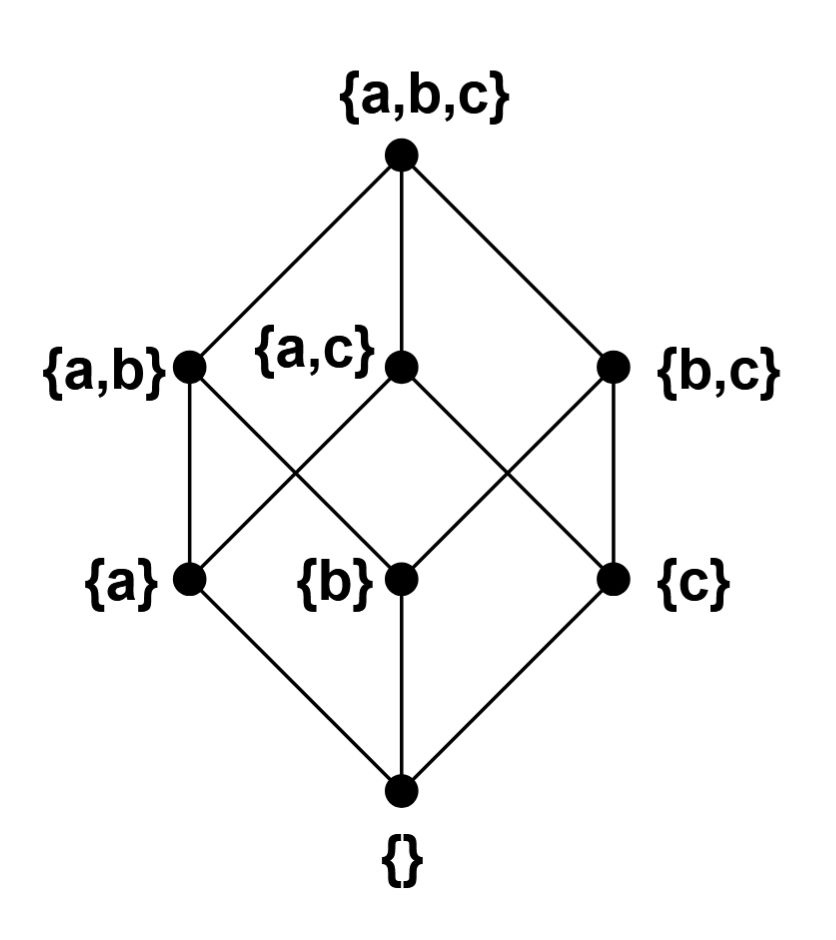
Field-by-field Comparison
| Field | Before | After |
|---|---|---|
| Front | What |
What does the Hasse diagram of a poset \((A; \preceq)\) look like? |
| Back | A directed graph whose vertices are labeled with elements of \(A\) and where there is an edge from \(a\) to \(b\) <strong>if and only if</strong> \(b\) <strong>covers</strong> \(a\). | A directed graph whose vertices are labeled with elements of \(A\) and where there is an edge from \(a\) to \(b\) <strong>if and only if</strong> \(b\) <strong>covers</strong> \(a\).<br><br><img src="paste-f73994d226c864f7b27dfb8150666efd3d3b8bf6.jpg"> |
Note 17: ETH::DiskMat
Deck: ETH::DiskMat
Note Type: Horvath Classic
GUID:
modified
Note Type: Horvath Classic
GUID:
y+%Du@ss=x
Before
Front
If we intersect two equivalence relations, what do we get?
Back
If we intersect two equivalence relations, what do we get?
The intersection of two equivalence relations (on the same set) is also an equivalence relation.
After
Front
If we intersect two equivalence relations, what do we get?
Back
If we intersect two equivalence relations, what do we get?
Another equivalence relation.
Field-by-field Comparison
| Field | Before | After |
|---|---|---|
| Back | Another equivalence relation. |
Note 18: ETH::DiskMat
Deck: ETH::DiskMat
Note Type: Horvath Classic
GUID:
modified
Note Type: Horvath Classic
GUID:
y7i@2u]aPf
Before
Front
What properties does the relation \(=\) satisfy?
Back
What properties does the relation \(=\) satisfy?
- Equivalence relation
- Partial order relation
As it's reflexive, transitive, symmetric and antisymmetric.
After
Front
What properties does the relation \(=\) satisfy?
Back
What properties does the relation \(=\) satisfy?
- Reflexivity
- Symmetry
- Antisymmetry
- Transitivity
Thus, it's both an equivalence and a partial order relation!
Field-by-field Comparison
| Field | Before | After |
|---|---|---|
| Back | <ul><li> |
<ul><li>Reflexivity</li><li>Symmetry</li><li>Antisymmetry</li><li>Transitivity</li></ul><div>Thus, it's both an equivalence and a partial order relation!</div> |
Note 19: ETH::DiskMat
Deck: ETH::DiskMat
Note Type: Horvath Classic
GUID:
modified
Note Type: Horvath Classic
GUID:
z&#Z_j.A(t
Before
Front
What is the identity relation \(\text{id}_A\) on set \(A\)?
Back
What is the identity relation \(\text{id}_A\) on set \(A\)?
\[\text{id}_A = \{(a, a) \ | \ a \in A\}\]
After
Front
What is the definition of the identity relation \(\text{id}_A\) on set \(A\)?
Back
What is the definition of the identity relation \(\text{id}_A\) on set \(A\)?
\[\text{id}_A = \{(a, a) \ | \ a \in A\}\]
Field-by-field Comparison
| Field | Before | After |
|---|---|---|
| Front | What is the identity relation \(\text{id}_A\) on set \(A\)? | What is the definition of the identity relation \(\text{id}_A\) on set \(A\)? |
Note 20: ETH::EProg
Deck: ETH::EProg
Note Type: Horvath Cloze
GUID:
modified
Note Type: Horvath Cloze
GUID:
BNF`UuyO%Q
Before
Front
var is the keyword for a type inferred variable in Java
Back
var is the keyword for a type inferred variable in Java
After
Front
var is the keyword for a type inferred variable in Java.
Back
var is the keyword for a type inferred variable in Java.
Field-by-field Comparison
| Field | Before | After |
|---|---|---|
| Text | {{c1:: var}} is the keyword for a type inferred variable in Java | {{c1:: var}} is the keyword for a type inferred variable in Java. |
Note 21: ETH::EProg
Deck: ETH::EProg
Note Type: Horvath Cloze
GUID:
modified
Note Type: Horvath Cloze
GUID:
p$+y{A-`_b
Before
Front
Casts from int to long and double can always be implicit.
Back
Casts from int to long and double can always be implicit.
After
Front
Casts from int to long and double can always be implicit.
Back
Casts from int to long and double can always be implicit.
Field-by-field Comparison
| Field | Before | After |
|---|---|---|
| Text | Casts from {{c1:: int}} to long and double {{c2:: |
Casts from {{c1:: int}} to long and double can {{c2::always::never/sometimes/always}} be implicit. |
Note 22: ETH::EProg
Deck: ETH::EProg
Note Type: Horvath Classic
GUID:
modified
Note Type: Horvath Classic
GUID:
pD;qk4geEz
Before
Front
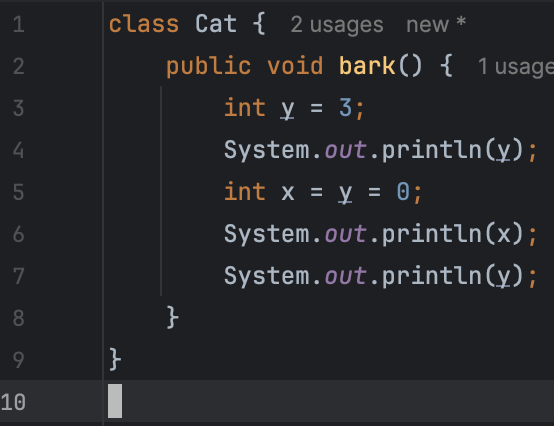
The output of the code snippet is:
Back
The output of the code snippet is:
3
0
0
0
0
After
Front
The output of this code snippet is:
Back
The output of this code snippet is:
3
0
0
0
0
Field-by-field Comparison
| Field | Before | After |
|---|---|---|
| Front | The output of th |
The output of this code snippet is:<br><img src="Screenshot 2025-12-12 at 22.32.55.png"> |
Note 23: ETH::LinAlg
Deck: ETH::LinAlg
Note Type: Horvath Cloze
GUID:
modified
Note Type: Horvath Cloze
GUID:
nkL&a6|Q;d
Before
Front
The span of m linearly independent vectors is
Back
The span of m linearly independent vectors is
\(\mathbb{R}^m\) this also means that a matrix in \(\mathbb{R}^{n \times n}\) with rank(A) = n spans all of the space.
After
Front
The span of m linearly independent vectors is \({{c1::\mathbb{R}^m}}\).
Back
The span of m linearly independent vectors is \({{c1::\mathbb{R}^m}}\).
This also means that a matrix in \(\mathbb{R}^{n \times n}\) with rank(A) = n spans all of the space.
Field-by-field Comparison
| Field | Before | After |
|---|---|---|
| Text | The span of m linearly independent vectors is | The span of m linearly independent vectors is \({{c1::\mathbb{R}^m}}\). |
| Extra | This also means that a matrix in \(\mathbb{R}^{n \times n}\) with rank(A) = n spans all of the space. |