Runtime of Merge Sort?
Note 1: ETH::A&D
Deck: ETH::A&D
Note Type: Image Occlusion
GUID:
modified
Note Type: Image Occlusion
GUID:
GKG~Tp?e4l
Before
Front
Back
After
Front
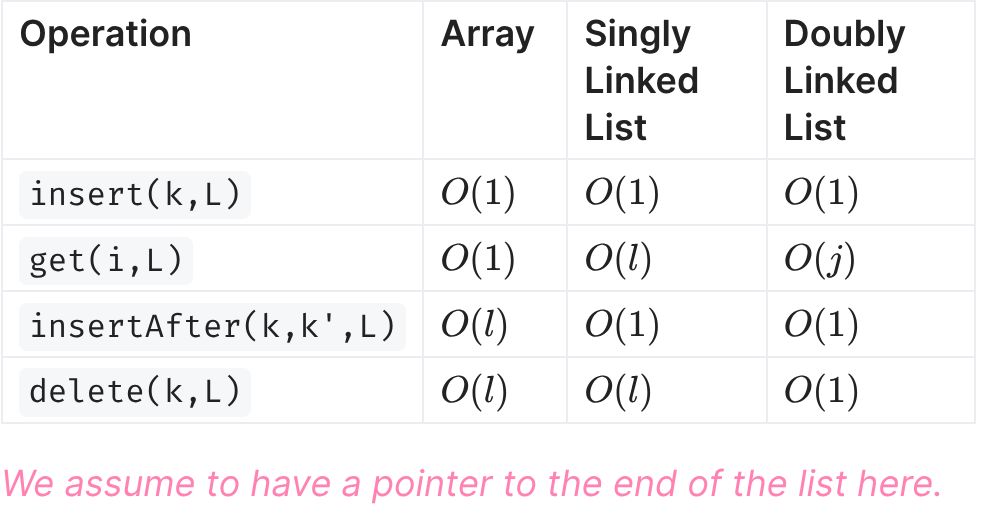
Note that the key parameter of insertAfter and delete in lists refers to the actual node, not it's value.
Back
Note that the key parameter of insertAfter and delete in lists refers to the actual node, not it's value.
Field-by-field Comparison
| Field | Before | After |
|---|---|---|
| Header | Note that the key parameter of insertAfter and delete in lists refers to the actual node, not it's value.<br> |
Note 2: ETH::A&D
Deck: ETH::A&D
Note Type: Algorithms
GUID:
modified
Note Type: Algorithms
GUID:
NAHrkHd^ik
Before
Front
Back
Runtime of Merge Sort?
Best Case: \(O(n \log n)\)
Worst Case: \(O(n \log n)\)
Worst Case: \(O(n \log n)\)
After
Front
Runtime of Merge Sort?
Back
Runtime of Merge Sort?
Best Case: \(O(n \log n)\)
Worst Case: \(O(n \log n)\)
Worst Case: \(O(n \log n)\)
Field-by-field Comparison
| Field | Before | After |
|---|---|---|
| Invariant | <div> |
<div>For all \(n < r - l + 1\) merge sort correctly sorts any sub-array of length n.</div><div><br></div><div>Assuming the invariant holds, the two recursive calls return sorted halves. </div><div><br></div><div>It remains to show that merge correctly combines two sorted halves into a sorted whole.</div> |
Note 3: ETH::DiskMat
Deck: ETH::DiskMat
Note Type: Horvath Classic
GUID:
modified
Note Type: Horvath Classic
GUID:
H*J4QbU35P
Before
Front
What exponentiation operation is valid in modular arithmetic?
Back
What exponentiation operation is valid in modular arithmetic?
I can do:
- \(a \equiv_n b\) and then \(a^x \equiv_n b^x\)
What is illegal is:
- \(a \equiv_n b\) and \(c \equiv_n d\) and then doing \(a^c \equiv_n b^d\)
After
Front
What exponentiation operation is valid in modular arithmetic?
Back
What exponentiation operation is valid in modular arithmetic?
This is allowed:
- \(a \equiv_n b\) and then \(a^x \equiv_n b^x\)
But this on the other hand is illegal:
- \(a \equiv_n b\) and \(c \equiv_n d\) and then doing \(a^c \equiv_n b^d\)
Field-by-field Comparison
| Field | Before | After |
|---|---|---|
| Back | This is allowed:<br><ul><li>\(a \equiv_n b\) and then \(a^x \equiv_n b^x\)<br></li></ul><div>But this on the other hand is illegal:</div><div><ul><li>\(a \equiv_n b\) and \(c \equiv_n d\) and then doing \(a^c \equiv_n b^d\)</li></ul></div> |
Note 4: ETH::DiskMat
Deck: ETH::DiskMat
Note Type: Horvath Cloze
GUID:
modified
Note Type: Horvath Cloze
GUID:
Pz>]O?kRm)
Before
Front
It follow from the respective definitions that \(\gcd(a,b) \times \text{lcm}(a,b) =\) \(ab\).
Back
It follow from the respective definitions that \(\gcd(a,b) \times \text{lcm}(a,b) =\) \(ab\).
After
Front
It follows from the respective definitions that \(\gcd(a,b) \cdot \text{lcm}(a,b) =\) \(ab\).
Back
It follows from the respective definitions that \(\gcd(a,b) \cdot \text{lcm}(a,b) =\) \(ab\).
Field-by-field Comparison
| Field | Before | After |
|---|---|---|
| Text | It follow from the respective definitions that \(\gcd(a,b) \ |
It follows from the respective definitions that \(\gcd(a,b) \cdot \text{lcm}(a,b) =\) {{c1:: \(ab\)}}. |
Note 5: ETH::DiskMat
Deck: ETH::DiskMat
Note Type: Horvath Classic
GUID:
modified
Note Type: Horvath Classic
GUID:
d_Wm7Nf:G2
Before
Front
What do we need to state before using the decomposition of an \(n \in \mathbb{Z}\) into prime factors?
Back
What do we need to state before using the decomposition of an \(n \in \mathbb{Z}\) into prime factors?
We need to state that this is allowed by the fundamental theorem of arithmetic.
After
Front
What do we need to state before using the decomposition of an \(n \in \mathbb{Z}\) into prime factors?
Back
What do we need to state before using the decomposition of an \(n \in \mathbb{Z}\) into prime factors?
That this is allowed by the fundamental theorem of arithmetic.
Field-by-field Comparison
| Field | Before | After |
|---|---|---|
| Back | That this is allowed by the fundamental theorem of arithmetic. |
Note 6: ETH::DiskMat
Deck: ETH::DiskMat
Note Type: Horvath Classic
GUID:
modified
Note Type: Horvath Classic
GUID:
e+8V~0_GeE
Before
Front
How does one show the injectivity of a function?
Back
How does one show the injectivity of a function?
Show that if \(a \not= b\), then under that assumption, if \(f(a) = f(b)\) we get a contradiction as this implies \(a = b\).
Example: \(f(x) = 2x\), then if \(a \not = b\) then if \(f(a) = f(b) \ \implies \ 2a = 2b\). This however \( \ \implies a = b\).
Example: \(f(x) = 2x\), then if \(a \not = b\) then if \(f(a) = f(b) \ \implies \ 2a = 2b\). This however \( \ \implies a = b\).
After
Front
How does one show the injectivity of a function?
Back
How does one show the injectivity of a function?
Assume \(a \not= b\) and show that\(f(a) \neq f(b)\). Equivalently (by contrapositive), assume \(f(a) = f(b)\) and show that \(a = b\).
Example: \(f(x) = 2x\), if \(f(a) = f(b)\), then \(2a = 2b\), which implies \(a = b\). Hence \(f\) is injective.
Example: \(f(x) = 2x\), if \(f(a) = f(b)\), then \(2a = 2b\), which implies \(a = b\). Hence \(f\) is injective.
Field-by-field Comparison
| Field | Before | After |
|---|---|---|
| Back | Assume \(a \not= b\) and show that\(f(a) \neq f(b)\). Equivalently (by contrapositive), assume \(f(a) = f(b)\) and show that \(a = b\).<br><br><b>Example: </b>\(f(x) = 2x\), if \(f(a) = f(b)\), then \(2a = 2b\), which implies \(a = b\). Hence \(f\) is injective. |
Note 7: ETH::DiskMat
Deck: ETH::DiskMat
Note Type: Horvath Classic
GUID:
modified
Note Type: Horvath Classic
GUID:
g|p?@3JwCd
Before
Front
Why does \(ax \equiv_m 1\) have no solution when \(\text{gcd}(a, m) = d > 1\)?
Back
Why does \(ax \equiv_m 1\) have no solution when \(\text{gcd}(a, m) = d > 1\)?
We can rewrite \(ax \equiv_m 1\) as \(ax - 1 = km \Leftrightarrow ax - km = 1\). Now since, \(d | a\) and \(d | m\), then \(d | ax\) and \(d | km\) for any \(x\).
Thus \(d | (ax - km)\), and \(ax - km = 1\).
But \(d \nmid 1 \implies d \nmid (ax - km)\), which is a contradiction. Thus \(ax\) can never be congruent to \(1\) modulo \(m\).
Thus \(d | (ax - km)\), and \(ax - km = 1\).
But \(d \nmid 1 \implies d \nmid (ax - km)\), which is a contradiction. Thus \(ax\) can never be congruent to \(1\) modulo \(m\).
After
Front
Why does \(ax \equiv_m 1\) have no solution when \(\text{gcd}(a, m) = d > 1\)?
Back
Why does \(ax \equiv_m 1\) have no solution when \(\text{gcd}(a, m) = d > 1\)?
We can rewrite \(ax \equiv_m 1\) as \(ax - 1 = km \Leftrightarrow ax - km = 1\). Now since, \(d \mid a\) and \(d \mid m\), then \(d \mid ax\) and \(d \mid km\) for any \(x\).
Thus \(d \mid (ax - km)\), and \(ax - km = 1\).
But \(d \nmid 1 \implies d \nmid (ax - km)\), which is a contradiction. Thus \(ax\) can never be congruent to \(1\) modulo \(m\).
Thus \(d \mid (ax - km)\), and \(ax - km = 1\).
But \(d \nmid 1 \implies d \nmid (ax - km)\), which is a contradiction. Thus \(ax\) can never be congruent to \(1\) modulo \(m\).
Field-by-field Comparison
| Field | Before | After |
|---|---|---|
| Back | We can rewrite \(ax \equiv_m 1\) as \(ax - 1 = km \Leftrightarrow ax - km = 1\). Now since, \(d |
We can rewrite \(ax \equiv_m 1\) as \(ax - 1 = km \Leftrightarrow ax - km = 1\). Now since, \(d \mid a\) and \(d \mid m\), then \(d \mid ax\) and \(d \mid km\) for any \(x\).<br>Thus \(d \mid (ax - km)\), and \(ax - km = 1\).<br><br>But \(d \nmid 1 \implies d \nmid (ax - km)\), which is a contradiction. Thus \(ax\) can never be congruent to \(1\) modulo \(m\). |
Note 8: ETH::DiskMat
Deck: ETH::DiskMat
Note Type: Horvath Classic
GUID:
modified
Note Type: Horvath Classic
GUID:
iQE!&/N&9W
Before
Front
How do polynomials behave under modular reduction? (Corollary 4.15)
Back
How do polynomials behave under modular reduction? (Corollary 4.15)
Let \(f(x_1, \dots, x_k)\) be a polynomial with integer coefficients, and let \(m \geq 1\). If \(a_i \equiv_m b_i\) for \(1 \leq i \leq k\), then:
\[f(a_1, \dots, a_k) \equiv_m f(b_1, \dots, b_k)\]
After
Front
How do polynomials behave under modular reduction? (Corollary 4.15)
Back
How do polynomials behave under modular reduction? (Corollary 4.15)
Let \(f(x_1, \dots, x_k)\) be a polynomial with integer coefficients, and let \(m \geq 1\).
If \(a_i \equiv_m b_i\) for all \(i \in \{1, ..., k\}\), then: \[f(a_1, \dots, a_k) \equiv_m f(b_1, \dots, b_k)\]
If \(a_i \equiv_m b_i\) for all \(i \in \{1, ..., k\}\), then: \[f(a_1, \dots, a_k) \equiv_m f(b_1, \dots, b_k)\]
Field-by-field Comparison
| Field | Before | After |
|---|---|---|
| Back | Let \(f(x_1, \dots, x_k)\) be a polynomial with integer coefficients, and let \(m \geq 1\). If \(a_i \equiv_m b_i\) for |
Let \(f(x_1, \dots, x_k)\) be a polynomial with integer coefficients, and let \(m \geq 1\). <br><br>If \(a_i \equiv_m b_i\) for all \(i \in \{1, ..., k\}\), then: \[f(a_1, \dots, a_k) \equiv_m f(b_1, \dots, b_k)\] |
Note 9: ETH::DiskMat
Deck: ETH::DiskMat
Note Type: Horvath Classic
GUID:
modified
Note Type: Horvath Classic
GUID:
l7;;$C9=2
Before
Front
What is the multiplicative inverse of \(a\) modulo \(m\)?
Back
What is the multiplicative inverse of \(a\) modulo \(m\)?
The unique solution \(x \in \mathbb{Z}_m\) to the congruence equation \(ax \equiv_m 1\), where \(\text{gcd}(a, m) = 1\). Denoted \(a^{-1} \pmod{m}\) or \(1/a \pmod{m}\).
After
Front
What is the meaning of the multiplicative inverse of some number \(a\) modulo \(m\)?
Back
What is the meaning of the multiplicative inverse of some number \(a\) modulo \(m\)?
It is the unique solution \(x \in \mathbb{Z}_m\) to the congruence equation \(ax \equiv_m 1\), where \(\text{gcd}(a, m) = 1\). Denoted \(a^{-1} \pmod{m}\) or \(1/a \pmod{m}\).
Field-by-field Comparison
| Field | Before | After |
|---|---|---|
| Front | What is the multiplicative inverse of |
What is the meaning of the multiplicative inverse of some number \(a\) modulo \(m\)? |
| Back | It is the unique solution \(x \in \mathbb{Z}_m\) to the congruence equation \(ax \equiv_m 1\), where \(\text{gcd}(a, m) = 1\). Denoted \(a^{-1} \pmod{m}\) or \(1/a \pmod{m}\). |
Note 10: ETH::DiskMat
Deck: ETH::DiskMat
Note Type: Horvath Classic
GUID:
modified
Note Type: Horvath Classic
GUID:
pI:![>}CgZ
Before
Front
Give the formal definition of "\(a\) is congruent to \(b\) modulo \(m\)".
Back
Give the formal definition of "\(a\) is congruent to \(b\) modulo \(m\)".
\[a \equiv_m b \overset{\text{def}}{\Longleftrightarrow} m | (a - b)\]
Also written as \(a \equiv b \pmod{m}\).
After
Front
Give the formal definition of "\(a\) is congruent to \(b\) modulo \(m\)".
Back
Give the formal definition of "\(a\) is congruent to \(b\) modulo \(m\)".
\[a \equiv_m b \overset{\text{def}}{\Longleftrightarrow} m \mid (a - b)\]
Also written as \(a \equiv b \pmod{m}\).
Field-by-field Comparison
| Field | Before | After |
|---|---|---|
| Back | \[a \equiv_m b \overset{\text{def}}{\Longleftrightarrow} m |
\[a \equiv_m b \overset{\text{def}}{\Longleftrightarrow} m \mid (a - b)\] Also written as \(a \equiv b \pmod{m}\). |
Note 11: ETH::DiskMat
Deck: ETH::DiskMat
Note Type: Horvath Cloze
GUID:
modified
Note Type: Horvath Cloze
GUID:
xWhw%ncc|4
Before
Front
Verify that \(\equiv_m\) is reflexive, symmetric, and transitive.
- Reflexive: \(a \equiv_m a\) since \(m | (a - a) = 0\) ✓
- Symmetric: \(a \equiv_m b \Rightarrow m | (a-b) \Rightarrow m | (b-a) \Rightarrow b \equiv_m a\) ✓
- Transitive: If \(m | (a-b)\) and \(m | (b-c)\), then \(m | (a-b+b-c) = (a-c)\) ✓
Back
Verify that \(\equiv_m\) is reflexive, symmetric, and transitive.
- Reflexive: \(a \equiv_m a\) since \(m | (a - a) = 0\) ✓
- Symmetric: \(a \equiv_m b \Rightarrow m | (a-b) \Rightarrow m | (b-a) \Rightarrow b \equiv_m a\) ✓
- Transitive: If \(m | (a-b)\) and \(m | (b-c)\), then \(m | (a-b+b-c) = (a-c)\) ✓
After
Front
Verify that \(\equiv_m\) is reflexive, symmetric, and transitive.
- Reflexive: \(a \equiv_m a\) since \(m \mid (a - a) = 0\) ✓
- Symmetric: \(a \equiv_m b \Rightarrow m \mid (a-b) \Rightarrow m \mid (b-a) \Rightarrow b \equiv_m a\) ✓
- Transitive: If \(m \mid (a-b)\) and \(m \mid (b-c)\), then \(m \mid (a-b+b-c) = (a-c)\) ✓
Back
Verify that \(\equiv_m\) is reflexive, symmetric, and transitive.
- Reflexive: \(a \equiv_m a\) since \(m \mid (a - a) = 0\) ✓
- Symmetric: \(a \equiv_m b \Rightarrow m \mid (a-b) \Rightarrow m \mid (b-a) \Rightarrow b \equiv_m a\) ✓
- Transitive: If \(m \mid (a-b)\) and \(m \mid (b-c)\), then \(m \mid (a-b+b-c) = (a-c)\) ✓
Field-by-field Comparison
| Field | Before | After |
|---|---|---|
| Text | Verify that \(\equiv_m\) is reflexive, symmetric, and transitive.<br><ul><li><strong>Reflexive</strong>: {{c1:: \(a \equiv_m a\) since \(m |
Verify that \(\equiv_m\) is reflexive, symmetric, and transitive.<br><ul><li><strong>Reflexive</strong>: {{c1:: \(a \equiv_m a\) since \(m \mid (a - a) = 0\) ✓}}</li><li><strong>Symmetric</strong>: {{c2:: \(a \equiv_m b \Rightarrow m \mid (a-b) \Rightarrow m \mid (b-a) \Rightarrow b \equiv_m a\) ✓}}</li><li><strong>Transitive</strong>: {{c3:: If \(m \mid (a-b)\) and \(m \mid (b-c)\), then \(m \mid (a-b+b-c) = (a-c)\) ✓}}</li></ul> |