Der Abstand zwischen zwei Komplexen \(z_1, z_2\) ist \( d = |z_2 - z_1 | = |z_1 - z_2| \).
Note 1: ETH::2. Semester::Analysis
Deck: ETH::2. Semester::Analysis
Note Type: Horvath Cloze
GUID:
modified
Note Type: Horvath Cloze
GUID:
Hpp:g}bJuy
Before
Front
Back
Der Abstand zwischen zwei Komplexen \(z_1, z_2\) ist \( d = |z_2 - z_1 | = |z_1 - z_2| \).
Hier gilt wieder die Dreiecksungleichung: \(|z + w| \leq |z| + |w|\).
After
Front
Der Abstand zwischen zwei Komplexen \(z_1, z_2\) ist \( d = {{c1:: |z_2 - z_1 | = |z_1 - z_2| ::\text{Beide Formen} }}\).
Back
Der Abstand zwischen zwei Komplexen \(z_1, z_2\) ist \( d = {{c1:: |z_2 - z_1 | = |z_1 - z_2| ::\text{Beide Formen} }}\).
Hier gilt wieder die Dreiecksungleichung: \(|z + w| \leq |z| + |w|\).
Field-by-field Comparison
| Field | Before | After |
|---|---|---|
| Text | Der Abstand zwischen zwei Komplexen \(z_1, z_2\) ist \( d = {{c1:: |z_2 - z_1 | = |z_1 - z_2| :: |
Der Abstand zwischen zwei Komplexen \(z_1, z_2\) ist \( d = {{c1:: |z_2 - z_1 | = |z_1 - z_2| ::\text{Beide Formen} }}\). |
Note 2: ETH::2. Semester::Analysis
Deck: ETH::2. Semester::Analysis
Note Type: Horvath Classic
GUID:
modified
Note Type: Horvath Classic
GUID:
J9yi_Ht+N)
Before
Front
Dreiecksungleichung (Substraktion)
Back
Dreiecksungleichung (Substraktion)
\[|x + y| \geq ||x| - |y|| \]
After
Front
Dreiecksungleichung (Subtraktion)
Back
Dreiecksungleichung (Subtraktion)
\[|x + y| \geq ||x| - |y|| \]
Field-by-field Comparison
| Field | Before | After |
|---|---|---|
| Front | Dreiecksungleichung (Sub |
Dreiecksungleichung (Subtraktion) |
Note 3: ETH::2. Semester::Analysis
Deck: ETH::2. Semester::Analysis
Note Type: Horvath Cloze
GUID:
modified
Note Type: Horvath Cloze
GUID:
KWf.KkD*CS
Before
Front
Für \(z \in \mathbb{C}\) gilt: $z + \bar{z} = {{c1:: 2 \text{Re}(z) }}$ und $z - \bar{z} = {{c1:: 2i \text{Im}(z) }}$
Back
Für \(z \in \mathbb{C}\) gilt: $z + \bar{z} = {{c1:: 2 \text{Re}(z) }}$ und $z - \bar{z} = {{c1:: 2i \text{Im}(z) }}$
After
Front
Für \(z \in \mathbb{C}\) gilt:
\(z + \bar{z} = {{c1:: 2 \text{ Re}(z)}} \text{ und } z - \bar{z} = {{c1:: 2i \text{ Im}(z) }}\)
\(z + \bar{z} = {{c1:: 2 \text{ Re}(z)}} \text{ und } z - \bar{z} = {{c1:: 2i \text{ Im}(z) }}\)
Back
Für \(z \in \mathbb{C}\) gilt:
\(z + \bar{z} = {{c1:: 2 \text{ Re}(z)}} \text{ und } z - \bar{z} = {{c1:: 2i \text{ Im}(z) }}\)
\(z + \bar{z} = {{c1:: 2 \text{ Re}(z)}} \text{ und } z - \bar{z} = {{c1:: 2i \text{ Im}(z) }}\)
Field-by-field Comparison
| Field | Before | After |
|---|---|---|
| Text | Für \(z \in \mathbb{C}\) gilt: |
Für \(z \in \mathbb{C}\) gilt: <br>\(z + \bar{z} = {{c1:: 2 \text{ Re}(z)}} \text{ und } z - \bar{z} = {{c1:: 2i \text{ Im}(z) }}\) |
Note 4: ETH::2. Semester::Analysis
Deck: ETH::2. Semester::Analysis
Note Type: Horvath Cloze
GUID:
modified
Note Type: Horvath Cloze
GUID:
L1F:TU2gp~
Before
Front
Youngsche Ungleichung: Für jedes \(x, y \in \mathbb{R}\), \(\epsilon > 0\) gilt \[ 2|xy| \leq {{c2:: \epsilon x^2 + \frac{1}{\epsilon} y^2 }}\]Proof Included
Back
Youngsche Ungleichung: Für jedes \(x, y \in \mathbb{R}\), \(\epsilon > 0\) gilt \[ 2|xy| \leq {{c2:: \epsilon x^2 + \frac{1}{\epsilon} y^2 }}\]Proof Included
Proof: Setze \(\gamma = \sqrt{\epsilon} > 0\). OBDA gelte \(x \cdot y \geq 0\). \[ 0 \leq (\gamma x - \frac{y}{\gamma})^2 = \gamma^2 x^2 - 2x\cdot y + \frac{1}{\gamma^2}y^2 \]
After
Front
Youngsche Ungleichung
Für jedes \(x, y \in \mathbb{R}\), \(\epsilon > 0\) gilt: \[ 2|xy| \leq {{c2:: \epsilon x^2 + \frac{1}{\epsilon} y^2 }}\]Proof Included
Für jedes \(x, y \in \mathbb{R}\), \(\epsilon > 0\) gilt: \[ 2|xy| \leq {{c2:: \epsilon x^2 + \frac{1}{\epsilon} y^2 }}\]Proof Included
Back
Youngsche Ungleichung
Für jedes \(x, y \in \mathbb{R}\), \(\epsilon > 0\) gilt: \[ 2|xy| \leq {{c2:: \epsilon x^2 + \frac{1}{\epsilon} y^2 }}\]Proof Included
Für jedes \(x, y \in \mathbb{R}\), \(\epsilon > 0\) gilt: \[ 2|xy| \leq {{c2:: \epsilon x^2 + \frac{1}{\epsilon} y^2 }}\]Proof Included
Proof: Setze \(\gamma = \sqrt{\epsilon} > 0\). OBDA gelte \(x \cdot y \geq 0\). \[ 0 \leq (\gamma x - \frac{y}{\gamma})^2 = \gamma^2 x^2 - 2x\cdot y + \frac{1}{\gamma^2}y^2 \]
Field-by-field Comparison
| Field | Before | After |
|---|---|---|
| Text | <b>Youngsche Ungleichung< |
<b>Youngsche Ungleichung<br></b><br>Für jedes \(x, y \in \mathbb{R}\), \(\epsilon > 0\) gilt: \[ {{c1:: 2|xy| }} \leq {{c2:: \epsilon x^2 + \frac{1}{\epsilon} y^2 }}\]<i>Proof Included</i> |
Note 5: ETH::2. Semester::Analysis
Deck: ETH::2. Semester::Analysis
Note Type: Horvath Cloze
GUID:
modified
Note Type: Horvath Cloze
GUID:
L@=m$)(QYg
Before
Front
Aus \(x \leq y\) und \(u \leq v\) folgt \(x + u \leq y + v\) .
Back
Aus \(x \leq y\) und \(u \leq v\) folgt \(x + u \leq y + v\) .
Konsistenz der Ordnung zur Addition
After
Front
Aus \(x \leq y\) und \(u \leq v\) folgt \(x + u \leq y + v\) .
Back
Aus \(x \leq y\) und \(u \leq v\) folgt \(x + u \leq y + v\) .
Konsistenz der Ordnung zur Addition
Field-by-field Comparison
| Field | Before | After |
|---|---|---|
| Text | Aus \(x \leq y\) und \(u \leq v\) folgt {{c1::\(x + u \leq y + v\) :: |
Aus \(x \leq y\) und \(u \leq v\) folgt {{c1::\(x + u \leq y + v\) ::Kombination}}. |
Note 6: ETH::2. Semester::DDCA
Deck: ETH::2. Semester::DDCA
Note Type: Horvath Classic
GUID:
modified
Note Type: Horvath Classic
GUID:
rKhGk@]2@!
Before
Front
What is dynamic power consumption?
Back
What is dynamic power consumption?
Power used to charge capacitance as signals change (0 <==> 1).
After
Front
What is dynamic power consumption?
Back
What is dynamic power consumption?
Power used to charge capacitance as signals change (0\(\iff\)1).
Field-by-field Comparison
| Field | Before | After |
|---|---|---|
| Back | Power used to charge capacitance as signals change (0 |
Power used to charge capacitance as signals change (0\(\iff\)1). |
Note 7: ETH::2. Semester::PProg
Deck: ETH::2. Semester::PProg
Note Type: Horvath Cloze
GUID:
modified
Note Type: Horvath Cloze
GUID:
hxi*,8Kfw7
Before
Front
A thread is an independent (i.e. capable of running in parallel) unit of computation that executes a piece of code.
Back
A thread is an independent (i.e. capable of running in parallel) unit of computation that executes a piece of code.
After
Front
A thread is an independent (i.e. capable of running in parallel) unit of computation that executes a piece of code.
Back
A thread is an independent (i.e. capable of running in parallel) unit of computation that executes a piece of code.
Field-by-field Comparison
| Field | Before | After |
|---|---|---|
| Text | A {{c1::thread}} is |
A {{c1::thread}} is {{c2::an independent (i.e. capable of running in parallel) unit of computation that executes a piece of code}}. |
Note 8: ETH::2. Semester::PProg
Deck: ETH::2. Semester::PProg
Note Type: Horvath Occlusio
GUID:
modified
Note Type: Horvath Occlusio
GUID:
uzNFPB755~
Before
Front
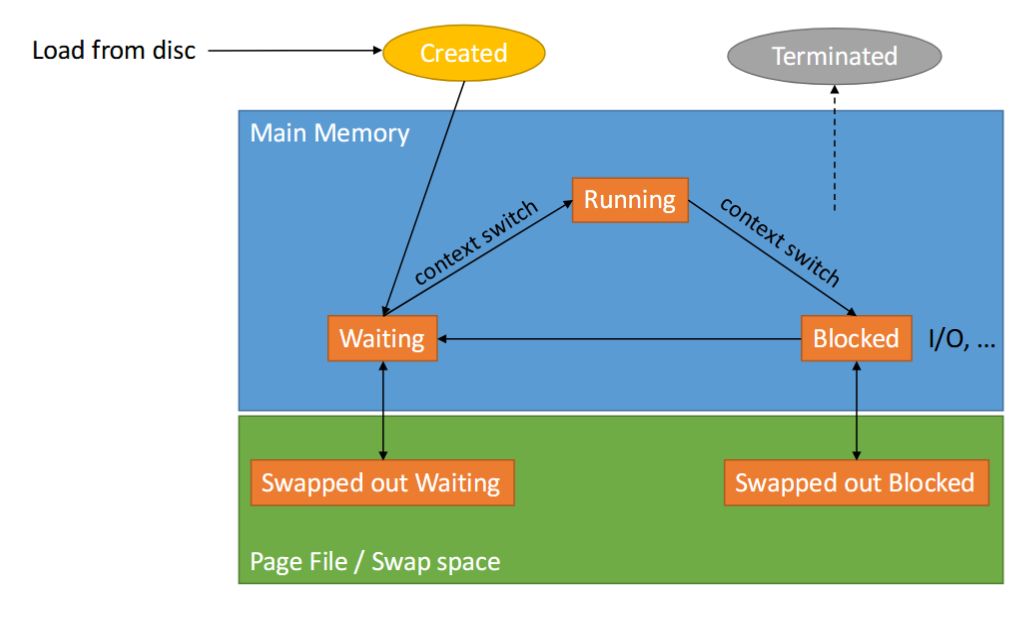
Back
After
Front
Back
Field-by-field Comparison
| Field | Before | After |
|---|---|---|
| Occlusion | {{c1::image-occlusion:rect:left=.55 |
{{c1::image-occlusion:rect:left=.5516:top=.2782:width=.1174:height=.0851:oi=1}}<br>{{c2::image-occlusion:rect:left=.3149:top=.504:width=.1095:height=.0818:oi=1}}<br>{{c2::image-occlusion:rect:left=.2425:top=.7396:width=.2562:height=.0785:oi=1}}<br>{{c3::image-occlusion:rect:left=.7726:top=.504:width=.1213:height=.0897:oi=1}}<br>{{c3::image-occlusion:rect:left=.6982:top=.7363:width=.2582:height=.0785:oi=1}}<br> |
Note 9: ETH::2. Semester::PProg
Deck: ETH::2. Semester::PProg
Note Type: Horvath Cloze
GUID:
modified
Note Type: Horvath Cloze
GUID:
vP9^d+kmz!
Before
Front
A livelock is a situation in which all threads starve by infinitely often trying to enter a critical section, but never succeeding.
Back
A livelock is a situation in which all threads starve by infinitely often trying to enter a critical section, but never succeeding.
Similar to a deadlock, the system makes no real progress, although the threads execute statements/use CPU time.
After
Front
A livelock is a situation in which all threads starve by infinitely often trying to enter a critical section, but never succeeding.
Back
A livelock is a situation in which all threads starve by infinitely often trying to enter a critical section, but never succeeding.
Similar to a deadlock, the system makes no real progress, although the threads execute statements/use CPU time.
Field-by-field Comparison
| Field | Before | After |
|---|---|---|
| Text | A {{c1::livelock}} is a situation in which all threads |
A {{c1::livelock}} is a situation in which {{c2::all threads starve by infinitely often trying to enter a critical section, but never succeeding}}. |