Sei \(n \in \mathbb{N}\), \(n \ge 1\). Dann hat die Gleichung \(z^n = 1\) genau \(n\) Lösungen in \(\mathbb{C}\): \(z_1, z_2, \dots, z_n\) wobei \[ z_j = {{c1:: \cos \frac{2\pi j}{n} + i \cdot \sin \frac{2 \pi j}{n} }}, \quad 1 \le j \le n \]
Note 1: ETH::2. Semester::Analysis
Deck: ETH::2. Semester::Analysis
Note Type: Horvath Cloze
GUID:
modified
Note Type: Horvath Cloze
GUID:
E#P*nHH>$>
Before
Front
Back
Sei \(n \in \mathbb{N}\), \(n \ge 1\). Dann hat die Gleichung \(z^n = 1\) genau \(n\) Lösungen in \(\mathbb{C}\): \(z_1, z_2, \dots, z_n\) wobei \[ z_j = {{c1:: \cos \frac{2\pi j}{n} + i \cdot \sin \frac{2 \pi j}{n} }}, \quad 1 \le j \le n \]
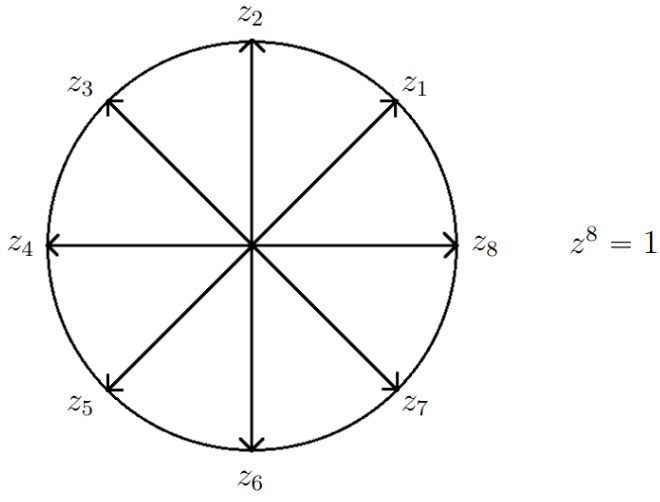
Die Lösungen sind alle auf einem Kreis mit Radius 1 und sind gleichmäßig verteilt (formen ein n-Eck).
Beispiel:
Für \(w = R \cdot e^{i \varphi}\) sind die Lösungen von \(z^n = w\) gleich der \(n\) komplexen Zahlen mit Betrag \(\sqrt[^n]{R}\) und Winkeln \(\varphi_k = \frac{\varphi}{n} + k \cdot \frac{2 \pi}{n}\) für \(k = 0, \dots, n - 1\).
After
Front
Sei \(n \in \mathbb{N}\), \(n \ge 1\).
Dann hat die Gleichung \(z^n = 1\) genau \(n\) Lösungen in \(\mathbb{C}\): \(z_1, z_2, \dots, z_n\) wobei: \[ z_j = {{c1:: \cos \frac{2\pi j}{n} + i \cdot \sin \frac{2 \pi j}{n} }}, \quad 1 \le j \le n \]
Dann hat die Gleichung \(z^n = 1\) genau \(n\) Lösungen in \(\mathbb{C}\): \(z_1, z_2, \dots, z_n\) wobei: \[ z_j = {{c1:: \cos \frac{2\pi j}{n} + i \cdot \sin \frac{2 \pi j}{n} }}, \quad 1 \le j \le n \]
Back
Sei \(n \in \mathbb{N}\), \(n \ge 1\).
Dann hat die Gleichung \(z^n = 1\) genau \(n\) Lösungen in \(\mathbb{C}\): \(z_1, z_2, \dots, z_n\) wobei: \[ z_j = {{c1:: \cos \frac{2\pi j}{n} + i \cdot \sin \frac{2 \pi j}{n} }}, \quad 1 \le j \le n \]
Dann hat die Gleichung \(z^n = 1\) genau \(n\) Lösungen in \(\mathbb{C}\): \(z_1, z_2, \dots, z_n\) wobei: \[ z_j = {{c1:: \cos \frac{2\pi j}{n} + i \cdot \sin \frac{2 \pi j}{n} }}, \quad 1 \le j \le n \]
Die Lösungen liegen alle auf einem Kreis mit Radius 1 und sind gleichmäßig verteilt (formen ein n-Eck).
Beispiel:
Für \(w = R \cdot e^{i \varphi}\) sind die Lösungen von \(z^n = w\) gleich der \(n\) komplexen Zahlen mit Betrag \(\sqrt[^n]{R}\) und Winkeln \(\varphi_k = \frac{\varphi}{n} + k \cdot \frac{2 \pi}{n}\) für \(k = 0, \dots, n - 1\).
Field-by-field Comparison
| Field | Before | After |
|---|---|---|
| Text | Sei \(n \in \mathbb{N}\), \(n \ge 1\). Dann hat die Gleichung \(z^n = 1\) genau \(n\) Lösungen in \(\mathbb{C}\): \(z_1, z_2, \dots, z_n\) wobei |
Sei \(n \in \mathbb{N}\), \(n \ge 1\). <br><br>Dann hat die Gleichung \(z^n = 1\) genau \(n\) Lösungen in \(\mathbb{C}\): \(z_1, z_2, \dots, z_n\) wobei: \[ z_j = {{c1:: \cos \frac{2\pi j}{n} + i \cdot \sin \frac{2 \pi j}{n} }}, \quad 1 \le j \le n \] |
| Extra | <img src="paste-d82ffaf45ffbd9d16177968af1e2d0295676539b.jpg"><br><div>Die Lösungen |
<img src="paste-d82ffaf45ffbd9d16177968af1e2d0295676539b.jpg"><br><div>Die Lösungen liegen alle auf einem Kreis mit Radius 1 und sind gleichmäßig verteilt (formen ein n-Eck).</div><div><br></div> <div>Beispiel: </div><div>Für \(w = R \cdot e^{i \varphi}\) sind die Lösungen von \(z^n = w\) gleich der \(n\) komplexen Zahlen mit Betrag \(\sqrt[^n]{R}\) und Winkeln \(\varphi_k = \frac{\varphi}{n} + k \cdot \frac{2 \pi}{n}\) für \(k = 0, \dots, n - 1\).</div> |
Note 2: ETH::2. Semester::Analysis
Deck: ETH::2. Semester::Analysis
Note Type: Horvath Cloze
GUID:
modified
Note Type: Horvath Cloze
GUID:
M:f@_%USlo
Before
Front
- \(\liminf_{n \rightarrow \infty} a_n\) ist der kleinste Häufungspunkt von \((a_n)\).
- \(\limsup_{n \rightarrow \infty} a_n\) ist der größte Häufungspunkt von \((a_n)\).
Back
- \(\liminf_{n \rightarrow \infty} a_n\) ist der kleinste Häufungspunkt von \((a_n)\).
- \(\limsup_{n \rightarrow \infty} a_n\) ist der größte Häufungspunkt von \((a_n)\).
(Limes inferior den kleinsten möglichen)
After
Front
- \(\liminf_{n \rightarrow \infty} a_n\) ist der kleinste Häufungspunkt von \((a_n)\).
- \(\limsup_{n \rightarrow \infty} a_n\) ist der größte Häufungspunkt von \((a_n)\).
Back
- \(\liminf_{n \rightarrow \infty} a_n\) ist der kleinste Häufungspunkt von \((a_n)\).
- \(\limsup_{n \rightarrow \infty} a_n\) ist der größte Häufungspunkt von \((a_n)\).
Field-by-field Comparison
| Field | Before | After |
|---|---|---|
| Extra |
Note 3: ETH::2. Semester::Analysis
Deck: ETH::2. Semester::Analysis
Note Type: Horvath Cloze
GUID:
modified
Note Type: Horvath Cloze
GUID:
eaR`C4g=_B
Before
Front
Eine Folge \((a_n)_{n \in \mathbb{N}_0} \subset \mathbb{R}\) heißt Cauchy-Folge, falls {{c1::für jedes \(\epsilon > 0\) ein \(N \in \mathbb{N}\) existiert, so dass gilt \[ \forall m, n \ge N \quad |a_n - a_m| < \epsilon \]}}
Back
Eine Folge \((a_n)_{n \in \mathbb{N}_0} \subset \mathbb{R}\) heißt Cauchy-Folge, falls {{c1::für jedes \(\epsilon > 0\) ein \(N \in \mathbb{N}\) existiert, so dass gilt \[ \forall m, n \ge N \quad |a_n - a_m| < \epsilon \]}}
Beispiel \(\sum_{k = 1}^n \frac{1}{k^2}\) ist eine Cauchy Folge.
Die Folge \(\sum_{k = 1}^n \frac{1}{k}\) ist jedoch keine Cauchy-Folge.
After
Front
Eine Folge \((a_n)_{n \in \mathbb{N}_0} \subset \mathbb{R}\) heisst Cauchy-Folge, falls {{c1::für jedes \(\epsilon > 0\) ein \(N \in \mathbb{N}\) existiert, sodass gilt: \[ \forall m, n \ge N \quad |a_n - a_m| < \epsilon \]}}
Back
Eine Folge \((a_n)_{n \in \mathbb{N}_0} \subset \mathbb{R}\) heisst Cauchy-Folge, falls {{c1::für jedes \(\epsilon > 0\) ein \(N \in \mathbb{N}\) existiert, sodass gilt: \[ \forall m, n \ge N \quad |a_n - a_m| < \epsilon \]}}
Beispiele:
\(\sum_{k = 1}^n \frac{1}{k^2}\) ist eine Cauchy Folge.
Die Folge \(\sum_{k = 1}^n \frac{1}{k}\) ist hingegen keine Cauchy-Folge.
\(\sum_{k = 1}^n \frac{1}{k^2}\) ist eine Cauchy Folge.
Die Folge \(\sum_{k = 1}^n \frac{1}{k}\) ist hingegen keine Cauchy-Folge.
Field-by-field Comparison
| Field | Before | After |
|---|---|---|
| Text | Eine Folge \((a_n)_{n \in \mathbb{N}_0} \subset \mathbb{R}\) hei |
Eine Folge \((a_n)_{n \in \mathbb{N}_0} \subset \mathbb{R}\) heisst <b>Cauchy-Folge</b>, falls {{c1::für jedes \(\epsilon > 0\) ein \(N \in \mathbb{N}\) existiert, sodass gilt: \[ \forall m, n \ge N \quad |a_n - a_m| < \epsilon \]}} |
| Extra | <b>Beispiel</b> \(\sum_{k = 1}^n \frac{1}{k^2}\) ist eine Cauchy Folge.
Die Folge \(\sum_{k = 1}^n \frac{1}{k}\) ist |
<b>Beispiele:<br></b> \(\sum_{k = 1}^n \frac{1}{k^2}\) ist eine Cauchy Folge. <br>Die Folge \(\sum_{k = 1}^n \frac{1}{k}\) ist hingegen keine Cauchy-Folge. |
Note 4: ETH::2. Semester::Analysis
Deck: ETH::2. Semester::Analysis
Note Type: Horvath Cloze
GUID:
modified
Note Type: Horvath Cloze
GUID:
f_B`=@^ngo
Before
Front
Die Folge \(\sup \{ a_k \mid k \ge n \}\) ist monoton fallend .
Back
Die Folge \(\sup \{ a_k \mid k \ge n \}\) ist monoton fallend .
Für das infimum: monoton steigend.
Dies gilt, da \(n = 2\) weniger Terme als \(n = 1\) vergleicht (i.e. \(\{a_k \mid k \ge n + 1\} \subseteq \{a_k \mid k \ge n\}\)), deswegen kann es nur kleiner sein.
Dies gilt, da \(n = 2\) weniger Terme als \(n = 1\) vergleicht (i.e. \(\{a_k \mid k \ge n + 1\} \subseteq \{a_k \mid k \ge n\}\)), deswegen kann es nur kleiner sein.
After
Front
Die Folge \(\sup \{ a_k \mid k \ge n \}\) ist monoton fallend.
Back
Die Folge \(\sup \{ a_k \mid k \ge n \}\) ist monoton fallend.
Für das Infinum: monoton steigend.
Dies gilt, da \(n = 2\) weniger Terme als \(n = 1\) vergleicht (d.h. \(\{a_k \mid k \ge n + 1\} \subseteq \{a_k \mid k \ge n\}\)), weswegen es nur kleiner sein kann.
Dies gilt, da \(n = 2\) weniger Terme als \(n = 1\) vergleicht (d.h. \(\{a_k \mid k \ge n + 1\} \subseteq \{a_k \mid k \ge n\}\)), weswegen es nur kleiner sein kann.
Field-by-field Comparison
| Field | Before | After |
|---|---|---|
| Text | Die Folge \(\sup \{ a_k \mid k \ge n \}\) ist {{c1::monoton fallend |
Die Folge \(\sup \{ a_k \mid k \ge n \}\) ist {{c1::monoton fallend::property}}. |
| Extra | Für das |
Für das Infinum: monoton steigend.<br><br>Dies gilt, da \(n = 2\) weniger Terme als \(n = 1\) vergleicht (d.h. \(\{a_k \mid k \ge n + 1\} \subseteq \{a_k \mid k \ge n\}\)), weswegen es nur kleiner sein kann. |
Note 5: ETH::2. Semester::Analysis
Deck: ETH::2. Semester::Analysis
Note Type: Horvath Classic
GUID:
modified
Note Type: Horvath Classic
GUID:
m?qT5<.33+
Before
Front
Limes superior oder inferior können \(\pm \infty\) sein?
Back
Limes superior oder inferior können \(\pm \infty\) sein?
Ja
After
Front
Kann Limes superior (inferior) den Wert \(+ \infty\) (\(-\infty\)) annehmen?
Back
Kann Limes superior (inferior) den Wert \(+ \infty\) (\(-\infty\)) annehmen?
Ja.
Field-by-field Comparison
| Field | Before | After |
|---|---|---|
| Front | Limes superior |
Kann Limes superior (inferior) den Wert \(+ \infty\) (\(-\infty\)) annehmen? |
| Back | Ja | Ja. |
Note 6: ETH::2. Semester::Analysis
Deck: ETH::2. Semester::Analysis
Note Type: Horvath Cloze
GUID:
modified
Note Type: Horvath Cloze
GUID:
qu@PEalZbz
Before
Front
Sandwich Theorem: Conditions for:
Dann ist auch die Folge \((b_n)_{n \in \mathbb{N}_0}\) konvergent und es gilt \[ \lim_{n \rightarrow \infty} b_n = L \]
Dann ist auch die Folge \((b_n)_{n \in \mathbb{N}_0}\) konvergent und es gilt \[ \lim_{n \rightarrow \infty} b_n = L \]
Back
Sandwich Theorem: Conditions for:
Dann ist auch die Folge \((b_n)_{n \in \mathbb{N}_0}\) konvergent und es gilt \[ \lim_{n \rightarrow \infty} b_n = L \]
Dann ist auch die Folge \((b_n)_{n \in \mathbb{N}_0}\) konvergent und es gilt \[ \lim_{n \rightarrow \infty} b_n = L \]
Es seien \((a_n)_{n \in \mathbb{N}_0}\) und \((c_n)_{n \in \mathbb{N}_0}\) zwei konvergente Folgen mit gleichem Grenzwert gegeben \[ \lim_{n \rightarrow \infty} a_n = L \text{ und } \lim_{n \rightarrow \infty} c_n = L \] sowie eine dritte Folge \((b_n)_{n \in \mathbb{N}_0}\) mit der Eigenschaft, dass ein \(N_0 \in \mathbb{N}\) existiert, so dass gilt \[ a_n \le b_n \le c_n \quad \forall n \ge N_0 \]
After
Front
Es seien \((a_n)_{n \in \mathbb{N}_0}\) und \((c_n)_{n \in \mathbb{N}_0}\) zwei konvergente Folgen mit gleichem Grenzwert gegeben: \[ \lim_{n \rightarrow \infty} a_n = L \text{ und } \lim_{n \rightarrow \infty} c_n = L \] sowie eine dritte Folge \((b_n)_{n \in \mathbb{N}_0}\) mit der Eigenschaft, dass ein \(N_0 \in \mathbb{N}\) existiert, so dass gilt:\[ a_n \le b_n \le c_n \quad \forall n \ge N_0 \] Dann ist die Folge \((b_n)_{n \in \mathbb{N}_0}\) konvergent und es gilt: \[ \lim_{n \rightarrow \infty} b_n = L \]
Back
Es seien \((a_n)_{n \in \mathbb{N}_0}\) und \((c_n)_{n \in \mathbb{N}_0}\) zwei konvergente Folgen mit gleichem Grenzwert gegeben: \[ \lim_{n \rightarrow \infty} a_n = L \text{ und } \lim_{n \rightarrow \infty} c_n = L \] sowie eine dritte Folge \((b_n)_{n \in \mathbb{N}_0}\) mit der Eigenschaft, dass ein \(N_0 \in \mathbb{N}\) existiert, so dass gilt:\[ a_n \le b_n \le c_n \quad \forall n \ge N_0 \] Dann ist die Folge \((b_n)_{n \in \mathbb{N}_0}\) konvergent und es gilt: \[ \lim_{n \rightarrow \infty} b_n = L \]
(Sandwich-Theorem)
Field-by-field Comparison
| Field | Before | After |
|---|---|---|
| Text | Es seien \((a_n)_{n \in \mathbb{N}_0}\) und \((c_n)_{n \in \mathbb{N}_0}\) zwei konvergente Folgen mit gleichem Grenzwert gegeben: \[ \lim_{n \rightarrow \infty} a_n = L \text{ und } \lim_{n \rightarrow \infty} c_n = L \] sowie eine dritte Folge \((b_n)_{n \in \mathbb{N}_0}\) mit der Eigenschaft, dass ein \(N_0 \in \mathbb{N}\) existiert, so dass gilt:\[ a_n \le b_n \le c_n \quad \forall n \ge N_0 \] Dann ist die Folge \((b_n)_{n \in \mathbb{N}_0}\) {{c1::konvergent}} und es gilt: \[ \lim_{n \rightarrow \infty} b_n = {{c1::L }}\]<br> | |
| Extra | (Sandwich-Theorem) |
Note 7: ETH::2. Semester::Analysis
Deck: ETH::2. Semester::Analysis
Note Type: Horvath Cloze
GUID:
modified
Note Type: Horvath Cloze
GUID:
r!b0]VV~/_
Before
Front
Wenn \(\lim a_n = 0\) eine Nullfolge ist, so gilt das du dumm bist, die implikation geht nur in eine Richtung.
Back
Wenn \(\lim a_n = 0\) eine Nullfolge ist, so gilt das du dumm bist, die implikation geht nur in eine Richtung.
Ein Gegenbeispiel ist die Harmonische Reihe, \(1/n \) ist eine Nullfolge, aber \(\sum a_n\) konvergiert nicht.
After
Front
Wenn \(\lim a_n = 0\) eine Nullfolge ist, so gilt, dass du dumm bist, die Implikation gilt nur in die Gegenrichtung.
Back
Wenn \(\lim a_n = 0\) eine Nullfolge ist, so gilt, dass du dumm bist, die Implikation gilt nur in die Gegenrichtung.

Ein Gegenbeispiel ist die Harmonische Reihe, \(1/n \) ist eine Nullfolge, aber \(\sum a_n\) konvergiert nicht.
Field-by-field Comparison
| Field | Before | After |
|---|---|---|
| Text | Wenn \(\lim a_n = 0\) eine Nullfolge ist, so gilt {{c1:: |
Wenn \(\lim a_n = 0\) eine Nullfolge ist, so gilt, dass {{c1::du dumm bist, die Implikation gilt nur in die Gegenrichtung}}. |
| Extra | Ein Gegenbeispiel ist die Harmonische Reihe, \(1/n \) ist eine Nullfolge, aber \(\sum a_n\) konvergiert nicht. | <div style="text-align: center;"><img alt="Cat Laughing GIFs | Tenor" src="cat-meme-laughing-gif.gif"></div><br>Ein Gegenbeispiel ist die Harmonische Reihe, \(1/n \) ist eine Nullfolge, aber \(\sum a_n\) konvergiert nicht.<br> |
Note 8: ETH::2. Semester::Analysis
Deck: ETH::2. Semester::Analysis
Note Type: Horvath Classic
GUID:
modified
Note Type: Horvath Classic
GUID:
rgs$EaRM~}
Before
Front
Trick: Rationalisieren
Back
Trick: Rationalisieren
Binomische Formel \(a^2 - b^2 = (a - b)(a + b)\). Multipliziere die gleichung mit \(\dots \times 1 = \dots \times \frac{\sqrt{n} + \sqrt{n + 1}}{\sqrt{n} - \sqrt{n + 1}}\) z.B.
Beispiel: \({\sqrt{n^2 + 3} - n} \cdot 1 = \sqrt{n^2 + 3} - n \cdot \frac{\sqrt{n^2 + 3} + n}{\sqrt{n^2 + 3} + n}\) und dann mit \(a^2 - b^2\) vereinfachen
After
Front
Trick: Rationalisieren
Back
Trick: Rationalisieren
Binomische Formel \(a^2 - b^2 = (a - b)(a + b)\). Multipliziere die Gleichung mit \(\dots \times 1 = \dots \times \frac{\sqrt{n} + \sqrt{n + 1}}{\sqrt{n} - \sqrt{n + 1}}\).
Beispiel: \({\sqrt{n^2 + 3} - n} \cdot 1 = \sqrt{n^2 + 3} - n \cdot \frac{\sqrt{n^2 + 3} + n}{\sqrt{n^2 + 3} + n}\) und dann mit \(a^2 - b^2\) vereinfachen.
Beispiel: \({\sqrt{n^2 + 3} - n} \cdot 1 = \sqrt{n^2 + 3} - n \cdot \frac{\sqrt{n^2 + 3} + n}{\sqrt{n^2 + 3} + n}\) und dann mit \(a^2 - b^2\) vereinfachen.
Field-by-field Comparison
| Field | Before | After |
|---|---|---|
| Back | Binomische Formel \(a^2 - b^2 = (a - b)(a + b)\). Multipliziere die |
Binomische Formel \(a^2 - b^2 = (a - b)(a + b)\). Multipliziere die Gleichung mit \(\dots \times 1 = \dots \times \frac{\sqrt{n} + \sqrt{n + 1}}{\sqrt{n} - \sqrt{n + 1}}\). <br><b><br>Beispiel:</b> \({\sqrt{n^2 + 3} - n} \cdot 1 = \sqrt{n^2 + 3} - n \cdot \frac{\sqrt{n^2 + 3} + n}{\sqrt{n^2 + 3} + n}\) und dann mit \(a^2 - b^2\) vereinfachen. |
Note 9: ETH::2. Semester::Analysis
Deck: ETH::2. Semester::Analysis
Note Type: Horvath Classic
GUID:
modified
Note Type: Horvath Classic
GUID:
ssuChhYL(+
Before
Front
Polarform (cosinus, sin) \(z = re^{i \varphi} = \) schreiben.
Back
Polarform (cosinus, sin) \(z = re^{i \varphi} = \) schreiben.
\[ e^x = 1 + x + \frac{x^2}{2} + \frac{x^3}{3!} + \dots = \sum_{k = 0}^\infty \frac{1}{k!}x^k \]Setzen wir in diese formel \(x = it\) ein, so erhalten wir \(e^{it} = \cos(t) + i \sin(t)\), \(t \in \mathbb{R}\).
After
Front
Wie lautet \(re^{i\varphi}\) ausgeschrieben mit \(\cos\) und \(\sin\)?
Back
Wie lautet \(re^{i\varphi}\) ausgeschrieben mit \(\cos\) und \(\sin\)?
\(re^{i \varphi} = r (\cos(\varphi) + i \sin(\varphi))\)
Herleitung:\[ e^x = 1 + x + \frac{x^2}{2} + \frac{x^3}{3!} + \dots = \sum_{k = 0}^\infty \frac{1}{k!}x^k \]Setzen wir in diese formel \(x = it\) ein, so erhalten wir \(e^{it} = \cos(t) + i \sin(t)\), \(t \in \mathbb{R}\).
Herleitung:\[ e^x = 1 + x + \frac{x^2}{2} + \frac{x^3}{3!} + \dots = \sum_{k = 0}^\infty \frac{1}{k!}x^k \]Setzen wir in diese formel \(x = it\) ein, so erhalten wir \(e^{it} = \cos(t) + i \sin(t)\), \(t \in \mathbb{R}\).
Field-by-field Comparison
| Field | Before | After |
|---|---|---|
| Front | Wie lautet \(re^{i\varphi}\) ausgeschrieben mit \(\cos\) und \(\sin\)? | |
| Back | \[ e^x = 1 + x + \frac{x^2}{2} + \frac{x^3}{3!} + \dots = \sum_{k = 0}^\infty \frac{1}{k!}x^k \]Setzen wir in diese formel \(x = it\) ein, so erhalten wir \(e^{it} = \cos(t) + i \sin(t)\), \(t \in \mathbb{R}\). | \(re^{i \varphi} = r (\cos(\varphi) + i \sin(\varphi))\)<br><br>Herleitung:\[ e^x = 1 + x + \frac{x^2}{2} + \frac{x^3}{3!} + \dots = \sum_{k = 0}^\infty \frac{1}{k!}x^k \]Setzen wir in diese formel \(x = it\) ein, so erhalten wir \(e^{it} = \cos(t) + i \sin(t)\), \(t \in \mathbb{R}\). |
Note 10: ETH::2. Semester::Analysis
Deck: ETH::2. Semester::Analysis
Note Type: Horvath Cloze
GUID:
modified
Note Type: Horvath Cloze
GUID:
tRig1dSymm02
Before
Front
\[ \cos(-\theta) = \cos\theta \] (\(\cos\) is even)
Back
\[ \cos(-\theta) = \cos\theta \] (\(\cos\) is even)
After
Front
\[ \cos(-\theta) = \cos\theta \]
Back
\[ \cos(-\theta) = \cos\theta \]
\(\cos\) ist eine gerade Funktion.
Field-by-field Comparison
| Field | Before | After |
|---|---|---|
| Text | \[ \cos(-\theta) = {{c1::\cos\theta}} \] |
\[ \cos(-\theta) = {{c1::\cos\theta}} \]<br> |
| Extra | \(\cos\) ist eine gerade Funktion. |
Note 11: ETH::2. Semester::Analysis
Deck: ETH::2. Semester::Analysis
Note Type: Horvath Cloze
GUID:
modified
Note Type: Horvath Cloze
GUID:
wje`U@*|!T
Before
Front
Wenn \(\sum a_n\) konvergiert, so gilt dass \(\lim a_n = 0\) eine Nullfolge ist.
Back
Wenn \(\sum a_n\) konvergiert, so gilt dass \(\lim a_n = 0\) eine Nullfolge ist.
Das ist eine notwendige bedingung, nicht aber eine hinreichende.
After
Front
Wenn \(\sum a_n\) konvergiert, so gilt, dass \(\lim a_n = 0\) eine Nullfolge ist.
Back
Wenn \(\sum a_n\) konvergiert, so gilt, dass \(\lim a_n = 0\) eine Nullfolge ist.
Dies ist zwar eine notwendige Bedingung, jedoch noch keine hinreichende!
Field-by-field Comparison
| Field | Before | After |
|---|---|---|
| Text | Wenn \(\sum a_n\) konvergiert, so gilt {{c1:: |
Wenn \(\sum a_n\) konvergiert, so gilt, dass {{c1::\(\lim a_n = 0\) eine Nullfolge ist}}. |
| Extra | D |
Dies ist zwar eine notwendige Bedingung, jedoch noch <b>keine hinreichende!</b> |
Note 12: ETH::2. Semester::Analysis
Deck: ETH::2. Semester::Analysis
Note Type: Horvath Cloze
GUID:
modified
Note Type: Horvath Cloze
GUID:
y~JMs{9f3
Before
Front
Sei \((a_n)_{n \in \mathbb{N}_0}\) eine beschränkte Folge mit \(A = \limsup_{n \rightarrow \infty} a_n\).
Dann ist \(A\) ein Häufungspunkt und für alle \(\epsilon > 0\) gilt,
Dann ist \(A\) ein Häufungspunkt und für alle \(\epsilon > 0\) gilt,
- Dass es nur endlich viele Elemente \(a_n\) gibt, für welche gilt \(a_n \ge A + \epsilon\)
- Dass für unendlich viele Element gilt \(A - \epsilon < a_n < A + \epsilon\)
Back
Sei \((a_n)_{n \in \mathbb{N}_0}\) eine beschränkte Folge mit \(A = \limsup_{n \rightarrow \infty} a_n\).
Dann ist \(A\) ein Häufungspunkt und für alle \(\epsilon > 0\) gilt,
Dann ist \(A\) ein Häufungspunkt und für alle \(\epsilon > 0\) gilt,
- Dass es nur endlich viele Elemente \(a_n\) gibt, für welche gilt \(a_n \ge A + \epsilon\)
- Dass für unendlich viele Element gilt \(A - \epsilon < a_n < A + \epsilon\)
Eine analoge Aussage gilt auch für den limes inferior.
After
Front
Sei \((a_n)_{n \in \mathbb{N}_0}\) eine beschränkte Folge mit \(A = \limsup_{n \rightarrow \infty} a_n\).
Dann ist \(A\) ein Häufungspunkt und für alle \(\epsilon > 0\) gilt, dass:
Dann ist \(A\) ein Häufungspunkt und für alle \(\epsilon > 0\) gilt, dass:
- es nur endlich viele Elemente \(a_n\) gibt, für welche \(a_n \ge A + \epsilon\) gilt.
- für unendlich viele Elemente \(A - \epsilon < a_n < A + \epsilon\) gilt.
Back
Sei \((a_n)_{n \in \mathbb{N}_0}\) eine beschränkte Folge mit \(A = \limsup_{n \rightarrow \infty} a_n\).
Dann ist \(A\) ein Häufungspunkt und für alle \(\epsilon > 0\) gilt, dass:
Dann ist \(A\) ein Häufungspunkt und für alle \(\epsilon > 0\) gilt, dass:
- es nur endlich viele Elemente \(a_n\) gibt, für welche \(a_n \ge A + \epsilon\) gilt.
- für unendlich viele Elemente \(A - \epsilon < a_n < A + \epsilon\) gilt.
Eine analoge Aussage gilt auch für den Limes inferior.
Field-by-field Comparison
| Field | Before | After |
|---|---|---|
| Text | Sei \((a_n)_{n \in \mathbb{N}_0}\) eine <i>beschränkte Folge</i> mit \(A = \limsup_{n \rightarrow \infty} a_n\). <br>Dann ist \(A\) ein <b>Häufungspunkt</b> und für alle \(\epsilon > 0\) gilt, <br><ol><li>{{c1:: |
Sei \((a_n)_{n \in \mathbb{N}_0}\) eine <i>beschränkte Folge</i> mit \(A = \limsup_{n \rightarrow \infty} a_n\). <br>Dann ist \(A\) ein <b>Häufungspunkt</b> und für alle \(\epsilon > 0\) gilt, dass:<br><ol><li>{{c1::es nur endlich viele Elemente \(a_n\) gibt, für welche \(a_n \ge A + \epsilon\) gilt.}}</li><li>{{c2::für unendlich viele Elemente \(A - \epsilon < a_n < A + \epsilon\) gilt.}}</li></ol> |
| Extra | Eine analoge Aussage gilt auch für den |
Eine analoge Aussage gilt auch für den Limes inferior. |
Note 13: ETH::2. Semester::Analysis
Deck: ETH::2. Semester::Analysis
Note Type: Horvath Cloze
GUID:
modified
Note Type: Horvath Cloze
GUID:
z!sAYo_L3D
Before
Front
Für alle \(P(n)\) polynome sodass \(P(n) > 0\) gilt für große \(n\): \[ \lim_{n \rightarrow \infty} \sqrt[n]{P(n)} = 1 \]
Back
Für alle \(P(n)\) polynome sodass \(P(n) > 0\) gilt für große \(n\): \[ \lim_{n \rightarrow \infty} \sqrt[n]{P(n)} = 1 \]
Die Wurzel dämpft diese vollständig ab.
After
Front
Für alle Polynome \(P(n)\) mit \(P(n) > 0\), gilt für große \(n\): \[ \lim_{n \rightarrow \infty} \sqrt[n]{P(n)} = 1 \]
Back
Für alle Polynome \(P(n)\) mit \(P(n) > 0\), gilt für große \(n\): \[ \lim_{n \rightarrow \infty} \sqrt[n]{P(n)} = 1 \]
(Die Wurzel dämpft diese vollständig ab.)
Field-by-field Comparison
| Field | Before | After |
|---|---|---|
| Text | Für alle |
Für alle Polynome \(P(n)\) mit \(P(n) > 0\), gilt für große \(n\): \[ \lim_{n \rightarrow \infty} \sqrt[n]{P(n)} = {{c1:: 1}} \] |
| Extra | Die Wurzel dämpft diese vollständig ab. | (Die Wurzel dämpft diese vollständig ab.) |
Note 14: ETH::2. Semester::PProg
Deck: ETH::2. Semester::PProg
Note Type: Horvath Classic
GUID:
modified
Note Type: Horvath Classic
GUID:
I[AczCve:{
Before
Front
Considering Amdahl's Law, what limits the maximum Speedup?
Back
Considering Amdahl's Law, what limits the maximum Speedup?
The Sequential fraction of the program.
\[\lim_{P \to \infty} S_P \leq \frac{1}{f + \frac{1-f}{P}}\] \[\leq \frac{1}{f}\]
\[\lim_{P \to \infty} S_P \leq \frac{1}{f + \frac{1-f}{P}}\] \[\leq \frac{1}{f}\]
After
Front
Considering Amdahl's Law, what limits the maximum speedup?
Back
Considering Amdahl's Law, what limits the maximum speedup?
The sequential part of the program.
\[\lim_{P \to \infty} S_P \leq \frac{1}{f + \frac{1-f}{P}}\] \[\leq \frac{1}{f}\]
\[\lim_{P \to \infty} S_P \leq \frac{1}{f + \frac{1-f}{P}}\] \[\leq \frac{1}{f}\]
Field-by-field Comparison
| Field | Before | After |
|---|---|---|
| Front | Considering Amdahl's Law, what limits the maximum |
Considering Amdahl's Law, what limits the maximum speedup? |
| Back | The |
The sequential part of the program.<br><br>\[\lim_{P \to \infty} S_P \leq \frac{1}{f + \frac{1-f}{P}}\] \[\leq \frac{1}{f}\] |
Note 15: ETH::2. Semester::PProg
Deck: ETH::2. Semester::PProg
Note Type: Horvath Cloze
GUID:
modified
Note Type: Horvath Cloze
GUID:
I]N`CBnVud
Before
Front
Amdahl's Law specifies the maximum amount of speedup that can be achieved for a program with a given sequential part. The pessimistic view on scalability.
Back
Amdahl's Law specifies the maximum amount of speedup that can be achieved for a program with a given sequential part. The pessimistic view on scalability.
After
Front
Amdahl's Law specifies the maximum amount of speedup that can be achieved for a program with a given sequential part.
Back
Amdahl's Law specifies the maximum amount of speedup that can be achieved for a program with a given sequential part.
The pessimistic view on scalability.
Field-by-field Comparison
| Field | Before | After |
|---|---|---|
| Text | {{c1::Amdahl's Law}} specifies {{c2::the maximum amount of speedup |
{{c1::Amdahl's Law}} specifies {{c2::the maximum amount of speedup that can be achieved for a program with a given sequential part.}} |
| Extra | The pessimistic view on scalability. |
Note 16: ETH::2. Semester::PProg
Deck: ETH::2. Semester::PProg
Note Type: Horvath Cloze
GUID:
modified
Note Type: Horvath Cloze
GUID:
LI8)TL2FuA
Before
Front
Gustafson's Law looks at fixed time but increased problem size.
Back
Gustafson's Law looks at fixed time but increased problem size.
After
Front
Gustafson's Law looks at performance gains from the perspective of fixed time, but increased problem size.
Back
Gustafson's Law looks at performance gains from the perspective of fixed time, but increased problem size.
Field-by-field Comparison
| Field | Before | After |
|---|---|---|
| Text | Gustafson's Law looks at {{c1::fixed time but increased problem size::what quantity, what variable}}. | Gustafson's Law looks at performance gains from the perspective of {{c1::fixed time, but increased problem size::what quantity, what variable}}. |
Note 17: ETH::2. Semester::PProg
Deck: ETH::2. Semester::PProg
Note Type: Horvath Cloze
GUID:
modified
Note Type: Horvath Cloze
GUID:
w;6HF?V7OK
Before
Front
Gustafson's Law specifies how much more work can be performed for a given fixed amount of time by adding more processors. The optimistic view on scalability.
Back
Gustafson's Law specifies how much more work can be performed for a given fixed amount of time by adding more processors. The optimistic view on scalability.
After
Front
Gustafson's Law specifies how much more work can be performed for a given fixed amount of time by adding more processors.
Back
Gustafson's Law specifies how much more work can be performed for a given fixed amount of time by adding more processors.
The optimistic view on scalability.
Field-by-field Comparison
| Field | Before | After |
|---|---|---|
| Text | {{c1::Gustafson's Law}} specifies {{c2::how much more work can be performed |
{{c1::Gustafson's Law}} specifies {{c2::how much more work can be performed for a given fixed amount of time by adding more processors.}} |
| Extra | The optimistic view on scalability. |