{{c1:: \(\sum_{i = 1}^{n} i\)}} \(\leq\) \(O(n^2)\) (Sum)
Note 1: ETH::A&D
Deck: ETH::A&D
Note Type: Horvath Cloze
GUID:
modified
Note Type: Horvath Cloze
GUID:
B9BorfLC*u
Before
Front
Back
{{c1:: \(\sum_{i = 1}^{n} i\)}} \(\leq\) \(O(n^2)\) (Sum)
After
Front
{{c1:: \(\sum_{i = 1}^{n} i\)}} \(\leq\) \(O(n^2)\) (Sum)
Back
{{c1:: \(\sum_{i = 1}^{n} i\)}} \(\leq\) \(O(n^2)\) (Sum)
Field-by-field Comparison
| Field | Before | After |
|---|---|---|
| Text | {{c1:: \(\sum_{i = 1}^{n} i\)}} \(\leq\) {{c2::\(O(n^2)\) |
{{c1:: \(\sum_{i = 1}^{n} i\)}} \(\leq\) {{c2::\(O(n^2)\) (Sum)}} |
Note 2: ETH::A&D
Deck: ETH::A&D
Note Type: Horvath Cloze
GUID:
modified
Note Type: Horvath Cloze
GUID:
C}:U@+B*;Q
Before
Front
{{c1:: \(\sum_{i = 1}^{n} i^3\)}} \(\leq\) \(O(n^4)\) (Sum)
Back
{{c1:: \(\sum_{i = 1}^{n} i^3\)}} \(\leq\) \(O(n^4)\) (Sum)
After
Front
{{c1:: \(\sum_{i = 1}^{n} i^3\)}} \(\leq\) \(O(n^4)\) (Sum)
Back
{{c1:: \(\sum_{i = 1}^{n} i^3\)}} \(\leq\) \(O(n^4)\) (Sum)
Field-by-field Comparison
| Field | Before | After |
|---|---|---|
| Text | {{c1:: \(\sum_{i = 1}^{n} i^3\)}} \(\leq\) {{c2::\(O(n^4)\) |
{{c1:: \(\sum_{i = 1}^{n} i^3\)}} \(\leq\) {{c2::\(O(n^4)\) (Sum)}} |
Note 3: ETH::A&D
Deck: ETH::A&D
Note Type: Horvath Cloze
GUID:
modified
Note Type: Horvath Cloze
GUID:
E>+A_WABT2
Before
Front
{{c1:: \(\sum_{i = 1}^{n} i^3\)}} \(=\) {{c2::\(\frac{n^2(n + 1)^2}{4}\)}} (Sum)
Back
{{c1:: \(\sum_{i = 1}^{n} i^3\)}} \(=\) {{c2::\(\frac{n^2(n + 1)^2}{4}\)}} (Sum)
After
Front
{{c1:: \(\sum_{i = 1}^{n} i^3\)}} \(=\) {{c2::\(\frac{n^2(n + 1)^2}{4}\) (Sum)}}
Back
{{c1:: \(\sum_{i = 1}^{n} i^3\)}} \(=\) {{c2::\(\frac{n^2(n + 1)^2}{4}\) (Sum)}}
Field-by-field Comparison
| Field | Before | After |
|---|---|---|
| Text | {{c1:: \(\sum_{i = 1}^{n} i^3\)}} \(=\) {{c2::\(\frac{n^2(n + 1)^2}{4}\) |
{{c1:: \(\sum_{i = 1}^{n} i^3\)}} \(=\) {{c2::\(\frac{n^2(n + 1)^2}{4}\) (Sum)}} |
Note 4: ETH::A&D
Deck: ETH::A&D
Note Type: Horvath Cloze
GUID:
modified
Note Type: Horvath Cloze
GUID:
Jm.C(wC@Lp
Before
Front
{{c1:: \(\sum_{i = 1}^{n} i^2\)}} \(=\) {{c2::\(\frac{n(n + 1)(2n + 1)}{6}\)}} (Sum)
Back
{{c1:: \(\sum_{i = 1}^{n} i^2\)}} \(=\) {{c2::\(\frac{n(n + 1)(2n + 1)}{6}\)}} (Sum)
After
Front
{{c1:: \(\sum_{i = 1}^{n} i^2\)}} \(=\) {{c2::\(\frac{n(n + 1)(2n + 1)}{6}\) (Sum)}}
Back
{{c1:: \(\sum_{i = 1}^{n} i^2\)}} \(=\) {{c2::\(\frac{n(n + 1)(2n + 1)}{6}\) (Sum)}}
Field-by-field Comparison
| Field | Before | After |
|---|---|---|
| Text | {{c1:: \(\sum_{i = 1}^{n} i^2\)}} \(=\) {{c2::\(\frac{n(n + 1)(2n + 1)}{6}\) |
{{c1:: \(\sum_{i = 1}^{n} i^2\)}} \(=\) {{c2::\(\frac{n(n + 1)(2n + 1)}{6}\) (Sum)}} |
Note 5: ETH::A&D
Deck: ETH::A&D
Note Type: Horvath Cloze
GUID:
modified
Note Type: Horvath Cloze
GUID:
Jp{gN:I7yh
Before
Front
{{c1:: \(\sum_{i = 1}^{n} \log(i)\)}} \(=\) \(\log(n!)\) (Sum)
Back
{{c1:: \(\sum_{i = 1}^{n} \log(i)\)}} \(=\) \(\log(n!)\) (Sum)
After
Front
{{c1:: \(\sum_{i = 1}^{n} \log(i)\)}} \(=\) \(\log(n!)\) (Sum)
Back
{{c1:: \(\sum_{i = 1}^{n} \log(i)\)}} \(=\) \(\log(n!)\) (Sum)
Field-by-field Comparison
| Field | Before | After |
|---|---|---|
| Text | {{c1:: \(\sum_{i = 1}^{n} \log(i)\)}} \(=\) {{c2::\(\log(n!)\) |
{{c1:: \(\sum_{i = 1}^{n} \log(i)\)}} \(=\) {{c2::\(\log(n!)\) (Sum)}} |
Note 6: ETH::A&D
Deck: ETH::A&D
Note Type: Horvath Cloze
GUID:
modified
Note Type: Horvath Cloze
GUID:
NU;6ob<^n3
Before
Front
{{c1:: \(\sum_{i = 1}^{n} \sum_{k = 1}^{\textbf{i} } 1\)}} \(=\) {{c2:: \(\sum_{i = 1}^n i = \frac{n(n + 1)}{2}\)}} (Sum)
Back
{{c1:: \(\sum_{i = 1}^{n} \sum_{k = 1}^{\textbf{i} } 1\)}} \(=\) {{c2:: \(\sum_{i = 1}^n i = \frac{n(n + 1)}{2}\)}} (Sum)
inner loop depends on outer
After
Front
{{c1:: \(\sum_{i = 1}^{n} \sum_{k = 1}^{\textbf{i} } 1\)}} \(=\) {{c2:: \(\sum_{i = 1}^n i = \frac{n(n + 1)}{2}\) (Sum)}}
Back
{{c1:: \(\sum_{i = 1}^{n} \sum_{k = 1}^{\textbf{i} } 1\)}} \(=\) {{c2:: \(\sum_{i = 1}^n i = \frac{n(n + 1)}{2}\) (Sum)}}
inner loop depends on outer
Field-by-field Comparison
| Field | Before | After |
|---|---|---|
| Text | {{c1:: \(\sum_{i = 1}^{n} \sum_{k = 1}^{\textbf{i} } 1\)}} \(=\) {{c2:: \(\sum_{i = 1}^n i = \frac{n(n + 1)}{2}\) |
{{c1:: \(\sum_{i = 1}^{n} \sum_{k = 1}^{\textbf{i} } 1\)}} \(=\) {{c2:: \(\sum_{i = 1}^n i = \frac{n(n + 1)}{2}\) (Sum)}} |
Note 7: ETH::A&D
Deck: ETH::A&D
Note Type: Horvath Cloze
GUID:
modified
Note Type: Horvath Cloze
GUID:
cF,b)K]Ha!
Before
Front
{{c1:: \(\sum_{i = 1}^{n} i^2\)}} \(\leq\) \(O(n^3)\) (Sum)
Back
{{c1:: \(\sum_{i = 1}^{n} i^2\)}} \(\leq\) \(O(n^3)\) (Sum)
After
Front
{{c1:: \(\sum_{i = 1}^{n} i^2\)}} \(\leq\) \(O(n^3)\) (Sum)
Back
{{c1:: \(\sum_{i = 1}^{n} i^2\)}} \(\leq\) \(O(n^3)\) (Sum)
Field-by-field Comparison
| Field | Before | After |
|---|---|---|
| Text | {{c1:: \(\sum_{i = 1}^{n} i^2\)}} \(\leq\) {{c2::\(O(n^3)\) |
{{c1:: \(\sum_{i = 1}^{n} i^2\)}} \(\leq\) {{c2::\(O(n^3)\) (Sum)}} |
Note 8: ETH::A&D
Deck: ETH::A&D
Note Type: Horvath Cloze
GUID:
modified
Note Type: Horvath Cloze
GUID:
n!`Y!GEmVs
Before
Front
{{c1:: \(\sum_{i = 1}^{n} i\)}} \(=\) {{c2::\(\frac{n(n + 1)}{2}\)}} (Sum)
Back
{{c1:: \(\sum_{i = 1}^{n} i\)}} \(=\) {{c2::\(\frac{n(n + 1)}{2}\)}} (Sum)
After
Front
{{c1:: \(\sum_{i = 1}^{n} i\)}} \(=\) {{c2::\(\frac{n(n + 1)}{2}\) (Sum)}}
Back
{{c1:: \(\sum_{i = 1}^{n} i\)}} \(=\) {{c2::\(\frac{n(n + 1)}{2}\) (Sum)}}
Field-by-field Comparison
| Field | Before | After |
|---|---|---|
| Text | {{c1:: \(\sum_{i = 1}^{n} i\)}} \(=\) {{c2::\(\frac{n(n + 1)}{2}\) |
{{c1:: \(\sum_{i = 1}^{n} i\)}} \(=\) {{c2::\(\frac{n(n + 1)}{2}\) (Sum)}} |
Note 9: ETH::DiskMat
Deck: ETH::DiskMat
Note Type: Horvath Cloze
GUID:
modified
Note Type: Horvath Cloze
GUID:
C;65zxNGcG
Before
Front
The definition of inverse relation is \( a \ \rho \ b \iff{{c1:: b \ \hat{\rho} \ a}}\).
Back
The definition of inverse relation is \( a \ \rho \ b \iff{{c1:: b \ \hat{\rho} \ a}}\).
Example: Inverse of parent relation is childhood relation. Also written as \( \rho^{-1}\)
After
Front
The definition of an inverse relation is \( a \ \rho \ b \iff{{c1:: b \ \hat{\rho} \ a}}\).
Back
The definition of an inverse relation is \( a \ \rho \ b \iff{{c1:: b \ \hat{\rho} \ a}}\).
Example: Inverse of parent relation is childhood relation. Also written as \( \rho^{-1}\)
Field-by-field Comparison
| Field | Before | After |
|---|---|---|
| Text | The definition of {{c2::inverse relation}} is \( a \ \rho \ b \iff{{c1:: b \ \hat{\rho} \ a}}\). | The definition of {{c2::an inverse relation}} is \( a \ \rho \ b \iff{{c1:: b \ \hat{\rho} \ a}}\). |
Note 10: ETH::DiskMat
Deck: ETH::DiskMat
Note Type: Horvath Cloze
GUID:
modified
Note Type: Horvath Cloze
GUID:
D`/l5%ja#*
Before
Front
Special elements in posets: \((A; \preceq)\) is a poset, \( S \subseteq A\).
\(a \in A\) is a lower (upper) bound of \(S\) if \(b \preceq a\) (\(b \succeq a) \) for all \(b \in S\)
Back
Special elements in posets: \((A; \preceq)\) is a poset, \( S \subseteq A\).
\(a \in A\) is a lower (upper) bound of \(S\) if \(b \preceq a\) (\(b \succeq a) \) for all \(b \in S\)
Note that a is not necessarily in the subset S (difference to the least and greatest elements).
After
Front
Consider the poset \((A; \preceq)\) and \( S \subseteq A\).
\(a \in A\) is a lower (upper) bound of \(S\) if \(b \preceq a\) (\(b \succeq a) \) for all \(b \in S\)
Back
Consider the poset \((A; \preceq)\) and \( S \subseteq A\).
\(a \in A\) is a lower (upper) bound of \(S\) if \(b \preceq a\) (\(b \succeq a) \) for all \(b \in S\)
Note that a is not necessarily in the subset S (difference to the least and greatest elements).
Field-by-field Comparison
| Field | Before | After |
|---|---|---|
| Text | Consider the poset \((A; \preceq)\) and \( S \subseteq A\).<br><br><div>\(a \in A\) is a {{c1::<b>lower (upper) bound</b> of \(S\)}} if {{c2::\(b \preceq a\) (\(b \succeq a) \) for all \(b \in S\)}}</div> |
Note 11: ETH::DiskMat
Deck: ETH::DiskMat
Note Type: Horvath Cloze
GUID:
modified
Note Type: Horvath Cloze
GUID:
F:9iVjG>$B
Before
Front
Special elements in posets: \((A; \preceq)\) is a poset, \( S \subseteq A\).
\(a \in A\) is a minimal (maximal) element of \(A\) if there exists no \(b \in A\) with \(b \prec a\) (\(b \succ a \) )
Back
Special elements in posets: \((A; \preceq)\) is a poset, \( S \subseteq A\).
\(a \in A\) is a minimal (maximal) element of \(A\) if there exists no \(b \in A\) with \(b \prec a\) (\(b \succ a \) )
After
Front
Consider the poset \((A; \preceq)\) and \( S \subseteq A\).
\(a \in A\) is a minimal (maximal) element of \(A\) if there exists no \(b \in A\) with \(b \prec a\) (\(b \succ a \) )
Back
Consider the poset \((A; \preceq)\) and \( S \subseteq A\).
\(a \in A\) is a minimal (maximal) element of \(A\) if there exists no \(b \in A\) with \(b \prec a\) (\(b \succ a \) )
Field-by-field Comparison
| Field | Before | After |
|---|---|---|
| Text | Consider the poset \((A; \preceq)\) and \( S \subseteq A\).<br><br><div>\(a \in A\) is a {{c1::<b>minimal (maximal) element</b> of \(A\)}} if {{c2::there exists no \(b \in A\) with \(b \prec a\) (\(b \succ a \) )}}<br></div> |
Note 12: ETH::DiskMat
Deck: ETH::DiskMat
Note Type: Horvath Cloze
GUID:
modified
Note Type: Horvath Cloze
GUID:
iYX;e6S}74
Before
Front
The Hasse diagram of a poset \((A; \preceq)\) is the directed graph whose vertices are the elements of \(A\) and where there is an edge from \(a\) to \(b\) if and only if \(b\) covers \(a\).
Back
The Hasse diagram of a poset \((A; \preceq)\) is the directed graph whose vertices are the elements of \(A\) and where there is an edge from \(a\) to \(b\) if and only if \(b\) covers \(a\).
After
Front
The Hasse diagram of a poset \((A; \preceq)\) is the directed graph whose vertices are the elements of \(A\) and where there is an edge from \(a\) to \(b\) if and only if \(b\) covers \(a\).
Back
The Hasse diagram of a poset \((A; \preceq)\) is the directed graph whose vertices are the elements of \(A\) and where there is an edge from \(a\) to \(b\) if and only if \(b\) covers \(a\).
Field-by-field Comparison
| Field | Before | After |
|---|---|---|
| Text | The <i>Hasse diagram</i> of a poset \((A; \preceq)\) is {{c1::the directed graph whose vertices are the elements of \(A\) and where there is an edge from \(a\) to \(b\) if and only if \(b\) covers \(a\).}} | The <i>Hasse diagram</i> of a poset \((A; \preceq)\) is {{c1::the directed graph whose vertices are the elements of \(A\) and where there is an edge from \(a\) to \(b\) if and only if \(b\) covers \(a\).::defined as?}} |
Note 13: ETH::DiskMat
Deck: ETH::DiskMat
Note Type: Horvath Classic
GUID:
modified
Note Type: Horvath Classic
GUID:
l&wZTwi1Sq
Before
Front
When is a relation \(\rho\) on set \(A\) irreflexive?
Back
When is a relation \(\rho\) on set \(A\) irreflexive?
When \(a \ \not\rho \ a\) is true for all \(a \in A\), i.e., \(\rho \cap \text{id} = \emptyset\)
After
Front
When is a relation \(\rho\) on set \(A\) irreflexive?
Back
When is a relation \(\rho\) on set \(A\) irreflexive?
When \(a \ \not\rho \ a\) is true for all \(a \in A\), i.e., \(\rho \cap \text{id} = \emptyset\).
Note that irreflexive is NOT the negation of reflexive!
Note that irreflexive is NOT the negation of reflexive!
Field-by-field Comparison
| Field | Before | After |
|---|---|---|
| Back | When \(a \ \not\rho \ a\) is true for all \(a \in A\), i.e., \(\rho \cap \text{id} = \emptyset\) | When \(a \ \not\rho \ a\) is true for all \(a \in A\), i.e., \(\rho \cap \text{id} = \emptyset\).<br><br>Note that irreflexive is NOT the negation of reflexive! |
Note 14: ETH::DiskMat
Deck: ETH::DiskMat
Note Type: Horvath Cloze
GUID:
modified
Note Type: Horvath Cloze
GUID:
pjd-vCXMX,
Before
Front
In the poset \((\{2, 3, 4, 5, 6, 7, 8, 9\}; |)\), identify the minimal and maximal elements.
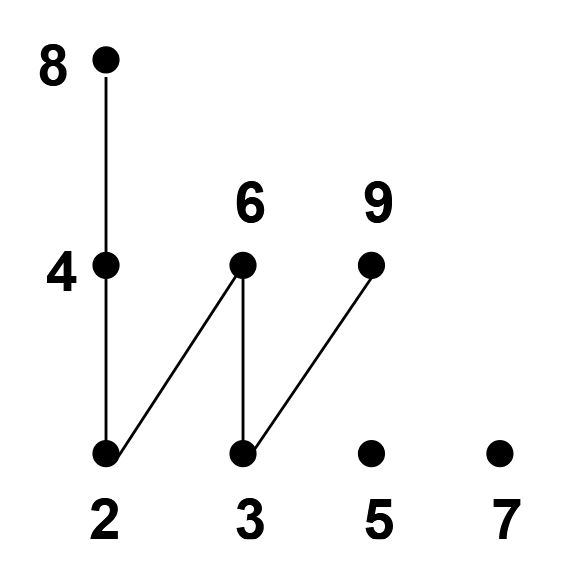
- Minimal elements: \(2, 3, 5, 7\) (primes)
- Maximal elements: \(5, 6, 7, 8, 9\)
- Least or greatest element There is none (not all elements comparable)
Back
In the poset \((\{2, 3, 4, 5, 6, 7, 8, 9\}; |)\), identify the minimal and maximal elements.
- Minimal elements: \(2, 3, 5, 7\) (primes)
- Maximal elements: \(5, 6, 7, 8, 9\)
- Least or greatest element There is none (not all elements comparable)
After
Front
Consider the poset \((\{2, 3, 4, 5, 6, 7, 8, 9\}; |)\).
- Minimal elements: \(2, 3, 5, 7\) (primes)
- Maximal elements: \(5, 6, 7, 8, 9\)
- Least or greatest element There is none (not all elements comparable)
Back
Consider the poset \((\{2, 3, 4, 5, 6, 7, 8, 9\}; |)\).
- Minimal elements: \(2, 3, 5, 7\) (primes)
- Maximal elements: \(5, 6, 7, 8, 9\)
- Least or greatest element There is none (not all elements comparable)
Field-by-field Comparison
| Field | Before | After |
|---|---|---|
| Text | Consider the poset \((\{2, 3, 4, 5, 6, 7, 8, 9\}; |)\).<br><ul><li><strong>Minimal elements</strong>: {{c1:: \(2, 3, 5, 7\) (primes)}}</li><li><strong>Maximal elements</strong>: {{c2:: \(5, 6, 7, 8, 9\)}}</li><li><strong>Least or greatest element</strong> {{c3:: There is none (not all elements comparable)}}</li></ul><div><img src="paste-1d2f8dcd3adedbac7c91aff60842c9ece732a3a8.jpg"></div> |
Note 15: ETH::DiskMat
Deck: ETH::DiskMat
Note Type: Horvath Classic
GUID:
modified
Note Type: Horvath Classic
GUID:
u*{HjaX,5R
Before
Front
In the lattice \((\{1,2,3,4,5,6,8,12,24\}; |)\), what are the meet and join for two examples of pairs of numbers?
Back
In the lattice \((\{1,2,3,4,5,6,8,12,24\}; |)\), what are the meet and join for two examples of pairs of numbers?
- Meet: The gcd (greatest common divisor)
- Join: The lcm (least common multiple)
Example: \(6 \land 8 = 2\), \(6 \lor 8 = 24\)
After
Front
In the lattice \((\{1,2,3,4,5,6,8,12,24\}; |)\), what are the meet and join for 6 and 8?
Back
In the lattice \((\{1,2,3,4,5,6,8,12,24\}; |)\), what are the meet and join for 6 and 8?
Meet: \(6 \land 8 = 2\) (gcd)
Join: \(6 \lor 8 = 24\) (lcm)
Field-by-field Comparison
| Field | Before | After |
|---|---|---|
| Front | In the lattice \((\{1,2,3,4,5,6,8,12,24\}; |)\), what are the meet and join for |
In the lattice \((\{1,2,3,4,5,6,8,12,24\}; |)\), what are the meet and join for 6 and 8? |
| Back | < |
<div>Meet: \(6 \land 8 = 2\) (gcd)</div><div>Join: \(6 \lor 8 = 24\) (lcm)</div> |
Note 16: ETH::DiskMat
Deck: ETH::DiskMat
Note Type: Horvath Cloze
GUID:
modified
Note Type: Horvath Cloze
GUID:
y4s0XCy@A
Before
Front
Special elements in posets: \((A; \preceq)\) is a poset.
\(a \in A\) is the least (greatest) element of \(A\) if \(a \preceq b\) (\(a \succeq b) \) for all \(b \in A\)
Back
Special elements in posets: \((A; \preceq)\) is a poset.
\(a \in A\) is the least (greatest) element of \(A\) if \(a \preceq b\) (\(a \succeq b) \) for all \(b \in A\)
After
Front
Consider the poset \((A; \preceq)\).
\(a \in A\) is the least (greatest) element of \(A\) if \(a \preceq b\) (\(a \succeq b) \) for all \(b \in A\)
Back
Consider the poset \((A; \preceq)\).
\(a \in A\) is the least (greatest) element of \(A\) if \(a \preceq b\) (\(a \succeq b) \) for all \(b \in A\)
Field-by-field Comparison
| Field | Before | After |
|---|---|---|
| Text | Consider the poset \((A; \preceq)\).<br><br><div>\(a \in A\) is the {{c1::<b>least (greatest) element</b> of \(A\)}} if {{c2::\(a \preceq b\) (\(a \succeq b) \) for all \(b \in A\)}}</div> |
Note 17: ETH::DiskMat
Deck: ETH::DiskMat
Note Type: Horvath Cloze
GUID:
modified
Note Type: Horvath Cloze
GUID:
yF7brLJQxE
Before
Front
Special elements in posets: \((A; \preceq)\) is a poset, \( S \subseteq A\).
\(a \in A\) is the greatest lower (least upper) bound of \(S\) if \(a\) is the greatest (least) element of the set of all lower (upper) bounds of \(S\).
Back
Special elements in posets: \((A; \preceq)\) is a poset, \( S \subseteq A\).
\(a \in A\) is the greatest lower (least upper) bound of \(S\) if \(a\) is the greatest (least) element of the set of all lower (upper) bounds of \(S\).
Note that greatest (least) refers to the operation \(\preceq\) and not to order by \(>\) or \(<\) (smaller, bigger).
After
Front
Consider the poset \((A; \preceq)\) and \( S \subseteq A\).
\(a \in A\) is the greatest lower (least upper) bound of \(S\) if \(a\) is the greatest (least) element of the set of all lower (upper) bounds of \(S\).
Back
Consider the poset \((A; \preceq)\) and \( S \subseteq A\).
\(a \in A\) is the greatest lower (least upper) bound of \(S\) if \(a\) is the greatest (least) element of the set of all lower (upper) bounds of \(S\).
Note that greatest (least) refers to the operation \(\preceq\) and not to order by \(>\) or \(<\) (smaller, bigger).
Field-by-field Comparison
| Field | Before | After |
|---|---|---|
| Text | Consider the poset \((A; \preceq)\) and \( S \subseteq A\).<br><br><div>\(a \in A\) is the {{c1::<b>greatest lower (least upper) bound</b> of \(S\)}} if {{c2::\(a\) is the greatest (least) element of the set of all lower (upper) bounds of \(S\). }}</div> |
Note 18: ETH::EProg
Deck: ETH::EProg
Note Type: Horvath Cloze
GUID:
modified
Note Type: Horvath Cloze
GUID:
p9%v,4EY(!
Before
Front
Values given to a method in Java are always copied.
Back
Values given to a method in Java are always copied.
After
Front
Values given to a method in Java are always copied.
Back
Values given to a method in Java are always copied.
Field-by-field Comparison
| Field | Before | After |
|---|---|---|
| Text | Values given to a method in Java are |
Values given to a method in Java are always {{c1::copied}}. |
Note 19: ETH::LinAlg
Deck: ETH::LinAlg
Note Type: Horvath Cloze
GUID:
modified
Note Type: Horvath Cloze
GUID:
(scS~v1D#
Before
Front
\((AB)^{\top}\)?
Back
\((AB)^{\top}\)?
\(B^\top A^\top\)
After
Front
\((AB)^{\top}=B^\top A^\top\)
Back
\((AB)^{\top}=B^\top A^\top\)
Field-by-field Comparison
| Field | Before | After |
|---|---|---|
| Text | \((AB)^{\top}\) |
\((AB)^{\top}={{c1::B^\top A^\top}}\) |
| Extra |
Note 20: ETH::LinAlg
Deck: ETH::LinAlg
Note Type: Horvath Classic
GUID:
modified
Note Type: Horvath Classic
GUID:
Hept`QKpE8
Before
Front
What is the Kronecker delta?
Back
What is the Kronecker delta?
The Kronecker delta is a function which is described as follows:
\(\delta_{i, j} = \begin{cases} \text{0} &\quad\text{if }i \neq j \\ \text{1} &\quad\text{if }i = j \end{cases}\)
\(\delta_{i, j} = \begin{cases} \text{0} &\quad\text{if }i \neq j \\ \text{1} &\quad\text{if }i = j \end{cases}\)
After
Front
What is the Kronecker delta?
Back
What is the Kronecker delta?
A function which is described as follows:
\(\delta_{i, j} = \begin{cases} \text{0} &\quad\text{if }i \neq j \\ \text{1} &\quad\text{if }i = j \end{cases}\)
\(\delta_{i, j} = \begin{cases} \text{0} &\quad\text{if }i \neq j \\ \text{1} &\quad\text{if }i = j \end{cases}\)
Field-by-field Comparison
| Field | Before | After |
|---|---|---|
| Back | A function which is described as follows:<br><br>\(\delta_{i, j} = \begin{cases} \text{0} &\quad\text{if }i \neq j \\ \text{1} &\quad\text{if }i = j \end{cases}\) |
Note 21: ETH::LinAlg
Deck: ETH::LinAlg
Note Type: Horvath Classic
GUID:
modified
Note Type: Horvath Classic
GUID:
h8vM!D=]5*
Before
Front
What is a full rank matrix \(A \in \mathbb{R}^{m \times n}\)?
Back
What is a full rank matrix \(A \in \mathbb{R}^{m \times n}\)?
\( r \le m, r \le n\), also ist der full / maximal Rank \( r = \text{min}(m,n)\)
After
Front
Was ist der rank einer full rank matrix \(A \in \mathbb{R}^{m \times n}\)?
Back
Was ist der rank einer full rank matrix \(A \in \mathbb{R}^{m \times n}\)?
\( r \le m, r \le n\), also ist der full / maximal Rank \( r = \text{min}(m,n)\)
Field-by-field Comparison
| Field | Before | After |
|---|---|---|
| Front | W |
Was ist der rank einer full rank matrix \(A \in \mathbb{R}^{m \times n}\)? |
Note 22: ETH::LinAlg
Deck: ETH::LinAlg
Note Type: Horvath Classic
GUID:
modified
Note Type: Horvath Classic
GUID:
p6e6T6[HIy
Before
Front
Was ist eine transponierte Matrix?
Back
Was ist eine transponierte Matrix?
Entlang der Hauptdiagonale gespiegelte Matrix \(\mathbf{A}^\top\), d.h. \( (\mathbf{A}^\top)_{ij} = (\mathbf{A})_{ji} \)
After
Front
Was ist eine transponierte Matrix?
Back
Was ist eine transponierte Matrix?
Eine entlang der Hauptdiagonale gespiegelte Matrix \(\mathbf{A}^\top\), d.h. \( (\mathbf{A}^\top)_{ij} = (\mathbf{A})_{ji} \)
Field-by-field Comparison
| Field | Before | After |
|---|---|---|
| Back | Entlang der Hauptdiagonale gespiegelte Matrix \(\mathbf{A}^\top\), d.h. \( (\mathbf{A}^\top)_{ij} = (\mathbf{A})_{ji} \) | Eine entlang der Hauptdiagonale gespiegelte Matrix \(\mathbf{A}^\top\), d.h. \( (\mathbf{A}^\top)_{ij} = (\mathbf{A})_{ji} \) |
Note 23: ETH::LinAlg
Deck: ETH::LinAlg
Note Type: Horvath Classic
GUID:
modified
Note Type: Horvath Classic
GUID:
vFzsuS+[?6
Before
Front
What is the columnspace of a matrix?
Back
What is the columnspace of a matrix?
it is the span of all column-vectors
After
Front
What is the columnspace of a matrix?
Back
What is the columnspace of a matrix?
The span of all column-vectors.
Field-by-field Comparison
| Field | Before | After |
|---|---|---|
| Back | The span of all column-vectors. |