How does a decoder work?
Note 1: ETH::2. Semester::DDCA
Deck: ETH::2. Semester::DDCA
Note Type: Horvath Classic
GUID:
modified
Note Type: Horvath Classic
GUID:
na4nPYvDI]
Before
Front
Back
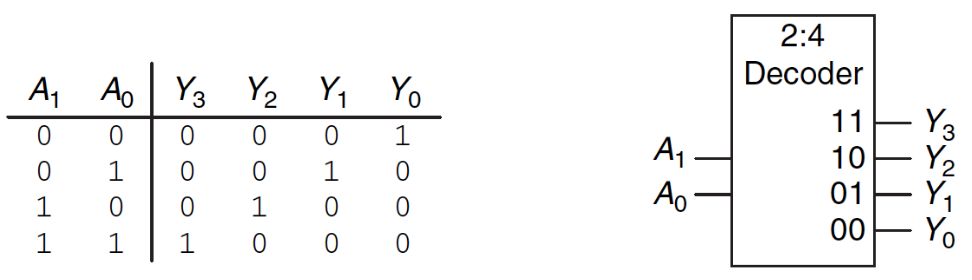
How does a decoder work?
- \(n\) inputs and \(2^n\) outputs
- Exactly one of the outputs is 1 and all the rest are 0s
- The output that is logically 1 is the output corresponding to the input pattern that the logic circuit is expected to detect
A decoder is an "input pattern detector".
Example: 2-to-4 decoder
After
Front
How does a decoder work?
Back
How does a decoder work?
- \(n\) possible inputs and \(2^n\) outputs
- Exactly one of the outputs is 1 and all the rest are 0s
- The output that is logically 1 is the output corresponding to the input pattern that the logic circuit is expected to detect
A decoder is an "input pattern detector".
Example: 2-to-4 decoder
Field-by-field Comparison
| Field | Before | After |
|---|---|---|
| Back | <ol><li>\(n\) |
<ol><li>\(n\) possible inputs and \(2^n\) outputs</li><li>Exactly one of the outputs is 1 and all the rest are 0s</li><li>The output that is logically 1 is the output corresponding to the input pattern that the logic circuit is expected to detect</li></ol><div>A decoder is an "input pattern detector".<br></div><div><br></div><div>Example: 2-to-4 decoder</div><div><img src="paste-41f427073aea6bbe436440d617e8ed5e4b95a46e.jpg"><br></div> |
Note 2: ETH::2. Semester::DDCA
Deck: ETH::2. Semester::DDCA
Note Type: Horvath Cloze
GUID:
modified
Note Type: Horvath Cloze
GUID:
oJl`_}4^pa
Before
Front
\(X + \overline{X} \bullet Y = X\)
Back
\(X + \overline{X} \bullet Y = X\)
After
Front
\(X + \overline{X} \bullet Y = X+Y\)
Back
\(X + \overline{X} \bullet Y = X+Y\)
Field-by-field Comparison
| Field | Before | After |
|---|---|---|
| Text | \(X + \overline{X} \bullet Y = {{c1::X}}\) | \(X + \overline{X} \bullet Y = {{c1::X+Y}}\) |