\(g \geq \Omega(f)\) \( \Leftrightarrow\) \( f \leq O(g)\)
Note 1: ETH::A&D
Deck: ETH::A&D
Note Type: Horvath Cloze
GUID:
added
Note Type: Horvath Cloze
GUID:
A!-/#G=){
Previous
Note did not exist
New Note
Front
Back
\(g \geq \Omega(f)\) \( \Leftrightarrow\) \( f \leq O(g)\)
Field-by-field Comparison
| Field | Before | After |
|---|---|---|
| Text | {{c2::\(g \geq \Omega(f)\)}} \( \Leftrightarrow\) {{c1::\( f \leq O(g)\)}} |
Note 2: ETH::A&D
Deck: ETH::A&D
Note Type: Horvath Cloze
GUID:
added
Note Type: Horvath Cloze
GUID:
A+lafWP/s]
Previous
Note did not exist
New Note
Front
In a directed graph we call a (\(\epsilon\)/Eulerian/Hamiltonian) walk/closed walk/path/cycle a directed (gerichtet) (\(\epsilon\)/Eulerian/Hamiltonian) walk/closed walk/path/cycle.
Back
In a directed graph we call a (\(\epsilon\)/Eulerian/Hamiltonian) walk/closed walk/path/cycle a directed (gerichtet) (\(\epsilon\)/Eulerian/Hamiltonian) walk/closed walk/path/cycle.
Field-by-field Comparison
| Field | Before | After |
|---|---|---|
| Text | In a directed graph we call a (\(\epsilon\)/Eulerian/Hamiltonian) walk/closed walk/path/cycle a {{c1::directed (<i>gerichtet</i>)}} (\(\epsilon\)/Eulerian/Hamiltonian) walk/closed walk/path/cycle. |
Note 3: ETH::A&D
Deck: ETH::A&D
Note Type: Horvath Reverso
GUID:
added
Note Type: Horvath Reverso
GUID:
A1y[0:/g)f
Previous
Note did not exist
New Note
Front
Graph Theory:
Closed Walk
Closed Walk
Back
Graph Theory:
Closed Walk
Closed Walk
Graph Theory:
Zyklus
Zyklus
Field-by-field Comparison
| Field | Before | After |
|---|---|---|
| Front | Graph Theory:<br><br>Closed Walk | |
| Back | Graph Theory:<br><br>Zyklus |
Note 4: ETH::A&D
Deck: ETH::A&D
Note Type: Algorithms
GUID:
added
Note Type: Algorithms
GUID:
AJT5T7qaW3
Previous
Note did not exist
New Note
Front
Runtime of Find Closed Eulerian Path?
Back
Runtime of Find Closed Eulerian Path?
\(O(n+m)\)
In an Adjacency Matrix: runtime is \(O(n^2)\) as looping over all edges is \(O(n)\).
In an Adjacency List: we loop \(n\) times over \(O(1 + \deg(u))\).
Using the handshake lemma: \(\sum_{u \in V} (1 + \deg(u)) = n + \sum_{u \in V} \deg(u) = n + 2m\)
In an Adjacency Matrix: runtime is \(O(n^2)\) as looping over all edges is \(O(n)\).
In an Adjacency List: we loop \(n\) times over \(O(1 + \deg(u))\).
Using the handshake lemma: \(\sum_{u \in V} (1 + \deg(u)) = n + \sum_{u \in V} \deg(u) = n + 2m\)
Field-by-field Comparison
| Field | Before | After |
|---|---|---|
| Name | Find Closed Eulerian Path | |
| Runtime | \(O(n+m)\) | |
| Approach | We want to be able to find closed walks in a graph. We can then merge them together to form a single closed walk, by exploiting shared vertices.<br><br>Algo:<br><ol><li>Start at vertex \(u_0\) arbitrary</li><li>For loop over edges. If not marked, mark and recurse.</li><li>Append vertex to list after execution</li></ol> Returns a list of vertices in order of a closed walk if there is one.<br><br>Example:<br><img src="paste-a669de30c7bc4a38d788fb96b6b5551a4781ec71.jpg"><br>Output:<br><img src="paste-b453826818903aa4da2ac10897e9dc0e177229b6.jpg"> | |
| Pseudocode | <img src="paste-b2cbbb1cb599a09a77bcc0e991ec4bcb83c586fb.jpg"><br><img src="paste-c82a6519899f9b1f1f49c932a2b252ff64a2184a.jpg"> | |
| Extra Info | In an Adjacency Matrix: runtime is \(O(n^2)\) as looping over all edges is \(O(n)\).<br><br>In an Adjacency List: we loop \(n\) times over \(O(1 + \deg(u))\).<br>Using the handshake lemma: \(\sum_{u \in V} (1 + \deg(u)) = n + \sum_{u \in V} \deg(u) = n + 2m\) |
Note 5: ETH::A&D
Deck: ETH::A&D
Note Type: Horvath Cloze
GUID:
added
Note Type: Horvath Cloze
GUID:
AQQfmx,sQF
Previous
Note did not exist
New Note
Front
A graph \(G\) is acyclic (azyklisch) if it has no cycles (Kreise).
Back
A graph \(G\) is acyclic (azyklisch) if it has no cycles (Kreise).
Field-by-field Comparison
| Field | Before | After |
|---|---|---|
| Text | A graph \(G\) is {{c1::acyclic (<i>azyklisch</i>)}} if it {{c2::has no cycles (<i>Kreise</i>)}}. |
Note 6: ETH::A&D
Deck: ETH::A&D
Note Type: Horvath Cloze
GUID:
added
Note Type: Horvath Cloze
GUID:
AS{7LiImd:
Previous
Note did not exist
New Note
Front
A graph \(G\) is bipartite if {{c2:: it's possible to partition the vertices into two sets \(V_1\) and \(V_2\) that are disjoint and cover the graph. Any edge \(\{u, v\}\) has to have one endpoint in \(V_1\) and the other in \(V_2\)}}.
Back
A graph \(G\) is bipartite if {{c2:: it's possible to partition the vertices into two sets \(V_1\) and \(V_2\) that are disjoint and cover the graph. Any edge \(\{u, v\}\) has to have one endpoint in \(V_1\) and the other in \(V_2\)}}.
Field-by-field Comparison
| Field | Before | After |
|---|---|---|
| Text | A graph \(G\) is {{c1:: <b>bipartite</b>}} if {{c2:: it's possible to partition the vertices into two sets \(V_1\) and \(V_2\) that are disjoint and cover the graph. Any edge \(\{u, v\}\) has to have one endpoint in \(V_1\) and the other in \(V_2\)}}. |
Note 7: ETH::A&D
Deck: ETH::A&D
Note Type: Horvath Cloze
GUID:
added
Note Type: Horvath Cloze
GUID:
AY}!l[d)1z
Previous
Note did not exist
New Note
Front
Name the impossible cases in DFS pre/post ordering for edge \((u, v)\):
- Overlapping but not Nested Intervals:
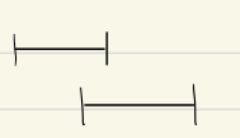
- {{c2:: \(\text{pre}(u)<\text{pre}(v)<\text{post}(u)<\text{post}(v)\):
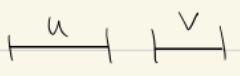 as visit(u) would call visit(v) before the recursive call ends}}
Back
Name the impossible cases in DFS pre/post ordering for edge \((u, v)\):
- Overlapping but not Nested Intervals:
- {{c2:: \(\text{pre}(u)<\text{pre}(v)<\text{post}(u)<\text{post}(v)\): as visit(u) would call visit(v) before the recursive call ends}}
Field-by-field Comparison
| Field | Before | After |
|---|---|---|
| Text | Name the impossible cases in DFS pre/post ordering for edge \((u, v)\):<br><ul><li>{{c1::Overlapping but not Nested Intervals: <img src="paste-b7976dbbff12de2b44594553e0c91633f59e9c05.jpg">}}</li><li>{{c2:: \(\text{pre}(u)<\text{pre}(v)<\text{post}(u)<\text{post}(v)\): <img src="paste-a6fc070f96de8bd2b8148e3891cf956fd611a0a2.jpg"> as visit(u) would call visit(v) before the recursive call ends}}</li></ul> |
Note 8: ETH::A&D
Deck: ETH::A&D
Note Type: Algorithms
GUID:
added
Note Type: Algorithms
GUID:
Ah4U@kYYNJ
Previous
Note did not exist
New Note
Front
Runtime of Linear Search?
Back
Runtime of Linear Search?
\(\Theta(n)\) as we go through the entire list once.
Field-by-field Comparison
| Field | Before | After |
|---|---|---|
| Name | Linear Search | |
| Runtime | \(\Theta(n)\) as we go through the entire list once. | |
| Requirements | Linear search does <i>not</i> require a sorted array, it will perform the same on any array. | |
| Approach | Linear search simply goes through the entire list and compares the current element to the one we are searching. |
Note 9: ETH::A&D
Deck: ETH::A&D
Note Type: Horvath Cloze
GUID:
added
Note Type: Horvath Cloze
GUID:
Ah6X9iA&#j
Previous
Note did not exist
New Note
Front
The ADT stack has the following operations:
- push(k, S): push a new object k to the top of the stack S
- pop(S): remove and return the top element of the stack S
- top(S): get the top element of the stack S without deleting it
Back
The ADT stack has the following operations:
- push(k, S): push a new object k to the top of the stack S
- pop(S): remove and return the top element of the stack S
- top(S): get the top element of the stack S without deleting it
Other operations might be isEmpty or emptystack which produces and emtpy stack.
Field-by-field Comparison
| Field | Before | After |
|---|---|---|
| Text | The ADT <b>stack</b> has the following operations:<br><ul><li>{{c1:: <b>push(k, S)</b>}}: {{c2:: push a new object <b>k</b> to the top of the stack <b>S</b>}}</li><li>{{c3:: <b>pop(S)</b>}}: {{c4:: remove and return the top element of the stack <b>S</b>}}</li><li>{{c5:: <b>top(S)</b>}}: {{c6:: get the top element of the stack <b>S</b> without deleting it}}</li></ul> | |
| Extra | Other operations might be <b>isEmpty</b> or <b>emptystack</b> which produces and emtpy stack. |
Note 10: ETH::A&D
Deck: ETH::A&D
Note Type: Horvath Classic
GUID:
added
Note Type: Horvath Classic
GUID:
AqQ}Ty8GRj
Previous
Note did not exist
New Note
Front
How do we fix the Quicksort worst-case runtime?
Back
How do we fix the Quicksort worst-case runtime?
Chose a random element as the pivot.
Median of medians algo ideal but too complex to implement.
Median of medians algo ideal but too complex to implement.
Field-by-field Comparison
| Field | Before | After |
|---|---|---|
| Front | How do we fix the Quicksort worst-case runtime? | |
| Back | Chose a random element as the pivot.<br><br>Median of medians algo ideal but too complex to implement. |
Note 11: ETH::A&D
Deck: ETH::A&D
Note Type: Horvath Cloze
GUID:
added
Note Type: Horvath Cloze
GUID:
Au,kdh[/@(
Previous
Note did not exist
New Note
Front
A safe edge is a edge that is included in at all MSTs.
Back
A safe edge is a edge that is included in at all MSTs.
all, If the edge-weights are distinct, which means there is one unique MST.
Field-by-field Comparison
| Field | Before | After |
|---|---|---|
| Text | A {{c1:: <b>safe edge</b>}} is a {{c2:: edge that is included in at <i>all</i> MSTs}}. | |
| Extra | <div><i>all, </i>If the edge-weights are distinct, which means there is one unique MST.</div> |
Note 12: ETH::A&D
Deck: ETH::A&D
Note Type: Horvath Cloze
GUID:
added
Note Type: Horvath Cloze
GUID:
Auw]yKf@xT
Previous
Note did not exist
New Note
Front
Pre-/Post-Ordering Classification for an edge \((u, v)\):
\(\text{pre}(u) < \text{pre}(v) < \text{post}(v) < \text{post}(u)\), but not tree edge: Forward edge
\(\text{pre}(u) < \text{pre}(v) < \text{post}(v) < \text{post}(u)\), but not tree edge: Forward edge
Back
Pre-/Post-Ordering Classification for an edge \((u, v)\):
\(\text{pre}(u) < \text{pre}(v) < \text{post}(v) < \text{post}(u)\), but not tree edge: Forward edge
\(\text{pre}(u) < \text{pre}(v) < \text{post}(v) < \text{post}(u)\), but not tree edge: Forward edge
Field-by-field Comparison
| Field | Before | After |
|---|---|---|
| Text | Pre-/Post-Ordering Classification for an edge \((u, v)\):<br>\(\text{pre}(u) < \text{pre}(v) < \text{post}(v) < \text{post}(u)\), but <b>not tree edge</b>: {{c1:: Forward edge}} |
Note 13: ETH::A&D
Deck: ETH::A&D
Note Type: Horvath Classic
GUID:
added
Note Type: Horvath Classic
GUID:
B)ghZbgf?6
Previous
Note did not exist
New Note
Front
Describe the steps of Prim's Algorithm:
Back
Describe the steps of Prim's Algorithm:
Prim’s algorithm starts with a single vertex and grows the MST outwards from that seed.
- Initialisation:
- Select and arbitrary starting vertex \(s\) and empty set \(F\)
- Set \(S = {s}\) tracks the vertices in the MST
- Each vertex gets a
key[v] =representing the cheapest known connection cost to \(v\):- \(\infty\) if no edge connects \(s\) to \(v\)
- \(w(s, v)\) if edge \((s, v)\) exists
- Use a priority queue \(Q\) (Min-Heap) to store the vertices, in order of lowest
keycost
- Iteration:
- Select and add Extract the vertex \(u\) with the minimum
keyfrom \(Q\). This is the cheapest to connected to the current MST. Add \(u\) to \(S\). - Update Neighbours For each neighbour \(v\) of \(u\) not in \(S\):
- If \(w(u, v) < \text{key}[v]\) update
key[v] = w(u, v)and update the priority in $Q$.- This discovers potentially cheaper connections to vertices outside the current MST. If a cheaper edge to \(v\) is found, the current value in
key[v]cannot be part of the MST
- This discovers potentially cheaper connections to vertices outside the current MST. If a cheaper edge to \(v\) is found, the current value in
- If \(w(u, v) < \text{key}[v]\) update
- Select and add Extract the vertex \(u\) with the minimum
- Termination: When \(Q\) is empty, all vertices are in \(S\) and connected, and the edges chosen are in the MST (tracked in the set \(F\) through updates).
Field-by-field Comparison
| Field | Before | After |
|---|---|---|
| Front | Describe the steps of <b>Prim's Algorithm</b>: | |
| Back | <div>Prim’s algorithm starts with a single vertex and grows the MST outwards from that seed.</div> <ol> <li><strong>Initialisation:</strong><ul> <li>Select and arbitrary starting vertex \(s\) and empty set \(F\)</li> <li>Set \(S = {s}\) tracks the vertices in the MST</li> <li>Each vertex gets a <code>key[v] =</code> representing the cheapest known connection cost to \(v\):<ul> <li>\(\infty\) if no edge connects \(s\) to \(v\)</li> <li>\(w(s, v)\) if edge \((s, v)\) exists</li> </ul> </li> <li>Use a priority queue \(Q\) (<em>Min-Heap</em>) to store the vertices, in order of lowest <code>key</code> cost</li> </ul> </li> <li><strong>Iteration:</strong><ul> <li><em>Select and add</em> Extract the vertex \(u\) with the minimum <code>key</code> from \(Q\). This is the cheapest to connected to the current MST. Add \(u\) to \(S\).</li> <li><em>Update Neighbours</em> For each neighbour <b>\(v\) </b>of \(u\) <em>not</em> in \(S\):<ul> <li>If \(w(u, v) < \text{key}[v]\) update <code>key[v] = w(u, v)</code> and update the priority in $Q$.<ul> <li>This discovers potentially cheaper connections to vertices outside the current MST. If a <em>cheaper edge</em> to \(v\) is found, the current value in <code>key[v]</code> cannot be part of the MST</li> </ul> </li> </ul> </li> </ul> </li> <li><strong>Termination:</strong> When \(Q\) is empty, all vertices are in \(S\) and connected, and the edges chosen are in the MST (tracked in the set \(F\) through updates).</li></ol> |
Note 14: ETH::A&D
Deck: ETH::A&D
Note Type: Horvath Reverso
GUID:
added
Note Type: Horvath Reverso
GUID:
B+m&Yt;~bM
Previous
Note did not exist
New Note
Front
Graph Theory:
Path
Path
Back
Graph Theory:
Path
Path
Graph Theory:
Pfad
Pfad
Field-by-field Comparison
| Field | Before | After |
|---|---|---|
| Front | Graph Theory:<br><br>Path | |
| Back | Graph Theory:<br><br>Pfad |
Note 15: ETH::A&D
Deck: ETH::A&D
Note Type: Horvath Cloze
GUID:
added
Note Type: Horvath Cloze
GUID:
B/7aNL0zYE
Previous
Note did not exist
New Note
Front
Boruvka's Algorithm has a runtime of \(O((|V| + |E|) \log |V|)\).
Back
Boruvka's Algorithm has a runtime of \(O((|V| + |E|) \log |V|)\).
During each iteration, we examine all edges to find the cheapest one: \(O(|V| + |E|)\):
- Run DFS to find the connected components: \(O(|V| + |E|)\)
- Find the cheapest one \(O(|E|)\)
Field-by-field Comparison
| Field | Before | After |
|---|---|---|
| Text | <b>Boruvka's Algorithm</b> has a runtime of {{c1:: \(O((|V| + |E|) \log |V|)\)}}. | |
| Extra | During each iteration, we examine all edges to find the cheapest one: \(O(|V| + |E|)\):<br><ol><li>Run DFS to find the connected components: \(O(|V| + |E|)\)</li><li>Find the cheapest one \(O(|E|)\)</li></ol>We iterate a total of \(\log_2 |V|\) times as each iteration halves the number of connected components. |
Note 16: ETH::A&D
Deck: ETH::A&D
Note Type: Horvath Cloze
GUID:
added
Note Type: Horvath Cloze
GUID:
B9BorfLC*u
Previous
Note did not exist
New Note
Front
{{c1:: \(\sum_{i = 1}^{n} i\)}} \(\leq\) \(O(n^2)\) (Sum)
Back
{{c1:: \(\sum_{i = 1}^{n} i\)}} \(\leq\) \(O(n^2)\) (Sum)
Field-by-field Comparison
| Field | Before | After |
|---|---|---|
| Text | {{c1:: \(\sum_{i = 1}^{n} i\)}} \(\leq\) {{c2::\(O(n^2)\)}} (Sum) |
Note 17: ETH::A&D
Deck: ETH::A&D
Note Type: Algorithms
GUID:
added
Note Type: Algorithms
GUID:
BRmyi3>lm%
Previous
Note did not exist
New Note
Front
Back
Runtime of
DFS
Runtime: {{c1::\( \mathcal{O}(|E| + |V|) \)}}
Approach:
Uses:
?Field-by-field Comparison
| Field | Before | After |
|---|---|---|
| Name | <div style="text-align: center;"><b>DFS</b></div><div><br></div><div><b>Runtime</b>: {{c1::\( \mathcal{O}(|E| + |V|) \)}}</div><div><br></div><div><b>Approach</b>: {{c2::Explore as far as possible along each branch before backtracking. Potentially keep track of pre- / post-numbers to make edge classifications.}}</div><div><br></div><div><b>Uses</b>: {{c3::Detect cycles (if backward edge), <b>topological sorting </b>(reverse post-ordering), test if bipartite, mazes, ...}}</div> |
Note 18: ETH::A&D
Deck: ETH::A&D
Note Type: Horvath Cloze
GUID:
added
Note Type: Horvath Cloze
GUID:
Bb-m%-jtI|
Previous
Note did not exist
New Note
Front
Pre-/Post-Ordering Classification for an edge \((u, v)\):
\(\text{pre}(v) < \text{post}(v) < \text{pre}(u) < \text{post}(u)\): Cross edge, \(u, v\) in different subtrees
\(\text{pre}(v) < \text{post}(v) < \text{pre}(u) < \text{post}(u)\): Cross edge, \(u, v\) in different subtrees
Back
Pre-/Post-Ordering Classification for an edge \((u, v)\):
\(\text{pre}(v) < \text{post}(v) < \text{pre}(u) < \text{post}(u)\): Cross edge, \(u, v\) in different subtrees
\(\text{pre}(v) < \text{post}(v) < \text{pre}(u) < \text{post}(u)\): Cross edge, \(u, v\) in different subtrees
Field-by-field Comparison
| Field | Before | After |
|---|---|---|
| Text | Pre-/Post-Ordering Classification for an edge \((u, v)\):<br>\(\text{pre}(v) < \text{post}(v) < \text{pre}(u) < \text{post}(u)\): {{c1:: Cross edge, \(u, v\) in different subtrees}} |
Note 19: ETH::A&D
Deck: ETH::A&D
Note Type: Horvath Cloze
GUID:
added
Note Type: Horvath Cloze
GUID:
Bgd/GP4-Fq
Previous
Note did not exist
New Note
Front
A graph \(G\) is a tree if it is connected and has no cycles (Kreise).
Back
A graph \(G\) is a tree if it is connected and has no cycles (Kreise).
Field-by-field Comparison
| Field | Before | After |
|---|---|---|
| Text | A graph \(G\) is a {{c1::tree}} if it is {{c2::connected and has no cycles (<i>Kreise</i>)}}. |
Note 20: ETH::A&D
Deck: ETH::A&D
Note Type: Horvath Classic
GUID:
added
Note Type: Horvath Classic
GUID:
Bq5(?)1v6(
Previous
Note did not exist
New Note
Front
What does \(\prod_{i=1}^n a_i\) mean?
Back
What does \(\prod_{i=1}^n a_i\) mean?
it is the product of all numbers between \(i\) and \(n\), in this specific case it is \(n!\)
Field-by-field Comparison
| Field | Before | After |
|---|---|---|
| Front | What does \(\prod_{i=1}^n a_i\) mean? | |
| Back | it is the product of all numbers between \(i\) and \(n\), in this specific case it is \(n!\) |
Note 21: ETH::A&D
Deck: ETH::A&D
Note Type: Horvath Cloze
GUID:
added
Note Type: Horvath Cloze
GUID:
Br&58pkCU{
Previous
Note did not exist
New Note
Front
We start counting the height of a tree at \(0\).
Back
We start counting the height of a tree at \(0\).
Field-by-field Comparison
| Field | Before | After |
|---|---|---|
| Text | We start counting the height of a tree at {{c1::\(0\)}}. |
Note 22: ETH::A&D
Deck: ETH::A&D
Note Type: Horvath Cloze
GUID:
added
Note Type: Horvath Cloze
GUID:
BvQCv]T&c0
Previous
Note did not exist
New Note
Front
\(\log(n!)\) \(\leq O(\)\(n \log n\)\()\)
Back
\(\log(n!)\) \(\leq O(\)\(n \log n\)\()\)
Field-by-field Comparison
| Field | Before | After |
|---|---|---|
| Text | {{c2::\(\log(n!)\)}} \(\leq O(\){{c1::\(n \log n\)}}\()\) |
Note 23: ETH::A&D
Deck: ETH::A&D
Note Type: Horvath Cloze
GUID:
added
Note Type: Horvath Cloze
GUID:
BwR)%}KG6h
Previous
Note did not exist
New Note
Front
Boruvka's Algorithm requires an undirected, connected, weighted Graph.
Back
Boruvka's Algorithm requires an undirected, connected, weighted Graph.
Field-by-field Comparison
| Field | Before | After |
|---|---|---|
| Text | <b>Boruvka's Algorithm</b> requires an {{c1:: undirected, connected, weighted}} Graph. |
Note 24: ETH::A&D
Deck: ETH::A&D
Note Type: Horvath Cloze
GUID:
added
Note Type: Horvath Cloze
GUID:
Bz)mOB:[n-
Previous
Note did not exist
New Note
Front
2-3 Tree: Runtime of: Search, Inserting, Deleting: \(O(\log n)\)
Back
2-3 Tree: Runtime of: Search, Inserting, Deleting: \(O(\log n)\)
This is because the tree is now forced to be balanced and \(h \leq \log_2 n\).
Field-by-field Comparison
| Field | Before | After |
|---|---|---|
| Text | <b>2-3 Tree</b>: Runtime of: Search, Inserting, Deleting: {{c1:: \(O(\log n)\)}} | |
| Extra | This is because the tree is now forced to be balanced and \(h \leq \log_2 n\). |
Note 25: ETH::A&D
Deck: ETH::A&D
Note Type: Algorithms
GUID:
added
Note Type: Algorithms
GUID:
C$#TvbwG_l
Previous
Note did not exist
New Note
Front
Runtime of Longest Ascending Subsequence (Längste Aufsteigende Teilfolge)?
Back
Runtime of Longest Ascending Subsequence (Längste Aufsteigende Teilfolge)?
\(\Theta(n \log n)\)
Field-by-field Comparison
| Field | Before | After |
|---|---|---|
| Name | Longest Ascending Subsequence (Längste Aufsteigende Teilfolge) | |
| Runtime | \(\Theta(n \log n)\) | |
| Approach | For an array A[1..n] <b>longest</b> subsequence (non-continuous) that is ascending.<br><br>DP Table with entry \(M(l) = a\) where a ist the smallest possible ending of a LAT with length \(l\).<br><ul><li>Base Cases: \(M[*] = \infty\)</li><li>Recursion: set \(M[k]\) to \(A[i]\) where \(k\) is the index of the next smallest + 1 in \(M\).</li></ul>We can find the smaller with binary search, thus \(\log n \) search for \(n\) elements -> \(\Theta(n \log n)\).<br><img src="paste-1b9069bf0a881a3cd3900a4de699cac89f0498b8.jpg"><br> | |
| Pseudocode | <img src="paste-0cd3692a4a909acf7f7ae0540eb6d714fc346b41.jpg"> |
Note 26: ETH::A&D
Deck: ETH::A&D
Note Type: Horvath Cloze
GUID:
added
Note Type: Horvath Cloze
GUID:
C1$vvwFoR0
Previous
Note did not exist
New Note
Front
In graph theory, an closed Eulerian walk (Eulerzyklus) is an Eulerian walk (Eulerweg) that ends at the start vertex.
Back
In graph theory, an closed Eulerian walk (Eulerzyklus) is an Eulerian walk (Eulerweg) that ends at the start vertex.
Field-by-field Comparison
| Field | Before | After |
|---|---|---|
| Text | In graph theory, an {{c2::closed Eulerian walk (Eulerzyklus)}} is an {{c1::Eulerian walk (Eulerweg) that ends at the start vertex}}. |
Note 27: ETH::A&D
Deck: ETH::A&D
Note Type: Horvath Cloze
GUID:
added
Note Type: Horvath Cloze
GUID:
C9v-$JhadV
Previous
Note did not exist
New Note
Front
If \(\frac{f(n)}{g(n)}\) tends to 0, then \(f \leq O(g)\) and \(f \neq \Theta(g)\)
Back
If \(\frac{f(n)}{g(n)}\) tends to 0, then \(f \leq O(g)\) and \(f \neq \Theta(g)\)
Field-by-field Comparison
| Field | Before | After |
|---|---|---|
| Text | If \(\frac{f(n)}{g(n)}\) tends to {{c1:: 0}}, then {{c2::\(f \leq O(g)\) and \(f \neq \Theta(g)\)}} |
Note 28: ETH::A&D
Deck: ETH::A&D
Note Type: Horvath Classic
GUID:
added
Note Type: Horvath Classic
GUID:
CJsa&>C5sO
Previous
Note did not exist
New Note
Front
Kruskal's Algorithm can be executed in \(O(|E| + |V|\log|V|)\) time?
Back
Kruskal's Algorithm can be executed in \(O(|E| + |V|\log|V|)\) time?
no, we need to sort the edges which takes at least \(|E| \log |E|\) time.
Field-by-field Comparison
| Field | Before | After |
|---|---|---|
| Front | Kruskal's Algorithm can be executed in \(O(|E| + |V|\log|V|)\) time? | |
| Back | no, we need to sort the edges which takes at least \(|E| \log |E|\) time. |
Note 29: ETH::A&D
Deck: ETH::A&D
Note Type: Horvath Cloze
GUID:
added
Note Type: Horvath Cloze
GUID:
CaRvZ82Z-e
Previous
Note did not exist
New Note
Front
{{c1:: \(\sum_{i = 1}^{n} \sum_{i = 1}^{n} \sum_{i = 1}^{n} 1\)}} \(=\) \(n^3\) (Sum)
Back
{{c1:: \(\sum_{i = 1}^{n} \sum_{i = 1}^{n} \sum_{i = 1}^{n} 1\)}} \(=\) \(n^3\) (Sum)
Field-by-field Comparison
| Field | Before | After |
|---|---|---|
| Text | {{c1:: \(\sum_{i = 1}^{n} \sum_{i = 1}^{n} \sum_{i = 1}^{n} 1\)}} \(=\) {{c2:: \(n^3\)}} (Sum) |
Note 30: ETH::A&D
Deck: ETH::A&D
Note Type: Horvath Cloze
GUID:
added
Note Type: Horvath Cloze
GUID:
Ceyt5d#^?A
Previous
Note did not exist
New Note
Front
\( g = \Theta(f)\) \(\Leftrightarrow\) {{c1:: \(g \leq O(f) \text{ and } f \leq O(g)\)}}
Back
\( g = \Theta(f)\) \(\Leftrightarrow\) {{c1:: \(g \leq O(f) \text{ and } f \leq O(g)\)}}
Field-by-field Comparison
| Field | Before | After |
|---|---|---|
| Text | {{c2::\( g = \Theta(f)\)}} \(\Leftrightarrow\) {{c1:: \(g \leq O(f) \text{ and } f \leq O(g)\)}} |
Note 31: ETH::A&D
Deck: ETH::A&D
Note Type: Horvath Cloze
GUID:
added
Note Type: Horvath Cloze
GUID:
C}:U@+B*;Q
Previous
Note did not exist
New Note
Front
{{c1:: \(\sum_{i = 1}^{n} i^3\)}} \(\leq\) \(O(n^4)\) (Sum)
Back
{{c1:: \(\sum_{i = 1}^{n} i^3\)}} \(\leq\) \(O(n^4)\) (Sum)
Field-by-field Comparison
| Field | Before | After |
|---|---|---|
| Text | {{c1:: \(\sum_{i = 1}^{n} i^3\)}} \(\leq\) {{c2::\(O(n^4)\)}} (Sum) |
Note 32: ETH::A&D
Deck: ETH::A&D
Note Type: Horvath Cloze
GUID:
added
Note Type: Horvath Cloze
GUID:
D!4=n6GM2_
Previous
Note did not exist
New Note
Front
In a doubly linked list, we store a pointer to the previous and next element for each key.
This increases memory usage as a trade-off for speed.
This increases memory usage as a trade-off for speed.
Back
In a doubly linked list, we store a pointer to the previous and next element for each key.
This increases memory usage as a trade-off for speed.
This increases memory usage as a trade-off for speed.
Field-by-field Comparison
| Field | Before | After |
|---|---|---|
| Text | In a <b>doubly linked list</b>, we store a pointer to the {{c1:: previous and next element}} for each key.<br><br>This increases {{c2::memory usage}} as a trade-off for {{c2:: speed}}. |
Note 33: ETH::A&D
Deck: ETH::A&D
Note Type: Horvath Classic
GUID:
added
Note Type: Horvath Classic
GUID:
D%cpEp.*I3
Previous
Note did not exist
New Note
Front
What is L'Hôpital's Rule?
Back
What is L'Hôpital's Rule?
If \(\lim_{x \rightarrow \infty} \frac{f’(x)}{g’(x)} = C \in \mathbb{R}^{+}\cup\set0\) or \(\lim_{x \rightarrow \infty} \frac{f’(x)}{g’(x)} = \infty\), then:
\[\lim_{x \rightarrow \infty} \frac{f(x)}{g(x)} = \lim_{x \rightarrow \infty} \frac{f’(x)}{g’(x)}\]The ratio of the derivatives tend to the same limit.
Field-by-field Comparison
| Field | Before | After |
|---|---|---|
| Front | What is L'Hôpital's Rule? | |
| Back | <div>If \(\lim_{x \rightarrow \infty} \frac{f’(x)}{g’(x)} = C \in \mathbb{R}^{+}\cup\set0\) or \(\lim_{x \rightarrow \infty} \frac{f’(x)}{g’(x)} = \infty\), then:</div> <div>\[\lim_{x \rightarrow \infty} \frac{f(x)}{g(x)} = \lim_{x \rightarrow \infty} \frac{f’(x)}{g’(x)}\]The ratio of the <b>derivatives</b> tend to the <b>same limit.</b><br></div> |
Note 34: ETH::A&D
Deck: ETH::A&D
Note Type: Horvath Cloze
GUID:
added
Note Type: Horvath Cloze
GUID:
D2>~h
Previous
Note did not exist
New Note
Front
The ADT quue has the following operations:
- enqueue(k, S): append at the end of the queue
- dequeue(S): remove and return the first element of the queue
Back
The ADT quue has the following operations:
- enqueue(k, S): append at the end of the queue
- dequeue(S): remove and return the first element of the queue
Field-by-field Comparison
| Field | Before | After |
|---|---|---|
| Text | The ADT <b>quue</b> has the following operations:<br><ul><li>{{c1:: <b>enqueue(k, S)</b>}}: {{c2:: append at the end of the queue}}</li><li>{{c3:: <b>dequeue(S)</b>}}: {{c4:: remove and return the first element of the queue}}</li></ul> |
Note 35: ETH::A&D
Deck: ETH::A&D
Note Type: Horvath Cloze
GUID:
added
Note Type: Horvath Cloze
GUID:
D9:.N,D17I
Previous
Note did not exist
New Note
Front
A graph \(G\) is called a directed acyclic graph (DAG) (gerichteter azyklischer Graph) if there is no directed cycles (gerichteter Kreis).
Back
A graph \(G\) is called a directed acyclic graph (DAG) (gerichteter azyklischer Graph) if there is no directed cycles (gerichteter Kreis).
Field-by-field Comparison
| Field | Before | After |
|---|---|---|
| Text | A graph \(G\) is called a {{c1::directed acyclic graph (DAG) (<i>gerichteter azyklischer Graph</i>)}} if there is {{c2::no directed cycles (<i>gerichteter Kreis</i>)}}. |
Note 36: ETH::A&D
Deck: ETH::A&D
Note Type: Algorithms
GUID:
added
Note Type: Algorithms
GUID:
DD]dBe%Sn|
Previous
Note did not exist
New Note
Front
Runtime of Binary Search?
Back
Runtime of Binary Search?
\(O(\log(n))\) (optimal)
Field-by-field Comparison
| Field | Before | After |
|---|---|---|
| Name | Binary Search | |
| Runtime | \(O(\log(n))\) (optimal) | |
| Requirements | Sorted Array | |
| Approach | You start in the middle and if the middle element is not the one you're searching, you recurse on the left OR right side (depending on the middle elements size). | |
| Pseudocode | <img src="paste-c63669116a3e862cbe19f556da7b184c6cecc888.jpg"> |
Note 37: ETH::A&D
Deck: ETH::A&D
Note Type: Horvath Classic
GUID:
added
Note Type: Horvath Classic
GUID:
D]]~[I)jx9
Previous
Note did not exist
New Note
Front
What is the lower limit for sorting algorithms?
Back
What is the lower limit for sorting algorithms?
\(\Omega(n \log n)\) cannot be improve upon.
Field-by-field Comparison
| Field | Before | After |
|---|---|---|
| Front | What is the lower limit for sorting algorithms? | |
| Back | \(\Omega(n \log n)\) cannot be improve upon. |
Note 38: ETH::A&D
Deck: ETH::A&D
Note Type: Horvath Cloze
GUID:
added
Note Type: Horvath Cloze
GUID:
Dc@O2/=Azj
Previous
Note did not exist
New Note
Front
The number of edges in an MST are \(|V| - 1\).
Back
The number of edges in an MST are \(|V| - 1\).
Otherwise we could remove one and it would still span the edges, thus the cost is not minimal.
Field-by-field Comparison
| Field | Before | After |
|---|---|---|
| Text | The number of edges in an MST are {{c1:: \(|V| - 1\)}}. | |
| Extra | Otherwise we could remove one and it would still span the edges, thus the cost is not minimal. |
Note 39: ETH::A&D
Deck: ETH::A&D
Note Type: Algorithms
GUID:
added
Note Type: Algorithms
GUID:
DeJ!2ph{Al
Previous
Note did not exist
New Note
Front
Runtime of Johnson's Algorithm?
Back
Runtime of Johnson's Algorithm?
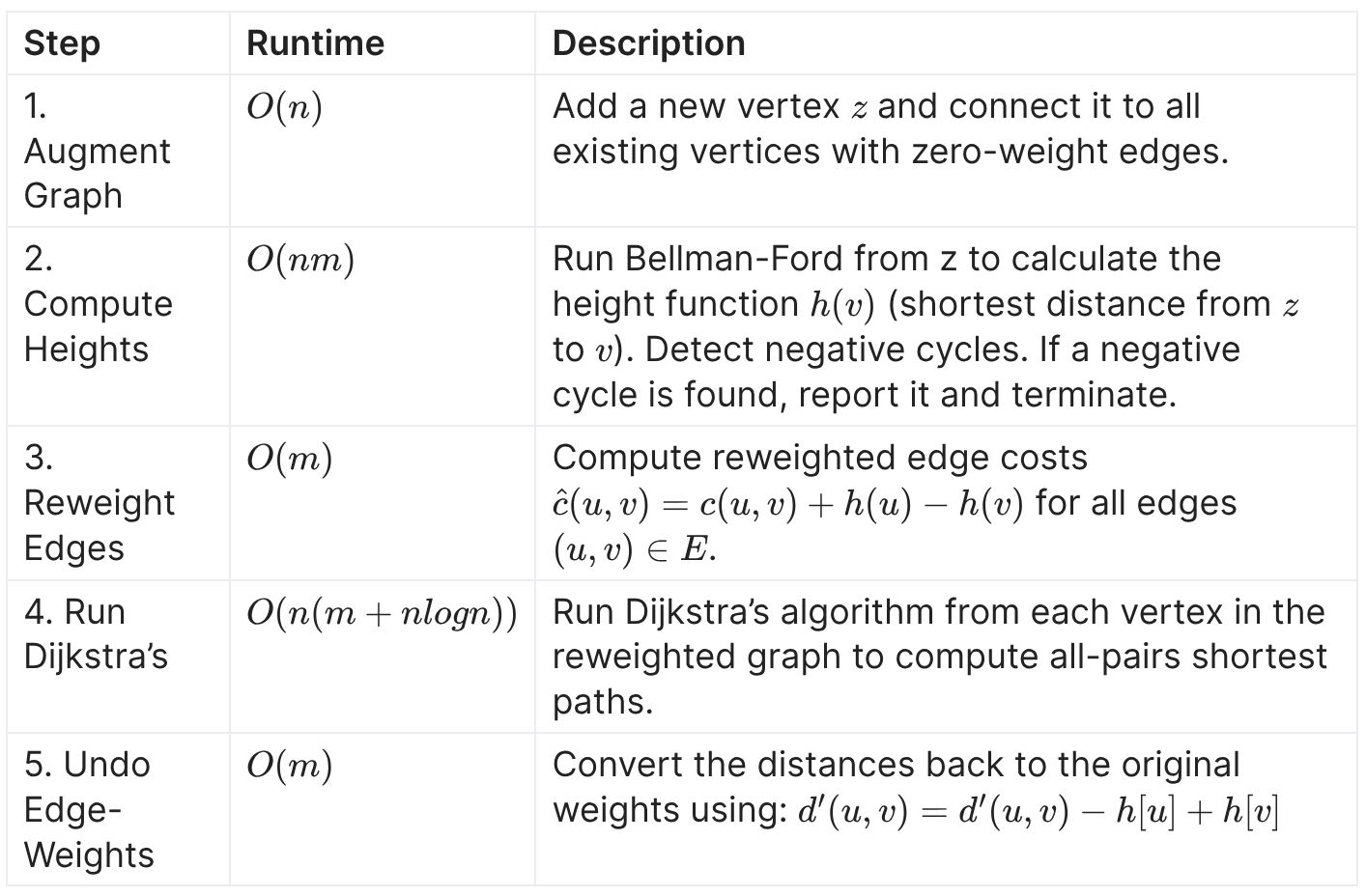
\(O(|V| \cdot (|V| + |E|) \log |V|)\) (running dijkstra's n times, but allows negatives)
Field-by-field Comparison
| Field | Before | After |
|---|---|---|
| Name | Johnson's Algorithm | |
| Runtime | \(O(|V| \cdot (|V| + |E|) \log |V|)\) (running dijkstra's n times, but allows negatives)<br><img src="paste-b0103885454d02688fec99eb8383f57710d89f68.jpg"> | |
| Requirements | No negative cycles | |
| Approach | <ol><li><b>Add a New Vertex:</b><ul><li>Add a new vertex s to the graph and connect it to all vertices with zero-weight edges. </li> </ul></li><li><b>Run Bellman-Ford</b>:<ul><li>Use the Bellman-Ford algorithm starting from s to compute the shortest distance h[v] from s to each vertex v.</li><li>If a negative-weight cycle is detected, stop.</li></ul></li><li><b>Reweight Edges</b>: <ul><li>For each edge u → v with weight w(u, v), reweight it as: w′(u, v) = w(u, v) + h[u] − h[v]</li><li>This ensures all edge weights are non-negative.</li> </ul> </li><li><b>Run Dijkstra’s Algorithm:</b><ul><li>For each vertex v, use Dijkstra’s algorithm to compute the shortest paths to all other vertices.</li> </ul></li><li><b>Adjust Back</b>:<ul><li>Convert the distances back to the original weights using: d′(u, v) = d′(u, v) − h[u] + h[v]</li> </ul></li><li><b>End:</b></li><ul><li>The resulting shortest path distances between all pairs of vertices are valid.</li></ul></ol><div>The overall higher cost allows us to run pre-computation steps like B-F for "free"</div> | |
| Use Case | All Pairs Shortest Path |
Note 40: ETH::A&D
Deck: ETH::A&D
Note Type: Horvath Cloze
GUID:
added
Note Type: Horvath Cloze
GUID:
DhNROhdDaL
Previous
Note did not exist
New Note
Front
A Minimum Spanning Tree is a subgraph of a connected, undirected, weighted Graph with that fullfills:
- spanning, it connects all vertices
- acylic, it's a tree
- minimal, the sum of all edge weights in the Tree is minimal
Back
A Minimum Spanning Tree is a subgraph of a connected, undirected, weighted Graph with that fullfills:
- spanning, it connects all vertices
- acylic, it's a tree
- minimal, the sum of all edge weights in the Tree is minimal
Field-by-field Comparison
| Field | Before | After |
|---|---|---|
| Text | A <b>Minimum Spanning Tree</b> is a subgraph of a {{c1:: connected, undirected, weighted}} Graph with that fullfills:<br><ul><li>{{c3:: spanning, it connects all vertices}}</li><li>{{c3:: acylic, it's a tree}}</li><li>{{c3:: minimal, the sum of all edge weights in the Tree is minimal}}</li></ul> |
Note 41: ETH::A&D
Deck: ETH::A&D
Note Type: Horvath Classic
GUID:
added
Note Type: Horvath Classic
GUID:
DkT;0O|rUB
Previous
Note did not exist
New Note
Front
What is \(\log x\) in AuD classes?
Back
What is \(\log x\) in AuD classes?
\(\log_2 x\)
Field-by-field Comparison
| Field | Before | After |
|---|---|---|
| Front | What is \(\log x\) in AuD classes? | |
| Back | \(\log_2 x\) |
Note 42: ETH::A&D
Deck: ETH::A&D
Note Type: Horvath Classic
GUID:
added
Note Type: Horvath Classic
GUID:
Dkf-+^.Z}
Previous
Note did not exist
New Note
Front
What does the Master theorem state when it comes to the upper bound on the asymptotic runtime of a function?
Back
What does the Master theorem state when it comes to the upper bound on the asymptotic runtime of a function?
Let \(a, C > 0\) and \(b \geq 0\) be constants and let \(T: \mathbb{N} \rightarrow \mathbb{R}^+\) a function such that for all even \(n \in \mathbb{N}\)
\(T(n) \leq aT(\frac{n}{2}) + Cn^b\).
Then for all \(n = 2^k\) the following statements hold:
1. if \(b > \log_2a\), \(T(n) \leq O(n^b)\)
2. if \(b = \log_2a\), \(T(n) \leq O(n^{log_2a}\log n)\)
3. if \(b < \log_2a\), \(T(n) \leq O(n^{\log_2a})\)
\(T(n) \leq aT(\frac{n}{2}) + Cn^b\).
Then for all \(n = 2^k\) the following statements hold:
1. if \(b > \log_2a\), \(T(n) \leq O(n^b)\)
2. if \(b = \log_2a\), \(T(n) \leq O(n^{log_2a}\log n)\)
3. if \(b < \log_2a\), \(T(n) \leq O(n^{\log_2a})\)
Field-by-field Comparison
| Field | Before | After |
|---|---|---|
| Front | What does the Master theorem state when it comes to the upper bound on the asymptotic runtime of a function? | |
| Back | Let \(a, C > 0\) and \(b \geq 0\) be constants and let \(T: \mathbb{N} \rightarrow \mathbb{R}^+\) a function such that for all even \(n \in \mathbb{N}\)<br>\(T(n) \leq aT(\frac{n}{2}) + Cn^b\). <br>Then for all \(n = 2^k\) the following statements hold:<br>1. if \(b > \log_2a\), \(T(n) \leq O(n^b)\)<br>2. if \(b = \log_2a\), \(T(n) \leq O(n^{log_2a}\log n)\)<br>3. if \(b < \log_2a\), \(T(n) \leq O(n^{\log_2a})\)<br> |
Note 43: ETH::A&D
Deck: ETH::A&D
Note Type: Horvath Reverso
GUID:
added
Note Type: Horvath Reverso
GUID:
D{#5DM:PFn
Previous
Note did not exist
New Note
Front
\(O(1) \leq\) (Name the next bigger function)
Back
\(O(1) \leq\) (Name the next bigger function)
\(\leq O(\log(n))\) (name the next smaller function)
Field-by-field Comparison
| Field | Before | After |
|---|---|---|
| Front | \(O(1) \leq\) <i>(Name the next bigger function)</i> | |
| Back | \(\leq O(\log(n))\) <i>(name the next smaller function)</i> |
Note 44: ETH::A&D
Deck: ETH::A&D
Note Type: Horvath Cloze
GUID:
added
Note Type: Horvath Cloze
GUID:
E%2HyUMa`
Previous
Note did not exist
New Note
Front
A graph \(G\) is connected (Zusammenhängend) if it has one connected component.
Back
A graph \(G\) is connected (Zusammenhängend) if it has one connected component.
Field-by-field Comparison
| Field | Before | After |
|---|---|---|
| Text | A graph \(G\) is {{c1::connected (<i>Zusammenhängend</i>)}} if it has {{c2::one connected component}}. |
Note 45: ETH::A&D
Deck: ETH::A&D
Note Type: Horvath Cloze
GUID:
added
Note Type: Horvath Cloze
GUID:
E>+A_WABT2
Previous
Note did not exist
New Note
Front
{{c1:: \(\sum_{i = 1}^{n} i^3\)}} \(=\) {{c2::\(\frac{n^2(n + 1)^2}{4}\)}} (Sum)
Back
{{c1:: \(\sum_{i = 1}^{n} i^3\)}} \(=\) {{c2::\(\frac{n^2(n + 1)^2}{4}\)}} (Sum)
Field-by-field Comparison
| Field | Before | After |
|---|---|---|
| Text | {{c1:: \(\sum_{i = 1}^{n} i^3\)}} \(=\) {{c2::\(\frac{n^2(n + 1)^2}{4}\)}} (Sum) |
Note 46: ETH::A&D
Deck: ETH::A&D
Note Type: Image Occlusion
GUID:
added
Note Type: Image Occlusion
GUID:
EE{ugGOkjL
Previous
Note did not exist
New Note
Front
Back
Field-by-field Comparison
| Field | Before | After |
|---|---|---|
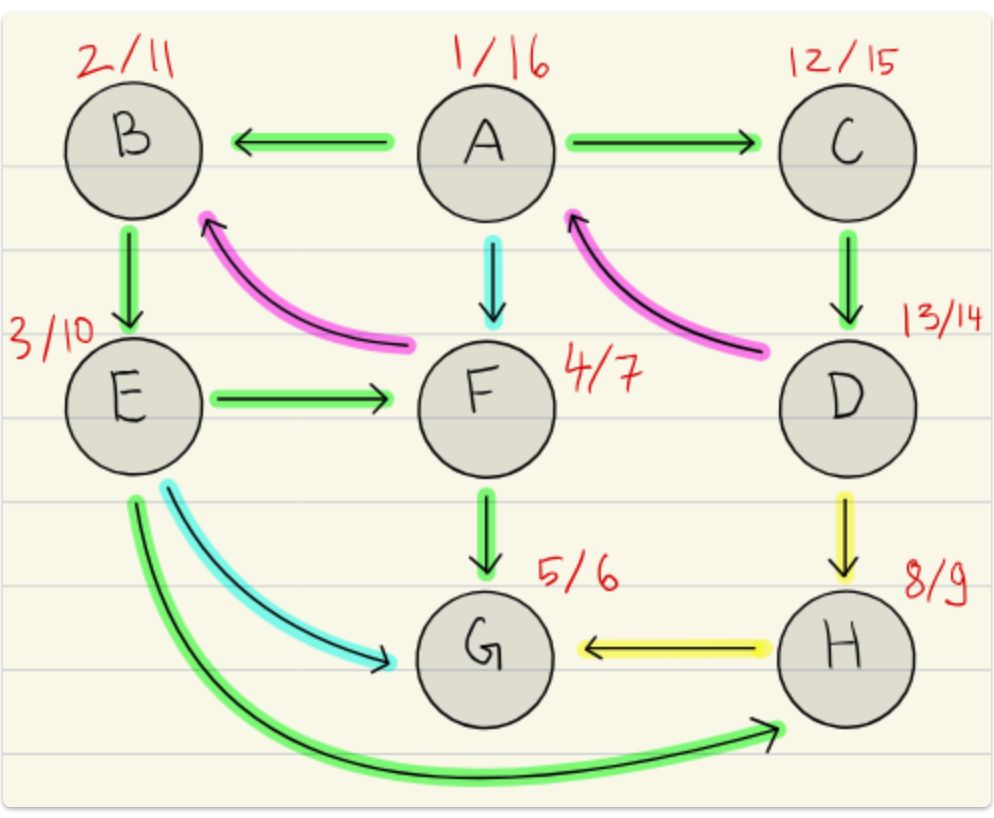
| Occlusion | {{c3::image-occlusion:rect:left=.1725:top=.5468:angle=985:width=.3135:height=.1117:oi=1}}<br>{{c1::image-occlusion:rect:left=.1923:top=.2416:width=.2286:height=.2:oi=1}}<br>{{c2::image-occlusion:rect:left=.5726:top=.7584:width=.2179:height=.0701:oi=1}}<br>{{c0::image-occlusion:text:left=.2051:top=.0987:text=B<-F:scale=1.:fs=.1133:oi=1}}<br>{{c0::image-occlusion:text:left=.6132:top=.8338:text=G<-H:scale=.5385:fs=.1133:oi=1}}<br>{{c0::image-occlusion:text:left=.1645:top=.7065:angle=989:text=E->G:scale=.6858:fs=.1133:oi=1}}<br> | |
| Image | <img src="paste-92fb45dcbaee894af9f32d9c2de935b1985dd979.jpg"> |
Note 47: ETH::A&D
Deck: ETH::A&D
Note Type: Horvath Cloze
GUID:
added
Note Type: Horvath Cloze
GUID:
Ew6/RqtSN]
Previous
Note did not exist
New Note
Front
The {{c1::In-degree \(\deg_{\text{in} }(v)\) (Eingangsgrad)}} of a vertex in a directed graph is the number of edges that have \(v\) as the end-vertex.
Back
The {{c1::In-degree \(\deg_{\text{in} }(v)\) (Eingangsgrad)}} of a vertex in a directed graph is the number of edges that have \(v\) as the end-vertex.
Field-by-field Comparison
| Field | Before | After |
|---|---|---|
| Text | The {{c1::In-degree \(\deg_{\text{in} }(v)\) (<i>Eingangsgrad</i>)}} of a vertex in a directed graph is the {{c2::number of edges that have \(v\) as the end-vertex}}. |
Note 48: ETH::A&D
Deck: ETH::A&D
Note Type: Horvath Cloze
GUID:
added
Note Type: Horvath Cloze
GUID:
F*Z7jn}vxk
Previous
Note did not exist
New Note
Front
The ADT List defines the following operations:
- insert(k, L): insert the key K at the end of the list L
- get(i, L): return the memory address of the i-th key in list L
- delete(k, L): remove the key k from the list L
- insertAfter(k, k', L): inserts the key k' after the key k in the list L
Back
The ADT List defines the following operations:
- insert(k, L): insert the key K at the end of the list L
- get(i, L): return the memory address of the i-th key in list L
- delete(k, L): remove the key k from the list L
- insertAfter(k, k', L): inserts the key k' after the key k in the list L
Field-by-field Comparison
| Field | Before | After |
|---|---|---|
| Text | The ADT <b>List</b> defines the following operations:<br><ul><li>{{c1:: <b>insert(k, L)</b>}}: {{c2:: insert the key <b>K</b> at the end of the list <b>L</b>}}</li><li>{{c3:: <b>get(i, L)</b>}}: {{c4:: return the memory address of the i-th key in list <b>L</b> }}</li><li>{{c4:: <b>delete(k, L)</b>}}: {{c5:: remove the key <b>k</b> from the list <b>L</b>}}</li><li>{{c6::<b>insertAfter(k, k', L)</b>}}: {{c7:: inserts the key <b>k'</b> after the key <b>k</b> in the list <b>L</b>}}</li></ul> |
Note 49: ETH::A&D
Deck: ETH::A&D
Note Type: Horvath Classic
GUID:
added
Note Type: Horvath Classic
GUID:
FAEpag8L6e
Previous
Note did not exist
New Note
Front
Runtime Determine if Hamiltonian path exists?
Back
Runtime Determine if Hamiltonian path exists?
Hamiltonian walk - exponential, we have to brute-force
Field-by-field Comparison
| Field | Before | After |
|---|---|---|
| Front | <b>Runtime</b> Determine if <b>Hamiltonian path</b> exists? | |
| Back | Hamiltonian walk - <b>exponential</b>, we have to brute-force |
Note 50: ETH::A&D
Deck: ETH::A&D
Note Type: Horvath Classic
GUID:
added
Note Type: Horvath Classic
GUID:
FS|421SN1o
Previous
Note did not exist
New Note
Front
Explain how unions works in the optimised Union-Find:
Back
Explain how unions works in the optimised Union-Find:
Arrays:
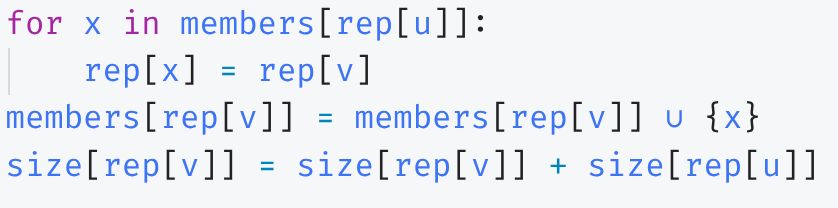
We update the reps, then the membership lists and finally the size
- rep, where rep[v] gives the representative of \(v\).
- members, where members[rep[v]] which contains all members of the ZHK of \(v\)
- rank, where rank[rep[v]] contains the size of the ZHK of \(v\).
We always merge the smaller ZHK into the bigger to minimise updates.
We update the reps, then the membership lists and finally the size
Field-by-field Comparison
| Field | Before | After |
|---|---|---|
| Front | Explain how unions works in the optimised <b>Union-Find:</b> | |
| Back | Arrays:<br><ul><li><b>rep</b>, where <b>rep[v]</b> gives the representative of \(v\).</li><li><b>members</b>, where <b>members[rep[v]] </b>which contains all members of the ZHK of \(v\)<br></li><li><b>rank</b>, where <b>rank[rep[v]]</b> contains the size of the ZHK of \(v\).</li></ul><div>We always merge the smaller ZHK into the bigger to minimise updates.</div><img src="paste-5129796b3ae6c46edebbaae726a47f0c892c2435.jpg"><br>We update the reps, then the membership lists and finally the size |
Note 51: ETH::A&D
Deck: ETH::A&D
Note Type: Horvath Classic
GUID:
added
Note Type: Horvath Classic
GUID:
FYr.:eNxT,
Previous
Note did not exist
New Note
Front
Types of 2-3 Tree nodes:
Back
Types of 2-3 Tree nodes:
keys in left (middle, right) sub-tree \(l\) (\(m, r\) respect.ively):
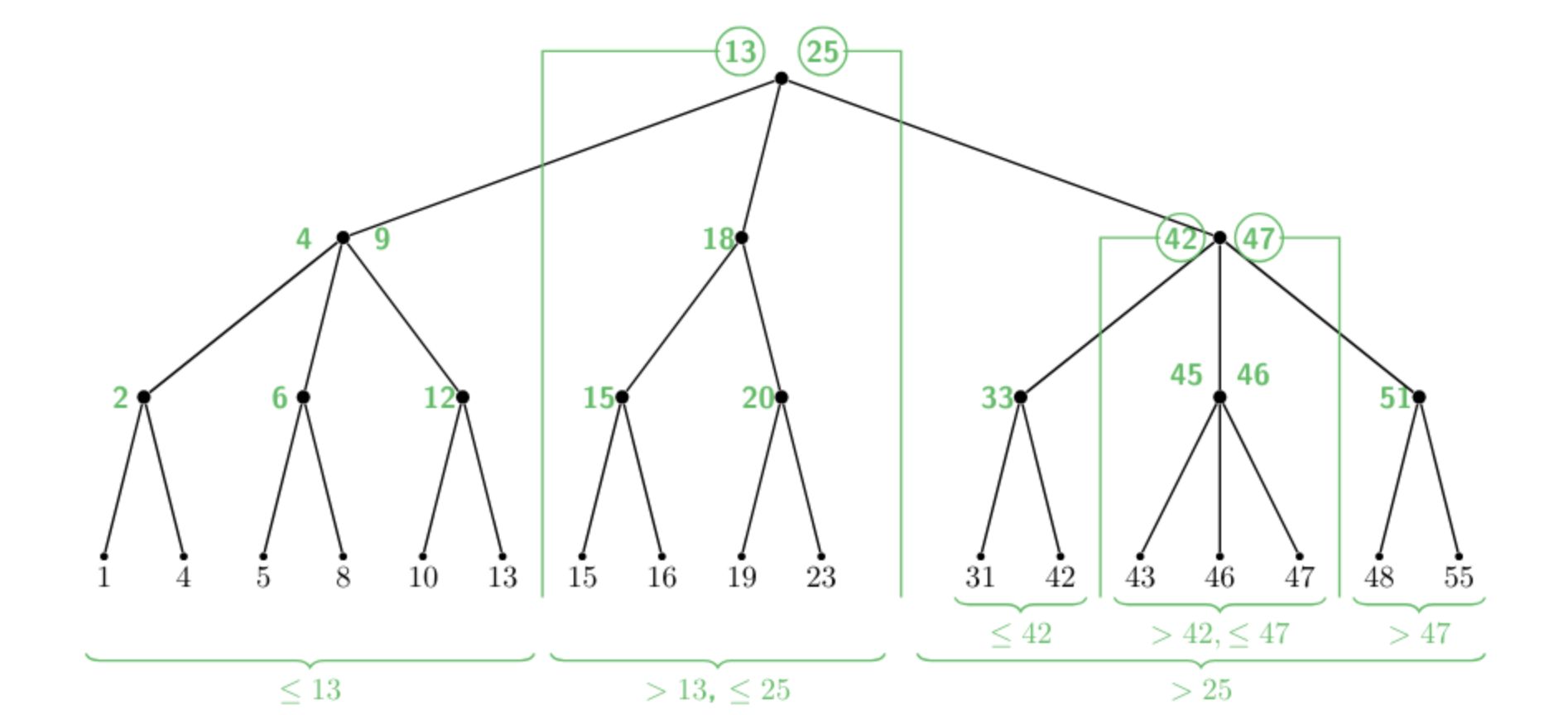
- 2 children: 1 separator \(s\) s.t. for \(l \leq s < r\).
- 3 children: 2 separators \(s_1, s_2\) s.t. \(l \leq s_1 < m \leq s_2 < r\)
Field-by-field Comparison
| Field | Before | After |
|---|---|---|
| Front | Types of <b>2-3 Tree</b> nodes: | |
| Back | keys in left (middle, right) sub-tree \(l\) (\(m, r\) respect.ively):<br><ol><li>2 children: 1 separator \(s\) s.t. for \(l \leq s < r\).</li><li>3 children: 2 separators \(s_1, s_2\) s.t. \(l \leq s_1 < m \leq s_2 < r\)</li></ol><img src="paste-099f4518906c93c69e397c80221d3fd5535c17e2.jpg"><br> |
Note 52: ETH::A&D
Deck: ETH::A&D
Note Type: Horvath Cloze
GUID:
added
Note Type: Horvath Cloze
GUID:
F^&OZQURkx
Previous
Note did not exist
New Note
Front
The ADT queue can be efficiently implemented using a singly linked list with a pointer to the end:
- push: \(O(1)\) insert at the end, with pointer to the end
- pop: \(O(1)\) remove the first element like in a stack
Back
The ADT queue can be efficiently implemented using a singly linked list with a pointer to the end:
- push: \(O(1)\) insert at the end, with pointer to the end
- pop: \(O(1)\) remove the first element like in a stack
Field-by-field Comparison
| Field | Before | After |
|---|---|---|
| Text | The ADT <b>queue</b> can be efficiently implemented using a {{c1:: <b>singly linked list with a pointer to the end</b>}}:<br><ul><li><b>push</b>: {{c2:: \(O(1)\) insert at the end, with pointer to the end}}<br></li><li><b>pop</b>: {{c3:: \(O(1)\) remove the first element like in a stack}}</li></ul> |
Note 53: ETH::A&D
Deck: ETH::A&D
Note Type: Algorithms
GUID:
added
Note Type: Algorithms
GUID:
F^nhYx>fXl
Previous
Note did not exist
New Note
Front
Back
Runtime of
Boruvka
Runtime:
Approach: Add all vertices to the set of components (so every vertex has its own component). As long as the size of the components set is greater than 1, connect each component to the one with the cheapest edge.
Uses: Find MST in weighted, undirected graph
?Field-by-field Comparison
| Field | Before | After |
|---|---|---|
| Name | <div style="text-align: center;"><b>Boruvka</b></div><div><br></div><div><b>Runtime</b>: </div><div><br></div><div><b>Approach</b>: Add all vertices to the set of components (so every vertex has its own component). As long as the size of the components set is greater than 1, connect each component to the one with the cheapest edge.</div><div><br></div><div><b>Uses</b>: Find MST in weighted, undirected graph</div> | |
| Approach | <ol><li>For Boruvka, we start with the set of edges \(F = \emptyset\). We treat each of the <em>isolated vertices</em> of the graph as it’s <em>own connected component</em>.</li><li>Each vertex marks it’s cheapest outgoing edge as a <em>safe edge</em> (making use of the cut property). We add these to \(F\).</li></ol><ul><li>Note that some of the edges might be chosen by both adjacent vertices, we still only add them once.<br><img src="paste-053ccf0acc6d560628bd8518b928a0d6c2687cb1.jpg"></li></ul><ol><li>Now, repeat by finding the cheapest outgoing edge for each component. Do this until all are connected.</li><li>\(F\) constitutes the edges of the MST.</li></ol> |
Note 54: ETH::A&D
Deck: ETH::A&D
Note Type: Horvath Classic
GUID:
added
Note Type: Horvath Classic
GUID:
Fn+W}!cgj0
Previous
Note did not exist
New Note
Front
If we know that shortest paths have a length of max \(h\), runtime of algo to find them?
Back
If we know that shortest paths have a length of max \(h\), runtime of algo to find them?
We can find them in \(O(h|E|)\) using Bellman-Ford since we only need to relax \(h\) times.
Field-by-field Comparison
| Field | Before | After |
|---|---|---|
| Front | If we know that shortest paths have a length of max \(h\), runtime of algo to find them? | |
| Back | We can find them in \(O(h|E|)\) using Bellman-Ford since we only need to relax \(h\) times. |
Note 55: ETH::A&D
Deck: ETH::A&D
Note Type: Horvath Cloze
GUID:
added
Note Type: Horvath Cloze
GUID:
Fzt_!E{2Xk
Previous
Note did not exist
New Note
Front
Master Theorem: In \(T(n) \leq aT(n/2) + Cn^b\), \(Cn^b\) is the work done outside the recursive calls (\(\geq 0\)).
Back
Master Theorem: In \(T(n) \leq aT(n/2) + Cn^b\), \(Cn^b\) is the work done outside the recursive calls (\(\geq 0\)).
Field-by-field Comparison
| Field | Before | After |
|---|---|---|
| Text | Master Theorem: In \(T(n) \leq aT(n/2) + Cn^b\), \(Cn^b\) is {{c1:: the work done outside the recursive calls (\(\geq 0\))}}. |
Note 56: ETH::A&D
Deck: ETH::A&D
Note Type: Horvath Classic
GUID:
added
Note Type: Horvath Classic
GUID:
F{a&v[Q@_W
Previous
Note did not exist
New Note
Front
Let \(W\) be a walk and let \(u\) be a vertex, what is \(\text{deg}_W(u)\)? (generally)
Back
Let \(W\) be a walk and let \(u\) be a vertex, what is \(\text{deg}_W(u)\)? (generally)
it is the degree of \(u\) in \(W\), which is the number of edges incident to \(u\) which are part of \(W\) but repetitions are included, therefore it is possible that \(\text{deg}(u) < \text{deg}_W(u)\)
Field-by-field Comparison
| Field | Before | After |
|---|---|---|
| Front | Let \(W\) be a walk and let \(u\) be a vertex, what is \(\text{deg}_W(u)\)? (generally) | |
| Back | it is the degree of \(u\) in \(W\), which is the number of edges incident to \(u\) which are part of \(W\) but <b>repetitions are included</b>, therefore it is possible that \(\text{deg}(u) < \text{deg}_W(u)\) |
Note 57: ETH::A&D
Deck: ETH::A&D
Note Type: Horvath Classic
GUID:
added
Note Type: Horvath Classic
GUID:
G9Xwk@MZZb
Previous
Note did not exist
New Note
Front
If \(f \leq O(h)\)
Back
If \(f \leq O(h)\)
\(\forall C > 0\) we have \(c \cdot f \leq O(h)\)
Field-by-field Comparison
| Field | Before | After |
|---|---|---|
| Front | If \(f \leq O(h)\) | |
| Back | \(\forall C > 0\) we have \(c \cdot f \leq O(h)\) |
Note 58: ETH::A&D
Deck: ETH::A&D
Note Type: Horvath Cloze
GUID:
added
Note Type: Horvath Cloze
GUID:
G<9txw#|QX
Previous
Note did not exist
New Note
Front
The {{c1::Out-degree \(\deg_{\text{out} }(v)\) (Ausgangsgrad)}} of a vertex in a directed graph is the number of edges that have \(v\) as the start-vertex.
Back
The {{c1::Out-degree \(\deg_{\text{out} }(v)\) (Ausgangsgrad)}} of a vertex in a directed graph is the number of edges that have \(v\) as the start-vertex.
Field-by-field Comparison
| Field | Before | After |
|---|---|---|
| Text | The {{c1::Out-degree \(\deg_{\text{out} }(v)\) (<i>Ausgangsgrad</i>)}} of a vertex in a directed graph is the {{c2::number of edges that have \(v\) as the start-vertex}}. |
Note 59: ETH::A&D
Deck: ETH::A&D
Note Type: Horvath Classic
GUID:
added
Note Type: Horvath Classic
GUID:
G?trbZc%;
Previous
Note did not exist
New Note
Front
What is a sufficient condition to show that \(f = \Theta(g)\)?
Back
What is a sufficient condition to show that \(f = \Theta(g)\)?
Let \(N\) be an infinite subset of \(\mathbb{N}\) and \(f: \mathbb{N} \rightarrow \mathbb{R}^+\) and \(g: \mathbb{N} \rightarrow \mathbb{R}^+\)
then \(\lim_{n\rightarrow \infty} \frac{f(n)}{g(n)} = C \in \mathbb{R}^+\) then \(f = \Theta(g)\)
then \(\lim_{n\rightarrow \infty} \frac{f(n)}{g(n)} = C \in \mathbb{R}^+\) then \(f = \Theta(g)\)
Field-by-field Comparison
| Field | Before | After |
|---|---|---|
| Front | What is a sufficient condition to show that \(f = \Theta(g)\)? | |
| Back | Let \(N\) be an infinite subset of \(\mathbb{N}\) and \(f: \mathbb{N} \rightarrow \mathbb{R}^+\) and \(g: \mathbb{N} \rightarrow \mathbb{R}^+\)<br>then \(\lim_{n\rightarrow \infty} \frac{f(n)}{g(n)} = C \in \mathbb{R}^+\) then \(f = \Theta(g)\) |
Note 60: ETH::A&D
Deck: ETH::A&D
Note Type: Horvath Cloze
GUID:
added
Note Type: Horvath Cloze
GUID:
GA*(aETcmb
Previous
Note did not exist
New Note
Front
DFS Runtime: In a sparse graph adjacency list better, in a dense graph adjacency matrix is better.
Back
DFS Runtime: In a sparse graph adjacency list better, in a dense graph adjacency matrix is better.
\(|E| \geq |V|^2 / 10\), then DFS has the same runtime in the worst-case using adjacency matrices or lists as \(|V| + |E| \leq |V| + |V|^2 \)which is \(O(n^2)\).
Field-by-field Comparison
| Field | Before | After |
|---|---|---|
| Text | DFS Runtime: In a sparse graph {{c1:: adjacency list better}}, in a dense graph {{c1:: adjacency matrix is better}}. | |
| Extra | \(|E| \geq |V|^2 / 10\), then DFS has the same runtime in the worst-case using adjacency matrices or lists as \(|V| + |E| \leq |V| + |V|^2 \)which is \(O(n^2)\). |
Note 61: ETH::A&D
Deck: ETH::A&D
Note Type: Horvath Classic
GUID:
added
Note Type: Horvath Classic
GUID:
Gr6wW?Nt0R
Previous
Note did not exist
New Note
Front
How is a binary tree stored in memory? What are the indices of the children for a parent index \(k\)?
Back
How is a binary tree stored in memory? What are the indices of the children for a parent index \(k\)?
The children of a node k in a tree are at \(2k\) and \(2k + 1\).
This means that the tree is stored in memory by levels.
This means that the tree is stored in memory by levels.
Field-by-field Comparison
| Field | Before | After |
|---|---|---|
| Front | How is a binary tree stored in memory? What are the indices of the children for a parent index \(k\)? | |
| Back | The children of a node k in a tree are at \(2k\) and \(2k + 1\). <br>This means that the tree is stored in memory <b>by levels</b>. |
Note 62: ETH::A&D
Deck: ETH::A&D
Note Type: Horvath Cloze
GUID:
added
Note Type: Horvath Cloze
GUID:
GsU2XikyZ:
Previous
Note did not exist
New Note
Front
We use Johnsons over Floyd-Warshall, when the graph is sparse, like in a tree.
Back
We use Johnsons over Floyd-Warshall, when the graph is sparse, like in a tree.
Then the \(|E|\) doesn't matter much in comparison to Floyd-Warshall's \(|V|^3\).
Field-by-field Comparison
| Field | Before | After |
|---|---|---|
| Text | We use <b>Johnsons</b> over <b>Floyd-Warshall</b>, when the graph is {{c1:: sparse, like in a tree}}. | |
| Extra | Then the \(|E|\) doesn't matter much in comparison to Floyd-Warshall's \(|V|^3\). |
Note 63: ETH::A&D
Deck: ETH::A&D
Note Type: Horvath Cloze
GUID:
added
Note Type: Horvath Cloze
GUID:
Gt4c53(i;/
Previous
Note did not exist
New Note
Front
In graph theory, a Hamiltonian path (Hamiltonpfad) is a path (Pfad) that contains every vertex (every vertex exactly once as it's a path).
Back
In graph theory, a Hamiltonian path (Hamiltonpfad) is a path (Pfad) that contains every vertex (every vertex exactly once as it's a path).
Field-by-field Comparison
| Field | Before | After |
|---|---|---|
| Text | In graph theory, a {{c2::Hamiltonian path (<i>Hamiltonpfad</i>)}} is a {{c1::path (<i>Pfad</i>) that contains every vertex (every vertex exactly once as it's a path)}}. |
Note 64: ETH::A&D
Deck: ETH::A&D
Note Type: Horvath Cloze
GUID:
added
Note Type: Horvath Cloze
GUID:
H0^#YREe-o
Previous
Note did not exist
New Note
Front
A 2-3 Tree is an external search-tree.
Back
A 2-3 Tree is an external search-tree.
This means that the values are stored in the leaves only. The nodes are for "navigation".
Field-by-field Comparison
| Field | Before | After |
|---|---|---|
| Text | A <b>2-3 Tree</b> is an {{c1:: external}} search-tree. | |
| Extra | This means that the values are stored in the leaves only. The nodes are for "navigation". |
Note 65: ETH::A&D
Deck: ETH::A&D
Note Type: Horvath Classic
GUID:
added
Note Type: Horvath Classic
GUID:
H>#zg]RQy9
Previous
Note did not exist
New Note
Front
Do we need positive edges for an MST?
Back
Do we need positive edges for an MST?
No, the algorithms can handle negative edges as there are no distances to compute.
Field-by-field Comparison
| Field | Before | After |
|---|---|---|
| Front | Do we need positive edges for an MST? | |
| Back | No, the algorithms can handle negative edges as there are no distances to compute. |
Note 66: ETH::A&D
Deck: ETH::A&D
Note Type: Horvath Cloze
GUID:
added
Note Type: Horvath Cloze
GUID:
H?Cs9sT6&{
Previous
Note did not exist
New Note
Front
2-3 Tree: Inserting Steps:
- Search for the correct node under which the key is inserted: \(O(\log_2 n)\)
- Insert the new key value as a separator
- Rebalance (if necessary, i.e. more than 3 keys)
- split node into two nodes (each gets 2 children and 1 seps)
- the middle sep is pushed to the parent level (and propagate)
Back
2-3 Tree: Inserting Steps:
- Search for the correct node under which the key is inserted: \(O(\log_2 n)\)
- Insert the new key value as a separator
- Rebalance (if necessary, i.e. more than 3 keys)
- split node into two nodes (each gets 2 children and 1 seps)
- the middle sep is pushed to the parent level (and propagate)
The rebalancing being recursively pushed to the parent limits the operations at the height \(h\) thus we get \(O(\log n)\).
Field-by-field Comparison
| Field | Before | After |
|---|---|---|
| Text | <b>2-3 Tree</b>: Inserting Steps:<br><ol><li>{{c1::Search for the correct node under which the key is inserted: \(O(\log_2 n)\)}}</li><li>{{c2::Insert the new key value as a <b>separator</b>}}</li><li>{{c3::<b>Rebalance</b> (if necessary, i.e. more than 3 keys)<br></li></ol><ul><li>split node into two nodes (each gets 2 children and 1 seps)</li><li>the middle sep is pushed to the parent level (and propagate)}}</li></ul> | |
| Extra | The rebalancing being recursively pushed to the parent limits the operations at the height \(h\) thus we get \(O(\log n)\). |
Note 67: ETH::A&D
Deck: ETH::A&D
Note Type: Horvath Cloze
GUID:
added
Note Type: Horvath Cloze
GUID:
HNA(>OC%7u
Previous
Note did not exist
New Note
Front
In an array we can:
- Insert in \(O(1)\) as we know the first empty cell in the array and can just write the key there
- Get in \(O(1)\) as we know the offset for each key
- InsertAfter in \(\Theta(l)\), since we have to shift the entire contents of the array behind the newly inserted element by 1.
- Delete in \(\Theta(l)\) as in the worst case (Delete first element) we need to shift all to the left by 1.
Back
In an array we can:
- Insert in \(O(1)\) as we know the first empty cell in the array and can just write the key there
- Get in \(O(1)\) as we know the offset for each key
- InsertAfter in \(\Theta(l)\), since we have to shift the entire contents of the array behind the newly inserted element by 1.
- Delete in \(\Theta(l)\) as in the worst case (Delete first element) we need to shift all to the left by 1.
Field-by-field Comparison
| Field | Before | After |
|---|---|---|
| Text | In an array we can:<br><ul><li><b>Insert</b> in {{c1:: \(O(1)\) as we know the first empty cell in the array and can just write the key there}}</li><li><b>Get</b> in {{c2::\(O(1)\) as we know the offset for each key}}</li><li><b>InsertAfter</b> in {{c3::\(\Theta(l)\), since we have to shift the entire contents of the array behind the newly inserted element by 1.}}<br></li><li><b>Delete</b> in {{c4::\(\Theta(l)\) as in the worst case (Delete first element) we need to shift all to the left by 1.}}<br></li></ul> |
Note 68: ETH::A&D
Deck: ETH::A&D
Note Type: Horvath Classic
GUID:
added
Note Type: Horvath Classic
GUID:
HVQq>1?_s&
Previous
Note did not exist
New Note
Front
What is an Invariant?
Back
What is an Invariant?
An invariant holds before, for each iteration and after. We use it to prove an algorithm preserves a certain property.
Field-by-field Comparison
| Field | Before | After |
|---|---|---|
| Front | <b>What is an Invariant?</b> | |
| Back | An invariant holds before, for each iteration and after. We use it to prove an algorithm preserves a certain property. |
Note 69: ETH::A&D
Deck: ETH::A&D
Note Type: Horvath Classic
GUID:
added
Note Type: Horvath Classic
GUID:
Hw9:{9d7k0
Previous
Note did not exist
New Note
Front
How do we derive a lower limit for a sum?
Back
How do we derive a lower limit for a sum?
Take a limited number of terms, which is then automatically lower than the sum.
\[ \frac{n^4}{2^4} = \frac{n}{2} \cdot (\frac{n}{2})^3 = \sum_{i = \frac{n}{2}}^n (\frac{n}{2})^3 \leq \sum_{i = 1}^n i^3 = 1^3 + \ ... \ + (\frac{n}{2})^3 + \ ... \ + n^3 \]
Here we take only the n/2 term.
\[ \frac{n^4}{2^4} = \frac{n}{2} \cdot (\frac{n}{2})^3 = \sum_{i = \frac{n}{2}}^n (\frac{n}{2})^3 \leq \sum_{i = 1}^n i^3 = 1^3 + \ ... \ + (\frac{n}{2})^3 + \ ... \ + n^3 \]
Here we take only the n/2 term.
Field-by-field Comparison
| Field | Before | After |
|---|---|---|
| Front | How do we derive a <b>lower</b> limit for a sum? | |
| Back | Take a <b>limited number of terms</b>, which is then automatically <b>lower</b> than the sum.<br>\[ \frac{n^4}{2^4} = \frac{n}{2} \cdot (\frac{n}{2})^3 = \sum_{i = \frac{n}{2}}^n (\frac{n}{2})^3 \leq \sum_{i = 1}^n i^3 = 1^3 + \ ... \ + (\frac{n}{2})^3 + \ ... \ + n^3 \]<br>Here we take only the n/2 term. |
Note 70: ETH::A&D
Deck: ETH::A&D
Note Type: Horvath Classic
GUID:
added
Note Type: Horvath Classic
GUID:
H{hvq(0Rc-
Previous
Note did not exist
New Note
Front
Sei \(G\) ein ungerichteter, gewichteter und zusammenhängender Graph.
Nehmen Sie an, dass es eine eindeutige Kante mit Gewicht \(1\) gibt und, dass das Gewicht aller anderen Kanten strikt größer als \(1\) ist.
Nehmen Sie an, dass es eine eindeutige Kante mit Gewicht \(1\) gibt und, dass das Gewicht aller anderen Kanten strikt größer als \(1\) ist.
Dann enthält jeder minimale Spannbaum von die Kante \(e\).
Back
Sei \(G\) ein ungerichteter, gewichteter und zusammenhängender Graph.
Nehmen Sie an, dass es eine eindeutige Kante mit Gewicht \(1\) gibt und, dass das Gewicht aller anderen Kanten strikt größer als \(1\) ist.
Nehmen Sie an, dass es eine eindeutige Kante mit Gewicht \(1\) gibt und, dass das Gewicht aller anderen Kanten strikt größer als \(1\) ist.
Dann enthält jeder minimale Spannbaum von die Kante \(e\).
True
Wir wählen immer die Kante \(e\), weil sie die günstigste Art die ZHK's zu verbinden ist.
Siehe Cut Property.
Wir wählen immer die Kante \(e\), weil sie die günstigste Art die ZHK's zu verbinden ist.
Siehe Cut Property.
Field-by-field Comparison
| Field | Before | After |
|---|---|---|
| Front | Sei \(G\) ein ungerichteter, gewichteter und zusammenhängender Graph. <br>Nehmen Sie an, dass es eine eindeutige Kante mit Gewicht \(1\) gibt und, dass das Gewicht aller anderen Kanten strikt größer als \(1\) ist.<div>Dann enthält jeder minimale Spannbaum von die Kante \(e\).</div> | |
| Back | True<br><br>Wir wählen immer die Kante \(e\), weil sie die günstigste Art die ZHK's zu verbinden ist.<br><br>Siehe Cut Property. |
Note 71: ETH::A&D
Deck: ETH::A&D
Note Type: Horvath Classic
GUID:
added
Note Type: Horvath Classic
GUID:
I&{k}F8qaf
Previous
Note did not exist
New Note
Front
What edges cannot appear in a graph?
Back
What edges cannot appear in a graph?
- Self-loops (\(\{v, v\} \in V\))
- Multigraphs, i.e. same edge twice in the same graph
Field-by-field Comparison
| Field | Before | After |
|---|---|---|
| Front | What edges cannot appear in a graph? | |
| Back | <ul><li>Self-loops (\(\{v, v\} \in V\))</li><li>Multigraphs, i.e. same edge twice in the same graph</li></ul> |
Note 72: ETH::A&D
Deck: ETH::A&D
Note Type: Horvath Cloze
GUID:
added
Note Type: Horvath Cloze
GUID:
IE=7&p8[(7
Previous
Note did not exist
New Note
Front
In an undirected graph, what is special about pre/post-ordering:
- back-edges = forward-edges
- cross edges are not possible
Back
In an undirected graph, what is special about pre/post-ordering:
- back-edges = forward-edges
- cross edges are not possible
Field-by-field Comparison
| Field | Before | After |
|---|---|---|
| Text | In an undirected graph, what is special about pre/post-ordering:<br><ul><li><div>{{c2::back-edges = forward-edges}}</div></li><li><div><div>cross edges {{c1::are not possible}}</div></div></li></ul> |
Note 73: ETH::A&D
Deck: ETH::A&D
Note Type: Horvath Cloze
GUID:
added
Note Type: Horvath Cloze
GUID:
IV81kgA3~6
Previous
Note did not exist
New Note
Front
Prim's Algorithm Invariants:
\(\forall v \not \in S, v \neq s\), \(d[v] = \) {{c1:: \(\min \{ w(u, v) \ | \ (u, v) \in E, u \in S \}\)(\(\infty\) if no such edge exists)}}.
\(\forall v \not \in S, v \neq s\), \(d[v] = \) {{c1:: \(\min \{ w(u, v) \ | \ (u, v) \in E, u \in S \}\)(\(\infty\) if no such edge exists)}}.
Back
Prim's Algorithm Invariants:
\(\forall v \not \in S, v \neq s\), \(d[v] = \) {{c1:: \(\min \{ w(u, v) \ | \ (u, v) \in E, u \in S \}\)(\(\infty\) if no such edge exists)}}.
\(\forall v \not \in S, v \neq s\), \(d[v] = \) {{c1:: \(\min \{ w(u, v) \ | \ (u, v) \in E, u \in S \}\)(\(\infty\) if no such edge exists)}}.
The 3rd invariant \[d[v] = \begin{cases} 0, & \text{if } v = s \text{ (the starting vertex)} \\ \min_{(u,v) \in E : u \in S} {w(u,v)}, & \text{if } v \in V \setminus S \text{ and } \exists (u,v) \in E \text{ with } u \in S \\ \infty, & \text{if } v \in V \setminus S \text{ and } \nexists (u,v) \in E \text{ with } u \in S \end{cases}\]ensures that d[v] always reflects the minimum cost to reach vertex v from the current MST.
We always want to add the vertex with the cheapest edge connecting it to the MST, thus this invariant has to hold in order for the algorithm to be correct.
Field-by-field Comparison
| Field | Before | After |
|---|---|---|
| Text | Prim's Algorithm Invariants:<br>\(\forall v \not \in S, v \neq s\), \(d[v] = \) {{c1:: \(\min \{ w(u, v) \ | \ (u, v) \in E, u \in S \}\)(\(\infty\) if no such edge exists)}}. | |
| Extra | <div>The 3rd invariant \[d[v] = \begin{cases} 0, & \text{if } v = s \text{ (the starting vertex)} \\ \min_{(u,v) \in E : u \in S} {w(u,v)}, & \text{if } v \in V \setminus S \text{ and } \exists (u,v) \in E \text{ with } u \in S \\ \infty, & \text{if } v \in V \setminus S \text{ and } \nexists (u,v) \in E \text{ with } u \in S \end{cases}\]ensures that d[v] always reflects the minimum cost to reach vertex v from the current MST.</div><div><br></div> <div>We always want to add the vertex with the cheapest edge connecting it to the MST, thus this invariant has to hold in order for the algorithm to be correct.</div> |
Note 74: ETH::A&D
Deck: ETH::A&D
Note Type: Horvath Cloze
GUID:
added
Note Type: Horvath Cloze
GUID:
IXC|=r,qdR
Previous
Note did not exist
New Note
Front
The distance \(d(u, v)\) in a directed graph is defined as shortest length of a walk from \(u\) to \(v\)
Back
The distance \(d(u, v)\) in a directed graph is defined as shortest length of a walk from \(u\) to \(v\)
Keep in mind in a weighted graph, this might mean the cheapest, which refers to cost not length.
Field-by-field Comparison
| Field | Before | After |
|---|---|---|
| Text | The distance \(d(u, v)\) in a directed graph is defined as {{c1:: shortest length of a walk from \(u\) to \(v\)}} | |
| Extra | Keep in mind in a weighted graph, this might mean the <b>cheapest</b>, which refers to <b>cost</b> not length. |
Note 75: ETH::A&D
Deck: ETH::A&D
Note Type: Horvath Classic
GUID:
added
Note Type: Horvath Classic
GUID:
Ip_w|jj[VT
Previous
Note did not exist
New Note
Front
How can we quickly check if an Eulerian walk exists?
Back
How can we quickly check if an Eulerian walk exists?
we can check the degrees of the vertices, an Eulerian walk exists only if at most 2 vertices have an odd degree
this is because if a vertex has an odd degree, it must either be the start point or the endpoint as otherwise we would not be able to leave from it
this is because if a vertex has an odd degree, it must either be the start point or the endpoint as otherwise we would not be able to leave from it
Field-by-field Comparison
| Field | Before | After |
|---|---|---|
| Front | How can we quickly check if an Eulerian walk exists? | |
| Back | we can check the degrees of the vertices, an Eulerian walk exists only if at most 2 vertices have an odd degree<br><br>this is because if a vertex has an odd degree, it must either be the start point or the endpoint as otherwise we would not be able to leave from it |
Note 76: ETH::A&D
Deck: ETH::A&D
Note Type: Horvath Cloze
GUID:
added
Note Type: Horvath Cloze
GUID:
J!K^!6M$e^
Previous
Note did not exist
New Note
Front
Differences between Subarray vs. Subsequence vs. Subset:
- subarray: continous partition of the original
- subsequence: non-continous partition
- subset any subset (order does not matter)
Back
Differences between Subarray vs. Subsequence vs. Subset:
- subarray: continous partition of the original
- subsequence: non-continous partition
- subset any subset (order does not matter)
Field-by-field Comparison
| Field | Before | After |
|---|---|---|
| Text | Differences between Subarray vs. Subsequence vs. Subset:<br><ul><li><b>subarray</b>: {{c1:: continous partition of the original}}</li><li><b>subsequence</b>: {{c2:: non-continous partition}}</li><li><b>subset</b> {{c3:: any subset (order does not matter)}}</li></ul> |
Note 77: ETH::A&D
Deck: ETH::A&D
Note Type: Horvath Cloze
GUID:
added
Note Type: Horvath Cloze
GUID:
J%Ue&}vC`>
Previous
Note did not exist
New Note
Front
In a directed graph, for the edge \(e = (u, v)\), \(u\) is the direct predecessor (Vorgänger) of \(v\) and \(v\) the direct successor (Nachfolger of \(u\).
Back
In a directed graph, for the edge \(e = (u, v)\), \(u\) is the direct predecessor (Vorgänger) of \(v\) and \(v\) the direct successor (Nachfolger of \(u\).
Field-by-field Comparison
| Field | Before | After |
|---|---|---|
| Text | In a directed graph, for the edge \(e = (u, v)\), \(u\) is the {{c1::direct predecessor (<i>Vorgänger</i>)}} of \(v\) and \(v\) the {{c1::direct successor (<i>Nachfolger</i>}} of \(u\). |
Note 78: ETH::A&D
Deck: ETH::A&D
Note Type: Horvath Cloze
GUID:
added
Note Type: Horvath Cloze
GUID:
J5#2&7I#l3
Previous
Note did not exist
New Note
Front
A vertex with {{c1::\(\deg_{\text{out} }(v) = 0\)}} is called a sink (Senke).
Back
A vertex with {{c1::\(\deg_{\text{out} }(v) = 0\)}} is called a sink (Senke).
Field-by-field Comparison
| Field | Before | After |
|---|---|---|
| Text | A vertex with {{c1::\(\deg_{\text{out} }(v) = 0\)}} is called a {{c2::sink (<i>Senke</i>)}}. |
Note 79: ETH::A&D
Deck: ETH::A&D
Note Type: Horvath Cloze
GUID:
added
Note Type: Horvath Cloze
GUID:
J5>uyKCn19
Previous
Note did not exist
New Note
Front
The ADT Dictionary implements the following methods:
- search(x, W) returns the position of the key x in memory
- insert(x, W) Insert the key x into W, as long as it’s not saved there yet
- delete(x, W) find and delete the key x from W
Back
The ADT Dictionary implements the following methods:
- search(x, W) returns the position of the key x in memory
- insert(x, W) Insert the key x into W, as long as it’s not saved there yet
- delete(x, W) find and delete the key x from W
Field-by-field Comparison
| Field | Before | After |
|---|---|---|
| Text | The ADT Dictionary implements the following methods:<br><ul><li>{{c1::<b>search(x, W)</b> returns the position of the key x in memory}}</li><li>{{c2::<b>insert(x, W)</b> Insert the key <b>x</b> into <b>W</b>, as long as it’s not saved there yet}}<br></li><li>{{c3::<b>delete(x, W)</b> find and delete the key <b>x</b> from <b>W</b>}}<br></li></ul> |
Note 80: ETH::A&D
Deck: ETH::A&D
Note Type: Horvath Cloze
GUID:
added
Note Type: Horvath Cloze
GUID:
Jm.C(wC@Lp
Previous
Note did not exist
New Note
Front
{{c1:: \(\sum_{i = 1}^{n} i^2\)}} \(=\) {{c2::\(\frac{n(n + 1)(2n + 1)}{6}\)}} (Sum)
Back
{{c1:: \(\sum_{i = 1}^{n} i^2\)}} \(=\) {{c2::\(\frac{n(n + 1)(2n + 1)}{6}\)}} (Sum)
Field-by-field Comparison
| Field | Before | After |
|---|---|---|
| Text | {{c1:: \(\sum_{i = 1}^{n} i^2\)}} \(=\) {{c2::\(\frac{n(n + 1)(2n + 1)}{6}\)}} (Sum) |
Note 81: ETH::A&D
Deck: ETH::A&D
Note Type: Horvath Cloze
GUID:
added
Note Type: Horvath Cloze
GUID:
Jm{y&aYo^p
Previous
Note did not exist
New Note
Front
For \(u, v \in V\) we say that \(u\) reaches \(v\) (erreicht) if there is a walk with endpoints \(u\) and \(v\) (or a path).
Back
For \(u, v \in V\) we say that \(u\) reaches \(v\) (erreicht) if there is a walk with endpoints \(u\) and \(v\) (or a path).
Reachability is an equivalence relation.
Field-by-field Comparison
| Field | Before | After |
|---|---|---|
| Text | For \(u, v \in V\) we say that {{c1::\(u\) <b>reaches</b> \(v\) (<i>erreicht</i>)}} if {{c2::there is a walk with endpoints \(u\) and \(v\) (or a path)}}. | |
| Extra | Reachability is an <b>equivalence relation</b>. |
Note 82: ETH::A&D
Deck: ETH::A&D
Note Type: Horvath Cloze
GUID:
added
Note Type: Horvath Cloze
GUID:
Jp{gN:I7yh
Previous
Note did not exist
New Note
Front
{{c1:: \(\sum_{i = 1}^{n} \log(i)\)}} \(=\) \(\log(n!)\) (Sum)
Back
{{c1:: \(\sum_{i = 1}^{n} \log(i)\)}} \(=\) \(\log(n!)\) (Sum)
Field-by-field Comparison
| Field | Before | After |
|---|---|---|
| Text | {{c1:: \(\sum_{i = 1}^{n} \log(i)\)}} \(=\) {{c2::\(\log(n!)\)}} (Sum) |
Note 83: ETH::A&D
Deck: ETH::A&D
Note Type: Horvath Classic
GUID:
added
Note Type: Horvath Classic
GUID:
K(FaD(&[!I
Previous
Note did not exist
New Note
Front
In an undirected Graph, what does \(E\) contain?
Back
In an undirected Graph, what does \(E\) contain?
\(E\) is the set of all edges, which are unordered pairs \(e = \{u, v\}\).
Field-by-field Comparison
| Field | Before | After |
|---|---|---|
| Front | In an undirected Graph, what does \(E\) contain? | |
| Back | \(E\) is the set of all edges, which are unordered pairs \(e = \{u, v\}\). |
Note 84: ETH::A&D
Deck: ETH::A&D
Note Type: Algorithms
GUID:
added
Note Type: Algorithms
GUID:
KD23pBO,?%
Previous
Note did not exist
New Note
Front
Back
Runtime of
Johnson
Runtime: {{c1::\( \mathcal{O}(|E| \cdot |V| + |V|^2 \cdot \log|V|)\)}}
Approach:
Uses:
?Field-by-field Comparison
| Field | Before | After |
|---|---|---|
| Name | <div style="text-align: center;"><b>Johnson</b></div><div><br></div><div><b>Runtime</b>: {{c1::\( \mathcal{O}(|E| \cdot |V| + |V|^2 \cdot \log|V|)\)}}</div><div><br></div><div><b>Approach</b>: {{c2::Idea: Make all edges positive and then perform Dijkstra \(n\) times. To do this, create an additional node that is linked to each node with edge weight 0 and store for each node a height \(h(x)\), where \(h(x)\) is equal to the shortest path from the new node n to the node x (might be negative). The new weights are calculated with \(w'(u,v) = w(u,v) + h(u) - h(v)\).}}</div><div><br></div><div><b>Uses</b>: {{c3::All-to-all shortest paths in directed graphs without negative cycles.}}</div> |
Note 85: ETH::A&D
Deck: ETH::A&D
Note Type: Horvath Reverso
GUID:
added
Note Type: Horvath Reverso
GUID:
KgqO:Z_iT+
Previous
Note did not exist
New Note
Front
\(O(\log(n)) \leq\) (name the next bigger function)
Back
\(O(\log(n)) \leq\) (name the next bigger function)
\(\leq O(n)\) (name the next smaller function)
Field-by-field Comparison
| Field | Before | After |
|---|---|---|
| Front | \(O(\log(n)) \leq\) <i>(name the next bigger function)</i> | |
| Back | \(\leq O(n)\) <i>(name the next smaller function)</i> |
Note 86: ETH::A&D
Deck: ETH::A&D
Note Type: Horvath Classic
GUID:
added
Note Type: Horvath Classic
GUID:
L#@+crYi2-
Previous
Note did not exist
New Note
Front
Bipartite Test with BFS:
Back
Bipartite Test with BFS:
We substitute bipartite for two-colourable.
While traversing the tree, in each layer, we colour all vertices with the same. If we then encounter a vertex with the same colour during traversal, it's not two-colourable.
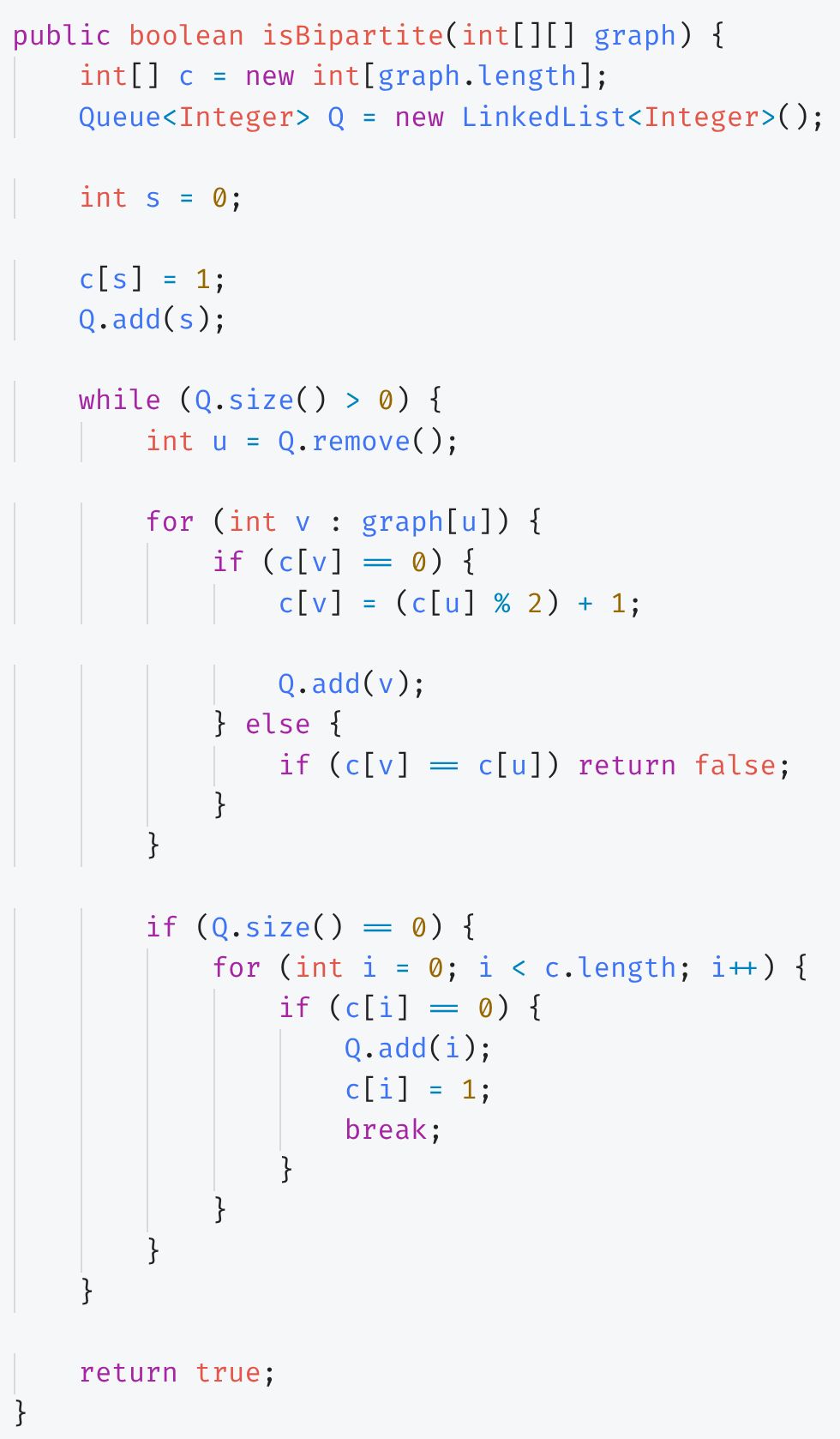
While traversing the tree, in each layer, we colour all vertices with the same. If we then encounter a vertex with the same colour during traversal, it's not two-colourable.
Field-by-field Comparison
| Field | Before | After |
|---|---|---|
| Front | Bipartite Test with BFS: | |
| Back | We substitute bipartite for two-colourable. <br><br>While traversing the tree, <b>in each layer</b>, we <b>colour all vertices with the same</b>. If we then <b>encounter </b>a vertex with the<b> same colour</b> during traversal, it's <b>not two-colourable</b>.<br><br><img src="paste-c8749f8e54bcf6eb4c7cd1ac37ca03ea43e15fd6.jpg"> |
Note 87: ETH::A&D
Deck: ETH::A&D
Note Type: Horvath Classic
GUID:
added
Note Type: Horvath Classic
GUID:
L4[cTT%fZ]
Previous
Note did not exist
New Note
Front
Give the outline of an induction proof:
Back
Give the outline of an induction proof:
We want to prove that ... for \(n \geq 5\)
Base Case: Let \(n = 5\) .... So the property holds for \(n = 5\).
Induction Hypothesis: We assume the property is true for some \(k \geq 5\)
Induction Step: We must show that the property holds for \(k + 1\).
By the principle of mathematical induction ... is true for all \(n \geq 5\).
Base Case: Let \(n = 5\) .... So the property holds for \(n = 5\).
Induction Hypothesis: We assume the property is true for some \(k \geq 5\)
Induction Step: We must show that the property holds for \(k + 1\).
By the principle of mathematical induction ... is true for all \(n \geq 5\).
Field-by-field Comparison
| Field | Before | After |
|---|---|---|
| Front | Give the outline of an induction proof: | |
| Back | We want to prove that ... for \(n \geq 5\)<br><br><b>Base Case: </b>Let \(n = 5\) .... So the property holds for \(n = 5\).<br><b>Induction Hypothesis:</b> We assume the property is true for some \(k \geq 5\)<br><b>Induction Step:</b> We must show that the property holds for \(k + 1\).<br><br>By the principle of mathematical induction ... is true for all \(n \geq 5\). |
Note 88: ETH::A&D
Deck: ETH::A&D
Note Type: Horvath Cloze
GUID:
added
Note Type: Horvath Cloze
GUID:
LGV&:!
Previous
Note did not exist
New Note
Front
Prim's Algorithm requires an undirected, connected, weighted Graph.
Back
Prim's Algorithm requires an undirected, connected, weighted Graph.
Field-by-field Comparison
| Field | Before | After |
|---|---|---|
| Text | <b>Prim's Algorithm</b> requires an {{c1:: undirected, connected, weighted}} Graph. |
Note 89: ETH::A&D
Deck: ETH::A&D
Note Type: Algorithms
GUID:
added
Note Type: Algorithms
GUID:
L`3Iw:nx:Z
Previous
Note did not exist
New Note
Front
Runtime of Subset Sum (Teilsummenproblem)?
Back
Runtime of Subset Sum (Teilsummenproblem)?
\(\Theta(n \cdot b)\) (Pseudo-Polynomial)
Field-by-field Comparison
| Field | Before | After |
|---|---|---|
| Name | Subset Sum (Teilsummenproblem) | |
| Runtime | \(\Theta(n \cdot b)\) (Pseudo-Polynomial) | |
| Requirements | We want to find the subset \(I \subseteq \{1, \dots, n\}\) such that \(\sum_{i \in I} A[i] = b\) (must not exist for all \(b\)).<br><br>\(T(i,s)\) is 1 if there exists a subset from 1 to i that sums to s<br><ul><li>Base Case: T(0, 0) = 1 as we can use </li><li>Recursion: \( T(i, s) = T(i - 1, s) \ \lor \ T(i - 1, s - A[i]) \)</li></ul><div>Either we use A[i] or we don't.</div> |
Note 90: ETH::A&D
Deck: ETH::A&D
Note Type: Horvath Cloze
GUID:
added
Note Type: Horvath Cloze
GUID:
Ld,vXkta~C
Previous
Note did not exist
New Note
Front
The ADT priorityQueue has the following operations:
- insert: insert with priority p
- extractMax: removes and returns element with highest priority.
Back
The ADT priorityQueue has the following operations:
- insert: insert with priority p
- extractMax: removes and returns element with highest priority.
Field-by-field Comparison
| Field | Before | After |
|---|---|---|
| Text | The ADT <b>priorityQueue</b> has the following operations:<br><ul><li><b>{{c1:: insert}}</b>: {{c2::insert with priority <b>p}}</b><br></li><li><b>{{c3:: extractMax}}</b>: {{c4::removes and returns element with highest priority.}}<br></li></ul> |
Note 91: ETH::A&D
Deck: ETH::A&D
Note Type: Algorithms
GUID:
added
Note Type: Algorithms
GUID:
LqP`8lU$&o
Previous
Note did not exist
New Note
Front
Runtime of Insertion Sort?
Back
Runtime of Insertion Sort?
Best Case: \(O(n)\)
Worst Case: \(O(n^2)\)
This insertion is not constant time! We have to swap it with each previous element!
Field-by-field Comparison
| Field | Before | After |
|---|---|---|
| Name | Insertion Sort | |
| Runtime | <div>Best Case: \(O(n)\)</div><div>Worst Case: \(O(n^2)\)</div> | |
| Approach | For insertion sort, we start at the left-side and create our sorted array there. We take the next element from the unsorted ones and insert it at the correct place in our sorted array.<br><img src="paste-5c36171852af92d3caae178195f26449be038802.jpg"><br>Insertion sort is slowly sorting in the elements from the right side into the left side sorted array.<br><br><i>This insertion is not constant time! We have to swap it with each previous element!</i> | |
| Pseudocode | <img src="paste-2783fa7cf7c57ffca0fb1baaff2d11ebe0379621.jpg"> | |
| Extra Info | <i>This insertion is not constant time! We have to swap it with each previous element!</i> | |
| Invariant | Nach \(j\) Durchläufen der äusseren Schleife ist das Teilarray \(A[1, \dots, j]\) sortiert (es enthält aber nicht zwangsläufig die \(j\) kleinsten Elemente des Arrays) | |
| Worst Case Scenario | Array sorted in reverse order. | |
| Attributes | In-Place<br>Stable |
Note 92: ETH::A&D
Deck: ETH::A&D
Note Type: Algorithms
GUID:
added
Note Type: Algorithms
GUID:
L~wgr~ELJV
Previous
Note did not exist
New Note
Front
Runtime of Knapsack Problem (Rucksackproblem)?
Back
Runtime of Knapsack Problem (Rucksackproblem)?
\(\Theta(n\cdot W)\) or \(\Theta(n \cdot P)\) (Pseudopolynomial)
Field-by-field Comparison
| Field | Before | After |
|---|---|---|
| Name | Knapsack Problem (Rucksackproblem) | |
| Runtime | \(\Theta(n\cdot W)\) or \(\Theta(n \cdot P)\) (Pseudopolynomial) | |
| Approach | Subset problem choosing the maximum staying under a weight \(W\).<br>The greedy algorithm fails as a local optimum is not global here.<br><br>Base Cases: \(dp[0][w] = 0, \quad dp[i][0] = 0\)<br>If item weight > max allowed left, don't take it. Otherwise get the max from using it or not:<br>\(dp[i][w] = \begin{cases} dp[i-1][w], & w_i > w \\ \max(dp[i-1][w], dp[i-1][w-w_i] + v_i), & \text{sonst} \end{cases}\) | |
| Pseudocode | <img src="paste-dfd5963f4f4fabfa2ea13e840d1530b8d7fe1a4a.jpg"> |
Note 93: ETH::A&D
Deck: ETH::A&D
Note Type: Horvath Cloze
GUID:
added
Note Type: Horvath Cloze
GUID:
M,7!v0F$PQ
Previous
Note did not exist
New Note
Front
A connected component of \(G\) is a equivalence class of the relation defined as follows: \(u = v\) if \(u\) reaches \(v\).
Back
A connected component of \(G\) is a equivalence class of the relation defined as follows: \(u = v\) if \(u\) reaches \(v\).
Field-by-field Comparison
| Field | Before | After |
|---|---|---|
| Text | A {{c1::connected component}} of \(G\) is a {{c2::equivalence class of the relation defined as follows: \(u = v\) if \(u\) reaches \(v\)}}. |
Note 94: ETH::A&D
Deck: ETH::A&D
Note Type: Horvath Cloze
GUID:
added
Note Type: Horvath Cloze
GUID:
M,?u9cw(S%
Previous
Note did not exist
New Note
Front
{{c1:: \(\sum_{i = 1}^{n} i\log(i)\)}} \(\leq\) \(O(n \log(n))\) (O notation)
Back
{{c1:: \(\sum_{i = 1}^{n} i\log(i)\)}} \(\leq\) \(O(n \log(n))\) (O notation)
Field-by-field Comparison
| Field | Before | After |
|---|---|---|
| Text | {{c1:: \(\sum_{i = 1}^{n} i\log(i)\)}} \(\leq\) {{c2::\(O(n \log(n))\)}} (O notation) |
Note 95: ETH::A&D
Deck: ETH::A&D
Note Type: Horvath Cloze
GUID:
added
Note Type: Horvath Cloze
GUID:
M11/nZaHIu
Previous
Note did not exist
New Note
Front
| search | insert | delete | |
| unsorted Array | \(O(n)\) | \(O(1)\) | \(O(n)\) |
| sorted Array | \(O(\log n)\) | \(O(n)\) | \(O(n)\) |
| DLL | \(O(n)\) (no bin. search possible) | \(O(1)\) | \(O(n)\) |
Back
| search | insert | delete | |
| unsorted Array | \(O(n)\) | \(O(1)\) | \(O(n)\) |
| sorted Array | \(O(\log n)\) | \(O(n)\) | \(O(n)\) |
| DLL | \(O(n)\) (no bin. search possible) | \(O(1)\) | \(O(n)\) |
Field-by-field Comparison
| Field | Before | After |
|---|---|---|
| Text | <b></b><b></b><b></b><b></b><table> <tbody><tr> <td></td> <td><b>search</b></td> <td><b>insert</b></td> <td><b>delete</b></td> </tr> <tr> <td>unsorted Array</td> <td>{{c1::\(O(n)\)}}</td> <td>{{c2::\(O(1)\)}}</td> <td>{{c3::\(O(n)\)}}</td> </tr> <tr> <td>sorted Array</td> <td>{{c4::\(O(\log n)\)}}</td> <td>{{c5::\(O(n)\)}}</td> <td>{{c6::\(O(n)\)}}</td> </tr> <tr> <td>DLL</td> <td>{{c7::\(O(n)\) (no bin. search possible)}}</td> <td>{{c8::\(O(1)\)}}</td> <td>{{c9::\(O(n)\)}}</td> </tr> </tbody></table> |
Note 96: ETH::A&D
Deck: ETH::A&D
Note Type: Horvath Classic
GUID:
added
Note Type: Horvath Classic
GUID:
M?qP8s.,s4
Previous
Note did not exist
New Note
Front
How can we represent a graph?
Back
How can we represent a graph?
1. Adjacency matrix
2. Adjacency lists
2. Adjacency lists
Field-by-field Comparison
| Field | Before | After |
|---|---|---|
| Front | How can we represent a graph? | |
| Back | <b>1. </b>Adjacency<b> matrix<br>2. </b>Adjacency<b> lists</b> |
Note 97: ETH::A&D
Deck: ETH::A&D
Note Type: Horvath Classic
GUID:
added
Note Type: Horvath Classic
GUID:
M^6zMs=8ah
Previous
Note did not exist
New Note
Front
What is the sum of all natural numbers between 1 and \(n\)?
Back
What is the sum of all natural numbers between 1 and \(n\)?
\(= \frac{n(n+1)}{2}\)
Field-by-field Comparison
| Field | Before | After |
|---|---|---|
| Front | What is the sum of all natural numbers between 1 and \(n\)? | |
| Back | \(= \frac{n(n+1)}{2}\) |
Note 98: ETH::A&D
Deck: ETH::A&D
Note Type: Horvath Cloze
GUID:
added
Note Type: Horvath Cloze
GUID:
Mv|.Tnx#vx
Previous
Note did not exist
New Note
Front
A graph with distinct ege weights has one unique MST.
Back
A graph with distinct ege weights has one unique MST.
There is one unique safe-edge.
Field-by-field Comparison
| Field | Before | After |
|---|---|---|
| Text | A graph with {{c1::distinct ege weights}} has {{c2::one unique MST}}. | |
| Extra | There is one unique safe-edge. |
Note 99: ETH::A&D
Deck: ETH::A&D
Note Type: Horvath Cloze
GUID:
added
Note Type: Horvath Cloze
GUID:
N9}LnE{]~X
Previous
Note did not exist
New Note
Front
In an edge \(e = \{u, v\}\), we call \(u\) adjacent (Adjazent oder Benachbart) to \(v\) (and the other way around) and \(e\) incident (Inzident oder Anliegen) to \(u, v\).
Back
In an edge \(e = \{u, v\}\), we call \(u\) adjacent (Adjazent oder Benachbart) to \(v\) (and the other way around) and \(e\) incident (Inzident oder Anliegen) to \(u, v\).
Field-by-field Comparison
| Field | Before | After |
|---|---|---|
| Text | In an edge \(e = \{u, v\}\), we call \(u\) {{c1::adjacent (<i>Adjazent</i> oder <i>Benachbart</i>)}} to \(v\) (and the other way around) and \(e\) {{c2::incident (<i>Inzident</i> oder <i>Anliegen</i>)}} to \(u, v\). |
Note 100: ETH::A&D
Deck: ETH::A&D
Note Type: Horvath Classic
GUID:
added
Note Type: Horvath Classic
GUID:
N@-]h|e+xG
Previous
Note did not exist
New Note
Front
Runtime: Operations in an Adjacency List:
Back
Runtime: Operations in an Adjacency List:
1. Check if \(uv \in E \): \(O(1 + \min\{\text{deg}(u), \text{deg}(v) \})\) (we have to check the smaller of the two adjacency lists
2. Vertex \(u\), find all adjacent vertices: \(O(1+\text{deg}(u) )\)
2. Vertex \(u\), find all adjacent vertices: \(O(1+\text{deg}(u) )\)
Field-by-field Comparison
| Field | Before | After |
|---|---|---|
| Front | <b>Runtime</b>: Operations in an Adjacency <b>List</b>: | |
| Back | 1. Check if \(uv \in E \): \(O(1 + \min\{\text{deg}(u), \text{deg}(v) \})\) (we have to check the smaller of the two adjacency lists<br>2. Vertex \(u\), find all adjacent vertices: \(O(1+\text{deg}(u) )\) |
Note 101: ETH::A&D
Deck: ETH::A&D
Note Type: Algorithms
GUID:
added
Note Type: Algorithms
GUID:
NAHrkHd^ik
Previous
Note did not exist
New Note
Front
Runtime of Merge Sort?
Back
Runtime of Merge Sort?
Best Case: \(O(n \log n)\)
Worst Case: \(O(n \log n)\)
Worst Case: \(O(n \log n)\)
Field-by-field Comparison
| Field | Before | After |
|---|---|---|
| Name | Merge Sort | |
| Runtime | Best Case: \(O(n \log n)\)<br>Worst Case: \(O(n \log n)\) | |
| Approach | Merge sort works by divide-and-conquering the array into smaller chunks. it then merges them together slowly.<br><br>The merging works by having two indices showing the current position in the left and right array that we are merging.<br>We then compare the elements at the indices and take the smaller one. We then increase the counter on that array, while the other stays the same.<br><br>As soon as one array has been merged in completely, we can just append the second one (as it's already sorted).<br><br><img src="merge-sort-example_0.png"> | |
| Pseudocode | <img src="paste-12189c9effe95e34aad497b476fcf9df9bd9d780.jpg"><br><img src="paste-763eaed89740e506f95db48e31e94b234ca72af2.jpg"> | |
| Invariant | <div>Merge sort always sorts correctly when called for a sub-array shorter than \(r - l + 1\).</div><div>This means that merge has to correctly merge the two sub-arrays into a complete array.</div> | |
| Worst Case Scenario | The worst-case scenario for Mergesort is an array that has alternating small and big elements, thus they will always have to be compared during the merge. | |
| Attributes | not in place, thus the space complexity is \(K(n)\). (can be made in place)<br><b>Stable</b> |
Note 102: ETH::A&D
Deck: ETH::A&D
Note Type: Horvath Classic
GUID:
added
Note Type: Horvath Classic
GUID:
NDIo0EK5KX
Previous
Note did not exist
New Note
Front
If \(T(n) \geq aT(n/ 2) + Cn^b\), then the O-Notation gives
Back
If \(T(n) \geq aT(n/ 2) + Cn^b\), then the O-Notation gives
\(T(n) \geq \Omega(...)\)
Field-by-field Comparison
| Field | Before | After |
|---|---|---|
| Front | If \(T(n) \geq aT(n/ 2) + Cn^b\), then the O-Notation gives | |
| Back | \(T(n) \geq \Omega(...)\) |
Note 103: ETH::A&D
Deck: ETH::A&D
Note Type: Horvath Classic
GUID:
added
Note Type: Horvath Classic
GUID:
NR^|^~o+xa
Previous
Note did not exist
New Note
Front
How do we get the topo sort from DFS?
Back
How do we get the topo sort from DFS?
Reversed Post order
Field-by-field Comparison
| Field | Before | After |
|---|---|---|
| Front | How do we get the topo sort from DFS? | |
| Back | Reversed Post order |
Note 104: ETH::A&D
Deck: ETH::A&D
Note Type: Horvath Cloze
GUID:
added
Note Type: Horvath Cloze
GUID:
NU;6ob<^n3
Previous
Note did not exist
New Note
Front
{{c1:: \(\sum_{i = 1}^{n} \sum_{k = 1}^{\textbf{i} } 1\)}} \(=\) {{c2:: \(\sum_{i = 1}^n i = \frac{n(n + 1)}{2}\)}} (Sum)
Back
{{c1:: \(\sum_{i = 1}^{n} \sum_{k = 1}^{\textbf{i} } 1\)}} \(=\) {{c2:: \(\sum_{i = 1}^n i = \frac{n(n + 1)}{2}\)}} (Sum)
inner loop depends on outer
Field-by-field Comparison
| Field | Before | After |
|---|---|---|
| Text | {{c1:: \(\sum_{i = 1}^{n} \sum_{k = 1}^{\textbf{i} } 1\)}} \(=\) {{c2:: \(\sum_{i = 1}^n i = \frac{n(n + 1)}{2}\)}} (Sum) | |
| Extra | inner loop depends on outer |
Note 105: ETH::A&D
Deck: ETH::A&D
Note Type: Horvath Classic
GUID:
added
Note Type: Horvath Classic
GUID:
Nl}2-%ar31
Previous
Note did not exist
New Note
Front
What is a maxHeap?
Back
What is a maxHeap?
A Datastructure that stores the values in a tree form, with the largest element always as the root.
Field-by-field Comparison
| Field | Before | After |
|---|---|---|
| Front | What is a maxHeap? | |
| Back | A Datastructure that stores the values in a tree form, with the largest element always as the root. |
Note 106: ETH::A&D
Deck: ETH::A&D
Note Type: Horvath Cloze
GUID:
added
Note Type: Horvath Cloze
GUID:
O%OM.97hp$
Previous
Note did not exist
New Note
Front
\(\exists\) back edge \(\Longleftrightarrow\)\(\exists\) Directed closed walk
Back
\(\exists\) back edge \(\Longleftrightarrow\)\(\exists\) Directed closed walk
Field-by-field Comparison
| Field | Before | After |
|---|---|---|
| Text | {{c1::\(\exists\) back edge}} \(\Longleftrightarrow\){{c2::\(\exists\) Directed closed walk}} |
Note 107: ETH::A&D
Deck: ETH::A&D
Note Type: Horvath Cloze
GUID:
added
Note Type: Horvath Cloze
GUID:
O5ty{6nA_*
Previous
Note did not exist
New Note
Front
The Degree (Knotengrad) \(\deg(v)\) of a vertex \(v\) is the number of edges that are incident to \(v\).
Back
The Degree (Knotengrad) \(\deg(v)\) of a vertex \(v\) is the number of edges that are incident to \(v\).
Field-by-field Comparison
| Field | Before | After |
|---|---|---|
| Text | The {{c1::Degree (<i>Knotengrad</i>) \(\deg(v)\)}} of a vertex \(v\) is the number of edges that are {{c2::incident}} to \(v\). |
Note 108: ETH::A&D
Deck: ETH::A&D
Note Type: Horvath Classic
GUID:
added
Note Type: Horvath Classic
GUID:
O>N2*/v~`q
Previous
Note did not exist
New Note
Front
If a vertex has degree 0, what do we call it?
Back
If a vertex has degree 0, what do we call it?
It is an isolated vertex.
Field-by-field Comparison
| Field | Before | After |
|---|---|---|
| Front | If a vertex has degree 0, what do we call it? | |
| Back | It is an <b>isolated vertex</b>. |
Note 109: ETH::A&D
Deck: ETH::A&D
Note Type: Horvath Cloze
GUID:
added
Note Type: Horvath Cloze
GUID:
OGBoPi1aY*
Previous
Note did not exist
New Note
Front
The ADTs stack and queue behave similarly to a list, but with more constrained operations that allow more efficient computation.
Back
The ADTs stack and queue behave similarly to a list, but with more constrained operations that allow more efficient computation.
Field-by-field Comparison
| Field | Before | After |
|---|---|---|
| Text | The ADTs {{c2::<b>stack</b> and <b>queue</b>}} behave similarly to a {{c1:: list}}, but with {{c3:: more constrained operations that allow more efficient computation}}. |
Note 110: ETH::A&D
Deck: ETH::A&D
Note Type: Horvath Classic
GUID:
added
Note Type: Horvath Classic
GUID:
OIsr/vHbhR
Previous
Note did not exist
New Note
Front
What do we have to pay attention to in the I.H. and the I.S. in an induction proof?
Back
What do we have to pay attention to in the I.H. and the I.S. in an induction proof?
We should change the variable name from \(n\) to \(k\) (for example) as not to confuse it.
Field-by-field Comparison
| Field | Before | After |
|---|---|---|
| Front | What do we have to pay attention to in the I.H. and the I.S. in an induction proof? | |
| Back | We should change the variable name from \(n\) to \(k\) (for example) as not to confuse it. |
Note 111: ETH::A&D
Deck: ETH::A&D
Note Type: Horvath Reverso
GUID:
added
Note Type: Horvath Reverso
GUID:
OW(TL-EP^P
Previous
Note did not exist
New Note
Front
Graph Theory:
Cycle
Cycle
Back
Graph Theory:
Cycle
Cycle
Graph Theory:
Kreis
Kreis
Field-by-field Comparison
| Field | Before | After |
|---|---|---|
| Front | Graph Theory:<br><br>Cycle | |
| Back | Graph Theory:<br><br>Kreis |
Note 112: ETH::A&D
Deck: ETH::A&D
Note Type: Horvath Cloze
GUID:
added
Note Type: Horvath Cloze
GUID:
OY@2Ay+>4p
Previous
Note did not exist
New Note
Front
2-3 Tree: Deleting Steps:
- Search for the correct node under which the key is inserted: \(O(\log_2 n)\)
- Remove the leaf with the value and one separator
- Rebalance (if necessary, i.e. now 1 key)
Back
2-3 Tree: Deleting Steps:
- Search for the correct node under which the key is inserted: \(O(\log_2 n)\)
- Remove the leaf with the value and one separator
- Rebalance (if necessary, i.e. now 1 key)
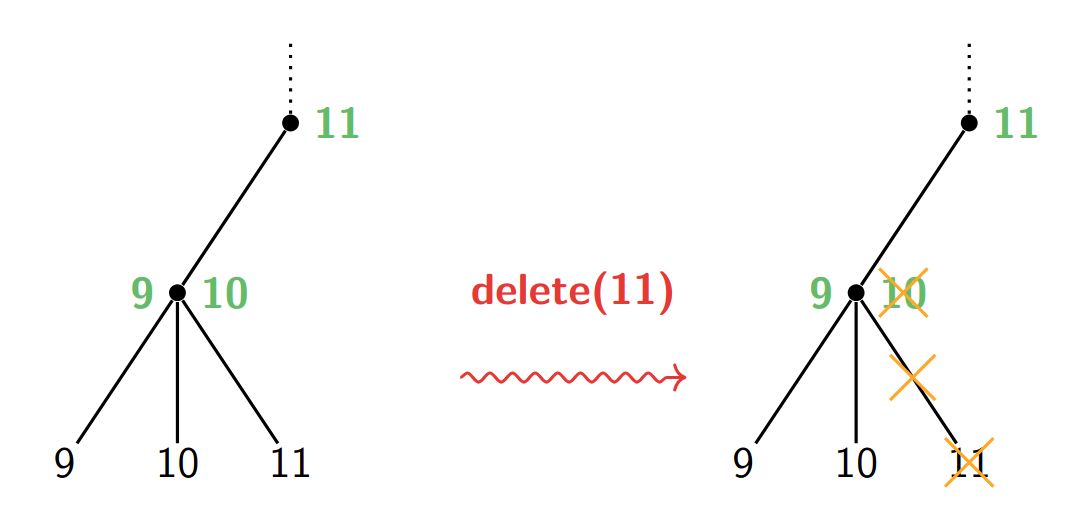
Field-by-field Comparison
| Field | Before | After |
|---|---|---|
| Text | <b>2-3 Tree</b>: Deleting Steps:<br><ol><li>{{c1::Search for the correct node under which the key is inserted: \(O(\log_2 n)\)}}</li><li>{{c2::Remove the leaf with the value and one separator}}</li><li>{{c3::<b>Rebalance</b> (if necessary, i.e. now 1 key)}}</li></ol> | |
| Extra | <img src="paste-7d452d931b0485669156a2669de65234617e5eb6.jpg"> |
Note 113: ETH::A&D
Deck: ETH::A&D
Note Type: Horvath Classic
GUID:
added
Note Type: Horvath Classic
GUID:
Otnyr;#TD1
Previous
Note did not exist
New Note
Front
Simplify \(\frac{a^{kn}}{b^{k'n}} =\)
Back
Simplify \(\frac{a^{kn}}{b^{k'n}} =\)
\(\frac{e^{\ln(a^{kn})}}{e^{\ln(b^{k'n})}} = e^{kn \cdot \ln(a) - k'n \cdot ln(b)}\)
Field-by-field Comparison
| Field | Before | After |
|---|---|---|
| Front | Simplify \(\frac{a^{kn}}{b^{k'n}} =\) | |
| Back | \(\frac{e^{\ln(a^{kn})}}{e^{\ln(b^{k'n})}} = e^{kn \cdot \ln(a) - k'n \cdot ln(b)}\) |
Note 114: ETH::A&D
Deck: ETH::A&D
Note Type: Horvath Classic
GUID:
added
Note Type: Horvath Classic
GUID:
O||9vPX+Y`
Previous
Note did not exist
New Note
Front
If \(f = \Theta(g)\)
Back
If \(f = \Theta(g)\)
\(\exists C_1,C_2 \ge 0 \quad \forall n \in \mathbb{N}\) \(C_1 \cdot g(n) \leq f(n) \leq C_2 \cdot g(n)\)
\(f\) grows asymptotically the same as \(g\)
\(f\) grows asymptotically the same as \(g\)
Field-by-field Comparison
| Field | Before | After |
|---|---|---|
| Front | If \(f = \Theta(g)\) | |
| Back | \(\exists C_1,C_2 \ge 0 \quad \forall n \in \mathbb{N}\) \(C_1 \cdot g(n) \leq f(n) \leq C_2 \cdot g(n)\)<br><br>\(f\) grows asymptotically the <b>same</b> as \(g\) |
Note 115: ETH::A&D
Deck: ETH::A&D
Note Type: Horvath Cloze
GUID:
added
Note Type: Horvath Cloze
GUID:
P<,uu+Hu
Previous
Note did not exist
New Note
Front
The shortest walk in a directed, weighted Graph is always a path.
Back
The shortest walk in a directed, weighted Graph is always a path.
If it's a walk, we can remove all edges between the first occurence of the repeated vertex and the last occurence.
Field-by-field Comparison
| Field | Before | After |
|---|---|---|
| Text | The shortest walk in a directed, weighted Graph is always a {{c1:: <b>path</b>}}. | |
| Extra | If it's a walk, we can remove all edges between the first occurence of the repeated vertex and the last occurence. |
Note 116: ETH::A&D
Deck: ETH::A&D
Note Type: Horvath Cloze
GUID:
added
Note Type: Horvath Cloze
GUID:
P
Previous
Note did not exist
New Note
Front
A vertex in a connected graph is a cut vertex if the subgraph obtained after removing it and all it's incident edges is disconnected.
Back
A vertex in a connected graph is a cut vertex if the subgraph obtained after removing it and all it's incident edges is disconnected.
Field-by-field Comparison
| Field | Before | After |
|---|---|---|
| Text | A vertex in a connected graph is a {{c1::cut vertex}} if {{c2::the subgraph obtained after removing it and all it's incident edges is <b>disconnected</b>}}. |
Note 117: ETH::A&D
Deck: ETH::A&D
Note Type: Horvath Classic
GUID:
added
Note Type: Horvath Classic
GUID:
PF|EmWOMd:
Previous
Note did not exist
New Note
Front
Cost of a walk in a weighted graph \(G = (V, E, c)\):
Back
Cost of a walk in a weighted graph \(G = (V, E, c)\):
sum of the weight of it's edges: \(\sum_{i = 0}^{l - 1} c(v_i, v_i+1)\)
Field-by-field Comparison
| Field | Before | After |
|---|---|---|
| Front | Cost of a walk in a weighted graph \(G = (V, E, c)\): | |
| Back | sum of the weight of it's edges: \(\sum_{i = 0}^{l - 1} c(v_i, v_i+1)\) |
Note 118: ETH::A&D
Deck: ETH::A&D
Note Type: Horvath Classic
GUID:
added
Note Type: Horvath Classic
GUID:
PU(5RRppkP
Previous
Note did not exist
New Note
Front
When can the condition \(n = 2^k\) be dropped in the Master Theorem?
Back
When can the condition \(n = 2^k\) be dropped in the Master Theorem?
When the function \(T\) is increasing (monotonically non-decreasing).
Field-by-field Comparison
| Field | Before | After |
|---|---|---|
| Front | When can the condition \(n = 2^k\) be dropped in the Master Theorem? | |
| Back | When the function \(T\) is increasing (monotonically non-decreasing). |
Note 119: ETH::A&D
Deck: ETH::A&D
Note Type: Horvath Cloze
GUID:
added
Note Type: Horvath Cloze
GUID:
Pf|C9|^n[w
Previous
Note did not exist
New Note
Front
In a singly and doubly linked list, the operation:
- Insert is \(\Theta(1)\) as we know the memory address of the final element in the list and just have to set the null pointer to the new keys address. Without this pointer it's \(\Theta(l)\).
- Get is \(\Theta(i)\) very slow as we need to traverse the entire list up to i
- insertAfter is \(O(1)\) if we get the memory address of the element to insert after.
- delete is:
SLL: {{c4::\(\Theta(l)\) as we need to find the previous element and change it's pointer.}
DLL: \(O(1)\) we know the address of the previous element and then just edit it's pointer.
Back
In a singly and doubly linked list, the operation:
- Insert is \(\Theta(1)\) as we know the memory address of the final element in the list and just have to set the null pointer to the new keys address. Without this pointer it's \(\Theta(l)\).
- Get is \(\Theta(i)\) very slow as we need to traverse the entire list up to i
- insertAfter is \(O(1)\) if we get the memory address of the element to insert after.
- delete is:
SLL: {{c4::\(\Theta(l)\) as we need to find the previous element and change it's pointer.}
DLL: \(O(1)\) we know the address of the previous element and then just edit it's pointer.
Field-by-field Comparison
| Field | Before | After |
|---|---|---|
| Text | In a <b>singly</b> and <b>doubly linked list</b>, the operation:<br><ul><li><b>Insert</b> is {{c1::\(\Theta(1)\) as we know the memory address of the final element in the list and just have to set the null pointer to the new keys address. Without this pointer it's \(\Theta(l)\). }}<br></li><li><b>Get</b> is {{c2::\(\Theta(i)\) very slow as we need to traverse the entire list up to <b>i</b>}}<br></li><li><b>insertAfter</b> is {{c3:: \(O(1)\) if we get the memory address of the element to insert after.}}<br></li><li><b>delete</b> is:<br> SLL: {{c4::\(\Theta(l)\) as we need to find the previous element and change it's pointer.}<br> DLL: {{c5:: \(O(1)\) we know the address of the previous element and then just edit it's pointer.}}</li></ul> |
Note 120: ETH::A&D
Deck: ETH::A&D
Note Type: Horvath Cloze
GUID:
added
Note Type: Horvath Cloze
GUID:
PhZTjS+XL8
Previous
Note did not exist
New Note
Front
If \(\frac{f(n)}{g(n)}\) tends to \(\infty+\), then \(f \nleq O(g)\) and \(g \leq O(f)\).
Back
If \(\frac{f(n)}{g(n)}\) tends to \(\infty+\), then \(f \nleq O(g)\) and \(g \leq O(f)\).
\(f \geq \Omega(g)\) but \(f \neq \Theta(g)\)
Field-by-field Comparison
| Field | Before | After |
|---|---|---|
| Text | If \(\frac{f(n)}{g(n)}\) tends to {{c1::\(\infty+\)}}, then {{c2::\(f \nleq O(g)\) and \(g \leq O(f)\)}}. | |
| Extra | \(f \geq \Omega(g)\) but \(f \neq \Theta(g)\) |
Note 121: ETH::A&D
Deck: ETH::A&D
Note Type: Horvath Cloze
GUID:
added
Note Type: Horvath Cloze
GUID:
PvmYSo9Bj_
Previous
Note did not exist
New Note
Front
In the edge \(e = (u, v)\), we call \(u\) the start vertex and \(v\) the end vertex
Back
In the edge \(e = (u, v)\), we call \(u\) the start vertex and \(v\) the end vertex
Field-by-field Comparison
| Field | Before | After |
|---|---|---|
| Text | In the edge \(e = (u, v)\), we call \(u\) the {{c1::start}} vertex and \(v\) the {{c1::end}} vertex |
Note 122: ETH::A&D
Deck: ETH::A&D
Note Type: Horvath Cloze
GUID:
added
Note Type: Horvath Cloze
GUID:
Q3:!A9V`D,
Previous
Note did not exist
New Note
Front
Steps of giving a DP solution:
- Define the DP table (dimensions, index, range; meaning of entry): ex: DP[1..n+1][1..k+1]
- Computation of Entry (Base Case, recursive formula, pay attention to bounds!)
- Calculation Order (what depends on what entries, what variable incremented first)
- Extract Solution (How to get final solution out)
- Running time proof
Back
Steps of giving a DP solution:
- Define the DP table (dimensions, index, range; meaning of entry): ex: DP[1..n+1][1..k+1]
- Computation of Entry (Base Case, recursive formula, pay attention to bounds!)
- Calculation Order (what depends on what entries, what variable incremented first)
- Extract Solution (How to get final solution out)
- Running time proof
SMIROST (Size, Meaning, Initialisation, Recursive, Order, Solution, Time)


Smiling Monkey In Red Overall Steals Tacos
Smiling Monkey In Red Overall Steals Tacos
Field-by-field Comparison
| Field | Before | After |
|---|---|---|
| Text | Steps of giving a DP solution:<br><ol><li>{{c1::Define the DP table (dimensions, index, range; meaning of entry): ex: <b>DP[1..n+1][1..k+1]</b>}}</li><li>{{c2::Computation of Entry (Base Case, recursive formula, pay attention to bounds!)}}</li><li>{{c3::Calculation Order (what depends on what entries, what variable incremented first)}}</li><li>{{c4::Extract Solution (How to get final solution out)}}</li><li>{{c5::Running time proof}}</li></ol> | |
| Extra | SMIROST (Size, Meaning, Initialisation, Recursive, Order, Solution, Time)<br><br><img alt="" src="https://chatgpt.com/backend-api/estuary/content?id=file_00000000b144722fb24d37aefc63a244&ts=490704&p=fs&cid=1&sig=9139f521032b1f527f402bd9e46aa4fc98c1c346920ce78fa1198c460ce702b0&v=0"><img src="b8ad5128-8b94-4df8-a395-8fcd177c0ef6.png"><br><strong>S</strong>miling <strong>M</strong>onkey <strong>I</strong>n <strong>R</strong>ed <strong>O</strong>verall <strong>S</strong>teals <strong>T</strong>acos<img alt="" src="https://chatgpt.com/backend-api/estuary/content?id=file_00000000b144722fb24d37aefc63a244&ts=490704&p=fs&cid=1&sig=9139f521032b1f527f402bd9e46aa4fc98c1c346920ce78fa1198c460ce702b0&v=0"> |
Note 123: ETH::A&D
Deck: ETH::A&D
Note Type: Horvath Reverso
GUID:
added
Note Type: Horvath Reverso
GUID:
QA~(,/7jXV
Previous
Note did not exist
New Note
Front
\(O(k^n) \leq\) (name the next bigger function)
Back
\(O(k^n) \leq\) (name the next bigger function)
\(\leq O(n!)\) (name the next smaller function)
Field-by-field Comparison
| Field | Before | After |
|---|---|---|
| Front | \(O(k^n) \leq\) <i>(name the next bigger function)</i> | |
| Back | \(\leq O(n!)\) <i>(name the next smaller function)</i> |
Note 124: ETH::A&D
Deck: ETH::A&D
Note Type: Horvath Classic
GUID:
added
Note Type: Horvath Classic
GUID:
QBdl=YAmG|
Previous
Note did not exist
New Note
Front
Check for cycles in DFS algo:
Back
Check for cycles in DFS algo:
During the recursive call, if we find an adjacent vertex without a post-number, there's a back-edge (\(\implies\)the recursive call for that edge is still active...)
Field-by-field Comparison
| Field | Before | After |
|---|---|---|
| Front | Check for cycles in DFS algo: | |
| Back | During the recursive call, if we find an adjacent vertex <b>without a post-number</b>, there's a back-edge (\(\implies\)the recursive call for that edge is still active...) |
Note 125: ETH::A&D
Deck: ETH::A&D
Note Type: Horvath Cloze
GUID:
added
Note Type: Horvath Cloze
GUID:
QJ{Y%?s>+w
Previous
Note did not exist
New Note
Front
When writing the recursion, make sure that if the index goes out of bound, you specify the "neutral".
Back
When writing the recursion, make sure that if the index goes out of bound, you specify the "neutral".
For subset sum, we take \(DP[i-1][B - b_i]\), where if we don't check \(B - b_i\) might go negative and thus oob.
Field-by-field Comparison
| Field | Before | After |
|---|---|---|
| Text | When writing the recursion, make sure that if the index {{c1:: goes out of bound, you specify the "neutral"}}. | |
| Extra | For subset sum, we take \(DP[i-1][B - b_i]\), where if we don't check \(B - b_i\) might go negative and thus oob. |
Note 126: ETH::A&D
Deck: ETH::A&D
Note Type: Horvath Classic
GUID:
added
Note Type: Horvath Classic
GUID:
Qv/bX3RU0v
Previous
Note did not exist
New Note
Front
How does the number of ZHK's change in Boruvka's for each round?
Back
How does the number of ZHK's change in Boruvka's for each round?
The number of component halves in each round, thus \(\log |V|\) iterations worst case.
Field-by-field Comparison
| Field | Before | After |
|---|---|---|
| Front | How does the number of ZHK's change in Boruvka's for each round? | |
| Back | The number of component halves in each round, thus \(\log |V|\) iterations worst case. |
Note 127: ETH::A&D
Deck: ETH::A&D
Note Type: Horvath Classic
GUID:
added
Note Type: Horvath Classic
GUID:
Q|AEYAPg!l
Previous
Note did not exist
New Note
Front
What is a sufficient condition to show that \(f \geq \Omega(g)\)?
Back
What is a sufficient condition to show that \(f \geq \Omega(g)\)?
Let \(N\) be an infinite subset of \(\mathbb{N}\) and \(f: N \rightarrow \mathbb{R}^+\) and \(g: N \rightarrow \mathbb{R}^+\)
then if \(\lim_{n\rightarrow \infty} \frac{f(n)}{g(n)} = \infty\), \(f \geq \Omega(g)\) but \(f \neq \Theta(g)\)
then if \(\lim_{n\rightarrow \infty} \frac{f(n)}{g(n)} = \infty\), \(f \geq \Omega(g)\) but \(f \neq \Theta(g)\)
Field-by-field Comparison
| Field | Before | After |
|---|---|---|
| Front | What is a sufficient condition to show that \(f \geq \Omega(g)\)? | |
| Back | Let \(N\) be an infinite subset of \(\mathbb{N}\) and \(f: N \rightarrow \mathbb{R}^+\) and \(g: N \rightarrow \mathbb{R}^+\)<br>then if \(\lim_{n\rightarrow \infty} \frac{f(n)}{g(n)} = \infty\), \(f \geq \Omega(g)\) but \(f \neq \Theta(g)\) |
Note 128: ETH::A&D
Deck: ETH::A&D
Note Type: Horvath Classic
GUID:
added
Note Type: Horvath Classic
GUID:
Q}a3<1,J]C
Previous
Note did not exist
New Note
Front
2-3 Tree: Deleting Steps if neighbour has 2 keys:
Back
2-3 Tree: Deleting Steps if neighbour has 2 keys:
- the nodes \(u\) and \(v\) are merged to form one new node with 3 children.
- The separator from the parent node is pulled down to be the new \(s_2\).
If root has 1 child -> root replaced by child.
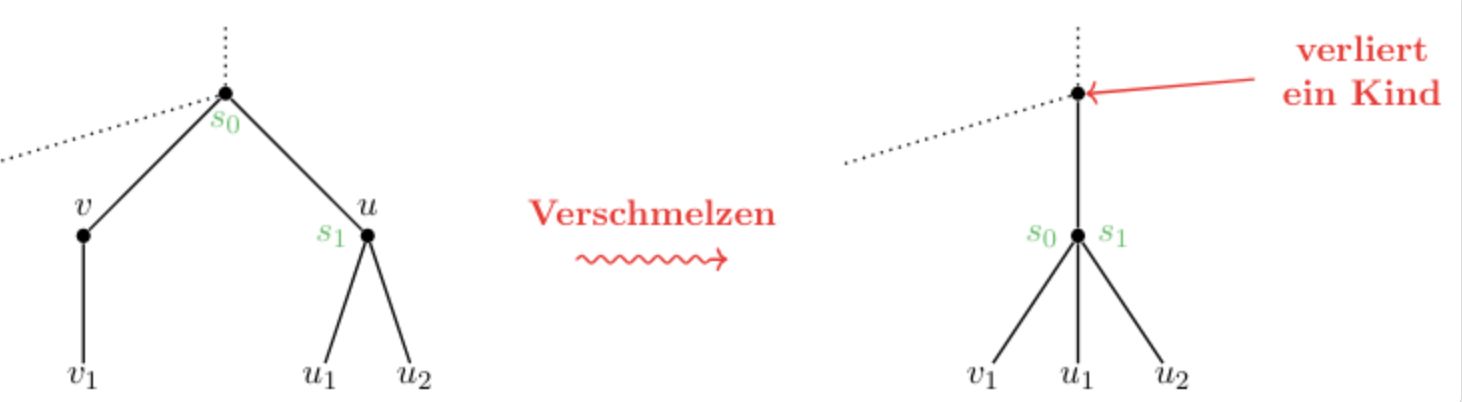
Field-by-field Comparison
| Field | Before | After |
|---|---|---|
| Front | 2-3 Tree: Deleting Steps if neighbour has 2 keys: | |
| Back | <ol><li>the nodes \(u\) and \(v\) are <b>merged</b> to form one new node with <b>3 children</b>.</li><li>The separator from the parent node is pulled down to be the new \(s_2\).</li></ol>Parent may lose child -> rebalance there (can go up to the root).<br>If root has 1 child -> root replaced by child.<br><img src="paste-fcffee6f619138677fc86eb74beebfaa266c8cfe.jpg"> |
Note 129: ETH::A&D
Deck: ETH::A&D
Note Type: Horvath Cloze
GUID:
added
Note Type: Horvath Cloze
GUID:
R<,pyG}zC
Previous
Note did not exist
New Note
Front
\(\log(n)\) \(\leq O(\){{c1::\(\sqrt{n}\)}}\()\)
Back
\(\log(n)\) \(\leq O(\){{c1::\(\sqrt{n}\)}}\()\)
Field-by-field Comparison
| Field | Before | After |
|---|---|---|
| Text | {{c2::\(\log(n)\)}} \(\leq O(\){{c1::\(\sqrt{n}\)}}\()\) |
Note 130: ETH::A&D
Deck: ETH::A&D
Note Type: Algorithms
GUID:
added
Note Type: Algorithms
GUID:
T?I`@dy&K
Previous
Note did not exist
New Note
Front
Runtime of Kruskal's Algorithm?
Back
Runtime of Kruskal's Algorithm?
\(O(|E| \log |E| + |V| \log |V|)\)
Outer loop: Iterate \(|E|\) times at most:
Inner loop: find and union take \(O(\log |V|)\) per call amortised, thus \(O(|V| \log |V|)\) total.
This requires the Union Find Datastructure
Outer loop: Iterate \(|E|\) times at most:
Inner loop: find and union take \(O(\log |V|)\) per call amortised, thus \(O(|V| \log |V|)\) total.
This requires the Union Find Datastructure
Field-by-field Comparison
| Field | Before | After |
|---|---|---|
| Name | Kruskal's Algorithm | |
| Runtime | \(O(|E| \log |E| + |V| \log |V|)\)<br><br><b>Outer loop: </b>Iterate \(|E|\) times at most:<br><b>Inner loop: </b>find and union take \(O(\log |V|)\) per call <b>amortised</b>, thus \(O(|V| \log |V|)\) total. | |
| Requirements | Undirected, weighted, connected graph | |
| Approach | <ol><li><b>Initialisation</b>: Start with an empty set \(F = \emptyset\) to represent the MST edges. Initially each vertex is it’s own seperate ZHK. </li><li><b>Iteration</b>: Sort all edges in the graphs by weight in increasing order. For each edge \((u, v)\) in sorted order: <br>If adding \((u, v)\) does not create a cycle (i.e. \(u\) and \(v\) in different ZHKs) <br>Add \((u, v)\) to \(F\). Merge the ZHKs of \(u\) and \(v\)</li><li>Stop: once we have \(n-1\) edges</li></ol><div>The operation of checking if there is no cycle can be done efficiently using the check of \(u\) and \(v\) being in different ZHKs. </div><div>This can be done efficiently using the <b>Union-Find datastructure</b>.</div> | |
| Pseudocode | <img src="paste-4f95b1dbfefb25bbfd8327342ed84d0141d63587.jpg"> | |
| Use Case | Find MST | |
| Extra Info | This requires the Union Find Datastructure |
Note 131: ETH::A&D
Deck: ETH::A&D
Note Type: Horvath Cloze
GUID:
added
Note Type: Horvath Cloze
GUID:
bD%.s|4?hI
Previous
Note did not exist
New Note
Front
Pre-/Post-Ordering Classification for an edge \((u, v)\):
\(\text{pre}(u) < \text{pre}(v) < \text{post}(v) < \text{post}(u)\): tree edge, as \(v\) is a descendant of \(u\)
\(\text{pre}(u) < \text{pre}(v) < \text{post}(v) < \text{post}(u)\): tree edge, as \(v\) is a descendant of \(u\)
Back
Pre-/Post-Ordering Classification for an edge \((u, v)\):
\(\text{pre}(u) < \text{pre}(v) < \text{post}(v) < \text{post}(u)\): tree edge, as \(v\) is a descendant of \(u\)
\(\text{pre}(u) < \text{pre}(v) < \text{post}(v) < \text{post}(u)\): tree edge, as \(v\) is a descendant of \(u\)
Field-by-field Comparison
| Field | Before | After |
|---|---|---|
| Text | Pre-/Post-Ordering Classification for an edge \((u, v)\):<br>\(\text{pre}(u) < \text{pre}(v) < \text{post}(v) < \text{post}(u)\): {{c1:: tree edge, as \(v\) is a descendant of \(u\)}} |
Note 132: ETH::A&D
Deck: ETH::A&D
Note Type: Horvath Cloze
GUID:
added
Note Type: Horvath Cloze
GUID:
bE2IXoJWO/
Previous
Note did not exist
New Note
Front
Master Theorem: In \(T(n) \leq aT(n/2) + Cn^b\), \(a\) is the number of recursive subproblems (must be \(> 0\)).
Back
Master Theorem: In \(T(n) \leq aT(n/2) + Cn^b\), \(a\) is the number of recursive subproblems (must be \(> 0\)).
Field-by-field Comparison
| Field | Before | After |
|---|---|---|
| Text | Master Theorem: In \(T(n) \leq aT(n/2) + Cn^b\), \(a\) is {{c1::the number of <b>recursive subproblems</b> (must be \(> 0\))}}. |
Note 133: ETH::A&D
Deck: ETH::A&D
Note Type: Horvath Classic
GUID:
added
Note Type: Horvath Classic
GUID:
bNHf:CUBWH
Previous
Note did not exist
New Note
Front
Bellman-Ford optimisation in a DAG?
Back
Bellman-Ford optimisation in a DAG?
In an acyclic graph, topological sorting is already an algorithm that gives us the most-efficient order to calculate the cost in.
Because we can be sure that any predecessors already have the correct \(l\)-good bound distance (guaranteed by topo-sort, no backedges), we can simply relax once.
Thus we can compute the correct cheapest path in one "relaxation": \(O(|E|)\).
Therefore with toposort: \(O(|V| + |E|)\)
Because we can be sure that any predecessors already have the correct \(l\)-good bound distance (guaranteed by topo-sort, no backedges), we can simply relax once.
Thus we can compute the correct cheapest path in one "relaxation": \(O(|E|)\).
Therefore with toposort: \(O(|V| + |E|)\)
Field-by-field Comparison
| Field | Before | After |
|---|---|---|
| Front | Bellman-Ford optimisation in a DAG? | |
| Back | In an acyclic graph, <b>topological sorting</b> is already an algorithm that gives us the most-efficient order to <b>calculate the cost in</b>.<br><br>Because we can be sure that any predecessors already have the correct \(l\)-good bound distance (guaranteed by topo-sort, no backedges), we can simply relax once.<br><br>Thus we can compute the correct cheapest path in one "relaxation": \(O(|E|)\).<br>Therefore with toposort: \(O(|V| + |E|)\) |
Note 134: ETH::A&D
Deck: ETH::A&D
Note Type: Horvath Classic
GUID:
added
Note Type: Horvath Classic
GUID:
bS
Previous
Note did not exist
New Note
Front
What does the Handshake lemma say?
Back
What does the Handshake lemma say?
it describes the relationship between the number of vertices and edges in a graph
\(\sum_{v\in V} \text{deg}(v) = 2|E|\)
\(\sum_{v\in V} \text{deg}(v) = 2|E|\)
Field-by-field Comparison
| Field | Before | After |
|---|---|---|
| Front | What does the Handshake lemma say? | |
| Back | it describes the relationship between the number of vertices and edges in a graph<br><br>\(\sum_{v\in V} \text{deg}(v) = 2|E|\) |
Note 135: ETH::A&D
Deck: ETH::A&D
Note Type: Horvath Classic
GUID:
added
Note Type: Horvath Classic
GUID:
baz0GGlXM[
Previous
Note did not exist
New Note
Front
Why does naively adding the lowest-edge weight not work for Johnson's?
Back
Why does naively adding the lowest-edge weight not work for Johnson's?
We need the cost of the paths to stay the same relative to each other.
If we add a constant to each edge, long (length-wise) paths are penalised more. This means that the ordering of all paths by cost changes.
If we add a constant to each edge, long (length-wise) paths are penalised more. This means that the ordering of all paths by cost changes.
Field-by-field Comparison
| Field | Before | After |
|---|---|---|
| Front | Why does naively adding the lowest-edge weight not work for Johnson's? | |
| Back | We need the cost of the paths to stay the same relative to each other.<br><br>If we add a constant to each edge, long (length-wise) paths are penalised more. This means that the ordering of all paths by cost changes. |
Note 136: ETH::A&D
Deck: ETH::A&D
Note Type: Horvath Cloze
GUID:
added
Note Type: Horvath Cloze
GUID:
bxHH*AJqWb
Previous
Note did not exist
New Note
Front
To find the cheapest walk in a directed, weighted graph, we use Dijkstra's Algorithm.
Back
To find the cheapest walk in a directed, weighted graph, we use Dijkstra's Algorithm.
Field-by-field Comparison
| Field | Before | After |
|---|---|---|
| Text | To find the <b>cheapest walk</b> in a directed, weighted graph, we use {{c1:: <b>Dijkstra's Algorithm</b>}}. |
Note 137: ETH::A&D
Deck: ETH::A&D
Note Type: Horvath Cloze
GUID:
added
Note Type: Horvath Cloze
GUID:
c&0A&-=*J^
Previous
Note did not exist
New Note
Front
{{c1::\(\sum_{i = 1}^{n} 1\)}} \(=\) \(n\) (Sum)
Back
{{c1::\(\sum_{i = 1}^{n} 1\)}} \(=\) \(n\) (Sum)
Field-by-field Comparison
| Field | Before | After |
|---|---|---|
| Text | {{c1::\(\sum_{i = 1}^{n} 1\)}} \(=\) {{c2:: \(n\)}} (Sum) |
Note 138: ETH::A&D
Deck: ETH::A&D
Note Type: Horvath Cloze
GUID:
added
Note Type: Horvath Cloze
GUID:
c*5:,uoi3s
Previous
Note did not exist
New Note
Front
An edge in a connected graph is a cut edge if the subgraph obtained after removing it (keeping the vertices) is disconnected.
Back
An edge in a connected graph is a cut edge if the subgraph obtained after removing it (keeping the vertices) is disconnected.
Field-by-field Comparison
| Field | Before | After |
|---|---|---|
| Text | An edge in a connected graph is a {{c1::cut edge}} if {{c2::the subgraph obtained after removing it (keeping the vertices) is <b>disconnected</b>}}. |
Note 139: ETH::A&D
Deck: ETH::A&D
Note Type: Horvath Classic
GUID:
added
Note Type: Horvath Classic
GUID:
c9U$4,GAT:
Previous
Note did not exist
New Note
Front
What is telescoping?
Back
What is telescoping?
By plugging in previous terms into a recursive definition we can get a feel for it's asymptotic runtime. This is only for intuiton, not a proof
\(M(n + 1) = 3 \cdot M(n)\) turns into \(M(n + 1) = 3 \cdot (3 \cdot M(n - 1))\) and so on and so forth.
\(M(n + 1) = 3 \cdot M(n)\) turns into \(M(n + 1) = 3 \cdot (3 \cdot M(n - 1))\) and so on and so forth.
Field-by-field Comparison
| Field | Before | After |
|---|---|---|
| Front | What is telescoping? | |
| Back | By plugging in previous terms into a recursive definition we can get a feel for it's asymptotic runtime. <i>This is only for intuiton, not a proof</i> <br><br>\(M(n + 1) = 3 \cdot M(n)\) turns into \(M(n + 1) = 3 \cdot (3 \cdot M(n - 1))\) and so on and so forth. |
Note 140: ETH::A&D
Deck: ETH::A&D
Note Type: Horvath Classic
GUID:
added
Note Type: Horvath Classic
GUID:
c?99yQ/?;v
Previous
Note did not exist
New Note
Front
How do we create a maxHeap?
Back
How do we create a maxHeap?
Insert the node \(v\) at the next free space in the tree, i.e. first to the left, then right (to conserve the tree structure).
Then we restore the heap condition by reverse-“versickern” the element until it’s restored.
You swap it with it’s parent nodes until the condition is restored.
Field-by-field Comparison
| Field | Before | After |
|---|---|---|
| Front | How do we create a maxHeap? | |
| Back | <div>Insert the node \(v\) at the next free space in the tree, i.e. first to the left, then right (to conserve the tree structure).</div><div><br></div> <div>Then we restore the heap condition by reverse-“<b>versickern</b>” the element until it’s restored.</div><div>You swap it with it’s parent nodes until the condition is restored.</div> |
Note 141: ETH::A&D
Deck: ETH::A&D
Note Type: Horvath Cloze
GUID:
added
Note Type: Horvath Cloze
GUID:
cF,b)K]Ha!
Previous
Note did not exist
New Note
Front
{{c1:: \(\sum_{i = 1}^{n} i^2\)}} \(\leq\) \(O(n^3)\) (Sum)
Back
{{c1:: \(\sum_{i = 1}^{n} i^2\)}} \(\leq\) \(O(n^3)\) (Sum)
Field-by-field Comparison
| Field | Before | After |
|---|---|---|
| Text | {{c1:: \(\sum_{i = 1}^{n} i^2\)}} \(\leq\) {{c2::\(O(n^3)\)}} (Sum) |
Note 142: ETH::A&D
Deck: ETH::A&D
Note Type: Algorithms
GUID:
added
Note Type: Algorithms
GUID:
cKo%p6:M08
Previous
Note did not exist
New Note
Front
Back
Runtime of
Prim
Runtime: {{c1::\( \mathcal{O}((|E| + |V|) \cdot \log|V|)\)}}
Approach:
Uses: Runtime: {{c1::
\( \mathcal{O}((|E| + |V|) \cdot \log|V|)\)}}
Approach:
Uses:
?Field-by-field Comparison
| Field | Before | After |
|---|---|---|
| Name | <div style="text-align: center;"><b>Prim</b></div><div><br></div><div><b>Runtime</b>: {{c1::\( \mathcal{O}((|E| + |V|) \cdot \log|V|)\)}}</div><div><br></div><div><b>Approach</b>: {{c2::We start at a given vertex. To this subtree we add one-by-one the cheapest edge connecting the subtree to another component until all vertices are connected. The implementation is very similar to Dijkstra.}}</div><div><br></div><div><b>Uses</b>: {{c3::Find MST in weighted, undirected graph}}<b>Runtime</b>: {{c1::</div><div>\( \mathcal{O}((|E| + |V|) \cdot \log|V|)\)}}</div><div><br></div><div><b>Approach</b>: {{c2::We start at a given vertex. To this subtree we add one-by-one the cheapest edge connecting the subtree to another component until all vertices are connected. The implementation is very similar to Dijkstra.}}</div><div><br></div><div><b>Uses</b>: {{c3::Find MST in weighted, undirected graph}}</div> |
Note 143: ETH::A&D
Deck: ETH::A&D
Note Type: Horvath Classic
GUID:
added
Note Type: Horvath Classic
GUID:
ch>ShkzK.z
Previous
Note did not exist
New Note
Front
What is the form of the recursive equations solved by the Master Theorem?
Back
What is the form of the recursive equations solved by the Master Theorem?
Recurrences of the form \(T(n) \leq aT(n/2) + Cn^b\)
where \(a\), \(C > 0\) and \(b \geq 0\) are constants.
where \(a\), \(C > 0\) and \(b \geq 0\) are constants.
Field-by-field Comparison
| Field | Before | After |
|---|---|---|
| Front | What is the form of the recursive equations solved by the Master Theorem? | |
| Back | Recurrences of the form \(T(n) \leq aT(n/2) + Cn^b\)<br>where \(a\), \(C > 0\) and \(b \geq 0\) are constants. |
Note 144: ETH::A&D
Deck: ETH::A&D
Note Type: Horvath Classic
GUID:
added
Note Type: Horvath Classic
GUID:
chQ&(3]SWg
Previous
Note did not exist
New Note
Front
When is a closed Eulerian walk possible?
Back
When is a closed Eulerian walk possible?
if and only if all vertex degrees are even
Field-by-field Comparison
| Field | Before | After |
|---|---|---|
| Front | When is a <b>closed</b> Eulerian walk possible? | |
| Back | if and only if all vertex degrees are even |
Note 145: ETH::A&D
Deck: ETH::A&D
Note Type: Algorithms
GUID:
added
Note Type: Algorithms
GUID:
d
Previous
Note did not exist
New Note
Front
Runtime of Quicksort?
Back
Runtime of Quicksort?
Best Case: \(O(n \log n)\)
Worst Case: \(O(n^2)\)
Worst Case: \(O(n^2)\)
Field-by-field Comparison
| Field | Before | After |
|---|---|---|
| Name | Quicksort | |
| Runtime | Best Case: \(O(n \log n)\)<br>Worst Case: \(O(n^2)\) | |
| Approach | Quicksort works by taking an element as the "pivot". We then split the array in to two parts: one smaller than the pivot and the other bigger.<br>We then swap the pivot into the middle of that.<br>Repeat for each of the smaller subdivisions, until you arrive at single-array elements. | |
| Pseudocode | <img src="paste-9d0bc0c9f693d82c223eeddd72313afb51429323.jpg"> | |
| Invariant | Elemente links des pivots sind kleiner und Elemente rechts des Pivots sind größer als das Pivot-Element selbst. | |
| Worst Case Scenario | <div>Already sorted array.</div><div>We usually choose the <b>last element</b> (element r) as the pivot. Then we only split the array into one part, with size \(n-1\).</div><div>If we instead randomly choose the pivot, we avoid the worst-case pitfalls.</div><div><br></div><div>In the best case the pivot is exactly in the middle and we can perfectly recurse with \(\log(n)\).</div> | |
| Attributes | Not In-Place (but can be implemented as such)<br>Not Stable |
Note 146: ETH::A&D
Deck: ETH::A&D
Note Type: Horvath Cloze
GUID:
added
Note Type: Horvath Cloze
GUID:
dYrUA*(KY7
Previous
Note did not exist
New Note
Front
\(\exists\) toposort \(\Longleftrightarrow\) \(\lnot \exists\) directed closed walk
Back
\(\exists\) toposort \(\Longleftrightarrow\) \(\lnot \exists\) directed closed walk
Field-by-field Comparison
| Field | Before | After |
|---|---|---|
| Text | {{c1:: \(\exists\) toposort}} \(\Longleftrightarrow\) {{c2:: \(\lnot \exists\) directed closed walk}} |
Note 147: ETH::A&D
Deck: ETH::A&D
Note Type: Algorithms
GUID:
added
Note Type: Algorithms
GUID:
dl`?#
Previous
Note did not exist
New Note
Front
Runtime of Boruvka's Algorithm?
Back
Runtime of Boruvka's Algorithm?
\(O((|V| + |E|) \cdot \log |V|)\)
During each iteration, we examine all edges to find the cheapest one: \(O(|V| + |E|)\):
During each iteration, we examine all edges to find the cheapest one: \(O(|V| + |E|)\):
- Run DFS to find the connected components: \(O(|V| + |E|)\)
- Find the cheapest one \(O(|E|)\)
Field-by-field Comparison
| Field | Before | After |
|---|---|---|
| Name | Boruvka's Algorithm | |
| Runtime | \(O((|V| + |E|) \cdot \log |V|)\)<br><br>During each iteration, we examine all edges to find the cheapest one: \(O(|V| + |E|)\):<br><ol><li>Run DFS to find the connected components: \(O(|V| + |E|)\)</li><li>Find the cheapest one \(O(|E|)\)</li></ol>We iterate a total of \(\log_2 |V|\) times as each iteration halves the number of connected components. | |
| Requirements | undirected, connected, weighted Graph. | |
| Approach | <ol><li>For Boruvka, we start with the set of edges \(F = \emptyset\). We treat each of the <em>isolated vertices</em> of the graph as it’s <em>own connected component</em>.</li><li>Each vertex marks it’s cheapest outgoing edge as a <em>safe edge</em> (making use of the cut property). We add these to \(F\).</li></ol><ul><li>Note that some of the edges might be chosen by both adjacent vertices, we still only add them once.<br><img src="paste-053ccf0acc6d560628bd8518b928a0d6c2687cb1.jpg"></li></ul><ol><li>Now, repeat by finding the cheapest outgoing edge for each component. Do this until all are connected.</li><li>\(F\) constitutes the edges of the MST.</li></ol> | |
| Pseudocode | <img src="paste-7f2fe108c849a581658c052b210a79e0897f8fe0.jpg"> | |
| Use Case | Find an MST |
Note 148: ETH::A&D
Deck: ETH::A&D
Note Type: Horvath Cloze
GUID:
added
Note Type: Horvath Cloze
GUID:
e=wgvK*bB^
Previous
Note did not exist
New Note
Front
The shortest walk is always a path.
Back
The shortest walk is always a path.
This is due to the triangle inequality, given that no negative cycles exist.
Field-by-field Comparison
| Field | Before | After |
|---|---|---|
| Text | The shortest walk is always {{c1::a path}}. | |
| Extra | This is due to the triangle inequality, given that no negative cycles exist. |
Note 149: ETH::A&D
Deck: ETH::A&D
Note Type: Algorithms
GUID:
added
Note Type: Algorithms
GUID:
eGQw>urFaH
Previous
Note did not exist
New Note
Front
Back
Runtime of
Dijkstra
Runtime: {{c1::\( \mathcal{O}((|E| + |V|) \cdot \log|V|) \)}}
Approach:
Uses:
?Field-by-field Comparison
| Field | Before | After |
|---|---|---|
| Name | <div style="text-align: center;"><b>Dijkstra</b></div><div><br></div><div><b>Runtime</b>: {{c1::\( \mathcal{O}((|E| + |V|) \cdot \log|V|) \)}}</div><div><br></div><div><b>Approach</b>: {{c2::Put the starting node into the queue, take it out, and set the distance for all adjacent nodes and put them into the queue. Repeat (we always take cheapest vertex from the queue first, min heap), update distances and only put nodes into the queue if they weren't visited before.}}</div><div><br></div><div><b>Uses</b>: {{c3::Minimal-cost paths in non-negative weighted directed graphs}}</div> |
Note 150: ETH::A&D
Deck: ETH::A&D
Note Type: Horvath Classic
GUID:
added
Note Type: Horvath Classic
GUID:
eP)-7WD~tP
Previous
Note did not exist
New Note
Front
Runtime Determine if Eulerian walk exists?
Back
Runtime Determine if Eulerian walk exists?
Eulerian path - \(O(n+m)\)
Field-by-field Comparison
| Field | Before | After |
|---|---|---|
| Front | <b>Runtime</b> Determine if Eulerian walk exists? | |
| Back | Eulerian path - \(O(n+m)\) |
Note 151: ETH::A&D
Deck: ETH::A&D
Note Type: Horvath Cloze
GUID:
added
Note Type: Horvath Cloze
GUID:
ePS|dQ=3Ic
Previous
Note did not exist
New Note
Front
Floyd-Warshall implementation java, use 10000 or other high values but not Integer.MAX_VALUE.
Back
Floyd-Warshall implementation java, use 10000 or other high values but not Integer.MAX_VALUE.
Otherwise you might get an overflow.
Field-by-field Comparison
| Field | Before | After |
|---|---|---|
| Text | <b>Floyd-Warshall</b> implementation java, use {{c1::10000 or other high values but not <b>Integer.MAX_VALUE</b>}}. | |
| Extra | Otherwise you might get an overflow. |
Note 152: ETH::A&D
Deck: ETH::A&D
Note Type: Horvath Cloze
GUID:
added
Note Type: Horvath Cloze
GUID:
ea8^2Vp8-y
Previous
Note did not exist
New Note
Front
Union-Find datastructure methods:
- make(u, v) creates the DS for \(F = \emptyset\)
- same(u,v) test if \(u, v\) in the same component
- union(u,v) merge ZHKs of \(u, v\)
Back
Union-Find datastructure methods:
- make(u, v) creates the DS for \(F = \emptyset\)
- same(u,v) test if \(u, v\) in the same component
- union(u,v) merge ZHKs of \(u, v\)
Field-by-field Comparison
| Field | Before | After |
|---|---|---|
| Text | <b>Union-Find</b> datastructure methods:<br><ul><li>{{c1::<b>make(u, v)</b> creates the DS for \(F = \emptyset\)}}<br></li><li>{{c2::<b>same(u,v) </b>test if \(u, v\) in the same component}}</li><li>{{c3::<b>union(u,v)</b> merge ZHKs of \(u, v\)}}<br></li></ul> |
Note 153: ETH::A&D
Deck: ETH::A&D
Note Type: Horvath Classic
GUID:
added
Note Type: Horvath Classic
GUID:
el_z)Xd5YD
Previous
Note did not exist
New Note
Front
What can we learn by running DFS on a directed graph?
Back
What can we learn by running DFS on a directed graph?
while running DFS we can keep a counter and each time we visit a vertex we denote the current counter value as the PRE value for that vertex and once we finish the recursive call on that vertex and return we denote the current counter as the POST value for that vertex.
This way we are able to reconstruct how the recursive calls overlap and construct the recursion call tree (also the depth-search tree/forest). Also, by reverse-sorting the nodes by their POST-value we get a topological sort.
This way we are able to reconstruct how the recursive calls overlap and construct the recursion call tree (also the depth-search tree/forest). Also, by reverse-sorting the nodes by their POST-value we get a topological sort.
Field-by-field Comparison
| Field | Before | After |
|---|---|---|
| Front | What can we learn by running DFS on a directed graph? | |
| Back | while running DFS we can keep a counter and each time we visit a vertex we denote the current counter value as the PRE value for that vertex and once we finish the recursive call on that vertex and return we denote the current counter as the POST value for that vertex.<br><br>This way we are able to reconstruct how the recursive calls overlap and construct the recursion call tree (also the depth-search tree/forest). Also, by reverse-sorting the nodes by their POST-value we get a topological sort. |
Note 154: ETH::A&D
Deck: ETH::A&D
Note Type: Horvath Classic
GUID:
added
Note Type: Horvath Classic
GUID:
eoess%f:7$
Previous
Note did not exist
New Note
Front
How does Bellman-Ford detect negative cycles?
Back
How does Bellman-Ford detect negative cycles?
We relax the edges one more time after \(n-1\) times. If the distance to an edge decreased, there's a negative cycle reachable from \(s\).
Field-by-field Comparison
| Field | Before | After |
|---|---|---|
| Front | How does Bellman-Ford detect negative cycles? | |
| Back | We relax the edges one more time after \(n-1\) times. If the distance to an edge decreased, there's a negative cycle reachable from \(s\). |
Note 155: ETH::A&D
Deck: ETH::A&D
Note Type: Horvath Cloze
GUID:
added
Note Type: Horvath Cloze
GUID:
f2x>M=+L9d
Previous
Note did not exist
New Note
Front
\(\forall\) not back-edge \((u,v) \in E\), \( \text{post}(u)\) \(\geq\) \(\text{post}(v) \)
Back
\(\forall\) not back-edge \((u,v) \in E\), \( \text{post}(u)\) \(\geq\) \(\text{post}(v) \)
Field-by-field Comparison
| Field | Before | After |
|---|---|---|
| Text | \(\forall\) not back-edge \((u,v) \in E\), \( \text{post}(u)\) {{c1::\(\geq\)}} \(\text{post}(v) \) |
Note 156: ETH::A&D
Deck: ETH::A&D
Note Type: Horvath Classic
GUID:
added
Note Type: Horvath Classic
GUID:
fL_XS]3izz
Previous
Note did not exist
New Note
Front
How does extract_max work for a maxHeap?
Back
How does extract_max work for a maxHeap?
The extract max operation works by taking the root node, the biggest element in the heap by it’s definition and restoring the heap condition.
We remove the root and replace it by the element that is most to the right (last element in the array storing the heap).
Then we "versickern" this small element, until the heap condition is restored.
Then we "versickern" this small element, until the heap condition is restored.
We swap it with the larger of the child nodes, until it's bigger than both of it's children.
This takes \(O(\log(n))\) time as the tree has maximum \(O(\log(n))\) levels.
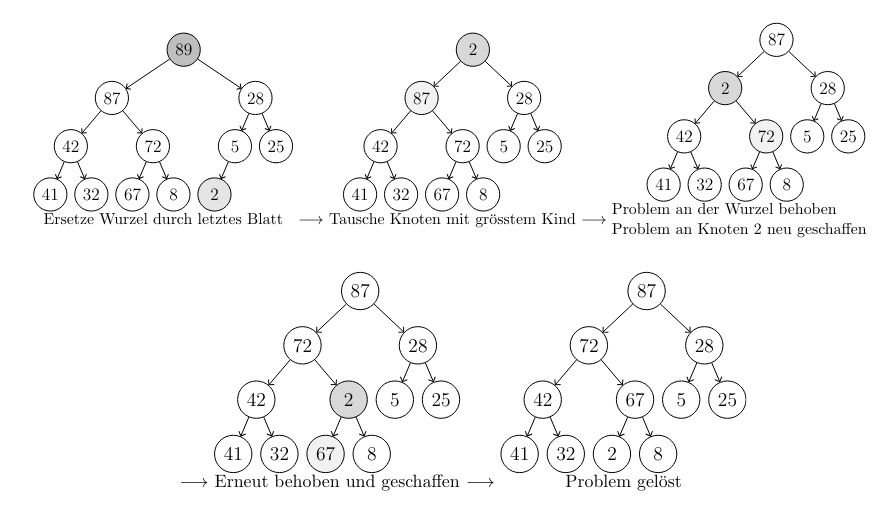
Field-by-field Comparison
| Field | Before | After |
|---|---|---|
| Front | How does <b>extract_max</b> work for a maxHeap? | |
| Back | <div>The extract max operation works by taking the root node, the biggest element in the heap by it’s definition and restoring the <b>heap condition</b>.</div><div><br></div><div>We remove the root and replace it by the element that is most to the right (last element in the array storing the heap).<br>Then we "versickern" this small element, until the heap condition is restored. </div><div>We <i>swap it with the larger of the child nodes</i>, until it's bigger than both of it's children. </div><div><br></div><div>This takes \(O(\log(n))\) time as the tree has maximum \(O(\log(n))\) levels.</div><div><br></div><div><img src="paste-bbcbf147dcbf6bb7fed164a5949034f0184f9017.jpg"></div> |
Note 157: ETH::A&D
Deck: ETH::A&D
Note Type: Horvath Cloze
GUID:
added
Note Type: Horvath Cloze
GUID:
fT7%2bq&hL
Previous
Note did not exist
New Note
Front
In BFS enter/leave ordering for all \(v\), enter[v] < leave[v].
Back
In BFS enter/leave ordering for all \(v\), enter[v] < leave[v].
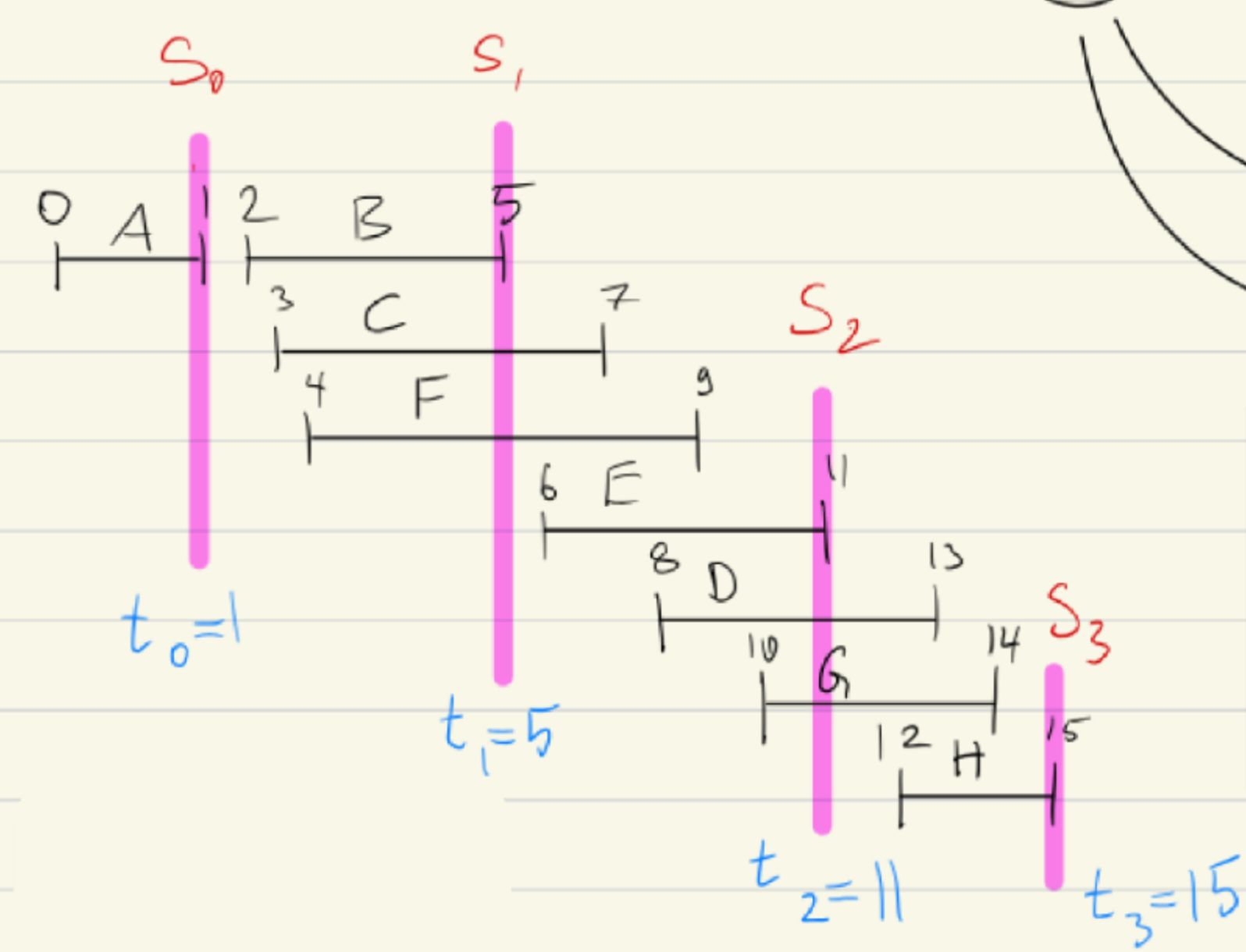
Field-by-field Comparison
| Field | Before | After |
|---|---|---|
| Text | In <b>BFS</b> enter/leave ordering for all \(v\), enter[v] {{c1:: <}} leave[v]. | |
| Extra | <img src="paste-c9b5b7b50fe725bc637971579e3dbf01f1fcf04e.jpg"> |
Note 158: ETH::A&D
Deck: ETH::A&D
Note Type: Horvath Classic
GUID:
added
Note Type: Horvath Classic
GUID:
fa/9a*g+D.
Previous
Note did not exist
New Note
Front
How can I get the lower bound on the function \(n!\) ?
Back
How can I get the lower bound on the function \(n!\) ?
I can only take for example the largest 90% of elements \(n! \geq 1 \cdot 2 \cdot ... \cdot n \geq n/10 \cdot ... \cdot n\)
\(\geq (n/10)^{0.9n}\)
Field-by-field Comparison
| Field | Before | After |
|---|---|---|
| Front | How can I get the lower bound on the function \(n!\) ? | |
| Back | I can only take for example the largest 90% of elements \(n! \geq 1 \cdot 2 \cdot ... \cdot n \geq n/10 \cdot ... \cdot n\)<div>\(\geq (n/10)^{0.9n}\)</div> |
Note 159: ETH::A&D
Deck: ETH::A&D
Note Type: Horvath Classic
GUID:
added
Note Type: Horvath Classic
GUID:
g$?N5#OWTc
Previous
Note did not exist
New Note
Front
How do we know if a walk \(W=(v_0, ..., v_n)\) is closed using the degree of \(v_n\) in \(W\)?
Back
How do we know if a walk \(W=(v_0, ..., v_n)\) is closed using the degree of \(v_n\) in \(W\)?
it is closed if and only if \(\text{deg}_W(v_n)\) is even
every occurrence of \(v_n\) within the walk increases its degree by 2, so it does not affect parity so if the degree is even then \(v_n\) is both the first and the last node
every occurrence of \(v_n\) within the walk increases its degree by 2, so it does not affect parity so if the degree is even then \(v_n\) is both the first and the last node
Field-by-field Comparison
| Field | Before | After |
|---|---|---|
| Front | How do we know if a walk \(W=(v_0, ..., v_n)\) is closed using the degree of \(v_n\) in \(W\)? | |
| Back | it is closed if and only if \(\text{deg}_W(v_n)\) is even<br><br>every occurrence of \(v_n\) within the walk increases its degree by 2, so it does not affect parity so if the degree is even then \(v_n\) is both the first and the last node |
Note 160: ETH::A&D
Deck: ETH::A&D
Note Type: Horvath Classic
GUID:
added
Note Type: Horvath Classic
GUID:
gCxT2!W2sa
Previous
Note did not exist
New Note
Front
Runtime of DFS with matrix vs list:
Back
Runtime of DFS with matrix vs list:
\(n\) calls to visit. Each takes:
- Matrix: \(O(n)\) as we loop edges gives \(n \cdot O(n) = O(n^2)\)
- List: \(O(1 + \deg_{out}(u))\) gives \(n \cdot O(1 + \deg_{out}(v) = |V| + |E|\)
Field-by-field Comparison
| Field | Before | After |
|---|---|---|
| Front | Runtime of DFS with matrix vs list: | |
| Back | \(n\) calls to visit. Each takes:<br><ul><li>Matrix: \(O(n)\) as we loop edges gives \(n \cdot O(n) = O(n^2)\)</li><li>List: \(O(1 + \deg_{out}(u))\) gives \(n \cdot O(1 + \deg_{out}(v) = |V| + |E|\)</li></ul> |
Note 161: ETH::A&D
Deck: ETH::A&D
Note Type: Algorithms
GUID:
added
Note Type: Algorithms
GUID:
gE_4/z}oud
Previous
Note did not exist
New Note
Front
Runtime of Edit Distance?
Back
Runtime of Edit Distance?
\(\Theta(n \cdot m)\)
Field-by-field Comparison
| Field | Before | After |
|---|---|---|
| Name | Edit Distance | |
| Runtime | \(\Theta(n \cdot m)\) | |
| Approach | Minimum amount of edits (insert, delete, replace) to go from s1 to s2 -> LGT gives us the ED.<br><br>Three cases for \(a_i\) last char of \(a\):<br><ul><li>deleted: \(ED(i, j) = 1 + ED(i - 1, j)\) (if deleted, it doesn't matter when)<br><img src="paste-254e45a17676954472f6aebe7c8c4f0517b3d6b5.jpg"></li><li>ends up in \(1, \dots, j-1\): no char \(a_k, k < i\) can be behind \(a_i\) (suboptimal as it would cost 2): \(E1+ ED(i, j -1)\)<br><img src="paste-fae70ea53a12531dc9ac1ac30b00512b6f0c150e.jpg"></li><li>ends up at \(b_j\): cannot insert char behind \(a_i\) thus: \(ED(i-1, j -1) \) if \(a_i = b_j\) else \(1 + ED(i-1, k-1)\) <br><img src="paste-3027dc66600e0cb2f8e3a1b12c8a1be248f13f5c.jpg"> </li></ul> | |
| Pseudocode | <img src="paste-1a255e78854ef70231b746a53228cd5420abeee8.jpg"> |
Note 162: ETH::A&D
Deck: ETH::A&D
Note Type: Horvath Cloze
GUID:
added
Note Type: Horvath Cloze
GUID:
gW55x`wH1(
Previous
Note did not exist
New Note
Front
A vertex with {{c1::\(\deg_{\text{in} }(v) = 0\)}} is called a source (Quelle).
Back
A vertex with {{c1::\(\deg_{\text{in} }(v) = 0\)}} is called a source (Quelle).
Field-by-field Comparison
| Field | Before | After |
|---|---|---|
| Text | A vertex with {{c1::\(\deg_{\text{in} }(v) = 0\)}} is called a {{c2::source (<i>Quelle</i>)}}. |
Note 163: ETH::A&D
Deck: ETH::A&D
Note Type: Horvath Cloze
GUID:
added
Note Type: Horvath Cloze
GUID:
ge[wn7-Qb.
Previous
Note did not exist
New Note
Front
Kadane's algorithm solves the Maximum Subarray Sum (MSS) problem in {{c2::linear (\(\mathcal{O}(n)\))}} time.
Back
Kadane's algorithm solves the Maximum Subarray Sum (MSS) problem in {{c2::linear (\(\mathcal{O}(n)\))}} time.
This is the optimal solution for MSS.
Field-by-field Comparison
| Field | Before | After |
|---|---|---|
| Text | <b>Kadane's</b> <b>algorithm</b> solves the {{c1::Maximum Subarray Sum (MSS)}} problem in {{c2::linear (\(\mathcal{O}(n)\))}} time. | |
| Extra | This is the optimal solution for MSS. |
Note 164: ETH::A&D
Deck: ETH::A&D
Note Type: Horvath Classic
GUID:
added
Note Type: Horvath Classic
GUID:
gm7WcQEU/C
Previous
Note did not exist
New Note
Front
When do we want Dijkstra's with an array?
Back
When do we want Dijkstra's with an array?
In very dense graphs\(|E| > \frac{|V|^2}{\log |V|}\), Dijkstra's is faster on an array than in a minHeap.
Extract_min takes \(O(|V|)\) with an array (\(O(\log |V|)\) in a MinHeap) -> array implementation runtime: \(O(|V|^2 + |E|) = O(|V|^2)\) for \(|E| = \Theta(|V|^2)\) (there are at most \(|V|^2\) edges in a graph).
If we plug in |E| > ... into the log runtime we see it's faster.
Field-by-field Comparison
| Field | Before | After |
|---|---|---|
| Front | When do we want Dijkstra's with an array? | |
| Back | In very dense graphs\(|E| > \frac{|V|^2}{\log |V|}\), Dijkstra's is <b>faster on an array than in a minHeap</b>.<br><br><div>Extract_min takes \(O(|V|)\) with an array (\(O(\log |V|)\) in a MinHeap) -> array implementation runtime: \(O(|V|^2 + |E|) = O(|V|^2)\) for \(|E| = \Theta(|V|^2)\) (there are at most \(|V|^2\) edges in a graph).</div><div><br></div><div>If we plug in |E| > ... into the log runtime we see it's faster.</div> |
Note 165: ETH::A&D
Deck: ETH::A&D
Note Type: Horvath Classic
GUID:
added
Note Type: Horvath Classic
GUID:
g}Fn_v+#@3
Previous
Note did not exist
New Note
Front
What is the Cut-Property (Schnittprinzip)?
Back
What is the Cut-Property (Schnittprinzip)?
To join a set of disjoint connected components, we need to use an edge to join two of their vertices. The idea is that the cheapest such edge is always a safe edge.
This is true only for distinct edge weights!
Field-by-field Comparison
| Field | Before | After |
|---|---|---|
| Front | What is the Cut-Property (Schnittprinzip)? | |
| Back | To join a set of disjoint connected components, we need to use an edge to join two of their vertices. The idea is that the <i>cheapest</i> such edge is always a <i>safe edge.</i><div><i><br></i></div><div><b>This is true only for distinct edge weights!</b></div> |
Note 166: ETH::A&D
Deck: ETH::A&D
Note Type: Algorithms
GUID:
added
Note Type: Algorithms
GUID:
hL7UB-)y6N
Previous
Note did not exist
New Note
Front
Runtime of Floyd-Warshall?
Back
Runtime of Floyd-Warshall?
\(O(|V|^3)\)
Field-by-field Comparison
| Field | Before | After |
|---|---|---|
| Name | Floyd-Warshall | |
| Runtime | \(O(|V|^3)\) | |
| Requirements | No negative cycles | |
| Approach | <ol><li><b>Initialise</b>: distance matrix D D[i][j] is the weight of the edge from \(i \rightarrow j\) if it exists, \(\infty\) otherwise<br></li><li><b>Iterate over intermediate</b>: for each vertex \(k\) update D[i][j] = min(D[i][j], D[i][k] + D[k][j]). for all intermediate k from 1,...,n</li></ol><div><br></div><div>The final distance matrix D contains the shortest path from any i to j.</div><div><br></div><div><i>Note that this can also be done using a 3d DP table, the 2d is just optimised.</i><br></div> | |
| Pseudocode | <img src="paste-f6965d427f4a2df5b61ba8dd2ee9c0f0a90baaf6.jpg"><br><div><b>Important</b>: Use a value like 10000 instead of Integer.MAX_VALUE in Java, as you get <b>overflows</b> otherwise.</div> | |
| Use Case | All Pairs Shortest Path |
Note 167: ETH::A&D
Deck: ETH::A&D
Note Type: Horvath Cloze
GUID:
added
Note Type: Horvath Cloze
GUID:
hsaD+h{~n8
Previous
Note did not exist
New Note
Front
Reweighting in Johnson's algorithm:
- We add a vertex \(s\) and add a 0 cost edge from it to all vertices.
- We then run B-F which determines the height of each vertex by the d[v] from start vertex \(s\)
Back
Reweighting in Johnson's algorithm:
- We add a vertex \(s\) and add a 0 cost edge from it to all vertices.
- We then run B-F which determines the height of each vertex by the d[v] from start vertex \(s\)
Field-by-field Comparison
| Field | Before | After |
|---|---|---|
| Text | Reweighting in Johnson's algorithm:<br><ol><li>We {{c1::add a vertex \(s\)}} and {{c1::add a 0 cost edge from it to all vertices}}.</li><li>We then {{c2::run B-F which determines the height of each vertex by the d[v] from start vertex \(s\)}} </li></ol> |
Note 168: ETH::A&D
Deck: ETH::A&D
Note Type: Horvath Cloze
GUID:
added
Note Type: Horvath Cloze
GUID:
hv)-{h!@?x
Previous
Note did not exist
New Note
Front
The amortised runtime of union in the Union-Find DS is \(O(|V| \log |V|)\).
Back
The amortised runtime of union in the Union-Find DS is \(O(|V| \log |V|)\).
union takes \(\Theta(\min \{ |ZHK(u)| , |ZHK(v)| \}\). In the worst case, the minimum is \(|V| / 2\) as both have the same size.
Therefore over all loops, this would take \(O(|V| \log |V|)\) time, as on average we only take \(O(\log |V|)\) time.
The graph stays worst case, this is the average of the calls in the worst case.
Therefore over all loops, this would take \(O(|V| \log |V|)\) time, as on average we only take \(O(\log |V|)\) time.
The graph stays worst case, this is the average of the calls in the worst case.
Field-by-field Comparison
| Field | Before | After |
|---|---|---|
| Text | The amortised runtime of <b>union</b> in the Union-Find DS is {{c1:: \(O(|V| \log |V|)\)}}. | |
| Extra | union takes \(\Theta(\min \{ |ZHK(u)| , |ZHK(v)| \}\). In the worst case, the minimum is \(|V| / 2\) as both have the same size.<br><br>Therefore over all loops, this would take \(O(|V| \log |V|)\) time, as <i>on average</i> we only take \(O(\log |V|)\) time.<br><i>The graph stays worst case, this is the average of the calls in the worst case.</i> |
Note 169: ETH::A&D
Deck: ETH::A&D
Note Type: Horvath Cloze
GUID:
added
Note Type: Horvath Cloze
GUID:
i3K1KB$5&t
Previous
Note did not exist
New Note
Front
{{c1::\(\sum_{i = 1}^{n} \sum_{i = 1}^{n} 1\)}} \(=\) \(n^2\) (Sum)
Back
{{c1::\(\sum_{i = 1}^{n} \sum_{i = 1}^{n} 1\)}} \(=\) \(n^2\) (Sum)
Field-by-field Comparison
| Field | Before | After |
|---|---|---|
| Text | {{c1::\(\sum_{i = 1}^{n} \sum_{i = 1}^{n} 1\)}} \(=\) {{c2:: \(n^2\)}} (Sum) |
Note 170: ETH::A&D
Deck: ETH::A&D
Note Type: Horvath Reverso
GUID:
added
Note Type: Horvath Reverso
GUID:
i6hHee%a$O
Previous
Note did not exist
New Note
Front
\(O(n!) \leq\) (name the next bigger function)
Back
\(O(n!) \leq\) (name the next bigger function)
\(\leq O(n^n)\) (name the next smaller function)
Field-by-field Comparison
| Field | Before | After |
|---|---|---|
| Front | \(O(n!) \leq\) <i>(name the next bigger function)</i> | |
| Back | \(\leq O(n^n)\) <i>(name the next smaller function)</i> |
Note 171: ETH::A&D
Deck: ETH::A&D
Note Type: Horvath Cloze
GUID:
added
Note Type: Horvath Cloze
GUID:
iFt.dzS26%
Previous
Note did not exist
New Note
Front
A graph \(G\) is transitive when for {{c2:: any two edges \(\{u, v\} \text{ and } \{v, w\}\) in \(E\), the edge \(\{u, w\}\) is also in \(E\)}}.
Back
A graph \(G\) is transitive when for {{c2:: any two edges \(\{u, v\} \text{ and } \{v, w\}\) in \(E\), the edge \(\{u, w\}\) is also in \(E\)}}.
Field-by-field Comparison
| Field | Before | After |
|---|---|---|
| Text | A graph \(G\) is {{c1:: <b>transitive</b>}} when for {{c2:: any two edges \(\{u, v\} \text{ and } \{v, w\}\) in \(E\), the edge \(\{u, w\}\) is also in \(E\)}}. |
Note 172: ETH::A&D
Deck: ETH::A&D
Note Type: Horvath Cloze
GUID:
added
Note Type: Horvath Cloze
GUID:
iHlSvEEQPk
Previous
Note did not exist
New Note
Front
A graph \(G\) is complete when it's set of edges is {{c2:: \(\{\{u, v\} \ | \ u, v \in V, u \neq v\}\) }}.
Back
A graph \(G\) is complete when it's set of edges is {{c2:: \(\{\{u, v\} \ | \ u, v \in V, u \neq v\}\) }}.
Field-by-field Comparison
| Field | Before | After |
|---|---|---|
| Text | A graph \(G\) is {{c1:: <b>complete</b>}} when it's set of edges is {{c2:: \(\{\{u, v\} \ | \ u, v \in V, u \neq v\}\) }}. |
Note 173: ETH::A&D
Deck: ETH::A&D
Note Type: Horvath Cloze
GUID:
added
Note Type: Horvath Cloze
GUID:
i`Yd8WTI?B
Previous
Note did not exist
New Note
Front
There's no MST if the graph is disconnected.
Back
There's no MST if the graph is disconnected.
Field-by-field Comparison
| Field | Before | After |
|---|---|---|
| Text | There's no MST if the graph is {{c1:: disconnected}}. |
Note 174: ETH::A&D
Deck: ETH::A&D
Note Type: Horvath Classic
GUID:
added
Note Type: Horvath Classic
GUID:
ij#NQ.@u}5
Previous
Note did not exist
New Note
Front
Is it possible to use the master theorem to get \(\Theta(f)\)? How?
Back
Is it possible to use the master theorem to get \(\Theta(f)\)? How?
for a recursive function if both the Master theorem for the upper bound on the runtime and the lower bound on the runtime hold, then \(T(n) = \Theta(n^b), \Theta(n^{\log_2 a}\log n), \Theta(n^{\log_2 a})\) respectively for the three cases
Field-by-field Comparison
| Field | Before | After |
|---|---|---|
| Front | Is it possible to use the master theorem to get \(\Theta(f)\)? How? | |
| Back | for a recursive function if both the Master theorem for the upper bound on the runtime and the lower bound on the runtime hold, then \(T(n) = \Theta(n^b), \Theta(n^{\log_2 a}\log n), \Theta(n^{\log_2 a})\) respectively for the three cases |
Note 175: ETH::A&D
Deck: ETH::A&D
Note Type: Horvath Cloze
GUID:
added
Note Type: Horvath Cloze
GUID:
i|cJp0X3s*
Previous
Note did not exist
New Note
Front
A graph \(G\) is connected (Zusammenhängend) if for every two vertices \(u, v \in V\) \(u\) reaches \(v\).
Back
A graph \(G\) is connected (Zusammenhängend) if for every two vertices \(u, v \in V\) \(u\) reaches \(v\).
Field-by-field Comparison
| Field | Before | After |
|---|---|---|
| Text | A graph \(G\) is {{c1::connected (<i>Zusammenhängend</i>)}} if {{c2::for every two vertices \(u, v \in V\) \(u\) reaches \(v\)}}. |
Note 176: ETH::A&D
Deck: ETH::A&D
Note Type: Horvath Classic
GUID:
added
Note Type: Horvath Classic
GUID:
i~[|jYI|rt
Previous
Note did not exist
New Note
Front
Backtracking in DP Problems
Back
Backtracking in DP Problems
Backtracking can find the solution of the problem from the DP table. From the recursion and it's behaviour we find the "path"
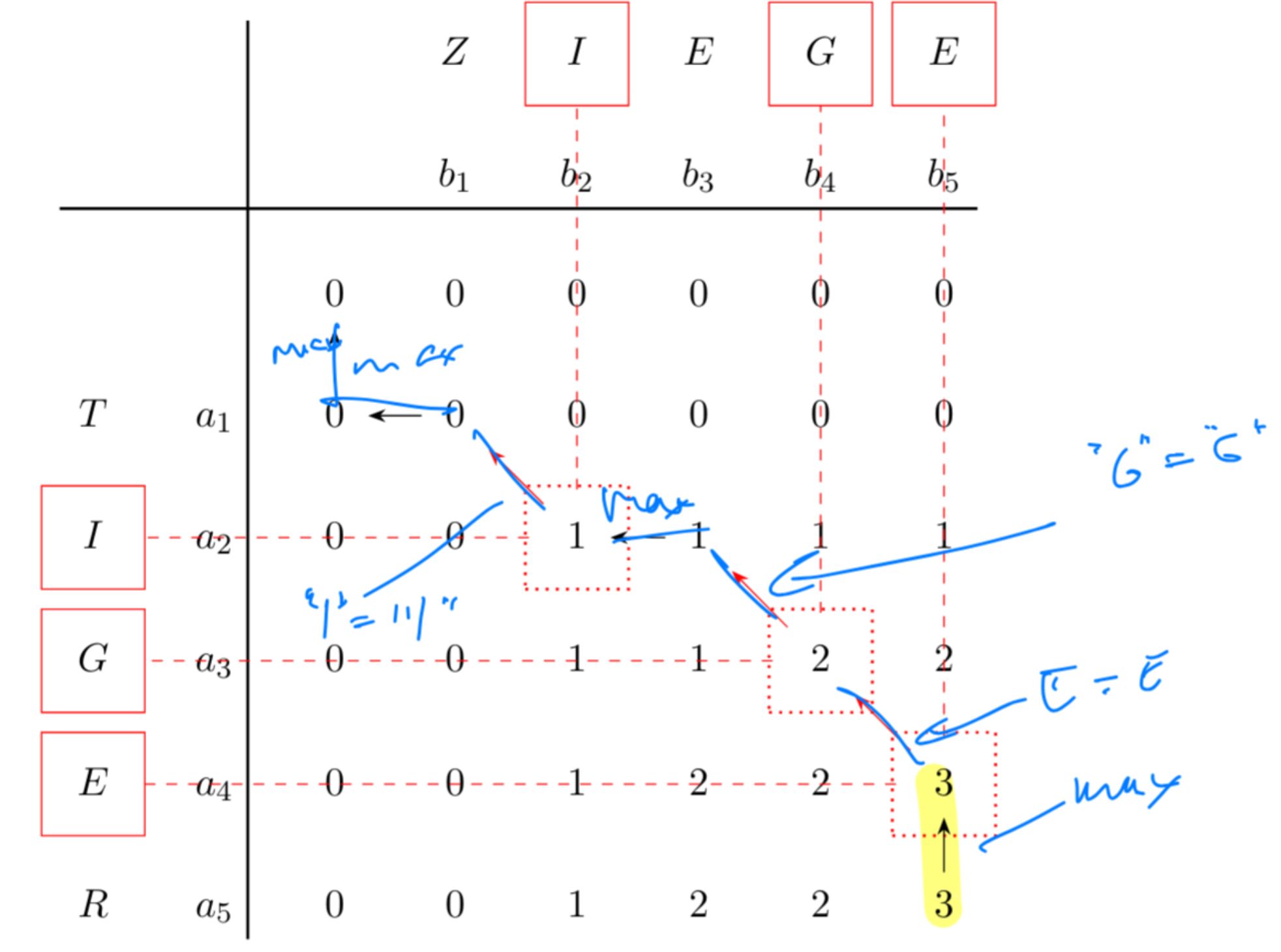
Field-by-field Comparison
| Field | Before | After |
|---|---|---|
| Front | Backtracking in DP Problems | |
| Back | Backtracking can find the solution of the problem from the DP table. From the recursion and it's behaviour we find the "path"<br><br><img src="paste-c186a33203c3cb874cfeb7870ee1a4c5d52bf205.jpg"> |
Note 177: ETH::A&D
Deck: ETH::A&D
Note Type: Algorithms
GUID:
added
Note Type: Algorithms
GUID:
j#w5w>dS6
Previous
Note did not exist
New Note
Front
Back
Runtime of
Bellman-Ford
Runtime: :\( \mathcal{O}(|E| \cdot |V|)\)}}
Approach: Initiate all distances with \(\infty\) . Then go \(|V| - 1\) times through every edge, and test for all (u,v) in E if \(\text{dist}[v] > \text{dist}[u] + w(u,v)\). If yes, update the distance. If after \(|V| - 1\) iterations an edge can still be relaxed (in a last iteration), then there exists a negative cycle
Uses: Detect negative cycles, find minimal-cost paths in weighted graphs with negative weights}}
?Field-by-field Comparison
| Field | Before | After |
|---|---|---|
| Name | <div style="text-align: center;"><b>Bellman-Ford</b></div><div style="text-align: center; "><br></div><div><b>Runtime</b>: :\( \mathcal{O}(|E| \cdot |V|)\)}}</div><div><br></div><div><b>Approach</b>: Initiate all distances with \(\infty\) . Then go \(|V| - 1\) times through every edge, and test for all (u,v) in E if \(\text{dist}[v] > \text{dist}[u] + w(u,v)\). If yes, update the distance. If after \(|V| - 1\) iterations an edge can still be relaxed (in a last iteration), then there exists a negative cycle</div><div><br></div><div><b>Uses</b>: Detect negative cycles, find minimal-cost paths in weighted graphs with negative weights}}</div> |
Note 178: ETH::A&D
Deck: ETH::A&D
Note Type: Horvath Classic
GUID:
added
Note Type: Horvath Classic
GUID:
j+9WeY4$!x
Previous
Note did not exist
New Note
Front
Explain why reweighting in Johnson's algorithm works:
Back
Explain why reweighting in Johnson's algorithm works:
Assigns a height \(h(v)\) to each vertex. The new cost is then \(\hat{c}(u, v) = c(u, v) + h(u) - h(v)\).
For a path \(P = (s, v_1, v_2, \dots, v_n, t)\) the cost \(\hat{c}(P) = \hat{c}(s, v_1) + \hat{c}(v_1, v_2) + \dots + \hat{c}(v_n, t)\) the costs cancel out in pairs: \(c(s, v_1) + h(s) - h(v_1) + c(v_1, v_2) + h(v_1) - h(v_2) + \dots + c(v_n, t) + h(v_n) - h(t)\) gives \(= c(P) + h(s) - h(t)\), which satisfies our requirements that the ordering stay the same.
For a path \(P = (s, v_1, v_2, \dots, v_n, t)\) the cost \(\hat{c}(P) = \hat{c}(s, v_1) + \hat{c}(v_1, v_2) + \dots + \hat{c}(v_n, t)\) the costs cancel out in pairs: \(c(s, v_1) + h(s) - h(v_1) + c(v_1, v_2) + h(v_1) - h(v_2) + \dots + c(v_n, t) + h(v_n) - h(t)\) gives \(= c(P) + h(s) - h(t)\), which satisfies our requirements that the ordering stay the same.
Field-by-field Comparison
| Field | Before | After |
|---|---|---|
| Front | Explain <b>why</b> reweighting in Johnson's algorithm works: | |
| Back | Assigns a height \(h(v)\) to each vertex. The new cost is then \(\hat{c}(u, v) = c(u, v) + h(u) - h(v)\).<br><br>For a path \(P = (s, v_1, v_2, \dots, v_n, t)\) the cost \(\hat{c}(P) = \hat{c}(s, v_1) + \hat{c}(v_1, v_2) + \dots + \hat{c}(v_n, t)\) the costs cancel out in pairs: \(c(s, v_1) + h(s) - h(v_1) + c(v_1, v_2) + h(v_1) - h(v_2) + \dots + c(v_n, t) + h(v_n) - h(t)\) gives \(= c(P) + h(s) - h(t)\), which satisfies our requirements that the ordering stay the same. |
Note 179: ETH::A&D
Deck: ETH::A&D
Note Type: Horvath Cloze
GUID:
added
Note Type: Horvath Cloze
GUID:
jBru?ce!L0
Previous
Note did not exist
New Note
Front
We use Floyd-Warshall over Johnsons, when the graph is very dense \(|E| = \Theta(|V|^2)\).
Back
We use Floyd-Warshall over Johnsons, when the graph is very dense \(|E| = \Theta(|V|^2)\).
Then the \(n \cdot (n + m) \) becomes \(n \cdot (n + n^2)\) which is \(O(n^3)\).
Field-by-field Comparison
| Field | Before | After |
|---|---|---|
| Text | We use <b>Floyd-Warshall</b> over <b>Johnsons</b>, when the graph is {{c1:: very dense \(|E| = \Theta(|V|^2)\)}}. | |
| Extra | Then the \(n \cdot (n + m) \) becomes \(n \cdot (n + n^2)\) which is \(O(n^3)\). |
Note 180: ETH::A&D
Deck: ETH::A&D
Note Type: Algorithms
GUID:
added
Note Type: Algorithms
GUID:
jcougdQ#0G
Previous
Note did not exist
New Note
Front
Back
Runtime of
Kruskal
Runtime: {{c1::\( \mathcal{O}(|E| \log |E| + |E| \log|V|)\)}}
Approach:
Uses:
?Field-by-field Comparison
| Field | Before | After |
|---|---|---|
| Name | <div style="text-align: center;"><b>Kruskal</b></div><div><br></div><div><b>Runtime</b>: {{c1::\( \mathcal{O}(|E| \log |E| + |E| \log|V|)\)}}</div><div><br></div><div><b>Approach</b>: {{c2::Sort the edges by weight and add them one-by-one as long as they are in different components (which can be checked efficiently with Union Find).}}</div><div><br></div><div><b>Uses</b>: {{c3::Find MST in weighted, undirected graph}}</div> |
Note 181: ETH::A&D
Deck: ETH::A&D
Note Type: Horvath Classic
GUID:
added
Note Type: Horvath Classic
GUID:
jj%LAs_%qo
Previous
Note did not exist
New Note
Front
Pre- and Postordering in BFS:
Back
Pre- and Postordering in BFS:
Same as with pre-/postordering, we can use enter-/leave-ordering here:
enterstep at which vertex \(v\) is first encountered.leavestep at which vertex \(v\) is dequeued
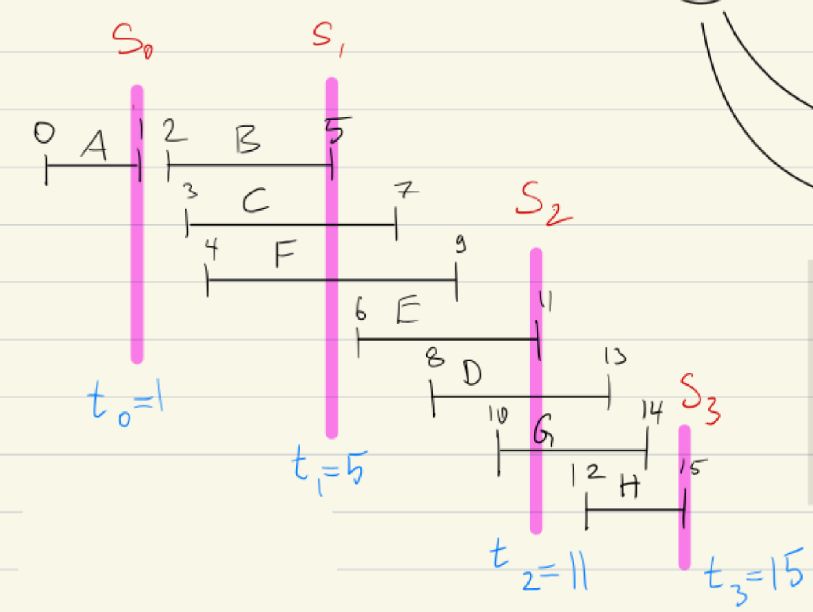
Field-by-field Comparison
| Field | Before | After |
|---|---|---|
| Front | Pre- and Postordering in BFS: | |
| Back | <div>Same as with <strong>pre-/postordering</strong>, we can use <strong>enter-/leave-ordering</strong> here: </div><div><ul><li><code>enter</code> step at which vertex \(v\) is first encountered.</li><li><code>leave</code> step at which vertex \(v\) is dequeued<br></li></ul><div><img src="paste-19431b32f9a8ad33704854b76596be9edd8629d5.jpg"></div></div> |
Note 182: ETH::A&D
Deck: ETH::A&D
Note Type: Horvath Classic
GUID:
added
Note Type: Horvath Classic
GUID:
jp(fyg:?5N
Previous
Note did not exist
New Note
Front
What is the mathematical definition of a Graph?
Back
What is the mathematical definition of a Graph?
It's a \(G = (V, E)\) with \(V\) the set of all vertices (Knotenmenge) and \(E\) the set of all edges (Kantenmenge).
Field-by-field Comparison
| Field | Before | After |
|---|---|---|
| Front | What is the mathematical definition of a Graph? | |
| Back | It's a \(G = (V, E)\) with \(V\) the set of all vertices (<i>Knotenmenge</i>) and \(E\) the set of all edges (<i>Kantenmenge</i>). |
Note 183: ETH::A&D
Deck: ETH::A&D
Note Type: Horvath Cloze
GUID:
added
Note Type: Horvath Cloze
GUID:
k#~pL>w{_$
Previous
Note did not exist
New Note
Front
What are the prerequisites for \(f\) and \(g\) to apply l'Hôpital's?
- {{c1::\(f: \mathbb{R}^{+} \rightarrow \mathbb{R}^{+}\) and \(g: \mathbb{R}^{+} \rightarrow \mathbb{R}^{+}\) are differentiable}}
- {{c2::\(\lim_{x \rightarrow \infty} f(x) = \lim_{x \rightarrow \infty} g(x) = \infty\) (they tend to infinity)}}
- {{c3::\(\forall x \in \mathbb{R}^{+} , g'(x) \neq 0\) and \(g\) never equals to 0}}
Back
What are the prerequisites for \(f\) and \(g\) to apply l'Hôpital's?
- {{c1::\(f: \mathbb{R}^{+} \rightarrow \mathbb{R}^{+}\) and \(g: \mathbb{R}^{+} \rightarrow \mathbb{R}^{+}\) are differentiable}}
- {{c2::\(\lim_{x \rightarrow \infty} f(x) = \lim_{x \rightarrow \infty} g(x) = \infty\) (they tend to infinity)}}
- {{c3::\(\forall x \in \mathbb{R}^{+} , g'(x) \neq 0\) and \(g\) never equals to 0}}
This guarantees that we can take the fraction f/g.
Field-by-field Comparison
| Field | Before | After |
|---|---|---|
| Text | What are the prerequisites for \(f\) and \(g\) to apply l'Hôpital's?<br><ol><li>{{c1::\(f: \mathbb{R}^{+} \rightarrow \mathbb{R}^{+}\) and \(g: \mathbb{R}^{+} \rightarrow \mathbb{R}^{+}\) are <b>differentiable</b>}}<br></li><li>{{c2::\(\lim_{x \rightarrow \infty} f(x) = \lim_{x \rightarrow \infty} g(x) = \infty\) (they <b>tend to infinity)</b>}}<br></li><li>{{c3::\(\forall x \in \mathbb{R}^{+} , g'(x) \neq 0\) and \(g\) <b>never equals to 0</b>}}</li></ol> | |
| Extra | This guarantees that we can take the fraction f/g. |
Note 184: ETH::A&D
Deck: ETH::A&D
Note Type: Horvath Classic
GUID:
added
Note Type: Horvath Classic
GUID:
k%duL(GzS|
Previous
Note did not exist
New Note
Front
In every connected graph \(G\), when executing Kruskal using Union-Find, the representative repr[u] changes \(O(\dots)\) times:
Back
In every connected graph \(G\), when executing Kruskal using Union-Find, the representative repr[u] changes \(O(\dots)\) times:
\(O(\log_2 |V|)\), as we always at least double the size of the representative (we merge smaller into bigger, and repr[u] changes if it's the smaller one).
Field-by-field Comparison
| Field | Before | After |
|---|---|---|
| Front | In every connected graph \(G\), when executing Kruskal using Union-Find, the representative <b>repr[u]</b> changes \(O(\dots)\) times: | |
| Back | \(O(\log_2 |V|)\), as we always at least double the size of the representative (we merge smaller into bigger, and repr[u] changes if it's the smaller one). |
Note 185: ETH::A&D
Deck: ETH::A&D
Note Type: Horvath Cloze
GUID:
added
Note Type: Horvath Cloze
GUID:
kR-q@1!eo3
Previous
Note did not exist
New Note
Front
Runtime: search in binary tree: \(O(h)\) where \(h\) is the height.
Back
Runtime: search in binary tree: \(O(h)\) where \(h\) is the height.
Field-by-field Comparison
| Field | Before | After |
|---|---|---|
| Text | Runtime: <b>search</b> in binary tree: {{c1::\(O(h)\) where \(h\) is the height}}. |
Note 186: ETH::A&D
Deck: ETH::A&D
Note Type: Algorithms
GUID:
added
Note Type: Algorithms
GUID:
kn@H8`z>0t
Previous
Note did not exist
New Note
Front
Runtime of DFS (Depth First Search)?
Back
Runtime of DFS (Depth First Search)?
\( \mathcal{O}(|E| + |V|) \) (using Adjacency List)
Can be efficiently implemented using a stack.
Can be efficiently implemented using a stack.
Field-by-field Comparison
| Field | Before | After |
|---|---|---|
| Name | DFS (Depth First Search) | |
| Runtime | \( \mathcal{O}(|E| + |V|) \) (using Adjacency List) | |
| Approach | Explore as far as possible along each branch before backtracking. Potentially keep track of pre- / post-numbers to make edge classifications.<br><br>We want to find a sink, add it to the list, then backtrack and find the next one.<br><br>The reversed post-order then gives us a toposort.<br><br>Example output:<br><img src="paste-f6163ccea9c72dbfdc9cb9045b600a5a41b8aa6b.jpg"> | |
| Pseudocode | <img src="paste-5537480f9880c9630a43556e85ee2212f7e13193.jpg"><br><img src="paste-41e2f022754e20c752ede867ac0cee31b182479f.jpg"> | |
| Use Case | Find Connected Components, Toposort | |
| Extra Info | Can be efficiently implemented using a stack. |
Note 187: ETH::A&D
Deck: ETH::A&D
Note Type: Horvath Reverso
GUID:
added
Note Type: Horvath Reverso
GUID:
l2vPmFwTj!
Previous
Note did not exist
New Note
Front
Subsequence
Back
Subsequence
Teilfolge
Field-by-field Comparison
| Field | Before | After |
|---|---|---|
| Front | Subsequence | |
| Back | Teilfolge |
Note 188: ETH::A&D
Deck: ETH::A&D
Note Type: Horvath Classic
GUID:
added
Note Type: Horvath Classic
GUID:
ll$H=f;!5
Previous
Note did not exist
New Note
Front
Which functions \(f(n)\) have \(\lim_{n\rightarrow \infty} f(n)\) undefined?
Back
Which functions \(f(n)\) have \(\lim_{n\rightarrow \infty} f(n)\) undefined?
typically functions that oscilate as they approach infinity such as \(f(n) = \sin n\) or \(f(n) = (-1)^n\)
Field-by-field Comparison
| Field | Before | After |
|---|---|---|
| Front | Which functions \(f(n)\) have \(\lim_{n\rightarrow \infty} f(n)\) undefined? | |
| Back | typically functions that oscilate as they approach infinity such as \(f(n) = \sin n\) or \(f(n) = (-1)^n\) |
Note 189: ETH::A&D
Deck: ETH::A&D
Note Type: Horvath Classic
GUID:
added
Note Type: Horvath Classic
GUID:
m3`Qbb~x?c
Previous
Note did not exist
New Note
Front
2-3 Tree: Deleting Steps if neighbour has 3 keys:
Back
2-3 Tree: Deleting Steps if neighbour has 3 keys:
Our current node adopts one of the children. The separators have to be updated (one is given with the adopted child)
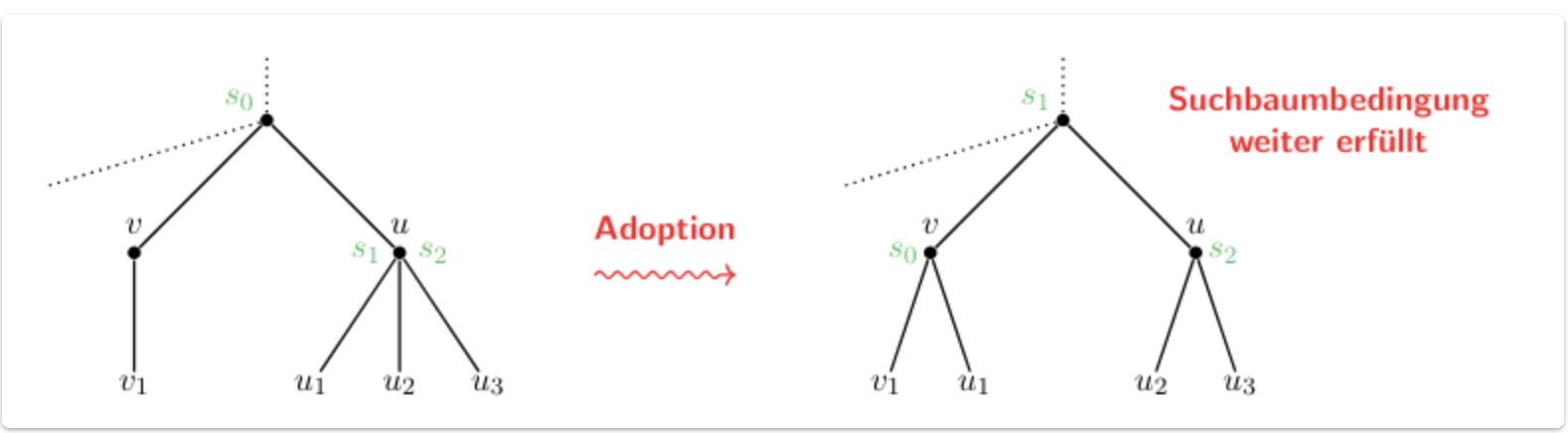
Field-by-field Comparison
| Field | Before | After |
|---|---|---|
| Front | <b>2-3 Tree</b>: Deleting Steps if neighbour has 3 keys: | |
| Back | Our current node adopts one of the children. The separators have to be updated (one is given with the adopted child)<br><img src="paste-bd8f4c10d3d0aaa08619b4e358673f9ff6b134a0.jpg"> |
Note 190: ETH::A&D
Deck: ETH::A&D
Note Type: Horvath Classic
GUID:
added
Note Type: Horvath Classic
GUID:
m5TC:^C`Y9
Previous
Note did not exist
New Note
Front
how to speed up array access to DP-Array
Back
how to speed up array access to DP-Array
Row-Major vs. Column Major Access:
set the inner loop variable to be the array's inner variable:
for j in ...:
for i in ...:
DP[j][i]
Otherwise we have to jump DP[i].length elements each time we want to access the next element
set the inner loop variable to be the array's inner variable:
for j in ...:
for i in ...:
DP[j][i]
Otherwise we have to jump DP[i].length elements each time we want to access the next element
Field-by-field Comparison
| Field | Before | After |
|---|---|---|
| Front | how to speed up array access to DP-Array | |
| Back | <b>Row-Major</b> vs. <b>Column Major</b> Access:<br><br>set the inner loop variable to be the array's inner variable:<br><br>for j in ...:<br> for i in ...:<br> DP[j][i]<br><br>Otherwise we have to jump DP[i].length elements each time we want to access the next element |
Note 191: ETH::A&D
Deck: ETH::A&D
Note Type: Horvath Cloze
GUID:
added
Note Type: Horvath Cloze
GUID:
m@n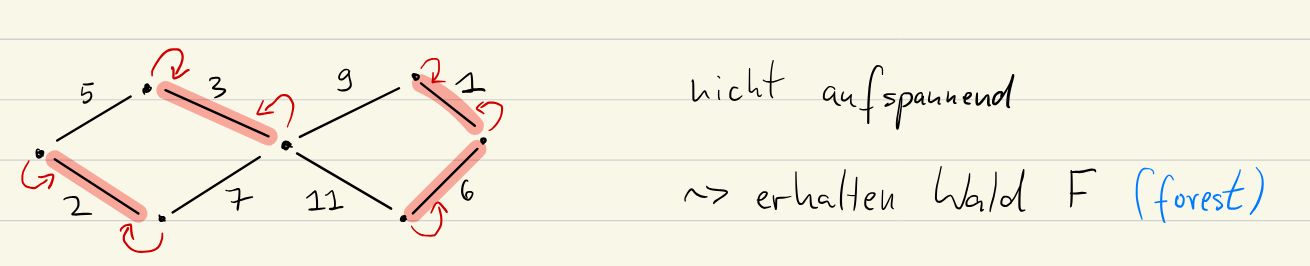
- Now, repeat by finding the cheapest outgoing edge for each component. Do this until all are connected.
- \(F\) constitutes the edges of the MST.
Field-by-field Comparison
| Field | Before | After |
|---|---|---|
| Front | Describe the steps of <b>Boruvka's Algorithm</b>: | |
| Back | <ol><br><li>For Boruvka, we start with the set of edges \(F = \emptyset\). We treat each of the <em>isolated vertices</em> of the graph as it’s <em>own connected component</em>.</li><li>Each vertex marks it’s cheapest outgoing edge as a <em>safe edge</em> (making use of the cut property). We add these to \(F\).</li></ol><ul><li>Note that some of the edges might be chosen by both adjacent vertices, we still only add them once.<br><img src="paste-053ccf0acc6d560628bd8518b928a0d6c2687cb1.jpg"></li></ul><ol><li>Now, repeat by finding the cheapest outgoing edge for each component. Do this until all are connected.</li><li>\(F\) constitutes the edges of the MST.</li></ol> |
Note 196: ETH::A&D
Deck: ETH::A&D
Note Type: Algorithms
GUID:
added
Note Type: Algorithms
GUID:
m`oj
Previous
Note did not exist
New Note
Front
Runtime of Prim's Algorithm?
Back
Runtime of Prim's Algorithm?
\(O((|V| + |E|) \log |V|)\) (Adjacency List, otherwise \(\Theta(|V|^2)\) like Dijkstra's)
Field-by-field Comparison
| Field | Before | After |
|---|---|---|
| Name | Prim's Algorithm | |
| Runtime | \(O((|V| + |E|) \log |V|)\) (Adjacency List, otherwise \(\Theta(|V|^2)\) like Dijkstra's) | |
| Requirements | undirected, connected, weighted Graph | |
| Approach | <div>Prim’s algorithm starts with a single vertex and grows the MST outwards from that seed.</div> <ol> <li><strong>Initialisation:</strong><ul> <li>Select and arbitrary starting vertex \(s\) and empty set \(F\)</li> <li>Set \(S = {s}\) tracks the vertices in the MST</li> <li>Each vertex gets a <code>key[v] =</code> representing the cheapest known connection cost to \(v\):<ul> <li>\(\infty\) if no edge connects \(s\) to \(v\)</li> <li>\(w(s, v)\) if edge \((s, v)\) exists</li> </ul> </li> <li>Use a priority queue \(Q\) (<em>Min-Heap</em>) to store the vertices, in order of lowest <code>key</code> cost</li> </ul> </li> <li><strong>Iteration:</strong><ul> <li><em>Select and add</em> Extract the vertex \(u\) with the minimum <code>key</code> from \(Q\). This is the cheapest to connected to the current MST. Add \(u\) to \(S\).</li> <li><em>Update Neighbours</em> For each neighbour <b>\(v\) </b>of \(u\) <em>not</em> in \(S\):<ul> <li>If \(w(u, v) < \text{key}[v]\) update <code>key[v] = w(u, v)</code> and update the priority in \(Q\).<ul> <li>This discovers potentially cheaper connections to vertices outside the current MST. If a <em>cheaper edge</em> to \(v\) is found, the current value in <code>key[v]</code> cannot be part of the MST</li> </ul> </li> </ul> </li> </ul> </li> <li><strong>Termination:</strong> When \(Q\) is empty, all vertices are in \(S\) and connected, and the edges chosen are in the MST (tracked in the set \(F\) through updates).</li></ol> | |
| Pseudocode | <img src="paste-7d28e852262c66f4efd97974921c1a6120b2c2a1.jpg"> | |
| Use Case | Find MST |
Note 197: ETH::A&D
Deck: ETH::A&D
Note Type: Horvath Classic
GUID:
added
Note Type: Horvath Classic
GUID:
mabS@W|F#G
Previous
Note did not exist
New Note
Front
Explain how to find a topological order (high-level):
Back
Explain how to find a topological order (high-level):
it is a sorting of the vertices of a directed graph, which we can build from the back by always finding a vertex which has no succeeding vertices, remove it from the graph and add it to the front of our topologically sorted list.
This is not possible if there is a directed cycle in the graph.
This is not possible if there is a directed cycle in the graph.
Field-by-field Comparison
| Field | Before | After |
|---|---|---|
| Front | Explain how to find a topological order (high-level): | |
| Back | it is a sorting of the vertices of a directed graph, which we can build from the back by always finding a vertex which has no succeeding vertices, remove it from the graph and add it to the front of our topologically sorted list.<br><br>This is not possible if there is a directed cycle in the graph. |
Note 198: ETH::A&D
Deck: ETH::A&D
Note Type: Horvath Cloze
GUID:
added
Note Type: Horvath Cloze
GUID:
mhrX@w|*.`
Previous
Note did not exist
New Note
Front
In graph theory, an Eulerian walk (Eulerweg) is a walk that contains every edge of the graph exactly once.
Back
In graph theory, an Eulerian walk (Eulerweg) is a walk that contains every edge of the graph exactly once.
Field-by-field Comparison
| Field | Before | After |
|---|---|---|
| Text | In graph theory, an {{c2::Eulerian walk (Eulerweg)}} is a {{c1::walk that contains every edge of the graph exactly once}}. |
Note 199: ETH::A&D
Deck: ETH::A&D
Note Type: Horvath Classic
GUID:
added
Note Type: Horvath Classic
GUID:
ms|2]oAD;M
Previous
Note did not exist
New Note
Front
If \(T(n) = aT(n/ 2) + Cn^b\), then the O-Notation gives
Back
If \(T(n) = aT(n/ 2) + Cn^b\), then the O-Notation gives
\(T(n) = \Theta(...)\)
Field-by-field Comparison
| Field | Before | After |
|---|---|---|
| Front | If \(T(n) = aT(n/ 2) + Cn^b\), then the O-Notation gives | |
| Back | \(T(n) = \Theta(...)\) |
Note 200: ETH::A&D
Deck: ETH::A&D
Note Type: Horvath Cloze
GUID:
added
Note Type: Horvath Cloze
GUID:
n!`Y!GEmVs
Previous
Note did not exist
New Note
Front
{{c1:: \(\sum_{i = 1}^{n} i\)}} \(=\) {{c2::\(\frac{n(n + 1)}{2}\)}} (Sum)
Back
{{c1:: \(\sum_{i = 1}^{n} i\)}} \(=\) {{c2::\(\frac{n(n + 1)}{2}\)}} (Sum)
Field-by-field Comparison
| Field | Before | After |
|---|---|---|
| Text | {{c1:: \(\sum_{i = 1}^{n} i\)}} \(=\) {{c2::\(\frac{n(n + 1)}{2}\)}} (Sum) |
Note 201: ETH::A&D
Deck: ETH::A&D
Note Type: Horvath Cloze
GUID:
added
Note Type: Horvath Cloze
GUID:
n/PBpw~:i9
Previous
Note did not exist
New Note
Front
We can use a binary search tree to implement the dictionary. The tree-condition is for every node, all keys in the left child are smaller than those in the right child.
Back
We can use a binary search tree to implement the dictionary. The tree-condition is for every node, all keys in the left child are smaller than those in the right child.
Field-by-field Comparison
| Field | Before | After |
|---|---|---|
| Text | We can use a binary search tree to implement the dictionary. The tree-condition is {{c1::for every node, all keys in the left child are smaller than those in the right child}}. |
Note 202: ETH::A&D
Deck: ETH::A&D
Note Type: Horvath Cloze
GUID:
added
Note Type: Horvath Cloze
GUID:
n=wUJ;@Xl(
Previous
Note did not exist
New Note
Front
In BFS enter/leave ordering, the FIFO queue guarantees that the enter order = leave order within a given level.
Back
In BFS enter/leave ordering, the FIFO queue guarantees that the enter order = leave order within a given level.
Field-by-field Comparison
| Field | Before | After |
|---|---|---|
| Text | In BFS enter/leave ordering, the FIFO queue guarantees that {{c1:: the <b>enter</b> order = <b>leave</b> order}} within a given level. | |
| Extra | <img src="paste-c9b5b7b50fe725bc637971579e3dbf01f1fcf04e.jpg"> |
Note 203: ETH::A&D
Deck: ETH::A&D
Note Type: Horvath Cloze
GUID:
added
Note Type: Horvath Cloze
GUID:
nK{)v6I%zc
Previous
Note did not exist
New Note
Front
The ADT stack can be efficiently implemented using a singly linked list:
- push: \(\Theta(1)\)
- pop: \(\Theta(1)\) as this removes the first element. This means we just copy the pointer next from the first element to be the first pointer of the list.
Back
The ADT stack can be efficiently implemented using a singly linked list:
- push: \(\Theta(1)\)
- pop: \(\Theta(1)\) as this removes the first element. This means we just copy the pointer next from the first element to be the first pointer of the list.
Field-by-field Comparison
| Field | Before | After |
|---|---|---|
| Text | The ADT <b>stack</b> can be efficiently implemented using a {{c1:: <b>singly linked list</b>}}:<br><ul><li><b>push</b>: {{c2:: \(\Theta(1)\)}}<br></li><li><b>pop</b>: {{c3:: \(\Theta(1)\) as this removes the first element. This means we just copy the pointer next from the first element to be the first pointer of the list.}}<br></li></ul> |
Note 204: ETH::A&D
Deck: ETH::A&D
Note Type: Algorithms
GUID:
added
Note Type: Algorithms
GUID:
nb9;e*.#MD
Previous
Note did not exist
New Note
Front
Back
Runtime of Heapsort?
Field-by-field Comparison
| Field | Before | After |
|---|---|---|
| Name | Heapsort | |
| Approach | <div>Heapsort works like selection sort by always selecting the largest element and placing it at the end of the sorted array, but instead of having to do an expensive linear search for the largest element, we make it \(O(\log(n))\).</div><div><br></div> <div>This is done by converting the array into a <b>MaxHeap</b> before sorting.</div><div>This Heap is a tree that has the property that children are always smaller than their parents.</div> | |
| Pseudocode | <img src="paste-c3c90bd522d914043899edd053866ac14fa0391e.jpg"> | |
| Invariant | <div>The heap property is correct for the maxHeap. Then the biggest element will always be on top.</div> | |
| Attributes | Not In-Place (it uses a heap)<br>Not Stable |
Note 205: ETH::A&D
Deck: ETH::A&D
Note Type: Algorithms
GUID:
added
Note Type: Algorithms
GUID:
nfdJ7OmBdJ
Previous
Note did not exist
New Note
Front
Back
Runtime of
Floyd-Warshall
Runtime: {{c1::\( \mathcal{O}(|V|^3)\)}}
Approach:
Uses:
?Field-by-field Comparison
| Field | Before | After |
|---|---|---|
| Name | <div style="text-align: center;"><b>Floyd-Warshall</b></div><div style="text-align: center; "><br></div><div><b>Runtime</b>: {{c1::\( \mathcal{O}(|V|^3)\)}}</div><div><br></div><div><b>Approach</b>: {{c2::3D DP: It is based on a triple-nested <code>for</code>-loop with the following recursion: \(d[u][v] = \min(d[u][v], d[u][i] + d[i][v])\).}}</div><div><br></div><div><b>Uses</b>: {{c3::All-to-all shortest path in directed graph without negative cycles.}}</div> |
Note 206: ETH::A&D
Deck: ETH::A&D
Note Type: Horvath Classic
GUID:
added
Note Type: Horvath Classic
GUID:
nveI`k>WMt
Previous
Note did not exist
New Note
Front
What is the lower bound for any search algorithm?
Back
What is the lower bound for any search algorithm?
No search algorithm can be faster than \(\log n\) as that is the minimum number of comparisons needed to have "seen all elements".
Field-by-field Comparison
| Field | Before | After |
|---|---|---|
| Front | What is the lower bound for any search algorithm? | |
| Back | No search algorithm can be faster than \(\log n\) as that is the minimum number of comparisons needed to have "seen all elements". |
Note 207: ETH::A&D
Deck: ETH::A&D
Note Type: Algorithms
GUID:
added
Note Type: Algorithms
GUID:
nzfDv_KLH2
Previous
Note did not exist
New Note
Front
Runtime of Bubble Sort?
Back
Runtime of Bubble Sort?
Best Case: \(O(n^2)\) (\(O(n)\) if checking for swaps and aborting early)
Worst Case: \(O(n^2)\)
We use \(\Theta(n^2)\) comparisons and \(O(n^2)\) switches.
Worst Case: \(O(n^2)\)
We use \(\Theta(n^2)\) comparisons and \(O(n^2)\) switches.
Field-by-field Comparison
| Field | Before | After |
|---|---|---|
| Name | Bubble Sort | |
| Runtime | Best Case: \(O(n^2)\) (\(O(n)\) if checking for swaps and aborting early)<br>Worst Case: \(O(n^2)\) | |
| Approach | It goes through the array \(n\) times, each time "bubbling up" the biggest element to the end, by swapping it.<br><br>During each inner iteration, high elements are swapped with their right neighbours until they hit a higher one. The algorithm then continues after that.<br><img src="paste-77ff59065d5ea6786b5452097dc4c319413d239e.jpg"> | |
| Pseudocode | <img src="paste-b6704232ae2ec9073bbdb5b301db58d064bf7963.jpg"> | |
| Extra Info | We use \(\Theta(n^2)\) comparisons and \(O(n^2)\) switches. | |
| Invariant | Nach \(j\) Durchläufen der äusseren Schleife sind die \(j\) grössten Elemente am richtigen Ort. | |
| Worst Case Scenario | Array sorted in descending order | |
| Attributes | In-Place<br>Stable |
Note 208: ETH::A&D
Deck: ETH::A&D
Note Type: Horvath Classic
GUID:
added
Note Type: Horvath Classic
GUID:
nzhNF&3(!D
Previous
Note did not exist
New Note
Front
Handshake lemma in directed graphs:
Back
Handshake lemma in directed graphs:
\[ \sum_{v \in V} \deg_{out}(v) = \sum_{v \in V} \deg_{in}(v) = |E| \]
Field-by-field Comparison
| Field | Before | After |
|---|---|---|
| Front | Handshake lemma in directed graphs: | |
| Back | \[ \sum_{v \in V} \deg_{out}(v) = \sum_{v \in V} \deg_{in}(v) = |E| \]<br> |
Note 209: ETH::A&D
Deck: ETH::A&D
Note Type: Algorithms
GUID:
added
Note Type: Algorithms
GUID:
o-3hRLI()p
Previous
Note did not exist
New Note
Front
Runtime of Longest Common Subsequence?
Back
Runtime of Longest Common Subsequence?
\(\Theta(n \cdot m)\)
Field-by-field Comparison
| Field | Before | After |
|---|---|---|
| Name | Longest Common Subsequence | |
| Runtime | \(\Theta(n \cdot m)\) | |
| Approach | <div>DP-Table: <code>DP[0..n][0..m]</code> for \(n, m\) lengths of the strings</div><div><br></div><div><div>longest common subsequence that two strings share. For example TIGER and ZIEGE share IGE as a LGT.</div></div><div><br></div><div> <div>This gives us the following recursion: \[L(i,j) = \begin{cases} 0, & i = 0 \text{ oder } j = 0 \\ L(i-1, j-1) + 1, & X_i = Y_j \\ \max(L(i-1,j), L(i,j-1)), & X_i \neq Y_j \end{cases}\]</div></div> | |
| Pseudocode | <img src="paste-5d0d1e2b1030b40ef6fce29f1fe1bd0e71105b03.jpg"> |
Note 210: ETH::A&D
Deck: ETH::A&D
Note Type: Horvath Classic
GUID:
added
Note Type: Horvath Classic
GUID:
o5O]N!`p|^
Previous
Note did not exist
New Note
Front
Floyd-Warshall, when is there a negative cycle?
Back
Floyd-Warshall, when is there a negative cycle?
There exists a negative cycle \(\Leftrightarrow \exists v \in V \ : \ d^n_{v \rightarrow v} < 0\)
In words: If there exists a path from a vertex to itself with negative weight (passing through any other vertex, i.e. \(n\)th iteration of the outer loop), then there exists a negative cycle that contains this vertex.
We can perform a negative cycle check at the end, by going over all diagonals.
Field-by-field Comparison
| Field | Before | After |
|---|---|---|
| Front | Floyd-Warshall, when is there a negative cycle? | |
| Back | <div>There exists a negative cycle \(\Leftrightarrow \exists v \in V \ : \ d^n_{v \rightarrow v} < 0\)</div><div><br></div> <div>In words: If there exists a path from a vertex to itself with negative weight (passing through any other vertex, i.e. \(n\)th iteration of the outer loop), then there exists a negative cycle that contains this vertex.</div><br><div>We can perform a negative cycle check at the end, by going over all diagonals.</div> |
Note 211: ETH::A&D
Deck: ETH::A&D
Note Type: Horvath Classic
GUID:
added
Note Type: Horvath Classic
GUID:
o5tDbHBc7i
Previous
Note did not exist
New Note
Front
In a directed Graph, what does \(E\) contain?
Back
In a directed Graph, what does \(E\) contain?
\(E\) is the set of all edges which contains tuples \(e = (u, v)\). The edge has a direction.
Field-by-field Comparison
| Field | Before | After |
|---|---|---|
| Front | In a directed Graph, what does \(E\) contain? | |
| Back | \(E\) is the set of all edges which contains tuples \(e = (u, v)\). The edge has a direction. |
Note 212: ETH::A&D
Deck: ETH::A&D
Note Type: Horvath Classic
GUID:
added
Note Type: Horvath Classic
GUID:
o82ycSuD=_
Previous
Note did not exist
New Note
Front
How do we derive an upper limit for a sum?
Back
How do we derive an upper limit for a sum?
The upper limit can be expressed as the highest term, times the amount of terms:\[ \sum_{i = 1}^n i^3 = 1^3 + 2^3 + 3^3 + \ ... \ + n^3 \leq n \cdot \sum_{i = 1}^n n^3 = n^4 \]
Field-by-field Comparison
| Field | Before | After |
|---|---|---|
| Front | How do we derive an upper limit for a sum? | |
| Back | The upper limit can be expressed as the <b>highest term</b>, times the <b>amount of terms</b>:\[ \sum_{i = 1}^n i^3 = 1^3 + 2^3 + 3^3 + \ ... \ + n^3 \leq n \cdot \sum_{i = 1}^n n^3 = n^4 \]<br> |
Note 213: ETH::A&D
Deck: ETH::A&D
Note Type: Horvath Classic
GUID:
added
Note Type: Horvath Classic
GUID:
o>e0u7Qnuv
Previous
Note did not exist
New Note
Front
What is pseudo-polynomial time?
Back
What is pseudo-polynomial time?
runtime dependent on a number \(W\) (like in knapsack) which is not correlated polynomially to input length but exponentially.
The DP-table get's 10x for \(W = 10 \rightarrow 100\) but the input size (binary) only grows from \(\log_2(10) \approx 3 \rightarrow \approx 6\) so x2.
The DP-table get's 10x for \(W = 10 \rightarrow 100\) but the input size (binary) only grows from \(\log_2(10) \approx 3 \rightarrow \approx 6\) so x2.
Field-by-field Comparison
| Field | Before | After |
|---|---|---|
| Front | What is pseudo-polynomial time? | |
| Back | runtime dependent on a number \(W\) (like in knapsack) which is not correlated polynomially to input length but exponentially.<br><br>The DP-table get's 10x for \(W = 10 \rightarrow 100\) but the input size (binary) only grows from \(\log_2(10) \approx 3 \rightarrow \approx 6\) so x2. |
Note 214: ETH::A&D
Deck: ETH::A&D
Note Type: Horvath Cloze
GUID:
added
Note Type: Horvath Cloze
GUID:
oFu
Previous
Note did not exist
New Note
Front
Prim's Algorithm has a runtime of \(O((|V| + |E|) \log |V|)\).
Back
Prim's Algorithm has a runtime of \(O((|V| + |E|) \log |V|)\).
Field-by-field Comparison
| Field | Before | After |
|---|---|---|
| Text | <b>Prim's Algorithm</b> has a runtime of {{c1:: \(O((|V| + |E|) \log |V|)\)}}. |
Note 215: ETH::A&D
Deck: ETH::A&D
Note Type: Horvath Cloze
GUID:
added
Note Type: Horvath Cloze
GUID:
oOY},#*:q]
Previous
Note did not exist
New Note
Front
In every iteration of insertion sort, we take the first element from the unsorted input and place it correctly in the sorted output.
Back
In every iteration of insertion sort, we take the first element from the unsorted input and place it correctly in the sorted output.
Field-by-field Comparison
| Field | Before | After |
|---|---|---|
| Text | In every iteration of <b>insertion sort</b>, we {{c1::take the first element from the unsorted input and place it correctly in the sorted output}}. |
Note 216: ETH::A&D
Deck: ETH::A&D
Note Type: Horvath Cloze
GUID:
added
Note Type: Horvath Cloze
GUID:
oOvB8b@l_D
Previous
Note did not exist
New Note
Front
Master Theorem: If \(b < \log_2(a)\) then {{c2:: \(T(n) \leq O(n^{\log_2 a})\)}}.
Back
Master Theorem: If \(b < \log_2(a)\) then {{c2:: \(T(n) \leq O(n^{\log_2 a})\)}}.
The recursive work dominates.
Field-by-field Comparison
| Field | Before | After |
|---|---|---|
| Text | Master Theorem: If {{c1:: \(b < \log_2(a)\)}} then {{c2:: \(T(n) \leq O(n^{\log_2 a})\)}}. | |
| Extra | The recursive work dominates. |
Note 217: ETH::A&D
Deck: ETH::A&D
Note Type: Horvath Cloze
GUID:
added
Note Type: Horvath Cloze
GUID:
oSKGiZq$
Previous
Note did not exist
New Note
Front
In graph theory, a closed walk (Zyklus) is a walk where \(v_0 = v_n\) (start = end).
Back
In graph theory, a closed walk (Zyklus) is a walk where \(v_0 = v_n\) (start = end).
Field-by-field Comparison
| Field | Before | After |
|---|---|---|
| Text | In graph theory, a {{c2::closed walk (<i>Zyklus</i>)}} is a {{c1::walk where \(v_0 = v_n\) (start = end)}}. |
Note 218: ETH::A&D
Deck: ETH::A&D
Note Type: Horvath Cloze
GUID:
added
Note Type: Horvath Cloze
GUID:
oWyDyQ_9bL
Previous
Note did not exist
New Note
Front
After adding \(x\) edges to the Union-Find DS, the repr array contains \(n-x\) components (different values).
Back
After adding \(x\) edges to the Union-Find DS, the repr array contains \(n-x\) components (different values).
Each added edge removes one unconnected component.
Field-by-field Comparison
| Field | Before | After |
|---|---|---|
| Text | After adding \(x\) edges to the Union-Find DS, the <b>repr</b> array contains {{c1::\(n-x\) components (different values)}}. | |
| Extra | Each added edge <i>removes one unconnected component</i>. |
Note 219: ETH::A&D
Deck: ETH::A&D
Note Type: Horvath Classic
GUID:
added
Note Type: Horvath Classic
GUID:
o[gwr|.}+m
Previous
Note did not exist
New Note
Front
What is a relaxation in Bellman-Ford?
Back
What is a relaxation in Bellman-Ford?
We "relax" an edge when \(d[u] + c(u, v) < d[v]\). In other words, we currently say that there is a path from \(s \rightarrow u\) and \(u \rightarrow v\) such that it's shorter than \(s \rightarrow v\).
This means that our current upper-bound for the shortest distance to \(v\) (\(d[v]\)), is too high as it violates the triangle inequality. Thus we updated ("relax") the edge.
This means that our current upper-bound for the shortest distance to \(v\) (\(d[v]\)), is too high as it violates the triangle inequality. Thus we updated ("relax") the edge.
Field-by-field Comparison
| Field | Before | After |
|---|---|---|
| Front | What is a relaxation in Bellman-Ford? | |
| Back | We "relax" an edge when \(d[u] + c(u, v) < d[v]\). In other words, we currently say that there is a path from \(s \rightarrow u\) and \(u \rightarrow v\) such that it's shorter than \(s \rightarrow v\).<br><br>This means that our <b>current upper-bound</b> for the shortest distance to \(v\) (\(d[v]\)), is too high as it violates the triangle inequality. Thus we updated ("relax") the edge. |
Note 220: ETH::A&D
Deck: ETH::A&D
Note Type: Horvath Classic
GUID:
added
Note Type: Horvath Classic
GUID:
pK&d|%vUW(
Previous
Note did not exist
New Note
Front
How can we make Knapsack polynomial using approximation?
Back
How can we make Knapsack polynomial using approximation?
round the profits and solve the Knapsack problem for these rounded profits:\(\overline{p_i} := K \cdot \lfloor \frac{p_i}{K} \rfloor\). We then only have to compute every K'th entry to the DP-table.
Field-by-field Comparison
| Field | Before | After |
|---|---|---|
| Front | How can we make Knapsack polynomial using approximation? | |
| Back | round the profits and solve the Knapsack problem for these rounded profits:\(\overline{p_i} := K \cdot \lfloor \frac{p_i}{K} \rfloor\). We then only have to compute every K'th entry to the DP-table. |
Note 221: ETH::A&D
Deck: ETH::A&D
Note Type: Horvath Classic
GUID:
added
Note Type: Horvath Classic
GUID:
pN9u9bXAnD
Previous
Note did not exist
New Note
Front
When trying to find if \(f \leq O(g)\), what is a sufficient but not necessary condition to show?
Back
When trying to find if \(f \leq O(g)\), what is a sufficient but not necessary condition to show?
Let \(N\) be an infinite subset of \(\mathbb{N}\) and \(f:N \rightarrow \mathbb{R}^+\) and \(g: N \rightarrow \mathbb{R}^+\)
If \(\lim_{n \rightarrow \infty} \frac{f(n)}{g(n)} = 0\), \(f \leq O(g)\), but \(f \neq \Theta(g)\)
Field-by-field Comparison
| Field | Before | After |
|---|---|---|
| Front | When trying to find if \(f \leq O(g)\), what is a sufficient but not necessary condition to show? | |
| Back | <div>Let \(N\) be an infinite subset of \(\mathbb{N}\) and \(f:N \rightarrow \mathbb{R}^+\) and \(g: N \rightarrow \mathbb{R}^+\)</div><div>If \(\lim_{n \rightarrow \infty} \frac{f(n)}{g(n)} = 0\), \(f \leq O(g)\), but \(f \neq \Theta(g)\)</div> |
Note 222: ETH::A&D
Deck: ETH::A&D
Note Type: Algorithms
GUID:
added
Note Type: Algorithms
GUID:
pOtqbJPwg.
Previous
Note did not exist
New Note
Front
Runtime of Selection Sort?
Back
Runtime of Selection Sort?
Best Case: \(O(n^2)\)
Worst Case: \(O(n^2)\)
Field-by-field Comparison
| Field | Before | After |
|---|---|---|
| Name | Selection Sort | |
| Runtime | <div>Best Case: \(O(n^2)\)</div><div>Worst Case: \(O(n^2)\)</div> | |
| Approach | Every iteration, selection sort goes through the "unsorted part" of the array, searches for the biggest element and puts it at the end.<br><br>Thus on the right-side (or left-side if inverted), we have a list of sorted integers slowly growing, while we only compare the unsorted ones to findest the next biggest to put at the beginning of the sorted list.<br><br><img src="paste-6a66b1206f7de5b79d25af683f5dd409004852c0.jpg"> | |
| Pseudocode | <img src="paste-e41e8fe78828c54643b03175043cfb7610ff04df.jpg"><div>(This has the sorted list at the start thus searches the smallest element)</div> | |
| Invariant | Nach \(j\) Durchläufen der äusseren Schleife sind die \(j\) grössten Elemente am richtigen Ort. (Same as for Bubblesort) | |
| Attributes | In place<br>Not Stable |
Note 223: ETH::A&D
Deck: ETH::A&D
Note Type: Horvath Classic
GUID:
added
Note Type: Horvath Classic
GUID:
pW,X*T|gC[
Previous
Note did not exist
New Note
Front
How can we use the Master theorem to get a lower bound on the asymptotic runtime of a recursive function?
Back
How can we use the Master theorem to get a lower bound on the asymptotic runtime of a recursive function?
Let \(a, C' > 0\) and \(b \geq 0\) be constants and let \(T: \mathbb{N} \rightarrow \mathbb{R}^+\) a function such that for all even \(n \in \mathbb{N}\)
\(T(n) \geq aT(\frac{n}{2}) + C'n^b\) .
Then for all \(n = 2^k\) the following statements hold:
1. if \(b > \log_2a\), \(T(n) \geq \Omega(n^b)\)
2. if \(b = \log_2a\), \(T(n) \geq \Omega (n^{\log_2a}\log n)\)
3. if \(b < \log_2a\), \(T(n) \geq \Omega(n^{\log_2 a})\)
\(T(n) \geq aT(\frac{n}{2}) + C'n^b\) .
Then for all \(n = 2^k\) the following statements hold:
1. if \(b > \log_2a\), \(T(n) \geq \Omega(n^b)\)
2. if \(b = \log_2a\), \(T(n) \geq \Omega (n^{\log_2a}\log n)\)
3. if \(b < \log_2a\), \(T(n) \geq \Omega(n^{\log_2 a})\)
Field-by-field Comparison
| Field | Before | After |
|---|---|---|
| Front | How can we use the Master theorem to get a lower bound on the asymptotic runtime of a recursive function? | |
| Back | Let \(a, C' > 0\) and \(b \geq 0\) be constants and let \(T: \mathbb{N} \rightarrow \mathbb{R}^+\) a function such that for all even \(n \in \mathbb{N}\) <br> \(T(n) \geq aT(\frac{n}{2}) + C'n^b\) . <br>Then for all \(n = 2^k\) the following statements hold:<br>1. if \(b > \log_2a\), \(T(n) \geq \Omega(n^b)\)<br>2. if \(b = \log_2a\), \(T(n) \geq \Omega (n^{\log_2a}\log n)\)<br>3. if \(b < \log_2a\), \(T(n) \geq \Omega(n^{\log_2 a})\) |
Note 224: ETH::A&D
Deck: ETH::A&D
Note Type: Horvath Cloze
GUID:
added
Note Type: Horvath Cloze
GUID:
ph8S[}`Eh]
Previous
Note did not exist
New Note
Front
Insertion Sort is used in practice for sorting small arrays.
Back
Insertion Sort is used in practice for sorting small arrays.
Example: In gcc, for (sub)arrays with length \(\le 16\), insertion sort is used, because it is faster.
Field-by-field Comparison
| Field | Before | After |
|---|---|---|
| Text | <b>Insertion Sort</b> is used in practice for {{c1::sorting small arrays}}. | |
| Extra | Example: In gcc, for (sub)arrays with length \(\le 16\), insertion sort is used, because it is faster. |
Note 225: ETH::A&D
Deck: ETH::A&D
Note Type: Horvath Cloze
GUID:
added
Note Type: Horvath Cloze
GUID:
p{21Af5^Ae
Previous
Note did not exist
New Note
Front
If a vertex of degree \(\geq 2\) is not a cut vertex then it must lie on a cycle.
Back
If a vertex of degree \(\geq 2\) is not a cut vertex then it must lie on a cycle.
Field-by-field Comparison
| Field | Before | After |
|---|---|---|
| Text | If a vertex of degree \(\geq 2\) is <b>not</b> a cut vertex then {{c1::it must lie on a cycle}}. |
Note 226: ETH::A&D
Deck: ETH::A&D
Note Type: Horvath Cloze
GUID:
added
Note Type: Horvath Cloze
GUID:
q@6d+^{0gK
Previous
Note did not exist
New Note
Front
In Dijkstra's after visiting vertex \(v\), the distance \(d(v)\) is never updated anymore.
Back
In Dijkstra's after visiting vertex \(v\), the distance \(d(v)\) is never updated anymore.
No negative edges means there's no shorter way (we consider in increasing distance order).
With negative weights, a longer path through an unvisited vertex could later turn out to be shorter due to a negative edge.
With negative weights, a longer path through an unvisited vertex could later turn out to be shorter due to a negative edge.
Field-by-field Comparison
| Field | Before | After |
|---|---|---|
| Text | In Dijkstra's after visiting vertex \(v\), the distance \(d(v)\) is {{c1:: never updated anymore}}. | |
| Extra | No negative edges means there's no shorter way (we consider in increasing distance order).<br><br>With negative weights, a longer path through an unvisited vertex could later turn out to be shorter due to a negative edge. |
Note 227: ETH::A&D
Deck: ETH::A&D
Note Type: Horvath Classic
GUID:
added
Note Type: Horvath Classic
GUID:
qBT+Ifr6uX
Previous
Note did not exist
New Note
Front
In what situation is the array the correct datastructure?
Back
In what situation is the array the correct datastructure?
When we have a fixed upper bound for the size of the list.
Field-by-field Comparison
| Field | Before | After |
|---|---|---|
| Front | In what situation is the array the correct datastructure? | |
| Back | When we have a fixed upper bound for the size of the list. |
Note 228: ETH::A&D
Deck: ETH::A&D
Note Type: Horvath Cloze
GUID:
added
Note Type: Horvath Cloze
GUID:
qG4lf_?<~s
Previous
Note did not exist
New Note
Front
We find the shortest walk in a Graph using BFS.
Back
We find the shortest walk in a Graph using BFS.
Field-by-field Comparison
| Field | Before | After |
|---|---|---|
| Text | We find the <b>shortest walk</b> in a Graph using {{c1:: BFS}}. |
Note 229: ETH::A&D
Deck: ETH::A&D
Note Type: Horvath Cloze
GUID:
added
Note Type: Horvath Cloze
GUID:
qYjlu[L8wY
Previous
Note did not exist
New Note
Front
Runtime of initialising an adjacency matrix: \(O(n^2)\).
Back
Runtime of initialising an adjacency matrix: \(O(n^2)\).
Field-by-field Comparison
| Field | Before | After |
|---|---|---|
| Text | Runtime of initialising an adjacency matrix: {{c1:: \(O(n^2)\)}}. |
Note 230: ETH::A&D
Deck: ETH::A&D
Note Type: Horvath Reverso
GUID:
added
Note Type: Horvath Reverso
GUID:
r8fq,6tx}{
Previous
Note did not exist
New Note
Front
Graph Theory:
Walk
Walk
Back
Graph Theory:
Walk
Walk
Graph Theory:
Weg
Weg
Field-by-field Comparison
| Field | Before | After |
|---|---|---|
| Front | Graph Theory:<br><br>Walk | |
| Back | Graph Theory:<br><br>Weg |
Note 231: ETH::A&D
Deck: ETH::A&D
Note Type: Horvath Classic
GUID:
added
Note Type: Horvath Classic
GUID:
rK[r{Nqt?9
Previous
Note did not exist
New Note
Front
In a directed graph can we have \((u, v) \land (v, u) \in E\)?
Back
In a directed graph can we have \((u, v) \land (v, u) \in E\)?
Yes
Field-by-field Comparison
| Field | Before | After |
|---|---|---|
| Front | In a directed graph can we have \((u, v) \land (v, u) \in E\)? | |
| Back | Yes |
Note 232: ETH::A&D
Deck: ETH::A&D
Note Type: Horvath Classic
GUID:
added
Note Type: Horvath Classic
GUID:
rL+,fn.ulX
Previous
Note did not exist
New Note
Front
The shortest path tree output by BFS is:
Back
The shortest path tree output by BFS is:
A tree from the start-vertex with levels, for each distance:
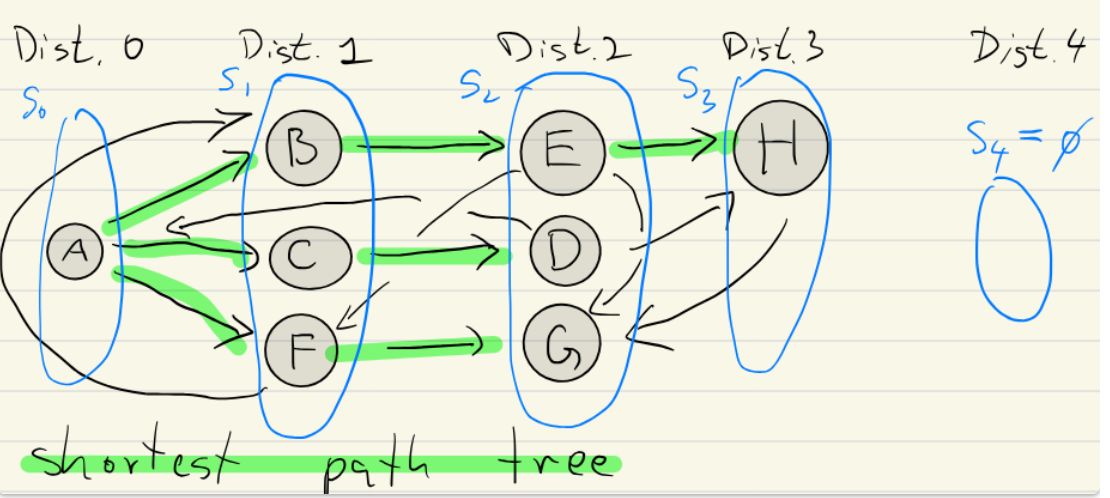
Field-by-field Comparison
| Field | Before | After |
|---|---|---|
| Front | The shortest path tree output by BFS is: | |
| Back | A tree from the start-vertex with levels, for each distance:<br><br><img src="paste-4c913ffd2f874833dce2fab6c179871903517c76.jpg"> |
Note 233: ETH::A&D
Deck: ETH::A&D
Note Type: Algorithms
GUID:
added
Note Type: Algorithms
GUID:
rUd4]Y&$Fr
Previous
Note did not exist
New Note
Front
Runtime of Maximum Subarray Sum?
Back
Runtime of Maximum Subarray Sum?
\(\Theta(n)\)
Field-by-field Comparison
| Field | Before | After |
|---|---|---|
| Name | Maximum Subarray Sum | |
| Runtime | \(\Theta(n)\) | |
| Approach | Table: DP[1..n]<br>Define the "randmax": \( R_j := \max_{1 \leq i \leq j} \sum_{k = i}^j A[k] \) (maximale summe eines teilarrays das an j endet.<br><ul><li>Base Case: \(R_1 = A[1]\)</li><li>Recursion is \(R_j = \max \{ A[j], R_{j - 1} + A[j] \}\)<br>Thus either our current subarray contains the element at j, or not and we start with it again.</li></ul> | |
| Pseudocode | <img src="paste-8b50441eb44313fbab2c817e37ae70bb89ab0449.jpg"> |
Note 234: ETH::A&D
Deck: ETH::A&D
Note Type: Horvath Classic
GUID:
added
Note Type: Horvath Classic
GUID:
ra?I5x|G>*
Previous
Note did not exist
New Note
Front
Runtime: Operations in an Adjacency Matrix:
Back
Runtime: Operations in an Adjacency Matrix:
1. check if \(uv \in E\): \(O(1)\)
2. Vertex \(u\) , find all adjacent vertices in: \(O(n)\)
2. Vertex \(u\) , find all adjacent vertices in: \(O(n)\)
Field-by-field Comparison
| Field | Before | After |
|---|---|---|
| Front | <b>Runtime</b>: Operations in an Adjacency <b>Matrix</b>: | |
| Back | 1. check if \(uv \in E\): \(O(1)\)<br>2. Vertex \(u\) , find all adjacent vertices in: \(O(n)\) |
Note 235: ETH::A&D
Deck: ETH::A&D
Note Type: Horvath Cloze
GUID:
added
Note Type: Horvath Cloze
GUID:
rnACRB4[8n
Previous
Note did not exist
New Note
Front
Pre-/Post-Ordering Classification for an edge \((u, v)\):
\(\text{pre}(v) < \text{pre}(u) < \text{post}(u) < \text{post}(v)\): back edge
\(\text{pre}(v) < \text{pre}(u) < \text{post}(u) < \text{post}(v)\): back edge
Back
Pre-/Post-Ordering Classification for an edge \((u, v)\):
\(\text{pre}(v) < \text{pre}(u) < \text{post}(u) < \text{post}(v)\): back edge
\(\text{pre}(v) < \text{pre}(u) < \text{post}(u) < \text{post}(v)\): back edge
exists a cycle!
Field-by-field Comparison
| Field | Before | After |
|---|---|---|
| Text | Pre-/Post-Ordering Classification for an edge \((u, v)\):<br>\(\text{pre}(v) < \text{pre}(u) < \text{post}(u) < \text{post}(v)\): {{c1:: back edge}} | |
| Extra | exists a cycle! |
Note 236: ETH::A&D
Deck: ETH::A&D
Note Type: Horvath Cloze
GUID:
added
Note Type: Horvath Cloze
GUID:
rp1#iPsvnq
Previous
Note did not exist
New Note
Front
In a linked list, the keys don't appear in order in memory. They each contain {c2::a pointer to the start of the next element in the list instead}}.
We also have an extra pointer to the end in practice.
We also have an extra pointer to the end in practice.
Back
In a linked list, the keys don't appear in order in memory. They each contain {c2::a pointer to the start of the next element in the list instead}}.
We also have an extra pointer to the end in practice.
We also have an extra pointer to the end in practice.
The last pointer of the list is a null pointer to indicate the end.
Field-by-field Comparison
| Field | Before | After |
|---|---|---|
| Text | In a <b>linked list</b>, the keys {{c1::don't appear in order in memory}}. They each contain {c2::a pointer to the start of the next element in the list instead}}.<br><br>We also have {{c3::an extra pointer to the end in practice}}. | |
| Extra | The last pointer of the list is a null pointer to indicate the end. |
Note 237: ETH::A&D
Deck: ETH::A&D
Note Type: Horvath Classic
GUID:
added
Note Type: Horvath Classic
GUID:
ruU|XgSe,e
Previous
Note did not exist
New Note
Front
What extra pointer does the ADT List store?
Back
What extra pointer does the ADT List store?
It stores an extra pointer to the end of the list (in a LinkedList to the last node, in an array to delimit the last element).
Field-by-field Comparison
| Field | Before | After |
|---|---|---|
| Front | What extra pointer does the ADT List store? | |
| Back | It stores an extra pointer to the end of the list (in a LinkedList to the last node, in an array to delimit the last element). |
Note 238: ETH::A&D
Deck: ETH::A&D
Note Type: Horvath Classic
GUID:
added
Note Type: Horvath Classic
GUID:
rx?y6g[CSG
Previous
Note did not exist
New Note
Front
Describe the steps in BFS:
Back
Describe the steps in BFS:
BFS is a shortest path algorithm.
- Initialisation:
- Set the distance to all vertices to \(\infty\) in the
d[v]array. Set thed[s] = 0. - Initialise a Queue \(Q\) with \(s\)
- Set the dictionary
parent = {}
- Set the distance to all vertices to \(\infty\) in the
- Exploration:
- Dequeue the first element in the queue $v$
- For all adjacent nodes \(u\) with distance \(= \infty\) (not visited yet):
- Set the distance
d[u] = d[v] + 1 - add \(u\) to the queue
- Set the
parent[u] = v.
- Set the distance
- Return: We return the distances and the shortest path tree
The queue ensures that we don't mix up the order.
Field-by-field Comparison
| Field | Before | After |
|---|---|---|
| Front | Describe the steps in <b>BFS</b>: | |
| Back | BFS is a <b>shortest path algorithm</b>.<br><ol><li><strong>Initialisation:</strong> <ul> <li>Set the distance to all vertices to \(\infty\) in the <code>d[v]</code> array. Set the <code>d[s] = 0</code>.</li> <li>Initialise a Queue \(Q\) with \(s\)</li> <li>Set the dictionary <code>parent = {}</code></li> </ul> </li> <li><strong>Exploration:</strong><ul> <li>Dequeue the first element in the queue $v$</li> <li>For all <em>adjacent nodes</em> \(u\) with distance \(= \infty\) (not visited yet):<ul> <li>Set the distance <code>d[u] = d[v] + 1</code></li> <li>add \(u\) to the queue</li> <li>Set the <code>parent[u] = v</code>.</li> </ul> </li> </ul> </li> <li><strong>Return:</strong> We return the distances and the <em>shortest path tree</em></li></ol><div><br></div><div>The queue ensures that we don't mix up the order.</div> |
Note 239: ETH::A&D
Deck: ETH::A&D
Note Type: Horvath Cloze
GUID:
added
Note Type: Horvath Cloze
GUID:
rzX#2=8CU?
Previous
Note did not exist
New Note
Front
In graph theory, a cycle (Kreis) is a closed walk without repeated vertices and at least three vertices.
Back
In graph theory, a cycle (Kreis) is a closed walk without repeated vertices and at least three vertices.
Field-by-field Comparison
| Field | Before | After |
|---|---|---|
| Text | In graph theory, a {{c2::cycle (<i>Kreis</i>)}} is a {{c1::closed walk without repeated vertices}} and {{c1::at least three vertices}}. |
Note 240: ETH::A&D
Deck: ETH::A&D
Note Type: Horvath Cloze
GUID:
added
Note Type: Horvath Cloze
GUID:
s++QypVica
Previous
Note did not exist
New Note
Front
A PriorityQueue is like a queue, with the difference that every key is associated with a natural number which indicates the importance.
Back
A PriorityQueue is like a queue, with the difference that every key is associated with a natural number which indicates the importance.
The elements are then returned in the order of this importance.
Field-by-field Comparison
| Field | Before | After |
|---|---|---|
| Text | A <b>PriorityQueue</b> is like a queue, with the difference that {{c1:: every key is associated with a natural number which indicates the importance}}. | |
| Extra | The elements are then returned in the order of this importance. |
Note 241: ETH::A&D
Deck: ETH::A&D
Note Type: Horvath Cloze
GUID:
added
Note Type: Horvath Cloze
GUID:
s0knxb/
Previous
Note did not exist
New Note
Front
The height \(h(v)\) in Johnson's Algorithm is always negative \(\leq 0\).
Back
The height \(h(v)\) in Johnson's Algorithm is always negative \(\leq 0\).
Field-by-field Comparison
| Field | Before | After |
|---|---|---|
| Text | The height \(h(v)\) in Johnson's Algorithm is {{c1::always negative \(\leq 0\)}}. |
Note 242: ETH::A&D
Deck: ETH::A&D
Note Type: Horvath Cloze
GUID:
added
Note Type: Horvath Cloze
GUID:
s6a5!K0P)L
Previous
Note did not exist
New Note
Front
| Operation | Array | Singly Linked List | Doubly Linked List |
|---|---|---|---|
insert(k,L) |
\(O(1)\) | \(O(1)\) | \(O(1)\) |
get(i,L) |
\(O(1)\) | \(O(l)\) | \(O(j)\) |
insertAfter(k,k',L) |
\(O(l)\) | \(O(1)\) | \(O(1)\) |
delete(k,L) |
\(O(l)\) | \(O(l)\) | \(O(1)\) |
We assume to have a pointer to the end of the list here. |
Back
| Operation | Array | Singly Linked List | Doubly Linked List |
|---|---|---|---|
insert(k,L) |
\(O(1)\) | \(O(1)\) | \(O(1)\) |
get(i,L) |
\(O(1)\) | \(O(l)\) | \(O(j)\) |
insertAfter(k,k',L) |
\(O(l)\) | \(O(1)\) | \(O(1)\) |
delete(k,L) |
\(O(l)\) | \(O(l)\) | \(O(1)\) |
We assume to have a pointer to the end of the list here. |
Field-by-field Comparison
| Field | Before | After |
|---|---|---|
| Text | <table> <tbody><tr> <th>Operation</th> <th>Array</th> <th>Singly Linked List</th> <th>Doubly Linked List</th> </tr> <tr> <td><code>insert(k,L)</code></td> <td>{{c1:: \(O(1)\)}}</td> <td>{{c2:: \(O(1)\)}}</td> <td>{{c3:: \(O(1)\)}}</td> </tr> <tr> <td><code>get(i,L)</code></td> <td>{{c4:: \(O(1)\)}}</td> <td>{{c5:: \(O(l)\)}}</td> <td>{{c6:: \(O(j)\)}}</td> </tr> <tr> <td><code>insertAfter(k,k',L)</code></td> <td>{{c7:: \(O(l)\)}}</td> <td>{{c8:: \(O(1)\)}}</td> <td>{{c9:: \(O(1)\)}}</td> </tr> <tr> <td><code>delete(k,L)</code></td> <td>{{c10:: \(O(l)\)}}</td> <td>{{c11:: \(O(l)\)}}</td> <td>{{c12:: \(O(1)\)}}</td> </tr> <tr> <td><em><br>We assume to have a pointer to the end of the list here.</em></td> <td></td> <td></td> <td></td> </tr></tbody></table> |
Note 243: ETH::A&D
Deck: ETH::A&D
Note Type: Horvath Cloze
GUID:
added
Note Type: Horvath Cloze
GUID:
s@rY_v*&u_
Previous
Note did not exist
New Note
Front
A graph is bipartite if and only if it does not contain any cycles of odd length.
Back
A graph is bipartite if and only if it does not contain any cycles of odd length.
Field-by-field Comparison
| Field | Before | After |
|---|---|---|
| Text | A graph is bipartite if and only if {{c1::it does not contain any cycles of odd length}}. |
Note 244: ETH::A&D
Deck: ETH::A&D
Note Type: Horvath Classic
GUID:
added
Note Type: Horvath Classic
GUID:
sPqRN2wuHY
Previous
Note did not exist
New Note
Front
How does Depth-first-search work and what is its runtime for the two implementations of a graph?
Back
How does Depth-first-search work and what is its runtime for the two implementations of a graph?
a depth first search marks the vertices it visits, at each vertex it looks for a vertex it has not yet visited and if there are none, it tracks back to a vertex which still has some unvisited adjacent nodes
its runtime in an adjacency matrix is \(O(n^2)\) as it has to visit each vertex once and search through all \(n\) potential neighbors
implemented using adjacency lists, the runtime is \(O(n+m)\) as we still have to visit each vertex once but we only have to search through at most \(\text{deg}_{out}(u)\) vertices at each step, which adds up to searching through all the edges
its runtime in an adjacency matrix is \(O(n^2)\) as it has to visit each vertex once and search through all \(n\) potential neighbors
implemented using adjacency lists, the runtime is \(O(n+m)\) as we still have to visit each vertex once but we only have to search through at most \(\text{deg}_{out}(u)\) vertices at each step, which adds up to searching through all the edges
Field-by-field Comparison
| Field | Before | After |
|---|---|---|
| Front | How does Depth-first-search work and what is its runtime for the two implementations of a graph? | |
| Back | a depth first search marks the vertices it visits, at each vertex it looks for a vertex it has not yet visited and if there are none, it tracks back to a vertex which still has some unvisited adjacent nodes<br><br>its runtime in an adjacency matrix is \(O(n^2)\) as it has to visit each vertex once and search through all \(n\) potential neighbors<br><br>implemented using adjacency lists, the runtime is \(O(n+m)\) as we still have to visit each vertex once but we only have to search through at most \(\text{deg}_{out}(u)\) vertices at each step, which adds up to searching through all the edges |
Note 245: ETH::A&D
Deck: ETH::A&D
Note Type: Horvath Classic
GUID:
added
Note Type: Horvath Classic
GUID:
sS2;w|7M-!
Previous
Note did not exist
New Note
Front
What condition on the function \(T\) does the Master Theorem set?
Back
What condition on the function \(T\) does the Master Theorem set?
It only holds if \(n = 2^k\) or the function is increasing.
Field-by-field Comparison
| Field | Before | After |
|---|---|---|
| Front | What condition on the function \(T\) does the Master Theorem set? | |
| Back | It only holds if \(n = 2^k\) or the function is <b>increasing</b>. |
Note 246: ETH::A&D
Deck: ETH::A&D
Note Type: Horvath Reverso
GUID:
added
Note Type: Horvath Reverso
GUID:
sap]uaOK!q
Previous
Note did not exist
New Note
Front
\(O(n^k) \leq\) (name the next bigger function)
Back
\(O(n^k) \leq\) (name the next bigger function)
\(\leq O(k^n)\) (name the next smaller function)
Field-by-field Comparison
| Field | Before | After |
|---|---|---|
| Front | \(O(n^k) \leq\) <i>(name the next bigger function)</i> | |
| Back | \(\leq O(k^n)\) <i>(name the next smaller function)</i> |
Note 247: ETH::A&D
Deck: ETH::A&D
Note Type: Horvath Cloze
GUID:
added
Note Type: Horvath Cloze
GUID:
t/(N7FzdP}
Previous
Note did not exist
New Note
Front
The ADT priorityQueue can be efficiently implemented using a MaxHeap. This guarantees \(O(\log n)\) for both operations.
Back
The ADT priorityQueue can be efficiently implemented using a MaxHeap. This guarantees \(O(\log n)\) for both operations.
Field-by-field Comparison
| Field | Before | After |
|---|---|---|
| Text | <div>The ADT <b>priorityQueue</b> can be efficiently implemented using a {{c1:: <b>MaxHeap</b>}}. This guarantees {{c2:: \(O(\log n)\)}} for both operations.</div> |
Note 248: ETH::A&D
Deck: ETH::A&D
Note Type: Algorithms
GUID:
added
Note Type: Algorithms
GUID:
t:15}v~LmN
Previous
Note did not exist
New Note
Front
Runtime of Bellman-Ford?
Back
Runtime of Bellman-Ford?
\(O(|V| \cdot |E|)\) (uses DP)
We iterate over all edges in the "relaxation" thus the time complexity of that step is \(O(m)\) (the actual check is \(O(1)\)).
As we relax \(n - 1\) (or \(n\) for negative cycle check) times, the total runtime is \(O(n \cdot m)\).
We iterate over all edges in the "relaxation" thus the time complexity of that step is \(O(m)\) (the actual check is \(O(1)\)).
As we relax \(n - 1\) (or \(n\) for negative cycle check) times, the total runtime is \(O(n \cdot m)\).
Field-by-field Comparison
| Field | Before | After |
|---|---|---|
| Name | Bellman-Ford | |
| Runtime | \(O(|V| \cdot |E|)\) (uses DP)<br><br>We iterate over all edges in the "relaxation" thus the time complexity of that step is \(O(m)\) (the actual check is \(O(1)\)).<br>As we relax \(n - 1\) (or \(n\) for negative cycle check) times, the total runtime is \(O(n \cdot m)\). | |
| Requirements | Negative-edges allowed (neg. cycles detected) in a directed, weighted graph. | |
| Approach | <ol> <li><b>Initialize</b>:<br>Set the distance to the source vertex as 0 and to all other vertices as infinity.</li> <li><b>Relax Edges</b>: <br>Repeat for V − 1 iterations (where V is the number of vertices):<br>For each edge, update the distance to its destination vertex if the distance through the edge is smaller than the current distance.</li> <li><b>Check for Negative Cycles</b>: <br>Check all edges to see if a shorter path can still be found. If so, the graph contains a negative- weight cycle.</li> <li><b>End</b>: <br>If no negative-weight cycle is found, the algorithm outputs the shortest paths.</li></ol><img src="paste-95017d19365697a9f94b52394c6bdb999dfc81d1.jpg"><br><br>(quicker to implement the edge-based approach, but there's also a vertex based approach) | |
| Pseudocode | <img src="paste-46ff4f85bab3ae924d9ef2c955277d49fc616cc6.jpg"> | |
| Use Case | Find cheapest path in graphs with negative edges. |
Note 249: ETH::A&D
Deck: ETH::A&D
Note Type: Horvath Classic
GUID:
added
Note Type: Horvath Classic
GUID:
tH)JXa7KfA
Previous
Note did not exist
New Note
Front
Worst case for search in a binary tree?
Back
Worst case for search in a binary tree?
Binary trees are not balanced possible that \(h >> \log_2 n\)
Worst case example if inserted in ascending order:
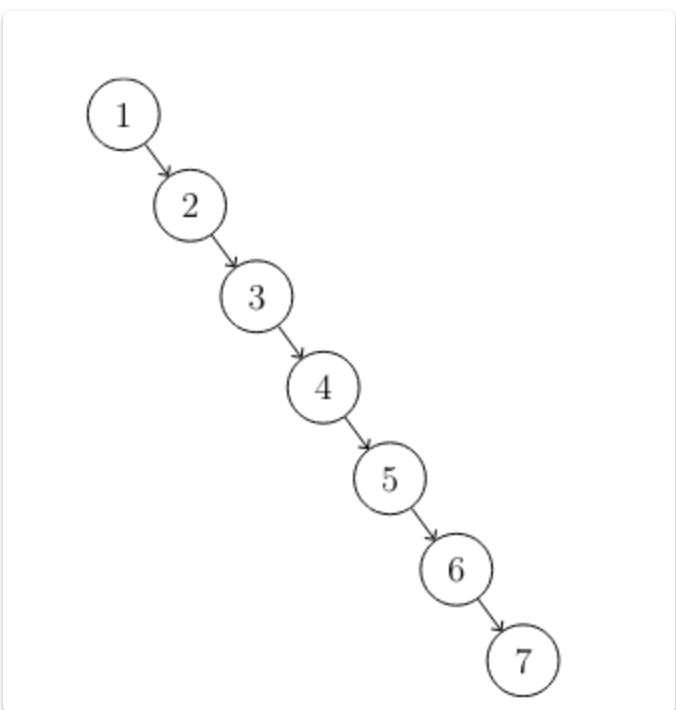
Worst case example if inserted in ascending order:
Field-by-field Comparison
| Field | Before | After |
|---|---|---|
| Front | <b>Worst case</b> for <b>search</b> in a <b>binary tree</b>? | |
| Back | Binary trees are not <b>balanced</b> possible that \(h >> \log_2 n\)<br>Worst case example if inserted in ascending order:<br><b></b><img src="paste-201c49e27928e7a814e89e8de667e07e5c7789ce.jpg"> |
Note 250: ETH::A&D
Deck: ETH::A&D
Note Type: Algorithms
GUID:
added
Note Type: Algorithms
GUID:
tYh57HT9#t
Previous
Note did not exist
New Note
Front
Runtime of Jump Game?
Back
Runtime of Jump Game?
\(O(n)\) (hyper-optimised version)
Field-by-field Comparison
| Field | Before | After |
|---|---|---|
| Name | Jump Game | |
| Runtime | \(O(n)\) (hyper-optimised version) | |
| Requirements | Minimal jumps to get from beginning of array to the end.<br><br>Variable switch: cells which we can reach in \(k\) jumps. Solution is smallest \(k\) for which \(M[k] \geq n\).<br><br>We look at all \(i\) we can reach with exactly \(k-1\) jumps:<br><ul><li>Base Case: \(M[0] = A[0]\), \(M[1] = A[1] + 1\)</li><li>Recursion: \( M[k] = \max \{i + A[i] \ | \ M[k - 2] \leq i \leq M[k - 1]\} \)</li></ul><div>We look exactly 1 at every \(i\), thus \(O(n)\)</div> | |
| Pseudocode | <img src="paste-1f13db1cbb6b8d772fa2de2563b63627af8a038f.jpg"> |
Note 251: ETH::A&D
Deck: ETH::A&D
Note Type: Horvath Cloze
GUID:
added
Note Type: Horvath Cloze
GUID:
t]QH{.^=tP
Previous
Note did not exist
New Note
Front
The Karatsuba algorithm provides an asymptotically faster way to multiply numbers.
Back
The Karatsuba algorithm provides an asymptotically faster way to multiply numbers.
Field-by-field Comparison
| Field | Before | After |
|---|---|---|
| Text | The <b>Karatsuba</b> algorithm provides an asymptotically faster way to {{c1::multiply numbers}}. |
Note 252: ETH::A&D
Deck: ETH::A&D
Note Type: Algorithms
GUID:
added
Note Type: Algorithms
GUID:
u%cN;v|jjQ
Previous
Note did not exist
New Note
Front
Back
Runtime of
BFS
Runtime: {{c1::\( \mathcal{O}(|E| + |V|) \)}}
Approach:
Uses:
?Field-by-field Comparison
| Field | Before | After |
|---|---|---|
| Name | <div style="text-align: center;"><b>BFS</b></div><div><br></div><div><b>Runtime</b>: {{c1::\( \mathcal{O}(|E| + |V|) \)}}</div><div><br></div><div><b>Approach</b>: {{c2::First go through all direct successors of an edge, then move to a level deeper.}}</div><div><br></div><div><b>Uses</b>: {{c3::Shortest path in unweighted graphs, cycle detection, test if graph is bipartite, path finding}}</div> |
Note 253: ETH::A&D
Deck: ETH::A&D
Note Type: Horvath Cloze
GUID:
added
Note Type: Horvath Cloze
GUID:
u)lmsqp*H!
Previous
Note did not exist
New Note
Front
A stack is also called a LIFO queue.
Back
A stack is also called a LIFO queue.
Field-by-field Comparison
| Field | Before | After |
|---|---|---|
| Text | A stack is also called a {{c1:: LIFO}} queue. |
Note 254: ETH::A&D
Deck: ETH::A&D
Note Type: Horvath Cloze
GUID:
added
Note Type: Horvath Cloze
GUID:
u2lDE>&5/e
Previous
Note did not exist
New Note
Front
{{c1:: \(\sum_{j = 1}^{n} \sum_{k = \textbf{j} }^{n} 1\)}} \(=\) {{c2:: \(\sum_{j = 1}^n (n - j + 1) = \frac{n(n + 1)}{2}\)}} (Sum)
Back
{{c1:: \(\sum_{j = 1}^{n} \sum_{k = \textbf{j} }^{n} 1\)}} \(=\) {{c2:: \(\sum_{j = 1}^n (n - j + 1) = \frac{n(n + 1)}{2}\)}} (Sum)
inner loop depends on outer
Field-by-field Comparison
| Field | Before | After |
|---|---|---|
| Text | {{c1:: \(\sum_{j = 1}^{n} \sum_{k = \textbf{j} }^{n} 1\)}} \(=\) {{c2:: \(\sum_{j = 1}^n (n - j + 1) = \frac{n(n + 1)}{2}\)}} (Sum) | |
| Extra | <i>inner loop depends on outer</i><br> |
Note 255: ETH::A&D
Deck: ETH::A&D
Note Type: Horvath Classic
GUID:
added
Note Type: Horvath Classic
GUID:
uHC]1fZd$=
Previous
Note did not exist
New Note
Front
Tree Condition: for 2-3 Trees implementing dictionary.
Back
Tree Condition: for 2-3 Trees implementing dictionary.
Each node has 2 or 3 children but that all leafs are on the same level
Field-by-field Comparison
| Field | Before | After |
|---|---|---|
| Front | <b>Tree Condition</b>: for <b>2-3 Trees</b> implementing dictionary. | |
| Back | Each node has <b>2 or 3 children</b> but that all leafs are <b>on the same level</b> |
Note 256: ETH::A&D
Deck: ETH::A&D
Note Type: Horvath Cloze
GUID:
added
Note Type: Horvath Cloze
GUID:
ub(U6EB=d{
Previous
Note did not exist
New Note
Front
A topological ordering of vertices is an order such that for every edge \((u, v) \), \(u\) comes before \(v\).
Back
A topological ordering of vertices is an order such that for every edge \((u, v) \), \(u\) comes before \(v\).
thus all arrows point rightwards.
Field-by-field Comparison
| Field | Before | After |
|---|---|---|
| Text | A topological ordering of vertices is an order such that for every edge \((u, v) \), {{c1::\(u\) comes before \(v\)}}. | |
| Extra | thus all arrows point rightwards. |
Note 257: ETH::A&D
Deck: ETH::A&D
Note Type: Horvath Cloze
GUID:
added
Note Type: Horvath Cloze
GUID:
uxhT]f%32k
Previous
Note did not exist
New Note
Front
Master Theorem: If \(b = \log_2(a)\) then {{c2:: \(T(n) \leq O(n^{\log_2 a} \cdot \log n)\)}}.
Back
Master Theorem: If \(b = \log_2(a)\) then {{c2:: \(T(n) \leq O(n^{\log_2 a} \cdot \log n)\)}}.
The recursive and non-recursive work is balanced.
Field-by-field Comparison
| Field | Before | After |
|---|---|---|
| Text | Master Theorem: If {{c1:: \(b = \log_2(a)\)}} then {{c2:: \(T(n) \leq O(n^{\log_2 a} \cdot \log n)\)}}. | |
| Extra | The recursive and non-recursive work is balanced. |
Note 258: ETH::A&D
Deck: ETH::A&D
Note Type: Horvath Classic
GUID:
added
Note Type: Horvath Classic
GUID:
v%fJG/oUBR
Previous
Note did not exist
New Note
Front
How many edges does a tree with \(n\) vertices have?
Back
How many edges does a tree with \(n\) vertices have?
\(n-1\) edges
Field-by-field Comparison
| Field | Before | After |
|---|---|---|
| Front | How many edges does a tree with \(n\) vertices have? | |
| Back | \(n-1\) edges |
Note 259: ETH::A&D
Deck: ETH::A&D
Note Type: Horvath Classic
GUID:
added
Note Type: Horvath Classic
GUID:
v,>nr{ym:e
Previous
Note did not exist
New Note
Front
What is an ADT?
Back
What is an ADT?
An abstract data type describes a wishlist for operations we want to perform on our data.
Field-by-field Comparison
| Field | Before | After |
|---|---|---|
| Front | What is an ADT? | |
| Back | An <b>abstract data type</b> describes a wishlist for operations we want to perform on our data. |
Note 260: ETH::A&D
Deck: ETH::A&D
Note Type: Horvath Classic
GUID:
added
Note Type: Horvath Classic
GUID:
v7@jgp_hjT
Previous
Note did not exist
New Note
Front
Find cross edge in DFS algorithm:
Back
Find cross edge in DFS algorithm:
If we find vertex with both pre- and post- there's a cross edge.
Field-by-field Comparison
| Field | Before | After |
|---|---|---|
| Front | Find cross edge in DFS algorithm: | |
| Back | If we find vertex with both pre- and post- there's a cross edge. |
Note 261: ETH::A&D
Deck: ETH::A&D
Note Type: Horvath Classic
GUID:
added
Note Type: Horvath Classic
GUID:
vE[;wMoI5.
Previous
Note did not exist
New Note
Front
Optimal substructure of cheapest paths:
Back
Optimal substructure of cheapest paths:
A cheapest path in a weighted graph (without negative cycles) has the optimal substructure property: any subpath is itself the cheapest path between it's endpoints.
Field-by-field Comparison
| Field | Before | After |
|---|---|---|
| Front | Optimal substructure of cheapest paths: | |
| Back | A cheapest path in a weighted graph (without negative cycles) has the optimal substructure property: <i>any subpath is itself the cheapest path between it's endpoints</i>. |
Note 262: ETH::A&D
Deck: ETH::A&D
Note Type: Horvath Classic
GUID:
added
Note Type: Horvath Classic
GUID:
vQJH81Jg-1
Previous
Note did not exist
New Note
Front
For \(T(n) = 4T(n/2) + n\), which Master Theorem case applies?
Back
For \(T(n) = 4T(n/2) + n\), which Master Theorem case applies?
Because \(b = 1\) and \(\log_2(a) = \log_2 4 = 2 > b\), therefore \(T(n) = \Theta(n^2)\).
Field-by-field Comparison
| Field | Before | After |
|---|---|---|
| Front | For \(T(n) = 4T(n/2) + n\), which Master Theorem case applies? | |
| Back | Because \(b = 1\) and \(\log_2(a) = \log_2 4 = 2 > b\), therefore \(T(n) = \Theta(n^2)\). |
Note 263: ETH::A&D
Deck: ETH::A&D
Note Type: Horvath Classic
GUID:
added
Note Type: Horvath Classic
GUID:
vSWG3t+7{<
Previous
Note did not exist
New Note
Front
\(e^{\ln c} =\) ?
Back
\(e^{\ln c} =\) ?
\(c\)
Field-by-field Comparison
| Field | Before | After |
|---|---|---|
| Front | \(e^{\ln c} =\) ? | |
| Back | \(c\) |
Note 264: ETH::A&D
Deck: ETH::A&D
Note Type: Horvath Cloze
GUID:
added
Note Type: Horvath Cloze
GUID:
vfw3/~)/(m
Previous
Note did not exist
New Note
Front
Master Theorem: If \(b > \log_2(a)\) then \(T(n) \leq O(n^b)\).
Back
Master Theorem: If \(b > \log_2(a)\) then \(T(n) \leq O(n^b)\).
This is the case for which the work outside the recursion dominates.
Field-by-field Comparison
| Field | Before | After |
|---|---|---|
| Text | Master Theorem: If {{c1:: \(b > \log_2(a)\)}} then {{c2:: \(T(n) \leq O(n^b)\)}}. | |
| Extra | This is the case for which the work outside the recursion dominates. |
Note 265: ETH::A&D
Deck: ETH::A&D
Note Type: Horvath Classic
GUID:
added
Note Type: Horvath Classic
GUID:
vgCb-fRsjm
Previous
Note did not exist
New Note
Front
Runtime from DP Table
Back
Runtime from DP Table
We use the number of entries * the time to compute them (usually \(O(1)\))
Field-by-field Comparison
| Field | Before | After |
|---|---|---|
| Front | Runtime from DP Table | |
| Back | We use the number of entries * the time to compute them (usually \(O(1)\)) |
Note 266: ETH::A&D
Deck: ETH::A&D
Note Type: Horvath Classic
GUID:
added
Note Type: Horvath Classic
GUID:
v{-8tJEW)=
Previous
Note did not exist
New Note
Front
What is the length of a walk?
Back
What is the length of a walk?
The length of a walk \((v_0, v_1, \dots, v_k)\) is \(k\), i.e. the number of vertices minus 1.
A walk of length \(l\) connects \(l + 1\) vertices.
A walk of length \(l\) connects \(l + 1\) vertices.
Field-by-field Comparison
| Field | Before | After |
|---|---|---|
| Front | What is the length of a walk? | |
| Back | The length of a walk \((v_0, v_1, \dots, v_k)\) is \(k\), i.e. the number of vertices minus 1.<br><br>A walk of length \(l\) connects \(l + 1\) vertices. |
Note 267: ETH::A&D
Deck: ETH::A&D
Note Type: Horvath Cloze
GUID:
added
Note Type: Horvath Cloze
GUID:
v|.y5zi[:;
Previous
Note did not exist
New Note
Front
Prim's Algorithm Invariants:
The distances "d[.] = " in the distance array are the values of the vertices in the priority queue (see line decrease_key(H, v, d[v])).
Back
Prim's Algorithm Invariants:
The distances "d[.] = " in the distance array are the values of the vertices in the priority queue (see line decrease_key(H, v, d[v])).
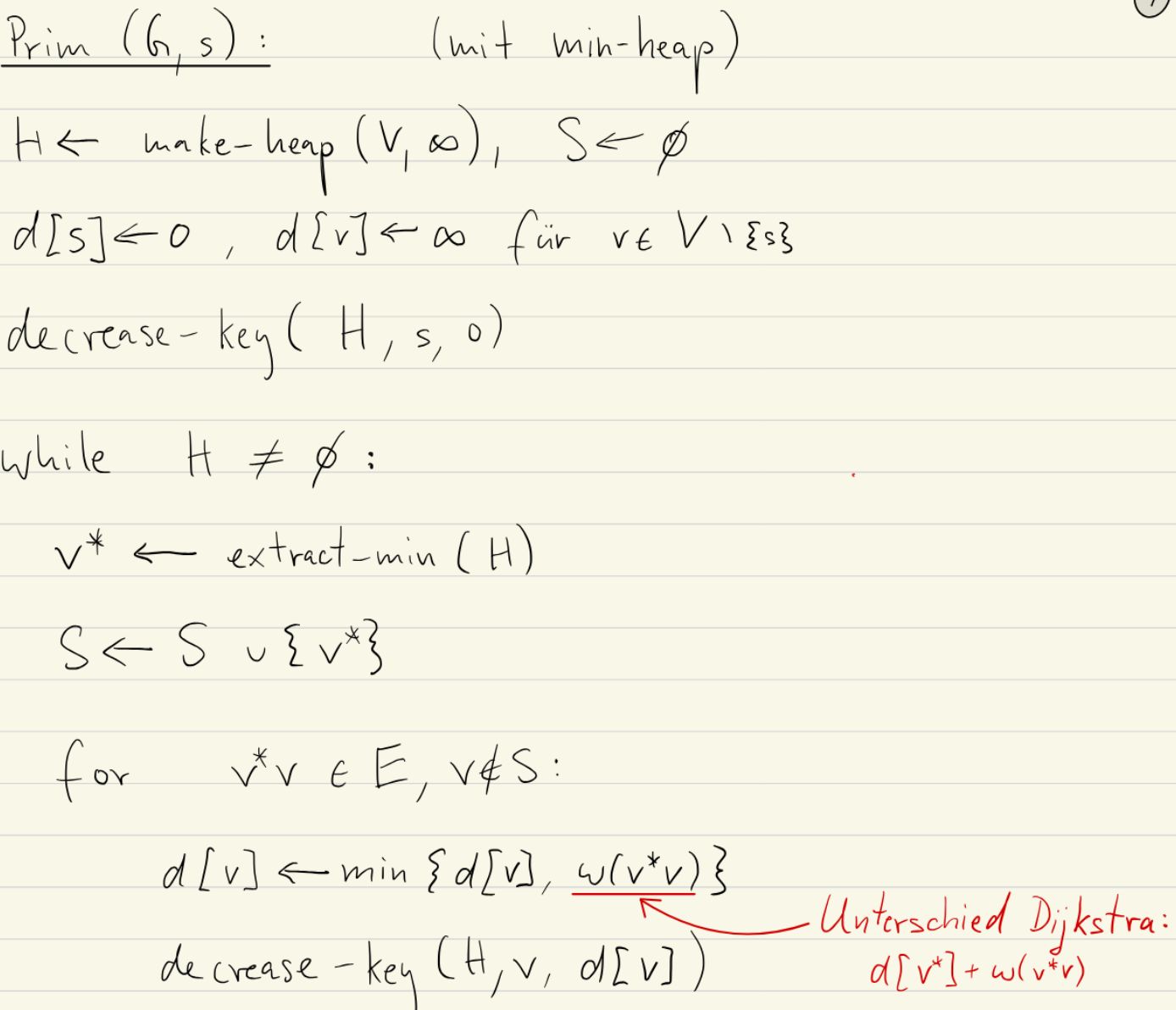
Field-by-field Comparison
| Field | Before | After |
|---|---|---|
| Text | Prim's Algorithm Invariants:<br><br><div>The distances "d[.] = " in the distance array are {{c1::the values of the vertices in the priority queue (see line decrease_key(H, v, d[v]))}}.</div> | |
| Extra | <img src="paste-c6f5e360bdfa85548214127036942fc80a2cde0e.jpg"> |
Note 268: ETH::A&D
Deck: ETH::A&D
Note Type: Horvath Classic
GUID:
added
Note Type: Horvath Classic
GUID:
w2#a}f;^-i
Previous
Note did not exist
New Note
Front
How many leaf nodes can a 2-3 tree of depth \(h\) have?
Back
How many leaf nodes can a 2-3 tree of depth \(h\) have?
let \(n\) be the number of leaf nodes, \(2^h \leq n \leq 3^h\)
Field-by-field Comparison
| Field | Before | After |
|---|---|---|
| Front | How many leaf nodes can a 2-3 tree of depth \(h\) have? | |
| Back | let \(n\) be the number of leaf nodes, \(2^h \leq n \leq 3^h\) |
Note 269: ETH::A&D
Deck: ETH::A&D
Note Type: Horvath Cloze
GUID:
added
Note Type: Horvath Cloze
GUID:
wD<:EQZU&2
Previous
Note did not exist
New Note
Front
Prim's Algorithm is similar to Dijkstra's with the difference that \(d[v]\) is the minimum between current value and \(w(v*, v)\) instead of \(d[v^*] + w(v^*, v)\) .
Back
Prim's Algorithm is similar to Dijkstra's with the difference that \(d[v]\) is the minimum between current value and \(w(v*, v)\) instead of \(d[v^*] + w(v^*, v)\) .
Dijkstra's find the shortest distance to each vertex, thus it tracks the total.
Prim's needs to build the MST, thus it only cares about which vertex to choose next to find a (cheapest) safe-edge.
Prim's needs to build the MST, thus it only cares about which vertex to choose next to find a (cheapest) safe-edge.
Field-by-field Comparison
| Field | Before | After |
|---|---|---|
| Text | <b>Prim's Algorithm</b> is similar to {{c1:: Dijkstra's}} with the difference that {{c1:: \(d[v]\) is the minimum between current value and \(w(v*, v)\) instead of \(d[v^*] + w(v^*, v)\) }}. | |
| Extra | Dijkstra's find the shortest distance to each vertex, thus it tracks the total.<br><br>Prim's needs to build the MST, thus it only cares about which vertex to choose next to find a (cheapest) safe-edge. |
Note 270: ETH::A&D
Deck: ETH::A&D
Note Type: Horvath Classic
GUID:
added
Note Type: Horvath Classic
GUID:
wStzO9J_2Q
Previous
Note did not exist
New Note
Front
If \(f \leq O(h)\) and \(g \leq O(h)\)
Back
If \(f \leq O(h)\) and \(g \leq O(h)\)
\(f + g \leq O(h)\)
Field-by-field Comparison
| Field | Before | After |
|---|---|---|
| Front | If \(f \leq O(h)\) and \(g \leq O(h)\) | |
| Back | \(f + g \leq O(h)\) |
Note 271: ETH::A&D
Deck: ETH::A&D
Note Type: Horvath Cloze
GUID:
added
Note Type: Horvath Cloze
GUID:
wbdb9#fK:J
Previous
Note did not exist
New Note
Front
Height of a 2-3 Tree for \(n\) keys is \(\leq \log_2(n)\) thus \(h=\)\(O(\log(n)\) (O-notation).
Back
Height of a 2-3 Tree for \(n\) keys is \(\leq \log_2(n)\) thus \(h=\)\(O(\log(n)\) (O-notation).
Note that for the case \(n = 1\) the root has one leaf with the key.
Field-by-field Comparison
| Field | Before | After |
|---|---|---|
| Text | Height of a <b>2-3 Tree</b> for \(n\) keys is {{c1::\(\leq \log_2(n)\)}} thus \(h=\){{c2::\(O(\log(n)\)}} (O-notation). | |
| Extra | Note that for the case \(n = 1\) the root has one leaf with the key. |
Note 272: ETH::A&D
Deck: ETH::A&D
Note Type: Horvath Classic
GUID:
added
Note Type: Horvath Classic
GUID:
wxuX$c!)%k
Previous
Note did not exist
New Note
Front
A graph with this DP table from F-W:
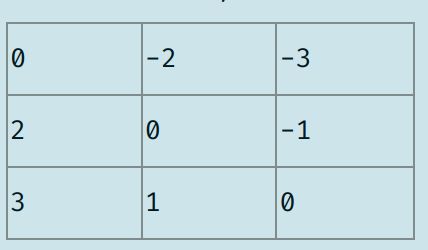
contains ___ negative cycles.
contains ___ negative cycles.
Back
A graph with this DP table from F-W:
contains ___ negative cycles.
contains ___ negative cycles.
no (there is no diagonal \(< 0\))
Field-by-field Comparison
| Field | Before | After |
|---|---|---|
| Front | A graph with this DP table from F-W:<br><img src="paste-deae0d6c4a31dc3e71c5f654f12387c82b186739.jpg"><br>contains ___ negative cycles. | |
| Back | <b>no</b> (there is no diagonal \(< 0\)) |
Note 273: ETH::A&D
Deck: ETH::A&D
Note Type: Horvath Classic
GUID:
added
Note Type: Horvath Classic
GUID:
w{Q]%!`f&#
Previous
Note did not exist
New Note
Front
Transform Eulerian walk to closed eulerian walk problem:
Back
Transform Eulerian walk to closed eulerian walk problem:
add an edge connected the start-end points with odd degrees.
Field-by-field Comparison
| Field | Before | After |
|---|---|---|
| Front | Transform Eulerian walk to closed eulerian walk problem: | |
| Back | add an edge connected the start-end points with odd degrees. |
Note 274: ETH::A&D
Deck: ETH::A&D
Note Type: Horvath Cloze
GUID:
added
Note Type: Horvath Cloze
GUID:
w|i$)J%}4f
Previous
Note did not exist
New Note
Front
In graph theory, a Hamiltonian cycle (Hamiltonkreis) is a cycle that contains every vertex.
Back
In graph theory, a Hamiltonian cycle (Hamiltonkreis) is a cycle that contains every vertex.
Field-by-field Comparison
| Field | Before | After |
|---|---|---|
| Text | In graph theory, a {{c2::Hamiltonian cycle (<i>Hamiltonkreis</i>)}} is a {{c1::cycle that contains every vertex}}. |
Note 275: ETH::A&D
Deck: ETH::A&D
Note Type: Horvath Cloze
GUID:
added
Note Type: Horvath Cloze
GUID:
x@F_EbzW}O
Previous
Note did not exist
New Note
Front
Prim's Algorithm Invariants:
The priority queue \(H = V \setminus S\) (\(V\) set of all vertices, \(S\) vertices currently in the MST) never contains a vertex already in the MST.
The priority queue \(H = V \setminus S\) (\(V\) set of all vertices, \(S\) vertices currently in the MST) never contains a vertex already in the MST.
Back
Prim's Algorithm Invariants:
The priority queue \(H = V \setminus S\) (\(V\) set of all vertices, \(S\) vertices currently in the MST) never contains a vertex already in the MST.
The priority queue \(H = V \setminus S\) (\(V\) set of all vertices, \(S\) vertices currently in the MST) never contains a vertex already in the MST.
Field-by-field Comparison
| Field | Before | After |
|---|---|---|
| Text | Prim's Algorithm Invariants: <br>The priority queue \(H = V \setminus S\) (\(V\) set of all vertices, \(S\) vertices currently in the MST) {{c1::never contains a vertex already in the MST}}. |
Note 276: ETH::A&D
Deck: ETH::A&D
Note Type: Horvath Cloze
GUID:
added
Note Type: Horvath Cloze
GUID:
xI`7oXbl[?
Previous
Note did not exist
New Note
Front
If \(\frac{f(n)}{g(n)}\) tends to {{c1::\(C \in \mathbb{R}^+\)}}, then \(f \leq O(g)\) and \(g \leq O(f) \Leftrightarrow f = \Theta(g)\).
Back
If \(\frac{f(n)}{g(n)}\) tends to {{c1::\(C \in \mathbb{R}^+\)}}, then \(f \leq O(g)\) and \(g \leq O(f) \Leftrightarrow f = \Theta(g)\).
Field-by-field Comparison
| Field | Before | After |
|---|---|---|
| Text | If \(\frac{f(n)}{g(n)}\) tends to {{c1::\(C \in \mathbb{R}^+\)}}, then {{c2::\(f \leq O(g)\) and \(g \leq O(f) \Leftrightarrow f = \Theta(g)\)}}. |
Note 277: ETH::A&D
Deck: ETH::A&D
Note Type: Horvath Classic
GUID:
added
Note Type: Horvath Classic
GUID:
xP1aIt[ejN
Previous
Note did not exist
New Note
Front
If \(f \geq \Omega(g)\) then
Back
If \(f \geq \Omega(g)\) then
\(\exists C \ge 0 \quad \forall n \in \mathbb{N} \quad f(n) \ge C\cdot g(n)\)
\(f\) grows asymptotically faster than \(g\)
\(f\) grows asymptotically faster than \(g\)
Field-by-field Comparison
| Field | Before | After |
|---|---|---|
| Front | If \(f \geq \Omega(g)\) then | |
| Back | \(\exists C \ge 0 \quad \forall n \in \mathbb{N} \quad f(n) \ge C\cdot g(n)\)<br><br>\(f\) grows asymptotically <b>faster</b> than \(g\) |
Note 278: ETH::A&D
Deck: ETH::A&D
Note Type: Horvath Cloze
GUID:
added
Note Type: Horvath Cloze
GUID:
xdGDHE`#zR
Previous
Note did not exist
New Note
Front
A datastructure is the implementation of the wishlist of operations defined in our ADT.
Back
A datastructure is the implementation of the wishlist of operations defined in our ADT.
Field-by-field Comparison
| Field | Before | After |
|---|---|---|
| Text | A {{c1:: datastructure}} is the implementation of the wishlist of operations defined in our ADT. |
Note 279: ETH::A&D
Deck: ETH::A&D
Note Type: Horvath Classic
GUID:
added
Note Type: Horvath Classic
GUID:
x{57Az=}b`
Previous
Note did not exist
New Note
Front
How can we say that the function \(f\) and \(g\) grow asymptotically at the same rate?
Back
How can we say that the function \(f\) and \(g\) grow asymptotically at the same rate?
\(f = \Theta(g)\)
Field-by-field Comparison
| Field | Before | After |
|---|---|---|
| Front | How can we say that the function \(f\) and \(g\) grow asymptotically at the same rate? | |
| Back | \(f = \Theta(g)\) |
Note 280: ETH::A&D
Deck: ETH::A&D
Note Type: Horvath Classic
GUID:
added
Note Type: Horvath Classic
GUID:
y5w&L[iNjs
Previous
Note did not exist
New Note
Front
For \(T(n) = 2T(n/2) + n\), which Master Theorem case applies?
Back
For \(T(n) = 2T(n/2) + n\), which Master Theorem case applies?
Because \(b = 1\) and \(\log_2 a = \log_2 2 = 1 = b\), therefore \(T(n) = \Theta(n \log n)\).
Field-by-field Comparison
| Field | Before | After |
|---|---|---|
| Front | For \(T(n) = 2T(n/2) + n\), which Master Theorem case applies? | |
| Back | Because \(b = 1\) and \(\log_2 a = \log_2 2 = 1 = b\), therefore \(T(n) = \Theta(n \log n)\). |
Note 281: ETH::A&D
Deck: ETH::A&D
Note Type: Algorithms
GUID:
added
Note Type: Algorithms
GUID:
y@l`JCIJ<4
Previous
Note did not exist
New Note
Front
Runtime of BFS (Breadth First Search)?
Back
Runtime of BFS (Breadth First Search)?
\(O(|V|+|E|)\) (Adjacency List)
The runtime of BFS:
The runtime of BFS:
- each loop we take \(O(1 + \deg(u))\) time (go through the vertex \(u\)'s edges
- We loop a total of \(|V|\) times (we visit each edge max. 1 time)
Field-by-field Comparison
| Field | Before | After |
|---|---|---|
| Name | BFS (Breadth First Search) | |
| Runtime | \(O(|V|+|E|)\) (Adjacency List) | |
| Requirements | Directed Graph ((negative) cycles accepted, as "shortest" (not cheapest) path not affected) | |
| Approach | <b>BFS</b> looks for the shortest paths (not cheapest) in a graph.<br><ol><li><b>Initialisation:</b> <ul> <li>Set the distance to all vertices to \(\infty\) in the <code>d[v]</code> array. Set the <code>d[s] = 0</code>.</li> <li>Initialise a Queue \(Q\) with \(s\)</li> <li>Set the dictionary <code>parent = {}</code></li> </ul> </li> <li><b>Exploration:</b><ul> <li>Dequeue the first element in the queue \(v\)</li> <li>For all <em>adjacent nodes</em> \(u\) with distance \(= \infty\) (not visited yet):<ul> <li>Set the distance <code>d[u] = d[v] + 1</code></li> <li>add \(u\) to the queue</li> <li>Set the <code>parent[u] = v</code>.</li> </ul> </li> </ul> </li> <li><b>Return:</b> We return the distances and the <i>shortest path tree</i></li></ol> | |
| Pseudocode | <img src="paste-4fbaff6bb07ad8ff63a53ac2e179914e1c8cac2b.jpg"> | |
| Use Case | Shortest Path in a directed graph, Bipartite Test | |
| Extra Info | The runtime of BFS:<br><ol><li>each loop we take \(O(1 + \deg(u))\) time (go through the vertex \(u\)'s edges</li><li>We loop a total of \(|V|\) times (we visit each edge max. 1 time)</li></ol> |
Note 282: ETH::A&D
Deck: ETH::A&D
Note Type: Horvath Reverso
GUID:
added
Note Type: Horvath Reverso
GUID:
yOa^MOZU`,
Previous
Note did not exist
New Note
Front
\(O(n) \leq\) (name the next bigger function)
Back
\(O(n) \leq\) (name the next bigger function)
\(\leq O(n \log(n))\) (name the next smaller function)
Field-by-field Comparison
| Field | Before | After |
|---|---|---|
| Front | \(O(n) \leq\) <i>(name the next bigger function)</i> | |
| Back | \(\leq O(n \log(n))\) <i>(name the next smaller function)</i> |
Note 283: ETH::A&D
Deck: ETH::A&D
Note Type: Horvath Cloze
GUID:
added
Note Type: Horvath Cloze
GUID:
yX`f0NZg((
Previous
Note did not exist
New Note
Front
The triangle inequality in a weighted graph is \(d(u, v) \leq d(u, w) + d(w, v)\)
Back
The triangle inequality in a weighted graph is \(d(u, v) \leq d(u, w) + d(w, v)\)
This holds as if the path through \(w\) was actually cheaper, then \(d(u, v)\) would be wrong.
Does not hold in graphs with negative cycles.
Does not hold in graphs with negative cycles.
Field-by-field Comparison
| Field | Before | After |
|---|---|---|
| Text | The {{c1::<b>triangle inequality</b>}} in a weighted graph is {{c2::\(d(u, v) \leq d(u, w) + d(w, v)\)}} | |
| Extra | This holds as if the path through \(w\) was actually cheaper, then \(d(u, v)\) would be wrong.<br><br>Does not hold in graphs with negative cycles. |
Note 284: ETH::A&D
Deck: ETH::A&D
Note Type: Horvath Cloze
GUID:
added
Note Type: Horvath Cloze
GUID:
y_NK5>_:x4
Previous
Note did not exist
New Note
Front
In the edge \(e = \{u, v\}\), \(u\) and \(v\) are the endpoints of the edge.
Back
In the edge \(e = \{u, v\}\), \(u\) and \(v\) are the endpoints of the edge.
Field-by-field Comparison
| Field | Before | After |
|---|---|---|
| Text | In the edge \(e = \{u, v\}\), \(u\) and \(v\) are the {{c1::endpoints}} of the edge. |
Note 285: ETH::A&D
Deck: ETH::A&D
Note Type: Horvath Cloze
GUID:
added
Note Type: Horvath Cloze
GUID:
yg-tkTB|,7
Previous
Note did not exist
New Note
Front
{{c1:: \(\sum_{i = 1}^{n} i\log(i)\)}} \(\leq\) {{c2::\(\sum_{i = 1}^n n \log(n) = n^2 \log n\)}} (Sum)
Back
{{c1:: \(\sum_{i = 1}^{n} i\log(i)\)}} \(\leq\) {{c2::\(\sum_{i = 1}^n n \log(n) = n^2 \log n\)}} (Sum)
Field-by-field Comparison
| Field | Before | After |
|---|---|---|
| Text | {{c1:: \(\sum_{i = 1}^{n} i\log(i)\)}} \(\leq\) {{c2::\(\sum_{i = 1}^n n \log(n) = n^2 \log n\)}} (Sum) |
Note 286: ETH::A&D
Deck: ETH::A&D
Note Type: Horvath Cloze
GUID:
added
Note Type: Horvath Cloze
GUID:
yy3TxuBe~r
Previous
Note did not exist
New Note
Front
A queue is also called FIFO.
Back
A queue is also called FIFO.
Field-by-field Comparison
| Field | Before | After |
|---|---|---|
| Text | A queue is also called {{c1:: FIFO}}. |
Note 287: ETH::A&D
Deck: ETH::A&D
Note Type: Horvath Cloze
GUID:
added
Note Type: Horvath Cloze
GUID:
z4Nw/I#?J^
Previous
Note did not exist
New Note
Front
In graph theory, a path (Pfad) is a walk in which all vertices are distinct.
Back
In graph theory, a path (Pfad) is a walk in which all vertices are distinct.
Field-by-field Comparison
| Field | Before | After |
|---|---|---|
| Text | In graph theory, a {{c2::path (<i>Pfad</i>)}} is a {{c1::walk in which all vertices are distinct}}. |
Note 288: ETH::A&D
Deck: ETH::A&D
Note Type: Horvath Classic
GUID:
added
Note Type: Horvath Classic
GUID:
z=SLl>>F5y
Previous
Note did not exist
New Note
Front
Simplify \(a^{log_b(n)} = \)
Back
Simplify \(a^{log_b(n)} = \)
\(n^{log_b(a)}\)
Field-by-field Comparison
| Field | Before | After |
|---|---|---|
| Front | Simplify \(a^{log_b(n)} = \) | |
| Back | \(n^{log_b(a)}\) |
Note 289: ETH::A&D
Deck: ETH::A&D
Note Type: Horvath Reverso
GUID:
added
Note Type: Horvath Reverso
GUID:
zBLkhwqevO
Previous
Note did not exist
New Note
Front
\(O(n \log(n)) \leq\) (name the next bigger function)
Back
\(O(n \log(n)) \leq\) (name the next bigger function)
\(\leq O(n^k)\) (name the next smaller function)
Field-by-field Comparison
| Field | Before | After |
|---|---|---|
| Front | \(O(n \log(n)) \leq\) <i>(name the next bigger function)</i> | |
| Back | \(\leq O(n^k)\) <i>(name the next smaller function)</i> |
Note 290: ETH::A&D
Deck: ETH::A&D
Note Type: Algorithms
GUID:
added
Note Type: Algorithms
GUID:
z{8WPibSbC
Previous
Note did not exist
New Note
Front
Runtime of Dijkstra's Algorithm?
Back
Runtime of Dijkstra's Algorithm?
\(O((|E| + |V|) \log |V|)\) (or \(O(|V|^2)\)
The runtime is calculated from \(O(n + (\#\text{extract-min} + \#\text{decrease-key}) \cdot \log n)\) which gives \(O((n + m) \cdot \log n)\).
The runtime is calculated from \(O(n + (\#\text{extract-min} + \#\text{decrease-key}) \cdot \log n)\) which gives \(O((n + m) \cdot \log n)\).
Field-by-field Comparison
| Field | Before | After |
|---|---|---|
| Name | Dijkstra's Algorithm | |
| Runtime | \(O((|E| + |V|) \log |V|)\) (or \(O(|V|^2)\)<br><br>The runtime is calculated from \(O(n + (\#\text{extract-min} + \#\text{decrease-key}) \cdot \log n)\) which gives \(O((n + m) \cdot \log n)\). | |
| Requirements | No negative edge-weights (to make sure that we don't need to go back) | |
| Approach | Vertices are considered in <i>increasing</i> order of their distances from the source.<br><br>Recurrence:\[ d(s, v_k) = \min_{(v_i, v_k) \in E, i < k} \{ d(s, v_i) + c(v_i, v_k) \} \]<br><ol><li>Add start vertex \(s\) to prioqueue with dist 0 and set all other dists to \(\infty\)</li><li>Pop Cheapest Vertex \(v\) from Priority Queue</li><li>For each neighbour \(u\): if distance (= current_distance + \(w(v\rightarrow u)\)) < distance to \(u\) then overwrite and push new distance to queue.<br>Current vertex is marked as visited and not revisited again.</li></ol> | |
| Pseudocode | <img src="paste-38d6665cd236d4094cec91025d07594c2e082538.jpg"> | |
| Use Case | Cheapest Path in Weighted graph with non-negative edge costs |
Note 291: ETH::A&D
Deck: ETH::A&D
Note Type: Horvath Cloze
GUID:
added
Note Type: Horvath Cloze
GUID:
|%{-v*KE>
Previous
Note did not exist
New Note
Front
The standard notation for \(|V|\) is \(n\) and for \(|E|\) is \(m\).
Back
The standard notation for \(|V|\) is \(n\) and for \(|E|\) is \(m\).
Field-by-field Comparison
| Field | Before | After |
|---|---|---|
| Text | The standard notation for \(|V|\) is {{c1:: \(n\)}} and for \(|E|\) is {{c1:: \(m\)}}. |
Note 292: ETH::DiskMat
Deck: ETH::DiskMat
Note Type: Horvath Cloze
GUID:
added
Note Type: Horvath Cloze
GUID:
%-v5b-!x=
Previous
Note did not exist
New Note
Front
\( \neg (A \lor B) \) \( \equiv \) \( \neg A \land \neg B\)
Back
\( \neg (A \lor B) \) \( \equiv \) \( \neg A \land \neg B\)
De Morgan rules
Field-by-field Comparison
| Field | Before | After |
|---|---|---|
| Text | {{c1::\( \neg (A \lor B) \) }} \( \equiv \) {{c2::\( \neg A \land \neg B\)}}<br> | |
| Extra | De Morgan rules |
Note 293: ETH::DiskMat
Deck: ETH::DiskMat
Note Type: Horvath Cloze
GUID:
added
Note Type: Horvath Cloze
GUID:
.@%aS+kuV
Previous
Note did not exist
New Note
Front
In any ring \(\langle R; +, -, 0, \cdot, 1 \rangle\), and for all \(a, b \in R\) \(a0 =\) \(0a = 0\).
Back
In any ring \(\langle R; +, -, 0, \cdot, 1 \rangle\), and for all \(a, b \in R\) \(a0 =\) \(0a = 0\).
The zero (neutral of additive group) pulls all other elements to 0 by multiplication.
\(0a=(0+0)a=0a+0a\) and thus \(0a - 0a = 0a \implies 0 = 0a\)
\(0a=(0+0)a=0a+0a\) and thus \(0a - 0a = 0a \implies 0 = 0a\)
Field-by-field Comparison
| Field | Before | After |
|---|---|---|
| Text | In any ring \(\langle R; +, -, 0, \cdot, 1 \rangle\), and for all \(a, b \in R\) \(a0 =\) {{c1::\(0a = 0\)}}. | |
| Extra | The zero (neutral of additive group) pulls all other elements to 0 by multiplication.<br><br>\(0a=(0+0)a=0a+0a\) and thus \(0a - 0a = 0a \implies 0 = 0a\) |
Note 294: ETH::DiskMat
Deck: ETH::DiskMat
Note Type: Horvath Classic
GUID:
added
Note Type: Horvath Classic
GUID:
.H2xW-FA|
Previous
Note did not exist
New Note
Front
Which of the following are countable: \(\mathbb{N}\), \(\mathbb{Z}\), \(\mathbb{Q}\), \(\mathbb{R}\), \(\{0,1\}^*\), \(\{0,1\}^{\infty}\)?
Back
Which of the following are countable: \(\mathbb{N}\), \(\mathbb{Z}\), \(\mathbb{Q}\), \(\mathbb{R}\), \(\{0,1\}^*\), \(\{0,1\}^{\infty}\)?
Countable: \(\mathbb{N}\), \(\mathbb{Z}\), \(\mathbb{Q}\), \(\{0,1\}^*\)
Uncountable: \(\mathbb{R}\), \(\{0,1\}^{\infty}\)
Field-by-field Comparison
| Field | Before | After |
|---|---|---|
| Front | Which of the following are countable: \(\mathbb{N}\), \(\mathbb{Z}\), \(\mathbb{Q}\), \(\mathbb{R}\), \(\{0,1\}^*\), \(\{0,1\}^{\infty}\)? | |
| Back | <strong>Countable</strong>: \(\mathbb{N}\), \(\mathbb{Z}\), \(\mathbb{Q}\), \(\{0,1\}^*\) <strong>Uncountable</strong>: \(\mathbb{R}\), \(\{0,1\}^{\infty}\) |
Note 295: ETH::DiskMat
Deck: ETH::DiskMat
Note Type: Horvath Cloze
GUID:
added
Note Type: Horvath Cloze
GUID:
.d,WRJq.}
Previous
Note did not exist
New Note
Front
A subset \(H \subseteq G\) of a group is called a subgroup if \(H\) is: closed with respect to all operations (operation, neutral, inverse).
Back
A subset \(H \subseteq G\) of a group is called a subgroup if \(H\) is: closed with respect to all operations (operation, neutral, inverse).
Field-by-field Comparison
| Field | Before | After |
|---|---|---|
| Text | <p>A subset \(H \subseteq G\) of a group is called a {{c1::subgroup}} if \(H\) is: {{c2::closed with respect to all operations (operation, neutral, inverse)}}.</p> |
Note 296: ETH::DiskMat
Deck: ETH::DiskMat
Note Type: Horvath Cloze
GUID:
added
Note Type: Horvath Cloze
GUID:
6o/GG^(~_
Previous
Note did not exist
New Note
Front
In a group, the left cancellation law states: \(a = b\) \(\Leftrightarrow\) \(ca = cb\).
Back
In a group, the left cancellation law states: \(a = b\) \(\Leftrightarrow\) \(ca = cb\).
Field-by-field Comparison
| Field | Before | After |
|---|---|---|
| Text | <p>In a group, the {{c1::left cancellation}} law states: \(a = b\) {{c2::\(\Leftrightarrow\)}} {{c3::\(ca = cb\)}}.</p> |
Note 297: ETH::DiskMat
Deck: ETH::DiskMat
Note Type: Horvath Classic
GUID:
added
Note Type: Horvath Classic
GUID:
A0$~M#^-(C
Previous
Note did not exist
New Note
Front
If \(F \models G\) in predicate logic, what can we conclude about validity?
Back
If \(F \models G\) in predicate logic, what can we conclude about validity?
If \(F\) is valid, then \(G\) is also valid. (Logical consequence preserves validity)
Field-by-field Comparison
| Field | Before | After |
|---|---|---|
| Front | If \(F \models G\) in predicate logic, what can we conclude about validity? | |
| Back | If \(F\) is valid, then \(G\) is also valid. (Logical consequence preserves validity) |
Note 298: ETH::DiskMat
Deck: ETH::DiskMat
Note Type: Horvath Classic
GUID:
added
Note Type: Horvath Classic
GUID:
A9?srsv3Y:
Previous
Note did not exist
New Note
Front
What is the \((n, k)\)-error correcting code over the alphabet \(\mathcal{A}\) with \(|\mathcal{A}| = q\)?
Back
What is the \((n, k)\)-error correcting code over the alphabet \(\mathcal{A}\) with \(|\mathcal{A}| = q\)?
It's a subset of \(\mathcal{A}^n\) of cardinality \(q^k\).
Field-by-field Comparison
| Field | Before | After |
|---|---|---|
| Front | <p>What is the \((n, k)\)-error correcting code over the alphabet \(\mathcal{A}\) with \(|\mathcal{A}| = q\)?</p> | |
| Back | <p>It's a subset of \(\mathcal{A}^n\) of cardinality \(q^k\).</p> |
Note 299: ETH::DiskMat
Deck: ETH::DiskMat
Note Type: Horvath Classic
GUID:
added
Note Type: Horvath Classic
GUID:
A>Qb$tT})[
Previous
Note did not exist
New Note
Front
Is the interval \([0, 1]\) countable or uncountable? What does this imply for \(\mathbb{R}\)?
Back
Is the interval \([0, 1]\) countable or uncountable? What does this imply for \(\mathbb{R}\)?
The interval is uncountable by Cantor's diagonal argument, thus \(\mathbb{R}\) is too.
Field-by-field Comparison
| Field | Before | After |
|---|---|---|
| Front | Is the interval \([0, 1]\) countable or uncountable? What does this imply for \(\mathbb{R}\)? | |
| Back | The interval is uncountable by Cantor's diagonal argument, thus \(\mathbb{R}\) is too. |
Note 300: ETH::DiskMat
Deck: ETH::DiskMat
Note Type: Horvath Cloze
GUID:
added
Note Type: Horvath Cloze
GUID:
AFt:;I:*/e
Previous
Note did not exist
New Note
Front
\(a \mod m\) is the same as \(R_m(a)\)
Back
\(a \mod m\) is the same as \(R_m(a)\)
Field-by-field Comparison
| Field | Before | After |
|---|---|---|
| Text | {{c1::\(a \mod m\)}} is the same as {{c2::\(R_m(a)\)}}<br> |
Note 301: ETH::DiskMat
Deck: ETH::DiskMat
Note Type: Horvath Classic
GUID:
added
Note Type: Horvath Classic
GUID:
AOBg=yO4_)
Previous
Note did not exist
New Note
Front
Are the rational numbers \(\mathbb{Q}\) countable?
Back
Are the rational numbers \(\mathbb{Q}\) countable?
Yes, the rational numbers \(\mathbb{Q}\) are countable. They correspond to (a, b) tuples which can be mapped bijectively to the natural numbers.
Field-by-field Comparison
| Field | Before | After |
|---|---|---|
| Front | Are the rational numbers \(\mathbb{Q}\) countable? | |
| Back | Yes, the rational numbers \(\mathbb{Q}\) are <strong>countable</strong>. They correspond to (a, b) tuples which can be mapped bijectively to the natural numbers. |
Note 302: ETH::DiskMat
Deck: ETH::DiskMat
Note Type: Horvath Classic
GUID:
added
Note Type: Horvath Classic
GUID:
AR?8CyMux0
Previous
Note did not exist
New Note
Front
What is a polynomial over a commutative ring?
Back
What is a polynomial over a commutative ring?
A polynomial \(a(x)\) over a commutative ring \(R\) in the indeterminate \(x\) is a formal expression of the form: \[ a(x) = {{c2::a_d x^d + a_{d-1}x^{d-1} + \cdots + a_1 x + a_0}} = \sum_{i=0}^d a_i x^i \] for some non-negative integer \(d\), with \(a_i \in R\).
The set of polynomials in \(x\) over \(R\) is denoted \(R[x]\).
Field-by-field Comparison
| Field | Before | After |
|---|---|---|
| Front | <p>What is a polynomial over a commutative ring?</p> | |
| Back | <p>A polynomial \(a(x)\) over a commutative ring \(R\) in the indeterminate \(x\) is a formal expression of the form: \[ a(x) = {{c2::a_d x^d + a_{d-1}x^{d-1} + \cdots + a_1 x + a_0}} = \sum_{i=0}^d a_i x^i \] for some non-negative integer \(d\), with \(a_i \in R\).</p> <p>The set of polynomials in \(x\) over \(R\) is denoted \(R[x]\).</p><p><br></p> |
Note 303: ETH::DiskMat
Deck: ETH::DiskMat
Note Type: Horvath Classic
GUID:
added
Note Type: Horvath Classic
GUID:
Ak;RI/ADAm
Previous
Note did not exist
New Note
Front
Steps to proving an isomorphism \(\phi: G \rightarrow H\):
Back
Steps to proving an isomorphism \(\phi: G \rightarrow H\):
We have to prove the map is:
- well-defined
- The image of \(\phi\) lies entirely within \(H\)
- homomorphism-property \(\phi(g_1 \cdot g_2) = \phi(g_1) \cdot \phi(g_2)\)
- injectivity
- surjectivity
Field-by-field Comparison
| Field | Before | After |
|---|---|---|
| Front | Steps to proving an isomorphism \(\phi: G \rightarrow H\): | |
| Back | We have to prove the map is:<br><ul><li>well-defined</li><li>The image of \(\phi\) lies entirely within \(H\)</li><li>homomorphism-property \(\phi(g_1 \cdot g_2) = \phi(g_1) \cdot \phi(g_2)\)</li><li>injectivity</li><li>surjectivity</li></ul> |
Note 304: ETH::DiskMat
Deck: ETH::DiskMat
Note Type: Horvath Classic
GUID:
added
Note Type: Horvath Classic
GUID:
AluZ0L@#]a
Previous
Note did not exist
New Note
Front
What does it mean for a function \(f: A \to B\) to be injective (one-to-one)?
Back
What does it mean for a function \(f: A \to B\) to be injective (one-to-one)?
For \(a \neq a'\) we have \(f(a) \neq f(a')\). No two distinct values are mapped to the same function value (no "collisions").
Field-by-field Comparison
| Field | Before | After |
|---|---|---|
| Front | What does it mean for a function \(f: A \to B\) to be injective (one-to-one)? | |
| Back | For \(a \neq a'\) we have \(f(a) \neq f(a')\). No two distinct values are mapped to the same function value (no "collisions"). |
Note 305: ETH::DiskMat
Deck: ETH::DiskMat
Note Type: Horvath Cloze
GUID:
added
Note Type: Horvath Cloze
GUID:
Am`UxH.Oyx
Previous
Note did not exist
New Note
Front
\(a \mid b\) means that {{c1::\(a\) divides \(b\), that is, there exists a \(c \in \mathbb{Z}\) such that \(b = ac\)}}
Back
\(a \mid b\) means that {{c1::\(a\) divides \(b\), that is, there exists a \(c \in \mathbb{Z}\) such that \(b = ac\)}}
\(\forall a \ne 0 \rightarrow a \mid 0\) and \(\forall a \quad 1 \mid a \land -1 \mid a\)
Field-by-field Comparison
| Field | Before | After |
|---|---|---|
| Text | \(a \mid b\) means that {{c1::\(a\) divides \(b\), that is, there exists a \(c \in \mathbb{Z}\) such that \(b = ac\)}}<br> | |
| Extra | \(\forall a \ne 0 \rightarrow a \mid 0\) and \(\forall a \quad 1 \mid a \land -1 \mid a\)<br> |
Note 306: ETH::DiskMat
Deck: ETH::DiskMat
Note Type: Horvath Cloze
GUID:
added
Note Type: Horvath Cloze
GUID:
Amp7wwZ8FK
Previous
Note did not exist
New Note
Front
For a poset \((A;\preceq)\), two elements \(a,b\) are comparable if \(a \preceq b\) or \(b \preceq a\), otherwise they are incomparable.
Back
For a poset \((A;\preceq)\), two elements \(a,b\) are comparable if \(a \preceq b\) or \(b \preceq a\), otherwise they are incomparable.
Field-by-field Comparison
| Field | Before | After |
|---|---|---|
| Text | For a poset \((A;\preceq)\), two elements \(a,b\) are <b>comparable</b> if {{c1::\(a \preceq b\) or \(b \preceq a\),}} otherwise they are <b>incomparable</b>. |
Note 307: ETH::DiskMat
Deck: ETH::DiskMat
Note Type: Horvath Cloze
GUID:
added
Note Type: Horvath Cloze
GUID:
Au5Kz9Rp2H
Previous
Note did not exist
New Note
Front
\(F\)\(\vdash\)\( \vdash F \lor G\) and \(F \vdash G \lor F\) are valid derivation rules.
Back
\(F\)\(\vdash\)\( \vdash F \lor G\) and \(F \vdash G \lor F\) are valid derivation rules.
Field-by-field Comparison
| Field | Before | After |
|---|---|---|
| Text | {{c1::\(F\)}}\(\vdash\){{c2::\( \vdash F \lor G\)}} and {{c2::\(F \vdash G \lor F\)}} are valid derivation rules. |
Note 308: ETH::DiskMat
Deck: ETH::DiskMat
Note Type: Horvath Classic
GUID:
added
Note Type: Horvath Classic
GUID:
Auz&g~bS8q
Previous
Note did not exist
New Note
Front
What is \(\lnot \forall x P(x)\) equivalent to?
Back
What is \(\lnot \forall x P(x)\) equivalent to?
\(\lnot \forall x P(x) \equiv \exists x \lnot P(x)\)
Field-by-field Comparison
| Field | Before | After |
|---|---|---|
| Front | What is \(\lnot \forall x P(x)\) equivalent to? | |
| Back | \(\lnot \forall x P(x) \equiv \exists x \lnot P(x)\) |
Note 309: ETH::DiskMat
Deck: ETH::DiskMat
Note Type: Horvath Cloze
GUID:
added
Note Type: Horvath Cloze
GUID:
Av3Ww9Kn5Y
Previous
Note did not exist
New Note
Front
For any \(i\) and \(k\), if \(t_1, \dots, t_k\) are terms, then {{c1::\(P_i^{(k)}(t_1, \dots, t_k)\) is a formula}}, called an atomic formula.
Back
For any \(i\) and \(k\), if \(t_1, \dots, t_k\) are terms, then {{c1::\(P_i^{(k)}(t_1, \dots, t_k)\) is a formula}}, called an atomic formula.
Field-by-field Comparison
| Field | Before | After |
|---|---|---|
| Text | For any \(i\) and \(k\), if \(t_1, \dots, t_k\) are terms, then {{c1::\(P_i^{(k)}(t_1, \dots, t_k)\) is a formula}}, called an {{c2::<i>atomic formula</i>}}. |
Note 310: ETH::DiskMat
Deck: ETH::DiskMat
Note Type: Horvath Classic
GUID:
added
Note Type: Horvath Classic
GUID:
B)Cal)+#sy
Previous
Note did not exist
New Note
Front
What are De Morgan's laws?
Back
What are De Morgan's laws?
- \(\lnot(A \land B) \equiv \lnot A \lor \lnot B\)
- \(\lnot(A \lor B) \equiv \lnot A \land \lnot B\)
Field-by-field Comparison
| Field | Before | After |
|---|---|---|
| Front | What are De Morgan's laws? | |
| Back | <ul> <li>\(\lnot(A \land B) \equiv \lnot A \lor \lnot B\)</li> <li>\(\lnot(A \lor B) \equiv \lnot A \land \lnot B\)</li> </ul> |
Note 311: ETH::DiskMat
Deck: ETH::DiskMat
Note Type: Horvath Cloze
GUID:
added
Note Type: Horvath Cloze
GUID:
B/hV
Previous
Note did not exist
New Note
Front
A poset \((A;\preceq)\) is well-ordered if it is totally ordered and every non-empty subset has a least element.
Back
A poset \((A;\preceq)\) is well-ordered if it is totally ordered and every non-empty subset has a least element.
Every totally ordered finite poset \(\rightarrow\) well-ordered
Infinite example: \((\mathbb{N}; \le)\)
Infinite counterexample \((\mathbb{Z}; \le)\)
Infinite counterexample \((\mathbb{Z}; \le)\)
Field-by-field Comparison
| Field | Before | After |
|---|---|---|
| Text | A poset \((A;\preceq)\) is <b>well-ordered </b>if {{c1::it is totally ordered and every non-empty subset has a least element.}} | |
| Extra | Every totally ordered finite poset \(\rightarrow\) well-ordered<div>Infinite example: \((\mathbb{N}; \le)\)<br>Infinite counterexample \((\mathbb{Z}; \le)\)</div> |
Note 312: ETH::DiskMat
Deck: ETH::DiskMat
Note Type: Horvath Cloze
GUID:
added
Note Type: Horvath Cloze
GUID:
B7%
Previous
Note did not exist
New Note
Front
Describe the RSA protocol:
- Alice generates primes \(p\) and \(q\)
- Set \(n = pq\) and \(f = \varphi(n) = (p - 1)(q - 1)\)
- {{c3:: Select \(e\): \(d \equiv_f e^{-1}\) the modular inverse (decryption)}}
- Send \(n\) and \(e\) to Bob
- {{c5:: Bob encrypts the plaintext \(m \in \{1, \dots, n -1 \}\) (unique modulo \(n\)) \(c = R_n(m^e)\) and sends it}}
- Alice decrypts using \(m = R_n(c^d)\)
Back
Describe the RSA protocol:
- Alice generates primes \(p\) and \(q\)
- Set \(n = pq\) and \(f = \varphi(n) = (p - 1)(q - 1)\)
- {{c3:: Select \(e\): \(d \equiv_f e^{-1}\) the modular inverse (decryption)}}
- Send \(n\) and \(e\) to Bob
- {{c5:: Bob encrypts the plaintext \(m \in \{1, \dots, n -1 \}\) (unique modulo \(n\)) \(c = R_n(m^e)\) and sends it}}
- Alice decrypts using \(m = R_n(c^d)\)
Field-by-field Comparison
| Field | Before | After |
|---|---|---|
| Text | Describe the RSA protocol:<br><ol><li>{{c1:: Alice generates primes \(p\) and \(q\)}}</li><li>{{c2:: Set \(n = pq\) and \(f = \varphi(n) = (p - 1)(q - 1)\) }}</li><li>{{c3:: Select \(e\): \(d \equiv_f e^{-1}\) the modular inverse (decryption)}}</li><li>{{c4:: Send \(n\) and \(e\) to Bob}}</li><li>{{c5:: Bob encrypts the plaintext \(m \in \{1, \dots, n -1 \}\) (unique modulo \(n\)) \(c = R_n(m^e)\) and sends it}}</li><li>{{c6:: Alice decrypts using \(m = R_n(c^d)\)}} </li></ol> |
Note 313: ETH::DiskMat
Deck: ETH::DiskMat
Note Type: Horvath Classic
GUID:
added
Note Type: Horvath Classic
GUID:
B7f%iVC#KH
Previous
Note did not exist
New Note
Front
What does it mean intuitively for two groups to be isomorphic?
Back
What does it mean intuitively for two groups to be isomorphic?
Two groups are isomorphic if they have the same structure - they "behave identically" even if they look different.
Analogy: Like two jigsaw puzzles that look completely different, but use the same cutout pattern. The same piece goes into the same place on both puzzles.
The bijection between them preserves all group operations and relationships.
Field-by-field Comparison
| Field | Before | After |
|---|---|---|
| Front | <p>What does it mean intuitively for two groups to be isomorphic?</p> | |
| Back | <p>Two groups are isomorphic if they have the <strong>same structure</strong> - they "behave identically" even if they look different.</p> <p><strong>Analogy</strong>: Like two jigsaw puzzles that look completely different, but use the same cutout pattern. The same piece goes into the same place on both puzzles.</p> <p>The bijection between them preserves all group operations and relationships.</p> |
Note 314: ETH::DiskMat
Deck: ETH::DiskMat
Note Type: Horvath Cloze
GUID:
added
Note Type: Horvath Cloze
GUID:
BA!Uj{h&4e
Previous
Note did not exist
New Note
Front
For a homomorphism \(h: G \rightarrow H\), the {{c1::image \(\text{im} h\)}} is the set of all elements in \(H\) that are mapped to by some element in \(G\).
Back
For a homomorphism \(h: G \rightarrow H\), the {{c1::image \(\text{im} h\)}} is the set of all elements in \(H\) that are mapped to by some element in \(G\).
Field-by-field Comparison
| Field | Before | After |
|---|---|---|
| Text | <p>For a homomorphism \(h: G \rightarrow H\), the {{c1::image \(\text{im} h\)}} is the {{c2::set of all elements in \(H\) that are mapped to by some element in \(G\)}}.</p> |
Note 315: ETH::DiskMat
Deck: ETH::DiskMat
Note Type: Horvath Classic
GUID:
added
Note Type: Horvath Classic
GUID:
BCPARdin7?
Previous
Note did not exist
New Note
Front
What is the logical rule for case distinction?
Back
What is the logical rule for case distinction?
For every \(k\) we have:
\[(A_1 \lor \dots \lor A_k) \land (A_1 \rightarrow B) \land \dots \land (A_k \rightarrow B) \models B\]
(If at least one case occurs, and all cases imply \(B\), then \(B\) holds)
(If at least one case occurs, and all cases imply \(B\), then \(B\) holds)
Field-by-field Comparison
| Field | Before | After |
|---|---|---|
| Front | What is the logical rule for case distinction? | |
| Back | For every \(k\) we have: \[(A_1 \lor \dots \lor A_k) \land (A_1 \rightarrow B) \land \dots \land (A_k \rightarrow B) \models B\] <br> (If at least one case occurs, and all cases imply \(B\), then \(B\) holds) |
Note 316: ETH::DiskMat
Deck: ETH::DiskMat
Note Type: Horvath Cloze
GUID:
added
Note Type: Horvath Cloze
GUID:
BG+yKyLb,^
Previous
Note did not exist
New Note
Front
Ein Körper ist eine Menge {{c1::\( \mathbb{K}\) mit Operationen \(+ , *\)}} mit folgenden Eigenschaften:
{{c2::
- \( (\mathbb{K}, +)\) ist eine abelsche Gruppe
- \( (\mathbb{K} \backslash \{0\}, *)\) ist eine abelsche Gruppe
- Distributivität: \( a * (b+c) = a*b + a*c\)
}}Back
Ein Körper ist eine Menge {{c1::\( \mathbb{K}\) mit Operationen \(+ , *\)}} mit folgenden Eigenschaften:
{{c2::
- \( (\mathbb{K}, +)\) ist eine abelsche Gruppe
- \( (\mathbb{K} \backslash \{0\}, *)\) ist eine abelsche Gruppe
- Distributivität: \( a * (b+c) = a*b + a*c\)
}}Beispiel: \( \mathbb{Q}, \mathbb{R}\)
Field-by-field Comparison
| Field | Before | After |
|---|---|---|
| Text | {{c1::Ein Körper}} ist eine Menge {{c1::\( \mathbb{K}\) mit Operationen \(+ , *\)}} mit folgenden Eigenschaften:<div>{{c2::<div>- \( (\mathbb{K}, +)\) ist eine abelsche Gruppe</div><div>- \( (\mathbb{K} \backslash \{0\}, *)\) ist eine abelsche Gruppe</div><div>- Distributivität: \( a * (b+c) = a*b + a*c\)</div>}}<br></div> | |
| Extra | Beispiel: \( \mathbb{Q}, \mathbb{R}\) |
Note 317: ETH::DiskMat
Deck: ETH::DiskMat
Note Type: Horvath Classic
GUID:
added
Note Type: Horvath Classic
GUID:
BMW]cGxx90
Previous
Note did not exist
New Note
Front
Give the formal definition of a greatest common divisor \(d\) of integers \(a\) and \(b\) (not both 0).
Back
Give the formal definition of a greatest common divisor \(d\) of integers \(a\) and \(b\) (not both 0).
\[d | a \land d | b \land \forall c \ ((c | a \land c | b) \rightarrow c | d)\]
\(d\) divides both \(a\) and \(b\), AND every common divisor of \(a\) and \(b\) divides \(d\).
Field-by-field Comparison
| Field | Before | After |
|---|---|---|
| Front | Give the formal definition of a greatest common divisor \(d\) of integers \(a\) and \(b\) (not both 0). | |
| Back | \[d | a \land d | b \land \forall c \ ((c | a \land c | b) \rightarrow c | d)\] \(d\) divides both \(a\) and \(b\), AND every common divisor of \(a\) and \(b\) divides \(d\). |
Note 318: ETH::DiskMat
Deck: ETH::DiskMat
Note Type: Horvath Cloze
GUID:
added
Note Type: Horvath Cloze
GUID:
BQ.+C9_=de
Previous
Note did not exist
New Note
Front
The symbol \(\perp\) denotes unsatisfiability.
Back
The symbol \(\perp\) denotes unsatisfiability.
Field-by-field Comparison
| Field | Before | After |
|---|---|---|
| Text | The symbol {{c1:: \(\perp\)}} denotes {{c2:: unsatisfiability}}. |
Note 319: ETH::DiskMat
Deck: ETH::DiskMat
Note Type: Horvath Cloze
GUID:
added
Note Type: Horvath Cloze
GUID:
BTm~S%al=(
Previous
Note did not exist
New Note
Front
The {{c1::set of statements \(\mathcal{S}\)}} is denoted as a subset of the finite bit strings \(\Sigma^*\).
Back
The {{c1::set of statements \(\mathcal{S}\)}} is denoted as a subset of the finite bit strings \(\Sigma^*\).
Field-by-field Comparison
| Field | Before | After |
|---|---|---|
| Text | The {{c1::set of statements \(\mathcal{S}\)}} is denoted as {{c2:: a subset of the finite bit strings \(\Sigma^*\)}}. |
Note 320: ETH::DiskMat
Deck: ETH::DiskMat
Note Type: Horvath Cloze
GUID:
added
Note Type: Horvath Cloze
GUID:
BYs?C)>Q^q
Previous
Note did not exist
New Note
Front
A proof system is sound if no false statement has a proof: \(\phi(s, p) = 1 \implies \tau(s) = 1\).
Back
A proof system is sound if no false statement has a proof: \(\phi(s, p) = 1 \implies \tau(s) = 1\).
Note that the use of \(\implies\)is not the correct formalism.
For all \(s \in \mathcal{S}\) for which there exists a \(p \in \mathcal{P}\) with \(\phi(s, p) = 1\), we have \(\tau(s) = 1\) is the correct formal definition.
For all \(s \in \mathcal{S}\) for which there exists a \(p \in \mathcal{P}\) with \(\phi(s, p) = 1\), we have \(\tau(s) = 1\) is the correct formal definition.
Field-by-field Comparison
| Field | Before | After |
|---|---|---|
| Text | A proof system is {{c2:: <b>sound</b>}} if {{c1:: no false statement has a proof: \(\phi(s, p) = 1 \implies \tau(s) = 1\)}}. | |
| Extra | <i>Note that the use of </i>\(\implies\)<i>is not the correct formalism.<br></i><br>For all \(s \in \mathcal{S}\) for which there exists a \(p \in \mathcal{P}\) with \(\phi(s, p) = 1\), we have \(\tau(s) = 1\) is the correct formal definition. |
Note 321: ETH::DiskMat
Deck: ETH::DiskMat
Note Type: Horvath Classic
GUID:
added
Note Type: Horvath Classic
GUID:
Bd%?U@FpLL
Previous
Note did not exist
New Note
Front
What is a \(k\)-ary predicate on universe \(U\)?
Back
What is a \(k\)-ary predicate on universe \(U\)?
A function \(U^k \rightarrow \{0, 1\}\) that assigns each element of \(U^k\) to a truth value.
Field-by-field Comparison
| Field | Before | After |
|---|---|---|
| Front | What is a \(k\)-ary predicate on universe \(U\)? | |
| Back | A function \(U^k \rightarrow \{0, 1\}\) that assigns each element of \(U^k\) to a truth value. |
Note 322: ETH::DiskMat
Deck: ETH::DiskMat
Note Type: Horvath Classic
GUID:
added
Note Type: Horvath Classic
GUID:
Bg7Ck0wym~
Previous
Note did not exist
New Note
Front
What is the logical rule for proof by contradiction?
Back
What is the logical rule for proof by contradiction?
- \((\lnot A \rightarrow B) \land \lnot B \models A\)
- Alternative: \((A \lor B) \land \lnot B \models A\)
(If assuming \(\lnot A\) leads to something false, then \(A\) must be true)
Field-by-field Comparison
| Field | Before | After |
|---|---|---|
| Front | What is the logical rule for proof by contradiction? | |
| Back | <ul> <li>\((\lnot A \rightarrow B) \land \lnot B \models A\)</li> <li>Alternative: \((A \lor B) \land \lnot B \models A\)</li> </ul> <br> (If assuming \(\lnot A\) leads to something false, then \(A\) must be true) |
Note 323: ETH::DiskMat
Deck: ETH::DiskMat
Note Type: Horvath Cloze
GUID:
added
Note Type: Horvath Cloze
GUID:
Bn4Qy6Kl8M
Previous
Note did not exist
New Note
Front
If \(F\) and \(G\) are formulas, then:
- \(\lnot F\)
- \((F \land G)\)
- \((F \lor G)\)
Back
If \(F\) and \(G\) are formulas, then:
- \(\lnot F\)
- \((F \land G)\)
- \((F \lor G)\)
Field-by-field Comparison
| Field | Before | After |
|---|---|---|
| Text | If \(F\) and \(G\) are formulas, then:<br><ul><li> {{c1::\(\lnot F\)}}</li><li>{{c2::\((F \land G)\)}}</li><li>{{c3::\((F \lor G)\)}}</li></ul>are formulas. |
Note 324: ETH::DiskMat
Deck: ETH::DiskMat
Note Type: Horvath Cloze
GUID:
added
Note Type: Horvath Cloze
GUID:
Bq7Kx4Mp9L
Previous
Note did not exist
New Note
Front
An interpretation is suitable for a formula \(F\) if it assigns a value to all symbols \(\beta \in \Lambda\) occurring free in \(F\).
Back
An interpretation is suitable for a formula \(F\) if it assigns a value to all symbols \(\beta \in \Lambda\) occurring free in \(F\).
Field-by-field Comparison
| Field | Before | After |
|---|---|---|
| Text | An interpretation is {{c1::<i>suitable</i>}} for a formula \(F\) if it {{c2::assigns a value to all symbols \(\beta \in \Lambda\) occurring free in \(F\)}}. |
Note 325: ETH::DiskMat
Deck: ETH::DiskMat
Note Type: Horvath Cloze
GUID:
added
Note Type: Horvath Cloze
GUID:
Bv3Yw9Rn5Z
Previous
Note did not exist
New Note
Front
The CNF or DNF forms are NOT unique!
Back
The CNF or DNF forms are NOT unique!
We can construct many equivalent ones.
Field-by-field Comparison
| Field | Before | After |
|---|---|---|
| Text | The CNF or DNF forms are {{c1::<b>NOT</b>}} unique! | |
| Extra | We can construct many equivalent ones. |
Note 326: ETH::DiskMat
Deck: ETH::DiskMat
Note Type: Horvath Cloze
GUID:
added
Note Type: Horvath Cloze
GUID:
Bv6Pw3Tn8L
Previous
Note did not exist
New Note
Front
Prop. Logic Dervation rules: {{c1::\(\{F, F \rightarrow G\}\)}}\( \vdash\) \( G\).
Back
Prop. Logic Dervation rules: {{c1::\(\{F, F \rightarrow G\}\)}}\( \vdash\) \( G\).
(modus ponens)
Field-by-field Comparison
| Field | Before | After |
|---|---|---|
| Text | Prop. Logic Dervation rules: {{c1::\(\{F, F \rightarrow G\}\)}}\( \vdash\) {{c2:: \( G\)}}. | |
| Extra | (modus ponens) |
Note 327: ETH::DiskMat
Deck: ETH::DiskMat
Note Type: Horvath Cloze
GUID:
added
Note Type: Horvath Cloze
GUID:
Bw5Ww4Kp8Z
Previous
Note did not exist
New Note
Front
\(\forall x \, \forall y \, F\)\(\equiv\)\(\forall y \, \forall x \, F\).
Back
\(\forall x \, \forall y \, F\)\(\equiv\)\(\forall y \, \forall x \, F\).
Field-by-field Comparison
| Field | Before | After |
|---|---|---|
| Text | {{c1::\(\forall x \, \forall y \, F\)}}\(\equiv\){{c2::\(\forall y \, \forall x \, F\)}}. |
Note 328: ETH::DiskMat
Deck: ETH::DiskMat
Note Type: Horvath Classic
GUID:
added
Note Type: Horvath Classic
GUID:
By5dw(#>1%
Previous
Note did not exist
New Note
Front
Euclidian Division of polynomials in a Field:
Back
Euclidian Division of polynomials in a Field:
Theorem 5.25: Let \(F\) be a field. For any \(a(x)\) and \(b(x) \neq 0\) in \(F[x]\), there exists a unique \(q(x)\) (quotient) and unique \(r(x)\) (remainder) such that: \[ a(x) = b(x) \cdot q(x) + r(x) \quad \text{and} \quad \deg(r(x)) < \deg(b(x)) \]
This is analogous to integer division with remainder.
Field-by-field Comparison
| Field | Before | After |
|---|---|---|
| Front | <p>Euclidian Division of polynomials in a Field:</p> | |
| Back | <p><strong>Theorem 5.25</strong>: Let \(F\) be a field. For any \(a(x)\) and \(b(x) \neq 0\) in \(F[x]\), there exists a <strong>unique</strong> \(q(x)\) (quotient) and <strong>unique</strong> \(r(x)\) (remainder) such that: \[ a(x) = b(x) \cdot q(x) + r(x) \quad \text{and} \quad \deg(r(x)) < \deg(b(x)) \]</p> <p>This is analogous to integer division with remainder.</p> |
Note 329: ETH::DiskMat
Deck: ETH::DiskMat
Note Type: Horvath Cloze
GUID:
added
Note Type: Horvath Cloze
GUID:
Byvb`08=9%
Previous
Note did not exist
New Note
Front
A partial function \(A \to B\) is a relation from \(A\) to \(B\) such that{{c1::\(\forall a \in A \; \forall b,b' \in B \; (a \mathop{f} b \land a\mathop{f} b' \to b = b')\) (well-defined).}}
Back
A partial function \(A \to B\) is a relation from \(A\) to \(B\) such that{{c1::\(\forall a \in A \; \forall b,b' \in B \; (a \mathop{f} b \land a\mathop{f} b' \to b = b')\) (well-defined).}}
Field-by-field Comparison
| Field | Before | After |
|---|---|---|
| Text | A <b>partial function </b>\(A \to B\) is a relation from \(A\) to \(B\) such that{{c1::\(\forall a \in A \; \forall b,b' \in B \; (a \mathop{f} b \land a\mathop{f} b' \to b = b')\) (well-defined).}} |
Note 330: ETH::DiskMat
Deck: ETH::DiskMat
Note Type: Horvath Classic
GUID:
added
Note Type: Horvath Classic
GUID:
B|?G*=z[c4
Previous
Note did not exist
New Note
Front
Why is a polynomial of degree \(d\) uniquely determined by \(d + 1\) values of \(a(x)\)?
Back
Why is a polynomial of degree \(d\) uniquely determined by \(d + 1\) values of \(a(x)\)?
This \(a(x)\) is unique since if there was another \(a'(x)\) then \(a(x) - a'(x)\) would have at most degree \(d\) and thus at most \(d\) roots. But since \(a(x) - a'(x)\) has the same \(d + 1\) roots, it's \(0 \implies a(x) = a'(x)\).
Field-by-field Comparison
| Field | Before | After |
|---|---|---|
| Front | <p>Why is a polynomial of degree \(d\) <strong>uniquely</strong> determined by \(d + 1\) values of \(a(x)\)?</p> | |
| Back | <p>This \(a(x)\) is unique since if there was another \(a'(x)\) then \(a(x) - a'(x)\) would have at most degree \(d\) and thus at most \(d\) roots. But since \(a(x) - a'(x)\) has the same \(d + 1\) roots, it's \(0 \implies a(x) = a'(x)\).</p> |
Note 331: ETH::DiskMat
Deck: ETH::DiskMat
Note Type: Horvath Classic
GUID:
added
Note Type: Horvath Classic
GUID:
C$zk7TjRBE
Previous
Note did not exist
New Note
Front
A polynomial \(a(x) \in F[x]\) of degree at most \(d\) is uniquely determined by:
Back
A polynomial \(a(x) \in F[x]\) of degree at most \(d\) is uniquely determined by:
By any \(d + 1\) values of \(a(x)\), i.e., by \(a(\alpha_1), \dots, a(\alpha_{d+1})\) for any distinct \(\alpha_1, \dots, \alpha_{d+1} \in F\).
This is the basis for polynomial interpolation.
Field-by-field Comparison
| Field | Before | After |
|---|---|---|
| Front | <p>A polynomial \(a(x) \in F[x]\) of degree <strong>at most \(d\)</strong> is <strong>uniquely determined</strong> by:</p> | |
| Back | <p>By any \(d + 1\) values of \(a(x)\), i.e., by \(a(\alpha_1), \dots, a(\alpha_{d+1})\) for any <strong>distinct</strong> \(\alpha_1, \dots, \alpha_{d+1} \in F\).</p> <p>This is the basis for polynomial interpolation.</p> |
Note 332: ETH::DiskMat
Deck: ETH::DiskMat
Note Type: Horvath Classic
GUID:
added
Note Type: Horvath Classic
GUID:
C%dvo%-J^R
Previous
Note did not exist
New Note
Front
Is \(\mathbb{N}\) well-ordered by \(\leq\)? What about \(\mathbb{Z}\)?
Back
Is \(\mathbb{N}\) well-ordered by \(\leq\)? What about \(\mathbb{Z}\)?
- \(\mathbb{N}\): YES (every non-empty subset has a least element)
- \(\mathbb{Z}\): NO (e.g., \(\mathbb{Z}\) itself has no least element)
Field-by-field Comparison
| Field | Before | After |
|---|---|---|
| Front | Is \(\mathbb{N}\) well-ordered by \(\leq\)? What about \(\mathbb{Z}\)? | |
| Back | <ul> <li><strong>\(\mathbb{N}\)</strong>: YES (every non-empty subset has a least element)</li> <li><strong>\(\mathbb{Z}\)</strong>: NO (e.g., \(\mathbb{Z}\) itself has no least element)</li> </ul> |
Note 333: ETH::DiskMat
Deck: ETH::DiskMat
Note Type: Horvath Cloze
GUID:
added
Note Type: Horvath Cloze
GUID:
C&Xw,j%hGf
Previous
Note did not exist
New Note
Front
Group axiom G3 states that {{c1::every element \(a\) in \(G\) has an inverse element \(\widehat{a}\) such that \(a * \widehat{a} = \widehat{a} * a = e\)}}.
Back
Group axiom G3 states that {{c1::every element \(a\) in \(G\) has an inverse element \(\widehat{a}\) such that \(a * \widehat{a} = \widehat{a} * a = e\)}}.
Field-by-field Comparison
| Field | Before | After |
|---|---|---|
| Text | <p>Group axiom {{c2::<strong>G3</strong>}} states that {{c1::every element \(a\) in \(G\) has an inverse element \(\widehat{a}\) such that \(a * \widehat{a} = \widehat{a} * a = e\)}}.</p> |
Note 334: ETH::DiskMat
Deck: ETH::DiskMat
Note Type: Horvath Classic
GUID:
added
Note Type: Horvath Classic
GUID:
C*B}W{!59&
Previous
Note did not exist
New Note
Front
Give the formal definition of the inverse \(\hat{\rho}\) of a relation \(\rho \subseteq A \times B\).
Back
Give the formal definition of the inverse \(\hat{\rho}\) of a relation \(\rho \subseteq A \times B\).
\[\hat{\rho} \overset{\text{def}}{=} \{(b,a) \ | \ (a, b) \in \rho\} \subseteq B \times A\]
Field-by-field Comparison
| Field | Before | After |
|---|---|---|
| Front | Give the formal definition of the inverse \(\hat{\rho}\) of a relation \(\rho \subseteq A \times B\). | |
| Back | \[\hat{\rho} \overset{\text{def}}{=} \{(b,a) \ | \ (a, b) \in \rho\} \subseteq B \times A\] |
Note 335: ETH::DiskMat
Deck: ETH::DiskMat
Note Type: Horvath Classic
GUID:
added
Note Type: Horvath Classic
GUID:
C+
Previous
Note did not exist
New Note
Front
How are ordered pairs \((a, b)\) formally defined in set theory?
Back
How are ordered pairs \((a, b)\) formally defined in set theory?
\[(a, b) \overset{\text{def}}{=} \{\{a\}, \{a, b\}\}\]
Field-by-field Comparison
| Field | Before | After |
|---|---|---|
| Front | How are ordered pairs \((a, b)\) formally defined in set theory? | |
| Back | \[(a, b) \overset{\text{def}}{=} \{\{a\}, \{a, b\}\}\] |
Note 336: ETH::DiskMat
Deck: ETH::DiskMat
Note Type: Horvath Classic
GUID:
added
Note Type: Horvath Classic
GUID:
C-&-kW&(OI
Previous
Note did not exist
New Note
Front
What is the prime counting function \(\pi(x)\)?
Back
What is the prime counting function \(\pi(x)\)?
\[\pi : \mathbb{R} \rightarrow \mathbb{N}\]
For any real \(x\), \(\pi(x)\) is the number of primes \(\leq x\).
Field-by-field Comparison
| Field | Before | After |
|---|---|---|
| Front | What is the prime counting function \(\pi(x)\)? | |
| Back | \[\pi : \mathbb{R} \rightarrow \mathbb{N}\] For any real \(x\), \(\pi(x)\) is the number of primes \(\leq x\). |
Note 337: ETH::DiskMat
Deck: ETH::DiskMat
Note Type: Horvath Cloze
GUID:
added
Note Type: Horvath Cloze
GUID:
C18gm]huq&
Previous
Note did not exist
New Note
Front
In a Group:
{{c1:: \(\widehat{a * b}\) }} = {{c2:: \(\widehat{b} * \widehat{a}\)}} This is a property from a Lemma.
Back
In a Group:
{{c1:: \(\widehat{a * b}\) }} = {{c2:: \(\widehat{b} * \widehat{a}\)}} This is a property from a Lemma.
Field-by-field Comparison
| Field | Before | After |
|---|---|---|
| Text | <p>In a Group:<br> {{c1:: \(\widehat{a * b}\) }} = {{c2:: \(\widehat{b} * \widehat{a}\)}} This is a property from a Lemma.</p> |
Note 338: ETH::DiskMat
Deck: ETH::DiskMat
Note Type: Horvath Classic
GUID:
added
Note Type: Horvath Classic
GUID:
C5}BF3R%Qa
Previous
Note did not exist
New Note
Front
When are two integers \(a\) and \(b\) called relatively prime (or coprime)?
Back
When are two integers \(a\) and \(b\) called relatively prime (or coprime)?
When \(\text{gcd}(a, b) = 1\).
Field-by-field Comparison
| Field | Before | After |
|---|---|---|
| Front | When are two integers \(a\) and \(b\) called relatively prime (or coprime)? | |
| Back | When \(\text{gcd}(a, b) = 1\). |
Note 339: ETH::DiskMat
Deck: ETH::DiskMat
Note Type: Horvath Classic
GUID:
added
Note Type: Horvath Classic
GUID:
C6/[-jy07I
Previous
Note did not exist
New Note
Front
In an algebra \(\langle S, \Omega \rangle\), how is S usually called?
Back
In an algebra \(\langle S, \Omega \rangle\), how is S usually called?
carrier (of the algebra)
Field-by-field Comparison
| Field | Before | After |
|---|---|---|
| Front | In an algebra \(\langle S, \Omega \rangle\), how is S usually called? | |
| Back | carrier (of the algebra) |
Note 340: ETH::DiskMat
Deck: ETH::DiskMat
Note Type: Horvath Classic
GUID:
added
Note Type: Horvath Classic
GUID:
C8cvZ0}Mn#
Previous
Note did not exist
New Note
Front
Give an example of a group homomorphism involving the logarithm function.
Back
Give an example of a group homomorphism involving the logarithm function.
The logarithm function is a group homomorphism from \(\langle \mathbb{R}^{>0}; \cdot \rangle\) to \(\langle \mathbb{R}; + \rangle\) because: \[\log(a \cdot b) = \log a + \log b\]
It's also an isomorphism because the logarithm is bijective on positive reals.
Field-by-field Comparison
| Field | Before | After |
|---|---|---|
| Front | <p>Give an example of a group homomorphism involving the logarithm function.</p> | |
| Back | <p>The logarithm function is a group homomorphism from \(\langle \mathbb{R}^{>0}; \cdot \rangle\) to \(\langle \mathbb{R}; + \rangle\) because: \[\log(a \cdot b) = \log a + \log b\]</p> <p>It's also an <strong>isomorphism</strong> because the logarithm is bijective on positive reals.</p> |
Note 341: ETH::DiskMat
Deck: ETH::DiskMat
Note Type: Horvath Classic
GUID:
added
Note Type: Horvath Classic
GUID:
C:,kb=SDJG
Previous
Note did not exist
New Note
Front
How does the inverse of a relation appear in matrix and graph representations?
Back
How does the inverse of a relation appear in matrix and graph representations?
- Matrix: The transpose of the matrix
- Graph: Reversing the direction of all edges
Field-by-field Comparison
| Field | Before | After |
|---|---|---|
| Front | How does the inverse of a relation appear in matrix and graph representations? | |
| Back | <ul> <li><strong>Matrix</strong>: The transpose of the matrix</li> <li><strong>Graph</strong>: Reversing the direction of all edges</li> </ul> |
Note 342: ETH::DiskMat
Deck: ETH::DiskMat
Note Type: Horvath Cloze
GUID:
added
Note Type: Horvath Cloze
GUID:
C;65zxNGcG
Previous
Note did not exist
New Note
Front
The inverse relation is {{c1::\( a \ \rho \ b \iff b \ \hat{\rho} \ a\)}}.
Back
The inverse relation is {{c1::\( a \ \rho \ b \iff b \ \hat{\rho} \ a\)}}.
Example: Inverse of parent relation is childhood relation. Also written as \( \rho^{-1}\)
Field-by-field Comparison
| Field | Before | After |
|---|---|---|
| Text | The {{c2::inverse relation}} is {{c1::\( a \ \rho \ b \iff b \ \hat{\rho} \ a\)}}. | |
| Extra | Example: Inverse of parent relation is childhood relation. Also written as \( \rho^{-1}\) |
Note 343: ETH::DiskMat
Deck: ETH::DiskMat
Note Type: Horvath Classic
GUID:
added
Note Type: Horvath Classic
GUID:
CCL,(oU]OH
Previous
Note did not exist
New Note
Front
How many equivalence classes does \(\equiv_m\) have, and what are they?
Back
How many equivalence classes does \(\equiv_m\) have, and what are they?
There are \(m\) equivalence classes: \([0], [1], \dots, [m-1]\).
The set \(\mathbb{Z}_m = \{0, 1, \dots, m-1\}\) contains the canonical representative from each class.
The set \(\mathbb{Z}_m = \{0, 1, \dots, m-1\}\) contains the canonical representative from each class.
Field-by-field Comparison
| Field | Before | After |
|---|---|---|
| Front | How many equivalence classes does \(\equiv_m\) have, and what are they? | |
| Back | There are \(m\) equivalence classes: \([0], [1], \dots, [m-1]\). <br> The set \(\mathbb{Z}_m = \{0, 1, \dots, m-1\}\) contains the canonical representative from each class. |
Note 344: ETH::DiskMat
Deck: ETH::DiskMat
Note Type: Horvath Cloze
GUID:
added
Note Type: Horvath Cloze
GUID:
CL8*F@7NV5
Previous
Note did not exist
New Note
Front
For any group \(G\), there exist two trivial subgroups:
- {{c2::The set \(\{e\}\) (containing only the neutral element)}}
- \(G\) itself
Back
For any group \(G\), there exist two trivial subgroups:
- {{c2::The set \(\{e\}\) (containing only the neutral element)}}
- \(G\) itself
Field-by-field Comparison
| Field | Before | After |
|---|---|---|
| Text | <!-- Card 38: Trivial Subgroups (Cloze) --> <p>For any group \(G\), there exist two trivial subgroups:<br> - {{c2::The set \(\{e\}\) (containing only the neutral element)}}<br> - {{c3::\(G\) itself}}</p> |
Note 345: ETH::DiskMat
Deck: ETH::DiskMat
Note Type: Horvath Classic
GUID:
added
Note Type: Horvath Classic
GUID:
COIPD#JUBC
Previous
Note did not exist
New Note
Front
When are two sets \(A\) and \(B\) equinumerous (\(A \sim B\))?
Back
When are two sets \(A\) and \(B\) equinumerous (\(A \sim B\))?
When there exists a bijection \(A \to B\).
Field-by-field Comparison
| Field | Before | After |
|---|---|---|
| Front | When are two sets \(A\) and \(B\) equinumerous (\(A \sim B\))? | |
| Back | When there exists a <strong>bijection</strong> \(A \to B\). |
Note 346: ETH::DiskMat
Deck: ETH::DiskMat
Note Type: Horvath Classic
GUID:
added
Note Type: Horvath Classic
GUID:
CQ?58^>q$U
Previous
Note did not exist
New Note
Front
What happens when a formula in predicate logic has a free variable (no quantifier)?
Back
What happens when a formula in predicate logic has a free variable (no quantifier)?
The variable must be replaced by a specific constant from the universe for any interpretation. Without a quantifier, \(x\) is not bound and requires a concrete value.
Field-by-field Comparison
| Field | Before | After |
|---|---|---|
| Front | What happens when a formula in predicate logic has a free variable (no quantifier)? | |
| Back | The variable must be replaced by a <strong>specific constant</strong> from the universe for any interpretation. Without a quantifier, \(x\) is not bound and requires a concrete value. |
Note 347: ETH::DiskMat
Deck: ETH::DiskMat
Note Type: Horvath Cloze
GUID:
added
Note Type: Horvath Cloze
GUID:
CX)J6e_z}-
Previous
Note did not exist
New Note
Front
\(F[x]_{m(x)}\) is equal {{c2::to \(F[x]_{m(x)}^* \setminus \{0\}\)}} iff \(m(x)\) is irreducible.
Back
\(F[x]_{m(x)}\) is equal {{c2::to \(F[x]_{m(x)}^* \setminus \{0\}\)}} iff \(m(x)\) is irreducible.
Field-by-field Comparison
| Field | Before | After |
|---|---|---|
| Text | <p>\(F[x]_{m(x)}\) is equal {{c2::to \(F[x]_{m(x)}^* \setminus \{0\}\)}} iff {{c1:: \(m(x)\) is irreducible}}.</p> |
Note 348: ETH::DiskMat
Deck: ETH::DiskMat
Note Type: Horvath Cloze
GUID:
added
Note Type: Horvath Cloze
GUID:
Cw4Jx2Tn6L
Previous
Note did not exist
New Note
Front
\(F \lor \top\) \(\equiv\) \( \top\) and \(F \land \top\)\(\equiv\)\(F\) (tautology rules).
Back
\(F \lor \top\) \(\equiv\) \( \top\) and \(F \land \top\)\(\equiv\)\(F\) (tautology rules).
Field-by-field Comparison
| Field | Before | After |
|---|---|---|
| Text | {{c1::\(F \lor \top\)}} \(\equiv\){{c2:: \( \top\)}} and {{c1::\(F \land \top\)}}\(\equiv\){{c2::\(F\)}} (tautology rules). |
Note 349: ETH::DiskMat
Deck: ETH::DiskMat
Note Type: Horvath Cloze
GUID:
added
Note Type: Horvath Cloze
GUID:
Cw7Qx4Vm9M
Previous
Note did not exist
New Note
Front
Prop. Logic Dervation rules: {{c1::\(\{F \lor G, F \rightarrow H, G \rightarrow H\}\)}}\(\vdash\)\( \vdash H\).
Back
Prop. Logic Dervation rules: {{c1::\(\{F \lor G, F \rightarrow H, G \rightarrow H\}\)}}\(\vdash\)\( \vdash H\).
(case distinction)
Field-by-field Comparison
| Field | Before | After |
|---|---|---|
| Text | Prop. Logic Dervation rules: {{c1::\(\{F \lor G, F \rightarrow H, G \rightarrow H\}\)}}\(\vdash\){{c2::\( \vdash H\)}}. | |
| Extra | (case distinction) |
Note 350: ETH::DiskMat
Deck: ETH::DiskMat
Note Type: Horvath Cloze
GUID:
added
Note Type: Horvath Cloze
GUID:
Cx5Zv7Tn9A
Previous
Note did not exist
New Note
Front
If \(F\) is a formula in predicate logic, then for any \(i\):
- \(\forall x_i F\)
- \(\exists x_i F\)
Back
If \(F\) is a formula in predicate logic, then for any \(i\):
- \(\forall x_i F\)
- \(\exists x_i F\)
Field-by-field Comparison
| Field | Before | After |
|---|---|---|
| Text | If \(F\) is a formula in predicate logic, then for any \(i\):<br><ul><li>{{c1::\(\forall x_i F\)}}</li><li>{{c2::\(\exists x_i F\)}} </li></ul>are formulas. |
Note 351: ETH::DiskMat
Deck: ETH::DiskMat
Note Type: Horvath Cloze
GUID:
added
Note Type: Horvath Cloze
GUID:
Cx9Xy3Rn5A
Previous
Note did not exist
New Note
Front
\(\exists x \, \exists y \, F \)\(\equiv\)\(\exists y \, \exists x \, F\).
Back
\(\exists x \, \exists y \, F \)\(\equiv\)\(\exists y \, \exists x \, F\).
Field-by-field Comparison
| Field | Before | After |
|---|---|---|
| Text | {{c1::\(\exists x \, \exists y \, F \)}}\(\equiv\){{c2::\(\exists y \, \exists x \, F\)}}. |
Note 352: ETH::DiskMat
Deck: ETH::DiskMat
Note Type: Horvath Cloze
GUID:
added
Note Type: Horvath Cloze
GUID:
Cz5Pn8Jt3Y
Previous
Note did not exist
New Note
Front
The notation {{c1::\(\mathcal{A} \models F\)}} means that {{c2::\(\mathcal{A}\) is a model for \(F\)}}.
Back
The notation {{c1::\(\mathcal{A} \models F\)}} means that {{c2::\(\mathcal{A}\) is a model for \(F\)}}.
Field-by-field Comparison
| Field | Before | After |
|---|---|---|
| Text | The notation {{c1::\(\mathcal{A} \models F\)}} means that {{c2::\(\mathcal{A}\) is a model for \(F\)}}. |
Note 353: ETH::DiskMat
Deck: ETH::DiskMat
Note Type: Horvath Classic
GUID:
added
Note Type: Horvath Classic
GUID:
C}sy0oyJ5m
Previous
Note did not exist
New Note
Front
Lemma about uniqueness of the inverse:
Back
Lemma about uniqueness of the inverse:
Lemma 5.2: In a monoid \(\langle M; *, e \rangle\), if \(a \in M\) has a left inverse and a right inverse, then they are equal. In particular, \(a\) has at most one inverse.
Field-by-field Comparison
| Field | Before | After |
|---|---|---|
| Front | <p>Lemma about uniqueness of the inverse:</p> | |
| Back | <p><strong>Lemma 5.2</strong>: In a monoid \(\langle M; *, e \rangle\), if \(a \in M\) has a left inverse and a right inverse, then they are <strong>equal</strong>. In particular, \(a\) has <strong>at most one inverse</strong>.</p> |
Note 354: ETH::DiskMat
Deck: ETH::DiskMat
Note Type: Horvath Classic
GUID:
added
Note Type: Horvath Classic
GUID:
C~9^NhSK^q
Previous
Note did not exist
New Note
Front
State Bézout's identity (Corollary 4.5).
Back
State Bézout's identity (Corollary 4.5).
For \(a, b \in \mathbb{Z}\) (not both 0), there exist \(u, v \in \mathbb{Z}\) such that:
\[\text{gcd}(a, b) = ua + vb\]
The GCD can be expressed as an integer linear combination.
Field-by-field Comparison
| Field | Before | After |
|---|---|---|
| Front | State Bézout's identity (Corollary 4.5). | |
| Back | For \(a, b \in \mathbb{Z}\) (not both 0), there exist \(u, v \in \mathbb{Z}\) such that: \[\text{gcd}(a, b) = ua + vb\] The GCD can be expressed as an integer linear combination. |
Note 355: ETH::DiskMat
Deck: ETH::DiskMat
Note Type: Horvath Classic
GUID:
added
Note Type: Horvath Classic
GUID:
D0bP}6KO$]
Previous
Note did not exist
New Note
Front
How does antisymmetry appear in graph representation?
Back
How does antisymmetry appear in graph representation?
There is not a single cycle of length 2 (no edge from \(a\) to \(b\) AND from \(b\) to \(a\)).
Field-by-field Comparison
| Field | Before | After |
|---|---|---|
| Front | How does antisymmetry appear in graph representation? | |
| Back | There is not a single cycle of length 2 (no edge from \(a\) to \(b\) AND from \(b\) to \(a\)). |
Note 356: ETH::DiskMat
Deck: ETH::DiskMat
Note Type: Horvath Classic
GUID:
added
Note Type: Horvath Classic
GUID:
D0k7OAp
Previous
Note did not exist
New Note
Front
What happens if there is a left and right neutral element in a group?
Back
What happens if there is a left and right neutral element in a group?
Lemma 5.1: If \(\langle S; * \rangle\) has both a left and a right neutral element, then they are equal.
Field-by-field Comparison
| Field | Before | After |
|---|---|---|
| Front | What happens if there is a left and right neutral element in a group? | |
| Back | <p><strong>Lemma 5.1</strong>: If \(\langle S; * \rangle\) has both a left and a right neutral element, then they are <strong>equal</strong>.</p> |
Note 357: ETH::DiskMat
Deck: ETH::DiskMat
Note Type: Horvath Classic
GUID:
added
Note Type: Horvath Classic
GUID:
D5|(#{I..o
Previous
Note did not exist
New Note
Front
What is the double negation law?
Back
What is the double negation law?
\(\lnot \lnot A \equiv A\)
Field-by-field Comparison
| Field | Before | After |
|---|---|---|
| Front | What is the double negation law? | |
| Back | \(\lnot \lnot A \equiv A\) |
Note 358: ETH::DiskMat
Deck: ETH::DiskMat
Note Type: Horvath Classic
GUID:
added
Note Type: Horvath Classic
GUID:
D8=8u.)-}S
Previous
Note did not exist
New Note
Front
What is the power set \(\mathcal{P}(A)\) of a set \(A\)?
Back
What is the power set \(\mathcal{P}(A)\) of a set \(A\)?
\[\mathcal{P}(A) \overset{\text{def}}{=} \{S \ | \ S \subseteq A\}\]
The set of all subsets of \(A\).
Field-by-field Comparison
| Field | Before | After |
|---|---|---|
| Front | What is the power set \(\mathcal{P}(A)\) of a set \(A\)? | |
| Back | \[\mathcal{P}(A) \overset{\text{def}}{=} \{S \ | \ S \subseteq A\}\] The set of all subsets of \(A\). |
Note 359: ETH::DiskMat
Deck: ETH::DiskMat
Note Type: Horvath Classic
GUID:
added
Note Type: Horvath Classic
GUID:
D:fQHHFS8g
Previous
Note did not exist
New Note
Front
State Corollary 5.9 about the relationship between element order and group order for a finite group \(G\).
Back
State Corollary 5.9 about the relationship between element order and group order for a finite group \(G\).
Corollary 5.9: For a finite group \(G\), the order of every element divides the group order, i.e., \(\text{ord}(a)\) divides \(|G|\) for every \(a \in G\).
Proof: \(\langle a \rangle\) is a subgroup of \(G\) of order \(\text{ord}(a)\), which by Lagrange's Theorem must divide \(|G|\).
Field-by-field Comparison
| Field | Before | After |
|---|---|---|
| Front | <p>State Corollary 5.9 about the relationship between element order and group order for a finite group \(G\).</p> | |
| Back | <p><strong>Corollary 5.9</strong>: For a finite group \(G\), the order of every element <strong>divides</strong> the group order, i.e., \(\text{ord}(a)\) divides \(|G|\) for every \(a \in G\).</p> <p><strong>Proof</strong>: \(\langle a \rangle\) is a subgroup of \(G\) of order \(\text{ord}(a)\), which by Lagrange's Theorem must divide \(|G|\).</p> |
Note 360: ETH::DiskMat
Deck: ETH::DiskMat
Note Type: Horvath Classic
GUID:
added
Note Type: Horvath Classic
GUID:
D=/jeb&[,)
Previous
Note did not exist
New Note
Front
When is a polynomial of degree \(2\) or \(3\) irreducible?
Back
When is a polynomial of degree \(2\) or \(3\) irreducible?
Corollary 5.30: A polynomial \(a(x)\) of degree \(2\) or \(3\) over a field \(F\) is irreducible if and only if it has no root.
Important: This doesn't work for polynomials of higher degrees! A degree \(4\) polynomial might be the product of two irreducible degree \(2\) polynomials, each with no roots.
Field-by-field Comparison
| Field | Before | After |
|---|---|---|
| Front | <p>When is a polynomial of degree \(2\) or \(3\) irreducible?</p> | |
| Back | <p><strong>Corollary 5.30</strong>: A polynomial \(a(x)\) of degree \(2\) or \(3\) over a field \(F\) is irreducible <strong>if and only if</strong> it has <strong>no root</strong>.</p> <p><strong>Important</strong>: This doesn't work for polynomials of higher degrees! A degree \(4\) polynomial might be the product of two irreducible degree \(2\) polynomials, each with no roots.</p> |
Note 361: ETH::DiskMat
Deck: ETH::DiskMat
Note Type: Horvath Cloze
GUID:
added
Note Type: Horvath Cloze
GUID:
DPl{@]cnAw
Previous
Note did not exist
New Note
Front
In a group, the right cancellation law states: \(a = b\) \(\Leftrightarrow\) \(ac = bc\).
Back
In a group, the right cancellation law states: \(a = b\) \(\Leftrightarrow\) \(ac = bc\).
Field-by-field Comparison
| Field | Before | After |
|---|---|---|
| Text | <p>In a group, the {{c1::right cancellation}} law states: \(a = b\) {{c2::\(\Leftrightarrow\)}} {{c3::\(ac = bc\)}}.</p> |
Note 362: ETH::DiskMat
Deck: ETH::DiskMat
Note Type: Horvath Cloze
GUID:
added
Note Type: Horvath Cloze
GUID:
D`/l5%ja#*
Previous
Note did not exist
New Note
Front
Special elements in posets: \((A; \preceq)\) is a poset, \( S \subseteq A\).
\(a \in A\) is a lower (upper) bound of \(S\) if \(b \preceq a\) (\(b \succeq a) \) for all \(b \in S\)
Back
Special elements in posets: \((A; \preceq)\) is a poset, \( S \subseteq A\).
\(a \in A\) is a lower (upper) bound of \(S\) if \(b \preceq a\) (\(b \succeq a) \) for all \(b \in S\)
Note that a is not necessarily in the subset S (difference to the least and greatest elements).
Field-by-field Comparison
| Field | Before | After |
|---|---|---|
| Text | Special elements in posets: \((A; \preceq)\) is a poset, \( S \subseteq A\).<div>\(a \in A\) is a {{c1::<b>lower (upper) bound</b> of \(S\)}} if {{c2::\(b \preceq a\) (\(b \succeq a) \) for all \(b \in S\)}}</div> | |
| Extra | Note that a is not necessarily in the subset S (difference to the least and greatest elements). |
Note 363: ETH::DiskMat
Deck: ETH::DiskMat
Note Type: Horvath Cloze
GUID:
added
Note Type: Horvath Cloze
GUID:
Dm5Ty7Wn2K
Previous
Note did not exist
New Note
Front
A formula \(F\) is called a tautology or valid if it is true for every suitable interpretation.
Back
A formula \(F\) is called a tautology or valid if it is true for every suitable interpretation.
Symbol: \(\top\)
Also written as \(\models F\)
Also written as \(\models F\)
Field-by-field Comparison
| Field | Before | After |
|---|---|---|
| Text | A formula \(F\) is called a {{c1::<i>tautology</i> or <i>valid</i>}} if it is {{c2::true for every suitable interpretation}}. | |
| Extra | Symbol: \(\top\)<br>Also written as \(\models F\) |
Note 364: ETH::DiskMat
Deck: ETH::DiskMat
Note Type: Horvath Cloze
GUID:
added
Note Type: Horvath Cloze
GUID:
Do3{r5T{`.
Previous
Note did not exist
New Note
Front
Diffie-Hellman is used to securely create a shared secret between two parties over a public channel.
Back
Diffie-Hellman is used to securely create a shared secret between two parties over a public channel.
Field-by-field Comparison
| Field | Before | After |
|---|---|---|
| Text | Diffie-Hellman is used to {{c1::securely create a shared secret between two parties over a public channel::do what?}}. |
Note 365: ETH::DiskMat
Deck: ETH::DiskMat
Note Type: Horvath Cloze
GUID:
added
Note Type: Horvath Cloze
GUID:
Dx5Yw7Kn9B
Previous
Note did not exist
New Note
Front
A clause is a set of literals.
Back
A clause is a set of literals.
Example: \(\{A, \lnot B, \lnot D\}\) is a clause. The empty set \(\emptyset\) is also a clause.
Field-by-field Comparison
| Field | Before | After |
|---|---|---|
| Text | A {{c1::<i>clause</i>}} is a {{c2::set of literals}}. | |
| Extra | Example: \(\{A, \lnot B, \lnot D\}\) is a clause. The empty set \(\emptyset\) is also a clause. |
Note 366: ETH::DiskMat
Deck: ETH::DiskMat
Note Type: Horvath Cloze
GUID:
added
Note Type: Horvath Cloze
GUID:
Dx8Ry5Wn3P
Previous
Note did not exist
New Note
Front
If in a sound calculus \(K\) one can derive \(G\) from the set of formulas \(F\) (\(F \vdash_K G\)), then one has proved that \(F \rightarrow G\) is a tautology and thus that \(F \models G\).
Back
If in a sound calculus \(K\) one can derive \(G\) from the set of formulas \(F\) (\(F \vdash_K G\)), then one has proved that \(F \rightarrow G\) is a tautology and thus that \(F \models G\).
Field-by-field Comparison
| Field | Before | After |
|---|---|---|
| Text | If in a sound calculus \(K\) one can <i>derive</i> \(G\) from the set of formulas \(F\) (\(F \vdash_K G\)), then one has proved that {{c1::\(F \rightarrow G\) is a <i>tautology</i> and thus that \(F \models G\)}}. |
Note 367: ETH::DiskMat
Deck: ETH::DiskMat
Note Type: Horvath Cloze
GUID:
added
Note Type: Horvath Cloze
GUID:
Dx9Pv7Wm3K
Previous
Note did not exist
New Note
Front
\(F \lor \bot\) \(\equiv\) \(F\) and \(F \land \bot\) \(\equiv\) \(\bot\) (unsatisfiability rules).
Back
\(F \lor \bot\) \(\equiv\) \(F\) and \(F \land \bot\) \(\equiv\) \(\bot\) (unsatisfiability rules).
Field-by-field Comparison
| Field | Before | After |
|---|---|---|
| Text | {{c1::\(F \lor \bot\)}} \(\equiv\){{c2:: \(F\)}} and {{c1::\(F \land \bot\)}} \(\equiv\){{c2:: \(\bot\)}} (unsatisfiability rules). |
Note 368: ETH::DiskMat
Deck: ETH::DiskMat
Note Type: Horvath Cloze
GUID:
added
Note Type: Horvath Cloze
GUID:
Dy6Zv8Tp2B
Previous
Note did not exist
New Note
Front
For formulas \(F\) and \(H\), where \(x\) does not occur free in \(H\), we have:
- \((\forall x \, F) \land H\) \( \equiv\) \( \forall x \, (F \land H)\)
- \((\forall x \, F) \lor H \) \(\equiv\) \(\forall x \, (F \lor H)\)
- \((\exists x \, F) \land H \) \(\equiv\) \(\exists x \, (F \land H)\)
- \((\exists x \, F) \lor H\) \(\equiv\) \(\exists x \, (F \lor H)\)
- \((\forall x \, F) \land H\) \( \equiv\) \( \forall x \, (F \land H)\)
- \((\forall x \, F) \lor H \) \(\equiv\) \(\forall x \, (F \lor H)\)
- \((\exists x \, F) \land H \) \(\equiv\) \(\exists x \, (F \land H)\)
- \((\exists x \, F) \lor H\) \(\equiv\) \(\exists x \, (F \lor H)\)
Back
For formulas \(F\) and \(H\), where \(x\) does not occur free in \(H\), we have:
- \((\forall x \, F) \land H\) \( \equiv\) \( \forall x \, (F \land H)\)
- \((\forall x \, F) \lor H \) \(\equiv\) \(\forall x \, (F \lor H)\)
- \((\exists x \, F) \land H \) \(\equiv\) \(\exists x \, (F \land H)\)
- \((\exists x \, F) \lor H\) \(\equiv\) \(\exists x \, (F \lor H)\)
- \((\forall x \, F) \land H\) \( \equiv\) \( \forall x \, (F \land H)\)
- \((\forall x \, F) \lor H \) \(\equiv\) \(\forall x \, (F \lor H)\)
- \((\exists x \, F) \land H \) \(\equiv\) \(\exists x \, (F \land H)\)
- \((\exists x \, F) \lor H\) \(\equiv\) \(\exists x \, (F \lor H)\)
Field-by-field Comparison
| Field | Before | After |
|---|---|---|
| Text | For formulas \(F\) and \(H\), where \(x\) <b>does not occur free</b> in \(H\), we have:<br>- {{c1::\((\forall x \, F) \land H\)}} \( \equiv\) {{c2::\( \forall x \, (F \land H)\)}}<br>- {{c3::\((\forall x \, F) \lor H \)}} \(\equiv\) {{c4::\(\forall x \, (F \lor H)\)}}<br>- {{c5::\((\exists x \, F) \land H \)}} \(\equiv\) {{c6:: \(\exists x \, (F \land H)\)}}<br>- {{c7::\((\exists x \, F) \lor H\)}} \(\equiv\) {{c8:: \(\exists x \, (F \lor H)\)}} |
Note 369: ETH::DiskMat
Deck: ETH::DiskMat
Note Type: Horvath Cloze
GUID:
added
Note Type: Horvath Cloze
GUID:
Dz7Kx9Tn5L
Previous
Note did not exist
New Note
Front
\(F \leftrightarrow G\) stands for \((F \land G) \lor (\lnot F \land \lnot G)\).
Back
\(F \leftrightarrow G\) stands for \((F \land G) \lor (\lnot F \land \lnot G)\).
Field-by-field Comparison
| Field | Before | After |
|---|---|---|
| Text | \(F \leftrightarrow G\) stands for {{c1::\((F \land G) \lor (\lnot F \land \lnot G)\)}}. |
Note 370: ETH::DiskMat
Deck: ETH::DiskMat
Note Type: Horvath Cloze
GUID:
added
Note Type: Horvath Cloze
GUID:
E,Vbly-9X8
Previous
Note did not exist
New Note
Front
A proof system \(\Pi\) is {{c1:: a quadruple \(\Pi = (\mathcal{S, P}, \tau, \phi)\)}}.
Back
A proof system \(\Pi\) is {{c1:: a quadruple \(\Pi = (\mathcal{S, P}, \tau, \phi)\)}}.
Field-by-field Comparison
| Field | Before | After |
|---|---|---|
| Text | A proof system \(\Pi\) is {{c1:: a quadruple \(\Pi = (\mathcal{S, P}, \tau, \phi)\)}}. |
Note 371: ETH::DiskMat
Deck: ETH::DiskMat
Note Type: Horvath Classic
GUID:
added
Note Type: Horvath Classic
GUID:
E3nG0q}H>n
Previous
Note did not exist
New Note
Front
Is \(F[x]_{m(x)}\) a monoid, group, ring, field?
Back
Is \(F[x]_{m(x)}\) a monoid, group, ring, field?
Lemma 5.35: \(F[x]_{m(x)}\) is a commutative ring with respect to addition and multiplication modulo \(m(x)\).
Field-by-field Comparison
| Field | Before | After |
|---|---|---|
| Front | <p>Is \(F[x]_{m(x)}\) a monoid, group, ring, field?</p> | |
| Back | <p><b>Lemma 5.35</b>: \(F[x]_{m(x)}\) is a <b>commutative ring</b> with respect to addition and multiplication modulo \(m(x)\).</p> |
Note 372: ETH::DiskMat
Deck: ETH::DiskMat
Note Type: Horvath Cloze
GUID:
added
Note Type: Horvath Cloze
GUID:
E6{tZ_2cBJ
Previous
Note did not exist
New Note
Front
For a subset \(T\) of \(B\), the {{c1::preimage (in Linalg: Urbild) of \(T\), denoted \(f^{-1}(T)\)}}, is the set of values in \(A\) that map into \(T\).
Back
For a subset \(T\) of \(B\), the {{c1::preimage (in Linalg: Urbild) of \(T\), denoted \(f^{-1}(T)\)}}, is the set of values in \(A\) that map into \(T\).
Example: \(f(x) = x^2\), the preimage of \([4,9]\) is \([-3,-2] \cup [2,3]\)
Field-by-field Comparison
| Field | Before | After |
|---|---|---|
| Text | For a subset \(T\) of \(B\), the {{c1::<b>preimage </b>(in Linalg: Urbild) of \(T\), denoted \(f^{-1}(T)\)}}, is {{c2::the set of values in \(A\) that map into \(T\).}} | |
| Extra | Example: \(f(x) = x^2\), the preimage of \([4,9]\) is \([-3,-2] \cup [2,3]\) |
Note 373: ETH::DiskMat
Deck: ETH::DiskMat
Note Type: Horvath Classic
GUID:
added
Note Type: Horvath Classic
GUID:
E7<;U^~bFt
Previous
Note did not exist
New Note
Front
Reduce \(R_{11}(9^{2024})\)
Back
Reduce \(R_{11}(9^{2024})\)
As \(9^{10} \equiv_{11} 1\) (see Fermat little theorem and 11 prime), we can reduce the exponent modulo $10$ (see Lagrange's theorem in chapter 5). Thus \(R_{11}(9^{2024}) = R_{11}(9^{4}) = R_{11}(-2^{4}) = 5\).
For this to work however, we need the *number and the order of the group* (modulo remainder) to be coprime, i.e. \(\gcd(9, 11) = 1\).
For this to work however, we need the *number and the order of the group* (modulo remainder) to be coprime, i.e. \(\gcd(9, 11) = 1\).
If the modulus itself is prime then it always works and the order of the element can be used to reduce the exponent as \(9^{11-1} = 1\) by FLT.
Field-by-field Comparison
| Field | Before | After |
|---|---|---|
| Front | Reduce \(R_{11}(9^{2024})\) | |
| Back | As \(9^{10} \equiv_{11} 1\) (see Fermat little theorem and 11 prime), we can reduce the exponent modulo $10$ (see Lagrange's theorem in chapter 5). Thus \(R_{11}(9^{2024}) = R_{11}(9^{4}) = R_{11}(-2^{4}) = 5\).<br><br>For this to work however, we need the *number and the order of the group* (modulo remainder) to be <i>coprime</i>, i.e. \(\gcd(9, 11) = 1\).<div>If the modulus itself is prime then it always works and the order of the element can be used to reduce the exponent as \(9^{11-1} = 1\) by FLT.</div> |
Note 374: ETH::DiskMat
Deck: ETH::DiskMat
Note Type: Horvath Cloze
GUID:
added
Note Type: Horvath Cloze
GUID:
E8|8/h)Gv3
Previous
Note did not exist
New Note
Front
Predicate logic: A formula in prenex form has all quantifiers in front and none afterwards.
Back
Predicate logic: A formula in prenex form has all quantifiers in front and none afterwards.
Field-by-field Comparison
| Field | Before | After |
|---|---|---|
| Text | Predicate logic: A formula in {{c2::prenex form}} has {{c1::all quantifiers in front and none afterwards. }} |
Note 375: ETH::DiskMat
Deck: ETH::DiskMat
Note Type: Horvath Classic
GUID:
added
Note Type: Horvath Classic
GUID:
ED/iJI~Uhm
Previous
Note did not exist
New Note
Front
Do uncomputable functions exist?
Back
Do uncomputable functions exist?
Yes, there exist uncomputable functions \(\mathbb{N} \to \{0, 1\}\).
Proof idea: Programs are finite bitstrings (\(\{0,1\}^*\) is countable), but functions \(\mathbb{N} \to \{0,1\}\) are uncountable.
Proof idea: Programs are finite bitstrings (\(\{0,1\}^*\) is countable), but functions \(\mathbb{N} \to \{0,1\}\) are uncountable.
Field-by-field Comparison
| Field | Before | After |
|---|---|---|
| Front | Do uncomputable functions exist? | |
| Back | Yes, there exist <strong>uncomputable</strong> functions \(\mathbb{N} \to \{0, 1\}\). <br> <strong>Proof idea</strong>: Programs are finite bitstrings (\(\{0,1\}^*\) is countable), but functions \(\mathbb{N} \to \{0,1\}\) are uncountable. |
Note 376: ETH::DiskMat
Deck: ETH::DiskMat
Note Type: Horvath Cloze
GUID:
added
Note Type: Horvath Cloze
GUID:
EDPL:,`:xZ
Previous
Note did not exist
New Note
Front
The group\(\langle \mathbb{Z}; +, -, 0 \rangle\) is generated by \(1, -1\).
Back
The group\(\langle \mathbb{Z}; +, -, 0 \rangle\) is generated by \(1, -1\).
Field-by-field Comparison
| Field | Before | After |
|---|---|---|
| Text | <p>The group\(\langle \mathbb{Z}; +, -, 0 \rangle\) is generated by {{c1:: \(1, -1\)}}.</p> |
Note 377: ETH::DiskMat
Deck: ETH::DiskMat
Note Type: Horvath Classic
GUID:
added
Note Type: Horvath Classic
GUID:
EE&#dBK8n>
Previous
Note did not exist
New Note
Front
Disjunction
Back
Disjunction
\(\lor\)
Field-by-field Comparison
| Field | Before | After |
|---|---|---|
| Front | <b>Disjunction</b> | |
| Back | \(\lor\) |
Note 378: ETH::DiskMat
Deck: ETH::DiskMat
Note Type: Horvath Classic
GUID:
added
Note Type: Horvath Classic
GUID:
EL>#%*1JZ?
Previous
Note did not exist
New Note
Front
Sketch step-by-step how Cantor's diagonalization argument can be used to prove that the set \(\{0,1\}^\infty\) is uncountable.
Back
Sketch step-by-step how Cantor's diagonalization argument can be used to prove that the set \(\{0,1\}^\infty\) is uncountable.
- Proof by contradiction: Assume a bijection to \(\mathbb{N}\) exists.
- That means there exists for each \(n\in \mathbb{N}\) a corresponding sequence of 0 and 1s, and vice-versa.
- We now construct a new sequence \(\alpha\) of 0s and 1s, by always taking the \(i\)-th bit from the \(i\)-th sequence, and inverting it.
- This new sequence does not agree with every existing sequence in at least one place.
- However, there is no \(n\in\mathbb{N}\) such that \(\alpha = f(n)\) since \(\alpha\) disagrees with every \(f(n)\) in at least one place.
- Thus, no bijection to \(\mathbb{N}\) exists, which means \(\{0,1\}^\infty\) is uncountable.
Field-by-field Comparison
| Field | Before | After |
|---|---|---|
| Front | Sketch step-by-step how <b>Cantor's diagonalization argument</b> can be used to prove that the set \(\{0,1\}^\infty\) is uncountable. | |
| Back | <ul><li>Proof by contradiction: Assume a bijection to \(\mathbb{N}\) exists.</li><li>That means there exists for each \(n\in \mathbb{N}\) a corresponding sequence of 0 and 1s, and vice-versa.</li><li>We now construct a new sequence \(\alpha\) of 0s and 1s, by always taking the \(i\)-th bit from the \(i\)-th sequence, and inverting it.</li><li>This new sequence does not agree with every existing sequence in at least one place.</li><li>However, there is no \(n\in\mathbb{N}\) such that \(\alpha = f(n)\) since \(\alpha\) disagrees with every \(f(n)\) in at least one place.</li><li>Thus, no bijection to \(\mathbb{N}\) exists, which means \(\{0,1\}^\infty\) is uncountable.</li></ul> |
Note 379: ETH::DiskMat
Deck: ETH::DiskMat
Note Type: Horvath Classic
GUID:
added
Note Type: Horvath Classic
GUID:
EOU=o(/Tm!
Previous
Note did not exist
New Note
Front
A ring has the following properties:
Back
A ring has the following properties:
Additive Group:
- closure
- associativity
- identity
- inverse
Multiplicative group:
- closure
- associativity
- distributivity
Field-by-field Comparison
| Field | Before | After |
|---|---|---|
| Front | A <b>ring</b> has the following properties: | |
| Back | Additive Group:<br><ul><li>closure</li><li>associativity</li><li>identity</li><li>inverse</li></ul><div>Multiplicative group:</div><div></div><ul><li>closure</li><li>associativity</li><li>distributivity</li></ul> |
Note 380: ETH::DiskMat
Deck: ETH::DiskMat
Note Type: Horvath Cloze
GUID:
added
Note Type: Horvath Cloze
GUID:
EXrM_MIDyC
Previous
Note did not exist
New Note
Front
Let \(a(x) \in R[x]\). An element \(\alpha \in R\) for which \(a(\alpha) = 0\) is called a root of \(a(x)\).
Back
Let \(a(x) \in R[x]\). An element \(\alpha \in R\) for which \(a(\alpha) = 0\) is called a root of \(a(x)\).
Field-by-field Comparison
| Field | Before | After |
|---|---|---|
| Text | <p>Let \(a(x) \in R[x]\). An element \(\alpha \in R\) for which {{c1::\(a(\alpha) = 0\) is called a root of \(a(x)\)}}.</p> |
Note 381: ETH::DiskMat
Deck: ETH::DiskMat
Note Type: Horvath Cloze
GUID:
added
Note Type: Horvath Cloze
GUID:
Ey5Ht8Nq4M
Previous
Note did not exist
New Note
Front
\(F \lor \neg F\) \(\equiv\) \( \top\) and \(F \land \neg F\) \(\equiv\) \( \bot\).
Back
\(F \lor \neg F\) \(\equiv\) \( \top\) and \(F \land \neg F\) \(\equiv\) \( \bot\).
Field-by-field Comparison
| Field | Before | After |
|---|---|---|
| Text | {{c1::\(F \lor \neg F\)}} \(\equiv\){{c2:: \( \top\)}} and {{c1::\(F \land \neg F\)}} \(\equiv\){{c2:: \( \bot\)}}. |
Note 382: ETH::DiskMat
Deck: ETH::DiskMat
Note Type: Horvath Cloze
GUID:
added
Note Type: Horvath Cloze
GUID:
Ey9Sz2Kp7Q
Previous
Note did not exist
New Note
Front
If \(F \vdash_K G\) in a calculus \(K\), one could extend the calculus by the new derivation \(F \rightarrow G\).
Back
If \(F \vdash_K G\) in a calculus \(K\), one could extend the calculus by the new derivation \(F \rightarrow G\).
Field-by-field Comparison
| Field | Before | After |
|---|---|---|
| Text | If \(F \vdash_K G\) in a calculus \(K\), one could {{c1::<i>extend the calculus</i> by the new derivation \(F \rightarrow G\)}}. |
Note 383: ETH::DiskMat
Deck: ETH::DiskMat
Note Type: Horvath Cloze
GUID:
added
Note Type: Horvath Cloze
GUID:
Ey9Zv4Rp6C
Previous
Note did not exist
New Note
Front
The empty set \(\emptyset\) is a clause.
Back
The empty set \(\emptyset\) is a clause.
Field-by-field Comparison
| Field | Before | After |
|---|---|---|
| Text | The {{c1::empty set \(\emptyset\)}} is a {{c2::clause}}. |
Note 384: ETH::DiskMat
Deck: ETH::DiskMat
Note Type: Horvath Classic
GUID:
added
Note Type: Horvath Classic
GUID:
Ez3Ww5Kn9C
Previous
Note did not exist
New Note
Front
Does quantifier order matter?
Back
Does quantifier order matter?
YES! Quantifier order matters for nested variables.
\(\exists x \forall y P(x, y)\) is NOT equivalent to \(\forall y \exists x P(x, y)\)!
Example: \(\exists x \forall y (x < y)\) means "there exists a smallest element", while \(\forall y \exists x (x < y)\) means "for every element, there exists a smaller one".
\(\exists x \forall y P(x, y)\) is NOT equivalent to \(\forall y \exists x P(x, y)\)!
Example: \(\exists x \forall y (x < y)\) means "there exists a smallest element", while \(\forall y \exists x (x < y)\) means "for every element, there exists a smaller one".
Field-by-field Comparison
| Field | Before | After |
|---|---|---|
| Front | Does quantifier order matter? | |
| Back | <b>YES!</b> Quantifier order matters for <b>nested</b> <b>variables</b>.<br><br>\(\exists x \forall y P(x, y)\) is <b>NOT</b> equivalent to \(\forall y \exists x P(x, y)\)!<br><br>Example: \(\exists x \forall y (x < y)\) means "there exists a smallest element", while \(\forall y \exists x (x < y)\) means "for every element, there exists a smaller one". |
Note 385: ETH::DiskMat
Deck: ETH::DiskMat
Note Type: Horvath Cloze
GUID:
added
Note Type: Horvath Cloze
GUID:
Ez6Xy8Rn7C
Previous
Note did not exist
New Note
Front
\(\forall\) is called the universal quantifier.
Back
\(\forall\) is called the universal quantifier.
Field-by-field Comparison
| Field | Before | After |
|---|---|---|
| Text | {{c1::\(\forall\)}} is called the {{c2::<i>universal quantifier</i>}}. |
Note 386: ETH::DiskMat
Deck: ETH::DiskMat
Note Type: Horvath Classic
GUID:
added
Note Type: Horvath Classic
GUID:
F2
Previous
Note did not exist
New Note
Front
How are the rational numbers \(\mathbb{Q}\) defined using equivalence relations?
Back
How are the rational numbers \(\mathbb{Q}\) defined using equivalence relations?
Let \(A = \mathbb{Z} \times (\mathbb{Z} \setminus \{0\})\) and \((a, b) \sim (c,d) \overset{\text{def}}{\Longleftrightarrow} ad = bc\)
Then: \(\mathbb{Q} \overset{\text{def}}{=} (\mathbb{Z} \times (\mathbb{Z} \setminus \{0\})) / \sim\)
Then: \(\mathbb{Q} \overset{\text{def}}{=} (\mathbb{Z} \times (\mathbb{Z} \setminus \{0\})) / \sim\)
Field-by-field Comparison
| Field | Before | After |
|---|---|---|
| Front | How are the rational numbers \(\mathbb{Q}\) defined using equivalence relations? | |
| Back | Let \(A = \mathbb{Z} \times (\mathbb{Z} \setminus \{0\})\) and \((a, b) \sim (c,d) \overset{\text{def}}{\Longleftrightarrow} ad = bc\) <br> Then: \(\mathbb{Q} \overset{\text{def}}{=} (\mathbb{Z} \times (\mathbb{Z} \setminus \{0\})) / \sim\) |
Note 387: ETH::DiskMat
Deck: ETH::DiskMat
Note Type: Horvath Classic
GUID:
added
Note Type: Horvath Classic
GUID:
F5|a$AQwO,
Previous
Note did not exist
New Note
Front
Give an example of a direct product of groups and explain its structure.
Back
Give an example of a direct product of groups and explain its structure.
The group \(\langle \mathbb{Z}_5; \oplus \rangle \times \langle \mathbb{Z}_7; \oplus \rangle\):
- Carrier: \(\mathbb{Z}_5 \times \mathbb{Z}_7\)
- Neutral element: \((0, 0)\)
- Operation is component-wise: \((a, b) \star (c, d) = (a \oplus_5 c, b \oplus_7 d)\)
By the Chinese Remainder Theorem, this group is isomorphic to \(\langle \mathbb{Z}_{35}; \oplus \rangle\).
Field-by-field Comparison
| Field | Before | After |
|---|---|---|
| Front | <p>Give an example of a direct product of groups and explain its structure.</p> | |
| Back | <p>The group \(\langle \mathbb{Z}_5; \oplus \rangle \times \langle \mathbb{Z}_7; \oplus \rangle\):<br> - Carrier: \(\mathbb{Z}_5 \times \mathbb{Z}_7\)<br> - Neutral element: \((0, 0)\)<br> - Operation is component-wise: \((a, b) \star (c, d) = (a \oplus_5 c, b \oplus_7 d)\)</p> <p>By the <strong>Chinese Remainder Theorem</strong>, this group is isomorphic to \(\langle \mathbb{Z}_{35}; \oplus \rangle\).</p> |
Note 388: ETH::DiskMat
Deck: ETH::DiskMat
Note Type: Horvath Cloze
GUID:
added
Note Type: Horvath Cloze
GUID:
F6#_)#wBbP
Previous
Note did not exist
New Note
Front
For a field \(F\), the polynomial extension \(F[x]\) is an integral domain (name most constrained property).
Back
For a field \(F\), the polynomial extension \(F[x]\) is an integral domain (name most constrained property).
Field-by-field Comparison
| Field | Before | After |
|---|---|---|
| Text | For a field \(F\), the polynomial extension \(F[x]\) is {{c1:: an integral domain}} (name most constrained property). |
Note 389: ETH::DiskMat
Deck: ETH::DiskMat
Note Type: Horvath Cloze
GUID:
added
Note Type: Horvath Cloze
GUID:
F:9iVjG>$B
Previous
Note did not exist
New Note
Front
Special elements in posets: \((A; \preceq)\) is a poset, \( S \subseteq A\).
\(a \in A\) is a minimal (maximal) element of \(A\) if there exists no \(b \in A\) with \(b \prec a\) (\(b \succ a \) )
Back
Special elements in posets: \((A; \preceq)\) is a poset, \( S \subseteq A\).
\(a \in A\) is a minimal (maximal) element of \(A\) if there exists no \(b \in A\) with \(b \prec a\) (\(b \succ a \) )
Field-by-field Comparison
| Field | Before | After |
|---|---|---|
| Text | Special elements in posets: \((A; \preceq)\) is a poset, \( S \subseteq A\).<div>\(a \in A\) is a {{c1::<b>minimal (maximal) element</b> of \(A\)}} if {{c2::there exists no \(b \in A\) with \(b \prec a\) (\(b \succ a \) )}}<br></div> |
Note 390: ETH::DiskMat
Deck: ETH::DiskMat
Note Type: Horvath Classic
GUID:
added
Note Type: Horvath Classic
GUID:
F:~PC*C^u=
Previous
Note did not exist
New Note
Front
What is the Pigeonhole Principle?
Back
What is the Pigeonhole Principle?
If a set of \(n\) objects is partitioned into \(k < n\) sets, then at least one of those sets contains at least \(\lceil \frac{n}{k} \rceil\) objects.
(If you have more pigeons than holes, at least one hole must contain multiple pigeons)
(If you have more pigeons than holes, at least one hole must contain multiple pigeons)
Field-by-field Comparison
| Field | Before | After |
|---|---|---|
| Front | What is the Pigeonhole Principle? | |
| Back | If a set of \(n\) objects is partitioned into \(k < n\) sets, then at least one of those sets contains at least \(\lceil \frac{n}{k} \rceil\) objects. <br> (If you have more pigeons than holes, at least one hole must contain multiple pigeons) |
Note 391: ETH::DiskMat
Deck: ETH::DiskMat
Note Type: Horvath Classic
GUID:
added
Note Type: Horvath Classic
GUID:
FAcYlLV)Q#
Previous
Note did not exist
New Note
Front
What are the absorption laws for sets?
Back
What are the absorption laws for sets?
- \(A \cap (A \cup B) = A\)
- \(A \cup (A \cap B) = A\)
Field-by-field Comparison
| Field | Before | After |
|---|---|---|
| Front | What are the absorption laws for sets? | |
| Back | <ul> <li>\(A \cap (A \cup B) = A\)</li> <li>\(A \cup (A \cap B) = A\)</li> </ul> |
Note 392: ETH::DiskMat
Deck: ETH::DiskMat
Note Type: Horvath Cloze
GUID:
added
Note Type: Horvath Cloze
GUID:
FBp54}[I*C
Previous
Note did not exist
New Note
Front
\(\models F\) means that \(F\) is a tautology.
Back
\(\models F\) means that \(F\) is a tautology.
Field-by-field Comparison
| Field | Before | After |
|---|---|---|
| Text | \(\models F\) means that \(F\) is a {{c1::tautology}}. |
Note 393: ETH::DiskMat
Deck: ETH::DiskMat
Note Type: Horvath Classic
GUID:
added
Note Type: Horvath Classic
GUID:
FDfn]bHyB6
Previous
Note did not exist
New Note
Front
What is the universe in predicate logic?
Back
What is the universe in predicate logic?
A universe is the non-empty set that we work within. Examples: \( \mathbb{N}, \mathbb{R}, \{ 0,1,2,3,6 \} \)
Field-by-field Comparison
| Field | Before | After |
|---|---|---|
| Front | What is the universe in predicate logic? | |
| Back | A universe is the non-empty set that we work within. Examples: \( \mathbb{N}, \mathbb{R}, \{ 0,1,2,3,6 \} \) |
Note 394: ETH::DiskMat
Deck: ETH::DiskMat
Note Type: Horvath Classic
GUID:
added
Note Type: Horvath Classic
GUID:
FMdIN{F>5c
Previous
Note did not exist
New Note
Front
Is the projection of points from \(\mathbb{R}^3\) to \(\mathbb{R}^2\) a homomorphism? Is it an isomorphism?
Back
Is the projection of points from \(\mathbb{R}^3\) to \(\mathbb{R}^2\) a homomorphism? Is it an isomorphism?
The projection is a homomorphism (it preserves the group operation of vector addition).
However, it is not an isomorphism because it's not a bijection (not injective - many 3D points project to the same 2D point).
Field-by-field Comparison
| Field | Before | After |
|---|---|---|
| Front | <p>Is the projection of points from \(\mathbb{R}^3\) to \(\mathbb{R}^2\) a homomorphism? Is it an isomorphism?</p> | |
| Back | <p>The projection is a <strong>homomorphism</strong> (it preserves the group operation of vector addition).</p> <p>However, it is <strong>not an isomorphism</strong> because it's not a bijection (not injective - many 3D points project to the same 2D point).</p> |
Note 395: ETH::DiskMat
Deck: ETH::DiskMat
Note Type: Horvath Cloze
GUID:
added
Note Type: Horvath Cloze
GUID:
FQ(ROCHF--
Previous
Note did not exist
New Note
Front
Inverse in a group:
- Addition \(-a\)
- Multiplication {{c1::\(a^{-1}\)}}.
Back
Inverse in a group:
- Addition \(-a\)
- Multiplication {{c1::\(a^{-1}\)}}.
Field-by-field Comparison
| Field | Before | After |
|---|---|---|
| Text | <p>Inverse in a group:</p><ul><li><b>Addition </b>{{c1::\(-a\)}}</li><li><b>Multiplication </b>{{c1::\(a^{-1}\)}}.</li></ul> |
Note 396: ETH::DiskMat
Deck: ETH::DiskMat
Note Type: Horvath Classic
GUID:
added
Note Type: Horvath Classic
GUID:
FSUY[I=V>]
Previous
Note did not exist
New Note
Front
State Fermat's Little Theorem (Corollary 5.14) (both totient and prime):
Back
State Fermat's Little Theorem (Corollary 5.14) (both totient and prime):
Corollary 5.14 (Fermat's Little Theorem): For all \(m \geq 2\) and all \(a\) with \(\gcd(a, m) = 1\): \[a^{\varphi(m)} \equiv_m 1\]
In particular, for every prime \(p\) and every \(a\) not divisible by \(p\): \[a^{p-1} \equiv_p 1\]
Proof: This follows from Corollary 5.10 (\(a^{|G|} = e\)) since the order of \(\mathbb{Z}_m^*\) is \[a^{p-1} \equiv_p 1\]0 (and \[a^{p-1} \equiv_p 1\]1 for prime \[a^{p-1} \equiv_p 1\]2).
Field-by-field Comparison
| Field | Before | After |
|---|---|---|
| Front | <p>State Fermat's Little Theorem (Corollary 5.14) (both totient and prime):</p> | |
| Back | <p><strong>Corollary 5.14 (Fermat's Little Theorem)</strong>: For all \(m \geq 2\) and all \(a\) with \(\gcd(a, m) = 1\): \[a^{\varphi(m)} \equiv_m 1\]</p> <p>In particular, for every prime \(p\) and every \(a\) not divisible by \(p\): \[a^{p-1} \equiv_p 1\]</p> <p><strong>Proof</strong>: This follows from Corollary 5.10 (\(a^{|G|} = e\)) since the order of \(\mathbb{Z}_m^*\) is \[a^{p-1} \equiv_p 1\]0 (and \[a^{p-1} \equiv_p 1\]1 for prime \[a^{p-1} \equiv_p 1\]2).</p> |
Note 397: ETH::DiskMat
Deck: ETH::DiskMat
Note Type: Horvath Cloze
GUID:
added
Note Type: Horvath Cloze
GUID:
FZV7*~vSAW
Previous
Note did not exist
New Note
Front
Group axiom G2 states that \(e\) is a neutral element: \(a * e = e * a = a\) for all \(a\) in \(G\).
Back
Group axiom G2 states that \(e\) is a neutral element: \(a * e = e * a = a\) for all \(a\) in \(G\).
Field-by-field Comparison
| Field | Before | After |
|---|---|---|
| Text | <p>Group axiom <strong>G2</strong> states that {{c1::\(e\) is a neutral element: \(a * e = e * a = a\)}} for all \(a\) in \(G\).</p> |
Note 398: ETH::DiskMat
Deck: ETH::DiskMat
Note Type: Horvath Cloze
GUID:
added
Note Type: Horvath Cloze
GUID:
Fa&qY%lL0q
Previous
Note did not exist
New Note
Front
In a poset \( ( A; \preceq )\), \(b\) covers \(a\) if \(a \prec b\) and there does not exist a \(c\) with \(a \prec c \land c \prec b \), so no elements are between \(a\) and \(b\).
Back
In a poset \( ( A; \preceq )\), \(b\) covers \(a\) if \(a \prec b\) and there does not exist a \(c\) with \(a \prec c \land c \prec b \), so no elements are between \(a\) and \(b\).
Example: direct superior in a company
Field-by-field Comparison
| Field | Before | After |
|---|---|---|
| Text | In a poset \( ( A; \preceq )\), \(b\) <b>covers</b> \(a\) if {{c1::\(a \prec b\) and there does not exist a \(c\) with \(a \prec c \land c \prec b \), so no elements are between \(a\) and \(b\).}} | |
| Extra | Example: direct superior in a company |
Note 399: ETH::DiskMat
Deck: ETH::DiskMat
Note Type: Horvath Cloze
GUID:
added
Note Type: Horvath Cloze
GUID:
Fa3Zv5Tp4D
Previous
Note did not exist
New Note
Front
\(\exists\) is called the existential quantifier.
Back
\(\exists\) is called the existential quantifier.
Field-by-field Comparison
| Field | Before | After |
|---|---|---|
| Text | {{c1::\(\exists\)}} is called the {{c2::<i>existential quantifier</i>}}. |
Note 400: ETH::DiskMat
Deck: ETH::DiskMat
Note Type: Horvath Cloze
GUID:
added
Note Type: Horvath Cloze
GUID:
Fa8Xy2Rp4D
Previous
Note did not exist
New Note
Front
If one replaces a sub-formula \(G\) of a formula \(F\) by an equivalent (to \(G\)) formula \(H\), then the resulting formula is equivalent to \(F\).
Back
If one replaces a sub-formula \(G\) of a formula \(F\) by an equivalent (to \(G\)) formula \(H\), then the resulting formula is equivalent to \(F\).
Field-by-field Comparison
| Field | Before | After |
|---|---|---|
| Text | If one replaces a sub-formula \(G\) of a formula \(F\) by an equivalent (to \(G\)) formula \(H\), then {{c2::the resulting formula is equivalent to \(F\)}}. |
Note 401: ETH::DiskMat
Deck: ETH::DiskMat
Note Type: Horvath Classic
GUID:
added
Note Type: Horvath Classic
GUID:
Fb9Yx1Dk3Q
Previous
Note did not exist
New Note
Front
What does the syntax of a logic define?
Back
What does the syntax of a logic define?
The syntax defines:
1. An alphabet \(\Lambda\) of allowed symbols
2. Which strings in \(\Lambda^*\) are valid formulas (syntactically correct)
1. An alphabet \(\Lambda\) of allowed symbols
2. Which strings in \(\Lambda^*\) are valid formulas (syntactically correct)
Field-by-field Comparison
| Field | Before | After |
|---|---|---|
| Front | What does the syntax of a logic define? | |
| Back | The syntax defines:<br>1. An alphabet \(\Lambda\) of allowed symbols<br>2. Which strings in \(\Lambda^*\) are valid formulas (syntactically correct) |
Note 402: ETH::DiskMat
Deck: ETH::DiskMat
Note Type: Horvath Cloze
GUID:
added
Note Type: Horvath Cloze
GUID:
Fh4R-ccO%^
Previous
Note did not exist
New Note
Front
The equation \(ax \equiv_m 1\) has a unique solution \(x \in \mathbb{Z}_m\) if and only if \(\gcd(a,m) = 1\). This \(x\) is then called the multiplicative inverse of \(a \mod m\).
Back
The equation \(ax \equiv_m 1\) has a unique solution \(x \in \mathbb{Z}_m\) if and only if \(\gcd(a,m) = 1\). This \(x\) is then called the multiplicative inverse of \(a \mod m\).
Field-by-field Comparison
| Field | Before | After |
|---|---|---|
| Text | The equation \(ax \equiv_m 1\) has a unique solution \(x \in \mathbb{Z}_m\) if and only if {{c1::\(\gcd(a,m) = 1\).}} This \(x\) is then called the {{c2::multiplicative inverse of \(a \mod m\)}}. |
Note 403: ETH::DiskMat
Deck: ETH::DiskMat
Note Type: Horvath Cloze
GUID:
added
Note Type: Horvath Cloze
GUID:
FjP~)Df]`o
Previous
Note did not exist
New Note
Front
All polynomials in \(F[x]_{m(x)}\)? have {{c1:: degree \(< \text{deg}(m(x))\)}}.
Back
All polynomials in \(F[x]_{m(x)}\)? have {{c1:: degree \(< \text{deg}(m(x))\)}}.
Field-by-field Comparison
| Field | Before | After |
|---|---|---|
| Text | <p>All polynomials in \(F[x]_{m(x)}\)? have {{c1:: degree \(< \text{deg}(m(x))\)}}.</p> |
Note 404: ETH::DiskMat
Deck: ETH::DiskMat
Note Type: Horvath Cloze
GUID:
added
Note Type: Horvath Cloze
GUID:
Fl3HSpM`6f
Previous
Note did not exist
New Note
Front
When proving \(H\) is a subgroup, we have to prove the closure of \(H\).
Back
When proving \(H\) is a subgroup, we have to prove the closure of \(H\).
Field-by-field Comparison
| Field | Before | After |
|---|---|---|
| Text | When proving \(H\) is {{c2:: a subgroup}}, we have to prove the {{c1:: <b>closure</b> of \(H\)}}. |
Note 405: ETH::DiskMat
Deck: ETH::DiskMat
Note Type: Horvath Cloze
GUID:
added
Note Type: Horvath Cloze
GUID:
Fz2Lv6Km9P
Previous
Note did not exist
New Note
Front
A formula \(F\) is a tautology if and only if \(\lnot F\) is unsatisfiable.
Back
A formula \(F\) is a tautology if and only if \(\lnot F\) is unsatisfiable.
Field-by-field Comparison
| Field | Before | After |
|---|---|---|
| Text | A formula {{c1::\(F\) is a tautology}} if and only if {{c2::\(\lnot F\) is unsatisfiable}}. |
Note 406: ETH::DiskMat
Deck: ETH::DiskMat
Note Type: Horvath Cloze
GUID:
added
Note Type: Horvath Cloze
GUID:
Fz3Wv7Kn2B
Previous
Note did not exist
New Note
Front
In propositional logic, an atomic formula is {{c2::a symbol of the form \(A_i\), with \(i \in \mathbb{N}\)}}.
Back
In propositional logic, an atomic formula is {{c2::a symbol of the form \(A_i\), with \(i \in \mathbb{N}\)}}.
Field-by-field Comparison
| Field | Before | After |
|---|---|---|
| Text | In propositional logic, an {{c1::<i>atomic</i> formula}} is {{c2::a symbol of the form \(A_i\), with \(i \in \mathbb{N}\)}}. |
Note 407: ETH::DiskMat
Deck: ETH::DiskMat
Note Type: Horvath Cloze
GUID:
added
Note Type: Horvath Cloze
GUID:
Fz6Ww3Tn2D
Previous
Note did not exist
New Note
Front
The set of clauses associated with a formula \[F = (L_{11} \lor \dots \lor L_{1m_1}) \land \dots \land (L_{n1} \lor \dots \lor L_{nm_n})\] in CNF, denoted as {{c1::\(\mathcal{K}(F)\)}}, is the set {{c2::\[\mathcal{K}(F) = \{\{L_{11}, \dots, L_{1m_1}\}, \dots, \{L_{n1}, \dots, L_{nm_n}\}\}\]}}
Back
The set of clauses associated with a formula \[F = (L_{11} \lor \dots \lor L_{1m_1}) \land \dots \land (L_{n1} \lor \dots \lor L_{nm_n})\] in CNF, denoted as {{c1::\(\mathcal{K}(F)\)}}, is the set {{c2::\[\mathcal{K}(F) = \{\{L_{11}, \dots, L_{1m_1}\}, \dots, \{L_{n1}, \dots, L_{nm_n}\}\}\]}}
Field-by-field Comparison
| Field | Before | After |
|---|---|---|
| Text | The set of clauses associated with a formula \[F = (L_{11} \lor \dots \lor L_{1m_1}) \land \dots \land (L_{n1} \lor \dots \lor L_{nm_n})\] in CNF, denoted as {{c1::\(\mathcal{K}(F)\)}}, is the set {{c2::\[\mathcal{K}(F) = \{\{L_{11}, \dots, L_{1m_1}\}, \dots, \{L_{n1}, \dots, L_{nm_n}\}\}\]}} |
Note 408: ETH::DiskMat
Deck: ETH::DiskMat
Note Type: Horvath Classic
GUID:
added
Note Type: Horvath Classic
GUID:
F}3e(}*Ue#
Previous
Note did not exist
New Note
Front
What are the absorption laws in propositional logic?
Back
What are the absorption laws in propositional logic?
- \(A \land (A \lor B) \equiv A\)
- \(A \lor (A \land B) \equiv A\)
Field-by-field Comparison
| Field | Before | After |
|---|---|---|
| Front | What are the absorption laws in propositional logic? | |
| Back | <ul> <li>\(A \land (A \lor B) \equiv A\)</li> <li>\(A \lor (A \land B) \equiv A\)</li> </ul> |
Note 409: ETH::DiskMat
Deck: ETH::DiskMat
Note Type: Horvath Cloze
GUID:
added
Note Type: Horvath Cloze
GUID:
G#]T4?!iZs
Previous
Note did not exist
New Note
Front
In a group, for \(n \geq 1\), the positive power is defined recursively: {{c1::\(a^n = a \cdot a^{n-1}\)}}.
Back
In a group, for \(n \geq 1\), the positive power is defined recursively: {{c1::\(a^n = a \cdot a^{n-1}\)}}.
Field-by-field Comparison
| Field | Before | After |
|---|---|---|
| Text | <p>In a group, for \(n \geq 1\), the positive power is defined recursively: {{c1::\(a^n = a \cdot a^{n-1}\)}}.</p> |
Note 410: ETH::DiskMat
Deck: ETH::DiskMat
Note Type: Horvath Classic
GUID:
added
Note Type: Horvath Classic
GUID:
G&Y|dtr7^k
Previous
Note did not exist
New Note
Front
If the prime factorization of \(m\) is \(m = \prod_{i=1}^r p_i^{e_i}\) then \(\varphi(m)\) is?
Back
If the prime factorization of \(m\) is \(m = \prod_{i=1}^r p_i^{e_i}\) then \(\varphi(m)\) is?
For a prime and :\[\varphi(m) = \prod_{i=1}^r (p_i - 1)p_i^{e_i - 1}\]
Field-by-field Comparison
| Field | Before | After |
|---|---|---|
| Front | <p>If the prime factorization of \(m\) is \(m = \prod_{i=1}^r p_i^{e_i}\) then \(\varphi(m)\) is?</p> | |
| Back | <p>For a prime and :\[\varphi(m) = \prod_{i=1}^r (p_i - 1)p_i^{e_i - 1}\]<br></p> |
Note 411: ETH::DiskMat
Deck: ETH::DiskMat
Note Type: Horvath Cloze
GUID:
added
Note Type: Horvath Cloze
GUID:
G)?a@}6F-&
Previous
Note did not exist
New Note
Front
The idea of Universal Instantiation is that if a statement is true for all elements, it is also true for a particular element, so \(\forall x F \models F[x/t]\).
Back
The idea of Universal Instantiation is that if a statement is true for all elements, it is also true for a particular element, so \(\forall x F \models F[x/t]\).
Example: All elements in \(\mathbb{R}\) are invertible. Thus, 2 is also invertible.
Field-by-field Comparison
| Field | Before | After |
|---|---|---|
| Text | The idea of {{c2::Universal Instantiation}} is that {{c1::if a statement is true for all elements, it is also true for a particular element, so \(\forall x F \models F[x/t]\).}} | |
| Extra | Example: All elements in \(\mathbb{R}\) are invertible. Thus, 2 is also invertible. |
Note 412: ETH::DiskMat
Deck: ETH::DiskMat
Note Type: Horvath Cloze
GUID:
added
Note Type: Horvath Cloze
GUID:
G.~PQ_U#Td
Previous
Note did not exist
New Note
Front
An axiom or postulate is a statement that is taken to be true.
Back
An axiom or postulate is a statement that is taken to be true.
Example: All right angles are equal to each other.
Field-by-field Comparison
| Field | Before | After |
|---|---|---|
| Text | An <i>axiom</i> or <i>postulate</i> is {{c1::a statement that is taken to be true}}. | |
| Extra | Example: All right angles are equal to each other. |
Note 413: ETH::DiskMat
Deck: ETH::DiskMat
Note Type: Horvath Cloze
GUID:
added
Note Type: Horvath Cloze
GUID:
G2]R~8h{q4
Previous
Note did not exist
New Note
Front
What operations preserve countability?
Let \(A\) and \(A_i\) for \(i \in \mathbb{N}\) be countable sets. Then:
Let \(A\) and \(A_i\) for \(i \in \mathbb{N}\) be countable sets. Then:
- (i) \(A^n\) (\(n\)-tuples) is countable
- (ii) \(\bigcup_{i\in \mathbb{N A_i\) (countable union) is countable }}
- (iii) \(A^*\) (finite sequences) is countable
Back
What operations preserve countability?
Let \(A\) and \(A_i\) for \(i \in \mathbb{N}\) be countable sets. Then:
Let \(A\) and \(A_i\) for \(i \in \mathbb{N}\) be countable sets. Then:
- (i) \(A^n\) (\(n\)-tuples) is countable
- (ii) \(\bigcup_{i\in \mathbb{N A_i\) (countable union) is countable }}
- (iii) \(A^*\) (finite sequences) is countable
Field-by-field Comparison
| Field | Before | After |
|---|---|---|
| Text | What operations preserve countability?<br><br>Let \(A\) and \(A_i\) for \(i \in \mathbb{N}\) be countable sets. Then: <div> - (i) {{c1::\(A^n\) (\(n\)-tuples) is countable }}</div><div> - (ii) {{c2::\(\bigcup_{i\in \mathbb{N}} A_i\) (countable union) is countable }}</div><div> - (iii) {{c3::\(A^*\) (finite sequences) is countable}}</div> |
Note 414: ETH::DiskMat
Deck: ETH::DiskMat
Note Type: Horvath Classic
GUID:
added
Note Type: Horvath Classic
GUID:
G3,dI)){d{
Previous
Note did not exist
New Note
Front
Which elements generate \(\mathbb{Z}_n\)? Also proof
Back
Which elements generate \(\mathbb{Z}_n\)? Also proof
\(\mathbb{Z}_n\) is generated by all \(a \in \mathbb{Z}_n\) for which \(\gcd(n, a) = 1\) (all elements coprime to \(n\)).
Proof idea:
- If \(\mathbb{Z}_n = \langle a \rangle\), then \(1 \in \langle a \rangle\)
- This means \(au \equiv_n 1\) for some \(u\)
- By Bézout's identity, this implies \(\gcd(a, n) = 1\)
Field-by-field Comparison
| Field | Before | After |
|---|---|---|
| Front | <p>Which elements generate \(\mathbb{Z}_n\)? Also proof</p> | |
| Back | <p>\(\mathbb{Z}_n\) is generated by <strong>all \(a \in \mathbb{Z}_n\) for which \(\gcd(n, a) = 1\)</strong> (all elements coprime to \(n\)).</p> <p><strong>Proof idea</strong>:<br> - If \(\mathbb{Z}_n = \langle a \rangle\), then \(1 \in \langle a \rangle\)<br> - This means \(au \equiv_n 1\) for some \(u\)<br> - By Bézout's identity, this implies \(\gcd(a, n) = 1\)</p> |
Note 415: ETH::DiskMat
Deck: ETH::DiskMat
Note Type: Horvath Classic
GUID:
added
Note Type: Horvath Classic
GUID:
G3^gV5vRZ#
Previous
Note did not exist
New Note
Front
What is the principle behind composing proofs (Definition 2.12)?
Back
What is the principle behind composing proofs (Definition 2.12)?
If \(S \Rightarrow T\) and \(T \Rightarrow U\) are both true, then \(S \Rightarrow U\) is also true (transitivity of implication).
Field-by-field Comparison
| Field | Before | After |
|---|---|---|
| Front | What is the principle behind composing proofs (Definition 2.12)? | |
| Back | If \(S \Rightarrow T\) and \(T \Rightarrow U\) are both true, then \(S \Rightarrow U\) is also true (transitivity of implication). |
Note 416: ETH::DiskMat
Deck: ETH::DiskMat
Note Type: Horvath Cloze
GUID:
added
Note Type: Horvath Cloze
GUID:
GE_=q.pKz`
Previous
Note did not exist
New Note
Front
Group axiom G1 states that the operation \(*\) is associative: \(a * (b * c) = (a * b) * c\) for all \(a, b, c\) in \(G\).
Back
Group axiom G1 states that the operation \(*\) is associative: \(a * (b * c) = (a * b) * c\) for all \(a, b, c\) in \(G\).
Field-by-field Comparison
| Field | Before | After |
|---|---|---|
| Text | <p>Group axiom <strong>G1</strong> states that the operation \(*\) is {{c1::associative}}: {{c2::\(a * (b * c) = (a * b) * c\)}} for all \(a, b, c\) in \(G\).</p> |
Note 417: ETH::DiskMat
Deck: ETH::DiskMat
Note Type: Horvath Cloze
GUID:
added
Note Type: Horvath Cloze
GUID:
GJW/OqN_%q
Previous
Note did not exist
New Note
Front
Two codewords in a polynomial code with degree \(k-1\) cannot agree at \(k\) positions (else they'd be equal), so they disagree in at least \(n - k + 1\) positions.
Back
Two codewords in a polynomial code with degree \(k-1\) cannot agree at \(k\) positions (else they'd be equal), so they disagree in at least \(n - k + 1\) positions.
Field-by-field Comparison
| Field | Before | After |
|---|---|---|
| Text | <p>Two codewords in a <em>polynomial code</em> with degree \(k-1\) cannot agree at {{c1:: \(k\) positions (else they'd be equal)}}, so they disagree in {{c2:: at least \(n - k + 1\) positions}}.</p> |
Note 418: ETH::DiskMat
Deck: ETH::DiskMat
Note Type: Horvath Classic
GUID:
added
Note Type: Horvath Classic
GUID:
GO/(AI35~Q
Previous
Note did not exist
New Note
Front
If we want to use roots to check that a polynomial is irreducible, it has to have?
Back
If we want to use roots to check that a polynomial is irreducible, it has to have?
Degree \(2\) or \(3\).
Important: This doesn't work for polynomials of higher degrees! A degree \(4\) polynomial might be the product of two irreducible degree \(2\) polynomials, each with no roots.
Field-by-field Comparison
| Field | Before | After |
|---|---|---|
| Front | <p>If we want to use roots to check that a polynomial is irreducible, it has to have?</p> | |
| Back | <p>Degree \(2\) or \(3\).</p> <p><strong>Important</strong>: This doesn't work for polynomials of higher degrees! A degree \(4\) polynomial might be the product of two irreducible degree \(2\) polynomials, each with no roots.</p> |
Note 419: ETH::DiskMat
Deck: ETH::DiskMat
Note Type: Horvath Classic
GUID:
added
Note Type: Horvath Classic
GUID:
GV.6~{1l[p
Previous
Note did not exist
New Note
Front
What is the quotient set \(A / \theta\)?
Back
What is the quotient set \(A / \theta\)?
\[A / \theta \overset{\text{def}}{=} \{[a]_{\theta} \ | \ a \in A\}\]
The set of all equivalence classes of \(\theta\) on \(A\) (also called "\(A\) modulo \(\theta\)" or "\(A\) mod \(\theta\)").
Field-by-field Comparison
| Field | Before | After |
|---|---|---|
| Front | What is the quotient set \(A / \theta\)? | |
| Back | \[A / \theta \overset{\text{def}}{=} \{[a]_{\theta} \ | \ a \in A\}\] The set of all equivalence classes of \(\theta\) on \(A\) (also called "\(A\) modulo \(\theta\)" or "\(A\) mod \(\theta\)"). |
Note 420: ETH::DiskMat
Deck: ETH::DiskMat
Note Type: Horvath Cloze
GUID:
added
Note Type: Horvath Cloze
GUID:
GVPq@0w6qO
Previous
Note did not exist
New Note
Front
For \(a, b\) in a commutative ring \(R\), we say that \(a\) divides \(b\), denoted \(a \ | \ b\), if there exists a \(c \in R\) such that \(b = ac\).
Back
For \(a, b\) in a commutative ring \(R\), we say that \(a\) divides \(b\), denoted \(a \ | \ b\), if there exists a \(c \in R\) such that \(b = ac\).
Field-by-field Comparison
| Field | Before | After |
|---|---|---|
| Text | <p>For \(a, b\) in a <strong>commutative</strong> ring \(R\), we say that {{c1::\(a\) divides \(b\), denoted \(a \ | \ b\)}}, if {{c2:: there exists a \(c \in R\) such that \(b = ac\)}}.</p> |
Note 421: ETH::DiskMat
Deck: ETH::DiskMat
Note Type: Horvath Cloze
GUID:
added
Note Type: Horvath Cloze
GUID:
Ga3Xy8Kp9E
Previous
Note did not exist
New Note
Front
The set of clauses associated with a set \(M = \{F_1, \dots, F_k\}\) of formulas is {{c1::\[\mathcal{K}(M) = \bigcup_{i=1}^k \mathcal{K}(F_i)\]}} (the union of their clause sets).
Back
The set of clauses associated with a set \(M = \{F_1, \dots, F_k\}\) of formulas is {{c1::\[\mathcal{K}(M) = \bigcup_{i=1}^k \mathcal{K}(F_i)\]}} (the union of their clause sets).
Field-by-field Comparison
| Field | Before | After |
|---|---|---|
| Text | The set of clauses associated with a set \(M = \{F_1, \dots, F_k\}\) of formulas is {{c1::\[\mathcal{K}(M) = \bigcup_{i=1}^k \mathcal{K}(F_i)\]}} (the {{c2::union of their clause sets}}). |
Note 422: ETH::DiskMat
Deck: ETH::DiskMat
Note Type: Horvath Cloze
GUID:
added
Note Type: Horvath Cloze
GUID:
Ga7Wx4Cv5Q
Previous
Note did not exist
New Note
Front
The following three statements are equivalent:
1. {{c1::\(\{F_1, \dots, F_k\} \models G\)}}
2. \((F_1 \land F_2 \land \dots F_k) \rightarrow G\) is a tautology
3. {{c3::\(\{F_1, F_2, \dots, F_k, \lnot G\}\) is unsatisfiable}}.
1. {{c1::\(\{F_1, \dots, F_k\} \models G\)}}
2. \((F_1 \land F_2 \land \dots F_k) \rightarrow G\) is a tautology
3. {{c3::\(\{F_1, F_2, \dots, F_k, \lnot G\}\) is unsatisfiable}}.
Back
The following three statements are equivalent:
1. {{c1::\(\{F_1, \dots, F_k\} \models G\)}}
2. \((F_1 \land F_2 \land \dots F_k) \rightarrow G\) is a tautology
3. {{c3::\(\{F_1, F_2, \dots, F_k, \lnot G\}\) is unsatisfiable}}.
1. {{c1::\(\{F_1, \dots, F_k\} \models G\)}}
2. \((F_1 \land F_2 \land \dots F_k) \rightarrow G\) is a tautology
3. {{c3::\(\{F_1, F_2, \dots, F_k, \lnot G\}\) is unsatisfiable}}.
This is important for resolution calculus!
Field-by-field Comparison
| Field | Before | After |
|---|---|---|
| Text | The following three statements are equivalent:<br>1. {{c1::\(\{F_1, \dots, F_k\} \models G\)}}<br>2. {{c2::\((F_1 \land F_2 \land \dots F_k) \rightarrow G\) is a tautology}}<br>3. {{c3::\(\{F_1, F_2, \dots, F_k, \lnot G\}\) is unsatisfiable}}. | |
| Extra | This is important for resolution calculus! |
Note 423: ETH::DiskMat
Deck: ETH::DiskMat
Note Type: Horvath Cloze
GUID:
added
Note Type: Horvath Cloze
GUID:
Ga8Ty4Rl9M
Previous
Note did not exist
New Note
Front
A formula in propositional logic is defined recursively:
- An atomic formula is a formula
- If \(F\) and \(G\) are formulas, then also \(\lnot F\), \(F \lor G\), \(F \land G\).
- An atomic formula is a formula
- If \(F\) and \(G\) are formulas, then also \(\lnot F\), \(F \lor G\), \(F \land G\).
Back
A formula in propositional logic is defined recursively:
- An atomic formula is a formula
- If \(F\) and \(G\) are formulas, then also \(\lnot F\), \(F \lor G\), \(F \land G\).
- An atomic formula is a formula
- If \(F\) and \(G\) are formulas, then also \(\lnot F\), \(F \lor G\), \(F \land G\).
Field-by-field Comparison
| Field | Before | After |
|---|---|---|
| Text | A formula in propositional logic is defined recursively:<br>- {{c2::An atomic formula is a formula}}<br>- If \(F\) and \(G\) are formulas, then also {{c3::\(\lnot F\), \(F \lor G\), \(F \land G\)}}. |
Note 424: ETH::DiskMat
Deck: ETH::DiskMat
Note Type: Horvath Cloze
GUID:
added
Note Type: Horvath Cloze
GUID:
Gb5Zv7Tn8E
Previous
Note did not exist
New Note
Front
The name of a bound variable carries no semantic meaning and can be replaced.
Back
The name of a bound variable carries no semantic meaning and can be replaced.
Field-by-field Comparison
| Field | Before | After |
|---|---|---|
| Text | The {{c1::<i>name</i> of a bound variable}} {{c2::carries no semantic meaning and can be <i>replaced</i>}}. |
Note 425: ETH::DiskMat
Deck: ETH::DiskMat
Note Type: Horvath Cloze
GUID:
added
Note Type: Horvath Cloze
GUID:
Gb8Ww2Kn9E
Previous
Note did not exist
New Note
Front
Every occurrence of a variable in a formula is either bound or free.
Back
Every occurrence of a variable in a formula is either bound or free.
Field-by-field Comparison
| Field | Before | After |
|---|---|---|
| Text | Every occurrence of a variable in a formula is either {{c1::<i>bound</i>}} or {{c1::<i>free</i>}}. |
Note 426: ETH::DiskMat
Deck: ETH::DiskMat
Note Type: Horvath Cloze
GUID:
added
Note Type: Horvath Cloze
GUID:
Gdk~1PL`6=
Previous
Note did not exist
New Note
Front
A cyclic group can have more than one generator.
Back
A cyclic group can have more than one generator.
Field-by-field Comparison
| Field | Before | After |
|---|---|---|
| Text | <p>A cyclic group can have {{c1::more than one}} {{c2::generator}}.</p> |
Note 427: ETH::DiskMat
Deck: ETH::DiskMat
Note Type: Horvath Classic
GUID:
added
Note Type: Horvath Classic
GUID:
GoF!ZP7[i!
Previous
Note did not exist
New Note
Front
How can we test if a relation is transitive using composition?
Back
How can we test if a relation is transitive using composition?
A relation \(\rho\) is transitive if and only if \(\rho^2 \subseteq \rho\).
(If all two-step paths are already direct edges, the relation is transitive)
(If all two-step paths are already direct edges, the relation is transitive)
Field-by-field Comparison
| Field | Before | After |
|---|---|---|
| Front | How can we test if a relation is transitive using composition? | |
| Back | A relation \(\rho\) is transitive <strong>if and only if</strong> \(\rho^2 \subseteq \rho\). <br> (If all two-step paths are already direct edges, the relation is transitive) |
Note 428: ETH::DiskMat
Deck: ETH::DiskMat
Note Type: Horvath Classic
GUID:
added
Note Type: Horvath Classic
GUID:
Gt)<8bFII>
Previous
Note did not exist
New Note
Front
Which of the following are fields: \(\mathbb{Z}, \mathbb{Q}, \mathbb{R}, \mathbb{C}, \mathbb{Z}_5, \mathbb{Z}_6, R[x]\)?
Back
Which of the following are fields: \(\mathbb{Z}, \mathbb{Q}, \mathbb{R}, \mathbb{C}, \mathbb{Z}_5, \mathbb{Z}_6, R[x]\)?
Fields: \(\mathbb{Q}, \mathbb{R}, \mathbb{C}, \mathbb{Z}_5\) (where \(5\) is prime)
Not fields:
- \(\mathbb{Z}\) (not all nonzero elements have multiplicative inverse, e.g., \(2\))
- \(\mathbb{Z}_6\) (since \(6\) is not prime, e.g., \(2\) has no inverse)
- \(R[x]\) for any ring \(R\) (polynomials don't have multiplicative inverses)
Field-by-field Comparison
| Field | Before | After |
|---|---|---|
| Front | <p>Which of the following are fields: \(\mathbb{Z}, \mathbb{Q}, \mathbb{R}, \mathbb{C}, \mathbb{Z}_5, \mathbb{Z}_6, R[x]\)?</p> | |
| Back | <p><strong>Fields</strong>: \(\mathbb{Q}, \mathbb{R}, \mathbb{C}, \mathbb{Z}_5\) (where \(5\) is prime)</p> <p><strong>Not fields</strong>:<br> - \(\mathbb{Z}\) (not all nonzero elements have multiplicative inverse, e.g., \(2\))<br> - \(\mathbb{Z}_6\) (since \(6\) is not prime, e.g., \(2\) has no inverse)<br> - \(R[x]\) for any ring \(R\) (polynomials don't have multiplicative inverses)</p> |
Note 429: ETH::DiskMat
Deck: ETH::DiskMat
Note Type: Horvath Cloze
GUID:
added
Note Type: Horvath Cloze
GUID:
Gv8Tm4Np5W
Previous
Note did not exist
New Note
Front
The semantics of a logic defines a function \(free\) which {{c2::assigns to each formula \(F = (f_1, f_2, \dots, f_k) \in \Lambda^*\) a subset \(free(F) \subseteq \{1, \dots, k\}\) of the indices}}.
Back
The semantics of a logic defines a function \(free\) which {{c2::assigns to each formula \(F = (f_1, f_2, \dots, f_k) \in \Lambda^*\) a subset \(free(F) \subseteq \{1, \dots, k\}\) of the indices}}.
If \(i \in free(F)\), then the symbol is said to occur free in \(F\).
Field-by-field Comparison
| Field | Before | After |
|---|---|---|
| Text | The {{c3::<i>semantics</i>}} of a logic defines a function {{c1::\(free\)}} which {{c2::assigns to each formula \(F = (f_1, f_2, \dots, f_k) \in \Lambda^*\) a subset \(free(F) \subseteq \{1, \dots, k\}\) of the indices}}. | |
| Extra | If \(i \in free(F)\), then the symbol is said to occur <i>free</i> in \(F\). |
Note 430: ETH::DiskMat
Deck: ETH::DiskMat
Note Type: Horvath Cloze
GUID:
added
Note Type: Horvath Cloze
GUID:
Gw~6}3;R1[
Previous
Note did not exist
New Note
Front
\((A;\preceq)\) is a poset. If \(\{a,b\}\) have a greatest lower bound, then it is called the meet of \(a\) and \(b\) (also denoted \(a \land b\)).
Back
\((A;\preceq)\) is a poset. If \(\{a,b\}\) have a greatest lower bound, then it is called the meet of \(a\) and \(b\) (also denoted \(a \land b\)).
Field-by-field Comparison
| Field | Before | After |
|---|---|---|
| Text | \((A;\preceq)\) is a poset. If \(\{a,b\}\) have a {{c2::greatest lower bound}}, then it is called the {{c1::<b>meet </b>of \(a\) and \(b\) (also denoted \(a \land b\)).}}<br> |
Note 431: ETH::DiskMat
Deck: ETH::DiskMat
Note Type: Horvath Cloze
GUID:
added
Note Type: Horvath Cloze
GUID:
Gx(I9$%V&{
Previous
Note did not exist
New Note
Front
The notation {{c1::\(\mathcal{A} \not \models F\)}} means that {{c2::\(\mathcal{A}\) is not a model for \(F\)}}.
Back
The notation {{c1::\(\mathcal{A} \not \models F\)}} means that {{c2::\(\mathcal{A}\) is not a model for \(F\)}}.
Field-by-field Comparison
| Field | Before | After |
|---|---|---|
| Text | The notation {{c1::\(\mathcal{A} \not \models F\)}} means that {{c2::\(\mathcal{A}\) is not a model for \(F\)}}. |
Note 432: ETH::DiskMat
Deck: ETH::DiskMat
Note Type: Horvath Cloze
GUID:
added
Note Type: Horvath Cloze
GUID:
G|6fl[78G`
Previous
Note did not exist
New Note
Front
To prove \(\langle G; * \rangle\) is a group, you need to prove three axioms:
- G1 (associativity)
- G2 (neutral element) G2' -> you only need to prove existence of a right neutral element (not a full two-sided neutral).
- G3 (inverse) G3' -> you only need to prove the existence of a right inverse
Back
To prove \(\langle G; * \rangle\) is a group, you need to prove three axioms:
- G1 (associativity)
- G2 (neutral element) G2' -> you only need to prove existence of a right neutral element (not a full two-sided neutral).
- G3 (inverse) G3' -> you only need to prove the existence of a right inverse
Field-by-field Comparison
| Field | Before | After |
|---|---|---|
| Text | <p>To prove \(\langle G; * \rangle\) is a group, you need to prove three axioms:<br> - {{c2::G1 (associativity)}}<br> - {{c3::G2 (neutral element) G2' -> you only need to prove existence of a right neutral element (not a full two-sided neutral).}}<br> - {{c4::G3 (inverse) G3' -> you only need to prove the existence of a right inverse}}</p> |
Note 433: ETH::DiskMat
Deck: ETH::DiskMat
Note Type: Horvath Cloze
GUID:
added
Note Type: Horvath Cloze
GUID:
H!j|tU4T~6
Previous
Note did not exist
New Note
Front
A relation is transitive if \((a \ \rho \ b \wedge b \ \rho \ c) \implies a \ \rho \ c \) is true.
Back
A relation is transitive if \((a \ \rho \ b \wedge b \ \rho \ c) \implies a \ \rho \ c \) is true.
Examples: \( \le, \ge, <, |, \equiv_m\)
Field-by-field Comparison
| Field | Before | After |
|---|---|---|
| Text | A relation is {{c1::transitive}} if {{c2::\((a \ \rho \ b \wedge b \ \rho \ c) \implies a \ \rho \ c \) is true.}} | |
| Extra | Examples: \( \le, \ge, <, |, \equiv_m\) |
Note 434: ETH::DiskMat
Deck: ETH::DiskMat
Note Type: Horvath Classic
GUID:
added
Note Type: Horvath Classic
GUID:
H*J4QbU35P
Previous
Note did not exist
New Note
Front
What exponentiation operation is valid in modular arithmetic?
Back
What exponentiation operation is valid in modular arithmetic?
I can do:
- \(a \equiv_n b\) and then \(a^x \equiv_n b^x\)
What is illegal is:
- \(a \equiv_n b\) and \(c \equiv_n d\) and then doing \(a^c \equiv_n b^d\)
Field-by-field Comparison
| Field | Before | After |
|---|---|---|
| Front | What exponentiation operation is valid in modular arithmetic? | |
| Back | I can do:<br><ul><li>\(a \equiv_n b\) and then \(a^x \equiv_n b^x\)<br></li></ul><div>What is illegal is:</div><div><ul><li>\(a \equiv_n b\) and \(c \equiv_n d\) and then doing \(a^c \equiv_n b^d\)</li></ul></div> |
Note 435: ETH::DiskMat
Deck: ETH::DiskMat
Note Type: Horvath Cloze
GUID:
added
Note Type: Horvath Cloze
GUID:
H*rUl{%/Iu
Previous
Note did not exist
New Note
Front
We denote the group generated by \(a\) as \(\langle a \rangle\).
Back
We denote the group generated by \(a\) as \(\langle a \rangle\).
Field-by-field Comparison
| Field | Before | After |
|---|---|---|
| Text | <p>We denote the {{c2:: group generated}} by \(a\) as {{c1:: \(\langle a \rangle\)}}.</p> |
Note 436: ETH::DiskMat
Deck: ETH::DiskMat
Note Type: Horvath Cloze
GUID:
added
Note Type: Horvath Cloze
GUID:
H+<9!8uj.@
Previous
Note did not exist
New Note
Front
The set of units of \(R\) is denoted by \(R^*\)
Back
The set of units of \(R\) is denoted by \(R^*\)
Field-by-field Comparison
| Field | Before | After |
|---|---|---|
| Text | The set of units of \(R\) is denoted by {{c1::\(R^*\)}} |
Note 437: ETH::DiskMat
Deck: ETH::DiskMat
Note Type: Horvath Classic
GUID:
added
Note Type: Horvath Classic
GUID:
H5-[+SLX3[
Previous
Note did not exist
New Note
Front
Cardinality of a set
Back
Cardinality of a set
The number of elements in the set, written as \( |A| \).
Field-by-field Comparison
| Field | Before | After |
|---|---|---|
| Front | Cardinality of a set | |
| Back | The number of elements in the set, written as \( |A| \). |
Note 438: ETH::DiskMat
Deck: ETH::DiskMat
Note Type: Horvath Cloze
GUID:
added
Note Type: Horvath Cloze
GUID:
H
Previous
Note did not exist
New Note
Front
Transform a formula to prenex form:
- rectify the formula (rename all bound occurrences clashing with free variables)
- equivalences in Lemma 6.7 to move up all quantifiers in the tree
Back
Transform a formula to prenex form:
- rectify the formula (rename all bound occurrences clashing with free variables)
- equivalences in Lemma 6.7 to move up all quantifiers in the tree
Field-by-field Comparison
| Field | Before | After |
|---|---|---|
| Text | Transform a formula to <b>prenex</b> form:<br><ol><li>{{c1::<b>rectify</b> the formula (rename all bound occurrences clashing with free variables)}}</li><li>{{c2::equivalences in Lemma 6.7 to <b>move up all quantifiers</b> in the tree}}</li></ol> |
Note 439: ETH::DiskMat
Deck: ETH::DiskMat
Note Type: Horvath Cloze
GUID:
added
Note Type: Horvath Cloze
GUID:
H?B
Previous
Note did not exist
New Note
Front
A function \(f:\mathbb{N}\to\{0,1\}\) is called computable if {{c1::there is a computer program that, for every \(n\in\mathbb{N}\), when given \(n\) as input, outputs \(f(n)\).}}
Back
A function \(f:\mathbb{N}\to\{0,1\}\) is called computable if {{c1::there is a computer program that, for every \(n\in\mathbb{N}\), when given \(n\) as input, outputs \(f(n)\).}}
Field-by-field Comparison
| Field | Before | After |
|---|---|---|
| Text | A function \(f:\mathbb{N}\to\{0,1\}\) is called <b>computable</b> if {{c1::there is a computer program that, for every \(n\in\mathbb{N}\), when given \(n\) as input, outputs \(f(n)\).}} |
Note 440: ETH::DiskMat
Deck: ETH::DiskMat
Note Type: Horvath Cloze
GUID:
added
Note Type: Horvath Cloze
GUID:
HI{+|nsE+a
Previous
Note did not exist
New Note
Front
The order \(\text{ord}(e)\) of \(e \in G\) is 1 by definition.
Back
The order \(\text{ord}(e)\) of \(e \in G\) is 1 by definition.
Field-by-field Comparison
| Field | Before | After |
|---|---|---|
| Text | <p>The order \(\text{ord}(e)\) of \(e \in G\) is {{c1:: 1 by definition}}.</p> |
Note 441: ETH::DiskMat
Deck: ETH::DiskMat
Note Type: Horvath Cloze
GUID:
added
Note Type: Horvath Cloze
GUID:
HM@g5s7n?R
Previous
Note did not exist
New Note
Front
A function \(f: A \rightarrow B\) has an inverse \(f^{-1}\) if and only if \(f\) is bijective.
Back
A function \(f: A \rightarrow B\) has an inverse \(f^{-1}\) if and only if \(f\) is bijective.
Field-by-field Comparison
| Field | Before | After |
|---|---|---|
| Text | <p>A function \(f: A \rightarrow B\) has an {{c1::inverse}} \(f^{-1}\) if and only if \(f\) is {{c2::bijective}}.</p> |
Note 442: ETH::DiskMat
Deck: ETH::DiskMat
Note Type: Horvath Classic
GUID:
added
Note Type: Horvath Classic
GUID:
HR>/;ZN2^c
Previous
Note did not exist
New Note
Front
List all types of symbols meaning implication:
Back
List all types of symbols meaning implication:
Implications
- \(\models\) (formula→statement)
- \(\rightarrow\) (formula→formula)
- \(\Rightarrow\) (statement→statement)
Field-by-field Comparison
| Field | Before | After |
|---|---|---|
| Front | List all types of symbols meaning implication: | |
| Back | <b>Implications</b><br><ul><li>\(\models\) (formula→statement)</li><li>\(\rightarrow\) (formula→formula)</li><li>\(\Rightarrow\) (statement→statement)</li></ul> |
Note 443: ETH::DiskMat
Deck: ETH::DiskMat
Note Type: Horvath Cloze
GUID:
added
Note Type: Horvath Cloze
GUID:
HTIS
Previous
Note did not exist
New Note
Front
What are the two trivial equivalence relations on a set \(A\)?
1. Complete relation \(A \times A\) → single equivalence class \(A\)
2. {{c2:: Identity relation → equivalence classes are all singletons \(\{a\}\)}}
1. Complete relation \(A \times A\) → single equivalence class \(A\)
2. {{c2:: Identity relation → equivalence classes are all singletons \(\{a\}\)}}
Back
What are the two trivial equivalence relations on a set \(A\)?
1. Complete relation \(A \times A\) → single equivalence class \(A\)
2. {{c2:: Identity relation → equivalence classes are all singletons \(\{a\}\)}}
1. Complete relation \(A \times A\) → single equivalence class \(A\)
2. {{c2:: Identity relation → equivalence classes are all singletons \(\{a\}\)}}
Field-by-field Comparison
| Field | Before | After |
|---|---|---|
| Text | What are the two trivial equivalence relations on a set \(A\)?<br><br>1. {{c1:: <strong>Complete relation</strong> \(A \times A\) → single equivalence class \(A\)}}<br>2. {{c2:: <strong>Identity relation</strong> → equivalence classes are all singletons \(\{a\}\)}} |
Note 444: ETH::DiskMat
Deck: ETH::DiskMat
Note Type: Horvath Classic
GUID:
added
Note Type: Horvath Classic
GUID:
HV{[!>wU0*
Previous
Note did not exist
New Note
Front
What is a tautology?
Back
What is a tautology?
A formula F (propositional logic) is a tautology/valid if it is true for all truth combinations of the involved symbols, so if it is always true. Symbol: \( \top \)
Field-by-field Comparison
| Field | Before | After |
|---|---|---|
| Front | What is a tautology? | |
| Back | A formula F (propositional logic) is a tautology/valid if it is true for all truth combinations of the involved symbols, so if it is always true. Symbol: \( \top \) |
Note 445: ETH::DiskMat
Deck: ETH::DiskMat
Note Type: Horvath Classic
GUID:
added
Note Type: Horvath Classic
GUID:
HZ}7IYAhX9
Previous
Note did not exist
New Note
Front
How can we use the CRT to decompose remainders like \(R_{77}(n)\)?
Back
How can we use the CRT to decompose remainders like \(R_{77}(n)\)?
We can decompose \(77 = 11 \cdot 7\) and then calculate:
- \(R_7(n) = 3\)
- \(R_{11}(n) = 5\)
- Find \(11^{-1} \pmod{7} = 2\) (since \(11 \cdot 2 = 22 \equiv 1 \pmod{7}\))
- Find \(7^{-1} \pmod{11} = 8\) (since \(7 \cdot 8 = 56 \equiv 1 \pmod{11}\))
- Calculate: \(x = 3 \cdot 11 \cdot 2 + 5 \cdot 7 \cdot 8 = 66 + 280 = 346 \equiv 38 \pmod{77}\)
- Therefore \(R_{77}(n) = 38\)
Field-by-field Comparison
| Field | Before | After |
|---|---|---|
| Front | How can we use the CRT to decompose remainders like \(R_{77}(n)\)? | |
| Back | We can decompose \(77 = 11 \cdot 7\) and then calculate:<br><ul><li>\(R_7(n) = 3\)</li><li>\(R_{11}(n) = 5\)</li></ul>Then to find the result mod 77, we use the CRT.<br><ol><li>Find \(11^{-1} \pmod{7} = 2\) (since \(11 \cdot 2 = 22 \equiv 1 \pmod{7}\))</li><li>Find \(7^{-1} \pmod{11} = 8\) (since \(7 \cdot 8 = 56 \equiv 1 \pmod{11}\))</li><li>Calculate: \(x = 3 \cdot 11 \cdot 2 + 5 \cdot 7 \cdot 8 = 66 + 280 = 346 \equiv 38 \pmod{77}\)</li><li>Therefore \(R_{77}(n) = 38\)</li></ol> |
Note 446: ETH::DiskMat
Deck: ETH::DiskMat
Note Type: Horvath Classic
GUID:
added
Note Type: Horvath Classic
GUID:
Hb8Ny2Pl6R
Previous
Note did not exist
New Note
Front
Why is Lemma 6.3 (the equivalence between \(F \models G\) and unsatisfiability of \(\{F, \lnot G\}\)) important for the resolution calculus?
Back
Why is Lemma 6.3 (the equivalence between \(F \models G\) and unsatisfiability of \(\{F, \lnot G\}\)) important for the resolution calculus?
The fact that \(F \models G\) is equivalent to \(\{F, \lnot G\}\) being unsatisfiable makes the resolution calculus powerful enough to also show implications, not just unsatisfiability.
Field-by-field Comparison
| Field | Before | After |
|---|---|---|
| Front | Why is Lemma 6.3 (the equivalence between \(F \models G\) and unsatisfiability of \(\{F, \lnot G\}\)) important for the resolution calculus? | |
| Back | The fact that \(F \models G\) is equivalent to \(\{F, \lnot G\}\) being unsatisfiable makes the resolution calculus powerful enough to also show implications, not just unsatisfiability. |
Note 447: ETH::DiskMat
Deck: ETH::DiskMat
Note Type: Horvath Cloze
GUID:
added
Note Type: Horvath Cloze
GUID:
Hb8Zv5Rn4F
Previous
Note did not exist
New Note
Front
A clause stands for the disjunction of its literals. It's thus only satisfied if one of its literals evaluates to true.
Back
A clause stands for the disjunction of its literals. It's thus only satisfied if one of its literals evaluates to true.
Field-by-field Comparison
| Field | Before | After |
|---|---|---|
| Text | A clause stands for the {{c1::<i>disjunction</i> of its literals}}. It's thus only satisfied if {{c2::one of its literals evaluates to true}}. |
Note 448: ETH::DiskMat
Deck: ETH::DiskMat
Note Type: Horvath Cloze
GUID:
added
Note Type: Horvath Cloze
GUID:
HbBihH#d!&
Previous
Note did not exist
New Note
Front
The direct product of \(n\) groups \(\langle G_1; *_1 \rangle, \dots, \langle G_n; *_n \rangle\) is the algebra \(\langle G_1 \times \dots \times G_n; \star \rangle\) where the operation \(\star\) is component-wise.
Back
The direct product of \(n\) groups \(\langle G_1; *_1 \rangle, \dots, \langle G_n; *_n \rangle\) is the algebra \(\langle G_1 \times \dots \times G_n; \star \rangle\) where the operation \(\star\) is component-wise.
Field-by-field Comparison
| Field | Before | After |
|---|---|---|
| Text | <p>The {{c1::direct product}} of \(n\) groups \(\langle G_1; *_1 \rangle, \dots, \langle G_n; *_n \rangle\) is the algebra {{c2::\(\langle G_1 \times \dots \times G_n; \star \rangle\)}} where the operation \(\star\) is {{c3::component-wise}}.</p> |
Note 449: ETH::DiskMat
Deck: ETH::DiskMat
Note Type: Horvath Cloze
GUID:
added
Note Type: Horvath Cloze
GUID:
Hc9Ww4Kp5F
Previous
Note did not exist
New Note
Front
For a formula \(G\) in which \(y\) does not occur, we have:
- \(\forall x G\)\(\equiv\)\(\forall y G[x/y]\)
- \(\exists x G\)\(\equiv\)\(\exists y G[x/y]\)
Back
For a formula \(G\) in which \(y\) does not occur, we have:
- \(\forall x G\)\(\equiv\)\(\forall y G[x/y]\)
- \(\exists x G\)\(\equiv\)\(\exists y G[x/y]\)
Field-by-field Comparison
| Field | Before | After |
|---|---|---|
| Text | For a formula \(G\) in which \(y\) does not occur, we have:<br><ul><li>{{c1::\(\forall x G\)}}\(\equiv\){{c2::\(\forall y G[x/y]\)}}</li><li>{{c3::\(\exists x G\)}}\(\equiv\){{c4::\(\exists y G[x/y]\)}}</li></ul> |
Note 450: ETH::DiskMat
Deck: ETH::DiskMat
Note Type: Horvath Classic
GUID:
added
Note Type: Horvath Classic
GUID:
HhPtl[(/Am
Previous
Note did not exist
New Note
Front
When does set \(B\) dominate set \(A\) (denoted \(A \preceq B\))?
Back
When does set \(B\) dominate set \(A\) (denoted \(A \preceq B\))?
When \(A \sim C\) for some subset \(C \subseteq B\), or equivalently, when there exists an injection \(A \to B\).
Field-by-field Comparison
| Field | Before | After |
|---|---|---|
| Front | When does set \(B\) dominate set \(A\) (denoted \(A \preceq B\))? | |
| Back | When \(A \sim C\) for some subset \(C \subseteq B\), or equivalently, when there exists an <strong>injection</strong> \(A \to B\). |
Note 451: ETH::DiskMat
Deck: ETH::DiskMat
Note Type: Horvath Classic
GUID:
added
Note Type: Horvath Classic
GUID:
HhW@G6`v-^
Previous
Note did not exist
New Note
Front
If \(a \equiv_m b\) and \(c \equiv_m d\), what operations are preserved? (Lemma 4.14)
Back
If \(a \equiv_m b\) and \(c \equiv_m d\), what operations are preserved? (Lemma 4.14)
\[a + c \equiv_m b + d \quad \text{and} \quad ac \equiv_m bd\]
Both addition and multiplication are preserved under congruence.
Field-by-field Comparison
| Field | Before | After |
|---|---|---|
| Front | If \(a \equiv_m b\) and \(c \equiv_m d\), what operations are preserved? (Lemma 4.14) | |
| Back | \[a + c \equiv_m b + d \quad \text{and} \quad ac \equiv_m bd\] Both addition and multiplication are preserved under congruence. |
Note 452: ETH::DiskMat
Deck: ETH::DiskMat
Note Type: Horvath Cloze
GUID:
added
Note Type: Horvath Cloze
GUID:
Ho{|wl$$tb
Previous
Note did not exist
New Note
Front
A mathematical statement (also proposition) is a statement that is true or false in a mathematical sense.
Back
A mathematical statement (also proposition) is a statement that is true or false in a mathematical sense.
Example: 5 is a prime number.
Field-by-field Comparison
| Field | Before | After |
|---|---|---|
| Text | A <i>mathematical statement</i> (also <i>proposition</i>) is {{c1::a statement that is true or false in a mathematical sense}}. | |
| Extra | Example: 5 is a prime number. |
Note 453: ETH::DiskMat
Deck: ETH::DiskMat
Note Type: Horvath Cloze
GUID:
added
Note Type: Horvath Cloze
GUID:
Hq7Bm3Xc9T
Previous
Note did not exist
New Note
Front
A logic is defined by the syntax and semantics.
Back
A logic is defined by the syntax and semantics.
Field-by-field Comparison
| Field | Before | After |
|---|---|---|
| Text | A <i>logic</i> is defined by the {{c1::syntax}} and {{c2::semantics}}. |
Note 454: ETH::DiskMat
Deck: ETH::DiskMat
Note Type: Horvath Classic
GUID:
added
Note Type: Horvath Classic
GUID:
Ht7Vw2Cz9Q
Previous
Note did not exist
New Note
Front
What does \(F \models \emptyset\) mean?
Back
What does \(F \models \emptyset\) mean?
\(F \models \emptyset\) means that \(F\) is unsatisfiable, as the empty set cannot be made true under any interpretation (it has no literals to set to true).
Field-by-field Comparison
| Field | Before | After |
|---|---|---|
| Front | What does \(F \models \emptyset\) mean? | |
| Back | \(F \models \emptyset\) means that \(F\) is <b>unsatisfiable</b>, as the empty set cannot be made true under any interpretation (it has no literals to set to true). |
Note 455: ETH::DiskMat
Deck: ETH::DiskMat
Note Type: Horvath Classic
GUID:
added
Note Type: Horvath Classic
GUID:
I#?[mJ!qfu
Previous
Note did not exist
New Note
Front
How can you check if a polynomial of degree \(d\) is irreducible?
Back
How can you check if a polynomial of degree \(d\) is irreducible?
To check if a polynomial of degree \(d\) is irreducible, check all monic irreducible polynomials of degree \(\leq d/2\) as possible divisors.
Why \(d/2\)? If \(a(x) = b(x) \cdot c(x)\) where \(b\) and \(c\) are non-constant, then \(\deg(b) + \deg(c) = \deg(a) = d\). So at least one of \(b\) or \(c\) has degree \(\leq d/2\).
Field-by-field Comparison
| Field | Before | After |
|---|---|---|
| Front | <p>How can you check if a polynomial of degree \(d\) is irreducible?</p> | |
| Back | <p>To check if a polynomial of degree \(d\) is irreducible, check all <strong>monic irreducible</strong> polynomials of degree \(\leq d/2\) as possible divisors.</p> <p><strong>Why \(d/2\)?</strong> If \(a(x) = b(x) \cdot c(x)\) where \(b\) and \(c\) are non-constant, then \(\deg(b) + \deg(c) = \deg(a) = d\). So at least one of \(b\) or \(c\) has degree \(\leq d/2\).</p> |
Note 456: ETH::DiskMat
Deck: ETH::DiskMat
Note Type: Horvath Cloze
GUID:
added
Note Type: Horvath Cloze
GUID:
I*>`1t?wD%
Previous
Note did not exist
New Note
Front
For a commutative ring \(R\), \(R[x]\) is a commutative ring.
Back
For a commutative ring \(R\), \(R[x]\) is a commutative ring.
Field-by-field Comparison
| Field | Before | After |
|---|---|---|
| Text | For a commutative ring \(R\), \(R[x]\) is {{c1:: a commutative ring}}. |
Note 457: ETH::DiskMat
Deck: ETH::DiskMat
Note Type: Horvath Cloze
GUID:
added
Note Type: Horvath Cloze
GUID:
I+oWgzW/bK
Previous
Note did not exist
New Note
Front
A poset in which every pair of elements has a meet and a join is called a lattice.
Back
A poset in which every pair of elements has a meet and a join is called a lattice.
Examples: \((\mathbb{N}; \le), \ (\mathcal{P}(S); \subseteq)\)
Field-by-field Comparison
| Field | Before | After |
|---|---|---|
| Text | A poset in which {{c2::every pair of elements has a meet and a join}} is called a {{c1::lattice}}. | |
| Extra | Examples: \((\mathbb{N}; \le), \ (\mathcal{P}(S); \subseteq)\) |
Note 458: ETH::DiskMat
Deck: ETH::DiskMat
Note Type: Horvath Cloze
GUID:
added
Note Type: Horvath Cloze
GUID:
I1&*hbv&c,
Previous
Note did not exist
New Note
Front
An integral domain is a commutative ring without zerodivisors (\( \forall a \ \forall b \quad ab = 0 \rightarrow a = 0 \lor b = 0\) ).
Back
An integral domain is a commutative ring without zerodivisors (\( \forall a \ \forall b \quad ab = 0 \rightarrow a = 0 \lor b = 0\) ).
Examples: \(\mathbb{Z}, \mathbb{R}\)
Counterexample: \(\mathbb{Z}_m, m\) not prime
Field-by-field Comparison
| Field | Before | After |
|---|---|---|
| Text | An {{c1::integral domain}} is a {{c2::commutative ring without zerodivisors (\( \forall a \ \forall b \quad ab = 0 \rightarrow a = 0 \lor b = 0\) ).}} | |
| Extra | Examples: \(\mathbb{Z}, \mathbb{R}\)<div>Counterexample: \(\mathbb{Z}_m, m\) not prime</div> |
Note 459: ETH::DiskMat
Deck: ETH::DiskMat
Note Type: Horvath Cloze
GUID:
added
Note Type: Horvath Cloze
GUID:
IAwcb*
Previous
Note did not exist
New Note
Front
A proof of \(S\) by case distinction has three steps:
- Find a finite list \(R_1,\ldots,R_k\) of mathematical statements, the cases.
- Prove that at least one of the \(R_i\) is true (at least one case occurs).
- Prove \(R_i \implies S\) for \(i = 1,\ldots,k\).
Back
A proof of \(S\) by case distinction has three steps:
- Find a finite list \(R_1,\ldots,R_k\) of mathematical statements, the cases.
- Prove that at least one of the \(R_i\) is true (at least one case occurs).
- Prove \(R_i \implies S\) for \(i = 1,\ldots,k\).
Field-by-field Comparison
| Field | Before | After |
|---|---|---|
| Text | A proof of \(S\) by <i>case distinction</i> has three steps:<br><ol><li>{{c1::Find a finite list \(R_1,\ldots,R_k\) of mathematical statements, the cases.}}<br></li><li>{{c2::Prove that at least one of the \(R_i\) is true (at least one case occurs).}}<br></li><li>{{c3::Prove \(R_i \implies S\) for \(i = 1,\ldots,k\).}}<br></li></ol> |
Note 460: ETH::DiskMat
Deck: ETH::DiskMat
Note Type: Horvath Cloze
GUID:
added
Note Type: Horvath Cloze
GUID:
IH=>J8$0Y%
Previous
Note did not exist
New Note
Front
What are the three ways to represent a relation on finite sets?
1. Set notation (subset of \(A \times B\))
2. Boolean matrix (1 if \((a,b) \in \rho\), 0 otherwise)
3. Directed graph (nodes are elements, edges are relations)
1. Set notation (subset of \(A \times B\))
2. Boolean matrix (1 if \((a,b) \in \rho\), 0 otherwise)
3. Directed graph (nodes are elements, edges are relations)
Back
What are the three ways to represent a relation on finite sets?
1. Set notation (subset of \(A \times B\))
2. Boolean matrix (1 if \((a,b) \in \rho\), 0 otherwise)
3. Directed graph (nodes are elements, edges are relations)
1. Set notation (subset of \(A \times B\))
2. Boolean matrix (1 if \((a,b) \in \rho\), 0 otherwise)
3. Directed graph (nodes are elements, edges are relations)
Field-by-field Comparison
| Field | Before | After |
|---|---|---|
| Text | What are the three ways to represent a relation on finite sets?<br><br>1. {{c1:: <strong>Set notation</strong> (subset of \(A \times B\))}}<br>2. {{c2:: <strong>Boolean matrix</strong> (1 if \((a,b) \in \rho\), 0 otherwise)}}<br>3. {{c3:: <strong>Directed graph</strong> (nodes are elements, edges are relations)}} |
Note 461: ETH::DiskMat
Deck: ETH::DiskMat
Note Type: Horvath Cloze
GUID:
added
Note Type: Horvath Cloze
GUID:
IL*Um}/|aF
Previous
Note did not exist
New Note
Front
A ring is called commutative if multiplication is commutative: \(ab = ba\).
Back
A ring is called commutative if multiplication is commutative: \(ab = ba\).
Field-by-field Comparison
| Field | Before | After |
|---|---|---|
| Text | <p>A ring is called {{c1::commutative}} if {{c2::multiplication is commutative}}: {{c2::\(ab = ba\)}}.</p> |
Note 462: ETH::DiskMat
Deck: ETH::DiskMat
Note Type: Horvath Cloze
GUID:
added
Note Type: Horvath Cloze
GUID:
IL3~+k+|$5
Previous
Note did not exist
New Note
Front
A set together with a partial order \(\preceq\) is called a partially ordered set or simply poset.
Back
A set together with a partial order \(\preceq\) is called a partially ordered set or simply poset.
Denoted \((A; \preceq)\)
Field-by-field Comparison
| Field | Before | After |
|---|---|---|
| Text | A set together with a partial order \(\preceq\) is called {{c1::a partially ordered set or simply poset.}} | |
| Extra | Denoted \((A; \preceq)\) |
Note 463: ETH::DiskMat
Deck: ETH::DiskMat
Note Type: Horvath Cloze
GUID:
added
Note Type: Horvath Cloze
GUID:
IMA[MEvc,-
Previous
Note did not exist
New Note
Front
The set of all functions \(A\to B\) is denoted as \(B^A\).
Back
The set of all functions \(A\to B\) is denoted as \(B^A\).
Field-by-field Comparison
| Field | Before | After |
|---|---|---|
| Text | The set of all functions \(A\to B\) is denoted as {{c1::\(B^A\).}} |
Note 464: ETH::DiskMat
Deck: ETH::DiskMat
Note Type: Horvath Cloze
GUID:
added
Note Type: Horvath Cloze
GUID:
INFuk<;]fv
Previous
Note did not exist
New Note
Front
An integer greater than \(1\) that is not a prime is called composite.
Back
An integer greater than \(1\) that is not a prime is called composite.
Field-by-field Comparison
| Field | Before | After |
|---|---|---|
| Text | An integer greater than \(1\) that is not a prime is called {{c1::composite}}. |
Note 465: ETH::DiskMat
Deck: ETH::DiskMat
Note Type: Horvath Classic
GUID:
added
Note Type: Horvath Classic
GUID:
IW0P%oipLx
Previous
Note did not exist
New Note
Front
What are the equivalence classes of \(\equiv_3\) on \(\mathbb{Z}\)?
Back
What are the equivalence classes of \(\equiv_3\) on \(\mathbb{Z}\)?
- \([0] = \{\ldots, -6, -3, 0, 3, 6, \ldots\}\)
- \([1] = \{\ldots, -5, -2, 1, 4, 7, \ldots\}\)
- \([2] = \{\ldots, -4, -1, 2, 5, 8, \ldots\}\)
Field-by-field Comparison
| Field | Before | After |
|---|---|---|
| Front | What are the equivalence classes of \(\equiv_3\) on \(\mathbb{Z}\)? | |
| Back | <ul> <li>\([0] = \{\ldots, -6, -3, 0, 3, 6, \ldots\}\)</li> <li>\([1] = \{\ldots, -5, -2, 1, 4, 7, \ldots\}\)</li> <li>\([2] = \{\ldots, -4, -1, 2, 5, 8, \ldots\}\)</li> </ul> |
Note 466: ETH::DiskMat
Deck: ETH::DiskMat
Note Type: Horvath Classic
GUID:
added
Note Type: Horvath Classic
GUID:
IY+[tV3KDj
Previous
Note did not exist
New Note
Front
State Lemma 5.18 about the units of a ring and the property they satisfy?
Back
State Lemma 5.18 about the units of a ring and the property they satisfy?
Lemma 5.18: For a ring \(R\), \(R^*\) is a group (the multiplicative group of units of \(R\)).
Proof idea: Every element of \(R^*\) has an inverse by definition, so axiom G3 holds. The other group axioms (associativity, neutral element) are inherited from the ring.
Field-by-field Comparison
| Field | Before | After |
|---|---|---|
| Front | <p>State Lemma 5.18 about the units of a ring and the property they satisfy?</p> | |
| Back | <p><strong>Lemma 5.18</strong>: For a ring \(R\), \(R^*\) is a <strong>group</strong> (the multiplicative group of units of \(R\)).</p> <p><strong>Proof idea</strong>: Every element of \(R^*\) has an inverse by definition, so axiom <strong>G3</strong> holds. The other group axioms (associativity, neutral element) are inherited from the ring.</p> |
Note 467: ETH::DiskMat
Deck: ETH::DiskMat
Note Type: Horvath Cloze
GUID:
added
Note Type: Horvath Cloze
GUID:
Ic5Kv9Wm3S
Previous
Note did not exist
New Note
Front
An axiom \(A\) is a statement taken as true in a theory. Theorems are the statements which follow from these axioms (\(A \models T\)).
Back
An axiom \(A\) is a statement taken as true in a theory. Theorems are the statements which follow from these axioms (\(A \models T\)).
Field-by-field Comparison
| Field | Before | After |
|---|---|---|
| Text | An {{c1::<i>axiom</i> \(A\)}} is a {{c2::statement taken as true in a theory}}. {{c3::<i>Theorems</i>}} are the statements which {{c4::follow from these axioms}} (\(A \models T\)). |
Note 468: ETH::DiskMat
Deck: ETH::DiskMat
Note Type: Horvath Cloze
GUID:
added
Note Type: Horvath Cloze
GUID:
Ic5Ww2Tp7G
Previous
Note did not exist
New Note
Front
The set of clauses is the conjunction, it's only satisfied if every clause within is satisfied.
Back
The set of clauses is the conjunction, it's only satisfied if every clause within is satisfied.
Field-by-field Comparison
| Field | Before | After |
|---|---|---|
| Text | The set of clauses is the {{c1::<i>conjunction</i>}}, it's only satisfied if {{c2::every clause within is satisfied}}. |
Note 469: ETH::DiskMat
Deck: ETH::DiskMat
Note Type: Horvath Cloze
GUID:
added
Note Type: Horvath Cloze
GUID:
Ic9Vx7Wn4Q
Previous
Note did not exist
New Note
Front
In propositional logic, the free symbols of a formula are all the atomic formulas.
Back
In propositional logic, the free symbols of a formula are all the atomic formulas.
Field-by-field Comparison
| Field | Before | After |
|---|---|---|
| Text | In propositional logic, the {{c1::<i>free symbols</i> of a formula}} are {{c2::all the <i>atomic formulas</i>}}. |
Note 470: ETH::DiskMat
Deck: ETH::DiskMat
Note Type: Horvath Cloze
GUID:
added
Note Type: Horvath Cloze
GUID:
Id9Zv4Tn8G
Previous
Note did not exist
New Note
Front
A formula is closed if it contains no free variables.
Back
A formula is closed if it contains no free variables.
Field-by-field Comparison
| Field | Before | After |
|---|---|---|
| Text | A formula is {{c1::<i>closed</i>}} if it {{c2::contains no free variables}}. |
Note 471: ETH::DiskMat
Deck: ETH::DiskMat
Note Type: Horvath Cloze
GUID:
added
Note Type: Horvath Cloze
GUID:
IhW:&11Iid
Previous
Note did not exist
New Note
Front
The set \(B\) dominates (denoted \(A \preceq B\)) if there exists an injective function \(A \rightarrow B\).
Back
The set \(B\) dominates (denoted \(A \preceq B\)) if there exists an injective function \(A \rightarrow B\).
Example: \(f(x): \mathbb{N} \rightarrow \mathbb{R} = x\)
Field-by-field Comparison
| Field | Before | After |
|---|---|---|
| Text | The set \(B\) {{c1::<b>dominates</b> (denoted \(A \preceq B\))}} if {{c2::there exists an injective function \(A \rightarrow B\).}} | |
| Extra | Example: \(f(x): \mathbb{N} \rightarrow \mathbb{R} = x\) |
Note 472: ETH::DiskMat
Deck: ETH::DiskMat
Note Type: Horvath Classic
GUID:
added
Note Type: Horvath Classic
GUID:
I}5HhmCO#y
Previous
Note did not exist
New Note
Front
What is the cardinality of the power set of a finite set with cardinality \(k\)?
Back
What is the cardinality of the power set of a finite set with cardinality \(k\)?
\(|\mathcal{P}(A)| = 2^k\) (hence the alternative notation \(2^A\))
Field-by-field Comparison
| Field | Before | After |
|---|---|---|
| Front | What is the cardinality of the power set of a finite set with cardinality \(k\)? | |
| Back | \(|\mathcal{P}(A)| = 2^k\) (hence the alternative notation \(2^A\)) |
Note 473: ETH::DiskMat
Deck: ETH::DiskMat
Note Type: Horvath Classic
GUID:
added
Note Type: Horvath Classic
GUID:
I~OaC$m;X=
Previous
Note did not exist
New Note
Front
Give the formal definition of set equality.
Back
Give the formal definition of set equality.
\[A = B \overset{\text{def}}{\Longleftrightarrow} \forall x (x \in A \leftrightarrow x \in B)\]
Field-by-field Comparison
| Field | Before | After |
|---|---|---|
| Front | Give the formal definition of set equality. | |
| Back | \[A = B \overset{\text{def}}{\Longleftrightarrow} \forall x (x \in A \leftrightarrow x \in B)\] |
Note 474: ETH::DiskMat
Deck: ETH::DiskMat
Note Type: Horvath Cloze
GUID:
added
Note Type: Horvath Cloze
GUID:
J!)tsK,]3<
Previous
Note did not exist
New Note
Front
A field (Körper) is {{c2::a nontrivial commutative ring \(F\) in which every nonzero element is a unit, so \(F^* = F \backslash \{0\}\)}}
Back
A field (Körper) is {{c2::a nontrivial commutative ring \(F\) in which every nonzero element is a unit, so \(F^* = F \backslash \{0\}\)}}
Example: \(\mathbb{R}\), but not \(\mathbb{Z}\)
Field-by-field Comparison
| Field | Before | After |
|---|---|---|
| Text | A {{c1::field (<i>Körper</i>)}} is {{c2::a nontrivial commutative ring \(F\) in which every nonzero element is a unit, so \(F^* = F \backslash \{0\}\)}} | |
| Extra | Example: \(\mathbb{R}\), but not \(\mathbb{Z}\) |
Note 475: ETH::DiskMat
Deck: ETH::DiskMat
Note Type: Horvath Classic
GUID:
added
Note Type: Horvath Classic
GUID:
J!|K;g5R$4
Previous
Note did not exist
New Note
Front
What is a predicate?
Back
What is a predicate?
A k-ary predicate on \( U \) is a function \( U^k \rightarrow \{0,1\}\).
It's like a function that takes any number of arguments, but only returns boolean results.
Field-by-field Comparison
| Field | Before | After |
|---|---|---|
| Front | What is a predicate? | |
| Back | A k-ary predicate on \( U \) is a function \( U^k \rightarrow \{0,1\}\).<div>It's like a function that takes any number of arguments, but only returns boolean results.</div> |
Note 476: ETH::DiskMat
Deck: ETH::DiskMat
Note Type: Horvath Classic
GUID:
added
Note Type: Horvath Classic
GUID:
J*162N]zbU
Previous
Note did not exist
New Note
Front
State Theorem 5.31 about the number of roots a polynomial can have.
Back
State Theorem 5.31 about the number of roots a polynomial can have.
Theorem 5.31: For a field \(F\), a nonzero polynomial \(a(x) \in F[x]\) of degree \(d\) has at most \(d\) roots.
Field-by-field Comparison
| Field | Before | After |
|---|---|---|
| Front | <p>State Theorem 5.31 about the number of roots a polynomial can have.</p> | |
| Back | <p><strong>Theorem 5.31</strong>: For a field \(F\), a nonzero polynomial \(a(x) \in F[x]\) of degree \(d\) has <strong>at most \(d\) roots</strong>.</p> |
Note 477: ETH::DiskMat
Deck: ETH::DiskMat
Note Type: Horvath Classic
GUID:
added
Note Type: Horvath Classic
GUID:
JOM4&m6Z&$
Previous
Note did not exist
New Note
Front
What is a cyclic group of order \(n\) isomorphic to?
Back
What is a cyclic group of order \(n\) isomorphic to?
Theorem 5.7: A cyclic group of order \(n\) is isomorphic to \(\langle \mathbb{Z}_n; \oplus \rangle\) (and hence abelian).
This means all cyclic groups of the same order have the same structure.
Field-by-field Comparison
| Field | Before | After |
|---|---|---|
| Front | <p>What is a cyclic group of order \(n\) isomorphic to?</p> | |
| Back | <p><strong>Theorem 5.7</strong>: A cyclic group of order \(n\) is <strong>isomorphic</strong> to \(\langle \mathbb{Z}_n; \oplus \rangle\) (and hence <strong>abelian</strong>).</p> <p>This means all cyclic groups of the same order have the same structure.</p> |
Note 478: ETH::DiskMat
Deck: ETH::DiskMat
Note Type: Horvath Cloze
GUID:
added
Note Type: Horvath Cloze
GUID:
Jd6Wy2Kp8H
Previous
Note did not exist
New Note
Front
In propositional logic an interpretation is called a truth assignment.
Back
In propositional logic an interpretation is called a truth assignment.
Field-by-field Comparison
| Field | Before | After |
|---|---|---|
| Text | In {{c2::propositional logic}} an interpretation is called a {{c1::<b>truth assignment</b>}}. |
Note 479: ETH::DiskMat
Deck: ETH::DiskMat
Note Type: Horvath Cloze
GUID:
added
Note Type: Horvath Cloze
GUID:
Jd9Rx7Tn4T
Previous
Note did not exist
New Note
Front
A theorem is a statement that follows from axioms \(A\): \(A \models T\).
Back
A theorem is a statement that follows from axioms \(A\): \(A \models T\).
Field-by-field Comparison
| Field | Before | After |
|---|---|---|
| Text | A theorem is a statement that {{c1::follows from axioms \(A\): \(A \models T\)}}. |
Note 480: ETH::DiskMat
Deck: ETH::DiskMat
Note Type: Horvath Cloze
GUID:
added
Note Type: Horvath Cloze
GUID:
Jd9Xy7Kn3H
Previous
Note did not exist
New Note
Front
The empty clause \(\emptyset\) (formula with no literals) corresponds to an unsatisfiable formula.
Back
The empty clause \(\emptyset\) (formula with no literals) corresponds to an unsatisfiable formula.
Field-by-field Comparison
| Field | Before | After |
|---|---|---|
| Text | The {{c1::empty clause \(\emptyset\) (formula with no literals)}} corresponds to an {{c2::<i>unsatisfiable formula</i>}}. |
Note 481: ETH::DiskMat
Deck: ETH::DiskMat
Note Type: Horvath Classic
GUID:
added
Note Type: Horvath Classic
GUID:
Je6Ww9Kp5H
Previous
Note did not exist
New Note
Front
Can the same variable occur both bound and free in a formula?
Back
Can the same variable occur both bound and free in a formula?
YES! The same variable can occur both bound in one place and free in another.
We can then replace all occurrences of the bound variable with another letter without changing the meaning.
We can then replace all occurrences of the bound variable with another letter without changing the meaning.
Field-by-field Comparison
| Field | Before | After |
|---|---|---|
| Front | Can the same variable occur both bound and free in a formula? | |
| Back | <b>YES!</b> The same variable can occur both bound in one place and free in another.<br><br>We can then replace all occurrences of the bound variable with another letter without changing the meaning. |
Note 482: ETH::DiskMat
Deck: ETH::DiskMat
Note Type: Horvath Classic
GUID:
added
Note Type: Horvath Classic
GUID:
JjXfbTUxG|
Previous
Note did not exist
New Note
Front
Is the set of infinite binary sequences countable?
Back
Is the set of infinite binary sequences countable?
No, the set \(\{0,1\}^{\infty}\) is uncountable.
(Proven by Cantor's diagonalization argument)
(Proven by Cantor's diagonalization argument)
Field-by-field Comparison
| Field | Before | After |
|---|---|---|
| Front | Is the set of infinite binary sequences countable? | |
| Back | No, the set \(\{0,1\}^{\infty}\) is <strong>uncountable</strong>. <br> (Proven by Cantor's diagonalization argument) |
Note 483: ETH::DiskMat
Deck: ETH::DiskMat
Note Type: Horvath Classic
GUID:
added
Note Type: Horvath Classic
GUID:
Joth6W.E([
Previous
Note did not exist
New Note
Front
How many distinct relations are possible on a finite set \(A\) with \(|A|\) elements?
Back
How many distinct relations are possible on a finite set \(A\) with \(|A|\) elements?
\(2^{|A \times A|} = 2^{|A|^2}\) (because \(\rho \subseteq A \times A\))
Field-by-field Comparison
| Field | Before | After |
|---|---|---|
| Front | How many distinct relations are possible on a finite set \(A\) with \(|A|\) elements? | |
| Back | \(2^{|A \times A|} = 2^{|A|^2}\) (because \(\rho \subseteq A \times A\)) |
Note 484: ETH::DiskMat
Deck: ETH::DiskMat
Note Type: Horvath Classic
GUID:
added
Note Type: Horvath Classic
GUID:
Jt5Wm9Nq3R
Previous
Note did not exist
New Note
Front
Restrictions on the universe \(U\)
Back
Restrictions on the universe \(U\)
- cannot be empty
- not necessarily a set
Field-by-field Comparison
| Field | Before | After |
|---|---|---|
| Front | Restrictions on the universe \(U\) | |
| Back | <ul><li><b>cannot be empty</b></li><li>not necessarily a <i>set</i></li></ul> |
Note 485: ETH::DiskMat
Deck: ETH::DiskMat
Note Type: Horvath Cloze
GUID:
added
Note Type: Horvath Cloze
GUID:
Jv8Hm2Ny4P
Previous
Note did not exist
New Note
Front
\(F \rightarrow G\) stands for \(\lnot F \lor G\).
Back
\(F \rightarrow G\) stands for \(\lnot F \lor G\).
This is a notational convention.
Field-by-field Comparison
| Field | Before | After |
|---|---|---|
| Text | \(F \rightarrow G\) stands for {{c1::\(\lnot F \lor G\)}}. | |
| Extra | This is a notational convention. |
Note 486: ETH::DiskMat
Deck: ETH::DiskMat
Note Type: Horvath Classic
GUID:
added
Note Type: Horvath Classic
GUID:
JwxvW*##[%
Previous
Note did not exist
New Note
Front
Give the formal definition of "\(a\) divides \(b\)" (denoted \(a | b\)).
Back
Give the formal definition of "\(a\) divides \(b\)" (denoted \(a | b\)).
\[a | b \overset{\text{def}}{\Longleftrightarrow} \exists c \in \mathbb{Z} \ b = ac\]
\(a\) is a divisor of \(b\), \(b\) is a multiple of \(a\), and \(c\) is the quotient.
Field-by-field Comparison
| Field | Before | After |
|---|---|---|
| Front | Give the formal definition of "\(a\) divides \(b\)" (denoted \(a | b\)). | |
| Back | \[a | b \overset{\text{def}}{\Longleftrightarrow} \exists c \in \mathbb{Z} \ b = ac\] \(a\) is a divisor of \(b\), \(b\) is a multiple of \(a\), and \(c\) is the quotient. |
Note 487: ETH::DiskMat
Deck: ETH::DiskMat
Note Type: Horvath Classic
GUID:
added
Note Type: Horvath Classic
GUID:
Jyob1i~-v!
Previous
Note did not exist
New Note
Front
A commutative ring has the following properties:
Back
A commutative ring has the following properties:
Additive Group:
- closure
- associativity
- identity
- inverse
Multiplicative group:
- closure
- associativity
- distributivity
- commutative
Field-by-field Comparison
| Field | Before | After |
|---|---|---|
| Front | A <b>commutative ring</b> has the following properties: | |
| Back | Additive Group:<br><ul><li>closure</li><li>associativity</li><li>identity</li><li>inverse</li></ul><div>Multiplicative group:</div><div></div><ul><li>closure</li><li>associativity</li><li>distributivity</li><li>commutative</li></ul> |
Note 488: ETH::DiskMat
Deck: ETH::DiskMat
Note Type: Horvath Classic
GUID:
added
Note Type: Horvath Classic
GUID:
K$Y):x!SG=
Previous
Note did not exist
New Note
Front
What is the characteristic of \(\mathbb{Z}_m\)?
Back
What is the characteristic of \(\mathbb{Z}_m\)?
The characteristic of \(\mathbb{Z}_m\) is \(m\).
Explanation: The characteristic is the order of \(1\) in the additive group. In \(\mathbb{Z}_m\), adding \(1\) to itself \(m\) times gives: \[\underbrace{1 + 1 + \cdots + 1}_{m \text{ times}} = m \equiv_m 0\]
So \(\text{ord}(1) = m\).
Field-by-field Comparison
| Field | Before | After |
|---|---|---|
| Front | <p>What is the characteristic of \(\mathbb{Z}_m\)?</p> | |
| Back | <p>The characteristic of \(\mathbb{Z}_m\) is <strong>\(m\)</strong>.</p> <p><strong>Explanation</strong>: The characteristic is the order of \(1\) in the additive group. In \(\mathbb{Z}_m\), adding \(1\) to itself \(m\) times gives: \[\underbrace{1 + 1 + \cdots + 1}_{m \text{ times}} = m \equiv_m 0\]</p> <p>So \(\text{ord}(1) = m\).</p> |
Note 489: ETH::DiskMat
Deck: ETH::DiskMat
Note Type: Horvath Classic
GUID:
added
Note Type: Horvath Classic
GUID:
K(.[83d?32
Previous
Note did not exist
New Note
Front
Is the set \(\{0,1\}^\infty\) (semi-infinite binary sequences) countable?
Back
Is the set \(\{0,1\}^\infty\) (semi-infinite binary sequences) countable?
No. This can be proven by Cantor's diagonalization argument.
Field-by-field Comparison
| Field | Before | After |
|---|---|---|
| Front | Is the set \(\{0,1\}^\infty\) (semi-infinite binary sequences) countable? | |
| Back | No. This can be proven by Cantor's diagonalization argument. |
Note 490: ETH::DiskMat
Deck: ETH::DiskMat
Note Type: Horvath Cloze
GUID:
added
Note Type: Horvath Cloze
GUID:
K,;}YIg:-h
Previous
Note did not exist
New Note
Front
A relation \(\rho\) from a set \(A\) to a set \(B\) (also called an \((A,B)\)-relation) is a subset of \(A\times B\). If \(A = B\), then \(\rho\) is called a relation on \(A\).
Back
A relation \(\rho\) from a set \(A\) to a set \(B\) (also called an \((A,B)\)-relation) is a subset of \(A\times B\). If \(A = B\), then \(\rho\) is called a relation on \(A\).
Field-by-field Comparison
| Field | Before | After |
|---|---|---|
| Text | A <b>relation </b>\(\rho\) from a set \(A\) to a set \(B\) (also called an \((A,B)\)-relation) is {{c1::a subset of \(A\times B\).}} If \(A = B\), then \(\rho\) is called {{c1::a <i>relation on</i> \(A\).}} |
Note 491: ETH::DiskMat
Deck: ETH::DiskMat
Note Type: Horvath Cloze
GUID:
added
Note Type: Horvath Cloze
GUID:
K.T&n8s7:q
Previous
Note did not exist
New Note
Front
A group or monoid \(\langle G;* \rangle\) is called commutative or abelian if \(a * b = b * a\) for all \(a,b \in G\).
Back
A group or monoid \(\langle G;* \rangle\) is called commutative or abelian if \(a * b = b * a\) for all \(a,b \in G\).
Field-by-field Comparison
| Field | Before | After |
|---|---|---|
| Text | A group or monoid \(\langle G;* \rangle\) is called <i>commutative</i> or <i>abelian</i> if {{c1::\(a * b = b * a\) for all \(a,b \in G\)}}. |
Note 492: ETH::DiskMat
Deck: ETH::DiskMat
Note Type: Horvath Cloze
GUID:
added
Note Type: Horvath Cloze
GUID:
K4Ll=rR|5+
Previous
Note did not exist
New Note
Front
\(a \equiv_m b \stackrel{\text{def}}{\iff}\) \(m \mid (a-b)\)
Back
\(a \equiv_m b \stackrel{\text{def}}{\iff}\) \(m \mid (a-b)\)
Field-by-field Comparison
| Field | Before | After |
|---|---|---|
| Text | \(a \equiv_m b \stackrel{\text{def}}{\iff}\) {{c1::\(m \mid (a-b)\)}}<br> |
Note 493: ETH::DiskMat
Deck: ETH::DiskMat
Note Type: Horvath Cloze
GUID:
added
Note Type: Horvath Cloze
GUID:
K5psNfU-&?
Previous
Note did not exist
New Note
Front
\( L = \{s \ | \ \tau(s) = 1\} \) is a set of strings called a formal language. It defines a predicate \(\tau\).
Back
\( L = \{s \ | \ \tau(s) = 1\} \) is a set of strings called a formal language. It defines a predicate \(\tau\).
Field-by-field Comparison
| Field | Before | After |
|---|---|---|
| Text | \( L = \{s \ | \ \tau(s) = 1\} \) is a set of strings called a {{c1:: formal language}}. It defines a {{c2:: predicate \(\tau\)}}. |
Note 494: ETH::DiskMat
Deck: ETH::DiskMat
Note Type: Horvath Classic
GUID:
added
Note Type: Horvath Classic
GUID:
K>1Kv;vQr=
Previous
Note did not exist
New Note
Front
Why is \((\mathcal{P}(\{1,2,3\}); \subseteq)\) NOT totally ordered?
Back
Why is \((\mathcal{P}(\{1,2,3\}); \subseteq)\) NOT totally ordered?
Because \(\{2, 3\} \not\subseteq \{3, 1\}\) and \(\{3, 1\} \not\subseteq \{2, 3\}\) (they are incomparable).
Field-by-field Comparison
| Field | Before | After |
|---|---|---|
| Front | Why is \((\mathcal{P}(\{1,2,3\}); \subseteq)\) NOT totally ordered? | |
| Back | Because \(\{2, 3\} \not\subseteq \{3, 1\}\) and \(\{3, 1\} \not\subseteq \{2, 3\}\) (they are incomparable). |
Note 495: ETH::DiskMat
Deck: ETH::DiskMat
Note Type: Horvath Cloze
GUID:
added
Note Type: Horvath Cloze
GUID:
KE]BoQ-4oe
Previous
Note did not exist
New Note
Front
The neutral element is always in \(\langle g \rangle\) because \(g^0 = e\).
Back
The neutral element is always in \(\langle g \rangle\) because \(g^0 = e\).
Field-by-field Comparison
| Field | Before | After |
|---|---|---|
| Text | <p>The {{c1::neutral element}} is always in \(\langle g \rangle\) because {{c1::\(g^0 = e\)}}.</p> |
Note 496: ETH::DiskMat
Deck: ETH::DiskMat
Note Type: Horvath Classic
GUID:
added
Note Type: Horvath Classic
GUID:
K]-MS+TT
Previous
Note did not exist
New Note
Front
What shortcut exists for testing whether \(n\) is prime? (Lemma 4.12)
Back
What shortcut exists for testing whether \(n\) is prime? (Lemma 4.12)
Every composite integer \(n\) has a prime divisor \(\leq \sqrt{n}\).
Therefore, to test if \(n\) is prime, we only need to check divisibility by primes up to \(\sqrt{n}\).
Therefore, to test if \(n\) is prime, we only need to check divisibility by primes up to \(\sqrt{n}\).
Field-by-field Comparison
| Field | Before | After |
|---|---|---|
| Front | What shortcut exists for testing whether \(n\) is prime? (Lemma 4.12) | |
| Back | Every composite integer \(n\) has a prime divisor \(\leq \sqrt{n}\). <br> Therefore, to test if \(n\) is prime, we only need to check divisibility by primes up to \(\sqrt{n}\). |
Note 497: ETH::DiskMat
Deck: ETH::DiskMat
Note Type: Horvath Classic
GUID:
added
Note Type: Horvath Classic
GUID:
Ka?d&yqaWX
Previous
Note did not exist
New Note
Front
What is a computable function \(f: \mathbb{N} \to \{0, 1\}\)?
Back
What is a computable function \(f: \mathbb{N} \to \{0, 1\}\)?
A function for which there exists a program that, for every \(n \in \mathbb{N}\), when given \(n\) as input, outputs \(f(n)\).
Field-by-field Comparison
| Field | Before | After |
|---|---|---|
| Front | What is a computable function \(f: \mathbb{N} \to \{0, 1\}\)? | |
| Back | A function for which there exists a program that, for every \(n \in \mathbb{N}\), when given \(n\) as input, outputs \(f(n)\). |
Note 498: ETH::DiskMat
Deck: ETH::DiskMat
Note Type: Horvath Cloze
GUID:
added
Note Type: Horvath Cloze
GUID:
Ke4Xz9Rl3T
Previous
Note did not exist
New Note
Front
For a set \(Z\) of atomic formulas, a {{c1::truth assignment \(\mathcal{A}\)}} is {{c2::a function \(\mathcal{A}: Z \rightarrow \{0, 1\}\)}}.
Back
For a set \(Z\) of atomic formulas, a {{c1::truth assignment \(\mathcal{A}\)}} is {{c2::a function \(\mathcal{A}: Z \rightarrow \{0, 1\}\)}}.
A truth assignment \(\mathcal{A}\) is suitable for a formula \(F\) if it contains all atomic formulas appearing in \(F\).
Field-by-field Comparison
| Field | Before | After |
|---|---|---|
| Text | For a set \(Z\) of atomic formulas, a {{c1::<i>truth assignment</i> \(\mathcal{A}\)}} is {{c2::a function \(\mathcal{A}: Z \rightarrow \{0, 1\}\)}}. | |
| Extra | A truth assignment \(\mathcal{A}\) is suitable for a formula \(F\) if it contains all atomic formulas appearing in \(F\). |
Note 499: ETH::DiskMat
Deck: ETH::DiskMat
Note Type: Horvath Cloze
GUID:
added
Note Type: Horvath Cloze
GUID:
Ke6Tz2Pv8U
Previous
Note did not exist
New Note
Front
If a theorem follows from the empty set of axioms \(\emptyset\), then it's a tautology. This means that it's a theorem in any theory!
Back
If a theorem follows from the empty set of axioms \(\emptyset\), then it's a tautology. This means that it's a theorem in any theory!
Field-by-field Comparison
| Field | Before | After |
|---|---|---|
| Text | If a theorem follows from the {{c1::empty set}} of axioms \(\emptyset\), then it's a {{c2::<i>tautology</i>}}. This means that {{c3::it's a theorem in any theory!}} |
Note 500: ETH::DiskMat
Deck: ETH::DiskMat
Note Type: Horvath Cloze
GUID:
added
Note Type: Horvath Cloze
GUID:
Ke6Zv4Rp8I
Previous
Note did not exist
New Note
Front
The {{c1::empty clause set \(\{\}\) (or \(\emptyset\))}} corresponds to a tautology.
Back
The {{c1::empty clause set \(\{\}\) (or \(\emptyset\))}} corresponds to a tautology.
Field-by-field Comparison
| Field | Before | After |
|---|---|---|
| Text | The {{c1::empty clause set \(\{\}\) (or \(\emptyset\))}} corresponds to a {{c2::<i>tautology</i>}}. |
Note 501: ETH::DiskMat
Deck: ETH::DiskMat
Note Type: Horvath Cloze
GUID:
added
Note Type: Horvath Cloze
GUID:
Kf3Xy2Rn9I
Previous
Note did not exist
New Note
Front
For a formula \(F\), a variable \(x\) and a term \(t\), \(F[x/t]\) denotes the formula obtained from \(F\) by substituting every free occurrence of \(x\) by \(t\).
Back
For a formula \(F\), a variable \(x\) and a term \(t\), \(F[x/t]\) denotes the formula obtained from \(F\) by substituting every free occurrence of \(x\) by \(t\).
Field-by-field Comparison
| Field | Before | After |
|---|---|---|
| Text | For a formula \(F\), {{c1::a variable \(x\) and a term \(t\), \(F[x/t]\)}} denotes {{c2::the formula obtained from \(F\) by substituting every free occurrence of \(x\) by \(t\)}}. |
Note 502: ETH::DiskMat
Deck: ETH::DiskMat
Note Type: Horvath Cloze
GUID:
added
Note Type: Horvath Cloze
GUID:
Kf8Ww5Kn7I
Previous
Note did not exist
New Note
Front
Quantifier order matters in prenex form!
Back
Quantifier order matters in prenex form!
For example, \(\exists x \forall y P(x, y)\) is not equivalent to \(\forall y \exists x P(x, y)\).
Field-by-field Comparison
| Field | Before | After |
|---|---|---|
| Text | Quantifier order {{c1::matters}} in prenex form! | |
| Extra | For example, \(\exists x \forall y P(x, y)\) is <b>not</b> equivalent to \(\forall y \exists x P(x, y)\). |
Note 503: ETH::DiskMat
Deck: ETH::DiskMat
Note Type: Horvath Cloze
GUID:
added
Note Type: Horvath Cloze
GUID:
Kq8Nx5Rm3J
Previous
Note did not exist
New Note
Front
If \(F\) is a tautology one also writes \(\models F\). If it's unsatisfiable it can be written as \(F \models \perp\).
Back
If \(F\) is a tautology one also writes \(\models F\). If it's unsatisfiable it can be written as \(F \models \perp\).
Field-by-field Comparison
| Field | Before | After |
|---|---|---|
| Text | If \(F\) is a tautology one also writes {{c1::\(\models F\)}}. If it's unsatisfiable it can be written as {{c2::\(F \models \perp\)}}. |
Note 504: ETH::DiskMat
Deck: ETH::DiskMat
Note Type: Horvath Classic
GUID:
added
Note Type: Horvath Classic
GUID:
Ks+2SPij4{
Previous
Note did not exist
New Note
Front
How does an indirect proof of \(S \Rightarrow T\) work?
Back
How does an indirect proof of \(S \Rightarrow T\) work?
An indirect proof assumes that \(T\) is false and proves that \(S\) is false under this assumption. This works because \(\lnot B \rightarrow \lnot A \models A \rightarrow B\).
Field-by-field Comparison
| Field | Before | After |
|---|---|---|
| Front | How does an indirect proof of \(S \Rightarrow T\) work? | |
| Back | An indirect proof assumes that \(T\) is <strong>false</strong> and proves that \(S\) is <strong>false</strong> under this assumption. This works because \(\lnot B \rightarrow \lnot A \models A \rightarrow B\). |
Note 505: ETH::DiskMat
Deck: ETH::DiskMat
Note Type: Horvath Classic
GUID:
added
Note Type: Horvath Classic
GUID:
Kw9Rh6Pn2D
Previous
Note did not exist
New Note
Front
What is the relationship between \(\sigma(F, \mathcal{A})\) and \(\mathcal{A}(F)\)?
Back
What is the relationship between \(\sigma(F, \mathcal{A})\) and \(\mathcal{A}(F)\)?
They are the same! In logic, one often writes \(\mathcal{A}(F)\) instead of \(\sigma(F, \mathcal{A})\) and calls \(\mathcal{A}(F)\) the truth value of \(F\) under interpretation \(\mathcal{A}\).
Field-by-field Comparison
| Field | Before | After |
|---|---|---|
| Front | What is the relationship between \(\sigma(F, \mathcal{A})\) and \(\mathcal{A}(F)\)? | |
| Back | They are the same! In logic, one often writes \(\mathcal{A}(F)\) instead of \(\sigma(F, \mathcal{A})\) and calls \(\mathcal{A}(F)\) the <i>truth value of \(F\) under interpretation \(\mathcal{A}\)</i>. |
Note 506: ETH::DiskMat
Deck: ETH::DiskMat
Note Type: Horvath Classic
GUID:
added
Note Type: Horvath Classic
GUID:
Kz0bW-z|V:
Previous
Note did not exist
New Note
Front
What are the trivial divisors that apply to all integers?
Back
What are the trivial divisors that apply to all integers?
- Every non-zero integer is a divisor of \(0\)
- \(1\) and \(-1\) are divisors of every integer
Field-by-field Comparison
| Field | Before | After |
|---|---|---|
| Front | What are the trivial divisors that apply to all integers? | |
| Back | <ul> <li>Every non-zero integer is a divisor of \(0\)</li> <li>\(1\) and \(-1\) are divisors of every integer</li> </ul> |
Note 507: ETH::DiskMat
Deck: ETH::DiskMat
Note Type: Horvath Cloze
GUID:
added
Note Type: Horvath Cloze
GUID:
L,+=h7*qew
Previous
Note did not exist
New Note
Front
A set \(A\) is called countable if and only if {{c1::it is finite or\(A \sim \mathbb{N}\)}}, and uncountable otherwise.
Back
A set \(A\) is called countable if and only if {{c1::it is finite or\(A \sim \mathbb{N}\)}}, and uncountable otherwise.
Field-by-field Comparison
| Field | Before | After |
|---|---|---|
| Text | A set \(A\) is called <b>countable </b>if and only if {{c1::it is finite or\(A \sim \mathbb{N}\)}}, and <b>uncountable</b> otherwise. |
Note 508: ETH::DiskMat
Deck: ETH::DiskMat
Note Type: Horvath Classic
GUID:
added
Note Type: Horvath Classic
GUID:
L41@,Ff0ne
Previous
Note did not exist
New Note
Front
What are the units of \(\mathbb{Z}\) and \(\mathbb{R}\)?
Back
What are the units of \(\mathbb{Z}\) and \(\mathbb{R}\)?
- Units of \(\mathbb{Z}\): \(\mathbb{Z}^* = \{-1, 1\}\) (only elements with multiplicative inverse in \(\mathbb{Z}\))
- Units of \(\mathbb{R}\): \(\mathbb{R}^* = \mathbb{R} \setminus \{0\}\) (all non-zero reals have multiplicative inverse)
Field-by-field Comparison
| Field | Before | After |
|---|---|---|
| Front | <p>What are the units of \(\mathbb{Z}\) and \(\mathbb{R}\)?</p> | |
| Back | <ul> <li><strong>Units of \(\mathbb{Z}\)</strong>: \(\mathbb{Z}^* = \{-1, 1\}\) (only elements with multiplicative inverse in \(\mathbb{Z}\))</li> <li><strong>Units of \(\mathbb{R}\)</strong>: \(\mathbb{R}^* = \mathbb{R} \setminus \{0\}\) (all non-zero reals have multiplicative inverse)</li> </ul> |
Note 509: ETH::DiskMat
Deck: ETH::DiskMat
Note Type: Horvath Classic
GUID:
added
Note Type: Horvath Classic
GUID:
L;:^L}E1n*
Previous
Note did not exist
New Note
Front
What is the set \(\{0, 1\}^{\infty}\)?
Back
What is the set \(\{0, 1\}^{\infty}\)?
The set of semi-infinite binary sequences, or equivalently, the set of functions \(\mathbb{N} \to \{0,1\}\).
Field-by-field Comparison
| Field | Before | After |
|---|---|---|
| Front | What is the set \(\{0, 1\}^{\infty}\)? | |
| Back | The set of semi-infinite binary sequences, or equivalently, the set of functions \(\mathbb{N} \to \{0,1\}\). |
Note 510: ETH::DiskMat
Deck: ETH::DiskMat
Note Type: Horvath Classic
GUID:
added
Note Type: Horvath Classic
GUID:
LBWc+/kB&L
Previous
Note did not exist
New Note
Front
Give the formal definition of set difference \(B \setminus A\).
Back
Give the formal definition of set difference \(B \setminus A\).
\[B \setminus A \overset{\text{def}}{=} \{x \in B \ | \ x \not\in A\}\]
(Elements in \(B\) that are not in \(A\))
Field-by-field Comparison
| Field | Before | After |
|---|---|---|
| Front | Give the formal definition of set difference \(B \setminus A\). | |
| Back | \[B \setminus A \overset{\text{def}}{=} \{x \in B \ | \ x \not\in A\}\] (Elements in \(B\) that are not in \(A\)) |
Note 511: ETH::DiskMat
Deck: ETH::DiskMat
Note Type: Horvath Cloze
GUID:
added
Note Type: Horvath Cloze
GUID:
LFnfauD_]7
Previous
Note did not exist
New Note
Front
A group \(G = \langle g \rangle\) generated by an element \(g \in G\) is called cyclic, and \(g\) is called a generator of \(G\).
Back
A group \(G = \langle g \rangle\) generated by an element \(g \in G\) is called cyclic, and \(g\) is called a generator of \(G\).
Examples:
\(\langle \mathbb{Z}_n;\oplus\rangle\) (cyclic for every \(n\), 1 is a generator)
\(\langle\mathbb{Z}_n; +,-,0\rangle\)(infinite cyclic group with generators 1 and -1)
\(\langle \mathbb{Z}_n;\oplus\rangle\) (cyclic for every \(n\), 1 is a generator)
\(\langle\mathbb{Z}_n; +,-,0\rangle\)(infinite cyclic group with generators 1 and -1)
Field-by-field Comparison
| Field | Before | After |
|---|---|---|
| Text | A group \(G = \langle g \rangle\) generated by an element \(g \in G\) is called {{c1::cyclic}}, and \(g\) is called {{c1::a <b>generator</b> of \(G\)}}. | |
| Extra | Examples:<br>\(\langle \mathbb{Z}_n;\oplus\rangle\) (cyclic for every \(n\), 1 is a generator)<br>\(\langle\mathbb{Z}_n; +,-,0\rangle\)(infinite cyclic group with generators 1 and -1) |
Note 512: ETH::DiskMat
Deck: ETH::DiskMat
Note Type: Horvath Cloze
GUID:
added
Note Type: Horvath Cloze
GUID:
LM9=
Previous
Note did not exist
New Note
Front
DHKE selects two public values:
- a large prime \(p\)
- basis \(g\) which is then exponentiated
Back
DHKE selects two public values:
- a large prime \(p\)
- basis \(g\) which is then exponentiated
Field-by-field Comparison
| Field | Before | After |
|---|---|---|
| Text | DHKE selects two public values:<br><ol><li>{{c1:: a large prime \(p\)}}</li><li>{{c2:: basis \(g\) which is then exponentiated}}</li></ol> |
Note 513: ETH::DiskMat
Deck: ETH::DiskMat
Note Type: Horvath Classic
GUID:
added
Note Type: Horvath Classic
GUID:
LTXK//3RaH
Previous
Note did not exist
New Note
Front
What important property do equivalence classes have?
Back
What important property do equivalence classes have?
The set \(A / \theta\) of equivalence classes of an equivalence relation \(\theta\) on \(A\) is a partition of \(A\).
(Equivalence classes are disjoint and cover the entire set)
(Equivalence classes are disjoint and cover the entire set)
Field-by-field Comparison
| Field | Before | After |
|---|---|---|
| Front | What important property do equivalence classes have? | |
| Back | The set \(A / \theta\) of equivalence classes of an equivalence relation \(\theta\) on \(A\) is a partition of \(A\). <br> (Equivalence classes are disjoint and cover the entire set) |
Note 514: ETH::DiskMat
Deck: ETH::DiskMat
Note Type: Horvath Classic
GUID:
added
Note Type: Horvath Classic
GUID:
LWf)m2..vK
Previous
Note did not exist
New Note
Front
What three properties must a relation have to be an equivalence relation?
Back
What three properties must a relation have to be an equivalence relation?
- Reflexive
- Symmetric
- Transitive
Field-by-field Comparison
| Field | Before | After |
|---|---|---|
| Front | What three properties must a relation have to be an equivalence relation? | |
| Back | <ol><li><span><b>Reflexive</b></span></li><li><b>Symmetric</b></li><li><b>Transitive</b></li></ol> |
Note 515: ETH::DiskMat
Deck: ETH::DiskMat
Note Type: Horvath Classic
GUID:
added
Note Type: Horvath Classic
GUID:
LXd]$6O4Sv
Previous
Note did not exist
New Note
Front
What is the transitivity property of implication?
Back
What is the transitivity property of implication?
\((A \rightarrow B) \land (B \rightarrow C) \models A \rightarrow C\)
Field-by-field Comparison
| Field | Before | After |
|---|---|---|
| Front | What is the transitivity property of implication? | |
| Back | \((A \rightarrow B) \land (B \rightarrow C) \models A \rightarrow C\) |
Note 516: ETH::DiskMat
Deck: ETH::DiskMat
Note Type: Horvath Classic
GUID:
added
Note Type: Horvath Classic
GUID:
L[2O7285Lj
Previous
Note did not exist
New Note
Front
Universal Instantiation:
Back
Universal Instantiation:
For any formula \(F\) and any term \(t\) we have \[\forall x F \models F[x/t]\]
Field-by-field Comparison
| Field | Before | After |
|---|---|---|
| Front | <b>Universal</b> <b>Instantiation</b>: | |
| Back | For any formula \(F\) and any term \(t\) we have \[\forall x F \models F[x/t]\] |
Note 517: ETH::DiskMat
Deck: ETH::DiskMat
Note Type: Horvath Classic
GUID:
added
Note Type: Horvath Classic
GUID:
LdYCF$3P>i
Previous
Note did not exist
New Note
Front
Is \(\mathbb{N} \times \mathbb{N}\) countable?
Back
Is \(\mathbb{N} \times \mathbb{N}\) countable?
Yes, the set \(\mathbb{N} \times \mathbb{N}\) (= \(\mathbb{N}^2\)) of ordered pairs of natural numbers is countable.
Field-by-field Comparison
| Field | Before | After |
|---|---|---|
| Front | Is \(\mathbb{N} \times \mathbb{N}\) countable? | |
| Back | Yes, the set \(\mathbb{N} \times \mathbb{N}\) (= \(\mathbb{N}^2\)) of ordered pairs of natural numbers is <strong>countable</strong>. |
Note 518: ETH::DiskMat
Deck: ETH::DiskMat
Note Type: Horvath Cloze
GUID:
added
Note Type: Horvath Cloze
GUID:
Lf4Wq7Zn9B
Previous
Note did not exist
New Note
Front
A well defined set of rules for manipulating formulas (the syntactic objects) is called a calculus.
Back
A well defined set of rules for manipulating formulas (the syntactic objects) is called a calculus.
There are also calculi in which more complex objects are manipulated.
Field-by-field Comparison
| Field | Before | After |
|---|---|---|
| Text | A well defined {{c1::<i>set of rules</i> for manipulating formulas (the syntactic objects)}} is called a {{c2::<i>calculus</i>}}. | |
| Extra | There are also calculi in which more complex objects are manipulated. |
Note 519: ETH::DiskMat
Deck: ETH::DiskMat
Note Type: Horvath Cloze
GUID:
added
Note Type: Horvath Cloze
GUID:
Lf7Yw5Vn2P
Previous
Note did not exist
New Note
Front
The semantics of propositional logic are defined as:
- {{c1::\(\mathcal{A}(F) = \mathcal{A}(A_i)\) for any atomic formula \(A_i\)}}
Back
The semantics of propositional logic are defined as:
- {{c1::\(\mathcal{A}(F) = \mathcal{A}(A_i)\) for any atomic formula \(A_i\)}}
Field-by-field Comparison
| Field | Before | After |
|---|---|---|
| Text | The semantics of propositional logic are defined as:<br><ol><li>{{c1::\(\mathcal{A}(F) = \mathcal{A}(A_i)\) for any atomic formula \(A_i\)}}</li></ol>for \(\land, \lor, \lnot\) the semantics are identical to before.<br> |
Note 520: ETH::DiskMat
Deck: ETH::DiskMat
Note Type: Horvath Cloze
GUID:
added
Note Type: Horvath Cloze
GUID:
Lfk_~v/e2Q
Previous
Note did not exist
New Note
Front
Two sets \(A, B\) are equinumerous (denoted \(A \sim B\)) if there exists a bijection \(A \rightarrow B\).
Back
Two sets \(A, B\) are equinumerous (denoted \(A \sim B\)) if there exists a bijection \(A \rightarrow B\).
Example: \(f: \mathbb{N} \rightarrow \mathbb{Z} = (-1)^n \lceil n/2 \rceil\)
Field-by-field Comparison
| Field | Before | After |
|---|---|---|
| Text | Two sets \(A, B\) are {{c1::<b>equinumerous </b>(denoted \(A \sim B\))}} if {{c2::there exists a bijection \(A \rightarrow B\).}} | |
| Extra | Example: \(f: \mathbb{N} \rightarrow \mathbb{Z} = (-1)^n \lceil n/2 \rceil\) |
Note 521: ETH::DiskMat
Deck: ETH::DiskMat
Note Type: Horvath Cloze
GUID:
added
Note Type: Horvath Cloze
GUID:
Lg8Zv7Tp4J
Previous
Note did not exist
New Note
Front
An interpretation or structure in predicate logic is a tuple \(\mathcal{A} = (U, \phi, \varphi, \xi)\) where:
- \(U\) is a non-empty universe
- \(\phi\) assigns function symbols to functions \(U^k \rightarrow U\)
- {{c3::\(\varphi\) assigns predicate symbols to functions \(U^k \rightarrow \{0,1\}\)}}
- \(\xi\) assigns variable symbols to values in \(U\)
- \(U\) is a non-empty universe
- \(\phi\) assigns function symbols to functions \(U^k \rightarrow U\)
- {{c3::\(\varphi\) assigns predicate symbols to functions \(U^k \rightarrow \{0,1\}\)}}
- \(\xi\) assigns variable symbols to values in \(U\)
Back
An interpretation or structure in predicate logic is a tuple \(\mathcal{A} = (U, \phi, \varphi, \xi)\) where:
- \(U\) is a non-empty universe
- \(\phi\) assigns function symbols to functions \(U^k \rightarrow U\)
- {{c3::\(\varphi\) assigns predicate symbols to functions \(U^k \rightarrow \{0,1\}\)}}
- \(\xi\) assigns variable symbols to values in \(U\)
- \(U\) is a non-empty universe
- \(\phi\) assigns function symbols to functions \(U^k \rightarrow U\)
- {{c3::\(\varphi\) assigns predicate symbols to functions \(U^k \rightarrow \{0,1\}\)}}
- \(\xi\) assigns variable symbols to values in \(U\)
Field-by-field Comparison
| Field | Before | After |
|---|---|---|
| Text | An <i>interpretation</i> or <i>structure</i> in predicate logic is a tuple \(\mathcal{A} = (U, \phi, \varphi, \xi)\) where:<br>- {{c1::\(U\) is a <b>non-empty</b> universe}}<br>- {{c2::\(\phi\) assigns function symbols to functions \(U^k \rightarrow U\)}}<br>- {{c3::\(\varphi\) assigns predicate symbols to functions \(U^k \rightarrow \{0,1\}\)}}<br>- {{c4::\(\xi\) assigns variable symbols to values in \(U\)}} |
Note 522: ETH::DiskMat
Deck: ETH::DiskMat
Note Type: Horvath Classic
GUID:
added
Note Type: Horvath Classic
GUID:
LkLLT.l%2!
Previous
Note did not exist
New Note
Front
State the Euclidean Division Theorem.
Back
State the Euclidean Division Theorem.
For all integers \(a\) and \(d \neq 0\), there exist unique integers \(q\) and \(r\) satisfying:
\[a = dq + r \quad \text{and} \quad 0 \leq r < |d|\]
(\(r\) is the remainder, \(q\) is the quotient)
Field-by-field Comparison
| Field | Before | After |
|---|---|---|
| Front | State the Euclidean Division Theorem. | |
| Back | For all integers \(a\) and \(d \neq 0\), there exist <strong>unique</strong> integers \(q\) and \(r\) satisfying: \[a = dq + r \quad \text{and} \quad 0 \leq r < |d|\] (\(r\) is the remainder, \(q\) is the quotient) |
Note 523: ETH::DiskMat
Deck: ETH::DiskMat
Note Type: Horvath Cloze
GUID:
added
Note Type: Horvath Cloze
GUID:
Llw?`Jb)R)
Previous
Note did not exist
New Note
Front
We require that the proof verification function \(\phi\) is efficiently computable, otherwise the proof system is not useful.
Back
We require that the proof verification function \(\phi\) is efficiently computable, otherwise the proof system is not useful.
A proof system is useless if verification is infeasible.
Field-by-field Comparison
| Field | Before | After |
|---|---|---|
| Text | We require that the proof verification function \(\phi\) is {{c1::efficiently computable}}, otherwise the proof system is not useful. | |
| Extra | A proof system is useless if verification is infeasible. |
Note 524: ETH::DiskMat
Deck: ETH::DiskMat
Note Type: Horvath Cloze
GUID:
added
Note Type: Horvath Cloze
GUID:
Lm6Pv9Ty4W
Previous
Note did not exist
New Note
Front
A set of formulas \(M\) can be interpreted as the conjunction (AND) of all formulas in \(M\).
Back
A set of formulas \(M\) can be interpreted as the conjunction (AND) of all formulas in \(M\).
Thus \(\{F_1, \dots, F_n\}\) is equivalent to \(F_1 \land \dots \land F_n\).
Field-by-field Comparison
| Field | Before | After |
|---|---|---|
| Text | A set of formulas \(M\) can be interpreted as the {{c1::<i>conjunction</i> (AND) of all formulas in \(M\)}}. | |
| Extra | Thus \(\{F_1, \dots, F_n\}\) is equivalent to \(F_1 \land \dots \land F_n\). |
Note 525: ETH::DiskMat
Deck: ETH::DiskMat
Note Type: Horvath Cloze
GUID:
added
Note Type: Horvath Cloze
GUID:
Lp6Jy9Ht2V
Previous
Note did not exist
New Note
Front
The same symbol can occur free in one place and unfree (bound) in another.
Back
The same symbol can occur free in one place and unfree (bound) in another.
Field-by-field Comparison
| Field | Before | After |
|---|---|---|
| Text | The same symbol can occur {{c1::free}} in one place and {{c2::unfree (bound)}} in another. |
Note 526: ETH::DiskMat
Deck: ETH::DiskMat
Note Type: Horvath Classic
GUID:
added
Note Type: Horvath Classic
GUID:
L}28Y2#qgD
Previous
Note did not exist
New Note
Front
What's the difference between \(\equiv\), \(\leftrightarrow\), and \(\Leftrightarrow\)?
Back
What's the difference between \(\equiv\), \(\leftrightarrow\), and \(\Leftrightarrow\)?
- \(\equiv\): links formulas to statements (not part of PL itself)
- \(\leftrightarrow\): formula → formula (part of PL)
- \(\Leftrightarrow\): statement → statement
Field-by-field Comparison
| Field | Before | After |
|---|---|---|
| Front | What's the difference between \(\equiv\), \(\leftrightarrow\), and \(\Leftrightarrow\)? | |
| Back | <ul> <li>\(\equiv\): links formulas to statements (not part of PL itself)</li> <li>\(\leftrightarrow\): formula → formula (part of PL)</li> <li>\(\Leftrightarrow\): statement → statement</li> </ul> |
Note 527: ETH::DiskMat
Deck: ETH::DiskMat
Note Type: Horvath Cloze
GUID:
added
Note Type: Horvath Cloze
GUID:
L~%b?8X(+<
Previous
Note did not exist
New Note
Front
The polynomial \(0\) (all \(a_i\) are \(0\)) is defined to have degree \(-\infty\).
Back
The polynomial \(0\) (all \(a_i\) are \(0\)) is defined to have degree \(-\infty\).
Field-by-field Comparison
| Field | Before | After |
|---|---|---|
| Text | <p>The polynomial {{c1::\(0\) (all \(a_i\) are \(0\))}} is defined to have degree {{c2::\(-\infty\)}}.</p> |
Note 528: ETH::DiskMat
Deck: ETH::DiskMat
Note Type: Horvath Classic
GUID:
added
Note Type: Horvath Classic
GUID:
M,heUX>`7o
Previous
Note did not exist
New Note
Front
What is \(R_m(x)\)?
Back
What is \(R_m(x)\)?
The smallest non-negative integer \(n \in \mathbb{N}\) for which \(x \equiv_m n\). Equivalently, the remainder when \(x\) is divided by \(m\) (so \(0 \leq R_m(x) < m\)).
Field-by-field Comparison
| Field | Before | After |
|---|---|---|
| Front | What is \(R_m(x)\)? | |
| Back | The smallest <strong>non-negative</strong> integer \(n \in \mathbb{N}\) for which \(x \equiv_m n\). Equivalently, the remainder when \(x\) is divided by \(m\) (so \(0 \leq R_m(x) < m\)). |
Note 529: ETH::DiskMat
Deck: ETH::DiskMat
Note Type: Horvath Classic
GUID:
added
Note Type: Horvath Classic
GUID:
M035/^ZEJ$
Previous
Note did not exist
New Note
Front
What is the number of subgroups of \(\mathbb{Z}_n\)?
Back
What is the number of subgroups of \(\mathbb{Z}_n\)?
it is the number of divisors of \(n\)
if \(n\) is written \(n = p_1^{e_1} \times p_2^{e_2} \times ... \times p_k^{e_k}\) then it is \(\prod_{i=1}^k (e_i+1)\)
if \(n\) is written \(n = p_1^{e_1} \times p_2^{e_2} \times ... \times p_k^{e_k}\) then it is \(\prod_{i=1}^k (e_i+1)\)
Field-by-field Comparison
| Field | Before | After |
|---|---|---|
| Front | What is the number of subgroups of \(\mathbb{Z}_n\)? | |
| Back | it is the number of divisors of \(n\)<br>if \(n\) is written \(n = p_1^{e_1} \times p_2^{e_2} \times ... \times p_k^{e_k}\) then it is \(\prod_{i=1}^k (e_i+1)\) |
Note 530: ETH::DiskMat
Deck: ETH::DiskMat
Note Type: Horvath Classic
GUID:
added
Note Type: Horvath Classic
GUID:
M
Previous
Note did not exist
New Note
Front
What are the idempotence laws for sets?
Back
What are the idempotence laws for sets?
- \(A \cap A = A\)
- \(A \cup A = A\)
Field-by-field Comparison
| Field | Before | After |
|---|---|---|
| Front | What are the idempotence laws for sets? | |
| Back | <ul> <li>\(A \cap A = A\)</li> <li>\(A \cup A = A\)</li> </ul> |
Note 531: ETH::DiskMat
Deck: ETH::DiskMat
Note Type: Horvath Cloze
GUID:
added
Note Type: Horvath Cloze
GUID:
MUE8!)s%
Previous
Note did not exist
New Note
Front
Lemma 5.5(ii): A group homomorphism \(\psi: G \rightarrow H\) maps {{c1::inverses to inverses: \(\psi(\widehat{a}) = \widetilde{\psi(a)}\)}} for all \(a\).
Back
Lemma 5.5(ii): A group homomorphism \(\psi: G \rightarrow H\) maps {{c1::inverses to inverses: \(\psi(\widehat{a}) = \widetilde{\psi(a)}\)}} for all \(a\).
Field-by-field Comparison
| Field | Before | After |
|---|---|---|
| Text | <p><strong>Lemma 5.5(ii)</strong>: A group homomorphism \(\psi: G \rightarrow H\) maps {{c1::inverses to inverses: \(\psi(\widehat{a}) = \widetilde{\psi(a)}\)}} for all \(a\).</p> |
Note 532: ETH::DiskMat
Deck: ETH::DiskMat
Note Type: Horvath Cloze
GUID:
added
Note Type: Horvath Cloze
GUID:
MZ}brx(2+L
Previous
Note did not exist
New Note
Front
To prove equivalence between formulas \(F\) and \(G\) we have to prove that \(F \models G \ \ \land \ \ G \models F\).
Back
To prove equivalence between formulas \(F\) and \(G\) we have to prove that \(F \models G \ \ \land \ \ G \models F\).
Field-by-field Comparison
| Field | Before | After |
|---|---|---|
| Text | To prove equivalence between formulas \(F\) and \(G\) we have to prove that {{c1:: \(F \models G \ \ \land \ \ G \models F\)}}. |
Note 533: ETH::DiskMat
Deck: ETH::DiskMat
Note Type: Horvath Cloze
GUID:
added
Note Type: Horvath Cloze
GUID:
Ma#P3o/Xx{
Previous
Note did not exist
New Note
Front
A group is an algebra \(\langle G; *, \widehat{\ \ }, e \rangle\) satisfying three axioms: G1 (associativity), G2 (neutral element), and G3 (inverse elements).
Back
A group is an algebra \(\langle G; *, \widehat{\ \ }, e \rangle\) satisfying three axioms: G1 (associativity), G2 (neutral element), and G3 (inverse elements).
Field-by-field Comparison
| Field | Before | After |
|---|---|---|
| Text | <p>A {{c1::group}} is an algebra \(\langle G; *, \widehat{\ \ }, e \rangle\) satisfying {{c2::three}} axioms: {{c3::G1 (associativity)}}, {{c4::G2 (neutral element)}}, and {{c5::G3 (inverse elements)}}.</p> |
Note 534: ETH::DiskMat
Deck: ETH::DiskMat
Note Type: Horvath Cloze
GUID:
added
Note Type: Horvath Cloze
GUID:
Mc|AR7cj;b
Previous
Note did not exist
New Note
Front
A polynomial \(a(x)\) is called monic if the leading coefficient is \(1\).
Back
A polynomial \(a(x)\) is called monic if the leading coefficient is \(1\).
Field-by-field Comparison
| Field | Before | After |
|---|---|---|
| Text | <p>A polynomial \(a(x)\) is called {{c1::monic}} if the {{c2::leading coefficient is \(1\)}}.</p> |
Note 535: ETH::DiskMat
Deck: ETH::DiskMat
Note Type: Horvath Cloze
GUID:
added
Note Type: Horvath Cloze
GUID:
Mg4Zv3Tp9K
Previous
Note did not exist
New Note
Front
Two formulas \(F\) and \(G\) are equivalent if their truth tables (function tables) are equivalent.
Back
Two formulas \(F\) and \(G\) are equivalent if their truth tables (function tables) are equivalent.
Field-by-field Comparison
| Field | Before | After |
|---|---|---|
| Text | Two formulas \(F\) and \(G\) are {{c1::equivalent}} if their {{c2::<i>truth tables</i> (function tables) are equivalent}}. |
Note 536: ETH::DiskMat
Deck: ETH::DiskMat
Note Type: Horvath Cloze
GUID:
added
Note Type: Horvath Cloze
GUID:
Mg8Vt2Kp5X
Previous
Note did not exist
New Note
Front
There is a trade-off in calculi between simplicity (which makes proving soundness easier) and versatility (which makes the calculus more complete).
Back
There is a trade-off in calculi between simplicity (which makes proving soundness easier) and versatility (which makes the calculus more complete).
Field-by-field Comparison
| Field | Before | After |
|---|---|---|
| Text | There is a trade-off in calculi between {{c1::simplicity (which makes proving soundness easier)}} and {{c1::versatility (which makes the calculus more complete)}}. |
Note 537: ETH::DiskMat
Deck: ETH::DiskMat
Note Type: Horvath Cloze
GUID:
added
Note Type: Horvath Cloze
GUID:
Mg8Xy2Kp6K
Previous
Note did not exist
New Note
Front
A clause \(K\) is resolvent of clauses \(K_1\) and \(K_2\) if there is a literal \(L\) such that \(L \in K_1\), \(\lnot L \in K_2\).
Back
A clause \(K\) is resolvent of clauses \(K_1\) and \(K_2\) if there is a literal \(L\) such that \(L \in K_1\), \(\lnot L \in K_2\).
\[K = (K_1 \setminus \{L\}) \cup (K_2 \setminus \{\lnot L\})\]
Field-by-field Comparison
| Field | Before | After |
|---|---|---|
| Text | A clause \(K\) is {{c1::<i>resolvent</i>}} of clauses \(K_1\) and \(K_2\) if {{c2::there is a literal \(L\) such that \(L \in K_1\), \(\lnot L \in K_2\)}}. | |
| Extra | \[K = (K_1 \setminus \{L\}) \cup (K_2 \setminus \{\lnot L\})\]<br> |
Note 538: ETH::DiskMat
Deck: ETH::DiskMat
Note Type: Horvath Cloze
GUID:
added
Note Type: Horvath Cloze
GUID:
Mn5Cx7Rp2J
Previous
Note did not exist
New Note
Front
The syntax of a logic defines an alphabet \(\Lambda\) (of allowed symbols) and specifies which strings in \(\Lambda^*\) are formulas (i.e. syntactically correct).
Back
The syntax of a logic defines an alphabet \(\Lambda\) (of allowed symbols) and specifies which strings in \(\Lambda^*\) are formulas (i.e. syntactically correct).
Field-by-field Comparison
| Field | Before | After |
|---|---|---|
| Text | The {{c1::<i>syntax</i>}} of a logic defines {{c2::an alphabet \(\Lambda\) (of allowed symbols)}} and specifies {{c2::which strings in \(\Lambda^*\) are formulas (i.e. syntactically correct)}}. |
Note 539: ETH::DiskMat
Deck: ETH::DiskMat
Note Type: Horvath Cloze
GUID:
added
Note Type: Horvath Cloze
GUID:
Mqpm#lUsGl
Previous
Note did not exist
New Note
Front
A function \(f: A \rightarrow B\) has a right inverse if and only if \(f\) is surjective.
Back
A function \(f: A \rightarrow B\) has a right inverse if and only if \(f\) is surjective.
Field-by-field Comparison
| Field | Before | After |
|---|---|---|
| Text | <p>A function \(f: A \rightarrow B\) has a {{c1::right inverse}} if and only if \(f\) is {{c2::surjective}}.</p> |
Note 540: ETH::DiskMat
Deck: ETH::DiskMat
Note Type: Horvath Cloze
GUID:
added
Note Type: Horvath Cloze
GUID:
Mz.H046~kk
Previous
Note did not exist
New Note
Front
To verify the homomorphism property, check that: \(\phi(g_1 \cdot g_2) = \phi(g_1) + \phi(g_2)\) for all \(g_1, g_2\) in \(G\).
Back
To verify the homomorphism property, check that: \(\phi(g_1 \cdot g_2) = \phi(g_1) + \phi(g_2)\) for all \(g_1, g_2\) in \(G\).
Field-by-field Comparison
| Field | Before | After |
|---|---|---|
| Text | <p>To verify the {{c1::homomorphism property}}, check that: {{c2::\(\phi(g_1 \cdot g_2) = \phi(g_1) + \phi(g_2)\)}} for all \(g_1, g_2\) in \(G\).</p> |
Note 541: ETH::DiskMat
Deck: ETH::DiskMat
Note Type: Horvath Cloze
GUID:
added
Note Type: Horvath Cloze
GUID:
N$(b/mcC}}
Previous
Note did not exist
New Note
Front
A monoid is an algebra \( \langle S; *, e \rangle\) where \(*\) is associative and \(e\) is the neutral element.
Back
A monoid is an algebra \( \langle S; *, e \rangle\) where \(*\) is associative and \(e\) is the neutral element.
Difference to group: Inverse missing
Field-by-field Comparison
| Field | Before | After |
|---|---|---|
| Text | {{c1::A <b>monoid</b>}}<b> </b>is an algebra {{c2::\( \langle S; *, e \rangle\) where \(*\) is associative and \(e\) is the neutral element.}} | |
| Extra | Difference to group: Inverse missing |
Note 542: ETH::DiskMat
Deck: ETH::DiskMat
Note Type: Horvath Classic
GUID:
added
Note Type: Horvath Classic
GUID:
N*:u1Dw&:/
Previous
Note did not exist
New Note
Front
For \(F \vdash_K G\), what is \(F\) called in a calculus?
Back
For \(F \vdash_K G\), what is \(F\) called in a calculus?
The premises or preconditions.
Field-by-field Comparison
| Field | Before | After |
|---|---|---|
| Front | For \(F \vdash_K G\), what is \(F\) called in a calculus? | |
| Back | The premises or preconditions. |
Note 543: ETH::DiskMat
Deck: ETH::DiskMat
Note Type: Horvath Classic
GUID:
added
Note Type: Horvath Classic
GUID:
N,%,xCUm($
Previous
Note did not exist
New Note
Front
What is the group generated by a, denoted \(\langle a \rangle\) defined as?
Back
What is the group generated by a, denoted \(\langle a \rangle\) defined as?
For a group \(G\) and \(a \in G\), the group generated by \(a\), denoted \(\langle a \rangle\), is defined as: \[\langle a \rangle \ \overset{\text{def}}{=} \ \{a^n \ | \ n \in \mathbb{Z}\}\]
This is a group, the smallest subgroup of \(G\) containing the element \(a\).
For finite groups: \(\langle a \rangle = \{e, a, a^2, \dots, a^{\text{ord}(a)-1}\}\).
Field-by-field Comparison
| Field | Before | After |
|---|---|---|
| Front | <p>What is the group <em>generated by a</em>, denoted \(\langle a \rangle\) defined as?</p> | |
| Back | <p>For a group \(G\) and \(a \in G\), the group generated by \(a\), denoted \(\langle a \rangle\), is defined as: \[\langle a \rangle \ \overset{\text{def}}{=} \ \{a^n \ | \ n \in \mathbb{Z}\}\]</p> <p>This is a group, the smallest subgroup of \(G\) containing the element \(a\).</p> <p>For finite groups: \(\langle a \rangle = \{e, a, a^2, \dots, a^{\text{ord}(a)-1}\}\).</p> |
Note 544: ETH::DiskMat
Deck: ETH::DiskMat
Note Type: Horvath Classic
GUID:
added
Note Type: Horvath Classic
GUID:
N-`M!,:KwP
Previous
Note did not exist
New Note
Front
Can a relation be both symmetric and antisymmetric?
Back
Can a relation be both symmetric and antisymmetric?
YES - the identity relation is both symmetric and antisymmetric. The properties are independent, not mutually exclusive.
Field-by-field Comparison
| Field | Before | After |
|---|---|---|
| Front | Can a relation be both symmetric and antisymmetric? | |
| Back | <strong>YES</strong> - the identity relation is both symmetric and antisymmetric. The properties are <strong>independent</strong>, not mutually exclusive. |
Note 545: ETH::DiskMat
Deck: ETH::DiskMat
Note Type: Horvath Cloze
GUID:
added
Note Type: Horvath Cloze
GUID:
N2+?o9|%9:
Previous
Note did not exist
New Note
Front
In propositional logic, a formula \(G\) is a logical consequence of a formula \(F\) if for all truth assignments to the propositional symbols appearing in \(F\) or \(G\), the truth value of \(G\) is \(1\) if the truth value of \(F\) is \(1\). This is denoted with \(F \models G\).
Back
In propositional logic, a formula \(G\) is a logical consequence of a formula \(F\) if for all truth assignments to the propositional symbols appearing in \(F\) or \(G\), the truth value of \(G\) is \(1\) if the truth value of \(F\) is \(1\). This is denoted with \(F \models G\).
Example: \(A \land B \models A \lor B\)
Field-by-field Comparison
| Field | Before | After |
|---|---|---|
| Text | In <b>propositional logic</b>, a formula \(G\) is a <i>logical consequence</i> of a formula \(F\) if {{c1:: for all truth assignments to the propositional symbols appearing in \(F\) or \(G\), the truth value of \(G\) is \(1\) if the truth value of \(F\) is \(1\)}}. This is denoted with \(F \models G\). | |
| Extra | Example: \(A \land B \models A \lor B\) |
Note 546: ETH::DiskMat
Deck: ETH::DiskMat
Note Type: Horvath Cloze
GUID:
added
Note Type: Horvath Cloze
GUID:
N9}Teh]+={
Previous
Note did not exist
New Note
Front
For \(H\) to be a subgroup, it must have closure under inverses: {{c2:: \(\widehat{a} \in H\) for all \(a \in H\)}}.
Back
For \(H\) to be a subgroup, it must have closure under inverses: {{c2:: \(\widehat{a} \in H\) for all \(a \in H\)}}.
Field-by-field Comparison
| Field | Before | After |
|---|---|---|
| Text | <p>For \(H\) to be a subgroup, it must have {{c1::closure under inverses}}: {{c2:: \(\widehat{a} \in H\) for all \({{c3::a \in H}}\)}}.</p> |
Note 547: ETH::DiskMat
Deck: ETH::DiskMat
Note Type: Horvath Classic
GUID:
added
Note Type: Horvath Classic
GUID:
N>8-!q7YcU
Previous
Note did not exist
New Note
Front
How is the composition \(g \circ f\) of functions \(f: A \to B\) and \(g: B \to C\) defined?
Back
How is the composition \(g \circ f\) of functions \(f: A \to B\) and \(g: B \to C\) defined?
\[(g \circ f)(a) = g(f(a))\]
Critical: \(f\) is applied FIRST, then \(g\) (read right to left!)
Field-by-field Comparison
| Field | Before | After |
|---|---|---|
| Front | How is the composition \(g \circ f\) of functions \(f: A \to B\) and \(g: B \to C\) defined? | |
| Back | \[(g \circ f)(a) = g(f(a))\] <strong>Critical</strong>: \(f\) is applied <strong>FIRST</strong>, then \(g\) (read right to left!) |
Note 548: ETH::DiskMat
Deck: ETH::DiskMat
Note Type: Horvath Cloze
GUID:
added
Note Type: Horvath Cloze
GUID:
NJ8=)_1qP|
Previous
Note did not exist
New Note
Front
An \((n,k)\)-encoding function \(E\) is an {{c2::injective function \(E: \mathcal{A}^k \rightarrow \mathcal{A}^n\) where \(n > k\)}}.
Back
An \((n,k)\)-encoding function \(E\) is an {{c2::injective function \(E: \mathcal{A}^k \rightarrow \mathcal{A}^n\) where \(n > k\)}}.
Field-by-field Comparison
| Field | Before | After |
|---|---|---|
| Text | <p>An {{c1::\((n,k)\)-encoding function}} \(E\) is an {{c2::injective function \(E: \mathcal{A}^k \rightarrow \mathcal{A}^n\) where \(n > k\)}}.</p> |
Note 549: ETH::DiskMat
Deck: ETH::DiskMat
Note Type: Horvath Cloze
GUID:
added
Note Type: Horvath Cloze
GUID:
NfXydu*6p1
Previous
Note did not exist
New Note
Front
An operation on a set \(S\) is a function \(S^n \to S\), where \(n \ge 0\) is called the arity of the operation.
Back
An operation on a set \(S\) is a function \(S^n \to S\), where \(n \ge 0\) is called the arity of the operation.
Field-by-field Comparison
| Field | Before | After |
|---|---|---|
| Text | An <i>operation</i> on a set \(S\) is {{c1::a function \(S^n \to S\), where \(n \ge 0\) is called the <i>arity</i> of the operation::what (include arity)?}}. |
Note 550: ETH::DiskMat
Deck: ETH::DiskMat
Note Type: Horvath Classic
GUID:
added
Note Type: Horvath Classic
GUID:
Nh5Zv7Rn9L
Previous
Note did not exist
New Note
Front
Can the resolution calculus remove two complementary literals at once?
Back
Can the resolution calculus remove two complementary literals at once?
NO! The resolution calculus doesn't allow removing two complementary literals at once.
The derivation \(\{A, \lnot B\}, \{\lnot A, B\} \vdash_{\text{res}} \emptyset\) is wrong and illegal!
For \(A = 1\), \(B = 1\) both clauses are true, so this would derive unsatisfiability from satisfiable clauses.
The derivation \(\{A, \lnot B\}, \{\lnot A, B\} \vdash_{\text{res}} \emptyset\) is wrong and illegal!
For \(A = 1\), \(B = 1\) both clauses are true, so this would derive unsatisfiability from satisfiable clauses.
Field-by-field Comparison
| Field | Before | After |
|---|---|---|
| Front | Can the resolution calculus remove two complementary literals at once? | |
| Back | <b>NO!</b> The resolution calculus <b>doesn't allow</b> removing two complementary literals at once.<br><br>The derivation \(\{A, \lnot B\}, \{\lnot A, B\} \vdash_{\text{res}} \emptyset\) is <b>wrong and illegal!</b><br><br>For \(A = 1\), \(B = 1\) both clauses are true, so this would derive unsatisfiability from satisfiable clauses. |
Note 551: ETH::DiskMat
Deck: ETH::DiskMat
Note Type: Horvath Cloze
GUID:
added
Note Type: Horvath Cloze
GUID:
Nh8Wx6Kn4L
Previous
Note did not exist
New Note
Front
\(F \models G\) in propositional logic means that the function table (truth table) of \(G\) contains a \(1\) for at least all arguments for which the function table of \(F\) contains a \(1\).
Back
\(F \models G\) in propositional logic means that the function table (truth table) of \(G\) contains a \(1\) for at least all arguments for which the function table of \(F\) contains a \(1\).
Field-by-field Comparison
| Field | Before | After |
|---|---|---|
| Text | {{c2::\(F \models G\)}} in propositional logic means that {{c1::the function table (truth table) of \(G\) contains a \(1\) for at least all arguments for which the function table of \(F\) contains a \(1\)}}. |
Note 552: ETH::DiskMat
Deck: ETH::DiskMat
Note Type: Horvath Cloze
GUID:
added
Note Type: Horvath Cloze
GUID:
Ni(5U1m?zz
Previous
Note did not exist
New Note
Front
Russell's Paradox proposes the (problematic) set \(R=\) {{c1::\(\{ A \mid A \notin A\}\)}}.
Back
Russell's Paradox proposes the (problematic) set \(R=\) {{c1::\(\{ A \mid A \notin A\}\)}}.
Field-by-field Comparison
| Field | Before | After |
|---|---|---|
| Text | Russell's Paradox proposes the (problematic) set \(R=\) {{c1::\(\{ A \mid A \notin A\}\)}}. |
Note 553: ETH::DiskMat
Deck: ETH::DiskMat
Note Type: Horvath Cloze
GUID:
added
Note Type: Horvath Cloze
GUID:
Ni9Xy4Rp5L
Previous
Note did not exist
New Note
Front
In predicate logic interpretation, \(\phi\) assigns function symbols \(f\) to functions, \(\phi(f)\) is a function \(U^k \rightarrow U\).
Back
In predicate logic interpretation, \(\phi\) assigns function symbols \(f\) to functions, \(\phi(f)\) is a function \(U^k \rightarrow U\).
Field-by-field Comparison
| Field | Before | After |
|---|---|---|
| Text | In predicate logic interpretation, {{c1::\(\phi\)}} assigns {{c2::<b>function</b> symbols \(f\) to functions, \(\phi(f)\) is a function \(U^k \rightarrow U\)}}. |
Note 554: ETH::DiskMat
Deck: ETH::DiskMat
Note Type: Horvath Cloze
GUID:
added
Note Type: Horvath Cloze
GUID:
O?~Mb}~!3:
Previous
Note did not exist
New Note
Front
Proof method: "Modus Ponens"
1. Find a suitable statement \(R\)
1. Find a suitable statement \(R\)
2. Prove \(R\)
3. Prove \(R \implies S\)
Back
Proof method: "Modus Ponens"
1. Find a suitable statement \(R\)
1. Find a suitable statement \(R\)
2. Prove \(R\)
3. Prove \(R \implies S\)
Field-by-field Comparison
| Field | Before | After |
|---|---|---|
| Text | Proof method: "Modus Ponens"<br><br>1. {{c1:: Find a suitable statement \(R\)}}<div>2. {{c2:: Prove \(R\)}}</div><div>3. {{c3:: Prove \(R \implies S\)}}</div> |
Note 555: ETH::DiskMat
Deck: ETH::DiskMat
Note Type: Horvath Classic
GUID:
added
Note Type: Horvath Classic
GUID:
OAo>])E_~&
Previous
Note did not exist
New Note
Front
State the Fundamental Theorem of Arithmetic (Theorem 4.6).
Back
State the Fundamental Theorem of Arithmetic (Theorem 4.6).
Every positive integer can be written uniquely (up to the order of factors) as the product of primes:
\[x = \prod p_i^{e_i}\]
Field-by-field Comparison
| Field | Before | After |
|---|---|---|
| Front | State the Fundamental Theorem of Arithmetic (Theorem 4.6). | |
| Back | Every positive integer can be written <strong>uniquely</strong> (up to the order of factors) as the product of primes: \[x = \prod p_i^{e_i}\] |
Note 556: ETH::DiskMat
Deck: ETH::DiskMat
Note Type: Horvath Cloze
GUID:
added
Note Type: Horvath Cloze
GUID:
OR;0HVwMqM
Previous
Note did not exist
New Note
Front
Both RSA and Diffie-Hellman use modular exponentiation for their main operation.
Back
Both RSA and Diffie-Hellman use modular exponentiation for their main operation.
Field-by-field Comparison
| Field | Before | After |
|---|---|---|
| Text | Both RSA and Diffie-Hellman use {{c1::modular exponentiation}} for their main operation. |
Note 557: ETH::DiskMat
Deck: ETH::DiskMat
Note Type: Horvath Classic
GUID:
added
Note Type: Horvath Classic
GUID:
O[H(W]T@Fv
Previous
Note did not exist
New Note
Front
When is the lexicographic order on \(A \times B\) totally ordered?
Back
When is the lexicographic order on \(A \times B\) totally ordered?
When both \((A; \preceq)\) and \((B; \sqsubseteq)\) are totally ordered.
Field-by-field Comparison
| Field | Before | After |
|---|---|---|
| Front | When is the lexicographic order on \(A \times B\) totally ordered? | |
| Back | When <strong>both</strong> \((A; \preceq)\) and \((B; \sqsubseteq)\) are totally ordered. |
Note 558: ETH::DiskMat
Deck: ETH::DiskMat
Note Type: Horvath Cloze
GUID:
added
Note Type: Horvath Cloze
GUID:
Od*A$z}#*`
Previous
Note did not exist
New Note
Front
For two groups \(\langle G;*;\widehat{};e\rangle\)and \(\langle H;\star;\sim;e'\rangle\), a function \(\psi: G\to H\) is called a group homomorphism if for all \(a\) and \(b\):
\(\psi(a*b) = \psi(a)\star\psi(b)\).
If \(\psi\) is a bijection from \(G\) to \(H\), then it is called an isomorphism.
\(\psi(a*b) = \psi(a)\star\psi(b)\).
If \(\psi\) is a bijection from \(G\) to \(H\), then it is called an isomorphism.
Back
For two groups \(\langle G;*;\widehat{};e\rangle\)and \(\langle H;\star;\sim;e'\rangle\), a function \(\psi: G\to H\) is called a group homomorphism if for all \(a\) and \(b\):
\(\psi(a*b) = \psi(a)\star\psi(b)\).
If \(\psi\) is a bijection from \(G\) to \(H\), then it is called an isomorphism.
\(\psi(a*b) = \psi(a)\star\psi(b)\).
If \(\psi\) is a bijection from \(G\) to \(H\), then it is called an isomorphism.
Field-by-field Comparison
| Field | Before | After |
|---|---|---|
| Text | For two groups \(\langle G;*;\widehat{};e\rangle\)and \(\langle H;\star;\sim;e'\rangle\), a function \(\psi: G\to H\) is called a <i>group homomorphism</i> if for all \(a\) and \(b\):<br>{{c1::\(\psi(a*b) = \psi(a)\star\psi(b)\)}}.<br>If \(\psi\) is {{c2::a bijection from \(G\) to \(H\)}}, then it is called an <i>isomorphism</i>. |
Note 559: ETH::DiskMat
Deck: ETH::DiskMat
Note Type: Horvath Classic
GUID:
added
Note Type: Horvath Classic
GUID:
OdIrp%Y_=t
Previous
Note did not exist
New Note
Front
Given prime factorizations \(a = \prod_i p_i^{e_i}\) and \(b = \prod_i p_i^{f_i}\), express \(\text{gcd}(a,b)\) and \(\text{lcm}(a,b)\).
Back
Given prime factorizations \(a = \prod_i p_i^{e_i}\) and \(b = \prod_i p_i^{f_i}\), express \(\text{gcd}(a,b)\) and \(\text{lcm}(a,b)\).
\[\text{gcd}(a,b) = \prod_i p_i^{\min(e_i, f_i)}\]
\[\text{lcm}(a,b) = \prod_i p_i^{\max(e_i, f_i)}\]
Field-by-field Comparison
| Field | Before | After |
|---|---|---|
| Front | Given prime factorizations \(a = \prod_i p_i^{e_i}\) and \(b = \prod_i p_i^{f_i}\), express \(\text{gcd}(a,b)\) and \(\text{lcm}(a,b)\). | |
| Back | \[\text{gcd}(a,b) = \prod_i p_i^{\min(e_i, f_i)}\] \[\text{lcm}(a,b) = \prod_i p_i^{\max(e_i, f_i)}\] |
Note 560: ETH::DiskMat
Deck: ETH::DiskMat
Note Type: Horvath Cloze
GUID:
added
Note Type: Horvath Cloze
GUID:
Oi5Ty2Rp7M
Previous
Note did not exist
New Note
Front
A literal is an atomic formula or the negation of an atomic formula.
Back
A literal is an atomic formula or the negation of an atomic formula.
Field-by-field Comparison
| Field | Before | After |
|---|---|---|
| Text | A {{c1::<i>literal</i>}} is {{c2::an atomic formula or the negation of an atomic formula}}. |
Note 561: ETH::DiskMat
Deck: ETH::DiskMat
Note Type: Horvath Cloze
GUID:
added
Note Type: Horvath Cloze
GUID:
Oi6Kx4Tn8L
Previous
Note did not exist
New Note
Front
Derivation or inference rule:
{{c1::\(\{F_1, \dots, F_k\} \vdash_R G\)}} if {{c2:: \(G\) can be derived from the set \(\{F_1, \dots, F_k\}\) by rule \(R\)}}.
{{c1::\(\{F_1, \dots, F_k\} \vdash_R G\)}} if {{c2:: \(G\) can be derived from the set \(\{F_1, \dots, F_k\}\) by rule \(R\)}}.
Back
Derivation or inference rule:
{{c1::\(\{F_1, \dots, F_k\} \vdash_R G\)}} if {{c2:: \(G\) can be derived from the set \(\{F_1, \dots, F_k\}\) by rule \(R\)}}.
{{c1::\(\{F_1, \dots, F_k\} \vdash_R G\)}} if {{c2:: \(G\) can be derived from the set \(\{F_1, \dots, F_k\}\) by rule \(R\)}}.
Formally, a derivation rule \(R\) is a relation from the power set of the set of formulas to the set of formulas.
Field-by-field Comparison
| Field | Before | After |
|---|---|---|
| Text | <i>Derivation </i>or <i>inference</i> rule: <br>{{c1::\(\{F_1, \dots, F_k\} \vdash_R G\)}} if {{c2:: \(G\) can be derived from the set \(\{F_1, \dots, F_k\}\) by rule \(R\)}}. | |
| Extra | Formally, a derivation rule \(R\) is a relation from the power set of the set of formulas to the set of formulas. |
Note 562: ETH::DiskMat
Deck: ETH::DiskMat
Note Type: Horvath Cloze
GUID:
added
Note Type: Horvath Cloze
GUID:
Oj3Xy8Rn2M
Previous
Note did not exist
New Note
Front
Skolem Normal Form has only universal quantifiers.
It is equisatisfiable (not equivalent!) to the original formula.
It is equisatisfiable (not equivalent!) to the original formula.
Back
Skolem Normal Form has only universal quantifiers.
It is equisatisfiable (not equivalent!) to the original formula.
It is equisatisfiable (not equivalent!) to the original formula.
Field-by-field Comparison
| Field | Before | After |
|---|---|---|
| Text | Skolem Normal Form has {{c1::only universal quantifiers}}.<br>It is {{c2::<i>equisatisfiable</i> (not equivalent!)}} to the original formula. |
Note 563: ETH::DiskMat
Deck: ETH::DiskMat
Note Type: Horvath Cloze
GUID:
added
Note Type: Horvath Cloze
GUID:
Oj6Zv8Tn2M
Previous
Note did not exist
New Note
Front
In predicate logic interpretation, \(\varphi\) assigns {{c2::predicate symbols \(P\) to functions, \(\varphi(P)\) is a function \(U^k \rightarrow \{0,1\}\)}}.
Back
In predicate logic interpretation, \(\varphi\) assigns {{c2::predicate symbols \(P\) to functions, \(\varphi(P)\) is a function \(U^k \rightarrow \{0,1\}\)}}.
Field-by-field Comparison
| Field | Before | After |
|---|---|---|
| Text | In predicate logic interpretation, {{c1::\(\varphi\)}} assigns {{c2::<b>predicate</b> symbols \(P\) to functions, \(\varphi(P)\) is a function \(U^k \rightarrow \{0,1\}\)}}. |
Note 564: ETH::DiskMat
Deck: ETH::DiskMat
Note Type: Horvath Classic
GUID:
added
Note Type: Horvath Classic
GUID:
OkpH]*vEZ%
Previous
Note did not exist
New Note
Front
What are the equivalence classes modulo \(m(x)\) in a polynomial field.
Back
What are the equivalence classes modulo \(m(x)\) in a polynomial field.
Lemma 5.33: Congruence modulo \(m(x)\) is an equivalence relation on \(F[x]\), and each equivalence class has a unique representation of degree less than \(\deg(m(x))\).
Field-by-field Comparison
| Field | Before | After |
|---|---|---|
| Front | <p>What are the equivalence classes modulo \(m(x)\) in a polynomial field.</p> | |
| Back | <p><strong>Lemma 5.33</strong>: Congruence modulo \(m(x)\) is an <strong>equivalence relation</strong> on \(F[x]\), and each equivalence class has a <strong>unique representation</strong> of degree less than \(\deg(m(x))\).</p> |
Note 565: ETH::DiskMat
Deck: ETH::DiskMat
Note Type: Horvath Cloze
GUID:
added
Note Type: Horvath Cloze
GUID:
Ot[i#kJ>s<
Previous
Note did not exist
New Note
Front
If for two groups \(G\) and \(H\) there is a function \(\psi: G\to H\) which is an isomorphism, then we say that \(G\) and \(H\) are isomorphic and we write this as \(G \simeq H\).
Back
If for two groups \(G\) and \(H\) there is a function \(\psi: G\to H\) which is an isomorphism, then we say that \(G\) and \(H\) are isomorphic and we write this as \(G \simeq H\).
Field-by-field Comparison
| Field | Before | After |
|---|---|---|
| Text | If for two groups \(G\) and \(H\) there is a function \(\psi: G\to H\) which is an isomorphism, then we say that {{c1::\(G\) and \(H\) are <i>isomorphic</i>}} and we write this as {{c1::\(G \simeq H\)}}. |
Note 566: ETH::DiskMat
Deck: ETH::DiskMat
Note Type: Horvath Classic
GUID:
added
Note Type: Horvath Classic
GUID:
OzF|Oem
Previous
Note did not exist
New Note
Front
What kind of relation is \(\equiv_m\)? (Lemma 4.13)
Back
What kind of relation is \(\equiv_m\)? (Lemma 4.13)
For any \(m > 1\), \(\equiv_m\) is an equivalence relation on \(\mathbb{Z}\) (reflexive, symmetric, and transitive).
Field-by-field Comparison
| Field | Before | After |
|---|---|---|
| Front | What kind of relation is \(\equiv_m\)? (Lemma 4.13) | |
| Back | For any \(m > 1\), \(\equiv_m\) is an <strong>equivalence relation</strong> on \(\mathbb{Z}\) (reflexive, symmetric, and transitive). |
Note 567: ETH::DiskMat
Deck: ETH::DiskMat
Note Type: Horvath Classic
GUID:
added
Note Type: Horvath Classic
GUID:
P-/!|^T*.(
Previous
Note did not exist
New Note
Front
What is a partial function \(A \to B\)?
Back
What is a partial function \(A \to B\)?
A relation from \(A\) to \(B\) that satisfies only the well-defined property (condition 2), NOT necessarily totally defined.
Field-by-field Comparison
| Field | Before | After |
|---|---|---|
| Front | What is a partial function \(A \to B\)? | |
| Back | A relation from \(A\) to \(B\) that satisfies only the <strong>well-defined</strong> property (condition 2), NOT necessarily totally defined. |
Note 568: ETH::DiskMat
Deck: ETH::DiskMat
Note Type: Horvath Classic
GUID:
added
Note Type: Horvath Classic
GUID:
P.B9cv;^*B
Previous
Note did not exist
New Note
Front
What is the image \(f(S)\) of a subset \(S \subseteq A\) under function \(f: A \to B\)?
Back
What is the image \(f(S)\) of a subset \(S \subseteq A\) under function \(f: A \to B\)?
\[f(S) \overset{\text{def}}{=} \{f(a) \ | \ a \in S\}\]
Field-by-field Comparison
| Field | Before | After |
|---|---|---|
| Front | What is the image \(f(S)\) of a subset \(S \subseteq A\) under function \(f: A \to B\)? | |
| Back | \[f(S) \overset{\text{def}}{=} \{f(a) \ | \ a \in S\}\] |
Note 569: ETH::DiskMat
Deck: ETH::DiskMat
Note Type: Horvath Classic
GUID:
added
Note Type: Horvath Classic
GUID:
P02nk|&p.d
Previous
Note did not exist
New Note
Front
What are the idempotence laws in propositional logic?
Back
What are the idempotence laws in propositional logic?
- \(A \land A \equiv A\)
- \(A \lor A \equiv A\)
Field-by-field Comparison
| Field | Before | After |
|---|---|---|
| Front | What are the idempotence laws in propositional logic? | |
| Back | <ul> <li>\(A \land A \equiv A\)</li> <li>\(A \lor A \equiv A\)</li> </ul> |
Note 570: ETH::DiskMat
Deck: ETH::DiskMat
Note Type: Horvath Classic
GUID:
added
Note Type: Horvath Classic
GUID:
P1
Previous
Note did not exist
New Note
Front
What is the difference between a constructive and non-constructive existence proof?
Back
What is the difference between a constructive and non-constructive existence proof?
- Constructive: Exhibits an explicit \(a\) for which \(S_a\) is true
- Non-constructive: Proves existence without constructing a specific example
Field-by-field Comparison
| Field | Before | After |
|---|---|---|
| Front | What is the difference between a constructive and non-constructive existence proof? | |
| Back | <ul> <li><strong>Constructive</strong>: Exhibits an explicit \(a\) for which \(S_a\) is true</li> <li><strong>Non-constructive</strong>: Proves existence without constructing a specific example</li> </ul> |
Note 571: ETH::DiskMat
Deck: ETH::DiskMat
Note Type: Horvath Cloze
GUID:
added
Note Type: Horvath Cloze
GUID:
PI2pek)9t%
Previous
Note did not exist
New Note
Front
In a group, \(a^0\) is defined as the identity element \(e\).
Back
In a group, \(a^0\) is defined as the identity element \(e\).
Field-by-field Comparison
| Field | Before | After |
|---|---|---|
| Text | <p>In a group, \({{c1::a^0}}\) is defined as the {{c2::identity element}} \({{c3::e}}\).</p> |
Note 572: ETH::DiskMat
Deck: ETH::DiskMat
Note Type: Horvath Cloze
GUID:
added
Note Type: Horvath Cloze
GUID:
PLw>#T/cN`
Previous
Note did not exist
New Note
Front
Lagrange's theorem: If \(G\) is a finite group and \(H\) is a subgroup, then the order of \(H\) divides the order of \(G\), i.e. \(|H|\) divides \(|G|\).
Back
Lagrange's theorem: If \(G\) is a finite group and \(H\) is a subgroup, then the order of \(H\) divides the order of \(G\), i.e. \(|H|\) divides \(|G|\).
Field-by-field Comparison
| Field | Before | After |
|---|---|---|
| Text | Lagrange's theorem: If \(G\) is a finite group and \(H\) is a subgroup, then {{c1::the order of \(H\) divides the order of \(G\), i.e. \(|H|\) divides \(|G|\).}} |
Note 573: ETH::DiskMat
Deck: ETH::DiskMat
Note Type: Horvath Cloze
GUID:
added
Note Type: Horvath Cloze
GUID:
PU}Z|agcHs
Previous
Note did not exist
New Note
Front
For a finite group \(G\), \(|G|\) is called the order of \(G\).
Back
For a finite group \(G\), \(|G|\) is called the order of \(G\).
Field-by-field Comparison
| Field | Before | After |
|---|---|---|
| Text | <p>For a finite group \(G\), {{c1::\(|G|\)}} is called the {{c2::order of \(G\)}}.</p> |
Note 574: ETH::DiskMat
Deck: ETH::DiskMat
Note Type: Horvath Classic
GUID:
added
Note Type: Horvath Classic
GUID:
Pg13FEy@4+
Previous
Note did not exist
New Note
Front
What are the 7 main proof patterns covered in the course?
Back
What are the 7 main proof patterns covered in the course?
1. Direct proof
2. Indirect proof (contraposition)
3. Modus ponens
4. Case distinction
5. Contradiction
6. Existence proof
7. Induction
Field-by-field Comparison
| Field | Before | After |
|---|---|---|
| Front | What are the 7 main proof patterns covered in the course? | |
| Back | 1. Direct proof 2. Indirect proof (contraposition) 3. Modus ponens 4. Case distinction 5. Contradiction 6. Existence proof 7. Induction |
Note 575: ETH::DiskMat
Deck: ETH::DiskMat
Note Type: Horvath Cloze
GUID:
added
Note Type: Horvath Cloze
GUID:
Pi%FwZEpJz
Previous
Note did not exist
New Note
Front
For any formulas \(F\) and \(G\), \(F \rightarrow G\) is a tautology if and only if \(F \models G\).
Back
For any formulas \(F\) and \(G\), \(F \rightarrow G\) is a tautology if and only if \(F \models G\).
Field-by-field Comparison
| Field | Before | After |
|---|---|---|
| Text | For any formulas \(F\) and \(G\), {{c1::\(F \rightarrow G\)}} is a tautology <strong>if and only if</strong> {{c2::\(F \models G\)}}. |
Note 576: ETH::DiskMat
Deck: ETH::DiskMat
Note Type: Horvath Classic
GUID:
added
Note Type: Horvath Classic
GUID:
Pj+hP=zmjl
Previous
Note did not exist
New Note
Front
\(\alpha \in F\) is a root of \(a(x)\) if and only if:
Back
\(\alpha \in F\) is a root of \(a(x)\) if and only if:
\((x - \alpha)\) divides \(a(x)\).
Corollary: An irreducible polynomial of degree \(\geq 2\) has no roots.
Field-by-field Comparison
| Field | Before | After |
|---|---|---|
| Front | <p>\(\alpha \in F\) is a root of \(a(x)\) <em>if and only if</em>:</p> | |
| Back | <p>\((x - \alpha)\) divides \(a(x)\).</p> <p><strong>Corollary</strong>: An <strong>irreducible</strong> polynomial of degree \(\geq 2\) has <strong>no roots</strong>.</p> |
Note 577: ETH::DiskMat
Deck: ETH::DiskMat
Note Type: Horvath Cloze
GUID:
added
Note Type: Horvath Cloze
GUID:
Pj6Xy8Kn7N
Previous
Note did not exist
New Note
Front
The resolution calculus is sound, i.e. if {{c2::\(\mathcal{K} \vdash_{\textbf{Res}} K\)}}, then {{c2::\(\mathcal{K} \models K\)}}.
Back
The resolution calculus is sound, i.e. if {{c2::\(\mathcal{K} \vdash_{\textbf{Res}} K\)}}, then {{c2::\(\mathcal{K} \models K\)}}.
Field-by-field Comparison
| Field | Before | After |
|---|---|---|
| Text | The resolution calculus is {{c1::<i>sound</i>}}, i.e. if {{c2::\(\mathcal{K} \vdash_{\textbf{Res}} K\)}}, then {{c2::\(\mathcal{K} \models K\)}}. |
Note 578: ETH::DiskMat
Deck: ETH::DiskMat
Note Type: Horvath Cloze
GUID:
added
Note Type: Horvath Cloze
GUID:
Pj9Uz7Wm3N
Previous
Note did not exist
New Note
Front
A formula is in conjunctive normal form (CNF) if it is a {{c2::conjunction of disjunctions of literals: \[(L_{11} \lor \dots \lor L_{1m_1}) \land \dots \land (L_{n1} \lor \dots \lor L_{nm_n})\]}}
Back
A formula is in conjunctive normal form (CNF) if it is a {{c2::conjunction of disjunctions of literals: \[(L_{11} \lor \dots \lor L_{1m_1}) \land \dots \land (L_{n1} \lor \dots \lor L_{nm_n})\]}}
Field-by-field Comparison
| Field | Before | After |
|---|---|---|
| Text | A formula is in {{c1::<i>conjunctive normal form</i> (CNF)}} if it is a {{c2::conjunction of disjunctions of literals: \[(L_{11} \lor \dots \lor L_{1m_1}) \land \dots \land (L_{n1} \lor \dots \lor L_{nm_n})\]}} |
Note 579: ETH::DiskMat
Deck: ETH::DiskMat
Note Type: Horvath Classic
GUID:
added
Note Type: Horvath Classic
GUID:
PjfIvXynOi
Previous
Note did not exist
New Note
Front
Which group operations work for \(\mathbb{Z}_m\) and \(\mathbb{Z}_m^*\)?
Back
Which group operations work for \(\mathbb{Z}_m\) and \(\mathbb{Z}_m^*\)?
| \(\mathbb{Z}_m\) | \(\mathbb{Z}_m^*\) | |
|---|---|---|
| \(\oplus\) | Yes (forms a group) | No |
| \(\odot\) | No | Yes (forms a group) |
Key point: \(\mathbb{Z}_m\) with addition \(\oplus\) is a group. \(\mathbb{Z}_m^*\) (coprime elements) with multiplication \(\odot\) is a group.
Field-by-field Comparison
| Field | Before | After |
|---|---|---|
| Front | <p>Which group operations work for \(\mathbb{Z}_m\) and \(\mathbb{Z}_m^*\)?</p> | |
| Back | <table> <thead> <tr> <th></th> <th>\(\mathbb{Z}_m\)</th> <th>\(\mathbb{Z}_m^*\)</th> </tr> </thead> <tbody> <tr> <td>\(\oplus\)</td> <td><strong>Yes</strong> (forms a group)</td> <td>No</td> </tr> <tr> <td>\(\odot\)</td> <td>No</td> <td><strong>Yes</strong> (forms a group)</td> </tr> </tbody> </table> <p><strong>Key point</strong>: \(\mathbb{Z}_m\) with addition \(\oplus\) is a group. \(\mathbb{Z}_m^*\) (coprime elements) with multiplication \(\odot\) is a group.</p> |
Note 580: ETH::DiskMat
Deck: ETH::DiskMat
Note Type: Horvath Cloze
GUID:
added
Note Type: Horvath Cloze
GUID:
Pk2Wn8Yv4L
Previous
Note did not exist
New Note
Front
The goal of logic is to provide a specific proof system with which we can express a very large class of mathematical statements in \(\mathcal{S}\).
Back
The goal of logic is to provide a specific proof system with which we can express a very large class of mathematical statements in \(\mathcal{S}\).
However, it's never possible to create a proof system that captures all such statements, especially self-referential statements.
Field-by-field Comparison
| Field | Before | After |
|---|---|---|
| Text | The goal of logic is to provide a {{c1::specific proof system}} with which we can express {{c2::a very large class of mathematical statements}} in \(\mathcal{S}\). | |
| Extra | However, it's never possible to create a proof system that captures <i>all</i> such statements, especially self-referential statements. |
Note 581: ETH::DiskMat
Deck: ETH::DiskMat
Note Type: Horvath Cloze
GUID:
added
Note Type: Horvath Cloze
GUID:
Pk3Ww5Kp9N
Previous
Note did not exist
New Note
Front
In predicate logic interpretation, \(\xi\) assigns variable symbols to values in \(U\): \(\xi : Z \rightarrow U\).
Back
In predicate logic interpretation, \(\xi\) assigns variable symbols to values in \(U\): \(\xi : Z \rightarrow U\).
Field-by-field Comparison
| Field | Before | After |
|---|---|---|
| Text | In predicate logic interpretation, {{c1::\(\xi\)}} assigns {{c2::<b>variable</b> symbols to values in \(U\): \(\xi : Z \rightarrow U\)}}. |
Note 582: ETH::DiskMat
Deck: ETH::DiskMat
Note Type: Horvath Cloze
GUID:
added
Note Type: Horvath Cloze
GUID:
Pk8Zv5Tp9N
Previous
Note did not exist
New Note
Front
The Skolem transformation works by replacing all variables bound to an \(\exists\) by a function whose arguments are the universally quantified variables that precede it.
Back
The Skolem transformation works by replacing all variables bound to an \(\exists\) by a function whose arguments are the universally quantified variables that precede it.
Field-by-field Comparison
| Field | Before | After |
|---|---|---|
| Text | The Skolem transformation works by {{c1::replacing all variables <i>bound to an \(\exists\)</i> by a function}} whose arguments are {{c2::the universally quantified variables that precede it}}. |
Note 583: ETH::DiskMat
Deck: ETH::DiskMat
Note Type: Horvath Cloze
GUID:
added
Note Type: Horvath Cloze
GUID:
Pm0iLHpE%M
Previous
Note did not exist
New Note
Front
The symbol \(\top\) denotes tautology.
Back
The symbol \(\top\) denotes tautology.
Field-by-field Comparison
| Field | Before | After |
|---|---|---|
| Text | The symbol {{c1:: \(\top\)}} denotes {{c2:: tautology}}. |
Note 584: ETH::DiskMat
Deck: ETH::DiskMat
Note Type: Horvath Cloze
GUID:
added
Note Type: Horvath Cloze
GUID:
Pmsd]lM3W/
Previous
Note did not exist
New Note
Front
In any ring \(\langle R; +, -, 0, \cdot, 1 \rangle\), and for all \(a, b \in R\) \((-a)(-b) = \) \(ab\).
Back
In any ring \(\langle R; +, -, 0, \cdot, 1 \rangle\), and for all \(a, b \in R\) \((-a)(-b) = \) \(ab\).
\((−a)(−b)=−(a(−b))=−(−(ab))=ab\)
Field-by-field Comparison
| Field | Before | After |
|---|---|---|
| Text | In any ring \(\langle R; +, -, 0, \cdot, 1 \rangle\), and for all \(a, b \in R\) \((-a)(-b) = \) {{c1::\(ab\)}}. | |
| Extra | \((−a)(−b)=−(a(−b))=−(−(ab))=ab\) |
Note 585: ETH::DiskMat
Deck: ETH::DiskMat
Note Type: Horvath Classic
GUID:
added
Note Type: Horvath Classic
GUID:
Po:;E1|!W;
Previous
Note did not exist
New Note
Front
A polynomial \(a(x) \in F[x]\) with degree at least \(1\) is called irreducible if it is divisible only by:
Back
A polynomial \(a(x) \in F[x]\) with degree at least \(1\) is called irreducible if it is divisible only by:
- Constant polynomials (\(\deg = 0\))
- Constant multiples \(a(x)\) (itself)
Field-by-field Comparison
| Field | Before | After |
|---|---|---|
| Front | <p>A polynomial \(a(x) \in F[x]\) with degree at least \(1\) is called irreducible if it is divisible only by:</p> | |
| Back | <ul> <li>Constant polynomials (\(\deg = 0\))</li> <li>Constant multiples \(a(x)\) (itself)</li> </ul> |
Note 586: ETH::DiskMat
Deck: ETH::DiskMat
Note Type: Horvath Cloze
GUID:
added
Note Type: Horvath Cloze
GUID:
Pq[u}J3gBK
Previous
Note did not exist
New Note
Front
A ring is called commutative if \(ab = ba\).
Back
A ring is called commutative if \(ab = ba\).
Field-by-field Comparison
| Field | Before | After |
|---|---|---|
| Text | A ring is called {{c1::commutative}} if {{c2::\(ab = ba\).}} |
Note 587: ETH::DiskMat
Deck: ETH::DiskMat
Note Type: Horvath Cloze
GUID:
added
Note Type: Horvath Cloze
GUID:
Pw8Zq3Bn5V
Previous
Note did not exist
New Note
Front
A formula \(F\) (or a set \(M\)) is called satisfiable if there exists a model for \(F\).
Back
A formula \(F\) (or a set \(M\)) is called satisfiable if there exists a model for \(F\).
It's unsatisfiable otherwise: denoted \(\perp\).
Field-by-field Comparison
| Field | Before | After |
|---|---|---|
| Text | A formula \(F\) (or a set \(M\)) is called {{c1::<i>satisfiable</i>}} if {{c2::there exists a model for \(F\)}}. | |
| Extra | It's <b>unsatisfiable</b> otherwise: denoted \(\perp\). |
Note 588: ETH::DiskMat
Deck: ETH::DiskMat
Note Type: Horvath Cloze
GUID:
added
Note Type: Horvath Cloze
GUID:
Pz>]O?kRm)
Previous
Note did not exist
New Note
Front
It follow from the respective definitions that \(\gcd(a,b) \times \text{lcm}(a,b) =\) \(ab\).
Back
It follow from the respective definitions that \(\gcd(a,b) \times \text{lcm}(a,b) =\) \(ab\).
Field-by-field Comparison
| Field | Before | After |
|---|---|---|
| Text | It follow from the respective definitions that \(\gcd(a,b) \times \text{lcm}(a,b) =\) {{c1:: \(ab\)}}. |
Note 589: ETH::DiskMat
Deck: ETH::DiskMat
Note Type: Horvath Classic
GUID:
added
Note Type: Horvath Classic
GUID:
Q,]Hshe7A7
Previous
Note did not exist
New Note
Front
How is the direct product \((A; \preceq) \times (B; \sqsubseteq)\) defined?
Back
How is the direct product \((A; \preceq) \times (B; \sqsubseteq)\) defined?
The set \(A \times B\) with relation \(\leq\) defined by:
\[(a_1, b_1) \leq (a_2, b_2) \overset{\text{def}}{\Longleftrightarrow} a_1 \preceq a_2 \land b_1 \sqsubseteq b_2\]
Field-by-field Comparison
| Field | Before | After |
|---|---|---|
| Front | How is the direct product \((A; \preceq) \times (B; \sqsubseteq)\) defined? | |
| Back | The set \(A \times B\) with relation \(\leq\) defined by: \[(a_1, b_1) \leq (a_2, b_2) \overset{\text{def}}{\Longleftrightarrow} a_1 \preceq a_2 \land b_1 \sqsubseteq b_2\] |
Note 590: ETH::DiskMat
Deck: ETH::DiskMat
Note Type: Horvath Classic
GUID:
added
Note Type: Horvath Classic
GUID:
Q9H=Tu9vHf
Previous
Note did not exist
New Note
Front
For any commutative ring \(R\), \(R[x]\) is a?
Back
For any commutative ring \(R\), \(R[x]\) is a?
Theorem 5.21: For any commutative ring \(R\), \(R[x]\) is a commutative ring.
Field-by-field Comparison
| Field | Before | After |
|---|---|---|
| Front | <p>For any <em>commutative ring</em> \(R\), \(R[x]\) is a?</p> | |
| Back | <p><strong>Theorem 5.21</strong>: For any <strong>commutative</strong> ring \(R\), \(R[x]\) is a <strong>commutative ring</strong>.</p> |
Note 591: ETH::DiskMat
Deck: ETH::DiskMat
Note Type: Horvath Cloze
GUID:
added
Note Type: Horvath Cloze
GUID:
Q;AJBWzP3u
Previous
Note did not exist
New Note
Front
A formula is unsatisfiable if it is never true under any truth assignment. Denoted as \(\perp\).
Back
A formula is unsatisfiable if it is never true under any truth assignment. Denoted as \(\perp\).
Field-by-field Comparison
| Field | Before | After |
|---|---|---|
| Text | A formula is {{c1:: unsatisfiable}} if it {{c2:: is <strong>never</strong> true under any truth assignment. Denoted as \(\perp\)}}. |
Note 592: ETH::DiskMat
Deck: ETH::DiskMat
Note Type: Horvath Classic
GUID:
added
Note Type: Horvath Classic
GUID:
QHq8d__[K&
Previous
Note did not exist
New Note
Front
How is composition of relations represented in matrix and graph form?
Back
How is composition of relations represented in matrix and graph form?
- Matrix: Matrix multiplication
- Graph: Natural composition - there's a path from \(a\) to \(c\) if there's a path \(a \to b\) in graph 1 and \(b \to c\) in graph 2
Field-by-field Comparison
| Field | Before | After |
|---|---|---|
| Front | How is composition of relations represented in matrix and graph form? | |
| Back | <ul> <li><strong>Matrix</strong>: Matrix multiplication</li> <li><strong>Graph</strong>: Natural composition - there's a path from \(a\) to \(c\) if there's a path \(a \to b\) in graph 1 and \(b \to c\) in graph 2</li> </ul> |
Note 593: ETH::DiskMat
Deck: ETH::DiskMat
Note Type: Horvath Classic
GUID:
added
Note Type: Horvath Classic
GUID:
QJpd=j`ODU
Previous
Note did not exist
New Note
Front
What is the image (or range) of a function \(f: A \to B\)?
Back
What is the image (or range) of a function \(f: A \to B\)?
The subset \(f(A)\) of \(B\), also denoted \(\text{Im}(f)\).
Field-by-field Comparison
| Field | Before | After |
|---|---|---|
| Front | What is the image (or range) of a function \(f: A \to B\)? | |
| Back | The subset \(f(A)\) of \(B\), also denoted \(\text{Im}(f)\). |
Note 594: ETH::DiskMat
Deck: ETH::DiskMat
Note Type: Horvath Classic
GUID:
added
Note Type: Horvath Classic
GUID:
QJze`vq8.0
Previous
Note did not exist
New Note
Front
Which of the following are integral domains: \(\mathbb{Z}, \mathbb{Q}, \mathbb{R}, \mathbb{C}, \mathbb{Z}_6, \mathbb{Z}_7\)?
Back
Which of the following are integral domains: \(\mathbb{Z}, \mathbb{Q}, \mathbb{R}, \mathbb{C}, \mathbb{Z}_6, \mathbb{Z}_7\)?
Integral domains: \(\mathbb{Z}, \mathbb{Q}, \mathbb{R}, \mathbb{C}, \mathbb{Z}_7\) (where \(7\) is prime)
Not integral domains: \(\mathbb{Z}_6\) (since \(6\) is not prime)
Explanation: \(\mathbb{Z}_m\) is an integral domain if and only if \(m\) is prime. For \(\mathbb{Z}_6\), we have \(2 \cdot 3 \equiv_6 0\), so \(2\) and \(3\) are zerodivisors.
Field-by-field Comparison
| Field | Before | After |
|---|---|---|
| Front | <p>Which of the following are integral domains: \(\mathbb{Z}, \mathbb{Q}, \mathbb{R}, \mathbb{C}, \mathbb{Z}_6, \mathbb{Z}_7\)?</p> | |
| Back | <p><strong>Integral domains</strong>: \(\mathbb{Z}, \mathbb{Q}, \mathbb{R}, \mathbb{C}, \mathbb{Z}_7\) (where \(7\) is prime)</p> <p><strong>Not integral domains</strong>: \(\mathbb{Z}_6\) (since \(6\) is not prime)</p> <p><strong>Explanation</strong>: \(\mathbb{Z}_m\) is an integral domain if and only if \(m\) is prime. For \(\mathbb{Z}_6\), we have \(2 \cdot 3 \equiv_6 0\), so \(2\) and \(3\) are zerodivisors.</p> |
Note 595: ETH::DiskMat
Deck: ETH::DiskMat
Note Type: Horvath Cloze
GUID:
added
Note Type: Horvath Cloze
GUID:
QS$4YdV.SM
Previous
Note did not exist
New Note
Front
An element \(u\) of a ring is called a unit if \(u\) {{c2::is invertible, so \(uu^{-1} = u^{-1}u = 1\).}}
Back
An element \(u\) of a ring is called a unit if \(u\) {{c2::is invertible, so \(uu^{-1} = u^{-1}u = 1\).}}
Example: Units of \(\mathbb{Z}\) are \(-1, 1\)
Field-by-field Comparison
| Field | Before | After |
|---|---|---|
| Text | An element \(u\) of a ring is called a {{c1::unit}} if \(u\) {{c2::is invertible, so \(uu^{-1} = u^{-1}u = 1\).}} | |
| Extra | Example: Units of \(\mathbb{Z}\) are \(-1, 1\) |
Note 596: ETH::DiskMat
Deck: ETH::DiskMat
Note Type: Horvath Classic
GUID:
added
Note Type: Horvath Classic
GUID:
QUR}wUg]J-
Previous
Note did not exist
New Note
Front
State Theorem 5.23 about when \(\mathbb{Z}_p\) is a field.
Back
State Theorem 5.23 about when \(\mathbb{Z}_p\) is a field.
Theorem 5.23: \(\mathbb{Z}_p\) is a field if and only if \(p\) is prime.
Explanation: When \(p\) is prime, every non-zero element is coprime to \(p\) and thus has a multiplicative inverse. When \(p\) is composite, there exist elements without inverses (the factors of \(p\)).
Field-by-field Comparison
| Field | Before | After |
|---|---|---|
| Front | <p>State Theorem 5.23 about when \(\mathbb{Z}_p\) is a field.</p> | |
| Back | <p><strong>Theorem 5.23</strong>: \(\mathbb{Z}_p\) is a field <strong>if and only if</strong> \(p\) is prime.</p> <p><strong>Explanation</strong>: When \(p\) is prime, every non-zero element is coprime to \(p\) and thus has a multiplicative inverse. When \(p\) is composite, there exist elements without inverses (the factors of \(p\)).</p> |
Note 597: ETH::DiskMat
Deck: ETH::DiskMat
Note Type: Horvath Classic
GUID:
added
Note Type: Horvath Classic
GUID:
Qk3Zv5Rp4O
Previous
Note did not exist
New Note
Front
What is the proof idea for the soundness of the resolution calculus (Lemma 6.5)?
Back
What is the proof idea for the soundness of the resolution calculus (Lemma 6.5)?
If \(\mathcal{A}\) models the set \(K_1, K_2\) then it makes at least one literal in both true. Case distinction:
- If \(\mathcal{A}(L) = 1\), then \(K_2\) (which has \(\lnot L\)) must have at least one other literal that evaluates to true, so the union (resolvent) is also true
- Similarly for \(\mathcal{A}(L) = 0\)
- If \(\mathcal{A}(L) = 1\), then \(K_2\) (which has \(\lnot L\)) must have at least one other literal that evaluates to true, so the union (resolvent) is also true
- Similarly for \(\mathcal{A}(L) = 0\)
Field-by-field Comparison
| Field | Before | After |
|---|---|---|
| Front | What is the proof idea for the soundness of the resolution calculus (Lemma 6.5)? | |
| Back | If \(\mathcal{A}\) models the set \(K_1, K_2\) then it makes at least one literal in both true. Case distinction:<br>- If \(\mathcal{A}(L) = 1\), then \(K_2\) (which has \(\lnot L\)) must have at least one other literal that evaluates to true, so the union (resolvent) is also true<br>- Similarly for \(\mathcal{A}(L) = 0\) |
Note 598: ETH::DiskMat
Deck: ETH::DiskMat
Note Type: Horvath Cloze
GUID:
added
Note Type: Horvath Cloze
GUID:
Qk6Vx4Tn8O
Previous
Note did not exist
New Note
Front
A formula is in disjunctive normal form (DNF) if it is a {{c2::disjunction of conjunctions of literals: \[(L_{11} \land \dots \land L_{1m_1}) \lor \dots \lor (L_{n1} \land \dots \land L_{nm_n})\]}}
Back
A formula is in disjunctive normal form (DNF) if it is a {{c2::disjunction of conjunctions of literals: \[(L_{11} \land \dots \land L_{1m_1}) \lor \dots \lor (L_{n1} \land \dots \land L_{nm_n})\]}}
Field-by-field Comparison
| Field | Before | After |
|---|---|---|
| Text | A formula is in {{c1::<i>disjunctive normal form</i> (DNF)}} if it is a {{c2::disjunction of conjunctions of literals: \[(L_{11} \land \dots \land L_{1m_1}) \lor \dots \lor (L_{n1} \land \dots \land L_{nm_n})\]}} |
Note 599: ETH::DiskMat
Deck: ETH::DiskMat
Note Type: Horvath Cloze
GUID:
added
Note Type: Horvath Cloze
GUID:
Qk9Nz5Bw4H
Previous
Note did not exist
New Note
Front
The application of a derivation rule \(R\) to a set \(M\) of formulas means:
1. Select a subset \(N\) of \(M\) such that \(N \vdash_R G\) for some formula \(G\)
2. {{c2::Add \(G\) to the set \(M\) (i.e., replace \(M\) by \(M \cup \{G\}\))}}
1. Select a subset \(N\) of \(M\) such that \(N \vdash_R G\) for some formula \(G\)
2. {{c2::Add \(G\) to the set \(M\) (i.e., replace \(M\) by \(M \cup \{G\}\))}}
Back
The application of a derivation rule \(R\) to a set \(M\) of formulas means:
1. Select a subset \(N\) of \(M\) such that \(N \vdash_R G\) for some formula \(G\)
2. {{c2::Add \(G\) to the set \(M\) (i.e., replace \(M\) by \(M \cup \{G\}\))}}
1. Select a subset \(N\) of \(M\) such that \(N \vdash_R G\) for some formula \(G\)
2. {{c2::Add \(G\) to the set \(M\) (i.e., replace \(M\) by \(M \cup \{G\}\))}}
Field-by-field Comparison
| Field | Before | After |
|---|---|---|
| Text | The <i>application of a derivation rule</i> \(R\) to a set \(M\) of formulas means:<br>1. {{c1::Select a subset \(N\) of \(M\) such that \(N \vdash_R G\) for some formula \(G\)}}<br>2. {{c2::Add \(G\) to the set \(M\) (i.e., replace \(M\) by \(M \cup \{G\}\))}} |
Note 600: ETH::DiskMat
Deck: ETH::DiskMat
Note Type: Horvath Classic
GUID:
added
Note Type: Horvath Classic
GUID:
Ql5Ww2Kn4O
Previous
Note did not exist
New Note
Front
Why do we replace \(\exists x\) in \(\exists x f(x)\) with a constant \(a\) in Skolem Normal Form?
Back
Why do we replace \(\exists x\) in \(\exists x f(x)\) with a constant \(a\) in Skolem Normal Form?
If the \(\exists\) is the first quantifier in the formula, then it doesn't depend on anything, and we can just replace it by a constant function \(a\) that always returns the \(x\) for which our formula is true: \(\exists x f(x) \equiv f(a)\).
Field-by-field Comparison
| Field | Before | After |
|---|---|---|
| Front | Why do we replace \(\exists x\) in \(\exists x f(x)\) with a constant \(a\) in Skolem Normal Form? | |
| Back | If the \(\exists\) is the first quantifier in the formula, then it <b>doesn't depend on anything</b>, and we can just replace it by a constant function \(a\) that always returns the \(x\) for which our formula is true: \(\exists x f(x) \equiv f(a)\). |
Note 601: ETH::DiskMat
Deck: ETH::DiskMat
Note Type: Horvath Cloze
GUID:
added
Note Type: Horvath Cloze
GUID:
Ql8Xy2Rn4O
Previous
Note did not exist
New Note
Front
Under interpretation \(P, U, x, f\) become {{c1:: \(P^\mathcal{A}\), \(U^\mathcal{A}\), \(x^\mathcal{A} = \xi(x)\) and \(f^\mathcal{A}\)}}.
Back
Under interpretation \(P, U, x, f\) become {{c1:: \(P^\mathcal{A}\), \(U^\mathcal{A}\), \(x^\mathcal{A} = \xi(x)\) and \(f^\mathcal{A}\)}}.
Field-by-field Comparison
| Field | Before | After |
|---|---|---|
| Text | Under interpretation \(P, U, x, f\) become {{c1:: \(P^\mathcal{A}\), \(U^\mathcal{A}\), \(x^\mathcal{A} = \xi(x)\) and \(f^\mathcal{A}\)}}. |
Note 602: ETH::DiskMat
Deck: ETH::DiskMat
Note Type: Horvath Cloze
GUID:
added
Note Type: Horvath Cloze
GUID:
Qm3Pv6Wt8N
Previous
Note did not exist
New Note
Front
Semantics Prop. Logic: {{c2::\(\mathcal{A}((F \land G)) = 1\) }} if and only if {{c1::\(\mathcal{A}(F) = 1\) and \(\mathcal{A}(G) = 1\)}}.
Back
Semantics Prop. Logic: {{c2::\(\mathcal{A}((F \land G)) = 1\) }} if and only if {{c1::\(\mathcal{A}(F) = 1\) and \(\mathcal{A}(G) = 1\)}}.
Field-by-field Comparison
| Field | Before | After |
|---|---|---|
| Text | Semantics Prop. Logic: {{c2::\(\mathcal{A}((F \land G)) = 1\) }} if and only if {{c1::\(\mathcal{A}(F) = 1\) <i>and</i> \(\mathcal{A}(G) = 1\)}}. |
Note 603: ETH::DiskMat
Deck: ETH::DiskMat
Note Type: Horvath Cloze
GUID:
added
Note Type: Horvath Cloze
GUID:
Qn4Vs7Ck2H
Previous
Note did not exist
New Note
Front
An interpretation consists of {{c1::a set \(\mathcal{Z} \subseteq \Lambda\) of \(\Lambda\)}}, {{c2::a domain (a set of possible values) for each symbol in \(\mathcal{Z}\)}}, and {{c3::a function that assigns to each symbol in \(\mathcal{Z}\) a value in the associated domain}}.
Back
An interpretation consists of {{c1::a set \(\mathcal{Z} \subseteq \Lambda\) of \(\Lambda\)}}, {{c2::a domain (a set of possible values) for each symbol in \(\mathcal{Z}\)}}, and {{c3::a function that assigns to each symbol in \(\mathcal{Z}\) a value in the associated domain}}.
Often the domain is defined in terms of the universe \(U\) where a symbol can be a function, predicate or element of \(U\).
Field-by-field Comparison
| Field | Before | After |
|---|---|---|
| Text | An <i>interpretation</i> consists of {{c1::a set \(\mathcal{Z} \subseteq \Lambda\) of \(\Lambda\)}}, {{c2::a domain (a set of possible values) for each symbol in \(\mathcal{Z}\)}}, and {{c3::a function that assigns to each symbol in \(\mathcal{Z}\) a value in the associated domain}}. | |
| Extra | Often the domain is defined in terms of the <i>universe</i> \(U\) where a symbol can be a function, predicate or element of \(U\). |
Note 604: ETH::DiskMat
Deck: ETH::DiskMat
Note Type: Horvath Classic
GUID:
added
Note Type: Horvath Classic
GUID:
Qzp().;[`~
Previous
Note did not exist
New Note
Front
When is a relation \(\rho\) on set \(A\) symmetric?
Back
When is a relation \(\rho\) on set \(A\) symmetric?
When \(a \ \rho \ b \Longleftrightarrow b \ \rho \ a\) for all \(a, b \in A\), i.e., \(\rho = \hat{\rho}\)
Field-by-field Comparison
| Field | Before | After |
|---|---|---|
| Front | When is a relation \(\rho\) on set \(A\) symmetric? | |
| Back | When \(a \ \rho \ b \Longleftrightarrow b \ \rho \ a\) for all \(a, b \in A\), i.e., \(\rho = \hat{\rho}\) |
Note 605: ETH::DiskMat
Deck: ETH::DiskMat
Note Type: Horvath Cloze
GUID:
added
Note Type: Horvath Cloze
GUID:
Q~CcPI;l0U
Previous
Note did not exist
New Note
Front
In a cyclic group, the inverse of \(a^n\) is {{c2::\(a^{-n}\)}}.
Back
In a cyclic group, the inverse of \(a^n\) is {{c2::\(a^{-n}\)}}.
Field-by-field Comparison
| Field | Before | After |
|---|---|---|
| Text | <p>In a cyclic group, the {{c1::inverse}} of \(a^n\) is {{c2::\(a^{-n}\)}}.</p> |
Note 606: ETH::DiskMat
Deck: ETH::DiskMat
Note Type: Horvath Cloze
GUID:
added
Note Type: Horvath Cloze
GUID:
Rl3Wy9Kp5P
Previous
Note did not exist
New Note
Front
Every formula is equivalent to a formula in CNF and also to a formula in DNF.
Back
Every formula is equivalent to a formula in CNF and also to a formula in DNF.
Field-by-field Comparison
| Field | Before | After |
|---|---|---|
| Text | Every formula is {{c1::equivalent}} to a formula in {{c2::CNF and also to a formula in DNF}}. |
Note 607: ETH::DiskMat
Deck: ETH::DiskMat
Note Type: Horvath Cloze
GUID:
added
Note Type: Horvath Cloze
GUID:
Rl7Hx3Cp6T
Previous
Note did not exist
New Note
Front
A (logical) calculus \(K\) is a {{c2::finite set of derivation rules: \(K = \{R_1, \dots, R_m\}\)}}.
Back
A (logical) calculus \(K\) is a {{c2::finite set of derivation rules: \(K = \{R_1, \dots, R_m\}\)}}.
Field-by-field Comparison
| Field | Before | After |
|---|---|---|
| Text | A (logical) {{c1::<i>calculus</i> \(K\)}} is a {{c2::finite set of derivation rules: \(K = \{R_1, \dots, R_m\}\)}}. |
Note 608: ETH::DiskMat
Deck: ETH::DiskMat
Note Type: Horvath Cloze
GUID:
added
Note Type: Horvath Cloze
GUID:
Rl8Ww2Tn9P
Previous
Note did not exist
New Note
Front
A set \(M\) of formulas is unsatisfiable if and only if {{c2::\(\mathcal{K}(M) \vdash_{\textbf{Res}} \emptyset\)}}.
Back
A set \(M\) of formulas is unsatisfiable if and only if {{c2::\(\mathcal{K}(M) \vdash_{\textbf{Res}} \emptyset\)}}.
Field-by-field Comparison
| Field | Before | After |
|---|---|---|
| Text | A set \(M\) of formulas is {{c1::unsatisfiable}} if and only if {{c2::\(\mathcal{K}(M) \vdash_{\textbf{Res}} \emptyset\)}}. |
Note 609: ETH::DiskMat
Deck: ETH::DiskMat
Note Type: Horvath Classic
GUID:
added
Note Type: Horvath Classic
GUID:
Rm9Xy7Rp8P
Previous
Note did not exist
New Note
Front
What is the Skolem transformation of \(\forall s \exists t \forall x \forall y \exists z F(s, t, x, y, z)\)?
Back
What is the Skolem transformation of \(\forall s \exists t \forall x \forall y \exists z F(s, t, x, y, z)\)?
\[\forall s \forall x \forall y F(s, f(s), x, y, g(s, x, y))\]
The \(t\) depends only on \(s\), so it becomes \(f(s)\). The \(z\) depends on \(s\), \(x\), and \(y\), so it becomes \(g(s, x, y)\).
The \(t\) depends only on \(s\), so it becomes \(f(s)\). The \(z\) depends on \(s\), \(x\), and \(y\), so it becomes \(g(s, x, y)\).
Field-by-field Comparison
| Field | Before | After |
|---|---|---|
| Front | What is the Skolem transformation of \(\forall s \exists t \forall x \forall y \exists z F(s, t, x, y, z)\)? | |
| Back | \[\forall s \forall x \forall y F(s, f(s), x, y, g(s, x, y))\]<br><br>The \(t\) depends only on \(s\), so it becomes \(f(s)\). The \(z\) depends on \(s\), \(x\), and \(y\), so it becomes \(g(s, x, y)\). |
Note 610: ETH::DiskMat
Deck: ETH::DiskMat
Note Type: Horvath Cloze
GUID:
added
Note Type: Horvath Cloze
GUID:
Rn8Lt4Cv2K
Previous
Note did not exist
New Note
Front
Semantics Prop. Logic: {{c2:: \(\mathcal{A}((F \lor G)) = 1\)}} if and only if {{c1::\(\mathcal{A}(F) = 1\) or \(\mathcal{A}(G) = 1\)}}.
Back
Semantics Prop. Logic: {{c2:: \(\mathcal{A}((F \lor G)) = 1\)}} if and only if {{c1::\(\mathcal{A}(F) = 1\) or \(\mathcal{A}(G) = 1\)}}.
Field-by-field Comparison
| Field | Before | After |
|---|---|---|
| Text | Semantics Prop. Logic: {{c2:: \(\mathcal{A}((F \lor G)) = 1\)}} if and only if {{c1::\(\mathcal{A}(F) = 1\) <i>or</i> \(\mathcal{A}(G) = 1\)}}. |
Note 611: ETH::DiskMat
Deck: ETH::DiskMat
Note Type: Horvath Cloze
GUID:
added
Note Type: Horvath Cloze
GUID:
Rt6Kv4Nx8Q
Previous
Note did not exist
New Note
Front
A formula \(G\) is a logical consequence of a formula \(F\) (or a set \(M\)), denoted \(F \models G\), if every interpretation suitable for both \(F\) and \(G\) which is a model for \(F\) is also a model for \(G\).
Back
A formula \(G\) is a logical consequence of a formula \(F\) (or a set \(M\)), denoted \(F \models G\), if every interpretation suitable for both \(F\) and \(G\) which is a model for \(F\) is also a model for \(G\).
\(F\) model for \(G\) means: \(\mathcal{A} \models F \implies \mathcal{A} \models G\).
Field-by-field Comparison
| Field | Before | After |
|---|---|---|
| Text | A formula \(G\) is a {{c1::<i>logical consequence</i>}} of a formula \(F\) (or a set \(M\)), denoted {{c1::\(F \models G\)}}, if {{c2::every interpretation suitable for both \(F\) and \(G\) which is a model for \(F\) is also a model for \(G\)}}. | |
| Extra | \(F\) model for \(G\) means: \(\mathcal{A} \models F \implies \mathcal{A} \models G\). |
Note 612: ETH::DiskMat
Deck: ETH::DiskMat
Note Type: Horvath Cloze
GUID:
added
Note Type: Horvath Cloze
GUID:
S^AYekncO
Previous
Note did not exist
New Note
Front
We use {{c1::\(\langle \mathbb{Z}_n; \oplus \rangle\)}} as our standard notation for cyclic groups of order \(n\).
Back
We use {{c1::\(\langle \mathbb{Z}_n; \oplus \rangle\)}} as our standard notation for cyclic groups of order \(n\).
Field-by-field Comparison
| Field | Before | After |
|---|---|---|
| Text | <p>We use {{c1::\(\langle \mathbb{Z}_n; \oplus \rangle\)}} as our standard notation for cyclic groups of order \(n\).</p> |
Note 613: ETH::DiskMat
Deck: ETH::DiskMat
Note Type: Horvath Cloze
GUID:
added
Note Type: Horvath Cloze
GUID:
Sm4Wv8Ry9M
Previous
Note did not exist
New Note
Front
A derivation of a formula \(G\) from a set \(M\) of formulas in a calculus \(K\) is a finite sequence (of some length \(n\)) of applications of rules in \(K\), leading to \(G\) denoted \(M \vdash_K G\).
Back
A derivation of a formula \(G\) from a set \(M\) of formulas in a calculus \(K\) is a finite sequence (of some length \(n\)) of applications of rules in \(K\), leading to \(G\) denoted \(M \vdash_K G\).
More precisely: \(M_0 := M\), \(M_i := M_{i-1} \cup \{G_i\}\) for \(1 \leq i \leq n\), where \(N \vdash_R G_i\) for some \(N \subseteq M_{i-1}\) and for some \(R_j \in K\), and where \(G_n = G\).
Field-by-field Comparison
| Field | Before | After |
|---|---|---|
| Text | A <i>derivation</i> of a formula \(G\) from a set \(M\) of formulas in a calculus \(K\) is a {{c1::finite sequence (of some length \(n\)) of applications of rules in \(K\), leading to \(G\)}} denoted {{c2:: \(M \vdash_K G\)}}. | |
| Extra | More precisely: \(M_0 := M\), \(M_i := M_{i-1} \cup \{G_i\}\) for \(1 \leq i \leq n\), where \(N \vdash_R G_i\) for some \(N \subseteq M_{i-1}\) and for some \(R_j \in K\), and where \(G_n = G\). |
Note 614: ETH::DiskMat
Deck: ETH::DiskMat
Note Type: Horvath Classic
GUID:
added
Note Type: Horvath Classic
GUID:
Sm5Xy7Kp3Q
Previous
Note did not exist
New Note
Front
Proof Idea Resolution Calculus complete (regard to unsatisfiability):
Back
Proof Idea Resolution Calculus complete (regard to unsatisfiability):
Proof by induction on \(n\) literals:
- Base case (n=1): Only one unsatisfiable set for 1 literal: \(\{\{A_1\}, \{\lnot A_1\}\}\)
- Inductive step: Remove \(A_{n+1}\)/\(\lnot A_{n+1}\) from all formulas, producing two sets \(\mathcal{K}_1\)/\(\mathcal{K}_0\)
- Apply I.H. to derive \(\emptyset\) in each (if unsatisfiable)
- Add literals back: get derivations for \(\{A_{n+1}\}\) and \(\{\lnot A_{n+1}\}\), which resolve to \(\emptyset\)
- (It could also be that we didn't use the literals in the derivations, then we're done immediately)
Field-by-field Comparison
| Field | Before | After |
|---|---|---|
| Front | Proof Idea Resolution Calculus complete (regard to unsatisfiability): | |
| Back | <b>Proof by induction on \(n\) literals:</b><br><ul><li><b>Base case (n=1):</b> Only one unsatisfiable set for 1 literal: \(\{\{A_1\}, \{\lnot A_1\}\}\)</li><li><b>Inductive step:</b> Remove \(A_{n+1}\)/\(\lnot A_{n+1}\) from all formulas, producing two sets \(\mathcal{K}_1\)/\(\mathcal{K}_0\)</li><li>Apply I.H. to derive \(\emptyset\) in each (if unsatisfiable)</li><li>Add literals back: get derivations for \(\{A_{n+1}\}\) and \(\{\lnot A_{n+1}\}\), which resolve to \(\emptyset\)</li><li>(It could also be that we didn't use the literals in the derivations, then we're done immediately)</li></ul><br> |
Note 615: ETH::DiskMat
Deck: ETH::DiskMat
Note Type: Horvath Classic
GUID:
added
Note Type: Horvath Classic
GUID:
Sm8Xz2Vn4Q
Previous
Note did not exist
New Note
Front
How do you construct a CNF formula from a truth table?
Back
How do you construct a CNF formula from a truth table?
For every row evaluating to 0:
1. Take the disjunction of \(n\) literals
2. If \(A_i = 0\) in the row, take \(A_i\)
3. If \(A_i = 1\) in the row, take \(\lnot A_i\)
4. Then take the conjunction of all these rows
This works because \(F\) is \(0\) exactly if every single disjunction is true, which is the case by construction.
1. Take the disjunction of \(n\) literals
2. If \(A_i = 0\) in the row, take \(A_i\)
3. If \(A_i = 1\) in the row, take \(\lnot A_i\)
4. Then take the conjunction of all these rows
This works because \(F\) is \(0\) exactly if every single disjunction is true, which is the case by construction.
Field-by-field Comparison
| Field | Before | After |
|---|---|---|
| Front | How do you construct a CNF formula from a truth table? | |
| Back | For every row evaluating to <b>0</b>:<br>1. Take the <i>disjunction</i> of \(n\) literals<br>2. If \(A_i = 0\) in the row, take \(A_i\)<br>3. If \(A_i = 1\) in the row, take \(\lnot A_i\)<br>4. Then take the <i>conjunction</i> of all these rows<br><br>This works because \(F\) is \(0\) exactly if every single disjunction is true, which is the case by construction. |
Note 616: ETH::DiskMat
Deck: ETH::DiskMat
Note Type: Horvath Cloze
GUID:
added
Note Type: Horvath Cloze
GUID:
Sv5Wz7Jq9Y
Previous
Note did not exist
New Note
Front
Semantics Prop. Logic: {{c2::\(\mathcal{A}(\lnot F) = 1\)}} if and only if {{c1::\(\mathcal{A}(F) = 0\)}}.
Back
Semantics Prop. Logic: {{c2::\(\mathcal{A}(\lnot F) = 1\)}} if and only if {{c1::\(\mathcal{A}(F) = 0\)}}.
Field-by-field Comparison
| Field | Before | After |
|---|---|---|
| Text | Semantics Prop. Logic: {{c2::\(\mathcal{A}(\lnot F) = 1\)}} if and only if {{c1::\(\mathcal{A}(F) = 0\)}}. |
Note 617: ETH::DiskMat
Deck: ETH::DiskMat
Note Type: Horvath Cloze
GUID:
added
Note Type: Horvath Cloze
GUID:
Tn2Bx6Km4H
Previous
Note did not exist
New Note
Front
\(F \land F\) \(\equiv\) \( F\) and \(F \lor F\) \(\equiv\) \( F\) (idempotence).
Back
\(F \land F\) \(\equiv\) \( F\) and \(F \lor F\) \(\equiv\) \( F\) (idempotence).
Field-by-field Comparison
| Field | Before | After |
|---|---|---|
| Text | {{c1::\(F \land F\)}} \(\equiv\) {{c2:: \( F\)}} and {{c1::\(F \lor F\)}} \(\equiv\) {{c2:: \( F\)}} (idempotence). |
Note 618: ETH::DiskMat
Deck: ETH::DiskMat
Note Type: Horvath Classic
GUID:
added
Note Type: Horvath Classic
GUID:
Tn5Yw7Rp3R
Previous
Note did not exist
New Note
Front
For CNF construction from truth table, which rows do you use?
Back
For CNF construction from truth table, which rows do you use?
Rows evaluating to 0.
Field-by-field Comparison
| Field | Before | After |
|---|---|---|
| Front | For CNF construction from truth table, which rows do you use? | |
| Back | Rows evaluating to <b>0</b>. |
Note 619: ETH::DiskMat
Deck: ETH::DiskMat
Note Type: Horvath Cloze
GUID:
added
Note Type: Horvath Cloze
GUID:
Tn5Zq2Lw7P
Previous
Note did not exist
New Note
Front
We write \(M \vdash_K G\) if there is a derivation of \(G\) from \(M\) in the calculus \(K\).
Back
We write \(M \vdash_K G\) if there is a derivation of \(G\) from \(M\) in the calculus \(K\).
Field-by-field Comparison
| Field | Before | After |
|---|---|---|
| Text | We write {{c1::\(M \vdash_K G\)}} if there is a {{c2::<i>derivation</i> of \(G\) from \(M\) in the calculus \(K\)}}. |
Note 620: ETH::DiskMat
Deck: ETH::DiskMat
Note Type: Horvath Classic
GUID:
added
Note Type: Horvath Classic
GUID:
Tn9Zv4Rn8R
Previous
Note did not exist
New Note
Front
How do you prove \(M \models F\) using the resolution calculus?
Back
How do you prove \(M \models F\) using the resolution calculus?
Show that \(M \cup \{\lnot F\} \vdash_{\text{res}} \emptyset\).
This works by Lemma 6.3: \(M \models F\) is equivalent to \(M \cup \{\lnot F\}\) being unsatisfiable.
This works by Lemma 6.3: \(M \models F\) is equivalent to \(M \cup \{\lnot F\}\) being unsatisfiable.
Field-by-field Comparison
| Field | Before | After |
|---|---|---|
| Front | How do you prove \(M \models F\) using the resolution calculus? | |
| Back | Show that \(M \cup \{\lnot F\} \vdash_{\text{res}} \emptyset\).<br><br>This works by Lemma 6.3: \(M \models F\) is equivalent to \(M \cup \{\lnot F\}\) being unsatisfiable. |
Note 621: ETH::DiskMat
Deck: ETH::DiskMat
Note Type: Horvath Classic
GUID:
added
Note Type: Horvath Classic
GUID:
To3Ww9Kp2R
Previous
Note did not exist
New Note
Front
Why does universal instantiation work?
Back
Why does universal instantiation work?
We can eliminate the quantifier by replacing \(x\) by one specific \(t\). As \(F\) is true for all \(x\), this holds for the free variable \(t\).
Field-by-field Comparison
| Field | Before | After |
|---|---|---|
| Front | Why does universal instantiation work? | |
| Back | We can eliminate the quantifier by replacing \(x\) by one specific \(t\). As \(F\) is true for all \(x\), this holds for the free variable \(t\). |
Note 622: ETH::DiskMat
Deck: ETH::DiskMat
Note Type: Horvath Classic
GUID:
added
Note Type: Horvath Classic
GUID:
Uo6Xt9Km4N
Previous
Note did not exist
New Note
Front
Rule: \(\{F \land G\} \vdash_R F\) can be instantiated with ... in a derivation rule:
Back
Rule: \(\{F \land G\} \vdash_R F\) can be instantiated with ... in a derivation rule:
more complex formulas, ex: \(\{(A \lor B) \land (C \lor B)\} \vdash_R A \lor B\)
Field-by-field Comparison
| Field | Before | After |
|---|---|---|
| Front | Rule: \(\{F \land G\} \vdash_R F\) can be instantiated with ... in a derivation rule: | |
| Back | more <b>complex formulas</b>, ex: \(\{(A \lor B) \land (C \lor B)\} \vdash_R A \lor B\) |
Note 623: ETH::DiskMat
Deck: ETH::DiskMat
Note Type: Horvath Classic
GUID:
added
Note Type: Horvath Classic
GUID:
Uo9Xv4Km8S
Previous
Note did not exist
New Note
Front
For CNF construction, how do you form literals from a row?
Back
For CNF construction, how do you form literals from a row?
- If \(A_i = 0\) in the row, take \(A_i\)
- If \(A_i = 1\) in the row, take \(\lnot A_i\)
- If \(A_i = 1\) in the row, take \(\lnot A_i\)
Field-by-field Comparison
| Field | Before | After |
|---|---|---|
| Front | For CNF construction, how do you form literals from a row? | |
| Back | - If \(A_i = 0\) in the row, take \(A_i\)<br>- If \(A_i = 1\) in the row, take \(\lnot A_i\) |
Note 624: ETH::DiskMat
Deck: ETH::DiskMat
Note Type: Horvath Classic
GUID:
added
Note Type: Horvath Classic
GUID:
Up7Wv9Kn2S
Previous
Note did not exist
New Note
Front
Propositional logic is (in relation to predicate logic):
Back
Propositional logic is (in relation to predicate logic):
embedded into predicate logic as a special case.
We extend it by the concept of predicates.
We extend it by the concept of predicates.
Field-by-field Comparison
| Field | Before | After |
|---|---|---|
| Front | Propositional logic is (in relation to predicate logic): | |
| Back | <i>embedded</i> into predicate logic as a <i>special case</i>. <br>We extend it by the concept of <b>predicates</b>. |
Note 625: ETH::DiskMat
Deck: ETH::DiskMat
Note Type: Horvath Classic
GUID:
added
Note Type: Horvath Classic
GUID:
Vp6Yw9Tn5T
Previous
Note did not exist
New Note
Front
For CNF construction, how do you combine literals within and across rows?
Back
For CNF construction, how do you combine literals within and across rows?
- Within a row: disjunction (\(\lor\))
- Across rows: conjunction (\(\land\))
- Across rows: conjunction (\(\land\))
Field-by-field Comparison
| Field | Before | After |
|---|---|---|
| Front | For CNF construction, how do you combine literals within and across rows? | |
| Back | - Within a row: <i>disjunction</i> (\(\lor\))<br>- Across rows: <i>conjunction</i> (\(\land\)) |
Note 626: ETH::DiskMat
Deck: ETH::DiskMat
Note Type: Horvath Cloze
GUID:
added
Note Type: Horvath Cloze
GUID:
Vq2Wr7Km4H
Previous
Note did not exist
New Note
Front
For a set \(M\) of formulas, a (suitable) interpretation for which all formulas are true is called a model for \(M\) denoted as {{c2::\(\mathcal{A} \models M\)}}.
Back
For a set \(M\) of formulas, a (suitable) interpretation for which all formulas are true is called a model for \(M\) denoted as {{c2::\(\mathcal{A} \models M\)}}.
If \(\mathcal{A}\) is not a model for \(M\) one writes \(\mathcal{A} \not\models M\).
Field-by-field Comparison
| Field | Before | After |
|---|---|---|
| Text | For a set \(M\) of formulas, a {{c3:: (suitable) interpretation for which all formulas are true}} is called a {{c2::<i>model</i> for \(M\)}} denoted as {{c2::\(\mathcal{A} \models M\)}}. | |
| Extra | If \(\mathcal{A}\) is not a model for \(M\) one writes \(\mathcal{A} \not\models M\). |
Note 627: ETH::DiskMat
Deck: ETH::DiskMat
Note Type: Horvath Cloze
GUID:
added
Note Type: Horvath Cloze
GUID:
Vq4Xy3Rp8T
Previous
Note did not exist
New Note
Front
A variable symbol is of the form {{c2::\(x_i\) with \(i \in \mathbb{N}\)}}.
Back
A variable symbol is of the form {{c2::\(x_i\) with \(i \in \mathbb{N}\)}}.
Field-by-field Comparison
| Field | Before | After |
|---|---|---|
| Text | A {{c1::<i>variable symbol</i>}} is of the form {{c2::\(x_i\) with \(i \in \mathbb{N}\)}}. |
Note 628: ETH::DiskMat
Deck: ETH::DiskMat
Note Type: Horvath Classic
GUID:
added
Note Type: Horvath Classic
GUID:
Wq3Zx7Vp2U
Previous
Note did not exist
New Note
Front
How do you construct a DNF formula from a truth table?
Back
How do you construct a DNF formula from a truth table?
For every row evaluating to 1:
1. Take the conjunction of \(n\) literals
2. If \(A_i = 0\) in the row, take \(\lnot A_i\)
3. If \(A_i = 1\) in the row, take \(A_i\)
4. Then take the disjunction of all these rows
This works because \(F\) is \(1\) exactly if one of the rows is \(1\), which is the case by construction.
1. Take the conjunction of \(n\) literals
2. If \(A_i = 0\) in the row, take \(\lnot A_i\)
3. If \(A_i = 1\) in the row, take \(A_i\)
4. Then take the disjunction of all these rows
This works because \(F\) is \(1\) exactly if one of the rows is \(1\), which is the case by construction.
Field-by-field Comparison
| Field | Before | After |
|---|---|---|
| Front | How do you construct a DNF formula from a truth table? | |
| Back | For every row evaluating to <b>1</b>:<br>1. Take the <i>conjunction</i> of \(n\) literals<br>2. If \(A_i = 0\) in the row, take \(\lnot A_i\)<br>3. If \(A_i = 1\) in the row, take \(A_i\)<br>4. Then take the <i>disjunction</i> of all these rows<br><br>This works because \(F\) is \(1\) exactly if one of the rows is \(1\), which is the case by construction. |
Note 629: ETH::DiskMat
Deck: ETH::DiskMat
Note Type: Horvath Cloze
GUID:
added
Note Type: Horvath Cloze
GUID:
Wq8Bz5Tm2V
Previous
Note did not exist
New Note
Front
A derivation rule \(R\) is correct if for every set \(M\) of formulas and every formula \(F\), \(M \vdash_R F\) implies \(M \models F\).
Back
A derivation rule \(R\) is correct if for every set \(M\) of formulas and every formula \(F\), \(M \vdash_R F\) implies \(M \models F\).
Field-by-field Comparison
| Field | Before | After |
|---|---|---|
| Text | A derivation rule \(R\) is {{c1::<i>correct</i>}} if for every set \(M\) of formulas and every formula \(F\), {{c2::\(M \vdash_R F\) implies \(M \models F\)}}. |
Note 630: ETH::DiskMat
Deck: ETH::DiskMat
Note Type: Horvath Classic
GUID:
added
Note Type: Horvath Classic
GUID:
Wr3Zk5Bq8M
Previous
Note did not exist
New Note
Front
What does the semantics of a logic define?
Back
What does the semantics of a logic define?
The semantics defines:
1. A function \(free\) that assigns to each formula which symbols occur free
2. A function \(\sigma\) that assigns truth values to formulas under interpretations
3. The meaning and behavior of logical operators
1. A function \(free\) that assigns to each formula which symbols occur free
2. A function \(\sigma\) that assigns truth values to formulas under interpretations
3. The meaning and behavior of logical operators
Field-by-field Comparison
| Field | Before | After |
|---|---|---|
| Front | What does the semantics of a logic define? | |
| Back | The semantics defines:<br>1. A function \(free\) that assigns to each formula which symbols occur free<br>2. A function \(\sigma\) that assigns truth values to formulas under interpretations<br>3. The meaning and behavior of logical operators |
Note 631: ETH::DiskMat
Deck: ETH::DiskMat
Note Type: Horvath Cloze
GUID:
added
Note Type: Horvath Cloze
GUID:
Wr5Xy7Rn3U
Previous
Note did not exist
New Note
Front
\(F\) of the form \(\forall x G\) or \(\exists x G\) semantics:
- \(\mathcal{A}(\forall x G) = 1\) if {{c1::\(\mathcal{A}_{[x \rightarrow u]}(G) = 1\) for all \(u\) in \(U\)}}
- \(\mathcal{A}(\exists x G) = 1\) if {{c2::\(\mathcal{A}_{[x \rightarrow u]}(G) = 1\) for some \(u\) in \(U\)}}
Back
\(F\) of the form \(\forall x G\) or \(\exists x G\) semantics:
- \(\mathcal{A}(\forall x G) = 1\) if {{c1::\(\mathcal{A}_{[x \rightarrow u]}(G) = 1\) for all \(u\) in \(U\)}}
- \(\mathcal{A}(\exists x G) = 1\) if {{c2::\(\mathcal{A}_{[x \rightarrow u]}(G) = 1\) for some \(u\) in \(U\)}}
\(\mathcal{A}_{[x \rightarrow u]}\)}} for \(u\) in \(U\) is the same structure as \(\mathcal{A}\), except that \(\xi(x)\) is overwritten by \(u\): \(\xi(x) = u\).
Field-by-field Comparison
| Field | Before | After |
|---|---|---|
| Text | \(F\) of the form \(\forall x G\) or \(\exists x G\) semantics:<br><ul><li>\(\mathcal{A}(\forall x G) = 1\) if {{c1::\(\mathcal{A}_{[x \rightarrow u]}(G) = 1\) for all \(u\) in \(U\)}}</li><li>\(\mathcal{A}(\exists x G) = 1\) if {{c2::\(\mathcal{A}_{[x \rightarrow u]}(G) = 1\) for some \(u\) in \(U\)}}</li></ul> | |
| Extra | <div>\(\mathcal{A}_{[x \rightarrow u]}\)}} for \(u\) in \(U\) is the same structure as \(\mathcal{A}\), except that \(\xi(x)\) is overwritten by \(u\): \(\xi(x) = u\).</div> |
Note 632: ETH::DiskMat
Deck: ETH::DiskMat
Note Type: Horvath Cloze
GUID:
added
Note Type: Horvath Cloze
GUID:
Wr8Zv5Tn4U
Previous
Note did not exist
New Note
Front
A function symbol is of the form {{c2::\(f_i^{(k)}\) with \(i, k \in \mathbb{N}\)}}, where \(k\) denotes the number of arguments (the arity) of the function.
Back
A function symbol is of the form {{c2::\(f_i^{(k)}\) with \(i, k \in \mathbb{N}\)}}, where \(k\) denotes the number of arguments (the arity) of the function.
Function symbols for \(k = 0\) are called constants.
Field-by-field Comparison
| Field | Before | After |
|---|---|---|
| Text | A {{c1::<i>function symbol</i>}} is of the form {{c2::\(f_i^{(k)}\) with \(i, k \in \mathbb{N}\)}}, where {{c2::\(k\) denotes the number of arguments (the <i>arity</i>) of the function}}. | |
| Extra | Function symbols for \(k = 0\) are called <i>constants</i>. |
Note 633: ETH::DiskMat
Deck: ETH::DiskMat
Note Type: Horvath Cloze
GUID:
added
Note Type: Horvath Cloze
GUID:
Xm7Lt4Vq9P
Previous
Note did not exist
New Note
Front
A {{c2:: (suitable) interpretation \(\mathcal{A}\) for which a formula \(F\) is true (i.e. \(\mathcal{A}(F) = 1\))}} is called a model for \(F\) and one also writes {{c1::\(\mathcal{A} \models F\)}}.
Back
A {{c2:: (suitable) interpretation \(\mathcal{A}\) for which a formula \(F\) is true (i.e. \(\mathcal{A}(F) = 1\))}} is called a model for \(F\) and one also writes {{c1::\(\mathcal{A} \models F\)}}.
Field-by-field Comparison
| Field | Before | After |
|---|---|---|
| Text | A {{c2:: (suitable) interpretation \(\mathcal{A}\) for which a formula \(F\) is true (i.e. \(\mathcal{A}(F) = 1\))}} is called a {{c1::<i>model</i>}} for \(F\) and one also writes {{c1::\(\mathcal{A} \models F\)}}. |
Note 634: ETH::DiskMat
Deck: ETH::DiskMat
Note Type: Horvath Cloze
GUID:
added
Note Type: Horvath Cloze
GUID:
Xr4Hv6Pn9W
Previous
Note did not exist
New Note
Front
A calculus \(K\) is
- sound or correct if \(M \vdash_K F\) implies \(M \models F\).
- complete if \(M \models F\) implies \(M \vdash_K F\).
Back
A calculus \(K\) is
- sound or correct if \(M \vdash_K F\) implies \(M \models F\).
- complete if \(M \models F\) implies \(M \vdash_K F\).
Hence, it's sound and complete if \(M \vdash_K F \Leftrightarrow M \models F\).
Field-by-field Comparison
| Field | Before | After |
|---|---|---|
| Text | A calculus \(K\) is <br><ul><li>{{c1::<i>sound</i> or <i>correct</i>}} if {{c2::\(M \vdash_K F\) implies \(M \models F\)}}.</li><li>{{c3::<i>complete</i>}} if {{c4::\(M \models F\) implies \(M \vdash_K F\)}}.</li></ul> | |
| Extra | Hence, it's <b>sound and complete</b> if \(M \vdash_K F \Leftrightarrow M \models F\). |
Note 635: ETH::DiskMat
Deck: ETH::DiskMat
Note Type: Horvath Classic
GUID:
added
Note Type: Horvath Classic
GUID:
Xr8Yw4Kn9V
Previous
Note did not exist
New Note
Front
For DNF construction from truth table, which rows do you use?
Back
For DNF construction from truth table, which rows do you use?
Rows evaluating to 1.
Field-by-field Comparison
| Field | Before | After |
|---|---|---|
| Front | For DNF construction from truth table, which rows do you use? | |
| Back | Rows evaluating to <b>1</b>. |
Note 636: ETH::DiskMat
Deck: ETH::DiskMat
Note Type: Horvath Cloze
GUID:
added
Note Type: Horvath Cloze
GUID:
Xs5Ww2Kp9V
Previous
Note did not exist
New Note
Front
Function symbols \(f^{(k)}_i\) for \(k = 0\) are called constants.
Back
Function symbols \(f^{(k)}_i\) for \(k = 0\) are called constants.
Field-by-field Comparison
| Field | Before | After |
|---|---|---|
| Text | Function symbols \(f^{(k)}_i\) for {{c1::\(k = 0\)}} are called {{c2::<i>constants</i>}}. |
Note 637: ETH::DiskMat
Deck: ETH::DiskMat
Note Type: Horvath Cloze
GUID:
added
Note Type: Horvath Cloze
GUID:
Xs9Zv4Tp8V
Previous
Note did not exist
New Note
Front
\(\neg(\forall x \, F)\)\(\equiv\)\(\exists x \, \neg F\).
Back
\(\neg(\forall x \, F)\)\(\equiv\)\(\exists x \, \neg F\).
Field-by-field Comparison
| Field | Before | After |
|---|---|---|
| Text | {{c1::\(\neg(\forall x \, F)\)}}\(\equiv\){{c2::\(\exists x \, \neg F\)}}. |
Note 638: ETH::DiskMat
Deck: ETH::DiskMat
Note Type: Horvath Classic
GUID:
added
Note Type: Horvath Classic
GUID:
Y4t
Previous
Note did not exist
New Note
Front
What does it mean for a function \(f: A \to B\) to be surjective (onto)?
Back
What does it mean for a function \(f: A \to B\) to be surjective (onto)?
\(f(A) = B\), i.e., for every \(b \in B\), \(b = f(a)\) for some \(a \in A\). Every value in the codomain is taken on.
Field-by-field Comparison
| Field | Before | After |
|---|---|---|
| Front | What does it mean for a function \(f: A \to B\) to be surjective (onto)? | |
| Back | \(f(A) = B\), i.e., for every \(b \in B\), \(b = f(a)\) for some \(a \in A\). Every value in the codomain is taken on. |
Note 639: ETH::DiskMat
Deck: ETH::DiskMat
Note Type: Horvath Classic
GUID:
added
Note Type: Horvath Classic
GUID:
Ys5Zv2Rp6W
Previous
Note did not exist
New Note
Front
For DNF construction, how do you form literals from a row?
Back
For DNF construction, how do you form literals from a row?
- If \(A_i = 0\) in the row, take \(\lnot A_i\)
- If \(A_i = 1\) in the row, take \(A_i\)
- If \(A_i = 1\) in the row, take \(A_i\)
Field-by-field Comparison
| Field | Before | After |
|---|---|---|
| Front | For DNF construction, how do you form literals from a row? | |
| Back | - If \(A_i = 0\) in the row, take \(\lnot A_i\)<br>- If \(A_i = 1\) in the row, take \(A_i\) |
Note 640: ETH::DiskMat
Deck: ETH::DiskMat
Note Type: Horvath Cloze
GUID:
added
Note Type: Horvath Cloze
GUID:
Ys9Lw3Kq7C
Previous
Note did not exist
New Note
Front
A calculus is sound if and only if every rule itself is correct.
Back
A calculus is sound if and only if every rule itself is correct.
Field-by-field Comparison
| Field | Before | After |
|---|---|---|
| Text | A calculus is {{c1::sound}} if and only if {{c2::every <i>rule</i> itself is correct}}. |
Note 641: ETH::DiskMat
Deck: ETH::DiskMat
Note Type: Horvath Cloze
GUID:
added
Note Type: Horvath Cloze
GUID:
Yt6Ww9Kn5W
Previous
Note did not exist
New Note
Front
\(\neg(\exists x \, F)\)\(\equiv\)\(\forall x \, \neg F\).
Back
\(\neg(\exists x \, F)\)\(\equiv\)\(\forall x \, \neg F\).
Field-by-field Comparison
| Field | Before | After |
|---|---|---|
| Text | {{c1::\(\neg(\exists x \, F)\)}}\(\equiv\){{c2::\(\forall x \, \neg F\)}}. |
Note 642: ETH::DiskMat
Deck: ETH::DiskMat
Note Type: Horvath Cloze
GUID:
added
Note Type: Horvath Cloze
GUID:
Yt9Xy7Rn3W
Previous
Note did not exist
New Note
Front
A predicate symbol is of the form {{c2::\(P_i^{(k)}\) with \(i, k \in \mathbb{N}\)}}, where \(k\) denotes the number of arguments of the predicate.
Back
A predicate symbol is of the form {{c2::\(P_i^{(k)}\) with \(i, k \in \mathbb{N}\)}}, where \(k\) denotes the number of arguments of the predicate.
Field-by-field Comparison
| Field | Before | After |
|---|---|---|
| Text | A {{c1::<i>predicate symbol</i>}} is of the form {{c2::\(P_i^{(k)}\) with \(i, k \in \mathbb{N}\)}}, where {{c2::\(k\) denotes the number of arguments of the predicate}}. |
Note 643: ETH::DiskMat
Deck: ETH::DiskMat
Note Type: Horvath Cloze
GUID:
added
Note Type: Horvath Cloze
GUID:
Yv3Tn8Zw5C
Previous
Note did not exist
New Note
Front
The semantics of a logic defines a function \(\sigma\) {{c1::assigning to each formula \(F\) and each interpretation \(\mathcal{A}\) suitable for \(F\) a truth value\(\sigma(F, \mathcal{A})\)in \(\{0, 1\}\)}}.
Back
The semantics of a logic defines a function \(\sigma\) {{c1::assigning to each formula \(F\) and each interpretation \(\mathcal{A}\) suitable for \(F\) a truth value\(\sigma(F, \mathcal{A})\)in \(\{0, 1\}\)}}.
Field-by-field Comparison
| Field | Before | After |
|---|---|---|
| Text | The <i>semantics</i> of a logic defines a function \(\sigma\) {{c1::assigning to each formula \(F\) and each interpretation \(\mathcal{A}\) suitable for \(F\) a truth value\(\sigma(F, \mathcal{A})\)in \(\{0, 1\}\)}}. |
Note 644: ETH::DiskMat
Deck: ETH::DiskMat
Note Type: Horvath Classic
GUID:
added
Note Type: Horvath Classic
GUID:
Zt9Ww7Tn3X
Previous
Note did not exist
New Note
Front
For DNF construction, how do you combine literals within and across rows?
Back
For DNF construction, how do you combine literals within and across rows?
- Within a row: conjunction (\(\land\))
- Across rows: disjunction (\(\lor\))
- Across rows: disjunction (\(\lor\))
Field-by-field Comparison
| Field | Before | After |
|---|---|---|
| Front | For DNF construction, how do you combine literals within and across rows? | |
| Back | - Within a row: <i>conjunction</i> (\(\land\))<br>- Across rows: <i>disjunction</i> (\(\lor\)) |
Note 645: ETH::DiskMat
Deck: ETH::DiskMat
Note Type: Horvath Cloze
GUID:
added
Note Type: Horvath Cloze
GUID:
Zu6Zv4Tp8X
Previous
Note did not exist
New Note
Front
A term is defined inductively:
- A variable is a term
- if \((t_1, \dots, t_k)\) are terms, then {{c3::\(f^{(k)}(t_1, \dots, t_k)\) is a term}}.
Back
A term is defined inductively:
- A variable is a term
- if \((t_1, \dots, t_k)\) are terms, then {{c3::\(f^{(k)}(t_1, \dots, t_k)\) is a term}}.
For \(k = 0\) one writes no parenthesis (constants).
Field-by-field Comparison
| Field | Before | After |
|---|---|---|
| Text | A <b>term</b> is defined inductively: <br><ul><li>{{c1::A variable}} is a term</li><li>if {{c2::\((t_1, \dots, t_k)\) are terms}}, then {{c3::\(f^{(k)}(t_1, \dots, t_k)\) is a term}}.</li></ul> | |
| Extra | For \(k = 0\) one writes no parenthesis (constants). |
Note 646: ETH::DiskMat
Deck: ETH::DiskMat
Note Type: Horvath Cloze
GUID:
added
Note Type: Horvath Cloze
GUID:
Zv3Ht8Lp2N
Previous
Note did not exist
New Note
Front
Two formulas \(F\) and \(G\) are equivalent, denoted \(F \equiv G\), if every interpretation suitable for both \(F\) and \(G\) yields the same truth value.
Back
Two formulas \(F\) and \(G\) are equivalent, denoted \(F \equiv G\), if every interpretation suitable for both \(F\) and \(G\) yields the same truth value.
Each one is a logical consequence of the other: \(F \models G\) and \(G \models F\).
Field-by-field Comparison
| Field | Before | After |
|---|---|---|
| Text | Two formulas \(F\) and \(G\) are {{c1::<i>equivalent</i>}}, denoted {{c1::\(F \equiv G\)}}, if {{c2::every interpretation suitable for both \(F\) and \(G\) yields the same truth value}}. | |
| Extra | Each one is a logical consequence of the other: \(F \models G\) and \(G \models F\). |
Note 647: ETH::DiskMat
Deck: ETH::DiskMat
Note Type: Horvath Cloze
GUID:
added
Note Type: Horvath Cloze
GUID:
b$)[z:.0@q
Previous
Note did not exist
New Note
Front
{{c2::\(\mathcal{P} \subseteq \Sigma^*\)}} is the set of (syntactic representations of) proof strings.
Back
{{c2::\(\mathcal{P} \subseteq \Sigma^*\)}} is the set of (syntactic representations of) proof strings.
Field-by-field Comparison
| Field | Before | After |
|---|---|---|
| Text | {{c2::\(\mathcal{P} \subseteq \Sigma^*\)}} is the set of {{c1:: (syntactic representations of) proof strings}}. |
Note 648: ETH::DiskMat
Deck: ETH::DiskMat
Note Type: Horvath Cloze
GUID:
added
Note Type: Horvath Cloze
GUID:
b75u`Hl{|J
Previous
Note did not exist
New Note
Front
If a variable \(x\) occurs in a (sub-)formula of the form \(\forall x G\) or \(\exists x G\) then it is bound, otherwise it is free.
Back
If a variable \(x\) occurs in a (sub-)formula of the form \(\forall x G\) or \(\exists x G\) then it is bound, otherwise it is free.
Field-by-field Comparison
| Field | Before | After |
|---|---|---|
| Text | If a variable \(x\) occurs {{c1::in a (sub-)formula of the form \(\forall x G\) or \(\exists x G\)}} then it is {{c2:: <b>bound</b>, otherwise it is <b>free</b>}}. |
Note 649: ETH::DiskMat
Deck: ETH::DiskMat
Note Type: Horvath Classic
GUID:
added
Note Type: Horvath Classic
GUID:
bDWd}.?.!o
Previous
Note did not exist
New Note
Front
How does \(\forall\) distribute over \(\land\)?
Back
How does \(\forall\) distribute over \(\land\)?
\(\forall x P(x) \land \forall x Q(x) \equiv \forall x (P(x) \land Q(x))\)
Field-by-field Comparison
| Field | Before | After |
|---|---|---|
| Front | How does \(\forall\) distribute over \(\land\)? | |
| Back | \(\forall x P(x) \land \forall x Q(x) \equiv \forall x (P(x) \land Q(x))\) |
Note 650: ETH::DiskMat
Deck: ETH::DiskMat
Note Type: Horvath Cloze
GUID:
added
Note Type: Horvath Cloze
GUID:
bx_roOuYn/
Previous
Note did not exist
New Note
Front
The Hamming weight of a string in a finite alphabet \(\mathcal{A}\) is the number of positions at which the string is non-zero.
Back
The Hamming weight of a string in a finite alphabet \(\mathcal{A}\) is the number of positions at which the string is non-zero.
Field-by-field Comparison
| Field | Before | After |
|---|---|---|
| Text | <p>The {{c1::Hamming weight}} of a string in a finite alphabet \(\mathcal{A}\) is the {{c2::number of positions at which the string is non-zero}}.</p> |
Note 651: ETH::DiskMat
Deck: ETH::DiskMat
Note Type: Horvath Classic
GUID:
added
Note Type: Horvath Classic
GUID:
bzpi*}NRv1
Previous
Note did not exist
New Note
Front
Does every homomorphism have to be injective? Give an example.
Back
Does every homomorphism have to be injective? Give an example.
No, homomorphisms do not need to be injective.
Example: We could map all elements of \(G\) to the neutral element \(e'\) in \(H\). This satisfies the homomorphism property: \[\psi(a * b) = e' = e' \star e' = \psi(a) \star \psi(b)\] but is clearly not injective.
Field-by-field Comparison
| Field | Before | After |
|---|---|---|
| Front | <p>Does every homomorphism have to be injective? Give an example.</p> | |
| Back | <p><strong>No</strong>, homomorphisms do not need to be injective.</p> <p><strong>Example</strong>: We could map all elements of \(G\) to the neutral element \(e'\) in \(H\). This satisfies the homomorphism property: \[\psi(a * b) = e' = e' \star e' = \psi(a) \star \psi(b)\] but is clearly not injective.</p> |
Note 652: ETH::DiskMat
Deck: ETH::DiskMat
Note Type: Horvath Cloze
GUID:
added
Note Type: Horvath Cloze
GUID:
c.BJE1FC)A
Previous
Note did not exist
New Note
Front
A binary operation \(*\) on a set \(S\) is associative if \(a * (b * c) = (a * b) * c\) for all \(a, b, c\) in \(S\).
Back
A binary operation \(*\) on a set \(S\) is associative if \(a * (b * c) = (a * b) * c\) for all \(a, b, c\) in \(S\).
Field-by-field Comparison
| Field | Before | After |
|---|---|---|
| Text | <p>A binary operation \(*\) on a set \(S\) is {{c1::associative}} if {{c2::\(a * (b * c) = (a * b) * c\)}} for all \({{c3::a, b, c}}\) in \(S\).</p> |
Note 653: ETH::DiskMat
Deck: ETH::DiskMat
Note Type: Horvath Cloze
GUID:
added
Note Type: Horvath Cloze
GUID:
c/L6mH(n[?
Previous
Note did not exist
New Note
Front
In any ring \(\langle R; +, -, 0, \cdot, 1 \rangle\), and for all \(a, b \in R\) \((-a)b =\) \(-(ab)\).
Back
In any ring \(\langle R; +, -, 0, \cdot, 1 \rangle\), and for all \(a, b \in R\) \((-a)b =\) \(-(ab)\).
Proof: \(ab+(−a)b=(a+(−a))b=0⋅b=0\)
Since \((−a)b\) satisfies \(ab+(−a)b=0\), we have \((−a)b=−(ab\)).
Field-by-field Comparison
| Field | Before | After |
|---|---|---|
| Text | In any ring \(\langle R; +, -, 0, \cdot, 1 \rangle\), and for all \(a, b \in R\) \((-a)b =\) {{c1::\(-(ab)\)}}. | |
| Extra | Proof: \(ab+(−a)b=(a+(−a))b=0⋅b=0\)<br><br><div>Since \((−a)b\) satisfies \(ab+(−a)b=0\), we have \((−a)b=−(ab\)). </div> |
Note 654: ETH::DiskMat
Deck: ETH::DiskMat
Note Type: Horvath Classic
GUID:
added
Note Type: Horvath Classic
GUID:
c
Previous
Note did not exist
New Note
Front
For what order is every group cyclic?
Back
For what order is every group cyclic?
If the order of the group is prime, it is cyclic!
Field-by-field Comparison
| Field | Before | After |
|---|---|---|
| Front | <p>For what order is every group cyclic?</p> | |
| Back | <p>If the <strong>order of the group</strong> is <strong>prime</strong>, it is cyclic!</p> |
Note 655: ETH::DiskMat
Deck: ETH::DiskMat
Note Type: Horvath Cloze
GUID:
added
Note Type: Horvath Cloze
GUID:
cAOL5`!9R2
Previous
Note did not exist
New Note
Front
\(2^A\) is an alternatively used notation that denotes {{c1::the power set of \(A\), so \(\mathcal{P}(A))\)}}.
Back
\(2^A\) is an alternatively used notation that denotes {{c1::the power set of \(A\), so \(\mathcal{P}(A))\)}}.
Field-by-field Comparison
| Field | Before | After |
|---|---|---|
| Text | \(2^A\) is an alternatively used notation that denotes {{c1::the power set of \(A\), so \(\mathcal{P}(A))\)}}. |
Note 656: ETH::DiskMat
Deck: ETH::DiskMat
Note Type: Horvath Cloze
GUID:
added
Note Type: Horvath Cloze
GUID:
cAat^jY(>E
Previous
Note did not exist
New Note
Front
The set of units of \(R\) is denoted by \(R^*\) and \(R^*\) is a group. This holds as we can easily see that every element of \(R^*\) has an inverse by definition. Thus the axiom \(G3\) holds.
Back
The set of units of \(R\) is denoted by \(R^*\) and \(R^*\) is a group. This holds as we can easily see that every element of \(R^*\) has an inverse by definition. Thus the axiom \(G3\) holds.
Field-by-field Comparison
| Field | Before | After |
|---|---|---|
| Text | <p>The {{c1::set of units}} of \(R\) is denoted by {{c2::\(R^*\)}} and {{c3::\(R^*\) is a group. This holds as we can easily see that every element of \(R^*\) has an inverse by definition. Thus the axiom \(G3\) holds}}.</p> |
Note 657: ETH::DiskMat
Deck: ETH::DiskMat
Note Type: Horvath Classic
GUID:
added
Note Type: Horvath Classic
GUID:
cAb(&A1O)c
Previous
Note did not exist
New Note
Front
Is the Cartesian product associative? Give an example.
Back
Is the Cartesian product associative? Give an example.
No, it's NOT associative.
- \(\bigtimes_{i=1}^3 A_i\) gives \((a_1, a_2, a_3)\)
- \((A_1 \times A_2) \times A_3\) gives \(((a_1, a_2), a_3)\)
Field-by-field Comparison
| Field | Before | After |
|---|---|---|
| Front | Is the Cartesian product associative? Give an example. | |
| Back | <strong>No</strong>, it's NOT associative. <ul> <li>\(\bigtimes_{i=1}^3 A_i\) gives \((a_1, a_2, a_3)\)</li> <li>\((A_1 \times A_2) \times A_3\) gives \(((a_1, a_2), a_3)\)</li> </ul> |
Note 658: ETH::DiskMat
Deck: ETH::DiskMat
Note Type: Horvath Classic
GUID:
added
Note Type: Horvath Classic
GUID:
cCH0IEV{bD
Previous
Note did not exist
New Note
Front
What is \(\equiv_5 \cap \equiv_3\) (as equivalence relations on \(\mathbb{Z}\))?
Back
What is \(\equiv_5 \cap \equiv_3\) (as equivalence relations on \(\mathbb{Z}\))?
\(\equiv_{15}\) (equivalence modulo 15)
Field-by-field Comparison
| Field | Before | After |
|---|---|---|
| Front | What is \(\equiv_5 \cap \equiv_3\) (as equivalence relations on \(\mathbb{Z}\))? | |
| Back | \(\equiv_{15}\) (equivalence modulo 15) |
Note 659: ETH::DiskMat
Deck: ETH::DiskMat
Note Type: Horvath Classic
GUID:
added
Note Type: Horvath Classic
GUID:
cF5:Gfp+}y
Previous
Note did not exist
New Note
Front
What is the preimage \(f^{-1}(T)\) of a subset \(T \subseteq B\)?
Back
What is the preimage \(f^{-1}(T)\) of a subset \(T \subseteq B\)?
\[f^{-1}(T) \overset{\text{def}}{=} \{a \in A \ | \ f(a) \in T\}\]
The set of values in \(A\) that map into \(T\).
Field-by-field Comparison
| Field | Before | After |
|---|---|---|
| Front | What is the preimage \(f^{-1}(T)\) of a subset \(T \subseteq B\)? | |
| Back | \[f^{-1}(T) \overset{\text{def}}{=} \{a \in A \ | \ f(a) \in T\}\] The set of values in \(A\) that map into \(T\). |
Note 660: ETH::DiskMat
Deck: ETH::DiskMat
Note Type: Horvath Classic
GUID:
added
Note Type: Horvath Classic
GUID:
cI`JIkx,*[
Previous
Note did not exist
New Note
Front
What are the associativity laws for sets?
Back
What are the associativity laws for sets?
- \(A \cap (B \cap C) = (A \cap B) \cap C\)
- \(A \cup (B \cup C) = (A \cup B) \cup C\)
Field-by-field Comparison
| Field | Before | After |
|---|---|---|
| Front | What are the associativity laws for sets? | |
| Back | <ul> <li>\(A \cap (B \cap C) = (A \cap B) \cap C\)</li> <li>\(A \cup (B \cup C) = (A \cup B) \cup C\)</li> </ul> |
Note 661: ETH::DiskMat
Deck: ETH::DiskMat
Note Type: Horvath Classic
GUID:
added
Note Type: Horvath Classic
GUID:
cMp-bYX->s
Previous
Note did not exist
New Note
Front
When is a relation \(\rho\) on set \(A\) reflexive?
Back
When is a relation \(\rho\) on set \(A\) reflexive?
When \(a \ \rho \ a\) is true for all \(a \in A\), i.e., \(\text{id} \subseteq \rho\)
Field-by-field Comparison
| Field | Before | After |
|---|---|---|
| Front | When is a relation \(\rho\) on set \(A\) reflexive? | |
| Back | When \(a \ \rho \ a\) is true for all \(a \in A\), i.e., \(\text{id} \subseteq \rho\) |
Note 662: ETH::DiskMat
Deck: ETH::DiskMat
Note Type: Horvath Classic
GUID:
added
Note Type: Horvath Classic
GUID:
cV1b,==V*(
Previous
Note did not exist
New Note
Front
Give an example of an element with infinite order.
Back
Give an example of an element with infinite order.
In the group \(\langle \mathbb{Z}; + \rangle\), any integer \(a \neq 0\) has infinite order.
Explanation: The carrier \(\mathbb{Z}\) is infinite, and we never "loop around" to reach \(0\) by repeatedly adding a non-zero integer. For any \(n \geq 1\), we have \(na \neq 0\) if \(a \neq 0\).
Field-by-field Comparison
| Field | Before | After |
|---|---|---|
| Front | <p>Give an example of an element with infinite order.</p> | |
| Back | <p>In the group \(\langle \mathbb{Z}; + \rangle\), any integer \(a \neq 0\) has <strong>infinite order</strong>.</p> <p><strong>Explanation</strong>: The carrier \(\mathbb{Z}\) is infinite, and we never "loop around" to reach \(0\) by repeatedly adding a non-zero integer. For any \(n \geq 1\), we have \(na \neq 0\) if \(a \neq 0\).</p> |
Note 663: ETH::DiskMat
Deck: ETH::DiskMat
Note Type: Horvath Classic
GUID:
added
Note Type: Horvath Classic
GUID:
c]m^c+1P3C
Previous
Note did not exist
New Note
Front
When does \(ax \equiv_m 1\) have a solution? (Lemma 4.18)
Back
When does \(ax \equiv_m 1\) have a solution? (Lemma 4.18)
The equation \(ax \equiv_m 1\) has a unique solution \(x \in \mathbb{Z}_m\) if and only if \(\text{gcd}(a, m) = 1\).
Field-by-field Comparison
| Field | Before | After |
|---|---|---|
| Front | When does \(ax \equiv_m 1\) have a solution? (Lemma 4.18) | |
| Back | The equation \(ax \equiv_m 1\) has a <strong>unique</strong> solution \(x \in \mathbb{Z}_m\) <strong>if and only if</strong> \(\text{gcd}(a, m) = 1\). |
Note 664: ETH::DiskMat
Deck: ETH::DiskMat
Note Type: Horvath Classic
GUID:
added
Note Type: Horvath Classic
GUID:
c_0QUK~Q5x
Previous
Note did not exist
New Note
Front
If \(\phi\) is the parenthood relation on the set \(H\) of all humans, what is \(\phi^2\)?
Back
If \(\phi\) is the parenthood relation on the set \(H\) of all humans, what is \(\phi^2\)?
The grand-parenthood relation.
Field-by-field Comparison
| Field | Before | After |
|---|---|---|
| Front | If \(\phi\) is the parenthood relation on the set \(H\) of all humans, what is \(\phi^2\)? | |
| Back | The grand-parenthood relation. |
Note 665: ETH::DiskMat
Deck: ETH::DiskMat
Note Type: Horvath Classic
GUID:
added
Note Type: Horvath Classic
GUID:
cl$26mU5(,
Previous
Note did not exist
New Note
Front
What is a zerodivisor and in which structure do they exist?
Back
What is a zerodivisor and in which structure do they exist?
A zerodivisor is an element \(a \neq 0\) in a commutative ring for which there exists a \(b \neq 0\) such that \(ab = 0\).
This is commonly encountered for the polynomial rings formed over \(\text{GF}[x]_{m(x)}\) with \(m(x)\) not irreducible (i.e. it's not a field).
This is commonly encountered for the polynomial rings formed over \(\text{GF}[x]_{m(x)}\) with \(m(x)\) not irreducible (i.e. it's not a field).
Field-by-field Comparison
| Field | Before | After |
|---|---|---|
| Front | What is a zerodivisor and in which structure do they exist? | |
| Back | A <b>zerodivisor</b> is an element \(a \neq 0\) in a <b>commutative ring</b> for which there exists a \(b \neq 0\) such that \(ab = 0\).<br><br>This is commonly encountered for the polynomial rings formed over \(\text{GF}[x]_{m(x)}\) with \(m(x)\) not irreducible (i.e. it's not a field). |
Note 666: ETH::DiskMat
Deck: ETH::DiskMat
Note Type: Horvath Cloze
GUID:
added
Note Type: Horvath Cloze
GUID:
clQ8TG-]Z`
Previous
Note did not exist
New Note
Front
The truth function \(\tau : \mathcal{S} \rightarrow \{0,1\}\) defines the meaning or semantics in \(\mathcal{S}\).
Back
The truth function \(\tau : \mathcal{S} \rightarrow \{0,1\}\) defines the meaning or semantics in \(\mathcal{S}\).
Field-by-field Comparison
| Field | Before | After |
|---|---|---|
| Text | The truth function \(\tau : \mathcal{S} \rightarrow \{0,1\}\) defines the {{c1:: meaning or <i>semantics</i>}} in \(\mathcal{S}\). |
Note 667: ETH::DiskMat
Deck: ETH::DiskMat
Note Type: Horvath Classic
GUID:
added
Note Type: Horvath Classic
GUID:
cm^dke)Enb
Previous
Note did not exist
New Note
Front
What's the difference between a minimal element and the least element in a poset?
Back
What's the difference between a minimal element and the least element in a poset?
- Minimal: No \(b\) exists with \(b \prec a\) (could be multiple minimal elements)
- Least: \(a \preceq b\) for all \(b \in A\) (unique if it exists)
Field-by-field Comparison
| Field | Before | After |
|---|---|---|
| Front | What's the difference between a minimal element and the least element in a poset? | |
| Back | <ul> <li><strong>Minimal</strong>: No \(b\) exists with \(b \prec a\) (could be multiple minimal elements)</li> <li><strong>Least</strong>: \(a \preceq b\) for <strong>all</strong> \(b \in A\) (unique if it exists)</li> </ul> |
Note 668: ETH::DiskMat
Deck: ETH::DiskMat
Note Type: Horvath Classic
GUID:
added
Note Type: Horvath Classic
GUID:
cxm4}mrmBE
Previous
Note did not exist
New Note
Front
Describe the three steps of a modus ponens proof of statement \(S\).
Back
Describe the three steps of a modus ponens proof of statement \(S\).
1. Find a suitable mathematical statement \(R\)
2. Prove \(R\)
3. Prove \(R \Rightarrow S\)
2. Prove \(R\)
3. Prove \(R \Rightarrow S\)
Field-by-field Comparison
| Field | Before | After |
|---|---|---|
| Front | Describe the three steps of a modus ponens proof of statement \(S\). | |
| Back | 1. Find a suitable mathematical statement \(R\) <br>2. Prove \(R\) <br>3. Prove \(R \Rightarrow S\) |
Note 669: ETH::DiskMat
Deck: ETH::DiskMat
Note Type: Horvath Cloze
GUID:
added
Note Type: Horvath Cloze
GUID:
d7Vy2Qw5Hn
Previous
Note did not exist
New Note
Front
A proof system is always restricted to a certain type of mathematical statement.
Back
A proof system is always restricted to a certain type of mathematical statement.
Field-by-field Comparison
| Field | Before | After |
|---|---|---|
| Text | A proof system is always {{c1::restricted to a certain type of mathematical statement}}. |
Note 670: ETH::DiskMat
Deck: ETH::DiskMat
Note Type: Horvath Classic
GUID:
added
Note Type: Horvath Classic
GUID:
d:5GF4yFOm
Previous
Note did not exist
New Note
Front
What is \(\text{gcd}(a, b)\)?
Back
What is \(\text{gcd}(a, b)\)?
The unique positive greatest common divisor of \(a\) and \(b\).
Field-by-field Comparison
| Field | Before | After |
|---|---|---|
| Front | What is \(\text{gcd}(a, b)\)? | |
| Back | The <strong>unique positive</strong> greatest common divisor of \(a\) and \(b\). |
Note 671: ETH::DiskMat
Deck: ETH::DiskMat
Note Type: Horvath Classic
GUID:
added
Note Type: Horvath Classic
GUID:
dJ#.`ol9+u
Previous
Note did not exist
New Note
Front
What is the ideal \((a, b)\) generated by integers \(a\) and \(b\) and just \(a\)?
Back
What is the ideal \((a, b)\) generated by integers \(a\) and \(b\) and just \(a\)?
\[(a, b) \overset{\text{def}}{=} \{ ua + vb \ | \ u, v \in \mathbb{Z}\}\] and \[(a) \overset{\text{def}}{=} \{ ua \ | \ u \in \mathbb{Z}\}\]
The set of all integer linear combinations of \(a\) and \(b\).
Field-by-field Comparison
| Field | Before | After |
|---|---|---|
| Front | What is the ideal \((a, b)\) generated by integers \(a\) and \(b\) and just \(a\)? | |
| Back | \[(a, b) \overset{\text{def}}{=} \{ ua + vb \ | \ u, v \in \mathbb{Z}\}\] and \[(a) \overset{\text{def}}{=} \{ ua \ | \ u \in \mathbb{Z}\}\] The set of all integer linear combinations of \(a\) and \(b\). |
Note 672: ETH::DiskMat
Deck: ETH::DiskMat
Note Type: Horvath Classic
GUID:
added
Note Type: Horvath Classic
GUID:
dK0`$S[9VD
Previous
Note did not exist
New Note
Front
List all types of symbols meaning equivalence:
Back
List all types of symbols meaning equivalence:
Equivalences
- \(\equiv\) (formula→statement)
- \(\leftrightarrow\) (formula→formula)
- \(\Leftrightarrow\) (statement→statement)
Field-by-field Comparison
| Field | Before | After |
|---|---|---|
| Front | List all types of symbols meaning equivalence: | |
| Back | <b>Equivalences</b><br><ul><li>\(\equiv\) (formula→statement)</li><li>\(\leftrightarrow\) (formula→formula)</li><li>\(\Leftrightarrow\) (statement→statement)</li></ul> |
Note 673: ETH::DiskMat
Deck: ETH::DiskMat
Note Type: Horvath Classic
GUID:
added
Note Type: Horvath Classic
GUID:
dN@QTW15&g
Previous
Note did not exist
New Note
Front
Are we allowed to assume that the inverse of the inverse of a relation is simply the relation itself?
Back
Are we allowed to assume that the inverse of the inverse of a relation is simply the relation itself?
No, we need to prove it every time.
Field-by-field Comparison
| Field | Before | After |
|---|---|---|
| Front | Are we allowed to assume that the inverse of the inverse of a relation is simply the relation itself? | |
| Back | No, we need to prove it every time. |
Note 674: ETH::DiskMat
Deck: ETH::DiskMat
Note Type: Horvath Cloze
GUID:
added
Note Type: Horvath Cloze
GUID:
dNOrR*l4!S
Previous
Note did not exist
New Note
Front
A formula \(F\) is satisfiable if it is true for at least one truth assignment of the involved propositional symbols.
Back
A formula \(F\) is satisfiable if it is true for at least one truth assignment of the involved propositional symbols.
Field-by-field Comparison
| Field | Before | After |
|---|---|---|
| Text | A formula \(F\) is {{c1:: satisfiable}} if it {{c2:: is true for <strong>at least one</strong> truth assignment of the involved propositional symbols}}. |
Note 675: ETH::DiskMat
Deck: ETH::DiskMat
Note Type: Horvath Classic
GUID:
added
Note Type: Horvath Classic
GUID:
dQBgAq4%4R
Previous
Note did not exist
New Note
Front
What is the key difference between a partial order and an equivalence relation?
Back
What is the key difference between a partial order and an equivalence relation?
Replace the symmetry condition with an antisymmetry condition.
Field-by-field Comparison
| Field | Before | After |
|---|---|---|
| Front | What is the key difference between a partial order and an equivalence relation? | |
| Back | Replace the <strong>symmetry</strong> condition with an <strong>antisymmetry</strong> condition. |
Note 676: ETH::DiskMat
Deck: ETH::DiskMat
Note Type: Horvath Cloze
GUID:
added
Note Type: Horvath Cloze
GUID:
dU/F
Previous
Note did not exist
New Note
Front
The set \(\mathcal{C} = {{c1::\text{Im}(E)}}\) is called the set of codewords.
Back
The set \(\mathcal{C} = {{c1::\text{Im}(E)}}\) is called the set of codewords.
Field-by-field Comparison
| Field | Before | After |
|---|---|---|
| Text | <p>The set \(\mathcal{C} = {{c1::\text{Im}(E)}}\) is called the {{c2::set of codewords}}.</p> |
Note 677: ETH::DiskMat
Deck: ETH::DiskMat
Note Type: Horvath Classic
GUID:
added
Note Type: Horvath Classic
GUID:
d_Wm7Nf:G2
Previous
Note did not exist
New Note
Front
What do we need to state before using the decomposition of an \(n \in \mathbb{Z}\) into prime factors?
Back
What do we need to state before using the decomposition of an \(n \in \mathbb{Z}\) into prime factors?
We need to state that this is allowed by the fundamental theorem of arithmetic.
Field-by-field Comparison
| Field | Before | After |
|---|---|---|
| Front | What do we need to state before using the decomposition of an \(n \in \mathbb{Z}\) into prime factors? | |
| Back | We need to state that this is allowed by the fundamental theorem of arithmetic. |
Note 678: ETH::DiskMat
Deck: ETH::DiskMat
Note Type: Horvath Cloze
GUID:
added
Note Type: Horvath Cloze
GUID:
do;Stqp
Previous
Note did not exist
New Note
Front
An \((n,k)\)-error-correcting code over the alphabet \(\mathcal{A}\) with \(|\mathcal{A}| = q\) is a subset of \(\mathcal{A}^n\) of cardinality \(q^k\).
Back
An \((n,k)\)-error-correcting code over the alphabet \(\mathcal{A}\) with \(|\mathcal{A}| = q\) is a subset of \(\mathcal{A}^n\) of cardinality \(q^k\).
Field-by-field Comparison
| Field | Before | After |
|---|---|---|
| Text | <p>An \((n,k)\)-error-correcting code over the alphabet \(\mathcal{A}\) with \(|\mathcal{A}| = q\) is a subset of \(\mathcal{A}^n\) of cardinality {{c1::\(q^k\)}}.</p> |
Note 679: ETH::DiskMat
Deck: ETH::DiskMat
Note Type: Horvath Classic
GUID:
added
Note Type: Horvath Classic
GUID:
dr%1xX~#D@
Previous
Note did not exist
New Note
Front
How does satisfiability differ between propositional logic and predicate logic?
Back
How does satisfiability differ between propositional logic and predicate logic?
- Propositional Logic: About truth assignments to symbols
- Predicate Logic: About interpretations (universe, predicates, and constants)
Field-by-field Comparison
| Field | Before | After |
|---|---|---|
| Front | How does satisfiability differ between propositional logic and predicate logic? | |
| Back | <ul> <li><strong>Propositional Logic</strong>: About truth assignments to symbols</li> <li><strong>Predicate Logic</strong>: About interpretations (universe, predicates, and constants)</li> </ul> |
Note 680: ETH::DiskMat
Deck: ETH::DiskMat
Note Type: Horvath Cloze
GUID:
added
Note Type: Horvath Cloze
GUID:
dt/TXCWYbv
Previous
Note did not exist
New Note
Front
A function is bijective (one-to-one correspondence) if it is both injective and surjective.
Back
A function is bijective (one-to-one correspondence) if it is both injective and surjective.
Field-by-field Comparison
| Field | Before | After |
|---|---|---|
| Text | A function is {{c1::bijective (one-to-one correspondence)}} if it is {{c2::both injective and surjective.}} |
Note 681: ETH::DiskMat
Deck: ETH::DiskMat
Note Type: Horvath Classic
GUID:
added
Note Type: Horvath Classic
GUID:
dy9U=xZ%`c
Previous
Note did not exist
New Note
Front
What does polynomial evaluation preserve?
Back
What does polynomial evaluation preserve?
Lemma 5.28: Polynomial evaluation is compatible with the ring operations:
- If \(c(x) = a(x) + b(x)\) then \(c(\alpha) = a(\alpha) + b(\alpha)\) for any \(\alpha\)
- If \(c(x) = a(x) \cdot b(x)\) then \(c(\alpha) = a(\alpha) \cdot b(\alpha)\) for any \(\alpha\)
Field-by-field Comparison
| Field | Before | After |
|---|---|---|
| Front | <p>What does polynomial evaluation preserve?</p> | |
| Back | <p><strong>Lemma 5.28</strong>: Polynomial evaluation is compatible with the ring operations:<br> - If \(c(x) = a(x) + b(x)\) then \(c(\alpha) = a(\alpha) + b(\alpha)\) for any \(\alpha\)<br> - If \(c(x) = a(x) \cdot b(x)\) then \(c(\alpha) = a(\alpha) \cdot b(\alpha)\) for any \(\alpha\)</p> |
Note 682: ETH::DiskMat
Deck: ETH::DiskMat
Note Type: Horvath Classic
GUID:
added
Note Type: Horvath Classic
GUID:
e#X:3>sc!d
Previous
Note did not exist
New Note
Front
What is the meet of elements \(a\) and \(b\) in a poset?
Back
What is the meet of elements \(a\) and \(b\) in a poset?
Meet (\(a \land b\)): The greatest lower bound of \(\{a, b\}\).
Field-by-field Comparison
| Field | Before | After |
|---|---|---|
| Front | What is the <b>meet</b> of elements \(a\) and \(b\) in a poset? | |
| Back | <div><strong>Meet</strong> (\(a \land b\)): The greatest lower bound of \(\{a, b\}\).</div> |
Note 683: ETH::DiskMat
Deck: ETH::DiskMat
Note Type: Horvath Classic
GUID:
added
Note Type: Horvath Classic
GUID:
e+8V~0_GeE
Previous
Note did not exist
New Note
Front
How do I show the injectivity of a function?
Back
How do I show the injectivity of a function?
Show that if \(a \not= b\) then under that assumption, if \(f(a) = f(b)\) we get a contradiction as this implies \(a = b\).
Example: \(f(x) = 2x\), then if \(a \not = b\) then if \(f(a) = f(b) \ \implies \ 2a = 2b\). This however \( \ \implies a = b\).
Example: \(f(x) = 2x\), then if \(a \not = b\) then if \(f(a) = f(b) \ \implies \ 2a = 2b\). This however \( \ \implies a = b\).
Field-by-field Comparison
| Field | Before | After |
|---|---|---|
| Front | How do I show the injectivity of a function? | |
| Back | Show that if \(a \not= b\) then under that assumption, if \(f(a) = f(b)\) we get a contradiction as this implies \(a = b\).<br><br><b>Example: </b>\(f(x) = 2x\), then if \(a \not = b\) then if \(f(a) = f(b) \ \implies \ 2a = 2b\). This however \( \ \implies a = b\). |
Note 684: ETH::DiskMat
Deck: ETH::DiskMat
Note Type: Horvath Classic
GUID:
added
Note Type: Horvath Classic
GUID:
e=ty%{6vg!
Previous
Note did not exist
New Note
Front
What is the join of elements \(a\) and \(b\) in a poset?
Back
What is the join of elements \(a\) and \(b\) in a poset?
Join (\(a \lor b\)): The least upper bound of \(\{a, b\}\)
Field-by-field Comparison
| Field | Before | After |
|---|---|---|
| Front | What is the join of elements \(a\) and \(b\) in a poset? | |
| Back | <strong>Join</strong> (\(a \lor b\)): The least upper bound of \(\{a, b\}\) |
Note 685: ETH::DiskMat
Deck: ETH::DiskMat
Note Type: Horvath Classic
GUID:
added
Note Type: Horvath Classic
GUID:
eApiqwS~J~
Previous
Note did not exist
New Note
Front
State the Chinese Remainder Theorem (Theorem 4.19).
Back
State the Chinese Remainder Theorem (Theorem 4.19).
Let \(m_1, m_2, \dots, m_r\) be pairwise relatively prime integers and let \(M = \prod_{i=1}^{r} m_i\). For every list \(a_1, \dots, a_r\) with \(0 \leq a_i < m_i\), the system
\[\begin{align} x &\equiv_{m_1} a_1 \\ x &\equiv_{m_2} a_2 \\ &\vdots \\ x &\equiv_{m_r} a_r \end{align}\]
has a unique solution \(x\) satisfying \(0 \leq x < M\).
Field-by-field Comparison
| Field | Before | After |
|---|---|---|
| Front | State the Chinese Remainder Theorem (Theorem 4.19). | |
| Back | Let \(m_1, m_2, \dots, m_r\) be <strong>pairwise relatively prime</strong> integers and let \(M = \prod_{i=1}^{r} m_i\). For every list \(a_1, \dots, a_r\) with \(0 \leq a_i < m_i\), the system \[\begin{align} x &\equiv_{m_1} a_1 \\ x &\equiv_{m_2} a_2 \\ &\vdots \\ x &\equiv_{m_r} a_r \end{align}\] has a <strong>unique solution</strong> \(x\) satisfying \(0 \leq x < M\). |
Note 686: ETH::DiskMat
Deck: ETH::DiskMat
Note Type: Horvath Classic
GUID:
added
Note Type: Horvath Classic
GUID:
eGuh+*a7
Previous
Note did not exist
New Note
Front
Is the "dominates" relation (\(\preceq\)) transitive?
Back
Is the "dominates" relation (\(\preceq\)) transitive?
Yes: \(A \preceq B \land B \preceq C \Rightarrow A \preceq C\)
(If \(A\) injects into \(B\) and \(B\) injects into \(C\), then \(A\) injects into \(C\))
(If \(A\) injects into \(B\) and \(B\) injects into \(C\), then \(A\) injects into \(C\))
Field-by-field Comparison
| Field | Before | After |
|---|---|---|
| Front | Is the "dominates" relation (\(\preceq\)) transitive? | |
| Back | Yes: \(A \preceq B \land B \preceq C \Rightarrow A \preceq C\) <br> (If \(A\) injects into \(B\) and \(B\) injects into \(C\), then \(A\) injects into \(C\)) |
Note 687: ETH::DiskMat
Deck: ETH::DiskMat
Note Type: Horvath Classic
GUID:
added
Note Type: Horvath Classic
GUID:
eJRzdkys-%
Previous
Note did not exist
New Note
Front
What is a composite number?
Back
What is a composite number?
An integer greater than 1 that is not prime (i.e., it has divisors other than 1 and itself).
Field-by-field Comparison
| Field | Before | After |
|---|---|---|
| Front | What is a composite number? | |
| Back | An integer greater than 1 that is <strong>not prime</strong> (i.e., it has divisors other than 1 and itself). |
Note 688: ETH::DiskMat
Deck: ETH::DiskMat
Note Type: Horvath Classic
GUID:
added
Note Type: Horvath Classic
GUID:
eJwT]j&5OY
Previous
Note did not exist
New Note
Front
Why do we need \(\mathbb{Z}_m^*\) for multiplication, rather than just using \(\mathbb{Z}_m\)?
Back
Why do we need \(\mathbb{Z}_m^*\) for multiplication, rather than just using \(\mathbb{Z}_m\)?
\(\mathbb{Z}_m\) (with \(\oplus\)) is not a group with respect to multiplication modulo \(m\) because elements that are not coprime to \(m\) don't have a multiplicative inverse.
For example, in \(\mathbb{Z}_6\), the element \(2\) has no multiplicative inverse because \(\gcd(2, 6) = 2 \neq 1\).
Thus we need \(\mathbb{Z}_m^*\) (elements coprime to \(m\)) to form a group with \(\odot\) (multiplication mod \(\oplus\)0).
Field-by-field Comparison
| Field | Before | After |
|---|---|---|
| Front | <p>Why do we need \(\mathbb{Z}_m^*\) for multiplication, rather than just using \(\mathbb{Z}_m\)?</p> | |
| Back | <p>\(\mathbb{Z}_m\) (with \(\oplus\)) is <strong>not a group</strong> with respect to multiplication modulo \(m\) because elements that are <strong>not coprime</strong> to \(m\) don't have a <strong>multiplicative inverse</strong>.</p> <p>For example, in \(\mathbb{Z}_6\), the element \(2\) has no multiplicative inverse because \(\gcd(2, 6) = 2 \neq 1\).</p> <p>Thus we need \(\mathbb{Z}_m^*\) (elements coprime to \(m\)) to form a group with \(\odot\) (multiplication mod \(\oplus\)0).</p> |
Note 689: ETH::DiskMat
Deck: ETH::DiskMat
Note Type: Horvath Classic
GUID:
added
Note Type: Horvath Classic
GUID:
eMixId]]vy
Previous
Note did not exist
New Note
Front
How can we characterize the subset relation using union and intersection?
Back
How can we characterize the subset relation using union and intersection?
\[A \subseteq B \iff A \cap B = A \iff A \cup B = B\]
Field-by-field Comparison
| Field | Before | After |
|---|---|---|
| Front | How can we characterize the subset relation using union and intersection? | |
| Back | \[A \subseteq B \iff A \cap B = A \iff A \cup B = B\] |
Note 690: ETH::DiskMat
Deck: ETH::DiskMat
Note Type: Horvath Cloze
GUID:
added
Note Type: Horvath Cloze
GUID:
eQKQ_hr,6l
Previous
Note did not exist
New Note
Front
We have the order {{c1::\(\text{ord}(a)\)}} = \(|\langle a \rangle|\).
Back
We have the order {{c1::\(\text{ord}(a)\)}} = \(|\langle a \rangle|\).
Field-by-field Comparison
| Field | Before | After |
|---|---|---|
| Text | <p>We have the order {{c1::\(\text{ord}(a)\)}} = {{c2::\(|\langle a \rangle|\)}}.</p> |
Note 691: ETH::DiskMat
Deck: ETH::DiskMat
Note Type: Horvath Classic
GUID:
added
Note Type: Horvath Classic
GUID:
eS{U|$mPp_
Previous
Note did not exist
New Note
Front
What is a special property of the group \(\langle \mathbb{Z}_n; \oplus \rangle\) for all \(n\)?
Back
What is a special property of the group \(\langle \mathbb{Z}_n; \oplus \rangle\) for all \(n\)?
It is abelian!
Field-by-field Comparison
| Field | Before | After |
|---|---|---|
| Front | <p>What is a special property of the group \(\langle \mathbb{Z}_n; \oplus \rangle\) for all \(n\)?</p> | |
| Back | <p>It is <strong>abelian</strong>!</p> |
Note 692: ETH::DiskMat
Deck: ETH::DiskMat
Note Type: Horvath Classic
GUID:
added
Note Type: Horvath Classic
GUID:
edP*JP.YY1
Previous
Note did not exist
New Note
Front
Is the subset relation transitive?
Back
Is the subset relation transitive?
Yes: \[(A \subseteq B) \land (B \subseteq C) \Rightarrow A \subseteq C\]
Field-by-field Comparison
| Field | Before | After |
|---|---|---|
| Front | Is the subset relation transitive? | |
| Back | Yes: \[(A \subseteq B) \land (B \subseteq C) \Rightarrow A \subseteq C\] |
Note 693: ETH::DiskMat
Deck: ETH::DiskMat
Note Type: Horvath Classic
GUID:
added
Note Type: Horvath Classic
GUID:
exf+nqtlh=
Previous
Note did not exist
New Note
Front
What is \(\lnot \exists x P(x)\) equivalent to?
Back
What is \(\lnot \exists x P(x)\) equivalent to?
\(\lnot \exists x P(x) \equiv \forall x \lnot P(x)\)
Field-by-field Comparison
| Field | Before | After |
|---|---|---|
| Front | What is \(\lnot \exists x P(x)\) equivalent to? | |
| Back | \(\lnot \exists x P(x) \equiv \forall x \lnot P(x)\) |
Note 694: ETH::DiskMat
Deck: ETH::DiskMat
Note Type: Horvath Classic
GUID:
added
Note Type: Horvath Classic
GUID:
f-!N^|LEoU
Previous
Note did not exist
New Note
Front
If two sets each dominate the other, what can we conclude?
Back
If two sets each dominate the other, what can we conclude?
For sets \(A\) and \(B\):
\[A \preceq B \land B \preceq A \quad \Rightarrow \quad A \sim B\]
If there's an injection \(f: A \to B\) and an injection \(g: B \to A\), then there's a bijection between \(A\) and \(B\).
Bernstein-Schröder Theorem
Field-by-field Comparison
| Field | Before | After |
|---|---|---|
| Front | If two sets each dominate the other, what can we conclude? | |
| Back | For sets \(A\) and \(B\): \[A \preceq B \land B \preceq A \quad \Rightarrow \quad A \sim B\] If there's an injection \(f: A \to B\) and an injection \(g: B \to A\), then there's a bijection between \(A\) and \(B\).<div><br></div><div>Bernstein-Schröder Theorem</div> |
Note 695: ETH::DiskMat
Deck: ETH::DiskMat
Note Type: Horvath Classic
GUID:
added
Note Type: Horvath Classic
GUID:
f1r3O.O4h,
Previous
Note did not exist
New Note
Front
What is the GCD in a polynomial Field
Back
What is the GCD in a polynomial Field
The monic polynomial \(g(x)\) of largest degree such that \(g(x) \ | \ a(x)\) and \(g(x) \ | \ b(x)\) is called the greatest common divisor of \(a(x)\) and \(b(x)\), denoted \(\gcd(a(x), b(x))\).
Field-by-field Comparison
| Field | Before | After |
|---|---|---|
| Front | <p>What is the GCD in a polynomial Field</p> | |
| Back | <p>The <em>monic</em> polynomial \(g(x)\) of <em>largest degree</em> such that \(g(x) \ | \ a(x)\) and \(g(x) \ | \ b(x)\) is called the <em>greatest common divisor</em> of \(a(x)\) and \(b(x)\), denoted \(\gcd(a(x), b(x))\).</p> |
Note 696: ETH::DiskMat
Deck: ETH::DiskMat
Note Type: Horvath Classic
GUID:
added
Note Type: Horvath Classic
GUID:
f2h|0dA&t[
Previous
Note did not exist
New Note
Front
What is the relationship between \(\text{gcd}(a,b)\), \(\text{lcm}(a,b)\), and \(ab\)?
Back
What is the relationship between \(\text{gcd}(a,b)\), \(\text{lcm}(a,b)\), and \(ab\)?
\[\text{gcd}(a,b) \cdot \text{lcm}(a,b) = ab\]
This follows from \(\min(e_i, f_i) + \max(e_i, f_i) = e_i + f_i\).
Field-by-field Comparison
| Field | Before | After |
|---|---|---|
| Front | What is the relationship between \(\text{gcd}(a,b)\), \(\text{lcm}(a,b)\), and \(ab\)? | |
| Back | \[\text{gcd}(a,b) \cdot \text{lcm}(a,b) = ab\] This follows from \(\min(e_i, f_i) + \max(e_i, f_i) = e_i + f_i\). |
Note 697: ETH::DiskMat
Deck: ETH::DiskMat
Note Type: Horvath Cloze
GUID:
added
Note Type: Horvath Cloze
GUID:
f?mV5JRdT{
Previous
Note did not exist
New Note
Front
A relation ρ on a set A is called reflexive if {{c2::\( a \ \rho \ a\) is true for all \( a \in A\), i.e. if \( \text{id} \subseteq \rho\).}}
Back
A relation ρ on a set A is called reflexive if {{c2::\( a \ \rho \ a\) is true for all \( a \in A\), i.e. if \( \text{id} \subseteq \rho\).}}
Example: \( \ge, \le \) are reflexive, while \( <, > \) are not.
Field-by-field Comparison
| Field | Before | After |
|---|---|---|
| Text | A relation ρ on a set A is called {{c1::reflexive}} if {{c2::\( a \ \rho \ a\) is true for all \( a \in A\), i.e. if \( \text{id} \subseteq \rho\).}} | |
| Extra | Example: \( \ge, \le \) are reflexive, while \( <, > \) are not. |
Note 698: ETH::DiskMat
Deck: ETH::DiskMat
Note Type: Horvath Cloze
GUID:
added
Note Type: Horvath Cloze
GUID:
fDaa%yb|#1
Previous
Note did not exist
New Note
Front
A proof system is complete if every true statement has a proof: \(\phi(s, p) = 1 \Longleftarrow \tau(s) = 1\).
Back
A proof system is complete if every true statement has a proof: \(\phi(s, p) = 1 \Longleftarrow \tau(s) = 1\).
Note that the use of \(\Longleftarrow\) is not the correct formalism.
For all \(s \in \mathcal{S}\) with \(\tau(s) = 1\) there exists a \(p \in \mathcal{P}\) such that \(\phi(s, p) = 1\), is the correct formal definition.
For all \(s \in \mathcal{S}\) with \(\tau(s) = 1\) there exists a \(p \in \mathcal{P}\) such that \(\phi(s, p) = 1\), is the correct formal definition.
Field-by-field Comparison
| Field | Before | After |
|---|---|---|
| Text | A proof system is {{c2:: <b>complete</b>}} if {{c1:: every true statement has a proof: \(\phi(s, p) = 1 \Longleftarrow \tau(s) = 1\)}}. | |
| Extra | <i>Note that the use of </i> \(\Longleftarrow\) <i>is not the correct formalism.</i><br>For all \(s \in \mathcal{S}\) with \(\tau(s) = 1\) there exists a \(p \in \mathcal{P}\) such that \(\phi(s, p) = 1\), is the correct formal definition. |
Note 699: ETH::DiskMat
Deck: ETH::DiskMat
Note Type: Horvath Classic
GUID:
added
Note Type: Horvath Classic
GUID:
fIw1$@c
Previous
Note did not exist
New Note
Front
Give the formal definition of a prime number \(p\).
Back
Give the formal definition of a prime number \(p\).
\[p \ \text{prime} \overset{\text{def}}{\Longleftrightarrow} p > 1 \land \forall d \ ((d > 1) \land (d | p) \rightarrow d = p)\]
A prime is greater than 1 and its only positive divisors are 1 and itself.
Field-by-field Comparison
| Field | Before | After |
|---|---|---|
| Front | Give the formal definition of a prime number \(p\). | |
| Back | \[p \ \text{prime} \overset{\text{def}}{\Longleftrightarrow} p > 1 \land \forall d \ ((d > 1) \land (d | p) \rightarrow d = p)\] A prime is greater than 1 and its only positive divisors are 1 and itself. |
Note 700: ETH::DiskMat
Deck: ETH::DiskMat
Note Type: Horvath Classic
GUID:
added
Note Type: Horvath Classic
GUID:
fYNR0,>|4R
Previous
Note did not exist
New Note
Front
What does \(F \models G\) mean (logical consequence)?
Back
What does \(F \models G\) mean (logical consequence)?
\(G\) is a logical consequence of \(F\) if for all truth assignments where \(F\) evaluates to \(1\), \(G\) also evaluates to \(1\).
Field-by-field Comparison
| Field | Before | After |
|---|---|---|
| Front | What does \(F \models G\) mean (logical consequence)? | |
| Back | \(G\) is a logical consequence of \(F\) if for all truth assignments where \(F\) evaluates to \(1\), \(G\) also evaluates to \(1\). |
Note 701: ETH::DiskMat
Deck: ETH::DiskMat
Note Type: Horvath Classic
GUID:
added
Note Type: Horvath Classic
GUID:
f[+}!o@v9|
Previous
Note did not exist
New Note
Front
When does a function have an inverse function?
Back
When does a function have an inverse function?
When the function is bijective. The inverse (as a relation) is called the inverse function, denoted \(f^{-1}\).
Field-by-field Comparison
| Field | Before | After |
|---|---|---|
| Front | When does a function have an inverse function? | |
| Back | When the function is <strong>bijective</strong>. The inverse (as a relation) is called the inverse function, denoted \(f^{-1}\). |
Note 702: ETH::DiskMat
Deck: ETH::DiskMat
Note Type: Horvath Classic
GUID:
added
Note Type: Horvath Classic
GUID:
f_%oe]V2X6
Previous
Note did not exist
New Note
Front
State Corollary 5.10 about raising elements to the power of the group order.
Back
State Corollary 5.10 about raising elements to the power of the group order.
Corollary 5.10: Let \(G\) be a finite group. Then \(a^{|G|} = e\) for every \(a \in G\).
Proof: By Corollary 5.9, \(|G| = k \cdot \text{ord}(a)\) for some \(k\). Thus: \[a^{|G|} = a^{k \cdot \text{ord}(a)} = (a^{\text{ord}(a)})^k = e^k = e\]
Field-by-field Comparison
| Field | Before | After |
|---|---|---|
| Front | <p>State Corollary 5.10 about raising elements to the power of the group order.</p> | |
| Back | <p><strong>Corollary 5.10</strong>: Let \(G\) be a finite group. Then \(a^{|G|} = e\) for every \(a \in G\).</p> <p><strong>Proof</strong>: By Corollary 5.9, \(|G| = k \cdot \text{ord}(a)\) for some \(k\). Thus: \[a^{|G|} = a^{k \cdot \text{ord}(a)} = (a^{\text{ord}(a)})^k = e^k = e\]</p> |
Note 703: ETH::DiskMat
Deck: ETH::DiskMat
Note Type: Horvath Cloze
GUID:
added
Note Type: Horvath Cloze
GUID:
fd?4%T(3|z
Previous
Note did not exist
New Note
Front
A function is injective (or one-to-one) if for \(a \ne b\) we have \(f(a) \ne f(b)\), i.e. no "collisions"
Back
A function is injective (or one-to-one) if for \(a \ne b\) we have \(f(a) \ne f(b)\), i.e. no "collisions"
Example: \(f(x) = x\), counterexample: \(f(x) = x^2, x \in \mathbb{R}\)
Field-by-field Comparison
| Field | Before | After |
|---|---|---|
| Text | A function is {{c1::injective (or one-to-one)}} if {{c2::for \(a \ne b\) we have \(f(a) \ne f(b)\), i.e. no "collisions"}} | |
| Extra | Example: \(f(x) = x\), counterexample: \(f(x) = x^2, x \in \mathbb{R}\) |
Note 704: ETH::DiskMat
Deck: ETH::DiskMat
Note Type: Horvath Classic
GUID:
added
Note Type: Horvath Classic
GUID:
fll?FK2HQW
Previous
Note did not exist
New Note
Front
How does the inverse of a composition of relations behave?
Back
How does the inverse of a composition of relations behave?
Let \(\rho: A \to B\) and \(\sigma: B \to C\). Then:
\[\widehat{\rho \sigma} = \hat{\sigma}\hat{\rho}\]
(The inverse of a composition reverses the order)
Field-by-field Comparison
| Field | Before | After |
|---|---|---|
| Front | How does the inverse of a composition of relations behave? | |
| Back | Let \(\rho: A \to B\) and \(\sigma: B \to C\). Then: \[\widehat{\rho \sigma} = \hat{\sigma}\hat{\rho}\] (The inverse of a composition reverses the order) |
Note 705: ETH::DiskMat
Deck: ETH::DiskMat
Note Type: Horvath Classic
GUID:
added
Note Type: Horvath Classic
GUID:
fs1LiNLiNF
Previous
Note did not exist
New Note
Front
What are the commutativity laws for \(\land\) and \(\lor\)?
Back
What are the commutativity laws for \(\land\) and \(\lor\)?
- \(A \land B \equiv B \land A\)
- \(A \lor B \equiv B \lor A\)
Field-by-field Comparison
| Field | Before | After |
|---|---|---|
| Front | What are the commutativity laws for \(\land\) and \(\lor\)? | |
| Back | <ul> <li>\(A \land B \equiv B \land A\)</li> <li>\(A \lor B \equiv B \lor A\)</li> </ul> |
Note 706: ETH::DiskMat
Deck: ETH::DiskMat
Note Type: Horvath Classic
GUID:
added
Note Type: Horvath Classic
GUID:
g#t(8{VF+8
Previous
Note did not exist
New Note
Front
Is the divisibility relation \(|\) antisymmetric on \(\mathbb{N}\)? On \(\mathbb{Z}\)?
Back
Is the divisibility relation \(|\) antisymmetric on \(\mathbb{N}\)? On \(\mathbb{Z}\)?
- On \(\mathbb{N}\): YES (if \(a | b\) and \(b | a\), then \(a = b\))
- On \(\mathbb{Z}\): NO (e.g., \(2 | -2\) and \(-2 | 2\) but \(2 \neq -2\))
Field-by-field Comparison
| Field | Before | After |
|---|---|---|
| Front | Is the divisibility relation \(|\) antisymmetric on \(\mathbb{N}\)? On \(\mathbb{Z}\)? | |
| Back | <ul> <li><strong>On \(\mathbb{N}\)</strong>: YES (if \(a | b\) and \(b | a\), then \(a = b\))</li> <li><strong>On \(\mathbb{Z}\)</strong>: NO (e.g., \(2 | -2\) and \(-2 | 2\) but \(2 \neq -2\))</li> </ul> |
Note 707: ETH::DiskMat
Deck: ETH::DiskMat
Note Type: Horvath Classic
GUID:
added
Note Type: Horvath Classic
GUID:
g)zJH(^4f3
Previous
Note did not exist
New Note
Front
In a finite group of order \(|G|\), for \(x^e = y\), \(d\) is the inverse such that \(y^d = x\) iff:
Back
In a finite group of order \(|G|\), for \(x^e = y\), \(d\) is the inverse such that \(y^d = x\) iff:
\(ed \equiv_{|G|} 1\), i.e. \(d\) is the multiplicative inverse of \(e\) modulo \(|G|\).
Proof
Proof
- \(ed = k \cdot |G| + 1\) (multiplicative inverse)
- \((x^e)^d = x^{ed} = x^{k\cdot |G| + 1}\)
- \((x^{|G|})^k \cdot x = 1^k \cdot x = x\)
Thus this returns \(x\).
Field-by-field Comparison
| Field | Before | After |
|---|---|---|
| Front | In a finite group of order \(|G|\), for \(x^e = y\), \(d\) is the inverse such that \(y^d = x\) iff: | |
| Back | \(ed \equiv_{|G|} 1\), i.e. \(d\) is the multiplicative inverse of \(e\) modulo \(|G|\).<br><br><b>Proof</b><br><ol><li>\(ed = k \cdot |G| + 1\) (multiplicative inverse)</li><li>\((x^e)^d = x^{ed} = x^{k\cdot |G| + 1}\)</li><li>\((x^{|G|})^k \cdot x = 1^k \cdot x = x\)</li></ol><div>Thus this returns \(x\).</div> |
Note 708: ETH::DiskMat
Deck: ETH::DiskMat
Note Type: Horvath Classic
GUID:
added
Note Type: Horvath Classic
GUID:
gJ{V;%|BlB
Previous
Note did not exist
New Note
Front
How can we construct the first few natural numbers using only the empty set?
Back
How can we construct the first few natural numbers using only the empty set?
- \(\mathbf{0} = \emptyset\)
- \(\mathbf{1} = \{\emptyset\}\)
- \(\mathbf{2} = \{\emptyset, \{\emptyset\}\}\)
- Successor: \(s(\mathbf{n}) = \mathbf{n} \cup \{\mathbf{n}\}\)
Field-by-field Comparison
| Field | Before | After |
|---|---|---|
| Front | How can we construct the first few natural numbers using only the empty set? | |
| Back | <ul> <li>\(\mathbf{0} = \emptyset\)</li> <li>\(\mathbf{1} = \{\emptyset\}\)</li> <li>\(\mathbf{2} = \{\emptyset, \{\emptyset\}\}\)</li> <li>Successor: \(s(\mathbf{n}) = \mathbf{n} \cup \{\mathbf{n}\}\)</li> </ul> |
Note 709: ETH::DiskMat
Deck: ETH::DiskMat
Note Type: Horvath Classic
GUID:
added
Note Type: Horvath Classic
GUID:
gK5yW[0/~7
Previous
Note did not exist
New Note
Front
Is composition of relations associative?
Back
Is composition of relations associative?
Yes: \(\rho \circ (\sigma \circ \phi) = (\rho \circ \sigma) \circ \phi\)
Field-by-field Comparison
| Field | Before | After |
|---|---|---|
| Front | Is composition of relations associative? | |
| Back | Yes: \(\rho \circ (\sigma \circ \phi) = (\rho \circ \sigma) \circ \phi\) |
Note 710: ETH::DiskMat
Deck: ETH::DiskMat
Note Type: Horvath Classic
GUID:
added
Note Type: Horvath Classic
GUID:
gQ[WUgT90D
Previous
Note did not exist
New Note
Front
In the composition \(g \circ f\), which function is applied first?
Back
In the composition \(g \circ f\), which function is applied first?
\(f\) is applied FIRST, then \(g\). The order of letters (left to right) is OPPOSITE to the order of application (right to left).
Field-by-field Comparison
| Field | Before | After |
|---|---|---|
| Front | In the composition \(g \circ f\), which function is applied first? | |
| Back | \(f\) is applied FIRST, then \(g\). The order of letters (left to right) is <strong>OPPOSITE</strong> to the order of application (right to left). |
Note 711: ETH::DiskMat
Deck: ETH::DiskMat
Note Type: Horvath Cloze
GUID:
added
Note Type: Horvath Cloze
GUID:
gY:3x2q3Co
Previous
Note did not exist
New Note
Front
For \(D\) integral domain, \(D[x]\) is an integral domain.
Back
For \(D\) integral domain, \(D[x]\) is an integral domain.
Field-by-field Comparison
| Field | Before | After |
|---|---|---|
| Text | For \(D\) integral domain, \(D[x]\) is {{c1:: an integral domain}}. |
Note 712: ETH::DiskMat
Deck: ETH::DiskMat
Note Type: Horvath Classic
GUID:
added
Note Type: Horvath Classic
GUID:
gYg{Yu8NW0
Previous
Note did not exist
New Note
Front
Are no roots equivalent to irreducibility for a polynomial extension?
Back
Are no roots equivalent to irreducibility for a polynomial extension?
No, the factors could all be irreducible polynomials.
Field-by-field Comparison
| Field | Before | After |
|---|---|---|
| Front | Are no roots equivalent to irreducibility for a polynomial extension? | |
| Back | No, the factors could all be irreducible polynomials. |
Note 713: ETH::DiskMat
Deck: ETH::DiskMat
Note Type: Horvath Cloze
GUID:
added
Note Type: Horvath Cloze
GUID:
gZmXpTb$!?
Previous
Note did not exist
New Note
Front
There are uncomputable functions \(\mathbb{N} \to \{0, 1\}\) because {{c1::the set of functions \(\mathbb{N} \to \{0, 1\}\) is uncountable (Cantor's diagonalization argument), but the set of programs \(\{0, 1\}^*\) computing them is countable.}}
Back
There are uncomputable functions \(\mathbb{N} \to \{0, 1\}\) because {{c1::the set of functions \(\mathbb{N} \to \{0, 1\}\) is uncountable (Cantor's diagonalization argument), but the set of programs \(\{0, 1\}^*\) computing them is countable.}}
Field-by-field Comparison
| Field | Before | After |
|---|---|---|
| Text | There are <i>uncomputable functions</i> \(\mathbb{N} \to \{0, 1\}\) because {{c1::the set of functions \(\mathbb{N} \to \{0, 1\}\) is uncountable (<i>Cantor's diagonalization argument</i>), but the set of programs \(\{0, 1\}^*\) computing them is countable.}} |
Note 714: ETH::DiskMat
Deck: ETH::DiskMat
Note Type: Horvath Classic
GUID:
added
Note Type: Horvath Classic
GUID:
g^6j,^Okg0
Previous
Note did not exist
New Note
Front
When is a poset \((A; \preceq)\) well-ordered?
Back
When is a poset \((A; \preceq)\) well-ordered?
When it is totally ordered AND every non-empty subset of \(A\) has a least element.
Field-by-field Comparison
| Field | Before | After |
|---|---|---|
| Front | When is a poset \((A; \preceq)\) well-ordered? | |
| Back | When it is <strong>totally ordered</strong> AND every non-empty subset of \(A\) has a <strong>least element</strong>. |
Note 715: ETH::DiskMat
Deck: ETH::DiskMat
Note Type: Horvath Classic
GUID:
added
Note Type: Horvath Classic
GUID:
gg+,r$i,o
Previous
Note did not exist
New Note
Front
For what \(m\) is \(\mathbb{Z}^*_m\) cyclic? (Theorem 5.15)
Back
For what \(m\) is \(\mathbb{Z}^*_m\) cyclic? (Theorem 5.15)
The group ℤ*_m is cyclic if and only if:
• \(m = 2\)
• \(m = 4\)
• \(m = p^e\) (where p is an odd prime and \(e ≥ 1\))
• \(m = 2p^e\) (where p is an odd prime and \(e ≥ 1\)) Example: Is \(\mathbb{Z}^*_{19}\) cyclic? What is a generator? Yes, \(\mathbb{Z}^*_{19}\) is cyclic (since \(19\) is an odd prime).
2 is a generator.
Powers of 2: 2, 4, 8, 16, 13, 7, 14, 9, 18, 17, 15, 11, 3, 6, 12, 5, 10, 1
Other generators: 3, 10, 13, 14, 15
• \(m = 2\)
• \(m = 4\)
• \(m = p^e\) (where p is an odd prime and \(e ≥ 1\))
• \(m = 2p^e\) (where p is an odd prime and \(e ≥ 1\)) Example: Is \(\mathbb{Z}^*_{19}\) cyclic? What is a generator? Yes, \(\mathbb{Z}^*_{19}\) is cyclic (since \(19\) is an odd prime).
2 is a generator.
Powers of 2: 2, 4, 8, 16, 13, 7, 14, 9, 18, 17, 15, 11, 3, 6, 12, 5, 10, 1
Other generators: 3, 10, 13, 14, 15
Field-by-field Comparison
| Field | Before | After |
|---|---|---|
| Front | For what \(m\) is \(\mathbb{Z}^*_m\) cyclic? (Theorem 5.15) | |
| Back | The group ℤ*_m is cyclic if and only if:<br>• \(m = 2\)<br>• \(m = 4\)<br>• \(m = p^e\) (where p is an odd prime and \(e ≥ 1\))<br>• \(m = 2p^e\) (where p is an odd prime and \(e ≥ 1\)) Example: Is \(\mathbb{Z}^*_{19}\) cyclic? What is a generator? Yes, \(\mathbb{Z}^*_{19}\) is cyclic (since \(19\) is an odd prime).<br><br>2 is a generator.<br><br>Powers of 2: 2, 4, 8, 16, 13, 7, 14, 9, 18, 17, 15, 11, 3, 6, 12, 5, 10, 1<br><br>Other generators: 3, 10, 13, 14, 15 |
Note 716: ETH::DiskMat
Deck: ETH::DiskMat
Note Type: Horvath Cloze
GUID:
added
Note Type: Horvath Cloze
GUID:
grVf##]DMH
Previous
Note did not exist
New Note
Front
Lemma 5.17(4): If a ring \(R\) is non-trivial (has more than one element), then \(1 \neq 0\).
Back
Lemma 5.17(4): If a ring \(R\) is non-trivial (has more than one element), then \(1 \neq 0\).
Field-by-field Comparison
| Field | Before | After |
|---|---|---|
| Text | <p><strong>Lemma 5.17(4)</strong>: If a ring \(R\) is {{c1::non-trivial (has more than one element)}}, then {{c2::\(1 \neq 0\)}}.</p> |
Note 717: ETH::DiskMat
Deck: ETH::DiskMat
Note Type: Horvath Cloze
GUID:
added
Note Type: Horvath Cloze
GUID:
grl{%W],MK
Previous
Note did not exist
New Note
Front
An element \(a\ne0\) of a commutative ring \(R\) is called a zerodivisor if \(ab=0\) for some \(b\ne0\) in \(R\).
Back
An element \(a\ne0\) of a commutative ring \(R\) is called a zerodivisor if \(ab=0\) for some \(b\ne0\) in \(R\).
Field-by-field Comparison
| Field | Before | After |
|---|---|---|
| Text | An element \(a\ne0\) of a commutative ring \(R\) is called a <i>zerodivisor</i> if {{c1:: \(ab=0\) for some \(b\ne0\) in \(R\)}}. |
Note 718: ETH::DiskMat
Deck: ETH::DiskMat
Note Type: Horvath Cloze
GUID:
added
Note Type: Horvath Cloze
GUID:
gyJPNg>H@A
Previous
Note did not exist
New Note
Front
The direct product of \(n\) groups \(\langle G_1; *_1 \rangle, \ldots, \langle G_n; *_n \rangle\) is the algebra \(\langle G_1 \times \cdots \times G_n; \star\rangle\). The operation \(\star\) is component-wise.
Back
The direct product of \(n\) groups \(\langle G_1; *_1 \rangle, \ldots, \langle G_n; *_n \rangle\) is the algebra \(\langle G_1 \times \cdots \times G_n; \star\rangle\). The operation \(\star\) is component-wise.
Field-by-field Comparison
| Field | Before | After |
|---|---|---|
| Text | The direct product of \(n\) groups \(\langle G_1; *_1 \rangle, \ldots, \langle G_n; *_n \rangle\) is {{c1::the algebra \(\langle G_1 \times \cdots \times G_n; \star\rangle\)}}. The operation \(\star\) is component-wise. |
Note 719: ETH::DiskMat
Deck: ETH::DiskMat
Note Type: Horvath Classic
GUID:
added
Note Type: Horvath Classic
GUID:
g|p?@3JwCd
Previous
Note did not exist
New Note
Front
Why does \(ax \equiv_m 1\) have no solution when \(\text{gcd}(a, m) = d > 1\)?
Back
Why does \(ax \equiv_m 1\) have no solution when \(\text{gcd}(a, m) = d > 1\)?
We can rewrite \(ax \equiv_m 1\) as \(ax - 1 = km \Leftrightarrow ax - km = 1\). Now since, \(d | a\) and \(d | m\), then \(d | ax\) and \(d | km\) for any \(x\).
Thus \(d | (ax - km)\), and \(ax - km = 1\).
But \(d \nmid 1 \implies d \nmid (ax - km)\), which is a contradiction. Thus \(ax\) can never be congruent to \(1\) modulo \(m\).
Thus \(d | (ax - km)\), and \(ax - km = 1\).
But \(d \nmid 1 \implies d \nmid (ax - km)\), which is a contradiction. Thus \(ax\) can never be congruent to \(1\) modulo \(m\).
Field-by-field Comparison
| Field | Before | After |
|---|---|---|
| Front | Why does \(ax \equiv_m 1\) have no solution when \(\text{gcd}(a, m) = d > 1\)? | |
| Back | We can rewrite \(ax \equiv_m 1\) as \(ax - 1 = km \Leftrightarrow ax - km = 1\). Now since, \(d | a\) and \(d | m\), then \(d | ax\) and \(d | km\) for any \(x\).<br>Thus \(d | (ax - km)\), and \(ax - km = 1\).<br><br>But \(d \nmid 1 \implies d \nmid (ax - km)\), which is a contradiction. Thus \(ax\) can never be congruent to \(1\) modulo \(m\). |
Note 720: ETH::DiskMat
Deck: ETH::DiskMat
Note Type: Horvath Classic
GUID:
added
Note Type: Horvath Classic
GUID:
h3KTs;Sad%
Previous
Note did not exist
New Note
Front
A code \(\mathcal{C}\) with minimum distance \(d\) is \(t\)-error correcting if and only if:
Back
A code \(\mathcal{C}\) with minimum distance \(d\) is \(t\)-error correcting if and only if:
\(d \geq 2t + 1\).
Intuition: To correct \(t\) errors, codewords must be at least \(2t + 1\) apart (so that even with \(t\) errors, the received word is closer to the correct codeword than to any other).
If they were only \(2t\) apart for each codeword, then there would be a tie.
Field-by-field Comparison
| Field | Before | After |
|---|---|---|
| Front | <p>A code \(\mathcal{C}\) with minimum distance \(d\) is \(t\)-error correcting if and only if:</p> | |
| Back | <p>\(d \geq 2t + 1\).</p> <p><strong>Intuition</strong>: To correct \(t\) errors, codewords must be at least \(2t + 1\) apart (so that even with \(t\) errors, the received word is closer to the correct codeword than to any other).</p> <p>If they were only \(2t\) apart for each codeword, then there would be a <strong>tie</strong>.</p> |
Note 721: ETH::DiskMat
Deck: ETH::DiskMat
Note Type: Horvath Cloze
GUID:
added
Note Type: Horvath Cloze
GUID:
h:Z}faoBcQ
Previous
Note did not exist
New Note
Front
We can reduce the exponent \(a^m\) modulo \(n\) by {{c1::the \(\text{ord}(a)\)}} iff. \(\gcd(a, n) = 1\), i.e. \(a\) and \(n\) are coprime.
Back
We can reduce the exponent \(a^m\) modulo \(n\) by {{c1::the \(\text{ord}(a)\)}} iff. \(\gcd(a, n) = 1\), i.e. \(a\) and \(n\) are coprime.
This is because if \(\gcd(a, n) = 1\) then there exists an \(m\) for which \(a^m = e\).
Field-by-field Comparison
| Field | Before | After |
|---|---|---|
| Text | We can reduce the exponent \(a^m\) modulo \(n\) by {{c1::the \(\text{ord}(a)\)}} iff. {{c2::\(\gcd(a, n) = 1\), i.e. \(a\) and \(n\) are coprime}}. | |
| Extra | This is because if \(\gcd(a, n) = 1\) then there exists an \(m\) for which \(a^m = e\). |
Note 722: ETH::DiskMat
Deck: ETH::DiskMat
Note Type: Horvath Classic
GUID:
added
Note Type: Horvath Classic
GUID:
hAzQO,E_+E
Previous
Note did not exist
New Note
Front
What is the order of elements in finite groups.
Back
What is the order of elements in finite groups.
Lemma 5.6: In a finite group \(G\), every element has a finite order.
(This doesn't hold for infinite groups - elements can have infinite order.)
Field-by-field Comparison
| Field | Before | After |
|---|---|---|
| Front | <p>What is the order of elements in finite groups.</p> | |
| Back | <p><strong>Lemma 5.6</strong>: In a <strong>finite group</strong> \(G\), every element has a <strong>finite order</strong>.</p> <p>(This doesn't hold for infinite groups - elements can have infinite order.)</p> |
Note 723: ETH::DiskMat
Deck: ETH::DiskMat
Note Type: Horvath Cloze
GUID:
added
Note Type: Horvath Cloze
GUID:
hJb:YVj|nK
Previous
Note did not exist
New Note
Front
If {{c2:: the order \(\text{ord}(a)\) of \(a \in G\) is 2}}, a is it's own self-inverse.
Back
If {{c2:: the order \(\text{ord}(a)\) of \(a \in G\) is 2}}, a is it's own self-inverse.
Field-by-field Comparison
| Field | Before | After |
|---|---|---|
| Text | <p>If {{c2:: the order \(\text{ord}(a)\) of \(a \in G\) is 2}}, {{c1:: a is it's own self-inverse}}.</p> |
Note 724: ETH::DiskMat
Deck: ETH::DiskMat
Note Type: Horvath Cloze
GUID:
added
Note Type: Horvath Cloze
GUID:
hU:-C(Wl{v
Previous
Note did not exist
New Note
Front
The Euler function \(\varphi: \mathbb{Z}^+ \rightarrow \mathbb{Z}^+\) (also called Euler's totient function) is defined as {{c1::the cardinality of \(\mathbb{Z}^*_m\).}}
Back
The Euler function \(\varphi: \mathbb{Z}^+ \rightarrow \mathbb{Z}^+\) (also called Euler's totient function) is defined as {{c1::the cardinality of \(\mathbb{Z}^*_m\).}}
Example: \(\mathbb{Z}_{18}^* = \{1,5,7,11,13,17\}\), so \(\varphi(18) = 6\)
Field-by-field Comparison
| Field | Before | After |
|---|---|---|
| Text | The Euler function \(\varphi: \mathbb{Z}^+ \rightarrow \mathbb{Z}^+\) (also called Euler's totient function) is defined as {{c1::the cardinality of \(\mathbb{Z}^*_m\).}} | |
| Extra | Example: \(\mathbb{Z}_{18}^* = \{1,5,7,11,13,17\}\), so \(\varphi(18) = 6\) |
Note 725: ETH::DiskMat
Deck: ETH::DiskMat
Note Type: Horvath Classic
GUID:
added
Note Type: Horvath Classic
GUID:
hYntlvvIQu
Previous
Note did not exist
New Note
Front
What are the commutativity laws for sets?
Back
What are the commutativity laws for sets?
- \(A \cap B = B \cap A\)
- \(A \cup B = B \cup A\)
Field-by-field Comparison
| Field | Before | After |
|---|---|---|
| Front | What are the commutativity laws for sets? | |
| Back | <ul> <li>\(A \cap B = B \cap A\)</li> <li>\(A \cup B = B \cup A\)</li> </ul> |
Note 726: ETH::DiskMat
Deck: ETH::DiskMat
Note Type: Horvath Classic
GUID:
added
Note Type: Horvath Classic
GUID:
hgLWI9eF!L
Previous
Note did not exist
New Note
Front
Why is closure important when verifying that \(H\) is a subgroup of \(G\)?
Back
Why is closure important when verifying that \(H\) is a subgroup of \(G\)?
Closure ensures that when you apply operations within \(H\), you stay within \(H\).
Without closure:
- \(a * b\) might not be in \(H\) (operation closure)
- \(\widehat{a}\) might not be in \(H\) (inverse closure)
- The neutral element \(e\) might not be in \(H\)
If \(H\) lacks closure, it cannot form a group on its own.
Field-by-field Comparison
| Field | Before | After |
|---|---|---|
| Front | <p>Why is closure important when verifying that \(H\) is a subgroup of \(G\)?</p> | |
| Back | <p>Closure ensures that when you apply operations within \(H\), you <strong>stay within</strong> \(H\).</p> <p>Without closure:<br> - \(a * b\) might not be in \(H\) (operation closure)<br> - \(\widehat{a}\) might not be in \(H\) (inverse closure)<br> - The neutral element \(e\) might not be in \(H\)</p> <p>If \(H\) lacks closure, it cannot form a group on its own.</p> |
Note 727: ETH::DiskMat
Deck: ETH::DiskMat
Note Type: Horvath Cloze
GUID:
added
Note Type: Horvath Cloze
GUID:
hnJOhm[6,3
Previous
Note did not exist
New Note
Front
The transitive closure of a relation \(\rho\) on a set \(A\), denoted \(\rho^*\), is defined as {{c1::\(\rho^* = \bigcup_{n\in\mathbb{N}\setminus \{0\} } \rho^n\)}}.
Back
The transitive closure of a relation \(\rho\) on a set \(A\), denoted \(\rho^*\), is defined as {{c1::\(\rho^* = \bigcup_{n\in\mathbb{N}\setminus \{0\} } \rho^n\)}}.
Field-by-field Comparison
| Field | Before | After |
|---|---|---|
| Text | The <b>transitive closure </b>of a relation \(\rho\) on a set \(A\), denoted \(\rho^*\), is defined as {{c1::\(\rho^* = \bigcup_{n\in\mathbb{N}\setminus \{0\} } \rho^n\)}}. |
Note 728: ETH::DiskMat
Deck: ETH::DiskMat
Note Type: Horvath Classic
GUID:
added
Note Type: Horvath Classic
GUID:
hsa`$jP&p8
Previous
Note did not exist
New Note
Front
What are the associativity laws for \(\land\) and \(\lor\)?
Back
What are the associativity laws for \(\land\) and \(\lor\)?
- \((A \land B) \land C \equiv A \land (B \land C)\)
- \((A \lor B) \lor C \equiv A \lor (B \lor C)\)
Field-by-field Comparison
| Field | Before | After |
|---|---|---|
| Front | What are the associativity laws for \(\land\) and \(\lor\)? | |
| Back | <ul> <li>\((A \land B) \land C \equiv A \land (B \land C)\)</li> <li>\((A \lor B) \lor C \equiv A \lor (B \lor C)\)</li> </ul> |
Note 729: ETH::DiskMat
Deck: ETH::DiskMat
Note Type: Horvath Classic
GUID:
added
Note Type: Horvath Classic
GUID:
hx=y:u%$sF
Previous
Note did not exist
New Note
Front
By what can we reduce the exponent of an element in a finite order Group?
Back
By what can we reduce the exponent of an element in a finite order Group?
In a group \(G\) of finite order, for \(a \in G\): \[a^m = a^{R_{\text{ord}(a)}(m)}\]This holds because:
\(a^m = a^{m + \text{ord}(a)}\)
\( = a^m \cdot a^{\text{ord}(a)}\)
\( = a^m \cdot e = a^m\)
Field-by-field Comparison
| Field | Before | After |
|---|---|---|
| Front | <p>By what can we reduce the exponent of an element in a <strong>finite order</strong> Group?</p> | |
| Back | <p>In a group \(G\) of finite order, for \(a \in G\): \[a^m = a^{R_{\text{ord}(a)}(m)}\]This holds because:</p><p> \(a^m = a^{m + \text{ord}(a)}\)</p><p>\( = a^m \cdot a^{\text{ord}(a)}\)</p><p>\( = a^m \cdot e = a^m\)</p> |
Note 730: ETH::DiskMat
Deck: ETH::DiskMat
Note Type: Horvath Cloze
GUID:
added
Note Type: Horvath Cloze
GUID:
i!A>I-](&
Previous
Note did not exist
New Note
Front
The Fermat-Euler theorem states that for all \(m\ge 2\) and all \(a\) with \(\gcd(a,m) = 1\),{{c1:: \[a^{\varphi(m)} \equiv_m 1\]and so in particular, for every prime \(p\) and every \(a\) not divisible by \(p\): \(a^{p-1} \equiv_p 1\).}}
Back
The Fermat-Euler theorem states that for all \(m\ge 2\) and all \(a\) with \(\gcd(a,m) = 1\),{{c1:: \[a^{\varphi(m)} \equiv_m 1\]and so in particular, for every prime \(p\) and every \(a\) not divisible by \(p\): \(a^{p-1} \equiv_p 1\).}}
This theorem is used for RSA.
Field-by-field Comparison
| Field | Before | After |
|---|---|---|
| Text | The Fermat-Euler theorem states that for all \(m\ge 2\) and all \(a\) with \(\gcd(a,m) = 1\),{{c1:: \[a^{\varphi(m)} \equiv_m 1\]and so in particular, for every prime \(p\) and every \(a\) not divisible by \(p\): \(a^{p-1} \equiv_p 1\).}} | |
| Extra | This theorem is used for RSA. |
Note 731: ETH::DiskMat
Deck: ETH::DiskMat
Note Type: Horvath Cloze
GUID:
added
Note Type: Horvath Cloze
GUID:
i!L>3&eKRo
Previous
Note did not exist
New Note
Front
A function \(f: A\to B\) from a domain \(A\) to a codomain \(B\) is a relation from \(A\) to \(B\) with the special properties:
{{c1::1. (totally defined) \(\forall a\in A \; \exists b \in B \quad a \mathop{f} b\)
2. (well-defined) \(\forall a\in A \; \forall b, b' \in B \quad (a \mathop{f} b \land a\mathop{f}b' \to b = b')\)}}
{{c1::1. (totally defined) \(\forall a\in A \; \exists b \in B \quad a \mathop{f} b\)
2. (well-defined) \(\forall a\in A \; \forall b, b' \in B \quad (a \mathop{f} b \land a\mathop{f}b' \to b = b')\)}}
Back
A function \(f: A\to B\) from a domain \(A\) to a codomain \(B\) is a relation from \(A\) to \(B\) with the special properties:
{{c1::1. (totally defined) \(\forall a\in A \; \exists b \in B \quad a \mathop{f} b\)
2. (well-defined) \(\forall a\in A \; \forall b, b' \in B \quad (a \mathop{f} b \land a\mathop{f}b' \to b = b')\)}}
{{c1::1. (totally defined) \(\forall a\in A \; \exists b \in B \quad a \mathop{f} b\)
2. (well-defined) \(\forall a\in A \; \forall b, b' \in B \quad (a \mathop{f} b \land a\mathop{f}b' \to b = b')\)}}
Field-by-field Comparison
| Field | Before | After |
|---|---|---|
| Text | A <b>function</b> \(f: A\to B\) from a <i>domain</i> \(A\) to a <i>codomain</i> \(B\) is {{c1::a relation from \(A\) to \(B\)}} with the special properties:<br>{{c1::1. (totally defined) \(\forall a\in A \; \exists b \in B \quad a \mathop{f} b\)<br>2. (well-defined) \(\forall a\in A \; \forall b, b' \in B \quad (a \mathop{f} b \land a\mathop{f}b' \to b = b')\)}} |
Note 732: ETH::DiskMat
Deck: ETH::DiskMat
Note Type: Horvath Classic
GUID:
added
Note Type: Horvath Classic
GUID:
i;]362(]mf
Previous
Note did not exist
New Note
Front
If two singleton sets are equal, what can we conclude about their elements?
Back
If two singleton sets are equal, what can we conclude about their elements?
For any sets \(a\) and \(b\), \(\{a\} = \{b\} \Longrightarrow a = b\)
(A singleton is a set with one element.)
(A singleton is a set with one element.)
Field-by-field Comparison
| Field | Before | After |
|---|---|---|
| Front | If two singleton sets are equal, what can we conclude about their elements? | |
| Back | For any sets \(a\) and \(b\), \(\{a\} = \{b\} \Longrightarrow a = b\)<br><br>(A singleton is a set with one element.) |
Note 733: ETH::DiskMat
Deck: ETH::DiskMat
Note Type: Horvath Classic
GUID:
added
Note Type: Horvath Classic
GUID:
i
Previous
Note did not exist
New Note
Front
A monoid has the following properties:
Back
A monoid has the following properties:
- closure
- associativity
- identity
Field-by-field Comparison
| Field | Before | After |
|---|---|---|
| Front | A <b>monoid</b> has the following properties: | |
| Back | <ul><li>closure</li><li>associativity</li><li>identity</li></ul> |
Note 734: ETH::DiskMat
Deck: ETH::DiskMat
Note Type: Horvath Classic
GUID:
added
Note Type: Horvath Classic
GUID:
iQE!&/N&9W
Previous
Note did not exist
New Note
Front
How do polynomials behave under modular reduction? (Corollary 4.15)
Back
How do polynomials behave under modular reduction? (Corollary 4.15)
Let \(f(x_1, \dots, x_k)\) be a polynomial with integer coefficients, and let \(m \geq 1\). If \(a_i \equiv_m b_i\) for \(1 \leq i \leq k\), then:
\[f(a_1, \dots, a_k) \equiv_m f(b_1, \dots, b_k)\]
Field-by-field Comparison
| Field | Before | After |
|---|---|---|
| Front | How do polynomials behave under modular reduction? (Corollary 4.15) | |
| Back | Let \(f(x_1, \dots, x_k)\) be a polynomial with integer coefficients, and let \(m \geq 1\). If \(a_i \equiv_m b_i\) for \(1 \leq i \leq k\), then: \[f(a_1, \dots, a_k) \equiv_m f(b_1, \dots, b_k)\] |
Note 735: ETH::DiskMat
Deck: ETH::DiskMat
Note Type: Horvath Cloze
GUID:
added
Note Type: Horvath Cloze
GUID:
iYX;e6S}74
Previous
Note did not exist
New Note
Front
The Hasse diagram of a poset \((A; \preceq)\) is the directed graph whose vertices are the elements of \(A\) and where there is an edge from \(a\) to \(b\) if and only if \(b\) covers \(a\).
Back
The Hasse diagram of a poset \((A; \preceq)\) is the directed graph whose vertices are the elements of \(A\) and where there is an edge from \(a\) to \(b\) if and only if \(b\) covers \(a\).
Field-by-field Comparison
| Field | Before | After |
|---|---|---|
| Text | The <i>Hasse diagram</i> of a poset \((A; \preceq)\) is {{c1::the directed graph whose vertices are the elements of \(A\) and where there is an edge from \(a\) to \(b\) if and only if \(b\) covers \(a\).}} |
Note 736: ETH::DiskMat
Deck: ETH::DiskMat
Note Type: Horvath Classic
GUID:
added
Note Type: Horvath Classic
GUID:
ih~tka$0AQ
Previous
Note did not exist
New Note
Front
Proof method: Proofs by counterexample
Back
Proof method: Proofs by counterexample
Special case of constructive existence proofs. By finding a counter example \( x\) such that \(S_x\) is not true, we can prove that \( S_i \) isn't always true.
Field-by-field Comparison
| Field | Before | After |
|---|---|---|
| Front | Proof method: Proofs by counterexample | |
| Back | Special case of constructive existence proofs. By finding a counter example \( x\) such that \(S_x\) is not true, we can prove that \( S_i \) isn't always true. |
Note 737: ETH::DiskMat
Deck: ETH::DiskMat
Note Type: Horvath Classic
GUID:
added
Note Type: Horvath Classic
GUID:
ik]315@gR<
Previous
Note did not exist
New Note
Front
\(F = \forall x ( P(x, y) \rightarrow \exists y (Q(z, y) \land (\forall z R(y, z)))\) to prenex
Back
\(F = \forall x ( P(x, y) \rightarrow \exists y (Q(z, y) \land (\forall z R(y, z)))\) to prenex
\(\forall x \exists k \forall l (P (x, y) \rightarrow (Q(z, k) \land R(k, l)))\)
We rename \(y \rightarrow k\) and \(z \rightarrow l\).
We rename \(y \rightarrow k\) and \(z \rightarrow l\).
Field-by-field Comparison
| Field | Before | After |
|---|---|---|
| Front | \(F = \forall x ( P(x, y) \rightarrow \exists y (Q(z, y) \land (\forall z R(y, z)))\) to <b>prenex</b> | |
| Back | \(\forall x \exists k \forall l (P (x, y) \rightarrow (Q(z, k) \land R(k, l)))\)<br>We rename \(y \rightarrow k\) and \(z \rightarrow l\). |
Note 738: ETH::DiskMat
Deck: ETH::DiskMat
Note Type: Horvath Cloze
GUID:
added
Note Type: Horvath Cloze
GUID:
iltVkN7$2X
Previous
Note did not exist
New Note
Front
A right inverse element of \(a\) in \(\langle S; *, e \rangle\) is an element \(b\) such that \(a * b = e\).
Back
A right inverse element of \(a\) in \(\langle S; *, e \rangle\) is an element \(b\) such that \(a * b = e\).
Field-by-field Comparison
| Field | Before | After |
|---|---|---|
| Text | <p>A {{c1::right inverse element}} of \(a\) in \(\langle S; *, e \rangle\) is an element \(b\) such that {{c3::\(a * b = e\)}}.</p> |
Note 739: ETH::DiskMat
Deck: ETH::DiskMat
Note Type: Horvath Classic
GUID:
added
Note Type: Horvath Classic
GUID:
ivOfI913lL
Previous
Note did not exist
New Note
Front
Is \(\mathbb{Z}_m^*\) a group?.
Back
Is \(\mathbb{Z}_m^*\) a group?.
Theorem 5.13: \(\langle \mathbb{Z}_m^*; \odot, \text{ }^{-1}, 1 \rangle\) is a group.
Proof idea: For \(a, b \in \mathbb{Z}_m^*\), if \(\gcd(a, m) = 1\) and \(\gcd(b, m) = 1\), then \(\gcd(ab, m) = 1\). Thus the group is closed under multiplication.
Field-by-field Comparison
| Field | Before | After |
|---|---|---|
| Front | <p>Is \(\mathbb{Z}_m^*\) a group?.</p> | |
| Back | <p><strong>Theorem 5.13</strong>: \(\langle \mathbb{Z}_m^*; \odot, \text{ }^{-1}, 1 \rangle\) is a <strong>group</strong>.</p> <p><strong>Proof idea</strong>: For \(a, b \in \mathbb{Z}_m^*\), if \(\gcd(a, m) = 1\) and \(\gcd(b, m) = 1\), then \(\gcd(ab, m) = 1\). Thus the group is closed under multiplication.</p> |
Note 740: ETH::DiskMat
Deck: ETH::DiskMat
Note Type: Horvath Classic
GUID:
added
Note Type: Horvath Classic
GUID:
j0f>T
Previous
Note did not exist
New Note
Front
Proof method: "Case Distinction"
Back
Proof method: "Case Distinction"
1. Find a finite list \( R_1, \ldots, R_k\) of statements (cases)
2. Prove that one case applies for the situation (prove one \(R_i\))
3. Prove \( R_i \implies S\) for \(i = 1, \ldots, k\)
Basically, show for all cases that they are correct.
Field-by-field Comparison
| Field | Before | After |
|---|---|---|
| Front | Proof method: "Case Distinction" | |
| Back | 1. Find a finite list \( R_1, \ldots, R_k\) of statements (cases)<div>2. Prove that one case applies for the situation (prove one \(R_i\))</div><div>3. Prove \( R_i \implies S\) for \(i = 1, \ldots, k\)</div><div><br></div><div>Basically, show for all cases that they are correct.</div> |
Note 741: ETH::DiskMat
Deck: ETH::DiskMat
Note Type: Horvath Cloze
GUID:
added
Note Type: Horvath Cloze
GUID:
j5a}0B}`Qc
Previous
Note did not exist
New Note
Front
The group \(\mathbb{Z}^*_m\) contains all numbers \(a \in \mathbb{Z}_m\) that are coprime to \(m\), that is, \(\gcd(a,m) = 1\).
Back
The group \(\mathbb{Z}^*_m\) contains all numbers \(a \in \mathbb{Z}_m\) that are coprime to \(m\), that is, \(\gcd(a,m) = 1\).
As they are coprime, they are invertible. Thus its the set of units.
Field-by-field Comparison
| Field | Before | After |
|---|---|---|
| Text | The group \(\mathbb{Z}^*_m\) contains all numbers \(a \in \mathbb{Z}_m\) that are {{c1::coprime to \(m\), that is, \(\gcd(a,m) = 1\).}} | |
| Extra | As they are coprime, they are invertible. Thus its the set of units. |
Note 742: ETH::DiskMat
Deck: ETH::DiskMat
Note Type: Horvath Classic
GUID:
added
Note Type: Horvath Classic
GUID:
jAR2Tu9;l8
Previous
Note did not exist
New Note
Front
When is writing \(\top\) or \(\perp\) allowed in formulas (proof steps for example)?
Back
When is writing \(\top\) or \(\perp\) allowed in formulas (proof steps for example)?
We are not allowed to use \(\top\) or \(\perp\) in formulas, to replace statement that are true or false under our interpretation.
It's only allowed when the formula is actually a tautology (or unsatisfiable), i.e. true or false under all interpretations!
For example, in \(U = \mathbb{N}\), \(x \geq 0 \land x = 5 \implies \top \land x = 5 \implies x = 5\) but this is wrong as \(x \geq 0\) is only equivalent to \(\top\) in this specific universe. We instead can just write the implication directly.
It's only allowed when the formula is actually a tautology (or unsatisfiable), i.e. true or false under all interpretations!
For example, in \(U = \mathbb{N}\), \(x \geq 0 \land x = 5 \implies \top \land x = 5 \implies x = 5\) but this is wrong as \(x \geq 0\) is only equivalent to \(\top\) in this specific universe. We instead can just write the implication directly.
Field-by-field Comparison
| Field | Before | After |
|---|---|---|
| Front | When is writing \(\top\) or \(\perp\) allowed in formulas (proof steps for example)? | |
| Back | We are not allowed to use \(\top\) or \(\perp\) in formulas, to replace statement that are <b>true</b> or <b>false</b> under our interpretation.<br><br>It's only allowed when the formula is actually a tautology (or unsatisfiable), i.e. true or false under <b>all</b> interpretations!<br><br>For example, in \(U = \mathbb{N}\), \(x \geq 0 \land x = 5 \implies \top \land x = 5 \implies x = 5\) but this is wrong as \(x \geq 0\) is only equivalent to \(\top\) in this specific universe. We instead can just write the implication directly. |
Note 743: ETH::DiskMat
Deck: ETH::DiskMat
Note Type: Horvath Cloze
GUID:
added
Note Type: Horvath Cloze
GUID:
jTx~;>i=Aw
Previous
Note did not exist
New Note
Front
An encoding function maps \(k\) information symbols to \(n\) encoded symbols.
Back
An encoding function maps \(k\) information symbols to \(n\) encoded symbols.
Field-by-field Comparison
| Field | Before | After |
|---|---|---|
| Text | <p>An encoding function maps {{c1::\(k\) information symbols}} to {{c3::\(n\) encoded symbols}}.</p> |
Note 744: ETH::DiskMat
Deck: ETH::DiskMat
Note Type: Horvath Classic
GUID:
added
Note Type: Horvath Classic
GUID:
jYfc^7cMcd
Previous
Note did not exist
New Note
Front
When is a decoding function \(t\)-error correcting?
Back
When is a decoding function \(t\)-error correcting?
A decoding function \(D\) is \(t\)-error-correcting for encoding function \(E\) if for any \((a_0, \dots, a_{k-1})\): \[D((r_0, \dots, r_{n-1})) = (a_0, \dots, a_{k-1})\] for any \((r_0, \dots, r_{n-1})\) with Hamming distance at most \(t\) from \(E((a_0, \dots, a_{k-1}))\).
In other words, every codeword with a maximum of \(t\) errors, is correctly decoded.
A code is \(t\)-error-correcting if there exists \(E\) and \(D\) with \(C = Im(D)\) where \(D\) is \(t\)-error-correcting.
Field-by-field Comparison
| Field | Before | After |
|---|---|---|
| Front | <p>When is a decoding function \(t\)-error correcting?</p> | |
| Back | <p>A decoding function \(D\) is \(t\)-error-correcting for encoding function \(E\) if for any \((a_0, \dots, a_{k-1})\): \[D((r_0, \dots, r_{n-1})) = (a_0, \dots, a_{k-1})\] for any \((r_0, \dots, r_{n-1})\) with Hamming distance at most \(t\) from \(E((a_0, \dots, a_{k-1}))\).</p> <p><em>In other words</em>, every codeword with a maximum of \(t\) errors, is correctly decoded.</p> <p>A code is \(t\)-error-correcting if there exists \(E\) and \(D\) with \(C = Im(D)\) where \(D\) is \(t\)-error-correcting.</p> |
Note 745: ETH::DiskMat
Deck: ETH::DiskMat
Note Type: Horvath Classic
GUID:
added
Note Type: Horvath Classic
GUID:
jZ$Sm[y:;|
Previous
Note did not exist
New Note
Front
What is the cardinality of a finite set \(A\)?
Back
What is the cardinality of a finite set \(A\)?
The number of elements of \(A\), denoted \(|A|\).
Field-by-field Comparison
| Field | Before | After |
|---|---|---|
| Front | What is the cardinality of a finite set \(A\)? | |
| Back | The number of elements of \(A\), denoted \(|A|\). |
Note 746: ETH::DiskMat
Deck: ETH::DiskMat
Note Type: Horvath Cloze
GUID:
added
Note Type: Horvath Cloze
GUID:
j]Gy^>$7h+
Previous
Note did not exist
New Note
Front
For \(H\) to be a subgroup, the neutral element must be in \(H\): \(e \in H\).
Back
For \(H\) to be a subgroup, the neutral element must be in \(H\): \(e \in H\).
Field-by-field Comparison
| Field | Before | After |
|---|---|---|
| Text | <p>For \(H\) to be a subgroup, the {{c1::neutral element}} must be in \(H\): {{c1::\(e \in H\)}}.</p> |
Note 747: ETH::DiskMat
Deck: ETH::DiskMat
Note Type: Horvath Classic
GUID:
added
Note Type: Horvath Classic
GUID:
j`(x0/xzRV
Previous
Note did not exist
New Note
Front
If \(b(x)\) divides \(a(x)\), then so does:
Back
If \(b(x)\) divides \(a(x)\), then so does:
\(v \cdot b(x)\) for any nonzero \(v \in F\).
This holds because if \(a(x) = b(x) \cdot c(x)\), then \(a(x) = vb(x) \cdot (v^{-1} c(x))\).
Field-by-field Comparison
| Field | Before | After |
|---|---|---|
| Front | <p>If \(b(x)\) divides \(a(x)\), then so does:</p> | |
| Back | <p>\(v \cdot b(x)\) for any nonzero \(v \in F\).</p> <p>This holds because if \(a(x) = b(x) \cdot c(x)\), then \(a(x) = vb(x) \cdot (v^{-1} c(x))\).</p> |
Note 748: ETH::DiskMat
Deck: ETH::DiskMat
Note Type: Horvath Classic
GUID:
added
Note Type: Horvath Classic
GUID:
jaM!qS&))E
Previous
Note did not exist
New Note
Front
What does "unique up to order" mean in the Fundamental Theorem of Arithmetic?
Back
What does "unique up to order" mean in the Fundamental Theorem of Arithmetic?
Every integer has exactly one prime factorization if we don't care about the order of factors. For example, \(12 = 2^2 \cdot 3 = 3 \cdot 2 \cdot 2 = 2 \cdot 3 \cdot 2\) are all the same factorization, just written differently.
Field-by-field Comparison
| Field | Before | After |
|---|---|---|
| Front | What does "unique up to order" mean in the Fundamental Theorem of Arithmetic? | |
| Back | Every integer has exactly one prime factorization if we don't care about the order of factors. For example, \(12 = 2^2 \cdot 3 = 3 \cdot 2 \cdot 2 = 2 \cdot 3 \cdot 2\) are all the same factorization, just written differently. |
Note 749: ETH::DiskMat
Deck: ETH::DiskMat
Note Type: Horvath Classic
GUID:
added
Note Type: Horvath Classic
GUID:
jbk$(]c7J_
Previous
Note did not exist
New Note
Front
What is the order of \(\text{ord}(a)\) for \(a \in G\) in a group?
Back
What is the order of \(\text{ord}(a)\) for \(a \in G\) in a group?
Let \(G\) be a group and let \(a\) be an element of \(G\). The order of \(a\), denoted \(\text{ord}(a)\), is the least \(m \geq 1\) such that \(a^m = e\), if such an \(m\) exists: \[\text{ord}(a) = \min \{n \geq 1 \ | \ a^n = e\} \cup \{\infty\}\]
If no such \(m\) exists, \(\text{ord}(a)\) is said to be infinite, written \(\text{ord}(a) = \infty\).
Field-by-field Comparison
| Field | Before | After |
|---|---|---|
| Front | <p>What is the order of \(\text{ord}(a)\) for \(a \in G\) in a group?</p> | |
| Back | <p>Let \(G\) be a group and let \(a\) be an element of \(G\). The order of \(a\), denoted \(\text{ord}(a)\), is the least \(m \geq 1\) such that \(a^m = e\), if such an \(m\) exists: \[\text{ord}(a) = \min \{n \geq 1 \ | \ a^n = e\} \cup \{\infty\}\]</p> <p>If no such \(m\) exists, \(\text{ord}(a)\) is said to be infinite, written \(\text{ord}(a) = \infty\).</p> |
Note 750: ETH::DiskMat
Deck: ETH::DiskMat
Note Type: Horvath Cloze
GUID:
added
Note Type: Horvath Cloze
GUID:
jlIbESSBdv
Previous
Note did not exist
New Note
Front
The degree of the product of two polynomials is at most the sum of their degrees.
Back
The degree of the product of two polynomials is at most the sum of their degrees.
Field-by-field Comparison
| Field | Before | After |
|---|---|---|
| Text | <p>The degree of the {{c1::product}} of two polynomials is {{c2::at most the sum}} of their degrees.</p> |
Note 751: ETH::DiskMat
Deck: ETH::DiskMat
Note Type: Horvath Classic
GUID:
added
Note Type: Horvath Classic
GUID:
jngIBgkHz<
Previous
Note did not exist
New Note
Front
State Corollary 5.11 about groups of prime order (what property, what does each element satisfy).
Back
State Corollary 5.11 about groups of prime order (what property, what does each element satisfy).
Corollary 5.11: Every group of prime order is cyclic, and in such a group every element except the neutral element is a generator.
Proof: Only \(1 | p\) and \(p | p\) for \(p\) prime. So for \(a \in G\), either \(\text{ord}(a) = 1\) (meaning \(a = e\)) or \(\text{ord}(a) = p\) (meaning \(a\) generates the whole group).
Field-by-field Comparison
| Field | Before | After |
|---|---|---|
| Front | <p>State Corollary 5.11 about groups of prime order (what property, what does each element satisfy).</p> | |
| Back | <p><strong>Corollary 5.11</strong>: Every group of <strong>prime order</strong> is cyclic, and in such a group <strong>every element except the neutral element is a generator</strong>.</p> <p><strong>Proof</strong>: Only \(1 | p\) and \(p | p\) for \(p\) prime. So for \(a \in G\), either \(\text{ord}(a) = 1\) (meaning \(a = e\)) or \(\text{ord}(a) = p\) (meaning \(a\) generates the whole group).</p> |
Note 752: ETH::DiskMat
Deck: ETH::DiskMat
Note Type: Horvath Classic
GUID:
added
Note Type: Horvath Classic
GUID:
juXB+9W`+)
Previous
Note did not exist
New Note
Front
Does \( p | a \land q | a \land \gcd(p, q) = 1 \implies pq | a \) hold?
Back
Does \( p | a \land q | a \land \gcd(p, q) = 1 \implies pq | a \) hold?
Yes, but this has to be reproven before using.
The proof technique is important. Replacing a neutral element by something it's equal is often a smart move.
Proof: This is an important result for the exam:
Since \(p \mid a\) and \(q \mid a\), we have:
The proof technique is important. Replacing a neutral element by something it's equal is often a smart move.
Proof: This is an important result for the exam:
\[p \mid a \land q \mid a \land \gcd(p, q) = 1 \implies pq \mid a\]
Which is the same as saying \(\exists k \in \mathbb{Z}\) such that \(a = pq \cdot k\).
Since \(p \mid a\) and \(q \mid a\), we have:
\[\exists k, k' \in \mathbb{Z} \text{ such that } a = pk \land a = qk'\]
Since \(\gcd(p, q) = 1\), by Bézout's identity:
\[\exists u, v \in \mathbb{Z} \text{ such that } 1 = pu + qv\]
Now we can write:
\[\begin{align}
a &= 1 \cdot a \\
&= a \cdot (pu + qv) \\
&= pua + qva \\
&= pu \cdot qk' + qv \cdot pk \\
&= pq(uk' + vk')
\end{align}\]
Thus \(pq \mid a\). \(\square\)Field-by-field Comparison
| Field | Before | After |
|---|---|---|
| Front | Does \( p | a \land q | a \land \gcd(p, q) = 1 \implies pq | a \) hold? | |
| Back | Yes, but this has to be reproven before using.<br><br>The proof technique is important. Replacing a neutral element by something it's equal is often a smart move.<br> <b>Proof:</b> This is an important result for the exam: <div>\[p \mid a \land q \mid a \land \gcd(p, q) = 1 \implies pq \mid a\]</div> Which is the same as saying \(\exists k \in \mathbb{Z}\) such that \(a = pq \cdot k\). <br> Since \(p \mid a\) and \(q \mid a\), we have: <div>\[\exists k, k' \in \mathbb{Z} \text{ such that } a = pk \land a = qk'\]</div> Since \(\gcd(p, q) = 1\), by Bézout's identity: <div>\[\exists u, v \in \mathbb{Z} \text{ such that } 1 = pu + qv\]</div> Now we can write: <div>\[\begin{align} a &= 1 \cdot a \\ &= a \cdot (pu + qv) \\ &= pua + qva \\ &= pu \cdot qk' + qv \cdot pk \\ &= pq(uk' + vk') \end{align}\]</div> Thus \(pq \mid a\). \(\square\) |
Note 753: ETH::DiskMat
Deck: ETH::DiskMat
Note Type: Horvath Classic
GUID:
added
Note Type: Horvath Classic
GUID:
jyS*[vJ/iH
Previous
Note did not exist
New Note
Front
When does an element of \(F[x]_{m(x)}\) have an inverse?
Back
When does an element of \(F[x]_{m(x)}\) have an inverse?
Lemma 5.36: The congruence equation \[a(x)b(x) \equiv_{m(x)} 1\] for a given \(a(x)\) has a solution \(b(x) \in F[x]_{m(x)}\) if and only if \(\gcd(a(x), m(x)) = 1\). The solution is unique.
In other words: \[ F[x]_{m(x)}^* = \{a(x) \in F[x]_{m(x)} \ | \ \gcd(a(x), m(x)) = 1\} \]
This is analogous to \(\mathbb{Z}_m^*\).
Field-by-field Comparison
| Field | Before | After |
|---|---|---|
| Front | <p>When does an element of \(F[x]_{m(x)}\) have an inverse?</p> | |
| Back | <p><strong>Lemma 5.36</strong>: The congruence equation \[a(x)b(x) \equiv_{m(x)} 1\] for a given \(a(x)\) has a solution \(b(x) \in F[x]_{m(x)}\) <strong>if and only if</strong> \(\gcd(a(x), m(x)) = 1\). The solution is <strong>unique</strong>.</p> <p>In other words: \[ F[x]_{m(x)}^* = \{a(x) \in F[x]_{m(x)} \ | \ \gcd(a(x), m(x)) = 1\} \]</p> <p>This is analogous to \(\mathbb{Z}_m^*\).</p> |
Note 754: ETH::DiskMat
Deck: ETH::DiskMat
Note Type: Horvath Cloze
GUID:
added
Note Type: Horvath Cloze
GUID:
k3`On,s-[c
Previous
Note did not exist
New Note
Front
The generators of \(\langle \mathbb{Z}_n; \oplus \rangle\) are all \(g \in \mathbb{Z}_n\) for which \(\gcd(g, n) = 1\)(i.e., \(g\) is coprime to \(n\)).
Back
The generators of \(\langle \mathbb{Z}_n; \oplus \rangle\) are all \(g \in \mathbb{Z}_n\) for which \(\gcd(g, n) = 1\)(i.e., \(g\) is coprime to \(n\)).
Field-by-field Comparison
| Field | Before | After |
|---|---|---|
| Text | <p>The generators of \(\langle \mathbb{Z}_n; \oplus \rangle\) are all \(g \in \mathbb{Z}_n\) for which {{c1::\(\gcd(g, n) = 1\)(i.e., \(g\) is coprime to \(n\))}}.</p> |
Note 755: ETH::DiskMat
Deck: ETH::DiskMat
Note Type: Horvath Classic
GUID:
added
Note Type: Horvath Classic
GUID:
kH8u]Z~QoA
Previous
Note did not exist
New Note
Front
Prenex form defintion:
Back
Prenex form defintion:
A formula of the form \[Q_1 x_1 \ Q_2 x_2 \ \dots \ Q_n x_n G\]where the \(Q_i\) are arbitrary quantifiers and \(G\) is a formula free of quantifiers.
Field-by-field Comparison
| Field | Before | After |
|---|---|---|
| Front | <b>Prenex</b> form defintion: | |
| Back | A formula of the form \[Q_1 x_1 \ Q_2 x_2 \ \dots \ Q_n x_n G\]where the \(Q_i\) are arbitrary quantifiers and \(G\) is a formula free of quantifiers. |
Note 756: ETH::DiskMat
Deck: ETH::DiskMat
Note Type: Horvath Classic
GUID:
added
Note Type: Horvath Classic
GUID:
kJ1TdT+N(|
Previous
Note did not exist
New Note
Front
Why does RSA work, i.e. why can't we break it?
Back
Why does RSA work, i.e. why can't we break it?
Finding the \(e\)-th root is a hard problem (we have to try all possibilities) as long as we don't know the group order \(|G|\).
If we do, we can find d using the extended euclidean algorithm.
If we do, we can find d using the extended euclidean algorithm.
Field-by-field Comparison
| Field | Before | After |
|---|---|---|
| Front | Why does RSA work, i.e. why can't we break it? | |
| Back | Finding the \(e\)-th root is a hard problem (we have to try all possibilities) <b>as long as we don't know the group order </b>\(|G|\).<br><br>If we do, we can find d using the extended euclidean algorithm. |
Note 757: ETH::DiskMat
Deck: ETH::DiskMat
Note Type: Horvath Classic
GUID:
added
Note Type: Horvath Classic
GUID:
kK>xp?~?KO
Previous
Note did not exist
New Note
Front
In \((\{2, 3, 4, 5, 6, 7, 8, 9\}; |)\), what is the glb of \(\{4, 6, 8\}\)?
Back
In \((\{2, 3, 4, 5, 6, 7, 8, 9\}; |)\), what is the glb of \(\{4, 6, 8\}\)?
\(2\) is a lower bound (and the greatest lower bound/glb) of \(\{4, 6, 8\}\).
Field-by-field Comparison
| Field | Before | After |
|---|---|---|
| Front | In \((\{2, 3, 4, 5, 6, 7, 8, 9\}; |)\), what is the glb of \(\{4, 6, 8\}\)? | |
| Back | \(2\) is a lower bound (and the greatest lower bound/glb) of \(\{4, 6, 8\}\). |
Note 758: ETH::DiskMat
Deck: ETH::DiskMat
Note Type: Horvath Cloze
GUID:
added
Note Type: Horvath Cloze
GUID:
kfsN#[8n@)
Previous
Note did not exist
New Note
Front
\( \neg (A \land B) \) \( \equiv \) \( \neg A \lor \neg B \)
Back
\( \neg (A \land B) \) \( \equiv \) \( \neg A \lor \neg B \)
de Morgan rules
Field-by-field Comparison
| Field | Before | After |
|---|---|---|
| Text | {{c1::\( \neg (A \land B) \)}} \( \equiv \) {{c2::\( \neg A \lor \neg B \)}}<br> | |
| Extra | de Morgan rules |
Note 759: ETH::DiskMat
Deck: ETH::DiskMat
Note Type: Horvath Classic
GUID:
added
Note Type: Horvath Classic
GUID:
k}1~03snwg
Previous
Note did not exist
New Note
Front
In a ring, \(d\) is a gcd of \(a\) and \(b\) if:
Back
In a ring, \(d\) is a gcd of \(a\) and \(b\) if:
For any ring elements \(a\) and \(b\) in \(R\) (not both \(0\)), a ring element \(d\) is called a greatest common divisor of \(a\) and \(b\) if:
- \(d\) divides both \(a\) and \(a\)0
- Every common divisor of \(a\)1 and \(a\)2 divides \(a\)3
Formally: \[d \ | \ a \ \land \ d \ | \ b \ \land \ \forall c ((c \ | \ a \ \land \ c \ | \ b) \rightarrow c \ | \ d)\]
Field-by-field Comparison
| Field | Before | After |
|---|---|---|
| Front | <p>In a ring, \(d\) is a gcd of \(a\) and \(b\) if:</p> | |
| Back | <p>For any ring elements \(a\) and \(b\) in \(R\) (not both \(0\)), a ring element \(d\) is called a greatest common divisor of \(a\) and \(b\) if:<br> - \(d\) divides both \(a\) and \(a\)0<br> - Every common divisor of \(a\)1 and \(a\)2 divides \(a\)3</p> <p>Formally: \[d \ | \ a \ \land \ d \ | \ b \ \land \ \forall c ((c \ | \ a \ \land \ c \ | \ b) \rightarrow c \ | \ d)\]</p> |
Note 760: ETH::DiskMat
Deck: ETH::DiskMat
Note Type: Horvath Classic
GUID:
added
Note Type: Horvath Classic
GUID:
l&wZTwi1Sq
Previous
Note did not exist
New Note
Front
When is a relation \(\rho\) on set \(A\) irreflexive?
Back
When is a relation \(\rho\) on set \(A\) irreflexive?
When \(a \ \not\rho \ a\) is true for all \(a \in A\), i.e., \(\rho \cap \text{id} = \emptyset\)
Field-by-field Comparison
| Field | Before | After |
|---|---|---|
| Front | When is a relation \(\rho\) on set \(A\) irreflexive? | |
| Back | When \(a \ \not\rho \ a\) is true for all \(a \in A\), i.e., \(\rho \cap \text{id} = \emptyset\) |
Note 761: ETH::DiskMat
Deck: ETH::DiskMat
Note Type: Horvath Cloze
GUID:
added
Note Type: Horvath Cloze
GUID:
l.
Previous
Note did not exist
New Note
Front
\(\mathbb{Z}_p\) is a field if and only if \(p\) is prime.
Back
\(\mathbb{Z}_p\) is a field if and only if \(p\) is prime.
Field-by-field Comparison
| Field | Before | After |
|---|---|---|
| Text | \(\mathbb{Z}_p\) is a field if and only if {{c1::\(p\) is prime.}}<br> |
Note 762: ETH::DiskMat
Deck: ETH::DiskMat
Note Type: Horvath Classic
GUID:
added
Note Type: Horvath Classic
GUID:
l7;;$C9=2
Previous
Note did not exist
New Note
Front
What is the multiplicative inverse of \(a\) modulo \(m\)?
Back
What is the multiplicative inverse of \(a\) modulo \(m\)?
The unique solution \(x \in \mathbb{Z}_m\) to the congruence equation \(ax \equiv_m 1\), where \(\text{gcd}(a, m) = 1\). Denoted \(a^{-1} \pmod{m}\) or \(1/a \pmod{m}\).
Field-by-field Comparison
| Field | Before | After |
|---|---|---|
| Front | What is the multiplicative inverse of \(a\) modulo \(m\)? | |
| Back | The unique solution \(x \in \mathbb{Z}_m\) to the congruence equation \(ax \equiv_m 1\), where \(\text{gcd}(a, m) = 1\). Denoted \(a^{-1} \pmod{m}\) or \(1/a \pmod{m}\). |
Note 763: ETH::DiskMat
Deck: ETH::DiskMat
Note Type: Horvath Classic
GUID:
added
Note Type: Horvath Classic
GUID:
lLOgs0U=^u
Previous
Note did not exist
New Note
Front
Is the set \(\{0,1\}^*\) (finite binary sequences) countable?
Back
Is the set \(\{0,1\}^*\) (finite binary sequences) countable?
Yes. A possible injection to \(\mathbb{N}\) is to add a "1" at the beginning of each sequence and interpret it in binary.
Field-by-field Comparison
| Field | Before | After |
|---|---|---|
| Front | Is the set \(\{0,1\}^*\) (finite binary sequences) countable? | |
| Back | Yes. A possible injection to \(\mathbb{N}\) is to add a "1" at the beginning of each sequence and interpret it in binary. |
Note 764: ETH::DiskMat
Deck: ETH::DiskMat
Note Type: Horvath Classic
GUID:
added
Note Type: Horvath Classic
GUID:
lN0x
Previous
Note did not exist
New Note
Front
If \((A; \preceq)\) is well-ordered, is every subset of \(A\) also well-ordered?
Back
If \((A; \preceq)\) is well-ordered, is every subset of \(A\) also well-ordered?
YES, any subset of a well-ordered set is well-ordered (by the same relation).
Field-by-field Comparison
| Field | Before | After |
|---|---|---|
| Front | If \((A; \preceq)\) is well-ordered, is every subset of \(A\) also well-ordered? | |
| Back | <strong>YES</strong>, any subset of a well-ordered set is well-ordered (by the same relation). |
Note 765: ETH::DiskMat
Deck: ETH::DiskMat
Note Type: Horvath Cloze
GUID:
added
Note Type: Horvath Cloze
GUID:
lNUw/[p~+9
Previous
Note did not exist
New Note
Front
A formula \(F\) is a tautology (or valid) if it is true for all truth assignments of the involved propositional symbols. Denoted as \(\models F\) or \(\top\).
Back
A formula \(F\) is a tautology (or valid) if it is true for all truth assignments of the involved propositional symbols. Denoted as \(\models F\) or \(\top\).
Field-by-field Comparison
| Field | Before | After |
|---|---|---|
| Text | A formula \(F\) is a {{c1:: tautology (or valid)}} if it {{c2:: is true for <strong>all</strong> truth assignments of the involved propositional symbols}}. Denoted as {{c3:: \(\models F\) or \(\top\)}}. |
Note 766: ETH::DiskMat
Deck: ETH::DiskMat
Note Type: Horvath Cloze
GUID:
added
Note Type: Horvath Cloze
GUID:
lU;|P?yhpq
Previous
Note did not exist
New Note
Front
The Cartesian product \(A \times B\) of sets \(A, B\) is {{c1::the set of all ordered pairs with the first component from \(A\) and the second component from \(B\): \(A\times B = \{(a,b)\mid a\in A \land b \in B\}\)}}.
Back
The Cartesian product \(A \times B\) of sets \(A, B\) is {{c1::the set of all ordered pairs with the first component from \(A\) and the second component from \(B\): \(A\times B = \{(a,b)\mid a\in A \land b \in B\}\)}}.
Field-by-field Comparison
| Field | Before | After |
|---|---|---|
| Text | The <b>Cartesian product </b>\(A \times B\) of sets \(A, B\) is {{c1::the set of all ordered pairs with the first component from \(A\) and the second component from \(B\): \(A\times B = \{(a,b)\mid a\in A \land b \in B\}\)}}. |
Note 767: ETH::DiskMat
Deck: ETH::DiskMat
Note Type: Horvath Classic
GUID:
added
Note Type: Horvath Classic
GUID:
lY*59pTngJ
Previous
Note did not exist
New Note
Front
What is the relationship between \(\exists x (P(x) \land Q(x))\) and \(\exists x P(x) \land \exists x Q(x)\)?
Back
What is the relationship between \(\exists x (P(x) \land Q(x))\) and \(\exists x P(x) \land \exists x Q(x)\)?
\(\exists x (P(x) \land Q(x)) \models \exists x P(x) \land \exists x Q(x)\)
(Note: This is logical consequence, NOT equivalence. The reverse doesn't hold!)
(Note: This is logical consequence, NOT equivalence. The reverse doesn't hold!)
Field-by-field Comparison
| Field | Before | After |
|---|---|---|
| Front | What is the relationship between \(\exists x (P(x) \land Q(x))\) and \(\exists x P(x) \land \exists x Q(x)\)? | |
| Back | \(\exists x (P(x) \land Q(x)) \models \exists x P(x) \land \exists x Q(x)\) <br> (Note: This is logical consequence, NOT equivalence. The reverse doesn't hold!) |
Note 768: ETH::DiskMat
Deck: ETH::DiskMat
Note Type: Horvath Cloze
GUID:
added
Note Type: Horvath Cloze
GUID:
l];xKGd{%I
Previous
Note did not exist
New Note
Front
A function \( f: A \rightarrow B\) is surjective (or onto) if \( \forall b \ \exists a \ , b = f(a)\), i.e. every value is taken
Back
A function \( f: A \rightarrow B\) is surjective (or onto) if \( \forall b \ \exists a \ , b = f(a)\), i.e. every value is taken
Field-by-field Comparison
| Field | Before | After |
|---|---|---|
| Text | A function \( f: A \rightarrow B\) is {{c1::surjective (or onto)}} if {{c2::\( \forall b \ \exists a \ , b = f(a)\), i.e. every value is taken}} |
Note 769: ETH::DiskMat
Deck: ETH::DiskMat
Note Type: Horvath Cloze
GUID:
added
Note Type: Horvath Cloze
GUID:
l]y7c-.I]L
Previous
Note did not exist
New Note
Front
The order of an element \(a\) in a group (denoted \(\text{ord}(a)\)) is {{c1::the smallest \(m \ge 1\) such that \(a^m = e\). If such an \(m\) does not exist, \(\text{ord}(a) = \infty\)}}
Back
The order of an element \(a\) in a group (denoted \(\text{ord}(a)\)) is {{c1::the smallest \(m \ge 1\) such that \(a^m = e\). If such an \(m\) does not exist, \(\text{ord}(a) = \infty\)}}
\(\text{ord}(e) = 1\) in any group
Field-by-field Comparison
| Field | Before | After |
|---|---|---|
| Text | The order of an element \(a\) in a group (denoted \(\text{ord}(a)\)) is {{c1::the smallest \(m \ge 1\) such that \(a^m = e\). If such an \(m\) does not exist, \(\text{ord}(a) = \infty\)}} | |
| Extra | \(\text{ord}(e) = 1\) in any group<br> |
Note 770: ETH::DiskMat
Deck: ETH::DiskMat
Note Type: Horvath Cloze
GUID:
added
Note Type: Horvath Cloze
GUID:
l^=&ux},*9
Previous
Note did not exist
New Note
Front
Every polynomial of degree 2 is either irreducible or the product of two polynomials degree 1.
Back
Every polynomial of degree 2 is either irreducible or the product of two polynomials degree 1.
Field-by-field Comparison
| Field | Before | After |
|---|---|---|
| Text | Every polynomial of degree {{c1:: 2}} is either {{c2:: irreducible or the product of two polynomials degree 1}}. |
Note 771: ETH::DiskMat
Deck: ETH::DiskMat
Note Type: Horvath Classic
GUID:
added
Note Type: Horvath Classic
GUID:
lq:b}[Y<9t
Previous
Note did not exist
New Note
Front
Lagrange Interpolation for polynomials in a Field
Back
Lagrange Interpolation for polynomials in a Field
Let \(\beta_i = a(\alpha_i)\) for \(i = 1, \dots, d+1\).
Then \(a(x)\) is given by Lagrange's Interpolation formula: \[a(x) = \sum_{i=1}^{d+1} \beta_i u_i(x)\] where the polynomial \(u_i(x)\) is: \[u_i(x) = \frac{{{c2::(x - \alpha_1) \cdots (x - \alpha_{i-1})(x - \alpha_{i+1}) \cdots (x - \alpha_{d+1})}}}{{{c3::(\alpha_i - \alpha_1) \cdots (\alpha_i - \alpha_{i-1})(\alpha_i - \alpha_{i+1}) \cdots (\alpha_i - \alpha_{d+1})}}}\]
Note that for \(u_i(x)\) to be well-defined, all constant terms \(\alpha_i - \alpha_j\) in the denominator must be invertible. This is guaranteed in a field since \(a_i - a_j \neq 0\) for \(i \neq j\) (as they are all distinct).
Field-by-field Comparison
| Field | Before | After |
|---|---|---|
| Front | <p>Lagrange Interpolation for polynomials in a Field</p> | |
| Back | <p>Let \(\beta_i = a(\alpha_i)\) for \(i = 1, \dots, d+1\).</p> <p>Then \(a(x)\) is given by Lagrange's Interpolation formula: \[a(x) = \sum_{i=1}^{d+1} \beta_i u_i(x)\] where the polynomial \(u_i(x)\) is: \[u_i(x) = \frac{{{c2::(x - \alpha_1) \cdots (x - \alpha_{i-1})(x - \alpha_{i+1}) \cdots (x - \alpha_{d+1})}}}{{{c3::(\alpha_i - \alpha_1) \cdots (\alpha_i - \alpha_{i-1})(\alpha_i - \alpha_{i+1}) \cdots (\alpha_i - \alpha_{d+1})}}}\]</p> <p>Note that for \(u_i(x)\) to be well-defined, all constant terms \(\alpha_i - \alpha_j\) in the denominator must be invertible. This is guaranteed in a field since \(a_i - a_j \neq 0\) for \(i \neq j\) (as they are all distinct).</p> |
Note 772: ETH::DiskMat
Deck: ETH::DiskMat
Note Type: Horvath Cloze
GUID:
added
Note Type: Horvath Cloze
GUID:
lx/&=nJI{d
Previous
Note did not exist
New Note
Front
Neutral Element of a group:
- Addition \(0\).
- Multiplication \(1\).
Back
Neutral Element of a group:
- Addition \(0\).
- Multiplication \(1\).
Field-by-field Comparison
| Field | Before | After |
|---|---|---|
| Text | <p>Neutral Element of a group:</p><ul><li><b>Addition</b> {{c1::\(0\)}}. </li><li><b>Multiplication</b> {{c2::\(1\)}}.</li></ul> |
Note 773: ETH::DiskMat
Deck: ETH::DiskMat
Note Type: Horvath Classic
GUID:
added
Note Type: Horvath Classic
GUID:
lzYGHiH>1u
Previous
Note did not exist
New Note
Front
Give an example of a binary operation that is not associative and demonstrate why.
Back
Give an example of a binary operation that is not associative and demonstrate why.
Exponentiation on the integers is not associative.
Example:
- \((2^3)^2 = 8^2 = 64\)
- \(2^{(3^2)} = 2^9 = 512\)
Since \((2^3)^2 \neq 2^{(3^2)}\), exponentiation is not associative.
Field-by-field Comparison
| Field | Before | After |
|---|---|---|
| Front | <p>Give an example of a binary operation that is <strong>not</strong> associative and demonstrate why.</p> | |
| Back | <p><strong>Exponentiation</strong> on the integers is not associative.</p> <p><strong>Example</strong>:<br> - \((2^3)^2 = 8^2 = 64\)<br> - \(2^{(3^2)} = 2^9 = 512\)</p> <p>Since \((2^3)^2 \neq 2^{(3^2)}\), exponentiation is not associative.</p> |
Note 774: ETH::DiskMat
Deck: ETH::DiskMat
Note Type: Horvath Classic
GUID:
added
Note Type: Horvath Classic
GUID:
m+a(a1n4{R
Previous
Note did not exist
New Note
Front
State Lagrange's Theorem (Theorem 5.8).
Back
State Lagrange's Theorem (Theorem 5.8).
Theorem 5.8 (Lagrange's Theorem): Let \(G\) be a finite group and let \(H\) be a subgroup of \(G\). Then the order of \(H\) divides the order of \(G\), i.e., \(|H|\) divides \(|G|\).
Written: \(|H| \ | \ |G|\)
Field-by-field Comparison
| Field | Before | After |
|---|---|---|
| Front | <p>State Lagrange's Theorem (Theorem 5.8).</p> | |
| Back | <p><strong>Theorem 5.8 (Lagrange's Theorem)</strong>: Let \(G\) be a finite group and let \(H\) be a subgroup of \(G\). Then the order of \(H\) <strong>divides</strong> the order of \(G\), i.e., \(|H|\) divides \(|G|\).</p> <p>Written: \(|H| \ | \ |G|\)</p> |
Note 775: ETH::DiskMat
Deck: ETH::DiskMat
Note Type: Horvath Classic
GUID:
added
Note Type: Horvath Classic
GUID:
m4Zf%s#mN4
Previous
Note did not exist
New Note
Front
What important property do ideals in \(\mathbb{Z}\) have? (Lemma 4.3)
Back
What important property do ideals in \(\mathbb{Z}\) have? (Lemma 4.3)
For \(a, b \in \mathbb{Z}\), there exists \(d \in \mathbb{Z}\) such that \((a, b) = (d)\).
Every ideal can be generated by a single integer.
Every ideal can be generated by a single integer.
Field-by-field Comparison
| Field | Before | After |
|---|---|---|
| Front | What important property do ideals in \(\mathbb{Z}\) have? (Lemma 4.3) | |
| Back | For \(a, b \in \mathbb{Z}\), there exists \(d \in \mathbb{Z}\) such that \((a, b) = (d)\). <br> <strong>Every ideal</strong> can be generated by a <strong>single integer</strong>. |
Note 776: ETH::DiskMat
Deck: ETH::DiskMat
Note Type: Horvath Classic
GUID:
added
Note Type: Horvath Classic
GUID:
m5H0_vW**A
Previous
Note did not exist
New Note
Front
Compute \(\varphi(60)\) using the prime factorization method.
Back
Compute \(\varphi(60)\) using the prime factorization method.
First, find the prime factorization: \(60 = 2^2 \cdot 3 \cdot 5\)
\[\varphi(60) = \varphi(2^2) \cdot \varphi(3) \cdot \varphi(5)\]
\[= 2^{2-1}(2-1) \cdot 3^{1-1}(3-1) \cdot 5^{1-1}(5-1)\]
\[= 2 \cdot 1 \cdot 1 \cdot 2 \cdot 1 \cdot 4 = 2 \cdot 2 \cdot 4 = 16\]
So \(\varphi(60) = 16\).
Field-by-field Comparison
| Field | Before | After |
|---|---|---|
| Front | <p>Compute \(\varphi(60)\) using the prime factorization method.</p> | |
| Back | <p>First, find the prime factorization: \(60 = 2^2 \cdot 3 \cdot 5\)</p> <p>\[\varphi(60) = \varphi(2^2) \cdot \varphi(3) \cdot \varphi(5)\]</p> <p>\[= 2^{2-1}(2-1) \cdot 3^{1-1}(3-1) \cdot 5^{1-1}(5-1)\]</p> <p>\[= 2 \cdot 1 \cdot 1 \cdot 2 \cdot 1 \cdot 4 = 2 \cdot 2 \cdot 4 = 16\]</p> <p>So \(\varphi(60) = 16\).</p> |
Note 777: ETH::DiskMat
Deck: ETH::DiskMat
Note Type: Horvath Cloze
GUID:
added
Note Type: Horvath Cloze
GUID:
m=x|N12mNI
Previous
Note did not exist
New Note
Front
If {{c2:: the order \(\text{ord}(a)\) of \(a \in G\) is \(|G|\)}}, it has "volle Ordung".
Back
If {{c2:: the order \(\text{ord}(a)\) of \(a \in G\) is \(|G|\)}}, it has "volle Ordung".
Field-by-field Comparison
| Field | Before | After |
|---|---|---|
| Text | <p>If {{c2:: the order \(\text{ord}(a)\) of \(a \in G\) is \(|G|\)}}, {{c1:: it has "volle Ordung"}}.</p> |
Note 778: ETH::DiskMat
Deck: ETH::DiskMat
Note Type: Horvath Cloze
GUID:
added
Note Type: Horvath Cloze
GUID:
m?%j+
Previous
Note did not exist
New Note
Front
A root (also: zero) of \(a(x) \in \mathbb{R}[x]\) is {{c2::an element \(y \in \mathbb{R}\) for which \(a(y) = 0\).}}
Back
A root (also: zero) of \(a(x) \in \mathbb{R}[x]\) is {{c2::an element \(y \in \mathbb{R}\) for which \(a(y) = 0\).}}
Example: \(x^4 + x^3 + x + 1\) in GF(2)\([x]\) has root 1.
Field-by-field Comparison
| Field | Before | After |
|---|---|---|
| Text | A {{c1::root (also: zero)}} of \(a(x) \in \mathbb{R}[x]\) is {{c2::an element \(y \in \mathbb{R}\) for which \(a(y) = 0\).}} | |
| Extra | Example: \(x^4 + x^3 + x + 1\) in GF(2)\([x]\) has root 1. |
Note 779: ETH::DiskMat
Deck: ETH::DiskMat
Note Type: Horvath Classic
GUID:
added
Note Type: Horvath Classic
GUID:
mA6Xn.z1Ap
Previous
Note did not exist
New Note
Front
How does \(\mathbb{Z}_m = \{0, 1, \dots, m-1\}\) relate to equivalence classes of modulo?
Back
How does \(\mathbb{Z}_m = \{0, 1, \dots, m-1\}\) relate to equivalence classes of modulo?
\(\mathbb{Z}_m\) is the set of canonical representatives from \(\mathbb{Z} / \equiv_m\). Each element of \(\mathbb{Z}_m\) represents one of the \(m\) equivalence classes of integers congruent modulo \(m\).
Field-by-field Comparison
| Field | Before | After |
|---|---|---|
| Front | How does \(\mathbb{Z}_m = \{0, 1, \dots, m-1\}\) relate to equivalence classes of modulo? | |
| Back | \(\mathbb{Z}_m\) is the set of <strong>canonical representatives</strong> from \(\mathbb{Z} / \equiv_m\). Each element of \(\mathbb{Z}_m\) represents one of the \(m\) equivalence classes of integers congruent modulo \(m\). |
Note 780: ETH::DiskMat
Deck: ETH::DiskMat
Note Type: Horvath Cloze
GUID:
added
Note Type: Horvath Cloze
GUID:
mH2hUq)MAg
Previous
Note did not exist
New Note
Front
Lemma 5.5(i): A group homomorphism \(\psi: G \rightarrow H\) maps the neutral element to the neutral element: \(\psi(e) = e'\).
Back
Lemma 5.5(i): A group homomorphism \(\psi: G \rightarrow H\) maps the neutral element to the neutral element: \(\psi(e) = e'\).
Field-by-field Comparison
| Field | Before | After |
|---|---|---|
| Text | <p><strong>Lemma 5.5(i)</strong>: A group homomorphism \(\psi: G \rightarrow H\) maps the neutral element to {{c1::the neutral element: \(\psi(e) = e'\)}}.</p> |
Note 781: ETH::DiskMat
Deck: ETH::DiskMat
Note Type: Horvath Classic
GUID:
added
Note Type: Horvath Classic
GUID:
mIeYx_[A>*
Previous
Note did not exist
New Note
Front
What notation denotes the set of all functions \(A \to B\)?
Back
What notation denotes the set of all functions \(A \to B\)?
\(B^A\)
Field-by-field Comparison
| Field | Before | After |
|---|---|---|
| Front | What notation denotes the set of all functions \(A \to B\)? | |
| Back | \(B^A\) |
Note 782: ETH::DiskMat
Deck: ETH::DiskMat
Note Type: Horvath Cloze
GUID:
added
Note Type: Horvath Cloze
GUID:
mT06zMA!$%
Previous
Note did not exist
New Note
Front
The Hamming distance between two strings of equal length over a finite alphabet \(\mathcal{A}\) is the number of positions at which the two strings differ.
Back
The Hamming distance between two strings of equal length over a finite alphabet \(\mathcal{A}\) is the number of positions at which the two strings differ.
Field-by-field Comparison
| Field | Before | After |
|---|---|---|
| Text | <p>The {{c1::Hamming distance}} between two strings of equal length over a finite alphabet \(\mathcal{A}\) is the {{c2::number of positions at which the two strings differ}}.</p> |
Note 783: ETH::DiskMat
Deck: ETH::DiskMat
Note Type: Horvath Classic
GUID:
added
Note Type: Horvath Classic
GUID:
mW<[l@|LPN
Previous
Note did not exist
New Note
Front
Proof method: "Indirect Proof of an Implication"
Back
Proof method: "Indirect Proof of an Implication"
Indirect proof of \( S \implies T \): Assume T is false, prove that S is false.
Follows from \( (\neg B \to \neg A) \models (A \to B) \)
Field-by-field Comparison
| Field | Before | After |
|---|---|---|
| Front | <i>Proof method:</i> "Indirect Proof of an Implication" | |
| Back | Indirect proof of \( S \implies T \): Assume T is false, prove that S is false.<div><br></div><div>Follows from \( (\neg B \to \neg A) \models (A \to B) \)</div> |
Note 784: ETH::DiskMat
Deck: ETH::DiskMat
Note Type: Horvath Classic
GUID:
added
Note Type: Horvath Classic
GUID:
mYt/;(B,2|
Previous
Note did not exist
New Note
Front
How is the countability of the power set of any set related to the countability of that set?
Back
How is the countability of the power set of any set related to the countability of that set?
\[\mathbb{N} \prec \mathcal{P}(\mathbb{N}) \prec \mathcal{P}(\mathcal{P}(\mathbb{N}))\]
Field-by-field Comparison
| Field | Before | After |
|---|---|---|
| Front | How is the countability of the power set of any set related to the countability of that set? | |
| Back | \[\mathbb{N} \prec \mathcal{P}(\mathbb{N}) \prec \mathcal{P}(\mathcal{P}(\mathbb{N}))\] |
Note 785: ETH::DiskMat
Deck: ETH::DiskMat
Note Type: Horvath Classic
GUID:
added
Note Type: Horvath Classic
GUID:
n,]J2Y;mka
Previous
Note did not exist
New Note
Front
Why is Bézout's identity useful for finding modular inverses?
Back
Why is Bézout's identity useful for finding modular inverses?
If \(\text{gcd}(a, m) = 1\), then \(ua + vm = 1\) for some \(u, v\). This means \(ua = 1 - vm\), so \(ua \equiv_m 1\), making \(u\) the multiplicative inverse of \(a\) modulo \(m\).
Field-by-field Comparison
| Field | Before | After |
|---|---|---|
| Front | Why is Bézout's identity useful for finding modular inverses? | |
| Back | If \(\text{gcd}(a, m) = 1\), then \(ua + vm = 1\) for some \(u, v\). This means \(ua = 1 - vm\), so \(ua \equiv_m 1\), making \(u\) the multiplicative inverse of \(a\) modulo \(m\). |
Note 786: ETH::DiskMat
Deck: ETH::DiskMat
Note Type: Horvath Classic
GUID:
added
Note Type: Horvath Classic
GUID:
nIuNPsEb_k
Previous
Note did not exist
New Note
Front
State Theorem 5.37 about when \(F[x]_{m(x)}\) is a field.
Back
State Theorem 5.37 about when \(F[x]_{m(x)}\) is a field.
Theorem 5.37: The ring \(F[x]_{m(x)}\) is a field if and only if \(m(x)\) is irreducible.
Explanation: If \(m(x)\) is irreducible, then \(\gcd(a(x), m(x)) = 1\) for all non-zero \(a(x)\) in \(F[x]_{m(x)}\), so all elements (except \(0\)) are units.
Field-by-field Comparison
| Field | Before | After |
|---|---|---|
| Front | <p>State Theorem 5.37 about when \(F[x]_{m(x)}\) is a field.</p> | |
| Back | <p><strong>Theorem 5.37</strong>: The ring \(F[x]_{m(x)}\) is a field <strong>if and only if</strong> \(m(x)\) is <strong>irreducible</strong>.</p> <p><strong>Explanation</strong>: If \(m(x)\) is irreducible, then \(\gcd(a(x), m(x)) = 1\) for all non-zero \(a(x)\) in \(F[x]_{m(x)}\), so all elements (except \(0\)) are units.</p> |
Note 787: ETH::DiskMat
Deck: ETH::DiskMat
Note Type: Horvath Cloze
GUID:
added
Note Type: Horvath Cloze
GUID:
nNq&rzbEm:
Previous
Note did not exist
New Note
Front
Every statement \(s \in \mathcal{S}\) is either true or false as assigned by the {{c2:: truth function \(\tau : \mathcal{S} \rightarrow \{0,1\}\) which assigns to each statement it's truth value}}.
Back
Every statement \(s \in \mathcal{S}\) is either true or false as assigned by the {{c2:: truth function \(\tau : \mathcal{S} \rightarrow \{0,1\}\) which assigns to each statement it's truth value}}.
Field-by-field Comparison
| Field | Before | After |
|---|---|---|
| Text | Every statement \(s \in \mathcal{S}\) is {{c1:: either true or false}} as assigned by the {{c2:: truth function \(\tau : \mathcal{S} \rightarrow \{0,1\}\) which assigns to each statement it's <b>truth value</b>}}. |
Note 788: ETH::DiskMat
Deck: ETH::DiskMat
Note Type: Horvath Classic
GUID:
added
Note Type: Horvath Classic
GUID:
n_mr4ry^xv
Previous
Note did not exist
New Note
Front
What are the two types of countable sets?
Back
What are the two types of countable sets?
\(A\) is countable if and only if \(A \sim \mathbb{N}\) or \(A \sim \mathbf{n}\) for some \(n \in \mathbb{N}\) (i.e., \(A\) is finite or equinumerous with \(\mathbb{N}\)).
Conclusion: No cardinality level exists between finite and countably infinite.
Conclusion: No cardinality level exists between finite and countably infinite.
Field-by-field Comparison
| Field | Before | After |
|---|---|---|
| Front | What are the two types of countable sets? | |
| Back | \(A\) is countable <strong>if and only if</strong> \(A \sim \mathbb{N}\) or \(A \sim \mathbf{n}\) for some \(n \in \mathbb{N}\) (i.e., \(A\) is finite or equinumerous with \(\mathbb{N}\)). <br> <strong>Conclusion</strong>: No cardinality level exists between finite and countably infinite. |
Note 789: ETH::DiskMat
Deck: ETH::DiskMat
Note Type: Horvath Classic
GUID:
added
Note Type: Horvath Classic
GUID:
nf).~SMKa%
Previous
Note did not exist
New Note
Front
If \(uv = vu = 1\) for some \(v \in R\) (we write \(v = u^{-1}\)), then \(u\) is a?
Back
If \(uv = vu = 1\) for some \(v \in R\) (we write \(v = u^{-1}\)), then \(u\) is a?
Unit.
Example The units of \(\mathbb{Z}\) are \(-1\) and \(1\). Therefore \(\mathbb{Z}^* = \{-1, 1\}\). In contrast, \(\mathbb{R}^* = \mathbb{R} \backslash \{0\}\), as we can divide any two numbers.
The set of units of \(R\) is denoted by \(R^*\).
Field-by-field Comparison
| Field | Before | After |
|---|---|---|
| Front | <p>If \(uv = vu = 1\) for some \(v \in R\) (we write \(v = u^{-1}\)), then \(u\) is a?</p> | |
| Back | <p>Unit.</p> <p><strong>Example</strong> The units of \(\mathbb{Z}\) are \(-1\) and \(1\). Therefore \(\mathbb{Z}^* = \{-1, 1\}\). In contrast, \(\mathbb{R}^* = \mathbb{R} \backslash \{0\}\), as we can divide any two numbers.</p> <p>The set of units of \(R\) is denoted by \(R^*\).</p> |
Note 790: ETH::DiskMat
Deck: ETH::DiskMat
Note Type: Horvath Cloze
GUID:
added
Note Type: Horvath Cloze
GUID:
nizWAJt?$u
Previous
Note did not exist
New Note
Front
What are the two key properties of the remainder function \(R_m\)? (Lemma 4.16)
(i) \(a \equiv_m R_m(a)\) (the remainder represents the equivalence class)
(ii) \(a \equiv_m b \Longleftrightarrow R_m(a) = R_m(b)\) (congruence iff same remainder)
(i) \(a \equiv_m R_m(a)\) (the remainder represents the equivalence class)
(ii) \(a \equiv_m b \Longleftrightarrow R_m(a) = R_m(b)\) (congruence iff same remainder)
Back
What are the two key properties of the remainder function \(R_m\)? (Lemma 4.16)
(i) \(a \equiv_m R_m(a)\) (the remainder represents the equivalence class)
(ii) \(a \equiv_m b \Longleftrightarrow R_m(a) = R_m(b)\) (congruence iff same remainder)
(i) \(a \equiv_m R_m(a)\) (the remainder represents the equivalence class)
(ii) \(a \equiv_m b \Longleftrightarrow R_m(a) = R_m(b)\) (congruence iff same remainder)
Field-by-field Comparison
| Field | Before | After |
|---|---|---|
| Text | What are the two key properties of the remainder function \(R_m\)? (Lemma 4.16)<br><br><strong>(i)</strong> {{c1:: \(a \equiv_m R_m(a)\) (the remainder represents the equivalence class)}}<br><b>(ii)</b> {{c2:: \(a \equiv_m b \Longleftrightarrow R_m(a) = R_m(b)\) (congruence iff same remainder)}} |
Note 791: ETH::DiskMat
Deck: ETH::DiskMat
Note Type: Horvath Cloze
GUID:
added
Note Type: Horvath Cloze
GUID:
np*2077JVj
Previous
Note did not exist
New Note
Front
The minimum distance of an error-correcting code \(\mathcal{C}\), denoted \(d_{\min}(\mathcal{C})\), is the minimum of the Hamming distance between any two codewords.
Back
The minimum distance of an error-correcting code \(\mathcal{C}\), denoted \(d_{\min}(\mathcal{C})\), is the minimum of the Hamming distance between any two codewords.
Field-by-field Comparison
| Field | Before | After |
|---|---|---|
| Text | <p>The minimum distance of an error-correcting code \(\mathcal{C}\), denoted \(d_{\min}(\mathcal{C})\), is the {{c3::minimum of the Hamming distance}} between any two codewords.</p> |
Note 792: ETH::DiskMat
Deck: ETH::DiskMat
Note Type: Horvath Classic
GUID:
added
Note Type: Horvath Classic
GUID:
n{BL(`.1n2
Previous
Note did not exist
New Note
Front
When is a relation \(\rho\) on set \(A\) antisymmetric?
Back
When is a relation \(\rho\) on set \(A\) antisymmetric?
When \(a \ \rho \ b \land b \ \rho \ a \Longleftrightarrow a = b\) for all \(a, b \in A\), i.e., \(\rho \cap \hat{\rho} \subseteq \text{id}\)
Field-by-field Comparison
| Field | Before | After |
|---|---|---|
| Front | When is a relation \(\rho\) on set \(A\) antisymmetric? | |
| Back | When \(a \ \rho \ b \land b \ \rho \ a \Longleftrightarrow a = b\) for all \(a, b \in A\), i.e., \(\rho \cap \hat{\rho} \subseteq \text{id}\) |
Note 793: ETH::DiskMat
Deck: ETH::DiskMat
Note Type: Horvath Classic
GUID:
added
Note Type: Horvath Classic
GUID:
n|SJ_Z2SP!
Previous
Note did not exist
New Note
Front
What is the minimum distance of two codewords in a polynomial code?
Back
What is the minimum distance of two codewords in a polynomial code?
The code has minimum distance \(d_{\min} = n - k + 1\).
Field-by-field Comparison
| Field | Before | After |
|---|---|---|
| Front | <p>What is the minimum distance of two codewords in a polynomial code?</p> | |
| Back | <p>The code has minimum distance \(d_{\min} = n - k + 1\).</p> |
Note 794: ETH::DiskMat
Deck: ETH::DiskMat
Note Type: Horvath Classic
GUID:
added
Note Type: Horvath Classic
GUID:
o(Dzb)&qjz
Previous
Note did not exist
New Note
Front
How many primes exist? (Theorem 4.9)
Back
How many primes exist? (Theorem 4.9)
There are infinitely many primes.
Field-by-field Comparison
| Field | Before | After |
|---|---|---|
| Front | How many primes exist? (Theorem 4.9) | |
| Back | There are <strong>infinitely many</strong> primes. |
Note 795: ETH::DiskMat
Deck: ETH::DiskMat
Note Type: Horvath Classic
GUID:
added
Note Type: Horvath Classic
GUID:
o(LvZ=h%lv
Previous
Note did not exist
New Note
Front
What is the greatest lower bound (glb) of a subset \(S\) in a poset?
Back
What is the greatest lower bound (glb) of a subset \(S\) in a poset?
The greatest element (by the relation, not just integer ordering) of the set of all lower bounds of \(S\). Also called the infimum.
Field-by-field Comparison
| Field | Before | After |
|---|---|---|
| Front | What is the greatest lower bound (glb) of a subset \(S\) in a poset? | |
| Back | The <strong>greatest element</strong> (by the relation, not just integer ordering) of the set of all lower bounds of \(S\). Also called the <strong>infimum</strong>. |
Note 796: ETH::DiskMat
Deck: ETH::DiskMat
Note Type: Horvath Classic
GUID:
added
Note Type: Horvath Classic
GUID:
o)+^3Q.5-H
Previous
Note did not exist
New Note
Front
When does an irreducible polynomial exist in \(\text{GF}(p)[x]\)?
Back
When does an irreducible polynomial exist in \(\text{GF}(p)[x]\)?
For every prime \(p\) and every \(d > 1\), there exists an irreducible polynomial of degree \(d\) in \(\text{GF}(p)[x]\).
In particular, there exists a finite field with \(p^d\) elements.
Field-by-field Comparison
| Field | Before | After |
|---|---|---|
| Front | <p>When does an irreducible polynomial exist in \(\text{GF}(p)[x]\)?</p> | |
| Back | <p>For every prime \(p\) and every \(d > 1\), there exists an <strong>irreducible polynomial</strong> of degree \(d\) in \(\text{GF}(p)[x]\).</p> <p>In particular, there exists a <strong>finite field</strong> with \(p^d\) elements.</p> |
Note 797: ETH::DiskMat
Deck: ETH::DiskMat
Note Type: Horvath Cloze
GUID:
added
Note Type: Horvath Cloze
GUID:
o1a(R_.1]i
Previous
Note did not exist
New Note
Front
For a finite group \(G\), we call \(|G|\) the order of \(G\).
Back
For a finite group \(G\), we call \(|G|\) the order of \(G\).
Field-by-field Comparison
| Field | Before | After |
|---|---|---|
| Text | For a finite group \(G\), we call \(|G|\) the {{c1::order of \(G\)}}. |
Note 798: ETH::DiskMat
Deck: ETH::DiskMat
Note Type: Horvath Cloze
GUID:
added
Note Type: Horvath Cloze
GUID:
o>U!Pt@-U1
Previous
Note did not exist
New Note
Front
Every polynomial of degree 3 is either irreducible, or it has at least a factor of degree 1.
Back
Every polynomial of degree 3 is either irreducible, or it has at least a factor of degree 1.
Field-by-field Comparison
| Field | Before | After |
|---|---|---|
| Text | Every polynomial of degree {{c1:: 3}} is {{c2:: either irreducible, or it has at least a factor of degree 1}}. |
Note 799: ETH::DiskMat
Deck: ETH::DiskMat
Note Type: Horvath Cloze
GUID:
added
Note Type: Horvath Cloze
GUID:
oFF!4
Previous
Note did not exist
New Note
Front
A group \(\langle G; * \rangle\) (or monoid) is called commutative or abelian if \(a * b = b * a\) for all \(a, b \in G\).
Back
A group \(\langle G; * \rangle\) (or monoid) is called commutative or abelian if \(a * b = b * a\) for all \(a, b \in G\).
Field-by-field Comparison
| Field | Before | After |
|---|---|---|
| Text | <p>A group \(\langle G; * \rangle\) (or monoid) is called {{c1::commutative}} or {{c1::abelian}} if {{c2::\(a * b = b * a\)}} for all \({{c3::a, b}} \in G\).</p> |
Note 800: ETH::DiskMat
Deck: ETH::DiskMat
Note Type: Horvath Cloze
GUID:
added
Note Type: Horvath Cloze
GUID:
oIQZcTr*H#
Previous
Note did not exist
New Note
Front
For two groups \(\langle G; *, \widehat{\ \ }, e \rangle\) and \(\langle H; \star, \tilde{\ \ }, e' \rangle\), a function \(\psi: G \rightarrow H\) is called a group homomorphism if for all \(a\) and \(b\): \[.
This means the operation can be applied before or after the function with the same result.
Back
For two groups \(\langle G; *, \widehat{\ \ }, e \rangle\) and \(\langle H; \star, \tilde{\ \ }, e' \rangle\), a function \(\psi: G \rightarrow H\) is called a group homomorphism if for all \(a\) and \(b\): \[.
This means the operation can be applied before or after the function with the same result.
Field-by-field Comparison
| Field | Before | After |
|---|---|---|
| Text | <p>For two groups \(\langle G; *, \widehat{\ \ }, e \rangle\) and \(\langle H; \star, \tilde{\ \ }, e' \rangle\), a function \(\psi: G \rightarrow H\) is called a {{c1::group homomorphism}} if {{c2:: for all \(a\) and \(b\): \[{{c2::\psi(a * b) = \psi(a) \star \psi(b)}}\]}}.</p> <p>This means the operation can be applied {{c3::before or after}} the function with the same result.</p> |
Note 801: ETH::DiskMat
Deck: ETH::DiskMat
Note Type: Horvath Cloze
GUID:
added
Note Type: Horvath Cloze
GUID:
oKjV}w*z+.
Previous
Note did not exist
New Note
Front
In a finite group the function \(x \rightarrow x^e\) is a bijection if \(e\) coprime to \(|G|\).
For \(x^e = y\), the inverse of \(y\) is the unique \(e\)th root \(x = y^d\).
For \(x^e = y\), the inverse of \(y\) is the unique \(e\)th root \(x = y^d\).
Back
In a finite group the function \(x \rightarrow x^e\) is a bijection if \(e\) coprime to \(|G|\).
For \(x^e = y\), the inverse of \(y\) is the unique \(e\)th root \(x = y^d\).
For \(x^e = y\), the inverse of \(y\) is the unique \(e\)th root \(x = y^d\).
Field-by-field Comparison
| Field | Before | After |
|---|---|---|
| Text | In a finite group the function \(x \rightarrow x^e\) is {{c1:: a bijection}} if {{c2:: \(e\) coprime to \(|G|\)}}.<br>For \(x^e = y\), the inverse of \(y\) is {{c3:: the <b>unique</b> \(e\)th root \(x = y^d\)}}. |
Note 802: ETH::DiskMat
Deck: ETH::DiskMat
Note Type: Horvath Cloze
GUID:
added
Note Type: Horvath Cloze
GUID:
oPaK;$.R2B
Previous
Note did not exist
New Note
Front
An irreducible polynomial of degree \(\geq 2\) has no roots in the field.
Proof: If it had a root \(\alpha\), then \((x - \alpha)\) would divide it by Lemma 5.29, contradicting irreducibility.
Back
An irreducible polynomial of degree \(\geq 2\) has no roots in the field.
Proof: If it had a root \(\alpha\), then \((x - \alpha)\) would divide it by Lemma 5.29, contradicting irreducibility.
Field-by-field Comparison
| Field | Before | After |
|---|---|---|
| Text | <p>An {{c1::irreducible}} polynomial of degree {{c2::\(\geq 2\)}} has {{c3::no roots}} in the field.</p> <p><strong>Proof</strong>: If it had a root \(\alpha\), then \((x - \alpha)\) would divide it by Lemma 5.29, contradicting irreducibility.</p> |
Note 803: ETH::DiskMat
Deck: ETH::DiskMat
Note Type: Horvath Classic
GUID:
added
Note Type: Horvath Classic
GUID:
o[h]hYy%u}
Previous
Note did not exist
New Note
Front
What is the relationship between the empty set and all other sets?
Back
What is the relationship between the empty set and all other sets?
\(\forall A (\emptyset \subseteq A)\) - The empty set is a subset of every set.
Field-by-field Comparison
| Field | Before | After |
|---|---|---|
| Front | What is the relationship between the empty set and all other sets? | |
| Back | \(\forall A (\emptyset \subseteq A)\) - The empty set is a subset of every set. |
Note 804: ETH::DiskMat
Deck: ETH::DiskMat
Note Type: Horvath Classic
GUID:
added
Note Type: Horvath Classic
GUID:
oafmfH$<;[
Previous
Note did not exist
New Note
Front
If two sets are countable, what about their Cartesian product?
Back
If two sets are countable, what about their Cartesian product?
The Cartesian product \(A \times B\) of two countable sets is also countable:
\[A \preceq \mathbb{N} \land B \preceq \mathbb{N} \Rightarrow A \times B \preceq \mathbb{N}\]
Field-by-field Comparison
| Field | Before | After |
|---|---|---|
| Front | If two sets are countable, what about their Cartesian product? | |
| Back | The Cartesian product \(A \times B\) of two countable sets is also countable: \[A \preceq \mathbb{N} \land B \preceq \mathbb{N} \Rightarrow A \times B \preceq \mathbb{N}\] |
Note 805: ETH::DiskMat
Deck: ETH::DiskMat
Note Type: Horvath Cloze
GUID:
added
Note Type: Horvath Cloze
GUID:
oh?4Rvv7tZ
Previous
Note did not exist
New Note
Front
If \(\psi: G \rightarrow H\) is a bijection and a homomorphism, then it is called an isomorphism, and we say that \(G\) and \(H\) are isomorphic and write \(G \simeq H\).
Back
If \(\psi: G \rightarrow H\) is a bijection and a homomorphism, then it is called an isomorphism, and we say that \(G\) and \(H\) are isomorphic and write \(G \simeq H\).
Field-by-field Comparison
| Field | Before | After |
|---|---|---|
| Text | <p>If \(\psi: G \rightarrow H\) is a {{c1::bijection}} and a homomorphism, then it is called an {{c2::isomorphism}}, and we say that \(G\) and \(H\) are {{c2::isomorphic}} and write {{c2::\(G \simeq H\)}}.</p> |
Note 806: ETH::DiskMat
Deck: ETH::DiskMat
Note Type: Horvath Cloze
GUID:
added
Note Type: Horvath Cloze
GUID:
om)==wk?k1
Previous
Note did not exist
New Note
Front
An integral domain \(D\) is a (nontrivial, \(0 \neq 1\)) commutative ring without zerodivisors (\(ab = 0 \implies a = 0 \lor b = 0\))
Back
An integral domain \(D\) is a (nontrivial, \(0 \neq 1\)) commutative ring without zerodivisors (\(ab = 0 \implies a = 0 \lor b = 0\))
Field-by-field Comparison
| Field | Before | After |
|---|---|---|
| Text | <p>An {{c1::integral domain \(D\)}} is a {{c2::(nontrivial, \(0 \neq 1\)) commutative ring}} without {{c3::zerodivisors (\(ab = 0 \implies a = 0 \lor b = 0\))}}</p> |
Note 807: ETH::DiskMat
Deck: ETH::DiskMat
Note Type: Horvath Classic
GUID:
added
Note Type: Horvath Classic
GUID:
omy86HKbVn
Previous
Note did not exist
New Note
Front
Is \(\langle \mathbb{Z}_n; \oplus \rangle\) abelian (commutative)?
Back
Is \(\langle \mathbb{Z}_n; \oplus \rangle\) abelian (commutative)?
Yes, \(\langle \mathbb{Z}_n; \oplus \rangle\) is abelian because addition modulo \(n\) is commutative: \[a \oplus b = (a + b) \bmod n = (b + a) \bmod n = b \oplus a\]
Field-by-field Comparison
| Field | Before | After |
|---|---|---|
| Front | <p>Is \(\langle \mathbb{Z}_n; \oplus \rangle\) abelian (commutative)?</p> | |
| Back | <p><strong>Yes</strong>, \(\langle \mathbb{Z}_n; \oplus \rangle\) is <strong>abelian</strong> because addition modulo \(n\) is commutative: \[a \oplus b = (a + b) \bmod n = (b + a) \bmod n = b \oplus a\]</p> |
Note 808: ETH::DiskMat
Deck: ETH::DiskMat
Note Type: Horvath Classic
GUID:
added
Note Type: Horvath Classic
GUID:
oo(x.D7C(:
Previous
Note did not exist
New Note
Front
What is the left cancellation law in a group?
Back
What is the left cancellation law in a group?
Left cancellation law: \(a * b = a * c \ \implies \ b = c\)
Field-by-field Comparison
| Field | Before | After |
|---|---|---|
| Front | What is the left cancellation law in a group? | |
| Back | Left cancellation law: \(a * b = a * c \ \implies \ b = c\) |
Note 809: ETH::DiskMat
Deck: ETH::DiskMat
Note Type: Horvath Classic
GUID:
added
Note Type: Horvath Classic
GUID:
oo]q?8DZqo
Previous
Note did not exist
New Note
Front
How can we prove two sets are equal using subsets?
Back
How can we prove two sets are equal using subsets?
\[A = B \Longleftrightarrow (A \subseteq B) \land (B \subseteq A)\]
(To prove equality, show mutual subset inclusion)
(To prove equality, show mutual subset inclusion)
Field-by-field Comparison
| Field | Before | After |
|---|---|---|
| Front | How can we prove two sets are equal using subsets? | |
| Back | \[A = B \Longleftrightarrow (A \subseteq B) \land (B \subseteq A)\] <br> (To prove equality, show mutual subset inclusion) |
Note 810: ETH::DiskMat
Deck: ETH::DiskMat
Note Type: Horvath Classic
GUID:
added
Note Type: Horvath Classic
GUID:
op#z.)
Previous
Note did not exist
New Note
Front
What is a partition of a set \(A\)?
Back
What is a partition of a set \(A\)?
A set \(\{S_i \ | \ i \in \mathcal{I}\}\) of mutually disjoint subsets that cover \(A\):
- \(S_i \cap S_j = \emptyset\) for \(i \neq j\)
- \(\bigcup_{i \in \mathcal{I}} S_i = A\)
Field-by-field Comparison
| Field | Before | After |
|---|---|---|
| Front | What is a partition of a set \(A\)? | |
| Back | A set \(\{S_i \ | \ i \in \mathcal{I}\}\) of mutually disjoint subsets that cover \(A\): <ul> <li>\(S_i \cap S_j = \emptyset\) for \(i \neq j\)</li> <li>\(\bigcup_{i \in \mathcal{I}} S_i = A\)</li> </ul> |
Note 811: ETH::DiskMat
Deck: ETH::DiskMat
Note Type: Horvath Cloze
GUID:
added
Note Type: Horvath Cloze
GUID:
op}IVwoXF>
Previous
Note did not exist
New Note
Front
A group \(G = \) \(\langle g \rangle\) generated by an element \(g\) is called cyclic.
Back
A group \(G = \) \(\langle g \rangle\) generated by an element \(g\) is called cyclic.
Field-by-field Comparison
| Field | Before | After |
|---|---|---|
| Text | <p>A group \(G = \) {{c2:: \(\langle g \rangle\) generated by an element}} \(g\) is called {{c1::cyclic}}.</p> |
Note 812: ETH::DiskMat
Deck: ETH::DiskMat
Note Type: Horvath Cloze
GUID:
added
Note Type: Horvath Cloze
GUID:
otWm4$@-u8
Previous
Note did not exist
New Note
Front
\((A;\preceq)\) is a poset. If \(\{a,b\}\) have a least upper bound, then it is called the join of \(a\) and \(b\) (also denoted \(a \lor b\)).
Back
\((A;\preceq)\) is a poset. If \(\{a,b\}\) have a least upper bound, then it is called the join of \(a\) and \(b\) (also denoted \(a \lor b\)).
Field-by-field Comparison
| Field | Before | After |
|---|---|---|
| Text | \((A;\preceq)\) is a poset. If \(\{a,b\}\) have a {{c2::least upper bound}}, then it is called the {{c1::<b>join </b>of \(a\) and \(b\) (also denoted \(a \lor b\)).}} |
Note 813: ETH::DiskMat
Deck: ETH::DiskMat
Note Type: Horvath Classic
GUID:
added
Note Type: Horvath Classic
GUID:
ox}#N|#u(e
Previous
Note did not exist
New Note
Front
Describe the three steps of a proof by contradiction of statement \(S\).
Back
Describe the three steps of a proof by contradiction of statement \(S\).
1. Find a suitable statement \(T\)
2. Prove that \(T\) is false
3. Assume \(S\) is false and prove that \(T\) is true (a contradiction)
2. Prove that \(T\) is false
3. Assume \(S\) is false and prove that \(T\) is true (a contradiction)
Field-by-field Comparison
| Field | Before | After |
|---|---|---|
| Front | Describe the three steps of a proof by contradiction of statement \(S\). | |
| Back | 1. Find a suitable statement \(T\) <br>2. Prove that \(T\) is false <br>3. Assume \(S\) is false and prove that \(T\) is true (a contradiction) |
Note 814: ETH::DiskMat
Deck: ETH::DiskMat
Note Type: Horvath Classic
GUID:
added
Note Type: Horvath Classic
GUID:
p$?:uS#|X
Previous
Note did not exist
New Note
Front
In a homomorphism \(\psi: G \rightarrow H\), does it matter whether you apply the operation before or after applying the function?
Back
In a homomorphism \(\psi: G \rightarrow H\), does it matter whether you apply the operation before or after applying the function?
No, it doesn't matter! That's exactly what defines a homomorphism:
\[\psi(a *_G b) = \psi(a) *_H \psi(b)\]
You get the same result whether you:
- First operate in \(G\), then map to \(H\), OR
- First map both elements to \(H\), then operate in \(H\)
Field-by-field Comparison
| Field | Before | After |
|---|---|---|
| Front | <p>In a homomorphism \(\psi: G \rightarrow H\), does it matter whether you apply the operation before or after applying the function?</p> | |
| Back | <p><strong>No</strong>, it doesn't matter! That's exactly what defines a homomorphism:</p> <p>\[\psi(a *_G b) = \psi(a) *_H \psi(b)\]</p> <p>You get the same result whether you:<br> - First operate in \(G\), then map to \(H\), OR<br> - First map both elements to \(H\), then operate in \(H\)</p> |
Note 815: ETH::DiskMat
Deck: ETH::DiskMat
Note Type: Horvath Classic
GUID:
added
Note Type: Horvath Classic
GUID:
p$|niq~.{F
Previous
Note did not exist
New Note
Front
Why does Euclid's algorithm work? (Based on Lemma 4.2)
Back
Why does Euclid's algorithm work? (Based on Lemma 4.2)
Because \(\text{gcd}(m, n) = \text{gcd}(m, R_m(n))\). We repeatedly replace the larger number with its remainder when divided by the smaller, preserving the GCD while reducing the problem size. Eventually we reach \(\text{gcd}(d, 0) = d\).
Field-by-field Comparison
| Field | Before | After |
|---|---|---|
| Front | Why does Euclid's algorithm work? (Based on Lemma 4.2) | |
| Back | Because \(\text{gcd}(m, n) = \text{gcd}(m, R_m(n))\). We repeatedly replace the larger number with its remainder when divided by the smaller, preserving the GCD while reducing the problem size. Eventually we reach \(\text{gcd}(d, 0) = d\). |
Note 816: ETH::DiskMat
Deck: ETH::DiskMat
Note Type: Horvath Classic
GUID:
added
Note Type: Horvath Classic
GUID:
p/iwJ8wlG.
Previous
Note did not exist
New Note
Front
Why must every common divisor of \(a\) and \(b\) also divide \(\text{gcd}(a,b)\)?
Back
Why must every common divisor of \(a\) and \(b\) also divide \(\text{gcd}(a,b)\)?
This is part of the definition of GCD - it's not just the largest common divisor by magnitude, but also the one that is divisible by all other common divisors. This makes it "greatest" in the divisibility ordering, not just in size.
Field-by-field Comparison
| Field | Before | After |
|---|---|---|
| Front | Why must every common divisor of \(a\) and \(b\) also divide \(\text{gcd}(a,b)\)? | |
| Back | This is part of the definition of GCD - it's not just the largest common divisor by magnitude, but also the one that is divisible by all other common divisors. This makes it "greatest" in the divisibility ordering, not just in size. |
Note 817: ETH::DiskMat
Deck: ETH::DiskMat
Note Type: Horvath Cloze
GUID:
added
Note Type: Horvath Cloze
GUID:
p1NkGJ>_F5
Previous
Note did not exist
New Note
Front
The characteristic of a ring is the order of \(1\) in the additive group if it is finite, and 0 if it is infinite.
Back
The characteristic of a ring is the order of \(1\) in the additive group if it is finite, and 0 if it is infinite.
Example: the characteristic of \(\langle \mathbb{Z}_m;\oplus,\ominus,0,\odot,1\rangle\)is \(m\).
Field-by-field Comparison
| Field | Before | After |
|---|---|---|
| Text | The <i>characteristic</i> of a ring is {{c1::the order of \(1\) in the additive group if it is finite, and 0 if it is infinite.}} | |
| Extra | Example: the characteristic of \(\langle \mathbb{Z}_m;\oplus,\ominus,0,\odot,1\rangle\)is \(m\). |
Note 818: ETH::DiskMat
Deck: ETH::DiskMat
Note Type: Horvath Cloze
GUID:
added
Note Type: Horvath Cloze
GUID:
p9^,`U1Fb;
Previous
Note did not exist
New Note
Front
The degree of the product of two polynomials is equal to the sum of their degrees if \(R\) is an integral domain.
Back
The degree of the product of two polynomials is equal to the sum of their degrees if \(R\) is an integral domain.
Field-by-field Comparison
| Field | Before | After |
|---|---|---|
| Text | <p>The degree of the product of two polynomials is {{c1::equal}} to the sum of their degrees if \(R\) is an {{c2::integral domain}}.</p> |
Note 819: ETH::DiskMat
Deck: ETH::DiskMat
Note Type: Horvath Classic
GUID:
added
Note Type: Horvath Classic
GUID:
pD<6]f{)8D
Previous
Note did not exist
New Note
Front
What is the number of generators of \(\mathbb{Z}_{25}^* \)?
Back
What is the number of generators of \(\mathbb{Z}_{25}^* \)?
it is \(\varphi(\varphi(25)) = |\mathbb{Z}_{\varphi(25)}^*| = |\mathbb{Z}_{20}^*| = 8\) ( 1, 3, 7, 9, 11, 13, 17, 19 )
Field-by-field Comparison
| Field | Before | After |
|---|---|---|
| Front | What is the number of generators of \(\mathbb{Z}_{25}^* \)? | |
| Back | it is \(\varphi(\varphi(25)) = |\mathbb{Z}_{\varphi(25)}^*| = |\mathbb{Z}_{20}^*| = 8\) ( 1, 3, 7, 9, 11, 13, 17, 19 ) |
Note 820: ETH::DiskMat
Deck: ETH::DiskMat
Note Type: Horvath Cloze
GUID:
added
Note Type: Horvath Cloze
GUID:
pGj91UD)+)
Previous
Note did not exist
New Note
Front
The degree of \(a(x)\), denoted \(\deg(a(x))\), is the greatest \(i\) for which \(a_i \neq 0\).
Back
The degree of \(a(x)\), denoted \(\deg(a(x))\), is the greatest \(i\) for which \(a_i \neq 0\).
Field-by-field Comparison
| Field | Before | After |
|---|---|---|
| Text | <p>The {{c1::degree of \(a(x)\), denoted \(\deg(a(x))\)}}, is the {{c3::greatest \(i\) for which \(a_i \neq 0\)}}.</p> |
Note 821: ETH::DiskMat
Deck: ETH::DiskMat
Note Type: Horvath Classic
GUID:
added
Note Type: Horvath Classic
GUID:
pI:![>}CgZ
Previous
Note did not exist
New Note
Front
Give the formal definition of "\(a\) is congruent to \(b\) modulo \(m\)".
Back
Give the formal definition of "\(a\) is congruent to \(b\) modulo \(m\)".
\[a \equiv_m b \overset{\text{def}}{\Longleftrightarrow} m | (a - b)\]
Also written as \(a \equiv b \pmod{m}\).
Field-by-field Comparison
| Field | Before | After |
|---|---|---|
| Front | Give the formal definition of "\(a\) is congruent to \(b\) modulo \(m\)". | |
| Back | \[a \equiv_m b \overset{\text{def}}{\Longleftrightarrow} m | (a - b)\] Also written as \(a \equiv b \pmod{m}\). |
Note 822: ETH::DiskMat
Deck: ETH::DiskMat
Note Type: Horvath Cloze
GUID:
added
Note Type: Horvath Cloze
GUID:
pL8pp7+)x{
Previous
Note did not exist
New Note
Front
For a homomorphism \(h: G \rightarrow H\), the kernel \(\ker h\) is the set of all elements mapped to the neutral element (essentially the nullspace).
Back
For a homomorphism \(h: G \rightarrow H\), the kernel \(\ker h\) is the set of all elements mapped to the neutral element (essentially the nullspace).
Field-by-field Comparison
| Field | Before | After |
|---|---|---|
| Text | <p>For a homomorphism \(h: G \rightarrow H\), the {{c1::kernel \(\ker h\)}} is the set of all elements mapped to the {{c2::neutral element}} (essentially the {{c2::nullspace}}).</p> |
Note 823: ETH::DiskMat
Deck: ETH::DiskMat
Note Type: Horvath Cloze
GUID:
added
Note Type: Horvath Cloze
GUID:
pL:[)Gqs`_
Previous
Note did not exist
New Note
Front
For \(f: \mathbb{R} \to \mathbb{R}\) with \(f(x) = x^2\), what are:
1. Range: {{c1::\(\mathbb{R}^{\geq 0}\) (non-negative reals)}}
2. Preimage of \([4, 9]\): \([-3, -2] \cup [2, 3]\)
1. Range: {{c1::\(\mathbb{R}^{\geq 0}\) (non-negative reals)}}
2. Preimage of \([4, 9]\): \([-3, -2] \cup [2, 3]\)
Back
For \(f: \mathbb{R} \to \mathbb{R}\) with \(f(x) = x^2\), what are:
1. Range: {{c1::\(\mathbb{R}^{\geq 0}\) (non-negative reals)}}
2. Preimage of \([4, 9]\): \([-3, -2] \cup [2, 3]\)
1. Range: {{c1::\(\mathbb{R}^{\geq 0}\) (non-negative reals)}}
2. Preimage of \([4, 9]\): \([-3, -2] \cup [2, 3]\)
Field-by-field Comparison
| Field | Before | After |
|---|---|---|
| Text | For \(f: \mathbb{R} \to \mathbb{R}\) with \(f(x) = x^2\), what are: <br>1. <strong>Range</strong>: {{c1::\(\mathbb{R}^{\geq 0}\) (non-negative reals)}}<br>2. <strong>Preimage of \([4, 9]\)</strong>: {{c2::\([-3, -2] \cup [2, 3]\)}} |
Note 824: ETH::DiskMat
Deck: ETH::DiskMat
Note Type: Horvath Cloze
GUID:
added
Note Type: Horvath Cloze
GUID:
pVXp%#QpPg
Previous
Note did not exist
New Note
Front
In any commutative ring, if \(a \ | \ b\) and \(a \ | \ c\), then \(a \ | \ (b + c)\).
Back
In any commutative ring, if \(a \ | \ b\) and \(a \ | \ c\), then \(a \ | \ (b + c)\).
Field-by-field Comparison
| Field | Before | After |
|---|---|---|
| Text | In any commutative ring, if \(a \ | \ b\) and \(a \ | \ c\), then {{c1:: \(a \ | \ (b + c)\)}}. |
Note 825: ETH::DiskMat
Deck: ETH::DiskMat
Note Type: Horvath Classic
GUID:
added
Note Type: Horvath Classic
GUID:
pZ<5~uzq9f
Previous
Note did not exist
New Note
Front
Is the set of all finite binary sequences countable?
Back
Is the set of all finite binary sequences countable?
Yes, the set \(\{0, 1\}^* = \{\epsilon, 0, 1, 00, 01, 10, 11, 000, \ldots\}\) of finite binary sequences is countable.
Field-by-field Comparison
| Field | Before | After |
|---|---|---|
| Front | Is the set of all finite binary sequences countable? | |
| Back | Yes, the set \(\{0, 1\}^* = \{\epsilon, 0, 1, 00, 01, 10, 11, 000, \ldots\}\) of finite binary sequences is <strong>countable</strong>. |
Note 826: ETH::DiskMat
Deck: ETH::DiskMat
Note Type: Horvath Classic
GUID:
added
Note Type: Horvath Classic
GUID:
pgge?~JRZ-
Previous
Note did not exist
New Note
Front
Lemma 5.22(2): In \(D[x]\) where \(D\) is an integral domain, the degree of the product of two polynomials is?
Back
Lemma 5.22(2): In \(D[x]\) where \(D\) is an integral domain, the degree of the product of two polynomials is?
The degree of their product is exactly the sum (not just at most) of their degrees.
This holds because \(ab \neq 0\) for all \(a,b \neq 0\) in an integral domain (no zerodivisors).
Field-by-field Comparison
| Field | Before | After |
|---|---|---|
| Front | <p><strong>Lemma 5.22(2)</strong>: In \(D[x]\) where \(D\) is an integral domain, the degree of the product of two polynomials is?</p> | |
| Back | <p>The degree of their product is exactly the sum (not just at most) of their degrees.</p> <p>This holds because \(ab \neq 0\) for all \(a,b \neq 0\) in an integral domain (no zerodivisors).</p> |
Note 827: ETH::DiskMat
Deck: ETH::DiskMat
Note Type: Horvath Cloze
GUID:
added
Note Type: Horvath Cloze
GUID:
pjd-vCXMX,
Previous
Note did not exist
New Note
Front
In the poset \((\{2, 3, 4, 5, 6, 7, 8, 9\}; |)\), identify the minimal and maximal elements.
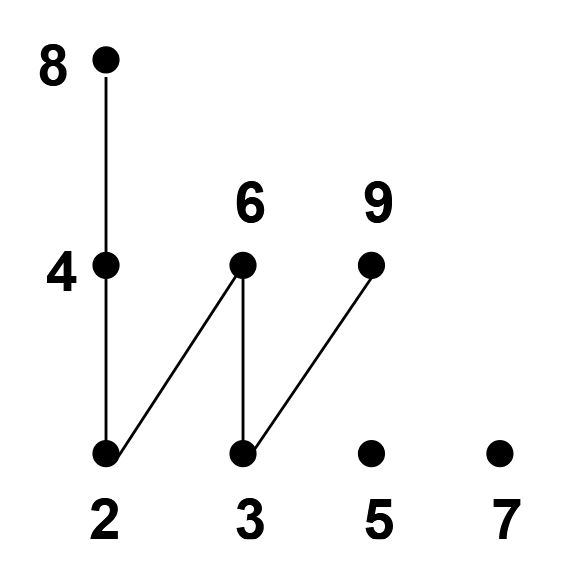
- Minimal elements: \(2, 3, 5, 7\) (primes)
- Maximal elements: \(5, 6, 7, 8, 9\)
- Least or greatest element There is none (not all elements comparable)
Back
In the poset \((\{2, 3, 4, 5, 6, 7, 8, 9\}; |)\), identify the minimal and maximal elements.
- Minimal elements: \(2, 3, 5, 7\) (primes)
- Maximal elements: \(5, 6, 7, 8, 9\)
- Least or greatest element There is none (not all elements comparable)
Field-by-field Comparison
| Field | Before | After |
|---|---|---|
| Text | In the poset \((\{2, 3, 4, 5, 6, 7, 8, 9\}; |)\), identify the minimal and maximal elements.<br><ul><li><strong>Minimal elements</strong>: {{c1:: \(2, 3, 5, 7\) (primes)}}</li><li><strong>Maximal elements</strong>: {{c2:: \(5, 6, 7, 8, 9\)}}</li><li><strong>Least or greatest element</strong> {{c3:: There is none (not all elements comparable)}}</li></ul><div><img src="paste-1d2f8dcd3adedbac7c91aff60842c9ece732a3a8.jpg"></div> |
Note 828: ETH::DiskMat
Deck: ETH::DiskMat
Note Type: Horvath Classic
GUID:
added
Note Type: Horvath Classic
GUID:
pmg@X@cPde
Previous
Note did not exist
New Note
Front
How can we simplify \(R_m(f(a_1, \dots, a_k))\) for a polynomial \(f\)? (Corollary 4.17)
Back
How can we simplify \(R_m(f(a_1, \dots, a_k))\) for a polynomial \(f\)? (Corollary 4.17)
\[R_m(f(a_1, \dots, a_k)) = R_m(f(R_m(a_1), \dots, R_m(a_k)))\]
We can first reduce each argument modulo \(m\), then evaluate the polynomial.
Field-by-field Comparison
| Field | Before | After |
|---|---|---|
| Front | How can we simplify \(R_m(f(a_1, \dots, a_k))\) for a polynomial \(f\)? (Corollary 4.17) | |
| Back | \[R_m(f(a_1, \dots, a_k)) = R_m(f(R_m(a_1), \dots, R_m(a_k)))\] We can first reduce each argument modulo \(m\), then evaluate the polynomial. |
Note 829: ETH::DiskMat
Deck: ETH::DiskMat
Note Type: Horvath Cloze
GUID:
added
Note Type: Horvath Cloze
GUID:
px2&&RIh%e
Previous
Note did not exist
New Note
Front
In any ring \(\langle R; +, -, 0, \cdot, 1 \rangle\), if it's non trivial (more than one element) \(1 \neq 0\)
Back
In any ring \(\langle R; +, -, 0, \cdot, 1 \rangle\), if it's non trivial (more than one element) \(1 \neq 0\)
If \(1=0\), then for all \(a \in R\) : \(a=1⋅a=0⋅a=0\)
So the ring would be trivial (only contains 0).
Field-by-field Comparison
| Field | Before | After |
|---|---|---|
| Text | In any ring \(\langle R; +, -, 0, \cdot, 1 \rangle\), if it's non trivial (more than one element) {{c1:: \(1 \neq 0\)}} | |
| Extra | <div>If \(1=0\), then for all \(a \in R\) : \(a=1⋅a=0⋅a=0\)</div><div><br></div><div>So the ring would be trivial (only contains 0). </div> |
Note 830: ETH::DiskMat
Deck: ETH::DiskMat
Note Type: Horvath Classic
GUID:
added
Note Type: Horvath Classic
GUID:
p|78(#x<7
Previous
Note did not exist
New Note
Front
When is a relation \(\rho\) on set \(A\) transitive?
Back
When is a relation \(\rho\) on set \(A\) transitive?
When \(a \ \rho \ b \land b \ \rho \ c \Rightarrow a \ \rho \ c\) for all \(a, b, c \in A\).
Field-by-field Comparison
| Field | Before | After |
|---|---|---|
| Front | When is a relation \(\rho\) on set \(A\) transitive? | |
| Back | When \(a \ \rho \ b \land b \ \rho \ c \Rightarrow a \ \rho \ c\) for all \(a, b, c \in A\). |
Note 831: ETH::DiskMat
Deck: ETH::DiskMat
Note Type: Horvath Classic
GUID:
added
Note Type: Horvath Classic
GUID:
p~hk22.~%D
Previous
Note did not exist
New Note
Front
What is the relationship between tautologies and unsatisfiable formulas?
Back
What is the relationship between tautologies and unsatisfiable formulas?
A formula \(F\) is a tautology if and only if \(\lnot F\) is unsatisfiable.
Field-by-field Comparison
| Field | Before | After |
|---|---|---|
| Front | What is the relationship between tautologies and unsatisfiable formulas? | |
| Back | A formula \(F\) is a tautology <strong>if and only if</strong> \(\lnot F\) is unsatisfiable. |
Note 832: ETH::DiskMat
Deck: ETH::DiskMat
Note Type: Horvath Cloze
GUID:
added
Note Type: Horvath Cloze
GUID:
q%i_)pDyvo
Previous
Note did not exist
New Note
Front
A prominent example for an uncomputable function is the Halting problem.
Back
A prominent example for an uncomputable function is the Halting problem.
Field-by-field Comparison
| Field | Before | After |
|---|---|---|
| Text | A prominent example for an uncomputable function is {{c1::the <i>Halting problem</i>}}<i>.</i> |
Note 833: ETH::DiskMat
Deck: ETH::DiskMat
Note Type: Horvath Classic
GUID:
added
Note Type: Horvath Classic
GUID:
q+.5DlE?)<
Previous
Note did not exist
New Note
Front
Give the formal definition of Cartesian product \(A \times B\).
Back
Give the formal definition of Cartesian product \(A \times B\).
\[A \times B = \{(a, b) \ | \ a \in A \land b \in B\}\]
The set of all ordered pairs with first component from \(A\) and second from \(B\).
Field-by-field Comparison
| Field | Before | After |
|---|---|---|
| Front | Give the formal definition of Cartesian product \(A \times B\). | |
| Back | \[A \times B = \{(a, b) \ | \ a \in A \land b \in B\}\] The set of all ordered pairs with first component from \(A\) and second from \(B\). |
Note 834: ETH::DiskMat
Deck: ETH::DiskMat
Note Type: Horvath Classic
GUID:
added
Note Type: Horvath Classic
GUID:
q+Di!TuDdT
Previous
Note did not exist
New Note
Front
How many divisors does \(n\) expressed as a factor of prime numbers \(n = \prod_{i = 1}^m p_i^{e_i}\) have?
Back
How many divisors does \(n\) expressed as a factor of prime numbers \(n = \prod_{i = 1}^m p_i^{e_i}\) have?
\(n\) has \(\# _ {\text{div}(n)} = \prod_{i = 1}^m (e_i + 1)\) divisors.
Field-by-field Comparison
| Field | Before | After |
|---|---|---|
| Front | How many divisors does \(n\) expressed as a factor of prime numbers \(n = \prod_{i = 1}^m p_i^{e_i}\) have? | |
| Back | \(n\) has \(\# _ {\text{div}(n)} = \prod_{i = 1}^m (e_i + 1)\) divisors. |
Note 835: ETH::DiskMat
Deck: ETH::DiskMat
Note Type: Horvath Cloze
GUID:
added
Note Type: Horvath Cloze
GUID:
q={`z2{i#x
Previous
Note did not exist
New Note
Front
We can transform every formula into:
- prenex
- CNF
- DNF
- Skolem
Back
We can transform every formula into:
- prenex
- CNF
- DNF
- Skolem
Field-by-field Comparison
| Field | Before | After |
|---|---|---|
| Text | We can transform every formula into:<br><ul><li>{{c1::<b>prenex</b>}}<br></li><li>{{c2::<b>CNF</b>}}<br></li><li>{{c3::<b>DNF</b>}}</li><li>{{c4::<b>Skolem</b>}}</li></ul> |
Note 836: ETH::DiskMat
Deck: ETH::DiskMat
Note Type: Horvath Classic
GUID:
added
Note Type: Horvath Classic
GUID:
q?95w$fJDO
Previous
Note did not exist
New Note
Front
What is \(F[x]_{m(x)}\)?
Back
What is \(F[x]_{m(x)}\)?
Let \(m(x)\) be a polynomial of degree \(d\) over \(F\). Then: \[F[x]_{m(x)} \ \overset{\text{def}}{=} \ \{a(x) \in F[x] \ | \ \deg(a(x)) < d\}\]
This is the set of all polynomials over \(F\) with degree strictly less than \(d\).
Field-by-field Comparison
| Field | Before | After |
|---|---|---|
| Front | <p>What is \(F[x]_{m(x)}\)?</p> | |
| Back | <p>Let \(m(x)\) be a polynomial of degree \(d\) over \(F\). Then: \[F[x]_{m(x)} \ \overset{\text{def}}{=} \ \{a(x) \in F[x] \ | \ \deg(a(x)) < d\}\]</p> <p>This is the set of all polynomials over \(F\) with <strong>degree strictly less than \(d\)</strong>.</p> |
Note 837: ETH::DiskMat
Deck: ETH::DiskMat
Note Type: Horvath Classic
GUID:
added
Note Type: Horvath Classic
GUID:
qAyHDnFN7L
Previous
Note did not exist
New Note
Front
What is the number of generators of \(\mathbb{Z}_n^*\)?
Back
What is the number of generators of \(\mathbb{Z}_n^*\)?
1. verify that \(\mathbb{Z}_n^*\)is cyclic (iff n = 2, 4, \(p^e\), \(2p^e\), with \(e \ge 1\) and \(p\) is an odd prime)
2. if \(\mathbb{Z}_n^*\) is cyclic then it is isomorphic to \(\mathbb{Z}_{\varphi(n)}^+\) (by lemma)
3. the number of generators of \(\mathbb{Z}_{\varphi(n)}^+\) is \(\varphi(\varphi(n))\) as it is the number of coprime elements of the group
2. if \(\mathbb{Z}_n^*\) is cyclic then it is isomorphic to \(\mathbb{Z}_{\varphi(n)}^+\) (by lemma)
3. the number of generators of \(\mathbb{Z}_{\varphi(n)}^+\) is \(\varphi(\varphi(n))\) as it is the number of coprime elements of the group
Field-by-field Comparison
| Field | Before | After |
|---|---|---|
| Front | What is the number of generators of \(\mathbb{Z}_n^*\)? | |
| Back | 1. verify that \(\mathbb{Z}_n^*\)is cyclic (iff n = 2, 4, \(p^e\), \(2p^e\), with \(e \ge 1\) and \(p\) is an odd prime)<br>2. if \(\mathbb{Z}_n^*\) is cyclic then it is isomorphic to \(\mathbb{Z}_{\varphi(n)}^+\) (by lemma) <br>3. the number of generators of \(\mathbb{Z}_{\varphi(n)}^+\) is \(\varphi(\varphi(n))\) as it is the number of coprime elements of the group |
Note 838: ETH::DiskMat
Deck: ETH::DiskMat
Note Type: Horvath Cloze
GUID:
added
Note Type: Horvath Cloze
GUID:
qFQ3yDTc>-
Previous
Note did not exist
New Note
Front
An element \(u\) of a ring \(R\) is called a unit if \(u\) is invertible.
Back
An element \(u\) of a ring \(R\) is called a unit if \(u\) is invertible.
Field-by-field Comparison
| Field | Before | After |
|---|---|---|
| Text | <p>An element \(u\) of a ring \(R\) is called a {{c1::unit}} if \(u\) is {{c2::invertible}}.</p> |
Note 839: ETH::DiskMat
Deck: ETH::DiskMat
Note Type: Horvath Cloze
GUID:
added
Note Type: Horvath Cloze
GUID:
qFYoZgCSMu
Previous
Note did not exist
New Note
Front
The predicate \(\tau\) defines the {{c1:: set of strings \(L \subseteq \{0, 1\}\) that correspond to true statements}}.
Back
The predicate \(\tau\) defines the {{c1:: set of strings \(L \subseteq \{0, 1\}\) that correspond to true statements}}.
Field-by-field Comparison
| Field | Before | After |
|---|---|---|
| Text | The predicate \(\tau\) defines the {{c1:: set of strings \(L \subseteq \{0, 1\}\) that correspond to true statements}}. |
Note 840: ETH::DiskMat
Deck: ETH::DiskMat
Note Type: Horvath Cloze
GUID:
added
Note Type: Horvath Cloze
GUID:
qScQPkEg%q
Previous
Note did not exist
New Note
Front
A logical formula is generally not a mathematical statement, because the truth value depends on the interpretation of the symbols.
Back
A logical formula is generally not a mathematical statement, because the truth value depends on the interpretation of the symbols.
(so we can't prove/disprove it)
Field-by-field Comparison
| Field | Before | After |
|---|---|---|
| Text | A logical formula is generally <i>not</i> a mathematical statement, because {{c1::the truth value depends on the interpretation of the symbols}}. | |
| Extra | (so we can't prove/disprove it) |
Note 841: ETH::DiskMat
Deck: ETH::DiskMat
Note Type: Horvath Classic
GUID:
added
Note Type: Horvath Classic
GUID:
q[i&,qVWc9
Previous
Note did not exist
New Note
Front
What is modular congruence in a field?
Back
What is modular congruence in a field?
\[a(x) \equiv_{m(x)} b(x) \quad \overset{\text{def}}{\Leftrightarrow} \quad m(x) \ | \ (a(x) - b(x))\]
Field-by-field Comparison
| Field | Before | After |
|---|---|---|
| Front | <p>What is modular congruence in a field?</p> | |
| Back | <p>\[a(x) \equiv_{m(x)} b(x) \quad \overset{\text{def}}{\Leftrightarrow} \quad m(x) \ | \ (a(x) - b(x))\]</p> |
Note 842: ETH::DiskMat
Deck: ETH::DiskMat
Note Type: Horvath Classic
GUID:
added
Note Type: Horvath Classic
GUID:
q]nbKvbP{^
Previous
Note did not exist
New Note
Front
In a field, you can:
Back
In a field, you can:
- add
- subtract
- multiply
- divide by any nonzero element.
You can divide as in a field, the multiplicative monoid is also a group (without \(0\), thus \(0\) cannot be divided by - no inverse).
Field-by-field Comparison
| Field | Before | After |
|---|---|---|
| Front | <p>In a field, you can:</p> | |
| Back | <ul> <li>add</li> <li>subtract</li> <li>multiply</li> <li><em>divide</em> by any nonzero element.</li> </ul> <p>You can divide as in a field, the multiplicative monoid is also a <em>group</em> (without \(0\), thus \(0\) cannot be divided by - no inverse).</p> |
Note 843: ETH::DiskMat
Deck: ETH::DiskMat
Note Type: Horvath Classic
GUID:
added
Note Type: Horvath Classic
GUID:
q_~/j+G,$p
Previous
Note did not exist
New Note
Front
What is the fundamental theorem of arithmetic?
Back
What is the fundamental theorem of arithmetic?
Every positive integer can be written uniquely as the product of primes.
Field-by-field Comparison
| Field | Before | After |
|---|---|---|
| Front | What is the <i>fundamental theorem of arithmetic</i>? | |
| Back | Every positive integer can be written uniquely as the product of primes. |
Note 844: ETH::DiskMat
Deck: ETH::DiskMat
Note Type: Horvath Cloze
GUID:
added
Note Type: Horvath Cloze
GUID:
qi1M.
Previous
Note did not exist
New Note
Front
When an operation is associative, \(a_1 * a_2 * \dots * a_n\) is independent of the order of execution.
Back
When an operation is associative, \(a_1 * a_2 * \dots * a_n\) is independent of the order of execution.
Field-by-field Comparison
| Field | Before | After |
|---|---|---|
| Text | <p>When an operation is associative, \(a_1 * a_2 * \dots * a_n\) is {{c1::independent of the order of execution}}.</p> |
Note 845: ETH::DiskMat
Deck: ETH::DiskMat
Note Type: Horvath Cloze
GUID:
added
Note Type: Horvath Cloze
GUID:
qnpI?yoaky
Previous
Note did not exist
New Note
Front
What three properties must a relation have to be a partial order:
1. Reflexive
2. Antisymmetric
3. Transitive
1. Reflexive
2. Antisymmetric
3. Transitive
Back
What three properties must a relation have to be a partial order:
1. Reflexive
2. Antisymmetric
3. Transitive
1. Reflexive
2. Antisymmetric
3. Transitive
Field-by-field Comparison
| Field | Before | After |
|---|---|---|
| Text | What three properties must a relation have to be a partial order:<br>1. {{c1:: <b>Reflexive</b>}}<br>2. {{c2:: <b>Antisymmetric</b>}}<br>3. {{c3:: <b>Transitive</b>}} |
Note 846: ETH::DiskMat
Deck: ETH::DiskMat
Note Type: Horvath Cloze
GUID:
added
Note Type: Horvath Cloze
GUID:
qo:})x5a6`
Previous
Note did not exist
New Note
Front
In a group, the equations \(a * x = b\) and \(x * a = b\) have unique solutions for all \(a, b\) (property G3(v)).
Back
In a group, the equations \(a * x = b\) and \(x * a = b\) have unique solutions for all \(a, b\) (property G3(v)).
Field-by-field Comparison
| Field | Before | After |
|---|---|---|
| Text | <p>In a group, the equations \({{c1::a * x = b}}\) and \({{c2::x * a = b}}\) have {{c3::unique solutions}} for all \(a, b\) (property G3(v)).</p> |
Note 847: ETH::DiskMat
Deck: ETH::DiskMat
Note Type: Horvath Cloze
GUID:
added
Note Type: Horvath Cloze
GUID:
q|}rXYFly~
Previous
Note did not exist
New Note
Front
The Euler function \(\varphi: \mathbb{Z}^+ \rightarrow \mathbb{Z}^+\) is defined as {{c2::the cardinality of \(\mathbb{Z}_m^*\): \[\varphi(m) = |\mathbb{Z}_m^*|\]}}.
Back
The Euler function \(\varphi: \mathbb{Z}^+ \rightarrow \mathbb{Z}^+\) is defined as {{c2::the cardinality of \(\mathbb{Z}_m^*\): \[\varphi(m) = |\mathbb{Z}_m^*|\]}}.
Field-by-field Comparison
| Field | Before | After |
|---|---|---|
| Text | <p>The {{c1::Euler function}} \(\varphi: \mathbb{Z}^+ \rightarrow \mathbb{Z}^+\) is defined as {{c2::the cardinality of \(\mathbb{Z}_m^*\): \[\varphi(m) = |\mathbb{Z}_m^*|\]}}.</p> |
Note 848: ETH::DiskMat
Deck: ETH::DiskMat
Note Type: Horvath Classic
GUID:
added
Note Type: Horvath Classic
GUID:
r.P@LlU$vR
Previous
Note did not exist
New Note
Front
Give the formal definition of the least common multiple \(\text{lcm}(a, b)\).
Back
Give the formal definition of the least common multiple \(\text{lcm}(a, b)\).
\[a | l \land b | l \land \forall m \ ((a | m \land b | m) \rightarrow l | m)\]
\(l\) is a common multiple of \(a\) and \(b\) which divides every common multiple of \(a\) and \(b\).
Field-by-field Comparison
| Field | Before | After |
|---|---|---|
| Front | Give the formal definition of the least common multiple \(\text{lcm}(a, b)\). | |
| Back | \[a | l \land b | l \land \forall m \ ((a | m \land b | m) \rightarrow l | m)\] \(l\) is a common multiple of \(a\) and \(b\) which divides every common multiple of \(a\) and \(b\). |
Note 849: ETH::DiskMat
Deck: ETH::DiskMat
Note Type: Horvath Classic
GUID:
added
Note Type: Horvath Classic
GUID:
r3)589~fN6
Previous
Note did not exist
New Note
Front
What is the cardinality of \(F[x]_{m(x)}\)?
Back
What is the cardinality of \(F[x]_{m(x)}\)?
Lemma 5.34: Let \(F\) be a finite field with \(q\) elements and let \(m(x)\) be a polynomial of degree \(d\) over \(F\). Then: \[|F[x]_{m(x)}| = q^d\]
Explanation: Each polynomial has \(d\) coefficients, and each coefficient can be any of \(q\) elements from \(F\).
Field-by-field Comparison
| Field | Before | After |
|---|---|---|
| Front | <p>What is the cardinality of \(F[x]_{m(x)}\)?</p> | |
| Back | <p><strong>Lemma 5.34</strong>: Let \(F\) be a finite field with \(q\) elements and let \(m(x)\) be a polynomial of degree \(d\) over \(F\). Then: \[|F[x]_{m(x)}| = q^d\]</p> <p><strong>Explanation</strong>: Each polynomial has \(d\) coefficients, and each coefficient can be any of \(q\) elements from \(F\).</p> |
Note 850: ETH::DiskMat
Deck: ETH::DiskMat
Note Type: Horvath Classic
GUID:
added
Note Type: Horvath Classic
GUID:
rI[60?4iFu
Previous
Note did not exist
New Note
Front
A group has the following properties:
Back
A group has the following properties:
- closure
- associativity
- identity
- inverse
Field-by-field Comparison
| Field | Before | After |
|---|---|---|
| Front | A <b>group</b> has the following properties: | |
| Back | <ul><li>closure</li><li>associativity</li><li>identity</li><li>inverse</li></ul> |
Note 851: ETH::DiskMat
Deck: ETH::DiskMat
Note Type: Horvath Cloze
GUID:
added
Note Type: Horvath Cloze
GUID:
rMrK0z!nVO
Previous
Note did not exist
New Note
Front
In a cyclic group \(\langle g \rangle\), associativity is inherited from the parent group \(G\).
Back
In a cyclic group \(\langle g \rangle\), associativity is inherited from the parent group \(G\).
Field-by-field Comparison
| Field | Before | After |
|---|---|---|
| Text | <p>In a cyclic group \(\langle g \rangle\), {{c1::associativity}} is {{c2::inherited}} from the parent group \({{c3::G}}\).</p> |
Note 852: ETH::DiskMat
Deck: ETH::DiskMat
Note Type: Horvath Cloze
GUID:
added
Note Type: Horvath Cloze
GUID:
rU5OFOfB=/
Previous
Note did not exist
New Note
Front
In any commutative ring, if \(a \ | \ b\) then \(a \ | \ bc\) for all \(c\).
Back
In any commutative ring, if \(a \ | \ b\) then \(a \ | \ bc\) for all \(c\).
Field-by-field Comparison
| Field | Before | After |
|---|---|---|
| Text | <div>In any commutative ring, if \(a \ | \ b\) then {{c1:: \(a \ | \ bc\)}} for all \(c\).</div> |
Note 853: ETH::DiskMat
Deck: ETH::DiskMat
Note Type: Horvath Cloze
GUID:
added
Note Type: Horvath Cloze
GUID:
rkyD`Rw*Nl
Previous
Note did not exist
New Note
Front
We are allowed to swap quantifier order in a formula if:
- they are of the same type
- the variables don't appear nested together
Back
We are allowed to swap quantifier order in a formula if:
- they are of the same type
- the variables don't appear nested together
Field-by-field Comparison
| Field | Before | After |
|---|---|---|
| Text | We are allowed to swap quantifier order in a formula if:<br><ul><li>{{c1:: they are of the same type}}</li><li>{{c2:: the variables don't appear nested together}}</li></ul> |
Note 854: ETH::DiskMat
Deck: ETH::DiskMat
Note Type: Horvath Classic
GUID:
added
Note Type: Horvath Classic
GUID:
rz^&c?ddI>
Previous
Note did not exist
New Note
Front
G is a logical conseqence of F. What does that mean?
Back
G is a logical conseqence of F. What does that mean?
\( F \models G\) if G is always true if F is true, but not necessarily false when F is false. (No causality!)
Field-by-field Comparison
| Field | Before | After |
|---|---|---|
| Front | G is a <i>logical conse</i><i>qence </i>of F. What does that mean? | |
| Back | \( F \models G\) if G is always true if F is true, but not necessarily false when F is false. (No causality!)<br> |
Note 855: ETH::DiskMat
Deck: ETH::DiskMat
Note Type: Horvath Cloze
GUID:
added
Note Type: Horvath Cloze
GUID:
s$,Xim%,O5
Previous
Note did not exist
New Note
Front
Lemma 5.22(3): The units of \(D[x]\) are the constant polynomials that are units of \(D\): \(D[x]^* = D^*\).
Back
Lemma 5.22(3): The units of \(D[x]\) are the constant polynomials that are units of \(D\): \(D[x]^* = D^*\).
Field-by-field Comparison
| Field | Before | After |
|---|---|---|
| Text | <p><strong>Lemma 5.22(3)</strong>: The {{c1::units of \(D[x]\)}} are the {{c2::constant polynomials that are units of \(D\): \(D[x]^* = D^*\)}}.</p> |
Note 856: ETH::DiskMat
Deck: ETH::DiskMat
Note Type: Horvath Cloze
GUID:
added
Note Type: Horvath Cloze
GUID:
s&thqL60qD
Previous
Note did not exist
New Note
Front
For \(a,b,m\in\mathbb{Z}\) with \(m\ge1\), we say that \(a\) is congruent to \(b\) modulo \(m\) if \(m\) divides \(a-b\). Written as an expression: \(a\equiv_mb \iff m \mid (a-b)\).
Back
For \(a,b,m\in\mathbb{Z}\) with \(m\ge1\), we say that \(a\) is congruent to \(b\) modulo \(m\) if \(m\) divides \(a-b\). Written as an expression: \(a\equiv_mb \iff m \mid (a-b)\).
Field-by-field Comparison
| Field | Before | After |
|---|---|---|
| Text | For \(a,b,m\in\mathbb{Z}\) with \(m\ge1\), we say that \(a\) is <i>congruent to </i>\(b\) <i>modulo </i>\(m\) if {{c1:: \(m\) divides \(a-b\)}}. Written as an expression:{{c1:: \(a\equiv_mb \iff m \mid (a-b)\).}} |
Note 857: ETH::DiskMat
Deck: ETH::DiskMat
Note Type: Horvath Cloze
GUID:
added
Note Type: Horvath Cloze
GUID:
s(DE`)q*(T
Previous
Note did not exist
New Note
Front
A partial order on a set \(A\) is a relation that is
* reflexive
* antisymmetric
* transitive
Back
A partial order on a set \(A\) is a relation that is
* reflexive
* antisymmetric
* transitive
Examples: \(\leq, \geq\)
Field-by-field Comparison
| Field | Before | After |
|---|---|---|
| Text | {{c1::A partial order}} on a set \(A\) is a relation that is<div>{{c2::<div>* reflexive</div><div>* antisymmetric</div><div>* transitive</div>}}<br></div> | |
| Extra | Examples: \(\leq, \geq\) |
Note 858: ETH::DiskMat
Deck: ETH::DiskMat
Note Type: Horvath Cloze
GUID:
added
Note Type: Horvath Cloze
GUID:
s*8T*K?3f=
Previous
Note did not exist
New Note
Front
A function \(f: A \rightarrow B\) has a left inverse if and only if \(f\) is injective.
Back
A function \(f: A \rightarrow B\) has a left inverse if and only if \(f\) is injective.
Field-by-field Comparison
| Field | Before | After |
|---|---|---|
| Text | <p>A function \(f: A \rightarrow B\) has a {{c1::left inverse}} if and only if \(f\) is {{c2::injective}}.</p> |
Note 859: ETH::DiskMat
Deck: ETH::DiskMat
Note Type: Horvath Cloze
GUID:
added
Note Type: Horvath Cloze
GUID:
s2,pAWT0;U
Previous
Note did not exist
New Note
Front
An irreducible polynomial of degree \(\geq 2\) has no roots.
Back
An irreducible polynomial of degree \(\geq 2\) has no roots.
Field-by-field Comparison
| Field | Before | After |
|---|---|---|
| Text | <p>An <strong>irreducible</strong> polynomial of degree \(\geq 2\) has {{c1:: <strong>no roots</strong>}}.</p> |
Note 860: ETH::DiskMat
Deck: ETH::DiskMat
Note Type: Horvath Cloze
GUID:
added
Note Type: Horvath Cloze
GUID:
s4qU[:Rl0m
Previous
Note did not exist
New Note
Front
A poset \((A; \preceq)\) is called totally ordered (also: linearly ordered) by \(\preceq\) if any two elements of the poset are comparable.
Back
A poset \((A; \preceq)\) is called totally ordered (also: linearly ordered) by \(\preceq\) if any two elements of the poset are comparable.
Example: \((\mathbb{Z}; \ge)\)
Field-by-field Comparison
| Field | Before | After |
|---|---|---|
| Text | A poset \((A; \preceq)\) is called {{c2::<b>totally ordered</b> (also: linearly ordered) by \(\preceq\)}} if {{c1::any two elements of the poset are comparable.}} | |
| Extra | Example: \((\mathbb{Z}; \ge)\) |
Note 861: ETH::DiskMat
Deck: ETH::DiskMat
Note Type: Horvath Classic
GUID:
added
Note Type: Horvath Classic
GUID:
s7*HAj`,kR
Previous
Note did not exist
New Note
Front
Name four examples for (binary) relations as defined in Discrete Mathematics.
Back
Name four examples for (binary) relations as defined in Discrete Mathematics.
\(=, \ne, \le, \ge, <, >, \mid, \dots\)
Field-by-field Comparison
| Field | Before | After |
|---|---|---|
| Front | Name four examples for (binary) relations as defined in Discrete Mathematics. | |
| Back | \(=, \ne, \le, \ge, <, >, \mid, \dots\) |
Note 862: ETH::DiskMat
Deck: ETH::DiskMat
Note Type: Horvath Classic
GUID:
added
Note Type: Horvath Classic
GUID:
s>%Mz^.26_
Previous
Note did not exist
New Note
Front
Name a zerodivisor in a Ring.
Back
Name a zerodivisor in a Ring.
\(2\) is a zerodivisor of \(\mathbb{Z}_4\), as \(2*2 = 0\).
Field-by-field Comparison
| Field | Before | After |
|---|---|---|
| Front | <p>Name a zerodivisor in a Ring.</p> | |
| Back | <p>\(2\) is a zerodivisor of \(\mathbb{Z}_4\), as \(2*2 = 0\).</p> |
Note 863: ETH::DiskMat
Deck: ETH::DiskMat
Note Type: Horvath Classic
GUID:
added
Note Type: Horvath Classic
GUID:
s?tB!9azRK
Previous
Note did not exist
New Note
Front
An abelian group has the following properties:
Back
An abelian group has the following properties:
- closure
- associativity
- identity
- inverse
- commutative
Field-by-field Comparison
| Field | Before | After |
|---|---|---|
| Front | An <b>abelian group</b> has the following properties: | |
| Back | <ul><li>closure</li><li>associativity</li><li>identity</li><li>inverse</li><li>commutative</li></ul> |
Note 864: ETH::DiskMat
Deck: ETH::DiskMat
Note Type: Horvath Cloze
GUID:
added
Note Type: Horvath Cloze
GUID:
sQoa!PVGy1
Previous
Note did not exist
New Note
Front
\(\mathbb{Z}_m^*\) is useful compared to \(\mathbb{Z}_m\)because {{c1::\(\mathbb{Z}_m\)is not a group with respect to multiplication modulo \(m\), but we would like to have this for building RSA}}.
Back
\(\mathbb{Z}_m^*\) is useful compared to \(\mathbb{Z}_m\)because {{c1::\(\mathbb{Z}_m\)is not a group with respect to multiplication modulo \(m\), but we would like to have this for building RSA}}.
Not all element in Zm have an inverse, something which Zm* guarantees by bezout.
Field-by-field Comparison
| Field | Before | After |
|---|---|---|
| Text | \(\mathbb{Z}_m^*\) is useful compared to \(\mathbb{Z}_m\)because {{c1::\(\mathbb{Z}_m\)is not a group with respect to multiplication modulo \(m\), but we would like to have this for building RSA}}. | |
| Extra | Not all element in Zm have an inverse, something which Zm* guarantees by bezout. |
Note 865: ETH::DiskMat
Deck: ETH::DiskMat
Note Type: Horvath Classic
GUID:
added
Note Type: Horvath Classic
GUID:
sXwCtB@o/s
Previous
Note did not exist
New Note
Front
What \(a \in \mathbb{Z}_n\) generate \(\mathbb{Z}_n\)?
Back
What \(a \in \mathbb{Z}_n\) generate \(\mathbb{Z}_n\)?
All \(a \in \mathbb{Z}_n\) such that \(\gcd(a, n) = 1\).
Field-by-field Comparison
| Field | Before | After |
|---|---|---|
| Front | What \(a \in \mathbb{Z}_n\) generate \(\mathbb{Z}_n\)? | |
| Back | All \(a \in \mathbb{Z}_n\) such that \(\gcd(a, n) = 1\). |
Note 866: ETH::DiskMat
Deck: ETH::DiskMat
Note Type: Horvath Cloze
GUID:
added
Note Type: Horvath Cloze
GUID:
s[Y-0E4#sz
Previous
Note did not exist
New Note
Front
A ring \(\langle R, +, -, 0, \cdot, 1 \rangle\) is an algebra with the properties that
- \(\langle R, +, -, 0 \rangle\) is a commutative group
- \(\langle R, \cdot, 1 \rangle\) is a monoid
- \( a(b+c) = (ab) + (ac), (b+c)a = (ba) + (ca)\) (left and right distributive laws)
Back
A ring \(\langle R, +, -, 0, \cdot, 1 \rangle\) is an algebra with the properties that
- \(\langle R, +, -, 0 \rangle\) is a commutative group
- \(\langle R, \cdot, 1 \rangle\) is a monoid
- \( a(b+c) = (ab) + (ac), (b+c)a = (ba) + (ca)\) (left and right distributive laws)
Examples: \(\mathbb{Z}, \mathbb{R}\)
Field-by-field Comparison
| Field | Before | After |
|---|---|---|
| Text | {{c1::A ring \(\langle R, +, -, 0, \cdot, 1 \rangle\)}} is an algebra with the properties that<br><ul><li>{{c2::\(\langle R, +, -, 0 \rangle\) is a commutative group}}<br></li><li>{{c3::\(\langle R, \cdot, 1 \rangle\) is a monoid}}</li><li>{{c4::\( a(b+c) = (ab) + (ac), (b+c)a = (ba) + (ca)\) (left and right distributive laws)}}</li></ul> | |
| Extra | Examples: \(\mathbb{Z}, \mathbb{R}\) |
Note 867: ETH::DiskMat
Deck: ETH::DiskMat
Note Type: Horvath Cloze
GUID:
added
Note Type: Horvath Cloze
GUID:
s[dJ]w
Previous
Note did not exist
New Note
Front
A relation ρ on a set A is called antisymmetric if {{c1::\( a \ \rho \ b \wedge b \ \rho \ a \implies a = b\) is true, i.e. if \( \rho \cap \hat{\rho} \subseteq \text{id}\)}}
Back
A relation ρ on a set A is called antisymmetric if {{c1::\( a \ \rho \ b \wedge b \ \rho \ a \implies a = b\) is true, i.e. if \( \rho \cap \hat{\rho} \subseteq \text{id}\)}}
Example: \( \le, \ge\) and the division relation: \( a \mid b \wedge b \mid a \implies a = b\)
Field-by-field Comparison
| Field | Before | After |
|---|---|---|
| Text | A relation ρ on a set A is called {{c2::antisymmetric}} if {{c1::\( a \ \rho \ b \wedge b \ \rho \ a \implies a = b\) is true, i.e. if \( \rho \cap \hat{\rho} \subseteq \text{id}\)}} | |
| Extra | Example: \( \le, \ge\) and the division relation: \( a \mid b \wedge b \mid a \implies a = b\) |
Note 868: ETH::DiskMat
Deck: ETH::DiskMat
Note Type: Horvath Classic
GUID:
added
Note Type: Horvath Classic
GUID:
s]+I0[)5QL
Previous
Note did not exist
New Note
Front
Show that \(\mathbb{Z}\) is countable by exhibiting a bijection with \(\mathbb{N}\).
Back
Show that \(\mathbb{Z}\) is countable by exhibiting a bijection with \(\mathbb{N}\).
The function \(f(n) = (-1)^n \lceil n/2 \rceil\) is a bijection \(\mathbb{N} \to \mathbb{Z}\).
Maps: \(0 \mapsto 0, 1 \mapsto 1, 2 \mapsto -1, 3 \mapsto 2, 4 \mapsto -2, \ldots\)
Maps: \(0 \mapsto 0, 1 \mapsto 1, 2 \mapsto -1, 3 \mapsto 2, 4 \mapsto -2, \ldots\)
Field-by-field Comparison
| Field | Before | After |
|---|---|---|
| Front | Show that \(\mathbb{Z}\) is countable by exhibiting a bijection with \(\mathbb{N}\). | |
| Back | The function \(f(n) = (-1)^n \lceil n/2 \rceil\) is a bijection \(\mathbb{N} \to \mathbb{Z}\). <br> Maps: \(0 \mapsto 0, 1 \mapsto 1, 2 \mapsto -1, 3 \mapsto 2, 4 \mapsto -2, \ldots\) |
Note 869: ETH::DiskMat
Deck: ETH::DiskMat
Note Type: Horvath Cloze
GUID:
added
Note Type: Horvath Cloze
GUID:
s`dg
Previous
Note did not exist
New Note
Front
If both \(b * a = e\) and \(a * b = e\), then \(b\) is simply called an inverse of \(a\).
Back
If both \(b * a = e\) and \(a * b = e\), then \(b\) is simply called an inverse of \(a\).
Field-by-field Comparison
| Field | Before | After |
|---|---|---|
| Text | <p>If both {{c1::\(b * a = e\)}} and {{c2::\(a * b = e\)}}, then \({{c3::b}}\) is simply called an {{c4::inverse}} of \(a\).</p> |
Note 870: ETH::DiskMat
Deck: ETH::DiskMat
Note Type: Horvath Classic
GUID:
added
Note Type: Horvath Classic
GUID:
sjn:t.?:uH
Previous
Note did not exist
New Note
Front
What are the two steps of a proof by induction?
Back
What are the two steps of a proof by induction?
1. Basis Step: Prove \(P(0)\) (or \(P(1)\) or \(P(k)\) depending on universe)
2. Induction Step: Prove that for any arbitrary \(n\), \(P(n) \Rightarrow P(n+1)\) (assuming \(P(n)\) as the induction hypothesis)
2. Induction Step: Prove that for any arbitrary \(n\), \(P(n) \Rightarrow P(n+1)\) (assuming \(P(n)\) as the induction hypothesis)
Field-by-field Comparison
| Field | Before | After |
|---|---|---|
| Front | What are the two steps of a proof by induction? | |
| Back | 1. <strong>Basis Step</strong>: Prove \(P(0)\) (or \(P(1)\) or \(P(k)\) depending on universe) <br>2. <strong>Induction Step</strong>: Prove that for any arbitrary \(n\), \(P(n) \Rightarrow P(n+1)\) (assuming \(P(n)\) as the induction hypothesis) |
Note 871: ETH::DiskMat
Deck: ETH::DiskMat
Note Type: Horvath Classic
GUID:
added
Note Type: Horvath Classic
GUID:
sxW-Trt$`+
Previous
Note did not exist
New Note
Front
\(\mathbb{Z}_m^*\) is defined as?
Back
\(\mathbb{Z}_m^*\) is defined as?
\[ \overset{\text{def}}{=} \ \{a \in \mathbb{Z}_m \ | \ \gcd(a, m) = 1\} \]
This is the set of all elements in \(\mathbb{Z}_m\) that are coprime to \(m\).
Field-by-field Comparison
| Field | Before | After |
|---|---|---|
| Front | <p>\(\mathbb{Z}_m^*\) is defined as?</p> | |
| Back | <p>\[ \overset{\text{def}}{=} \ \{a \in \mathbb{Z}_m \ | \ \gcd(a, m) = 1\} \]</p><br><p>This is the set of all elements in \(\mathbb{Z}_m\) that are coprime to \(m\).</p> |
Note 872: ETH::DiskMat
Deck: ETH::DiskMat
Note Type: Horvath Cloze
GUID:
added
Note Type: Horvath Cloze
GUID:
t$?o*APa?u
Previous
Note did not exist
New Note
Front
We denote the field with \(p\) elements (where \(p\) is prime) by {{c2::\(\text{GF}(p)\) rather than \(\mathbb{Z}_p\)}}.
Back
We denote the field with \(p\) elements (where \(p\) is prime) by {{c2::\(\text{GF}(p)\) rather than \(\mathbb{Z}_p\)}}.
Field-by-field Comparison
| Field | Before | After |
|---|---|---|
| Text | <p>We denote the {{c1:: field with \(p\) elements (where \(p\) is prime)}} by {{c2::\(\text{GF}(p)\) rather than \(\mathbb{Z}_p\)}}.</p> |
Note 873: ETH::DiskMat
Deck: ETH::DiskMat
Note Type: Horvath Classic
GUID:
added
Note Type: Horvath Classic
GUID:
t4rUQSlGPE
Previous
Note did not exist
New Note
Front
For what types of posets is well-ordering primarily of interest?
Back
For what types of posets is well-ordering primarily of interest?
Infinite posets. (Every totally ordered finite poset is automatically well-ordered)
Field-by-field Comparison
| Field | Before | After |
|---|---|---|
| Front | For what types of posets is well-ordering primarily of interest? | |
| Back | <strong>Infinite posets</strong>. (Every totally ordered finite poset is automatically well-ordered) |
Note 874: ETH::DiskMat
Deck: ETH::DiskMat
Note Type: Horvath Classic
GUID:
added
Note Type: Horvath Classic
GUID:
tBd|.5x#E:
Previous
Note did not exist
New Note
Front
How is the lexicographic order \(\leq_{\text{lex}}\) on \(A \times B\) defined?
Back
How is the lexicographic order \(\leq_{\text{lex}}\) on \(A \times B\) defined?
\[(a_1, b_1) \leq_{\text{lex}} (a_2, b_2) \overset{\text{def}}{\Longleftrightarrow} a_1 \preceq a_2 \lor (a_1 = a_2 \land b_1 \sqsubseteq b_2)\]
Field-by-field Comparison
| Field | Before | After |
|---|---|---|
| Front | How is the lexicographic order \(\leq_{\text{lex}}\) on \(A \times B\) defined? | |
| Back | \[(a_1, b_1) \leq_{\text{lex}} (a_2, b_2) \overset{\text{def}}{\Longleftrightarrow} a_1 \preceq a_2 \lor (a_1 = a_2 \land b_1 \sqsubseteq b_2)\] |
Note 875: ETH::DiskMat
Deck: ETH::DiskMat
Note Type: Horvath Cloze
GUID:
added
Note Type: Horvath Cloze
GUID:
tNw~Zi`Up.
Previous
Note did not exist
New Note
Front
In any commutative ring: If \(a \ | \ b\) and \(b \ | \ c\) then \(a \ | \ c\), i.e. the relation | is transitive.
Back
In any commutative ring: If \(a \ | \ b\) and \(b \ | \ c\) then \(a \ | \ c\), i.e. the relation | is transitive.
Field-by-field Comparison
| Field | Before | After |
|---|---|---|
| Text | <div>In any commutative ring: If \(a \ | \ b\) and \(b \ | \ c\) then {{c1:: \(a \ | \ c\), i.e. the relation | is transitive}}.</div> |
Note 876: ETH::DiskMat
Deck: ETH::DiskMat
Note Type: Horvath Classic
GUID:
added
Note Type: Horvath Classic
GUID:
tXnVRUZ1r.
Previous
Note did not exist
New Note
Front
To show that a newly defined operator can be used to express any formula, we show that:
Back
To show that a newly defined operator can be used to express any formula, we show that:
\(\lnot F\), \(F \lor G\) and \(F \land G\) can be rewritten only in terms of it.
For example NOT, AND, OR can be expressed in NAND form, thus we can rewritten in CNF (or DNF) then NANDs (by simply replacing).
For example NOT, AND, OR can be expressed in NAND form, thus we can rewritten in CNF (or DNF) then NANDs (by simply replacing).
Field-by-field Comparison
| Field | Before | After |
|---|---|---|
| Front | To show that a newly defined operator can be used to express any formula, we show that: | |
| Back | \(\lnot F\), \(F \lor G\) and \(F \land G\) can be rewritten <b>only</b> in terms of it.<br><br>For example NOT, AND, OR can be expressed in NAND form, thus we can rewritten in CNF (or DNF) then NANDs (by simply replacing). |
Note 877: ETH::DiskMat
Deck: ETH::DiskMat
Note Type: Horvath Classic
GUID:
added
Note Type: Horvath Classic
GUID:
tg<_s~pb{P
Previous
Note did not exist
New Note
Front
Proof method: "Composition of Implications"
Back
Proof method: "Composition of Implications"
Idea: If \( S \implies T \) and \( T \implies U \) are both true, then \( S \implies U \) is also true.
Field-by-field Comparison
| Field | Before | After |
|---|---|---|
| Front | Proof method: "Composition of Implications" | |
| Back | Idea: If \( S \implies T \) and \( T \implies U \) are both true, then \( S \implies U \) is also true. |
Note 878: ETH::DiskMat
Deck: ETH::DiskMat
Note Type: Horvath Classic
GUID:
added
Note Type: Horvath Classic
GUID:
tm%60;MTzw
Previous
Note did not exist
New Note
Front
What is a proof by counterexample?
Back
What is a proof by counterexample?
A proof that \(S_x\) is not true for all \(x \in X\) by exhibiting an \(a\) (called a counterexample) such that \(S_a\) is false.
Field-by-field Comparison
| Field | Before | After |
|---|---|---|
| Front | What is a proof by counterexample? | |
| Back | A proof that \(S_x\) is <strong>not</strong> true for all \(x \in X\) by exhibiting an \(a\) (called a counterexample) such that \(S_a\) is <strong>false</strong>. |
Note 879: ETH::DiskMat
Deck: ETH::DiskMat
Note Type: Horvath Cloze
GUID:
added
Note Type: Horvath Cloze
GUID:
tm=T&mwo5w
Previous
Note did not exist
New Note
Front
The group denoted by \(\mathbb{Z}_n\) is always meant in conjunction with the operation \(\oplus\) modulo \(n\).
Back
The group denoted by \(\mathbb{Z}_n\) is always meant in conjunction with the operation \(\oplus\) modulo \(n\).
Field-by-field Comparison
| Field | Before | After |
|---|---|---|
| Text | <p>The group denoted by \(\mathbb{Z}_n\) is always meant in conjunction with the operation {{c2::\(\oplus\) modulo \(n\)}}.</p> |
Note 880: ETH::DiskMat
Deck: ETH::DiskMat
Note Type: Horvath Classic
GUID:
added
Note Type: Horvath Classic
GUID:
tmXe!J(6@%
Previous
Note did not exist
New Note
Front
Is antisymmetric the negation of symmetric?
Back
Is antisymmetric the negation of symmetric?
NO! Antisymmetry is NOT the negation of symmetry. They are independent properties.
Field-by-field Comparison
| Field | Before | After |
|---|---|---|
| Front | Is antisymmetric the negation of symmetric? | |
| Back | <strong>NO!</strong> Antisymmetry is NOT the negation of symmetry. They are independent properties. |
Note 881: ETH::DiskMat
Deck: ETH::DiskMat
Note Type: Horvath Cloze
GUID:
added
Note Type: Horvath Cloze
GUID:
tpZRO@D#F:
Previous
Note did not exist
New Note
Front
Every polynomial of degree 4 is either irreducible or it has a factor of degree 1 or irreducible factor of degree 2.
Back
Every polynomial of degree 4 is either irreducible or it has a factor of degree 1 or irreducible factor of degree 2.
Field-by-field Comparison
| Field | Before | After |
|---|---|---|
| Text | Every polynomial of degree {{c1:: 4}} is {{c2:: either irreducible or it has a factor of degree 1 or irreducible factor of degree 2}}. |
Note 882: ETH::DiskMat
Deck: ETH::DiskMat
Note Type: Horvath Classic
GUID:
added
Note Type: Horvath Classic
GUID:
tuHe#n^N^#
Previous
Note did not exist
New Note
Front
DHKE works because?
Back
DHKE works because?
The discrete logarithm problem is hard!
That is, it's hard to find \(x_A\) from \(g^{x_A} \mod p\), knowing \(g\).
That is, it's hard to find \(x_A\) from \(g^{x_A} \mod p\), knowing \(g\).
Field-by-field Comparison
| Field | Before | After |
|---|---|---|
| Front | DHKE works because? | |
| Back | The <b>discrete logarithm</b> problem is hard!<br><br>That is, it's hard to find \(x_A\) from \(g^{x_A} \mod p\), knowing \(g\). |
Note 883: ETH::DiskMat
Deck: ETH::DiskMat
Note Type: Horvath Cloze
GUID:
added
Note Type: Horvath Cloze
GUID:
tz7t=t1v7n
Previous
Note did not exist
New Note
Front
\(F[x]\) is an integral domain.
Back
\(F[x]\) is an integral domain.
Field-by-field Comparison
| Field | Before | After |
|---|---|---|
| Text | \(F[x]\) is {{c1:: an integral domain}}. |
Note 884: ETH::DiskMat
Deck: ETH::DiskMat
Note Type: Horvath Classic
GUID:
added
Note Type: Horvath Classic
GUID:
u${[$*iYrd
Previous
Note did not exist
New Note
Front
Does the uniqueness of the neutral element imply that a group is abelian (commutative)?
I.e. does a*e = e*a mean G is abelian?
Back
Does the uniqueness of the neutral element imply that a group is abelian (commutative)?
I.e. does a*e = e*a mean G is abelian?
No! The uniqueness of the neutral element does not imply commutativity.
Counterexample: The identity matrix \(I_3\) is the unique neutral element for the group of \(3 \times 3\) real matrices under multiplication. We have \(A \cdot I_3 = I_3 \cdot A\) for all matrices \(A\), even though matrix multiplication is not commutative in general.
Field-by-field Comparison
| Field | Before | After |
|---|---|---|
| Front | <p>Does the uniqueness of the neutral element imply that a group is abelian (commutative)?</p><br><br>I.e. does a*e = e*a mean G is abelian? | |
| Back | <p><strong>No!</strong> The uniqueness of the neutral element does <strong>not</strong> imply commutativity.</p><br><p><strong>Counterexample</strong>: The identity matrix \(I_3\) is the unique neutral element for the group of \(3 \times 3\) real matrices under multiplication. We have \(A \cdot I_3 = I_3 \cdot A\) for all matrices \(A\), even though matrix multiplication is <strong>not commutative</strong> in general.</p> |
Note 885: ETH::DiskMat
Deck: ETH::DiskMat
Note Type: Horvath Classic
GUID:
added
Note Type: Horvath Classic
GUID:
u%LA!tL]Sb
Previous
Note did not exist
New Note
Front
What is a polynomial based encoding function?
Back
What is a polynomial based encoding function?
Theorem 5.42: Let \(\mathcal{A} = \text{GF}(q)\) and let \(\alpha_0, \dots, \alpha_{n-1}\) be arbitrary distinct elements of \(\text{GF}(q)\). Encode by polynomial evaluation: \[E((a_0, \dots, a_{k-1})) = (a(\alpha_0), \dots, a(\alpha_{n-1}))\] where \(a(x)\) is the polynomial with coefficients \((a_0, \dots, a_{k-1})\).
The code has minimum distance \(d_{\min} = n - k + 1\).
Key property: The polynomial can be interpolated from any \(k\) values by Lagrangian interpolation. Two codewords cannot agree at \(k\) positions (else they'd be equal), so they disagree in at least \(n - k + 1\) positions.
Field-by-field Comparison
| Field | Before | After |
|---|---|---|
| Front | <p>What is a polynomial based encoding function?</p> | |
| Back | <p><strong>Theorem 5.42</strong>: Let \(\mathcal{A} = \text{GF}(q)\) and let \(\alpha_0, \dots, \alpha_{n-1}\) be arbitrary distinct elements of \(\text{GF}(q)\). Encode by polynomial evaluation: \[E((a_0, \dots, a_{k-1})) = (a(\alpha_0), \dots, a(\alpha_{n-1}))\] where \(a(x)\) is the polynomial with coefficients \((a_0, \dots, a_{k-1})\).</p> <p>The code has minimum distance \(d_{\min} = n - k + 1\).</p> <p><strong>Key property</strong>: The polynomial can be interpolated from any \(k\) values by Lagrangian interpolation. Two codewords cannot agree at \(k\) positions (else they'd be equal), so they disagree in at least \(n - k + 1\) positions.</p> |
Note 886: ETH::DiskMat
Deck: ETH::DiskMat
Note Type: Horvath Classic
GUID:
added
Note Type: Horvath Classic
GUID:
u*{HjaX,5R
Previous
Note did not exist
New Note
Front
In the lattice \((\{1,2,3,4,5,6,8,12,24\}; |)\), what are the meet and join for two examples of pairs of numbers?
Back
In the lattice \((\{1,2,3,4,5,6,8,12,24\}; |)\), what are the meet and join for two examples of pairs of numbers?
- Meet: The gcd (greatest common divisor)
- Join: The lcm (least common multiple)
Example: \(6 \land 8 = 2\), \(6 \lor 8 = 24\)
Field-by-field Comparison
| Field | Before | After |
|---|---|---|
| Front | In the lattice \((\{1,2,3,4,5,6,8,12,24\}; |)\), what are the meet and join for two examples of pairs of numbers? | |
| Back | <ul> <li><strong>Meet</strong>: The gcd (greatest common divisor)</li> <li><strong>Join</strong>: The lcm (least common multiple)</li> </ul> <br> Example: \(6 \land 8 = 2\), \(6 \lor 8 = 24\) |
Note 887: ETH::DiskMat
Deck: ETH::DiskMat
Note Type: Horvath Classic
GUID:
added
Note Type: Horvath Classic
GUID:
u1$>B^csAD
Previous
Note did not exist
New Note
Front
How do you perform polynomial division when the divisor is not monic (e.g., in \(\text{GF}(7)[x]\))?
Back
How do you perform polynomial division when the divisor is not monic (e.g., in \(\text{GF}(7)[x]\))?
If dividing by a non-monic polynomial like \(4x + 2\) in \(\text{GF}(7)[x]\):
- Find the multiplicative inverse of the leading coefficient in the field
- For \(4\) in \(\text{GF}(7)\): \(4 \cdot 2 \equiv_7 1\), so \(4^{-1} = 2\)
- Multiply the polynomial by this inverse to make it monic
- \(2 \cdot (4x + 2) = 8x + 4 \equiv_7 x + 4\)
- Now divide by the monic polynomial
Example: \(3x^2 + 6x + 5\) divided by \(4x + 2\) becomes \(3x^2 + 6x + 5\) divided by \(\text{GF}(7)[x]\)0 (after multiplying by \(\text{GF}(7)[x]\)1).
Field-by-field Comparison
| Field | Before | After |
|---|---|---|
| Front | <p>How do you perform polynomial division when the divisor is not monic (e.g., in \(\text{GF}(7)[x]\))?</p> | |
| Back | <p>If dividing by a non-monic polynomial like \(4x + 2\) in \(\text{GF}(7)[x]\):</p> <ol> <li>Find the multiplicative inverse of the leading coefficient in the field</li> <li>For \(4\) in \(\text{GF}(7)\): \(4 \cdot 2 \equiv_7 1\), so \(4^{-1} = 2\)</li> <li>Multiply the polynomial by this inverse to make it monic</li> <li>\(2 \cdot (4x + 2) = 8x + 4 \equiv_7 x + 4\)</li> <li>Now divide by the monic polynomial</li> </ol> <p><strong>Example</strong>: \(3x^2 + 6x + 5\) divided by \(4x + 2\) becomes \(3x^2 + 6x + 5\) divided by \(\text{GF}(7)[x]\)0 (after multiplying by \(\text{GF}(7)[x]\)1).</p> |
Note 888: ETH::DiskMat
Deck: ETH::DiskMat
Note Type: Horvath Cloze
GUID:
added
Note Type: Horvath Cloze
GUID:
u3RL+}XGYF
Previous
Note did not exist
New Note
Front
The {{c2::power set of a set \(A\), denoted \(\mathcal{P}(A)\)}}, is the set of all subsets of \(A\).
Back
The {{c2::power set of a set \(A\), denoted \(\mathcal{P}(A)\)}}, is the set of all subsets of \(A\).
Field-by-field Comparison
| Field | Before | After |
|---|---|---|
| Text | The {{c2::power set of a set \(A\), denoted \(\mathcal{P}(A)\)}}, is {{c1::the set of all subsets of \(A\)}}. |
Note 889: ETH::DiskMat
Deck: ETH::DiskMat
Note Type: Horvath Classic
GUID:
added
Note Type: Horvath Classic
GUID:
u7I279IY#p
Previous
Note did not exist
New Note
Front
When is there a finite field with \(q\) elements?
Back
When is there a finite field with \(q\) elements?
\(\text{GF}(q)\) is only finite if and only if \(q\) is a power of a prime, i.e. \(q = p^k\) for \(p\) prime.
Any two fields of the same size \(q\) are isomorphic.
Field-by-field Comparison
| Field | Before | After |
|---|---|---|
| Front | <p>When is there a finite field with \(q\) elements?</p> | |
| Back | <p>\(\text{GF}(q)\) is only finite <em>if and only if</em> \(q\) is a <em>power</em> of a prime, i.e. \(q = p^k\) for \(p\) prime.</p> <p>Any two fields of the same size \(q\) are isomorphic.</p> |
Note 890: ETH::DiskMat
Deck: ETH::DiskMat
Note Type: Horvath Cloze
GUID:
added
Note Type: Horvath Cloze
GUID:
u8U)|c~>_!
Previous
Note did not exist
New Note
Front
The degree of the sum of two polynomials is at most the maximum (can be smaller if the biggest coefficients cancel) of their degrees.
Back
The degree of the sum of two polynomials is at most the maximum (can be smaller if the biggest coefficients cancel) of their degrees.
Field-by-field Comparison
| Field | Before | After |
|---|---|---|
| Text | <p>The degree of the sum of two polynomials is {{c2::at most the maximum (can be smaller if the biggest coefficients cancel)}} of their degrees.</p> |
Note 891: ETH::DiskMat
Deck: ETH::DiskMat
Note Type: Horvath Classic
GUID:
added
Note Type: Horvath Classic
GUID:
uBR/x3yn=f
Previous
Note did not exist
New Note
Front
What is the Principle of Mathematical Induction?
Back
What is the Principle of Mathematical Induction?
For the universe \(\mathbb{N}\) and an arbitrary unary predicate \(P\):
\[P(0) \land \forall n (P(n) \rightarrow P(n+1)) \Rightarrow \forall n P(n)\]
(If the base case holds and the induction step holds, then the property holds for all natural numbers)
(If the base case holds and the induction step holds, then the property holds for all natural numbers)
Field-by-field Comparison
| Field | Before | After |
|---|---|---|
| Front | What is the Principle of Mathematical Induction? | |
| Back | For the universe \(\mathbb{N}\) and an arbitrary unary predicate \(P\): \[P(0) \land \forall n (P(n) \rightarrow P(n+1)) \Rightarrow \forall n P(n)\] <br> (If the base case holds and the induction step holds, then the property holds for all natural numbers) |
Note 892: ETH::DiskMat
Deck: ETH::DiskMat
Note Type: Horvath Classic
GUID:
added
Note Type: Horvath Classic
GUID:
uCGhOduc{_
Previous
Note did not exist
New Note
Front
Explain the mechanical analog of the Diffie-Hellman protocol.
Back
Explain the mechanical analog of the Diffie-Hellman protocol.
Field-by-field Comparison
| Field | Before | After |
|---|---|---|
| Front | Explain the mechanical analog of the Diffie-Hellman protocol. | |
| Back | <img src="paste-39931b24c512906843c903f461b7c1cc9f5a6685.jpg"> |
Note 893: ETH::DiskMat
Deck: ETH::DiskMat
Note Type: Horvath Classic
GUID:
added
Note Type: Horvath Classic
GUID:
uFE6t!4Hr%
Previous
Note did not exist
New Note
Front
A field has the following properties:
Back
A field has the following properties:
Additive Group:
- closure
- associativity
- identity
- inverse
Multiplicative group:
- closure
- associativity
- distributivity
- identity
- no zero-divisor
- inverse
Field-by-field Comparison
| Field | Before | After |
|---|---|---|
| Front | A <b>field</b> has the following properties: | |
| Back | Additive Group:<br><ul><li>closure</li><li>associativity</li><li>identity</li><li>inverse</li></ul><div>Multiplicative group:</div><div></div><ul><li>closure</li><li>associativity</li><li>distributivity</li><li>identity</li><li>no zero-divisor</li><li>inverse</li></ul> |
Note 894: ETH::DiskMat
Deck: ETH::DiskMat
Note Type: Horvath Classic
GUID:
added
Note Type: Horvath Classic
GUID:
uFN2l+&cfr
Previous
Note did not exist
New Note
Front
Can there be more than one neutral element?
Back
Can there be more than one neutral element?
\(\langle S; * \rangle\) can have at most one neutral element.
There can be a distinct left and right neutral though.
Field-by-field Comparison
| Field | Before | After |
|---|---|---|
| Front | <p>Can there be more than one neutral element?</p> | |
| Back | <p>\(\langle S; * \rangle\) can have <strong>at most one neutral element</strong>.</p><p><br></p><p>There can be a distinct left and right neutral though.</p> |
Note 895: ETH::DiskMat
Deck: ETH::DiskMat
Note Type: Horvath Cloze
GUID:
added
Note Type: Horvath Cloze
GUID:
uK|j,XZw5[
Previous
Note did not exist
New Note
Front
For DHKE, both Alice and Bob choose \(x_A, x_B\) (their private keys) at random.
They then compute {{c2:: \(y_A := R_p(g^{x_A})\) and with \(y_B\)analogously, which are their public keys}} which is sent over the network to their partner.
The other {{c3:: then exponentiates by their private key to get the shared key \(k_{AB} \equiv_p y_B^{x_A} \equiv_p g^{x_B \cdot x_A} \equiv_p y_A^{x_B}\)}}.
They then compute {{c2:: \(y_A := R_p(g^{x_A})\) and with \(y_B\)analogously, which are their public keys}} which is sent over the network to their partner.
The other {{c3:: then exponentiates by their private key to get the shared key \(k_{AB} \equiv_p y_B^{x_A} \equiv_p g^{x_B \cdot x_A} \equiv_p y_A^{x_B}\)}}.
Back
For DHKE, both Alice and Bob choose \(x_A, x_B\) (their private keys) at random.
They then compute {{c2:: \(y_A := R_p(g^{x_A})\) and with \(y_B\)analogously, which are their public keys}} which is sent over the network to their partner.
The other {{c3:: then exponentiates by their private key to get the shared key \(k_{AB} \equiv_p y_B^{x_A} \equiv_p g^{x_B \cdot x_A} \equiv_p y_A^{x_B}\)}}.
They then compute {{c2:: \(y_A := R_p(g^{x_A})\) and with \(y_B\)analogously, which are their public keys}} which is sent over the network to their partner.
The other {{c3:: then exponentiates by their private key to get the shared key \(k_{AB} \equiv_p y_B^{x_A} \equiv_p g^{x_B \cdot x_A} \equiv_p y_A^{x_B}\)}}.
Field-by-field Comparison
| Field | Before | After |
|---|---|---|
| Text | For DHKE, both Alice and Bob {{c1:: choose \(x_A, x_B\) (their private keys) at random}}.<br>They then compute {{c2:: \(y_A := R_p(g^{x_A})\) and with \(y_B\)analogously, which are their public keys}} which is {{c2:: sent over the network to their partner}}.<br>The other {{c3:: then exponentiates by their private key to get the shared key \(k_{AB} \equiv_p y_B^{x_A} \equiv_p g^{x_B \cdot x_A} \equiv_p y_A^{x_B}\)}}. |
Note 896: ETH::DiskMat
Deck: ETH::DiskMat
Note Type: Horvath Classic
GUID:
added
Note Type: Horvath Classic
GUID:
uO0tm0+UFa
Previous
Note did not exist
New Note
Front
Proof method: Pigeonhole Principle
Back
Proof method: Pigeonhole Principle
If a set of \( n \) objects is divided into \( k < n\) sets, then at least one of the sets contains at least \( \left \lceil{\frac{n}{k}}\right \rceil\) objects.
Informally: If there are more objects than sets, there is a set with more than one object in it.
Field-by-field Comparison
| Field | Before | After |
|---|---|---|
| Front | Proof method: Pigeonhole Principle | |
| Back | If a set of \( n \) objects is divided into \( k < n\) sets, then at least one of the sets contains at least \( \left \lceil{\frac{n}{k}}\right \rceil\) objects.<div><br></div><div>Informally: If there are more objects than sets, there is a set with more than one object in it.</div> |
Note 897: ETH::DiskMat
Deck: ETH::DiskMat
Note Type: Horvath Cloze
GUID:
added
Note Type: Horvath Cloze
GUID:
uO>&}CGJV*
Previous
Note did not exist
New Note
Front
In a group's operation table, every row and every column must contain every element exactly once.
Back
In a group's operation table, every row and every column must contain every element exactly once.
Field-by-field Comparison
| Field | Before | After |
|---|---|---|
| Text | <p>In a group's operation table, every {{c1::row}} and every {{c1::column}} must contain {{c2::every element exactly once}}.</p> |
Note 898: ETH::DiskMat
Deck: ETH::DiskMat
Note Type: Horvath Cloze
GUID:
added
Note Type: Horvath Cloze
GUID:
u`Y+W
Previous
Note did not exist
New Note
Front
A left inverse element of \(a\) in \(\langle S; *, e \rangle\) is an element \(b\) such that \(b * a = e\).
Back
A left inverse element of \(a\) in \(\langle S; *, e \rangle\) is an element \(b\) such that \(b * a = e\).
Field-by-field Comparison
| Field | Before | After |
|---|---|---|
| Text | <p>A {{c1::left inverse element}} of \(a\) in \(\langle S; *, e \rangle\) is an element \(b\) such that {{c3::\(b * a = e\)}}.</p> |
Note 899: ETH::DiskMat
Deck: ETH::DiskMat
Note Type: Horvath Cloze
GUID:
added
Note Type: Horvath Cloze
GUID:
uaVso1SVrk
Previous
Note did not exist
New Note
Front
If no \(m\) exists, such that \(a^m = e\) in a group, the order \(\text{ord}(a)\) of \(a\) is {{c1:: said to be infinite, written \(\text{ord}(a) = \infty\)}}.
Back
If no \(m\) exists, such that \(a^m = e\) in a group, the order \(\text{ord}(a)\) of \(a\) is {{c1:: said to be infinite, written \(\text{ord}(a) = \infty\)}}.
Field-by-field Comparison
| Field | Before | After |
|---|---|---|
| Text | <p>If {{c2:: no \(m\) exists, such that \(a^m = e\) in a group}}, the order \(\text{ord}(a)\) of \(a\) is {{c1:: said to be infinite, written \(\text{ord}(a) = \infty\)}}.</p> |
Note 900: ETH::DiskMat
Deck: ETH::DiskMat
Note Type: Horvath Classic
GUID:
added
Note Type: Horvath Classic
GUID:
ucznaYpcB%
Previous
Note did not exist
New Note
Front
What does it mean for a function to be bijective?
Back
What does it mean for a function to be bijective?
It is both injective and surjective.
Field-by-field Comparison
| Field | Before | After |
|---|---|---|
| Front | What does it mean for a function to be bijective? | |
| Back | It is both <strong>injective</strong> and <strong>surjective</strong>. |
Note 901: ETH::DiskMat
Deck: ETH::DiskMat
Note Type: Horvath Cloze
GUID:
added
Note Type: Horvath Cloze
GUID:
udpmH`a[=Y
Previous
Note did not exist
New Note
Front
The subset \(f(A)\) of \(B\) is called the image (also: range) of \(f\) and is also denoted \(Im(f)\).
Back
The subset \(f(A)\) of \(B\) is called the image (also: range) of \(f\) and is also denoted \(Im(f)\).
Example: \(f(x) = x^2\), the range of \(f\) is \(\mathbb{R}^{\ge 0}\)
Field-by-field Comparison
| Field | Before | After |
|---|---|---|
| Text | The {{c2::subset \(f(A)\) of \(B\)}} is called the {{c1::<b>image</b> (also: range) of \(f\)}} and is also denoted {{c1::\(Im(f)\)}}. | |
| Extra | Example: \(f(x) = x^2\), the range of \(f\) is \(\mathbb{R}^{\ge 0}\) |
Note 902: ETH::DiskMat
Deck: ETH::DiskMat
Note Type: Horvath Cloze
GUID:
added
Note Type: Horvath Cloze
GUID:
ui6=/w5,Pi
Previous
Note did not exist
New Note
Front
An element \(p \in \mathcal{P}\) is either a valid proof for a statement \(s \in \mathcal{S}\) or it's not. this is defined by the {{c1:: verification function \(\phi : \mathcal{S} \times \mathcal{P} \rightarrow \{0, 1\}\) }}.
Back
An element \(p \in \mathcal{P}\) is either a valid proof for a statement \(s \in \mathcal{S}\) or it's not. this is defined by the {{c1:: verification function \(\phi : \mathcal{S} \times \mathcal{P} \rightarrow \{0, 1\}\) }}.
\(\phi(s, p) = 1\) means that \(p\) is a valid proof for \(s\).
Field-by-field Comparison
| Field | Before | After |
|---|---|---|
| Text | An element \(p \in \mathcal{P}\) is either a valid proof for a statement \(s \in \mathcal{S}\) or it's not. this is defined by the {{c1:: <b>verification function</b> \(\phi : \mathcal{S} \times \mathcal{P} \rightarrow \{0, 1\}\) }}. | |
| Extra | \(\phi(s, p) = 1\) means that \(p\) is a valid proof for \(s\). |
Note 903: ETH::DiskMat
Deck: ETH::DiskMat
Note Type: Horvath Cloze
GUID:
added
Note Type: Horvath Cloze
GUID:
ujCuoEmotl
Previous
Note did not exist
New Note
Front
If \(p\) is a prime which divides the product \(x_1 x_2 \dots x_n\) of some integers, then \(p\) divides at least one of them: \[p | (x_1 x_2 \dots x_n) \Rightarrow \exists i \ p | x_i\]
Back
If \(p\) is a prime which divides the product \(x_1 x_2 \dots x_n\) of some integers, then \(p\) divides at least one of them: \[p | (x_1 x_2 \dots x_n) \Rightarrow \exists i \ p | x_i\]
Field-by-field Comparison
| Field | Before | After |
|---|---|---|
| Text | If \(p\) is a prime which divides the product \(x_1 x_2 \dots x_n\) of some integers, then \(p\) {{c1:: divides at least one of them: \[p | (x_1 x_2 \dots x_n) \Rightarrow \exists i \ p | x_i\]}}<br> |
Note 904: ETH::DiskMat
Deck: ETH::DiskMat
Note Type: Horvath Classic
GUID:
added
Note Type: Horvath Classic
GUID:
ujG*JDz|2[
Previous
Note did not exist
New Note
Front
If we take the direct product of two posets, what do we get?
Back
If we take the direct product of two posets, what do we get?
\((A; \preceq) \times (B;\sqsubseteq)\) is also a poset.
(The direct product preserves the poset structure)
(The direct product preserves the poset structure)
Field-by-field Comparison
| Field | Before | After |
|---|---|---|
| Front | If we take the direct product of two posets, what do we get? | |
| Back | \((A; \preceq) \times (B;\sqsubseteq)\) is also a poset. <br> (The direct product preserves the poset structure) |
Note 905: ETH::DiskMat
Deck: ETH::DiskMat
Note Type: Horvath Cloze
GUID:
added
Note Type: Horvath Cloze
GUID:
ul?W)H}T|L
Previous
Note did not exist
New Note
Front
An expression using the propositional symbols \(A, B, C, \dots\) and logical operators \(\land, \lor, \lnot, \ldots\) is called a formula (of propositional logic).
Back
An expression using the propositional symbols \(A, B, C, \dots\) and logical operators \(\land, \lor, \lnot, \ldots\) is called a formula (of propositional logic).
Field-by-field Comparison
| Field | Before | After |
|---|---|---|
| Text | An {{c2::expression using the propositional symbols \(A, B, C, \dots\) and logical operators \(\land, \lor, \lnot, \ldots\)}} is called a {{c1::<i>formula</i> (of propositional logic)}}. |
Note 906: ETH::DiskMat
Deck: ETH::DiskMat
Note Type: Horvath Classic
GUID:
added
Note Type: Horvath Classic
GUID:
u}}Ht+=)aT
Previous
Note did not exist
New Note
Front
What is a Hasse diagram of a poset \((A; \preceq)\)?
Back
What is a Hasse diagram of a poset \((A; \preceq)\)?
A directed graph whose vertices are labeled with elements of \(A\) and where there is an edge from \(a\) to \(b\) if and only if \(b\) covers \(a\).
Field-by-field Comparison
| Field | Before | After |
|---|---|---|
| Front | What is a Hasse diagram of a poset \((A; \preceq)\)? | |
| Back | A directed graph whose vertices are labeled with elements of \(A\) and where there is an edge from \(a\) to \(b\) <strong>if and only if</strong> \(b\) <strong>covers</strong> \(a\). |
Note 907: ETH::DiskMat
Deck: ETH::DiskMat
Note Type: Horvath Classic
GUID:
added
Note Type: Horvath Classic
GUID:
v2<,m(`1YY
Previous
Note did not exist
New Note
Front
When are two elements \(a\) and \(b\) comparable in a poset \((A; \preceq)\)?
Back
When are two elements \(a\) and \(b\) comparable in a poset \((A; \preceq)\)?
When \(a \preceq b\) or \(b \preceq a\). Otherwise they are incomparable.
Field-by-field Comparison
| Field | Before | After |
|---|---|---|
| Front | When are two elements \(a\) and \(b\) comparable in a poset \((A; \preceq)\)? | |
| Back | When \(a \preceq b\) <strong>or</strong> \(b \preceq a\). Otherwise they are <strong>incomparable</strong>. |
Note 908: ETH::DiskMat
Deck: ETH::DiskMat
Note Type: Horvath Classic
GUID:
added
Note Type: Horvath Classic
GUID:
v9=<1hp!B8
Previous
Note did not exist
New Note
Front
What is a zerodivisor?
Back
What is a zerodivisor?
A zerodivisor \(a \in R, a \neq 0\) in a commutative ring such that \(ab = ba = 0\) for \(b \neq 0\).
Field-by-field Comparison
| Field | Before | After |
|---|---|---|
| Front | <p>What is a zerodivisor?</p> | |
| Back | <p>A zerodivisor \(a \in R, a \neq 0\) in a commutative ring such that \(ab = ba = 0\) for \(b \neq 0\).</p> |
Note 909: ETH::DiskMat
Deck: ETH::DiskMat
Note Type: Horvath Cloze
GUID:
added
Note Type: Horvath Cloze
GUID:
v
Previous
Note did not exist
New Note
Front
What two properties must a relation \(f: A \to B\) have to be a function?
1. Totally defined: \(\forall a \in A \ \exists b \in B : a \ f \ b\)
2. Well-defined: \(\forall a \in A \ \forall b, b' \in B : (a \ f \ b \land a \ f \ b' \rightarrow b = b')\)
1. Totally defined: \(\forall a \in A \ \exists b \in B : a \ f \ b\)
2. Well-defined: \(\forall a \in A \ \forall b, b' \in B : (a \ f \ b \land a \ f \ b' \rightarrow b = b')\)
Back
What two properties must a relation \(f: A \to B\) have to be a function?
1. Totally defined: \(\forall a \in A \ \exists b \in B : a \ f \ b\)
2. Well-defined: \(\forall a \in A \ \forall b, b' \in B : (a \ f \ b \land a \ f \ b' \rightarrow b = b')\)
1. Totally defined: \(\forall a \in A \ \exists b \in B : a \ f \ b\)
2. Well-defined: \(\forall a \in A \ \forall b, b' \in B : (a \ f \ b \land a \ f \ b' \rightarrow b = b')\)
Field-by-field Comparison
| Field | Before | After |
|---|---|---|
| Text | What two properties must a relation \(f: A \to B\) have to be a function?<br><br>1. {{c1:: <strong>Totally defined</strong>: \(\forall a \in A \ \exists b \in B : a \ f \ b\) }}<br>2. {{c2:: <strong>Well-defined</strong>: \(\forall a \in A \ \forall b, b' \in B : (a \ f \ b \land a \ f \ b' \rightarrow b = b')\)}} |
Note 910: ETH::DiskMat
Deck: ETH::DiskMat
Note Type: Horvath Classic
GUID:
added
Note Type: Horvath Classic
GUID:
vH;[>&}OXg
Previous
Note did not exist
New Note
Front
Conjunction
Back
Conjunction
\(\land\)
Field-by-field Comparison
| Field | Before | After |
|---|---|---|
| Front | <b>Conjunction</b> | |
| Back | \(\land\) |
Note 911: ETH::DiskMat
Deck: ETH::DiskMat
Note Type: Horvath Classic
GUID:
added
Note Type: Horvath Classic
GUID:
vHNwBT2PnJ
Previous
Note did not exist
New Note
Front
What is the transitive closure \(\rho^*\) of a relation \(\rho\)?
Back
What is the transitive closure \(\rho^*\) of a relation \(\rho\)?
\[\rho^{*} = \bigcup_{n \in \mathbb{N} \setminus \{0\}} \rho^n\]
The "reachability relation" - \((a,b) \in \rho^*\) iff there's a path of finite length from \(a\) to \(b\) in \(\rho\).
Field-by-field Comparison
| Field | Before | After |
|---|---|---|
| Front | What is the transitive closure \(\rho^*\) of a relation \(\rho\)? | |
| Back | \[\rho^{*} = \bigcup_{n \in \mathbb{N} \setminus \{0\}} \rho^n\] The "reachability relation" - \((a,b) \in \rho^*\) iff there's a path of finite length from \(a\) to \(b\) in \(\rho\). |
Note 912: ETH::DiskMat
Deck: ETH::DiskMat
Note Type: Horvath Cloze
GUID:
added
Note Type: Horvath Cloze
GUID:
vKeo,n,kS
Previous
Note did not exist
New Note
Front
The group \(\langle \mathbb{Z}_n; \oplus \rangle\) is cyclic for every \(n\), where 1 is always a generator.
Back
The group \(\langle \mathbb{Z}_n; \oplus \rangle\) is cyclic for every \(n\), where 1 is always a generator.
Field-by-field Comparison
| Field | Before | After |
|---|---|---|
| Text | The group \(\langle \mathbb{Z}_n; \oplus \rangle\) is {{c2::cyclic for every \(n\)}}, where {{c3:: 1}} is always a generator. |
Note 913: ETH::DiskMat
Deck: ETH::DiskMat
Note Type: Horvath Cloze
GUID:
added
Note Type: Horvath Cloze
GUID:
vRto[%;el{
Previous
Note did not exist
New Note
Front
The smallest subgroup of a group \(G\) containing \(a \in G\) is the group generated by \(a\), \(\langle a \rangle\).
Back
The smallest subgroup of a group \(G\) containing \(a \in G\) is the group generated by \(a\), \(\langle a \rangle\).
Field-by-field Comparison
| Field | Before | After |
|---|---|---|
| Text | <p>The {{c2:: smallest}} subgroup of a group \(G\) containing \(a \in G\) is {{c1:: the group <em>generated by \(a\)</em>, \(\langle a \rangle\)}}.</p> |
Note 914: ETH::DiskMat
Deck: ETH::DiskMat
Note Type: Horvath Cloze
GUID:
added
Note Type: Horvath Cloze
GUID:
v[{@yotn>*
Previous
Note did not exist
New Note
Front
In a field F, \(y \in F\) is a root of \(a(x)\) if and only if \(x - y\) divides \(a(x)\) or \(a(y) = 0\)
Back
In a field F, \(y \in F\) is a root of \(a(x)\) if and only if \(x - y\) divides \(a(x)\) or \(a(y) = 0\)
Field-by-field Comparison
| Field | Before | After |
|---|---|---|
| Text | In a field F, \(y \in F\) is a root of \(a(x)\) if and only if {{c1::\(x - y\) divides \(a(x)\) or \(a(y) = 0\)}} |
Note 915: ETH::DiskMat
Deck: ETH::DiskMat
Note Type: Horvath Classic
GUID:
added
Note Type: Horvath Classic
GUID:
v]O5De@N,S
Previous
Note did not exist
New Note
Front
How is the GCD related to ideals? (Lemma 4.4)
Back
How is the GCD related to ideals? (Lemma 4.4)
Let \(a, b \in \mathbb{Z}\) (not both 0). If \((a, b) = (d)\), then \(d\) is a greatest common divisor of \(a\) and \(b\).
Field-by-field Comparison
| Field | Before | After |
|---|---|---|
| Front | How is the GCD related to ideals? (Lemma 4.4) | |
| Back | Let \(a, b \in \mathbb{Z}\) (not both 0). If \((a, b) = (d)\), then \(d\) is a greatest common divisor of \(a\) and \(b\). |
Note 916: ETH::DiskMat
Deck: ETH::DiskMat
Note Type: Horvath Cloze
GUID:
added
Note Type: Horvath Cloze
GUID:
vi7xPhAi#`
Previous
Note did not exist
New Note
Front
If \(e * a = a * e = a\) for all \(a \in S\), then \(e\) is simply called a neutral element or identity element.
Back
If \(e * a = a * e = a\) for all \(a \in S\), then \(e\) is simply called a neutral element or identity element.
Field-by-field Comparison
| Field | Before | After |
|---|---|---|
| Text | <p>If {{c2::\(e * a = a * e = a\)}} for all \(a \in S\), then \(e\) is simply called a {{c1::neutral element or identity element}}.</p> |
Note 917: ETH::DiskMat
Deck: ETH::DiskMat
Note Type: Horvath Cloze
GUID:
added
Note Type: Horvath Cloze
GUID:
vnO
Previous
Note did not exist
New Note
Front
Equivalence relation is a relation on a set \(A\) that is
* reflexive
* symmetric
* transitive
Back
Equivalence relation is a relation on a set \(A\) that is
* reflexive
* symmetric
* transitive
Example: \(\equiv_m \)
Field-by-field Comparison
| Field | Before | After |
|---|---|---|
| Text | {{c1::Equivalence relation}} is a relation on a set \(A\) that is<div>{{c2::<div>* reflexive</div><div>* symmetric</div><div>* transitive</div>}}<br></div> | |
| Extra | Example: \(\equiv_m \) |
Note 918: ETH::DiskMat
Deck: ETH::DiskMat
Note Type: Horvath Cloze
GUID:
added
Note Type: Horvath Cloze
GUID:
vpgCC{U)O3
Previous
Note did not exist
New Note
Front
A cyclic group of order \(n\) {{c1::is isomorphic to \(\langle \mathbb{Z}_n,\oplus)\), and hence commutative::has which useful property?}}.
Back
A cyclic group of order \(n\) {{c1::is isomorphic to \(\langle \mathbb{Z}_n,\oplus)\), and hence commutative::has which useful property?}}.
Field-by-field Comparison
| Field | Before | After |
|---|---|---|
| Text | A cyclic group of order \(n\) {{c1::is isomorphic to \(\langle \mathbb{Z}_n,\oplus)\), and hence commutative::has which useful property?}}. |
Note 919: ETH::DiskMat
Deck: ETH::DiskMat
Note Type: Horvath Cloze
GUID:
added
Note Type: Horvath Cloze
GUID:
vt:Wqzxx@@
Previous
Note did not exist
New Note
Front
A subgroup \(H\) of a group \(G\) is a subset \(H \subseteq G\) which is a group in itself (closed with respect to all operations, inverses exist).
Back
A subgroup \(H\) of a group \(G\) is a subset \(H \subseteq G\) which is a group in itself (closed with respect to all operations, inverses exist).
Trivial subgroups: \(\{e\}, G\)
Field-by-field Comparison
| Field | Before | After |
|---|---|---|
| Text | A subgroup \(H\) of a group \(G\) is {{c1::a subset \(H \subseteq G\) which is a group in itself (closed with respect to all operations, <b>inverses</b> exist).}} | |
| Extra | Trivial subgroups: \(\{e\}, G\) |
Note 920: ETH::DiskMat
Deck: ETH::DiskMat
Note Type: Horvath Classic
GUID:
added
Note Type: Horvath Classic
GUID:
vx[#sC8q?V
Previous
Note did not exist
New Note
Front
What property does every finite field \(\text{GF}(q)\) have (and what does \(q\) satisfy)?
Back
What property does every finite field \(\text{GF}(q)\) have (and what does \(q\) satisfy)?
Theorem 5.40: The multiplicative group of every finite field \(\text{GF}(q)\) is cyclic (as \(q\) is a power of a prime, if \(\text{GF}(q)\) is cyclic).
This group has order \(q - 1\) and \(\varphi(q-1)\) generators.
Note that even though q is not prime thus not every integer is comprime, GF(q) is not Z_q.
Field-by-field Comparison
| Field | Before | After |
|---|---|---|
| Front | <p>What property does every finite field \(\text{GF}(q)\) have (and what does \(q\) satisfy)?</p> | |
| Back | <p><strong>Theorem 5.40</strong>: The multiplicative group of every finite field \(\text{GF}(q)\) is cyclic (as \(q\) is a power of a prime, if \(\text{GF}(q)\) is cyclic).</p> <p>This group has order \(q - 1\) and \(\varphi(q-1)\) generators.</p><p><i>Note that even though q is not prime thus not every integer is comprime, GF(q) is <b>not</b> Z_q.</i></p> |
Note 921: ETH::DiskMat
Deck: ETH::DiskMat
Note Type: Horvath Classic
GUID:
added
Note Type: Horvath Classic
GUID:
w%|YnPf>o2
Previous
Note did not exist
New Note
Front
When is a poset \((A; \preceq)\) totally ordered (linearly ordered)?
Back
When is a poset \((A; \preceq)\) totally ordered (linearly ordered)?
When any two elements of \(A\) are comparable.
Field-by-field Comparison
| Field | Before | After |
|---|---|---|
| Front | When is a poset \((A; \preceq)\) totally ordered (linearly ordered)? | |
| Back | When <strong>any two elements</strong> of \(A\) are comparable. |
Note 922: ETH::DiskMat
Deck: ETH::DiskMat
Note Type: Horvath Cloze
GUID:
added
Note Type: Horvath Cloze
GUID:
w99%AgTdDZ
Previous
Note did not exist
New Note
Front
Rectified form:
- no variable occurs both as a bound and as a free variable
- all variables appearing after the quantifiers are distinct
Back
Rectified form:
- no variable occurs both as a bound and as a free variable
- all variables appearing after the quantifiers are distinct
Field-by-field Comparison
| Field | Before | After |
|---|---|---|
| Text | <b>Rectified</b> form:<br><ul><li>{{c1::<b>no</b> variable occurs <b>both as a bound and as a free</b> variable}}</li><li>{{c2::<b>all</b> variables appearing <b>after the quantifiers</b> are distinct}}</li></ul> |
Note 923: ETH::DiskMat
Deck: ETH::DiskMat
Note Type: Horvath Classic
GUID:
added
Note Type: Horvath Classic
GUID:
wJ,ON3lFCv
Previous
Note did not exist
New Note
Front
Give an example of an extension field constructed from polynomials.
Back
Give an example of an extension field constructed from polynomials.
\(\mathbb{R}[x]_{x^2+1}\) is a field, isomorphic to \(\mathbb{C}\) (the complex numbers).
Explanation: \(x^2 + 1\) is irreducible over \(\mathbb{R}\) (no real roots). Elements of \(\mathbb{R}[x]_{x^2+1}\) are of the form \(a + bx\) where \(x^2 = -1\), which corresponds exactly to complex numbers \(a + bi\).
There are no other extension fields on \(\mathbb{R}\) that aren't isomorphic to \(\mathbb{C}\).
Field-by-field Comparison
| Field | Before | After |
|---|---|---|
| Front | <p>Give an example of an extension field constructed from polynomials.</p> | |
| Back | <p>\(\mathbb{R}[x]_{x^2+1}\) is a field, <strong>isomorphic to \(\mathbb{C}\)</strong> (the complex numbers).</p> <p><strong>Explanation</strong>: \(x^2 + 1\) is irreducible over \(\mathbb{R}\) (no real roots). Elements of \(\mathbb{R}[x]_{x^2+1}\) are of the form \(a + bx\) where \(x^2 = -1\), which corresponds exactly to complex numbers \(a + bi\).</p> <p>There are no other extension fields on \(\mathbb{R}\) that aren't isomorphic to \(\mathbb{C}\).</p> |
Note 924: ETH::DiskMat
Deck: ETH::DiskMat
Note Type: Horvath Cloze
GUID:
added
Note Type: Horvath Cloze
GUID:
wJPBh5aLN<
Previous
Note did not exist
New Note
Front
\(F[x]^*_{(m(x))}\) is a field.
Back
\(F[x]^*_{(m(x))}\) is a field.
Field-by-field Comparison
| Field | Before | After |
|---|---|---|
| Text | \(F[x]^*_{(m(x))}\) is {{c1:: a field}}. |
Note 925: ETH::DiskMat
Deck: ETH::DiskMat
Note Type: Horvath Cloze
GUID:
added
Note Type: Horvath Cloze
GUID:
wN=e)I[rpJ
Previous
Note did not exist
New Note
Front
Every polynomial of degree 1 is irreducible.
Back
Every polynomial of degree 1 is irreducible.
Field-by-field Comparison
| Field | Before | After |
|---|---|---|
| Text | Every polynomial of degree {{c1:: 1}} is {{c2:: irreducible}}. |
Note 926: ETH::DiskMat
Deck: ETH::DiskMat
Note Type: Horvath Cloze
GUID:
added
Note Type: Horvath Cloze
GUID:
wV8Y&j0xY.
Previous
Note did not exist
New Note
Front
Name the binding strengths of PL tokens in order:
- unary operators (NOT)
- quantifiers (for all and exists)
- operators (AND, OR)
- Implication
Back
Name the binding strengths of PL tokens in order:
- unary operators (NOT)
- quantifiers (for all and exists)
- operators (AND, OR)
- Implication
Field-by-field Comparison
| Field | Before | After |
|---|---|---|
| Text | Name the binding strengths of PL tokens in order:<br><ol><li>{{c1:: unary operators (NOT)}}</li><li>{{c2:: quantifiers (for all and exists)}}</li><li>{{c3:: operators (AND, OR)}}</li><li>{{c4:: Implication}}</li></ol> |
Note 927: ETH::DiskMat
Deck: ETH::DiskMat
Note Type: Horvath Classic
GUID:
added
Note Type: Horvath Classic
GUID:
wY#5P^[
Previous
Note did not exist
New Note
Front
State Lemma 5.20 about division in integral domains: (The quotient has what property?)
Back
State Lemma 5.20 about division in integral domains: (The quotient has what property?)
Lemma 5.20: In an integral domain, if \(a | b\) (i.e., \(b = ac\) for some \(c\)), then \(c\) is unique and is denoted by \(c = b/a\) (the quotient).
Explanation: If \(b = ac_1\) and \(b = ac_2\), then \(a(c_1 - c_2) = 0\). Since \(a \neq 0\) in an integral domain, we must have \(c_1 - c_2 = 0\), so \(b = ac\)0.
Field-by-field Comparison
| Field | Before | After |
|---|---|---|
| Front | <p>State Lemma 5.20 about division in integral domains: (The quotient has what property?)</p> | |
| Back | <p><strong>Lemma 5.20</strong>: In an integral domain, if \(a | b\) (i.e., \(b = ac\) for some \(c\)), then \(c\) is <strong>unique</strong> and is denoted by \(c = b/a\) (the quotient).</p> <p><strong>Explanation</strong>: If \(b = ac_1\) and \(b = ac_2\), then \(a(c_1 - c_2) = 0\). Since \(a \neq 0\) in an integral domain, we must have \(c_1 - c_2 = 0\), so \(b = ac\)0.</p> |
Note 928: ETH::DiskMat
Deck: ETH::DiskMat
Note Type: Horvath Classic
GUID:
added
Note Type: Horvath Classic
GUID:
wv2_);uy$2
Previous
Note did not exist
New Note
Front
When is \(a \in A\) a lower bound of subset \(S \subseteq A\) in poset \((A; \preceq)\)?
Back
When is \(a \in A\) a lower bound of subset \(S \subseteq A\) in poset \((A; \preceq)\)?
When \(a \preceq b\) for all \(b \in S\).
Field-by-field Comparison
| Field | Before | After |
|---|---|---|
| Front | When is \(a \in A\) a lower bound of subset \(S \subseteq A\) in poset \((A; \preceq)\)? | |
| Back | When \(a \preceq b\) for <strong>all</strong> \(b \in S\). |
Note 929: ETH::DiskMat
Deck: ETH::DiskMat
Note Type: Horvath Cloze
GUID:
added
Note Type: Horvath Cloze
GUID:
wxOSFQju/Y
Previous
Note did not exist
New Note
Front
For any prime \(p\), the Euler totient function \(\varphi(p)\) is equal to \(p-1\).
Back
For any prime \(p\), the Euler totient function \(\varphi(p)\) is equal to \(p-1\).
Field-by-field Comparison
| Field | Before | After |
|---|---|---|
| Text | For any prime \(p\), the Euler totient function \(\varphi(p)\) is equal to {{c1::\(p-1\)}}. |
Note 930: ETH::DiskMat
Deck: ETH::DiskMat
Note Type: Horvath Classic
GUID:
added
Note Type: Horvath Classic
GUID:
x-z%Jc>A>g
Previous
Note did not exist
New Note
Front
How does the GCD change when we subtract a multiple? (Lemma 4.2)
Back
How does the GCD change when we subtract a multiple? (Lemma 4.2)
For any integers \(m, n\) and \(q\):
\[\text{gcd}(m, n - qm) = \text{gcd}(m, n)\]
This is the key property for Euclid's algorithm:
\[\text{gcd}(m, R_m(n)) = \text{gcd}(m, n)\]
Field-by-field Comparison
| Field | Before | After |
|---|---|---|
| Front | How does the GCD change when we subtract a multiple? (Lemma 4.2) | |
| Back | For any integers \(m, n\) and \(q\): \[\text{gcd}(m, n - qm) = \text{gcd}(m, n)\] This is the key property for Euclid's algorithm: \[\text{gcd}(m, R_m(n)) = \text{gcd}(m, n)\] |
Note 931: ETH::DiskMat
Deck: ETH::DiskMat
Note Type: Horvath Cloze
GUID:
added
Note Type: Horvath Cloze
GUID:
x/&wX)sTYn
Previous
Note did not exist
New Note
Front
An algebra (also: algebraic structure, \( \Omega\)-algebra) is a pair \(\langle S, \Omega \rangle\) where S is a set and \(\Omega = (\omega_1, \ldots, \omega_n)\) is a list of operations on S.
Back
An algebra (also: algebraic structure, \( \Omega\)-algebra) is a pair \(\langle S, \Omega \rangle\) where S is a set and \(\Omega = (\omega_1, \ldots, \omega_n)\) is a list of operations on S.
Field-by-field Comparison
| Field | Before | After |
|---|---|---|
| Text | {{c1::An algebra (also: algebraic structure, \( \Omega\)-algebra)}} is a pair \(\langle S, \Omega \rangle\) {{c2::where S is a set and \(\Omega = (\omega_1, \ldots, \omega_n)\) is a list of operations on S.}} |
Note 932: ETH::DiskMat
Deck: ETH::DiskMat
Note Type: Horvath Classic
GUID:
added
Note Type: Horvath Classic
GUID:
x9H_WtVg+E
Previous
Note did not exist
New Note
Front
Is function composition associative?
Back
Is function composition associative?
Yes: \((h \circ g) \circ f = h \circ (g \circ f)\)
Field-by-field Comparison
| Field | Before | After |
|---|---|---|
| Front | Is function composition associative? | |
| Back | Yes: \((h \circ g) \circ f = h \circ (g \circ f)\) |
Note 933: ETH::DiskMat
Deck: ETH::DiskMat
Note Type: Horvath Classic
GUID:
added
Note Type: Horvath Classic
GUID:
x9yn[)SlRq
Previous
Note did not exist
New Note
Front
What is the cardinality of \(A \times B\) for finite sets?
Back
What is the cardinality of \(A \times B\) for finite sets?
\(|A \times B| = |A| \cdot |B|\)
Field-by-field Comparison
| Field | Before | After |
|---|---|---|
| Front | What is the cardinality of \(A \times B\) for finite sets? | |
| Back | \(|A \times B| = |A| \cdot |B|\) |
Note 934: ETH::DiskMat
Deck: ETH::DiskMat
Note Type: Horvath Cloze
GUID:
added
Note Type: Horvath Cloze
GUID:
xDDC{82KOB
Previous
Note did not exist
New Note
Front
Proof method: Proof by Contradiction
1. Find a suitable statement \( T\)
1. Find a suitable statement \( T\)
2. Prove that \( T \) is false
3. Assume that \( S \) is false and prove that \( T \) is true (-> contradiction)
Back
Proof method: Proof by Contradiction
1. Find a suitable statement \( T\)
1. Find a suitable statement \( T\)
2. Prove that \( T \) is false
3. Assume that \( S \) is false and prove that \( T \) is true (-> contradiction)
Field-by-field Comparison
| Field | Before | After |
|---|---|---|
| Text | Proof method: Proof by Contradiction<br><br>1. {{c1:: Find a suitable statement \( T\)}}<div>2. {{c2:: Prove that \( T \) is false}}</div><div>3. {{c3:: Assume that \( S \) is false and prove that \( T \) is true (-> contradiction)}}</div> |
Note 935: ETH::DiskMat
Deck: ETH::DiskMat
Note Type: Horvath Cloze
GUID:
added
Note Type: Horvath Cloze
GUID:
xH`d$W-97_
Previous
Note did not exist
New Note
Front
In a Group:
\(\widehat{(\widehat{a})} =\) \(a\) (inverse of inverse is the original element). This is a property from Lemma 5.3.
Back
In a Group:
\(\widehat{(\widehat{a})} =\) \(a\) (inverse of inverse is the original element). This is a property from Lemma 5.3.
Field-by-field Comparison
| Field | Before | After |
|---|---|---|
| Text | <p>In a Group:<br> \(\widehat{(\widehat{a})} =\){{c1:: \(a\) }} {{c1:: (inverse of inverse is the original element)}}. This is a property from Lemma 5.3.</p> |
Note 936: ETH::DiskMat
Deck: ETH::DiskMat
Note Type: Horvath Cloze
GUID:
added
Note Type: Horvath Cloze
GUID:
xWhw%ncc|4
Previous
Note did not exist
New Note
Front
Verify that \(\equiv_m\) is reflexive, symmetric, and transitive.
- Reflexive: \(a \equiv_m a\) since \(m | (a - a) = 0\) ✓
- Symmetric: \(a \equiv_m b \Rightarrow m | (a-b) \Rightarrow m | (b-a) \Rightarrow b \equiv_m a\) ✓
- Transitive: If \(m | (a-b)\) and \(m | (b-c)\), then \(m | (a-b+b-c) = (a-c)\) ✓
Back
Verify that \(\equiv_m\) is reflexive, symmetric, and transitive.
- Reflexive: \(a \equiv_m a\) since \(m | (a - a) = 0\) ✓
- Symmetric: \(a \equiv_m b \Rightarrow m | (a-b) \Rightarrow m | (b-a) \Rightarrow b \equiv_m a\) ✓
- Transitive: If \(m | (a-b)\) and \(m | (b-c)\), then \(m | (a-b+b-c) = (a-c)\) ✓
Field-by-field Comparison
| Field | Before | After |
|---|---|---|
| Text | Verify that \(\equiv_m\) is reflexive, symmetric, and transitive.<br><ul><li><strong>Reflexive</strong>: {{c1:: \(a \equiv_m a\) since \(m | (a - a) = 0\) ✓}}</li><li><strong>Symmetric</strong>: {{c2:: \(a \equiv_m b \Rightarrow m | (a-b) \Rightarrow m | (b-a) \Rightarrow b \equiv_m a\) ✓}}</li><li><strong>Transitive</strong>: {{c3:: If \(m | (a-b)\) and \(m | (b-c)\), then \(m | (a-b+b-c) = (a-c)\) ✓}}</li></ul> |
Note 937: ETH::DiskMat
Deck: ETH::DiskMat
Note Type: Horvath Classic
GUID:
added
Note Type: Horvath Classic
GUID:
xZLvO#5j~[
Previous
Note did not exist
New Note
Front
When does element \(b\) cover element \(a\) in a poset \((A; \preceq)\)?
Back
When does element \(b\) cover element \(a\) in a poset \((A; \preceq)\)?
When \(a \prec b\) and there exists no \(c\) with \(a \prec c \prec b\) (i.e., \(b\) is the direct successor of \(a\)).
Field-by-field Comparison
| Field | Before | After |
|---|---|---|
| Front | When does element \(b\) <strong>cover</strong> element \(a\) in a poset \((A; \preceq)\)? | |
| Back | When \(a \prec b\) and there exists <strong>no</strong> \(c\) with \(a \prec c \prec b\) (i.e., \(b\) is the direct successor of \(a\)). |
Note 938: ETH::DiskMat
Deck: ETH::DiskMat
Note Type: Horvath Classic
GUID:
added
Note Type: Horvath Classic
GUID:
x^Wv3;n[%Q
Previous
Note did not exist
New Note
Front
What is the equivalence class \([a]_\theta\) of element \(a\) under equivalence relation \(\theta\)?
Back
What is the equivalence class \([a]_\theta\) of element \(a\) under equivalence relation \(\theta\)?
\[[a]_{\theta} \overset{\text{def}}{=} \{b \in A \ | \ b \ \theta \ a\}\]
The set of all elements equivalent to \(a\).
Field-by-field Comparison
| Field | Before | After |
|---|---|---|
| Front | What is the equivalence class \([a]_\theta\) of element \(a\) under equivalence relation \(\theta\)? | |
| Back | \[[a]_{\theta} \overset{\text{def}}{=} \{b \in A \ | \ b \ \theta \ a\}\] The set of all elements equivalent to \(a\). |
Note 939: ETH::DiskMat
Deck: ETH::DiskMat
Note Type: Horvath Classic
GUID:
added
Note Type: Horvath Classic
GUID:
x`!R>+ily=
Previous
Note did not exist
New Note
Front
What is a lattice?
Back
What is a lattice?
A poset \((A; \preceq)\) in which every pair of elements has a meet and join.
Field-by-field Comparison
| Field | Before | After |
|---|---|---|
| Front | What is a lattice? | |
| Back | A poset \((A; \preceq)\) in which <strong>every pair</strong> of elements has a meet and join. |
Note 940: ETH::DiskMat
Deck: ETH::DiskMat
Note Type: Horvath Cloze
GUID:
added
Note Type: Horvath Cloze
GUID:
xelDz|Gp*?
Previous
Note did not exist
New Note
Front
A right (left) neutral element is an elements such that for all \(a \in G\), \(a*e = a\) (\(e*a = a\)).
Back
A right (left) neutral element is an elements such that for all \(a \in G\), \(a*e = a\) (\(e*a = a\)).
Field-by-field Comparison
| Field | Before | After |
|---|---|---|
| Text | <div>A {{c1::right (left) neutral element}} is an elements such that for all \(a \in G\), {{c2:: \(a*e = a\) (\(e*a = a\))}}.</div> |
Note 941: ETH::DiskMat
Deck: ETH::DiskMat
Note Type: Horvath Classic
GUID:
added
Note Type: Horvath Classic
GUID:
xkr{;Hl0wh
Previous
Note did not exist
New Note
Front
How do you find the GCD of two polynomials?
Back
How do you find the GCD of two polynomials?
To find \(\gcd(a(x), b(x))\):
- Find a common factor \((x - \alpha)\) using the roots method:
- Try all possible elements of the field to find roots
- If \(\alpha\) is a root of both, then \((x - \alpha)\) is a common factor
- Use division with remainder to reduce to smaller polynomials
- Repeat the process on the smaller polynomials
- Important: Don't just find all roots and multiply! A root might be repeated (e.g., \((x+1)^2\)), and you'd miss the higher multiplicity
Example: For \(a(x) = (x+1)(x+1)(x+2)\), the GCD with another polynomial might be \((x+1)^2\), not just \((x+1)\).
Field-by-field Comparison
| Field | Before | After |
|---|---|---|
| Front | <p>How do you find the GCD of two polynomials?</p> | |
| Back | <p>To find \(\gcd(a(x), b(x))\):</p> <ol> <li>Find a common factor \((x - \alpha)\) using the <strong>roots method</strong>:</li> <li>Try all possible elements of the field to find roots</li> <li>If \(\alpha\) is a root of both, then \((x - \alpha)\) is a common factor</li> <li>Use <strong>division with remainder</strong> to reduce to smaller polynomials</li> <li>Repeat the process on the smaller polynomials</li> <li><strong>Important</strong>: Don't just find all roots and multiply! A root might be repeated (e.g., \((x+1)^2\)), and you'd miss the higher multiplicity</li> </ol> <p><strong>Example</strong>: For \(a(x) = (x+1)(x+1)(x+2)\), the GCD with another polynomial might be \((x+1)^2\), not just \((x+1)\).</p> |
Note 942: ETH::DiskMat
Deck: ETH::DiskMat
Note Type: Horvath Classic
GUID:
added
Note Type: Horvath Classic
GUID:
xp_U|[rM*4
Previous
Note did not exist
New Note
Front
List all subgroups of \(\mathbb{Z}_{12}\).
Back
List all subgroups of \(\mathbb{Z}_{12}\).
The subgroups of \(\mathbb{Z}_{12}\) are:
- \(\{0\}\) (trivial subgroup)
- \(\{0, 6\}\)
- \(\{0, 4, 8\}\)
- \(\{0, 3, 6, 9\}\)
- \(\{0, 2, 4, 6, 8, 10\}\)
- \(\mathbb{Z}_{12}\) (trivial subgroup - the whole group)
Field-by-field Comparison
| Field | Before | After |
|---|---|---|
| Front | <p>List all subgroups of \(\mathbb{Z}_{12}\).</p> | |
| Back | <p>The subgroups of \(\mathbb{Z}_{12}\) are:<br> - \(\{0\}\) (trivial subgroup)<br> - \(\{0, 6\}\)<br> - \(\{0, 4, 8\}\)<br> - \(\{0, 3, 6, 9\}\)<br> - \(\{0, 2, 4, 6, 8, 10\}\)<br> - \(\mathbb{Z}_{12}\) (trivial subgroup - the whole group)</p> |
Note 943: ETH::DiskMat
Deck: ETH::DiskMat
Note Type: Horvath Cloze
GUID:
added
Note Type: Horvath Cloze
GUID:
y&2ryUB}aI
Previous
Note did not exist
New Note
Front
A ring \(R\) is a field if and only if {{c1:: \(\langle R \setminus \{0\}; \cdot, \text{ }^{-1}, 1 \rangle\) is an abelian group}}.
Back
A ring \(R\) is a field if and only if {{c1:: \(\langle R \setminus \{0\}; \cdot, \text{ }^{-1}, 1 \rangle\) is an abelian group}}.
Field-by-field Comparison
| Field | Before | After |
|---|---|---|
| Text | <p>A ring \(R\) is a field if and only if {{c1:: \(\langle R \setminus \{0\}; \cdot, \text{ }^{-1}, 1 \rangle\) is an abelian group}}.</p> |
Note 944: ETH::DiskMat
Deck: ETH::DiskMat
Note Type: Horvath Classic
GUID:
added
Note Type: Horvath Classic
GUID:
y)
Previous
Note did not exist
New Note
Front
Proof method: "Direct Proof of an Implication"
Back
Proof method: "Direct Proof of an Implication"
Direct proof of \( S \implies T \): assume S and prove T under that assumption
Field-by-field Comparison
| Field | Before | After |
|---|---|---|
| Front | Proof method: "Direct Proof of an Implication" | |
| Back | Direct proof of \( S \implies T \): assume S and prove T under that assumption |
Note 945: ETH::DiskMat
Deck: ETH::DiskMat
Note Type: Horvath Classic
GUID:
added
Note Type: Horvath Classic
GUID:
y+%Du@ss=x
Previous
Note did not exist
New Note
Front
If we intersect two equivalence relations, what do we get?
Back
If we intersect two equivalence relations, what do we get?
The intersection of two equivalence relations (on the same set) is also an equivalence relation.
Field-by-field Comparison
| Field | Before | After |
|---|---|---|
| Front | If we intersect two equivalence relations, what do we get? | |
| Back | The intersection of two equivalence relations (on the same set) is also an equivalence relation. |
Note 946: ETH::DiskMat
Deck: ETH::DiskMat
Note Type: Horvath Classic
GUID:
added
Note Type: Horvath Classic
GUID:
y+DFM]G]@{
Previous
Note did not exist
New Note
Front
Proof method: Existence Proof
Back
Proof method: Existence Proof
We just want to prove that there exists a \( x \) such that a statement \( S_x \) is true. (e.g. There exists a prime number such that \( n - 10\) and \( n + 10\) are also prime.)
constructive: We know the x.
non-constructive: We know that x has to exist, but we don't know its value.
Field-by-field Comparison
| Field | Before | After |
|---|---|---|
| Front | Proof method: Existence Proof | |
| Back | We just want to prove that there exists a \( x \) such that a statement \( S_x \) is true. (e.g. There exists a prime number such that \( n - 10\) and \( n + 10\) are also prime.) <div><br></div><div><i>constructive: </i>We know the x.</div><div><i>non-constructive: </i>We know that x has to exist, but we don't know its value.</div> |
Note 947: ETH::DiskMat
Deck: ETH::DiskMat
Note Type: Horvath Classic
GUID:
added
Note Type: Horvath Classic
GUID:
y,yASV&n3a
Previous
Note did not exist
New Note
Front
What kind of relation is equinumerosity (\(\sim\))?
Back
What kind of relation is equinumerosity (\(\sim\))?
The relation \(\sim\) (equinumerous) is an equivalence relation.
(It is reflexive, symmetric, and transitive)
(It is reflexive, symmetric, and transitive)
Field-by-field Comparison
| Field | Before | After |
|---|---|---|
| Front | What kind of relation is equinumerosity (\(\sim\))? | |
| Back | The relation \(\sim\) (equinumerous) is an <strong>equivalence relation</strong>. <br> (It is reflexive, symmetric, and transitive) |
Note 948: ETH::DiskMat
Deck: ETH::DiskMat
Note Type: Horvath Cloze
GUID:
added
Note Type: Horvath Cloze
GUID:
y4s0XCy@A
Previous
Note did not exist
New Note
Front
Special elements in posets: \((A; \preceq)\) is a poset.
\(a \in A\) is the least (greatest) element of \(A\) if \(a \preceq b\) (\(a \succeq b) \) for all \(b \in A\)
Back
Special elements in posets: \((A; \preceq)\) is a poset.
\(a \in A\) is the least (greatest) element of \(A\) if \(a \preceq b\) (\(a \succeq b) \) for all \(b \in A\)
Field-by-field Comparison
| Field | Before | After |
|---|---|---|
| Text | Special elements in posets: \((A; \preceq)\) is a poset.<div>\(a \in A\) is the {{c1::<b>least (greatest) element</b> of \(A\)}} if {{c2::\(a \preceq b\) (\(a \succeq b) \) for all \(b \in A\)}}</div> |
Note 949: ETH::DiskMat
Deck: ETH::DiskMat
Note Type: Horvath Classic
GUID:
added
Note Type: Horvath Classic
GUID:
y7i@2u]aPf
Previous
Note did not exist
New Note
Front
What properties does the relation \(=\) satisfy?
Back
What properties does the relation \(=\) satisfy?
- Equivalence relation
- Partial order relation
As it's reflexive, transitive, symmetric and antisymmetric.
Field-by-field Comparison
| Field | Before | After |
|---|---|---|
| Front | What properties does the relation \(=\) satisfy? | |
| Back | <ul><li>Equivalence relation</li><li>Partial order relation</li></ul><div>As it's reflexive, transitive, symmetric and antisymmetric.</div> |
Note 950: ETH::DiskMat
Deck: ETH::DiskMat
Note Type: Horvath Classic
GUID:
added
Note Type: Horvath Classic
GUID:
y;`2Cs<0nK
Previous
Note did not exist
New Note
Front
What is the modus ponens logical rule?
Back
What is the modus ponens logical rule?
\(A \land (A \rightarrow B) \models B\)
(If \(A\) is true and \(A\) implies \(B\), then \(B\) is true)
(If \(A\) is true and \(A\) implies \(B\), then \(B\) is true)
Field-by-field Comparison
| Field | Before | After |
|---|---|---|
| Front | What is the modus ponens logical rule? | |
| Back | \(A \land (A \rightarrow B) \models B\) <br> (If \(A\) is true and \(A\) implies \(B\), then \(B\) is true) |
Note 951: ETH::DiskMat
Deck: ETH::DiskMat
Note Type: Horvath Classic
GUID:
added
Note Type: Horvath Classic
GUID:
yBtcC{e:]{
Previous
Note did not exist
New Note
Front
What does it mean for a set \(A\) to be countable?
Back
What does it mean for a set \(A\) to be countable?
\(A \preceq \mathbb{N}\) (i.e., there exists an injection \(A \to \mathbb{N}\))
Field-by-field Comparison
| Field | Before | After |
|---|---|---|
| Front | What does it mean for a set \(A\) to be countable? | |
| Back | \(A \preceq \mathbb{N}\) (i.e., there exists an injection \(A \to \mathbb{N}\)) |
Note 952: ETH::DiskMat
Deck: ETH::DiskMat
Note Type: Horvath Cloze
GUID:
added
Note Type: Horvath Cloze
GUID:
yF7brLJQxE
Previous
Note did not exist
New Note
Front
Special elements in posets: \((A; \preceq)\) is a poset, \( S \subseteq A\).
\(a \in A\) is the greatest lower (least upper) bound of \(S\) if \(a\) is the greatest (least) element of the set of all lower (upper) bounds of \(S\).
Back
Special elements in posets: \((A; \preceq)\) is a poset, \( S \subseteq A\).
\(a \in A\) is the greatest lower (least upper) bound of \(S\) if \(a\) is the greatest (least) element of the set of all lower (upper) bounds of \(S\).
Note that greatest (least) refers to the operation \(\preceq\) and not to order by \(>\) or \(<\) (smaller, bigger).
Field-by-field Comparison
| Field | Before | After |
|---|---|---|
| Text | Special elements in posets: \((A; \preceq)\) is a poset, \( S \subseteq A\).<div>\(a \in A\) is the {{c1::<b>greatest lower (least upper) bound</b> of \(S\)}} if {{c2::\(a\) is the greatest (least) element of the set of all lower (upper) bounds of \(S\). }}</div> | |
| Extra | Note that greatest (least) refers to the operation \(\preceq\) and not to order by \(>\) or \(<\) (smaller, bigger). |
Note 953: ETH::DiskMat
Deck: ETH::DiskMat
Note Type: Horvath Cloze
GUID:
added
Note Type: Horvath Cloze
GUID:
yIRK71/G/r
Previous
Note did not exist
New Note
Front
A mathematical statement not known, but believed, to be true or false is called conjecture.
Back
A mathematical statement not known, but believed, to be true or false is called conjecture.
Example: Collatz conjecture.
Field-by-field Comparison
| Field | Before | After |
|---|---|---|
| Text | A mathematical statement not known, but believed, to be true or false is called {{c1::<i>conjecture</i>}}. | |
| Extra | Example: Collatz conjecture. |
Note 954: ETH::DiskMat
Deck: ETH::DiskMat
Note Type: Horvath Cloze
GUID:
added
Note Type: Horvath Cloze
GUID:
yJ}kX&Y9Od
Previous
Note did not exist
New Note
Front
A relation ρ on a set A is called symmetric if {{c2::\( a \ \rho \ b \iff b \ \rho \ a\) is true, i.e. if \( \rho = \hat{\rho}\)}}
Back
A relation ρ on a set A is called symmetric if {{c2::\( a \ \rho \ b \iff b \ \rho \ a\) is true, i.e. if \( \rho = \hat{\rho}\)}}
Examples: \( \equiv_m\), marriage
Field-by-field Comparison
| Field | Before | After |
|---|---|---|
| Text | A relation ρ on a set A is called {{c1::symmetric}} if {{c2::\( a \ \rho \ b \iff b \ \rho \ a\) is true, i.e. if \( \rho = \hat{\rho}\)}} | |
| Extra | Examples: \( \equiv_m\), marriage |
Note 955: ETH::DiskMat
Deck: ETH::DiskMat
Note Type: Horvath Cloze
GUID:
added
Note Type: Horvath Cloze
GUID:
yK:4+{Du_V
Previous
Note did not exist
New Note
Front
A codeword \(c\) of length \(n\) in a polynomial code with degree \(k-1\) can be interpolated from any \(k\) values by Lagrangian interpolation.
Back
A codeword \(c\) of length \(n\) in a polynomial code with degree \(k-1\) can be interpolated from any \(k\) values by Lagrangian interpolation.
Field-by-field Comparison
| Field | Before | After |
|---|---|---|
| Text | <p>A codeword \(c\) of length \(n\) in a <em>polynomial code</em> with degree \(k-1\) can be interpolated from {{c1:: <em>any \(k\) values</em> by Lagrangian interpolation}}.</p> |
Note 956: ETH::DiskMat
Deck: ETH::DiskMat
Note Type: Horvath Classic
GUID:
added
Note Type: Horvath Classic
GUID:
yYxXL_?YQ>
Previous
Note did not exist
New Note
Front
Why does the Chinese Remainder Theorem require \(m_1, \dots, m_r\) to be pairwise relatively prime?
Back
Why does the Chinese Remainder Theorem require \(m_1, \dots, m_r\) to be pairwise relatively prime?
If \(\text{gcd}(m_i, m_j) = d > 1\), then the system could be inconsistent (e.g., \(x \equiv 0 \pmod{6}\) and \(x \equiv 1 \pmod{4}\) has no solution) or have multiple solutions (destroying uniqueness).
Field-by-field Comparison
| Field | Before | After |
|---|---|---|
| Front | Why does the Chinese Remainder Theorem require \(m_1, \dots, m_r\) to be <strong>pairwise relatively prime</strong>? | |
| Back | If \(\text{gcd}(m_i, m_j) = d > 1\), then the system could be <strong>inconsistent</strong> (e.g., \(x \equiv 0 \pmod{6}\) and \(x \equiv 1 \pmod{4}\) has no solution) or have <strong>multiple solutions</strong> (destroying uniqueness). |
Note 957: ETH::DiskMat
Deck: ETH::DiskMat
Note Type: Horvath Cloze
GUID:
added
Note Type: Horvath Cloze
GUID:
y`5($Q$d37
Previous
Note did not exist
New Note
Front
Eine Gruppe ist eine Menge \(G\) mit Operation \( * \) mit folgenden Eigenschaften:
- {{c2::
- Assoziativität: \((a * b) * c = a * (b*c)\)
- Neutrales Element existiert: \( a * e = e * a = a \)
- Jedes Element \(a\in G\) hat eine Inverse: \( a * a^{-1} = a^{-1} * a = e\) }}
Back
Eine Gruppe ist eine Menge \(G\) mit Operation \( * \) mit folgenden Eigenschaften:
- {{c2::
- Assoziativität: \((a * b) * c = a * (b*c)\)
- Neutrales Element existiert: \( a * e = e * a = a \)
- Jedes Element \(a\in G\) hat eine Inverse: \( a * a^{-1} = a^{-1} * a = e\) }}
Field-by-field Comparison
| Field | Before | After |
|---|---|---|
| Text | {{c1::Eine Gruppe}} ist eine {{c1::Menge \(G\) mit Operation \( * \)}} mit folgenden Eigenschaften:<ul>{{c2::<li> Assoziativität: \((a * b) * c = a * (b*c)\)</li><li>Neutrales Element existiert: \( a * e = e * a = a \)</li><li>Jedes Element \(a\in G\) hat eine Inverse: \( a * a^{-1} = a^{-1} * a = e\)</li>}}<br></ul> |
Note 958: ETH::DiskMat
Deck: ETH::DiskMat
Note Type: Horvath Cloze
GUID:
added
Note Type: Horvath Cloze
GUID:
ykM`*q&]Lu
Previous
Note did not exist
New Note
Front
\(F \equiv G\) means they correspond to the same function, i.e., their truth values are equal for all truth assignments to the propositional symbols appearing in \(F\) or \(G\).
Back
\(F \equiv G\) means they correspond to the same function, i.e., their truth values are equal for all truth assignments to the propositional symbols appearing in \(F\) or \(G\).
Field-by-field Comparison
| Field | Before | After |
|---|---|---|
| Text | {{c2::\(F \equiv G\)}} means {{c1:: they correspond to the same function}}, i.e., {{c3:: their truth values are equal for <strong>all</strong> truth assignments to the propositional symbols appearing in \(F\) or \(G\)}}. |
Note 959: ETH::DiskMat
Deck: ETH::DiskMat
Note Type: Horvath Classic
GUID:
added
Note Type: Horvath Classic
GUID:
yl]2udZDYh
Previous
Note did not exist
New Note
Front
What is a binary relation from set \(A\) to set \(B\)?
Back
What is a binary relation from set \(A\) to set \(B\)?
A subset of \(A \times B\). If \(A = B\), then \(\rho\) is called a relation on \(A\).
Field-by-field Comparison
| Field | Before | After |
|---|---|---|
| Front | What is a binary relation from set \(A\) to set \(B\)? | |
| Back | A subset of \(A \times B\). If \(A = B\), then \(\rho\) is called a relation <strong>on</strong> \(A\). |
Note 960: ETH::DiskMat
Deck: ETH::DiskMat
Note Type: Horvath Cloze
GUID:
added
Note Type: Horvath Cloze
GUID:
ymyo>YcM?L
Previous
Note did not exist
New Note
Front
Lemma 5.22(1): If \(D\) is an integral domain, then \(D[x]\) is also an integral domain.
Back
Lemma 5.22(1): If \(D\) is an integral domain, then \(D[x]\) is also an integral domain.
Field-by-field Comparison
| Field | Before | After |
|---|---|---|
| Text | <p><strong>Lemma 5.22(1)</strong>: If \(D\) is an {{c1::integral domain}}, then {{c2::\(D[x]\) is also an integral domain}}.</p> |
Note 961: ETH::DiskMat
Deck: ETH::DiskMat
Note Type: Horvath Classic
GUID:
added
Note Type: Horvath Classic
GUID:
yvfeO9PXGk
Previous
Note did not exist
New Note
Front
How does symmetry of a relation appear in matrix representation?
Back
How does symmetry of a relation appear in matrix representation?
The matrix is symmetric (equals its own transpose).
Field-by-field Comparison
| Field | Before | After |
|---|---|---|
| Front | How does symmetry of a relation appear in matrix representation? | |
| Back | The matrix is symmetric (equals its own transpose). |
Note 962: ETH::DiskMat
Deck: ETH::DiskMat
Note Type: Horvath Classic
GUID:
added
Note Type: Horvath Classic
GUID:
y|z>._M[it
Previous
Note did not exist
New Note
Front
An integral domain has the following properties:
Back
An integral domain has the following properties:
Additive Group:
- closure
- associativity
- identity
- inverse
Multiplicative group:
- closure
- associativity
- distributivity
- identity
- no zero-divisors
Field-by-field Comparison
| Field | Before | After |
|---|---|---|
| Front | An <b>integral domain</b> has the following properties: | |
| Back | Additive Group:<br><ul><li>closure</li><li>associativity</li><li>identity</li><li>inverse</li></ul><div>Multiplicative group:</div><div></div><ul><li>closure</li><li>associativity</li><li>distributivity</li><li>identity</li><li>no zero-divisors</li></ul> |
Note 963: ETH::DiskMat
Deck: ETH::DiskMat
Note Type: Horvath Classic
GUID:
added
Note Type: Horvath Classic
GUID:
z&#Z_j.A(t
Previous
Note did not exist
New Note
Front
What is the identity relation \(\text{id}_A\) on set \(A\)?
Back
What is the identity relation \(\text{id}_A\) on set \(A\)?
\[\text{id}_A = \{(a, a) \ | \ a \in A\}\]
Field-by-field Comparison
| Field | Before | After |
|---|---|---|
| Front | What is the identity relation \(\text{id}_A\) on set \(A\)? | |
| Back | \[\text{id}_A = \{(a, a) \ | \ a \in A\}\] |
Note 964: ETH::DiskMat
Deck: ETH::DiskMat
Note Type: Horvath Classic
GUID:
added
Note Type: Horvath Classic
GUID:
z(I@k-aq<%
Previous
Note did not exist
New Note
Front
Why is \((\mathbb{N}; |)\) NOT totally ordered?
Back
Why is \((\mathbb{N}; |)\) NOT totally ordered?
Because \(2 \nmid 3\) and \(3 \nmid 2\) (they are incomparable).
Field-by-field Comparison
| Field | Before | After |
|---|---|---|
| Front | Why is \((\mathbb{N}; |)\) NOT totally ordered? | |
| Back | Because \(2 \nmid 3\) and \(3 \nmid 2\) (they are incomparable). |
Note 965: ETH::DiskMat
Deck: ETH::DiskMat
Note Type: Horvath Cloze
GUID:
added
Note Type: Horvath Cloze
GUID:
z)u:>M_Ael
Previous
Note did not exist
New Note
Front
The {{c2::output \((c_0, \dots, c_{n-1})\)}} of an encoding function is called a codeword.
Back
The {{c2::output \((c_0, \dots, c_{n-1})\)}} of an encoding function is called a codeword.
Field-by-field Comparison
| Field | Before | After |
|---|---|---|
| Text | <p>The {{c2::output \((c_0, \dots, c_{n-1})\)}} of an encoding function is called a {{c1::codeword}}.</p> |
Note 966: ETH::DiskMat
Deck: ETH::DiskMat
Note Type: Horvath Cloze
GUID:
added
Note Type: Horvath Cloze
GUID:
z8F6Pa3U/=
Previous
Note did not exist
New Note
Front
A \(k\)-ary predicate \(P\) on \(U\) is a {{c1::function \(U^k \to \{0, 1\}\)}}.
Back
A \(k\)-ary predicate \(P\) on \(U\) is a {{c1::function \(U^k \to \{0, 1\}\)}}.
Example: \(\text{prime}(x)=\begin{cases}1 & \text{if } x \text{ is prime}\\0 & \text{else}\end{cases}\)
Field-by-field Comparison
| Field | Before | After |
|---|---|---|
| Text | A \(k\)-ary <i>predicate</i> \(P\) on \(U\) is a {{c1::function \(U^k \to \{0, 1\}\)}}. | |
| Extra | Example: \(\text{prime}(x)=\begin{cases}1 & \text{if } x \text{ is prime}\\0 & \text{else}\end{cases}\) |
Note 967: ETH::DiskMat
Deck: ETH::DiskMat
Note Type: Horvath Classic
GUID:
added
Note Type: Horvath Classic
GUID:
z;jp`Lcv<(
Previous
Note did not exist
New Note
Front
What is the difference between propositional and predicate logic?
Back
What is the difference between propositional and predicate logic?
propositional: only values of \(\{0,1\}\), finite
predicate: any values in our universe, infinite
Field-by-field Comparison
| Field | Before | After |
|---|---|---|
| Front | What is the difference between propositional and predicate logic? | |
| Back | propositional: only values of \(\{0,1\}\), finite<div>predicate: any values in our universe, infinite</div> |
Note 968: ETH::DiskMat
Deck: ETH::DiskMat
Note Type: Horvath Classic
GUID:
added
Note Type: Horvath Classic
GUID:
z>oucv;uc6
Previous
Note did not exist
New Note
Front
What are both distributive laws in propositional logic?
Back
What are both distributive laws in propositional logic?
- \(A \land (B \lor C) \equiv (A \land B) \lor (A \land C)\) (distributing \(\land\) over \(\lor\))
- \(A \lor (B \land C) \equiv (A \lor B) \land (A \lor C)\) (distributing \(\lor\) over \(\land\))
Field-by-field Comparison
| Field | Before | After |
|---|---|---|
| Front | What are both distributive laws in propositional logic? | |
| Back | <ul> <li>\(A \land (B \lor C) \equiv (A \land B) \lor (A \land C)\) (distributing \(\land\) over \(\lor\))</li> <li>\(A \lor (B \land C) \equiv (A \lor B) \land (A \lor C)\) (distributing \(\lor\) over \(\land\))</li> </ul> |
Note 969: ETH::DiskMat
Deck: ETH::DiskMat
Note Type: Horvath Classic
GUID:
added
Note Type: Horvath Classic
GUID:
z?HLQ7,LxY
Previous
Note did not exist
New Note
Front
Give the formal definition of subset (\(A \subseteq B\)).
Back
Give the formal definition of subset (\(A \subseteq B\)).
\[A \subseteq B \overset{\text{def}}{\Longleftrightarrow} \forall x (x \in A \rightarrow x \in B)\]
Field-by-field Comparison
| Field | Before | After |
|---|---|---|
| Front | Give the formal definition of subset (\(A \subseteq B\)). | |
| Back | \[A \subseteq B \overset{\text{def}}{\Longleftrightarrow} \forall x (x \in A \rightarrow x \in B)\] |
Note 970: ETH::DiskMat
Deck: ETH::DiskMat
Note Type: Horvath Cloze
GUID:
added
Note Type: Horvath Cloze
GUID:
zDSrp9w@De
Previous
Note did not exist
New Note
Front
In a group, the equation \(a * x = b\) has a unique solution \(x\) for any \(a\) and \(b\) (So does the equation \(x * a = b\)).
Back
In a group, the equation \(a * x = b\) has a unique solution \(x\) for any \(a\) and \(b\) (So does the equation \(x * a = b\)).
Field-by-field Comparison
| Field | Before | After |
|---|---|---|
| Text | In a group, the equation \(a * x = b\) has {{c1:: a unique solution \(x\)}} for any \(a\) and \(b\) {{c1:: (So does the equation \(x * a = b\))}}. |
Note 971: ETH::DiskMat
Deck: ETH::DiskMat
Note Type: Horvath Cloze
GUID:
added
Note Type: Horvath Cloze
GUID:
zK!1=,UI{i
Previous
Note did not exist
New Note
Front
All generators of {{c2:: \(\langle \mathbb{Z}_n; \oplus \rangle\)}} are coprime to \(n\).
Back
All generators of {{c2:: \(\langle \mathbb{Z}_n; \oplus \rangle\)}} are coprime to \(n\).
Field-by-field Comparison
| Field | Before | After |
|---|---|---|
| Text | <p>All generators of {{c2:: \(\langle \mathbb{Z}_n; \oplus \rangle\)}} are {{c1:: <strong>coprime</strong> to \(n\)}}.</p> |
Note 972: ETH::DiskMat
Deck: ETH::DiskMat
Note Type: Horvath Classic
GUID:
added
Note Type: Horvath Classic
GUID:
zK&m+p6p[M
Previous
Note did not exist
New Note
Front
Give the formal definitions of union and intersection.
Back
Give the formal definitions of union and intersection.
- \(A \cup B \overset{\text{def}}{=} \{x \ | \ x \in A \lor x \in B\}\)
- \(A \cap B \overset{\text{def}}{=} \{x \ | \ x \in A \land x \in B\}\)
Field-by-field Comparison
| Field | Before | After |
|---|---|---|
| Front | Give the formal definitions of union and intersection. | |
| Back | <ul> <li>\(A \cup B \overset{\text{def}}{=} \{x \ | \ x \in A \lor x \in B\}\)</li> <li>\(A \cap B \overset{\text{def}}{=} \{x \ | \ x \in A \land x \in B\}\)</li> </ul> |
Note 973: ETH::DiskMat
Deck: ETH::DiskMat
Note Type: Horvath Classic
GUID:
added
Note Type: Horvath Classic
GUID:
zKQ!xV
Previous
Note did not exist
New Note
Front
What fundamental property distinguishes finite from infinite sets regarding proper subsets?
Back
What fundamental property distinguishes finite from infinite sets regarding proper subsets?
A finite set never has the same cardinality as one of its proper subsets. An infinite set can (e.g., \(\mathbb{N} \sim \mathbb{O}\) where \(\mathbb{O}\) is the set of odd numbers).
Field-by-field Comparison
| Field | Before | After |
|---|---|---|
| Front | What fundamental property distinguishes finite from infinite sets regarding proper subsets? | |
| Back | A <strong>finite</strong> set never has the same cardinality as one of its proper subsets. An <strong>infinite</strong> set can (e.g., \(\mathbb{N} \sim \mathbb{O}\) where \(\mathbb{O}\) is the set of odd numbers). |
Note 974: ETH::DiskMat
Deck: ETH::DiskMat
Note Type: Horvath Cloze
GUID:
added
Note Type: Horvath Cloze
GUID:
zKcmqH!B|+
Previous
Note did not exist
New Note
Front
To prove \(\phi: G \rightarrow H\) is an isomorphism, you must verify two main properties:
- \(\phi\) is a homomorphism
- \(\phi\) is a bijection.
Back
To prove \(\phi: G \rightarrow H\) is an isomorphism, you must verify two main properties:
- \(\phi\) is a homomorphism
- \(\phi\) is a bijection.
Field-by-field Comparison
| Field | Before | After |
|---|---|---|
| Text | <p>To prove \(\phi: G \rightarrow H\) is an {{c2:: isomorphism}}, you must verify two main properties:<br> - \(\phi\) is a {{c1::homomorphism}}<br> - \(\phi\) is a {{c1::bijection}}.</p> |
Note 975: ETH::DiskMat
Deck: ETH::DiskMat
Note Type: Horvath Classic
GUID:
added
Note Type: Horvath Classic
GUID:
zRN1V|E{mK
Previous
Note did not exist
New Note
Front
Give the formal definition of composition \(\rho \circ \sigma\) where \(\rho: A \to B\) and \(\sigma: B \to C\).
Back
Give the formal definition of composition \(\rho \circ \sigma\) where \(\rho: A \to B\) and \(\sigma: B \to C\).
\[\rho \circ \sigma \overset{\text{def}}{=} \{(a, c) \ | \ \exists b ((a, b) \in \rho \land (b, c) \in \sigma)\}\]
Field-by-field Comparison
| Field | Before | After |
|---|---|---|
| Front | Give the formal definition of composition \(\rho \circ \sigma\) where \(\rho: A \to B\) and \(\sigma: B \to C\). | |
| Back | \[\rho \circ \sigma \overset{\text{def}}{=} \{(a, c) \ | \ \exists b ((a, b) \in \rho \land (b, c) \in \sigma)\}\] |
Note 976: ETH::DiskMat
Deck: ETH::DiskMat
Note Type: Horvath Classic
GUID:
added
Note Type: Horvath Classic
GUID:
zX4AzKz1,)
Previous
Note did not exist
New Note
Front
What are the distributive laws for sets?
Back
What are the distributive laws for sets?
- \(A \cap (B \cup C) = (A \cap B) \cup (A \cap C)\)
- \(A \cup (B \cap C) = (A \cup B) \cap (A \cup C)\)
Field-by-field Comparison
| Field | Before | After |
|---|---|---|
| Front | What are the distributive laws for sets? | |
| Back | <ul> <li>\(A \cap (B \cup C) = (A \cap B) \cup (A \cap C)\)</li> <li>\(A \cup (B \cap C) = (A \cup B) \cap (A \cup C)\)</li> </ul> |
Note 977: ETH::DiskMat
Deck: ETH::DiskMat
Note Type: Horvath Cloze
GUID:
added
Note Type: Horvath Cloze
GUID:
z`P{~ta];p
Previous
Note did not exist
New Note
Front
The degree of the polynomial \(0\) is defined as \(-\infty\).
Back
The degree of the polynomial \(0\) is defined as \(-\infty\).
Field-by-field Comparison
| Field | Before | After |
|---|---|---|
| Text | The degree of the polynomial \(0\) is defined as {{c1::\(-\infty\)}}. |
Note 978: ETH::DiskMat
Deck: ETH::DiskMat
Note Type: Horvath Classic
GUID:
added
Note Type: Horvath Classic
GUID:
zic@0yO~I[
Previous
Note did not exist
New Note
Front
When is a field an integral domain?
Back
When is a field an integral domain?
Theorem 5.24: A field is always an integral domain.
Proof idea: If \(ab = 0\) in a field and \(a \neq 0\), then \(a\) has an inverse \(a^{-1}\). Multiplying both sides by \(a^{-1}\) gives \(b = a^{-1} \cdot 0 = 0\).
Field-by-field Comparison
| Field | Before | After |
|---|---|---|
| Front | <p>When is a field an integral domain?</p> | |
| Back | <p><strong>Theorem 5.24</strong>: A field is <strong>always</strong> an <strong>integral domain</strong>.</p> <p><strong>Proof idea</strong>: If \(ab = 0\) in a field and \(a \neq 0\), then \(a\) has an inverse \(a^{-1}\). Multiplying both sides by \(a^{-1}\) gives \(b = a^{-1} \cdot 0 = 0\).</p> |
Note 979: ETH::DiskMat
Deck: ETH::DiskMat
Note Type: Horvath Cloze
GUID:
added
Note Type: Horvath Cloze
GUID:
zjw2>4!xI
Previous
Note did not exist
New Note
Front
\(\mathbb{Z}_m^* \stackrel{\text{def}}{=}\) {{c1::\(\{a\in \mathbb{Z}_m \mid \gcd(a,m) = 1\}\)}}
Back
\(\mathbb{Z}_m^* \stackrel{\text{def}}{=}\) {{c1::\(\{a\in \mathbb{Z}_m \mid \gcd(a,m) = 1\}\)}}
Field-by-field Comparison
| Field | Before | After |
|---|---|---|
| Text | \(\mathbb{Z}_m^* \stackrel{\text{def}}{=}\) {{c1::\(\{a\in \mathbb{Z}_m \mid \gcd(a,m) = 1\}\)}} |
Note 980: ETH::DiskMat
Deck: ETH::DiskMat
Note Type: Horvath Cloze
GUID:
added
Note Type: Horvath Cloze
GUID:
zkj+2s}Km%
Previous
Note did not exist
New Note
Front
The gcd does not change if we subract a multiple of the first number from the second.
Back
The gcd does not change if we subract a multiple of the first number from the second.
\(\text{gcd}(m, n - qm) = \text{gcd}(m,n) \), which is why reduction modulo \(m\) preserves the gcd, which is what makes Euclid's algorithm work.
Field-by-field Comparison
| Field | Before | After |
|---|---|---|
| Text | The gcd does <b>not</b> change if we {{c1:: subract a multiple of the first number from the second}}. | |
| Extra | \(\text{gcd}(m, n - qm) = \text{gcd}(m,n) \), which is why reduction modulo \(m\) preserves the gcd, which is what makes Euclid's algorithm work. |
Note 981: ETH::DiskMat
Deck: ETH::DiskMat
Note Type: Horvath Cloze
GUID:
added
Note Type: Horvath Cloze
GUID:
zqVqxXe~xC
Previous
Note did not exist
New Note
Front
The group \(\mathbb{Z}_n\) also only contains the positive numbers up to \(n\) \(\{0, 1, 2, \dots, n-1\}\), as the negatives \(\{-n+1, \dots, -2, -1\}\) are equal to a positive number \(\equiv_n\).
Back
The group \(\mathbb{Z}_n\) also only contains the positive numbers up to \(n\) \(\{0, 1, 2, \dots, n-1\}\), as the negatives \(\{-n+1, \dots, -2, -1\}\) are equal to a positive number \(\equiv_n\).
Field-by-field Comparison
| Field | Before | After |
|---|---|---|
| Text | <p>The group \(\mathbb{Z}_n\) also {{c3::only contains the positive numbers up to \(n\)}} \(\{0, 1, 2, \dots, n-1\}\), as the negatives \(\{-n+1, \dots, -2, -1\}\) are equal to a positive number \(\equiv_n\).</p> |
Note 982: ETH::DiskMat
Deck: ETH::DiskMat
Note Type: Horvath Cloze
GUID:
added
Note Type: Horvath Cloze
GUID:
ztTfjE7<>>
Previous
Note did not exist
New Note
Front
Inverse in a group:
- Addition \(-a\)
- Multiplication {{c2::\(a^{-1}\)}}.
Back
Inverse in a group:
- Addition \(-a\)
- Multiplication {{c2::\(a^{-1}\)}}.
Field-by-field Comparison
| Field | Before | After |
|---|---|---|
| Text | <p>Inverse in a group:</p><ul><li><b>Addition </b>{{c1::\(-a\)}}</li><li><b>Multiplication </b>{{c2::\(a^{-1}\)}}.</li></ul> |
Note 983: ETH::EProg
Deck: ETH::EProg
Note Type: Horvath Cloze
GUID:
added
Note Type: Horvath Cloze
GUID:
BNF`UuyO%Q
Previous
Note did not exist
New Note
Front
var is the keyword for a type inferred variable in Java
Back
var is the keyword for a type inferred variable in Java
Field-by-field Comparison
| Field | Before | After |
|---|---|---|
| Text | {{c1:: var}} is the keyword for a type inferred variable in Java |
Note 984: ETH::EProg
Deck: ETH::EProg
Note Type: Horvath Cloze
GUID:
added
Note Type: Horvath Cloze
GUID:
D{XXurJu$`
Previous
Note did not exist
New Note
Front
short, int, float, double, long can be initialized using hexadecimal
Back
short, int, float, double, long can be initialized using hexadecimal
possibly also other types but definitely not boolean and char
Field-by-field Comparison
| Field | Before | After |
|---|---|---|
| Text | {{c1:: short, int, float, double, long}} can be initialized using {{c2:: hexadecimal}} | |
| Extra | possibly also other types but definitely not boolean and char |
Note 985: ETH::EProg
Deck: ETH::EProg
Note Type: Horvath Cloze
GUID:
added
Note Type: Horvath Cloze
GUID:
F405hHI@j2
Previous
Note did not exist
New Note
Front
A Java name is called an identifier.
Back
A Java name is called an identifier.
Field-by-field Comparison
| Field | Before | After |
|---|---|---|
| Text | A Java name is called an {{c1:: identifier}}. |
Note 986: ETH::EProg
Deck: ETH::EProg
Note Type: Horvath Cloze
GUID:
added
Note Type: Horvath Cloze
GUID:
IQ4$mZs7/D
Previous
Note did not exist
New Note
Front
The 8 primitve types of Java are:
- byte
- char
- short
- int
- long
- float
- double
- boolean
Back
The 8 primitve types of Java are:
- byte
- char
- short
- int
- long
- float
- double
- boolean
Field-by-field Comparison
| Field | Before | After |
|---|---|---|
| Text | The 8 primitve types of Java are:<br><ol><li>{{c1:: byte}}</li><li>{{c2:: char}}</li><li>{{c3:: short}}</li><li>{{c4:: int}}</li><li>{{c5:: long}}</li><li>{{c6:: float}}</li><li>{{c7:: double}}</li><li>{{c8:: boolean}}</li></ol> |
Note 987: ETH::EProg
Deck: ETH::EProg
Note Type: Horvath Cloze
GUID:
added
Note Type: Horvath Cloze
GUID:
Ih(!XjbZQJ
Previous
Note did not exist
New Note
Front
Die Sprache einer EBNF-Beschreibung ist die Menge aller legalen Zeichenfolgen.
Back
Die Sprache einer EBNF-Beschreibung ist die Menge aller legalen Zeichenfolgen.
Field-by-field Comparison
| Field | Before | After |
|---|---|---|
| Text | Die Sprache einer EBNF-Beschreibung ist {{c1:: die Menge aller legalen Zeichenfolgen}}. |
Note 988: ETH::EProg
Deck: ETH::EProg
Note Type: Horvath Classic
GUID:
added
Note Type: Horvath Classic
GUID:
N/)4j!wS3C
Previous
Note did not exist
New Note
Front
Which of the following is (or are) NOT a Java keyword?
- volatile
- mod
- strictfp
- loop
- transient
- do
- use
- volatile
- mod
- strictfp
- loop
- transient
- do
- use
Back
Which of the following is (or are) NOT a Java keyword?
- volatile
- mod
- strictfp
- loop
- transient
- do
- use
- volatile
- mod
- strictfp
- loop
- transient
- do
- use
loop, use and mod
Field-by-field Comparison
| Field | Before | After |
|---|---|---|
| Front | Which of the following is (or are) NOT a Java keyword? <br><br>- volatile<br>- mod<br>- strictfp<br>- loop<br>- transient<br>- do<br>- use | |
| Back | loop, use and mod |
Note 989: ETH::EProg
Deck: ETH::EProg
Note Type: Horvath Cloze
GUID:
added
Note Type: Horvath Cloze
GUID:
OJ16/M<6a6
Previous
Note did not exist
New Note
Front
An option in EBNF can be written as [ E ] or E | \(\epsilon\).
Back
An option in EBNF can be written as [ E ] or E | \(\epsilon\).
Field-by-field Comparison
| Field | Before | After |
|---|---|---|
| Text | An option in EBNF can be written as {{c1::[ E ]}} or {{c2::E | \(\epsilon\)}}. |
Note 990: ETH::EProg
Deck: ETH::EProg
Note Type: Horvath Cloze
GUID:
added
Note Type: Horvath Cloze
GUID:
Q=BFp=(vY3
Previous
Note did not exist
New Note
Front
The ternary operator has the following syntax: test ? valueTrue : valueFalse
Back
The ternary operator has the following syntax: test ? valueTrue : valueFalse
Field-by-field Comparison
| Field | Before | After |
|---|---|---|
| Text | The ternary operator has the following syntax: {{c1:: test ? valueTrue : valueFalse}} |
Note 991: ETH::EProg
Deck: ETH::EProg
Note Type: Horvath Cloze
GUID:
added
Note Type: Horvath Cloze
GUID:
e>j3maYE+y
Previous
Note did not exist
New Note
Front
Every primitive variable must be both declared and initialized before being used.
Back
Every primitive variable must be both declared and initialized before being used.
Field-by-field Comparison
| Field | Before | After |
|---|---|---|
| Text | Every primitive variable must be {{c1:: both declared and initialized}} before being used. |
Note 992: ETH::EProg
Deck: ETH::EProg
Note Type: Horvath Classic
GUID:
added
Note Type: Horvath Classic
GUID:
eEx@10sK[?
Previous
Note did not exist
New Note
Front
What is the difference between i++ and ++i in Java?
Back
What is the difference between i++ and ++i in Java?
i++ returns the current value of i and then increments i by 1
++i first increments value of i by 1 and then returns the value
++i first increments value of i by 1 and then returns the value
Field-by-field Comparison
| Field | Before | After |
|---|---|---|
| Front | What is the difference between i++ and ++i in Java? | |
| Back | i++ returns the current value of i and then increments i by 1<br><br>++i first increments value of i by 1 and then returns the value |
Note 993: ETH::EProg
Deck: ETH::EProg
Note Type: Horvath Cloze
GUID:
added
Note Type: Horvath Cloze
GUID:
g
Previous
Note did not exist
New Note
Front
A selection from several elements is written as A | B | C.
Back
A selection from several elements is written as A | B | C.
Field-by-field Comparison
| Field | Before | After |
|---|---|---|
| Text | A selection from several elements is written as {{c1:: A | B | C}}. |
Note 994: ETH::EProg
Deck: ETH::EProg
Note Type: Horvath Cloze
GUID:
added
Note Type: Horvath Cloze
GUID:
gAXH/(0;9S
Previous
Note did not exist
New Note
Front
Class Cat should be declared in the file Cat.java.
Back
Class Cat should be declared in the file Cat.java.
but it does not HAVE TO be declared, as long as it is not declared as public.
Field-by-field Comparison
| Field | Before | After |
|---|---|---|
| Text | Class Cat {{c1:: should}} be declared in the file Cat.java. | |
| Extra | but it does not HAVE TO be declared, as long as it is not declared as public. |
Note 995: ETH::EProg
Deck: ETH::EProg
Note Type: Horvath Cloze
GUID:
added
Note Type: Horvath Cloze
GUID:
m%x4[`&]1%
Previous
Note did not exist
New Note
Front
Only name and input types determine the signature of a method in Java.
Back
Only name and input types determine the signature of a method in Java.
Field-by-field Comparison
| Field | Before | After |
|---|---|---|
| Text | Only {{c1:: name and input types }} determine the signature of a method in Java. |
Note 996: ETH::EProg
Deck: ETH::EProg
Note Type: Horvath Cloze
GUID:
added
Note Type: Horvath Cloze
GUID:
m)$PxVQ^IS
Previous
Note did not exist
New Note
Front
Zwei EBNF-Beschreibungen sind äquivalent falls ihre Sprachen gleich sind.
Back
Zwei EBNF-Beschreibungen sind äquivalent falls ihre Sprachen gleich sind.
Field-by-field Comparison
| Field | Before | After |
|---|---|---|
| Text | Zwei EBNF-Beschreibungen sind äquivalent falls {{c1:: ihre Sprachen gleich sind.}} |
Note 997: ETH::EProg
Deck: ETH::EProg
Note Type: Horvath Cloze
GUID:
added
Note Type: Horvath Cloze
GUID:
o#o/7wH;E.
Previous
Note did not exist
New Note
Front
The convention for EBNF is that the rule being considered is written last.
Back
The convention for EBNF is that the rule being considered is written last.
Field-by-field Comparison
| Field | Before | After |
|---|---|---|
| Text | The convention for EBNF is that the rule being considered is written {{c1::last}}. |
Note 998: ETH::EProg
Deck: ETH::EProg
Note Type: Horvath Cloze
GUID:
added
Note Type: Horvath Cloze
GUID:
p$+y{A-`_b
Previous
Note did not exist
New Note
Front
Casts from int to long and double can always be implicit.
Back
Casts from int to long and double can always be implicit.
Field-by-field Comparison
| Field | Before | After |
|---|---|---|
| Text | Casts from {{c1:: int}} to long and double {{c2:: can always be implicit}}. |
Note 999: ETH::EProg
Deck: ETH::EProg
Note Type: Horvath Cloze
GUID:
added
Note Type: Horvath Cloze
GUID:
p9%v,4EY(!
Previous
Note did not exist
New Note
Front
Values given to a method in Java are always copied.
Back
Values given to a method in Java are always copied.
Field-by-field Comparison
| Field | Before | After |
|---|---|---|
| Text | Values given to a method in Java are {{c1:: always copied}}. |
Note 1000: ETH::EProg
Deck: ETH::EProg
Note Type: Horvath Classic
GUID:
added
Note Type: Horvath Classic
GUID:
pD;qk4geEz
Previous
Note did not exist
New Note
Front
The output of the code snippet is:
Back
The output of the code snippet is:
3
0
0
0
0
Field-by-field Comparison
| Field | Before | After |
|---|---|---|
| Front | The output of the code snippet is:<br><img src="Screenshot 2025-12-12 at 22.32.55.png"> | |
| Back | 3<br>0<br>0 |
Note 1001: ETH::EProg
Deck: ETH::EProg
Note Type: Horvath Cloze
GUID:
added
Note Type: Horvath Cloze
GUID:
t;7tcil{&|
Previous
Note did not exist
New Note
Front
An EBNF rule is defined by writing a variable name wrapped in < >.
Back
An EBNF rule is defined by writing a variable name wrapped in < >.
Field-by-field Comparison
| Field | Before | After |
|---|---|---|
| Text | An EBNF rule is defined by writing a variable name wrapped in {{c1::< >}}. |
Note 1002: ETH::EProg
Deck: ETH::EProg
Note Type: Horvath Cloze
GUID:
added
Note Type: Horvath Cloze
GUID:
vzp2j2|98!
Previous
Note did not exist
New Note
Front
Order of EBNF rules does not matter
Back
Order of EBNF rules does not matter
Field-by-field Comparison
| Field | Before | After |
|---|---|---|
| Text | Order of EBNF rules {{c1:: does not }} matter |
Note 1003: ETH::EProg
Deck: ETH::EProg
Note Type: Horvath Cloze
GUID:
added
Note Type: Horvath Cloze
GUID:
w5QXs;%q{4
Previous
Note did not exist
New Note
Front
Ein Symbol (auf der RHS) wie z.B. 1, a, A in EBNF wird Terminal oder auch Literal gennant.
Back
Ein Symbol (auf der RHS) wie z.B. 1, a, A in EBNF wird Terminal oder auch Literal gennant.
Field-by-field Comparison
| Field | Before | After |
|---|---|---|
| Text | Ein Symbol (auf der RHS) wie z.B. 1, a, A in EBNF wird {{c1::Terminal}} oder auch {{c1::Literal}} gennant. |
Note 1004: ETH::EProg
Deck: ETH::EProg
Note Type: Horvath Cloze
GUID:
added
Note Type: Horvath Cloze
GUID:
wT:
Previous
Note did not exist
New Note
Front
In EBNF we can write a recursive rule by writing the rule name on both sides e.g. <A> \(\leftarrow\) A[<A>] or by writing a series of rules that result in the same.
Back
In EBNF we can write a recursive rule by writing the rule name on both sides e.g. <A> \(\leftarrow\) A[<A>] or by writing a series of rules that result in the same.
Field-by-field Comparison
| Field | Before | After |
|---|---|---|
| Text | In EBNF we can write a recursive rule by {{c1:: writing the rule name on both sides e.g. <A> \(\leftarrow\) A[<A>]}} or by {{c1:: writing a series of rules that result in the same}}. |
Note 1005: ETH::EProg
Deck: ETH::EProg
Note Type: Horvath Cloze
GUID:
added
Note Type: Horvath Cloze
GUID:
z3M|&J1r.r
Previous
Note did not exist
New Note
Front
Not every EBNF language (Sprache) can be described with repetition (Wiederholung).
Back
Not every EBNF language (Sprache) can be described with repetition (Wiederholung).
Field-by-field Comparison
| Field | Before | After |
|---|---|---|
| Text | Not every EBNF language (Sprache) can be described with {{c2:: repetition (Wiederholung)}}. |
Note 1006: ETH::EProg
Deck: ETH::EProg
Note Type: Horvath Cloze
GUID:
added
Note Type: Horvath Cloze
GUID:
zCPO7,.L4T
Previous
Note did not exist
New Note
Front
A Java identifier can only include lower- and uppercase letters and digits and may never start with digits.
Back
A Java identifier can only include lower- and uppercase letters and digits and may never start with digits.
Field-by-field Comparison
| Field | Before | After |
|---|---|---|
| Text | A Java identifier can only include {{c1:: lower- and uppercase letters and digits}} and may never start with {{c2:: digits}}. |
Note 1007: ETH::LinAlg
Deck: ETH::LinAlg
Note Type: Horvath Classic
GUID:
added
Note Type: Horvath Classic
GUID:
(scS~v1D#
Previous
Note did not exist
New Note
Front
\((AB)^{\top}\)?
Back
\((AB)^{\top}\)?
\(B^\top A^\top\)
Field-by-field Comparison
| Field | Before | After |
|---|---|---|
| Front | \((AB)^{\top}\)? | |
| Back | \(B^\top A^\top\) |
Note 1008: ETH::LinAlg
Deck: ETH::LinAlg
Note Type: Horvath Classic
GUID:
added
Note Type: Horvath Classic
GUID:
(wR19U.@d
Previous
Note did not exist
New Note
Front
What is the result of \(\textbf{0} \cdot \textbf{v}\)
Back
What is the result of \(\textbf{0} \cdot \textbf{v}\)
It is 0, thus 0 is orthogonal to all vectors.
Field-by-field Comparison
| Field | Before | After |
|---|---|---|
| Front | What is the result of \(\textbf{0} \cdot \textbf{v}\) | |
| Back | It is 0, thus 0 is orthogonal to all vectors. |
Note 1009: ETH::LinAlg
Deck: ETH::LinAlg
Note Type: Horvath Cloze
GUID:
added
Note Type: Horvath Cloze
GUID:
A[sn#o|@++
Previous
Note did not exist
New Note
Front
A vector space \(V\) over a field \(F\) is a set with vector addition (\(V \times V \mapsto V)\) and scalar multiplication (\(F \times V \mapsto V\)) being defined. The elements of \(V\) are then usually called vectors and the elements of \(F\) scalars.
Back
A vector space \(V\) over a field \(F\) is a set with vector addition (\(V \times V \mapsto V)\) and scalar multiplication (\(F \times V \mapsto V\)) being defined. The elements of \(V\) are then usually called vectors and the elements of \(F\) scalars.
Example: \(\mathbb{R}^2\) with the usual definitions of \(+, \cdot\) (cartesian vectors)
Field-by-field Comparison
| Field | Before | After |
|---|---|---|
| Text | A <i>vector space</i> \(V\) over a field \(F\) is {{c1::a set with vector addition (\(V \times V \mapsto V)\) and scalar multiplication (\(F \times V \mapsto V\)) being defined}}. The elements of \(V\) are then usually called {{c1::vectors}} and the elements of \(F\) {{c1::scalars}}<i>.</i> | |
| Extra | Example: \(\mathbb{R}^2\) with the usual definitions of \(+, \cdot\) (cartesian vectors) |
Note 1010: ETH::LinAlg
Deck: ETH::LinAlg
Note Type: Horvath Classic
GUID:
added
Note Type: Horvath Classic
GUID:
HO&p/zi-tL
Previous
Note did not exist
New Note
Front
How is the scalar product defined on an angle?
Back
How is the scalar product defined on an angle?
\(\textbf{v} \cdot \textbf{w} = ||\textbf{v}|| \ ||\textbf{w}|| \cdot \cos(\alpha)\).
If v and w are unit vectors, we don't need to divide by their norms, see the definition of a scalar product geometrically.
If v and w are unit vectors, we don't need to divide by their norms, see the definition of a scalar product geometrically.
Field-by-field Comparison
| Field | Before | After |
|---|---|---|
| Front | How is the scalar product defined on an angle? | |
| Back | \(\textbf{v} \cdot \textbf{w} = ||\textbf{v}|| \ ||\textbf{w}|| \cdot \cos(\alpha)\).<br><br>If v and w are unit vectors, we don't need to divide by their norms, see the definition of a scalar product geometrically. |
Note 1011: ETH::LinAlg
Deck: ETH::LinAlg
Note Type: Horvath Classic
GUID:
added
Note Type: Horvath Classic
GUID:
Hept`QKpE8
Previous
Note did not exist
New Note
Front
What is the Kronecker delta?
Back
What is the Kronecker delta?
the Kronecker delta is a function which is described as follows:
\(\delta_{i, j} = \begin{cases} \text{0} &\quad\text{if }i \neq j \\ \text{1} &\quad\text{if }i = j \end{cases}\)
\(\delta_{i, j} = \begin{cases} \text{0} &\quad\text{if }i \neq j \\ \text{1} &\quad\text{if }i = j \end{cases}\)
Field-by-field Comparison
| Field | Before | After |
|---|---|---|
| Front | What is the <b>Kronecker delta?</b> | |
| Back | the Kronecker delta is a function which is described as follows:<br>\(\delta_{i, j} = \begin{cases} \text{0} &\quad\text{if }i \neq j \\ \text{1} &\quad\text{if }i = j \end{cases}\) |
Note 1012: ETH::LinAlg
Deck: ETH::LinAlg
Note Type: Horvath Classic
GUID:
added
Note Type: Horvath Classic
GUID:
ICEre
Previous
Note did not exist
New Note
Front
What does \(N(A) = \mathbb{R}^n\) mean?
Back
What does \(N(A) = \mathbb{R}^n\) mean?
it means \(A = \boldsymbol{0}\)
Field-by-field Comparison
| Field | Before | After |
|---|---|---|
| Front | What does \(N(A) = \mathbb{R}^n\) mean? | |
| Back | it means \(A = \boldsymbol{0}\) |
Note 1013: ETH::LinAlg
Deck: ETH::LinAlg
Note Type: Horvath Classic
GUID:
added
Note Type: Horvath Classic
GUID:
J,}qfri4M=
Previous
Note did not exist
New Note
Front
Was ist eine unitäre Matrix?
Back
Was ist eine unitäre Matrix?
Für eine unitäre Matrix gilt \( \mathbf{A^H A = I}_n\), d.h. die komplex-transponierte von A ist die Inverse von A.
Unitär = regulär & quadratisch
Field-by-field Comparison
| Field | Before | After |
|---|---|---|
| Front | Was ist eine <b>unitäre</b> Matrix? | |
| Back | Für eine unitäre Matrix gilt \( \mathbf{A^H A = I}_n\), d.h. die komplex-transponierte von A ist die Inverse von A. <div>Unitär = regulär & quadratisch </div> |
Note 1014: ETH::LinAlg
Deck: ETH::LinAlg
Note Type: Horvath Classic
GUID:
added
Note Type: Horvath Classic
GUID:
J1MYsJ:|-Q
Previous
Note did not exist
New Note
Front
An linear combination of \(\lambda_1\textbf{v}_1 + \lambda_2\textbf{v}_2 + \dots + \lambda_n\textbf{v}_n\) is convex if
Back
An linear combination of \(\lambda_1\textbf{v}_1 + \lambda_2\textbf{v}_2 + \dots + \lambda_n\textbf{v}_n\) is convex if
it is both affine and conic
Field-by-field Comparison
| Field | Before | After |
|---|---|---|
| Front | An linear combination of \(\lambda_1\textbf{v}_1 + \lambda_2\textbf{v}_2 + \dots + \lambda_n\textbf{v}_n\) is <b>convex</b> if | |
| Back | it is both <b>affine</b> and <b>conic<br></b><img src="paste-6c996ea28a45b085265e7aac3501d25ba5b1728c.jpg"> |
Note 1015: ETH::LinAlg
Deck: ETH::LinAlg
Note Type: Horvath Cloze
GUID:
added
Note Type: Horvath Cloze
GUID:
JG.Pzp,r%b
Previous
Note did not exist
New Note
Front
Wenn \(A,B\) invertierbar sind, dann ist es {{c1::\((AB)^{-1}=B^{-1}A^{-1}\)}} auch.
Back
Wenn \(A,B\) invertierbar sind, dann ist es {{c1::\((AB)^{-1}=B^{-1}A^{-1}\)}} auch.
Field-by-field Comparison
| Field | Before | After |
|---|---|---|
| Text | Wenn \(A,B\) invertierbar sind, dann ist es {{c1::\((AB)^{-1}=B^{-1}A^{-1}\)}} auch. |
Note 1016: ETH::LinAlg
Deck: ETH::LinAlg
Note Type: Horvath Classic
GUID:
added
Note Type: Horvath Classic
GUID:
JIi?26WP]C
Previous
Note did not exist
New Note
Front
What is the triangle inequality?
Back
What is the triangle inequality?

This follows from the geometric interpretation in two dimensions, generalised.
Field-by-field Comparison
| Field | Before | After |
|---|---|---|
| Front | What is the triangle inequality? | |
| Back | <img src="paste-92db18f438c2c25573711f4ed4db61a644962214.jpg"><br>This follows from the geometric interpretation in two dimensions, generalised. |
Note 1017: ETH::LinAlg
Deck: ETH::LinAlg
Note Type: Horvath Classic
GUID:
added
Note Type: Horvath Classic
GUID:
KW-&%*&l;g
Previous
Note did not exist
New Note
Front
Was ist eine reguläre Matrix?
Back
Was ist eine reguläre Matrix?
Eine Matrix \( A \) mit \(\text{Rang}(A) = n\).
regulär \( \iff \) invertierbar
Field-by-field Comparison
| Field | Before | After |
|---|---|---|
| Front | Was ist eine <b>reguläre</b> Matrix? | |
| Back | Eine Matrix \( A \) mit \(\text{Rang}(A) = n\). <div>regulär \( \iff \) invertierbar</div> |
Note 1018: ETH::LinAlg
Deck: ETH::LinAlg
Note Type: Horvath Classic
GUID:
added
Note Type: Horvath Classic
GUID:
Lr(&c[;1SI
Previous
Note did not exist
New Note
Front
An linear combination of \(\lambda_1\textbf{v}_1 + \lambda_2\textbf{v}_2 + \dots + \lambda_n\textbf{v}_n\) is conic if
Back
An linear combination of \(\lambda_1\textbf{v}_1 + \lambda_2\textbf{v}_2 + \dots + \lambda_n\textbf{v}_n\) is conic if
\(\lambda_j \geq 0\) for \(j = 1, 2, \dots, n\)
Field-by-field Comparison
| Field | Before | After |
|---|---|---|
| Front | An linear combination of \(\lambda_1\textbf{v}_1 + \lambda_2\textbf{v}_2 + \dots + \lambda_n\textbf{v}_n\) is <b>conic</b> if | |
| Back | \(\lambda_j \geq 0\) for \(j = 1, 2, \dots, n\)<br><img src="paste-f42edd0023b883599f6573655cce46ef46a6cf2d.jpg"> |
Note 1019: ETH::LinAlg
Deck: ETH::LinAlg
Note Type: Horvath Classic
GUID:
added
Note Type: Horvath Classic
GUID:
M527x=(6av
Previous
Note did not exist
New Note
Front
The euclidian norm of \(\textbf{v}\) is the number
Back
The euclidian norm of \(\textbf{v}\) is the number
\(|| \textbf{v} || := \sqrt{\textbf{v} \cdot \textbf{v}}\)
This is also called the 2-norm.
This is also called the 2-norm.
Field-by-field Comparison
| Field | Before | After |
|---|---|---|
| Front | The euclidian norm of \(\textbf{v}\) is the number | |
| Back | \(|| \textbf{v} || := \sqrt{\textbf{v} \cdot \textbf{v}}\)<br><br>This is also called the 2-norm. |
Note 1020: ETH::LinAlg
Deck: ETH::LinAlg
Note Type: Horvath Classic
GUID:
added
Note Type: Horvath Classic
GUID:
M`sU@`yo=O
Previous
Note did not exist
New Note
Front
Was ist ein Unterraum?
Back
Was ist ein Unterraum?
Ein Unterraum ist eine Teilmenge \( U \subseteq \mathbb{V}\) falls \( U \) auch die Eigenschaften eines Vektorraums hat (d.h. abgeschlossen bezüglich Vektoraddition & Skalarmultiplikation). Beispiel: Ebene in \(\mathbb{R}^3\)
Field-by-field Comparison
| Field | Before | After |
|---|---|---|
| Front | Was ist ein Unterraum? | |
| Back | Ein Unterraum ist eine Teilmenge \( U \subseteq \mathbb{V}\) falls \( U \) auch die Eigenschaften eines Vektorraums hat (d.h. abgeschlossen bezüglich Vektoraddition & Skalarmultiplikation). Beispiel: Ebene in \(\mathbb{R}^3\) |
Note 1021: ETH::LinAlg
Deck: ETH::LinAlg
Note Type: Horvath Classic
GUID:
added
Note Type: Horvath Classic
GUID:
OB6+3`~vyx
Previous
Note did not exist
New Note
Front
Wann ist eine Matrix skew-symmetric (schiefsymmetrisch)?
Back
Wann ist eine Matrix skew-symmetric (schiefsymmetrisch)?
Falls \( \mathbf{A}^\top = -\mathbf{A}\)
Beispiel:
\( \begin{pmatrix} 0 & -3 & 5 \\ 3 & 0 & -4 \\ -5 & 4 & 0 \end{pmatrix}\)
Field-by-field Comparison
| Field | Before | After |
|---|---|---|
| Front | Wann ist eine Matrix <b>skew-symmetric </b>(schiefsymmetrisch)? | |
| Back | Falls \( \mathbf{A}^\top = -\mathbf{A}\)<div><br></div><div>Beispiel:</div><div>\( \begin{pmatrix} 0 & -3 & 5 \\ 3 & 0 & -4 \\ -5 & 4 & 0 \end{pmatrix}\)<br></div> |
Note 1022: ETH::LinAlg
Deck: ETH::LinAlg
Note Type: Horvath Cloze
GUID:
added
Note Type: Horvath Cloze
GUID:
Oc
Previous
Note did not exist
New Note
Front
Gilt für zwei Matrizen \( \mathbf{A}\) und \( \mathbf{B}\), dass {{c2::\( \mathbf{AB} = \mathbf{BA}\)}}, dann kommutieren diese Matrizen.
Back
Gilt für zwei Matrizen \( \mathbf{A}\) und \( \mathbf{B}\), dass {{c2::\( \mathbf{AB} = \mathbf{BA}\)}}, dann kommutieren diese Matrizen.
Field-by-field Comparison
| Field | Before | After |
|---|---|---|
| Text | Gilt für zwei Matrizen \( \mathbf{A}\) und \( \mathbf{B}\), dass {{c2::\( \mathbf{AB} = \mathbf{BA}\)}}, dann {{c1::kommutieren}} diese Matrizen. |
Note 1023: ETH::LinAlg
Deck: ETH::LinAlg
Note Type: Horvath Cloze
GUID:
added
Note Type: Horvath Cloze
GUID:
PK*1xpYhw8
Previous
Note did not exist
New Note
Front
Komplexer Kehrwert: {{c1::\( \frac{1}{z}\)}} \( = \) {{c2::\( \frac{x - iy}{x^2 + y^2}\)}}
Back
Komplexer Kehrwert: {{c1::\( \frac{1}{z}\)}} \( = \) {{c2::\( \frac{x - iy}{x^2 + y^2}\)}}
Field-by-field Comparison
| Field | Before | After |
|---|---|---|
| Text | Komplexer Kehrwert: {{c1::\( \frac{1}{z}\)}} \( = \) {{c2::\( \frac{x - iy}{x^2 + y^2}\)}} |
Note 1024: ETH::LinAlg
Deck: ETH::LinAlg
Note Type: Horvath Classic
GUID:
added
Note Type: Horvath Classic
GUID:
Qp5sodd?T?
Previous
Note did not exist
New Note
Front
What is the definition of a linear transformation or a linear functional?
Back
What is the definition of a linear transformation or a linear functional?
a function \(T: \mathbb{R}^n \rightarrow \mathbb{R}^m / \ T: \mathbb{R}^n \rightarrow \mathbb{R}\) is called a linear transformation or a linear functional if the linearity axiom holds for it
linearity axiom: \(T(\lambda_1x_1 + \lambda_2x_2) = \lambda_1T(x_1) + \lambda_2T(x_2)\)
linearity axiom: \(T(\lambda_1x_1 + \lambda_2x_2) = \lambda_1T(x_1) + \lambda_2T(x_2)\)
Field-by-field Comparison
| Field | Before | After |
|---|---|---|
| Front | What is the definition of a linear transformation or a linear functional? | |
| Back | a function \(T: \mathbb{R}^n \rightarrow \mathbb{R}^m / \ T: \mathbb{R}^n \rightarrow \mathbb{R}\) is called a linear transformation or a linear functional if the <b>linearity axiom</b> holds for it <br><br><b>linearity axiom: </b>\(T(\lambda_1x_1 + \lambda_2x_2) = \lambda_1T(x_1) + \lambda_2T(x_2)\) |
Note 1025: ETH::LinAlg
Deck: ETH::LinAlg
Note Type: Horvath Classic
GUID:
added
Note Type: Horvath Classic
GUID:
Z|WywzzA)
Previous
Note did not exist
New Note
Front
We can get the unit vector for every single vector \(\textbf{v}\) by
Back
We can get the unit vector for every single vector \(\textbf{v}\) by
dividing by the norm of the vector: \(\frac{\textbf{v}}{||\textbf{v}||}\).
Field-by-field Comparison
| Field | Before | After |
|---|---|---|
| Front | We can get the unit vector for every single vector \(\textbf{v}\) by | |
| Back | dividing by the norm of the vector: \(\frac{\textbf{v}}{||\textbf{v}||}\). |
Note 1026: ETH::LinAlg
Deck: ETH::LinAlg
Note Type: Horvath Classic
GUID:
added
Note Type: Horvath Classic
GUID:
eGgKwc!Y>B
Previous
Note did not exist
New Note
Front
Was ist eine orthogonale Matrix?
Back
Was ist eine orthogonale Matrix?
Für eine orthogonale Matrix gilt \( \mathbf{A^\top A = I}_n\), d.h. die Inverse von A ist A transponiert. Orthogonal = reell, quadratisch, regulär
Field-by-field Comparison
| Field | Before | After |
|---|---|---|
| Front | Was ist eine <b>orthogonale</b> Matrix? | |
| Back | Für eine orthogonale Matrix gilt \( \mathbf{A^\top A = I}_n\), d.h. die Inverse von A ist A transponiert. Orthogonal = reell, quadratisch, regulär |
Note 1027: ETH::LinAlg
Deck: ETH::LinAlg
Note Type: Horvath Classic
GUID:
added
Note Type: Horvath Classic
GUID:
eUCQYkiYf@
Previous
Note did not exist
New Note
Front
What is a property that always hold for linear transformations?
Back
What is a property that always hold for linear transformations?
for a linear transformation \(T(X)\) \(T(0) =0\)
Field-by-field Comparison
| Field | Before | After |
|---|---|---|
| Front | What is a property that always hold for linear transformations? | |
| Back | for a linear transformation \(T(X)\) \(T(0) =0\) |
Note 1028: ETH::LinAlg
Deck: ETH::LinAlg
Note Type: Horvath Cloze
GUID:
added
Note Type: Horvath Cloze
GUID:
eY$X2~xJ5/
Previous
Note did not exist
New Note
Front
Give the three definitions for linear independence:
- None of the vectors is a linear combination of the other ones.
- {{c2::There are no scalars \(\lambda_1, ..., \lambda_n\) besides 0, 0, ..., 0 such that \(\sum_{i = 1}^n \lambda_i v_i = \mathbf{0}\). \(\mathbf{0}\) can only be written as a trivial combination of the vectors.}}
- None of the vectors is a linear combination of the previous ones.
Back
Give the three definitions for linear independence:
- None of the vectors is a linear combination of the other ones.
- {{c2::There are no scalars \(\lambda_1, ..., \lambda_n\) besides 0, 0, ..., 0 such that \(\sum_{i = 1}^n \lambda_i v_i = \mathbf{0}\). \(\mathbf{0}\) can only be written as a trivial combination of the vectors.}}
- None of the vectors is a linear combination of the previous ones.
Field-by-field Comparison
| Field | Before | After |
|---|---|---|
| Text | Give the three definitions for linear independence:<br><ol><li>{{c1::None of the vectors is a linear combination of the other ones.}}</li><li>{{c2::There are no scalars \(\lambda_1, ..., \lambda_n\) besides 0, 0, ..., 0 such that \(\sum_{i = 1}^n \lambda_i v_i = \mathbf{0}\). \(\mathbf{0}\) can only be written as a trivial combination of the vectors.}}<br></li><li>{{c3::None of the vectors is a linear combination of the previous ones.}}</li></ol> |
Note 1029: ETH::LinAlg
Deck: ETH::LinAlg
Note Type: Horvath Classic
GUID:
added
Note Type: Horvath Classic
GUID:
e`7dX^~/:X
Previous
Note did not exist
New Note
Front
For a function \(T: \mathbb{R}^n \rightarrow \mathbb{R}^m / \ T: \mathbb{R}^n \rightarrow \mathbb{R}\) the linearity axiom is:
Back
For a function \(T: \mathbb{R}^n \rightarrow \mathbb{R}^m / \ T: \mathbb{R}^n \rightarrow \mathbb{R}\) the linearity axiom is:
\(T(\lambda_1x_1 + \lambda_2x_2) = \lambda_1T(x_1) + \lambda_2T(x_2)\)
Field-by-field Comparison
| Field | Before | After |
|---|---|---|
| Front | For a function \(T: \mathbb{R}^n \rightarrow \mathbb{R}^m / \ T: \mathbb{R}^n \rightarrow \mathbb{R}\) the linearity axiom is: | |
| Back | \(T(\lambda_1x_1 + \lambda_2x_2) = \lambda_1T(x_1) + \lambda_2T(x_2)\) |
Note 1030: ETH::LinAlg
Deck: ETH::LinAlg
Note Type: Horvath Cloze
GUID:
added
Note Type: Horvath Cloze
GUID:
eb|cwXEzx`
Previous
Note did not exist
New Note
Front
A \(m\times 1\) matrix is called a column vector.
Back
A \(m\times 1\) matrix is called a column vector.
Field-by-field Comparison
| Field | Before | After |
|---|---|---|
| Text | A \(m\times 1\) matrix is called a {{c1::column vector}}. |
Note 1031: ETH::LinAlg
Deck: ETH::LinAlg
Note Type: Horvath Classic
GUID:
added
Note Type: Horvath Classic
GUID:
f3K7#O4X*v
Previous
Note did not exist
New Note
Front
Is the empty set of vectors linearly dependent or independent?
Back
Is the empty set of vectors linearly dependent or independent?
It is linearly independent by definition, since there is no vector it could be a combination of.
Field-by-field Comparison
| Field | Before | After |
|---|---|---|
| Front | Is the empty set of vectors linearly dependent or independent? | |
| Back | It is linearly independent by definition, since there is no vector it could be a combination of. |
Note 1032: ETH::LinAlg
Deck: ETH::LinAlg
Note Type: Horvath Classic
GUID:
added
Note Type: Horvath Classic
GUID:
f9O^%9R1}/
Previous
Note did not exist
New Note
Front
When are two vectors orthogonal?
Back
When are two vectors orthogonal?
When their scalar product is equal to 0.
This means that the projection of v onto w results in a vector v of 0 length.
This means that the projection of v onto w results in a vector v of 0 length.
Field-by-field Comparison
| Field | Before | After |
|---|---|---|
| Front | When are two vectors orthogonal? | |
| Back | When their scalar product is equal to 0.<br><br>This means that the projection of v onto w results in a vector v of 0 length. |
Note 1033: ETH::LinAlg
Deck: ETH::LinAlg
Note Type: Horvath Classic
GUID:
added
Note Type: Horvath Classic
GUID:
f>Z/u`5f-r
Previous
Note did not exist
New Note
Front
What does \(N(A) = \{0\}\) mean?
Back
What does \(N(A) = \{0\}\) mean?
it means that all the columns of the matrix are independent
Field-by-field Comparison
| Field | Before | After |
|---|---|---|
| Front | What does \(N(A) = \{0\}\) mean? | |
| Back | it means that all the columns of the matrix are independent |
Note 1034: ETH::LinAlg
Deck: ETH::LinAlg
Note Type: Horvath Classic
GUID:
added
Note Type: Horvath Classic
GUID:
ft&0@=!%Zq
Previous
Note did not exist
New Note
Front
What property holds for \(T(\lambda X)?\)
Back
What property holds for \(T(\lambda X)?\)
\(=\lambda T(X)\)
Field-by-field Comparison
| Field | Before | After |
|---|---|---|
| Front | What property holds for \(T(\lambda X)?\) | |
| Back | \(=\lambda T(X)\) |
Note 1035: ETH::LinAlg
Deck: ETH::LinAlg
Note Type: Horvath Classic
GUID:
added
Note Type: Horvath Classic
GUID:
g<1au-}>bh
Previous
Note did not exist
New Note
Front
What is a linear functional?
Back
What is a linear functional?
a function \(T: \mathbb{R}^n \rightarrow \mathbb{R}\) and for which the linearity axiom holds
Field-by-field Comparison
| Field | Before | After |
|---|---|---|
| Front | What is a linear functional? | |
| Back | a function \(T: \mathbb{R}^n \rightarrow \mathbb{R}\) and for which the linearity axiom holds |
Note 1036: ETH::LinAlg
Deck: ETH::LinAlg
Note Type: Horvath Classic
GUID:
added
Note Type: Horvath Classic
GUID:
gC,90MH_~p
Previous
Note did not exist
New Note
Front
Was ist eine konjugiert-transponierte (auch: Hermitesch-transponierte) Matrix?
Back
Was ist eine konjugiert-transponierte (auch: Hermitesch-transponierte) Matrix?
\( \mathbf{A}^H = (\overline{\mathbf{A}})^\top = \overline{\mathbf{A}^\top}\)
Field-by-field Comparison
| Field | Before | After |
|---|---|---|
| Front | Was ist eine <b>konjugiert-transponierte</b> (auch: Hermitesch-transponierte) Matrix? | |
| Back | \( \mathbf{A}^H = (\overline{\mathbf{A}})^\top = \overline{\mathbf{A}^\top}\)<br> |
Note 1037: ETH::LinAlg
Deck: ETH::LinAlg
Note Type: Horvath Classic
GUID:
added
Note Type: Horvath Classic
GUID:
g[av;3n%%l
Previous
Note did not exist
New Note
Front
Wann ist eine Matrix hermitesch?
Back
Wann ist eine Matrix hermitesch?
Falls \( \mathbf{A}^H = A\)
Field-by-field Comparison
| Field | Before | After |
|---|---|---|
| Front | Wann ist eine Matrix <b>hermitesch</b>? | |
| Back | Falls \( \mathbf{A}^H = A\) |
Note 1038: ETH::LinAlg
Deck: ETH::LinAlg
Note Type: Horvath Classic
GUID:
added
Note Type: Horvath Classic
GUID:
h8vM!D=]5*
Previous
Note did not exist
New Note
Front
What is a full rank matrix \(A \in \mathbb{R}^{m \times n}\)?
Back
What is a full rank matrix \(A \in \mathbb{R}^{m \times n}\)?
\( r \le m, r \le n\), also ist der full / maximal Rank \( r = \text{min}(m,n)\)
Field-by-field Comparison
| Field | Before | After |
|---|---|---|
| Front | What is a full rank matrix \(A \in \mathbb{R}^{m \times n}\)? | |
| Back | \( r \le m, r \le n\), also ist der full / maximal Rank \( r = \text{min}(m,n)\)<br> |
Note 1039: ETH::LinAlg
Deck: ETH::LinAlg
Note Type: Horvath Cloze
GUID:
added
Note Type: Horvath Cloze
GUID:
j0~h}Ph2E;
Previous
Note did not exist
New Note
Front
What does the linearity axiom say and how can it be interpreted for a function \(T: \mathbb{R}^n \rightarrow \mathbb{R}^m / \ T: \mathbb{R}^n \rightarrow \mathbb{R}\):
i) \(T(x+x') = T(x) + T(x')\)
ii) \(T(\lambda x) = \lambda T(x)\)
i) \(T(x+x') = T(x) + T(x')\)
ii) \(T(\lambda x) = \lambda T(x)\)
Back
What does the linearity axiom say and how can it be interpreted for a function \(T: \mathbb{R}^n \rightarrow \mathbb{R}^m / \ T: \mathbb{R}^n \rightarrow \mathbb{R}\):
i) \(T(x+x') = T(x) + T(x')\)
ii) \(T(\lambda x) = \lambda T(x)\)
i) \(T(x+x') = T(x) + T(x')\)
ii) \(T(\lambda x) = \lambda T(x)\)
Field-by-field Comparison
| Field | Before | After |
|---|---|---|
| Text | What does the linearity axiom say and how can it be interpreted for a function \(T: \mathbb{R}^n \rightarrow \mathbb{R}^m / \ T: \mathbb{R}^n \rightarrow \mathbb{R}\):<br><br>i) {{c1:: \(T(x+x') = T(x) + T(x')\)}}<br>ii) {{c2:: \(T(\lambda x) = \lambda T(x)\)}} |
Note 1040: ETH::LinAlg
Deck: ETH::LinAlg
Note Type: Horvath Classic
GUID:
added
Note Type: Horvath Classic
GUID:
kRJ}a-S?@*
Previous
Note did not exist
New Note
Front
Formula for the cosine of the angle between vectors v and w
Back
Formula for the cosine of the angle between vectors v and w
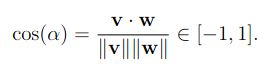
If v and w are unit vectors, we don't need to divide by their norms, see the definition of a scalar product geometrically.
Field-by-field Comparison
| Field | Before | After |
|---|---|---|
| Front | Formula for the cosine of the angle between vectors v and w | |
| Back | <img src="paste-f59da43aa9991b8ecc2f19c7a1f37d6e4e44107c.jpg"><br><br>If v and w are unit vectors, we don't need to divide by their norms, see the definition of a scalar product geometrically. |
Note 1041: ETH::LinAlg
Deck: ETH::LinAlg
Note Type: Horvath Classic
GUID:
added
Note Type: Horvath Classic
GUID:
ku_5}q!4@#
Previous
Note did not exist
New Note
Front
A linear combination of \(\lambda_1\textbf{v}_1 + \lambda_2\textbf{v}_2 + \dots + \lambda_n\textbf{v}_n\) is affine if
Back
A linear combination of \(\lambda_1\textbf{v}_1 + \lambda_2\textbf{v}_2 + \dots + \lambda_n\textbf{v}_n\) is affine if
\(\lambda_1 + \lambda_2 + \dots + \lambda_n = 1\)
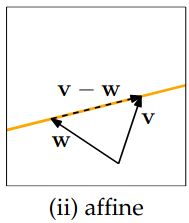
Field-by-field Comparison
| Field | Before | After |
|---|---|---|
| Front | A linear combination of \(\lambda_1\textbf{v}_1 + \lambda_2\textbf{v}_2 + \dots + \lambda_n\textbf{v}_n\) is <b>affine</b> if | |
| Back | \(\lambda_1 + \lambda_2 + \dots + \lambda_n = 1\)<br><img src="paste-588afe223c53749c81ee174038f4ecea73e37601.jpg"> |
Note 1042: ETH::LinAlg
Deck: ETH::LinAlg
Note Type: Horvath Classic
GUID:
added
Note Type: Horvath Classic
GUID:
l4%P|7pgCb
Previous
Note did not exist
New Note
Front
What are the four Moore-Penrose conditions?
Back
What are the four Moore-Penrose conditions?
Given an arbitrary matrix \(A \in \mathbb{R}^{m\times n}\) and its Moore-Penrose inverse matrix\(A^\dagger\)
1. \(AA^\dagger A = A\)
2. \(A^\dagger A A^\dagger = A^\dagger\)
3. \((AA^\dagger )^\top = AA^\dagger \)
4. \((A^\dagger A)^\top = A^\dagger A\)
1. \(AA^\dagger A = A\)
2. \(A^\dagger A A^\dagger = A^\dagger\)
3. \((AA^\dagger )^\top = AA^\dagger \)
4. \((A^\dagger A)^\top = A^\dagger A\)
Field-by-field Comparison
| Field | Before | After |
|---|---|---|
| Front | What are the four Moore-Penrose conditions? | |
| Back | Given an arbitrary matrix \(A \in \mathbb{R}^{m\times n}\) and its Moore-Penrose inverse matrix\(A^\dagger\)<br>1. \(AA^\dagger A = A\)<br>2. \(A^\dagger A A^\dagger = A^\dagger\)<br>3. \((AA^\dagger )^\top = AA^\dagger \)<br>4. \((A^\dagger A)^\top = A^\dagger A\) |
Note 1043: ETH::LinAlg
Deck: ETH::LinAlg
Note Type: Horvath Classic
GUID:
added
Note Type: Horvath Classic
GUID:
lG3L]2Sq+d
Previous
Note did not exist
New Note
Front
Was ist der Rang eines LGS?
Back
Was ist der Rang eines LGS?
Die Anzahl Pivotelemente bzw. die Anzahl Zeilen, welche nicht Nullzeilen sind.
Field-by-field Comparison
| Field | Before | After |
|---|---|---|
| Front | Was ist der Rang eines LGS? | |
| Back | Die Anzahl Pivotelemente bzw. die Anzahl Zeilen, welche nicht Nullzeilen sind. |
Note 1044: ETH::LinAlg
Deck: ETH::LinAlg
Note Type: Horvath Classic
GUID:
added
Note Type: Horvath Classic
GUID:
l[e7/3<
Previous
Note did not exist
New Note
Front
If columns \(v_1, v_2, ..., v_n\) of \(A\) are linearly independent and \(A\lambda = A\mu = x\) are two ways of writing vector x as a linear combination of the vectors v then:
Back
If columns \(v_1, v_2, ..., v_n\) of \(A\) are linearly independent and \(A\lambda = A\mu = x\) are two ways of writing vector x as a linear combination of the vectors v then:
\(\lambda \ \text{and} \ \mu\) are the same vector.
Linear combinations are unique if all vectors are independent.
Field-by-field Comparison
| Field | Before | After |
|---|---|---|
| Front | If columns \(v_1, v_2, ..., v_n\) of \(A\) are linearly independent and \(A\lambda = A\mu = x\) are two ways of writing vector x as a linear combination of the vectors v then: | |
| Back | \(\lambda \ \text{and} \ \mu\) are the same vector.<div><br></div><div>Linear combinations are unique if all vectors are independent.</div> |
Note 1045: ETH::LinAlg
Deck: ETH::LinAlg
Note Type: Horvath Cloze
GUID:
added
Note Type: Horvath Cloze
GUID:
m)DHqZ}2Ss
Previous
Note did not exist
New Note
Front
Give the three definitions of linear dependence:
- At least one of the vectors is a linear combination of the other ones.
- {{c2::There are scalars \(\lambda_1, ..., \lambda_n\) besides 0, 0, ..., 0 such that \(\sum_{i = 1}^n \lambda_i v_i = \mathbf{0}\). \(\mathbf{0}\) is a nontrivial combination of the vectors.}}
- At least one of the vectors is a linear combination of the previous ones.
Back
Give the three definitions of linear dependence:
- At least one of the vectors is a linear combination of the other ones.
- {{c2::There are scalars \(\lambda_1, ..., \lambda_n\) besides 0, 0, ..., 0 such that \(\sum_{i = 1}^n \lambda_i v_i = \mathbf{0}\). \(\mathbf{0}\) is a nontrivial combination of the vectors.}}
- At least one of the vectors is a linear combination of the previous ones.
Field-by-field Comparison
| Field | Before | After |
|---|---|---|
| Text | Give the three definitions of linear dependence:<br><ol><li>{{c1::At least one of the vectors is a linear combination of the other ones.}}</li><li>{{c2::There are scalars \(\lambda_1, ..., \lambda_n\) besides 0, 0, ..., 0 such that \(\sum_{i = 1}^n \lambda_i v_i = \mathbf{0}\). \(\mathbf{0}\) is a nontrivial combination of the vectors.}}<br></li><li>{{c3::At least one of the vectors is a linear combination of the previous ones.}}</li></ol> |
Note 1046: ETH::LinAlg
Deck: ETH::LinAlg
Note Type: Horvath Classic
GUID:
added
Note Type: Horvath Classic
GUID:
moUy5DUi0d
Previous
Note did not exist
New Note
Front
What is the definition of a hyperplane?
Back
What is the definition of a hyperplane?
given a vector \(\mathbf{d} \in \mathbb{R}^n\) \(\mathbf{d} \neq \mathbf{0}\), \(H_{\mathbf{d}} = \{\mathbf{v} \in \mathbb{R}^n : \mathbf{v} \cdot \mathbf{d} = \mathbf{0} \}\)
or in other words, it is the set of vectors orthogonal to a given vector
Since 0 is orthogonal to every vector \(0 \in H_d\).
or in other words, it is the set of vectors orthogonal to a given vector
Since 0 is orthogonal to every vector \(0 \in H_d\).
Field-by-field Comparison
| Field | Before | After |
|---|---|---|
| Front | What is the definition of a hyperplane? | |
| Back | given a vector \(\mathbf{d} \in \mathbb{R}^n\) \(\mathbf{d} \neq \mathbf{0}\), \(H_{\mathbf{d}} = \{\mathbf{v} \in \mathbb{R}^n : \mathbf{v} \cdot \mathbf{d} = \mathbf{0} \}\) <br>or in other words, it is the set of vectors orthogonal to a given vector<br><br>Since 0 is orthogonal to every vector \(0 \in H_d\). |
Note 1047: ETH::LinAlg
Deck: ETH::LinAlg
Note Type: Horvath Cloze
GUID:
added
Note Type: Horvath Cloze
GUID:
mqSXu9R3oO
Previous
Note did not exist
New Note
Front
The LU (Lower-Upper, also sometimes called LR) decomposition factors a matrix \(A\) as the product of a lower triangular matrix \(L\) and an upper triangular matrix \(U\).
Back
The LU (Lower-Upper, also sometimes called LR) decomposition factors a matrix \(A\) as the product of a lower triangular matrix \(L\) and an upper triangular matrix \(U\).
(so \(A = LU\))
Field-by-field Comparison
| Field | Before | After |
|---|---|---|
| Text | The LU ({{c1::Lower-Upper}}, also sometimes called {{c1::LR}}) decomposition factors a matrix \(A\) as {{c2::the product of a lower triangular matrix \(L\) and an upper triangular matrix \(U\)}}. | |
| Extra | (so \(A = LU\)) |
Note 1048: ETH::LinAlg
Deck: ETH::LinAlg
Note Type: Horvath Classic
GUID:
added
Note Type: Horvath Classic
GUID:
n060vly>1q
Previous
Note did not exist
New Note
Front
The Cauchy-Schwarz Inequality tells us that for \(\textbf{v}, \textbf{w} \in \mathbb{R}^m\)
Back
The Cauchy-Schwarz Inequality tells us that for \(\textbf{v}, \textbf{w} \in \mathbb{R}^m\)
\(|\textbf{v} \cdot \textbf{w}| \leq ||\textbf{v}|| \ ||\textbf{w}||\).
This equality holds exactly if one vector is the scalar multiple of the other.
This essentially means that: the length of the projecton of v onto w is smaller than the both of their lengths multiplied.
This explains the equality part: if they are already aligned, their projection doesn't lose any length...
This equality holds exactly if one vector is the scalar multiple of the other.
This essentially means that: the length of the projecton of v onto w is smaller than the both of their lengths multiplied.
This explains the equality part: if they are already aligned, their projection doesn't lose any length...
Field-by-field Comparison
| Field | Before | After |
|---|---|---|
| Front | The Cauchy-Schwarz Inequality tells us that for \(\textbf{v}, \textbf{w} \in \mathbb{R}^m\) | |
| Back | \(|\textbf{v} \cdot \textbf{w}| \leq ||\textbf{v}|| \ ||\textbf{w}||\).<br><br>This equality holds exactly if one vector is the scalar multiple of the other.<br><br>This essentially means that: the length of the projecton of v onto w is smaller than the both of their lengths multiplied.<br><br>This explains the equality part: if they are already aligned, their projection doesn't lose any length... |
Note 1049: ETH::LinAlg
Deck: ETH::LinAlg
Note Type: Horvath Classic
GUID:
added
Note Type: Horvath Classic
GUID:
nkL&a6|Q;d
Previous
Note did not exist
New Note
Front
The span of m linearly independent vectors is
Back
The span of m linearly independent vectors is
\(\mathbb{R}^m\) this also means that a matrix in \(\mathbb{R}^{n \times n}\) with rank(A) = n spans all of the space.
Field-by-field Comparison
| Field | Before | After |
|---|---|---|
| Front | The span of m linearly independent vectors is | |
| Back | \(\mathbb{R}^m\) this also means that a matrix in \(\mathbb{R}^{n \times n}\) with rank(A) = n spans all of the space. |
Note 1050: ETH::LinAlg
Deck: ETH::LinAlg
Note Type: Horvath Classic
GUID:
added
Note Type: Horvath Classic
GUID:
nkw:=NZ1ua
Previous
Note did not exist
New Note
Front
The scalar product of \(\textbf{v} \cdot \textbf{v}\) is \(\leq or \geq\) to what?
Back
The scalar product of \(\textbf{v} \cdot \textbf{v}\) is \(\leq or \geq\) to what?
\(\textbf{v} \cdot \textbf{v} \geq 0\) with equality exactly if \(\textbf{v} = \textbf{0}\).
This is because we essentially square the entries and thus can't get negatives.
This is because we essentially square the entries and thus can't get negatives.
Field-by-field Comparison
| Field | Before | After |
|---|---|---|
| Front | The <b>scalar product</b> of \(\textbf{v} \cdot \textbf{v}\) is \(\leq or \geq\) to what? | |
| Back | \(\textbf{v} \cdot \textbf{v} \geq 0\) with equality exactly if \(\textbf{v} = \textbf{0}\).<br><br>This is because we essentially square the entries and thus can't get negatives. |
Note 1051: ETH::LinAlg
Deck: ETH::LinAlg
Note Type: Horvath Classic
GUID:
added
Note Type: Horvath Classic
GUID:
o43^1:-/Cw
Previous
Note did not exist
New Note
Front
What is the rank of a matrix?
Back
What is the rank of a matrix?
it is the number of independent columns, where independence is defined such that given a column vector \(v_j\) then \(v_j\) is not a linear combination of \(v_1, v_2 ... v_{j-1}\)
Field-by-field Comparison
| Field | Before | After |
|---|---|---|
| Front | What is the rank of a matrix? | |
| Back | it is the number of independent columns, where independence is defined such that given a column vector \(v_j\) then \(v_j\) is not a linear combination of \(v_1, v_2 ... v_{j-1}\) |
Note 1052: ETH::LinAlg
Deck: ETH::LinAlg
Note Type: Horvath Cloze
GUID:
added
Note Type: Horvath Cloze
GUID:
oVmXrU@C,D
Previous
Note did not exist
New Note
Front
The span of a set of vectors is the set of all possible linear combinations of them.
Back
The span of a set of vectors is the set of all possible linear combinations of them.
The span is a linear subspace.
Field-by-field Comparison
| Field | Before | After |
|---|---|---|
| Text | The <i>span</i> of a set of vectors is {{c1::the set of all possible linear combinations of them}}. | |
| Extra | The span is a linear subspace. |
Note 1053: ETH::LinAlg
Deck: ETH::LinAlg
Note Type: Horvath Cloze
GUID:
added
Note Type: Horvath Cloze
GUID:
oXvW^EH?&l
Previous
Note did not exist
New Note
Front
An important difference between a field \(F\) and a vector space \(V\) is that multiplication in the field is \(F\times F\mapsto F\), whereas it is \(F\times V\mapsto V\) in the vector space.
Back
An important difference between a field \(F\) and a vector space \(V\) is that multiplication in the field is \(F\times F\mapsto F\), whereas it is \(F\times V\mapsto V\) in the vector space.
Field-by-field Comparison
| Field | Before | After |
|---|---|---|
| Text | An important difference between a field \(F\) and a vector space \(V\) is that {{c1::multiplication in the field is \(F\times F\mapsto F\), whereas it is \(F\times V\mapsto V\) in the vector space}}. |
Note 1054: ETH::LinAlg
Deck: ETH::LinAlg
Note Type: Horvath Classic
GUID:
added
Note Type: Horvath Classic
GUID:
p6e6T6[HIy
Previous
Note did not exist
New Note
Front
Was ist eine transponierte Matrix?
Back
Was ist eine transponierte Matrix?
Entlang der Hauptdiagonale gespiegelte Matrix \(\mathbf{A}^\top\), d.h. \( (\mathbf{A}^\top)_{ij} = (\mathbf{A})_{ji} \)
Field-by-field Comparison
| Field | Before | After |
|---|---|---|
| Front | Was ist eine <b>transponierte</b> Matrix? | |
| Back | Entlang der Hauptdiagonale gespiegelte Matrix \(\mathbf{A}^\top\), d.h. \( (\mathbf{A}^\top)_{ij} = (\mathbf{A})_{ji} \) |
Note 1055: ETH::LinAlg
Deck: ETH::LinAlg
Note Type: Horvath Classic
GUID:
added
Note Type: Horvath Classic
GUID:
pvT-hzO|2S
Previous
Note did not exist
New Note
Front
What is a hyperplane through the origin?
Back
What is a hyperplane through the origin?

Is called a hyperplane through the origin.
Since 0 is orthogonal to every vector \(0 \in H_d\).
Field-by-field Comparison
| Field | Before | After |
|---|---|---|
| Front | What is a hyperplane through the origin? | |
| Back | <img src="paste-668e9356fe68198a22a939d45f03e5d4e9db8bdd.jpg"><br>Is called a hyperplane through the origin.<br><br>Since 0 is orthogonal to every vector \(0 \in H_d\). |
Note 1056: ETH::LinAlg
Deck: ETH::LinAlg
Note Type: Horvath Classic
GUID:
added
Note Type: Horvath Classic
GUID:
qGI8y.9F)Z
Previous
Note did not exist
New Note
Front
If I add vector v, which is a linear combination of \(v_1, v_2, ..., v_n\) to the span it:
Back
If I add vector v, which is a linear combination of \(v_1, v_2, ..., v_n\) to the span it:
does not change
Field-by-field Comparison
| Field | Before | After |
|---|---|---|
| Front | If I add vector v, which is a linear combination of \(v_1, v_2, ..., v_n\) to the span it: | |
| Back | does not change |
Note 1057: ETH::LinAlg
Deck: ETH::LinAlg
Note Type: Horvath Classic
GUID:
added
Note Type: Horvath Classic
GUID:
s@:duB;6%y
Previous
Note did not exist
New Note
Front
What special conditions (other than the 3 basic conditions) make a set of vectors linearly dependent?
Back
What special conditions (other than the 3 basic conditions) make a set of vectors linearly dependent?
If:
- one of the vectors is 0
- one vector \(\textbf{v}\) is contained twice
Field-by-field Comparison
| Field | Before | After |
|---|---|---|
| Front | What special conditions (other than the 3 basic conditions) make a set of vectors linearly dependent? | |
| Back | If:<br><ul><li>one of the vectors is 0</li><li>one vector \(\textbf{v}\) is contained twice</li></ul> |
Note 1058: ETH::LinAlg
Deck: ETH::LinAlg
Note Type: Horvath Classic
GUID:
added
Note Type: Horvath Classic
GUID:
sp}Iuo:,06
Previous
Note did not exist
New Note
Front
How do we express the unit vectors of \(\mathbb{R}^n\)?
Back
How do we express the unit vectors of \(\mathbb{R}^n\)?
\(\{e_1, e_2, ... e_n\}\)
Field-by-field Comparison
| Field | Before | After |
|---|---|---|
| Front | How do we express the unit vectors of \(\mathbb{R}^n\)? | |
| Back | \(\{e_1, e_2, ... e_n\}\) |
Note 1059: ETH::LinAlg
Deck: ETH::LinAlg
Note Type: Horvath Cloze
GUID:
added
Note Type: Horvath Cloze
GUID:
tR&oOKzisO
Previous
Note did not exist
New Note
Front
A matrix decomposition is a factorization of a single matrix into a product of ones with useful properties.
Back
A matrix decomposition is a factorization of a single matrix into a product of ones with useful properties.
Example: LU decomposition (\(A=LU\))
Field-by-field Comparison
| Field | Before | After |
|---|---|---|
| Text | A matrix decomposition is {{c1::a factorization of a single matrix into a product of ones with useful properties}}. | |
| Extra | Example: LU decomposition (\(A=LU\)) |
Note 1060: ETH::LinAlg
Deck: ETH::LinAlg
Note Type: Horvath Classic
GUID:
added
Note Type: Horvath Classic
GUID:
uWwT2a*Vb[
Previous
Note did not exist
New Note
Front
What is the nullspace of a matrix?
Back
What is the nullspace of a matrix?
all vectors that when multiplied by the matrix give the 0-vector out
\(N(A) := \{x\in \mathbb{R} : Ax = \boldsymbol{0} \}\)
\(N(A) := \{x\in \mathbb{R} : Ax = \boldsymbol{0} \}\)
Field-by-field Comparison
| Field | Before | After |
|---|---|---|
| Front | What is the <b>nullspace </b>of a matrix?<b> </b> | |
| Back | all vectors that when multiplied by the matrix give the 0-vector out<br>\(N(A) := \{x\in \mathbb{R} : Ax = \boldsymbol{0} \}\) |
Note 1061: ETH::LinAlg
Deck: ETH::LinAlg
Note Type: Horvath Cloze
GUID:
added
Note Type: Horvath Cloze
GUID:
uo#Gn+y8bD
Previous
Note did not exist
New Note
Front
Für alle Vektorpaare \( \mathbf{x,y} \in \mathbb{E}^n \) gilt die Cauchy-Schwarz-Ungleichung: {{c1::\( | \langle \mathbf{x, y} \rangle | \le ||\mathbf{x}|| \ ||\mathbf{y}||\)}}
Back
Für alle Vektorpaare \( \mathbf{x,y} \in \mathbb{E}^n \) gilt die Cauchy-Schwarz-Ungleichung: {{c1::\( | \langle \mathbf{x, y} \rangle | \le ||\mathbf{x}|| \ ||\mathbf{y}||\)}}
Field-by-field Comparison
| Field | Before | After |
|---|---|---|
| Text | Für alle Vektorpaare \( \mathbf{x,y} \in \mathbb{E}^n \) gilt die Cauchy-Schwarz-Ungleichung: {{c1::\( | \langle \mathbf{x, y} \rangle | \le ||\mathbf{x}|| \ ||\mathbf{y}||\)}} |
Note 1062: ETH::LinAlg
Deck: ETH::LinAlg
Note Type: Horvath Cloze
GUID:
added
Note Type: Horvath Cloze
GUID:
v#FTBh.m{S
Previous
Note did not exist
New Note
Front
Ein LGS heisst homogen, wenn die rechte Seite Null ist.
Back
Ein LGS heisst homogen, wenn die rechte Seite Null ist.
Besitzt immer triviale Lösung (alles 0).
Field-by-field Comparison
| Field | Before | After |
|---|---|---|
| Text | Ein LGS heisst {{c1::homogen}}, wenn {{c2::die rechte Seite Null ist}}. | |
| Extra | Besitzt immer triviale Lösung (alles 0). |
Note 1063: ETH::LinAlg
Deck: ETH::LinAlg
Note Type: Horvath Classic
GUID:
added
Note Type: Horvath Classic
GUID:
vFzsuS+[?6
Previous
Note did not exist
New Note
Front
What is the columnspace of a matrix?
Back
What is the columnspace of a matrix?
it is the span of all column-vectors
Field-by-field Comparison
| Field | Before | After |
|---|---|---|
| Front | What is the columnspace of a matrix? | |
| Back | it is the span of all column-vectors |
Note 1064: ETH::LinAlg
Deck: ETH::LinAlg
Note Type: Horvath Classic
GUID:
added
Note Type: Horvath Classic
GUID:
v`BTz<1Q{~
Previous
Note did not exist
New Note
Front
Wann ist eine Matrix invertierbar?
Back
Wann ist eine Matrix invertierbar?
Falls eine Matrix \( \mathbf{X} \) existiert, so dass \( \mathbf{AX} = \mathbf{XA} = \mathbf{I_n}\)
Beispiel: \( \begin{pmatrix} 1 & 2 \\ 0 & 3 \end{pmatrix} * \begin{pmatrix} 1 & -\frac{2}{3} \\ 0 & \frac{1}{3} \end{pmatrix} = \mathbf{I_2}\)
Field-by-field Comparison
| Field | Before | After |
|---|---|---|
| Front | Wann ist eine Matrix <b>invertierbar</b>? | |
| Back | Falls eine Matrix \( \mathbf{X} \) existiert, so dass \( \mathbf{AX} = \mathbf{XA} = \mathbf{I_n}\)<div><br></div><div>Beispiel: \( \begin{pmatrix} 1 & 2 \\ 0 & 3 \end{pmatrix} * \begin{pmatrix} 1 & -\frac{2}{3} \\ 0 & \frac{1}{3} \end{pmatrix} = \mathbf{I_2}\) </div> |
Note 1065: ETH::LinAlg
Deck: ETH::LinAlg
Note Type: Horvath Classic
GUID:
added
Note Type: Horvath Classic
GUID:
vlkuMD-Ica
Previous
Note did not exist
New Note
Front
Was ist eine konjugiert-komplexe Matrix?
Back
Was ist eine konjugiert-komplexe Matrix?
Wenn \(\mathbf{A}\) eine komplexe Matrix ist, dann ist \(\overline{\mathbf{A}}\) mit \( (\overline{\mathbf{A}})_{ij} = \overline{(\mathbf{A})_{ij}}\) die konjugiert-komplexe Matrix.
Field-by-field Comparison
| Field | Before | After |
|---|---|---|
| Front | Was ist eine <b>konjugiert-komplexe </b>Matrix? | |
| Back | Wenn \(\mathbf{A}\) eine komplexe Matrix ist, dann ist \(\overline{\mathbf{A}}\) mit \( (\overline{\mathbf{A}})_{ij} = \overline{(\mathbf{A})_{ij}}\) die konjugiert-komplexe Matrix. |
Note 1066: ETH::LinAlg
Deck: ETH::LinAlg
Note Type: Horvath Classic
GUID:
added
Note Type: Horvath Classic
GUID:
vo=
Previous
Note did not exist
New Note
Front
What is a property of symmetrical matrices?
Back
What is a property of symmetrical matrices?
\(A^T = A\)
Field-by-field Comparison
| Field | Before | After |
|---|---|---|
| Front | What is a property of symmetrical matrices? | |
| Back | \(A^T = A\) |
Note 1067: ETH::LinAlg
Deck: ETH::LinAlg
Note Type: Horvath Classic
GUID:
added
Note Type: Horvath Classic
GUID:
vp8-Q1S6eI
Previous
Note did not exist
New Note
Front
What holds for \(T(X+Y)?\)
Back
What holds for \(T(X+Y)?\)
\(= T(X) + T(Y)\)
Field-by-field Comparison
| Field | Before | After |
|---|---|---|
| Front | What holds for \(T(X+Y)?\) | |
| Back | \(= T(X) + T(Y)\) |
Note 1068: ETH::LinAlg
Deck: ETH::LinAlg
Note Type: Horvath Classic
GUID:
added
Note Type: Horvath Classic
GUID:
w;_;AaM4pf
Previous
Note did not exist
New Note
Front
Was ist eine symmetrische Matrix?
Back
Was ist eine symmetrische Matrix?
Eine symmetrische Matrix erfüllt \(A^\top = A\) (d.h. eine "Spiegelachse" an der Hauptdiagonale). Hauptdiagonale selber unwichtig!
Beispiel:
\( \begin{pmatrix} 0 & 5 & 1 \\ 5 & 2 & 4 \\ 1 & 4 & 0 \end{pmatrix} \)
Field-by-field Comparison
| Field | Before | After |
|---|---|---|
| Front | Was ist eine <b>symmetrische</b> Matrix? | |
| Back | Eine symmetrische Matrix erfüllt \(A^\top = A\) (d.h. eine "Spiegelachse" an der Hauptdiagonale). Hauptdiagonale selber unwichtig!<div>Beispiel:</div><div>\( \begin{pmatrix} 0 & 5 & 1 \\ 5 & 2 & 4 \\ 1 & 4 & 0 \end{pmatrix} \)<br></div> |
Note 1069: ETH::LinAlg
Deck: ETH::LinAlg
Note Type: Horvath Classic
GUID:
added
Note Type: Horvath Classic
GUID:
wl,mf){>,^
Previous
Note did not exist
New Note
Front
What is the 1-norm of a vector?
Back
What is the 1-norm of a vector?
given a vector \(\mathbf{v} = (v_1, v_2, ..., v_n)^\top\)
\(||\mathbf{v}||_1 = \sum_{i=1}^n |v_i|\)
\(||\mathbf{v}||_1 = \sum_{i=1}^n |v_i|\)
Field-by-field Comparison
| Field | Before | After |
|---|---|---|
| Front | What is the 1-norm of a vector? | |
| Back | given a vector \(\mathbf{v} = (v_1, v_2, ..., v_n)^\top\) <br>\(||\mathbf{v}||_1 = \sum_{i=1}^n |v_i|\) |
Note 1070: ETH::LinAlg
Deck: ETH::LinAlg
Note Type: Horvath Classic
GUID:
added
Note Type: Horvath Classic
GUID:
x4{!d?wKd.
Previous
Note did not exist
New Note
Front
What is the span of a set of vectors?
Back
What is the span of a set of vectors?
The span is defined as the set of all linear combinations:

Field-by-field Comparison
| Field | Before | After |
|---|---|---|
| Front | What is the span of a set of vectors? | |
| Back | The span is defined as the set of all linear combinations:<br><img src="paste-36e53d12d56d7d813cefc55621f3b75e1d7eac63.jpg"> |
Note 1071: ETH::LinAlg
Deck: ETH::LinAlg
Note Type: Horvath Cloze
GUID:
added
Note Type: Horvath Cloze
GUID:
xBE,c~;Xop
Previous
Note did not exist
New Note
Front
A \(1\times n\) matrix is called row vector or, in other contexts, tuple.
Back
A \(1\times n\) matrix is called row vector or, in other contexts, tuple.
Field-by-field Comparison
| Field | Before | After |
|---|---|---|
| Text | A \(1\times n\) matrix is called {{c1::row vector}} or, in other contexts, {{c1::tuple}}. |
Note 1072: ETH::LinAlg
Deck: ETH::LinAlg
Note Type: Horvath Cloze
GUID:
added
Note Type: Horvath Cloze
GUID:
xn@gm`7I_o
Previous
Note did not exist
New Note
Front
Eine Linearkombination (LK) der Vektoren \( a_1, \ldots, a_n\) ist {{c2::ein Ausdruck der Form \( \alpha_1 a_1 + \cdots + \alpha_n a_n\) wobei \( \alpha_1, \ldots, \alpha_n \in \mathbb{R}\)}}
Back
Eine Linearkombination (LK) der Vektoren \( a_1, \ldots, a_n\) ist {{c2::ein Ausdruck der Form \( \alpha_1 a_1 + \cdots + \alpha_n a_n\) wobei \( \alpha_1, \ldots, \alpha_n \in \mathbb{R}\)}}
Field-by-field Comparison
| Field | Before | After |
|---|---|---|
| Text | Eine {{c1::Linearkombination (LK)}} der Vektoren \( a_1, \ldots, a_n\) ist {{c2::ein Ausdruck der Form \( \alpha_1 a_1 + \cdots + \alpha_n a_n\) wobei \( \alpha_1, \ldots, \alpha_n \in \mathbb{R}\)}} |
Note 1073: ETH::LinAlg
Deck: ETH::LinAlg
Note Type: Horvath Cloze
GUID:
added
Note Type: Horvath Cloze
GUID:
xs#S^-Mehy
Previous
Note did not exist
New Note
Front
\(\det A^{-1} =\) {{c1::\((\det A)^{-1}\)}}
Back
\(\det A^{-1} =\) {{c1::\((\det A)^{-1}\)}}
Field-by-field Comparison
| Field | Before | After |
|---|---|---|
| Text | \(\det A^{-1} =\) {{c1::\((\det A)^{-1}\)}} |
Note 1074: ETH::LinAlg
Deck: ETH::LinAlg
Note Type: Horvath Cloze
GUID:
added
Note Type: Horvath Cloze
GUID:
yIi4+D4X>;
Previous
Note did not exist
New Note
Front
The LU decomposition is useful because (among other things) it is computationally more efficient when solving multiple \(Ax = b\) having the same \(A\) and different \(b\) .
Back
The LU decomposition is useful because (among other things) it is computationally more efficient when solving multiple \(Ax = b\) having the same \(A\) and different \(b\) .
Field-by-field Comparison
| Field | Before | After |
|---|---|---|
| Text | The LU decomposition is useful because (among other things) {{c1::it is computationally more efficient when solving multiple \(Ax = b\) having the same \(A\) and different \(b\) }}. |
Note 1075: ETH::A&D
Deck: ETH::A&D
Note Type: Horvath Cloze
GUID:
deleted
Note Type: Horvath Cloze
GUID:
A!-/#G=){
Deleted Note
Front
\(g \geq \Omega(f)\) \( \Leftrightarrow\) \( f \leq O(g)\)
Back
\(g \geq \Omega(f)\) \( \Leftrightarrow\) \( f \leq O(g)\)
Current
Note has been deleted
Field-by-field Comparison
| Field | Before | After |
|---|---|---|
| Text |
Note 1076: ETH::A&D
Deck: ETH::A&D
Note Type: Horvath Cloze
GUID:
deleted
Note Type: Horvath Cloze
GUID:
A+lafWP/s]
Deleted Note
Front
In a directed graph we call a (\(\epsilon\)/Eulerian/Hamiltonian) walk/closed walk/path/cycle a directed (gerichtet) (\(\epsilon\)/Eulerian/Hamiltonian) walk/closed walk/path/cycle.
Back
In a directed graph we call a (\(\epsilon\)/Eulerian/Hamiltonian) walk/closed walk/path/cycle a directed (gerichtet) (\(\epsilon\)/Eulerian/Hamiltonian) walk/closed walk/path/cycle.
Current
Note has been deleted
Field-by-field Comparison
| Field | Before | After |
|---|---|---|
| Text |
Note 1077: ETH::A&D
Deck: ETH::A&D
Note Type: Horvath Reverso
GUID:
deleted
Note Type: Horvath Reverso
GUID:
A1y[0:/g)f
Deleted Note
Front
Graph Theory:
Closed Walk
Closed Walk
Back
Graph Theory:
Closed Walk
Closed Walk
Graph Theory:
Zyklus
Zyklus
Current
Note has been deleted
Field-by-field Comparison
| Field | Before | After |
|---|---|---|
| Front | ||
| Back |
Note 1078: ETH::A&D
Deck: ETH::A&D
Note Type: Algorithms
GUID:
deleted
Note Type: Algorithms
GUID:
AJT5T7qaW3
Deleted Note
Front
Runtime of Find Closed Eulerian Path?
Back
Runtime of Find Closed Eulerian Path?
\(O(n+m)\)
In an Adjacency Matrix: runtime is \(O(n^2)\) as looping over all edges is \(O(n)\).
In an Adjacency List: we loop \(n\) times over \(O(1 + \deg(u))\).
Using the handshake lemma: \(\sum_{u \in V} (1 + \deg(u)) = n + \sum_{u \in V} \deg(u) = n + 2m\)
In an Adjacency Matrix: runtime is \(O(n^2)\) as looping over all edges is \(O(n)\).
In an Adjacency List: we loop \(n\) times over \(O(1 + \deg(u))\).
Using the handshake lemma: \(\sum_{u \in V} (1 + \deg(u)) = n + \sum_{u \in V} \deg(u) = n + 2m\)
Current
Note has been deleted
Field-by-field Comparison
| Field | Before | After |
|---|---|---|
| Name | ||
| Runtime | ||
| Approach | ||
| Pseudocode | ||
| Extra Info |
Note 1079: ETH::A&D
Deck: ETH::A&D
Note Type: Horvath Cloze
GUID:
deleted
Note Type: Horvath Cloze
GUID:
AQQfmx,sQF
Deleted Note
Front
A graph \(G\) is acyclic (azyklisch) if it has no cycles (Kreise).
Back
A graph \(G\) is acyclic (azyklisch) if it has no cycles (Kreise).
Current
Note has been deleted
Field-by-field Comparison
| Field | Before | After |
|---|---|---|
| Text |
Note 1080: ETH::A&D
Deck: ETH::A&D
Note Type: Horvath Cloze
GUID:
deleted
Note Type: Horvath Cloze
GUID:
AS{7LiImd:
Deleted Note
Front
A graph \(G\) is bipartite if {{c2:: it's possible to partition the vertices into two sets \(V_1\) and \(V_2\) that are disjoint and cover the graph. Any edge \(\{u, v\}\) has to have one endpoint in \(V_1\) and the other in \(V_2\)}}.
Back
A graph \(G\) is bipartite if {{c2:: it's possible to partition the vertices into two sets \(V_1\) and \(V_2\) that are disjoint and cover the graph. Any edge \(\{u, v\}\) has to have one endpoint in \(V_1\) and the other in \(V_2\)}}.
Current
Note has been deleted
Field-by-field Comparison
| Field | Before | After |
|---|---|---|
| Text |
Note 1081: ETH::A&D
Deck: ETH::A&D
Note Type: Horvath Cloze
GUID:
deleted
Note Type: Horvath Cloze
GUID:
AY}!l[d)1z
Deleted Note
Front
Name the impossible cases in DFS pre/post ordering for edge \((u, v)\):
- Overlapping but not Nested Intervals:
- {{c2:: \(\text{pre}(u)<\text{pre}(v)<\text{post}(u)<\text{post}(v)\): as visit(u) would call visit(v) before the recursive call ends}}
Back
Name the impossible cases in DFS pre/post ordering for edge \((u, v)\):
- Overlapping but not Nested Intervals:
- {{c2:: \(\text{pre}(u)<\text{pre}(v)<\text{post}(u)<\text{post}(v)\): as visit(u) would call visit(v) before the recursive call ends}}
Current
Note has been deleted
Field-by-field Comparison
| Field | Before | After |
|---|---|---|
| Text |
Note 1082: ETH::A&D
Deck: ETH::A&D
Note Type: Algorithms
GUID:
deleted
Note Type: Algorithms
GUID:
Ah4U@kYYNJ
Deleted Note
Front
Runtime of Linear Search?
Back
Runtime of Linear Search?
\(\Theta(n)\) as we go through the entire list once.
Current
Note has been deleted
Field-by-field Comparison
| Field | Before | After |
|---|---|---|
| Name | ||
| Runtime | ||
| Requirements | ||
| Approach |
Note 1083: ETH::A&D
Deck: ETH::A&D
Note Type: Horvath Cloze
GUID:
deleted
Note Type: Horvath Cloze
GUID:
Ah6X9iA&#j
Deleted Note
Front
The ADT stack has the following operations:
- push(k, S): push a new object k to the top of the stack S
- pop(S): remove and return the top element of the stack S
- top(S): get the top element of the stack S without deleting it
Back
The ADT stack has the following operations:
- push(k, S): push a new object k to the top of the stack S
- pop(S): remove and return the top element of the stack S
- top(S): get the top element of the stack S without deleting it
Other operations might be isEmpty or emptystack which produces and emtpy stack.
Current
Note has been deleted
Field-by-field Comparison
| Field | Before | After |
|---|---|---|
| Text | ||
| Extra |
Note 1084: ETH::A&D
Deck: ETH::A&D
Note Type: Horvath Classic
GUID:
deleted
Note Type: Horvath Classic
GUID:
AqQ}Ty8GRj
Deleted Note
Front
How do we fix the Quicksort worst-case runtime?
Back
How do we fix the Quicksort worst-case runtime?
Chose a random element as the pivot.
Median of medians algo ideal but too complex to implement.
Median of medians algo ideal but too complex to implement.
Current
Note has been deleted
Field-by-field Comparison
| Field | Before | After |
|---|---|---|
| Front | ||
| Back |
Note 1085: ETH::A&D
Deck: ETH::A&D
Note Type: Horvath Cloze
GUID:
deleted
Note Type: Horvath Cloze
GUID:
Au,kdh[/@(
Deleted Note
Front
A safe edge is a edge that is included in at all MSTs.
Back
A safe edge is a edge that is included in at all MSTs.
all, If the edge-weights are distinct, which means there is one unique MST.
Current
Note has been deleted
Field-by-field Comparison
| Field | Before | After |
|---|---|---|
| Text | ||
| Extra |
Note 1086: ETH::A&D
Deck: ETH::A&D
Note Type: Horvath Cloze
GUID:
deleted
Note Type: Horvath Cloze
GUID:
Auw]yKf@xT
Deleted Note
Front
Pre-/Post-Ordering Classification for an edge \((u, v)\):
\(\text{pre}(u) < \text{pre}(v) < \text{post}(v) < \text{post}(u)\), but not tree edge: Forward edge
\(\text{pre}(u) < \text{pre}(v) < \text{post}(v) < \text{post}(u)\), but not tree edge: Forward edge
Back
Pre-/Post-Ordering Classification for an edge \((u, v)\):
\(\text{pre}(u) < \text{pre}(v) < \text{post}(v) < \text{post}(u)\), but not tree edge: Forward edge
\(\text{pre}(u) < \text{pre}(v) < \text{post}(v) < \text{post}(u)\), but not tree edge: Forward edge
Current
Note has been deleted
Field-by-field Comparison
| Field | Before | After |
|---|---|---|
| Text |
Note 1087: ETH::A&D
Deck: ETH::A&D
Note Type: Horvath Classic
GUID:
deleted
Note Type: Horvath Classic
GUID:
B)ghZbgf?6
Deleted Note
Front
Describe the steps of Prim's Algorithm:
Back
Describe the steps of Prim's Algorithm:
Prim’s algorithm starts with a single vertex and grows the MST outwards from that seed.
- Initialisation:
- Select and arbitrary starting vertex \(s\) and empty set \(F\)
- Set \(S = {s}\) tracks the vertices in the MST
- Each vertex gets a
key[v] =representing the cheapest known connection cost to \(v\):- \(\infty\) if no edge connects \(s\) to \(v\)
- \(w(s, v)\) if edge \((s, v)\) exists
- Use a priority queue \(Q\) (Min-Heap) to store the vertices, in order of lowest
keycost
- Iteration:
- Select and add Extract the vertex \(u\) with the minimum
keyfrom \(Q\). This is the cheapest to connected to the current MST. Add \(u\) to \(S\). - Update Neighbours For each neighbour \(v\) of \(u\) not in \(S\):
- If \(w(u, v) < \text{key}[v]\) update
key[v] = w(u, v)and update the priority in $Q$.- This discovers potentially cheaper connections to vertices outside the current MST. If a cheaper edge to \(v\) is found, the current value in
key[v]cannot be part of the MST
- This discovers potentially cheaper connections to vertices outside the current MST. If a cheaper edge to \(v\) is found, the current value in
- If \(w(u, v) < \text{key}[v]\) update
- Select and add Extract the vertex \(u\) with the minimum
- Termination: When \(Q\) is empty, all vertices are in \(S\) and connected, and the edges chosen are in the MST (tracked in the set \(F\) through updates).
Current
Note has been deleted
Field-by-field Comparison
| Field | Before | After |
|---|---|---|
| Front | ||
| Back |
Note 1088: ETH::A&D
Deck: ETH::A&D
Note Type: Horvath Reverso
GUID:
deleted
Note Type: Horvath Reverso
GUID:
B+m&Yt;~bM
Deleted Note
Front
Graph Theory:
Path
Path
Back
Graph Theory:
Path
Path
Graph Theory:
Pfad
Pfad
Current
Note has been deleted
Field-by-field Comparison
| Field | Before | After |
|---|---|---|
| Front | ||
| Back |
Note 1089: ETH::A&D
Deck: ETH::A&D
Note Type: Horvath Cloze
GUID:
deleted
Note Type: Horvath Cloze
GUID:
B/7aNL0zYE
Deleted Note
Front
Boruvka's Algorithm has a runtime of \(O((|V| + |E|) \log |V|)\).
Back
Boruvka's Algorithm has a runtime of \(O((|V| + |E|) \log |V|)\).
During each iteration, we examine all edges to find the cheapest one: \(O(|V| + |E|)\):
- Run DFS to find the connected components: \(O(|V| + |E|)\)
- Find the cheapest one \(O(|E|)\)
Current
Note has been deleted
Field-by-field Comparison
| Field | Before | After |
|---|---|---|
| Text | ||
| Extra |
Note 1090: ETH::A&D
Deck: ETH::A&D
Note Type: Horvath Cloze
GUID:
deleted
Note Type: Horvath Cloze
GUID:
B9BorfLC*u
Deleted Note
Front
{{c1:: \(\sum_{i = 1}^{n} i\)}} \(\leq\) \(O(n^2)\) (Sum)
Back
{{c1:: \(\sum_{i = 1}^{n} i\)}} \(\leq\) \(O(n^2)\) (Sum)
Current
Note has been deleted
Field-by-field Comparison
| Field | Before | After |
|---|---|---|
| Text |
Note 1091: ETH::A&D
Deck: ETH::A&D
Note Type: Algorithms
GUID:
deleted
Note Type: Algorithms
GUID:
BRmyi3>lm%
Deleted Note
Front
Back
Runtime of
DFS
Runtime: {{c1::\( \mathcal{O}(|E| + |V|) \)}}
Approach:
Uses:
?Current
Note has been deleted
Field-by-field Comparison
| Field | Before | After |
|---|---|---|
| Name |
Note 1092: ETH::A&D
Deck: ETH::A&D
Note Type: Horvath Cloze
GUID:
deleted
Note Type: Horvath Cloze
GUID:
Bb-m%-jtI|
Deleted Note
Front
Pre-/Post-Ordering Classification for an edge \((u, v)\):
\(\text{pre}(v) < \text{post}(v) < \text{pre}(u) < \text{post}(u)\): Cross edge, \(u, v\) in different subtrees
\(\text{pre}(v) < \text{post}(v) < \text{pre}(u) < \text{post}(u)\): Cross edge, \(u, v\) in different subtrees
Back
Pre-/Post-Ordering Classification for an edge \((u, v)\):
\(\text{pre}(v) < \text{post}(v) < \text{pre}(u) < \text{post}(u)\): Cross edge, \(u, v\) in different subtrees
\(\text{pre}(v) < \text{post}(v) < \text{pre}(u) < \text{post}(u)\): Cross edge, \(u, v\) in different subtrees
Current
Note has been deleted
Field-by-field Comparison
| Field | Before | After |
|---|---|---|
| Text |
Note 1093: ETH::A&D
Deck: ETH::A&D
Note Type: Horvath Cloze
GUID:
deleted
Note Type: Horvath Cloze
GUID:
Bgd/GP4-Fq
Deleted Note
Front
A graph \(G\) is a tree if it is connected and has no cycles (Kreise).
Back
A graph \(G\) is a tree if it is connected and has no cycles (Kreise).
Current
Note has been deleted
Field-by-field Comparison
| Field | Before | After |
|---|---|---|
| Text |
Note 1094: ETH::A&D
Deck: ETH::A&D
Note Type: Horvath Classic
GUID:
deleted
Note Type: Horvath Classic
GUID:
Bq5(?)1v6(
Deleted Note
Front
What does \(\prod_{i=1}^n a_i\) mean?
Back
What does \(\prod_{i=1}^n a_i\) mean?
it is the product of all numbers between \(i\) and \(n\), in this specific case it is \(n!\)
Current
Note has been deleted
Field-by-field Comparison
| Field | Before | After |
|---|---|---|
| Front | ||
| Back |
Note 1095: ETH::A&D
Deck: ETH::A&D
Note Type: Horvath Cloze
GUID:
deleted
Note Type: Horvath Cloze
GUID:
Br&58pkCU{
Deleted Note
Front
We start counting the height of a tree at \(0\).
Back
We start counting the height of a tree at \(0\).
Current
Note has been deleted
Field-by-field Comparison
| Field | Before | After |
|---|---|---|
| Text |
Note 1096: ETH::A&D
Deck: ETH::A&D
Note Type: Horvath Cloze
GUID:
deleted
Note Type: Horvath Cloze
GUID:
BvQCv]T&c0
Deleted Note
Front
\(\log(n!)\) \(\leq O(\)\(n \log n\)\()\)
Back
\(\log(n!)\) \(\leq O(\)\(n \log n\)\()\)
Current
Note has been deleted
Field-by-field Comparison
| Field | Before | After |
|---|---|---|
| Text |
Note 1097: ETH::A&D
Deck: ETH::A&D
Note Type: Horvath Cloze
GUID:
deleted
Note Type: Horvath Cloze
GUID:
BwR)%}KG6h
Deleted Note
Front
Boruvka's Algorithm requires an undirected, connected, weighted Graph.
Back
Boruvka's Algorithm requires an undirected, connected, weighted Graph.
Current
Note has been deleted
Field-by-field Comparison
| Field | Before | After |
|---|---|---|
| Text |
Note 1098: ETH::A&D
Deck: ETH::A&D
Note Type: Horvath Cloze
GUID:
deleted
Note Type: Horvath Cloze
GUID:
Bz)mOB:[n-
Deleted Note
Front
2-3 Tree: Runtime of: Search, Inserting, Deleting: \(O(\log n)\)
Back
2-3 Tree: Runtime of: Search, Inserting, Deleting: \(O(\log n)\)
This is because the tree is now forced to be balanced and \(h \leq \log_2 n\).
Current
Note has been deleted
Field-by-field Comparison
| Field | Before | After |
|---|---|---|
| Text | ||
| Extra |
Note 1099: ETH::A&D
Deck: ETH::A&D
Note Type: Algorithms
GUID:
deleted
Note Type: Algorithms
GUID:
C$#TvbwG_l
Deleted Note
Front
Runtime of Longest Ascending Subsequence (Längste Aufsteigende Teilfolge)?
Back
Runtime of Longest Ascending Subsequence (Längste Aufsteigende Teilfolge)?
\(\Theta(n \log n)\)
Current
Note has been deleted
Field-by-field Comparison
| Field | Before | After |
|---|---|---|
| Name | ||
| Runtime | ||
| Approach | ||
| Pseudocode |
Note 1100: ETH::A&D
Deck: ETH::A&D
Note Type: Horvath Cloze
GUID:
deleted
Note Type: Horvath Cloze
GUID:
C1$vvwFoR0
Deleted Note
Front
In graph theory, an closed Eulerian walk (Eulerzyklus) is an Eulerian walk (Eulerweg) that ends at the start vertex.
Back
In graph theory, an closed Eulerian walk (Eulerzyklus) is an Eulerian walk (Eulerweg) that ends at the start vertex.
Current
Note has been deleted
Field-by-field Comparison
| Field | Before | After |
|---|---|---|
| Text |
Note 1101: ETH::A&D
Deck: ETH::A&D
Note Type: Horvath Cloze
GUID:
deleted
Note Type: Horvath Cloze
GUID:
C9v-$JhadV
Deleted Note
Front
If \(\frac{f(n)}{g(n)}\) tends to 0, then \(f \leq O(g)\) and \(f \neq \Theta(g)\)
Back
If \(\frac{f(n)}{g(n)}\) tends to 0, then \(f \leq O(g)\) and \(f \neq \Theta(g)\)
Current
Note has been deleted
Field-by-field Comparison
| Field | Before | After |
|---|---|---|
| Text |
Note 1102: ETH::A&D
Deck: ETH::A&D
Note Type: Horvath Cloze
GUID:
deleted
Note Type: Horvath Cloze
GUID:
CaRvZ82Z-e
Deleted Note
Front
{{c1:: \(\sum_{i = 1}^{n} \sum_{i = 1}^{n} \sum_{i = 1}^{n} 1\)}} \(=\) \(n^3\) (Sum)
Back
{{c1:: \(\sum_{i = 1}^{n} \sum_{i = 1}^{n} \sum_{i = 1}^{n} 1\)}} \(=\) \(n^3\) (Sum)
Current
Note has been deleted
Field-by-field Comparison
| Field | Before | After |
|---|---|---|
| Text |
Note 1103: ETH::A&D
Deck: ETH::A&D
Note Type: Horvath Cloze
GUID:
deleted
Note Type: Horvath Cloze
GUID:
Ceyt5d#^?A
Deleted Note
Front
\( g = \Theta(f)\) \(\Leftrightarrow\) {{c1:: \(g \leq O(f) \text{ and } f \leq O(g)\)}}
Back
\( g = \Theta(f)\) \(\Leftrightarrow\) {{c1:: \(g \leq O(f) \text{ and } f \leq O(g)\)}}
Current
Note has been deleted
Field-by-field Comparison
| Field | Before | After |
|---|---|---|
| Text |
Note 1104: ETH::A&D
Deck: ETH::A&D
Note Type: Horvath Cloze
GUID:
deleted
Note Type: Horvath Cloze
GUID:
C}:U@+B*;Q
Deleted Note
Front
{{c1:: \(\sum_{i = 1}^{n} i^3\)}} \(\leq\) \(O(n^4)\) (Sum)
Back
{{c1:: \(\sum_{i = 1}^{n} i^3\)}} \(\leq\) \(O(n^4)\) (Sum)
Current
Note has been deleted
Field-by-field Comparison
| Field | Before | After |
|---|---|---|
| Text |
Note 1105: ETH::A&D
Deck: ETH::A&D
Note Type: Horvath Cloze
GUID:
deleted
Note Type: Horvath Cloze
GUID:
D!4=n6GM2_
Deleted Note
Front
In a doubly linked list, we store a pointer to the previous and next element for each key.
This increases memory usage as a trade-off for speed.
This increases memory usage as a trade-off for speed.
Back
In a doubly linked list, we store a pointer to the previous and next element for each key.
This increases memory usage as a trade-off for speed.
This increases memory usage as a trade-off for speed.
Current
Note has been deleted
Field-by-field Comparison
| Field | Before | After |
|---|---|---|
| Text |
Note 1106: ETH::A&D
Deck: ETH::A&D
Note Type: Horvath Classic
GUID:
deleted
Note Type: Horvath Classic
GUID:
D%cpEp.*I3
Deleted Note
Front
What is L'Hôpital's Rule?
Back
What is L'Hôpital's Rule?
If \(\lim_{x \rightarrow \infty} \frac{f’(x)}{g’(x)} = C \in \mathbb{R}^{+}\cup\set0\) or \(\lim_{x \rightarrow \infty} \frac{f’(x)}{g’(x)} = \infty\), then:
\[\lim_{x \rightarrow \infty} \frac{f(x)}{g(x)} = \lim_{x \rightarrow \infty} \frac{f’(x)}{g’(x)}\]The ratio of the derivatives tend to the same limit.
Current
Note has been deleted
Field-by-field Comparison
| Field | Before | After |
|---|---|---|
| Front | ||
| Back |
Note 1107: ETH::A&D
Deck: ETH::A&D
Note Type: Horvath Cloze
GUID:
deleted
Note Type: Horvath Cloze
GUID:
D2>~h
Deleted Note
Front
The ADT quue has the following operations:
- enqueue(k, S): append at the end of the queue
- dequeue(S): remove and return the first element of the queue
Back
The ADT quue has the following operations:
- enqueue(k, S): append at the end of the queue
- dequeue(S): remove and return the first element of the queue
Current
Note has been deleted
Field-by-field Comparison
| Field | Before | After |
|---|---|---|
| Text |
Note 1108: ETH::A&D
Deck: ETH::A&D
Note Type: Horvath Cloze
GUID:
deleted
Note Type: Horvath Cloze
GUID:
D9:.N,D17I
Deleted Note
Front
A graph \(G\) is called a directed acyclic graph (DAG) (gerichteter azyklischer Graph) if there is no directed cycles (gerichteter Kreis).
Back
A graph \(G\) is called a directed acyclic graph (DAG) (gerichteter azyklischer Graph) if there is no directed cycles (gerichteter Kreis).
Current
Note has been deleted
Field-by-field Comparison
| Field | Before | After |
|---|---|---|
| Text |
Note 1109: ETH::A&D
Deck: ETH::A&D
Note Type: Algorithms
GUID:
deleted
Note Type: Algorithms
GUID:
DD]dBe%Sn|
Deleted Note
Front
Runtime of Binary Search?
Back
Runtime of Binary Search?
\(O(\log(n))\) (optimal)
Current
Note has been deleted
Field-by-field Comparison
| Field | Before | After |
|---|---|---|
| Name | ||
| Runtime | ||
| Requirements | ||
| Approach | ||
| Pseudocode |
Note 1110: ETH::A&D
Deck: ETH::A&D
Note Type: Horvath Classic
GUID:
deleted
Note Type: Horvath Classic
GUID:
D]]~[I)jx9
Deleted Note
Front
What is the lower limit for sorting algorithms?
Back
What is the lower limit for sorting algorithms?
\(\Omega(n \log n)\) cannot be improve upon.
Current
Note has been deleted
Field-by-field Comparison
| Field | Before | After |
|---|---|---|
| Front | ||
| Back |
Note 1111: ETH::A&D
Deck: ETH::A&D
Note Type: Horvath Cloze
GUID:
deleted
Note Type: Horvath Cloze
GUID:
Dc@O2/=Azj
Deleted Note
Front
The number of edges in an MST are \(|V| - 1\).
Back
The number of edges in an MST are \(|V| - 1\).
Otherwise we could remove one and it would still span the edges, thus the cost is not minimal.
Current
Note has been deleted
Field-by-field Comparison
| Field | Before | After |
|---|---|---|
| Text | ||
| Extra |
Note 1112: ETH::A&D
Deck: ETH::A&D
Note Type: Algorithms
GUID:
deleted
Note Type: Algorithms
GUID:
DeJ!2ph{Al
Deleted Note
Front
Runtime of Johnson's Algorithm?
Back
Runtime of Johnson's Algorithm?
\(O(|V| \cdot (|V| + |E|) \log |V|)\) (running dijkstra's n times, but allows negatives)
Current
Note has been deleted
Field-by-field Comparison
| Field | Before | After |
|---|---|---|
| Name | ||
| Runtime | ||
| Requirements | ||
| Approach | ||
| Use Case |
Note 1113: ETH::A&D
Deck: ETH::A&D
Note Type: Horvath Cloze
GUID:
deleted
Note Type: Horvath Cloze
GUID:
DhNROhdDaL
Deleted Note
Front
A Minimum Spanning Tree is a subgraph of a connected, undirected, weighted Graph with that fullfills:
- spanning, it connects all vertices
- acylic, it's a tree
- minimal, the sum of all edge weights in the Tree is minimal
Back
A Minimum Spanning Tree is a subgraph of a connected, undirected, weighted Graph with that fullfills:
- spanning, it connects all vertices
- acylic, it's a tree
- minimal, the sum of all edge weights in the Tree is minimal
Current
Note has been deleted
Field-by-field Comparison
| Field | Before | After |
|---|---|---|
| Text |
Note 1114: ETH::A&D
Deck: ETH::A&D
Note Type: Horvath Classic
GUID:
deleted
Note Type: Horvath Classic
GUID:
DkT;0O|rUB
Deleted Note
Front
What is \(\log x\) in AuD classes?
Back
What is \(\log x\) in AuD classes?
\(\log_2 x\)
Current
Note has been deleted
Field-by-field Comparison
| Field | Before | After |
|---|---|---|
| Front | ||
| Back |
Note 1115: ETH::A&D
Deck: ETH::A&D
Note Type: Horvath Classic
GUID:
deleted
Note Type: Horvath Classic
GUID:
Dkf-+^.Z}
Deleted Note
Front
What does the Master theorem state when it comes to the upper bound on the asymptotic runtime of a function?
Back
What does the Master theorem state when it comes to the upper bound on the asymptotic runtime of a function?
Let \(a, C > 0\) and \(b \geq 0\) be constants and let \(T: \mathbb{N} \rightarrow \mathbb{R}^+\) a function such that for all even \(n \in \mathbb{N}\)
\(T(n) \leq aT(\frac{n}{2}) + Cn^b\).
Then for all \(n = 2^k\) the following statements hold:
1. if \(b > \log_2a\), \(T(n) \leq O(n^b)\)
2. if \(b = \log_2a\), \(T(n) \leq O(n^{log_2a}\log n)\)
3. if \(b < \log_2a\), \(T(n) \leq O(n^{\log_2a})\)
\(T(n) \leq aT(\frac{n}{2}) + Cn^b\).
Then for all \(n = 2^k\) the following statements hold:
1. if \(b > \log_2a\), \(T(n) \leq O(n^b)\)
2. if \(b = \log_2a\), \(T(n) \leq O(n^{log_2a}\log n)\)
3. if \(b < \log_2a\), \(T(n) \leq O(n^{\log_2a})\)
Current
Note has been deleted
Field-by-field Comparison
| Field | Before | After |
|---|---|---|
| Front | ||
| Back |
Note 1116: ETH::A&D
Deck: ETH::A&D
Note Type: Horvath Reverso
GUID:
deleted
Note Type: Horvath Reverso
GUID:
D{#5DM:PFn
Deleted Note
Front
\(O(1) \leq\) (Name the next bigger function)
Back
\(O(1) \leq\) (Name the next bigger function)
\(\leq O(\log(n))\) (name the next smaller function)
Current
Note has been deleted
Field-by-field Comparison
| Field | Before | After |
|---|---|---|
| Front | ||
| Back |
Note 1117: ETH::A&D
Deck: ETH::A&D
Note Type: Horvath Cloze
GUID:
deleted
Note Type: Horvath Cloze
GUID:
E%2HyUMa`
Deleted Note
Front
A graph \(G\) is connected (Zusammenhängend) if it has one connected component.
Back
A graph \(G\) is connected (Zusammenhängend) if it has one connected component.
Current
Note has been deleted
Field-by-field Comparison
| Field | Before | After |
|---|---|---|
| Text |
Note 1118: ETH::A&D
Deck: ETH::A&D
Note Type: Horvath Cloze
GUID:
deleted
Note Type: Horvath Cloze
GUID:
E>+A_WABT2
Deleted Note
Front
{{c1:: \(\sum_{i = 1}^{n} i^3\)}} \(=\) {{c2::\(\frac{n^2(n + 1)^2}{4}\)}} (Sum)
Back
{{c1:: \(\sum_{i = 1}^{n} i^3\)}} \(=\) {{c2::\(\frac{n^2(n + 1)^2}{4}\)}} (Sum)
Current
Note has been deleted
Field-by-field Comparison
| Field | Before | After |
|---|---|---|
| Text |
Note 1119: ETH::A&D
Deck: ETH::A&D
Note Type: Image Occlusion
GUID:
deleted
Note Type: Image Occlusion
GUID:
EE{ugGOkjL
Deleted Note
Front
Back
Current
Note has been deleted
Field-by-field Comparison
| Field | Before | After |
|---|---|---|
| Occlusion | ||
| Image |
Note 1120: ETH::A&D
Deck: ETH::A&D
Note Type: Horvath Cloze
GUID:
deleted
Note Type: Horvath Cloze
GUID:
Ew6/RqtSN]
Deleted Note
Front
The {{c1::In-degree \(\deg_{\text{in} }(v)\) (Eingangsgrad)}} of a vertex in a directed graph is the number of edges that have \(v\) as the end-vertex.
Back
The {{c1::In-degree \(\deg_{\text{in} }(v)\) (Eingangsgrad)}} of a vertex in a directed graph is the number of edges that have \(v\) as the end-vertex.
Current
Note has been deleted
Field-by-field Comparison
| Field | Before | After |
|---|---|---|
| Text |
Note 1121: ETH::A&D
Deck: ETH::A&D
Note Type: Horvath Cloze
GUID:
deleted
Note Type: Horvath Cloze
GUID:
F*Z7jn}vxk
Deleted Note
Front
The ADT List defines the following operations:
- insert(k, L): insert the key K at the end of the list L
- get(i, L): return the memory address of the i-th key in list L
- delete(k, L): remove the key k from the list L
- insertAfter(k, k', L): inserts the key k' after the key k in the list L
Back
The ADT List defines the following operations:
- insert(k, L): insert the key K at the end of the list L
- get(i, L): return the memory address of the i-th key in list L
- delete(k, L): remove the key k from the list L
- insertAfter(k, k', L): inserts the key k' after the key k in the list L
Current
Note has been deleted
Field-by-field Comparison
| Field | Before | After |
|---|---|---|
| Text |
Note 1122: ETH::A&D
Deck: ETH::A&D
Note Type: Horvath Classic
GUID:
deleted
Note Type: Horvath Classic
GUID:
FAEpag8L6e
Deleted Note
Front
Runtime Determine if Hamiltonian path exists?
Back
Runtime Determine if Hamiltonian path exists?
Hamiltonian walk - exponential, we have to brute-force
Current
Note has been deleted
Field-by-field Comparison
| Field | Before | After |
|---|---|---|
| Front | ||
| Back |
Note 1123: ETH::A&D
Deck: ETH::A&D
Note Type: Horvath Classic
GUID:
deleted
Note Type: Horvath Classic
GUID:
FS|421SN1o
Deleted Note
Front
Explain how unions works in the optimised Union-Find:
Back
Explain how unions works in the optimised Union-Find:
Arrays:
We update the reps, then the membership lists and finally the size
- rep, where rep[v] gives the representative of \(v\).
- members, where members[rep[v]] which contains all members of the ZHK of \(v\)
- rank, where rank[rep[v]] contains the size of the ZHK of \(v\).
We always merge the smaller ZHK into the bigger to minimise updates.
We update the reps, then the membership lists and finally the size
Current
Note has been deleted
Field-by-field Comparison
| Field | Before | After |
|---|---|---|
| Front | ||
| Back |
Note 1124: ETH::A&D
Deck: ETH::A&D
Note Type: Horvath Classic
GUID:
deleted
Note Type: Horvath Classic
GUID:
FYr.:eNxT,
Deleted Note
Front
Types of 2-3 Tree nodes:
Back
Types of 2-3 Tree nodes:
keys in left (middle, right) sub-tree \(l\) (\(m, r\) respect.ively):
- 2 children: 1 separator \(s\) s.t. for \(l \leq s < r\).
- 3 children: 2 separators \(s_1, s_2\) s.t. \(l \leq s_1 < m \leq s_2 < r\)
Current
Note has been deleted
Field-by-field Comparison
| Field | Before | After |
|---|---|---|
| Front | ||
| Back |
Note 1125: ETH::A&D
Deck: ETH::A&D
Note Type: Horvath Cloze
GUID:
deleted
Note Type: Horvath Cloze
GUID:
F^&OZQURkx
Deleted Note
Front
The ADT queue can be efficiently implemented using a singly linked list with a pointer to the end:
- push: \(O(1)\) insert at the end, with pointer to the end
- pop: \(O(1)\) remove the first element like in a stack
Back
The ADT queue can be efficiently implemented using a singly linked list with a pointer to the end:
- push: \(O(1)\) insert at the end, with pointer to the end
- pop: \(O(1)\) remove the first element like in a stack
Current
Note has been deleted
Field-by-field Comparison
| Field | Before | After |
|---|---|---|
| Text |
Note 1126: ETH::A&D
Deck: ETH::A&D
Note Type: Algorithms
GUID:
deleted
Note Type: Algorithms
GUID:
F^nhYx>fXl
Deleted Note
Front
Back
Runtime of
Boruvka
Runtime:
Approach: Add all vertices to the set of components (so every vertex has its own component). As long as the size of the components set is greater than 1, connect each component to the one with the cheapest edge.
Uses: Find MST in weighted, undirected graph
?Current
Note has been deleted
Field-by-field Comparison
| Field | Before | After |
|---|---|---|
| Name | ||
| Approach |
Note 1127: ETH::A&D
Deck: ETH::A&D
Note Type: Horvath Cloze
GUID:
deleted
Note Type: Horvath Cloze
GUID:
Fzt_!E{2Xk
Deleted Note
Front
Master Theorem: In \(T(n) \leq aT(n/2) + Cn^b\), \(Cn^b\) is the work done outside the recursive calls (\(\geq 0\)).
Back
Master Theorem: In \(T(n) \leq aT(n/2) + Cn^b\), \(Cn^b\) is the work done outside the recursive calls (\(\geq 0\)).
Current
Note has been deleted
Field-by-field Comparison
| Field | Before | After |
|---|---|---|
| Text |
Note 1128: ETH::A&D
Deck: ETH::A&D
Note Type: Horvath Classic
GUID:
deleted
Note Type: Horvath Classic
GUID:
F{a&v[Q@_W
Deleted Note
Front
Let \(W\) be a walk and let \(u\) be a vertex, what is \(\text{deg}_W(u)\)? (generally)
Back
Let \(W\) be a walk and let \(u\) be a vertex, what is \(\text{deg}_W(u)\)? (generally)
it is the degree of \(u\) in \(W\), which is the number of edges incident to \(u\) which are part of \(W\) but repetitions are included, therefore it is possible that \(\text{deg}(u) < \text{deg}_W(u)\)
Current
Note has been deleted
Field-by-field Comparison
| Field | Before | After |
|---|---|---|
| Front | ||
| Back |
Note 1129: ETH::A&D
Deck: ETH::A&D
Note Type: Horvath Classic
GUID:
deleted
Note Type: Horvath Classic
GUID:
G9Xwk@MZZb
Deleted Note
Front
If \(f \leq O(h)\)
Back
If \(f \leq O(h)\)
\(\forall C > 0\) we have \(c \cdot f \leq O(h)\)
Current
Note has been deleted
Field-by-field Comparison
| Field | Before | After |
|---|---|---|
| Front | ||
| Back |
Note 1130: ETH::A&D
Deck: ETH::A&D
Note Type: Horvath Cloze
GUID:
deleted
Note Type: Horvath Cloze
GUID:
G<9txw#|QX
Deleted Note
Front
The {{c1::Out-degree \(\deg_{\text{out} }(v)\) (Ausgangsgrad)}} of a vertex in a directed graph is the number of edges that have \(v\) as the start-vertex.
Back
The {{c1::Out-degree \(\deg_{\text{out} }(v)\) (Ausgangsgrad)}} of a vertex in a directed graph is the number of edges that have \(v\) as the start-vertex.
Current
Note has been deleted
Field-by-field Comparison
| Field | Before | After |
|---|---|---|
| Text |
Note 1131: ETH::A&D
Deck: ETH::A&D
Note Type: Horvath Classic
GUID:
deleted
Note Type: Horvath Classic
GUID:
G?trbZc%;
Deleted Note
Front
What is a sufficient condition to show that \(f = \Theta(g)\)?
Back
What is a sufficient condition to show that \(f = \Theta(g)\)?
Let \(N\) be an infinite subset of \(\mathbb{N}\) and \(f: \mathbb{N} \rightarrow \mathbb{R}^+\) and \(g: \mathbb{N} \rightarrow \mathbb{R}^+\)
then \(\lim_{n\rightarrow \infty} \frac{f(n)}{g(n)} = C \in \mathbb{R}^+\) then \(f = \Theta(g)\)
then \(\lim_{n\rightarrow \infty} \frac{f(n)}{g(n)} = C \in \mathbb{R}^+\) then \(f = \Theta(g)\)
Current
Note has been deleted
Field-by-field Comparison
| Field | Before | After |
|---|---|---|
| Front | ||
| Back |
Note 1132: ETH::A&D
Deck: ETH::A&D
Note Type: Horvath Cloze
GUID:
deleted
Note Type: Horvath Cloze
GUID:
GA*(aETcmb
Deleted Note
Front
DFS Runtime: In a sparse graph adjacency list better, in a dense graph adjacency matrix is better.
Back
DFS Runtime: In a sparse graph adjacency list better, in a dense graph adjacency matrix is better.
\(|E| \geq |V|^2 / 10\), then DFS has the same runtime in the worst-case using adjacency matrices or lists as \(|V| + |E| \leq |V| + |V|^2 \)which is \(O(n^2)\).
Current
Note has been deleted
Field-by-field Comparison
| Field | Before | After |
|---|---|---|
| Text | ||
| Extra |
Note 1133: ETH::A&D
Deck: ETH::A&D
Note Type: Horvath Classic
GUID:
deleted
Note Type: Horvath Classic
GUID:
Gr6wW?Nt0R
Deleted Note
Front
How is a binary tree stored in memory? What are the indices of the children for a parent index \(k\)?
Back
How is a binary tree stored in memory? What are the indices of the children for a parent index \(k\)?
The children of a node k in a tree are at \(2k\) and \(2k + 1\).
This means that the tree is stored in memory by levels.
This means that the tree is stored in memory by levels.
Current
Note has been deleted
Field-by-field Comparison
| Field | Before | After |
|---|---|---|
| Front | ||
| Back |
Note 1134: ETH::A&D
Deck: ETH::A&D
Note Type: Horvath Cloze
GUID:
deleted
Note Type: Horvath Cloze
GUID:
GsU2XikyZ:
Deleted Note
Front
We use Johnsons over F-W, when the graph is sparse, like in a tree.
Back
We use Johnsons over F-W, when the graph is sparse, like in a tree.
Then the \(|E|\) doesn't matter much in comparison to F-Ws \(|V|^3\).
Current
Note has been deleted
Field-by-field Comparison
| Field | Before | After |
|---|---|---|
| Text | ||
| Extra |
Note 1135: ETH::A&D
Deck: ETH::A&D
Note Type: Horvath Cloze
GUID:
deleted
Note Type: Horvath Cloze
GUID:
Gt4c53(i;/
Deleted Note
Front
In graph theory, a Hamiltonian path (Hamiltonpfad) is a path (Pfad) that contains every vertex (every vertex exactly once as it's a path).
Back
In graph theory, a Hamiltonian path (Hamiltonpfad) is a path (Pfad) that contains every vertex (every vertex exactly once as it's a path).
Current
Note has been deleted
Field-by-field Comparison
| Field | Before | After |
|---|---|---|
| Text |
Note 1136: ETH::A&D
Deck: ETH::A&D
Note Type: Horvath Cloze
GUID:
deleted
Note Type: Horvath Cloze
GUID:
H0^#YREe-o
Deleted Note
Front
A 2-3 Tree is an external search-tree.
Back
A 2-3 Tree is an external search-tree.
This means that the values are stored in the leaves only. The nodes are for "navigation".
Current
Note has been deleted
Field-by-field Comparison
| Field | Before | After |
|---|---|---|
| Text | ||
| Extra |
Note 1137: ETH::A&D
Deck: ETH::A&D
Note Type: Horvath Classic
GUID:
deleted
Note Type: Horvath Classic
GUID:
H>#zg]RQy9
Deleted Note
Front
Do we need positive edges for an MST?
Back
Do we need positive edges for an MST?
No, the algorithms can handle negative edges as there are no distances to compute.
Current
Note has been deleted
Field-by-field Comparison
| Field | Before | After |
|---|---|---|
| Front | ||
| Back |
Note 1138: ETH::A&D
Deck: ETH::A&D
Note Type: Horvath Cloze
GUID:
deleted
Note Type: Horvath Cloze
GUID:
H?Cs9sT6&{
Deleted Note
Front
2-3 Tree: Inserting Steps:
- Search for the correct node under which the key is inserted: \(O(\log_2 n)\)
- Insert the new key value as a separator
- Rebalance (if necessary, i.e. more than 3 keys)
- split node into two nodes (each gets 2 children and 1 seps)
- the middle sep is pushed to the parent level (and propagate)
Back
2-3 Tree: Inserting Steps:
- Search for the correct node under which the key is inserted: \(O(\log_2 n)\)
- Insert the new key value as a separator
- Rebalance (if necessary, i.e. more than 3 keys)
- split node into two nodes (each gets 2 children and 1 seps)
- the middle sep is pushed to the parent level (and propagate)
The rebalancing being recursively pushed to the parent limits the operations at the height \(h\) thus we get \(O(\log n)\).
Current
Note has been deleted
Field-by-field Comparison
| Field | Before | After |
|---|---|---|
| Text | ||
| Extra |
Note 1139: ETH::A&D
Deck: ETH::A&D
Note Type: Horvath Cloze
GUID:
deleted
Note Type: Horvath Cloze
GUID:
HNA(>OC%7u
Deleted Note
Front
In an array we can:
- Insert in \(O(1)\) as we know the first empty cell in the array and can just write the key there
- Get in \(O(1)\) as we know the offset for each key
- InsertAfter in \(\Theta(l)\), since we have to shift the entire contents of the array behind the newly inserted element by 1.
- Delete in \(\Theta(l)\) as in the worst case (Delete first element) we need to shift all to the left by 1.
Back
In an array we can:
- Insert in \(O(1)\) as we know the first empty cell in the array and can just write the key there
- Get in \(O(1)\) as we know the offset for each key
- InsertAfter in \(\Theta(l)\), since we have to shift the entire contents of the array behind the newly inserted element by 1.
- Delete in \(\Theta(l)\) as in the worst case (Delete first element) we need to shift all to the left by 1.
Current
Note has been deleted
Field-by-field Comparison
| Field | Before | After |
|---|---|---|
| Text |
Note 1140: ETH::A&D
Deck: ETH::A&D
Note Type: Horvath Classic
GUID:
deleted
Note Type: Horvath Classic
GUID:
HVQq>1?_s&
Deleted Note
Front
What is an Invariant?
Back
What is an Invariant?
An invariant holds before, for each iteration and after. We use it to prove an algorithm preserves a certain property.
Current
Note has been deleted
Field-by-field Comparison
| Field | Before | After |
|---|---|---|
| Front | ||
| Back |
Note 1141: ETH::A&D
Deck: ETH::A&D
Note Type: Horvath Classic
GUID:
deleted
Note Type: Horvath Classic
GUID:
Hw9:{9d7k0
Deleted Note
Front
How do we derive a lower limit for a sum?
Back
How do we derive a lower limit for a sum?
Take a limited number of terms, which is then automatically lower than the sum.
\[ \frac{n^4}{2^4} = \frac{n}{2} \cdot (\frac{n}{2})^3 = \sum_{i = \frac{n}{2}}^n (\frac{n}{2})^3 \leq \sum_{i = 1}^n i^3 = 1^3 + \ ... \ + (\frac{n}{2})^3 + \ ... \ + n^3 \]
Here we take only the n/2 term.
\[ \frac{n^4}{2^4} = \frac{n}{2} \cdot (\frac{n}{2})^3 = \sum_{i = \frac{n}{2}}^n (\frac{n}{2})^3 \leq \sum_{i = 1}^n i^3 = 1^3 + \ ... \ + (\frac{n}{2})^3 + \ ... \ + n^3 \]
Here we take only the n/2 term.
Current
Note has been deleted
Field-by-field Comparison
| Field | Before | After |
|---|---|---|
| Front | ||
| Back |
Note 1142: ETH::A&D
Deck: ETH::A&D
Note Type: Horvath Classic
GUID:
deleted
Note Type: Horvath Classic
GUID:
H{hvq(0Rc-
Deleted Note
Front
Sei \(G\) ein ungerichteter, gewichteter und zusammenhängender Graph.
Nehmen Sie an, dass es eine eindeutige Kante mit Gewicht \(1\) gibt und, dass das Gewicht aller anderen Kanten strikt größer als \(1\) ist.
Nehmen Sie an, dass es eine eindeutige Kante mit Gewicht \(1\) gibt und, dass das Gewicht aller anderen Kanten strikt größer als \(1\) ist.
Dann enthält jeder minimale Spannbaum von die Kante \(e\).
Back
Sei \(G\) ein ungerichteter, gewichteter und zusammenhängender Graph.
Nehmen Sie an, dass es eine eindeutige Kante mit Gewicht \(1\) gibt und, dass das Gewicht aller anderen Kanten strikt größer als \(1\) ist.
Nehmen Sie an, dass es eine eindeutige Kante mit Gewicht \(1\) gibt und, dass das Gewicht aller anderen Kanten strikt größer als \(1\) ist.
Dann enthält jeder minimale Spannbaum von die Kante \(e\).
True
Wir wählen immer die Kante \(e\), weil sie die günstigste Art die ZHK's zu verbinden ist.
Siehe Cut Property.
Wir wählen immer die Kante \(e\), weil sie die günstigste Art die ZHK's zu verbinden ist.
Siehe Cut Property.
Current
Note has been deleted
Field-by-field Comparison
| Field | Before | After |
|---|---|---|
| Front | ||
| Back |
Note 1143: ETH::A&D
Deck: ETH::A&D
Note Type: Horvath Classic
GUID:
deleted
Note Type: Horvath Classic
GUID:
I&{k}F8qaf
Deleted Note
Front
What edges cannot appear in a graph?
Back
What edges cannot appear in a graph?
- Self-loops (\(\{v, v\} \in V\))
- Multigraphs, i.e. same edge twice in the same graph
Current
Note has been deleted
Field-by-field Comparison
| Field | Before | After |
|---|---|---|
| Front | ||
| Back |
Note 1144: ETH::A&D
Deck: ETH::A&D
Note Type: Horvath Cloze
GUID:
deleted
Note Type: Horvath Cloze
GUID:
IE=7&p8[(7
Deleted Note
Front
In an undirected graph, what is special about pre/post-ordering:
- back-edges = forward-edges
- cross edges are not possible
Back
In an undirected graph, what is special about pre/post-ordering:
- back-edges = forward-edges
- cross edges are not possible
Current
Note has been deleted
Field-by-field Comparison
| Field | Before | After |
|---|---|---|
| Text |
Note 1145: ETH::A&D
Deck: ETH::A&D
Note Type: Horvath Cloze
GUID:
deleted
Note Type: Horvath Cloze
GUID:
IV81kgA3~6
Deleted Note
Front
Prim's Algorithm Invariants:
\(\forall v \not \in S, v \neq s\), \(d[v] = \) {{c1:: \(\min \{ w(u, v) \ | \ (u, v) \in E, u \in S \}\)(\(\infty\) if no such edge exists)}}.
\(\forall v \not \in S, v \neq s\), \(d[v] = \) {{c1:: \(\min \{ w(u, v) \ | \ (u, v) \in E, u \in S \}\)(\(\infty\) if no such edge exists)}}.
Back
Prim's Algorithm Invariants:
\(\forall v \not \in S, v \neq s\), \(d[v] = \) {{c1:: \(\min \{ w(u, v) \ | \ (u, v) \in E, u \in S \}\)(\(\infty\) if no such edge exists)}}.
\(\forall v \not \in S, v \neq s\), \(d[v] = \) {{c1:: \(\min \{ w(u, v) \ | \ (u, v) \in E, u \in S \}\)(\(\infty\) if no such edge exists)}}.
The 3rd invariant \[d[v] = \begin{cases} 0, & \text{if } v = s \text{ (the starting vertex)} \\ \min_{(u,v) \in E : u \in S} {w(u,v)}, & \text{if } v \in V \setminus S \text{ and } \exists (u,v) \in E \text{ with } u \in S \\ \infty, & \text{if } v \in V \setminus S \text{ and } \nexists (u,v) \in E \text{ with } u \in S \end{cases}\]ensures that d[v] always reflects the minimum cost to reach vertex v from the current MST.
We always want to add the vertex with the cheapest edge connecting it to the MST, thus this invariant has to hold in order for the algorithm to be correct.
Current
Note has been deleted
Field-by-field Comparison
| Field | Before | After |
|---|---|---|
| Text | ||
| Extra |
Note 1146: ETH::A&D
Deck: ETH::A&D
Note Type: Horvath Cloze
GUID:
deleted
Note Type: Horvath Cloze
GUID:
IXC|=r,qdR
Deleted Note
Front
The distance \(d(u, v)\) in a directed graph is defined as shortest length of a walk from \(u\) to \(v\)
Back
The distance \(d(u, v)\) in a directed graph is defined as shortest length of a walk from \(u\) to \(v\)
Keep in mind in a weighted graph, this might mean the cheapest, which refers to cost not length.
Current
Note has been deleted
Field-by-field Comparison
| Field | Before | After |
|---|---|---|
| Text | ||
| Extra |
Note 1147: ETH::A&D
Deck: ETH::A&D
Note Type: Horvath Classic
GUID:
deleted
Note Type: Horvath Classic
GUID:
Ip_w|jj[VT
Deleted Note
Front
How can we quickly check if an Eulerian walk exists?
Back
How can we quickly check if an Eulerian walk exists?
we can check the degrees of the vertices, an Eulerian walk exists only if at most 2 vertices have an odd degree
this is because if a vertex has an odd degree, it must either be the start point or the endpoint as otherwise we would not be able to leave from it
this is because if a vertex has an odd degree, it must either be the start point or the endpoint as otherwise we would not be able to leave from it
Current
Note has been deleted
Field-by-field Comparison
| Field | Before | After |
|---|---|---|
| Front | ||
| Back |
Note 1148: ETH::A&D
Deck: ETH::A&D
Note Type: Horvath Cloze
GUID:
deleted
Note Type: Horvath Cloze
GUID:
J!K^!6M$e^
Deleted Note
Front
Differences between Subarray vs. Subsequence vs. Subset:
- subarray: continous partition of the original
- subsequence: non-continous partition
- subset any subset (order does not matter)
Back
Differences between Subarray vs. Subsequence vs. Subset:
- subarray: continous partition of the original
- subsequence: non-continous partition
- subset any subset (order does not matter)
Current
Note has been deleted
Field-by-field Comparison
| Field | Before | After |
|---|---|---|
| Text |
Note 1149: ETH::A&D
Deck: ETH::A&D
Note Type: Horvath Cloze
GUID:
deleted
Note Type: Horvath Cloze
GUID:
J%Ue&}vC`>
Deleted Note
Front
In a directed graph, for the edge \(e = (u, v)\), \(u\) is the direct predecessor (Vorgänger) of \(v\) and \(v\) the direct successor (Nachfolger of \(u\).
Back
In a directed graph, for the edge \(e = (u, v)\), \(u\) is the direct predecessor (Vorgänger) of \(v\) and \(v\) the direct successor (Nachfolger of \(u\).
Current
Note has been deleted
Field-by-field Comparison
| Field | Before | After |
|---|---|---|
| Text |
Note 1150: ETH::A&D
Deck: ETH::A&D
Note Type: Horvath Cloze
GUID:
deleted
Note Type: Horvath Cloze
GUID:
J5#2&7I#l3
Deleted Note
Front
A vertex with {{c1::\(\deg_{\text{out} }(v) = 0\)}} is called a sink (Senke).
Back
A vertex with {{c1::\(\deg_{\text{out} }(v) = 0\)}} is called a sink (Senke).
Current
Note has been deleted
Field-by-field Comparison
| Field | Before | After |
|---|---|---|
| Text |
Note 1151: ETH::A&D
Deck: ETH::A&D
Note Type: Horvath Cloze
GUID:
deleted
Note Type: Horvath Cloze
GUID:
J5>uyKCn19
Deleted Note
Front
The ADT Dictionary implements the following methods:
- search(x, W) returns the position of the key x in memory
- insert(x, W) Insert the key x into W, as long as it’s not saved there yet
- delete(x, W) find and delete the key x from W
Back
The ADT Dictionary implements the following methods:
- search(x, W) returns the position of the key x in memory
- insert(x, W) Insert the key x into W, as long as it’s not saved there yet
- delete(x, W) find and delete the key x from W
Current
Note has been deleted
Field-by-field Comparison
| Field | Before | After |
|---|---|---|
| Text |
Note 1152: ETH::A&D
Deck: ETH::A&D
Note Type: Horvath Cloze
GUID:
deleted
Note Type: Horvath Cloze
GUID:
Jm.C(wC@Lp
Deleted Note
Front
{{c1:: \(\sum_{i = 1}^{n} i^2\)}} \(=\) {{c2::\(\frac{n(n + 1)(2n + 1)}{6}\)}} (Sum)
Back
{{c1:: \(\sum_{i = 1}^{n} i^2\)}} \(=\) {{c2::\(\frac{n(n + 1)(2n + 1)}{6}\)}} (Sum)
Current
Note has been deleted
Field-by-field Comparison
| Field | Before | After |
|---|---|---|
| Text |
Note 1153: ETH::A&D
Deck: ETH::A&D
Note Type: Horvath Cloze
GUID:
deleted
Note Type: Horvath Cloze
GUID:
Jm{y&aYo^p
Deleted Note
Front
For \(u, v \in V\) we say that \(u\) reaches \(v\) (erreicht) if there is a walk with endpoints \(u\) and \(v\) (or a path).
Back
For \(u, v \in V\) we say that \(u\) reaches \(v\) (erreicht) if there is a walk with endpoints \(u\) and \(v\) (or a path).
Reachability is an equivalence relation.
Current
Note has been deleted
Field-by-field Comparison
| Field | Before | After |
|---|---|---|
| Text | ||
| Extra |
Note 1154: ETH::A&D
Deck: ETH::A&D
Note Type: Horvath Cloze
GUID:
deleted
Note Type: Horvath Cloze
GUID:
Jp{gN:I7yh
Deleted Note
Front
{{c1:: \(\sum_{i = 1}^{n} \log(i)\)}} \(=\) \(\log(n!)\) (Sum)
Back
{{c1:: \(\sum_{i = 1}^{n} \log(i)\)}} \(=\) \(\log(n!)\) (Sum)
Current
Note has been deleted
Field-by-field Comparison
| Field | Before | After |
|---|---|---|
| Text |
Note 1155: ETH::A&D
Deck: ETH::A&D
Note Type: Horvath Classic
GUID:
deleted
Note Type: Horvath Classic
GUID:
K(FaD(&[!I
Deleted Note
Front
In an undirected Graph, what does \(E\) contain?
Back
In an undirected Graph, what does \(E\) contain?
\(E\) is the set of all edges, which are unordered pairs \(e = \{u, v\}\).
Current
Note has been deleted
Field-by-field Comparison
| Field | Before | After |
|---|---|---|
| Front | ||
| Back |
Note 1156: ETH::A&D
Deck: ETH::A&D
Note Type: Algorithms
GUID:
deleted
Note Type: Algorithms
GUID:
KD23pBO,?%
Deleted Note
Front
Back
Runtime of
Johnson
Runtime: {{c1::\( \mathcal{O}(|E| \cdot |V| + |V|^2 \cdot \log|V|)\)}}
Approach:
Uses:
?Current
Note has been deleted
Field-by-field Comparison
| Field | Before | After |
|---|---|---|
| Name |
Note 1157: ETH::A&D
Deck: ETH::A&D
Note Type: Horvath Reverso
GUID:
deleted
Note Type: Horvath Reverso
GUID:
KgqO:Z_iT+
Deleted Note
Front
\(O(\log(n)) \leq\) (name the next bigger function)
Back
\(O(\log(n)) \leq\) (name the next bigger function)
\(\leq O(n)\) (name the next smaller function)
Current
Note has been deleted
Field-by-field Comparison
| Field | Before | After |
|---|---|---|
| Front | ||
| Back |
Note 1158: ETH::A&D
Deck: ETH::A&D
Note Type: Horvath Classic
GUID:
deleted
Note Type: Horvath Classic
GUID:
L#@+crYi2-
Deleted Note
Front
Bipartite Test with BFS:
Back
Bipartite Test with BFS:
We substitute bipartite for two-colourable.
While traversing the tree, in each layer, we colour all vertices with the same. If we then encounter a vertex with the same colour during traversal, it's not two-colourable.
While traversing the tree, in each layer, we colour all vertices with the same. If we then encounter a vertex with the same colour during traversal, it's not two-colourable.
Current
Note has been deleted
Field-by-field Comparison
| Field | Before | After |
|---|---|---|
| Front | ||
| Back |
Note 1159: ETH::A&D
Deck: ETH::A&D
Note Type: Horvath Classic
GUID:
deleted
Note Type: Horvath Classic
GUID:
L4[cTT%fZ]
Deleted Note
Front
Give the outline of an induction proof:
Back
Give the outline of an induction proof:
We want to prove that ... for \(n \geq 5\)
Base Case: Let \(n = 5\) .... So the property holds for \(n = 5\).
Induction Hypothesis: We assume the property is true for some \(k \geq 5\)
Induction Step: We must show that the property holds for \(k + 1\).
By the principle of mathematical induction ... is true for all \(n \geq 5\).
Base Case: Let \(n = 5\) .... So the property holds for \(n = 5\).
Induction Hypothesis: We assume the property is true for some \(k \geq 5\)
Induction Step: We must show that the property holds for \(k + 1\).
By the principle of mathematical induction ... is true for all \(n \geq 5\).
Current
Note has been deleted
Field-by-field Comparison
| Field | Before | After |
|---|---|---|
| Front | ||
| Back |
Note 1160: ETH::A&D
Deck: ETH::A&D
Note Type: Horvath Cloze
GUID:
deleted
Note Type: Horvath Cloze
GUID:
LGV&:!
Deleted Note
Front
Prim's Algorithm requires an undirected, connected, weighted Graph.
Back
Prim's Algorithm requires an undirected, connected, weighted Graph.
Current
Note has been deleted
Field-by-field Comparison
| Field | Before | After |
|---|---|---|
| Text |
Note 1161: ETH::A&D
Deck: ETH::A&D
Note Type: Algorithms
GUID:
deleted
Note Type: Algorithms
GUID:
L`3Iw:nx:Z
Deleted Note
Front
Runtime of Subset Sum (Teilsummenproblem)?
Back
Runtime of Subset Sum (Teilsummenproblem)?
\(\Theta(n \cdot b)\) (Pseudo-Polynomial)
Current
Note has been deleted
Field-by-field Comparison
| Field | Before | After |
|---|---|---|
| Name | ||
| Runtime | ||
| Requirements |
Note 1162: ETH::A&D
Deck: ETH::A&D
Note Type: Horvath Cloze
GUID:
deleted
Note Type: Horvath Cloze
GUID:
Ld,vXkta~C
Deleted Note
Front
The ADT priorityQueue has the following operations:
- insert: insert with priority p
- extractMax: removes and returns element with highest priority.
Back
The ADT priorityQueue has the following operations:
- insert: insert with priority p
- extractMax: removes and returns element with highest priority.
Current
Note has been deleted
Field-by-field Comparison
| Field | Before | After |
|---|---|---|
| Text |
Note 1163: ETH::A&D
Deck: ETH::A&D
Note Type: Algorithms
GUID:
deleted
Note Type: Algorithms
GUID:
LqP`8lU$&o
Deleted Note
Front
Runtime of Insertion Sort?
Back
Runtime of Insertion Sort?
Best Case: \(O(n)\)
Worst Case: \(O(n^2)\)
This insertion is not constant time! We have to swap it with each previous element!
Current
Note has been deleted
Field-by-field Comparison
| Field | Before | After |
|---|---|---|
| Name | ||
| Runtime | ||
| Approach | ||
| Pseudocode | ||
| Extra Info | ||
| Invariant | ||
| Worst Case Scenario | ||
| Attributes |
Note 1164: ETH::A&D
Deck: ETH::A&D
Note Type: Algorithms
GUID:
deleted
Note Type: Algorithms
GUID:
L~wgr~ELJV
Deleted Note
Front
Runtime of Knapsack Problem (Rucksackproblem)?
Back
Runtime of Knapsack Problem (Rucksackproblem)?
\(\Theta(n\cdot W)\) or \(\Theta(n \cdot P)\) (Pseudopolynomial)
Current
Note has been deleted
Field-by-field Comparison
| Field | Before | After |
|---|---|---|
| Name | ||
| Runtime | ||
| Approach | ||
| Pseudocode |
Note 1165: ETH::A&D
Deck: ETH::A&D
Note Type: Horvath Cloze
GUID:
deleted
Note Type: Horvath Cloze
GUID:
M,7!v0F$PQ
Deleted Note
Front
A connected component of \(G\) is a equivalence class of the relation defined as follows: \(u = v\) if \(u\) reaches \(v\).
Back
A connected component of \(G\) is a equivalence class of the relation defined as follows: \(u = v\) if \(u\) reaches \(v\).
Current
Note has been deleted
Field-by-field Comparison
| Field | Before | After |
|---|---|---|
| Text |
Note 1166: ETH::A&D
Deck: ETH::A&D
Note Type: Horvath Cloze
GUID:
deleted
Note Type: Horvath Cloze
GUID:
M,?u9cw(S%
Deleted Note
Front
{{c1:: \(\sum_{i = 1}^{n} i\log(i)\)}} \(\leq\) \(O(n \log(n))\) (O notation)
Back
{{c1:: \(\sum_{i = 1}^{n} i\log(i)\)}} \(\leq\) \(O(n \log(n))\) (O notation)
Current
Note has been deleted
Field-by-field Comparison
| Field | Before | After |
|---|---|---|
| Text |
Note 1167: ETH::A&D
Deck: ETH::A&D
Note Type: Horvath Cloze
GUID:
deleted
Note Type: Horvath Cloze
GUID:
M11/nZaHIu
Deleted Note
Front
| search | insert | delete | |
| unsorted Array | \(O(n)\) | \(O(1)\) | \(O(n)\) |
| sorted Array | \(O(\log n)\) | \(O(n)\) | \(O(n)\) |
| DLL | \(O(n)\) (no bin. search possible) | \(O(1)\) | \(O(n)\) |
Back
| search | insert | delete | |
| unsorted Array | \(O(n)\) | \(O(1)\) | \(O(n)\) |
| sorted Array | \(O(\log n)\) | \(O(n)\) | \(O(n)\) |
| DLL | \(O(n)\) (no bin. search possible) | \(O(1)\) | \(O(n)\) |
Current
Note has been deleted
Field-by-field Comparison
| Field | Before | After |
|---|---|---|
| Text |
Note 1168: ETH::A&D
Deck: ETH::A&D
Note Type: Horvath Classic
GUID:
deleted
Note Type: Horvath Classic
GUID:
M?qP8s.,s4
Deleted Note
Front
How can we represent a graph?
Back
How can we represent a graph?
1. Adjacency matrix
2. Adjacency lists
2. Adjacency lists
Current
Note has been deleted
Field-by-field Comparison
| Field | Before | After |
|---|---|---|
| Front | ||
| Back |
Note 1169: ETH::A&D
Deck: ETH::A&D
Note Type: Horvath Classic
GUID:
deleted
Note Type: Horvath Classic
GUID:
M^6zMs=8ah
Deleted Note
Front
What is the sum of all natural numbers between 1 and \(n\)?
Back
What is the sum of all natural numbers between 1 and \(n\)?
\(= \frac{n(n+1)}{2}\)
Current
Note has been deleted
Field-by-field Comparison
| Field | Before | After |
|---|---|---|
| Front | ||
| Back |
Note 1170: ETH::A&D
Deck: ETH::A&D
Note Type: Horvath Cloze
GUID:
deleted
Note Type: Horvath Cloze
GUID:
N9}LnE{]~X
Deleted Note
Front
In an edge \(e = \{u, v\}\), we call \(u\) adjacent (Adjazent oder Benachbart) to \(v\) (and the other way around) and \(e\) incident (Inzident oder Anliegen) to \(u, v\).
Back
In an edge \(e = \{u, v\}\), we call \(u\) adjacent (Adjazent oder Benachbart) to \(v\) (and the other way around) and \(e\) incident (Inzident oder Anliegen) to \(u, v\).
Current
Note has been deleted
Field-by-field Comparison
| Field | Before | After |
|---|---|---|
| Text |
Note 1171: ETH::A&D
Deck: ETH::A&D
Note Type: Horvath Classic
GUID:
deleted
Note Type: Horvath Classic
GUID:
N@-]h|e+xG
Deleted Note
Front
Runtime: Operations in an Adjacency List:
Back
Runtime: Operations in an Adjacency List:
1. Check if \(uv \in E \): \(O(1 + \min\{\text{deg}(u), \text{deg}(v) \})\) (we have to check the smaller of the two adjacency lists
2. Vertex \(u\), find all adjacent vertices: \(O(1+\text{deg}(u) )\)
2. Vertex \(u\), find all adjacent vertices: \(O(1+\text{deg}(u) )\)
Current
Note has been deleted
Field-by-field Comparison
| Field | Before | After |
|---|---|---|
| Front | ||
| Back |
Note 1172: ETH::A&D
Deck: ETH::A&D
Note Type: Algorithms
GUID:
deleted
Note Type: Algorithms
GUID:
NAHrkHd^ik
Deleted Note
Front
Runtime of Merge Sort?
Back
Runtime of Merge Sort?
Best Case: \(O(n \log n)\)
Worst Case: \(O(n \log n)\)
Worst Case: \(O(n \log n)\)
Current
Note has been deleted
Field-by-field Comparison
| Field | Before | After |
|---|---|---|
| Name | ||
| Runtime | ||
| Approach | ||
| Pseudocode | ||
| Invariant | ||
| Worst Case Scenario | ||
| Attributes |
Note 1173: ETH::A&D
Deck: ETH::A&D
Note Type: Horvath Classic
GUID:
deleted
Note Type: Horvath Classic
GUID:
NDIo0EK5KX
Deleted Note
Front
If \(T(n) \geq aT(n/ 2) + Cn^b\), then the O-Notation gives
Back
If \(T(n) \geq aT(n/ 2) + Cn^b\), then the O-Notation gives
\(T(n) \geq \Omega(...)\)
Current
Note has been deleted
Field-by-field Comparison
| Field | Before | After |
|---|---|---|
| Front | ||
| Back |
Note 1174: ETH::A&D
Deck: ETH::A&D
Note Type: Horvath Classic
GUID:
deleted
Note Type: Horvath Classic
GUID:
NR^|^~o+xa
Deleted Note
Front
How do we get the topo sort from DFS?
Back
How do we get the topo sort from DFS?
Reversed Post order
Current
Note has been deleted
Field-by-field Comparison
| Field | Before | After |
|---|---|---|
| Front | ||
| Back |
Note 1175: ETH::A&D
Deck: ETH::A&D
Note Type: Horvath Cloze
GUID:
deleted
Note Type: Horvath Cloze
GUID:
NU;6ob<^n3
Deleted Note
Front
{{c1:: \(\sum_{i = 1}^{n} \sum_{k = 1}^{\textbf{i} } 1\)}} \(=\) {{c2:: \(\sum_{i = 1}^n i = \frac{n(n + 1)}{2}\)}} (Sum)
Back
{{c1:: \(\sum_{i = 1}^{n} \sum_{k = 1}^{\textbf{i} } 1\)}} \(=\) {{c2:: \(\sum_{i = 1}^n i = \frac{n(n + 1)}{2}\)}} (Sum)
inner loop depends on outer
Current
Note has been deleted
Field-by-field Comparison
| Field | Before | After |
|---|---|---|
| Text | ||
| Extra |
Note 1176: ETH::A&D
Deck: ETH::A&D
Note Type: Horvath Classic
GUID:
deleted
Note Type: Horvath Classic
GUID:
Nl}2-%ar31
Deleted Note
Front
What is a maxHeap?
Back
What is a maxHeap?
A Datastructure that stores the values in a tree form, with the largest element always as the root.
Current
Note has been deleted
Field-by-field Comparison
| Field | Before | After |
|---|---|---|
| Front | ||
| Back |
Note 1177: ETH::A&D
Deck: ETH::A&D
Note Type: Horvath Cloze
GUID:
deleted
Note Type: Horvath Cloze
GUID:
O%OM.97hp$
Deleted Note
Front
\(\exists\) back edge \(\Longleftrightarrow\)\(\exists\) Directed closed walk
Back
\(\exists\) back edge \(\Longleftrightarrow\)\(\exists\) Directed closed walk
Current
Note has been deleted
Field-by-field Comparison
| Field | Before | After |
|---|---|---|
| Text |
Note 1178: ETH::A&D
Deck: ETH::A&D
Note Type: Horvath Cloze
GUID:
deleted
Note Type: Horvath Cloze
GUID:
O5ty{6nA_*
Deleted Note
Front
The Degree (Knotengrad) \(\deg(v)\) of a vertex \(v\) is the number of edges that are incident to \(v\).
Back
The Degree (Knotengrad) \(\deg(v)\) of a vertex \(v\) is the number of edges that are incident to \(v\).
Current
Note has been deleted
Field-by-field Comparison
| Field | Before | After |
|---|---|---|
| Text |
Note 1179: ETH::A&D
Deck: ETH::A&D
Note Type: Horvath Classic
GUID:
deleted
Note Type: Horvath Classic
GUID:
O>N2*/v~`q
Deleted Note
Front
If a vertex has degree 0, what do we call it?
Back
If a vertex has degree 0, what do we call it?
It is an isolated vertex.
Current
Note has been deleted
Field-by-field Comparison
| Field | Before | After |
|---|---|---|
| Front | ||
| Back |
Note 1180: ETH::A&D
Deck: ETH::A&D
Note Type: Horvath Cloze
GUID:
deleted
Note Type: Horvath Cloze
GUID:
OGBoPi1aY*
Deleted Note
Front
The ADTs stack and queue behave similarly to a list, but with more constrained operations that allow more efficient computation.
Back
The ADTs stack and queue behave similarly to a list, but with more constrained operations that allow more efficient computation.
Current
Note has been deleted
Field-by-field Comparison
| Field | Before | After |
|---|---|---|
| Text |
Note 1181: ETH::A&D
Deck: ETH::A&D
Note Type: Horvath Classic
GUID:
deleted
Note Type: Horvath Classic
GUID:
OIsr/vHbhR
Deleted Note
Front
What do we have to pay attention to in the I.H. and the I.S. in an induction proof?
Back
What do we have to pay attention to in the I.H. and the I.S. in an induction proof?
We should change the variable name from \(n\) to \(k\) (for example) as not to confuse it.
Current
Note has been deleted
Field-by-field Comparison
| Field | Before | After |
|---|---|---|
| Front | ||
| Back |
Note 1182: ETH::A&D
Deck: ETH::A&D
Note Type: Horvath Reverso
GUID:
deleted
Note Type: Horvath Reverso
GUID:
OW(TL-EP^P
Deleted Note
Front
Graph Theory:
Cycle
Cycle
Back
Graph Theory:
Cycle
Cycle
Graph Theory:
Kreis
Kreis
Current
Note has been deleted
Field-by-field Comparison
| Field | Before | After |
|---|---|---|
| Front | ||
| Back |
Note 1183: ETH::A&D
Deck: ETH::A&D
Note Type: Horvath Cloze
GUID:
deleted
Note Type: Horvath Cloze
GUID:
OY@2Ay+>4p
Deleted Note
Front
2-3 Tree: Deleting Steps:
- Search for the correct node under which the key is inserted: \(O(\log_2 n)\)
- Remove the leaf with the value and one separator
- Rebalance (if necessary, i.e. now 1 key)
Back
2-3 Tree: Deleting Steps:
- Search for the correct node under which the key is inserted: \(O(\log_2 n)\)
- Remove the leaf with the value and one separator
- Rebalance (if necessary, i.e. now 1 key)
Current
Note has been deleted
Field-by-field Comparison
| Field | Before | After |
|---|---|---|
| Text | ||
| Extra |
Note 1184: ETH::A&D
Deck: ETH::A&D
Note Type: Horvath Classic
GUID:
deleted
Note Type: Horvath Classic
GUID:
Otnyr;#TD1
Deleted Note
Front
Simplify \(\frac{a^{kn}}{b^{k'n}} =\)
Back
Simplify \(\frac{a^{kn}}{b^{k'n}} =\)
\(\frac{e^{\ln(a^{kn})}}{e^{\ln(b^{k'n})}} = e^{kn \cdot \ln(a) - k'n \cdot ln(b)}\)
Current
Note has been deleted
Field-by-field Comparison
| Field | Before | After |
|---|---|---|
| Front | ||
| Back |
Note 1185: ETH::A&D
Deck: ETH::A&D
Note Type: Horvath Classic
GUID:
deleted
Note Type: Horvath Classic
GUID:
O||9vPX+Y`
Deleted Note
Front
If \(f = \Theta(g)\)
Back
If \(f = \Theta(g)\)
\(\exists C_1,C_2 \ge 0 \quad \forall n \in \mathbb{N}\) \(C_1 \cdot g(n) \leq f(n) \leq C_2 \cdot g(n)\)
\(f\) grows asymptotically the same as \(g\)
\(f\) grows asymptotically the same as \(g\)
Current
Note has been deleted
Field-by-field Comparison
| Field | Before | After |
|---|---|---|
| Front | ||
| Back |
Note 1186: ETH::A&D
Deck: ETH::A&D
Note Type: Horvath Cloze
GUID:
deleted
Note Type: Horvath Cloze
GUID:
P<,uu+Hu
Deleted Note
Front
The shortest walk in a directed, weighted Graph is always a path.
Back
The shortest walk in a directed, weighted Graph is always a path.
If it's a walk, we can remove all edges between the first occurence of the repeated vertex and the last occurence.
Current
Note has been deleted
Field-by-field Comparison
| Field | Before | After |
|---|---|---|
| Text | ||
| Extra |
Note 1187: ETH::A&D
Deck: ETH::A&D
Note Type: Horvath Cloze
GUID:
deleted
Note Type: Horvath Cloze
GUID:
P
Deleted Note
Front
A vertex in a connected graph is a cut vertex if the subgraph obtained after removing it and all it's incident edges is disconnected.
Back
A vertex in a connected graph is a cut vertex if the subgraph obtained after removing it and all it's incident edges is disconnected.
Current
Note has been deleted
Field-by-field Comparison
| Field | Before | After |
|---|---|---|
| Text |
Note 1188: ETH::A&D
Deck: ETH::A&D
Note Type: Horvath Classic
GUID:
deleted
Note Type: Horvath Classic
GUID:
PF|EmWOMd:
Deleted Note
Front
Cost of a walk in a weighted graph \(G = (V, E, c)\):
Back
Cost of a walk in a weighted graph \(G = (V, E, c)\):
sum of the weight of it's edges: \(\sum_{i = 0}^{l - 1} c(v_i, v_i+1)\)
Current
Note has been deleted
Field-by-field Comparison
| Field | Before | After |
|---|---|---|
| Front | ||
| Back |
Note 1189: ETH::A&D
Deck: ETH::A&D
Note Type: Horvath Classic
GUID:
deleted
Note Type: Horvath Classic
GUID:
PU(5RRppkP
Deleted Note
Front
When can the condition \(n = 2^k\) be dropped in the Master Theorem?
Back
When can the condition \(n = 2^k\) be dropped in the Master Theorem?
When the function \(T\) is increasing (monotonically non-decreasing).
Current
Note has been deleted
Field-by-field Comparison
| Field | Before | After |
|---|---|---|
| Front | ||
| Back |
Note 1190: ETH::A&D
Deck: ETH::A&D
Note Type: Horvath Cloze
GUID:
deleted
Note Type: Horvath Cloze
GUID:
Pf|C9|^n[w
Deleted Note
Front
In a singly and doubly linked list, the operation:
- Insert is \(\Theta(1)\) as we know the memory address of the final element in the list and just have to set the null pointer to the new keys address. Without this pointer it's \(\Theta(l)\).
- Get is \(\Theta(i)\) very slow as we need to traverse the entire list up to i
- insertAfter is \(O(1)\) if we get the memory address of the element to insert after.
- delete is:
SLL: {{c4::\(\Theta(l)\) as we need to find the previous element and change it's pointer.}
DLL: \(O(1)\) we know the address of the previous element and then just edit it's pointer.
Back
In a singly and doubly linked list, the operation:
- Insert is \(\Theta(1)\) as we know the memory address of the final element in the list and just have to set the null pointer to the new keys address. Without this pointer it's \(\Theta(l)\).
- Get is \(\Theta(i)\) very slow as we need to traverse the entire list up to i
- insertAfter is \(O(1)\) if we get the memory address of the element to insert after.
- delete is:
SLL: {{c4::\(\Theta(l)\) as we need to find the previous element and change it's pointer.}
DLL: \(O(1)\) we know the address of the previous element and then just edit it's pointer.
Current
Note has been deleted
Field-by-field Comparison
| Field | Before | After |
|---|---|---|
| Text |
Note 1191: ETH::A&D
Deck: ETH::A&D
Note Type: Horvath Cloze
GUID:
deleted
Note Type: Horvath Cloze
GUID:
PhZTjS+XL8
Deleted Note
Front
If \(\frac{f(n)}{g(n)}\) tends to \(\infty+\), then \(f \nleq O(g)\) and \(g \leq O(f)\).
Back
If \(\frac{f(n)}{g(n)}\) tends to \(\infty+\), then \(f \nleq O(g)\) and \(g \leq O(f)\).
\(f \geq \Omega(g)\) but \(f \neq \Theta(g)\)
Current
Note has been deleted
Field-by-field Comparison
| Field | Before | After |
|---|---|---|
| Text | ||
| Extra |
Note 1192: ETH::A&D
Deck: ETH::A&D
Note Type: Horvath Cloze
GUID:
deleted
Note Type: Horvath Cloze
GUID:
PvmYSo9Bj_
Deleted Note
Front
In the edge \(e = (u, v)\), we call \(u\) the start vertex and \(v\) the end vertex
Back
In the edge \(e = (u, v)\), we call \(u\) the start vertex and \(v\) the end vertex
Current
Note has been deleted
Field-by-field Comparison
| Field | Before | After |
|---|---|---|
| Text |
Note 1193: ETH::A&D
Deck: ETH::A&D
Note Type: Horvath Cloze
GUID:
deleted
Note Type: Horvath Cloze
GUID:
Q3:!A9V`D,
Deleted Note
Front
Steps of giving a DP solution:
- Define the DP table (dimensions, index, range; meaning of entry): ex: DP[1..n+1][1..k+1]
- Computation of Entry (Base Case, recursive formula, pay attention to bounds!)
- Calculation Order (what depends on what entries, what variable incremented first)
- Extract Solution (How to get final solution out)
- Running time proof
Back
Steps of giving a DP solution:
- Define the DP table (dimensions, index, range; meaning of entry): ex: DP[1..n+1][1..k+1]
- Computation of Entry (Base Case, recursive formula, pay attention to bounds!)
- Calculation Order (what depends on what entries, what variable incremented first)
- Extract Solution (How to get final solution out)
- Running time proof
SMIROST (Size, Meaning, Initialisation, Recursive, Order, Solution, Time)
Smiling Monkey In Red Overall Steals Tacos
Smiling Monkey In Red Overall Steals Tacos
Current
Note has been deleted
Field-by-field Comparison
| Field | Before | After |
|---|---|---|
| Text | ||
| Extra |
Note 1194: ETH::A&D
Deck: ETH::A&D
Note Type: Horvath Reverso
GUID:
deleted
Note Type: Horvath Reverso
GUID:
QA~(,/7jXV
Deleted Note
Front
\(O(k^n) \leq\) (name the next bigger function)
Back
\(O(k^n) \leq\) (name the next bigger function)
\(\leq O(n!)\) (name the next smaller function)
Current
Note has been deleted
Field-by-field Comparison
| Field | Before | After |
|---|---|---|
| Front | ||
| Back |
Note 1195: ETH::A&D
Deck: ETH::A&D
Note Type: Horvath Classic
GUID:
deleted
Note Type: Horvath Classic
GUID:
QBdl=YAmG|
Deleted Note
Front
Check for cycles in DFS algo:
Back
Check for cycles in DFS algo:
During the recursive call, if we find an adjacent vertex without a post-number, there's a back-edge (\(\implies\)the recursive call for that edge is still active...)
Current
Note has been deleted
Field-by-field Comparison
| Field | Before | After |
|---|---|---|
| Front | ||
| Back |
Note 1196: ETH::A&D
Deck: ETH::A&D
Note Type: Horvath Cloze
GUID:
deleted
Note Type: Horvath Cloze
GUID:
QJ{Y%?s>+w
Deleted Note
Front
When writing the recursion, make sure that if the index goes out of bound, you specify the "neutral".
Back
When writing the recursion, make sure that if the index goes out of bound, you specify the "neutral".
For subset sum, we take \(DP[i-1][B - b_i]\), where if we don't check \(B - b_i\) might go negative and thus oob.
Current
Note has been deleted
Field-by-field Comparison
| Field | Before | After |
|---|---|---|
| Text | ||
| Extra |
Note 1197: ETH::A&D
Deck: ETH::A&D
Note Type: Horvath Classic
GUID:
deleted
Note Type: Horvath Classic
GUID:
Q|AEYAPg!l
Deleted Note
Front
What is a sufficient condition to show that \(f \geq \Omega(g)\)?
Back
What is a sufficient condition to show that \(f \geq \Omega(g)\)?
Let \(N\) be an infinite subset of \(\mathbb{N}\) and \(f: N \rightarrow \mathbb{R}^+\) and \(g: N \rightarrow \mathbb{R}^+\)
then if \(\lim_{n\rightarrow \infty} \frac{f(n)}{g(n)} = \infty\), \(f \geq \Omega(g)\) but \(f \neq \Theta(g)\)
then if \(\lim_{n\rightarrow \infty} \frac{f(n)}{g(n)} = \infty\), \(f \geq \Omega(g)\) but \(f \neq \Theta(g)\)
Current
Note has been deleted
Field-by-field Comparison
| Field | Before | After |
|---|---|---|
| Front | ||
| Back |
Note 1198: ETH::A&D
Deck: ETH::A&D
Note Type: Horvath Classic
GUID:
deleted
Note Type: Horvath Classic
GUID:
Q}a3<1,J]C
Deleted Note
Front
2-3 Tree: Deleting Steps if neighbour has 2 keys:
Back
2-3 Tree: Deleting Steps if neighbour has 2 keys:
- the nodes \(u\) and \(v\) are merged to form one new node with 3 children.
- The separator from the parent node is pulled down to be the new \(s_2\).
If root has 1 child -> root replaced by child.
Current
Note has been deleted
Field-by-field Comparison
| Field | Before | After |
|---|---|---|
| Front | ||
| Back |
Note 1199: ETH::A&D
Deck: ETH::A&D
Note Type: Horvath Cloze
GUID:
deleted
Note Type: Horvath Cloze
GUID:
R<,pyG}zC
Deleted Note
Front
\(\log(n)\) \(\leq O(\){{c1::\(\sqrt{n}\)}}\()\)
Back
\(\log(n)\) \(\leq O(\){{c1::\(\sqrt{n}\)}}\()\)
Current
Note has been deleted
Field-by-field Comparison
| Field | Before | After |
|---|---|---|
| Text |
Note 1200: ETH::A&D
Deck: ETH::A&D
Note Type: Algorithms
GUID:
deleted
Note Type: Algorithms
GUID:
T?I`@dy&K
Deleted Note
Front
Runtime of Kruskal's Algorithm?
Back
Runtime of Kruskal's Algorithm?
\(O(|E| \log |E| + |V| \log |V|)\)
Outer loop: Iterate \(|E|\) times at most:
Inner loop: find and union take \(O(\log |V|)\) per call amortised, thus \(O(|V| \log |V|)\) total.
This requires the Union Find Datastructure
Outer loop: Iterate \(|E|\) times at most:
Inner loop: find and union take \(O(\log |V|)\) per call amortised, thus \(O(|V| \log |V|)\) total.
This requires the Union Find Datastructure
Current
Note has been deleted
Field-by-field Comparison
| Field | Before | After |
|---|---|---|
| Name | ||
| Runtime | ||
| Requirements | ||
| Approach | ||
| Pseudocode | ||
| Use Case | ||
| Extra Info |
Note 1201: ETH::A&D
Deck: ETH::A&D
Note Type: Horvath Cloze
GUID:
deleted
Note Type: Horvath Cloze
GUID:
bD%.s|4?hI
Deleted Note
Front
Pre-/Post-Ordering Classification for an edge \((u, v)\):
\(\text{pre}(u) < \text{pre}(v) < \text{post}(v) < \text{post}(u)\): tree edge, as \(v\) is a descendant of \(u\)
\(\text{pre}(u) < \text{pre}(v) < \text{post}(v) < \text{post}(u)\): tree edge, as \(v\) is a descendant of \(u\)
Back
Pre-/Post-Ordering Classification for an edge \((u, v)\):
\(\text{pre}(u) < \text{pre}(v) < \text{post}(v) < \text{post}(u)\): tree edge, as \(v\) is a descendant of \(u\)
\(\text{pre}(u) < \text{pre}(v) < \text{post}(v) < \text{post}(u)\): tree edge, as \(v\) is a descendant of \(u\)
Current
Note has been deleted
Field-by-field Comparison
| Field | Before | After |
|---|---|---|
| Text |
Note 1202: ETH::A&D
Deck: ETH::A&D
Note Type: Horvath Cloze
GUID:
deleted
Note Type: Horvath Cloze
GUID:
bE2IXoJWO/
Deleted Note
Front
Master Theorem: In \(T(n) \leq aT(n/2) + Cn^b\), \(a\) is the number of recursive subproblems (must be \(> 0\)).
Back
Master Theorem: In \(T(n) \leq aT(n/2) + Cn^b\), \(a\) is the number of recursive subproblems (must be \(> 0\)).
Current
Note has been deleted
Field-by-field Comparison
| Field | Before | After |
|---|---|---|
| Text |
Note 1203: ETH::A&D
Deck: ETH::A&D
Note Type: Horvath Classic
GUID:
deleted
Note Type: Horvath Classic
GUID:
bNHf:CUBWH
Deleted Note
Front
Bellman-Ford optimisation in a DAG?
Back
Bellman-Ford optimisation in a DAG?
In an acyclic graph, topological sorting is already an algorithm that gives us the most-efficient order to calculate the cost in.
Because we can be sure that any predecessors already have the correct \(l\)-good bound distance (guaranteed by topo-sort, no backedges), we can simply relax once.
Thus we can compute the correct cheapest path in one "relaxation": \(O(|E|)\).
Therefore with toposort: \(O(|V| + |E|)\)
Because we can be sure that any predecessors already have the correct \(l\)-good bound distance (guaranteed by topo-sort, no backedges), we can simply relax once.
Thus we can compute the correct cheapest path in one "relaxation": \(O(|E|)\).
Therefore with toposort: \(O(|V| + |E|)\)
Current
Note has been deleted
Field-by-field Comparison
| Field | Before | After |
|---|---|---|
| Front | ||
| Back |
Note 1204: ETH::A&D
Deck: ETH::A&D
Note Type: Horvath Classic
GUID:
deleted
Note Type: Horvath Classic
GUID:
bS
Deleted Note
Front
What does the Handshake lemma say?
Back
What does the Handshake lemma say?
it describes the relationship between the number of vertices and edges in a graph
\(\sum_{v\in V} \text{deg}(v) = 2|E|\)
\(\sum_{v\in V} \text{deg}(v) = 2|E|\)
Current
Note has been deleted
Field-by-field Comparison
| Field | Before | After |
|---|---|---|
| Front | ||
| Back |
Note 1205: ETH::A&D
Deck: ETH::A&D
Note Type: Horvath Classic
GUID:
deleted
Note Type: Horvath Classic
GUID:
baz0GGlXM[
Deleted Note
Front
Why does naively adding the lowest-edge weight not work for Johnson's?
Back
Why does naively adding the lowest-edge weight not work for Johnson's?
We need the cost of the paths to stay the same relative to each other.
If we add a constant to each edge, long (length-wise) paths are penalised more. This means that the ordering of all paths by cost changes.
If we add a constant to each edge, long (length-wise) paths are penalised more. This means that the ordering of all paths by cost changes.
Current
Note has been deleted
Field-by-field Comparison
| Field | Before | After |
|---|---|---|
| Front | ||
| Back |
Note 1206: ETH::A&D
Deck: ETH::A&D
Note Type: Horvath Cloze
GUID:
deleted
Note Type: Horvath Cloze
GUID:
bxHH*AJqWb
Deleted Note
Front
To find the cheapest walk in a directed, weighted graph, we use Dijkstra's Algorithm.
Back
To find the cheapest walk in a directed, weighted graph, we use Dijkstra's Algorithm.
Current
Note has been deleted
Field-by-field Comparison
| Field | Before | After |
|---|---|---|
| Text |
Note 1207: ETH::A&D
Deck: ETH::A&D
Note Type: Horvath Cloze
GUID:
deleted
Note Type: Horvath Cloze
GUID:
c&0A&-=*J^
Deleted Note
Front
{{c1::\(\sum_{i = 1}^{n} 1\)}} \(=\) \(n\) (Sum)
Back
{{c1::\(\sum_{i = 1}^{n} 1\)}} \(=\) \(n\) (Sum)
Current
Note has been deleted
Field-by-field Comparison
| Field | Before | After |
|---|---|---|
| Text |
Note 1208: ETH::A&D
Deck: ETH::A&D
Note Type: Horvath Cloze
GUID:
deleted
Note Type: Horvath Cloze
GUID:
c*5:,uoi3s
Deleted Note
Front
An edge in a connected graph is a cut edge if the subgraph obtained after removing it (keeping the vertices) is disconnected.
Back
An edge in a connected graph is a cut edge if the subgraph obtained after removing it (keeping the vertices) is disconnected.
Current
Note has been deleted
Field-by-field Comparison
| Field | Before | After |
|---|---|---|
| Text |
Note 1209: ETH::A&D
Deck: ETH::A&D
Note Type: Horvath Classic
GUID:
deleted
Note Type: Horvath Classic
GUID:
c9U$4,GAT:
Deleted Note
Front
What is telescoping?
Back
What is telescoping?
By plugging in previous terms into a recursive definition we can get a feel for it's asymptotic runtime. This is only for intuiton, not a proof
\(M(n + 1) = 3 \cdot M(n)\) turns into \(M(n + 1) = 3 \cdot (3 \cdot M(n - 1))\) and so on and so forth.
\(M(n + 1) = 3 \cdot M(n)\) turns into \(M(n + 1) = 3 \cdot (3 \cdot M(n - 1))\) and so on and so forth.
Current
Note has been deleted
Field-by-field Comparison
| Field | Before | After |
|---|---|---|
| Front | ||
| Back |
Note 1210: ETH::A&D
Deck: ETH::A&D
Note Type: Horvath Classic
GUID:
deleted
Note Type: Horvath Classic
GUID:
c?99yQ/?;v
Deleted Note
Front
How do we create a maxHeap?
Back
How do we create a maxHeap?
Insert the node \(v\) at the next free space in the tree, i.e. first to the left, then right (to conserve the tree structure).
Then we restore the heap condition by reverse-“versickern” the element until it’s restored.
You swap it with it’s parent nodes until the condition is restored.
Current
Note has been deleted
Field-by-field Comparison
| Field | Before | After |
|---|---|---|
| Front | ||
| Back |
Note 1211: ETH::A&D
Deck: ETH::A&D
Note Type: Horvath Cloze
GUID:
deleted
Note Type: Horvath Cloze
GUID:
cF,b)K]Ha!
Deleted Note
Front
{{c1:: \(\sum_{i = 1}^{n} i^2\)}} \(\leq\) \(O(n^3)\) (Sum)
Back
{{c1:: \(\sum_{i = 1}^{n} i^2\)}} \(\leq\) \(O(n^3)\) (Sum)
Current
Note has been deleted
Field-by-field Comparison
| Field | Before | After |
|---|---|---|
| Text |
Note 1212: ETH::A&D
Deck: ETH::A&D
Note Type: Algorithms
GUID:
deleted
Note Type: Algorithms
GUID:
cKo%p6:M08
Deleted Note
Front
Back
Runtime of
Prim
Runtime: {{c1::\( \mathcal{O}((|E| + |V|) \cdot \log|V|)\)}}
Approach:
Uses: Runtime: {{c1::
\( \mathcal{O}((|E| + |V|) \cdot \log|V|)\)}}
Approach:
Uses:
?Current
Note has been deleted
Field-by-field Comparison
| Field | Before | After |
|---|---|---|
| Name |
Note 1213: ETH::A&D
Deck: ETH::A&D
Note Type: Horvath Classic
GUID:
deleted
Note Type: Horvath Classic
GUID:
ch>ShkzK.z
Deleted Note
Front
What is the form of the recursive equations solved by the Master Theorem?
Back
What is the form of the recursive equations solved by the Master Theorem?
Recurrences of the form \(T(n) \leq aT(n/2) + Cn^b\)
where \(a\), \(C > 0\) and \(b \geq 0\) are constants.
where \(a\), \(C > 0\) and \(b \geq 0\) are constants.
Current
Note has been deleted
Field-by-field Comparison
| Field | Before | After |
|---|---|---|
| Front | ||
| Back |
Note 1214: ETH::A&D
Deck: ETH::A&D
Note Type: Horvath Classic
GUID:
deleted
Note Type: Horvath Classic
GUID:
chQ&(3]SWg
Deleted Note
Front
When is a closed Eulerian walk possible?
Back
When is a closed Eulerian walk possible?
if and only if all vertex degrees are even
Current
Note has been deleted
Field-by-field Comparison
| Field | Before | After |
|---|---|---|
| Front | ||
| Back |
Note 1215: ETH::A&D
Deck: ETH::A&D
Note Type: Algorithms
GUID:
deleted
Note Type: Algorithms
GUID:
d
Deleted Note
Front
Runtime of Quicksort?
Back
Runtime of Quicksort?
Best Case: \(O(n \log n)\)
Worst Case: \(O(n^2)\)
Worst Case: \(O(n^2)\)
Current
Note has been deleted
Field-by-field Comparison
| Field | Before | After |
|---|---|---|
| Name | ||
| Runtime | ||
| Approach | ||
| Pseudocode | ||
| Invariant | ||
| Worst Case Scenario | ||
| Attributes |
Note 1216: ETH::A&D
Deck: ETH::A&D
Note Type: Horvath Cloze
GUID:
deleted
Note Type: Horvath Cloze
GUID:
dYrUA*(KY7
Deleted Note
Front
\(\exists\) toposort \(\Longleftrightarrow\) \(\lnot \exists\) directed closed walk
Back
\(\exists\) toposort \(\Longleftrightarrow\) \(\lnot \exists\) directed closed walk
Current
Note has been deleted
Field-by-field Comparison
| Field | Before | After |
|---|---|---|
| Text |
Note 1217: ETH::A&D
Deck: ETH::A&D
Note Type: Algorithms
GUID:
deleted
Note Type: Algorithms
GUID:
dl`?#
Deleted Note
Front
Runtime of Boruvka's Algorithm?
Back
Runtime of Boruvka's Algorithm?
\(O((|V| + |E|) \cdot \log |V|)\)
During each iteration, we examine all edges to find the cheapest one: \(O(|V| + |E|)\):
During each iteration, we examine all edges to find the cheapest one: \(O(|V| + |E|)\):
- Run DFS to find the connected components: \(O(|V| + |E|)\)
- Find the cheapest one \(O(|E|)\)
Current
Note has been deleted
Field-by-field Comparison
| Field | Before | After |
|---|---|---|
| Name | ||
| Runtime | ||
| Requirements | ||
| Approach | ||
| Pseudocode | ||
| Use Case |
Note 1218: ETH::A&D
Deck: ETH::A&D
Note Type: Horvath Cloze
GUID:
deleted
Note Type: Horvath Cloze
GUID:
e=wgvK*bB^
Deleted Note
Front
The shortest walk is always a path.
Back
The shortest walk is always a path.
This is due to the triangle inequality, given that no negative cycles exist.
Current
Note has been deleted
Field-by-field Comparison
| Field | Before | After |
|---|---|---|
| Text | ||
| Extra |
Note 1219: ETH::A&D
Deck: ETH::A&D
Note Type: Algorithms
GUID:
deleted
Note Type: Algorithms
GUID:
eGQw>urFaH
Deleted Note
Front
Back
Runtime of
Dijkstra
Runtime: {{c1::\( \mathcal{O}((|E| + |V|) \cdot \log|V|) \)}}
Approach:
Uses:
?Current
Note has been deleted
Field-by-field Comparison
| Field | Before | After |
|---|---|---|
| Name |
Note 1220: ETH::A&D
Deck: ETH::A&D
Note Type: Horvath Classic
GUID:
deleted
Note Type: Horvath Classic
GUID:
eP)-7WD~tP
Deleted Note
Front
Runtime Determine if Eulerian walk exists?
Back
Runtime Determine if Eulerian walk exists?
Eulerian path - \(O(n+m)\)
Current
Note has been deleted
Field-by-field Comparison
| Field | Before | After |
|---|---|---|
| Front | ||
| Back |
Note 1221: ETH::A&D
Deck: ETH::A&D
Note Type: Horvath Cloze
GUID:
deleted
Note Type: Horvath Cloze
GUID:
ePS|dQ=3Ic
Deleted Note
Front
F-W implementation java, use 10000 or other high values but not Integer.MAX_VALUE.
Back
F-W implementation java, use 10000 or other high values but not Integer.MAX_VALUE.
Otherwise you might get an overflow.
Current
Note has been deleted
Field-by-field Comparison
| Field | Before | After |
|---|---|---|
| Text | ||
| Extra |
Note 1222: ETH::A&D
Deck: ETH::A&D
Note Type: Horvath Cloze
GUID:
deleted
Note Type: Horvath Cloze
GUID:
ea8^2Vp8-y
Deleted Note
Front
Union-Find datastructure methods:
- make(u, v) creates the DS for \(F = \emptyset\)
- same(u,v) test if \(u, v\) in the same component
- union(u,v) merge ZHKs of \(u, v\)
Back
Union-Find datastructure methods:
- make(u, v) creates the DS for \(F = \emptyset\)
- same(u,v) test if \(u, v\) in the same component
- union(u,v) merge ZHKs of \(u, v\)
Current
Note has been deleted
Field-by-field Comparison
| Field | Before | After |
|---|---|---|
| Text |
Note 1223: ETH::A&D
Deck: ETH::A&D
Note Type: Horvath Classic
GUID:
deleted
Note Type: Horvath Classic
GUID:
el_z)Xd5YD
Deleted Note
Front
What can we learn by running DFS on a directed graph?
Back
What can we learn by running DFS on a directed graph?
while running DFS we can keep a counter and each time we visit a vertex we denote the current counter value as the PRE value for that vertex and once we finish the recursive call on that vertex and return we denote the current counter as the POST value for that vertex.
This way we are able to reconstruct how the recursive calls overlap and construct the recursion call tree (also the depth-search tree/forest). Also, by reverse-sorting the nodes by their POST-value we get a topological sort.
This way we are able to reconstruct how the recursive calls overlap and construct the recursion call tree (also the depth-search tree/forest). Also, by reverse-sorting the nodes by their POST-value we get a topological sort.
Current
Note has been deleted
Field-by-field Comparison
| Field | Before | After |
|---|---|---|
| Front | ||
| Back |
Note 1224: ETH::A&D
Deck: ETH::A&D
Note Type: Horvath Classic
GUID:
deleted
Note Type: Horvath Classic
GUID:
eoess%f:7$
Deleted Note
Front
How does Bellman-Ford detect negative cycles?
Back
How does Bellman-Ford detect negative cycles?
We relax the edges one more time after \(n-1\) times. If the distance to an edge decreased, there's a negative cycle reachable from \(s\).
Current
Note has been deleted
Field-by-field Comparison
| Field | Before | After |
|---|---|---|
| Front | ||
| Back |
Note 1225: ETH::A&D
Deck: ETH::A&D
Note Type: Horvath Cloze
GUID:
deleted
Note Type: Horvath Cloze
GUID:
f2x>M=+L9d
Deleted Note
Front
\(\forall\) not back-edge \((u,v) \in E\), \( \text{post}(u)\) \(\geq\) \(\text{post}(v) \)
Back
\(\forall\) not back-edge \((u,v) \in E\), \( \text{post}(u)\) \(\geq\) \(\text{post}(v) \)
Current
Note has been deleted
Field-by-field Comparison
| Field | Before | After |
|---|---|---|
| Text |
Note 1226: ETH::A&D
Deck: ETH::A&D
Note Type: Horvath Classic
GUID:
deleted
Note Type: Horvath Classic
GUID:
fL_XS]3izz
Deleted Note
Front
How does extract_max work for a maxHeap?
Back
How does extract_max work for a maxHeap?
The extract max operation works by taking the root node, the biggest element in the heap by it’s definition and restoring the heap condition.
We remove the root and replace it by the element that is most to the right (last element in the array storing the heap).
Then we "versickern" this small element, until the heap condition is restored.
Then we "versickern" this small element, until the heap condition is restored.
We swap it with the larger of the child nodes, until it's bigger than both of it's children.
This takes \(O(\log(n))\) time as the tree has maximum \(O(\log(n))\) levels.
Current
Note has been deleted
Field-by-field Comparison
| Field | Before | After |
|---|---|---|
| Front | ||
| Back |
Note 1227: ETH::A&D
Deck: ETH::A&D
Note Type: Horvath Cloze
GUID:
deleted
Note Type: Horvath Cloze
GUID:
fT7%2bq&hL
Deleted Note
Front
In BFS enter/leave ordering for all \(v\), enter[v] < leave[v].
Back
In BFS enter/leave ordering for all \(v\), enter[v] < leave[v].
Current
Note has been deleted
Field-by-field Comparison
| Field | Before | After |
|---|---|---|
| Text | ||
| Extra |
Note 1228: ETH::A&D
Deck: ETH::A&D
Note Type: Horvath Classic
GUID:
deleted
Note Type: Horvath Classic
GUID:
fa/9a*g+D.
Deleted Note
Front
How can I get the lower bound on the function \(n!\) ?
Back
How can I get the lower bound on the function \(n!\) ?
I can only take for example the largest 90% of elements \(n! \geq 1 \cdot 2 \cdot ... \cdot n \geq n/10 \cdot ... \cdot n\)
\(\geq (n/10)^{0.9n}\)
Current
Note has been deleted
Field-by-field Comparison
| Field | Before | After |
|---|---|---|
| Front | ||
| Back |
Note 1229: ETH::A&D
Deck: ETH::A&D
Note Type: Horvath Classic
GUID:
deleted
Note Type: Horvath Classic
GUID:
g$?N5#OWTc
Deleted Note
Front
How do we know if a walk \(W=(v_0, ..., v_n)\) is closed using the degree of \(v_n\) in \(W\)?
Back
How do we know if a walk \(W=(v_0, ..., v_n)\) is closed using the degree of \(v_n\) in \(W\)?
it is closed if and only if \(\text{deg}_W(v_n)\) is even
every occurrence of \(v_n\) within the walk increases its degree by 2, so it does not affect parity so if the degree is even then \(v_n\) is both the first and the last node
every occurrence of \(v_n\) within the walk increases its degree by 2, so it does not affect parity so if the degree is even then \(v_n\) is both the first and the last node
Current
Note has been deleted
Field-by-field Comparison
| Field | Before | After |
|---|---|---|
| Front | ||
| Back |
Note 1230: ETH::A&D
Deck: ETH::A&D
Note Type: Horvath Classic
GUID:
deleted
Note Type: Horvath Classic
GUID:
gCxT2!W2sa
Deleted Note
Front
Runtime of DFS with matrix vs list:
Back
Runtime of DFS with matrix vs list:
\(n\) calls to visit. Each takes:
- Matrix: \(O(n)\) as we loop edges gives \(n \cdot O(n) = O(n^2)\)
- List: \(O(1 + \deg_{out}(u))\) gives \(n \cdot O(1 + \deg_{out}(v) = |V| + |E|\)
Current
Note has been deleted
Field-by-field Comparison
| Field | Before | After |
|---|---|---|
| Front | ||
| Back |
Note 1231: ETH::A&D
Deck: ETH::A&D
Note Type: Algorithms
GUID:
deleted
Note Type: Algorithms
GUID:
gE_4/z}oud
Deleted Note
Front
Runtime of Edit Distance?
Back
Runtime of Edit Distance?
\(\Theta(n \cdot m)\)
Current
Note has been deleted
Field-by-field Comparison
| Field | Before | After |
|---|---|---|
| Name | ||
| Runtime | ||
| Approach | ||
| Pseudocode |
Note 1232: ETH::A&D
Deck: ETH::A&D
Note Type: Horvath Cloze
GUID:
deleted
Note Type: Horvath Cloze
GUID:
gW55x`wH1(
Deleted Note
Front
A vertex with {{c1::\(\deg_{\text{in} }(v) = 0\)}} is called a source (Quelle).
Back
A vertex with {{c1::\(\deg_{\text{in} }(v) = 0\)}} is called a source (Quelle).
Current
Note has been deleted
Field-by-field Comparison
| Field | Before | After |
|---|---|---|
| Text |
Note 1233: ETH::A&D
Deck: ETH::A&D
Note Type: Horvath Cloze
GUID:
deleted
Note Type: Horvath Cloze
GUID:
ge[wn7-Qb.
Deleted Note
Front
Kadane's algorithm solves the Maximum Subarray Sum (MSS) problem in {{c2::linear (\(\mathcal{O}(n)\))}} time.
Back
Kadane's algorithm solves the Maximum Subarray Sum (MSS) problem in {{c2::linear (\(\mathcal{O}(n)\))}} time.
This is the optimal solution for MSS.
Current
Note has been deleted
Field-by-field Comparison
| Field | Before | After |
|---|---|---|
| Text | ||
| Extra |
Note 1234: ETH::A&D
Deck: ETH::A&D
Note Type: Horvath Classic
GUID:
deleted
Note Type: Horvath Classic
GUID:
gm7WcQEU/C
Deleted Note
Front
When do we want Dijkstra's with an array?
Back
When do we want Dijkstra's with an array?
In very dense graphs\(|E| > \frac{|V|^2}{\log |V|}\), Dijkstra's is faster on an array than in a minHeap.
Extract_min takes \(O(|V|)\) with an array (\(O(\log |V|)\) in a MinHeap) -> array implementation runtime: \(O(|V|^2 + |E|) = O(|V|^2)\) for \(|E| = \Theta(|V|^2)\) (there are at most \(|V|^2\) edges in a graph).
If we plug in |E| > ... into the log runtime we see it's faster.
Current
Note has been deleted
Field-by-field Comparison
| Field | Before | After |
|---|---|---|
| Front | ||
| Back |
Note 1235: ETH::A&D
Deck: ETH::A&D
Note Type: Horvath Classic
GUID:
deleted
Note Type: Horvath Classic
GUID:
g}Fn_v+#@3
Deleted Note
Front
What is the Cut-Property (Schnittprinzip)?
Back
What is the Cut-Property (Schnittprinzip)?
To join a set of disjoint connected components, we need to use an edge to join two of their vertices. The idea is that the cheapest such edge is always a safe edge.
This is true only for distinct edge weights!
Current
Note has been deleted
Field-by-field Comparison
| Field | Before | After |
|---|---|---|
| Front | ||
| Back |
Note 1236: ETH::A&D
Deck: ETH::A&D
Note Type: Algorithms
GUID:
deleted
Note Type: Algorithms
GUID:
hL7UB-)y6N
Deleted Note
Front
Runtime of Floyd-Warshall?
Back
Runtime of Floyd-Warshall?
\(O(|V|^3)\)
Current
Note has been deleted
Field-by-field Comparison
| Field | Before | After |
|---|---|---|
| Name | ||
| Runtime | ||
| Requirements | ||
| Approach | ||
| Pseudocode | ||
| Use Case |
Note 1237: ETH::A&D
Deck: ETH::A&D
Note Type: Horvath Cloze
GUID:
deleted
Note Type: Horvath Cloze
GUID:
hsaD+h{~n8
Deleted Note
Front
Reweighting in Johnson's algorithm:
- We add a vertex \(s\) and add a 0 cost edge from it to all vertices.
- We then run B-F which determines the height of each vertex by the d[v] from start vertex \(s\)
Back
Reweighting in Johnson's algorithm:
- We add a vertex \(s\) and add a 0 cost edge from it to all vertices.
- We then run B-F which determines the height of each vertex by the d[v] from start vertex \(s\)
Current
Note has been deleted
Field-by-field Comparison
| Field | Before | After |
|---|---|---|
| Text |
Note 1238: ETH::A&D
Deck: ETH::A&D
Note Type: Horvath Cloze
GUID:
deleted
Note Type: Horvath Cloze
GUID:
hv)-{h!@?x
Deleted Note
Front
The amortised runtime of union in the Union-Find DS is \(O(|V| \log |V|)\).
Back
The amortised runtime of union in the Union-Find DS is \(O(|V| \log |V|)\).
union takes \(\Theta(\min \{ |ZHK(u)| , |ZHK(v)| \}\). In the worst case, the minimum is \(|V| / 2\) as both have the same size.
Therefore over all loops, this would take \(O(|V| \log |V|)\) time, as on average we only take \(O(\log |V|)\) time.
The graph stays worst case, this is the average of the calls in the worst case.
Therefore over all loops, this would take \(O(|V| \log |V|)\) time, as on average we only take \(O(\log |V|)\) time.
The graph stays worst case, this is the average of the calls in the worst case.
Current
Note has been deleted
Field-by-field Comparison
| Field | Before | After |
|---|---|---|
| Text | ||
| Extra |
Note 1239: ETH::A&D
Deck: ETH::A&D
Note Type: Horvath Cloze
GUID:
deleted
Note Type: Horvath Cloze
GUID:
i3K1KB$5&t
Deleted Note
Front
{{c1::\(\sum_{i = 1}^{n} \sum_{i = 1}^{n} 1\)}} \(=\) \(n^2\) (Sum)
Back
{{c1::\(\sum_{i = 1}^{n} \sum_{i = 1}^{n} 1\)}} \(=\) \(n^2\) (Sum)
Current
Note has been deleted
Field-by-field Comparison
| Field | Before | After |
|---|---|---|
| Text |
Note 1240: ETH::A&D
Deck: ETH::A&D
Note Type: Horvath Reverso
GUID:
deleted
Note Type: Horvath Reverso
GUID:
i6hHee%a$O
Deleted Note
Front
\(O(n!) \leq\) (name the next bigger function)
Back
\(O(n!) \leq\) (name the next bigger function)
\(\leq O(n^n)\) (name the next smaller function)
Current
Note has been deleted
Field-by-field Comparison
| Field | Before | After |
|---|---|---|
| Front | ||
| Back |
Note 1241: ETH::A&D
Deck: ETH::A&D
Note Type: Horvath Cloze
GUID:
deleted
Note Type: Horvath Cloze
GUID:
iFt.dzS26%
Deleted Note
Front
A graph \(G\) is transitive when for {{c2:: any two edges \(\{u, v\} \text{ and } \{v, w\}\) in \(E\), the edge \(\{u, w\}\) is also in \(E\)}}.
Back
A graph \(G\) is transitive when for {{c2:: any two edges \(\{u, v\} \text{ and } \{v, w\}\) in \(E\), the edge \(\{u, w\}\) is also in \(E\)}}.
Current
Note has been deleted
Field-by-field Comparison
| Field | Before | After |
|---|---|---|
| Text |
Note 1242: ETH::A&D
Deck: ETH::A&D
Note Type: Horvath Cloze
GUID:
deleted
Note Type: Horvath Cloze
GUID:
iHlSvEEQPk
Deleted Note
Front
A graph \(G\) is complete when it's set of edges is {{c2:: \(\{\{u, v\} \ | \ u, v \in V, u \neq v\}\) }}.
Back
A graph \(G\) is complete when it's set of edges is {{c2:: \(\{\{u, v\} \ | \ u, v \in V, u \neq v\}\) }}.
Current
Note has been deleted
Field-by-field Comparison
| Field | Before | After |
|---|---|---|
| Text |
Note 1243: ETH::A&D
Deck: ETH::A&D
Note Type: Horvath Cloze
GUID:
deleted
Note Type: Horvath Cloze
GUID:
i`Yd8WTI?B
Deleted Note
Front
There's no MST if the graph is disconnected.
Back
There's no MST if the graph is disconnected.
Current
Note has been deleted
Field-by-field Comparison
| Field | Before | After |
|---|---|---|
| Text |
Note 1244: ETH::A&D
Deck: ETH::A&D
Note Type: Horvath Classic
GUID:
deleted
Note Type: Horvath Classic
GUID:
ij#NQ.@u}5
Deleted Note
Front
Is it possible to use the master theorem to get \(\Theta(f)\)? How?
Back
Is it possible to use the master theorem to get \(\Theta(f)\)? How?
for a recursive function if both the Master theorem for the upper bound on the runtime and the lower bound on the runtime hold, then \(T(n) = \Theta(n^b), \Theta(n^{\log_2 a}\log n), \Theta(n^{\log_2 a})\) respectively for the three cases
Current
Note has been deleted
Field-by-field Comparison
| Field | Before | After |
|---|---|---|
| Front | ||
| Back |
Note 1245: ETH::A&D
Deck: ETH::A&D
Note Type: Horvath Cloze
GUID:
deleted
Note Type: Horvath Cloze
GUID:
i|cJp0X3s*
Deleted Note
Front
A graph \(G\) is connected (Zusammenhängend) if for every two vertices \(u, v \in V\) \(u\) reaches \(v\).
Back
A graph \(G\) is connected (Zusammenhängend) if for every two vertices \(u, v \in V\) \(u\) reaches \(v\).
Current
Note has been deleted
Field-by-field Comparison
| Field | Before | After |
|---|---|---|
| Text |
Note 1246: ETH::A&D
Deck: ETH::A&D
Note Type: Horvath Classic
GUID:
deleted
Note Type: Horvath Classic
GUID:
i~[|jYI|rt
Deleted Note
Front
Backtracking in DP Problems
Back
Backtracking in DP Problems
Backtracking can find the solution of the problem from the DP table. From the recursion and it's behaviour we find the "path"
Current
Note has been deleted
Field-by-field Comparison
| Field | Before | After |
|---|---|---|
| Front | ||
| Back |
Note 1247: ETH::A&D
Deck: ETH::A&D
Note Type: Algorithms
GUID:
deleted
Note Type: Algorithms
GUID:
j#w5w>dS6
Deleted Note
Front
Back
Runtime of
Bellman-Ford
Runtime: :\( \mathcal{O}(|E| \cdot |V|)\)}}
Approach: Initiate all distances with \(\infty\) . Then go \(|V| - 1\) times through every edge, and test for all (u,v) in E if \(\text{dist}[v] > \text{dist}[u] + w(u,v)\). If yes, update the distance. If after \(|V| - 1\) iterations an edge can still be relaxed (in a last iteration), then there exists a negative cycle
Uses: Detect negative cycles, find minimal-cost paths in weighted graphs with negative weights}}
?Current
Note has been deleted
Field-by-field Comparison
| Field | Before | After |
|---|---|---|
| Name |
Note 1248: ETH::A&D
Deck: ETH::A&D
Note Type: Horvath Classic
GUID:
deleted
Note Type: Horvath Classic
GUID:
j+9WeY4$!x
Deleted Note
Front
Explain why reweighting in Johnson's algorithm works:
Back
Explain why reweighting in Johnson's algorithm works:
Assigns a height \(h(v)\) to each vertex. The new cost is then \(\hat{c}(u, v) = c(u, v) + h(u) - h(v)\).
For a path \(P = (s, v_1, v_2, \dots, v_n, t)\) the cost \(\hat{c}(P) = \hat{c}(s, v_1) + \hat{c}(v_1, v_2) + \dots + \hat{c}(v_n, t)\) the costs cancel out in pairs: \(c(s, v_1) + h(s) - h(v_1) + c(v_1, v_2) + h(v_1) - h(v_2) + \dots + c(v_n, t) + h(v_n) - h(t)\) gives \(= c(P) + h(s) - h(t)\), which satisfies our requirements that the ordering stay the same.
For a path \(P = (s, v_1, v_2, \dots, v_n, t)\) the cost \(\hat{c}(P) = \hat{c}(s, v_1) + \hat{c}(v_1, v_2) + \dots + \hat{c}(v_n, t)\) the costs cancel out in pairs: \(c(s, v_1) + h(s) - h(v_1) + c(v_1, v_2) + h(v_1) - h(v_2) + \dots + c(v_n, t) + h(v_n) - h(t)\) gives \(= c(P) + h(s) - h(t)\), which satisfies our requirements that the ordering stay the same.
Current
Note has been deleted
Field-by-field Comparison
| Field | Before | After |
|---|---|---|
| Front | ||
| Back |
Note 1249: ETH::A&D
Deck: ETH::A&D
Note Type: Horvath Cloze
GUID:
deleted
Note Type: Horvath Cloze
GUID:
jBru?ce!L0
Deleted Note
Front
We use F-W over Johnsons, when the graph is very dense \(|E| = \Theta(|V|^2)\).
Back
We use F-W over Johnsons, when the graph is very dense \(|E| = \Theta(|V|^2)\).
Then the \(n \cdot (n + m) \) becomes \(n \cdot (n + n^2)\) which is \(O(n^3)\).
Current
Note has been deleted
Field-by-field Comparison
| Field | Before | After |
|---|---|---|
| Text | ||
| Extra |
Note 1250: ETH::A&D
Deck: ETH::A&D
Note Type: Algorithms
GUID:
deleted
Note Type: Algorithms
GUID:
jcougdQ#0G
Deleted Note
Front
Back
Runtime of
Kruskal
Runtime: {{c1::\( \mathcal{O}(|E| \log |E| + |E| \log|V|)\)}}
Approach:
Uses:
?Current
Note has been deleted
Field-by-field Comparison
| Field | Before | After |
|---|---|---|
| Name |
Note 1251: ETH::A&D
Deck: ETH::A&D
Note Type: Horvath Classic
GUID:
deleted
Note Type: Horvath Classic
GUID:
jj%LAs_%qo
Deleted Note
Front
Pre- and Postordering in BFS:
Back
Pre- and Postordering in BFS:
Same as with pre-/postordering, we can use enter-/leave-ordering here:
enterstep at which vertex \(v\) is first encountered.leavestep at which vertex \(v\) is dequeued
Current
Note has been deleted
Field-by-field Comparison
| Field | Before | After |
|---|---|---|
| Front | ||
| Back |
Note 1252: ETH::A&D
Deck: ETH::A&D
Note Type: Horvath Classic
GUID:
deleted
Note Type: Horvath Classic
GUID:
jp(fyg:?5N
Deleted Note
Front
What is the mathematical definition of a Graph?
Back
What is the mathematical definition of a Graph?
It's a \(G = (V, E)\) with \(V\) the set of all vertices (Knotenmenge) and \(E\) the set of all edges (Kantenmenge).
Current
Note has been deleted
Field-by-field Comparison
| Field | Before | After |
|---|---|---|
| Front | ||
| Back |
Note 1253: ETH::A&D
Deck: ETH::A&D
Note Type: Horvath Cloze
GUID:
deleted
Note Type: Horvath Cloze
GUID:
k#~pL>w{_$
Deleted Note
Front
What are the prerequisites for \(f\) and \(g\) to apply l'Hôpital's?
- {{c1::\(f: \mathbb{R}^{+} \rightarrow \mathbb{R}^{+}\) and \(g: \mathbb{R}^{+} \rightarrow \mathbb{R}^{+}\) are differentiable}}
- {{c2::\(\lim_{x \rightarrow \infty} f(x) = \lim_{x \rightarrow \infty} g(x) = \infty\) (they tend to infinity)}}
- {{c3::\(\forall x \in \mathbb{R}^{+} , g'(x) \neq 0\) and \(g\) never equals to 0}}
Back
What are the prerequisites for \(f\) and \(g\) to apply l'Hôpital's?
- {{c1::\(f: \mathbb{R}^{+} \rightarrow \mathbb{R}^{+}\) and \(g: \mathbb{R}^{+} \rightarrow \mathbb{R}^{+}\) are differentiable}}
- {{c2::\(\lim_{x \rightarrow \infty} f(x) = \lim_{x \rightarrow \infty} g(x) = \infty\) (they tend to infinity)}}
- {{c3::\(\forall x \in \mathbb{R}^{+} , g'(x) \neq 0\) and \(g\) never equals to 0}}
This guarantees that we can take the fraction f/g.
Current
Note has been deleted
Field-by-field Comparison
| Field | Before | After |
|---|---|---|
| Text | ||
| Extra |
Note 1254: ETH::A&D
Deck: ETH::A&D
Note Type: Horvath Cloze
GUID:
deleted
Note Type: Horvath Cloze
GUID:
kR-q@1!eo3
Deleted Note
Front
Runtime: search in binary tree: \(O(h)\) where \(h\) is the height.
Back
Runtime: search in binary tree: \(O(h)\) where \(h\) is the height.
Current
Note has been deleted
Field-by-field Comparison
| Field | Before | After |
|---|---|---|
| Text |
Note 1255: ETH::A&D
Deck: ETH::A&D
Note Type: Algorithms
GUID:
deleted
Note Type: Algorithms
GUID:
kn@H8`z>0t
Deleted Note
Front
Runtime of DFS (Depth First Search)?
Back
Runtime of DFS (Depth First Search)?
\( \mathcal{O}(|E| + |V|) \) (using Adjacency List)
Can be efficiently implemented using a stack.
Can be efficiently implemented using a stack.
Current
Note has been deleted
Field-by-field Comparison
| Field | Before | After |
|---|---|---|
| Name | ||
| Runtime | ||
| Approach | ||
| Pseudocode | ||
| Use Case | ||
| Extra Info |
Note 1256: ETH::A&D
Deck: ETH::A&D
Note Type: Horvath Reverso
GUID:
deleted
Note Type: Horvath Reverso
GUID:
l2vPmFwTj!
Deleted Note
Front
Subsequence
Back
Subsequence
Teilfolge
Current
Note has been deleted
Field-by-field Comparison
| Field | Before | After |
|---|---|---|
| Front | ||
| Back |
Note 1257: ETH::A&D
Deck: ETH::A&D
Note Type: Horvath Classic
GUID:
deleted
Note Type: Horvath Classic
GUID:
ll$H=f;!5
Deleted Note
Front
Which functions \(f(n)\) have \(\lim_{n\rightarrow \infty} f(n)\) undefined?
Back
Which functions \(f(n)\) have \(\lim_{n\rightarrow \infty} f(n)\) undefined?
typically functions that oscilate as they approach infinity such as \(f(n) = \sin n\) or \(f(n) = (-1)^n\)
Current
Note has been deleted
Field-by-field Comparison
| Field | Before | After |
|---|---|---|
| Front | ||
| Back |
Note 1258: ETH::A&D
Deck: ETH::A&D
Note Type: Horvath Classic
GUID:
deleted
Note Type: Horvath Classic
GUID:
m3`Qbb~x?c
Deleted Note
Front
2-3 Tree: Deleting Steps if neighbour has 3 keys:
Back
2-3 Tree: Deleting Steps if neighbour has 3 keys:
Our current node adopts one of the children. The separators have to be updated (one is given with the adopted child)
Current
Note has been deleted
Field-by-field Comparison
| Field | Before | After |
|---|---|---|
| Front | ||
| Back |
Note 1259: ETH::A&D
Deck: ETH::A&D
Note Type: Horvath Classic
GUID:
deleted
Note Type: Horvath Classic
GUID:
m5TC:^C`Y9
Deleted Note
Front
how to speed up array access to DP-Array
Back
how to speed up array access to DP-Array
Row-Major vs. Column Major Access:
set the inner loop variable to be the array's inner variable:
for j in ...:
for i in ...:
DP[j][i]
Otherwise we have to jump DP[i].length elements each time we want to access the next element
set the inner loop variable to be the array's inner variable:
for j in ...:
for i in ...:
DP[j][i]
Otherwise we have to jump DP[i].length elements each time we want to access the next element
Current
Note has been deleted
Field-by-field Comparison
| Field | Before | After |
|---|---|---|
| Front | ||
| Back |
Note 1260: ETH::A&D
Deck: ETH::A&D
Note Type: Horvath Cloze
GUID:
deleted
Note Type: Horvath Cloze
GUID:
m@n![^u6MY
Deleted Note
Front
Two vertices are strongly connected in a directed graph if there exists both a path from u to v and v to u.
Back
Two vertices are strongly connected in a directed graph if there exists both a path from u to v and v to u.
Current
Note has been deleted
Field-by-field Comparison
| Field | Before | After |
|---|---|---|
| Text |
Note 1261: ETH::A&D
Deck: ETH::A&D
Note Type: Horvath Cloze
GUID:
deleted
Note Type: Horvath Cloze
GUID:
mBd+!cdp:/
Deleted Note
Front
In graph theory, a walk (Weg) is a series of connected vertices.
Back
In graph theory, a walk (Weg) is a series of connected vertices.
Current
Note has been deleted
Field-by-field Comparison
| Field | Before | After |
|---|---|---|
| Text |
Note 1262: ETH::A&D
Deck: ETH::A&D
Note Type: Horvath Classic
GUID:
deleted
Note Type: Horvath Classic
GUID:
mE_HQ.Ipi8
Deleted Note
Front
What is the heap condition for a maxHeap?
Back
What is the heap condition for a maxHeap?
All children are smaller than their Parents.
Current
Note has been deleted
Field-by-field Comparison
| Field | Before | After |
|---|---|---|
| Front | ||
| Back |
Note 1263: ETH::A&D
Deck: ETH::A&D
Note Type: Horvath Cloze
GUID:
deleted
Note Type: Horvath Cloze
GUID:
mLAF6cI?#i
Deleted Note
Front
Runtime of initialising an adjacency list: \(O(n + m)\).
Back
Runtime of initialising an adjacency list: \(O(n + m)\).
Current
Note has been deleted
Field-by-field Comparison
| Field | Before | After |
|---|---|---|
| Text |
Note 1264: ETH::A&D
Deck: ETH::A&D
Note Type: Horvath Classic
GUID:
deleted
Note Type: Horvath Classic
GUID:
mMw-t6k&nH
Deleted Note
Front
Describe the steps of Boruvka's Algorithm:
Back
Describe the steps of Boruvka's Algorithm:
- For Boruvka, we start with the set of edges \(F = \emptyset\). We treat each of the isolated vertices of the graph as it’s own connected component.
- Each vertex marks it’s cheapest outgoing edge as a safe edge (making use of the cut property). We add these to \(F\).
- Note that some of the edges might be chosen by both adjacent vertices, we still only add them once.
- Now, repeat by finding the cheapest outgoing edge for each component. Do this until all are connected.
- \(F\) constitutes the edges of the MST.
Current
Note has been deleted
Field-by-field Comparison
| Field | Before | After |
|---|---|---|
| Front | ||
| Back |
Note 1265: ETH::A&D
Deck: ETH::A&D
Note Type: Algorithms
GUID:
deleted
Note Type: Algorithms
GUID:
m`oj
Deleted Note
Front
Runtime of Prim's Algorithm?
Back
Runtime of Prim's Algorithm?
\(O((|V| + |E|) \log |V|)\) (Adjacency List, otherwise \(\Theta(|V|^2)\) like Dijkstra's)
Current
Note has been deleted
Field-by-field Comparison
| Field | Before | After |
|---|---|---|
| Name | ||
| Runtime | ||
| Requirements | ||
| Approach | ||
| Pseudocode | ||
| Use Case |
Note 1266: ETH::A&D
Deck: ETH::A&D
Note Type: Horvath Classic
GUID:
deleted
Note Type: Horvath Classic
GUID:
mabS@W|F#G
Deleted Note
Front
Explain how to find a topological order (high-level):
Back
Explain how to find a topological order (high-level):
it is a sorting of the vertices of a directed graph, which we can build from the back by always finding a vertex which has no succeeding vertices, remove it from the graph and add it to the front of our topologically sorted list.
This is not possible if there is a directed cycle in the graph.
This is not possible if there is a directed cycle in the graph.
Current
Note has been deleted
Field-by-field Comparison
| Field | Before | After |
|---|---|---|
| Front | ||
| Back |
Note 1267: ETH::A&D
Deck: ETH::A&D
Note Type: Horvath Cloze
GUID:
deleted
Note Type: Horvath Cloze
GUID:
mhrX@w|*.`
Deleted Note
Front
In graph theory, an Eulerian walk (Eulerweg) is a walk that contains every edge of the graph exactly once.
Back
In graph theory, an Eulerian walk (Eulerweg) is a walk that contains every edge of the graph exactly once.
Current
Note has been deleted
Field-by-field Comparison
| Field | Before | After |
|---|---|---|
| Text |
Note 1268: ETH::A&D
Deck: ETH::A&D
Note Type: Horvath Classic
GUID:
deleted
Note Type: Horvath Classic
GUID:
ms|2]oAD;M
Deleted Note
Front
If \(T(n) = aT(n/ 2) + Cn^b\), then the O-Notation gives
Back
If \(T(n) = aT(n/ 2) + Cn^b\), then the O-Notation gives
\(T(n) = \Theta(...)\)
Current
Note has been deleted
Field-by-field Comparison
| Field | Before | After |
|---|---|---|
| Front | ||
| Back |
Note 1269: ETH::A&D
Deck: ETH::A&D
Note Type: Horvath Cloze
GUID:
deleted
Note Type: Horvath Cloze
GUID:
n!`Y!GEmVs
Deleted Note
Front
{{c1:: \(\sum_{i = 1}^{n} i\)}} \(=\) {{c2::\(\frac{n(n + 1)}{2}\)}} (Sum)
Back
{{c1:: \(\sum_{i = 1}^{n} i\)}} \(=\) {{c2::\(\frac{n(n + 1)}{2}\)}} (Sum)
Current
Note has been deleted
Field-by-field Comparison
| Field | Before | After |
|---|---|---|
| Text |
Note 1270: ETH::A&D
Deck: ETH::A&D
Note Type: Horvath Cloze
GUID:
deleted
Note Type: Horvath Cloze
GUID:
n/PBpw~:i9
Deleted Note
Front
We can use a binary search tree to implement the dictionary. The tree-condition is for every node, all keys in the left child are smaller than those in the right child.
Back
We can use a binary search tree to implement the dictionary. The tree-condition is for every node, all keys in the left child are smaller than those in the right child.
Current
Note has been deleted
Field-by-field Comparison
| Field | Before | After |
|---|---|---|
| Text |
Note 1271: ETH::A&D
Deck: ETH::A&D
Note Type: Horvath Cloze
GUID:
deleted
Note Type: Horvath Cloze
GUID:
n=wUJ;@Xl(
Deleted Note
Front
In BFS enter/leave ordering, the FIFO queue guarantees that the enter order = leave order within a given level.
Back
In BFS enter/leave ordering, the FIFO queue guarantees that the enter order = leave order within a given level.
Current
Note has been deleted
Field-by-field Comparison
| Field | Before | After |
|---|---|---|
| Text | ||
| Extra |
Note 1272: ETH::A&D
Deck: ETH::A&D
Note Type: Horvath Cloze
GUID:
deleted
Note Type: Horvath Cloze
GUID:
nK{)v6I%zc
Deleted Note
Front
The ADT stack can be efficiently implemented using a singly linked list:
- push: \(\Theta(1)\)
- pop: \(\Theta(1)\) as this removes the first element. This means we just copy the pointer next from the first element to be the first pointer of the list.
Back
The ADT stack can be efficiently implemented using a singly linked list:
- push: \(\Theta(1)\)
- pop: \(\Theta(1)\) as this removes the first element. This means we just copy the pointer next from the first element to be the first pointer of the list.
Current
Note has been deleted
Field-by-field Comparison
| Field | Before | After |
|---|---|---|
| Text |
Note 1273: ETH::A&D
Deck: ETH::A&D
Note Type: Algorithms
GUID:
deleted
Note Type: Algorithms
GUID:
nb9;e*.#MD
Deleted Note
Front
Back
Runtime of Heapsort?
Current
Note has been deleted
Field-by-field Comparison
| Field | Before | After |
|---|---|---|
| Name | ||
| Approach | ||
| Pseudocode | ||
| Invariant | ||
| Attributes |
Note 1274: ETH::A&D
Deck: ETH::A&D
Note Type: Algorithms
GUID:
deleted
Note Type: Algorithms
GUID:
nfdJ7OmBdJ
Deleted Note
Front
Back
Runtime of
Floyd-Warshall
Runtime: {{c1::\( \mathcal{O}(|V|^3)\)}}
Approach:
Uses:
?Current
Note has been deleted
Field-by-field Comparison
| Field | Before | After |
|---|---|---|
| Name |
Note 1275: ETH::A&D
Deck: ETH::A&D
Note Type: Horvath Classic
GUID:
deleted
Note Type: Horvath Classic
GUID:
nveI`k>WMt
Deleted Note
Front
What is the lower bound for any search algorithm?
Back
What is the lower bound for any search algorithm?
No search algorithm can be faster than \(\log n\) as that is the minimum number of comparisons needed to have "seen all elements".
Current
Note has been deleted
Field-by-field Comparison
| Field | Before | After |
|---|---|---|
| Front | ||
| Back |
Note 1276: ETH::A&D
Deck: ETH::A&D
Note Type: Algorithms
GUID:
deleted
Note Type: Algorithms
GUID:
nzfDv_KLH2
Deleted Note
Front
Runtime of Bubble Sort?
Back
Runtime of Bubble Sort?
Best Case: \(O(n^2)\) (\(O(n)\) if checking for swaps and aborting early)
Worst Case: \(O(n^2)\)
We use \(\Theta(n^2)\) comparisons and \(O(n^2)\) switches.
Worst Case: \(O(n^2)\)
We use \(\Theta(n^2)\) comparisons and \(O(n^2)\) switches.
Current
Note has been deleted
Field-by-field Comparison
| Field | Before | After |
|---|---|---|
| Name | ||
| Runtime | ||
| Approach | ||
| Pseudocode | ||
| Extra Info | ||
| Invariant | ||
| Worst Case Scenario | ||
| Attributes |
Note 1277: ETH::A&D
Deck: ETH::A&D
Note Type: Horvath Classic
GUID:
deleted
Note Type: Horvath Classic
GUID:
nzhNF&3(!D
Deleted Note
Front
Handshake lemma in directed graphs:
Back
Handshake lemma in directed graphs:
\[ \sum_{v \in V} \deg_{out}(v) = \sum_{v \in V} \deg_{in}(v) = |E| \]
Current
Note has been deleted
Field-by-field Comparison
| Field | Before | After |
|---|---|---|
| Front | ||
| Back |
Note 1278: ETH::A&D
Deck: ETH::A&D
Note Type: Algorithms
GUID:
deleted
Note Type: Algorithms
GUID:
o-3hRLI()p
Deleted Note
Front
Runtime of Longest Common Subsequence?
Back
Runtime of Longest Common Subsequence?
\(\Theta(n \cdot m)\)
Current
Note has been deleted
Field-by-field Comparison
| Field | Before | After |
|---|---|---|
| Name | ||
| Runtime | ||
| Approach | ||
| Pseudocode |
Note 1279: ETH::A&D
Deck: ETH::A&D
Note Type: Horvath Classic
GUID:
deleted
Note Type: Horvath Classic
GUID:
o5O]N!`p|^
Deleted Note
Front
Floyd-Warshall, when is there a negative cycle?
Back
Floyd-Warshall, when is there a negative cycle?
There exists a negative cycle \(\Leftrightarrow \exists v \in V \ : \ d^n_{v \rightarrow v} < 0\)
In words: If there exists a path from a vertex to itself with negative weight (passing through any other vertex, i.e. \(n\)th iteration of the outer loop), then there exists a negative cycle that contains this vertex.
We can perform a negative cycle check at the end, by going over all diagonals.
Current
Note has been deleted
Field-by-field Comparison
| Field | Before | After |
|---|---|---|
| Front | ||
| Back |
Note 1280: ETH::A&D
Deck: ETH::A&D
Note Type: Horvath Classic
GUID:
deleted
Note Type: Horvath Classic
GUID:
o5tDbHBc7i
Deleted Note
Front
In a directed Graph, what does \(E\) contain?
Back
In a directed Graph, what does \(E\) contain?
\(E\) is the set of all edges which contains tuples \(e = (u, v)\). The edge has a direction.
Current
Note has been deleted
Field-by-field Comparison
| Field | Before | After |
|---|---|---|
| Front | ||
| Back |
Note 1281: ETH::A&D
Deck: ETH::A&D
Note Type: Horvath Classic
GUID:
deleted
Note Type: Horvath Classic
GUID:
o82ycSuD=_
Deleted Note
Front
How do we derive an upper limit for a sum?
Back
How do we derive an upper limit for a sum?
The upper limit can be expressed as the highest term, times the amount of terms:\[ \sum_{i = 1}^n i^3 = 1^3 + 2^3 + 3^3 + \ ... \ + n^3 \leq n \cdot \sum_{i = 1}^n n^3 = n^4 \]
Current
Note has been deleted
Field-by-field Comparison
| Field | Before | After |
|---|---|---|
| Front | ||
| Back |
Note 1282: ETH::A&D
Deck: ETH::A&D
Note Type: Horvath Classic
GUID:
deleted
Note Type: Horvath Classic
GUID:
o>e0u7Qnuv
Deleted Note
Front
What is pseudo-polynomial time?
Back
What is pseudo-polynomial time?
runtime dependent on a number \(W\) (like in knapsack) which is not correlated polynomially to input length but exponentially.
The DP-table get's 10x for \(W = 10 \rightarrow 100\) but the input size (binary) only grows from \(\log_2(10) \approx 3 \rightarrow \approx 6\) so x2.
The DP-table get's 10x for \(W = 10 \rightarrow 100\) but the input size (binary) only grows from \(\log_2(10) \approx 3 \rightarrow \approx 6\) so x2.
Current
Note has been deleted
Field-by-field Comparison
| Field | Before | After |
|---|---|---|
| Front | ||
| Back |
Note 1283: ETH::A&D
Deck: ETH::A&D
Note Type: Horvath Cloze
GUID:
deleted
Note Type: Horvath Cloze
GUID:
oFu
Deleted Note
Front
Prim's Algorithm has a runtime of \(O((|V| + |E|) \log |V|)\).
Back
Prim's Algorithm has a runtime of \(O((|V| + |E|) \log |V|)\).
Current
Note has been deleted
Field-by-field Comparison
| Field | Before | After |
|---|---|---|
| Text |
Note 1284: ETH::A&D
Deck: ETH::A&D
Note Type: Horvath Cloze
GUID:
deleted
Note Type: Horvath Cloze
GUID:
oOY},#*:q]
Deleted Note
Front
In every iteration of insertion sort, we take the first element from the unsorted input and place it correctly in the sorted output.
Back
In every iteration of insertion sort, we take the first element from the unsorted input and place it correctly in the sorted output.
Current
Note has been deleted
Field-by-field Comparison
| Field | Before | After |
|---|---|---|
| Text |
Note 1285: ETH::A&D
Deck: ETH::A&D
Note Type: Horvath Cloze
GUID:
deleted
Note Type: Horvath Cloze
GUID:
oOvB8b@l_D
Deleted Note
Front
Master Theorem: If \(b < \log_2(a)\) then {{c2:: \(T(n) \leq O(n^{\log_2 a})\)}}.
Back
Master Theorem: If \(b < \log_2(a)\) then {{c2:: \(T(n) \leq O(n^{\log_2 a})\)}}.
The recursive work dominates.
Current
Note has been deleted
Field-by-field Comparison
| Field | Before | After |
|---|---|---|
| Text | ||
| Extra |
Note 1286: ETH::A&D
Deck: ETH::A&D
Note Type: Horvath Cloze
GUID:
deleted
Note Type: Horvath Cloze
GUID:
oSKGiZq$
Deleted Note
Front
In graph theory, a closed walk (Zyklus) is a walk where \(v_0 = v_n\) (start = end).
Back
In graph theory, a closed walk (Zyklus) is a walk where \(v_0 = v_n\) (start = end).
Current
Note has been deleted
Field-by-field Comparison
| Field | Before | After |
|---|---|---|
| Text |
Note 1287: ETH::A&D
Deck: ETH::A&D
Note Type: Horvath Cloze
GUID:
deleted
Note Type: Horvath Cloze
GUID:
oWyDyQ_9bL
Deleted Note
Front
After adding \(x\) edges to the Union-Find DS, the repr array contains \(n-x\) components (different values).
Back
After adding \(x\) edges to the Union-Find DS, the repr array contains \(n-x\) components (different values).
Each added edge removes one unconnected component.
Current
Note has been deleted
Field-by-field Comparison
| Field | Before | After |
|---|---|---|
| Text | ||
| Extra |
Note 1288: ETH::A&D
Deck: ETH::A&D
Note Type: Horvath Classic
GUID:
deleted
Note Type: Horvath Classic
GUID:
o[gwr|.}+m
Deleted Note
Front
What is a relaxation in Bellman-Ford?
Back
What is a relaxation in Bellman-Ford?
We "relax" an edge when \(d[u] + c(u, v) < d[v]\). In other words, we currently say that there is a path from \(s \rightarrow u\) and \(u \rightarrow v\) such that it's shorter than \(s \rightarrow v\).
This means that our current upper-bound for the shortest distance to \(v\) (\(d[v]\)), is too high as it violates the triangle inequality. Thus we updated ("relax") the edge.
This means that our current upper-bound for the shortest distance to \(v\) (\(d[v]\)), is too high as it violates the triangle inequality. Thus we updated ("relax") the edge.
Current
Note has been deleted
Field-by-field Comparison
| Field | Before | After |
|---|---|---|
| Front | ||
| Back |
Note 1289: ETH::A&D
Deck: ETH::A&D
Note Type: Horvath Classic
GUID:
deleted
Note Type: Horvath Classic
GUID:
pK&d|%vUW(
Deleted Note
Front
How can we make Knapsack polynomial using approximation?
Back
How can we make Knapsack polynomial using approximation?
round the profits and solve the Knapsack problem for these rounded profits:\(\overline{p_i} := K \cdot \lfloor \frac{p_i}{K} \rfloor\). We then only have to compute every K'th entry to the DP-table.
Current
Note has been deleted
Field-by-field Comparison
| Field | Before | After |
|---|---|---|
| Front | ||
| Back |
Note 1290: ETH::A&D
Deck: ETH::A&D
Note Type: Horvath Classic
GUID:
deleted
Note Type: Horvath Classic
GUID:
pN9u9bXAnD
Deleted Note
Front
When trying to find if \(f \leq O(g)\), what is a sufficient but not necessary condition to show?
Back
When trying to find if \(f \leq O(g)\), what is a sufficient but not necessary condition to show?
Let \(N\) be an infinite subset of \(\mathbb{N}\) and \(f:N \rightarrow \mathbb{R}^+\) and \(g: N \rightarrow \mathbb{R}^+\)
If \(\lim_{n \rightarrow \infty} \frac{f(n)}{g(n)} = 0\), \(f \leq O(g)\), but \(f \neq \Theta(g)\)
Current
Note has been deleted
Field-by-field Comparison
| Field | Before | After |
|---|---|---|
| Front | ||
| Back |
Note 1291: ETH::A&D
Deck: ETH::A&D
Note Type: Algorithms
GUID:
deleted
Note Type: Algorithms
GUID:
pOtqbJPwg.
Deleted Note
Front
Runtime of Selection Sort?
Back
Runtime of Selection Sort?
Best Case: \(O(n^2)\)
Worst Case: \(O(n^2)\)
Current
Note has been deleted
Field-by-field Comparison
| Field | Before | After |
|---|---|---|
| Name | ||
| Runtime | ||
| Approach | ||
| Pseudocode | ||
| Invariant | ||
| Attributes |
Note 1292: ETH::A&D
Deck: ETH::A&D
Note Type: Horvath Classic
GUID:
deleted
Note Type: Horvath Classic
GUID:
pW,X*T|gC[
Deleted Note
Front
How can we use the Master theorem to get a lower bound on the asymptotic runtime of a recursive function?
Back
How can we use the Master theorem to get a lower bound on the asymptotic runtime of a recursive function?
Let \(a, C' > 0\) and \(b \geq 0\) be constants and let \(T: \mathbb{N} \rightarrow \mathbb{R}^+\) a function such that for all even \(n \in \mathbb{N}\)
\(T(n) \geq aT(\frac{n}{2}) + C'n^b\) .
Then for all \(n = 2^k\) the following statements hold:
1. if \(b > \log_2a\), \(T(n) \geq \Omega(n^b)\)
2. if \(b = \log_2a\), \(T(n) \geq \Omega (n^{\log_2a}\log n)\)
3. if \(b < \log_2a\), \(T(n) \geq \Omega(n^{\log_2 a})\)
\(T(n) \geq aT(\frac{n}{2}) + C'n^b\) .
Then for all \(n = 2^k\) the following statements hold:
1. if \(b > \log_2a\), \(T(n) \geq \Omega(n^b)\)
2. if \(b = \log_2a\), \(T(n) \geq \Omega (n^{\log_2a}\log n)\)
3. if \(b < \log_2a\), \(T(n) \geq \Omega(n^{\log_2 a})\)
Current
Note has been deleted
Field-by-field Comparison
| Field | Before | After |
|---|---|---|
| Front | ||
| Back |
Note 1293: ETH::A&D
Deck: ETH::A&D
Note Type: Horvath Cloze
GUID:
deleted
Note Type: Horvath Cloze
GUID:
ph8S[}`Eh]
Deleted Note
Front
Insertion Sort is used in practice for sorting small arrays.
Back
Insertion Sort is used in practice for sorting small arrays.
Example: In gcc, for (sub)arrays with length \(\le 16\), insertion sort is used, because it is faster.
Current
Note has been deleted
Field-by-field Comparison
| Field | Before | After |
|---|---|---|
| Text | ||
| Extra |
Note 1294: ETH::A&D
Deck: ETH::A&D
Note Type: Horvath Cloze
GUID:
deleted
Note Type: Horvath Cloze
GUID:
p{21Af5^Ae
Deleted Note
Front
If a vertex of degree \(\geq 2\) is not a cut vertex then it must lie on a cycle.
Back
If a vertex of degree \(\geq 2\) is not a cut vertex then it must lie on a cycle.
Current
Note has been deleted
Field-by-field Comparison
| Field | Before | After |
|---|---|---|
| Text |
Note 1295: ETH::A&D
Deck: ETH::A&D
Note Type: Horvath Cloze
GUID:
deleted
Note Type: Horvath Cloze
GUID:
q@6d+^{0gK
Deleted Note
Front
In Dijkstra's after visiting vertex \(v\), the distance \(d(v)\) is never updated anymore.
Back
In Dijkstra's after visiting vertex \(v\), the distance \(d(v)\) is never updated anymore.
No negative edges means there's no shorter way (we consider in increasing distance order).
With negative weights, a longer path through an unvisited vertex could later turn out to be shorter due to a negative edge.
With negative weights, a longer path through an unvisited vertex could later turn out to be shorter due to a negative edge.
Current
Note has been deleted
Field-by-field Comparison
| Field | Before | After |
|---|---|---|
| Text | ||
| Extra |
Note 1296: ETH::A&D
Deck: ETH::A&D
Note Type: Horvath Classic
GUID:
deleted
Note Type: Horvath Classic
GUID:
qBT+Ifr6uX
Deleted Note
Front
In what situation is the array the correct datastructure?
Back
In what situation is the array the correct datastructure?
When we have a fixed upper bound for the size of the list.
Current
Note has been deleted
Field-by-field Comparison
| Field | Before | After |
|---|---|---|
| Front | ||
| Back |
Note 1297: ETH::A&D
Deck: ETH::A&D
Note Type: Horvath Cloze
GUID:
deleted
Note Type: Horvath Cloze
GUID:
qG4lf_?<~s
Deleted Note
Front
We find the shortest walk in a Graph using BFS.
Back
We find the shortest walk in a Graph using BFS.
Current
Note has been deleted
Field-by-field Comparison
| Field | Before | After |
|---|---|---|
| Text |
Note 1298: ETH::A&D
Deck: ETH::A&D
Note Type: Horvath Cloze
GUID:
deleted
Note Type: Horvath Cloze
GUID:
qYjlu[L8wY
Deleted Note
Front
Runtime of initialising an adjacency matrix: \(O(n^2)\).
Back
Runtime of initialising an adjacency matrix: \(O(n^2)\).
Current
Note has been deleted
Field-by-field Comparison
| Field | Before | After |
|---|---|---|
| Text |
Note 1299: ETH::A&D
Deck: ETH::A&D
Note Type: Horvath Reverso
GUID:
deleted
Note Type: Horvath Reverso
GUID:
r8fq,6tx}{
Deleted Note
Front
Graph Theory:
Walk
Walk
Back
Graph Theory:
Walk
Walk
Graph Theory:
Weg
Weg
Current
Note has been deleted
Field-by-field Comparison
| Field | Before | After |
|---|---|---|
| Front | ||
| Back |
Note 1300: ETH::A&D
Deck: ETH::A&D
Note Type: Horvath Classic
GUID:
deleted
Note Type: Horvath Classic
GUID:
rK[r{Nqt?9
Deleted Note
Front
In a directed graph can we have \((u, v) \land (v, u) \in E\)?
Back
In a directed graph can we have \((u, v) \land (v, u) \in E\)?
Yes
Current
Note has been deleted
Field-by-field Comparison
| Field | Before | After |
|---|---|---|
| Front | ||
| Back |
Note 1301: ETH::A&D
Deck: ETH::A&D
Note Type: Horvath Classic
GUID:
deleted
Note Type: Horvath Classic
GUID:
rL+,fn.ulX
Deleted Note
Front
The shortest path tree output by BFS is:
Back
The shortest path tree output by BFS is:
A tree from the start-vertex with levels, for each distance:
Current
Note has been deleted
Field-by-field Comparison
| Field | Before | After |
|---|---|---|
| Front | ||
| Back |
Note 1302: ETH::A&D
Deck: ETH::A&D
Note Type: Algorithms
GUID:
deleted
Note Type: Algorithms
GUID:
rUd4]Y&$Fr
Deleted Note
Front
Runtime of Maximum Subarray Sum?
Back
Runtime of Maximum Subarray Sum?
\(\Theta(n)\)
Current
Note has been deleted
Field-by-field Comparison
| Field | Before | After |
|---|---|---|
| Name | ||
| Runtime | ||
| Approach | ||
| Pseudocode |
Note 1303: ETH::A&D
Deck: ETH::A&D
Note Type: Horvath Classic
GUID:
deleted
Note Type: Horvath Classic
GUID:
ra?I5x|G>*
Deleted Note
Front
Runtime: Operations in an Adjacency Matrix:
Back
Runtime: Operations in an Adjacency Matrix:
1. check if \(uv \in E\): \(O(1)\)
2. Vertex \(u\) , find all adjacent vertices in: \(O(n)\)
2. Vertex \(u\) , find all adjacent vertices in: \(O(n)\)
Current
Note has been deleted
Field-by-field Comparison
| Field | Before | After |
|---|---|---|
| Front | ||
| Back |
Note 1304: ETH::A&D
Deck: ETH::A&D
Note Type: Horvath Cloze
GUID:
deleted
Note Type: Horvath Cloze
GUID:
rnACRB4[8n
Deleted Note
Front
Pre-/Post-Ordering Classification for an edge \((u, v)\):
\(\text{pre}(v) < \text{pre}(u) < \text{post}(u) < \text{post}(v)\): back edge
\(\text{pre}(v) < \text{pre}(u) < \text{post}(u) < \text{post}(v)\): back edge
Back
Pre-/Post-Ordering Classification for an edge \((u, v)\):
\(\text{pre}(v) < \text{pre}(u) < \text{post}(u) < \text{post}(v)\): back edge
\(\text{pre}(v) < \text{pre}(u) < \text{post}(u) < \text{post}(v)\): back edge
exists a cycle!
Current
Note has been deleted
Field-by-field Comparison
| Field | Before | After |
|---|---|---|
| Text | ||
| Extra |
Note 1305: ETH::A&D
Deck: ETH::A&D
Note Type: Horvath Cloze
GUID:
deleted
Note Type: Horvath Cloze
GUID:
rp1#iPsvnq
Deleted Note
Front
In a linked list, the keys don't appear in order in memory. They each contain {c2::a pointer to the start of the next element in the list instead}}.
We also have an extra pointer to the end in practice.
We also have an extra pointer to the end in practice.
Back
In a linked list, the keys don't appear in order in memory. They each contain {c2::a pointer to the start of the next element in the list instead}}.
We also have an extra pointer to the end in practice.
We also have an extra pointer to the end in practice.
The last pointer of the list is a null pointer to indicate the end.
Current
Note has been deleted
Field-by-field Comparison
| Field | Before | After |
|---|---|---|
| Text | ||
| Extra |
Note 1306: ETH::A&D
Deck: ETH::A&D
Note Type: Horvath Classic
GUID:
deleted
Note Type: Horvath Classic
GUID:
ruU|XgSe,e
Deleted Note
Front
What extra pointer does the ADT List store?
Back
What extra pointer does the ADT List store?
It stores an extra pointer to the end of the list (in a LinkedList to the last node, in an array to delimit the last element).
Current
Note has been deleted
Field-by-field Comparison
| Field | Before | After |
|---|---|---|
| Front | ||
| Back |
Note 1307: ETH::A&D
Deck: ETH::A&D
Note Type: Horvath Classic
GUID:
deleted
Note Type: Horvath Classic
GUID:
rx?y6g[CSG
Deleted Note
Front
Describe the steps in BFS:
Back
Describe the steps in BFS:
BFS is a shortest path algorithm.
- Initialisation:
- Set the distance to all vertices to \(\infty\) in the
d[v]array. Set thed[s] = 0. - Initialise a Queue \(Q\) with \(s\)
- Set the dictionary
parent = {}
- Set the distance to all vertices to \(\infty\) in the
- Exploration:
- Dequeue the first element in the queue $v$
- For all adjacent nodes \(u\) with distance \(= \infty\) (not visited yet):
- Set the distance
d[u] = d[v] + 1 - add \(u\) to the queue
- Set the
parent[u] = v.
- Set the distance
- Return: We return the distances and the shortest path tree
The queue ensures that we don't mix up the order.
Current
Note has been deleted
Field-by-field Comparison
| Field | Before | After |
|---|---|---|
| Front | ||
| Back |
Note 1308: ETH::A&D
Deck: ETH::A&D
Note Type: Horvath Cloze
GUID:
deleted
Note Type: Horvath Cloze
GUID:
rzX#2=8CU?
Deleted Note
Front
In graph theory, a cycle (Kreis) is a closed walk without repeated vertices and at least three vertices.
Back
In graph theory, a cycle (Kreis) is a closed walk without repeated vertices and at least three vertices.
Current
Note has been deleted
Field-by-field Comparison
| Field | Before | After |
|---|---|---|
| Text |
Note 1309: ETH::A&D
Deck: ETH::A&D
Note Type: Horvath Cloze
GUID:
deleted
Note Type: Horvath Cloze
GUID:
s++QypVica
Deleted Note
Front
A PriorityQueue is like a queue, with the difference that every key is associated with a natural number which indicates the importance.
Back
A PriorityQueue is like a queue, with the difference that every key is associated with a natural number which indicates the importance.
The elements are then returned in the order of this importance.
Current
Note has been deleted
Field-by-field Comparison
| Field | Before | After |
|---|---|---|
| Text | ||
| Extra |
Note 1310: ETH::A&D
Deck: ETH::A&D
Note Type: Horvath Cloze
GUID:
deleted
Note Type: Horvath Cloze
GUID:
s6a5!K0P)L
Deleted Note
Front
| Operation | Array | Singly Linked List | Doubly Linked List |
|---|---|---|---|
insert(k,L) |
\(O(1)\) | \(O(1)\) | \(O(1)\) |
get(i,L) |
\(O(1)\) | \(O(l)\) | \(O(j)\) |
insertAfter(k,k',L) |
\(O(l)\) | \(O(1)\) | \(O(1)\) |
delete(k,L) |
\(O(l)\) | \(O(l)\) | \(O(1)\) |
We assume to have a pointer to the end of the list here. |
Back
| Operation | Array | Singly Linked List | Doubly Linked List |
|---|---|---|---|
insert(k,L) |
\(O(1)\) | \(O(1)\) | \(O(1)\) |
get(i,L) |
\(O(1)\) | \(O(l)\) | \(O(j)\) |
insertAfter(k,k',L) |
\(O(l)\) | \(O(1)\) | \(O(1)\) |
delete(k,L) |
\(O(l)\) | \(O(l)\) | \(O(1)\) |
We assume to have a pointer to the end of the list here. |
Current
Note has been deleted
Field-by-field Comparison
| Field | Before | After |
|---|---|---|
| Text |
Note 1311: ETH::A&D
Deck: ETH::A&D
Note Type: Horvath Cloze
GUID:
deleted
Note Type: Horvath Cloze
GUID:
s@rY_v*&u_
Deleted Note
Front
A graph is bipartite if and only if it does not contain any cycles of odd length.
Back
A graph is bipartite if and only if it does not contain any cycles of odd length.
Current
Note has been deleted
Field-by-field Comparison
| Field | Before | After |
|---|---|---|
| Text |
Note 1312: ETH::A&D
Deck: ETH::A&D
Note Type: Horvath Classic
GUID:
deleted
Note Type: Horvath Classic
GUID:
sPqRN2wuHY
Deleted Note
Front
How does Depth-first-search work and what is its runtime for the two implementations of a graph?
Back
How does Depth-first-search work and what is its runtime for the two implementations of a graph?
a depth first search marks the vertices it visits, at each vertex it looks for a vertex it has not yet visited and if there are none, it tracks back to a vertex which still has some unvisited adjacent nodes
its runtime in an adjacency matrix is \(O(n^2)\) as it has to visit each vertex once and search through all \(n\) potential neighbors
implemented using adjacency lists, the runtime is \(O(n+m)\) as we still have to visit each vertex once but we only have to search through at most \(\text{deg}_{out}(u)\) vertices at each step, which adds up to searching through all the edges
its runtime in an adjacency matrix is \(O(n^2)\) as it has to visit each vertex once and search through all \(n\) potential neighbors
implemented using adjacency lists, the runtime is \(O(n+m)\) as we still have to visit each vertex once but we only have to search through at most \(\text{deg}_{out}(u)\) vertices at each step, which adds up to searching through all the edges
Current
Note has been deleted
Field-by-field Comparison
| Field | Before | After |
|---|---|---|
| Front | ||
| Back |
Note 1313: ETH::A&D
Deck: ETH::A&D
Note Type: Horvath Classic
GUID:
deleted
Note Type: Horvath Classic
GUID:
sS2;w|7M-!
Deleted Note
Front
What condition on the function \(T\) does the Master Theorem set?
Back
What condition on the function \(T\) does the Master Theorem set?
It only holds if \(n = 2^k\) or the function is increasing.
Current
Note has been deleted
Field-by-field Comparison
| Field | Before | After |
|---|---|---|
| Front | ||
| Back |
Note 1314: ETH::A&D
Deck: ETH::A&D
Note Type: Horvath Reverso
GUID:
deleted
Note Type: Horvath Reverso
GUID:
sap]uaOK!q
Deleted Note
Front
\(O(n^k) \leq\) (name the next bigger function)
Back
\(O(n^k) \leq\) (name the next bigger function)
\(\leq O(k^n)\) (name the next smaller function)
Current
Note has been deleted
Field-by-field Comparison
| Field | Before | After |
|---|---|---|
| Front | ||
| Back |
Note 1315: ETH::A&D
Deck: ETH::A&D
Note Type: Horvath Cloze
GUID:
deleted
Note Type: Horvath Cloze
GUID:
t/(N7FzdP}
Deleted Note
Front
The ADT priorityQueue can be efficiently implemented using a MaxHeap. This guarantees \(O(\log n)\) for both operations.
Back
The ADT priorityQueue can be efficiently implemented using a MaxHeap. This guarantees \(O(\log n)\) for both operations.
Current
Note has been deleted
Field-by-field Comparison
| Field | Before | After |
|---|---|---|
| Text |
Note 1316: ETH::A&D
Deck: ETH::A&D
Note Type: Algorithms
GUID:
deleted
Note Type: Algorithms
GUID:
t:15}v~LmN
Deleted Note
Front
Runtime of Bellman-Ford?
Back
Runtime of Bellman-Ford?
\(O(|V| \cdot |E|)\) (uses DP)
We iterate over all edges in the "relaxation" thus the time complexity of that step is \(O(m)\) (the actual check is \(O(1)\)).
As we relax \(n - 1\) (or \(n\) for negative cycle check) times, the total runtime is \(O(n \cdot m)\).
We iterate over all edges in the "relaxation" thus the time complexity of that step is \(O(m)\) (the actual check is \(O(1)\)).
As we relax \(n - 1\) (or \(n\) for negative cycle check) times, the total runtime is \(O(n \cdot m)\).
Current
Note has been deleted
Field-by-field Comparison
| Field | Before | After |
|---|---|---|
| Name | ||
| Runtime | ||
| Requirements | ||
| Approach | ||
| Pseudocode | ||
| Use Case |
Note 1317: ETH::A&D
Deck: ETH::A&D
Note Type: Horvath Classic
GUID:
deleted
Note Type: Horvath Classic
GUID:
tH)JXa7KfA
Deleted Note
Front
Worst case for search in a binary tree?
Back
Worst case for search in a binary tree?
Binary trees are not balanced possible that \(h >> \log_2 n\)
Worst case example if inserted in ascending order:
Worst case example if inserted in ascending order:
Current
Note has been deleted
Field-by-field Comparison
| Field | Before | After |
|---|---|---|
| Front | ||
| Back |
Note 1318: ETH::A&D
Deck: ETH::A&D
Note Type: Algorithms
GUID:
deleted
Note Type: Algorithms
GUID:
tYh57HT9#t
Deleted Note
Front
Runtime of Jump Game?
Back
Runtime of Jump Game?
\(O(n)\) (hyper-optimised version)
Current
Note has been deleted
Field-by-field Comparison
| Field | Before | After |
|---|---|---|
| Name | ||
| Runtime | ||
| Requirements | ||
| Pseudocode |
Note 1319: ETH::A&D
Deck: ETH::A&D
Note Type: Horvath Cloze
GUID:
deleted
Note Type: Horvath Cloze
GUID:
t]QH{.^=tP
Deleted Note
Front
The Karatsuba algorithm provides an asymptotically faster way to multiply numbers.
Back
The Karatsuba algorithm provides an asymptotically faster way to multiply numbers.
Current
Note has been deleted
Field-by-field Comparison
| Field | Before | After |
|---|---|---|
| Text |
Note 1320: ETH::A&D
Deck: ETH::A&D
Note Type: Algorithms
GUID:
deleted
Note Type: Algorithms
GUID:
u%cN;v|jjQ
Deleted Note
Front
Back
Runtime of
BFS
Runtime: {{c1::\( \mathcal{O}(|E| + |V|) \)}}
Approach:
Uses:
?Current
Note has been deleted
Field-by-field Comparison
| Field | Before | After |
|---|---|---|
| Name |
Note 1321: ETH::A&D
Deck: ETH::A&D
Note Type: Horvath Cloze
GUID:
deleted
Note Type: Horvath Cloze
GUID:
u)lmsqp*H!
Deleted Note
Front
A stack is also called a LIFO queue.
Back
A stack is also called a LIFO queue.
Current
Note has been deleted
Field-by-field Comparison
| Field | Before | After |
|---|---|---|
| Text |
Note 1322: ETH::A&D
Deck: ETH::A&D
Note Type: Horvath Cloze
GUID:
deleted
Note Type: Horvath Cloze
GUID:
u2lDE>&5/e
Deleted Note
Front
{{c1:: \(\sum_{j = 1}^{n} \sum_{k = \textbf{j} }^{n} 1\)}} \(=\) {{c2:: \(\sum_{j = 1}^n (n - j + 1) = \frac{n(n + 1)}{2}\)}} (Sum)
Back
{{c1:: \(\sum_{j = 1}^{n} \sum_{k = \textbf{j} }^{n} 1\)}} \(=\) {{c2:: \(\sum_{j = 1}^n (n - j + 1) = \frac{n(n + 1)}{2}\)}} (Sum)
inner loop depends on outer
Current
Note has been deleted
Field-by-field Comparison
| Field | Before | After |
|---|---|---|
| Text | ||
| Extra |
Note 1323: ETH::A&D
Deck: ETH::A&D
Note Type: Horvath Classic
GUID:
deleted
Note Type: Horvath Classic
GUID:
uHC]1fZd$=
Deleted Note
Front
Tree Condition: for 2-3 Trees implementing dictionary.
Back
Tree Condition: for 2-3 Trees implementing dictionary.
Each node has 2 or 3 children but that all leafs are on the same level
Current
Note has been deleted
Field-by-field Comparison
| Field | Before | After |
|---|---|---|
| Front | ||
| Back |
Note 1324: ETH::A&D
Deck: ETH::A&D
Note Type: Horvath Cloze
GUID:
deleted
Note Type: Horvath Cloze
GUID:
ub(U6EB=d{
Deleted Note
Front
A topological ordering of vertices is an order such that for every edge \((u, v) \), \(u\) comes before \(v\).
Back
A topological ordering of vertices is an order such that for every edge \((u, v) \), \(u\) comes before \(v\).
thus all arrows point rightwards.
Current
Note has been deleted
Field-by-field Comparison
| Field | Before | After |
|---|---|---|
| Text | ||
| Extra |
Note 1325: ETH::A&D
Deck: ETH::A&D
Note Type: Horvath Cloze
GUID:
deleted
Note Type: Horvath Cloze
GUID:
uxhT]f%32k
Deleted Note
Front
Master Theorem: If \(b = \log_2(a)\) then {{c2:: \(T(n) \leq O(n^{\log_2 a} \cdot \log n)\)}}.
Back
Master Theorem: If \(b = \log_2(a)\) then {{c2:: \(T(n) \leq O(n^{\log_2 a} \cdot \log n)\)}}.
The recursive and non-recursive work is balanced.
Current
Note has been deleted
Field-by-field Comparison
| Field | Before | After |
|---|---|---|
| Text | ||
| Extra |
Note 1326: ETH::A&D
Deck: ETH::A&D
Note Type: Horvath Classic
GUID:
deleted
Note Type: Horvath Classic
GUID:
v%fJG/oUBR
Deleted Note
Front
How many edges does a tree with \(n\) vertices have?
Back
How many edges does a tree with \(n\) vertices have?
\(n-1\) edges
Current
Note has been deleted
Field-by-field Comparison
| Field | Before | After |
|---|---|---|
| Front | ||
| Back |
Note 1327: ETH::A&D
Deck: ETH::A&D
Note Type: Horvath Classic
GUID:
deleted
Note Type: Horvath Classic
GUID:
v,>nr{ym:e
Deleted Note
Front
What is an ADT?
Back
What is an ADT?
An abstract data type describes a wishlist for operations we want to perform on our data.
Current
Note has been deleted
Field-by-field Comparison
| Field | Before | After |
|---|---|---|
| Front | ||
| Back |
Note 1328: ETH::A&D
Deck: ETH::A&D
Note Type: Horvath Classic
GUID:
deleted
Note Type: Horvath Classic
GUID:
v7@jgp_hjT
Deleted Note
Front
Find cross edge in DFS algorithm:
Back
Find cross edge in DFS algorithm:
If we find vertex with both pre- and post- there's a cross edge.
Current
Note has been deleted
Field-by-field Comparison
| Field | Before | After |
|---|---|---|
| Front | ||
| Back |
Note 1329: ETH::A&D
Deck: ETH::A&D
Note Type: Horvath Classic
GUID:
deleted
Note Type: Horvath Classic
GUID:
vE[;wMoI5.
Deleted Note
Front
Optimal substructure of cheapest paths:
Back
Optimal substructure of cheapest paths:
A cheapest path in a weighted graph (without negative cycles) has the optimal substructure property: any subpath is itself the cheapest path between it's endpoints.
Current
Note has been deleted
Field-by-field Comparison
| Field | Before | After |
|---|---|---|
| Front | ||
| Back |
Note 1330: ETH::A&D
Deck: ETH::A&D
Note Type: Horvath Classic
GUID:
deleted
Note Type: Horvath Classic
GUID:
vQJH81Jg-1
Deleted Note
Front
For \(T(n) = 4T(n/2) + n\), which Master Theorem case applies?
Back
For \(T(n) = 4T(n/2) + n\), which Master Theorem case applies?
Because \(b = 1\) and \(\log_2(a) = \log_2 4 = 2 > b\), therefore \(T(n) = \Theta(n^2)\).
Current
Note has been deleted
Field-by-field Comparison
| Field | Before | After |
|---|---|---|
| Front | ||
| Back |
Note 1331: ETH::A&D
Deck: ETH::A&D
Note Type: Horvath Classic
GUID:
deleted
Note Type: Horvath Classic
GUID:
vSWG3t+7{<
Deleted Note
Front
\(e^{\ln c} =\) ?
Back
\(e^{\ln c} =\) ?
\(c\)
Current
Note has been deleted
Field-by-field Comparison
| Field | Before | After |
|---|---|---|
| Front | ||
| Back |
Note 1332: ETH::A&D
Deck: ETH::A&D
Note Type: Horvath Cloze
GUID:
deleted
Note Type: Horvath Cloze
GUID:
vfw3/~)/(m
Deleted Note
Front
Master Theorem: If \(b > \log_2(a)\) then \(T(n) \leq O(n^b)\).
Back
Master Theorem: If \(b > \log_2(a)\) then \(T(n) \leq O(n^b)\).
This is the case for which the work outside the recursion dominates.
Current
Note has been deleted
Field-by-field Comparison
| Field | Before | After |
|---|---|---|
| Text | ||
| Extra |
Note 1333: ETH::A&D
Deck: ETH::A&D
Note Type: Horvath Classic
GUID:
deleted
Note Type: Horvath Classic
GUID:
vgCb-fRsjm
Deleted Note
Front
Runtime from DP Table
Back
Runtime from DP Table
We use the number of entries * the time to compute them (usually \(O(1)\))
Current
Note has been deleted
Field-by-field Comparison
| Field | Before | After |
|---|---|---|
| Front | ||
| Back |
Note 1334: ETH::A&D
Deck: ETH::A&D
Note Type: Horvath Classic
GUID:
deleted
Note Type: Horvath Classic
GUID:
v{-8tJEW)=
Deleted Note
Front
What is the length of a walk?
Back
What is the length of a walk?
The length of a walk \((v_0, v_1, \dots, v_k)\) is \(k\), i.e. the number of vertices minus 1.
A walk of length \(l\) connects \(l + 1\) vertices.
A walk of length \(l\) connects \(l + 1\) vertices.
Current
Note has been deleted
Field-by-field Comparison
| Field | Before | After |
|---|---|---|
| Front | ||
| Back |
Note 1335: ETH::A&D
Deck: ETH::A&D
Note Type: Horvath Cloze
GUID:
deleted
Note Type: Horvath Cloze
GUID:
v|.y5zi[:;
Deleted Note
Front
Prim's Algorithm Invariants:
The distances "d[.] = " in the distance array are the values of the vertices in the priority queue (see line decrease_key(H, v, d[v])).
Back
Prim's Algorithm Invariants:
The distances "d[.] = " in the distance array are the values of the vertices in the priority queue (see line decrease_key(H, v, d[v])).
Current
Note has been deleted
Field-by-field Comparison
| Field | Before | After |
|---|---|---|
| Text | ||
| Extra |
Note 1336: ETH::A&D
Deck: ETH::A&D
Note Type: Horvath Classic
GUID:
deleted
Note Type: Horvath Classic
GUID:
w2#a}f;^-i
Deleted Note
Front
How many leaf nodes can a 2-3 tree of depth \(h\) have?
Back
How many leaf nodes can a 2-3 tree of depth \(h\) have?
let \(n\) be the number of leaf nodes, \(2^h \leq n \leq 3^h\)
Current
Note has been deleted
Field-by-field Comparison
| Field | Before | After |
|---|---|---|
| Front | ||
| Back |
Note 1337: ETH::A&D
Deck: ETH::A&D
Note Type: Horvath Cloze
GUID:
deleted
Note Type: Horvath Cloze
GUID:
wD<:EQZU&2
Deleted Note
Front
Prim's Algorithm is similar to Dijkstra's with the difference that \(d[v]\) is the minimum between current value and \(w(v*, v)\) instead of \(d[v^*] + w(v^*, v)\) .
Back
Prim's Algorithm is similar to Dijkstra's with the difference that \(d[v]\) is the minimum between current value and \(w(v*, v)\) instead of \(d[v^*] + w(v^*, v)\) .
Dijkstra's find the shortest distance to each vertex, thus it tracks the total.
Prim's needs to build the MST, thus it only cares about which vertex to choose next to find a (cheapest) safe-edge.
Prim's needs to build the MST, thus it only cares about which vertex to choose next to find a (cheapest) safe-edge.
Current
Note has been deleted
Field-by-field Comparison
| Field | Before | After |
|---|---|---|
| Text | ||
| Extra |
Note 1338: ETH::A&D
Deck: ETH::A&D
Note Type: Horvath Classic
GUID:
deleted
Note Type: Horvath Classic
GUID:
wStzO9J_2Q
Deleted Note
Front
If \(f \leq O(h)\) and \(g \leq O(h)\)
Back
If \(f \leq O(h)\) and \(g \leq O(h)\)
\(f + g \leq O(h)\)
Current
Note has been deleted
Field-by-field Comparison
| Field | Before | After |
|---|---|---|
| Front | ||
| Back |
Note 1339: ETH::A&D
Deck: ETH::A&D
Note Type: Horvath Cloze
GUID:
deleted
Note Type: Horvath Cloze
GUID:
wbdb9#fK:J
Deleted Note
Front
Height of a 2-3 Tree for \(n\) keys is \(\leq \log_2(n)\) thus \(h=\)\(O(\log(n)\) (O-notation).
Back
Height of a 2-3 Tree for \(n\) keys is \(\leq \log_2(n)\) thus \(h=\)\(O(\log(n)\) (O-notation).
Note that for the case \(n = 1\) the root has one leaf with the key.
Current
Note has been deleted
Field-by-field Comparison
| Field | Before | After |
|---|---|---|
| Text | ||
| Extra |
Note 1340: ETH::A&D
Deck: ETH::A&D
Note Type: Horvath Classic
GUID:
deleted
Note Type: Horvath Classic
GUID:
w{Q]%!`f&#
Deleted Note
Front
Transform Eulerian walk to closed eulerian walk problem:
Back
Transform Eulerian walk to closed eulerian walk problem:
add an edge connected the start-end points with odd degrees.
Current
Note has been deleted
Field-by-field Comparison
| Field | Before | After |
|---|---|---|
| Front | ||
| Back |
Note 1341: ETH::A&D
Deck: ETH::A&D
Note Type: Horvath Cloze
GUID:
deleted
Note Type: Horvath Cloze
GUID:
w|i$)J%}4f
Deleted Note
Front
In graph theory, a Hamiltonian cycle (Hamiltonkreis) is a cycle that contains every vertex.
Back
In graph theory, a Hamiltonian cycle (Hamiltonkreis) is a cycle that contains every vertex.
Current
Note has been deleted
Field-by-field Comparison
| Field | Before | After |
|---|---|---|
| Text |
Note 1342: ETH::A&D
Deck: ETH::A&D
Note Type: Horvath Cloze
GUID:
deleted
Note Type: Horvath Cloze
GUID:
x@F_EbzW}O
Deleted Note
Front
Prim's Algorithm Invariants:
The priority queue \(H = V \setminus S\) (\(V\) set of all vertices, \(S\) vertices currently in the MST) never contains a vertex already in the MST.
The priority queue \(H = V \setminus S\) (\(V\) set of all vertices, \(S\) vertices currently in the MST) never contains a vertex already in the MST.
Back
Prim's Algorithm Invariants:
The priority queue \(H = V \setminus S\) (\(V\) set of all vertices, \(S\) vertices currently in the MST) never contains a vertex already in the MST.
The priority queue \(H = V \setminus S\) (\(V\) set of all vertices, \(S\) vertices currently in the MST) never contains a vertex already in the MST.
Current
Note has been deleted
Field-by-field Comparison
| Field | Before | After |
|---|---|---|
| Text |
Note 1343: ETH::A&D
Deck: ETH::A&D
Note Type: Horvath Cloze
GUID:
deleted
Note Type: Horvath Cloze
GUID:
xI`7oXbl[?
Deleted Note
Front
If \(\frac{f(n)}{g(n)}\) tends to {{c1::\(C \in \mathbb{R}^+\)}}, then \(f \leq O(g)\) and \(g \leq O(f) \Leftrightarrow f = \Theta(g)\).
Back
If \(\frac{f(n)}{g(n)}\) tends to {{c1::\(C \in \mathbb{R}^+\)}}, then \(f \leq O(g)\) and \(g \leq O(f) \Leftrightarrow f = \Theta(g)\).
Current
Note has been deleted
Field-by-field Comparison
| Field | Before | After |
|---|---|---|
| Text |
Note 1344: ETH::A&D
Deck: ETH::A&D
Note Type: Horvath Classic
GUID:
deleted
Note Type: Horvath Classic
GUID:
xP1aIt[ejN
Deleted Note
Front
If \(f \geq \Omega(g)\) then
Back
If \(f \geq \Omega(g)\) then
\(\exists C \ge 0 \quad \forall n \in \mathbb{N} \quad f(n) \ge C\cdot g(n)\)
\(f\) grows asymptotically faster than \(g\)
\(f\) grows asymptotically faster than \(g\)
Current
Note has been deleted
Field-by-field Comparison
| Field | Before | After |
|---|---|---|
| Front | ||
| Back |
Note 1345: ETH::A&D
Deck: ETH::A&D
Note Type: Horvath Cloze
GUID:
deleted
Note Type: Horvath Cloze
GUID:
xdGDHE`#zR
Deleted Note
Front
A datastructure is the implementation of the wishlist of operations defined in our ADT.
Back
A datastructure is the implementation of the wishlist of operations defined in our ADT.
Current
Note has been deleted
Field-by-field Comparison
| Field | Before | After |
|---|---|---|
| Text |
Note 1346: ETH::A&D
Deck: ETH::A&D
Note Type: Horvath Classic
GUID:
deleted
Note Type: Horvath Classic
GUID:
x{57Az=}b`
Deleted Note
Front
How can we say that the function \(f\) and \(g\) grow asymptotically at the same rate?
Back
How can we say that the function \(f\) and \(g\) grow asymptotically at the same rate?
\(f = \Theta(g)\)
Current
Note has been deleted
Field-by-field Comparison
| Field | Before | After |
|---|---|---|
| Front | ||
| Back |
Note 1347: ETH::A&D
Deck: ETH::A&D
Note Type: Horvath Classic
GUID:
deleted
Note Type: Horvath Classic
GUID:
y5w&L[iNjs
Deleted Note
Front
For \(T(n) = 2T(n/2) + n\), which Master Theorem case applies?
Back
For \(T(n) = 2T(n/2) + n\), which Master Theorem case applies?
Because \(b = 1\) and \(\log_2 a = \log_2 2 = 1 = b\), therefore \(T(n) = \Theta(n \log n)\).
Current
Note has been deleted
Field-by-field Comparison
| Field | Before | After |
|---|---|---|
| Front | ||
| Back |
Note 1348: ETH::A&D
Deck: ETH::A&D
Note Type: Algorithms
GUID:
deleted
Note Type: Algorithms
GUID:
y@l`JCIJ<4
Deleted Note
Front
Runtime of BFS (Breadth First Search)?
Back
Runtime of BFS (Breadth First Search)?
\(O(|V|+|E|)\) (Adjacency List)
The runtime of BFS:
The runtime of BFS:
- each loop we take \(O(1 + \deg(u))\) time (go through the vertex \(u\)'s edges
- We loop a total of \(|V|\) times (we visit each edge max. 1 time)
Current
Note has been deleted
Field-by-field Comparison
| Field | Before | After |
|---|---|---|
| Name | ||
| Runtime | ||
| Requirements | ||
| Approach | ||
| Pseudocode | ||
| Use Case | ||
| Extra Info |
Note 1349: ETH::A&D
Deck: ETH::A&D
Note Type: Horvath Reverso
GUID:
deleted
Note Type: Horvath Reverso
GUID:
yOa^MOZU`,
Deleted Note
Front
\(O(n) \leq\) (name the next bigger function)
Back
\(O(n) \leq\) (name the next bigger function)
\(\leq O(n \log(n))\) (name the next smaller function)
Current
Note has been deleted
Field-by-field Comparison
| Field | Before | After |
|---|---|---|
| Front | ||
| Back |
Note 1350: ETH::A&D
Deck: ETH::A&D
Note Type: Horvath Cloze
GUID:
deleted
Note Type: Horvath Cloze
GUID:
yX`f0NZg((
Deleted Note
Front
The triangle inequality in a weighted graph is \(d(u, v) \leq d(u, w) + d(w, v)\)
Back
The triangle inequality in a weighted graph is \(d(u, v) \leq d(u, w) + d(w, v)\)
This holds as if the path through \(w\) was actually cheaper, then \(d(u, v)\) would be wrong.
Does not hold in graphs with negative cycles.
Does not hold in graphs with negative cycles.
Current
Note has been deleted
Field-by-field Comparison
| Field | Before | After |
|---|---|---|
| Text | ||
| Extra |
Note 1351: ETH::A&D
Deck: ETH::A&D
Note Type: Horvath Cloze
GUID:
deleted
Note Type: Horvath Cloze
GUID:
y_NK5>_:x4
Deleted Note
Front
In the edge \(e = \{u, v\}\), \(u\) and \(v\) are the endpoints of the edge.
Back
In the edge \(e = \{u, v\}\), \(u\) and \(v\) are the endpoints of the edge.
Current
Note has been deleted
Field-by-field Comparison
| Field | Before | After |
|---|---|---|
| Text |
Note 1352: ETH::A&D
Deck: ETH::A&D
Note Type: Horvath Cloze
GUID:
deleted
Note Type: Horvath Cloze
GUID:
yg-tkTB|,7
Deleted Note
Front
{{c1:: \(\sum_{i = 1}^{n} i\log(i)\)}} \(\leq\) {{c2::\(\sum_{i = 1}^n n \log(n) = n^2 \log n\)}} (Sum)
Back
{{c1:: \(\sum_{i = 1}^{n} i\log(i)\)}} \(\leq\) {{c2::\(\sum_{i = 1}^n n \log(n) = n^2 \log n\)}} (Sum)
Current
Note has been deleted
Field-by-field Comparison
| Field | Before | After |
|---|---|---|
| Text |
Note 1353: ETH::A&D
Deck: ETH::A&D
Note Type: Horvath Cloze
GUID:
deleted
Note Type: Horvath Cloze
GUID:
yy3TxuBe~r
Deleted Note
Front
A queue is also called FIFO.
Back
A queue is also called FIFO.
Current
Note has been deleted
Field-by-field Comparison
| Field | Before | After |
|---|---|---|
| Text |
Note 1354: ETH::A&D
Deck: ETH::A&D
Note Type: Horvath Cloze
GUID:
deleted
Note Type: Horvath Cloze
GUID:
z4Nw/I#?J^
Deleted Note
Front
In graph theory, a path (Pfad) is a walk in which all vertices are distinct.
Back
In graph theory, a path (Pfad) is a walk in which all vertices are distinct.
Current
Note has been deleted
Field-by-field Comparison
| Field | Before | After |
|---|---|---|
| Text |
Note 1355: ETH::A&D
Deck: ETH::A&D
Note Type: Horvath Classic
GUID:
deleted
Note Type: Horvath Classic
GUID:
z=SLl>>F5y
Deleted Note
Front
Simplify \(a^{log_b(n)} = \)
Back
Simplify \(a^{log_b(n)} = \)
\(n^{log_b(a)}\)
Current
Note has been deleted
Field-by-field Comparison
| Field | Before | After |
|---|---|---|
| Front | ||
| Back |
Note 1356: ETH::A&D
Deck: ETH::A&D
Note Type: Horvath Reverso
GUID:
deleted
Note Type: Horvath Reverso
GUID:
zBLkhwqevO
Deleted Note
Front
\(O(n \log(n)) \leq\) (name the next bigger function)
Back
\(O(n \log(n)) \leq\) (name the next bigger function)
\(\leq O(n^k)\) (name the next smaller function)
Current
Note has been deleted
Field-by-field Comparison
| Field | Before | After |
|---|---|---|
| Front | ||
| Back |
Note 1357: ETH::A&D
Deck: ETH::A&D
Note Type: Algorithms
GUID:
deleted
Note Type: Algorithms
GUID:
z{8WPibSbC
Deleted Note
Front
Runtime of Dijkstra's Algorithm?
Back
Runtime of Dijkstra's Algorithm?
\(O((|E| + |V|) \log |V|)\) (or \(O(|V|^2)\)
The runtime is calculated from \(O(n + (\#\text{extract-min} + \#\text{decrease-key}) \cdot \log n)\) which gives \(O((n + m) \cdot \log n)\).
The runtime is calculated from \(O(n + (\#\text{extract-min} + \#\text{decrease-key}) \cdot \log n)\) which gives \(O((n + m) \cdot \log n)\).
Current
Note has been deleted
Field-by-field Comparison
| Field | Before | After |
|---|---|---|
| Name | ||
| Runtime | ||
| Requirements | ||
| Approach | ||
| Pseudocode | ||
| Use Case |
Note 1358: ETH::A&D
Deck: ETH::A&D
Note Type: Horvath Cloze
GUID:
deleted
Note Type: Horvath Cloze
GUID:
|%{-v*KE>
Deleted Note
Front
The standard notation for \(|V|\) is \(n\) and for \(|E|\) is \(m\).
Back
The standard notation for \(|V|\) is \(n\) and for \(|E|\) is \(m\).
Current
Note has been deleted
Field-by-field Comparison
| Field | Before | After |
|---|---|---|
| Text |
Note 1359: ETH::DiskMat
Deck: ETH::DiskMat
Note Type: Horvath Cloze
GUID:
deleted
Note Type: Horvath Cloze
GUID:
%-v5b-!x=
Deleted Note
Front
\( \neg (A \lor B) \) \( \equiv \) \( \neg A \land \neg B\)
Back
\( \neg (A \lor B) \) \( \equiv \) \( \neg A \land \neg B\)
De Morgan rules
Current
Note has been deleted
Field-by-field Comparison
| Field | Before | After |
|---|---|---|
| Text | ||
| Extra |
Note 1360: ETH::DiskMat
Deck: ETH::DiskMat
Note Type: Horvath Cloze
GUID:
deleted
Note Type: Horvath Cloze
GUID:
.@%aS+kuV
Deleted Note
Front
In any ring \(\langle R; +, -, 0, \cdot, 1 \rangle\), and for all \(a, b \in R\) \(a0 =\) \(0a = 0\).
Back
In any ring \(\langle R; +, -, 0, \cdot, 1 \rangle\), and for all \(a, b \in R\) \(a0 =\) \(0a = 0\).
The zero (neutral of additive group) pulls all other elements to 0 by multiplication.
\(0a=(0+0)a=0a+0a\) and thus \(0a - 0a = 0a \implies 0 = 0a\)
\(0a=(0+0)a=0a+0a\) and thus \(0a - 0a = 0a \implies 0 = 0a\)
Current
Note has been deleted
Field-by-field Comparison
| Field | Before | After |
|---|---|---|
| Text | ||
| Extra |
Note 1361: ETH::DiskMat
Deck: ETH::DiskMat
Note Type: Horvath Classic
GUID:
deleted
Note Type: Horvath Classic
GUID:
.H2xW-FA|
Deleted Note
Front
Which of the following are countable: \(\mathbb{N}\), \(\mathbb{Z}\), \(\mathbb{Q}\), \(\mathbb{R}\), \(\{0,1\}^*\), \(\{0,1\}^{\infty}\)?
Back
Which of the following are countable: \(\mathbb{N}\), \(\mathbb{Z}\), \(\mathbb{Q}\), \(\mathbb{R}\), \(\{0,1\}^*\), \(\{0,1\}^{\infty}\)?
Countable: \(\mathbb{N}\), \(\mathbb{Z}\), \(\mathbb{Q}\), \(\{0,1\}^*\)
Uncountable: \(\mathbb{R}\), \(\{0,1\}^{\infty}\)
Current
Note has been deleted
Field-by-field Comparison
| Field | Before | After |
|---|---|---|
| Front | ||
| Back |
Note 1362: ETH::DiskMat
Deck: ETH::DiskMat
Note Type: Horvath Cloze
GUID:
deleted
Note Type: Horvath Cloze
GUID:
.d,WRJq.}
Deleted Note
Front
A subset \(H \subseteq G\) of a group is called a subgroup if \(H\) is: closed with respect to all operations (operation, neutral, inverse).
Back
A subset \(H \subseteq G\) of a group is called a subgroup if \(H\) is: closed with respect to all operations (operation, neutral, inverse).
Current
Note has been deleted
Field-by-field Comparison
| Field | Before | After |
|---|---|---|
| Text |
Note 1363: ETH::DiskMat
Deck: ETH::DiskMat
Note Type: Horvath Cloze
GUID:
deleted
Note Type: Horvath Cloze
GUID:
6o/GG^(~_
Deleted Note
Front
In a group, the left cancellation law states: \(a = b\) \(\Leftrightarrow\) \(ca = cb\).
Back
In a group, the left cancellation law states: \(a = b\) \(\Leftrightarrow\) \(ca = cb\).
Current
Note has been deleted
Field-by-field Comparison
| Field | Before | After |
|---|---|---|
| Text |
Note 1364: ETH::DiskMat
Deck: ETH::DiskMat
Note Type: Horvath Classic
GUID:
deleted
Note Type: Horvath Classic
GUID:
A0$~M#^-(C
Deleted Note
Front
If \(F \models G\) in predicate logic, what can we conclude about validity?
Back
If \(F \models G\) in predicate logic, what can we conclude about validity?
If \(F\) is valid, then \(G\) is also valid. (Logical consequence preserves validity)
Current
Note has been deleted
Field-by-field Comparison
| Field | Before | After |
|---|---|---|
| Front | ||
| Back |
Note 1365: ETH::DiskMat
Deck: ETH::DiskMat
Note Type: Horvath Classic
GUID:
deleted
Note Type: Horvath Classic
GUID:
A9?srsv3Y:
Deleted Note
Front
What is the \((n, k)\)-error correcting code over the alphabet \(\mathcal{A}\) with \(|\mathcal{A}| = q\)?
Back
What is the \((n, k)\)-error correcting code over the alphabet \(\mathcal{A}\) with \(|\mathcal{A}| = q\)?
It's a subset of \(\mathcal{A}^n\) of cardinality \(q^k\).
Current
Note has been deleted
Field-by-field Comparison
| Field | Before | After |
|---|---|---|
| Front | ||
| Back |
Note 1366: ETH::DiskMat
Deck: ETH::DiskMat
Note Type: Horvath Classic
GUID:
deleted
Note Type: Horvath Classic
GUID:
A>Qb$tT})[
Deleted Note
Front
Is the interval \([0, 1]\) countable or uncountable? What does this imply for \(\mathbb{R}\)?
Back
Is the interval \([0, 1]\) countable or uncountable? What does this imply for \(\mathbb{R}\)?
The interval is uncountable by Cantor's diagonal argument, thus \(\mathbb{R}\) is too.
Current
Note has been deleted
Field-by-field Comparison
| Field | Before | After |
|---|---|---|
| Front | ||
| Back |
Note 1367: ETH::DiskMat
Deck: ETH::DiskMat
Note Type: Horvath Cloze
GUID:
deleted
Note Type: Horvath Cloze
GUID:
AFt:;I:*/e
Deleted Note
Front
\(a \mod m\) is the same as \(R_m(a)\)
Back
\(a \mod m\) is the same as \(R_m(a)\)
Current
Note has been deleted
Field-by-field Comparison
| Field | Before | After |
|---|---|---|
| Text |
Note 1368: ETH::DiskMat
Deck: ETH::DiskMat
Note Type: Horvath Classic
GUID:
deleted
Note Type: Horvath Classic
GUID:
AOBg=yO4_)
Deleted Note
Front
Are the rational numbers \(\mathbb{Q}\) countable?
Back
Are the rational numbers \(\mathbb{Q}\) countable?
Yes, the rational numbers \(\mathbb{Q}\) are countable. They correspond to (a, b) tuples which can be mapped bijectively to the natural numbers.
Current
Note has been deleted
Field-by-field Comparison
| Field | Before | After |
|---|---|---|
| Front | ||
| Back |
Note 1369: ETH::DiskMat
Deck: ETH::DiskMat
Note Type: Horvath Classic
GUID:
deleted
Note Type: Horvath Classic
GUID:
AR?8CyMux0
Deleted Note
Front
What is a polynomial over a commutative ring?
Back
What is a polynomial over a commutative ring?
A polynomial \(a(x)\) over a commutative ring \(R\) in the indeterminate \(x\) is a formal expression of the form: \[ a(x) = {{c2::a_d x^d + a_{d-1}x^{d-1} + \cdots + a_1 x + a_0}} = \sum_{i=0}^d a_i x^i \] for some non-negative integer \(d\), with \(a_i \in R\).
The set of polynomials in \(x\) over \(R\) is denoted \(R[x]\).
Current
Note has been deleted
Field-by-field Comparison
| Field | Before | After |
|---|---|---|
| Front | ||
| Back |
Note 1370: ETH::DiskMat
Deck: ETH::DiskMat
Note Type: Horvath Classic
GUID:
deleted
Note Type: Horvath Classic
GUID:
Ak;RI/ADAm
Deleted Note
Front
Steps to proving an isomorphism \(\phi: G \rightarrow H\):
Back
Steps to proving an isomorphism \(\phi: G \rightarrow H\):
We have to prove the map is:
- well-defined
- The image of \(\phi\) lies entirely within \(H\)
- homomorphism-property \(\phi(g_1 \cdot g_2) = \phi(g_1) \cdot \phi(g_2)\)
- injectivity
- surjectivity
Current
Note has been deleted
Field-by-field Comparison
| Field | Before | After |
|---|---|---|
| Front | ||
| Back |
Note 1371: ETH::DiskMat
Deck: ETH::DiskMat
Note Type: Horvath Classic
GUID:
deleted
Note Type: Horvath Classic
GUID:
AluZ0L@#]a
Deleted Note
Front
What does it mean for a function \(f: A \to B\) to be injective (one-to-one)?
Back
What does it mean for a function \(f: A \to B\) to be injective (one-to-one)?
For \(a \neq a'\) we have \(f(a) \neq f(a')\). No two distinct values are mapped to the same function value (no "collisions").
Current
Note has been deleted
Field-by-field Comparison
| Field | Before | After |
|---|---|---|
| Front | ||
| Back |
Note 1372: ETH::DiskMat
Deck: ETH::DiskMat
Note Type: Horvath Cloze
GUID:
deleted
Note Type: Horvath Cloze
GUID:
Am`UxH.Oyx
Deleted Note
Front
\(a \mid b\) means that {{c1::\(a\) divides \(b\), that is, there exists a \(c \in \mathbb{Z}\) such that \(b = ac\)}}
Back
\(a \mid b\) means that {{c1::\(a\) divides \(b\), that is, there exists a \(c \in \mathbb{Z}\) such that \(b = ac\)}}
\(\forall a \ne 0 \rightarrow a \mid 0\) and \(\forall a \quad 1 \mid a \land -1 \mid a\)
Current
Note has been deleted
Field-by-field Comparison
| Field | Before | After |
|---|---|---|
| Text | ||
| Extra |
Note 1373: ETH::DiskMat
Deck: ETH::DiskMat
Note Type: Horvath Cloze
GUID:
deleted
Note Type: Horvath Cloze
GUID:
Amp7wwZ8FK
Deleted Note
Front
For a poset \((A;\preceq)\), two elements \(a,b\) are comparable if \(a \preceq b\) or \(b \preceq a\), otherwise they are incomparable.
Back
For a poset \((A;\preceq)\), two elements \(a,b\) are comparable if \(a \preceq b\) or \(b \preceq a\), otherwise they are incomparable.
Current
Note has been deleted
Field-by-field Comparison
| Field | Before | After |
|---|---|---|
| Text |
Note 1374: ETH::DiskMat
Deck: ETH::DiskMat
Note Type: Horvath Cloze
GUID:
deleted
Note Type: Horvath Cloze
GUID:
Au5Kz9Rp2H
Deleted Note
Front
\(F\)\(\vdash\)\( \vdash F \lor G\) and \(F \vdash G \lor F\) are valid derivation rules.
Back
\(F\)\(\vdash\)\( \vdash F \lor G\) and \(F \vdash G \lor F\) are valid derivation rules.
Current
Note has been deleted
Field-by-field Comparison
| Field | Before | After |
|---|---|---|
| Text |
Note 1375: ETH::DiskMat
Deck: ETH::DiskMat
Note Type: Horvath Classic
GUID:
deleted
Note Type: Horvath Classic
GUID:
Auz&g~bS8q
Deleted Note
Front
What is \(\lnot \forall x P(x)\) equivalent to?
Back
What is \(\lnot \forall x P(x)\) equivalent to?
\(\lnot \forall x P(x) \equiv \exists x \lnot P(x)\)
Current
Note has been deleted
Field-by-field Comparison
| Field | Before | After |
|---|---|---|
| Front | ||
| Back |
Note 1376: ETH::DiskMat
Deck: ETH::DiskMat
Note Type: Horvath Cloze
GUID:
deleted
Note Type: Horvath Cloze
GUID:
Av3Ww9Kn5Y
Deleted Note
Front
For any \(i\) and \(k\), if \(t_1, \dots, t_k\) are terms, then {{c1::\(P_i^{(k)}(t_1, \dots, t_k)\) is a formula}}, called an atomic formula.
Back
For any \(i\) and \(k\), if \(t_1, \dots, t_k\) are terms, then {{c1::\(P_i^{(k)}(t_1, \dots, t_k)\) is a formula}}, called an atomic formula.
Current
Note has been deleted
Field-by-field Comparison
| Field | Before | After |
|---|---|---|
| Text |
Note 1377: ETH::DiskMat
Deck: ETH::DiskMat
Note Type: Horvath Classic
GUID:
deleted
Note Type: Horvath Classic
GUID:
B)Cal)+#sy
Deleted Note
Front
What are De Morgan's laws?
Back
What are De Morgan's laws?
- \(\lnot(A \land B) \equiv \lnot A \lor \lnot B\)
- \(\lnot(A \lor B) \equiv \lnot A \land \lnot B\)
Current
Note has been deleted
Field-by-field Comparison
| Field | Before | After |
|---|---|---|
| Front | ||
| Back |
Note 1378: ETH::DiskMat
Deck: ETH::DiskMat
Note Type: Horvath Cloze
GUID:
deleted
Note Type: Horvath Cloze
GUID:
B/hV
Deleted Note
Front
A poset \((A;\preceq)\) is well-ordered if it is totally ordered and every non-empty subset has a least element.
Back
A poset \((A;\preceq)\) is well-ordered if it is totally ordered and every non-empty subset has a least element.
Every totally ordered finite poset \(\rightarrow\) well-ordered
Infinite example: \((\mathbb{N}; \le)\)
Infinite counterexample \((\mathbb{Z}; \le)\)
Infinite counterexample \((\mathbb{Z}; \le)\)
Current
Note has been deleted
Field-by-field Comparison
| Field | Before | After |
|---|---|---|
| Text | ||
| Extra |
Note 1379: ETH::DiskMat
Deck: ETH::DiskMat
Note Type: Horvath Cloze
GUID:
deleted
Note Type: Horvath Cloze
GUID:
B7%
Deleted Note
Front
Describe the RSA protocol:
- Alice generates primes \(p\) and \(q\)
- Set \(n = pq\) and \(f = \varphi(n) = (p - 1)(q - 1)\)
- {{c3:: Select \(e\): \(d \equiv_f e^{-1}\) the modular inverse (decryption)}}
- Send \(n\) and \(e\) to Bob
- {{c5:: Bob encrypts the plaintext \(m \in \{1, \dots, n -1 \}\) (unique modulo \(n\)) \(c = R_n(m^e)\) and sends it}}
- Alice decrypts using \(m = R_n(c^d)\)
Back
Describe the RSA protocol:
- Alice generates primes \(p\) and \(q\)
- Set \(n = pq\) and \(f = \varphi(n) = (p - 1)(q - 1)\)
- {{c3:: Select \(e\): \(d \equiv_f e^{-1}\) the modular inverse (decryption)}}
- Send \(n\) and \(e\) to Bob
- {{c5:: Bob encrypts the plaintext \(m \in \{1, \dots, n -1 \}\) (unique modulo \(n\)) \(c = R_n(m^e)\) and sends it}}
- Alice decrypts using \(m = R_n(c^d)\)
Current
Note has been deleted
Field-by-field Comparison
| Field | Before | After |
|---|---|---|
| Text |
Note 1380: ETH::DiskMat
Deck: ETH::DiskMat
Note Type: Horvath Classic
GUID:
deleted
Note Type: Horvath Classic
GUID:
B7f%iVC#KH
Deleted Note
Front
What does it mean intuitively for two groups to be isomorphic?
Back
What does it mean intuitively for two groups to be isomorphic?
Two groups are isomorphic if they have the same structure - they "behave identically" even if they look different.
Analogy: Like two jigsaw puzzles that look completely different, but use the same cutout pattern. The same piece goes into the same place on both puzzles.
The bijection between them preserves all group operations and relationships.
Current
Note has been deleted
Field-by-field Comparison
| Field | Before | After |
|---|---|---|
| Front | ||
| Back |
Note 1381: ETH::DiskMat
Deck: ETH::DiskMat
Note Type: Horvath Cloze
GUID:
deleted
Note Type: Horvath Cloze
GUID:
BA!Uj{h&4e
Deleted Note
Front
For a homomorphism \(h: G \rightarrow H\), the {{c1::image \(\text{im} h\)}} is the set of all elements in \(H\) that are mapped to by some element in \(G\).
Back
For a homomorphism \(h: G \rightarrow H\), the {{c1::image \(\text{im} h\)}} is the set of all elements in \(H\) that are mapped to by some element in \(G\).
Current
Note has been deleted
Field-by-field Comparison
| Field | Before | After |
|---|---|---|
| Text |
Note 1382: ETH::DiskMat
Deck: ETH::DiskMat
Note Type: Horvath Classic
GUID:
deleted
Note Type: Horvath Classic
GUID:
BCPARdin7?
Deleted Note
Front
What is the logical rule for case distinction?
Back
What is the logical rule for case distinction?
For every \(k\) we have:
\[(A_1 \lor \dots \lor A_k) \land (A_1 \rightarrow B) \land \dots \land (A_k \rightarrow B) \models B\]
(If at least one case occurs, and all cases imply \(B\), then \(B\) holds)
(If at least one case occurs, and all cases imply \(B\), then \(B\) holds)
Current
Note has been deleted
Field-by-field Comparison
| Field | Before | After |
|---|---|---|
| Front | ||
| Back |
Note 1383: ETH::DiskMat
Deck: ETH::DiskMat
Note Type: Horvath Cloze
GUID:
deleted
Note Type: Horvath Cloze
GUID:
BG+yKyLb,^
Deleted Note
Front
Ein Körper ist eine Menge {{c1::\( \mathbb{K}\) mit Operationen \(+ , *\)}} mit folgenden Eigenschaften:
{{c2::
- \( (\mathbb{K}, +)\) ist eine abelsche Gruppe
- \( (\mathbb{K} \backslash \{0\}, *)\) ist eine abelsche Gruppe
- Distributivität: \( a * (b+c) = a*b + a*c\)
}}Back
Ein Körper ist eine Menge {{c1::\( \mathbb{K}\) mit Operationen \(+ , *\)}} mit folgenden Eigenschaften:
{{c2::
- \( (\mathbb{K}, +)\) ist eine abelsche Gruppe
- \( (\mathbb{K} \backslash \{0\}, *)\) ist eine abelsche Gruppe
- Distributivität: \( a * (b+c) = a*b + a*c\)
}}Beispiel: \( \mathbb{Q}, \mathbb{R}\)
Current
Note has been deleted
Field-by-field Comparison
| Field | Before | After |
|---|---|---|
| Text | ||
| Extra |
Note 1384: ETH::DiskMat
Deck: ETH::DiskMat
Note Type: Horvath Classic
GUID:
deleted
Note Type: Horvath Classic
GUID:
BMW]cGxx90
Deleted Note
Front
Give the formal definition of a greatest common divisor \(d\) of integers \(a\) and \(b\) (not both 0).
Back
Give the formal definition of a greatest common divisor \(d\) of integers \(a\) and \(b\) (not both 0).
\[d | a \land d | b \land \forall c \ ((c | a \land c | b) \rightarrow c | d)\]
\(d\) divides both \(a\) and \(b\), AND every common divisor of \(a\) and \(b\) divides \(d\).
Current
Note has been deleted
Field-by-field Comparison
| Field | Before | After |
|---|---|---|
| Front | ||
| Back |
Note 1385: ETH::DiskMat
Deck: ETH::DiskMat
Note Type: Horvath Cloze
GUID:
deleted
Note Type: Horvath Cloze
GUID:
BQ.+C9_=de
Deleted Note
Front
The symbol \(\perp\) denotes unsatisfiability.
Back
The symbol \(\perp\) denotes unsatisfiability.
Current
Note has been deleted
Field-by-field Comparison
| Field | Before | After |
|---|---|---|
| Text |
Note 1386: ETH::DiskMat
Deck: ETH::DiskMat
Note Type: Horvath Cloze
GUID:
deleted
Note Type: Horvath Cloze
GUID:
BTm~S%al=(
Deleted Note
Front
The {{c1::set of statements \(\mathcal{S}\)}} is denoted as a subset of the finite bit strings \(\Sigma^*\).
Back
The {{c1::set of statements \(\mathcal{S}\)}} is denoted as a subset of the finite bit strings \(\Sigma^*\).
Current
Note has been deleted
Field-by-field Comparison
| Field | Before | After |
|---|---|---|
| Text |
Note 1387: ETH::DiskMat
Deck: ETH::DiskMat
Note Type: Horvath Cloze
GUID:
deleted
Note Type: Horvath Cloze
GUID:
BYs?C)>Q^q
Deleted Note
Front
A proof system is sound if no false statement has a proof: \(\phi(s, p) = 1 \implies \tau(s) = 1\).
Back
A proof system is sound if no false statement has a proof: \(\phi(s, p) = 1 \implies \tau(s) = 1\).
Note that the use of \(\implies\)is not the correct formalism.
For all \(s \in \mathcal{S}\) for which there exists a \(p \in \mathcal{P}\) with \(\phi(s, p) = 1\), we have \(\tau(s) = 1\) is the correct formal definition.
For all \(s \in \mathcal{S}\) for which there exists a \(p \in \mathcal{P}\) with \(\phi(s, p) = 1\), we have \(\tau(s) = 1\) is the correct formal definition.
Current
Note has been deleted
Field-by-field Comparison
| Field | Before | After |
|---|---|---|
| Text | ||
| Extra |
Note 1388: ETH::DiskMat
Deck: ETH::DiskMat
Note Type: Horvath Classic
GUID:
deleted
Note Type: Horvath Classic
GUID:
Bd%?U@FpLL
Deleted Note
Front
What is a \(k\)-ary predicate on universe \(U\)?
Back
What is a \(k\)-ary predicate on universe \(U\)?
A function \(U^k \rightarrow \{0, 1\}\) that assigns each element of \(U^k\) to a truth value.
Current
Note has been deleted
Field-by-field Comparison
| Field | Before | After |
|---|---|---|
| Front | ||
| Back |
Note 1389: ETH::DiskMat
Deck: ETH::DiskMat
Note Type: Horvath Classic
GUID:
deleted
Note Type: Horvath Classic
GUID:
Bg7Ck0wym~
Deleted Note
Front
What is the logical rule for proof by contradiction?
Back
What is the logical rule for proof by contradiction?
- \((\lnot A \rightarrow B) \land \lnot B \models A\)
- Alternative: \((A \lor B) \land \lnot B \models A\)
(If assuming \(\lnot A\) leads to something false, then \(A\) must be true)
Current
Note has been deleted
Field-by-field Comparison
| Field | Before | After |
|---|---|---|
| Front | ||
| Back |
Note 1390: ETH::DiskMat
Deck: ETH::DiskMat
Note Type: Horvath Cloze
GUID:
deleted
Note Type: Horvath Cloze
GUID:
Bn4Qy6Kl8M
Deleted Note
Front
If \(F\) and \(G\) are formulas, then:
- \(\lnot F\)
- \((F \land G)\)
- \((F \lor G)\)
Back
If \(F\) and \(G\) are formulas, then:
- \(\lnot F\)
- \((F \land G)\)
- \((F \lor G)\)
Current
Note has been deleted
Field-by-field Comparison
| Field | Before | After |
|---|---|---|
| Text |
Note 1391: ETH::DiskMat
Deck: ETH::DiskMat
Note Type: Horvath Cloze
GUID:
deleted
Note Type: Horvath Cloze
GUID:
Bq7Kx4Mp9L
Deleted Note
Front
An interpretation is suitable for a formula \(F\) if it assigns a value to all symbols \(\beta \in \Lambda\) occurring free in \(F\).
Back
An interpretation is suitable for a formula \(F\) if it assigns a value to all symbols \(\beta \in \Lambda\) occurring free in \(F\).
Current
Note has been deleted
Field-by-field Comparison
| Field | Before | After |
|---|---|---|
| Text |
Note 1392: ETH::DiskMat
Deck: ETH::DiskMat
Note Type: Horvath Cloze
GUID:
deleted
Note Type: Horvath Cloze
GUID:
Bv3Yw9Rn5Z
Deleted Note
Front
The CNF or DNF forms are NOT unique!
Back
The CNF or DNF forms are NOT unique!
We can construct many equivalent ones.
Current
Note has been deleted
Field-by-field Comparison
| Field | Before | After |
|---|---|---|
| Text | ||
| Extra |
Note 1393: ETH::DiskMat
Deck: ETH::DiskMat
Note Type: Horvath Cloze
GUID:
deleted
Note Type: Horvath Cloze
GUID:
Bv6Pw3Tn8L
Deleted Note
Front
Prop. Logic Dervation rules: {{c1::\(\{F, F \rightarrow G\}\)}}\( \vdash\) \( G\).
Back
Prop. Logic Dervation rules: {{c1::\(\{F, F \rightarrow G\}\)}}\( \vdash\) \( G\).
(modus ponens)
Current
Note has been deleted
Field-by-field Comparison
| Field | Before | After |
|---|---|---|
| Text | ||
| Extra |
Note 1394: ETH::DiskMat
Deck: ETH::DiskMat
Note Type: Horvath Cloze
GUID:
deleted
Note Type: Horvath Cloze
GUID:
Bw5Ww4Kp8Z
Deleted Note
Front
\(\forall x \, \forall y \, F\)\(\equiv\)\(\forall y \, \forall x \, F\).
Back
\(\forall x \, \forall y \, F\)\(\equiv\)\(\forall y \, \forall x \, F\).
Current
Note has been deleted
Field-by-field Comparison
| Field | Before | After |
|---|---|---|
| Text |
Note 1395: ETH::DiskMat
Deck: ETH::DiskMat
Note Type: Horvath Classic
GUID:
deleted
Note Type: Horvath Classic
GUID:
By5dw(#>1%
Deleted Note
Front
Euclidian Division of polynomials in a Field:
Back
Euclidian Division of polynomials in a Field:
Theorem 5.25: Let \(F\) be a field. For any \(a(x)\) and \(b(x) \neq 0\) in \(F[x]\), there exists a unique \(q(x)\) (quotient) and unique \(r(x)\) (remainder) such that: \[ a(x) = b(x) \cdot q(x) + r(x) \quad \text{and} \quad \deg(r(x)) < \deg(b(x)) \]
This is analogous to integer division with remainder.
Current
Note has been deleted
Field-by-field Comparison
| Field | Before | After |
|---|---|---|
| Front | ||
| Back |
Note 1396: ETH::DiskMat
Deck: ETH::DiskMat
Note Type: Horvath Cloze
GUID:
deleted
Note Type: Horvath Cloze
GUID:
Byvb`08=9%
Deleted Note
Front
A partial function \(A \to B\) is a relation from \(A\) to \(B\) such that{{c1::\(\forall a \in A \; \forall b,b' \in B \; (a \mathop{f} b \land a\mathop{f} b' \to b = b')\) (well-defined).}}
Back
A partial function \(A \to B\) is a relation from \(A\) to \(B\) such that{{c1::\(\forall a \in A \; \forall b,b' \in B \; (a \mathop{f} b \land a\mathop{f} b' \to b = b')\) (well-defined).}}
Current
Note has been deleted
Field-by-field Comparison
| Field | Before | After |
|---|---|---|
| Text |
Note 1397: ETH::DiskMat
Deck: ETH::DiskMat
Note Type: Horvath Classic
GUID:
deleted
Note Type: Horvath Classic
GUID:
B|?G*=z[c4
Deleted Note
Front
Why is a polynomial of degree \(d\) uniquely determined by \(d + 1\) values of \(a(x)\)?
Back
Why is a polynomial of degree \(d\) uniquely determined by \(d + 1\) values of \(a(x)\)?
This \(a(x)\) is unique since if there was another \(a'(x)\) then \(a(x) - a'(x)\) would have at most degree \(d\) and thus at most \(d\) roots. But since \(a(x) - a'(x)\) has the same \(d + 1\) roots, it's \(0 \implies a(x) = a'(x)\).
Current
Note has been deleted
Field-by-field Comparison
| Field | Before | After |
|---|---|---|
| Front | ||
| Back |
Note 1398: ETH::DiskMat
Deck: ETH::DiskMat
Note Type: Horvath Classic
GUID:
deleted
Note Type: Horvath Classic
GUID:
C$zk7TjRBE
Deleted Note
Front
A polynomial \(a(x) \in F[x]\) of degree at most \(d\) is uniquely determined by:
Back
A polynomial \(a(x) \in F[x]\) of degree at most \(d\) is uniquely determined by:
By any \(d + 1\) values of \(a(x)\), i.e., by \(a(\alpha_1), \dots, a(\alpha_{d+1})\) for any distinct \(\alpha_1, \dots, \alpha_{d+1} \in F\).
This is the basis for polynomial interpolation.
Current
Note has been deleted
Field-by-field Comparison
| Field | Before | After |
|---|---|---|
| Front | ||
| Back |
Note 1399: ETH::DiskMat
Deck: ETH::DiskMat
Note Type: Horvath Classic
GUID:
deleted
Note Type: Horvath Classic
GUID:
C%dvo%-J^R
Deleted Note
Front
Is \(\mathbb{N}\) well-ordered by \(\leq\)? What about \(\mathbb{Z}\)?
Back
Is \(\mathbb{N}\) well-ordered by \(\leq\)? What about \(\mathbb{Z}\)?
- \(\mathbb{N}\): YES (every non-empty subset has a least element)
- \(\mathbb{Z}\): NO (e.g., \(\mathbb{Z}\) itself has no least element)
Current
Note has been deleted
Field-by-field Comparison
| Field | Before | After |
|---|---|---|
| Front | ||
| Back |
Note 1400: ETH::DiskMat
Deck: ETH::DiskMat
Note Type: Horvath Cloze
GUID:
deleted
Note Type: Horvath Cloze
GUID:
C&Xw,j%hGf
Deleted Note
Front
Group axiom G3 states that {{c1::every element \(a\) in \(G\) has an inverse element \(\widehat{a}\) such that \(a * \widehat{a} = \widehat{a} * a = e\)}}.
Back
Group axiom G3 states that {{c1::every element \(a\) in \(G\) has an inverse element \(\widehat{a}\) such that \(a * \widehat{a} = \widehat{a} * a = e\)}}.
Current
Note has been deleted
Field-by-field Comparison
| Field | Before | After |
|---|---|---|
| Text |
Note 1401: ETH::DiskMat
Deck: ETH::DiskMat
Note Type: Horvath Classic
GUID:
deleted
Note Type: Horvath Classic
GUID:
C*B}W{!59&
Deleted Note
Front
Give the formal definition of the inverse \(\hat{\rho}\) of a relation \(\rho \subseteq A \times B\).
Back
Give the formal definition of the inverse \(\hat{\rho}\) of a relation \(\rho \subseteq A \times B\).
\[\hat{\rho} \overset{\text{def}}{=} \{(b,a) \ | \ (a, b) \in \rho\} \subseteq B \times A\]
Current
Note has been deleted
Field-by-field Comparison
| Field | Before | After |
|---|---|---|
| Front | ||
| Back |
Note 1402: ETH::DiskMat
Deck: ETH::DiskMat
Note Type: Horvath Classic
GUID:
deleted
Note Type: Horvath Classic
GUID:
C+
Deleted Note
Front
How are ordered pairs \((a, b)\) formally defined in set theory?
Back
How are ordered pairs \((a, b)\) formally defined in set theory?
\[(a, b) \overset{\text{def}}{=} \{\{a\}, \{a, b\}\}\]
Current
Note has been deleted
Field-by-field Comparison
| Field | Before | After |
|---|---|---|
| Front | ||
| Back |
Note 1403: ETH::DiskMat
Deck: ETH::DiskMat
Note Type: Horvath Classic
GUID:
deleted
Note Type: Horvath Classic
GUID:
C-&-kW&(OI
Deleted Note
Front
What is the prime counting function \(\pi(x)\)?
Back
What is the prime counting function \(\pi(x)\)?
\[\pi : \mathbb{R} \rightarrow \mathbb{N}\]
For any real \(x\), \(\pi(x)\) is the number of primes \(\leq x\).
Current
Note has been deleted
Field-by-field Comparison
| Field | Before | After |
|---|---|---|
| Front | ||
| Back |
Note 1404: ETH::DiskMat
Deck: ETH::DiskMat
Note Type: Horvath Cloze
GUID:
deleted
Note Type: Horvath Cloze
GUID:
C18gm]huq&
Deleted Note
Front
In a Group:
{{c1:: \(\widehat{a * b}\) }} = {{c2:: \(\widehat{b} * \widehat{a}\)}} This is a property from a Lemma.
Back
In a Group:
{{c1:: \(\widehat{a * b}\) }} = {{c2:: \(\widehat{b} * \widehat{a}\)}} This is a property from a Lemma.
Current
Note has been deleted
Field-by-field Comparison
| Field | Before | After |
|---|---|---|
| Text |
Note 1405: ETH::DiskMat
Deck: ETH::DiskMat
Note Type: Horvath Classic
GUID:
deleted
Note Type: Horvath Classic
GUID:
C5}BF3R%Qa
Deleted Note
Front
When are two integers \(a\) and \(b\) called relatively prime (or coprime)?
Back
When are two integers \(a\) and \(b\) called relatively prime (or coprime)?
When \(\text{gcd}(a, b) = 1\).
Current
Note has been deleted
Field-by-field Comparison
| Field | Before | After |
|---|---|---|
| Front | ||
| Back |
Note 1406: ETH::DiskMat
Deck: ETH::DiskMat
Note Type: Horvath Classic
GUID:
deleted
Note Type: Horvath Classic
GUID:
C6/[-jy07I
Deleted Note
Front
In an algebra \(\langle S, \Omega \rangle\), how is S usually called?
Back
In an algebra \(\langle S, \Omega \rangle\), how is S usually called?
carrier (of the algebra)
Current
Note has been deleted
Field-by-field Comparison
| Field | Before | After |
|---|---|---|
| Front | ||
| Back |
Note 1407: ETH::DiskMat
Deck: ETH::DiskMat
Note Type: Horvath Classic
GUID:
deleted
Note Type: Horvath Classic
GUID:
C8cvZ0}Mn#
Deleted Note
Front
Give an example of a group homomorphism involving the logarithm function.
Back
Give an example of a group homomorphism involving the logarithm function.
The logarithm function is a group homomorphism from \(\langle \mathbb{R}^{>0}; \cdot \rangle\) to \(\langle \mathbb{R}; + \rangle\) because: \[\log(a \cdot b) = \log a + \log b\]
It's also an isomorphism because the logarithm is bijective on positive reals.
Current
Note has been deleted
Field-by-field Comparison
| Field | Before | After |
|---|---|---|
| Front | ||
| Back |
Note 1408: ETH::DiskMat
Deck: ETH::DiskMat
Note Type: Horvath Classic
GUID:
deleted
Note Type: Horvath Classic
GUID:
C:,kb=SDJG
Deleted Note
Front
How does the inverse of a relation appear in matrix and graph representations?
Back
How does the inverse of a relation appear in matrix and graph representations?
- Matrix: The transpose of the matrix
- Graph: Reversing the direction of all edges
Current
Note has been deleted
Field-by-field Comparison
| Field | Before | After |
|---|---|---|
| Front | ||
| Back |
Note 1409: ETH::DiskMat
Deck: ETH::DiskMat
Note Type: Horvath Cloze
GUID:
deleted
Note Type: Horvath Cloze
GUID:
C;65zxNGcG
Deleted Note
Front
The inverse relation is {{c1::\( a \ \rho \ b \iff b \ \hat{\rho} \ a\)}}.
Back
The inverse relation is {{c1::\( a \ \rho \ b \iff b \ \hat{\rho} \ a\)}}.
Example: Inverse of parent relation is childhood relation. Also written as \( \rho^{-1}\)
Current
Note has been deleted
Field-by-field Comparison
| Field | Before | After |
|---|---|---|
| Text | ||
| Extra |
Note 1410: ETH::DiskMat
Deck: ETH::DiskMat
Note Type: Horvath Classic
GUID:
deleted
Note Type: Horvath Classic
GUID:
CCL,(oU]OH
Deleted Note
Front
How many equivalence classes does \(\equiv_m\) have, and what are they?
Back
How many equivalence classes does \(\equiv_m\) have, and what are they?
There are \(m\) equivalence classes: \([0], [1], \dots, [m-1]\).
The set \(\mathbb{Z}_m = \{0, 1, \dots, m-1\}\) contains the canonical representative from each class.
The set \(\mathbb{Z}_m = \{0, 1, \dots, m-1\}\) contains the canonical representative from each class.
Current
Note has been deleted
Field-by-field Comparison
| Field | Before | After |
|---|---|---|
| Front | ||
| Back |
Note 1411: ETH::DiskMat
Deck: ETH::DiskMat
Note Type: Horvath Classic
GUID:
deleted
Note Type: Horvath Classic
GUID:
CJsa&>C5sO
Deleted Note
Front
Kruskal's Algorithm can be executed in \(O(|E| + |V|\log|V|)\) time?
Back
Kruskal's Algorithm can be executed in \(O(|E| + |V|\log|V|)\) time?
no, we need to sort the edges which takes at least \(|E| \log |E|\) time.
Current
Note has been deleted
Field-by-field Comparison
| Field | Before | After |
|---|---|---|
| Front | ||
| Back |
Note 1412: ETH::DiskMat
Deck: ETH::DiskMat
Note Type: Horvath Cloze
GUID:
deleted
Note Type: Horvath Cloze
GUID:
CL8*F@7NV5
Deleted Note
Front
For any group \(G\), there exist two trivial subgroups:
- {{c2::The set \(\{e\}\) (containing only the neutral element)}}
- \(G\) itself
Back
For any group \(G\), there exist two trivial subgroups:
- {{c2::The set \(\{e\}\) (containing only the neutral element)}}
- \(G\) itself
Current
Note has been deleted
Field-by-field Comparison
| Field | Before | After |
|---|---|---|
| Text |
Note 1413: ETH::DiskMat
Deck: ETH::DiskMat
Note Type: Horvath Classic
GUID:
deleted
Note Type: Horvath Classic
GUID:
COIPD#JUBC
Deleted Note
Front
When are two sets \(A\) and \(B\) equinumerous (\(A \sim B\))?
Back
When are two sets \(A\) and \(B\) equinumerous (\(A \sim B\))?
When there exists a bijection \(A \to B\).
Current
Note has been deleted
Field-by-field Comparison
| Field | Before | After |
|---|---|---|
| Front | ||
| Back |
Note 1414: ETH::DiskMat
Deck: ETH::DiskMat
Note Type: Horvath Classic
GUID:
deleted
Note Type: Horvath Classic
GUID:
CQ?58^>q$U
Deleted Note
Front
What happens when a formula in predicate logic has a free variable (no quantifier)?
Back
What happens when a formula in predicate logic has a free variable (no quantifier)?
The variable must be replaced by a specific constant from the universe for any interpretation. Without a quantifier, \(x\) is not bound and requires a concrete value.
Current
Note has been deleted
Field-by-field Comparison
| Field | Before | After |
|---|---|---|
| Front | ||
| Back |
Note 1415: ETH::DiskMat
Deck: ETH::DiskMat
Note Type: Horvath Cloze
GUID:
deleted
Note Type: Horvath Cloze
GUID:
CX)J6e_z}-
Deleted Note
Front
\(F[x]_{m(x)}\) is equal {{c2::to \(F[x]_{m(x)}^* \setminus \{0\}\)}} iff \(m(x)\) is irreducible.
Back
\(F[x]_{m(x)}\) is equal {{c2::to \(F[x]_{m(x)}^* \setminus \{0\}\)}} iff \(m(x)\) is irreducible.
Current
Note has been deleted
Field-by-field Comparison
| Field | Before | After |
|---|---|---|
| Text |
Note 1416: ETH::DiskMat
Deck: ETH::DiskMat
Note Type: Horvath Cloze
GUID:
deleted
Note Type: Horvath Cloze
GUID:
Cw4Jx2Tn6L
Deleted Note
Front
\(F \lor \top\) \(\equiv\) \( \top\) and \(F \land \top\)\(\equiv\)\(F\) (tautology rules).
Back
\(F \lor \top\) \(\equiv\) \( \top\) and \(F \land \top\)\(\equiv\)\(F\) (tautology rules).
Current
Note has been deleted
Field-by-field Comparison
| Field | Before | After |
|---|---|---|
| Text |
Note 1417: ETH::DiskMat
Deck: ETH::DiskMat
Note Type: Horvath Cloze
GUID:
deleted
Note Type: Horvath Cloze
GUID:
Cw7Qx4Vm9M
Deleted Note
Front
Prop. Logic Dervation rules: {{c1::\(\{F \lor G, F \rightarrow H, G \rightarrow H\}\)}}\(\vdash\)\( \vdash H\).
Back
Prop. Logic Dervation rules: {{c1::\(\{F \lor G, F \rightarrow H, G \rightarrow H\}\)}}\(\vdash\)\( \vdash H\).
(case distinction)
Current
Note has been deleted
Field-by-field Comparison
| Field | Before | After |
|---|---|---|
| Text | ||
| Extra |
Note 1418: ETH::DiskMat
Deck: ETH::DiskMat
Note Type: Horvath Cloze
GUID:
deleted
Note Type: Horvath Cloze
GUID:
Cx5Zv7Tn9A
Deleted Note
Front
If \(F\) is a formula in predicate logic, then for any \(i\):
- \(\forall x_i F\)
- \(\exists x_i F\)
Back
If \(F\) is a formula in predicate logic, then for any \(i\):
- \(\forall x_i F\)
- \(\exists x_i F\)
Current
Note has been deleted
Field-by-field Comparison
| Field | Before | After |
|---|---|---|
| Text |
Note 1419: ETH::DiskMat
Deck: ETH::DiskMat
Note Type: Horvath Cloze
GUID:
deleted
Note Type: Horvath Cloze
GUID:
Cx9Xy3Rn5A
Deleted Note
Front
\(\exists x \, \exists y \, F \)\(\equiv\)\(\exists y \, \exists x \, F\).
Back
\(\exists x \, \exists y \, F \)\(\equiv\)\(\exists y \, \exists x \, F\).
Current
Note has been deleted
Field-by-field Comparison
| Field | Before | After |
|---|---|---|
| Text |
Note 1420: ETH::DiskMat
Deck: ETH::DiskMat
Note Type: Horvath Cloze
GUID:
deleted
Note Type: Horvath Cloze
GUID:
Cz5Pn8Jt3Y
Deleted Note
Front
The notation {{c1::\(\mathcal{A} \models F\)}} means that {{c2::\(\mathcal{A}\) is a model for \(F\)}}.
Back
The notation {{c1::\(\mathcal{A} \models F\)}} means that {{c2::\(\mathcal{A}\) is a model for \(F\)}}.
Current
Note has been deleted
Field-by-field Comparison
| Field | Before | After |
|---|---|---|
| Text |
Note 1421: ETH::DiskMat
Deck: ETH::DiskMat
Note Type: Horvath Classic
GUID:
deleted
Note Type: Horvath Classic
GUID:
C}sy0oyJ5m
Deleted Note
Front
Lemma about uniqueness of the inverse:
Back
Lemma about uniqueness of the inverse:
Lemma 5.2: In a monoid \(\langle M; *, e \rangle\), if \(a \in M\) has a left inverse and a right inverse, then they are equal. In particular, \(a\) has at most one inverse.
Current
Note has been deleted
Field-by-field Comparison
| Field | Before | After |
|---|---|---|
| Front | ||
| Back |
Note 1422: ETH::DiskMat
Deck: ETH::DiskMat
Note Type: Horvath Classic
GUID:
deleted
Note Type: Horvath Classic
GUID:
C~9^NhSK^q
Deleted Note
Front
State Bézout's identity (Corollary 4.5).
Back
State Bézout's identity (Corollary 4.5).
For \(a, b \in \mathbb{Z}\) (not both 0), there exist \(u, v \in \mathbb{Z}\) such that:
\[\text{gcd}(a, b) = ua + vb\]
The GCD can be expressed as an integer linear combination.
Current
Note has been deleted
Field-by-field Comparison
| Field | Before | After |
|---|---|---|
| Front | ||
| Back |
Note 1423: ETH::DiskMat
Deck: ETH::DiskMat
Note Type: Horvath Classic
GUID:
deleted
Note Type: Horvath Classic
GUID:
D0bP}6KO$]
Deleted Note
Front
How does antisymmetry appear in graph representation?
Back
How does antisymmetry appear in graph representation?
There is not a single cycle of length 2 (no edge from \(a\) to \(b\) AND from \(b\) to \(a\)).
Current
Note has been deleted
Field-by-field Comparison
| Field | Before | After |
|---|---|---|
| Front | ||
| Back |
Note 1424: ETH::DiskMat
Deck: ETH::DiskMat
Note Type: Horvath Classic
GUID:
deleted
Note Type: Horvath Classic
GUID:
D0k7OAp
Deleted Note
Front
What happens if there is a left and right neutral element in a group?
Back
What happens if there is a left and right neutral element in a group?
Lemma 5.1: If \(\langle S; * \rangle\) has both a left and a right neutral element, then they are equal.
Current
Note has been deleted
Field-by-field Comparison
| Field | Before | After |
|---|---|---|
| Front | ||
| Back |
Note 1425: ETH::DiskMat
Deck: ETH::DiskMat
Note Type: Horvath Classic
GUID:
deleted
Note Type: Horvath Classic
GUID:
D5|(#{I..o
Deleted Note
Front
What is the double negation law?
Back
What is the double negation law?
\(\lnot \lnot A \equiv A\)
Current
Note has been deleted
Field-by-field Comparison
| Field | Before | After |
|---|---|---|
| Front | ||
| Back |
Note 1426: ETH::DiskMat
Deck: ETH::DiskMat
Note Type: Horvath Classic
GUID:
deleted
Note Type: Horvath Classic
GUID:
D8=8u.)-}S
Deleted Note
Front
What is the power set \(\mathcal{P}(A)\) of a set \(A\)?
Back
What is the power set \(\mathcal{P}(A)\) of a set \(A\)?
\[\mathcal{P}(A) \overset{\text{def}}{=} \{S \ | \ S \subseteq A\}\]
The set of all subsets of \(A\).
Current
Note has been deleted
Field-by-field Comparison
| Field | Before | After |
|---|---|---|
| Front | ||
| Back |
Note 1427: ETH::DiskMat
Deck: ETH::DiskMat
Note Type: Horvath Classic
GUID:
deleted
Note Type: Horvath Classic
GUID:
D:fQHHFS8g
Deleted Note
Front
State Corollary 5.9 about the relationship between element order and group order for a finite group \(G\).
Back
State Corollary 5.9 about the relationship between element order and group order for a finite group \(G\).
Corollary 5.9: For a finite group \(G\), the order of every element divides the group order, i.e., \(\text{ord}(a)\) divides \(|G|\) for every \(a \in G\).
Proof: \(\langle a \rangle\) is a subgroup of \(G\) of order \(\text{ord}(a)\), which by Lagrange's Theorem must divide \(|G|\).
Current
Note has been deleted
Field-by-field Comparison
| Field | Before | After |
|---|---|---|
| Front | ||
| Back |
Note 1428: ETH::DiskMat
Deck: ETH::DiskMat
Note Type: Horvath Classic
GUID:
deleted
Note Type: Horvath Classic
GUID:
D=/jeb&[,)
Deleted Note
Front
When is a polynomial of degree \(2\) or \(3\) irreducible?
Back
When is a polynomial of degree \(2\) or \(3\) irreducible?
Corollary 5.30: A polynomial \(a(x)\) of degree \(2\) or \(3\) over a field \(F\) is irreducible if and only if it has no root.
Important: This doesn't work for polynomials of higher degrees! A degree \(4\) polynomial might be the product of two irreducible degree \(2\) polynomials, each with no roots.
Current
Note has been deleted
Field-by-field Comparison
| Field | Before | After |
|---|---|---|
| Front | ||
| Back |
Note 1429: ETH::DiskMat
Deck: ETH::DiskMat
Note Type: Horvath Cloze
GUID:
deleted
Note Type: Horvath Cloze
GUID:
DPl{@]cnAw
Deleted Note
Front
In a group, the right cancellation law states: \(a = b\) \(\Leftrightarrow\) \(ac = bc\).
Back
In a group, the right cancellation law states: \(a = b\) \(\Leftrightarrow\) \(ac = bc\).
Current
Note has been deleted
Field-by-field Comparison
| Field | Before | After |
|---|---|---|
| Text |
Note 1430: ETH::DiskMat
Deck: ETH::DiskMat
Note Type: Horvath Cloze
GUID:
deleted
Note Type: Horvath Cloze
GUID:
D`/l5%ja#*
Deleted Note
Front
Special elements in posets: \((A; \preceq)\) is a poset, \( S \subseteq A\).
\(a \in A\) is a lower (upper) bound of \(S\) if \(b \preceq a\) (\(b \succeq a) \) for all \(b \in S\)
Back
Special elements in posets: \((A; \preceq)\) is a poset, \( S \subseteq A\).
\(a \in A\) is a lower (upper) bound of \(S\) if \(b \preceq a\) (\(b \succeq a) \) for all \(b \in S\)
Note that a is not necessarily in the subset S (difference to the least and greatest elements).
Current
Note has been deleted
Field-by-field Comparison
| Field | Before | After |
|---|---|---|
| Text | ||
| Extra |
Note 1431: ETH::DiskMat
Deck: ETH::DiskMat
Note Type: Horvath Cloze
GUID:
deleted
Note Type: Horvath Cloze
GUID:
Dm5Ty7Wn2K
Deleted Note
Front
A formula \(F\) is called a tautology or valid if it is true for every suitable interpretation.
Back
A formula \(F\) is called a tautology or valid if it is true for every suitable interpretation.
Symbol: \(\top\)
Also written as \(\models F\)
Also written as \(\models F\)
Current
Note has been deleted
Field-by-field Comparison
| Field | Before | After |
|---|---|---|
| Text | ||
| Extra |
Note 1432: ETH::DiskMat
Deck: ETH::DiskMat
Note Type: Horvath Cloze
GUID:
deleted
Note Type: Horvath Cloze
GUID:
Do3{r5T{`.
Deleted Note
Front
Diffie-Hellman is used to securely create a shared secret between two parties over a public channel.
Back
Diffie-Hellman is used to securely create a shared secret between two parties over a public channel.
Current
Note has been deleted
Field-by-field Comparison
| Field | Before | After |
|---|---|---|
| Text |
Note 1433: ETH::DiskMat
Deck: ETH::DiskMat
Note Type: Horvath Cloze
GUID:
deleted
Note Type: Horvath Cloze
GUID:
Dx5Yw7Kn9B
Deleted Note
Front
A clause is a set of literals.
Back
A clause is a set of literals.
Example: \(\{A, \lnot B, \lnot D\}\) is a clause. The empty set \(\emptyset\) is also a clause.
Current
Note has been deleted
Field-by-field Comparison
| Field | Before | After |
|---|---|---|
| Text | ||
| Extra |
Note 1434: ETH::DiskMat
Deck: ETH::DiskMat
Note Type: Horvath Cloze
GUID:
deleted
Note Type: Horvath Cloze
GUID:
Dx8Ry5Wn3P
Deleted Note
Front
If in a sound calculus \(K\) one can derive \(G\) from the set of formulas \(F\) (\(F \vdash_K G\)), then one has proved that \(F \rightarrow G\) is a tautology and thus that \(F \models G\).
Back
If in a sound calculus \(K\) one can derive \(G\) from the set of formulas \(F\) (\(F \vdash_K G\)), then one has proved that \(F \rightarrow G\) is a tautology and thus that \(F \models G\).
Current
Note has been deleted
Field-by-field Comparison
| Field | Before | After |
|---|---|---|
| Text |
Note 1435: ETH::DiskMat
Deck: ETH::DiskMat
Note Type: Horvath Cloze
GUID:
deleted
Note Type: Horvath Cloze
GUID:
Dx9Pv7Wm3K
Deleted Note
Front
\(F \lor \bot\) \(\equiv\) \(F\) and \(F \land \bot\) \(\equiv\) \(\bot\) (unsatisfiability rules).
Back
\(F \lor \bot\) \(\equiv\) \(F\) and \(F \land \bot\) \(\equiv\) \(\bot\) (unsatisfiability rules).
Current
Note has been deleted
Field-by-field Comparison
| Field | Before | After |
|---|---|---|
| Text |
Note 1436: ETH::DiskMat
Deck: ETH::DiskMat
Note Type: Horvath Cloze
GUID:
deleted
Note Type: Horvath Cloze
GUID:
Dy6Zv8Tp2B
Deleted Note
Front
For formulas \(F\) and \(H\), where \(x\) does not occur free in \(H\), we have:
- \((\forall x \, F) \land H\) \( \equiv\) \( \forall x \, (F \land H)\)
- \((\forall x \, F) \lor H \) \(\equiv\) \(\forall x \, (F \lor H)\)
- \((\exists x \, F) \land H \) \(\equiv\) \(\exists x \, (F \land H)\)
- \((\exists x \, F) \lor H\) \(\equiv\) \(\exists x \, (F \lor H)\)
- \((\forall x \, F) \land H\) \( \equiv\) \( \forall x \, (F \land H)\)
- \((\forall x \, F) \lor H \) \(\equiv\) \(\forall x \, (F \lor H)\)
- \((\exists x \, F) \land H \) \(\equiv\) \(\exists x \, (F \land H)\)
- \((\exists x \, F) \lor H\) \(\equiv\) \(\exists x \, (F \lor H)\)
Back
For formulas \(F\) and \(H\), where \(x\) does not occur free in \(H\), we have:
- \((\forall x \, F) \land H\) \( \equiv\) \( \forall x \, (F \land H)\)
- \((\forall x \, F) \lor H \) \(\equiv\) \(\forall x \, (F \lor H)\)
- \((\exists x \, F) \land H \) \(\equiv\) \(\exists x \, (F \land H)\)
- \((\exists x \, F) \lor H\) \(\equiv\) \(\exists x \, (F \lor H)\)
- \((\forall x \, F) \land H\) \( \equiv\) \( \forall x \, (F \land H)\)
- \((\forall x \, F) \lor H \) \(\equiv\) \(\forall x \, (F \lor H)\)
- \((\exists x \, F) \land H \) \(\equiv\) \(\exists x \, (F \land H)\)
- \((\exists x \, F) \lor H\) \(\equiv\) \(\exists x \, (F \lor H)\)
Current
Note has been deleted
Field-by-field Comparison
| Field | Before | After |
|---|---|---|
| Text |
Note 1437: ETH::DiskMat
Deck: ETH::DiskMat
Note Type: Horvath Cloze
GUID:
deleted
Note Type: Horvath Cloze
GUID:
Dz7Kx9Tn5L
Deleted Note
Front
\(F \leftrightarrow G\) stands for \((F \land G) \lor (\lnot F \land \lnot G)\).
Back
\(F \leftrightarrow G\) stands for \((F \land G) \lor (\lnot F \land \lnot G)\).
Current
Note has been deleted
Field-by-field Comparison
| Field | Before | After |
|---|---|---|
| Text |
Note 1438: ETH::DiskMat
Deck: ETH::DiskMat
Note Type: Horvath Cloze
GUID:
deleted
Note Type: Horvath Cloze
GUID:
E,Vbly-9X8
Deleted Note
Front
A proof system \(\Pi\) is {{c1:: a quadruple \(\Pi = (\mathcal{S, P}, \tau, \phi)\)}}.
Back
A proof system \(\Pi\) is {{c1:: a quadruple \(\Pi = (\mathcal{S, P}, \tau, \phi)\)}}.
Current
Note has been deleted
Field-by-field Comparison
| Field | Before | After |
|---|---|---|
| Text |
Note 1439: ETH::DiskMat
Deck: ETH::DiskMat
Note Type: Horvath Classic
GUID:
deleted
Note Type: Horvath Classic
GUID:
E3nG0q}H>n
Deleted Note
Front
Is \(F[x]_{m(x)}\) a monoid, group, ring, field?
Back
Is \(F[x]_{m(x)}\) a monoid, group, ring, field?
Lemma 5.35: \(F[x]_{m(x)}\) is a commutative ring with respect to addition and multiplication modulo \(m(x)\).
Current
Note has been deleted
Field-by-field Comparison
| Field | Before | After |
|---|---|---|
| Front | ||
| Back |
Note 1440: ETH::DiskMat
Deck: ETH::DiskMat
Note Type: Horvath Cloze
GUID:
deleted
Note Type: Horvath Cloze
GUID:
E6{tZ_2cBJ
Deleted Note
Front
For a subset \(T\) of \(B\), the {{c1::preimage (in Linalg: Urbild) of \(T\), denoted \(f^{-1}(T)\)}}, is the set of values in \(A\) that map into \(T\).
Back
For a subset \(T\) of \(B\), the {{c1::preimage (in Linalg: Urbild) of \(T\), denoted \(f^{-1}(T)\)}}, is the set of values in \(A\) that map into \(T\).
Example: \(f(x) = x^2\), the preimage of \([4,9]\) is \([-3,-2] \cup [2,3]\)
Current
Note has been deleted
Field-by-field Comparison
| Field | Before | After |
|---|---|---|
| Text | ||
| Extra |
Note 1441: ETH::DiskMat
Deck: ETH::DiskMat
Note Type: Horvath Classic
GUID:
deleted
Note Type: Horvath Classic
GUID:
E7<;U^~bFt
Deleted Note
Front
Reduce \(R_{11}(9^{2024})\)
Back
Reduce \(R_{11}(9^{2024})\)
As \(9^{10} \equiv_{11} 1\) (see Fermat little theorem and 11 prime), we can reduce the exponent modulo $10$ (see Lagrange's theorem in chapter 5). Thus \(R_{11}(9^{2024}) = R_{11}(9^{4}) = R_{11}(-2^{4}) = 5\).
For this to work however, we need the *number and the order of the group* (modulo remainder) to be coprime, i.e. \(\gcd(9, 11) = 1\).
For this to work however, we need the *number and the order of the group* (modulo remainder) to be coprime, i.e. \(\gcd(9, 11) = 1\).
If the modulus itself is prime then it always works and the order of the element can be used to reduce the exponent as \(9^{11-1} = 1\) by FLT.
Current
Note has been deleted
Field-by-field Comparison
| Field | Before | After |
|---|---|---|
| Front | ||
| Back |
Note 1442: ETH::DiskMat
Deck: ETH::DiskMat
Note Type: Horvath Cloze
GUID:
deleted
Note Type: Horvath Cloze
GUID:
E8|8/h)Gv3
Deleted Note
Front
Predicate logic: A formula in prenex form has all quantifiers in front and none afterwards.
Back
Predicate logic: A formula in prenex form has all quantifiers in front and none afterwards.
Current
Note has been deleted
Field-by-field Comparison
| Field | Before | After |
|---|---|---|
| Text |
Note 1443: ETH::DiskMat
Deck: ETH::DiskMat
Note Type: Horvath Classic
GUID:
deleted
Note Type: Horvath Classic
GUID:
ED/iJI~Uhm
Deleted Note
Front
Do uncomputable functions exist?
Back
Do uncomputable functions exist?
Yes, there exist uncomputable functions \(\mathbb{N} \to \{0, 1\}\).
Proof idea: Programs are finite bitstrings (\(\{0,1\}^*\) is countable), but functions \(\mathbb{N} \to \{0,1\}\) are uncountable.
Proof idea: Programs are finite bitstrings (\(\{0,1\}^*\) is countable), but functions \(\mathbb{N} \to \{0,1\}\) are uncountable.
Current
Note has been deleted
Field-by-field Comparison
| Field | Before | After |
|---|---|---|
| Front | ||
| Back |
Note 1444: ETH::DiskMat
Deck: ETH::DiskMat
Note Type: Horvath Cloze
GUID:
deleted
Note Type: Horvath Cloze
GUID:
EDPL:,`:xZ
Deleted Note
Front
The group\(\langle \mathbb{Z}; +, -, 0 \rangle\) is generated by \(1, -1\).
Back
The group\(\langle \mathbb{Z}; +, -, 0 \rangle\) is generated by \(1, -1\).
Current
Note has been deleted
Field-by-field Comparison
| Field | Before | After |
|---|---|---|
| Text |
Note 1445: ETH::DiskMat
Deck: ETH::DiskMat
Note Type: Horvath Classic
GUID:
deleted
Note Type: Horvath Classic
GUID:
EE&#dBK8n>
Deleted Note
Front
Disjunction
Back
Disjunction
\(\lor\)
Current
Note has been deleted
Field-by-field Comparison
| Field | Before | After |
|---|---|---|
| Front | ||
| Back |
Note 1446: ETH::DiskMat
Deck: ETH::DiskMat
Note Type: Horvath Classic
GUID:
deleted
Note Type: Horvath Classic
GUID:
EL>#%*1JZ?
Deleted Note
Front
Sketch step-by-step how Cantor's diagonalization argument can be used to prove that the set \(\{0,1\}^\infty\) is uncountable.
Back
Sketch step-by-step how Cantor's diagonalization argument can be used to prove that the set \(\{0,1\}^\infty\) is uncountable.
- Proof by contradiction: Assume a bijection to \(\mathbb{N}\) exists.
- That means there exists for each \(n\in \mathbb{N}\) a corresponding sequence of 0 and 1s, and vice-versa.
- We now construct a new sequence \(\alpha\) of 0s and 1s, by always taking the \(i\)-th bit from the \(i\)-th sequence, and inverting it.
- This new sequence does not agree with every existing sequence in at least one place.
- However, there is no \(n\in\mathbb{N}\) such that \(\alpha = f(n)\) since \(\alpha\) disagrees with every \(f(n)\) in at least one place.
- Thus, no bijection to \(\mathbb{N}\) exists, which means \(\{0,1\}^\infty\) is uncountable.
Current
Note has been deleted
Field-by-field Comparison
| Field | Before | After |
|---|---|---|
| Front | ||
| Back |
Note 1447: ETH::DiskMat
Deck: ETH::DiskMat
Note Type: Horvath Classic
GUID:
deleted
Note Type: Horvath Classic
GUID:
EOU=o(/Tm!
Deleted Note
Front
A ring has the following properties:
Back
A ring has the following properties:
Additive Group:
- closure
- associativity
- identity
- inverse
Multiplicative group:
- closure
- associativity
- distributivity
Current
Note has been deleted
Field-by-field Comparison
| Field | Before | After |
|---|---|---|
| Front | ||
| Back |
Note 1448: ETH::DiskMat
Deck: ETH::DiskMat
Note Type: Horvath Cloze
GUID:
deleted
Note Type: Horvath Cloze
GUID:
EXrM_MIDyC
Deleted Note
Front
Let \(a(x) \in R[x]\). An element \(\alpha \in R\) for which \(a(\alpha) = 0\) is called a root of \(a(x)\).
Back
Let \(a(x) \in R[x]\). An element \(\alpha \in R\) for which \(a(\alpha) = 0\) is called a root of \(a(x)\).
Current
Note has been deleted
Field-by-field Comparison
| Field | Before | After |
|---|---|---|
| Text |
Note 1449: ETH::DiskMat
Deck: ETH::DiskMat
Note Type: Horvath Cloze
GUID:
deleted
Note Type: Horvath Cloze
GUID:
Ey5Ht8Nq4M
Deleted Note
Front
\(F \lor \neg F\) \(\equiv\) \( \top\) and \(F \land \neg F\) \(\equiv\) \( \bot\).
Back
\(F \lor \neg F\) \(\equiv\) \( \top\) and \(F \land \neg F\) \(\equiv\) \( \bot\).
Current
Note has been deleted
Field-by-field Comparison
| Field | Before | After |
|---|---|---|
| Text |
Note 1450: ETH::DiskMat
Deck: ETH::DiskMat
Note Type: Horvath Cloze
GUID:
deleted
Note Type: Horvath Cloze
GUID:
Ey9Sz2Kp7Q
Deleted Note
Front
If \(F \vdash_K G\) in a calculus \(K\), one could extend the calculus by the new derivation \(F \rightarrow G\).
Back
If \(F \vdash_K G\) in a calculus \(K\), one could extend the calculus by the new derivation \(F \rightarrow G\).
Current
Note has been deleted
Field-by-field Comparison
| Field | Before | After |
|---|---|---|
| Text |
Note 1451: ETH::DiskMat
Deck: ETH::DiskMat
Note Type: Horvath Cloze
GUID:
deleted
Note Type: Horvath Cloze
GUID:
Ey9Zv4Rp6C
Deleted Note
Front
The empty set \(\emptyset\) is a clause.
Back
The empty set \(\emptyset\) is a clause.
Current
Note has been deleted
Field-by-field Comparison
| Field | Before | After |
|---|---|---|
| Text |
Note 1452: ETH::DiskMat
Deck: ETH::DiskMat
Note Type: Horvath Classic
GUID:
deleted
Note Type: Horvath Classic
GUID:
Ez3Ww5Kn9C
Deleted Note
Front
Does quantifier order matter?
Back
Does quantifier order matter?
YES! Quantifier order matters for nested variables.
\(\exists x \forall y P(x, y)\) is NOT equivalent to \(\forall y \exists x P(x, y)\)!
Example: \(\exists x \forall y (x < y)\) means "there exists a smallest element", while \(\forall y \exists x (x < y)\) means "for every element, there exists a smaller one".
\(\exists x \forall y P(x, y)\) is NOT equivalent to \(\forall y \exists x P(x, y)\)!
Example: \(\exists x \forall y (x < y)\) means "there exists a smallest element", while \(\forall y \exists x (x < y)\) means "for every element, there exists a smaller one".
Current
Note has been deleted
Field-by-field Comparison
| Field | Before | After |
|---|---|---|
| Front | ||
| Back |
Note 1453: ETH::DiskMat
Deck: ETH::DiskMat
Note Type: Horvath Cloze
GUID:
deleted
Note Type: Horvath Cloze
GUID:
Ez6Xy8Rn7C
Deleted Note
Front
\(\forall\) is called the universal quantifier.
Back
\(\forall\) is called the universal quantifier.
Current
Note has been deleted
Field-by-field Comparison
| Field | Before | After |
|---|---|---|
| Text |
Note 1454: ETH::DiskMat
Deck: ETH::DiskMat
Note Type: Horvath Classic
GUID:
deleted
Note Type: Horvath Classic
GUID:
F2
Deleted Note
Front
How are the rational numbers \(\mathbb{Q}\) defined using equivalence relations?
Back
How are the rational numbers \(\mathbb{Q}\) defined using equivalence relations?
Let \(A = \mathbb{Z} \times (\mathbb{Z} \setminus \{0\})\) and \((a, b) \sim (c,d) \overset{\text{def}}{\Longleftrightarrow} ad = bc\)
Then: \(\mathbb{Q} \overset{\text{def}}{=} (\mathbb{Z} \times (\mathbb{Z} \setminus \{0\})) / \sim\)
Then: \(\mathbb{Q} \overset{\text{def}}{=} (\mathbb{Z} \times (\mathbb{Z} \setminus \{0\})) / \sim\)
Current
Note has been deleted
Field-by-field Comparison
| Field | Before | After |
|---|---|---|
| Front | ||
| Back |
Note 1455: ETH::DiskMat
Deck: ETH::DiskMat
Note Type: Horvath Classic
GUID:
deleted
Note Type: Horvath Classic
GUID:
F5|a$AQwO,
Deleted Note
Front
Give an example of a direct product of groups and explain its structure.
Back
Give an example of a direct product of groups and explain its structure.
The group \(\langle \mathbb{Z}_5; \oplus \rangle \times \langle \mathbb{Z}_7; \oplus \rangle\):
- Carrier: \(\mathbb{Z}_5 \times \mathbb{Z}_7\)
- Neutral element: \((0, 0)\)
- Operation is component-wise: \((a, b) \star (c, d) = (a \oplus_5 c, b \oplus_7 d)\)
By the Chinese Remainder Theorem, this group is isomorphic to \(\langle \mathbb{Z}_{35}; \oplus \rangle\).
Current
Note has been deleted
Field-by-field Comparison
| Field | Before | After |
|---|---|---|
| Front | ||
| Back |
Note 1456: ETH::DiskMat
Deck: ETH::DiskMat
Note Type: Horvath Cloze
GUID:
deleted
Note Type: Horvath Cloze
GUID:
F6#_)#wBbP
Deleted Note
Front
For a field \(F\), the polynomial extension \(F[x]\) is an integral domain (name most constrained property).
Back
For a field \(F\), the polynomial extension \(F[x]\) is an integral domain (name most constrained property).
Current
Note has been deleted
Field-by-field Comparison
| Field | Before | After |
|---|---|---|
| Text |
Note 1457: ETH::DiskMat
Deck: ETH::DiskMat
Note Type: Horvath Cloze
GUID:
deleted
Note Type: Horvath Cloze
GUID:
F:9iVjG>$B
Deleted Note
Front
Special elements in posets: \((A; \preceq)\) is a poset, \( S \subseteq A\).
\(a \in A\) is a minimal (maximal) element of \(A\) if there exists no \(b \in A\) with \(b \prec a\) (\(b \succ a \) )
Back
Special elements in posets: \((A; \preceq)\) is a poset, \( S \subseteq A\).
\(a \in A\) is a minimal (maximal) element of \(A\) if there exists no \(b \in A\) with \(b \prec a\) (\(b \succ a \) )
Current
Note has been deleted
Field-by-field Comparison
| Field | Before | After |
|---|---|---|
| Text |
Note 1458: ETH::DiskMat
Deck: ETH::DiskMat
Note Type: Horvath Classic
GUID:
deleted
Note Type: Horvath Classic
GUID:
F:~PC*C^u=
Deleted Note
Front
What is the Pigeonhole Principle?
Back
What is the Pigeonhole Principle?
If a set of \(n\) objects is partitioned into \(k < n\) sets, then at least one of those sets contains at least \(\lceil \frac{n}{k} \rceil\) objects.
(If you have more pigeons than holes, at least one hole must contain multiple pigeons)
(If you have more pigeons than holes, at least one hole must contain multiple pigeons)
Current
Note has been deleted
Field-by-field Comparison
| Field | Before | After |
|---|---|---|
| Front | ||
| Back |
Note 1459: ETH::DiskMat
Deck: ETH::DiskMat
Note Type: Horvath Classic
GUID:
deleted
Note Type: Horvath Classic
GUID:
FAcYlLV)Q#
Deleted Note
Front
What are the absorption laws for sets?
Back
What are the absorption laws for sets?
- \(A \cap (A \cup B) = A\)
- \(A \cup (A \cap B) = A\)
Current
Note has been deleted
Field-by-field Comparison
| Field | Before | After |
|---|---|---|
| Front | ||
| Back |
Note 1460: ETH::DiskMat
Deck: ETH::DiskMat
Note Type: Horvath Cloze
GUID:
deleted
Note Type: Horvath Cloze
GUID:
FBp54}[I*C
Deleted Note
Front
\(\models F\) means that \(F\) is a tautology.
Back
\(\models F\) means that \(F\) is a tautology.
Current
Note has been deleted
Field-by-field Comparison
| Field | Before | After |
|---|---|---|
| Text |
Note 1461: ETH::DiskMat
Deck: ETH::DiskMat
Note Type: Horvath Classic
GUID:
deleted
Note Type: Horvath Classic
GUID:
FDfn]bHyB6
Deleted Note
Front
What is the universe in predicate logic?
Back
What is the universe in predicate logic?
A universe is the non-empty set that we work within. Examples: \( \mathbb{N}, \mathbb{R}, \{ 0,1,2,3,6 \} \)
Current
Note has been deleted
Field-by-field Comparison
| Field | Before | After |
|---|---|---|
| Front | ||
| Back |
Note 1462: ETH::DiskMat
Deck: ETH::DiskMat
Note Type: Horvath Classic
GUID:
deleted
Note Type: Horvath Classic
GUID:
FMdIN{F>5c
Deleted Note
Front
Is the projection of points from \(\mathbb{R}^3\) to \(\mathbb{R}^2\) a homomorphism? Is it an isomorphism?
Back
Is the projection of points from \(\mathbb{R}^3\) to \(\mathbb{R}^2\) a homomorphism? Is it an isomorphism?
The projection is a homomorphism (it preserves the group operation of vector addition).
However, it is not an isomorphism because it's not a bijection (not injective - many 3D points project to the same 2D point).
Current
Note has been deleted
Field-by-field Comparison
| Field | Before | After |
|---|---|---|
| Front | ||
| Back |
Note 1463: ETH::DiskMat
Deck: ETH::DiskMat
Note Type: Horvath Cloze
GUID:
deleted
Note Type: Horvath Cloze
GUID:
FQ(ROCHF--
Deleted Note
Front
Inverse in a group:
- Addition \(-a\)
- Multiplication {{c1::\(a^{-1}\)}}.
Back
Inverse in a group:
- Addition \(-a\)
- Multiplication {{c1::\(a^{-1}\)}}.
Current
Note has been deleted
Field-by-field Comparison
| Field | Before | After |
|---|---|---|
| Text |
Note 1464: ETH::DiskMat
Deck: ETH::DiskMat
Note Type: Horvath Classic
GUID:
deleted
Note Type: Horvath Classic
GUID:
FSUY[I=V>]
Deleted Note
Front
State Fermat's Little Theorem (Corollary 5.14) (both totient and prime):
Back
State Fermat's Little Theorem (Corollary 5.14) (both totient and prime):
Corollary 5.14 (Fermat's Little Theorem): For all \(m \geq 2\) and all \(a\) with \(\gcd(a, m) = 1\): \[a^{\varphi(m)} \equiv_m 1\]
In particular, for every prime \(p\) and every \(a\) not divisible by \(p\): \[a^{p-1} \equiv_p 1\]
Proof: This follows from Corollary 5.10 (\(a^{|G|} = e\)) since the order of \(\mathbb{Z}_m^*\) is \[a^{p-1} \equiv_p 1\]0 (and \[a^{p-1} \equiv_p 1\]1 for prime \[a^{p-1} \equiv_p 1\]2).
Current
Note has been deleted
Field-by-field Comparison
| Field | Before | After |
|---|---|---|
| Front | ||
| Back |
Note 1465: ETH::DiskMat
Deck: ETH::DiskMat
Note Type: Horvath Cloze
GUID:
deleted
Note Type: Horvath Cloze
GUID:
FZV7*~vSAW
Deleted Note
Front
Group axiom G2 states that \(e\) is a neutral element: \(a * e = e * a = a\) for all \(a\) in \(G\).
Back
Group axiom G2 states that \(e\) is a neutral element: \(a * e = e * a = a\) for all \(a\) in \(G\).
Current
Note has been deleted
Field-by-field Comparison
| Field | Before | After |
|---|---|---|
| Text |
Note 1466: ETH::DiskMat
Deck: ETH::DiskMat
Note Type: Horvath Cloze
GUID:
deleted
Note Type: Horvath Cloze
GUID:
Fa&qY%lL0q
Deleted Note
Front
In a poset \( ( A; \preceq )\), \(b\) covers \(a\) if \(a \prec b\) and there does not exist a \(c\) with \(a \prec c \land c \prec b \), so no elements are between \(a\) and \(b\).
Back
In a poset \( ( A; \preceq )\), \(b\) covers \(a\) if \(a \prec b\) and there does not exist a \(c\) with \(a \prec c \land c \prec b \), so no elements are between \(a\) and \(b\).
Example: direct superior in a company
Current
Note has been deleted
Field-by-field Comparison
| Field | Before | After |
|---|---|---|
| Text | ||
| Extra |
Note 1467: ETH::DiskMat
Deck: ETH::DiskMat
Note Type: Horvath Cloze
GUID:
deleted
Note Type: Horvath Cloze
GUID:
Fa3Zv5Tp4D
Deleted Note
Front
\(\exists\) is called the existential quantifier.
Back
\(\exists\) is called the existential quantifier.
Current
Note has been deleted
Field-by-field Comparison
| Field | Before | After |
|---|---|---|
| Text |
Note 1468: ETH::DiskMat
Deck: ETH::DiskMat
Note Type: Horvath Cloze
GUID:
deleted
Note Type: Horvath Cloze
GUID:
Fa8Xy2Rp4D
Deleted Note
Front
If one replaces a sub-formula \(G\) of a formula \(F\) by an equivalent (to \(G\)) formula \(H\), then the resulting formula is equivalent to \(F\).
Back
If one replaces a sub-formula \(G\) of a formula \(F\) by an equivalent (to \(G\)) formula \(H\), then the resulting formula is equivalent to \(F\).
Current
Note has been deleted
Field-by-field Comparison
| Field | Before | After |
|---|---|---|
| Text |
Note 1469: ETH::DiskMat
Deck: ETH::DiskMat
Note Type: Horvath Classic
GUID:
deleted
Note Type: Horvath Classic
GUID:
Fb9Yx1Dk3Q
Deleted Note
Front
What does the syntax of a logic define?
Back
What does the syntax of a logic define?
The syntax defines:
1. An alphabet \(\Lambda\) of allowed symbols
2. Which strings in \(\Lambda^*\) are valid formulas (syntactically correct)
1. An alphabet \(\Lambda\) of allowed symbols
2. Which strings in \(\Lambda^*\) are valid formulas (syntactically correct)
Current
Note has been deleted
Field-by-field Comparison
| Field | Before | After |
|---|---|---|
| Front | ||
| Back |
Note 1470: ETH::DiskMat
Deck: ETH::DiskMat
Note Type: Horvath Cloze
GUID:
deleted
Note Type: Horvath Cloze
GUID:
Fh4R-ccO%^
Deleted Note
Front
The equation \(ax \equiv_m 1\) has a unique solution \(x \in \mathbb{Z}_m\) if and only if \(\gcd(a,m) = 1\). This \(x\) is then called the multiplicative inverse of \(a \mod m\).
Back
The equation \(ax \equiv_m 1\) has a unique solution \(x \in \mathbb{Z}_m\) if and only if \(\gcd(a,m) = 1\). This \(x\) is then called the multiplicative inverse of \(a \mod m\).
Current
Note has been deleted
Field-by-field Comparison
| Field | Before | After |
|---|---|---|
| Text |
Note 1471: ETH::DiskMat
Deck: ETH::DiskMat
Note Type: Horvath Cloze
GUID:
deleted
Note Type: Horvath Cloze
GUID:
FjP~)Df]`o
Deleted Note
Front
All polynomials in \(F[x]_{m(x)}\)? have {{c1:: degree \(< \text{deg}(m(x))\)}}.
Back
All polynomials in \(F[x]_{m(x)}\)? have {{c1:: degree \(< \text{deg}(m(x))\)}}.
Current
Note has been deleted
Field-by-field Comparison
| Field | Before | After |
|---|---|---|
| Text |
Note 1472: ETH::DiskMat
Deck: ETH::DiskMat
Note Type: Horvath Cloze
GUID:
deleted
Note Type: Horvath Cloze
GUID:
Fl3HSpM`6f
Deleted Note
Front
When proving \(H\) is a subgroup, we have to prove the closure of \(H\).
Back
When proving \(H\) is a subgroup, we have to prove the closure of \(H\).
Current
Note has been deleted
Field-by-field Comparison
| Field | Before | After |
|---|---|---|
| Text |
Note 1473: ETH::DiskMat
Deck: ETH::DiskMat
Note Type: Horvath Classic
GUID:
deleted
Note Type: Horvath Classic
GUID:
Fn+W}!cgj0
Deleted Note
Front
If we know that shortest paths have a length of max \(h\), runtime of algo to find them?
Back
If we know that shortest paths have a length of max \(h\), runtime of algo to find them?
We can find them in \(O(h|E|)\) using B-F since we only need to relax \(h\) times.
Current
Note has been deleted
Field-by-field Comparison
| Field | Before | After |
|---|---|---|
| Front | ||
| Back |
Note 1474: ETH::DiskMat
Deck: ETH::DiskMat
Note Type: Horvath Cloze
GUID:
deleted
Note Type: Horvath Cloze
GUID:
Fz2Lv6Km9P
Deleted Note
Front
A formula \(F\) is a tautology if and only if \(\lnot F\) is unsatisfiable.
Back
A formula \(F\) is a tautology if and only if \(\lnot F\) is unsatisfiable.
Current
Note has been deleted
Field-by-field Comparison
| Field | Before | After |
|---|---|---|
| Text |
Note 1475: ETH::DiskMat
Deck: ETH::DiskMat
Note Type: Horvath Cloze
GUID:
deleted
Note Type: Horvath Cloze
GUID:
Fz3Wv7Kn2B
Deleted Note
Front
In propositional logic, an atomic formula is {{c2::a symbol of the form \(A_i\), with \(i \in \mathbb{N}\)}}.
Back
In propositional logic, an atomic formula is {{c2::a symbol of the form \(A_i\), with \(i \in \mathbb{N}\)}}.
Current
Note has been deleted
Field-by-field Comparison
| Field | Before | After |
|---|---|---|
| Text |
Note 1476: ETH::DiskMat
Deck: ETH::DiskMat
Note Type: Horvath Cloze
GUID:
deleted
Note Type: Horvath Cloze
GUID:
Fz6Ww3Tn2D
Deleted Note
Front
The set of clauses associated with a formula \[F = (L_{11} \lor \dots \lor L_{1m_1}) \land \dots \land (L_{n1} \lor \dots \lor L_{nm_n})\] in CNF, denoted as {{c1::\(\mathcal{K}(F)\)}}, is the set {{c2::\[\mathcal{K}(F) = \{\{L_{11}, \dots, L_{1m_1}\}, \dots, \{L_{n1}, \dots, L_{nm_n}\}\}\]}}
Back
The set of clauses associated with a formula \[F = (L_{11} \lor \dots \lor L_{1m_1}) \land \dots \land (L_{n1} \lor \dots \lor L_{nm_n})\] in CNF, denoted as {{c1::\(\mathcal{K}(F)\)}}, is the set {{c2::\[\mathcal{K}(F) = \{\{L_{11}, \dots, L_{1m_1}\}, \dots, \{L_{n1}, \dots, L_{nm_n}\}\}\]}}
Current
Note has been deleted
Field-by-field Comparison
| Field | Before | After |
|---|---|---|
| Text |
Note 1477: ETH::DiskMat
Deck: ETH::DiskMat
Note Type: Horvath Classic
GUID:
deleted
Note Type: Horvath Classic
GUID:
F}3e(}*Ue#
Deleted Note
Front
What are the absorption laws in propositional logic?
Back
What are the absorption laws in propositional logic?
- \(A \land (A \lor B) \equiv A\)
- \(A \lor (A \land B) \equiv A\)
Current
Note has been deleted
Field-by-field Comparison
| Field | Before | After |
|---|---|---|
| Front | ||
| Back |
Note 1478: ETH::DiskMat
Deck: ETH::DiskMat
Note Type: Horvath Cloze
GUID:
deleted
Note Type: Horvath Cloze
GUID:
G#]T4?!iZs
Deleted Note
Front
In a group, for \(n \geq 1\), the positive power is defined recursively: {{c1::\(a^n = a \cdot a^{n-1}\)}}.
Back
In a group, for \(n \geq 1\), the positive power is defined recursively: {{c1::\(a^n = a \cdot a^{n-1}\)}}.
Current
Note has been deleted
Field-by-field Comparison
| Field | Before | After |
|---|---|---|
| Text |
Note 1479: ETH::DiskMat
Deck: ETH::DiskMat
Note Type: Horvath Classic
GUID:
deleted
Note Type: Horvath Classic
GUID:
G&Y|dtr7^k
Deleted Note
Front
If the prime factorization of \(m\) is \(m = \prod_{i=1}^r p_i^{e_i}\) then \(\varphi(m)\) is?
Back
If the prime factorization of \(m\) is \(m = \prod_{i=1}^r p_i^{e_i}\) then \(\varphi(m)\) is?
For a prime and :\[\varphi(m) = \prod_{i=1}^r (p_i - 1)p_i^{e_i - 1}\]
Current
Note has been deleted
Field-by-field Comparison
| Field | Before | After |
|---|---|---|
| Front | ||
| Back |
Note 1480: ETH::DiskMat
Deck: ETH::DiskMat
Note Type: Horvath Cloze
GUID:
deleted
Note Type: Horvath Cloze
GUID:
G)?a@}6F-&
Deleted Note
Front
The idea of Universal Instantiation is that if a statement is true for all elements, it is also true for a particular element, so \(\forall x F \models F[x/t]\).
Back
The idea of Universal Instantiation is that if a statement is true for all elements, it is also true for a particular element, so \(\forall x F \models F[x/t]\).
Example: All elements in \(\mathbb{R}\) are invertible. Thus, 2 is also invertible.
Current
Note has been deleted
Field-by-field Comparison
| Field | Before | After |
|---|---|---|
| Text | ||
| Extra |
Note 1481: ETH::DiskMat
Deck: ETH::DiskMat
Note Type: Horvath Cloze
GUID:
deleted
Note Type: Horvath Cloze
GUID:
G.~PQ_U#Td
Deleted Note
Front
An axiom or postulate is a statement that is taken to be true.
Back
An axiom or postulate is a statement that is taken to be true.
Example: All right angles are equal to each other.
Current
Note has been deleted
Field-by-field Comparison
| Field | Before | After |
|---|---|---|
| Text | ||
| Extra |
Note 1482: ETH::DiskMat
Deck: ETH::DiskMat
Note Type: Horvath Cloze
GUID:
deleted
Note Type: Horvath Cloze
GUID:
G2]R~8h{q4
Deleted Note
Front
What operations preserve countability?
Let \(A\) and \(A_i\) for \(i \in \mathbb{N}\) be countable sets. Then:
Let \(A\) and \(A_i\) for \(i \in \mathbb{N}\) be countable sets. Then:
- (i) \(A^n\) (\(n\)-tuples) is countable
- (ii) \(\bigcup_{i\in \mathbb{N A_i\) (countable union) is countable }}
- (iii) \(A^*\) (finite sequences) is countable
Back
What operations preserve countability?
Let \(A\) and \(A_i\) for \(i \in \mathbb{N}\) be countable sets. Then:
Let \(A\) and \(A_i\) for \(i \in \mathbb{N}\) be countable sets. Then:
- (i) \(A^n\) (\(n\)-tuples) is countable
- (ii) \(\bigcup_{i\in \mathbb{N A_i\) (countable union) is countable }}
- (iii) \(A^*\) (finite sequences) is countable
Current
Note has been deleted
Field-by-field Comparison
| Field | Before | After |
|---|---|---|
| Text |
Note 1483: ETH::DiskMat
Deck: ETH::DiskMat
Note Type: Horvath Classic
GUID:
deleted
Note Type: Horvath Classic
GUID:
G3,dI)){d{
Deleted Note
Front
Which elements generate \(\mathbb{Z}_n\)? Also proof
Back
Which elements generate \(\mathbb{Z}_n\)? Also proof
\(\mathbb{Z}_n\) is generated by all \(a \in \mathbb{Z}_n\) for which \(\gcd(n, a) = 1\) (all elements coprime to \(n\)).
Proof idea:
- If \(\mathbb{Z}_n = \langle a \rangle\), then \(1 \in \langle a \rangle\)
- This means \(au \equiv_n 1\) for some \(u\)
- By Bézout's identity, this implies \(\gcd(a, n) = 1\)
Current
Note has been deleted
Field-by-field Comparison
| Field | Before | After |
|---|---|---|
| Front | ||
| Back |
Note 1484: ETH::DiskMat
Deck: ETH::DiskMat
Note Type: Horvath Classic
GUID:
deleted
Note Type: Horvath Classic
GUID:
G3^gV5vRZ#
Deleted Note
Front
What is the principle behind composing proofs (Definition 2.12)?
Back
What is the principle behind composing proofs (Definition 2.12)?
If \(S \Rightarrow T\) and \(T \Rightarrow U\) are both true, then \(S \Rightarrow U\) is also true (transitivity of implication).
Current
Note has been deleted
Field-by-field Comparison
| Field | Before | After |
|---|---|---|
| Front | ||
| Back |
Note 1485: ETH::DiskMat
Deck: ETH::DiskMat
Note Type: Horvath Cloze
GUID:
deleted
Note Type: Horvath Cloze
GUID:
GE_=q.pKz`
Deleted Note
Front
Group axiom G1 states that the operation \(*\) is associative: \(a * (b * c) = (a * b) * c\) for all \(a, b, c\) in \(G\).
Back
Group axiom G1 states that the operation \(*\) is associative: \(a * (b * c) = (a * b) * c\) for all \(a, b, c\) in \(G\).
Current
Note has been deleted
Field-by-field Comparison
| Field | Before | After |
|---|---|---|
| Text |
Note 1486: ETH::DiskMat
Deck: ETH::DiskMat
Note Type: Horvath Cloze
GUID:
deleted
Note Type: Horvath Cloze
GUID:
GJW/OqN_%q
Deleted Note
Front
Two codewords in a polynomial code with degree \(k-1\) cannot agree at \(k\) positions (else they'd be equal), so they disagree in at least \(n - k + 1\) positions.
Back
Two codewords in a polynomial code with degree \(k-1\) cannot agree at \(k\) positions (else they'd be equal), so they disagree in at least \(n - k + 1\) positions.
Current
Note has been deleted
Field-by-field Comparison
| Field | Before | After |
|---|---|---|
| Text |
Note 1487: ETH::DiskMat
Deck: ETH::DiskMat
Note Type: Horvath Classic
GUID:
deleted
Note Type: Horvath Classic
GUID:
GO/(AI35~Q
Deleted Note
Front
If we want to use roots to check that a polynomial is irreducible, it has to have?
Back
If we want to use roots to check that a polynomial is irreducible, it has to have?
Degree \(2\) or \(3\).
Important: This doesn't work for polynomials of higher degrees! A degree \(4\) polynomial might be the product of two irreducible degree \(2\) polynomials, each with no roots.
Current
Note has been deleted
Field-by-field Comparison
| Field | Before | After |
|---|---|---|
| Front | ||
| Back |
Note 1488: ETH::DiskMat
Deck: ETH::DiskMat
Note Type: Horvath Classic
GUID:
deleted
Note Type: Horvath Classic
GUID:
GV.6~{1l[p
Deleted Note
Front
What is the quotient set \(A / \theta\)?
Back
What is the quotient set \(A / \theta\)?
\[A / \theta \overset{\text{def}}{=} \{[a]_{\theta} \ | \ a \in A\}\]
The set of all equivalence classes of \(\theta\) on \(A\) (also called "\(A\) modulo \(\theta\)" or "\(A\) mod \(\theta\)").
Current
Note has been deleted
Field-by-field Comparison
| Field | Before | After |
|---|---|---|
| Front | ||
| Back |
Note 1489: ETH::DiskMat
Deck: ETH::DiskMat
Note Type: Horvath Cloze
GUID:
deleted
Note Type: Horvath Cloze
GUID:
GVPq@0w6qO
Deleted Note
Front
For \(a, b\) in a commutative ring \(R\), we say that \(a\) divides \(b\), denoted \(a \ | \ b\), if there exists a \(c \in R\) such that \(b = ac\).
Back
For \(a, b\) in a commutative ring \(R\), we say that \(a\) divides \(b\), denoted \(a \ | \ b\), if there exists a \(c \in R\) such that \(b = ac\).
Current
Note has been deleted
Field-by-field Comparison
| Field | Before | After |
|---|---|---|
| Text |
Note 1490: ETH::DiskMat
Deck: ETH::DiskMat
Note Type: Horvath Cloze
GUID:
deleted
Note Type: Horvath Cloze
GUID:
Ga3Xy8Kp9E
Deleted Note
Front
The set of clauses associated with a set \(M = \{F_1, \dots, F_k\}\) of formulas is {{c1::\[\mathcal{K}(M) = \bigcup_{i=1}^k \mathcal{K}(F_i)\]}} (the union of their clause sets).
Back
The set of clauses associated with a set \(M = \{F_1, \dots, F_k\}\) of formulas is {{c1::\[\mathcal{K}(M) = \bigcup_{i=1}^k \mathcal{K}(F_i)\]}} (the union of their clause sets).
Current
Note has been deleted
Field-by-field Comparison
| Field | Before | After |
|---|---|---|
| Text |
Note 1491: ETH::DiskMat
Deck: ETH::DiskMat
Note Type: Horvath Cloze
GUID:
deleted
Note Type: Horvath Cloze
GUID:
Ga7Wx4Cv5Q
Deleted Note
Front
The following three statements are equivalent:
1. {{c1::\(\{F_1, \dots, F_k\} \models G\)}}
2. \((F_1 \land F_2 \land \dots F_k) \rightarrow G\) is a tautology
3. {{c3::\(\{F_1, F_2, \dots, F_k, \lnot G\}\) is unsatisfiable}}.
1. {{c1::\(\{F_1, \dots, F_k\} \models G\)}}
2. \((F_1 \land F_2 \land \dots F_k) \rightarrow G\) is a tautology
3. {{c3::\(\{F_1, F_2, \dots, F_k, \lnot G\}\) is unsatisfiable}}.
Back
The following three statements are equivalent:
1. {{c1::\(\{F_1, \dots, F_k\} \models G\)}}
2. \((F_1 \land F_2 \land \dots F_k) \rightarrow G\) is a tautology
3. {{c3::\(\{F_1, F_2, \dots, F_k, \lnot G\}\) is unsatisfiable}}.
1. {{c1::\(\{F_1, \dots, F_k\} \models G\)}}
2. \((F_1 \land F_2 \land \dots F_k) \rightarrow G\) is a tautology
3. {{c3::\(\{F_1, F_2, \dots, F_k, \lnot G\}\) is unsatisfiable}}.
This is important for resolution calculus!
Current
Note has been deleted
Field-by-field Comparison
| Field | Before | After |
|---|---|---|
| Text | ||
| Extra |
Note 1492: ETH::DiskMat
Deck: ETH::DiskMat
Note Type: Horvath Cloze
GUID:
deleted
Note Type: Horvath Cloze
GUID:
Ga8Ty4Rl9M
Deleted Note
Front
A formula in propositional logic is defined recursively:
- An atomic formula is a formula
- If \(F\) and \(G\) are formulas, then also \(\lnot F\), \(F \lor G\), \(F \land G\).
- An atomic formula is a formula
- If \(F\) and \(G\) are formulas, then also \(\lnot F\), \(F \lor G\), \(F \land G\).
Back
A formula in propositional logic is defined recursively:
- An atomic formula is a formula
- If \(F\) and \(G\) are formulas, then also \(\lnot F\), \(F \lor G\), \(F \land G\).
- An atomic formula is a formula
- If \(F\) and \(G\) are formulas, then also \(\lnot F\), \(F \lor G\), \(F \land G\).
Current
Note has been deleted
Field-by-field Comparison
| Field | Before | After |
|---|---|---|
| Text |
Note 1493: ETH::DiskMat
Deck: ETH::DiskMat
Note Type: Horvath Cloze
GUID:
deleted
Note Type: Horvath Cloze
GUID:
Gb5Zv7Tn8E
Deleted Note
Front
The name of a bound variable carries no semantic meaning and can be replaced.
Back
The name of a bound variable carries no semantic meaning and can be replaced.
Current
Note has been deleted
Field-by-field Comparison
| Field | Before | After |
|---|---|---|
| Text |
Note 1494: ETH::DiskMat
Deck: ETH::DiskMat
Note Type: Horvath Cloze
GUID:
deleted
Note Type: Horvath Cloze
GUID:
Gb8Ww2Kn9E
Deleted Note
Front
Every occurrence of a variable in a formula is either bound or free.
Back
Every occurrence of a variable in a formula is either bound or free.
Current
Note has been deleted
Field-by-field Comparison
| Field | Before | After |
|---|---|---|
| Text |
Note 1495: ETH::DiskMat
Deck: ETH::DiskMat
Note Type: Horvath Cloze
GUID:
deleted
Note Type: Horvath Cloze
GUID:
Gdk~1PL`6=
Deleted Note
Front
A cyclic group can have more than one generator.
Back
A cyclic group can have more than one generator.
Current
Note has been deleted
Field-by-field Comparison
| Field | Before | After |
|---|---|---|
| Text |
Note 1496: ETH::DiskMat
Deck: ETH::DiskMat
Note Type: Horvath Classic
GUID:
deleted
Note Type: Horvath Classic
GUID:
GoF!ZP7[i!
Deleted Note
Front
How can we test if a relation is transitive using composition?
Back
How can we test if a relation is transitive using composition?
A relation \(\rho\) is transitive if and only if \(\rho^2 \subseteq \rho\).
(If all two-step paths are already direct edges, the relation is transitive)
(If all two-step paths are already direct edges, the relation is transitive)
Current
Note has been deleted
Field-by-field Comparison
| Field | Before | After |
|---|---|---|
| Front | ||
| Back |
Note 1497: ETH::DiskMat
Deck: ETH::DiskMat
Note Type: Horvath Classic
GUID:
deleted
Note Type: Horvath Classic
GUID:
Gt)<8bFII>
Deleted Note
Front
Which of the following are fields: \(\mathbb{Z}, \mathbb{Q}, \mathbb{R}, \mathbb{C}, \mathbb{Z}_5, \mathbb{Z}_6, R[x]\)?
Back
Which of the following are fields: \(\mathbb{Z}, \mathbb{Q}, \mathbb{R}, \mathbb{C}, \mathbb{Z}_5, \mathbb{Z}_6, R[x]\)?
Fields: \(\mathbb{Q}, \mathbb{R}, \mathbb{C}, \mathbb{Z}_5\) (where \(5\) is prime)
Not fields:
- \(\mathbb{Z}\) (not all nonzero elements have multiplicative inverse, e.g., \(2\))
- \(\mathbb{Z}_6\) (since \(6\) is not prime, e.g., \(2\) has no inverse)
- \(R[x]\) for any ring \(R\) (polynomials don't have multiplicative inverses)
Current
Note has been deleted
Field-by-field Comparison
| Field | Before | After |
|---|---|---|
| Front | ||
| Back |
Note 1498: ETH::DiskMat
Deck: ETH::DiskMat
Note Type: Horvath Cloze
GUID:
deleted
Note Type: Horvath Cloze
GUID:
Gv8Tm4Np5W
Deleted Note
Front
The semantics of a logic defines a function \(free\) which {{c2::assigns to each formula \(F = (f_1, f_2, \dots, f_k) \in \Lambda^*\) a subset \(free(F) \subseteq \{1, \dots, k\}\) of the indices}}.
Back
The semantics of a logic defines a function \(free\) which {{c2::assigns to each formula \(F = (f_1, f_2, \dots, f_k) \in \Lambda^*\) a subset \(free(F) \subseteq \{1, \dots, k\}\) of the indices}}.
If \(i \in free(F)\), then the symbol is said to occur free in \(F\).
Current
Note has been deleted
Field-by-field Comparison
| Field | Before | After |
|---|---|---|
| Text | ||
| Extra |
Note 1499: ETH::DiskMat
Deck: ETH::DiskMat
Note Type: Horvath Cloze
GUID:
deleted
Note Type: Horvath Cloze
GUID:
Gw~6}3;R1[
Deleted Note
Front
\((A;\preceq)\) is a poset. If \(\{a,b\}\) have a greatest lower bound, then it is called the meet of \(a\) and \(b\) (also denoted \(a \land b\)).
Back
\((A;\preceq)\) is a poset. If \(\{a,b\}\) have a greatest lower bound, then it is called the meet of \(a\) and \(b\) (also denoted \(a \land b\)).
Current
Note has been deleted
Field-by-field Comparison
| Field | Before | After |
|---|---|---|
| Text |
Note 1500: ETH::DiskMat
Deck: ETH::DiskMat
Note Type: Horvath Cloze
GUID:
deleted
Note Type: Horvath Cloze
GUID:
Gx(I9$%V&{
Deleted Note
Front
The notation {{c1::\(\mathcal{A} \not \models F\)}} means that {{c2::\(\mathcal{A}\) is not a model for \(F\)}}.
Back
The notation {{c1::\(\mathcal{A} \not \models F\)}} means that {{c2::\(\mathcal{A}\) is not a model for \(F\)}}.
Current
Note has been deleted
Field-by-field Comparison
| Field | Before | After |
|---|---|---|
| Text |
Note 1501: ETH::DiskMat
Deck: ETH::DiskMat
Note Type: Horvath Cloze
GUID:
deleted
Note Type: Horvath Cloze
GUID:
G|6fl[78G`
Deleted Note
Front
To prove \(\langle G; * \rangle\) is a group, you need to prove three axioms:
- G1 (associativity)
- G2 (neutral element) G2' -> you only need to prove existence of a right neutral element (not a full two-sided neutral).
- G3 (inverse) G3' -> you only need to prove the existence of a right inverse
Back
To prove \(\langle G; * \rangle\) is a group, you need to prove three axioms:
- G1 (associativity)
- G2 (neutral element) G2' -> you only need to prove existence of a right neutral element (not a full two-sided neutral).
- G3 (inverse) G3' -> you only need to prove the existence of a right inverse
Current
Note has been deleted
Field-by-field Comparison
| Field | Before | After |
|---|---|---|
| Text |
Note 1502: ETH::DiskMat
Deck: ETH::DiskMat
Note Type: Horvath Cloze
GUID:
deleted
Note Type: Horvath Cloze
GUID:
H!j|tU4T~6
Deleted Note
Front
A relation is transitive if \((a \ \rho \ b \wedge b \ \rho \ c) \implies a \ \rho \ c \) is true.
Back
A relation is transitive if \((a \ \rho \ b \wedge b \ \rho \ c) \implies a \ \rho \ c \) is true.
Examples: \( \le, \ge, <, |, \equiv_m\)
Current
Note has been deleted
Field-by-field Comparison
| Field | Before | After |
|---|---|---|
| Text | ||
| Extra |
Note 1503: ETH::DiskMat
Deck: ETH::DiskMat
Note Type: Horvath Classic
GUID:
deleted
Note Type: Horvath Classic
GUID:
H*J4QbU35P
Deleted Note
Front
What exponentiation operation is valid in modular arithmetic?
Back
What exponentiation operation is valid in modular arithmetic?
I can do:
- \(a \equiv_n b\) and then \(a^x \equiv_n b^x\)
What is illegal is:
- \(a \equiv_n b\) and \(c \equiv_n d\) and then doing \(a^c \equiv_n b^d\)
Current
Note has been deleted
Field-by-field Comparison
| Field | Before | After |
|---|---|---|
| Front | ||
| Back |
Note 1504: ETH::DiskMat
Deck: ETH::DiskMat
Note Type: Horvath Cloze
GUID:
deleted
Note Type: Horvath Cloze
GUID:
H*rUl{%/Iu
Deleted Note
Front
We denote the group generated by \(a\) as \(\langle a \rangle\).
Back
We denote the group generated by \(a\) as \(\langle a \rangle\).
Current
Note has been deleted
Field-by-field Comparison
| Field | Before | After |
|---|---|---|
| Text |
Note 1505: ETH::DiskMat
Deck: ETH::DiskMat
Note Type: Horvath Cloze
GUID:
deleted
Note Type: Horvath Cloze
GUID:
H+<9!8uj.@
Deleted Note
Front
The set of units of \(R\) is denoted by \(R^*\)
Back
The set of units of \(R\) is denoted by \(R^*\)
Current
Note has been deleted
Field-by-field Comparison
| Field | Before | After |
|---|---|---|
| Text |
Note 1506: ETH::DiskMat
Deck: ETH::DiskMat
Note Type: Horvath Classic
GUID:
deleted
Note Type: Horvath Classic
GUID:
H5-[+SLX3[
Deleted Note
Front
Cardinality of a set
Back
Cardinality of a set
The number of elements in the set, written as \( |A| \).
Current
Note has been deleted
Field-by-field Comparison
| Field | Before | After |
|---|---|---|
| Front | ||
| Back |
Note 1507: ETH::DiskMat
Deck: ETH::DiskMat
Note Type: Horvath Cloze
GUID:
deleted
Note Type: Horvath Cloze
GUID:
H
Deleted Note
Front
Transform a formula to prenex form:
- rectify the formula (rename all bound occurrences clashing with free variables)
- equivalences in Lemma 6.7 to move up all quantifiers in the tree
Back
Transform a formula to prenex form:
- rectify the formula (rename all bound occurrences clashing with free variables)
- equivalences in Lemma 6.7 to move up all quantifiers in the tree
Current
Note has been deleted
Field-by-field Comparison
| Field | Before | After |
|---|---|---|
| Text |
Note 1508: ETH::DiskMat
Deck: ETH::DiskMat
Note Type: Horvath Cloze
GUID:
deleted
Note Type: Horvath Cloze
GUID:
H?B
Deleted Note
Front
A function \(f:\mathbb{N}\to\{0,1\}\) is called computable if {{c1::there is a computer program that, for every \(n\in\mathbb{N}\), when given \(n\) as input, outputs \(f(n)\).}}
Back
A function \(f:\mathbb{N}\to\{0,1\}\) is called computable if {{c1::there is a computer program that, for every \(n\in\mathbb{N}\), when given \(n\) as input, outputs \(f(n)\).}}
Current
Note has been deleted
Field-by-field Comparison
| Field | Before | After |
|---|---|---|
| Text |
Note 1509: ETH::DiskMat
Deck: ETH::DiskMat
Note Type: Horvath Cloze
GUID:
deleted
Note Type: Horvath Cloze
GUID:
HI{+|nsE+a
Deleted Note
Front
The order \(\text{ord}(e)\) of \(e \in G\) is 1 by definition.
Back
The order \(\text{ord}(e)\) of \(e \in G\) is 1 by definition.
Current
Note has been deleted
Field-by-field Comparison
| Field | Before | After |
|---|---|---|
| Text |
Note 1510: ETH::DiskMat
Deck: ETH::DiskMat
Note Type: Horvath Cloze
GUID:
deleted
Note Type: Horvath Cloze
GUID:
HM@g5s7n?R
Deleted Note
Front
A function \(f: A \rightarrow B\) has an inverse \(f^{-1}\) if and only if \(f\) is bijective.
Back
A function \(f: A \rightarrow B\) has an inverse \(f^{-1}\) if and only if \(f\) is bijective.
Current
Note has been deleted
Field-by-field Comparison
| Field | Before | After |
|---|---|---|
| Text |
Note 1511: ETH::DiskMat
Deck: ETH::DiskMat
Note Type: Horvath Classic
GUID:
deleted
Note Type: Horvath Classic
GUID:
HR>/;ZN2^c
Deleted Note
Front
List all types of symbols meaning implication:
Back
List all types of symbols meaning implication:
Implications
- \(\models\) (formula→statement)
- \(\rightarrow\) (formula→formula)
- \(\Rightarrow\) (statement→statement)
Current
Note has been deleted
Field-by-field Comparison
| Field | Before | After |
|---|---|---|
| Front | ||
| Back |
Note 1512: ETH::DiskMat
Deck: ETH::DiskMat
Note Type: Horvath Cloze
GUID:
deleted
Note Type: Horvath Cloze
GUID:
HTIS
Deleted Note
Front
What are the two trivial equivalence relations on a set \(A\)?
1. Complete relation \(A \times A\) → single equivalence class \(A\)
2. {{c2:: Identity relation → equivalence classes are all singletons \(\{a\}\)}}
1. Complete relation \(A \times A\) → single equivalence class \(A\)
2. {{c2:: Identity relation → equivalence classes are all singletons \(\{a\}\)}}
Back
What are the two trivial equivalence relations on a set \(A\)?
1. Complete relation \(A \times A\) → single equivalence class \(A\)
2. {{c2:: Identity relation → equivalence classes are all singletons \(\{a\}\)}}
1. Complete relation \(A \times A\) → single equivalence class \(A\)
2. {{c2:: Identity relation → equivalence classes are all singletons \(\{a\}\)}}
Current
Note has been deleted
Field-by-field Comparison
| Field | Before | After |
|---|---|---|
| Text |
Note 1513: ETH::DiskMat
Deck: ETH::DiskMat
Note Type: Horvath Classic
GUID:
deleted
Note Type: Horvath Classic
GUID:
HV{[!>wU0*
Deleted Note
Front
What is a tautology?
Back
What is a tautology?
A formula F (propositional logic) is a tautology/valid if it is true for all truth combinations of the involved symbols, so if it is always true. Symbol: \( \top \)
Current
Note has been deleted
Field-by-field Comparison
| Field | Before | After |
|---|---|---|
| Front | ||
| Back |
Note 1514: ETH::DiskMat
Deck: ETH::DiskMat
Note Type: Horvath Classic
GUID:
deleted
Note Type: Horvath Classic
GUID:
HZ}7IYAhX9
Deleted Note
Front
How can we use the CRT to decompose remainders like \(R_{77}(n)\)?
Back
How can we use the CRT to decompose remainders like \(R_{77}(n)\)?
We can decompose \(77 = 11 \cdot 7\) and then calculate:
- \(R_7(n) = 3\)
- \(R_{11}(n) = 5\)
- Find \(11^{-1} \pmod{7} = 2\) (since \(11 \cdot 2 = 22 \equiv 1 \pmod{7}\))
- Find \(7^{-1} \pmod{11} = 8\) (since \(7 \cdot 8 = 56 \equiv 1 \pmod{11}\))
- Calculate: \(x = 3 \cdot 11 \cdot 2 + 5 \cdot 7 \cdot 8 = 66 + 280 = 346 \equiv 38 \pmod{77}\)
- Therefore \(R_{77}(n) = 38\)
Current
Note has been deleted
Field-by-field Comparison
| Field | Before | After |
|---|---|---|
| Front | ||
| Back |
Note 1515: ETH::DiskMat
Deck: ETH::DiskMat
Note Type: Horvath Classic
GUID:
deleted
Note Type: Horvath Classic
GUID:
Hb8Ny2Pl6R
Deleted Note
Front
Why is Lemma 6.3 (the equivalence between \(F \models G\) and unsatisfiability of \(\{F, \lnot G\}\)) important for the resolution calculus?
Back
Why is Lemma 6.3 (the equivalence between \(F \models G\) and unsatisfiability of \(\{F, \lnot G\}\)) important for the resolution calculus?
The fact that \(F \models G\) is equivalent to \(\{F, \lnot G\}\) being unsatisfiable makes the resolution calculus powerful enough to also show implications, not just unsatisfiability.
Current
Note has been deleted
Field-by-field Comparison
| Field | Before | After |
|---|---|---|
| Front | ||
| Back |
Note 1516: ETH::DiskMat
Deck: ETH::DiskMat
Note Type: Horvath Cloze
GUID:
deleted
Note Type: Horvath Cloze
GUID:
Hb8Zv5Rn4F
Deleted Note
Front
A clause stands for the disjunction of its literals. It's thus only satisfied if one of its literals evaluates to true.
Back
A clause stands for the disjunction of its literals. It's thus only satisfied if one of its literals evaluates to true.
Current
Note has been deleted
Field-by-field Comparison
| Field | Before | After |
|---|---|---|
| Text |
Note 1517: ETH::DiskMat
Deck: ETH::DiskMat
Note Type: Horvath Cloze
GUID:
deleted
Note Type: Horvath Cloze
GUID:
HbBihH#d!&
Deleted Note
Front
The direct product of \(n\) groups \(\langle G_1; *_1 \rangle, \dots, \langle G_n; *_n \rangle\) is the algebra \(\langle G_1 \times \dots \times G_n; \star \rangle\) where the operation \(\star\) is component-wise.
Back
The direct product of \(n\) groups \(\langle G_1; *_1 \rangle, \dots, \langle G_n; *_n \rangle\) is the algebra \(\langle G_1 \times \dots \times G_n; \star \rangle\) where the operation \(\star\) is component-wise.
Current
Note has been deleted
Field-by-field Comparison
| Field | Before | After |
|---|---|---|
| Text |
Note 1518: ETH::DiskMat
Deck: ETH::DiskMat
Note Type: Horvath Cloze
GUID:
deleted
Note Type: Horvath Cloze
GUID:
Hc9Ww4Kp5F
Deleted Note
Front
For a formula \(G\) in which \(y\) does not occur, we have:
- \(\forall x G\)\(\equiv\)\(\forall y G[x/y]\)
- \(\exists x G\)\(\equiv\)\(\exists y G[x/y]\)
Back
For a formula \(G\) in which \(y\) does not occur, we have:
- \(\forall x G\)\(\equiv\)\(\forall y G[x/y]\)
- \(\exists x G\)\(\equiv\)\(\exists y G[x/y]\)
Current
Note has been deleted
Field-by-field Comparison
| Field | Before | After |
|---|---|---|
| Text |
Note 1519: ETH::DiskMat
Deck: ETH::DiskMat
Note Type: Horvath Classic
GUID:
deleted
Note Type: Horvath Classic
GUID:
HhPtl[(/Am
Deleted Note
Front
When does set \(B\) dominate set \(A\) (denoted \(A \preceq B\))?
Back
When does set \(B\) dominate set \(A\) (denoted \(A \preceq B\))?
When \(A \sim C\) for some subset \(C \subseteq B\), or equivalently, when there exists an injection \(A \to B\).
Current
Note has been deleted
Field-by-field Comparison
| Field | Before | After |
|---|---|---|
| Front | ||
| Back |
Note 1520: ETH::DiskMat
Deck: ETH::DiskMat
Note Type: Horvath Classic
GUID:
deleted
Note Type: Horvath Classic
GUID:
HhW@G6`v-^
Deleted Note
Front
If \(a \equiv_m b\) and \(c \equiv_m d\), what operations are preserved? (Lemma 4.14)
Back
If \(a \equiv_m b\) and \(c \equiv_m d\), what operations are preserved? (Lemma 4.14)
\[a + c \equiv_m b + d \quad \text{and} \quad ac \equiv_m bd\]
Both addition and multiplication are preserved under congruence.
Current
Note has been deleted
Field-by-field Comparison
| Field | Before | After |
|---|---|---|
| Front | ||
| Back |
Note 1521: ETH::DiskMat
Deck: ETH::DiskMat
Note Type: Horvath Cloze
GUID:
deleted
Note Type: Horvath Cloze
GUID:
Ho{|wl$$tb
Deleted Note
Front
A mathematical statement (also proposition) is a statement that is true or false in a mathematical sense.
Back
A mathematical statement (also proposition) is a statement that is true or false in a mathematical sense.
Example: 5 is a prime number.
Current
Note has been deleted
Field-by-field Comparison
| Field | Before | After |
|---|---|---|
| Text | ||
| Extra |
Note 1522: ETH::DiskMat
Deck: ETH::DiskMat
Note Type: Horvath Cloze
GUID:
deleted
Note Type: Horvath Cloze
GUID:
Hq7Bm3Xc9T
Deleted Note
Front
A logic is defined by the syntax and semantics.
Back
A logic is defined by the syntax and semantics.
Current
Note has been deleted
Field-by-field Comparison
| Field | Before | After |
|---|---|---|
| Text |
Note 1523: ETH::DiskMat
Deck: ETH::DiskMat
Note Type: Horvath Classic
GUID:
deleted
Note Type: Horvath Classic
GUID:
Ht7Vw2Cz9Q
Deleted Note
Front
What does \(F \models \emptyset\) mean?
Back
What does \(F \models \emptyset\) mean?
\(F \models \emptyset\) means that \(F\) is unsatisfiable, as the empty set cannot be made true under any interpretation (it has no literals to set to true).
Current
Note has been deleted
Field-by-field Comparison
| Field | Before | After |
|---|---|---|
| Front | ||
| Back |
Note 1524: ETH::DiskMat
Deck: ETH::DiskMat
Note Type: Horvath Classic
GUID:
deleted
Note Type: Horvath Classic
GUID:
I#?[mJ!qfu
Deleted Note
Front
How can you check if a polynomial of degree \(d\) is irreducible?
Back
How can you check if a polynomial of degree \(d\) is irreducible?
To check if a polynomial of degree \(d\) is irreducible, check all monic irreducible polynomials of degree \(\leq d/2\) as possible divisors.
Why \(d/2\)? If \(a(x) = b(x) \cdot c(x)\) where \(b\) and \(c\) are non-constant, then \(\deg(b) + \deg(c) = \deg(a) = d\). So at least one of \(b\) or \(c\) has degree \(\leq d/2\).
Current
Note has been deleted
Field-by-field Comparison
| Field | Before | After |
|---|---|---|
| Front | ||
| Back |
Note 1525: ETH::DiskMat
Deck: ETH::DiskMat
Note Type: Horvath Cloze
GUID:
deleted
Note Type: Horvath Cloze
GUID:
I*>`1t?wD%
Deleted Note
Front
For a commutative ring \(R\), \(R[x]\) is a commutative ring.
Back
For a commutative ring \(R\), \(R[x]\) is a commutative ring.
Current
Note has been deleted
Field-by-field Comparison
| Field | Before | After |
|---|---|---|
| Text |
Note 1526: ETH::DiskMat
Deck: ETH::DiskMat
Note Type: Horvath Cloze
GUID:
deleted
Note Type: Horvath Cloze
GUID:
I+oWgzW/bK
Deleted Note
Front
A poset in which every pair of elements has a meet and a join is called a lattice.
Back
A poset in which every pair of elements has a meet and a join is called a lattice.
Examples: \((\mathbb{N}; \le), \ (\mathcal{P}(S); \subseteq)\)
Current
Note has been deleted
Field-by-field Comparison
| Field | Before | After |
|---|---|---|
| Text | ||
| Extra |
Note 1527: ETH::DiskMat
Deck: ETH::DiskMat
Note Type: Horvath Cloze
GUID:
deleted
Note Type: Horvath Cloze
GUID:
I1&*hbv&c,
Deleted Note
Front
An integral domain is a commutative ring without zerodivisors (\( \forall a \ \forall b \quad ab = 0 \rightarrow a = 0 \lor b = 0\) ).
Back
An integral domain is a commutative ring without zerodivisors (\( \forall a \ \forall b \quad ab = 0 \rightarrow a = 0 \lor b = 0\) ).
Examples: \(\mathbb{Z}, \mathbb{R}\)
Counterexample: \(\mathbb{Z}_m, m\) not prime
Current
Note has been deleted
Field-by-field Comparison
| Field | Before | After |
|---|---|---|
| Text | ||
| Extra |
Note 1528: ETH::DiskMat
Deck: ETH::DiskMat
Note Type: Horvath Cloze
GUID:
deleted
Note Type: Horvath Cloze
GUID:
IAwcb*
Deleted Note
Front
A proof of \(S\) by case distinction has three steps:
- Find a finite list \(R_1,\ldots,R_k\) of mathematical statements, the cases.
- Prove that at least one of the \(R_i\) is true (at least one case occurs).
- Prove \(R_i \implies S\) for \(i = 1,\ldots,k\).
Back
A proof of \(S\) by case distinction has three steps:
- Find a finite list \(R_1,\ldots,R_k\) of mathematical statements, the cases.
- Prove that at least one of the \(R_i\) is true (at least one case occurs).
- Prove \(R_i \implies S\) for \(i = 1,\ldots,k\).
Current
Note has been deleted
Field-by-field Comparison
| Field | Before | After |
|---|---|---|
| Text |
Note 1529: ETH::DiskMat
Deck: ETH::DiskMat
Note Type: Horvath Cloze
GUID:
deleted
Note Type: Horvath Cloze
GUID:
IH=>J8$0Y%
Deleted Note
Front
What are the three ways to represent a relation on finite sets?
1. Set notation (subset of \(A \times B\))
2. Boolean matrix (1 if \((a,b) \in \rho\), 0 otherwise)
3. Directed graph (nodes are elements, edges are relations)
1. Set notation (subset of \(A \times B\))
2. Boolean matrix (1 if \((a,b) \in \rho\), 0 otherwise)
3. Directed graph (nodes are elements, edges are relations)
Back
What are the three ways to represent a relation on finite sets?
1. Set notation (subset of \(A \times B\))
2. Boolean matrix (1 if \((a,b) \in \rho\), 0 otherwise)
3. Directed graph (nodes are elements, edges are relations)
1. Set notation (subset of \(A \times B\))
2. Boolean matrix (1 if \((a,b) \in \rho\), 0 otherwise)
3. Directed graph (nodes are elements, edges are relations)
Current
Note has been deleted
Field-by-field Comparison
| Field | Before | After |
|---|---|---|
| Text |
Note 1530: ETH::DiskMat
Deck: ETH::DiskMat
Note Type: Horvath Cloze
GUID:
deleted
Note Type: Horvath Cloze
GUID:
IL*Um}/|aF
Deleted Note
Front
A ring is called commutative if multiplication is commutative: \(ab = ba\).
Back
A ring is called commutative if multiplication is commutative: \(ab = ba\).
Current
Note has been deleted
Field-by-field Comparison
| Field | Before | After |
|---|---|---|
| Text |
Note 1531: ETH::DiskMat
Deck: ETH::DiskMat
Note Type: Horvath Cloze
GUID:
deleted
Note Type: Horvath Cloze
GUID:
IL3~+k+|$5
Deleted Note
Front
A set together with a partial order \(\preceq\) is called a partially ordered set or simply poset.
Back
A set together with a partial order \(\preceq\) is called a partially ordered set or simply poset.
Denoted \((A; \preceq)\)
Current
Note has been deleted
Field-by-field Comparison
| Field | Before | After |
|---|---|---|
| Text | ||
| Extra |
Note 1532: ETH::DiskMat
Deck: ETH::DiskMat
Note Type: Horvath Cloze
GUID:
deleted
Note Type: Horvath Cloze
GUID:
IMA[MEvc,-
Deleted Note
Front
The set of all functions \(A\to B\) is denoted as \(B^A\).
Back
The set of all functions \(A\to B\) is denoted as \(B^A\).
Current
Note has been deleted
Field-by-field Comparison
| Field | Before | After |
|---|---|---|
| Text |
Note 1533: ETH::DiskMat
Deck: ETH::DiskMat
Note Type: Horvath Cloze
GUID:
deleted
Note Type: Horvath Cloze
GUID:
INFuk<;]fv
Deleted Note
Front
An integer greater than \(1\) that is not a prime is called composite.
Back
An integer greater than \(1\) that is not a prime is called composite.
Current
Note has been deleted
Field-by-field Comparison
| Field | Before | After |
|---|---|---|
| Text |
Note 1534: ETH::DiskMat
Deck: ETH::DiskMat
Note Type: Horvath Classic
GUID:
deleted
Note Type: Horvath Classic
GUID:
IW0P%oipLx
Deleted Note
Front
What are the equivalence classes of \(\equiv_3\) on \(\mathbb{Z}\)?
Back
What are the equivalence classes of \(\equiv_3\) on \(\mathbb{Z}\)?
- \([0] = \{\ldots, -6, -3, 0, 3, 6, \ldots\}\)
- \([1] = \{\ldots, -5, -2, 1, 4, 7, \ldots\}\)
- \([2] = \{\ldots, -4, -1, 2, 5, 8, \ldots\}\)
Current
Note has been deleted
Field-by-field Comparison
| Field | Before | After |
|---|---|---|
| Front | ||
| Back |
Note 1535: ETH::DiskMat
Deck: ETH::DiskMat
Note Type: Horvath Classic
GUID:
deleted
Note Type: Horvath Classic
GUID:
IY+[tV3KDj
Deleted Note
Front
State Lemma 5.18 about the units of a ring and the property they satisfy?
Back
State Lemma 5.18 about the units of a ring and the property they satisfy?
Lemma 5.18: For a ring \(R\), \(R^*\) is a group (the multiplicative group of units of \(R\)).
Proof idea: Every element of \(R^*\) has an inverse by definition, so axiom G3 holds. The other group axioms (associativity, neutral element) are inherited from the ring.
Current
Note has been deleted
Field-by-field Comparison
| Field | Before | After |
|---|---|---|
| Front | ||
| Back |
Note 1536: ETH::DiskMat
Deck: ETH::DiskMat
Note Type: Horvath Cloze
GUID:
deleted
Note Type: Horvath Cloze
GUID:
Ic5Kv9Wm3S
Deleted Note
Front
An axiom \(A\) is a statement taken as true in a theory. Theorems are the statements which follow from these axioms (\(A \models T\)).
Back
An axiom \(A\) is a statement taken as true in a theory. Theorems are the statements which follow from these axioms (\(A \models T\)).
Current
Note has been deleted
Field-by-field Comparison
| Field | Before | After |
|---|---|---|
| Text |
Note 1537: ETH::DiskMat
Deck: ETH::DiskMat
Note Type: Horvath Cloze
GUID:
deleted
Note Type: Horvath Cloze
GUID:
Ic5Ww2Tp7G
Deleted Note
Front
The set of clauses is the conjunction, it's only satisfied if every clause within is satisfied.
Back
The set of clauses is the conjunction, it's only satisfied if every clause within is satisfied.
Current
Note has been deleted
Field-by-field Comparison
| Field | Before | After |
|---|---|---|
| Text |
Note 1538: ETH::DiskMat
Deck: ETH::DiskMat
Note Type: Horvath Cloze
GUID:
deleted
Note Type: Horvath Cloze
GUID:
Ic9Vx7Wn4Q
Deleted Note
Front
In propositional logic, the free symbols of a formula are all the atomic formulas.
Back
In propositional logic, the free symbols of a formula are all the atomic formulas.
Current
Note has been deleted
Field-by-field Comparison
| Field | Before | After |
|---|---|---|
| Text |
Note 1539: ETH::DiskMat
Deck: ETH::DiskMat
Note Type: Horvath Cloze
GUID:
deleted
Note Type: Horvath Cloze
GUID:
Id9Zv4Tn8G
Deleted Note
Front
A formula is closed if it contains no free variables.
Back
A formula is closed if it contains no free variables.
Current
Note has been deleted
Field-by-field Comparison
| Field | Before | After |
|---|---|---|
| Text |
Note 1540: ETH::DiskMat
Deck: ETH::DiskMat
Note Type: Horvath Cloze
GUID:
deleted
Note Type: Horvath Cloze
GUID:
IhW:&11Iid
Deleted Note
Front
The set \(B\) dominates (denoted \(A \preceq B\)) if there exists an injective function \(A \rightarrow B\).
Back
The set \(B\) dominates (denoted \(A \preceq B\)) if there exists an injective function \(A \rightarrow B\).
Example: \(f(x): \mathbb{N} \rightarrow \mathbb{R} = x\)
Current
Note has been deleted
Field-by-field Comparison
| Field | Before | After |
|---|---|---|
| Text | ||
| Extra |
Note 1541: ETH::DiskMat
Deck: ETH::DiskMat
Note Type: Horvath Classic
GUID:
deleted
Note Type: Horvath Classic
GUID:
I}5HhmCO#y
Deleted Note
Front
What is the cardinality of the power set of a finite set with cardinality \(k\)?
Back
What is the cardinality of the power set of a finite set with cardinality \(k\)?
\(|\mathcal{P}(A)| = 2^k\) (hence the alternative notation \(2^A\))
Current
Note has been deleted
Field-by-field Comparison
| Field | Before | After |
|---|---|---|
| Front | ||
| Back |
Note 1542: ETH::DiskMat
Deck: ETH::DiskMat
Note Type: Horvath Classic
GUID:
deleted
Note Type: Horvath Classic
GUID:
I~OaC$m;X=
Deleted Note
Front
Give the formal definition of set equality.
Back
Give the formal definition of set equality.
\[A = B \overset{\text{def}}{\Longleftrightarrow} \forall x (x \in A \leftrightarrow x \in B)\]
Current
Note has been deleted
Field-by-field Comparison
| Field | Before | After |
|---|---|---|
| Front | ||
| Back |
Note 1543: ETH::DiskMat
Deck: ETH::DiskMat
Note Type: Horvath Cloze
GUID:
deleted
Note Type: Horvath Cloze
GUID:
J!)tsK,]3<
Deleted Note
Front
A field (Körper) is {{c2::a nontrivial commutative ring \(F\) in which every nonzero element is a unit, so \(F^* = F \backslash \{0\}\)}}
Back
A field (Körper) is {{c2::a nontrivial commutative ring \(F\) in which every nonzero element is a unit, so \(F^* = F \backslash \{0\}\)}}
Example: \(\mathbb{R}\), but not \(\mathbb{Z}\)
Current
Note has been deleted
Field-by-field Comparison
| Field | Before | After |
|---|---|---|
| Text | ||
| Extra |
Note 1544: ETH::DiskMat
Deck: ETH::DiskMat
Note Type: Horvath Classic
GUID:
deleted
Note Type: Horvath Classic
GUID:
J!|K;g5R$4
Deleted Note
Front
What is a predicate?
Back
What is a predicate?
A k-ary predicate on \( U \) is a function \( U^k \rightarrow \{0,1\}\).
It's like a function that takes any number of arguments, but only returns boolean results.
Current
Note has been deleted
Field-by-field Comparison
| Field | Before | After |
|---|---|---|
| Front | ||
| Back |
Note 1545: ETH::DiskMat
Deck: ETH::DiskMat
Note Type: Horvath Classic
GUID:
deleted
Note Type: Horvath Classic
GUID:
J*162N]zbU
Deleted Note
Front
State Theorem 5.31 about the number of roots a polynomial can have.
Back
State Theorem 5.31 about the number of roots a polynomial can have.
Theorem 5.31: For a field \(F\), a nonzero polynomial \(a(x) \in F[x]\) of degree \(d\) has at most \(d\) roots.
Current
Note has been deleted
Field-by-field Comparison
| Field | Before | After |
|---|---|---|
| Front | ||
| Back |
Note 1546: ETH::DiskMat
Deck: ETH::DiskMat
Note Type: Horvath Classic
GUID:
deleted
Note Type: Horvath Classic
GUID:
JOM4&m6Z&$
Deleted Note
Front
What is a cyclic group of order \(n\) isomorphic to?
Back
What is a cyclic group of order \(n\) isomorphic to?
Theorem 5.7: A cyclic group of order \(n\) is isomorphic to \(\langle \mathbb{Z}_n; \oplus \rangle\) (and hence abelian).
This means all cyclic groups of the same order have the same structure.
Current
Note has been deleted
Field-by-field Comparison
| Field | Before | After |
|---|---|---|
| Front | ||
| Back |
Note 1547: ETH::DiskMat
Deck: ETH::DiskMat
Note Type: Horvath Cloze
GUID:
deleted
Note Type: Horvath Cloze
GUID:
Jd6Wy2Kp8H
Deleted Note
Front
In propositional logic an interpretation is called a truth assignment.
Back
In propositional logic an interpretation is called a truth assignment.
Current
Note has been deleted
Field-by-field Comparison
| Field | Before | After |
|---|---|---|
| Text |
Note 1548: ETH::DiskMat
Deck: ETH::DiskMat
Note Type: Horvath Cloze
GUID:
deleted
Note Type: Horvath Cloze
GUID:
Jd9Rx7Tn4T
Deleted Note
Front
A theorem is a statement that follows from axioms \(A\): \(A \models T\).
Back
A theorem is a statement that follows from axioms \(A\): \(A \models T\).
Current
Note has been deleted
Field-by-field Comparison
| Field | Before | After |
|---|---|---|
| Text |
Note 1549: ETH::DiskMat
Deck: ETH::DiskMat
Note Type: Horvath Cloze
GUID:
deleted
Note Type: Horvath Cloze
GUID:
Jd9Xy7Kn3H
Deleted Note
Front
The empty clause \(\emptyset\) (formula with no literals) corresponds to an unsatisfiable formula.
Back
The empty clause \(\emptyset\) (formula with no literals) corresponds to an unsatisfiable formula.
Current
Note has been deleted
Field-by-field Comparison
| Field | Before | After |
|---|---|---|
| Text |
Note 1550: ETH::DiskMat
Deck: ETH::DiskMat
Note Type: Horvath Classic
GUID:
deleted
Note Type: Horvath Classic
GUID:
Je6Ww9Kp5H
Deleted Note
Front
Can the same variable occur both bound and free in a formula?
Back
Can the same variable occur both bound and free in a formula?
YES! The same variable can occur both bound in one place and free in another.
We can then replace all occurrences of the bound variable with another letter without changing the meaning.
We can then replace all occurrences of the bound variable with another letter without changing the meaning.
Current
Note has been deleted
Field-by-field Comparison
| Field | Before | After |
|---|---|---|
| Front | ||
| Back |
Note 1551: ETH::DiskMat
Deck: ETH::DiskMat
Note Type: Horvath Classic
GUID:
deleted
Note Type: Horvath Classic
GUID:
JjXfbTUxG|
Deleted Note
Front
Is the set of infinite binary sequences countable?
Back
Is the set of infinite binary sequences countable?
No, the set \(\{0,1\}^{\infty}\) is uncountable.
(Proven by Cantor's diagonalization argument)
(Proven by Cantor's diagonalization argument)
Current
Note has been deleted
Field-by-field Comparison
| Field | Before | After |
|---|---|---|
| Front | ||
| Back |
Note 1552: ETH::DiskMat
Deck: ETH::DiskMat
Note Type: Horvath Classic
GUID:
deleted
Note Type: Horvath Classic
GUID:
Joth6W.E([
Deleted Note
Front
How many distinct relations are possible on a finite set \(A\) with \(|A|\) elements?
Back
How many distinct relations are possible on a finite set \(A\) with \(|A|\) elements?
\(2^{|A \times A|} = 2^{|A|^2}\) (because \(\rho \subseteq A \times A\))
Current
Note has been deleted
Field-by-field Comparison
| Field | Before | After |
|---|---|---|
| Front | ||
| Back |
Note 1553: ETH::DiskMat
Deck: ETH::DiskMat
Note Type: Horvath Classic
GUID:
deleted
Note Type: Horvath Classic
GUID:
Jt5Wm9Nq3R
Deleted Note
Front
Restrictions on the universe \(U\)
Back
Restrictions on the universe \(U\)
- cannot be empty
- not necessarily a set
Current
Note has been deleted
Field-by-field Comparison
| Field | Before | After |
|---|---|---|
| Front | ||
| Back |
Note 1554: ETH::DiskMat
Deck: ETH::DiskMat
Note Type: Horvath Cloze
GUID:
deleted
Note Type: Horvath Cloze
GUID:
Jv8Hm2Ny4P
Deleted Note
Front
\(F \rightarrow G\) stands for \(\lnot F \lor G\).
Back
\(F \rightarrow G\) stands for \(\lnot F \lor G\).
This is a notational convention.
Current
Note has been deleted
Field-by-field Comparison
| Field | Before | After |
|---|---|---|
| Text | ||
| Extra |
Note 1555: ETH::DiskMat
Deck: ETH::DiskMat
Note Type: Horvath Classic
GUID:
deleted
Note Type: Horvath Classic
GUID:
JwxvW*##[%
Deleted Note
Front
Give the formal definition of "\(a\) divides \(b\)" (denoted \(a | b\)).
Back
Give the formal definition of "\(a\) divides \(b\)" (denoted \(a | b\)).
\[a | b \overset{\text{def}}{\Longleftrightarrow} \exists c \in \mathbb{Z} \ b = ac\]
\(a\) is a divisor of \(b\), \(b\) is a multiple of \(a\), and \(c\) is the quotient.
Current
Note has been deleted
Field-by-field Comparison
| Field | Before | After |
|---|---|---|
| Front | ||
| Back |
Note 1556: ETH::DiskMat
Deck: ETH::DiskMat
Note Type: Horvath Classic
GUID:
deleted
Note Type: Horvath Classic
GUID:
Jyob1i~-v!
Deleted Note
Front
A commutative ring has the following properties:
Back
A commutative ring has the following properties:
Additive Group:
- closure
- associativity
- identity
- inverse
Multiplicative group:
- closure
- associativity
- distributivity
- commutative
Current
Note has been deleted
Field-by-field Comparison
| Field | Before | After |
|---|---|---|
| Front | ||
| Back |
Note 1557: ETH::DiskMat
Deck: ETH::DiskMat
Note Type: Horvath Classic
GUID:
deleted
Note Type: Horvath Classic
GUID:
K$Y):x!SG=
Deleted Note
Front
What is the characteristic of \(\mathbb{Z}_m\)?
Back
What is the characteristic of \(\mathbb{Z}_m\)?
The characteristic of \(\mathbb{Z}_m\) is \(m\).
Explanation: The characteristic is the order of \(1\) in the additive group. In \(\mathbb{Z}_m\), adding \(1\) to itself \(m\) times gives: \[\underbrace{1 + 1 + \cdots + 1}_{m \text{ times}} = m \equiv_m 0\]
So \(\text{ord}(1) = m\).
Current
Note has been deleted
Field-by-field Comparison
| Field | Before | After |
|---|---|---|
| Front | ||
| Back |
Note 1558: ETH::DiskMat
Deck: ETH::DiskMat
Note Type: Horvath Classic
GUID:
deleted
Note Type: Horvath Classic
GUID:
K(.[83d?32
Deleted Note
Front
Is the set \(\{0,1\}^\infty\) (semi-infinite binary sequences) countable?
Back
Is the set \(\{0,1\}^\infty\) (semi-infinite binary sequences) countable?
No. This can be proven by Cantor's diagonalization argument.
Current
Note has been deleted
Field-by-field Comparison
| Field | Before | After |
|---|---|---|
| Front | ||
| Back |
Note 1559: ETH::DiskMat
Deck: ETH::DiskMat
Note Type: Horvath Cloze
GUID:
deleted
Note Type: Horvath Cloze
GUID:
K,;}YIg:-h
Deleted Note
Front
A relation \(\rho\) from a set \(A\) to a set \(B\) (also called an \((A,B)\)-relation) is a subset of \(A\times B\). If \(A = B\), then \(\rho\) is called a relation on \(A\).
Back
A relation \(\rho\) from a set \(A\) to a set \(B\) (also called an \((A,B)\)-relation) is a subset of \(A\times B\). If \(A = B\), then \(\rho\) is called a relation on \(A\).
Current
Note has been deleted
Field-by-field Comparison
| Field | Before | After |
|---|---|---|
| Text |
Note 1560: ETH::DiskMat
Deck: ETH::DiskMat
Note Type: Horvath Cloze
GUID:
deleted
Note Type: Horvath Cloze
GUID:
K.T&n8s7:q
Deleted Note
Front
A group or monoid \(\langle G;* \rangle\) is called commutative or abelian if \(a * b = b * a\) for all \(a,b \in G\).
Back
A group or monoid \(\langle G;* \rangle\) is called commutative or abelian if \(a * b = b * a\) for all \(a,b \in G\).
Current
Note has been deleted
Field-by-field Comparison
| Field | Before | After |
|---|---|---|
| Text |
Note 1561: ETH::DiskMat
Deck: ETH::DiskMat
Note Type: Horvath Cloze
GUID:
deleted
Note Type: Horvath Cloze
GUID:
K4Ll=rR|5+
Deleted Note
Front
\(a \equiv_m b \stackrel{\text{def}}{\iff}\) \(m \mid (a-b)\)
Back
\(a \equiv_m b \stackrel{\text{def}}{\iff}\) \(m \mid (a-b)\)
Current
Note has been deleted
Field-by-field Comparison
| Field | Before | After |
|---|---|---|
| Text |
Note 1562: ETH::DiskMat
Deck: ETH::DiskMat
Note Type: Horvath Cloze
GUID:
deleted
Note Type: Horvath Cloze
GUID:
K5psNfU-&?
Deleted Note
Front
\( L = \{s \ | \ \tau(s) = 1\} \) is a set of strings called a formal language. It defines a predicate \(\tau\).
Back
\( L = \{s \ | \ \tau(s) = 1\} \) is a set of strings called a formal language. It defines a predicate \(\tau\).
Current
Note has been deleted
Field-by-field Comparison
| Field | Before | After |
|---|---|---|
| Text |
Note 1563: ETH::DiskMat
Deck: ETH::DiskMat
Note Type: Horvath Classic
GUID:
deleted
Note Type: Horvath Classic
GUID:
K>1Kv;vQr=
Deleted Note
Front
Why is \((\mathcal{P}(\{1,2,3\}); \subseteq)\) NOT totally ordered?
Back
Why is \((\mathcal{P}(\{1,2,3\}); \subseteq)\) NOT totally ordered?
Because \(\{2, 3\} \not\subseteq \{3, 1\}\) and \(\{3, 1\} \not\subseteq \{2, 3\}\) (they are incomparable).
Current
Note has been deleted
Field-by-field Comparison
| Field | Before | After |
|---|---|---|
| Front | ||
| Back |
Note 1564: ETH::DiskMat
Deck: ETH::DiskMat
Note Type: Horvath Cloze
GUID:
deleted
Note Type: Horvath Cloze
GUID:
KE]BoQ-4oe
Deleted Note
Front
The neutral element is always in \(\langle g \rangle\) because \(g^0 = e\).
Back
The neutral element is always in \(\langle g \rangle\) because \(g^0 = e\).
Current
Note has been deleted
Field-by-field Comparison
| Field | Before | After |
|---|---|---|
| Text |
Note 1565: ETH::DiskMat
Deck: ETH::DiskMat
Note Type: Horvath Classic
GUID:
deleted
Note Type: Horvath Classic
GUID:
K]-MS+TT
Deleted Note
Front
What shortcut exists for testing whether \(n\) is prime? (Lemma 4.12)
Back
What shortcut exists for testing whether \(n\) is prime? (Lemma 4.12)
Every composite integer \(n\) has a prime divisor \(\leq \sqrt{n}\).
Therefore, to test if \(n\) is prime, we only need to check divisibility by primes up to \(\sqrt{n}\).
Therefore, to test if \(n\) is prime, we only need to check divisibility by primes up to \(\sqrt{n}\).
Current
Note has been deleted
Field-by-field Comparison
| Field | Before | After |
|---|---|---|
| Front | ||
| Back |
Note 1566: ETH::DiskMat
Deck: ETH::DiskMat
Note Type: Horvath Classic
GUID:
deleted
Note Type: Horvath Classic
GUID:
Ka?d&yqaWX
Deleted Note
Front
What is a computable function \(f: \mathbb{N} \to \{0, 1\}\)?
Back
What is a computable function \(f: \mathbb{N} \to \{0, 1\}\)?
A function for which there exists a program that, for every \(n \in \mathbb{N}\), when given \(n\) as input, outputs \(f(n)\).
Current
Note has been deleted
Field-by-field Comparison
| Field | Before | After |
|---|---|---|
| Front | ||
| Back |
Note 1567: ETH::DiskMat
Deck: ETH::DiskMat
Note Type: Horvath Cloze
GUID:
deleted
Note Type: Horvath Cloze
GUID:
Ke4Xz9Rl3T
Deleted Note
Front
For a set \(Z\) of atomic formulas, a {{c1::truth assignment \(\mathcal{A}\)}} is {{c2::a function \(\mathcal{A}: Z \rightarrow \{0, 1\}\)}}.
Back
For a set \(Z\) of atomic formulas, a {{c1::truth assignment \(\mathcal{A}\)}} is {{c2::a function \(\mathcal{A}: Z \rightarrow \{0, 1\}\)}}.
A truth assignment \(\mathcal{A}\) is suitable for a formula \(F\) if it contains all atomic formulas appearing in \(F\).
Current
Note has been deleted
Field-by-field Comparison
| Field | Before | After |
|---|---|---|
| Text | ||
| Extra |
Note 1568: ETH::DiskMat
Deck: ETH::DiskMat
Note Type: Horvath Cloze
GUID:
deleted
Note Type: Horvath Cloze
GUID:
Ke6Tz2Pv8U
Deleted Note
Front
If a theorem follows from the empty set of axioms \(\emptyset\), then it's a tautology. This means that it's a theorem in any theory!
Back
If a theorem follows from the empty set of axioms \(\emptyset\), then it's a tautology. This means that it's a theorem in any theory!
Current
Note has been deleted
Field-by-field Comparison
| Field | Before | After |
|---|---|---|
| Text |
Note 1569: ETH::DiskMat
Deck: ETH::DiskMat
Note Type: Horvath Cloze
GUID:
deleted
Note Type: Horvath Cloze
GUID:
Ke6Zv4Rp8I
Deleted Note
Front
The {{c1::empty clause set \(\{\}\) (or \(\emptyset\))}} corresponds to a tautology.
Back
The {{c1::empty clause set \(\{\}\) (or \(\emptyset\))}} corresponds to a tautology.
Current
Note has been deleted
Field-by-field Comparison
| Field | Before | After |
|---|---|---|
| Text |
Note 1570: ETH::DiskMat
Deck: ETH::DiskMat
Note Type: Horvath Cloze
GUID:
deleted
Note Type: Horvath Cloze
GUID:
Kf3Xy2Rn9I
Deleted Note
Front
For a formula \(F\), a variable \(x\) and a term \(t\), \(F[x/t]\) denotes the formula obtained from \(F\) by substituting every free occurrence of \(x\) by \(t\).
Back
For a formula \(F\), a variable \(x\) and a term \(t\), \(F[x/t]\) denotes the formula obtained from \(F\) by substituting every free occurrence of \(x\) by \(t\).
Current
Note has been deleted
Field-by-field Comparison
| Field | Before | After |
|---|---|---|
| Text |
Note 1571: ETH::DiskMat
Deck: ETH::DiskMat
Note Type: Horvath Cloze
GUID:
deleted
Note Type: Horvath Cloze
GUID:
Kf8Ww5Kn7I
Deleted Note
Front
Quantifier order matters in prenex form!
Back
Quantifier order matters in prenex form!
For example, \(\exists x \forall y P(x, y)\) is not equivalent to \(\forall y \exists x P(x, y)\).
Current
Note has been deleted
Field-by-field Comparison
| Field | Before | After |
|---|---|---|
| Text | ||
| Extra |
Note 1572: ETH::DiskMat
Deck: ETH::DiskMat
Note Type: Horvath Cloze
GUID:
deleted
Note Type: Horvath Cloze
GUID:
Kq8Nx5Rm3J
Deleted Note
Front
If \(F\) is a tautology one also writes \(\models F\). If it's unsatisfiable it can be written as \(F \models \perp\).
Back
If \(F\) is a tautology one also writes \(\models F\). If it's unsatisfiable it can be written as \(F \models \perp\).
Current
Note has been deleted
Field-by-field Comparison
| Field | Before | After |
|---|---|---|
| Text |
Note 1573: ETH::DiskMat
Deck: ETH::DiskMat
Note Type: Horvath Classic
GUID:
deleted
Note Type: Horvath Classic
GUID:
Ks+2SPij4{
Deleted Note
Front
How does an indirect proof of \(S \Rightarrow T\) work?
Back
How does an indirect proof of \(S \Rightarrow T\) work?
An indirect proof assumes that \(T\) is false and proves that \(S\) is false under this assumption. This works because \(\lnot B \rightarrow \lnot A \models A \rightarrow B\).
Current
Note has been deleted
Field-by-field Comparison
| Field | Before | After |
|---|---|---|
| Front | ||
| Back |
Note 1574: ETH::DiskMat
Deck: ETH::DiskMat
Note Type: Horvath Classic
GUID:
deleted
Note Type: Horvath Classic
GUID:
Kw9Rh6Pn2D
Deleted Note
Front
What is the relationship between \(\sigma(F, \mathcal{A})\) and \(\mathcal{A}(F)\)?
Back
What is the relationship between \(\sigma(F, \mathcal{A})\) and \(\mathcal{A}(F)\)?
They are the same! In logic, one often writes \(\mathcal{A}(F)\) instead of \(\sigma(F, \mathcal{A})\) and calls \(\mathcal{A}(F)\) the truth value of \(F\) under interpretation \(\mathcal{A}\).
Current
Note has been deleted
Field-by-field Comparison
| Field | Before | After |
|---|---|---|
| Front | ||
| Back |
Note 1575: ETH::DiskMat
Deck: ETH::DiskMat
Note Type: Horvath Classic
GUID:
deleted
Note Type: Horvath Classic
GUID:
Kz0bW-z|V:
Deleted Note
Front
What are the trivial divisors that apply to all integers?
Back
What are the trivial divisors that apply to all integers?
- Every non-zero integer is a divisor of \(0\)
- \(1\) and \(-1\) are divisors of every integer
Current
Note has been deleted
Field-by-field Comparison
| Field | Before | After |
|---|---|---|
| Front | ||
| Back |
Note 1576: ETH::DiskMat
Deck: ETH::DiskMat
Note Type: Horvath Cloze
GUID:
deleted
Note Type: Horvath Cloze
GUID:
L,+=h7*qew
Deleted Note
Front
A set \(A\) is called countable if and only if {{c1::it is finite or\(A \sim \mathbb{N}\)}}, and uncountable otherwise.
Back
A set \(A\) is called countable if and only if {{c1::it is finite or\(A \sim \mathbb{N}\)}}, and uncountable otherwise.
Current
Note has been deleted
Field-by-field Comparison
| Field | Before | After |
|---|---|---|
| Text |
Note 1577: ETH::DiskMat
Deck: ETH::DiskMat
Note Type: Horvath Classic
GUID:
deleted
Note Type: Horvath Classic
GUID:
L41@,Ff0ne
Deleted Note
Front
What are the units of \(\mathbb{Z}\) and \(\mathbb{R}\)?
Back
What are the units of \(\mathbb{Z}\) and \(\mathbb{R}\)?
- Units of \(\mathbb{Z}\): \(\mathbb{Z}^* = \{-1, 1\}\) (only elements with multiplicative inverse in \(\mathbb{Z}\))
- Units of \(\mathbb{R}\): \(\mathbb{R}^* = \mathbb{R} \setminus \{0\}\) (all non-zero reals have multiplicative inverse)
Current
Note has been deleted
Field-by-field Comparison
| Field | Before | After |
|---|---|---|
| Front | ||
| Back |
Note 1578: ETH::DiskMat
Deck: ETH::DiskMat
Note Type: Horvath Classic
GUID:
deleted
Note Type: Horvath Classic
GUID:
L;:^L}E1n*
Deleted Note
Front
What is the set \(\{0, 1\}^{\infty}\)?
Back
What is the set \(\{0, 1\}^{\infty}\)?
The set of semi-infinite binary sequences, or equivalently, the set of functions \(\mathbb{N} \to \{0,1\}\).
Current
Note has been deleted
Field-by-field Comparison
| Field | Before | After |
|---|---|---|
| Front | ||
| Back |
Note 1579: ETH::DiskMat
Deck: ETH::DiskMat
Note Type: Horvath Classic
GUID:
deleted
Note Type: Horvath Classic
GUID:
LBWc+/kB&L
Deleted Note
Front
Give the formal definition of set difference \(B \setminus A\).
Back
Give the formal definition of set difference \(B \setminus A\).
\[B \setminus A \overset{\text{def}}{=} \{x \in B \ | \ x \not\in A\}\]
(Elements in \(B\) that are not in \(A\))
Current
Note has been deleted
Field-by-field Comparison
| Field | Before | After |
|---|---|---|
| Front | ||
| Back |
Note 1580: ETH::DiskMat
Deck: ETH::DiskMat
Note Type: Horvath Cloze
GUID:
deleted
Note Type: Horvath Cloze
GUID:
LFnfauD_]7
Deleted Note
Front
A group \(G = \langle g \rangle\) generated by an element \(g \in G\) is called cyclic, and \(g\) is called a generator of \(G\).
Back
A group \(G = \langle g \rangle\) generated by an element \(g \in G\) is called cyclic, and \(g\) is called a generator of \(G\).
Examples:
\(\langle \mathbb{Z}_n;\oplus\rangle\) (cyclic for every \(n\), 1 is a generator)
\(\langle\mathbb{Z}_n; +,-,0\rangle\)(infinite cyclic group with generators 1 and -1)
\(\langle \mathbb{Z}_n;\oplus\rangle\) (cyclic for every \(n\), 1 is a generator)
\(\langle\mathbb{Z}_n; +,-,0\rangle\)(infinite cyclic group with generators 1 and -1)
Current
Note has been deleted
Field-by-field Comparison
| Field | Before | After |
|---|---|---|
| Text | ||
| Extra |
Note 1581: ETH::DiskMat
Deck: ETH::DiskMat
Note Type: Horvath Cloze
GUID:
deleted
Note Type: Horvath Cloze
GUID:
LM9=
Deleted Note
Front
DHKE selects two public values:
- a large prime \(p\)
- basis \(g\) which is then exponentiated
Back
DHKE selects two public values:
- a large prime \(p\)
- basis \(g\) which is then exponentiated
Current
Note has been deleted
Field-by-field Comparison
| Field | Before | After |
|---|---|---|
| Text |
Note 1582: ETH::DiskMat
Deck: ETH::DiskMat
Note Type: Horvath Classic
GUID:
deleted
Note Type: Horvath Classic
GUID:
LTXK//3RaH
Deleted Note
Front
What important property do equivalence classes have?
Back
What important property do equivalence classes have?
The set \(A / \theta\) of equivalence classes of an equivalence relation \(\theta\) on \(A\) is a partition of \(A\).
(Equivalence classes are disjoint and cover the entire set)
(Equivalence classes are disjoint and cover the entire set)
Current
Note has been deleted
Field-by-field Comparison
| Field | Before | After |
|---|---|---|
| Front | ||
| Back |
Note 1583: ETH::DiskMat
Deck: ETH::DiskMat
Note Type: Horvath Classic
GUID:
deleted
Note Type: Horvath Classic
GUID:
LWf)m2..vK
Deleted Note
Front
What three properties must a relation have to be an equivalence relation?
Back
What three properties must a relation have to be an equivalence relation?
- Reflexive
- Symmetric
- Transitive
Current
Note has been deleted
Field-by-field Comparison
| Field | Before | After |
|---|---|---|
| Front | ||
| Back |
Note 1584: ETH::DiskMat
Deck: ETH::DiskMat
Note Type: Horvath Classic
GUID:
deleted
Note Type: Horvath Classic
GUID:
LXd]$6O4Sv
Deleted Note
Front
What is the transitivity property of implication?
Back
What is the transitivity property of implication?
\((A \rightarrow B) \land (B \rightarrow C) \models A \rightarrow C\)
Current
Note has been deleted
Field-by-field Comparison
| Field | Before | After |
|---|---|---|
| Front | ||
| Back |
Note 1585: ETH::DiskMat
Deck: ETH::DiskMat
Note Type: Horvath Classic
GUID:
deleted
Note Type: Horvath Classic
GUID:
L[2O7285Lj
Deleted Note
Front
Universal Instantiation:
Back
Universal Instantiation:
For any formula \(F\) and any term \(t\) we have \[\forall x F \models F[x/t]\]
Current
Note has been deleted
Field-by-field Comparison
| Field | Before | After |
|---|---|---|
| Front | ||
| Back |
Note 1586: ETH::DiskMat
Deck: ETH::DiskMat
Note Type: Horvath Classic
GUID:
deleted
Note Type: Horvath Classic
GUID:
LdYCF$3P>i
Deleted Note
Front
Is \(\mathbb{N} \times \mathbb{N}\) countable?
Back
Is \(\mathbb{N} \times \mathbb{N}\) countable?
Yes, the set \(\mathbb{N} \times \mathbb{N}\) (= \(\mathbb{N}^2\)) of ordered pairs of natural numbers is countable.
Current
Note has been deleted
Field-by-field Comparison
| Field | Before | After |
|---|---|---|
| Front | ||
| Back |
Note 1587: ETH::DiskMat
Deck: ETH::DiskMat
Note Type: Horvath Cloze
GUID:
deleted
Note Type: Horvath Cloze
GUID:
Lf4Wq7Zn9B
Deleted Note
Front
A well defined set of rules for manipulating formulas (the syntactic objects) is called a calculus.
Back
A well defined set of rules for manipulating formulas (the syntactic objects) is called a calculus.
There are also calculi in which more complex objects are manipulated.
Current
Note has been deleted
Field-by-field Comparison
| Field | Before | After |
|---|---|---|
| Text | ||
| Extra |
Note 1588: ETH::DiskMat
Deck: ETH::DiskMat
Note Type: Horvath Cloze
GUID:
deleted
Note Type: Horvath Cloze
GUID:
Lf7Yw5Vn2P
Deleted Note
Front
The semantics of propositional logic are defined as:
- {{c1::\(\mathcal{A}(F) = \mathcal{A}(A_i)\) for any atomic formula \(A_i\)}}
Back
The semantics of propositional logic are defined as:
- {{c1::\(\mathcal{A}(F) = \mathcal{A}(A_i)\) for any atomic formula \(A_i\)}}
Current
Note has been deleted
Field-by-field Comparison
| Field | Before | After |
|---|---|---|
| Text |
Note 1589: ETH::DiskMat
Deck: ETH::DiskMat
Note Type: Horvath Cloze
GUID:
deleted
Note Type: Horvath Cloze
GUID:
Lfk_~v/e2Q
Deleted Note
Front
Two sets \(A, B\) are equinumerous (denoted \(A \sim B\)) if there exists a bijection \(A \rightarrow B\).
Back
Two sets \(A, B\) are equinumerous (denoted \(A \sim B\)) if there exists a bijection \(A \rightarrow B\).
Example: \(f: \mathbb{N} \rightarrow \mathbb{Z} = (-1)^n \lceil n/2 \rceil\)
Current
Note has been deleted
Field-by-field Comparison
| Field | Before | After |
|---|---|---|
| Text | ||
| Extra |
Note 1590: ETH::DiskMat
Deck: ETH::DiskMat
Note Type: Horvath Cloze
GUID:
deleted
Note Type: Horvath Cloze
GUID:
Lg8Zv7Tp4J
Deleted Note
Front
An interpretation or structure in predicate logic is a tuple \(\mathcal{A} = (U, \phi, \varphi, \xi)\) where:
- \(U\) is a non-empty universe
- \(\phi\) assigns function symbols to functions \(U^k \rightarrow U\)
- {{c3::\(\varphi\) assigns predicate symbols to functions \(U^k \rightarrow \{0,1\}\)}}
- \(\xi\) assigns variable symbols to values in \(U\)
- \(U\) is a non-empty universe
- \(\phi\) assigns function symbols to functions \(U^k \rightarrow U\)
- {{c3::\(\varphi\) assigns predicate symbols to functions \(U^k \rightarrow \{0,1\}\)}}
- \(\xi\) assigns variable symbols to values in \(U\)
Back
An interpretation or structure in predicate logic is a tuple \(\mathcal{A} = (U, \phi, \varphi, \xi)\) where:
- \(U\) is a non-empty universe
- \(\phi\) assigns function symbols to functions \(U^k \rightarrow U\)
- {{c3::\(\varphi\) assigns predicate symbols to functions \(U^k \rightarrow \{0,1\}\)}}
- \(\xi\) assigns variable symbols to values in \(U\)
- \(U\) is a non-empty universe
- \(\phi\) assigns function symbols to functions \(U^k \rightarrow U\)
- {{c3::\(\varphi\) assigns predicate symbols to functions \(U^k \rightarrow \{0,1\}\)}}
- \(\xi\) assigns variable symbols to values in \(U\)
Current
Note has been deleted
Field-by-field Comparison
| Field | Before | After |
|---|---|---|
| Text |
Note 1591: ETH::DiskMat
Deck: ETH::DiskMat
Note Type: Horvath Classic
GUID:
deleted
Note Type: Horvath Classic
GUID:
LkLLT.l%2!
Deleted Note
Front
State the Euclidean Division Theorem.
Back
State the Euclidean Division Theorem.
For all integers \(a\) and \(d \neq 0\), there exist unique integers \(q\) and \(r\) satisfying:
\[a = dq + r \quad \text{and} \quad 0 \leq r < |d|\]
(\(r\) is the remainder, \(q\) is the quotient)
Current
Note has been deleted
Field-by-field Comparison
| Field | Before | After |
|---|---|---|
| Front | ||
| Back |
Note 1592: ETH::DiskMat
Deck: ETH::DiskMat
Note Type: Horvath Cloze
GUID:
deleted
Note Type: Horvath Cloze
GUID:
Llw?`Jb)R)
Deleted Note
Front
We require that the proof verification function \(\phi\) is efficiently computable, otherwise the proof system is not useful.
Back
We require that the proof verification function \(\phi\) is efficiently computable, otherwise the proof system is not useful.
A proof system is useless if verification is infeasible.
Current
Note has been deleted
Field-by-field Comparison
| Field | Before | After |
|---|---|---|
| Text | ||
| Extra |
Note 1593: ETH::DiskMat
Deck: ETH::DiskMat
Note Type: Horvath Cloze
GUID:
deleted
Note Type: Horvath Cloze
GUID:
Lm6Pv9Ty4W
Deleted Note
Front
A set of formulas \(M\) can be interpreted as the conjunction (AND) of all formulas in \(M\).
Back
A set of formulas \(M\) can be interpreted as the conjunction (AND) of all formulas in \(M\).
Thus \(\{F_1, \dots, F_n\}\) is equivalent to \(F_1 \land \dots \land F_n\).
Current
Note has been deleted
Field-by-field Comparison
| Field | Before | After |
|---|---|---|
| Text | ||
| Extra |
Note 1594: ETH::DiskMat
Deck: ETH::DiskMat
Note Type: Horvath Cloze
GUID:
deleted
Note Type: Horvath Cloze
GUID:
Lp6Jy9Ht2V
Deleted Note
Front
The same symbol can occur free in one place and unfree (bound) in another.
Back
The same symbol can occur free in one place and unfree (bound) in another.
Current
Note has been deleted
Field-by-field Comparison
| Field | Before | After |
|---|---|---|
| Text |
Note 1595: ETH::DiskMat
Deck: ETH::DiskMat
Note Type: Horvath Classic
GUID:
deleted
Note Type: Horvath Classic
GUID:
L}28Y2#qgD
Deleted Note
Front
What's the difference between \(\equiv\), \(\leftrightarrow\), and \(\Leftrightarrow\)?
Back
What's the difference between \(\equiv\), \(\leftrightarrow\), and \(\Leftrightarrow\)?
- \(\equiv\): links formulas to statements (not part of PL itself)
- \(\leftrightarrow\): formula → formula (part of PL)
- \(\Leftrightarrow\): statement → statement
Current
Note has been deleted
Field-by-field Comparison
| Field | Before | After |
|---|---|---|
| Front | ||
| Back |
Note 1596: ETH::DiskMat
Deck: ETH::DiskMat
Note Type: Horvath Cloze
GUID:
deleted
Note Type: Horvath Cloze
GUID:
L~%b?8X(+<
Deleted Note
Front
The polynomial \(0\) (all \(a_i\) are \(0\)) is defined to have degree \(-\infty\).
Back
The polynomial \(0\) (all \(a_i\) are \(0\)) is defined to have degree \(-\infty\).
Current
Note has been deleted
Field-by-field Comparison
| Field | Before | After |
|---|---|---|
| Text |
Note 1597: ETH::DiskMat
Deck: ETH::DiskMat
Note Type: Horvath Classic
GUID:
deleted
Note Type: Horvath Classic
GUID:
M,heUX>`7o
Deleted Note
Front
What is \(R_m(x)\)?
Back
What is \(R_m(x)\)?
The smallest non-negative integer \(n \in \mathbb{N}\) for which \(x \equiv_m n\). Equivalently, the remainder when \(x\) is divided by \(m\) (so \(0 \leq R_m(x) < m\)).
Current
Note has been deleted
Field-by-field Comparison
| Field | Before | After |
|---|---|---|
| Front | ||
| Back |
Note 1598: ETH::DiskMat
Deck: ETH::DiskMat
Note Type: Horvath Classic
GUID:
deleted
Note Type: Horvath Classic
GUID:
M035/^ZEJ$
Deleted Note
Front
What is the number of subgroups of \(\mathbb{Z}_n\)?
Back
What is the number of subgroups of \(\mathbb{Z}_n\)?
it is the number of divisors of \(n\)
if \(n\) is written \(n = p_1^{e_1} \times p_2^{e_2} \times ... \times p_k^{e_k}\) then it is \(\prod_{i=1}^k (e_i+1)\)
if \(n\) is written \(n = p_1^{e_1} \times p_2^{e_2} \times ... \times p_k^{e_k}\) then it is \(\prod_{i=1}^k (e_i+1)\)
Current
Note has been deleted
Field-by-field Comparison
| Field | Before | After |
|---|---|---|
| Front | ||
| Back |
Note 1599: ETH::DiskMat
Deck: ETH::DiskMat
Note Type: Horvath Classic
GUID:
deleted
Note Type: Horvath Classic
GUID:
M
Deleted Note
Front
What are the idempotence laws for sets?
Back
What are the idempotence laws for sets?
- \(A \cap A = A\)
- \(A \cup A = A\)
Current
Note has been deleted
Field-by-field Comparison
| Field | Before | After |
|---|---|---|
| Front | ||
| Back |
Note 1600: ETH::DiskMat
Deck: ETH::DiskMat
Note Type: Horvath Cloze
GUID:
deleted
Note Type: Horvath Cloze
GUID:
MUE8!)s%
Deleted Note
Front
Lemma 5.5(ii): A group homomorphism \(\psi: G \rightarrow H\) maps {{c1::inverses to inverses: \(\psi(\widehat{a}) = \widetilde{\psi(a)}\)}} for all \(a\).
Back
Lemma 5.5(ii): A group homomorphism \(\psi: G \rightarrow H\) maps {{c1::inverses to inverses: \(\psi(\widehat{a}) = \widetilde{\psi(a)}\)}} for all \(a\).
Current
Note has been deleted
Field-by-field Comparison
| Field | Before | After |
|---|---|---|
| Text |
Note 1601: ETH::DiskMat
Deck: ETH::DiskMat
Note Type: Horvath Cloze
GUID:
deleted
Note Type: Horvath Cloze
GUID:
MZ}brx(2+L
Deleted Note
Front
To prove equivalence between formulas \(F\) and \(G\) we have to prove that \(F \models G \ \ \land \ \ G \models F\).
Back
To prove equivalence between formulas \(F\) and \(G\) we have to prove that \(F \models G \ \ \land \ \ G \models F\).
Current
Note has been deleted
Field-by-field Comparison
| Field | Before | After |
|---|---|---|
| Text |
Note 1602: ETH::DiskMat
Deck: ETH::DiskMat
Note Type: Horvath Cloze
GUID:
deleted
Note Type: Horvath Cloze
GUID:
Ma#P3o/Xx{
Deleted Note
Front
A group is an algebra \(\langle G; *, \widehat{\ \ }, e \rangle\) satisfying three axioms: G1 (associativity), G2 (neutral element), and G3 (inverse elements).
Back
A group is an algebra \(\langle G; *, \widehat{\ \ }, e \rangle\) satisfying three axioms: G1 (associativity), G2 (neutral element), and G3 (inverse elements).
Current
Note has been deleted
Field-by-field Comparison
| Field | Before | After |
|---|---|---|
| Text |
Note 1603: ETH::DiskMat
Deck: ETH::DiskMat
Note Type: Horvath Cloze
GUID:
deleted
Note Type: Horvath Cloze
GUID:
Mc|AR7cj;b
Deleted Note
Front
A polynomial \(a(x)\) is called monic if the leading coefficient is \(1\).
Back
A polynomial \(a(x)\) is called monic if the leading coefficient is \(1\).
Current
Note has been deleted
Field-by-field Comparison
| Field | Before | After |
|---|---|---|
| Text |
Note 1604: ETH::DiskMat
Deck: ETH::DiskMat
Note Type: Horvath Cloze
GUID:
deleted
Note Type: Horvath Cloze
GUID:
Mg4Zv3Tp9K
Deleted Note
Front
Two formulas \(F\) and \(G\) are equivalent if their truth tables (function tables) are equivalent.
Back
Two formulas \(F\) and \(G\) are equivalent if their truth tables (function tables) are equivalent.
Current
Note has been deleted
Field-by-field Comparison
| Field | Before | After |
|---|---|---|
| Text |
Note 1605: ETH::DiskMat
Deck: ETH::DiskMat
Note Type: Horvath Cloze
GUID:
deleted
Note Type: Horvath Cloze
GUID:
Mg8Vt2Kp5X
Deleted Note
Front
There is a trade-off in calculi between simplicity (which makes proving soundness easier) and versatility (which makes the calculus more complete).
Back
There is a trade-off in calculi between simplicity (which makes proving soundness easier) and versatility (which makes the calculus more complete).
Current
Note has been deleted
Field-by-field Comparison
| Field | Before | After |
|---|---|---|
| Text |
Note 1606: ETH::DiskMat
Deck: ETH::DiskMat
Note Type: Horvath Cloze
GUID:
deleted
Note Type: Horvath Cloze
GUID:
Mg8Xy2Kp6K
Deleted Note
Front
A clause \(K\) is resolvent of clauses \(K_1\) and \(K_2\) if there is a literal \(L\) such that \(L \in K_1\), \(\lnot L \in K_2\).
Back
A clause \(K\) is resolvent of clauses \(K_1\) and \(K_2\) if there is a literal \(L\) such that \(L \in K_1\), \(\lnot L \in K_2\).
\[K = (K_1 \setminus \{L\}) \cup (K_2 \setminus \{\lnot L\})\]
Current
Note has been deleted
Field-by-field Comparison
| Field | Before | After |
|---|---|---|
| Text | ||
| Extra |
Note 1607: ETH::DiskMat
Deck: ETH::DiskMat
Note Type: Horvath Cloze
GUID:
deleted
Note Type: Horvath Cloze
GUID:
Mn5Cx7Rp2J
Deleted Note
Front
The syntax of a logic defines an alphabet \(\Lambda\) (of allowed symbols) and specifies which strings in \(\Lambda^*\) are formulas (i.e. syntactically correct).
Back
The syntax of a logic defines an alphabet \(\Lambda\) (of allowed symbols) and specifies which strings in \(\Lambda^*\) are formulas (i.e. syntactically correct).
Current
Note has been deleted
Field-by-field Comparison
| Field | Before | After |
|---|---|---|
| Text |
Note 1608: ETH::DiskMat
Deck: ETH::DiskMat
Note Type: Horvath Cloze
GUID:
deleted
Note Type: Horvath Cloze
GUID:
Mqpm#lUsGl
Deleted Note
Front
A function \(f: A \rightarrow B\) has a right inverse if and only if \(f\) is surjective.
Back
A function \(f: A \rightarrow B\) has a right inverse if and only if \(f\) is surjective.
Current
Note has been deleted
Field-by-field Comparison
| Field | Before | After |
|---|---|---|
| Text |
Note 1609: ETH::DiskMat
Deck: ETH::DiskMat
Note Type: Horvath Cloze
GUID:
deleted
Note Type: Horvath Cloze
GUID:
Mv|.Tnx#vx
Deleted Note
Front
A graph with distinct ege weights has one unique MST.
Back
A graph with distinct ege weights has one unique MST.
There is one unique safe-edge.
Current
Note has been deleted
Field-by-field Comparison
| Field | Before | After |
|---|---|---|
| Text | ||
| Extra |
Note 1610: ETH::DiskMat
Deck: ETH::DiskMat
Note Type: Horvath Cloze
GUID:
deleted
Note Type: Horvath Cloze
GUID:
Mz.H046~kk
Deleted Note
Front
To verify the homomorphism property, check that: \(\phi(g_1 \cdot g_2) = \phi(g_1) + \phi(g_2)\) for all \(g_1, g_2\) in \(G\).
Back
To verify the homomorphism property, check that: \(\phi(g_1 \cdot g_2) = \phi(g_1) + \phi(g_2)\) for all \(g_1, g_2\) in \(G\).
Current
Note has been deleted
Field-by-field Comparison
| Field | Before | After |
|---|---|---|
| Text |
Note 1611: ETH::DiskMat
Deck: ETH::DiskMat
Note Type: Horvath Cloze
GUID:
deleted
Note Type: Horvath Cloze
GUID:
N$(b/mcC}}
Deleted Note
Front
A monoid is an algebra \( \langle S; *, e \rangle\) where \(*\) is associative and \(e\) is the neutral element.
Back
A monoid is an algebra \( \langle S; *, e \rangle\) where \(*\) is associative and \(e\) is the neutral element.
Difference to group: Inverse missing
Current
Note has been deleted
Field-by-field Comparison
| Field | Before | After |
|---|---|---|
| Text | ||
| Extra |
Note 1612: ETH::DiskMat
Deck: ETH::DiskMat
Note Type: Horvath Classic
GUID:
deleted
Note Type: Horvath Classic
GUID:
N*:u1Dw&:/
Deleted Note
Front
For \(F \vdash_K G\), what is \(F\) called in a calculus?
Back
For \(F \vdash_K G\), what is \(F\) called in a calculus?
The premises or preconditions.
Current
Note has been deleted
Field-by-field Comparison
| Field | Before | After |
|---|---|---|
| Front | ||
| Back |
Note 1613: ETH::DiskMat
Deck: ETH::DiskMat
Note Type: Horvath Classic
GUID:
deleted
Note Type: Horvath Classic
GUID:
N,%,xCUm($
Deleted Note
Front
What is the group generated by a, denoted \(\langle a \rangle\) defined as?
Back
What is the group generated by a, denoted \(\langle a \rangle\) defined as?
For a group \(G\) and \(a \in G\), the group generated by \(a\), denoted \(\langle a \rangle\), is defined as: \[\langle a \rangle \ \overset{\text{def}}{=} \ \{a^n \ | \ n \in \mathbb{Z}\}\]
This is a group, the smallest subgroup of \(G\) containing the element \(a\).
For finite groups: \(\langle a \rangle = \{e, a, a^2, \dots, a^{\text{ord}(a)-1}\}\).
Current
Note has been deleted
Field-by-field Comparison
| Field | Before | After |
|---|---|---|
| Front | ||
| Back |
Note 1614: ETH::DiskMat
Deck: ETH::DiskMat
Note Type: Horvath Classic
GUID:
deleted
Note Type: Horvath Classic
GUID:
N-`M!,:KwP
Deleted Note
Front
Can a relation be both symmetric and antisymmetric?
Back
Can a relation be both symmetric and antisymmetric?
YES - the identity relation is both symmetric and antisymmetric. The properties are independent, not mutually exclusive.
Current
Note has been deleted
Field-by-field Comparison
| Field | Before | After |
|---|---|---|
| Front | ||
| Back |
Note 1615: ETH::DiskMat
Deck: ETH::DiskMat
Note Type: Horvath Cloze
GUID:
deleted
Note Type: Horvath Cloze
GUID:
N2+?o9|%9:
Deleted Note
Front
In propositional logic, a formula \(G\) is a logical consequence of a formula \(F\) if for all truth assignments to the propositional symbols appearing in \(F\) or \(G\), the truth value of \(G\) is \(1\) if the truth value of \(F\) is \(1\). This is denoted with \(F \models G\).
Back
In propositional logic, a formula \(G\) is a logical consequence of a formula \(F\) if for all truth assignments to the propositional symbols appearing in \(F\) or \(G\), the truth value of \(G\) is \(1\) if the truth value of \(F\) is \(1\). This is denoted with \(F \models G\).
Example: \(A \land B \models A \lor B\)
Current
Note has been deleted
Field-by-field Comparison
| Field | Before | After |
|---|---|---|
| Text | ||
| Extra |
Note 1616: ETH::DiskMat
Deck: ETH::DiskMat
Note Type: Horvath Cloze
GUID:
deleted
Note Type: Horvath Cloze
GUID:
N9}Teh]+={
Deleted Note
Front
For \(H\) to be a subgroup, it must have closure under inverses: {{c2:: \(\widehat{a} \in H\) for all \(a \in H\)}}.
Back
For \(H\) to be a subgroup, it must have closure under inverses: {{c2:: \(\widehat{a} \in H\) for all \(a \in H\)}}.
Current
Note has been deleted
Field-by-field Comparison
| Field | Before | After |
|---|---|---|
| Text |
Note 1617: ETH::DiskMat
Deck: ETH::DiskMat
Note Type: Horvath Classic
GUID:
deleted
Note Type: Horvath Classic
GUID:
N>8-!q7YcU
Deleted Note
Front
How is the composition \(g \circ f\) of functions \(f: A \to B\) and \(g: B \to C\) defined?
Back
How is the composition \(g \circ f\) of functions \(f: A \to B\) and \(g: B \to C\) defined?
\[(g \circ f)(a) = g(f(a))\]
Critical: \(f\) is applied FIRST, then \(g\) (read right to left!)
Current
Note has been deleted
Field-by-field Comparison
| Field | Before | After |
|---|---|---|
| Front | ||
| Back |
Note 1618: ETH::DiskMat
Deck: ETH::DiskMat
Note Type: Horvath Cloze
GUID:
deleted
Note Type: Horvath Cloze
GUID:
NJ8=)_1qP|
Deleted Note
Front
An \((n,k)\)-encoding function \(E\) is an {{c2::injective function \(E: \mathcal{A}^k \rightarrow \mathcal{A}^n\) where \(n > k\)}}.
Back
An \((n,k)\)-encoding function \(E\) is an {{c2::injective function \(E: \mathcal{A}^k \rightarrow \mathcal{A}^n\) where \(n > k\)}}.
Current
Note has been deleted
Field-by-field Comparison
| Field | Before | After |
|---|---|---|
| Text |
Note 1619: ETH::DiskMat
Deck: ETH::DiskMat
Note Type: Horvath Cloze
GUID:
deleted
Note Type: Horvath Cloze
GUID:
NfXydu*6p1
Deleted Note
Front
An operation on a set \(S\) is a function \(S^n \to S\), where \(n \ge 0\) is called the arity of the operation.
Back
An operation on a set \(S\) is a function \(S^n \to S\), where \(n \ge 0\) is called the arity of the operation.
Current
Note has been deleted
Field-by-field Comparison
| Field | Before | After |
|---|---|---|
| Text |
Note 1620: ETH::DiskMat
Deck: ETH::DiskMat
Note Type: Horvath Classic
GUID:
deleted
Note Type: Horvath Classic
GUID:
Nh5Zv7Rn9L
Deleted Note
Front
Can the resolution calculus remove two complementary literals at once?
Back
Can the resolution calculus remove two complementary literals at once?
NO! The resolution calculus doesn't allow removing two complementary literals at once.
The derivation \(\{A, \lnot B\}, \{\lnot A, B\} \vdash_{\text{res}} \emptyset\) is wrong and illegal!
For \(A = 1\), \(B = 1\) both clauses are true, so this would derive unsatisfiability from satisfiable clauses.
The derivation \(\{A, \lnot B\}, \{\lnot A, B\} \vdash_{\text{res}} \emptyset\) is wrong and illegal!
For \(A = 1\), \(B = 1\) both clauses are true, so this would derive unsatisfiability from satisfiable clauses.
Current
Note has been deleted
Field-by-field Comparison
| Field | Before | After |
|---|---|---|
| Front | ||
| Back |
Note 1621: ETH::DiskMat
Deck: ETH::DiskMat
Note Type: Horvath Cloze
GUID:
deleted
Note Type: Horvath Cloze
GUID:
Nh8Wx6Kn4L
Deleted Note
Front
\(F \models G\) in propositional logic means that the function table (truth table) of \(G\) contains a \(1\) for at least all arguments for which the function table of \(F\) contains a \(1\).
Back
\(F \models G\) in propositional logic means that the function table (truth table) of \(G\) contains a \(1\) for at least all arguments for which the function table of \(F\) contains a \(1\).
Current
Note has been deleted
Field-by-field Comparison
| Field | Before | After |
|---|---|---|
| Text |
Note 1622: ETH::DiskMat
Deck: ETH::DiskMat
Note Type: Horvath Cloze
GUID:
deleted
Note Type: Horvath Cloze
GUID:
Ni(5U1m?zz
Deleted Note
Front
Russell's Paradox proposes the (problematic) set \(R=\) {{c1::\(\{ A \mid A \notin A\}\)}}.
Back
Russell's Paradox proposes the (problematic) set \(R=\) {{c1::\(\{ A \mid A \notin A\}\)}}.
Current
Note has been deleted
Field-by-field Comparison
| Field | Before | After |
|---|---|---|
| Text |
Note 1623: ETH::DiskMat
Deck: ETH::DiskMat
Note Type: Horvath Cloze
GUID:
deleted
Note Type: Horvath Cloze
GUID:
Ni9Xy4Rp5L
Deleted Note
Front
In predicate logic interpretation, \(\phi\) assigns function symbols \(f\) to functions, \(\phi(f)\) is a function \(U^k \rightarrow U\).
Back
In predicate logic interpretation, \(\phi\) assigns function symbols \(f\) to functions, \(\phi(f)\) is a function \(U^k \rightarrow U\).
Current
Note has been deleted
Field-by-field Comparison
| Field | Before | After |
|---|---|---|
| Text |
Note 1624: ETH::DiskMat
Deck: ETH::DiskMat
Note Type: Horvath Cloze
GUID:
deleted
Note Type: Horvath Cloze
GUID:
O?~Mb}~!3:
Deleted Note
Front
Proof method: "Modus Ponens"
1. Find a suitable statement \(R\)
1. Find a suitable statement \(R\)
2. Prove \(R\)
3. Prove \(R \implies S\)
Back
Proof method: "Modus Ponens"
1. Find a suitable statement \(R\)
1. Find a suitable statement \(R\)
2. Prove \(R\)
3. Prove \(R \implies S\)
Current
Note has been deleted
Field-by-field Comparison
| Field | Before | After |
|---|---|---|
| Text |
Note 1625: ETH::DiskMat
Deck: ETH::DiskMat
Note Type: Horvath Classic
GUID:
deleted
Note Type: Horvath Classic
GUID:
OAo>])E_~&
Deleted Note
Front
State the Fundamental Theorem of Arithmetic (Theorem 4.6).
Back
State the Fundamental Theorem of Arithmetic (Theorem 4.6).
Every positive integer can be written uniquely (up to the order of factors) as the product of primes:
\[x = \prod p_i^{e_i}\]
Current
Note has been deleted
Field-by-field Comparison
| Field | Before | After |
|---|---|---|
| Front | ||
| Back |
Note 1626: ETH::DiskMat
Deck: ETH::DiskMat
Note Type: Horvath Cloze
GUID:
deleted
Note Type: Horvath Cloze
GUID:
OR;0HVwMqM
Deleted Note
Front
Both RSA and Diffie-Hellman use modular exponentiation for their main operation.
Back
Both RSA and Diffie-Hellman use modular exponentiation for their main operation.
Current
Note has been deleted
Field-by-field Comparison
| Field | Before | After |
|---|---|---|
| Text |
Note 1627: ETH::DiskMat
Deck: ETH::DiskMat
Note Type: Horvath Classic
GUID:
deleted
Note Type: Horvath Classic
GUID:
O[H(W]T@Fv
Deleted Note
Front
When is the lexicographic order on \(A \times B\) totally ordered?
Back
When is the lexicographic order on \(A \times B\) totally ordered?
When both \((A; \preceq)\) and \((B; \sqsubseteq)\) are totally ordered.
Current
Note has been deleted
Field-by-field Comparison
| Field | Before | After |
|---|---|---|
| Front | ||
| Back |
Note 1628: ETH::DiskMat
Deck: ETH::DiskMat
Note Type: Horvath Cloze
GUID:
deleted
Note Type: Horvath Cloze
GUID:
Od*A$z}#*`
Deleted Note
Front
For two groups \(\langle G;*;\widehat{};e\rangle\)and \(\langle H;\star;\sim;e'\rangle\), a function \(\psi: G\to H\) is called a group homomorphism if for all \(a\) and \(b\):
\(\psi(a*b) = \psi(a)\star\psi(b)\).
If \(\psi\) is a bijection from \(G\) to \(H\), then it is called an isomorphism.
\(\psi(a*b) = \psi(a)\star\psi(b)\).
If \(\psi\) is a bijection from \(G\) to \(H\), then it is called an isomorphism.
Back
For two groups \(\langle G;*;\widehat{};e\rangle\)and \(\langle H;\star;\sim;e'\rangle\), a function \(\psi: G\to H\) is called a group homomorphism if for all \(a\) and \(b\):
\(\psi(a*b) = \psi(a)\star\psi(b)\).
If \(\psi\) is a bijection from \(G\) to \(H\), then it is called an isomorphism.
\(\psi(a*b) = \psi(a)\star\psi(b)\).
If \(\psi\) is a bijection from \(G\) to \(H\), then it is called an isomorphism.
Current
Note has been deleted
Field-by-field Comparison
| Field | Before | After |
|---|---|---|
| Text |
Note 1629: ETH::DiskMat
Deck: ETH::DiskMat
Note Type: Horvath Classic
GUID:
deleted
Note Type: Horvath Classic
GUID:
OdIrp%Y_=t
Deleted Note
Front
Given prime factorizations \(a = \prod_i p_i^{e_i}\) and \(b = \prod_i p_i^{f_i}\), express \(\text{gcd}(a,b)\) and \(\text{lcm}(a,b)\).
Back
Given prime factorizations \(a = \prod_i p_i^{e_i}\) and \(b = \prod_i p_i^{f_i}\), express \(\text{gcd}(a,b)\) and \(\text{lcm}(a,b)\).
\[\text{gcd}(a,b) = \prod_i p_i^{\min(e_i, f_i)}\]
\[\text{lcm}(a,b) = \prod_i p_i^{\max(e_i, f_i)}\]
Current
Note has been deleted
Field-by-field Comparison
| Field | Before | After |
|---|---|---|
| Front | ||
| Back |
Note 1630: ETH::DiskMat
Deck: ETH::DiskMat
Note Type: Horvath Cloze
GUID:
deleted
Note Type: Horvath Cloze
GUID:
Oi5Ty2Rp7M
Deleted Note
Front
A literal is an atomic formula or the negation of an atomic formula.
Back
A literal is an atomic formula or the negation of an atomic formula.
Current
Note has been deleted
Field-by-field Comparison
| Field | Before | After |
|---|---|---|
| Text |
Note 1631: ETH::DiskMat
Deck: ETH::DiskMat
Note Type: Horvath Cloze
GUID:
deleted
Note Type: Horvath Cloze
GUID:
Oi6Kx4Tn8L
Deleted Note
Front
Derivation or inference rule:
{{c1::\(\{F_1, \dots, F_k\} \vdash_R G\)}} if {{c2:: \(G\) can be derived from the set \(\{F_1, \dots, F_k\}\) by rule \(R\)}}.
{{c1::\(\{F_1, \dots, F_k\} \vdash_R G\)}} if {{c2:: \(G\) can be derived from the set \(\{F_1, \dots, F_k\}\) by rule \(R\)}}.
Back
Derivation or inference rule:
{{c1::\(\{F_1, \dots, F_k\} \vdash_R G\)}} if {{c2:: \(G\) can be derived from the set \(\{F_1, \dots, F_k\}\) by rule \(R\)}}.
{{c1::\(\{F_1, \dots, F_k\} \vdash_R G\)}} if {{c2:: \(G\) can be derived from the set \(\{F_1, \dots, F_k\}\) by rule \(R\)}}.
Formally, a derivation rule \(R\) is a relation from the power set of the set of formulas to the set of formulas.
Current
Note has been deleted
Field-by-field Comparison
| Field | Before | After |
|---|---|---|
| Text | ||
| Extra |
Note 1632: ETH::DiskMat
Deck: ETH::DiskMat
Note Type: Horvath Cloze
GUID:
deleted
Note Type: Horvath Cloze
GUID:
Oj3Xy8Rn2M
Deleted Note
Front
Skolem Normal Form has only universal quantifiers.
It is equisatisfiable (not equivalent!) to the original formula.
It is equisatisfiable (not equivalent!) to the original formula.
Back
Skolem Normal Form has only universal quantifiers.
It is equisatisfiable (not equivalent!) to the original formula.
It is equisatisfiable (not equivalent!) to the original formula.
Current
Note has been deleted
Field-by-field Comparison
| Field | Before | After |
|---|---|---|
| Text |
Note 1633: ETH::DiskMat
Deck: ETH::DiskMat
Note Type: Horvath Cloze
GUID:
deleted
Note Type: Horvath Cloze
GUID:
Oj6Zv8Tn2M
Deleted Note
Front
In predicate logic interpretation, \(\varphi\) assigns {{c2::predicate symbols \(P\) to functions, \(\varphi(P)\) is a function \(U^k \rightarrow \{0,1\}\)}}.
Back
In predicate logic interpretation, \(\varphi\) assigns {{c2::predicate symbols \(P\) to functions, \(\varphi(P)\) is a function \(U^k \rightarrow \{0,1\}\)}}.
Current
Note has been deleted
Field-by-field Comparison
| Field | Before | After |
|---|---|---|
| Text |
Note 1634: ETH::DiskMat
Deck: ETH::DiskMat
Note Type: Horvath Classic
GUID:
deleted
Note Type: Horvath Classic
GUID:
OkpH]*vEZ%
Deleted Note
Front
What are the equivalence classes modulo \(m(x)\) in a polynomial field.
Back
What are the equivalence classes modulo \(m(x)\) in a polynomial field.
Lemma 5.33: Congruence modulo \(m(x)\) is an equivalence relation on \(F[x]\), and each equivalence class has a unique representation of degree less than \(\deg(m(x))\).
Current
Note has been deleted
Field-by-field Comparison
| Field | Before | After |
|---|---|---|
| Front | ||
| Back |
Note 1635: ETH::DiskMat
Deck: ETH::DiskMat
Note Type: Horvath Cloze
GUID:
deleted
Note Type: Horvath Cloze
GUID:
Ot[i#kJ>s<
Deleted Note
Front
If for two groups \(G\) and \(H\) there is a function \(\psi: G\to H\) which is an isomorphism, then we say that \(G\) and \(H\) are isomorphic and we write this as \(G \simeq H\).
Back
If for two groups \(G\) and \(H\) there is a function \(\psi: G\to H\) which is an isomorphism, then we say that \(G\) and \(H\) are isomorphic and we write this as \(G \simeq H\).
Current
Note has been deleted
Field-by-field Comparison
| Field | Before | After |
|---|---|---|
| Text |
Note 1636: ETH::DiskMat
Deck: ETH::DiskMat
Note Type: Horvath Classic
GUID:
deleted
Note Type: Horvath Classic
GUID:
OzF|Oem
Deleted Note
Front
What kind of relation is \(\equiv_m\)? (Lemma 4.13)
Back
What kind of relation is \(\equiv_m\)? (Lemma 4.13)
For any \(m > 1\), \(\equiv_m\) is an equivalence relation on \(\mathbb{Z}\) (reflexive, symmetric, and transitive).
Current
Note has been deleted
Field-by-field Comparison
| Field | Before | After |
|---|---|---|
| Front | ||
| Back |
Note 1637: ETH::DiskMat
Deck: ETH::DiskMat
Note Type: Horvath Classic
GUID:
deleted
Note Type: Horvath Classic
GUID:
P-/!|^T*.(
Deleted Note
Front
What is a partial function \(A \to B\)?
Back
What is a partial function \(A \to B\)?
A relation from \(A\) to \(B\) that satisfies only the well-defined property (condition 2), NOT necessarily totally defined.
Current
Note has been deleted
Field-by-field Comparison
| Field | Before | After |
|---|---|---|
| Front | ||
| Back |
Note 1638: ETH::DiskMat
Deck: ETH::DiskMat
Note Type: Horvath Classic
GUID:
deleted
Note Type: Horvath Classic
GUID:
P.B9cv;^*B
Deleted Note
Front
What is the image \(f(S)\) of a subset \(S \subseteq A\) under function \(f: A \to B\)?
Back
What is the image \(f(S)\) of a subset \(S \subseteq A\) under function \(f: A \to B\)?
\[f(S) \overset{\text{def}}{=} \{f(a) \ | \ a \in S\}\]
Current
Note has been deleted
Field-by-field Comparison
| Field | Before | After |
|---|---|---|
| Front | ||
| Back |
Note 1639: ETH::DiskMat
Deck: ETH::DiskMat
Note Type: Horvath Classic
GUID:
deleted
Note Type: Horvath Classic
GUID:
P02nk|&p.d
Deleted Note
Front
What are the idempotence laws in propositional logic?
Back
What are the idempotence laws in propositional logic?
- \(A \land A \equiv A\)
- \(A \lor A \equiv A\)
Current
Note has been deleted
Field-by-field Comparison
| Field | Before | After |
|---|---|---|
| Front | ||
| Back |
Note 1640: ETH::DiskMat
Deck: ETH::DiskMat
Note Type: Horvath Classic
GUID:
deleted
Note Type: Horvath Classic
GUID:
P1
Deleted Note
Front
What is the difference between a constructive and non-constructive existence proof?
Back
What is the difference between a constructive and non-constructive existence proof?
- Constructive: Exhibits an explicit \(a\) for which \(S_a\) is true
- Non-constructive: Proves existence without constructing a specific example
Current
Note has been deleted
Field-by-field Comparison
| Field | Before | After |
|---|---|---|
| Front | ||
| Back |
Note 1641: ETH::DiskMat
Deck: ETH::DiskMat
Note Type: Horvath Cloze
GUID:
deleted
Note Type: Horvath Cloze
GUID:
PI2pek)9t%
Deleted Note
Front
In a group, \(a^0\) is defined as the identity element \(e\).
Back
In a group, \(a^0\) is defined as the identity element \(e\).
Current
Note has been deleted
Field-by-field Comparison
| Field | Before | After |
|---|---|---|
| Text |
Note 1642: ETH::DiskMat
Deck: ETH::DiskMat
Note Type: Horvath Cloze
GUID:
deleted
Note Type: Horvath Cloze
GUID:
PLw>#T/cN`
Deleted Note
Front
Lagrange's theorem: If \(G\) is a finite group and \(H\) is a subgroup, then the order of \(H\) divides the order of \(G\), i.e. \(|H|\) divides \(|G|\).
Back
Lagrange's theorem: If \(G\) is a finite group and \(H\) is a subgroup, then the order of \(H\) divides the order of \(G\), i.e. \(|H|\) divides \(|G|\).
Current
Note has been deleted
Field-by-field Comparison
| Field | Before | After |
|---|---|---|
| Text |
Note 1643: ETH::DiskMat
Deck: ETH::DiskMat
Note Type: Horvath Cloze
GUID:
deleted
Note Type: Horvath Cloze
GUID:
PU}Z|agcHs
Deleted Note
Front
For a finite group \(G\), \(|G|\) is called the order of \(G\).
Back
For a finite group \(G\), \(|G|\) is called the order of \(G\).
Current
Note has been deleted
Field-by-field Comparison
| Field | Before | After |
|---|---|---|
| Text |
Note 1644: ETH::DiskMat
Deck: ETH::DiskMat
Note Type: Horvath Classic
GUID:
deleted
Note Type: Horvath Classic
GUID:
Pg13FEy@4+
Deleted Note
Front
What are the 7 main proof patterns covered in the course?
Back
What are the 7 main proof patterns covered in the course?
1. Direct proof
2. Indirect proof (contraposition)
3. Modus ponens
4. Case distinction
5. Contradiction
6. Existence proof
7. Induction
Current
Note has been deleted
Field-by-field Comparison
| Field | Before | After |
|---|---|---|
| Front | ||
| Back |
Note 1645: ETH::DiskMat
Deck: ETH::DiskMat
Note Type: Horvath Cloze
GUID:
deleted
Note Type: Horvath Cloze
GUID:
Pi%FwZEpJz
Deleted Note
Front
For any formulas \(F\) and \(G\), \(F \rightarrow G\) is a tautology if and only if \(F \models G\).
Back
For any formulas \(F\) and \(G\), \(F \rightarrow G\) is a tautology if and only if \(F \models G\).
Current
Note has been deleted
Field-by-field Comparison
| Field | Before | After |
|---|---|---|
| Text |
Note 1646: ETH::DiskMat
Deck: ETH::DiskMat
Note Type: Horvath Classic
GUID:
deleted
Note Type: Horvath Classic
GUID:
Pj+hP=zmjl
Deleted Note
Front
\(\alpha \in F\) is a root of \(a(x)\) if and only if:
Back
\(\alpha \in F\) is a root of \(a(x)\) if and only if:
\((x - \alpha)\) divides \(a(x)\).
Corollary: An irreducible polynomial of degree \(\geq 2\) has no roots.
Current
Note has been deleted
Field-by-field Comparison
| Field | Before | After |
|---|---|---|
| Front | ||
| Back |
Note 1647: ETH::DiskMat
Deck: ETH::DiskMat
Note Type: Horvath Cloze
GUID:
deleted
Note Type: Horvath Cloze
GUID:
Pj6Xy8Kn7N
Deleted Note
Front
The resolution calculus is sound, i.e. if {{c2::\(\mathcal{K} \vdash_{\textbf{Res}} K\)}}, then {{c2::\(\mathcal{K} \models K\)}}.
Back
The resolution calculus is sound, i.e. if {{c2::\(\mathcal{K} \vdash_{\textbf{Res}} K\)}}, then {{c2::\(\mathcal{K} \models K\)}}.
Current
Note has been deleted
Field-by-field Comparison
| Field | Before | After |
|---|---|---|
| Text |
Note 1648: ETH::DiskMat
Deck: ETH::DiskMat
Note Type: Horvath Cloze
GUID:
deleted
Note Type: Horvath Cloze
GUID:
Pj9Uz7Wm3N
Deleted Note
Front
A formula is in conjunctive normal form (CNF) if it is a {{c2::conjunction of disjunctions of literals: \[(L_{11} \lor \dots \lor L_{1m_1}) \land \dots \land (L_{n1} \lor \dots \lor L_{nm_n})\]}}
Back
A formula is in conjunctive normal form (CNF) if it is a {{c2::conjunction of disjunctions of literals: \[(L_{11} \lor \dots \lor L_{1m_1}) \land \dots \land (L_{n1} \lor \dots \lor L_{nm_n})\]}}
Current
Note has been deleted
Field-by-field Comparison
| Field | Before | After |
|---|---|---|
| Text |
Note 1649: ETH::DiskMat
Deck: ETH::DiskMat
Note Type: Horvath Classic
GUID:
deleted
Note Type: Horvath Classic
GUID:
PjfIvXynOi
Deleted Note
Front
Which group operations work for \(\mathbb{Z}_m\) and \(\mathbb{Z}_m^*\)?
Back
Which group operations work for \(\mathbb{Z}_m\) and \(\mathbb{Z}_m^*\)?
| \(\mathbb{Z}_m\) | \(\mathbb{Z}_m^*\) | |
|---|---|---|
| \(\oplus\) | Yes (forms a group) | No |
| \(\odot\) | No | Yes (forms a group) |
Key point: \(\mathbb{Z}_m\) with addition \(\oplus\) is a group. \(\mathbb{Z}_m^*\) (coprime elements) with multiplication \(\odot\) is a group.
Current
Note has been deleted
Field-by-field Comparison
| Field | Before | After |
|---|---|---|
| Front | ||
| Back |
Note 1650: ETH::DiskMat
Deck: ETH::DiskMat
Note Type: Horvath Cloze
GUID:
deleted
Note Type: Horvath Cloze
GUID:
Pk2Wn8Yv4L
Deleted Note
Front
The goal of logic is to provide a specific proof system with which we can express a very large class of mathematical statements in \(\mathcal{S}\).
Back
The goal of logic is to provide a specific proof system with which we can express a very large class of mathematical statements in \(\mathcal{S}\).
However, it's never possible to create a proof system that captures all such statements, especially self-referential statements.
Current
Note has been deleted
Field-by-field Comparison
| Field | Before | After |
|---|---|---|
| Text | ||
| Extra |
Note 1651: ETH::DiskMat
Deck: ETH::DiskMat
Note Type: Horvath Cloze
GUID:
deleted
Note Type: Horvath Cloze
GUID:
Pk3Ww5Kp9N
Deleted Note
Front
In predicate logic interpretation, \(\xi\) assigns variable symbols to values in \(U\): \(\xi : Z \rightarrow U\).
Back
In predicate logic interpretation, \(\xi\) assigns variable symbols to values in \(U\): \(\xi : Z \rightarrow U\).
Current
Note has been deleted
Field-by-field Comparison
| Field | Before | After |
|---|---|---|
| Text |
Note 1652: ETH::DiskMat
Deck: ETH::DiskMat
Note Type: Horvath Cloze
GUID:
deleted
Note Type: Horvath Cloze
GUID:
Pk8Zv5Tp9N
Deleted Note
Front
The Skolem transformation works by replacing all variables bound to an \(\exists\) by a function whose arguments are the universally quantified variables that precede it.
Back
The Skolem transformation works by replacing all variables bound to an \(\exists\) by a function whose arguments are the universally quantified variables that precede it.
Current
Note has been deleted
Field-by-field Comparison
| Field | Before | After |
|---|---|---|
| Text |
Note 1653: ETH::DiskMat
Deck: ETH::DiskMat
Note Type: Horvath Cloze
GUID:
deleted
Note Type: Horvath Cloze
GUID:
Pm0iLHpE%M
Deleted Note
Front
The symbol \(\top\) denotes tautology.
Back
The symbol \(\top\) denotes tautology.
Current
Note has been deleted
Field-by-field Comparison
| Field | Before | After |
|---|---|---|
| Text |
Note 1654: ETH::DiskMat
Deck: ETH::DiskMat
Note Type: Horvath Cloze
GUID:
deleted
Note Type: Horvath Cloze
GUID:
Pmsd]lM3W/
Deleted Note
Front
In any ring \(\langle R; +, -, 0, \cdot, 1 \rangle\), and for all \(a, b \in R\) \((-a)(-b) = \) \(ab\).
Back
In any ring \(\langle R; +, -, 0, \cdot, 1 \rangle\), and for all \(a, b \in R\) \((-a)(-b) = \) \(ab\).
\((−a)(−b)=−(a(−b))=−(−(ab))=ab\)
Current
Note has been deleted
Field-by-field Comparison
| Field | Before | After |
|---|---|---|
| Text | ||
| Extra |
Note 1655: ETH::DiskMat
Deck: ETH::DiskMat
Note Type: Horvath Classic
GUID:
deleted
Note Type: Horvath Classic
GUID:
Po:;E1|!W;
Deleted Note
Front
A polynomial \(a(x) \in F[x]\) with degree at least \(1\) is called irreducible if it is divisible only by:
Back
A polynomial \(a(x) \in F[x]\) with degree at least \(1\) is called irreducible if it is divisible only by:
- Constant polynomials (\(\deg = 0\))
- Constant multiples \(a(x)\) (itself)
Current
Note has been deleted
Field-by-field Comparison
| Field | Before | After |
|---|---|---|
| Front | ||
| Back |
Note 1656: ETH::DiskMat
Deck: ETH::DiskMat
Note Type: Horvath Cloze
GUID:
deleted
Note Type: Horvath Cloze
GUID:
Pq[u}J3gBK
Deleted Note
Front
A ring is called commutative if \(ab = ba\).
Back
A ring is called commutative if \(ab = ba\).
Current
Note has been deleted
Field-by-field Comparison
| Field | Before | After |
|---|---|---|
| Text |
Note 1657: ETH::DiskMat
Deck: ETH::DiskMat
Note Type: Horvath Cloze
GUID:
deleted
Note Type: Horvath Cloze
GUID:
Pw8Zq3Bn5V
Deleted Note
Front
A formula \(F\) (or a set \(M\)) is called satisfiable if there exists a model for \(F\).
Back
A formula \(F\) (or a set \(M\)) is called satisfiable if there exists a model for \(F\).
It's unsatisfiable otherwise: denoted \(\perp\).
Current
Note has been deleted
Field-by-field Comparison
| Field | Before | After |
|---|---|---|
| Text | ||
| Extra |
Note 1658: ETH::DiskMat
Deck: ETH::DiskMat
Note Type: Horvath Cloze
GUID:
deleted
Note Type: Horvath Cloze
GUID:
Pz>]O?kRm)
Deleted Note
Front
It follow from the respective definitions that \(\gcd(a,b) \times \text{lcm}(a,b) =\) \(ab\).
Back
It follow from the respective definitions that \(\gcd(a,b) \times \text{lcm}(a,b) =\) \(ab\).
Current
Note has been deleted
Field-by-field Comparison
| Field | Before | After |
|---|---|---|
| Text |
Note 1659: ETH::DiskMat
Deck: ETH::DiskMat
Note Type: Horvath Classic
GUID:
deleted
Note Type: Horvath Classic
GUID:
Q,]Hshe7A7
Deleted Note
Front
How is the direct product \((A; \preceq) \times (B; \sqsubseteq)\) defined?
Back
How is the direct product \((A; \preceq) \times (B; \sqsubseteq)\) defined?
The set \(A \times B\) with relation \(\leq\) defined by:
\[(a_1, b_1) \leq (a_2, b_2) \overset{\text{def}}{\Longleftrightarrow} a_1 \preceq a_2 \land b_1 \sqsubseteq b_2\]
Current
Note has been deleted
Field-by-field Comparison
| Field | Before | After |
|---|---|---|
| Front | ||
| Back |
Note 1660: ETH::DiskMat
Deck: ETH::DiskMat
Note Type: Horvath Classic
GUID:
deleted
Note Type: Horvath Classic
GUID:
Q9H=Tu9vHf
Deleted Note
Front
For any commutative ring \(R\), \(R[x]\) is a?
Back
For any commutative ring \(R\), \(R[x]\) is a?
Theorem 5.21: For any commutative ring \(R\), \(R[x]\) is a commutative ring.
Current
Note has been deleted
Field-by-field Comparison
| Field | Before | After |
|---|---|---|
| Front | ||
| Back |
Note 1661: ETH::DiskMat
Deck: ETH::DiskMat
Note Type: Horvath Cloze
GUID:
deleted
Note Type: Horvath Cloze
GUID:
Q;AJBWzP3u
Deleted Note
Front
A formula is unsatisfiable if it is never true under any truth assignment. Denoted as \(\perp\).
Back
A formula is unsatisfiable if it is never true under any truth assignment. Denoted as \(\perp\).
Current
Note has been deleted
Field-by-field Comparison
| Field | Before | After |
|---|---|---|
| Text |
Note 1662: ETH::DiskMat
Deck: ETH::DiskMat
Note Type: Horvath Classic
GUID:
deleted
Note Type: Horvath Classic
GUID:
QHq8d__[K&
Deleted Note
Front
How is composition of relations represented in matrix and graph form?
Back
How is composition of relations represented in matrix and graph form?
- Matrix: Matrix multiplication
- Graph: Natural composition - there's a path from \(a\) to \(c\) if there's a path \(a \to b\) in graph 1 and \(b \to c\) in graph 2
Current
Note has been deleted
Field-by-field Comparison
| Field | Before | After |
|---|---|---|
| Front | ||
| Back |
Note 1663: ETH::DiskMat
Deck: ETH::DiskMat
Note Type: Horvath Classic
GUID:
deleted
Note Type: Horvath Classic
GUID:
QJpd=j`ODU
Deleted Note
Front
What is the image (or range) of a function \(f: A \to B\)?
Back
What is the image (or range) of a function \(f: A \to B\)?
The subset \(f(A)\) of \(B\), also denoted \(\text{Im}(f)\).
Current
Note has been deleted
Field-by-field Comparison
| Field | Before | After |
|---|---|---|
| Front | ||
| Back |
Note 1664: ETH::DiskMat
Deck: ETH::DiskMat
Note Type: Horvath Classic
GUID:
deleted
Note Type: Horvath Classic
GUID:
QJze`vq8.0
Deleted Note
Front
Which of the following are integral domains: \(\mathbb{Z}, \mathbb{Q}, \mathbb{R}, \mathbb{C}, \mathbb{Z}_6, \mathbb{Z}_7\)?
Back
Which of the following are integral domains: \(\mathbb{Z}, \mathbb{Q}, \mathbb{R}, \mathbb{C}, \mathbb{Z}_6, \mathbb{Z}_7\)?
Integral domains: \(\mathbb{Z}, \mathbb{Q}, \mathbb{R}, \mathbb{C}, \mathbb{Z}_7\) (where \(7\) is prime)
Not integral domains: \(\mathbb{Z}_6\) (since \(6\) is not prime)
Explanation: \(\mathbb{Z}_m\) is an integral domain if and only if \(m\) is prime. For \(\mathbb{Z}_6\), we have \(2 \cdot 3 \equiv_6 0\), so \(2\) and \(3\) are zerodivisors.
Current
Note has been deleted
Field-by-field Comparison
| Field | Before | After |
|---|---|---|
| Front | ||
| Back |
Note 1665: ETH::DiskMat
Deck: ETH::DiskMat
Note Type: Horvath Cloze
GUID:
deleted
Note Type: Horvath Cloze
GUID:
QS$4YdV.SM
Deleted Note
Front
An element \(u\) of a ring is called a unit if \(u\) {{c2::is invertible, so \(uu^{-1} = u^{-1}u = 1\).}}
Back
An element \(u\) of a ring is called a unit if \(u\) {{c2::is invertible, so \(uu^{-1} = u^{-1}u = 1\).}}
Example: Units of \(\mathbb{Z}\) are \(-1, 1\)
Current
Note has been deleted
Field-by-field Comparison
| Field | Before | After |
|---|---|---|
| Text | ||
| Extra |
Note 1666: ETH::DiskMat
Deck: ETH::DiskMat
Note Type: Horvath Classic
GUID:
deleted
Note Type: Horvath Classic
GUID:
QUR}wUg]J-
Deleted Note
Front
State Theorem 5.23 about when \(\mathbb{Z}_p\) is a field.
Back
State Theorem 5.23 about when \(\mathbb{Z}_p\) is a field.
Theorem 5.23: \(\mathbb{Z}_p\) is a field if and only if \(p\) is prime.
Explanation: When \(p\) is prime, every non-zero element is coprime to \(p\) and thus has a multiplicative inverse. When \(p\) is composite, there exist elements without inverses (the factors of \(p\)).
Current
Note has been deleted
Field-by-field Comparison
| Field | Before | After |
|---|---|---|
| Front | ||
| Back |
Note 1667: ETH::DiskMat
Deck: ETH::DiskMat
Note Type: Horvath Classic
GUID:
deleted
Note Type: Horvath Classic
GUID:
Qk3Zv5Rp4O
Deleted Note
Front
What is the proof idea for the soundness of the resolution calculus (Lemma 6.5)?
Back
What is the proof idea for the soundness of the resolution calculus (Lemma 6.5)?
If \(\mathcal{A}\) models the set \(K_1, K_2\) then it makes at least one literal in both true. Case distinction:
- If \(\mathcal{A}(L) = 1\), then \(K_2\) (which has \(\lnot L\)) must have at least one other literal that evaluates to true, so the union (resolvent) is also true
- Similarly for \(\mathcal{A}(L) = 0\)
- If \(\mathcal{A}(L) = 1\), then \(K_2\) (which has \(\lnot L\)) must have at least one other literal that evaluates to true, so the union (resolvent) is also true
- Similarly for \(\mathcal{A}(L) = 0\)
Current
Note has been deleted
Field-by-field Comparison
| Field | Before | After |
|---|---|---|
| Front | ||
| Back |
Note 1668: ETH::DiskMat
Deck: ETH::DiskMat
Note Type: Horvath Cloze
GUID:
deleted
Note Type: Horvath Cloze
GUID:
Qk6Vx4Tn8O
Deleted Note
Front
A formula is in disjunctive normal form (DNF) if it is a {{c2::disjunction of conjunctions of literals: \[(L_{11} \land \dots \land L_{1m_1}) \lor \dots \lor (L_{n1} \land \dots \land L_{nm_n})\]}}
Back
A formula is in disjunctive normal form (DNF) if it is a {{c2::disjunction of conjunctions of literals: \[(L_{11} \land \dots \land L_{1m_1}) \lor \dots \lor (L_{n1} \land \dots \land L_{nm_n})\]}}
Current
Note has been deleted
Field-by-field Comparison
| Field | Before | After |
|---|---|---|
| Text |
Note 1669: ETH::DiskMat
Deck: ETH::DiskMat
Note Type: Horvath Cloze
GUID:
deleted
Note Type: Horvath Cloze
GUID:
Qk9Nz5Bw4H
Deleted Note
Front
The application of a derivation rule \(R\) to a set \(M\) of formulas means:
1. Select a subset \(N\) of \(M\) such that \(N \vdash_R G\) for some formula \(G\)
2. {{c2::Add \(G\) to the set \(M\) (i.e., replace \(M\) by \(M \cup \{G\}\))}}
1. Select a subset \(N\) of \(M\) such that \(N \vdash_R G\) for some formula \(G\)
2. {{c2::Add \(G\) to the set \(M\) (i.e., replace \(M\) by \(M \cup \{G\}\))}}
Back
The application of a derivation rule \(R\) to a set \(M\) of formulas means:
1. Select a subset \(N\) of \(M\) such that \(N \vdash_R G\) for some formula \(G\)
2. {{c2::Add \(G\) to the set \(M\) (i.e., replace \(M\) by \(M \cup \{G\}\))}}
1. Select a subset \(N\) of \(M\) such that \(N \vdash_R G\) for some formula \(G\)
2. {{c2::Add \(G\) to the set \(M\) (i.e., replace \(M\) by \(M \cup \{G\}\))}}
Current
Note has been deleted
Field-by-field Comparison
| Field | Before | After |
|---|---|---|
| Text |
Note 1670: ETH::DiskMat
Deck: ETH::DiskMat
Note Type: Horvath Classic
GUID:
deleted
Note Type: Horvath Classic
GUID:
Ql5Ww2Kn4O
Deleted Note
Front
Why do we replace \(\exists x\) in \(\exists x f(x)\) with a constant \(a\) in Skolem Normal Form?
Back
Why do we replace \(\exists x\) in \(\exists x f(x)\) with a constant \(a\) in Skolem Normal Form?
If the \(\exists\) is the first quantifier in the formula, then it doesn't depend on anything, and we can just replace it by a constant function \(a\) that always returns the \(x\) for which our formula is true: \(\exists x f(x) \equiv f(a)\).
Current
Note has been deleted
Field-by-field Comparison
| Field | Before | After |
|---|---|---|
| Front | ||
| Back |
Note 1671: ETH::DiskMat
Deck: ETH::DiskMat
Note Type: Horvath Cloze
GUID:
deleted
Note Type: Horvath Cloze
GUID:
Ql8Xy2Rn4O
Deleted Note
Front
Under interpretation \(P, U, x, f\) become {{c1:: \(P^\mathcal{A}\), \(U^\mathcal{A}\), \(x^\mathcal{A} = \xi(x)\) and \(f^\mathcal{A}\)}}.
Back
Under interpretation \(P, U, x, f\) become {{c1:: \(P^\mathcal{A}\), \(U^\mathcal{A}\), \(x^\mathcal{A} = \xi(x)\) and \(f^\mathcal{A}\)}}.
Current
Note has been deleted
Field-by-field Comparison
| Field | Before | After |
|---|---|---|
| Text |
Note 1672: ETH::DiskMat
Deck: ETH::DiskMat
Note Type: Horvath Cloze
GUID:
deleted
Note Type: Horvath Cloze
GUID:
Qm3Pv6Wt8N
Deleted Note
Front
Semantics Prop. Logic: {{c2::\(\mathcal{A}((F \land G)) = 1\) }} if and only if {{c1::\(\mathcal{A}(F) = 1\) and \(\mathcal{A}(G) = 1\)}}.
Back
Semantics Prop. Logic: {{c2::\(\mathcal{A}((F \land G)) = 1\) }} if and only if {{c1::\(\mathcal{A}(F) = 1\) and \(\mathcal{A}(G) = 1\)}}.
Current
Note has been deleted
Field-by-field Comparison
| Field | Before | After |
|---|---|---|
| Text |
Note 1673: ETH::DiskMat
Deck: ETH::DiskMat
Note Type: Horvath Cloze
GUID:
deleted
Note Type: Horvath Cloze
GUID:
Qn4Vs7Ck2H
Deleted Note
Front
An interpretation consists of {{c1::a set \(\mathcal{Z} \subseteq \Lambda\) of \(\Lambda\)}}, {{c2::a domain (a set of possible values) for each symbol in \(\mathcal{Z}\)}}, and {{c3::a function that assigns to each symbol in \(\mathcal{Z}\) a value in the associated domain}}.
Back
An interpretation consists of {{c1::a set \(\mathcal{Z} \subseteq \Lambda\) of \(\Lambda\)}}, {{c2::a domain (a set of possible values) for each symbol in \(\mathcal{Z}\)}}, and {{c3::a function that assigns to each symbol in \(\mathcal{Z}\) a value in the associated domain}}.
Often the domain is defined in terms of the universe \(U\) where a symbol can be a function, predicate or element of \(U\).
Current
Note has been deleted
Field-by-field Comparison
| Field | Before | After |
|---|---|---|
| Text | ||
| Extra |
Note 1674: ETH::DiskMat
Deck: ETH::DiskMat
Note Type: Horvath Classic
GUID:
deleted
Note Type: Horvath Classic
GUID:
Qv/bX3RU0v
Deleted Note
Front
How does the number of ZHK's change in Boruvka's for each round?
Back
How does the number of ZHK's change in Boruvka's for each round?
The number of component halves in each round, thus \(\log |V|\) iterations worst case.
Current
Note has been deleted
Field-by-field Comparison
| Field | Before | After |
|---|---|---|
| Front | ||
| Back |
Note 1675: ETH::DiskMat
Deck: ETH::DiskMat
Note Type: Horvath Classic
GUID:
deleted
Note Type: Horvath Classic
GUID:
Qzp().;[`~
Deleted Note
Front
When is a relation \(\rho\) on set \(A\) symmetric?
Back
When is a relation \(\rho\) on set \(A\) symmetric?
When \(a \ \rho \ b \Longleftrightarrow b \ \rho \ a\) for all \(a, b \in A\), i.e., \(\rho = \hat{\rho}\)
Current
Note has been deleted
Field-by-field Comparison
| Field | Before | After |
|---|---|---|
| Front | ||
| Back |
Note 1676: ETH::DiskMat
Deck: ETH::DiskMat
Note Type: Horvath Cloze
GUID:
deleted
Note Type: Horvath Cloze
GUID:
Q~CcPI;l0U
Deleted Note
Front
In a cyclic group, the inverse of \(a^n\) is {{c2::\(a^{-n}\)}}.
Back
In a cyclic group, the inverse of \(a^n\) is {{c2::\(a^{-n}\)}}.
Current
Note has been deleted
Field-by-field Comparison
| Field | Before | After |
|---|---|---|
| Text |
Note 1677: ETH::DiskMat
Deck: ETH::DiskMat
Note Type: Horvath Cloze
GUID:
deleted
Note Type: Horvath Cloze
GUID:
Rl3Wy9Kp5P
Deleted Note
Front
Every formula is equivalent to a formula in CNF and also to a formula in DNF.
Back
Every formula is equivalent to a formula in CNF and also to a formula in DNF.
Current
Note has been deleted
Field-by-field Comparison
| Field | Before | After |
|---|---|---|
| Text |
Note 1678: ETH::DiskMat
Deck: ETH::DiskMat
Note Type: Horvath Cloze
GUID:
deleted
Note Type: Horvath Cloze
GUID:
Rl7Hx3Cp6T
Deleted Note
Front
A (logical) calculus \(K\) is a {{c2::finite set of derivation rules: \(K = \{R_1, \dots, R_m\}\)}}.
Back
A (logical) calculus \(K\) is a {{c2::finite set of derivation rules: \(K = \{R_1, \dots, R_m\}\)}}.
Current
Note has been deleted
Field-by-field Comparison
| Field | Before | After |
|---|---|---|
| Text |
Note 1679: ETH::DiskMat
Deck: ETH::DiskMat
Note Type: Horvath Cloze
GUID:
deleted
Note Type: Horvath Cloze
GUID:
Rl8Ww2Tn9P
Deleted Note
Front
A set \(M\) of formulas is unsatisfiable if and only if {{c2::\(\mathcal{K}(M) \vdash_{\textbf{Res}} \emptyset\)}}.
Back
A set \(M\) of formulas is unsatisfiable if and only if {{c2::\(\mathcal{K}(M) \vdash_{\textbf{Res}} \emptyset\)}}.
Current
Note has been deleted
Field-by-field Comparison
| Field | Before | After |
|---|---|---|
| Text |
Note 1680: ETH::DiskMat
Deck: ETH::DiskMat
Note Type: Horvath Classic
GUID:
deleted
Note Type: Horvath Classic
GUID:
Rm9Xy7Rp8P
Deleted Note
Front
What is the Skolem transformation of \(\forall s \exists t \forall x \forall y \exists z F(s, t, x, y, z)\)?
Back
What is the Skolem transformation of \(\forall s \exists t \forall x \forall y \exists z F(s, t, x, y, z)\)?
\[\forall s \forall x \forall y F(s, f(s), x, y, g(s, x, y))\]
The \(t\) depends only on \(s\), so it becomes \(f(s)\). The \(z\) depends on \(s\), \(x\), and \(y\), so it becomes \(g(s, x, y)\).
The \(t\) depends only on \(s\), so it becomes \(f(s)\). The \(z\) depends on \(s\), \(x\), and \(y\), so it becomes \(g(s, x, y)\).
Current
Note has been deleted
Field-by-field Comparison
| Field | Before | After |
|---|---|---|
| Front | ||
| Back |
Note 1681: ETH::DiskMat
Deck: ETH::DiskMat
Note Type: Horvath Cloze
GUID:
deleted
Note Type: Horvath Cloze
GUID:
Rn8Lt4Cv2K
Deleted Note
Front
Semantics Prop. Logic: {{c2:: \(\mathcal{A}((F \lor G)) = 1\)}} if and only if {{c1::\(\mathcal{A}(F) = 1\) or \(\mathcal{A}(G) = 1\)}}.
Back
Semantics Prop. Logic: {{c2:: \(\mathcal{A}((F \lor G)) = 1\)}} if and only if {{c1::\(\mathcal{A}(F) = 1\) or \(\mathcal{A}(G) = 1\)}}.
Current
Note has been deleted
Field-by-field Comparison
| Field | Before | After |
|---|---|---|
| Text |
Note 1682: ETH::DiskMat
Deck: ETH::DiskMat
Note Type: Horvath Cloze
GUID:
deleted
Note Type: Horvath Cloze
GUID:
Rt6Kv4Nx8Q
Deleted Note
Front
A formula \(G\) is a logical consequence of a formula \(F\) (or a set \(M\)), denoted \(F \models G\), if every interpretation suitable for both \(F\) and \(G\) which is a model for \(F\) is also a model for \(G\).
Back
A formula \(G\) is a logical consequence of a formula \(F\) (or a set \(M\)), denoted \(F \models G\), if every interpretation suitable for both \(F\) and \(G\) which is a model for \(F\) is also a model for \(G\).
\(F\) model for \(G\) means: \(\mathcal{A} \models F \implies \mathcal{A} \models G\).
Current
Note has been deleted
Field-by-field Comparison
| Field | Before | After |
|---|---|---|
| Text | ||
| Extra |
Note 1683: ETH::DiskMat
Deck: ETH::DiskMat
Note Type: Horvath Cloze
GUID:
deleted
Note Type: Horvath Cloze
GUID:
S^AYekncO
Deleted Note
Front
We use {{c1::\(\langle \mathbb{Z}_n; \oplus \rangle\)}} as our standard notation for cyclic groups of order \(n\).
Back
We use {{c1::\(\langle \mathbb{Z}_n; \oplus \rangle\)}} as our standard notation for cyclic groups of order \(n\).
Current
Note has been deleted
Field-by-field Comparison
| Field | Before | After |
|---|---|---|
| Text |
Note 1684: ETH::DiskMat
Deck: ETH::DiskMat
Note Type: Horvath Cloze
GUID:
deleted
Note Type: Horvath Cloze
GUID:
Sm4Wv8Ry9M
Deleted Note
Front
A derivation of a formula \(G\) from a set \(M\) of formulas in a calculus \(K\) is a finite sequence (of some length \(n\)) of applications of rules in \(K\), leading to \(G\) denoted \(M \vdash_K G\).
Back
A derivation of a formula \(G\) from a set \(M\) of formulas in a calculus \(K\) is a finite sequence (of some length \(n\)) of applications of rules in \(K\), leading to \(G\) denoted \(M \vdash_K G\).
More precisely: \(M_0 := M\), \(M_i := M_{i-1} \cup \{G_i\}\) for \(1 \leq i \leq n\), where \(N \vdash_R G_i\) for some \(N \subseteq M_{i-1}\) and for some \(R_j \in K\), and where \(G_n = G\).
Current
Note has been deleted
Field-by-field Comparison
| Field | Before | After |
|---|---|---|
| Text | ||
| Extra |
Note 1685: ETH::DiskMat
Deck: ETH::DiskMat
Note Type: Horvath Classic
GUID:
deleted
Note Type: Horvath Classic
GUID:
Sm5Xy7Kp3Q
Deleted Note
Front
Proof Idea Resolution Calculus complete (regard to unsatisfiability):
Back
Proof Idea Resolution Calculus complete (regard to unsatisfiability):
Proof by induction on \(n\) literals:
- Base case (n=1): Only one unsatisfiable set for 1 literal: \(\{\{A_1\}, \{\lnot A_1\}\}\)
- Inductive step: Remove \(A_{n+1}\)/\(\lnot A_{n+1}\) from all formulas, producing two sets \(\mathcal{K}_1\)/\(\mathcal{K}_0\)
- Apply I.H. to derive \(\emptyset\) in each (if unsatisfiable)
- Add literals back: get derivations for \(\{A_{n+1}\}\) and \(\{\lnot A_{n+1}\}\), which resolve to \(\emptyset\)
- (It could also be that we didn't use the literals in the derivations, then we're done immediately)
Current
Note has been deleted
Field-by-field Comparison
| Field | Before | After |
|---|---|---|
| Front | ||
| Back |
Note 1686: ETH::DiskMat
Deck: ETH::DiskMat
Note Type: Horvath Classic
GUID:
deleted
Note Type: Horvath Classic
GUID:
Sm8Xz2Vn4Q
Deleted Note
Front
How do you construct a CNF formula from a truth table?
Back
How do you construct a CNF formula from a truth table?
For every row evaluating to 0:
1. Take the disjunction of \(n\) literals
2. If \(A_i = 0\) in the row, take \(A_i\)
3. If \(A_i = 1\) in the row, take \(\lnot A_i\)
4. Then take the conjunction of all these rows
This works because \(F\) is \(0\) exactly if every single disjunction is true, which is the case by construction.
1. Take the disjunction of \(n\) literals
2. If \(A_i = 0\) in the row, take \(A_i\)
3. If \(A_i = 1\) in the row, take \(\lnot A_i\)
4. Then take the conjunction of all these rows
This works because \(F\) is \(0\) exactly if every single disjunction is true, which is the case by construction.
Current
Note has been deleted
Field-by-field Comparison
| Field | Before | After |
|---|---|---|
| Front | ||
| Back |
Note 1687: ETH::DiskMat
Deck: ETH::DiskMat
Note Type: Horvath Cloze
GUID:
deleted
Note Type: Horvath Cloze
GUID:
Sv5Wz7Jq9Y
Deleted Note
Front
Semantics Prop. Logic: {{c2::\(\mathcal{A}(\lnot F) = 1\)}} if and only if {{c1::\(\mathcal{A}(F) = 0\)}}.
Back
Semantics Prop. Logic: {{c2::\(\mathcal{A}(\lnot F) = 1\)}} if and only if {{c1::\(\mathcal{A}(F) = 0\)}}.
Current
Note has been deleted
Field-by-field Comparison
| Field | Before | After |
|---|---|---|
| Text |
Note 1688: ETH::DiskMat
Deck: ETH::DiskMat
Note Type: Horvath Cloze
GUID:
deleted
Note Type: Horvath Cloze
GUID:
Tn2Bx6Km4H
Deleted Note
Front
\(F \land F\) \(\equiv\) \( F\) and \(F \lor F\) \(\equiv\) \( F\) (idempotence).
Back
\(F \land F\) \(\equiv\) \( F\) and \(F \lor F\) \(\equiv\) \( F\) (idempotence).
Current
Note has been deleted
Field-by-field Comparison
| Field | Before | After |
|---|---|---|
| Text |
Note 1689: ETH::DiskMat
Deck: ETH::DiskMat
Note Type: Horvath Classic
GUID:
deleted
Note Type: Horvath Classic
GUID:
Tn5Yw7Rp3R
Deleted Note
Front
For CNF construction from truth table, which rows do you use?
Back
For CNF construction from truth table, which rows do you use?
Rows evaluating to 0.
Current
Note has been deleted
Field-by-field Comparison
| Field | Before | After |
|---|---|---|
| Front | ||
| Back |
Note 1690: ETH::DiskMat
Deck: ETH::DiskMat
Note Type: Horvath Cloze
GUID:
deleted
Note Type: Horvath Cloze
GUID:
Tn5Zq2Lw7P
Deleted Note
Front
We write \(M \vdash_K G\) if there is a derivation of \(G\) from \(M\) in the calculus \(K\).
Back
We write \(M \vdash_K G\) if there is a derivation of \(G\) from \(M\) in the calculus \(K\).
Current
Note has been deleted
Field-by-field Comparison
| Field | Before | After |
|---|---|---|
| Text |
Note 1691: ETH::DiskMat
Deck: ETH::DiskMat
Note Type: Horvath Classic
GUID:
deleted
Note Type: Horvath Classic
GUID:
Tn9Zv4Rn8R
Deleted Note
Front
How do you prove \(M \models F\) using the resolution calculus?
Back
How do you prove \(M \models F\) using the resolution calculus?
Show that \(M \cup \{\lnot F\} \vdash_{\text{res}} \emptyset\).
This works by Lemma 6.3: \(M \models F\) is equivalent to \(M \cup \{\lnot F\}\) being unsatisfiable.
This works by Lemma 6.3: \(M \models F\) is equivalent to \(M \cup \{\lnot F\}\) being unsatisfiable.
Current
Note has been deleted
Field-by-field Comparison
| Field | Before | After |
|---|---|---|
| Front | ||
| Back |
Note 1692: ETH::DiskMat
Deck: ETH::DiskMat
Note Type: Horvath Classic
GUID:
deleted
Note Type: Horvath Classic
GUID:
To3Ww9Kp2R
Deleted Note
Front
Why does universal instantiation work?
Back
Why does universal instantiation work?
We can eliminate the quantifier by replacing \(x\) by one specific \(t\). As \(F\) is true for all \(x\), this holds for the free variable \(t\).
Current
Note has been deleted
Field-by-field Comparison
| Field | Before | After |
|---|---|---|
| Front | ||
| Back |
Note 1693: ETH::DiskMat
Deck: ETH::DiskMat
Note Type: Horvath Classic
GUID:
deleted
Note Type: Horvath Classic
GUID:
Uo6Xt9Km4N
Deleted Note
Front
Rule: \(\{F \land G\} \vdash_R F\) can be instantiated with ... in a derivation rule:
Back
Rule: \(\{F \land G\} \vdash_R F\) can be instantiated with ... in a derivation rule:
more complex formulas, ex: \(\{(A \lor B) \land (C \lor B)\} \vdash_R A \lor B\)
Current
Note has been deleted
Field-by-field Comparison
| Field | Before | After |
|---|---|---|
| Front | ||
| Back |
Note 1694: ETH::DiskMat
Deck: ETH::DiskMat
Note Type: Horvath Classic
GUID:
deleted
Note Type: Horvath Classic
GUID:
Uo9Xv4Km8S
Deleted Note
Front
For CNF construction, how do you form literals from a row?
Back
For CNF construction, how do you form literals from a row?
- If \(A_i = 0\) in the row, take \(A_i\)
- If \(A_i = 1\) in the row, take \(\lnot A_i\)
- If \(A_i = 1\) in the row, take \(\lnot A_i\)
Current
Note has been deleted
Field-by-field Comparison
| Field | Before | After |
|---|---|---|
| Front | ||
| Back |
Note 1695: ETH::DiskMat
Deck: ETH::DiskMat
Note Type: Horvath Classic
GUID:
deleted
Note Type: Horvath Classic
GUID:
Up7Wv9Kn2S
Deleted Note
Front
Propositional logic is (in relation to predicate logic):
Back
Propositional logic is (in relation to predicate logic):
embedded into predicate logic as a special case.
We extend it by the concept of predicates.
We extend it by the concept of predicates.
Current
Note has been deleted
Field-by-field Comparison
| Field | Before | After |
|---|---|---|
| Front | ||
| Back |
Note 1696: ETH::DiskMat
Deck: ETH::DiskMat
Note Type: Horvath Classic
GUID:
deleted
Note Type: Horvath Classic
GUID:
Vp6Yw9Tn5T
Deleted Note
Front
For CNF construction, how do you combine literals within and across rows?
Back
For CNF construction, how do you combine literals within and across rows?
- Within a row: disjunction (\(\lor\))
- Across rows: conjunction (\(\land\))
- Across rows: conjunction (\(\land\))
Current
Note has been deleted
Field-by-field Comparison
| Field | Before | After |
|---|---|---|
| Front | ||
| Back |
Note 1697: ETH::DiskMat
Deck: ETH::DiskMat
Note Type: Horvath Cloze
GUID:
deleted
Note Type: Horvath Cloze
GUID:
Vq2Wr7Km4H
Deleted Note
Front
For a set \(M\) of formulas, a (suitable) interpretation for which all formulas are true is called a model for \(M\) denoted as {{c2::\(\mathcal{A} \models M\)}}.
Back
For a set \(M\) of formulas, a (suitable) interpretation for which all formulas are true is called a model for \(M\) denoted as {{c2::\(\mathcal{A} \models M\)}}.
If \(\mathcal{A}\) is not a model for \(M\) one writes \(\mathcal{A} \not\models M\).
Current
Note has been deleted
Field-by-field Comparison
| Field | Before | After |
|---|---|---|
| Text | ||
| Extra |
Note 1698: ETH::DiskMat
Deck: ETH::DiskMat
Note Type: Horvath Cloze
GUID:
deleted
Note Type: Horvath Cloze
GUID:
Vq4Xy3Rp8T
Deleted Note
Front
A variable symbol is of the form {{c2::\(x_i\) with \(i \in \mathbb{N}\)}}.
Back
A variable symbol is of the form {{c2::\(x_i\) with \(i \in \mathbb{N}\)}}.
Current
Note has been deleted
Field-by-field Comparison
| Field | Before | After |
|---|---|---|
| Text |
Note 1699: ETH::DiskMat
Deck: ETH::DiskMat
Note Type: Horvath Classic
GUID:
deleted
Note Type: Horvath Classic
GUID:
Wq3Zx7Vp2U
Deleted Note
Front
How do you construct a DNF formula from a truth table?
Back
How do you construct a DNF formula from a truth table?
For every row evaluating to 1:
1. Take the conjunction of \(n\) literals
2. If \(A_i = 0\) in the row, take \(\lnot A_i\)
3. If \(A_i = 1\) in the row, take \(A_i\)
4. Then take the disjunction of all these rows
This works because \(F\) is \(1\) exactly if one of the rows is \(1\), which is the case by construction.
1. Take the conjunction of \(n\) literals
2. If \(A_i = 0\) in the row, take \(\lnot A_i\)
3. If \(A_i = 1\) in the row, take \(A_i\)
4. Then take the disjunction of all these rows
This works because \(F\) is \(1\) exactly if one of the rows is \(1\), which is the case by construction.
Current
Note has been deleted
Field-by-field Comparison
| Field | Before | After |
|---|---|---|
| Front | ||
| Back |
Note 1700: ETH::DiskMat
Deck: ETH::DiskMat
Note Type: Horvath Cloze
GUID:
deleted
Note Type: Horvath Cloze
GUID:
Wq8Bz5Tm2V
Deleted Note
Front
A derivation rule \(R\) is correct if for every set \(M\) of formulas and every formula \(F\), \(M \vdash_R F\) implies \(M \models F\).
Back
A derivation rule \(R\) is correct if for every set \(M\) of formulas and every formula \(F\), \(M \vdash_R F\) implies \(M \models F\).
Current
Note has been deleted
Field-by-field Comparison
| Field | Before | After |
|---|---|---|
| Text |
Note 1701: ETH::DiskMat
Deck: ETH::DiskMat
Note Type: Horvath Classic
GUID:
deleted
Note Type: Horvath Classic
GUID:
Wr3Zk5Bq8M
Deleted Note
Front
What does the semantics of a logic define?
Back
What does the semantics of a logic define?
The semantics defines:
1. A function \(free\) that assigns to each formula which symbols occur free
2. A function \(\sigma\) that assigns truth values to formulas under interpretations
3. The meaning and behavior of logical operators
1. A function \(free\) that assigns to each formula which symbols occur free
2. A function \(\sigma\) that assigns truth values to formulas under interpretations
3. The meaning and behavior of logical operators
Current
Note has been deleted
Field-by-field Comparison
| Field | Before | After |
|---|---|---|
| Front | ||
| Back |
Note 1702: ETH::DiskMat
Deck: ETH::DiskMat
Note Type: Horvath Cloze
GUID:
deleted
Note Type: Horvath Cloze
GUID:
Wr5Xy7Rn3U
Deleted Note
Front
\(F\) of the form \(\forall x G\) or \(\exists x G\) semantics:
- \(\mathcal{A}(\forall x G) = 1\) if {{c1::\(\mathcal{A}_{[x \rightarrow u]}(G) = 1\) for all \(u\) in \(U\)}}
- \(\mathcal{A}(\exists x G) = 1\) if {{c2::\(\mathcal{A}_{[x \rightarrow u]}(G) = 1\) for some \(u\) in \(U\)}}
Back
\(F\) of the form \(\forall x G\) or \(\exists x G\) semantics:
- \(\mathcal{A}(\forall x G) = 1\) if {{c1::\(\mathcal{A}_{[x \rightarrow u]}(G) = 1\) for all \(u\) in \(U\)}}
- \(\mathcal{A}(\exists x G) = 1\) if {{c2::\(\mathcal{A}_{[x \rightarrow u]}(G) = 1\) for some \(u\) in \(U\)}}
\(\mathcal{A}_{[x \rightarrow u]}\)}} for \(u\) in \(U\) is the same structure as \(\mathcal{A}\), except that \(\xi(x)\) is overwritten by \(u\): \(\xi(x) = u\).
Current
Note has been deleted
Field-by-field Comparison
| Field | Before | After |
|---|---|---|
| Text | ||
| Extra |
Note 1703: ETH::DiskMat
Deck: ETH::DiskMat
Note Type: Horvath Cloze
GUID:
deleted
Note Type: Horvath Cloze
GUID:
Wr8Zv5Tn4U
Deleted Note
Front
A function symbol is of the form {{c2::\(f_i^{(k)}\) with \(i, k \in \mathbb{N}\)}}, where \(k\) denotes the number of arguments (the arity) of the function.
Back
A function symbol is of the form {{c2::\(f_i^{(k)}\) with \(i, k \in \mathbb{N}\)}}, where \(k\) denotes the number of arguments (the arity) of the function.
Function symbols for \(k = 0\) are called constants.
Current
Note has been deleted
Field-by-field Comparison
| Field | Before | After |
|---|---|---|
| Text | ||
| Extra |
Note 1704: ETH::DiskMat
Deck: ETH::DiskMat
Note Type: Horvath Cloze
GUID:
deleted
Note Type: Horvath Cloze
GUID:
Xm7Lt4Vq9P
Deleted Note
Front
A {{c2:: (suitable) interpretation \(\mathcal{A}\) for which a formula \(F\) is true (i.e. \(\mathcal{A}(F) = 1\))}} is called a model for \(F\) and one also writes {{c1::\(\mathcal{A} \models F\)}}.
Back
A {{c2:: (suitable) interpretation \(\mathcal{A}\) for which a formula \(F\) is true (i.e. \(\mathcal{A}(F) = 1\))}} is called a model for \(F\) and one also writes {{c1::\(\mathcal{A} \models F\)}}.
Current
Note has been deleted
Field-by-field Comparison
| Field | Before | After |
|---|---|---|
| Text |
Note 1705: ETH::DiskMat
Deck: ETH::DiskMat
Note Type: Horvath Cloze
GUID:
deleted
Note Type: Horvath Cloze
GUID:
Xr4Hv6Pn9W
Deleted Note
Front
A calculus \(K\) is
- sound or correct if \(M \vdash_K F\) implies \(M \models F\).
- complete if \(M \models F\) implies \(M \vdash_K F\).
Back
A calculus \(K\) is
- sound or correct if \(M \vdash_K F\) implies \(M \models F\).
- complete if \(M \models F\) implies \(M \vdash_K F\).
Hence, it's sound and complete if \(M \vdash_K F \Leftrightarrow M \models F\).
Current
Note has been deleted
Field-by-field Comparison
| Field | Before | After |
|---|---|---|
| Text | ||
| Extra |
Note 1706: ETH::DiskMat
Deck: ETH::DiskMat
Note Type: Horvath Classic
GUID:
deleted
Note Type: Horvath Classic
GUID:
Xr8Yw4Kn9V
Deleted Note
Front
For DNF construction from truth table, which rows do you use?
Back
For DNF construction from truth table, which rows do you use?
Rows evaluating to 1.
Current
Note has been deleted
Field-by-field Comparison
| Field | Before | After |
|---|---|---|
| Front | ||
| Back |
Note 1707: ETH::DiskMat
Deck: ETH::DiskMat
Note Type: Horvath Cloze
GUID:
deleted
Note Type: Horvath Cloze
GUID:
Xs5Ww2Kp9V
Deleted Note
Front
Function symbols \(f^{(k)}_i\) for \(k = 0\) are called constants.
Back
Function symbols \(f^{(k)}_i\) for \(k = 0\) are called constants.
Current
Note has been deleted
Field-by-field Comparison
| Field | Before | After |
|---|---|---|
| Text |
Note 1708: ETH::DiskMat
Deck: ETH::DiskMat
Note Type: Horvath Cloze
GUID:
deleted
Note Type: Horvath Cloze
GUID:
Xs9Zv4Tp8V
Deleted Note
Front
\(\neg(\forall x \, F)\)\(\equiv\)\(\exists x \, \neg F\).
Back
\(\neg(\forall x \, F)\)\(\equiv\)\(\exists x \, \neg F\).
Current
Note has been deleted
Field-by-field Comparison
| Field | Before | After |
|---|---|---|
| Text |
Note 1709: ETH::DiskMat
Deck: ETH::DiskMat
Note Type: Horvath Classic
GUID:
deleted
Note Type: Horvath Classic
GUID:
Y4t
Deleted Note
Front
What does it mean for a function \(f: A \to B\) to be surjective (onto)?
Back
What does it mean for a function \(f: A \to B\) to be surjective (onto)?
\(f(A) = B\), i.e., for every \(b \in B\), \(b = f(a)\) for some \(a \in A\). Every value in the codomain is taken on.
Current
Note has been deleted
Field-by-field Comparison
| Field | Before | After |
|---|---|---|
| Front | ||
| Back |
Note 1710: ETH::DiskMat
Deck: ETH::DiskMat
Note Type: Horvath Classic
GUID:
deleted
Note Type: Horvath Classic
GUID:
Ys5Zv2Rp6W
Deleted Note
Front
For DNF construction, how do you form literals from a row?
Back
For DNF construction, how do you form literals from a row?
- If \(A_i = 0\) in the row, take \(\lnot A_i\)
- If \(A_i = 1\) in the row, take \(A_i\)
- If \(A_i = 1\) in the row, take \(A_i\)
Current
Note has been deleted
Field-by-field Comparison
| Field | Before | After |
|---|---|---|
| Front | ||
| Back |
Note 1711: ETH::DiskMat
Deck: ETH::DiskMat
Note Type: Horvath Cloze
GUID:
deleted
Note Type: Horvath Cloze
GUID:
Ys9Lw3Kq7C
Deleted Note
Front
A calculus is sound if and only if every rule itself is correct.
Back
A calculus is sound if and only if every rule itself is correct.
Current
Note has been deleted
Field-by-field Comparison
| Field | Before | After |
|---|---|---|
| Text |
Note 1712: ETH::DiskMat
Deck: ETH::DiskMat
Note Type: Horvath Cloze
GUID:
deleted
Note Type: Horvath Cloze
GUID:
Yt6Ww9Kn5W
Deleted Note
Front
\(\neg(\exists x \, F)\)\(\equiv\)\(\forall x \, \neg F\).
Back
\(\neg(\exists x \, F)\)\(\equiv\)\(\forall x \, \neg F\).
Current
Note has been deleted
Field-by-field Comparison
| Field | Before | After |
|---|---|---|
| Text |
Note 1713: ETH::DiskMat
Deck: ETH::DiskMat
Note Type: Horvath Cloze
GUID:
deleted
Note Type: Horvath Cloze
GUID:
Yt9Xy7Rn3W
Deleted Note
Front
A predicate symbol is of the form {{c2::\(P_i^{(k)}\) with \(i, k \in \mathbb{N}\)}}, where \(k\) denotes the number of arguments of the predicate.
Back
A predicate symbol is of the form {{c2::\(P_i^{(k)}\) with \(i, k \in \mathbb{N}\)}}, where \(k\) denotes the number of arguments of the predicate.
Current
Note has been deleted
Field-by-field Comparison
| Field | Before | After |
|---|---|---|
| Text |
Note 1714: ETH::DiskMat
Deck: ETH::DiskMat
Note Type: Horvath Cloze
GUID:
deleted
Note Type: Horvath Cloze
GUID:
Yv3Tn8Zw5C
Deleted Note
Front
The semantics of a logic defines a function \(\sigma\) {{c1::assigning to each formula \(F\) and each interpretation \(\mathcal{A}\) suitable for \(F\) a truth value\(\sigma(F, \mathcal{A})\)in \(\{0, 1\}\)}}.
Back
The semantics of a logic defines a function \(\sigma\) {{c1::assigning to each formula \(F\) and each interpretation \(\mathcal{A}\) suitable for \(F\) a truth value\(\sigma(F, \mathcal{A})\)in \(\{0, 1\}\)}}.
Current
Note has been deleted
Field-by-field Comparison
| Field | Before | After |
|---|---|---|
| Text |
Note 1715: ETH::DiskMat
Deck: ETH::DiskMat
Note Type: Horvath Classic
GUID:
deleted
Note Type: Horvath Classic
GUID:
Zt9Ww7Tn3X
Deleted Note
Front
For DNF construction, how do you combine literals within and across rows?
Back
For DNF construction, how do you combine literals within and across rows?
- Within a row: conjunction (\(\land\))
- Across rows: disjunction (\(\lor\))
- Across rows: disjunction (\(\lor\))
Current
Note has been deleted
Field-by-field Comparison
| Field | Before | After |
|---|---|---|
| Front | ||
| Back |
Note 1716: ETH::DiskMat
Deck: ETH::DiskMat
Note Type: Horvath Cloze
GUID:
deleted
Note Type: Horvath Cloze
GUID:
Zu6Zv4Tp8X
Deleted Note
Front
A term is defined inductively:
- A variable is a term
- if \((t_1, \dots, t_k)\) are terms, then {{c3::\(f^{(k)}(t_1, \dots, t_k)\) is a term}}.
Back
A term is defined inductively:
- A variable is a term
- if \((t_1, \dots, t_k)\) are terms, then {{c3::\(f^{(k)}(t_1, \dots, t_k)\) is a term}}.
For \(k = 0\) one writes no parenthesis (constants).
Current
Note has been deleted
Field-by-field Comparison
| Field | Before | After |
|---|---|---|
| Text | ||
| Extra |
Note 1717: ETH::DiskMat
Deck: ETH::DiskMat
Note Type: Horvath Cloze
GUID:
deleted
Note Type: Horvath Cloze
GUID:
Zv3Ht8Lp2N
Deleted Note
Front
Two formulas \(F\) and \(G\) are equivalent, denoted \(F \equiv G\), if every interpretation suitable for both \(F\) and \(G\) yields the same truth value.
Back
Two formulas \(F\) and \(G\) are equivalent, denoted \(F \equiv G\), if every interpretation suitable for both \(F\) and \(G\) yields the same truth value.
Each one is a logical consequence of the other: \(F \models G\) and \(G \models F\).
Current
Note has been deleted
Field-by-field Comparison
| Field | Before | After |
|---|---|---|
| Text | ||
| Extra |
Note 1718: ETH::DiskMat
Deck: ETH::DiskMat
Note Type: Horvath Cloze
GUID:
deleted
Note Type: Horvath Cloze
GUID:
b$)[z:.0@q
Deleted Note
Front
{{c2::\(\mathcal{P} \subseteq \Sigma^*\)}} is the set of (syntactic representations of) proof strings.
Back
{{c2::\(\mathcal{P} \subseteq \Sigma^*\)}} is the set of (syntactic representations of) proof strings.
Current
Note has been deleted
Field-by-field Comparison
| Field | Before | After |
|---|---|---|
| Text |
Note 1719: ETH::DiskMat
Deck: ETH::DiskMat
Note Type: Horvath Cloze
GUID:
deleted
Note Type: Horvath Cloze
GUID:
b75u`Hl{|J
Deleted Note
Front
If a variable \(x\) occurs in a (sub-)formula of the form \(\forall x G\) or \(\exists x G\) then it is bound, otherwise it is free.
Back
If a variable \(x\) occurs in a (sub-)formula of the form \(\forall x G\) or \(\exists x G\) then it is bound, otherwise it is free.
Current
Note has been deleted
Field-by-field Comparison
| Field | Before | After |
|---|---|---|
| Text |
Note 1720: ETH::DiskMat
Deck: ETH::DiskMat
Note Type: Horvath Classic
GUID:
deleted
Note Type: Horvath Classic
GUID:
bDWd}.?.!o
Deleted Note
Front
How does \(\forall\) distribute over \(\land\)?
Back
How does \(\forall\) distribute over \(\land\)?
\(\forall x P(x) \land \forall x Q(x) \equiv \forall x (P(x) \land Q(x))\)
Current
Note has been deleted
Field-by-field Comparison
| Field | Before | After |
|---|---|---|
| Front | ||
| Back |
Note 1721: ETH::DiskMat
Deck: ETH::DiskMat
Note Type: Horvath Cloze
GUID:
deleted
Note Type: Horvath Cloze
GUID:
bx_roOuYn/
Deleted Note
Front
The Hamming weight of a string in a finite alphabet \(\mathcal{A}\) is the number of positions at which the string is non-zero.
Back
The Hamming weight of a string in a finite alphabet \(\mathcal{A}\) is the number of positions at which the string is non-zero.
Current
Note has been deleted
Field-by-field Comparison
| Field | Before | After |
|---|---|---|
| Text |
Note 1722: ETH::DiskMat
Deck: ETH::DiskMat
Note Type: Horvath Classic
GUID:
deleted
Note Type: Horvath Classic
GUID:
bzpi*}NRv1
Deleted Note
Front
Does every homomorphism have to be injective? Give an example.
Back
Does every homomorphism have to be injective? Give an example.
No, homomorphisms do not need to be injective.
Example: We could map all elements of \(G\) to the neutral element \(e'\) in \(H\). This satisfies the homomorphism property: \[\psi(a * b) = e' = e' \star e' = \psi(a) \star \psi(b)\] but is clearly not injective.
Current
Note has been deleted
Field-by-field Comparison
| Field | Before | After |
|---|---|---|
| Front | ||
| Back |
Note 1723: ETH::DiskMat
Deck: ETH::DiskMat
Note Type: Horvath Cloze
GUID:
deleted
Note Type: Horvath Cloze
GUID:
c.BJE1FC)A
Deleted Note
Front
A binary operation \(*\) on a set \(S\) is associative if \(a * (b * c) = (a * b) * c\) for all \(a, b, c\) in \(S\).
Back
A binary operation \(*\) on a set \(S\) is associative if \(a * (b * c) = (a * b) * c\) for all \(a, b, c\) in \(S\).
Current
Note has been deleted
Field-by-field Comparison
| Field | Before | After |
|---|---|---|
| Text |
Note 1724: ETH::DiskMat
Deck: ETH::DiskMat
Note Type: Horvath Cloze
GUID:
deleted
Note Type: Horvath Cloze
GUID:
c/L6mH(n[?
Deleted Note
Front
In any ring \(\langle R; +, -, 0, \cdot, 1 \rangle\), and for all \(a, b \in R\) \((-a)b =\) \(-(ab)\).
Back
In any ring \(\langle R; +, -, 0, \cdot, 1 \rangle\), and for all \(a, b \in R\) \((-a)b =\) \(-(ab)\).
Proof: \(ab+(−a)b=(a+(−a))b=0⋅b=0\)
Since \((−a)b\) satisfies \(ab+(−a)b=0\), we have \((−a)b=−(ab\)).
Current
Note has been deleted
Field-by-field Comparison
| Field | Before | After |
|---|---|---|
| Text | ||
| Extra |
Note 1725: ETH::DiskMat
Deck: ETH::DiskMat
Note Type: Horvath Classic
GUID:
deleted
Note Type: Horvath Classic
GUID:
c
Deleted Note
Front
For what order is every group cyclic?
Back
For what order is every group cyclic?
If the order of the group is prime, it is cyclic!
Current
Note has been deleted
Field-by-field Comparison
| Field | Before | After |
|---|---|---|
| Front | ||
| Back |
Note 1726: ETH::DiskMat
Deck: ETH::DiskMat
Note Type: Horvath Cloze
GUID:
deleted
Note Type: Horvath Cloze
GUID:
cAOL5`!9R2
Deleted Note
Front
\(2^A\) is an alternatively used notation that denotes {{c1::the power set of \(A\), so \(\mathcal{P}(A))\)}}.
Back
\(2^A\) is an alternatively used notation that denotes {{c1::the power set of \(A\), so \(\mathcal{P}(A))\)}}.
Current
Note has been deleted
Field-by-field Comparison
| Field | Before | After |
|---|---|---|
| Text |
Note 1727: ETH::DiskMat
Deck: ETH::DiskMat
Note Type: Horvath Cloze
GUID:
deleted
Note Type: Horvath Cloze
GUID:
cAat^jY(>E
Deleted Note
Front
The set of units of \(R\) is denoted by \(R^*\) and \(R^*\) is a group. This holds as we can easily see that every element of \(R^*\) has an inverse by definition. Thus the axiom \(G3\) holds.
Back
The set of units of \(R\) is denoted by \(R^*\) and \(R^*\) is a group. This holds as we can easily see that every element of \(R^*\) has an inverse by definition. Thus the axiom \(G3\) holds.
Current
Note has been deleted
Field-by-field Comparison
| Field | Before | After |
|---|---|---|
| Text |
Note 1728: ETH::DiskMat
Deck: ETH::DiskMat
Note Type: Horvath Classic
GUID:
deleted
Note Type: Horvath Classic
GUID:
cAb(&A1O)c
Deleted Note
Front
Is the Cartesian product associative? Give an example.
Back
Is the Cartesian product associative? Give an example.
No, it's NOT associative.
- \(\bigtimes_{i=1}^3 A_i\) gives \((a_1, a_2, a_3)\)
- \((A_1 \times A_2) \times A_3\) gives \(((a_1, a_2), a_3)\)
Current
Note has been deleted
Field-by-field Comparison
| Field | Before | After |
|---|---|---|
| Front | ||
| Back |
Note 1729: ETH::DiskMat
Deck: ETH::DiskMat
Note Type: Horvath Classic
GUID:
deleted
Note Type: Horvath Classic
GUID:
cCH0IEV{bD
Deleted Note
Front
What is \(\equiv_5 \cap \equiv_3\) (as equivalence relations on \(\mathbb{Z}\))?
Back
What is \(\equiv_5 \cap \equiv_3\) (as equivalence relations on \(\mathbb{Z}\))?
\(\equiv_{15}\) (equivalence modulo 15)
Current
Note has been deleted
Field-by-field Comparison
| Field | Before | After |
|---|---|---|
| Front | ||
| Back |
Note 1730: ETH::DiskMat
Deck: ETH::DiskMat
Note Type: Horvath Classic
GUID:
deleted
Note Type: Horvath Classic
GUID:
cF5:Gfp+}y
Deleted Note
Front
What is the preimage \(f^{-1}(T)\) of a subset \(T \subseteq B\)?
Back
What is the preimage \(f^{-1}(T)\) of a subset \(T \subseteq B\)?
\[f^{-1}(T) \overset{\text{def}}{=} \{a \in A \ | \ f(a) \in T\}\]
The set of values in \(A\) that map into \(T\).
Current
Note has been deleted
Field-by-field Comparison
| Field | Before | After |
|---|---|---|
| Front | ||
| Back |
Note 1731: ETH::DiskMat
Deck: ETH::DiskMat
Note Type: Horvath Classic
GUID:
deleted
Note Type: Horvath Classic
GUID:
cI`JIkx,*[
Deleted Note
Front
What are the associativity laws for sets?
Back
What are the associativity laws for sets?
- \(A \cap (B \cap C) = (A \cap B) \cap C\)
- \(A \cup (B \cup C) = (A \cup B) \cup C\)
Current
Note has been deleted
Field-by-field Comparison
| Field | Before | After |
|---|---|---|
| Front | ||
| Back |
Note 1732: ETH::DiskMat
Deck: ETH::DiskMat
Note Type: Horvath Classic
GUID:
deleted
Note Type: Horvath Classic
GUID:
cMp-bYX->s
Deleted Note
Front
When is a relation \(\rho\) on set \(A\) reflexive?
Back
When is a relation \(\rho\) on set \(A\) reflexive?
When \(a \ \rho \ a\) is true for all \(a \in A\), i.e., \(\text{id} \subseteq \rho\)
Current
Note has been deleted
Field-by-field Comparison
| Field | Before | After |
|---|---|---|
| Front | ||
| Back |
Note 1733: ETH::DiskMat
Deck: ETH::DiskMat
Note Type: Horvath Classic
GUID:
deleted
Note Type: Horvath Classic
GUID:
cV1b,==V*(
Deleted Note
Front
Give an example of an element with infinite order.
Back
Give an example of an element with infinite order.
In the group \(\langle \mathbb{Z}; + \rangle\), any integer \(a \neq 0\) has infinite order.
Explanation: The carrier \(\mathbb{Z}\) is infinite, and we never "loop around" to reach \(0\) by repeatedly adding a non-zero integer. For any \(n \geq 1\), we have \(na \neq 0\) if \(a \neq 0\).
Current
Note has been deleted
Field-by-field Comparison
| Field | Before | After |
|---|---|---|
| Front | ||
| Back |
Note 1734: ETH::DiskMat
Deck: ETH::DiskMat
Note Type: Horvath Classic
GUID:
deleted
Note Type: Horvath Classic
GUID:
c]m^c+1P3C
Deleted Note
Front
When does \(ax \equiv_m 1\) have a solution? (Lemma 4.18)
Back
When does \(ax \equiv_m 1\) have a solution? (Lemma 4.18)
The equation \(ax \equiv_m 1\) has a unique solution \(x \in \mathbb{Z}_m\) if and only if \(\text{gcd}(a, m) = 1\).
Current
Note has been deleted
Field-by-field Comparison
| Field | Before | After |
|---|---|---|
| Front | ||
| Back |
Note 1735: ETH::DiskMat
Deck: ETH::DiskMat
Note Type: Horvath Classic
GUID:
deleted
Note Type: Horvath Classic
GUID:
c_0QUK~Q5x
Deleted Note
Front
If \(\phi\) is the parenthood relation on the set \(H\) of all humans, what is \(\phi^2\)?
Back
If \(\phi\) is the parenthood relation on the set \(H\) of all humans, what is \(\phi^2\)?
The grand-parenthood relation.
Current
Note has been deleted
Field-by-field Comparison
| Field | Before | After |
|---|---|---|
| Front | ||
| Back |
Note 1736: ETH::DiskMat
Deck: ETH::DiskMat
Note Type: Horvath Classic
GUID:
deleted
Note Type: Horvath Classic
GUID:
cl$26mU5(,
Deleted Note
Front
What is a zerodivisor and in which structure do they exist?
Back
What is a zerodivisor and in which structure do they exist?
A zerodivisor is an element \(a \neq 0\) in a commutative ring for which there exists a \(b \neq 0\) such that \(ab = 0\).
This is commonly encountered for the polynomial rings formed over \(\text{GF}[x]_{m(x)}\) with \(m(x)\) not irreducible (i.e. it's not a field).
This is commonly encountered for the polynomial rings formed over \(\text{GF}[x]_{m(x)}\) with \(m(x)\) not irreducible (i.e. it's not a field).
Current
Note has been deleted
Field-by-field Comparison
| Field | Before | After |
|---|---|---|
| Front | ||
| Back |
Note 1737: ETH::DiskMat
Deck: ETH::DiskMat
Note Type: Horvath Cloze
GUID:
deleted
Note Type: Horvath Cloze
GUID:
clQ8TG-]Z`
Deleted Note
Front
The truth function \(\tau : \mathcal{S} \rightarrow \{0,1\}\) defines the meaning or semantics in \(\mathcal{S}\).
Back
The truth function \(\tau : \mathcal{S} \rightarrow \{0,1\}\) defines the meaning or semantics in \(\mathcal{S}\).
Current
Note has been deleted
Field-by-field Comparison
| Field | Before | After |
|---|---|---|
| Text |
Note 1738: ETH::DiskMat
Deck: ETH::DiskMat
Note Type: Horvath Classic
GUID:
deleted
Note Type: Horvath Classic
GUID:
cm^dke)Enb
Deleted Note
Front
What's the difference between a minimal element and the least element in a poset?
Back
What's the difference between a minimal element and the least element in a poset?
- Minimal: No \(b\) exists with \(b \prec a\) (could be multiple minimal elements)
- Least: \(a \preceq b\) for all \(b \in A\) (unique if it exists)
Current
Note has been deleted
Field-by-field Comparison
| Field | Before | After |
|---|---|---|
| Front | ||
| Back |
Note 1739: ETH::DiskMat
Deck: ETH::DiskMat
Note Type: Horvath Classic
GUID:
deleted
Note Type: Horvath Classic
GUID:
cxm4}mrmBE
Deleted Note
Front
Describe the three steps of a modus ponens proof of statement \(S\).
Back
Describe the three steps of a modus ponens proof of statement \(S\).
1. Find a suitable mathematical statement \(R\)
2. Prove \(R\)
3. Prove \(R \Rightarrow S\)
2. Prove \(R\)
3. Prove \(R \Rightarrow S\)
Current
Note has been deleted
Field-by-field Comparison
| Field | Before | After |
|---|---|---|
| Front | ||
| Back |
Note 1740: ETH::DiskMat
Deck: ETH::DiskMat
Note Type: Horvath Cloze
GUID:
deleted
Note Type: Horvath Cloze
GUID:
d7Vy2Qw5Hn
Deleted Note
Front
A proof system is always restricted to a certain type of mathematical statement.
Back
A proof system is always restricted to a certain type of mathematical statement.
Current
Note has been deleted
Field-by-field Comparison
| Field | Before | After |
|---|---|---|
| Text |
Note 1741: ETH::DiskMat
Deck: ETH::DiskMat
Note Type: Horvath Classic
GUID:
deleted
Note Type: Horvath Classic
GUID:
d:5GF4yFOm
Deleted Note
Front
What is \(\text{gcd}(a, b)\)?
Back
What is \(\text{gcd}(a, b)\)?
The unique positive greatest common divisor of \(a\) and \(b\).
Current
Note has been deleted
Field-by-field Comparison
| Field | Before | After |
|---|---|---|
| Front | ||
| Back |
Note 1742: ETH::DiskMat
Deck: ETH::DiskMat
Note Type: Horvath Classic
GUID:
deleted
Note Type: Horvath Classic
GUID:
dJ#.`ol9+u
Deleted Note
Front
What is the ideal \((a, b)\) generated by integers \(a\) and \(b\) and just \(a\)?
Back
What is the ideal \((a, b)\) generated by integers \(a\) and \(b\) and just \(a\)?
\[(a, b) \overset{\text{def}}{=} \{ ua + vb \ | \ u, v \in \mathbb{Z}\}\] and \[(a) \overset{\text{def}}{=} \{ ua \ | \ u \in \mathbb{Z}\}\]
The set of all integer linear combinations of \(a\) and \(b\).
Current
Note has been deleted
Field-by-field Comparison
| Field | Before | After |
|---|---|---|
| Front | ||
| Back |
Note 1743: ETH::DiskMat
Deck: ETH::DiskMat
Note Type: Horvath Classic
GUID:
deleted
Note Type: Horvath Classic
GUID:
dK0`$S[9VD
Deleted Note
Front
List all types of symbols meaning equivalence:
Back
List all types of symbols meaning equivalence:
Equivalences
- \(\equiv\) (formula→statement)
- \(\leftrightarrow\) (formula→formula)
- \(\Leftrightarrow\) (statement→statement)
Current
Note has been deleted
Field-by-field Comparison
| Field | Before | After |
|---|---|---|
| Front | ||
| Back |
Note 1744: ETH::DiskMat
Deck: ETH::DiskMat
Note Type: Horvath Classic
GUID:
deleted
Note Type: Horvath Classic
GUID:
dN@QTW15&g
Deleted Note
Front
Are we allowed to assume that the inverse of the inverse of a relation is simply the relation itself?
Back
Are we allowed to assume that the inverse of the inverse of a relation is simply the relation itself?
No, we need to prove it every time.
Current
Note has been deleted
Field-by-field Comparison
| Field | Before | After |
|---|---|---|
| Front | ||
| Back |
Note 1745: ETH::DiskMat
Deck: ETH::DiskMat
Note Type: Horvath Cloze
GUID:
deleted
Note Type: Horvath Cloze
GUID:
dNOrR*l4!S
Deleted Note
Front
A formula \(F\) is satisfiable if it is true for at least one truth assignment of the involved propositional symbols.
Back
A formula \(F\) is satisfiable if it is true for at least one truth assignment of the involved propositional symbols.
Current
Note has been deleted
Field-by-field Comparison
| Field | Before | After |
|---|---|---|
| Text |
Note 1746: ETH::DiskMat
Deck: ETH::DiskMat
Note Type: Horvath Classic
GUID:
deleted
Note Type: Horvath Classic
GUID:
dQBgAq4%4R
Deleted Note
Front
What is the key difference between a partial order and an equivalence relation?
Back
What is the key difference between a partial order and an equivalence relation?
Replace the symmetry condition with an antisymmetry condition.
Current
Note has been deleted
Field-by-field Comparison
| Field | Before | After |
|---|---|---|
| Front | ||
| Back |
Note 1747: ETH::DiskMat
Deck: ETH::DiskMat
Note Type: Horvath Cloze
GUID:
deleted
Note Type: Horvath Cloze
GUID:
dU/F
Deleted Note
Front
The set \(\mathcal{C} = {{c1::\text{Im}(E)}}\) is called the set of codewords.
Back
The set \(\mathcal{C} = {{c1::\text{Im}(E)}}\) is called the set of codewords.
Current
Note has been deleted
Field-by-field Comparison
| Field | Before | After |
|---|---|---|
| Text |
Note 1748: ETH::DiskMat
Deck: ETH::DiskMat
Note Type: Horvath Classic
GUID:
deleted
Note Type: Horvath Classic
GUID:
d_Wm7Nf:G2
Deleted Note
Front
What do we need to state before using the decomposition of an \(n \in \mathbb{Z}\) into prime factors?
Back
What do we need to state before using the decomposition of an \(n \in \mathbb{Z}\) into prime factors?
We need to state that this is allowed by the fundamental theorem of arithmetic.
Current
Note has been deleted
Field-by-field Comparison
| Field | Before | After |
|---|---|---|
| Front | ||
| Back |
Note 1749: ETH::DiskMat
Deck: ETH::DiskMat
Note Type: Horvath Cloze
GUID:
deleted
Note Type: Horvath Cloze
GUID:
do;Stqp
Deleted Note
Front
An \((n,k)\)-error-correcting code over the alphabet \(\mathcal{A}\) with \(|\mathcal{A}| = q\) is a subset of \(\mathcal{A}^n\) of cardinality \(q^k\).
Back
An \((n,k)\)-error-correcting code over the alphabet \(\mathcal{A}\) with \(|\mathcal{A}| = q\) is a subset of \(\mathcal{A}^n\) of cardinality \(q^k\).
Current
Note has been deleted
Field-by-field Comparison
| Field | Before | After |
|---|---|---|
| Text |
Note 1750: ETH::DiskMat
Deck: ETH::DiskMat
Note Type: Horvath Classic
GUID:
deleted
Note Type: Horvath Classic
GUID:
dr%1xX~#D@
Deleted Note
Front
How does satisfiability differ between propositional logic and predicate logic?
Back
How does satisfiability differ between propositional logic and predicate logic?
- Propositional Logic: About truth assignments to symbols
- Predicate Logic: About interpretations (universe, predicates, and constants)
Current
Note has been deleted
Field-by-field Comparison
| Field | Before | After |
|---|---|---|
| Front | ||
| Back |
Note 1751: ETH::DiskMat
Deck: ETH::DiskMat
Note Type: Horvath Cloze
GUID:
deleted
Note Type: Horvath Cloze
GUID:
dt/TXCWYbv
Deleted Note
Front
A function is bijective (one-to-one correspondence) if it is both injective and surjective.
Back
A function is bijective (one-to-one correspondence) if it is both injective and surjective.
Current
Note has been deleted
Field-by-field Comparison
| Field | Before | After |
|---|---|---|
| Text |
Note 1752: ETH::DiskMat
Deck: ETH::DiskMat
Note Type: Horvath Classic
GUID:
deleted
Note Type: Horvath Classic
GUID:
dy9U=xZ%`c
Deleted Note
Front
What does polynomial evaluation preserve?
Back
What does polynomial evaluation preserve?
Lemma 5.28: Polynomial evaluation is compatible with the ring operations:
- If \(c(x) = a(x) + b(x)\) then \(c(\alpha) = a(\alpha) + b(\alpha)\) for any \(\alpha\)
- If \(c(x) = a(x) \cdot b(x)\) then \(c(\alpha) = a(\alpha) \cdot b(\alpha)\) for any \(\alpha\)
Current
Note has been deleted
Field-by-field Comparison
| Field | Before | After |
|---|---|---|
| Front | ||
| Back |
Note 1753: ETH::DiskMat
Deck: ETH::DiskMat
Note Type: Horvath Classic
GUID:
deleted
Note Type: Horvath Classic
GUID:
e#X:3>sc!d
Deleted Note
Front
What is the meet of elements \(a\) and \(b\) in a poset?
Back
What is the meet of elements \(a\) and \(b\) in a poset?
Meet (\(a \land b\)): The greatest lower bound of \(\{a, b\}\).
Current
Note has been deleted
Field-by-field Comparison
| Field | Before | After |
|---|---|---|
| Front | ||
| Back |
Note 1754: ETH::DiskMat
Deck: ETH::DiskMat
Note Type: Horvath Classic
GUID:
deleted
Note Type: Horvath Classic
GUID:
e+8V~0_GeE
Deleted Note
Front
How do I show the injectivity of a function?
Back
How do I show the injectivity of a function?
Show that if \(a \not= b\) then under that assumption, if \(f(a) = f(b)\) we get a contradiction as this implies \(a = b\).
Example: \(f(x) = 2x\), then if \(a \not = b\) then if \(f(a) = f(b) \ \implies \ 2a = 2b\). This however \( \ \implies a = b\).
Example: \(f(x) = 2x\), then if \(a \not = b\) then if \(f(a) = f(b) \ \implies \ 2a = 2b\). This however \( \ \implies a = b\).
Current
Note has been deleted
Field-by-field Comparison
| Field | Before | After |
|---|---|---|
| Front | ||
| Back |
Note 1755: ETH::DiskMat
Deck: ETH::DiskMat
Note Type: Horvath Classic
GUID:
deleted
Note Type: Horvath Classic
GUID:
e=ty%{6vg!
Deleted Note
Front
What is the join of elements \(a\) and \(b\) in a poset?
Back
What is the join of elements \(a\) and \(b\) in a poset?
Join (\(a \lor b\)): The least upper bound of \(\{a, b\}\)
Current
Note has been deleted
Field-by-field Comparison
| Field | Before | After |
|---|---|---|
| Front | ||
| Back |
Note 1756: ETH::DiskMat
Deck: ETH::DiskMat
Note Type: Horvath Classic
GUID:
deleted
Note Type: Horvath Classic
GUID:
eApiqwS~J~
Deleted Note
Front
State the Chinese Remainder Theorem (Theorem 4.19).
Back
State the Chinese Remainder Theorem (Theorem 4.19).
Let \(m_1, m_2, \dots, m_r\) be pairwise relatively prime integers and let \(M = \prod_{i=1}^{r} m_i\). For every list \(a_1, \dots, a_r\) with \(0 \leq a_i < m_i\), the system
\[\begin{align} x &\equiv_{m_1} a_1 \\ x &\equiv_{m_2} a_2 \\ &\vdots \\ x &\equiv_{m_r} a_r \end{align}\]
has a unique solution \(x\) satisfying \(0 \leq x < M\).
Current
Note has been deleted
Field-by-field Comparison
| Field | Before | After |
|---|---|---|
| Front | ||
| Back |
Note 1757: ETH::DiskMat
Deck: ETH::DiskMat
Note Type: Horvath Classic
GUID:
deleted
Note Type: Horvath Classic
GUID:
eGuh+*a7
Deleted Note
Front
Is the "dominates" relation (\(\preceq\)) transitive?
Back
Is the "dominates" relation (\(\preceq\)) transitive?
Yes: \(A \preceq B \land B \preceq C \Rightarrow A \preceq C\)
(If \(A\) injects into \(B\) and \(B\) injects into \(C\), then \(A\) injects into \(C\))
(If \(A\) injects into \(B\) and \(B\) injects into \(C\), then \(A\) injects into \(C\))
Current
Note has been deleted
Field-by-field Comparison
| Field | Before | After |
|---|---|---|
| Front | ||
| Back |
Note 1758: ETH::DiskMat
Deck: ETH::DiskMat
Note Type: Horvath Classic
GUID:
deleted
Note Type: Horvath Classic
GUID:
eJRzdkys-%
Deleted Note
Front
What is a composite number?
Back
What is a composite number?
An integer greater than 1 that is not prime (i.e., it has divisors other than 1 and itself).
Current
Note has been deleted
Field-by-field Comparison
| Field | Before | After |
|---|---|---|
| Front | ||
| Back |
Note 1759: ETH::DiskMat
Deck: ETH::DiskMat
Note Type: Horvath Classic
GUID:
deleted
Note Type: Horvath Classic
GUID:
eJwT]j&5OY
Deleted Note
Front
Why do we need \(\mathbb{Z}_m^*\) for multiplication, rather than just using \(\mathbb{Z}_m\)?
Back
Why do we need \(\mathbb{Z}_m^*\) for multiplication, rather than just using \(\mathbb{Z}_m\)?
\(\mathbb{Z}_m\) (with \(\oplus\)) is not a group with respect to multiplication modulo \(m\) because elements that are not coprime to \(m\) don't have a multiplicative inverse.
For example, in \(\mathbb{Z}_6\), the element \(2\) has no multiplicative inverse because \(\gcd(2, 6) = 2 \neq 1\).
Thus we need \(\mathbb{Z}_m^*\) (elements coprime to \(m\)) to form a group with \(\odot\) (multiplication mod \(\oplus\)0).
Current
Note has been deleted
Field-by-field Comparison
| Field | Before | After |
|---|---|---|
| Front | ||
| Back |
Note 1760: ETH::DiskMat
Deck: ETH::DiskMat
Note Type: Horvath Classic
GUID:
deleted
Note Type: Horvath Classic
GUID:
eMixId]]vy
Deleted Note
Front
How can we characterize the subset relation using union and intersection?
Back
How can we characterize the subset relation using union and intersection?
\[A \subseteq B \iff A \cap B = A \iff A \cup B = B\]
Current
Note has been deleted
Field-by-field Comparison
| Field | Before | After |
|---|---|---|
| Front | ||
| Back |
Note 1761: ETH::DiskMat
Deck: ETH::DiskMat
Note Type: Horvath Cloze
GUID:
deleted
Note Type: Horvath Cloze
GUID:
eQKQ_hr,6l
Deleted Note
Front
We have the order {{c1::\(\text{ord}(a)\)}} = \(|\langle a \rangle|\).
Back
We have the order {{c1::\(\text{ord}(a)\)}} = \(|\langle a \rangle|\).
Current
Note has been deleted
Field-by-field Comparison
| Field | Before | After |
|---|---|---|
| Text |
Note 1762: ETH::DiskMat
Deck: ETH::DiskMat
Note Type: Horvath Classic
GUID:
deleted
Note Type: Horvath Classic
GUID:
eS{U|$mPp_
Deleted Note
Front
What is a special property of the group \(\langle \mathbb{Z}_n; \oplus \rangle\) for all \(n\)?
Back
What is a special property of the group \(\langle \mathbb{Z}_n; \oplus \rangle\) for all \(n\)?
It is abelian!
Current
Note has been deleted
Field-by-field Comparison
| Field | Before | After |
|---|---|---|
| Front | ||
| Back |
Note 1763: ETH::DiskMat
Deck: ETH::DiskMat
Note Type: Horvath Classic
GUID:
deleted
Note Type: Horvath Classic
GUID:
edP*JP.YY1
Deleted Note
Front
Is the subset relation transitive?
Back
Is the subset relation transitive?
Yes: \[(A \subseteq B) \land (B \subseteq C) \Rightarrow A \subseteq C\]
Current
Note has been deleted
Field-by-field Comparison
| Field | Before | After |
|---|---|---|
| Front | ||
| Back |
Note 1764: ETH::DiskMat
Deck: ETH::DiskMat
Note Type: Horvath Classic
GUID:
deleted
Note Type: Horvath Classic
GUID:
exf+nqtlh=
Deleted Note
Front
What is \(\lnot \exists x P(x)\) equivalent to?
Back
What is \(\lnot \exists x P(x)\) equivalent to?
\(\lnot \exists x P(x) \equiv \forall x \lnot P(x)\)
Current
Note has been deleted
Field-by-field Comparison
| Field | Before | After |
|---|---|---|
| Front | ||
| Back |
Note 1765: ETH::DiskMat
Deck: ETH::DiskMat
Note Type: Horvath Classic
GUID:
deleted
Note Type: Horvath Classic
GUID:
f-!N^|LEoU
Deleted Note
Front
If two sets each dominate the other, what can we conclude?
Back
If two sets each dominate the other, what can we conclude?
For sets \(A\) and \(B\):
\[A \preceq B \land B \preceq A \quad \Rightarrow \quad A \sim B\]
If there's an injection \(f: A \to B\) and an injection \(g: B \to A\), then there's a bijection between \(A\) and \(B\).
Bernstein-Schröder Theorem
Current
Note has been deleted
Field-by-field Comparison
| Field | Before | After |
|---|---|---|
| Front | ||
| Back |
Note 1766: ETH::DiskMat
Deck: ETH::DiskMat
Note Type: Horvath Classic
GUID:
deleted
Note Type: Horvath Classic
GUID:
f1r3O.O4h,
Deleted Note
Front
What is the GCD in a polynomial Field
Back
What is the GCD in a polynomial Field
The monic polynomial \(g(x)\) of largest degree such that \(g(x) \ | \ a(x)\) and \(g(x) \ | \ b(x)\) is called the greatest common divisor of \(a(x)\) and \(b(x)\), denoted \(\gcd(a(x), b(x))\).
Current
Note has been deleted
Field-by-field Comparison
| Field | Before | After |
|---|---|---|
| Front | ||
| Back |
Note 1767: ETH::DiskMat
Deck: ETH::DiskMat
Note Type: Horvath Classic
GUID:
deleted
Note Type: Horvath Classic
GUID:
f2h|0dA&t[
Deleted Note
Front
What is the relationship between \(\text{gcd}(a,b)\), \(\text{lcm}(a,b)\), and \(ab\)?
Back
What is the relationship between \(\text{gcd}(a,b)\), \(\text{lcm}(a,b)\), and \(ab\)?
\[\text{gcd}(a,b) \cdot \text{lcm}(a,b) = ab\]
This follows from \(\min(e_i, f_i) + \max(e_i, f_i) = e_i + f_i\).
Current
Note has been deleted
Field-by-field Comparison
| Field | Before | After |
|---|---|---|
| Front | ||
| Back |
Note 1768: ETH::DiskMat
Deck: ETH::DiskMat
Note Type: Horvath Cloze
GUID:
deleted
Note Type: Horvath Cloze
GUID:
f?mV5JRdT{
Deleted Note
Front
A relation ρ on a set A is called reflexive if {{c2::\( a \ \rho \ a\) is true for all \( a \in A\), i.e. if \( \text{id} \subseteq \rho\).}}
Back
A relation ρ on a set A is called reflexive if {{c2::\( a \ \rho \ a\) is true for all \( a \in A\), i.e. if \( \text{id} \subseteq \rho\).}}
Example: \( \ge, \le \) are reflexive, while \( <, > \) are not.
Current
Note has been deleted
Field-by-field Comparison
| Field | Before | After |
|---|---|---|
| Text | ||
| Extra |
Note 1769: ETH::DiskMat
Deck: ETH::DiskMat
Note Type: Horvath Cloze
GUID:
deleted
Note Type: Horvath Cloze
GUID:
fDaa%yb|#1
Deleted Note
Front
A proof system is complete if every true statement has a proof: \(\phi(s, p) = 1 \Longleftarrow \tau(s) = 1\).
Back
A proof system is complete if every true statement has a proof: \(\phi(s, p) = 1 \Longleftarrow \tau(s) = 1\).
Note that the use of \(\Longleftarrow\) is not the correct formalism.
For all \(s \in \mathcal{S}\) with \(\tau(s) = 1\) there exists a \(p \in \mathcal{P}\) such that \(\phi(s, p) = 1\), is the correct formal definition.
For all \(s \in \mathcal{S}\) with \(\tau(s) = 1\) there exists a \(p \in \mathcal{P}\) such that \(\phi(s, p) = 1\), is the correct formal definition.
Current
Note has been deleted
Field-by-field Comparison
| Field | Before | After |
|---|---|---|
| Text | ||
| Extra |
Note 1770: ETH::DiskMat
Deck: ETH::DiskMat
Note Type: Horvath Classic
GUID:
deleted
Note Type: Horvath Classic
GUID:
fIw1$@c
Deleted Note
Front
Give the formal definition of a prime number \(p\).
Back
Give the formal definition of a prime number \(p\).
\[p \ \text{prime} \overset{\text{def}}{\Longleftrightarrow} p > 1 \land \forall d \ ((d > 1) \land (d | p) \rightarrow d = p)\]
A prime is greater than 1 and its only positive divisors are 1 and itself.
Current
Note has been deleted
Field-by-field Comparison
| Field | Before | After |
|---|---|---|
| Front | ||
| Back |
Note 1771: ETH::DiskMat
Deck: ETH::DiskMat
Note Type: Horvath Classic
GUID:
deleted
Note Type: Horvath Classic
GUID:
fYNR0,>|4R
Deleted Note
Front
What does \(F \models G\) mean (logical consequence)?
Back
What does \(F \models G\) mean (logical consequence)?
\(G\) is a logical consequence of \(F\) if for all truth assignments where \(F\) evaluates to \(1\), \(G\) also evaluates to \(1\).
Current
Note has been deleted
Field-by-field Comparison
| Field | Before | After |
|---|---|---|
| Front | ||
| Back |
Note 1772: ETH::DiskMat
Deck: ETH::DiskMat
Note Type: Horvath Classic
GUID:
deleted
Note Type: Horvath Classic
GUID:
f[+}!o@v9|
Deleted Note
Front
When does a function have an inverse function?
Back
When does a function have an inverse function?
When the function is bijective. The inverse (as a relation) is called the inverse function, denoted \(f^{-1}\).
Current
Note has been deleted
Field-by-field Comparison
| Field | Before | After |
|---|---|---|
| Front | ||
| Back |
Note 1773: ETH::DiskMat
Deck: ETH::DiskMat
Note Type: Horvath Classic
GUID:
deleted
Note Type: Horvath Classic
GUID:
f_%oe]V2X6
Deleted Note
Front
State Corollary 5.10 about raising elements to the power of the group order.
Back
State Corollary 5.10 about raising elements to the power of the group order.
Corollary 5.10: Let \(G\) be a finite group. Then \(a^{|G|} = e\) for every \(a \in G\).
Proof: By Corollary 5.9, \(|G| = k \cdot \text{ord}(a)\) for some \(k\). Thus: \[a^{|G|} = a^{k \cdot \text{ord}(a)} = (a^{\text{ord}(a)})^k = e^k = e\]
Current
Note has been deleted
Field-by-field Comparison
| Field | Before | After |
|---|---|---|
| Front | ||
| Back |
Note 1774: ETH::DiskMat
Deck: ETH::DiskMat
Note Type: Horvath Cloze
GUID:
deleted
Note Type: Horvath Cloze
GUID:
fd?4%T(3|z
Deleted Note
Front
A function is injective (or one-to-one) if for \(a \ne b\) we have \(f(a) \ne f(b)\), i.e. no "collisions"
Back
A function is injective (or one-to-one) if for \(a \ne b\) we have \(f(a) \ne f(b)\), i.e. no "collisions"
Example: \(f(x) = x\), counterexample: \(f(x) = x^2, x \in \mathbb{R}\)
Current
Note has been deleted
Field-by-field Comparison
| Field | Before | After |
|---|---|---|
| Text | ||
| Extra |
Note 1775: ETH::DiskMat
Deck: ETH::DiskMat
Note Type: Horvath Classic
GUID:
deleted
Note Type: Horvath Classic
GUID:
fll?FK2HQW
Deleted Note
Front
How does the inverse of a composition of relations behave?
Back
How does the inverse of a composition of relations behave?
Let \(\rho: A \to B\) and \(\sigma: B \to C\). Then:
\[\widehat{\rho \sigma} = \hat{\sigma}\hat{\rho}\]
(The inverse of a composition reverses the order)
Current
Note has been deleted
Field-by-field Comparison
| Field | Before | After |
|---|---|---|
| Front | ||
| Back |
Note 1776: ETH::DiskMat
Deck: ETH::DiskMat
Note Type: Horvath Classic
GUID:
deleted
Note Type: Horvath Classic
GUID:
fs1LiNLiNF
Deleted Note
Front
What are the commutativity laws for \(\land\) and \(\lor\)?
Back
What are the commutativity laws for \(\land\) and \(\lor\)?
- \(A \land B \equiv B \land A\)
- \(A \lor B \equiv B \lor A\)
Current
Note has been deleted
Field-by-field Comparison
| Field | Before | After |
|---|---|---|
| Front | ||
| Back |
Note 1777: ETH::DiskMat
Deck: ETH::DiskMat
Note Type: Horvath Classic
GUID:
deleted
Note Type: Horvath Classic
GUID:
g#t(8{VF+8
Deleted Note
Front
Is the divisibility relation \(|\) antisymmetric on \(\mathbb{N}\)? On \(\mathbb{Z}\)?
Back
Is the divisibility relation \(|\) antisymmetric on \(\mathbb{N}\)? On \(\mathbb{Z}\)?
- On \(\mathbb{N}\): YES (if \(a | b\) and \(b | a\), then \(a = b\))
- On \(\mathbb{Z}\): NO (e.g., \(2 | -2\) and \(-2 | 2\) but \(2 \neq -2\))
Current
Note has been deleted
Field-by-field Comparison
| Field | Before | After |
|---|---|---|
| Front | ||
| Back |
Note 1778: ETH::DiskMat
Deck: ETH::DiskMat
Note Type: Horvath Classic
GUID:
deleted
Note Type: Horvath Classic
GUID:
g)zJH(^4f3
Deleted Note
Front
In a finite group of order \(|G|\), for \(x^e = y\), \(d\) is the inverse such that \(y^d = x\) iff:
Back
In a finite group of order \(|G|\), for \(x^e = y\), \(d\) is the inverse such that \(y^d = x\) iff:
\(ed \equiv_{|G|} 1\), i.e. \(d\) is the multiplicative inverse of \(e\) modulo \(|G|\).
Proof
Proof
- \(ed = k \cdot |G| + 1\) (multiplicative inverse)
- \((x^e)^d = x^{ed} = x^{k\cdot |G| + 1}\)
- \((x^{|G|})^k \cdot x = 1^k \cdot x = x\)
Thus this returns \(x\).
Current
Note has been deleted
Field-by-field Comparison
| Field | Before | After |
|---|---|---|
| Front | ||
| Back |
Note 1779: ETH::DiskMat
Deck: ETH::DiskMat
Note Type: Horvath Classic
GUID:
deleted
Note Type: Horvath Classic
GUID:
gJ{V;%|BlB
Deleted Note
Front
How can we construct the first few natural numbers using only the empty set?
Back
How can we construct the first few natural numbers using only the empty set?
- \(\mathbf{0} = \emptyset\)
- \(\mathbf{1} = \{\emptyset\}\)
- \(\mathbf{2} = \{\emptyset, \{\emptyset\}\}\)
- Successor: \(s(\mathbf{n}) = \mathbf{n} \cup \{\mathbf{n}\}\)
Current
Note has been deleted
Field-by-field Comparison
| Field | Before | After |
|---|---|---|
| Front | ||
| Back |
Note 1780: ETH::DiskMat
Deck: ETH::DiskMat
Note Type: Horvath Classic
GUID:
deleted
Note Type: Horvath Classic
GUID:
gK5yW[0/~7
Deleted Note
Front
Is composition of relations associative?
Back
Is composition of relations associative?
Yes: \(\rho \circ (\sigma \circ \phi) = (\rho \circ \sigma) \circ \phi\)
Current
Note has been deleted
Field-by-field Comparison
| Field | Before | After |
|---|---|---|
| Front | ||
| Back |
Note 1781: ETH::DiskMat
Deck: ETH::DiskMat
Note Type: Horvath Classic
GUID:
deleted
Note Type: Horvath Classic
GUID:
gQ[WUgT90D
Deleted Note
Front
In the composition \(g \circ f\), which function is applied first?
Back
In the composition \(g \circ f\), which function is applied first?
\(f\) is applied FIRST, then \(g\). The order of letters (left to right) is OPPOSITE to the order of application (right to left).
Current
Note has been deleted
Field-by-field Comparison
| Field | Before | After |
|---|---|---|
| Front | ||
| Back |
Note 1782: ETH::DiskMat
Deck: ETH::DiskMat
Note Type: Horvath Cloze
GUID:
deleted
Note Type: Horvath Cloze
GUID:
gY:3x2q3Co
Deleted Note
Front
For \(D\) integral domain, \(D[x]\) is an integral domain.
Back
For \(D\) integral domain, \(D[x]\) is an integral domain.
Current
Note has been deleted
Field-by-field Comparison
| Field | Before | After |
|---|---|---|
| Text |
Note 1783: ETH::DiskMat
Deck: ETH::DiskMat
Note Type: Horvath Classic
GUID:
deleted
Note Type: Horvath Classic
GUID:
gYg{Yu8NW0
Deleted Note
Front
Are no roots equivalent to irreducibility for a polynomial extension?
Back
Are no roots equivalent to irreducibility for a polynomial extension?
No, the factors could all be irreducible polynomials.
Current
Note has been deleted
Field-by-field Comparison
| Field | Before | After |
|---|---|---|
| Front | ||
| Back |
Note 1784: ETH::DiskMat
Deck: ETH::DiskMat
Note Type: Horvath Cloze
GUID:
deleted
Note Type: Horvath Cloze
GUID:
gZmXpTb$!?
Deleted Note
Front
There are uncomputable functions \(\mathbb{N} \to \{0, 1\}\) because {{c1::the set of functions \(\mathbb{N} \to \{0, 1\}\) is uncountable (Cantor's diagonalization argument), but the set of programs \(\{0, 1\}^*\) computing them is countable.}}
Back
There are uncomputable functions \(\mathbb{N} \to \{0, 1\}\) because {{c1::the set of functions \(\mathbb{N} \to \{0, 1\}\) is uncountable (Cantor's diagonalization argument), but the set of programs \(\{0, 1\}^*\) computing them is countable.}}
Current
Note has been deleted
Field-by-field Comparison
| Field | Before | After |
|---|---|---|
| Text |
Note 1785: ETH::DiskMat
Deck: ETH::DiskMat
Note Type: Horvath Classic
GUID:
deleted
Note Type: Horvath Classic
GUID:
g^6j,^Okg0
Deleted Note
Front
When is a poset \((A; \preceq)\) well-ordered?
Back
When is a poset \((A; \preceq)\) well-ordered?
When it is totally ordered AND every non-empty subset of \(A\) has a least element.
Current
Note has been deleted
Field-by-field Comparison
| Field | Before | After |
|---|---|---|
| Front | ||
| Back |
Note 1786: ETH::DiskMat
Deck: ETH::DiskMat
Note Type: Horvath Classic
GUID:
deleted
Note Type: Horvath Classic
GUID:
gg+,r$i,o
Deleted Note
Front
For what \(m\) is \(\mathbb{Z}^*_m\) cyclic? (Theorem 5.15)
Back
For what \(m\) is \(\mathbb{Z}^*_m\) cyclic? (Theorem 5.15)
The group ℤ*_m is cyclic if and only if:
• \(m = 2\)
• \(m = 4\)
• \(m = p^e\) (where p is an odd prime and \(e ≥ 1\))
• \(m = 2p^e\) (where p is an odd prime and \(e ≥ 1\)) Example: Is \(\mathbb{Z}^*_{19}\) cyclic? What is a generator? Yes, \(\mathbb{Z}^*_{19}\) is cyclic (since \(19\) is an odd prime).
2 is a generator.
Powers of 2: 2, 4, 8, 16, 13, 7, 14, 9, 18, 17, 15, 11, 3, 6, 12, 5, 10, 1
Other generators: 3, 10, 13, 14, 15
• \(m = 2\)
• \(m = 4\)
• \(m = p^e\) (where p is an odd prime and \(e ≥ 1\))
• \(m = 2p^e\) (where p is an odd prime and \(e ≥ 1\)) Example: Is \(\mathbb{Z}^*_{19}\) cyclic? What is a generator? Yes, \(\mathbb{Z}^*_{19}\) is cyclic (since \(19\) is an odd prime).
2 is a generator.
Powers of 2: 2, 4, 8, 16, 13, 7, 14, 9, 18, 17, 15, 11, 3, 6, 12, 5, 10, 1
Other generators: 3, 10, 13, 14, 15
Current
Note has been deleted
Field-by-field Comparison
| Field | Before | After |
|---|---|---|
| Front | ||
| Back |
Note 1787: ETH::DiskMat
Deck: ETH::DiskMat
Note Type: Horvath Cloze
GUID:
deleted
Note Type: Horvath Cloze
GUID:
grVf##]DMH
Deleted Note
Front
Lemma 5.17(4): If a ring \(R\) is non-trivial (has more than one element), then \(1 \neq 0\).
Back
Lemma 5.17(4): If a ring \(R\) is non-trivial (has more than one element), then \(1 \neq 0\).
Current
Note has been deleted
Field-by-field Comparison
| Field | Before | After |
|---|---|---|
| Text |
Note 1788: ETH::DiskMat
Deck: ETH::DiskMat
Note Type: Horvath Cloze
GUID:
deleted
Note Type: Horvath Cloze
GUID:
grl{%W],MK
Deleted Note
Front
An element \(a\ne0\) of a commutative ring \(R\) is called a zerodivisor if \(ab=0\) for some \(b\ne0\) in \(R\).
Back
An element \(a\ne0\) of a commutative ring \(R\) is called a zerodivisor if \(ab=0\) for some \(b\ne0\) in \(R\).
Current
Note has been deleted
Field-by-field Comparison
| Field | Before | After |
|---|---|---|
| Text |
Note 1789: ETH::DiskMat
Deck: ETH::DiskMat
Note Type: Horvath Cloze
GUID:
deleted
Note Type: Horvath Cloze
GUID:
gyJPNg>H@A
Deleted Note
Front
The direct product of \(n\) groups \(\langle G_1; *_1 \rangle, \ldots, \langle G_n; *_n \rangle\) is the algebra \(\langle G_1 \times \cdots \times G_n; \star\rangle\). The operation \(\star\) is component-wise.
Back
The direct product of \(n\) groups \(\langle G_1; *_1 \rangle, \ldots, \langle G_n; *_n \rangle\) is the algebra \(\langle G_1 \times \cdots \times G_n; \star\rangle\). The operation \(\star\) is component-wise.
Current
Note has been deleted
Field-by-field Comparison
| Field | Before | After |
|---|---|---|
| Text |
Note 1790: ETH::DiskMat
Deck: ETH::DiskMat
Note Type: Horvath Classic
GUID:
deleted
Note Type: Horvath Classic
GUID:
g|p?@3JwCd
Deleted Note
Front
Why does \(ax \equiv_m 1\) have no solution when \(\text{gcd}(a, m) = d > 1\)?
Back
Why does \(ax \equiv_m 1\) have no solution when \(\text{gcd}(a, m) = d > 1\)?
We can rewrite \(ax \equiv_m 1\) as \(ax - 1 = km \Leftrightarrow ax - km = 1\). Now since, \(d | a\) and \(d | m\), then \(d | ax\) and \(d | km\) for any \(x\).
Thus \(d | (ax - km)\), and \(ax - km = 1\).
But \(d \nmid 1 \implies d \nmid (ax - km)\), which is a contradiction. Thus \(ax\) can never be congruent to \(1\) modulo \(m\).
Thus \(d | (ax - km)\), and \(ax - km = 1\).
But \(d \nmid 1 \implies d \nmid (ax - km)\), which is a contradiction. Thus \(ax\) can never be congruent to \(1\) modulo \(m\).
Current
Note has been deleted
Field-by-field Comparison
| Field | Before | After |
|---|---|---|
| Front | ||
| Back |
Note 1791: ETH::DiskMat
Deck: ETH::DiskMat
Note Type: Horvath Classic
GUID:
deleted
Note Type: Horvath Classic
GUID:
h3KTs;Sad%
Deleted Note
Front
A code \(\mathcal{C}\) with minimum distance \(d\) is \(t\)-error correcting if and only if:
Back
A code \(\mathcal{C}\) with minimum distance \(d\) is \(t\)-error correcting if and only if:
\(d \geq 2t + 1\).
Intuition: To correct \(t\) errors, codewords must be at least \(2t + 1\) apart (so that even with \(t\) errors, the received word is closer to the correct codeword than to any other).
If they were only \(2t\) apart for each codeword, then there would be a tie.
Current
Note has been deleted
Field-by-field Comparison
| Field | Before | After |
|---|---|---|
| Front | ||
| Back |
Note 1792: ETH::DiskMat
Deck: ETH::DiskMat
Note Type: Horvath Cloze
GUID:
deleted
Note Type: Horvath Cloze
GUID:
h:Z}faoBcQ
Deleted Note
Front
We can reduce the exponent \(a^m\) modulo \(n\) by {{c1::the \(\text{ord}(a)\)}} iff. \(\gcd(a, n) = 1\), i.e. \(a\) and \(n\) are coprime.
Back
We can reduce the exponent \(a^m\) modulo \(n\) by {{c1::the \(\text{ord}(a)\)}} iff. \(\gcd(a, n) = 1\), i.e. \(a\) and \(n\) are coprime.
This is because if \(\gcd(a, n) = 1\) then there exists an \(m\) for which \(a^m = e\).
Current
Note has been deleted
Field-by-field Comparison
| Field | Before | After |
|---|---|---|
| Text | ||
| Extra |
Note 1793: ETH::DiskMat
Deck: ETH::DiskMat
Note Type: Horvath Classic
GUID:
deleted
Note Type: Horvath Classic
GUID:
hAzQO,E_+E
Deleted Note
Front
What is the order of elements in finite groups.
Back
What is the order of elements in finite groups.
Lemma 5.6: In a finite group \(G\), every element has a finite order.
(This doesn't hold for infinite groups - elements can have infinite order.)
Current
Note has been deleted
Field-by-field Comparison
| Field | Before | After |
|---|---|---|
| Front | ||
| Back |
Note 1794: ETH::DiskMat
Deck: ETH::DiskMat
Note Type: Horvath Cloze
GUID:
deleted
Note Type: Horvath Cloze
GUID:
hJb:YVj|nK
Deleted Note
Front
If {{c2:: the order \(\text{ord}(a)\) of \(a \in G\) is 2}}, a is it's own self-inverse.
Back
If {{c2:: the order \(\text{ord}(a)\) of \(a \in G\) is 2}}, a is it's own self-inverse.
Current
Note has been deleted
Field-by-field Comparison
| Field | Before | After |
|---|---|---|
| Text |
Note 1795: ETH::DiskMat
Deck: ETH::DiskMat
Note Type: Horvath Cloze
GUID:
deleted
Note Type: Horvath Cloze
GUID:
hU:-C(Wl{v
Deleted Note
Front
The Euler function \(\varphi: \mathbb{Z}^+ \rightarrow \mathbb{Z}^+\) (also called Euler's totient function) is defined as {{c1::the cardinality of \(\mathbb{Z}^*_m\).}}
Back
The Euler function \(\varphi: \mathbb{Z}^+ \rightarrow \mathbb{Z}^+\) (also called Euler's totient function) is defined as {{c1::the cardinality of \(\mathbb{Z}^*_m\).}}
Example: \(\mathbb{Z}_{18}^* = \{1,5,7,11,13,17\}\), so \(\varphi(18) = 6\)
Current
Note has been deleted
Field-by-field Comparison
| Field | Before | After |
|---|---|---|
| Text | ||
| Extra |
Note 1796: ETH::DiskMat
Deck: ETH::DiskMat
Note Type: Horvath Classic
GUID:
deleted
Note Type: Horvath Classic
GUID:
hYntlvvIQu
Deleted Note
Front
What are the commutativity laws for sets?
Back
What are the commutativity laws for sets?
- \(A \cap B = B \cap A\)
- \(A \cup B = B \cup A\)
Current
Note has been deleted
Field-by-field Comparison
| Field | Before | After |
|---|---|---|
| Front | ||
| Back |
Note 1797: ETH::DiskMat
Deck: ETH::DiskMat
Note Type: Horvath Classic
GUID:
deleted
Note Type: Horvath Classic
GUID:
hgLWI9eF!L
Deleted Note
Front
Why is closure important when verifying that \(H\) is a subgroup of \(G\)?
Back
Why is closure important when verifying that \(H\) is a subgroup of \(G\)?
Closure ensures that when you apply operations within \(H\), you stay within \(H\).
Without closure:
- \(a * b\) might not be in \(H\) (operation closure)
- \(\widehat{a}\) might not be in \(H\) (inverse closure)
- The neutral element \(e\) might not be in \(H\)
If \(H\) lacks closure, it cannot form a group on its own.
Current
Note has been deleted
Field-by-field Comparison
| Field | Before | After |
|---|---|---|
| Front | ||
| Back |
Note 1798: ETH::DiskMat
Deck: ETH::DiskMat
Note Type: Horvath Cloze
GUID:
deleted
Note Type: Horvath Cloze
GUID:
hnJOhm[6,3
Deleted Note
Front
The transitive closure of a relation \(\rho\) on a set \(A\), denoted \(\rho^*\), is defined as {{c1::\(\rho^* = \bigcup_{n\in\mathbb{N}\setminus \{0\} } \rho^n\)}}.
Back
The transitive closure of a relation \(\rho\) on a set \(A\), denoted \(\rho^*\), is defined as {{c1::\(\rho^* = \bigcup_{n\in\mathbb{N}\setminus \{0\} } \rho^n\)}}.
Current
Note has been deleted
Field-by-field Comparison
| Field | Before | After |
|---|---|---|
| Text |
Note 1799: ETH::DiskMat
Deck: ETH::DiskMat
Note Type: Horvath Classic
GUID:
deleted
Note Type: Horvath Classic
GUID:
hsa`$jP&p8
Deleted Note
Front
What are the associativity laws for \(\land\) and \(\lor\)?
Back
What are the associativity laws for \(\land\) and \(\lor\)?
- \((A \land B) \land C \equiv A \land (B \land C)\)
- \((A \lor B) \lor C \equiv A \lor (B \lor C)\)
Current
Note has been deleted
Field-by-field Comparison
| Field | Before | After |
|---|---|---|
| Front | ||
| Back |
Note 1800: ETH::DiskMat
Deck: ETH::DiskMat
Note Type: Horvath Classic
GUID:
deleted
Note Type: Horvath Classic
GUID:
hx=y:u%$sF
Deleted Note
Front
By what can we reduce the exponent of an element in a finite order Group?
Back
By what can we reduce the exponent of an element in a finite order Group?
In a group \(G\) of finite order, for \(a \in G\): \[a^m = a^{R_{\text{ord}(a)}(m)}\]This holds because:
\(a^m = a^{m + \text{ord}(a)}\)
\( = a^m \cdot a^{\text{ord}(a)}\)
\( = a^m \cdot e = a^m\)
Current
Note has been deleted
Field-by-field Comparison
| Field | Before | After |
|---|---|---|
| Front | ||
| Back |
Note 1801: ETH::DiskMat
Deck: ETH::DiskMat
Note Type: Horvath Cloze
GUID:
deleted
Note Type: Horvath Cloze
GUID:
i!A>I-](&
Deleted Note
Front
The Fermat-Euler theorem states that for all \(m\ge 2\) and all \(a\) with \(\gcd(a,m) = 1\),{{c1:: \[a^{\varphi(m)} \equiv_m 1\]and so in particular, for every prime \(p\) and every \(a\) not divisible by \(p\): \(a^{p-1} \equiv_p 1\).}}
Back
The Fermat-Euler theorem states that for all \(m\ge 2\) and all \(a\) with \(\gcd(a,m) = 1\),{{c1:: \[a^{\varphi(m)} \equiv_m 1\]and so in particular, for every prime \(p\) and every \(a\) not divisible by \(p\): \(a^{p-1} \equiv_p 1\).}}
This theorem is used for RSA.
Current
Note has been deleted
Field-by-field Comparison
| Field | Before | After |
|---|---|---|
| Text | ||
| Extra |
Note 1802: ETH::DiskMat
Deck: ETH::DiskMat
Note Type: Horvath Cloze
GUID:
deleted
Note Type: Horvath Cloze
GUID:
i!L>3&eKRo
Deleted Note
Front
A function \(f: A\to B\) from a domain \(A\) to a codomain \(B\) is a relation from \(A\) to \(B\) with the special properties:
{{c1::1. (totally defined) \(\forall a\in A \; \exists b \in B \quad a \mathop{f} b\)
2. (well-defined) \(\forall a\in A \; \forall b, b' \in B \quad (a \mathop{f} b \land a\mathop{f}b' \to b = b')\)}}
{{c1::1. (totally defined) \(\forall a\in A \; \exists b \in B \quad a \mathop{f} b\)
2. (well-defined) \(\forall a\in A \; \forall b, b' \in B \quad (a \mathop{f} b \land a\mathop{f}b' \to b = b')\)}}
Back
A function \(f: A\to B\) from a domain \(A\) to a codomain \(B\) is a relation from \(A\) to \(B\) with the special properties:
{{c1::1. (totally defined) \(\forall a\in A \; \exists b \in B \quad a \mathop{f} b\)
2. (well-defined) \(\forall a\in A \; \forall b, b' \in B \quad (a \mathop{f} b \land a\mathop{f}b' \to b = b')\)}}
{{c1::1. (totally defined) \(\forall a\in A \; \exists b \in B \quad a \mathop{f} b\)
2. (well-defined) \(\forall a\in A \; \forall b, b' \in B \quad (a \mathop{f} b \land a\mathop{f}b' \to b = b')\)}}
Current
Note has been deleted
Field-by-field Comparison
| Field | Before | After |
|---|---|---|
| Text |
Note 1803: ETH::DiskMat
Deck: ETH::DiskMat
Note Type: Horvath Classic
GUID:
deleted
Note Type: Horvath Classic
GUID:
i;]362(]mf
Deleted Note
Front
If two singleton sets are equal, what can we conclude about their elements?
Back
If two singleton sets are equal, what can we conclude about their elements?
For any sets \(a\) and \(b\), \(\{a\} = \{b\} \Longrightarrow a = b\)
(A singleton is a set with one element.)
(A singleton is a set with one element.)
Current
Note has been deleted
Field-by-field Comparison
| Field | Before | After |
|---|---|---|
| Front | ||
| Back |
Note 1804: ETH::DiskMat
Deck: ETH::DiskMat
Note Type: Horvath Classic
GUID:
deleted
Note Type: Horvath Classic
GUID:
i
Deleted Note
Front
A monoid has the following properties:
Back
A monoid has the following properties:
- closure
- associativity
- identity
Current
Note has been deleted
Field-by-field Comparison
| Field | Before | After |
|---|---|---|
| Front | ||
| Back |
Note 1805: ETH::DiskMat
Deck: ETH::DiskMat
Note Type: Horvath Classic
GUID:
deleted
Note Type: Horvath Classic
GUID:
iQE!&/N&9W
Deleted Note
Front
How do polynomials behave under modular reduction? (Corollary 4.15)
Back
How do polynomials behave under modular reduction? (Corollary 4.15)
Let \(f(x_1, \dots, x_k)\) be a polynomial with integer coefficients, and let \(m \geq 1\). If \(a_i \equiv_m b_i\) for \(1 \leq i \leq k\), then:
\[f(a_1, \dots, a_k) \equiv_m f(b_1, \dots, b_k)\]
Current
Note has been deleted
Field-by-field Comparison
| Field | Before | After |
|---|---|---|
| Front | ||
| Back |
Note 1806: ETH::DiskMat
Deck: ETH::DiskMat
Note Type: Horvath Cloze
GUID:
deleted
Note Type: Horvath Cloze
GUID:
iYX;e6S}74
Deleted Note
Front
The Hasse diagram of a poset \((A; \preceq)\) is the directed graph whose vertices are the elements of \(A\) and where there is an edge from \(a\) to \(b\) if and only if \(b\) covers \(a\).
Back
The Hasse diagram of a poset \((A; \preceq)\) is the directed graph whose vertices are the elements of \(A\) and where there is an edge from \(a\) to \(b\) if and only if \(b\) covers \(a\).
Current
Note has been deleted
Field-by-field Comparison
| Field | Before | After |
|---|---|---|
| Text |
Note 1807: ETH::DiskMat
Deck: ETH::DiskMat
Note Type: Horvath Classic
GUID:
deleted
Note Type: Horvath Classic
GUID:
ih~tka$0AQ
Deleted Note
Front
Proof method: Proofs by counterexample
Back
Proof method: Proofs by counterexample
Special case of constructive existence proofs. By finding a counter example \( x\) such that \(S_x\) is not true, we can prove that \( S_i \) isn't always true.
Current
Note has been deleted
Field-by-field Comparison
| Field | Before | After |
|---|---|---|
| Front | ||
| Back |
Note 1808: ETH::DiskMat
Deck: ETH::DiskMat
Note Type: Horvath Classic
GUID:
deleted
Note Type: Horvath Classic
GUID:
ik]315@gR<
Deleted Note
Front
\(F = \forall x ( P(x, y) \rightarrow \exists y (Q(z, y) \land (\forall z R(y, z)))\) to prenex
Back
\(F = \forall x ( P(x, y) \rightarrow \exists y (Q(z, y) \land (\forall z R(y, z)))\) to prenex
\(\forall x \exists k \forall l (P (x, y) \rightarrow (Q(z, k) \land R(k, l)))\)
We rename \(y \rightarrow k\) and \(z \rightarrow l\).
We rename \(y \rightarrow k\) and \(z \rightarrow l\).
Current
Note has been deleted
Field-by-field Comparison
| Field | Before | After |
|---|---|---|
| Front | ||
| Back |
Note 1809: ETH::DiskMat
Deck: ETH::DiskMat
Note Type: Horvath Cloze
GUID:
deleted
Note Type: Horvath Cloze
GUID:
iltVkN7$2X
Deleted Note
Front
A right inverse element of \(a\) in \(\langle S; *, e \rangle\) is an element \(b\) such that \(a * b = e\).
Back
A right inverse element of \(a\) in \(\langle S; *, e \rangle\) is an element \(b\) such that \(a * b = e\).
Current
Note has been deleted
Field-by-field Comparison
| Field | Before | After |
|---|---|---|
| Text |
Note 1810: ETH::DiskMat
Deck: ETH::DiskMat
Note Type: Horvath Classic
GUID:
deleted
Note Type: Horvath Classic
GUID:
ivOfI913lL
Deleted Note
Front
Is \(\mathbb{Z}_m^*\) a group?.
Back
Is \(\mathbb{Z}_m^*\) a group?.
Theorem 5.13: \(\langle \mathbb{Z}_m^*; \odot, \text{ }^{-1}, 1 \rangle\) is a group.
Proof idea: For \(a, b \in \mathbb{Z}_m^*\), if \(\gcd(a, m) = 1\) and \(\gcd(b, m) = 1\), then \(\gcd(ab, m) = 1\). Thus the group is closed under multiplication.
Current
Note has been deleted
Field-by-field Comparison
| Field | Before | After |
|---|---|---|
| Front | ||
| Back |
Note 1811: ETH::DiskMat
Deck: ETH::DiskMat
Note Type: Horvath Classic
GUID:
deleted
Note Type: Horvath Classic
GUID:
j0f>T
Deleted Note
Front
Proof method: "Case Distinction"
Back
Proof method: "Case Distinction"
1. Find a finite list \( R_1, \ldots, R_k\) of statements (cases)
2. Prove that one case applies for the situation (prove one \(R_i\))
3. Prove \( R_i \implies S\) for \(i = 1, \ldots, k\)
Basically, show for all cases that they are correct.
Current
Note has been deleted
Field-by-field Comparison
| Field | Before | After |
|---|---|---|
| Front | ||
| Back |
Note 1812: ETH::DiskMat
Deck: ETH::DiskMat
Note Type: Horvath Cloze
GUID:
deleted
Note Type: Horvath Cloze
GUID:
j5a}0B}`Qc
Deleted Note
Front
The group \(\mathbb{Z}^*_m\) contains all numbers \(a \in \mathbb{Z}_m\) that are coprime to \(m\), that is, \(\gcd(a,m) = 1\).
Back
The group \(\mathbb{Z}^*_m\) contains all numbers \(a \in \mathbb{Z}_m\) that are coprime to \(m\), that is, \(\gcd(a,m) = 1\).
As they are coprime, they are invertible. Thus its the set of units.
Current
Note has been deleted
Field-by-field Comparison
| Field | Before | After |
|---|---|---|
| Text | ||
| Extra |
Note 1813: ETH::DiskMat
Deck: ETH::DiskMat
Note Type: Horvath Classic
GUID:
deleted
Note Type: Horvath Classic
GUID:
jAR2Tu9;l8
Deleted Note
Front
When is writing \(\top\) or \(\perp\) allowed in formulas (proof steps for example)?
Back
When is writing \(\top\) or \(\perp\) allowed in formulas (proof steps for example)?
We are not allowed to use \(\top\) or \(\perp\) in formulas, to replace statement that are true or false under our interpretation.
It's only allowed when the formula is actually a tautology (or unsatisfiable), i.e. true or false under all interpretations!
For example, in \(U = \mathbb{N}\), \(x \geq 0 \land x = 5 \implies \top \land x = 5 \implies x = 5\) but this is wrong as \(x \geq 0\) is only equivalent to \(\top\) in this specific universe. We instead can just write the implication directly.
It's only allowed when the formula is actually a tautology (or unsatisfiable), i.e. true or false under all interpretations!
For example, in \(U = \mathbb{N}\), \(x \geq 0 \land x = 5 \implies \top \land x = 5 \implies x = 5\) but this is wrong as \(x \geq 0\) is only equivalent to \(\top\) in this specific universe. We instead can just write the implication directly.
Current
Note has been deleted
Field-by-field Comparison
| Field | Before | After |
|---|---|---|
| Front | ||
| Back |
Note 1814: ETH::DiskMat
Deck: ETH::DiskMat
Note Type: Horvath Cloze
GUID:
deleted
Note Type: Horvath Cloze
GUID:
jTx~;>i=Aw
Deleted Note
Front
An encoding function maps \(k\) information symbols to \(n\) encoded symbols.
Back
An encoding function maps \(k\) information symbols to \(n\) encoded symbols.
Current
Note has been deleted
Field-by-field Comparison
| Field | Before | After |
|---|---|---|
| Text |
Note 1815: ETH::DiskMat
Deck: ETH::DiskMat
Note Type: Horvath Classic
GUID:
deleted
Note Type: Horvath Classic
GUID:
jYfc^7cMcd
Deleted Note
Front
When is a decoding function \(t\)-error correcting?
Back
When is a decoding function \(t\)-error correcting?
A decoding function \(D\) is \(t\)-error-correcting for encoding function \(E\) if for any \((a_0, \dots, a_{k-1})\): \[D((r_0, \dots, r_{n-1})) = (a_0, \dots, a_{k-1})\] for any \((r_0, \dots, r_{n-1})\) with Hamming distance at most \(t\) from \(E((a_0, \dots, a_{k-1}))\).
In other words, every codeword with a maximum of \(t\) errors, is correctly decoded.
A code is \(t\)-error-correcting if there exists \(E\) and \(D\) with \(C = Im(D)\) where \(D\) is \(t\)-error-correcting.
Current
Note has been deleted
Field-by-field Comparison
| Field | Before | After |
|---|---|---|
| Front | ||
| Back |
Note 1816: ETH::DiskMat
Deck: ETH::DiskMat
Note Type: Horvath Classic
GUID:
deleted
Note Type: Horvath Classic
GUID:
jZ$Sm[y:;|
Deleted Note
Front
What is the cardinality of a finite set \(A\)?
Back
What is the cardinality of a finite set \(A\)?
The number of elements of \(A\), denoted \(|A|\).
Current
Note has been deleted
Field-by-field Comparison
| Field | Before | After |
|---|---|---|
| Front | ||
| Back |
Note 1817: ETH::DiskMat
Deck: ETH::DiskMat
Note Type: Horvath Cloze
GUID:
deleted
Note Type: Horvath Cloze
GUID:
j]Gy^>$7h+
Deleted Note
Front
For \(H\) to be a subgroup, the neutral element must be in \(H\): \(e \in H\).
Back
For \(H\) to be a subgroup, the neutral element must be in \(H\): \(e \in H\).
Current
Note has been deleted
Field-by-field Comparison
| Field | Before | After |
|---|---|---|
| Text |
Note 1818: ETH::DiskMat
Deck: ETH::DiskMat
Note Type: Horvath Classic
GUID:
deleted
Note Type: Horvath Classic
GUID:
j`(x0/xzRV
Deleted Note
Front
If \(b(x)\) divides \(a(x)\), then so does:
Back
If \(b(x)\) divides \(a(x)\), then so does:
\(v \cdot b(x)\) for any nonzero \(v \in F\).
This holds because if \(a(x) = b(x) \cdot c(x)\), then \(a(x) = vb(x) \cdot (v^{-1} c(x))\).
Current
Note has been deleted
Field-by-field Comparison
| Field | Before | After |
|---|---|---|
| Front | ||
| Back |
Note 1819: ETH::DiskMat
Deck: ETH::DiskMat
Note Type: Horvath Classic
GUID:
deleted
Note Type: Horvath Classic
GUID:
jaM!qS&))E
Deleted Note
Front
What does "unique up to order" mean in the Fundamental Theorem of Arithmetic?
Back
What does "unique up to order" mean in the Fundamental Theorem of Arithmetic?
Every integer has exactly one prime factorization if we don't care about the order of factors. For example, \(12 = 2^2 \cdot 3 = 3 \cdot 2 \cdot 2 = 2 \cdot 3 \cdot 2\) are all the same factorization, just written differently.
Current
Note has been deleted
Field-by-field Comparison
| Field | Before | After |
|---|---|---|
| Front | ||
| Back |
Note 1820: ETH::DiskMat
Deck: ETH::DiskMat
Note Type: Horvath Classic
GUID:
deleted
Note Type: Horvath Classic
GUID:
jbk$(]c7J_
Deleted Note
Front
What is the order of \(\text{ord}(a)\) for \(a \in G\) in a group?
Back
What is the order of \(\text{ord}(a)\) for \(a \in G\) in a group?
Let \(G\) be a group and let \(a\) be an element of \(G\). The order of \(a\), denoted \(\text{ord}(a)\), is the least \(m \geq 1\) such that \(a^m = e\), if such an \(m\) exists: \[\text{ord}(a) = \min \{n \geq 1 \ | \ a^n = e\} \cup \{\infty\}\]
If no such \(m\) exists, \(\text{ord}(a)\) is said to be infinite, written \(\text{ord}(a) = \infty\).
Current
Note has been deleted
Field-by-field Comparison
| Field | Before | After |
|---|---|---|
| Front | ||
| Back |
Note 1821: ETH::DiskMat
Deck: ETH::DiskMat
Note Type: Horvath Cloze
GUID:
deleted
Note Type: Horvath Cloze
GUID:
jlIbESSBdv
Deleted Note
Front
The degree of the product of two polynomials is at most the sum of their degrees.
Back
The degree of the product of two polynomials is at most the sum of their degrees.
Current
Note has been deleted
Field-by-field Comparison
| Field | Before | After |
|---|---|---|
| Text |
Note 1822: ETH::DiskMat
Deck: ETH::DiskMat
Note Type: Horvath Classic
GUID:
deleted
Note Type: Horvath Classic
GUID:
jngIBgkHz<
Deleted Note
Front
State Corollary 5.11 about groups of prime order (what property, what does each element satisfy).
Back
State Corollary 5.11 about groups of prime order (what property, what does each element satisfy).
Corollary 5.11: Every group of prime order is cyclic, and in such a group every element except the neutral element is a generator.
Proof: Only \(1 | p\) and \(p | p\) for \(p\) prime. So for \(a \in G\), either \(\text{ord}(a) = 1\) (meaning \(a = e\)) or \(\text{ord}(a) = p\) (meaning \(a\) generates the whole group).
Current
Note has been deleted
Field-by-field Comparison
| Field | Before | After |
|---|---|---|
| Front | ||
| Back |
Note 1823: ETH::DiskMat
Deck: ETH::DiskMat
Note Type: Horvath Classic
GUID:
deleted
Note Type: Horvath Classic
GUID:
juXB+9W`+)
Deleted Note
Front
Does \( p | a \land q | a \land \gcd(p, q) = 1 \implies pq | a \) hold?
Back
Does \( p | a \land q | a \land \gcd(p, q) = 1 \implies pq | a \) hold?
Yes, but this has to be reproven before using.
The proof technique is important. Replacing a neutral element by something it's equal is often a smart move.
Proof: This is an important result for the exam:
Since \(p \mid a\) and \(q \mid a\), we have:
The proof technique is important. Replacing a neutral element by something it's equal is often a smart move.
Proof: This is an important result for the exam:
\[p \mid a \land q \mid a \land \gcd(p, q) = 1 \implies pq \mid a\]
Which is the same as saying \(\exists k \in \mathbb{Z}\) such that \(a = pq \cdot k\).
Since \(p \mid a\) and \(q \mid a\), we have:
\[\exists k, k' \in \mathbb{Z} \text{ such that } a = pk \land a = qk'\]
Since \(\gcd(p, q) = 1\), by Bézout's identity:
\[\exists u, v \in \mathbb{Z} \text{ such that } 1 = pu + qv\]
Now we can write:
\[\begin{align}
a &= 1 \cdot a \\
&= a \cdot (pu + qv) \\
&= pua + qva \\
&= pu \cdot qk' + qv \cdot pk \\
&= pq(uk' + vk')
\end{align}\]
Thus \(pq \mid a\). \(\square\)Current
Note has been deleted
Field-by-field Comparison
| Field | Before | After |
|---|---|---|
| Front | ||
| Back |
Note 1824: ETH::DiskMat
Deck: ETH::DiskMat
Note Type: Horvath Classic
GUID:
deleted
Note Type: Horvath Classic
GUID:
jyS*[vJ/iH
Deleted Note
Front
When does an element of \(F[x]_{m(x)}\) have an inverse?
Back
When does an element of \(F[x]_{m(x)}\) have an inverse?
Lemma 5.36: The congruence equation \[a(x)b(x) \equiv_{m(x)} 1\] for a given \(a(x)\) has a solution \(b(x) \in F[x]_{m(x)}\) if and only if \(\gcd(a(x), m(x)) = 1\). The solution is unique.
In other words: \[ F[x]_{m(x)}^* = \{a(x) \in F[x]_{m(x)} \ | \ \gcd(a(x), m(x)) = 1\} \]
This is analogous to \(\mathbb{Z}_m^*\).
Current
Note has been deleted
Field-by-field Comparison
| Field | Before | After |
|---|---|---|
| Front | ||
| Back |
Note 1825: ETH::DiskMat
Deck: ETH::DiskMat
Note Type: Horvath Classic
GUID:
deleted
Note Type: Horvath Classic
GUID:
k%duL(GzS|
Deleted Note
Front
In every connected graph \(G\), when executing Kruskal using Union-Find, the representative repr[u] changes \(O(\dots)\) times:
Back
In every connected graph \(G\), when executing Kruskal using Union-Find, the representative repr[u] changes \(O(\dots)\) times:
\(O(\log_2 |V|)\), as we always at least double the size of the representative (we merge smaller into bigger, and repr[u] changes if it's the smaller one).
Current
Note has been deleted
Field-by-field Comparison
| Field | Before | After |
|---|---|---|
| Front | ||
| Back |
Note 1826: ETH::DiskMat
Deck: ETH::DiskMat
Note Type: Horvath Cloze
GUID:
deleted
Note Type: Horvath Cloze
GUID:
k3`On,s-[c
Deleted Note
Front
The generators of \(\langle \mathbb{Z}_n; \oplus \rangle\) are all \(g \in \mathbb{Z}_n\) for which \(\gcd(g, n) = 1\)(i.e., \(g\) is coprime to \(n\)).
Back
The generators of \(\langle \mathbb{Z}_n; \oplus \rangle\) are all \(g \in \mathbb{Z}_n\) for which \(\gcd(g, n) = 1\)(i.e., \(g\) is coprime to \(n\)).
Current
Note has been deleted
Field-by-field Comparison
| Field | Before | After |
|---|---|---|
| Text |
Note 1827: ETH::DiskMat
Deck: ETH::DiskMat
Note Type: Horvath Classic
GUID:
deleted
Note Type: Horvath Classic
GUID:
kH8u]Z~QoA
Deleted Note
Front
Prenex form defintion:
Back
Prenex form defintion:
A formula of the form \[Q_1 x_1 \ Q_2 x_2 \ \dots \ Q_n x_n G\]where the \(Q_i\) are arbitrary quantifiers and \(G\) is a formula free of quantifiers.
Current
Note has been deleted
Field-by-field Comparison
| Field | Before | After |
|---|---|---|
| Front | ||
| Back |
Note 1828: ETH::DiskMat
Deck: ETH::DiskMat
Note Type: Horvath Classic
GUID:
deleted
Note Type: Horvath Classic
GUID:
kJ1TdT+N(|
Deleted Note
Front
Why does RSA work, i.e. why can't we break it?
Back
Why does RSA work, i.e. why can't we break it?
Finding the \(e\)-th root is a hard problem (we have to try all possibilities) as long as we don't know the group order \(|G|\).
If we do, we can find d using the extended euclidean algorithm.
If we do, we can find d using the extended euclidean algorithm.
Current
Note has been deleted
Field-by-field Comparison
| Field | Before | After |
|---|---|---|
| Front | ||
| Back |
Note 1829: ETH::DiskMat
Deck: ETH::DiskMat
Note Type: Horvath Classic
GUID:
deleted
Note Type: Horvath Classic
GUID:
kK>xp?~?KO
Deleted Note
Front
In \((\{2, 3, 4, 5, 6, 7, 8, 9\}; |)\), what is the glb of \(\{4, 6, 8\}\)?
Back
In \((\{2, 3, 4, 5, 6, 7, 8, 9\}; |)\), what is the glb of \(\{4, 6, 8\}\)?
\(2\) is a lower bound (and the greatest lower bound/glb) of \(\{4, 6, 8\}\).
Current
Note has been deleted
Field-by-field Comparison
| Field | Before | After |
|---|---|---|
| Front | ||
| Back |
Note 1830: ETH::DiskMat
Deck: ETH::DiskMat
Note Type: Horvath Cloze
GUID:
deleted
Note Type: Horvath Cloze
GUID:
kfsN#[8n@)
Deleted Note
Front
\( \neg (A \land B) \) \( \equiv \) \( \neg A \lor \neg B \)
Back
\( \neg (A \land B) \) \( \equiv \) \( \neg A \lor \neg B \)
de Morgan rules
Current
Note has been deleted
Field-by-field Comparison
| Field | Before | After |
|---|---|---|
| Text | ||
| Extra |
Note 1831: ETH::DiskMat
Deck: ETH::DiskMat
Note Type: Horvath Classic
GUID:
deleted
Note Type: Horvath Classic
GUID:
k}1~03snwg
Deleted Note
Front
In a ring, \(d\) is a gcd of \(a\) and \(b\) if:
Back
In a ring, \(d\) is a gcd of \(a\) and \(b\) if:
For any ring elements \(a\) and \(b\) in \(R\) (not both \(0\)), a ring element \(d\) is called a greatest common divisor of \(a\) and \(b\) if:
- \(d\) divides both \(a\) and \(a\)0
- Every common divisor of \(a\)1 and \(a\)2 divides \(a\)3
Formally: \[d \ | \ a \ \land \ d \ | \ b \ \land \ \forall c ((c \ | \ a \ \land \ c \ | \ b) \rightarrow c \ | \ d)\]
Current
Note has been deleted
Field-by-field Comparison
| Field | Before | After |
|---|---|---|
| Front | ||
| Back |
Note 1832: ETH::DiskMat
Deck: ETH::DiskMat
Note Type: Horvath Classic
GUID:
deleted
Note Type: Horvath Classic
GUID:
l&wZTwi1Sq
Deleted Note
Front
When is a relation \(\rho\) on set \(A\) irreflexive?
Back
When is a relation \(\rho\) on set \(A\) irreflexive?
When \(a \ \not\rho \ a\) is true for all \(a \in A\), i.e., \(\rho \cap \text{id} = \emptyset\)
Current
Note has been deleted
Field-by-field Comparison
| Field | Before | After |
|---|---|---|
| Front | ||
| Back |
Note 1833: ETH::DiskMat
Deck: ETH::DiskMat
Note Type: Horvath Cloze
GUID:
deleted
Note Type: Horvath Cloze
GUID:
l.
Deleted Note
Front
\(\mathbb{Z}_p\) is a field if and only if \(p\) is prime.
Back
\(\mathbb{Z}_p\) is a field if and only if \(p\) is prime.
Current
Note has been deleted
Field-by-field Comparison
| Field | Before | After |
|---|---|---|
| Text |
Note 1834: ETH::DiskMat
Deck: ETH::DiskMat
Note Type: Horvath Classic
GUID:
deleted
Note Type: Horvath Classic
GUID:
l7;;$C9=2
Deleted Note
Front
What is the multiplicative inverse of \(a\) modulo \(m\)?
Back
What is the multiplicative inverse of \(a\) modulo \(m\)?
The unique solution \(x \in \mathbb{Z}_m\) to the congruence equation \(ax \equiv_m 1\), where \(\text{gcd}(a, m) = 1\). Denoted \(a^{-1} \pmod{m}\) or \(1/a \pmod{m}\).
Current
Note has been deleted
Field-by-field Comparison
| Field | Before | After |
|---|---|---|
| Front | ||
| Back |
Note 1835: ETH::DiskMat
Deck: ETH::DiskMat
Note Type: Horvath Classic
GUID:
deleted
Note Type: Horvath Classic
GUID:
lLOgs0U=^u
Deleted Note
Front
Is the set \(\{0,1\}^*\) (finite binary sequences) countable?
Back
Is the set \(\{0,1\}^*\) (finite binary sequences) countable?
Yes. A possible injection to \(\mathbb{N}\) is to add a "1" at the beginning of each sequence and interpret it in binary.
Current
Note has been deleted
Field-by-field Comparison
| Field | Before | After |
|---|---|---|
| Front | ||
| Back |
Note 1836: ETH::DiskMat
Deck: ETH::DiskMat
Note Type: Horvath Classic
GUID:
deleted
Note Type: Horvath Classic
GUID:
lN0x
Deleted Note
Front
If \((A; \preceq)\) is well-ordered, is every subset of \(A\) also well-ordered?
Back
If \((A; \preceq)\) is well-ordered, is every subset of \(A\) also well-ordered?
YES, any subset of a well-ordered set is well-ordered (by the same relation).
Current
Note has been deleted
Field-by-field Comparison
| Field | Before | After |
|---|---|---|
| Front | ||
| Back |
Note 1837: ETH::DiskMat
Deck: ETH::DiskMat
Note Type: Horvath Cloze
GUID:
deleted
Note Type: Horvath Cloze
GUID:
lNUw/[p~+9
Deleted Note
Front
A formula \(F\) is a tautology (or valid) if it is true for all truth assignments of the involved propositional symbols. Denoted as \(\models F\) or \(\top\).
Back
A formula \(F\) is a tautology (or valid) if it is true for all truth assignments of the involved propositional symbols. Denoted as \(\models F\) or \(\top\).
Current
Note has been deleted
Field-by-field Comparison
| Field | Before | After |
|---|---|---|
| Text |
Note 1838: ETH::DiskMat
Deck: ETH::DiskMat
Note Type: Horvath Cloze
GUID:
deleted
Note Type: Horvath Cloze
GUID:
lU;|P?yhpq
Deleted Note
Front
The Cartesian product \(A \times B\) of sets \(A, B\) is {{c1::the set of all ordered pairs with the first component from \(A\) and the second component from \(B\): \(A\times B = \{(a,b)\mid a\in A \land b \in B\}\)}}.
Back
The Cartesian product \(A \times B\) of sets \(A, B\) is {{c1::the set of all ordered pairs with the first component from \(A\) and the second component from \(B\): \(A\times B = \{(a,b)\mid a\in A \land b \in B\}\)}}.
Current
Note has been deleted
Field-by-field Comparison
| Field | Before | After |
|---|---|---|
| Text |
Note 1839: ETH::DiskMat
Deck: ETH::DiskMat
Note Type: Horvath Classic
GUID:
deleted
Note Type: Horvath Classic
GUID:
lY*59pTngJ
Deleted Note
Front
What is the relationship between \(\exists x (P(x) \land Q(x))\) and \(\exists x P(x) \land \exists x Q(x)\)?
Back
What is the relationship between \(\exists x (P(x) \land Q(x))\) and \(\exists x P(x) \land \exists x Q(x)\)?
\(\exists x (P(x) \land Q(x)) \models \exists x P(x) \land \exists x Q(x)\)
(Note: This is logical consequence, NOT equivalence. The reverse doesn't hold!)
(Note: This is logical consequence, NOT equivalence. The reverse doesn't hold!)
Current
Note has been deleted
Field-by-field Comparison
| Field | Before | After |
|---|---|---|
| Front | ||
| Back |
Note 1840: ETH::DiskMat
Deck: ETH::DiskMat
Note Type: Horvath Cloze
GUID:
deleted
Note Type: Horvath Cloze
GUID:
l];xKGd{%I
Deleted Note
Front
A function \( f: A \rightarrow B\) is surjective (or onto) if \( \forall b \ \exists a \ , b = f(a)\), i.e. every value is taken
Back
A function \( f: A \rightarrow B\) is surjective (or onto) if \( \forall b \ \exists a \ , b = f(a)\), i.e. every value is taken
Current
Note has been deleted
Field-by-field Comparison
| Field | Before | After |
|---|---|---|
| Text |
Note 1841: ETH::DiskMat
Deck: ETH::DiskMat
Note Type: Horvath Cloze
GUID:
deleted
Note Type: Horvath Cloze
GUID:
l]y7c-.I]L
Deleted Note
Front
The order of an element \(a\) in a group (denoted \(\text{ord}(a)\)) is {{c1::the smallest \(m \ge 1\) such that \(a^m = e\). If such an \(m\) does not exist, \(\text{ord}(a) = \infty\)}}
Back
The order of an element \(a\) in a group (denoted \(\text{ord}(a)\)) is {{c1::the smallest \(m \ge 1\) such that \(a^m = e\). If such an \(m\) does not exist, \(\text{ord}(a) = \infty\)}}
\(\text{ord}(e) = 1\) in any group
Current
Note has been deleted
Field-by-field Comparison
| Field | Before | After |
|---|---|---|
| Text | ||
| Extra |
Note 1842: ETH::DiskMat
Deck: ETH::DiskMat
Note Type: Horvath Cloze
GUID:
deleted
Note Type: Horvath Cloze
GUID:
l^=&ux},*9
Deleted Note
Front
Every polynomial of degree 2 is either irreducible or the product of two polynomials degree 1.
Back
Every polynomial of degree 2 is either irreducible or the product of two polynomials degree 1.
Current
Note has been deleted
Field-by-field Comparison
| Field | Before | After |
|---|---|---|
| Text |
Note 1843: ETH::DiskMat
Deck: ETH::DiskMat
Note Type: Horvath Classic
GUID:
deleted
Note Type: Horvath Classic
GUID:
lq:b}[Y<9t
Deleted Note
Front
Lagrange Interpolation for polynomials in a Field
Back
Lagrange Interpolation for polynomials in a Field
Let \(\beta_i = a(\alpha_i)\) for \(i = 1, \dots, d+1\).
Then \(a(x)\) is given by Lagrange's Interpolation formula: \[a(x) = \sum_{i=1}^{d+1} \beta_i u_i(x)\] where the polynomial \(u_i(x)\) is: \[u_i(x) = \frac{{{c2::(x - \alpha_1) \cdots (x - \alpha_{i-1})(x - \alpha_{i+1}) \cdots (x - \alpha_{d+1})}}}{{{c3::(\alpha_i - \alpha_1) \cdots (\alpha_i - \alpha_{i-1})(\alpha_i - \alpha_{i+1}) \cdots (\alpha_i - \alpha_{d+1})}}}\]
Note that for \(u_i(x)\) to be well-defined, all constant terms \(\alpha_i - \alpha_j\) in the denominator must be invertible. This is guaranteed in a field since \(a_i - a_j \neq 0\) for \(i \neq j\) (as they are all distinct).
Current
Note has been deleted
Field-by-field Comparison
| Field | Before | After |
|---|---|---|
| Front | ||
| Back |
Note 1844: ETH::DiskMat
Deck: ETH::DiskMat
Note Type: Horvath Cloze
GUID:
deleted
Note Type: Horvath Cloze
GUID:
lx/&=nJI{d
Deleted Note
Front
Neutral Element of a group:
- Addition \(0\).
- Multiplication \(1\).
Back
Neutral Element of a group:
- Addition \(0\).
- Multiplication \(1\).
Current
Note has been deleted
Field-by-field Comparison
| Field | Before | After |
|---|---|---|
| Text |
Note 1845: ETH::DiskMat
Deck: ETH::DiskMat
Note Type: Horvath Classic
GUID:
deleted
Note Type: Horvath Classic
GUID:
lzYGHiH>1u
Deleted Note
Front
Give an example of a binary operation that is not associative and demonstrate why.
Back
Give an example of a binary operation that is not associative and demonstrate why.
Exponentiation on the integers is not associative.
Example:
- \((2^3)^2 = 8^2 = 64\)
- \(2^{(3^2)} = 2^9 = 512\)
Since \((2^3)^2 \neq 2^{(3^2)}\), exponentiation is not associative.
Current
Note has been deleted
Field-by-field Comparison
| Field | Before | After |
|---|---|---|
| Front | ||
| Back |
Note 1846: ETH::DiskMat
Deck: ETH::DiskMat
Note Type: Horvath Classic
GUID:
deleted
Note Type: Horvath Classic
GUID:
m+a(a1n4{R
Deleted Note
Front
State Lagrange's Theorem (Theorem 5.8).
Back
State Lagrange's Theorem (Theorem 5.8).
Theorem 5.8 (Lagrange's Theorem): Let \(G\) be a finite group and let \(H\) be a subgroup of \(G\). Then the order of \(H\) divides the order of \(G\), i.e., \(|H|\) divides \(|G|\).
Written: \(|H| \ | \ |G|\)
Current
Note has been deleted
Field-by-field Comparison
| Field | Before | After |
|---|---|---|
| Front | ||
| Back |
Note 1847: ETH::DiskMat
Deck: ETH::DiskMat
Note Type: Horvath Classic
GUID:
deleted
Note Type: Horvath Classic
GUID:
m4Zf%s#mN4
Deleted Note
Front
What important property do ideals in \(\mathbb{Z}\) have? (Lemma 4.3)
Back
What important property do ideals in \(\mathbb{Z}\) have? (Lemma 4.3)
For \(a, b \in \mathbb{Z}\), there exists \(d \in \mathbb{Z}\) such that \((a, b) = (d)\).
Every ideal can be generated by a single integer.
Every ideal can be generated by a single integer.
Current
Note has been deleted
Field-by-field Comparison
| Field | Before | After |
|---|---|---|
| Front | ||
| Back |
Note 1848: ETH::DiskMat
Deck: ETH::DiskMat
Note Type: Horvath Classic
GUID:
deleted
Note Type: Horvath Classic
GUID:
m5H0_vW**A
Deleted Note
Front
Compute \(\varphi(60)\) using the prime factorization method.
Back
Compute \(\varphi(60)\) using the prime factorization method.
First, find the prime factorization: \(60 = 2^2 \cdot 3 \cdot 5\)
\[\varphi(60) = \varphi(2^2) \cdot \varphi(3) \cdot \varphi(5)\]
\[= 2^{2-1}(2-1) \cdot 3^{1-1}(3-1) \cdot 5^{1-1}(5-1)\]
\[= 2 \cdot 1 \cdot 1 \cdot 2 \cdot 1 \cdot 4 = 2 \cdot 2 \cdot 4 = 16\]
So \(\varphi(60) = 16\).
Current
Note has been deleted
Field-by-field Comparison
| Field | Before | After |
|---|---|---|
| Front | ||
| Back |
Note 1849: ETH::DiskMat
Deck: ETH::DiskMat
Note Type: Horvath Cloze
GUID:
deleted
Note Type: Horvath Cloze
GUID:
m=x|N12mNI
Deleted Note
Front
If {{c2:: the order \(\text{ord}(a)\) of \(a \in G\) is \(|G|\)}}, it has "volle Ordung".
Back
If {{c2:: the order \(\text{ord}(a)\) of \(a \in G\) is \(|G|\)}}, it has "volle Ordung".
Current
Note has been deleted
Field-by-field Comparison
| Field | Before | After |
|---|---|---|
| Text |
Note 1850: ETH::DiskMat
Deck: ETH::DiskMat
Note Type: Horvath Cloze
GUID:
deleted
Note Type: Horvath Cloze
GUID:
m?%j+
Deleted Note
Front
A root (also: zero) of \(a(x) \in \mathbb{R}[x]\) is {{c2::an element \(y \in \mathbb{R}\) for which \(a(y) = 0\).}}
Back
A root (also: zero) of \(a(x) \in \mathbb{R}[x]\) is {{c2::an element \(y \in \mathbb{R}\) for which \(a(y) = 0\).}}
Example: \(x^4 + x^3 + x + 1\) in GF(2)\([x]\) has root 1.
Current
Note has been deleted
Field-by-field Comparison
| Field | Before | After |
|---|---|---|
| Text | ||
| Extra |
Note 1851: ETH::DiskMat
Deck: ETH::DiskMat
Note Type: Horvath Classic
GUID:
deleted
Note Type: Horvath Classic
GUID:
mA6Xn.z1Ap
Deleted Note
Front
How does \(\mathbb{Z}_m = \{0, 1, \dots, m-1\}\) relate to equivalence classes of modulo?
Back
How does \(\mathbb{Z}_m = \{0, 1, \dots, m-1\}\) relate to equivalence classes of modulo?
\(\mathbb{Z}_m\) is the set of canonical representatives from \(\mathbb{Z} / \equiv_m\). Each element of \(\mathbb{Z}_m\) represents one of the \(m\) equivalence classes of integers congruent modulo \(m\).
Current
Note has been deleted
Field-by-field Comparison
| Field | Before | After |
|---|---|---|
| Front | ||
| Back |
Note 1852: ETH::DiskMat
Deck: ETH::DiskMat
Note Type: Horvath Cloze
GUID:
deleted
Note Type: Horvath Cloze
GUID:
mH2hUq)MAg
Deleted Note
Front
Lemma 5.5(i): A group homomorphism \(\psi: G \rightarrow H\) maps the neutral element to the neutral element: \(\psi(e) = e'\).
Back
Lemma 5.5(i): A group homomorphism \(\psi: G \rightarrow H\) maps the neutral element to the neutral element: \(\psi(e) = e'\).
Current
Note has been deleted
Field-by-field Comparison
| Field | Before | After |
|---|---|---|
| Text |
Note 1853: ETH::DiskMat
Deck: ETH::DiskMat
Note Type: Horvath Classic
GUID:
deleted
Note Type: Horvath Classic
GUID:
mIeYx_[A>*
Deleted Note
Front
What notation denotes the set of all functions \(A \to B\)?
Back
What notation denotes the set of all functions \(A \to B\)?
\(B^A\)
Current
Note has been deleted
Field-by-field Comparison
| Field | Before | After |
|---|---|---|
| Front | ||
| Back |
Note 1854: ETH::DiskMat
Deck: ETH::DiskMat
Note Type: Horvath Cloze
GUID:
deleted
Note Type: Horvath Cloze
GUID:
mT06zMA!$%
Deleted Note
Front
The Hamming distance between two strings of equal length over a finite alphabet \(\mathcal{A}\) is the number of positions at which the two strings differ.
Back
The Hamming distance between two strings of equal length over a finite alphabet \(\mathcal{A}\) is the number of positions at which the two strings differ.
Current
Note has been deleted
Field-by-field Comparison
| Field | Before | After |
|---|---|---|
| Text |
Note 1855: ETH::DiskMat
Deck: ETH::DiskMat
Note Type: Horvath Classic
GUID:
deleted
Note Type: Horvath Classic
GUID:
mW<[l@|LPN
Deleted Note
Front
Proof method: "Indirect Proof of an Implication"
Back
Proof method: "Indirect Proof of an Implication"
Indirect proof of \( S \implies T \): Assume T is false, prove that S is false.
Follows from \( (\neg B \to \neg A) \models (A \to B) \)
Current
Note has been deleted
Field-by-field Comparison
| Field | Before | After |
|---|---|---|
| Front | ||
| Back |
Note 1856: ETH::DiskMat
Deck: ETH::DiskMat
Note Type: Horvath Classic
GUID:
deleted
Note Type: Horvath Classic
GUID:
mYt/;(B,2|
Deleted Note
Front
How is the countability of the power set of any set related to the countability of that set?
Back
How is the countability of the power set of any set related to the countability of that set?
\[\mathbb{N} \prec \mathcal{P}(\mathbb{N}) \prec \mathcal{P}(\mathcal{P}(\mathbb{N}))\]
Current
Note has been deleted
Field-by-field Comparison
| Field | Before | After |
|---|---|---|
| Front | ||
| Back |
Note 1857: ETH::DiskMat
Deck: ETH::DiskMat
Note Type: Horvath Classic
GUID:
deleted
Note Type: Horvath Classic
GUID:
n,]J2Y;mka
Deleted Note
Front
Why is Bézout's identity useful for finding modular inverses?
Back
Why is Bézout's identity useful for finding modular inverses?
If \(\text{gcd}(a, m) = 1\), then \(ua + vm = 1\) for some \(u, v\). This means \(ua = 1 - vm\), so \(ua \equiv_m 1\), making \(u\) the multiplicative inverse of \(a\) modulo \(m\).
Current
Note has been deleted
Field-by-field Comparison
| Field | Before | After |
|---|---|---|
| Front | ||
| Back |
Note 1858: ETH::DiskMat
Deck: ETH::DiskMat
Note Type: Horvath Classic
GUID:
deleted
Note Type: Horvath Classic
GUID:
nIuNPsEb_k
Deleted Note
Front
State Theorem 5.37 about when \(F[x]_{m(x)}\) is a field.
Back
State Theorem 5.37 about when \(F[x]_{m(x)}\) is a field.
Theorem 5.37: The ring \(F[x]_{m(x)}\) is a field if and only if \(m(x)\) is irreducible.
Explanation: If \(m(x)\) is irreducible, then \(\gcd(a(x), m(x)) = 1\) for all non-zero \(a(x)\) in \(F[x]_{m(x)}\), so all elements (except \(0\)) are units.
Current
Note has been deleted
Field-by-field Comparison
| Field | Before | After |
|---|---|---|
| Front | ||
| Back |
Note 1859: ETH::DiskMat
Deck: ETH::DiskMat
Note Type: Horvath Cloze
GUID:
deleted
Note Type: Horvath Cloze
GUID:
nNq&rzbEm:
Deleted Note
Front
Every statement \(s \in \mathcal{S}\) is either true or false as assigned by the {{c2:: truth function \(\tau : \mathcal{S} \rightarrow \{0,1\}\) which assigns to each statement it's truth value}}.
Back
Every statement \(s \in \mathcal{S}\) is either true or false as assigned by the {{c2:: truth function \(\tau : \mathcal{S} \rightarrow \{0,1\}\) which assigns to each statement it's truth value}}.
Current
Note has been deleted
Field-by-field Comparison
| Field | Before | After |
|---|---|---|
| Text |
Note 1860: ETH::DiskMat
Deck: ETH::DiskMat
Note Type: Horvath Classic
GUID:
deleted
Note Type: Horvath Classic
GUID:
n_mr4ry^xv
Deleted Note
Front
What are the two types of countable sets?
Back
What are the two types of countable sets?
\(A\) is countable if and only if \(A \sim \mathbb{N}\) or \(A \sim \mathbf{n}\) for some \(n \in \mathbb{N}\) (i.e., \(A\) is finite or equinumerous with \(\mathbb{N}\)).
Conclusion: No cardinality level exists between finite and countably infinite.
Conclusion: No cardinality level exists between finite and countably infinite.
Current
Note has been deleted
Field-by-field Comparison
| Field | Before | After |
|---|---|---|
| Front | ||
| Back |
Note 1861: ETH::DiskMat
Deck: ETH::DiskMat
Note Type: Horvath Classic
GUID:
deleted
Note Type: Horvath Classic
GUID:
nf).~SMKa%
Deleted Note
Front
If \(uv = vu = 1\) for some \(v \in R\) (we write \(v = u^{-1}\)), then \(u\) is a?
Back
If \(uv = vu = 1\) for some \(v \in R\) (we write \(v = u^{-1}\)), then \(u\) is a?
Unit.
Example The units of \(\mathbb{Z}\) are \(-1\) and \(1\). Therefore \(\mathbb{Z}^* = \{-1, 1\}\). In contrast, \(\mathbb{R}^* = \mathbb{R} \backslash \{0\}\), as we can divide any two numbers.
The set of units of \(R\) is denoted by \(R^*\).
Current
Note has been deleted
Field-by-field Comparison
| Field | Before | After |
|---|---|---|
| Front | ||
| Back |
Note 1862: ETH::DiskMat
Deck: ETH::DiskMat
Note Type: Horvath Cloze
GUID:
deleted
Note Type: Horvath Cloze
GUID:
nizWAJt?$u
Deleted Note
Front
What are the two key properties of the remainder function \(R_m\)? (Lemma 4.16)
(i) \(a \equiv_m R_m(a)\) (the remainder represents the equivalence class)
(ii) \(a \equiv_m b \Longleftrightarrow R_m(a) = R_m(b)\) (congruence iff same remainder)
(i) \(a \equiv_m R_m(a)\) (the remainder represents the equivalence class)
(ii) \(a \equiv_m b \Longleftrightarrow R_m(a) = R_m(b)\) (congruence iff same remainder)
Back
What are the two key properties of the remainder function \(R_m\)? (Lemma 4.16)
(i) \(a \equiv_m R_m(a)\) (the remainder represents the equivalence class)
(ii) \(a \equiv_m b \Longleftrightarrow R_m(a) = R_m(b)\) (congruence iff same remainder)
(i) \(a \equiv_m R_m(a)\) (the remainder represents the equivalence class)
(ii) \(a \equiv_m b \Longleftrightarrow R_m(a) = R_m(b)\) (congruence iff same remainder)
Current
Note has been deleted
Field-by-field Comparison
| Field | Before | After |
|---|---|---|
| Text |
Note 1863: ETH::DiskMat
Deck: ETH::DiskMat
Note Type: Horvath Cloze
GUID:
deleted
Note Type: Horvath Cloze
GUID:
np*2077JVj
Deleted Note
Front
The minimum distance of an error-correcting code \(\mathcal{C}\), denoted \(d_{\min}(\mathcal{C})\), is the minimum of the Hamming distance between any two codewords.
Back
The minimum distance of an error-correcting code \(\mathcal{C}\), denoted \(d_{\min}(\mathcal{C})\), is the minimum of the Hamming distance between any two codewords.
Current
Note has been deleted
Field-by-field Comparison
| Field | Before | After |
|---|---|---|
| Text |
Note 1864: ETH::DiskMat
Deck: ETH::DiskMat
Note Type: Horvath Classic
GUID:
deleted
Note Type: Horvath Classic
GUID:
n{BL(`.1n2
Deleted Note
Front
When is a relation \(\rho\) on set \(A\) antisymmetric?
Back
When is a relation \(\rho\) on set \(A\) antisymmetric?
When \(a \ \rho \ b \land b \ \rho \ a \Longleftrightarrow a = b\) for all \(a, b \in A\), i.e., \(\rho \cap \hat{\rho} \subseteq \text{id}\)
Current
Note has been deleted
Field-by-field Comparison
| Field | Before | After |
|---|---|---|
| Front | ||
| Back |
Note 1865: ETH::DiskMat
Deck: ETH::DiskMat
Note Type: Horvath Classic
GUID:
deleted
Note Type: Horvath Classic
GUID:
n|SJ_Z2SP!
Deleted Note
Front
What is the minimum distance of two codewords in a polynomial code?
Back
What is the minimum distance of two codewords in a polynomial code?
The code has minimum distance \(d_{\min} = n - k + 1\).
Current
Note has been deleted
Field-by-field Comparison
| Field | Before | After |
|---|---|---|
| Front | ||
| Back |
Note 1866: ETH::DiskMat
Deck: ETH::DiskMat
Note Type: Horvath Classic
GUID:
deleted
Note Type: Horvath Classic
GUID:
o(Dzb)&qjz
Deleted Note
Front
How many primes exist? (Theorem 4.9)
Back
How many primes exist? (Theorem 4.9)
There are infinitely many primes.
Current
Note has been deleted
Field-by-field Comparison
| Field | Before | After |
|---|---|---|
| Front | ||
| Back |
Note 1867: ETH::DiskMat
Deck: ETH::DiskMat
Note Type: Horvath Classic
GUID:
deleted
Note Type: Horvath Classic
GUID:
o(LvZ=h%lv
Deleted Note
Front
What is the greatest lower bound (glb) of a subset \(S\) in a poset?
Back
What is the greatest lower bound (glb) of a subset \(S\) in a poset?
The greatest element (by the relation, not just integer ordering) of the set of all lower bounds of \(S\). Also called the infimum.
Current
Note has been deleted
Field-by-field Comparison
| Field | Before | After |
|---|---|---|
| Front | ||
| Back |
Note 1868: ETH::DiskMat
Deck: ETH::DiskMat
Note Type: Horvath Classic
GUID:
deleted
Note Type: Horvath Classic
GUID:
o)+^3Q.5-H
Deleted Note
Front
When does an irreducible polynomial exist in \(\text{GF}(p)[x]\)?
Back
When does an irreducible polynomial exist in \(\text{GF}(p)[x]\)?
For every prime \(p\) and every \(d > 1\), there exists an irreducible polynomial of degree \(d\) in \(\text{GF}(p)[x]\).
In particular, there exists a finite field with \(p^d\) elements.
Current
Note has been deleted
Field-by-field Comparison
| Field | Before | After |
|---|---|---|
| Front | ||
| Back |
Note 1869: ETH::DiskMat
Deck: ETH::DiskMat
Note Type: Horvath Cloze
GUID:
deleted
Note Type: Horvath Cloze
GUID:
o1a(R_.1]i
Deleted Note
Front
For a finite group \(G\), we call \(|G|\) the order of \(G\).
Back
For a finite group \(G\), we call \(|G|\) the order of \(G\).
Current
Note has been deleted
Field-by-field Comparison
| Field | Before | After |
|---|---|---|
| Text |
Note 1870: ETH::DiskMat
Deck: ETH::DiskMat
Note Type: Horvath Cloze
GUID:
deleted
Note Type: Horvath Cloze
GUID:
o>U!Pt@-U1
Deleted Note
Front
Every polynomial of degree 3 is either irreducible, or it has at least a factor of degree 1.
Back
Every polynomial of degree 3 is either irreducible, or it has at least a factor of degree 1.
Current
Note has been deleted
Field-by-field Comparison
| Field | Before | After |
|---|---|---|
| Text |
Note 1871: ETH::DiskMat
Deck: ETH::DiskMat
Note Type: Horvath Cloze
GUID:
deleted
Note Type: Horvath Cloze
GUID:
oFF!4
Deleted Note
Front
A group \(\langle G; * \rangle\) (or monoid) is called commutative or abelian if \(a * b = b * a\) for all \(a, b \in G\).
Back
A group \(\langle G; * \rangle\) (or monoid) is called commutative or abelian if \(a * b = b * a\) for all \(a, b \in G\).
Current
Note has been deleted
Field-by-field Comparison
| Field | Before | After |
|---|---|---|
| Text |
Note 1872: ETH::DiskMat
Deck: ETH::DiskMat
Note Type: Horvath Cloze
GUID:
deleted
Note Type: Horvath Cloze
GUID:
oIQZcTr*H#
Deleted Note
Front
For two groups \(\langle G; *, \widehat{\ \ }, e \rangle\) and \(\langle H; \star, \tilde{\ \ }, e' \rangle\), a function \(\psi: G \rightarrow H\) is called a group homomorphism if for all \(a\) and \(b\): \[.
This means the operation can be applied before or after the function with the same result.
Back
For two groups \(\langle G; *, \widehat{\ \ }, e \rangle\) and \(\langle H; \star, \tilde{\ \ }, e' \rangle\), a function \(\psi: G \rightarrow H\) is called a group homomorphism if for all \(a\) and \(b\): \[.
This means the operation can be applied before or after the function with the same result.
Current
Note has been deleted
Field-by-field Comparison
| Field | Before | After |
|---|---|---|
| Text |
Note 1873: ETH::DiskMat
Deck: ETH::DiskMat
Note Type: Horvath Cloze
GUID:
deleted
Note Type: Horvath Cloze
GUID:
oKjV}w*z+.
Deleted Note
Front
In a finite group the function \(x \rightarrow x^e\) is a bijection if \(e\) coprime to \(|G|\).
For \(x^e = y\), the inverse of \(y\) is the unique \(e\)th root \(x = y^d\).
For \(x^e = y\), the inverse of \(y\) is the unique \(e\)th root \(x = y^d\).
Back
In a finite group the function \(x \rightarrow x^e\) is a bijection if \(e\) coprime to \(|G|\).
For \(x^e = y\), the inverse of \(y\) is the unique \(e\)th root \(x = y^d\).
For \(x^e = y\), the inverse of \(y\) is the unique \(e\)th root \(x = y^d\).
Current
Note has been deleted
Field-by-field Comparison
| Field | Before | After |
|---|---|---|
| Text |
Note 1874: ETH::DiskMat
Deck: ETH::DiskMat
Note Type: Horvath Cloze
GUID:
deleted
Note Type: Horvath Cloze
GUID:
oPaK;$.R2B
Deleted Note
Front
An irreducible polynomial of degree \(\geq 2\) has no roots in the field.
Proof: If it had a root \(\alpha\), then \((x - \alpha)\) would divide it by Lemma 5.29, contradicting irreducibility.
Back
An irreducible polynomial of degree \(\geq 2\) has no roots in the field.
Proof: If it had a root \(\alpha\), then \((x - \alpha)\) would divide it by Lemma 5.29, contradicting irreducibility.
Current
Note has been deleted
Field-by-field Comparison
| Field | Before | After |
|---|---|---|
| Text |
Note 1875: ETH::DiskMat
Deck: ETH::DiskMat
Note Type: Horvath Classic
GUID:
deleted
Note Type: Horvath Classic
GUID:
o[h]hYy%u}
Deleted Note
Front
What is the relationship between the empty set and all other sets?
Back
What is the relationship between the empty set and all other sets?
\(\forall A (\emptyset \subseteq A)\) - The empty set is a subset of every set.
Current
Note has been deleted
Field-by-field Comparison
| Field | Before | After |
|---|---|---|
| Front | ||
| Back |
Note 1876: ETH::DiskMat
Deck: ETH::DiskMat
Note Type: Horvath Classic
GUID:
deleted
Note Type: Horvath Classic
GUID:
oafmfH$<;[
Deleted Note
Front
If two sets are countable, what about their Cartesian product?
Back
If two sets are countable, what about their Cartesian product?
The Cartesian product \(A \times B\) of two countable sets is also countable:
\[A \preceq \mathbb{N} \land B \preceq \mathbb{N} \Rightarrow A \times B \preceq \mathbb{N}\]
Current
Note has been deleted
Field-by-field Comparison
| Field | Before | After |
|---|---|---|
| Front | ||
| Back |
Note 1877: ETH::DiskMat
Deck: ETH::DiskMat
Note Type: Horvath Cloze
GUID:
deleted
Note Type: Horvath Cloze
GUID:
oh?4Rvv7tZ
Deleted Note
Front
If \(\psi: G \rightarrow H\) is a bijection and a homomorphism, then it is called an isomorphism, and we say that \(G\) and \(H\) are isomorphic and write \(G \simeq H\).
Back
If \(\psi: G \rightarrow H\) is a bijection and a homomorphism, then it is called an isomorphism, and we say that \(G\) and \(H\) are isomorphic and write \(G \simeq H\).
Current
Note has been deleted
Field-by-field Comparison
| Field | Before | After |
|---|---|---|
| Text |
Note 1878: ETH::DiskMat
Deck: ETH::DiskMat
Note Type: Horvath Cloze
GUID:
deleted
Note Type: Horvath Cloze
GUID:
om)==wk?k1
Deleted Note
Front
An integral domain \(D\) is a (nontrivial, \(0 \neq 1\)) commutative ring without zerodivisors (\(ab = 0 \implies a = 0 \lor b = 0\))
Back
An integral domain \(D\) is a (nontrivial, \(0 \neq 1\)) commutative ring without zerodivisors (\(ab = 0 \implies a = 0 \lor b = 0\))
Current
Note has been deleted
Field-by-field Comparison
| Field | Before | After |
|---|---|---|
| Text |
Note 1879: ETH::DiskMat
Deck: ETH::DiskMat
Note Type: Horvath Classic
GUID:
deleted
Note Type: Horvath Classic
GUID:
omy86HKbVn
Deleted Note
Front
Is \(\langle \mathbb{Z}_n; \oplus \rangle\) abelian (commutative)?
Back
Is \(\langle \mathbb{Z}_n; \oplus \rangle\) abelian (commutative)?
Yes, \(\langle \mathbb{Z}_n; \oplus \rangle\) is abelian because addition modulo \(n\) is commutative: \[a \oplus b = (a + b) \bmod n = (b + a) \bmod n = b \oplus a\]
Current
Note has been deleted
Field-by-field Comparison
| Field | Before | After |
|---|---|---|
| Front | ||
| Back |
Note 1880: ETH::DiskMat
Deck: ETH::DiskMat
Note Type: Horvath Classic
GUID:
deleted
Note Type: Horvath Classic
GUID:
oo(x.D7C(:
Deleted Note
Front
What is the left cancellation law in a group?
Back
What is the left cancellation law in a group?
Left cancellation law: \(a * b = a * c \ \implies \ b = c\)
Current
Note has been deleted
Field-by-field Comparison
| Field | Before | After |
|---|---|---|
| Front | ||
| Back |
Note 1881: ETH::DiskMat
Deck: ETH::DiskMat
Note Type: Horvath Classic
GUID:
deleted
Note Type: Horvath Classic
GUID:
oo]q?8DZqo
Deleted Note
Front
How can we prove two sets are equal using subsets?
Back
How can we prove two sets are equal using subsets?
\[A = B \Longleftrightarrow (A \subseteq B) \land (B \subseteq A)\]
(To prove equality, show mutual subset inclusion)
(To prove equality, show mutual subset inclusion)
Current
Note has been deleted
Field-by-field Comparison
| Field | Before | After |
|---|---|---|
| Front | ||
| Back |
Note 1882: ETH::DiskMat
Deck: ETH::DiskMat
Note Type: Horvath Classic
GUID:
deleted
Note Type: Horvath Classic
GUID:
op#z.)
Deleted Note
Front
What is a partition of a set \(A\)?
Back
What is a partition of a set \(A\)?
A set \(\{S_i \ | \ i \in \mathcal{I}\}\) of mutually disjoint subsets that cover \(A\):
- \(S_i \cap S_j = \emptyset\) for \(i \neq j\)
- \(\bigcup_{i \in \mathcal{I}} S_i = A\)
Current
Note has been deleted
Field-by-field Comparison
| Field | Before | After |
|---|---|---|
| Front | ||
| Back |
Note 1883: ETH::DiskMat
Deck: ETH::DiskMat
Note Type: Horvath Cloze
GUID:
deleted
Note Type: Horvath Cloze
GUID:
op}IVwoXF>
Deleted Note
Front
A group \(G = \) \(\langle g \rangle\) generated by an element \(g\) is called cyclic.
Back
A group \(G = \) \(\langle g \rangle\) generated by an element \(g\) is called cyclic.
Current
Note has been deleted
Field-by-field Comparison
| Field | Before | After |
|---|---|---|
| Text |
Note 1884: ETH::DiskMat
Deck: ETH::DiskMat
Note Type: Horvath Cloze
GUID:
deleted
Note Type: Horvath Cloze
GUID:
otWm4$@-u8
Deleted Note
Front
\((A;\preceq)\) is a poset. If \(\{a,b\}\) have a least upper bound, then it is called the join of \(a\) and \(b\) (also denoted \(a \lor b\)).
Back
\((A;\preceq)\) is a poset. If \(\{a,b\}\) have a least upper bound, then it is called the join of \(a\) and \(b\) (also denoted \(a \lor b\)).
Current
Note has been deleted
Field-by-field Comparison
| Field | Before | After |
|---|---|---|
| Text |
Note 1885: ETH::DiskMat
Deck: ETH::DiskMat
Note Type: Horvath Classic
GUID:
deleted
Note Type: Horvath Classic
GUID:
ox}#N|#u(e
Deleted Note
Front
Describe the three steps of a proof by contradiction of statement \(S\).
Back
Describe the three steps of a proof by contradiction of statement \(S\).
1. Find a suitable statement \(T\)
2. Prove that \(T\) is false
3. Assume \(S\) is false and prove that \(T\) is true (a contradiction)
2. Prove that \(T\) is false
3. Assume \(S\) is false and prove that \(T\) is true (a contradiction)
Current
Note has been deleted
Field-by-field Comparison
| Field | Before | After |
|---|---|---|
| Front | ||
| Back |
Note 1886: ETH::DiskMat
Deck: ETH::DiskMat
Note Type: Horvath Classic
GUID:
deleted
Note Type: Horvath Classic
GUID:
p$?:uS#|X
Deleted Note
Front
In a homomorphism \(\psi: G \rightarrow H\), does it matter whether you apply the operation before or after applying the function?
Back
In a homomorphism \(\psi: G \rightarrow H\), does it matter whether you apply the operation before or after applying the function?
No, it doesn't matter! That's exactly what defines a homomorphism:
\[\psi(a *_G b) = \psi(a) *_H \psi(b)\]
You get the same result whether you:
- First operate in \(G\), then map to \(H\), OR
- First map both elements to \(H\), then operate in \(H\)
Current
Note has been deleted
Field-by-field Comparison
| Field | Before | After |
|---|---|---|
| Front | ||
| Back |
Note 1887: ETH::DiskMat
Deck: ETH::DiskMat
Note Type: Horvath Classic
GUID:
deleted
Note Type: Horvath Classic
GUID:
p$|niq~.{F
Deleted Note
Front
Why does Euclid's algorithm work? (Based on Lemma 4.2)
Back
Why does Euclid's algorithm work? (Based on Lemma 4.2)
Because \(\text{gcd}(m, n) = \text{gcd}(m, R_m(n))\). We repeatedly replace the larger number with its remainder when divided by the smaller, preserving the GCD while reducing the problem size. Eventually we reach \(\text{gcd}(d, 0) = d\).
Current
Note has been deleted
Field-by-field Comparison
| Field | Before | After |
|---|---|---|
| Front | ||
| Back |
Note 1888: ETH::DiskMat
Deck: ETH::DiskMat
Note Type: Horvath Classic
GUID:
deleted
Note Type: Horvath Classic
GUID:
p/iwJ8wlG.
Deleted Note
Front
Why must every common divisor of \(a\) and \(b\) also divide \(\text{gcd}(a,b)\)?
Back
Why must every common divisor of \(a\) and \(b\) also divide \(\text{gcd}(a,b)\)?
This is part of the definition of GCD - it's not just the largest common divisor by magnitude, but also the one that is divisible by all other common divisors. This makes it "greatest" in the divisibility ordering, not just in size.
Current
Note has been deleted
Field-by-field Comparison
| Field | Before | After |
|---|---|---|
| Front | ||
| Back |
Note 1889: ETH::DiskMat
Deck: ETH::DiskMat
Note Type: Horvath Cloze
GUID:
deleted
Note Type: Horvath Cloze
GUID:
p1NkGJ>_F5
Deleted Note
Front
The characteristic of a ring is the order of \(1\) in the additive group if it is finite, and 0 if it is infinite.
Back
The characteristic of a ring is the order of \(1\) in the additive group if it is finite, and 0 if it is infinite.
Example: the characteristic of \(\langle \mathbb{Z}_m;\oplus,\ominus,0,\odot,1\rangle\)is \(m\).
Current
Note has been deleted
Field-by-field Comparison
| Field | Before | After |
|---|---|---|
| Text | ||
| Extra |
Note 1890: ETH::DiskMat
Deck: ETH::DiskMat
Note Type: Horvath Cloze
GUID:
deleted
Note Type: Horvath Cloze
GUID:
p9^,`U1Fb;
Deleted Note
Front
The degree of the product of two polynomials is equal to the sum of their degrees if \(R\) is an integral domain.
Back
The degree of the product of two polynomials is equal to the sum of their degrees if \(R\) is an integral domain.
Current
Note has been deleted
Field-by-field Comparison
| Field | Before | After |
|---|---|---|
| Text |
Note 1891: ETH::DiskMat
Deck: ETH::DiskMat
Note Type: Horvath Classic
GUID:
deleted
Note Type: Horvath Classic
GUID:
pD<6]f{)8D
Deleted Note
Front
What is the number of generators of \(\mathbb{Z}_{25}^* \)?
Back
What is the number of generators of \(\mathbb{Z}_{25}^* \)?
it is \(\varphi(\varphi(25)) = |\mathbb{Z}_{\varphi(25)}^*| = |\mathbb{Z}_{20}^*| = 8\) ( 1, 3, 7, 9, 11, 13, 17, 19 )
Current
Note has been deleted
Field-by-field Comparison
| Field | Before | After |
|---|---|---|
| Front | ||
| Back |
Note 1892: ETH::DiskMat
Deck: ETH::DiskMat
Note Type: Horvath Cloze
GUID:
deleted
Note Type: Horvath Cloze
GUID:
pGj91UD)+)
Deleted Note
Front
The degree of \(a(x)\), denoted \(\deg(a(x))\), is the greatest \(i\) for which \(a_i \neq 0\).
Back
The degree of \(a(x)\), denoted \(\deg(a(x))\), is the greatest \(i\) for which \(a_i \neq 0\).
Current
Note has been deleted
Field-by-field Comparison
| Field | Before | After |
|---|---|---|
| Text |
Note 1893: ETH::DiskMat
Deck: ETH::DiskMat
Note Type: Horvath Classic
GUID:
deleted
Note Type: Horvath Classic
GUID:
pI:![>}CgZ
Deleted Note
Front
Give the formal definition of "\(a\) is congruent to \(b\) modulo \(m\)".
Back
Give the formal definition of "\(a\) is congruent to \(b\) modulo \(m\)".
\[a \equiv_m b \overset{\text{def}}{\Longleftrightarrow} m | (a - b)\]
Also written as \(a \equiv b \pmod{m}\).
Current
Note has been deleted
Field-by-field Comparison
| Field | Before | After |
|---|---|---|
| Front | ||
| Back |
Note 1894: ETH::DiskMat
Deck: ETH::DiskMat
Note Type: Horvath Cloze
GUID:
deleted
Note Type: Horvath Cloze
GUID:
pL8pp7+)x{
Deleted Note
Front
For a homomorphism \(h: G \rightarrow H\), the kernel \(\ker h\) is the set of all elements mapped to the neutral element (essentially the nullspace).
Back
For a homomorphism \(h: G \rightarrow H\), the kernel \(\ker h\) is the set of all elements mapped to the neutral element (essentially the nullspace).
Current
Note has been deleted
Field-by-field Comparison
| Field | Before | After |
|---|---|---|
| Text |
Note 1895: ETH::DiskMat
Deck: ETH::DiskMat
Note Type: Horvath Cloze
GUID:
deleted
Note Type: Horvath Cloze
GUID:
pL:[)Gqs`_
Deleted Note
Front
For \(f: \mathbb{R} \to \mathbb{R}\) with \(f(x) = x^2\), what are:
1. Range: {{c1::\(\mathbb{R}^{\geq 0}\) (non-negative reals)}}
2. Preimage of \([4, 9]\): \([-3, -2] \cup [2, 3]\)
1. Range: {{c1::\(\mathbb{R}^{\geq 0}\) (non-negative reals)}}
2. Preimage of \([4, 9]\): \([-3, -2] \cup [2, 3]\)
Back
For \(f: \mathbb{R} \to \mathbb{R}\) with \(f(x) = x^2\), what are:
1. Range: {{c1::\(\mathbb{R}^{\geq 0}\) (non-negative reals)}}
2. Preimage of \([4, 9]\): \([-3, -2] \cup [2, 3]\)
1. Range: {{c1::\(\mathbb{R}^{\geq 0}\) (non-negative reals)}}
2. Preimage of \([4, 9]\): \([-3, -2] \cup [2, 3]\)
Current
Note has been deleted
Field-by-field Comparison
| Field | Before | After |
|---|---|---|
| Text |
Note 1896: ETH::DiskMat
Deck: ETH::DiskMat
Note Type: Horvath Cloze
GUID:
deleted
Note Type: Horvath Cloze
GUID:
pVXp%#QpPg
Deleted Note
Front
In any commutative ring, if \(a \ | \ b\) and \(a \ | \ c\), then \(a \ | \ (b + c)\).
Back
In any commutative ring, if \(a \ | \ b\) and \(a \ | \ c\), then \(a \ | \ (b + c)\).
Current
Note has been deleted
Field-by-field Comparison
| Field | Before | After |
|---|---|---|
| Text |
Note 1897: ETH::DiskMat
Deck: ETH::DiskMat
Note Type: Horvath Classic
GUID:
deleted
Note Type: Horvath Classic
GUID:
pZ<5~uzq9f
Deleted Note
Front
Is the set of all finite binary sequences countable?
Back
Is the set of all finite binary sequences countable?
Yes, the set \(\{0, 1\}^* = \{\epsilon, 0, 1, 00, 01, 10, 11, 000, \ldots\}\) of finite binary sequences is countable.
Current
Note has been deleted
Field-by-field Comparison
| Field | Before | After |
|---|---|---|
| Front | ||
| Back |
Note 1898: ETH::DiskMat
Deck: ETH::DiskMat
Note Type: Horvath Classic
GUID:
deleted
Note Type: Horvath Classic
GUID:
pgge?~JRZ-
Deleted Note
Front
Lemma 5.22(2): In \(D[x]\) where \(D\) is an integral domain, the degree of the product of two polynomials is?
Back
Lemma 5.22(2): In \(D[x]\) where \(D\) is an integral domain, the degree of the product of two polynomials is?
The degree of their product is exactly the sum (not just at most) of their degrees.
This holds because \(ab \neq 0\) for all \(a,b \neq 0\) in an integral domain (no zerodivisors).
Current
Note has been deleted
Field-by-field Comparison
| Field | Before | After |
|---|---|---|
| Front | ||
| Back |
Note 1899: ETH::DiskMat
Deck: ETH::DiskMat
Note Type: Horvath Cloze
GUID:
deleted
Note Type: Horvath Cloze
GUID:
pjd-vCXMX,
Deleted Note
Front
In the poset \((\{2, 3, 4, 5, 6, 7, 8, 9\}; |)\), identify the minimal and maximal elements.
- Minimal elements: \(2, 3, 5, 7\) (primes)
- Maximal elements: \(5, 6, 7, 8, 9\)
- Least or greatest element There is none (not all elements comparable)
Back
In the poset \((\{2, 3, 4, 5, 6, 7, 8, 9\}; |)\), identify the minimal and maximal elements.
- Minimal elements: \(2, 3, 5, 7\) (primes)
- Maximal elements: \(5, 6, 7, 8, 9\)
- Least or greatest element There is none (not all elements comparable)
Current
Note has been deleted
Field-by-field Comparison
| Field | Before | After |
|---|---|---|
| Text |
Note 1900: ETH::DiskMat
Deck: ETH::DiskMat
Note Type: Horvath Classic
GUID:
deleted
Note Type: Horvath Classic
GUID:
pmg@X@cPde
Deleted Note
Front
How can we simplify \(R_m(f(a_1, \dots, a_k))\) for a polynomial \(f\)? (Corollary 4.17)
Back
How can we simplify \(R_m(f(a_1, \dots, a_k))\) for a polynomial \(f\)? (Corollary 4.17)
\[R_m(f(a_1, \dots, a_k)) = R_m(f(R_m(a_1), \dots, R_m(a_k)))\]
We can first reduce each argument modulo \(m\), then evaluate the polynomial.
Current
Note has been deleted
Field-by-field Comparison
| Field | Before | After |
|---|---|---|
| Front | ||
| Back |
Note 1901: ETH::DiskMat
Deck: ETH::DiskMat
Note Type: Horvath Cloze
GUID:
deleted
Note Type: Horvath Cloze
GUID:
px2&&RIh%e
Deleted Note
Front
In any ring \(\langle R; +, -, 0, \cdot, 1 \rangle\), if it's non trivial (more than one element) \(1 \neq 0\)
Back
In any ring \(\langle R; +, -, 0, \cdot, 1 \rangle\), if it's non trivial (more than one element) \(1 \neq 0\)
If \(1=0\), then for all \(a \in R\) : \(a=1⋅a=0⋅a=0\)
So the ring would be trivial (only contains 0).
Current
Note has been deleted
Field-by-field Comparison
| Field | Before | After |
|---|---|---|
| Text | ||
| Extra |
Note 1902: ETH::DiskMat
Deck: ETH::DiskMat
Note Type: Horvath Classic
GUID:
deleted
Note Type: Horvath Classic
GUID:
p|78(#x<7
Deleted Note
Front
When is a relation \(\rho\) on set \(A\) transitive?
Back
When is a relation \(\rho\) on set \(A\) transitive?
When \(a \ \rho \ b \land b \ \rho \ c \Rightarrow a \ \rho \ c\) for all \(a, b, c \in A\).
Current
Note has been deleted
Field-by-field Comparison
| Field | Before | After |
|---|---|---|
| Front | ||
| Back |
Note 1903: ETH::DiskMat
Deck: ETH::DiskMat
Note Type: Horvath Classic
GUID:
deleted
Note Type: Horvath Classic
GUID:
p~hk22.~%D
Deleted Note
Front
What is the relationship between tautologies and unsatisfiable formulas?
Back
What is the relationship between tautologies and unsatisfiable formulas?
A formula \(F\) is a tautology if and only if \(\lnot F\) is unsatisfiable.
Current
Note has been deleted
Field-by-field Comparison
| Field | Before | After |
|---|---|---|
| Front | ||
| Back |
Note 1904: ETH::DiskMat
Deck: ETH::DiskMat
Note Type: Horvath Cloze
GUID:
deleted
Note Type: Horvath Cloze
GUID:
q%i_)pDyvo
Deleted Note
Front
A prominent example for an uncomputable function is the Halting problem.
Back
A prominent example for an uncomputable function is the Halting problem.
Current
Note has been deleted
Field-by-field Comparison
| Field | Before | After |
|---|---|---|
| Text |
Note 1905: ETH::DiskMat
Deck: ETH::DiskMat
Note Type: Horvath Classic
GUID:
deleted
Note Type: Horvath Classic
GUID:
q+.5DlE?)<
Deleted Note
Front
Give the formal definition of Cartesian product \(A \times B\).
Back
Give the formal definition of Cartesian product \(A \times B\).
\[A \times B = \{(a, b) \ | \ a \in A \land b \in B\}\]
The set of all ordered pairs with first component from \(A\) and second from \(B\).
Current
Note has been deleted
Field-by-field Comparison
| Field | Before | After |
|---|---|---|
| Front | ||
| Back |
Note 1906: ETH::DiskMat
Deck: ETH::DiskMat
Note Type: Horvath Classic
GUID:
deleted
Note Type: Horvath Classic
GUID:
q+Di!TuDdT
Deleted Note
Front
How many divisors does \(n\) expressed as a factor of prime numbers \(n = \prod_{i = 1}^m p_i^{e_i}\) have?
Back
How many divisors does \(n\) expressed as a factor of prime numbers \(n = \prod_{i = 1}^m p_i^{e_i}\) have?
\(n\) has \(\# _ {\text{div}(n)} = \prod_{i = 1}^m (e_i + 1)\) divisors.
Current
Note has been deleted
Field-by-field Comparison
| Field | Before | After |
|---|---|---|
| Front | ||
| Back |
Note 1907: ETH::DiskMat
Deck: ETH::DiskMat
Note Type: Horvath Cloze
GUID:
deleted
Note Type: Horvath Cloze
GUID:
q={`z2{i#x
Deleted Note
Front
We can transform every formula into:
- prenex
- CNF
- DNF
- Skolem
Back
We can transform every formula into:
- prenex
- CNF
- DNF
- Skolem
Current
Note has been deleted
Field-by-field Comparison
| Field | Before | After |
|---|---|---|
| Text |
Note 1908: ETH::DiskMat
Deck: ETH::DiskMat
Note Type: Horvath Classic
GUID:
deleted
Note Type: Horvath Classic
GUID:
q?95w$fJDO
Deleted Note
Front
What is \(F[x]_{m(x)}\)?
Back
What is \(F[x]_{m(x)}\)?
Let \(m(x)\) be a polynomial of degree \(d\) over \(F\). Then: \[F[x]_{m(x)} \ \overset{\text{def}}{=} \ \{a(x) \in F[x] \ | \ \deg(a(x)) < d\}\]
This is the set of all polynomials over \(F\) with degree strictly less than \(d\).
Current
Note has been deleted
Field-by-field Comparison
| Field | Before | After |
|---|---|---|
| Front | ||
| Back |
Note 1909: ETH::DiskMat
Deck: ETH::DiskMat
Note Type: Horvath Classic
GUID:
deleted
Note Type: Horvath Classic
GUID:
qAyHDnFN7L
Deleted Note
Front
What is the number of generators of \(\mathbb{Z}_n^*\)?
Back
What is the number of generators of \(\mathbb{Z}_n^*\)?
1. verify that \(\mathbb{Z}_n^*\)is cyclic (iff n = 2, 4, \(p^e\), \(2p^e\), with \(e \ge 1\) and \(p\) is an odd prime)
2. if \(\mathbb{Z}_n^*\) is cyclic then it is isomorphic to \(\mathbb{Z}_{\varphi(n)}^+\) (by lemma)
3. the number of generators of \(\mathbb{Z}_{\varphi(n)}^+\) is \(\varphi(\varphi(n))\) as it is the number of coprime elements of the group
2. if \(\mathbb{Z}_n^*\) is cyclic then it is isomorphic to \(\mathbb{Z}_{\varphi(n)}^+\) (by lemma)
3. the number of generators of \(\mathbb{Z}_{\varphi(n)}^+\) is \(\varphi(\varphi(n))\) as it is the number of coprime elements of the group
Current
Note has been deleted
Field-by-field Comparison
| Field | Before | After |
|---|---|---|
| Front | ||
| Back |
Note 1910: ETH::DiskMat
Deck: ETH::DiskMat
Note Type: Horvath Cloze
GUID:
deleted
Note Type: Horvath Cloze
GUID:
qFQ3yDTc>-
Deleted Note
Front
An element \(u\) of a ring \(R\) is called a unit if \(u\) is invertible.
Back
An element \(u\) of a ring \(R\) is called a unit if \(u\) is invertible.
Current
Note has been deleted
Field-by-field Comparison
| Field | Before | After |
|---|---|---|
| Text |
Note 1911: ETH::DiskMat
Deck: ETH::DiskMat
Note Type: Horvath Cloze
GUID:
deleted
Note Type: Horvath Cloze
GUID:
qFYoZgCSMu
Deleted Note
Front
The predicate \(\tau\) defines the {{c1:: set of strings \(L \subseteq \{0, 1\}\) that correspond to true statements}}.
Back
The predicate \(\tau\) defines the {{c1:: set of strings \(L \subseteq \{0, 1\}\) that correspond to true statements}}.
Current
Note has been deleted
Field-by-field Comparison
| Field | Before | After |
|---|---|---|
| Text |
Note 1912: ETH::DiskMat
Deck: ETH::DiskMat
Note Type: Horvath Cloze
GUID:
deleted
Note Type: Horvath Cloze
GUID:
qScQPkEg%q
Deleted Note
Front
A logical formula is generally not a mathematical statement, because the truth value depends on the interpretation of the symbols.
Back
A logical formula is generally not a mathematical statement, because the truth value depends on the interpretation of the symbols.
(so we can't prove/disprove it)
Current
Note has been deleted
Field-by-field Comparison
| Field | Before | After |
|---|---|---|
| Text | ||
| Extra |
Note 1913: ETH::DiskMat
Deck: ETH::DiskMat
Note Type: Horvath Classic
GUID:
deleted
Note Type: Horvath Classic
GUID:
q[i&,qVWc9
Deleted Note
Front
What is modular congruence in a field?
Back
What is modular congruence in a field?
\[a(x) \equiv_{m(x)} b(x) \quad \overset{\text{def}}{\Leftrightarrow} \quad m(x) \ | \ (a(x) - b(x))\]
Current
Note has been deleted
Field-by-field Comparison
| Field | Before | After |
|---|---|---|
| Front | ||
| Back |
Note 1914: ETH::DiskMat
Deck: ETH::DiskMat
Note Type: Horvath Classic
GUID:
deleted
Note Type: Horvath Classic
GUID:
q]nbKvbP{^
Deleted Note
Front
In a field, you can:
Back
In a field, you can:
- add
- subtract
- multiply
- divide by any nonzero element.
You can divide as in a field, the multiplicative monoid is also a group (without \(0\), thus \(0\) cannot be divided by - no inverse).
Current
Note has been deleted
Field-by-field Comparison
| Field | Before | After |
|---|---|---|
| Front | ||
| Back |
Note 1915: ETH::DiskMat
Deck: ETH::DiskMat
Note Type: Horvath Classic
GUID:
deleted
Note Type: Horvath Classic
GUID:
q_~/j+G,$p
Deleted Note
Front
What is the fundamental theorem of arithmetic?
Back
What is the fundamental theorem of arithmetic?
Every positive integer can be written uniquely as the product of primes.
Current
Note has been deleted
Field-by-field Comparison
| Field | Before | After |
|---|---|---|
| Front | ||
| Back |
Note 1916: ETH::DiskMat
Deck: ETH::DiskMat
Note Type: Horvath Cloze
GUID:
deleted
Note Type: Horvath Cloze
GUID:
qi1M.
Deleted Note
Front
When an operation is associative, \(a_1 * a_2 * \dots * a_n\) is independent of the order of execution.
Back
When an operation is associative, \(a_1 * a_2 * \dots * a_n\) is independent of the order of execution.
Current
Note has been deleted
Field-by-field Comparison
| Field | Before | After |
|---|---|---|
| Text |
Note 1917: ETH::DiskMat
Deck: ETH::DiskMat
Note Type: Horvath Cloze
GUID:
deleted
Note Type: Horvath Cloze
GUID:
qnpI?yoaky
Deleted Note
Front
What three properties must a relation have to be a partial order:
1. Reflexive
2. Antisymmetric
3. Transitive
1. Reflexive
2. Antisymmetric
3. Transitive
Back
What three properties must a relation have to be a partial order:
1. Reflexive
2. Antisymmetric
3. Transitive
1. Reflexive
2. Antisymmetric
3. Transitive
Current
Note has been deleted
Field-by-field Comparison
| Field | Before | After |
|---|---|---|
| Text |
Note 1918: ETH::DiskMat
Deck: ETH::DiskMat
Note Type: Horvath Cloze
GUID:
deleted
Note Type: Horvath Cloze
GUID:
qo:})x5a6`
Deleted Note
Front
In a group, the equations \(a * x = b\) and \(x * a = b\) have unique solutions for all \(a, b\) (property G3(v)).
Back
In a group, the equations \(a * x = b\) and \(x * a = b\) have unique solutions for all \(a, b\) (property G3(v)).
Current
Note has been deleted
Field-by-field Comparison
| Field | Before | After |
|---|---|---|
| Text |
Note 1919: ETH::DiskMat
Deck: ETH::DiskMat
Note Type: Horvath Cloze
GUID:
deleted
Note Type: Horvath Cloze
GUID:
q|}rXYFly~
Deleted Note
Front
The Euler function \(\varphi: \mathbb{Z}^+ \rightarrow \mathbb{Z}^+\) is defined as {{c2::the cardinality of \(\mathbb{Z}_m^*\): \[\varphi(m) = |\mathbb{Z}_m^*|\]}}.
Back
The Euler function \(\varphi: \mathbb{Z}^+ \rightarrow \mathbb{Z}^+\) is defined as {{c2::the cardinality of \(\mathbb{Z}_m^*\): \[\varphi(m) = |\mathbb{Z}_m^*|\]}}.
Current
Note has been deleted
Field-by-field Comparison
| Field | Before | After |
|---|---|---|
| Text |
Note 1920: ETH::DiskMat
Deck: ETH::DiskMat
Note Type: Horvath Classic
GUID:
deleted
Note Type: Horvath Classic
GUID:
r.P@LlU$vR
Deleted Note
Front
Give the formal definition of the least common multiple \(\text{lcm}(a, b)\).
Back
Give the formal definition of the least common multiple \(\text{lcm}(a, b)\).
\[a | l \land b | l \land \forall m \ ((a | m \land b | m) \rightarrow l | m)\]
\(l\) is a common multiple of \(a\) and \(b\) which divides every common multiple of \(a\) and \(b\).
Current
Note has been deleted
Field-by-field Comparison
| Field | Before | After |
|---|---|---|
| Front | ||
| Back |
Note 1921: ETH::DiskMat
Deck: ETH::DiskMat
Note Type: Horvath Classic
GUID:
deleted
Note Type: Horvath Classic
GUID:
r3)589~fN6
Deleted Note
Front
What is the cardinality of \(F[x]_{m(x)}\)?
Back
What is the cardinality of \(F[x]_{m(x)}\)?
Lemma 5.34: Let \(F\) be a finite field with \(q\) elements and let \(m(x)\) be a polynomial of degree \(d\) over \(F\). Then: \[|F[x]_{m(x)}| = q^d\]
Explanation: Each polynomial has \(d\) coefficients, and each coefficient can be any of \(q\) elements from \(F\).
Current
Note has been deleted
Field-by-field Comparison
| Field | Before | After |
|---|---|---|
| Front | ||
| Back |
Note 1922: ETH::DiskMat
Deck: ETH::DiskMat
Note Type: Horvath Classic
GUID:
deleted
Note Type: Horvath Classic
GUID:
rI[60?4iFu
Deleted Note
Front
A group has the following properties:
Back
A group has the following properties:
- closure
- associativity
- identity
- inverse
Current
Note has been deleted
Field-by-field Comparison
| Field | Before | After |
|---|---|---|
| Front | ||
| Back |
Note 1923: ETH::DiskMat
Deck: ETH::DiskMat
Note Type: Horvath Cloze
GUID:
deleted
Note Type: Horvath Cloze
GUID:
rMrK0z!nVO
Deleted Note
Front
In a cyclic group \(\langle g \rangle\), associativity is inherited from the parent group \(G\).
Back
In a cyclic group \(\langle g \rangle\), associativity is inherited from the parent group \(G\).
Current
Note has been deleted
Field-by-field Comparison
| Field | Before | After |
|---|---|---|
| Text |
Note 1924: ETH::DiskMat
Deck: ETH::DiskMat
Note Type: Horvath Cloze
GUID:
deleted
Note Type: Horvath Cloze
GUID:
rU5OFOfB=/
Deleted Note
Front
In any commutative ring, if \(a \ | \ b\) then \(a \ | \ bc\) for all \(c\).
Back
In any commutative ring, if \(a \ | \ b\) then \(a \ | \ bc\) for all \(c\).
Current
Note has been deleted
Field-by-field Comparison
| Field | Before | After |
|---|---|---|
| Text |
Note 1925: ETH::DiskMat
Deck: ETH::DiskMat
Note Type: Horvath Cloze
GUID:
deleted
Note Type: Horvath Cloze
GUID:
rkyD`Rw*Nl
Deleted Note
Front
We are allowed to swap quantifier order in a formula if:
- they are of the same type
- the variables don't appear nested together
Back
We are allowed to swap quantifier order in a formula if:
- they are of the same type
- the variables don't appear nested together
Current
Note has been deleted
Field-by-field Comparison
| Field | Before | After |
|---|---|---|
| Text |
Note 1926: ETH::DiskMat
Deck: ETH::DiskMat
Note Type: Horvath Classic
GUID:
deleted
Note Type: Horvath Classic
GUID:
rz^&c?ddI>
Deleted Note
Front
G is a logical conseqence of F. What does that mean?
Back
G is a logical conseqence of F. What does that mean?
\( F \models G\) if G is always true if F is true, but not necessarily false when F is false. (No causality!)
Current
Note has been deleted
Field-by-field Comparison
| Field | Before | After |
|---|---|---|
| Front | ||
| Back |
Note 1927: ETH::DiskMat
Deck: ETH::DiskMat
Note Type: Horvath Cloze
GUID:
deleted
Note Type: Horvath Cloze
GUID:
s$,Xim%,O5
Deleted Note
Front
Lemma 5.22(3): The units of \(D[x]\) are the constant polynomials that are units of \(D\): \(D[x]^* = D^*\).
Back
Lemma 5.22(3): The units of \(D[x]\) are the constant polynomials that are units of \(D\): \(D[x]^* = D^*\).
Current
Note has been deleted
Field-by-field Comparison
| Field | Before | After |
|---|---|---|
| Text |
Note 1928: ETH::DiskMat
Deck: ETH::DiskMat
Note Type: Horvath Cloze
GUID:
deleted
Note Type: Horvath Cloze
GUID:
s&thqL60qD
Deleted Note
Front
For \(a,b,m\in\mathbb{Z}\) with \(m\ge1\), we say that \(a\) is congruent to \(b\) modulo \(m\) if \(m\) divides \(a-b\). Written as an expression: \(a\equiv_mb \iff m \mid (a-b)\).
Back
For \(a,b,m\in\mathbb{Z}\) with \(m\ge1\), we say that \(a\) is congruent to \(b\) modulo \(m\) if \(m\) divides \(a-b\). Written as an expression: \(a\equiv_mb \iff m \mid (a-b)\).
Current
Note has been deleted
Field-by-field Comparison
| Field | Before | After |
|---|---|---|
| Text |
Note 1929: ETH::DiskMat
Deck: ETH::DiskMat
Note Type: Horvath Cloze
GUID:
deleted
Note Type: Horvath Cloze
GUID:
s(DE`)q*(T
Deleted Note
Front
A partial order on a set \(A\) is a relation that is
* reflexive
* antisymmetric
* transitive
Back
A partial order on a set \(A\) is a relation that is
* reflexive
* antisymmetric
* transitive
Examples: \(\leq, \geq\)
Current
Note has been deleted
Field-by-field Comparison
| Field | Before | After |
|---|---|---|
| Text | ||
| Extra |
Note 1930: ETH::DiskMat
Deck: ETH::DiskMat
Note Type: Horvath Cloze
GUID:
deleted
Note Type: Horvath Cloze
GUID:
s*8T*K?3f=
Deleted Note
Front
A function \(f: A \rightarrow B\) has a left inverse if and only if \(f\) is injective.
Back
A function \(f: A \rightarrow B\) has a left inverse if and only if \(f\) is injective.
Current
Note has been deleted
Field-by-field Comparison
| Field | Before | After |
|---|---|---|
| Text |
Note 1931: ETH::DiskMat
Deck: ETH::DiskMat
Note Type: Horvath Cloze
GUID:
deleted
Note Type: Horvath Cloze
GUID:
s0knxb/
Deleted Note
Front
The height \(h(v)\) in Johnson's Algorithm is always negative \(\leq 0\).
Back
The height \(h(v)\) in Johnson's Algorithm is always negative \(\leq 0\).
Current
Note has been deleted
Field-by-field Comparison
| Field | Before | After |
|---|---|---|
| Text |
Note 1932: ETH::DiskMat
Deck: ETH::DiskMat
Note Type: Horvath Cloze
GUID:
deleted
Note Type: Horvath Cloze
GUID:
s2,pAWT0;U
Deleted Note
Front
An irreducible polynomial of degree \(\geq 2\) has no roots.
Back
An irreducible polynomial of degree \(\geq 2\) has no roots.
Current
Note has been deleted
Field-by-field Comparison
| Field | Before | After |
|---|---|---|
| Text |
Note 1933: ETH::DiskMat
Deck: ETH::DiskMat
Note Type: Horvath Cloze
GUID:
deleted
Note Type: Horvath Cloze
GUID:
s4qU[:Rl0m
Deleted Note
Front
A poset \((A; \preceq)\) is called totally ordered (also: linearly ordered) by \(\preceq\) if any two elements of the poset are comparable.
Back
A poset \((A; \preceq)\) is called totally ordered (also: linearly ordered) by \(\preceq\) if any two elements of the poset are comparable.
Example: \((\mathbb{Z}; \ge)\)
Current
Note has been deleted
Field-by-field Comparison
| Field | Before | After |
|---|---|---|
| Text | ||
| Extra |
Note 1934: ETH::DiskMat
Deck: ETH::DiskMat
Note Type: Horvath Classic
GUID:
deleted
Note Type: Horvath Classic
GUID:
s7*HAj`,kR
Deleted Note
Front
Name four examples for (binary) relations as defined in Discrete Mathematics.
Back
Name four examples for (binary) relations as defined in Discrete Mathematics.
\(=, \ne, \le, \ge, <, >, \mid, \dots\)
Current
Note has been deleted
Field-by-field Comparison
| Field | Before | After |
|---|---|---|
| Front | ||
| Back |
Note 1935: ETH::DiskMat
Deck: ETH::DiskMat
Note Type: Horvath Classic
GUID:
deleted
Note Type: Horvath Classic
GUID:
s>%Mz^.26_
Deleted Note
Front
Name a zerodivisor in a Ring.
Back
Name a zerodivisor in a Ring.
\(2\) is a zerodivisor of \(\mathbb{Z}_4\), as \(2*2 = 0\).
Current
Note has been deleted
Field-by-field Comparison
| Field | Before | After |
|---|---|---|
| Front | ||
| Back |
Note 1936: ETH::DiskMat
Deck: ETH::DiskMat
Note Type: Horvath Classic
GUID:
deleted
Note Type: Horvath Classic
GUID:
s?tB!9azRK
Deleted Note
Front
An abelian group has the following properties:
Back
An abelian group has the following properties:
- closure
- associativity
- identity
- inverse
- commutative
Current
Note has been deleted
Field-by-field Comparison
| Field | Before | After |
|---|---|---|
| Front | ||
| Back |
Note 1937: ETH::DiskMat
Deck: ETH::DiskMat
Note Type: Horvath Cloze
GUID:
deleted
Note Type: Horvath Cloze
GUID:
sQoa!PVGy1
Deleted Note
Front
\(\mathbb{Z}_m^*\) is useful compared to \(\mathbb{Z}_m\)because {{c1::\(\mathbb{Z}_m\)is not a group with respect to multiplication modulo \(m\), but we would like to have this for building RSA}}.
Back
\(\mathbb{Z}_m^*\) is useful compared to \(\mathbb{Z}_m\)because {{c1::\(\mathbb{Z}_m\)is not a group with respect to multiplication modulo \(m\), but we would like to have this for building RSA}}.
Not all element in Zm have an inverse, something which Zm* guarantees by bezout.
Current
Note has been deleted
Field-by-field Comparison
| Field | Before | After |
|---|---|---|
| Text | ||
| Extra |
Note 1938: ETH::DiskMat
Deck: ETH::DiskMat
Note Type: Horvath Classic
GUID:
deleted
Note Type: Horvath Classic
GUID:
sXwCtB@o/s
Deleted Note
Front
What \(a \in \mathbb{Z}_n\) generate \(\mathbb{Z}_n\)?
Back
What \(a \in \mathbb{Z}_n\) generate \(\mathbb{Z}_n\)?
All \(a \in \mathbb{Z}_n\) such that \(\gcd(a, n) = 1\).
Current
Note has been deleted
Field-by-field Comparison
| Field | Before | After |
|---|---|---|
| Front | ||
| Back |
Note 1939: ETH::DiskMat
Deck: ETH::DiskMat
Note Type: Horvath Cloze
GUID:
deleted
Note Type: Horvath Cloze
GUID:
s[Y-0E4#sz
Deleted Note
Front
A ring \(\langle R, +, -, 0, \cdot, 1 \rangle\) is an algebra with the properties that
- \(\langle R, +, -, 0 \rangle\) is a commutative group
- \(\langle R, \cdot, 1 \rangle\) is a monoid
- \( a(b+c) = (ab) + (ac), (b+c)a = (ba) + (ca)\) (left and right distributive laws)
Back
A ring \(\langle R, +, -, 0, \cdot, 1 \rangle\) is an algebra with the properties that
- \(\langle R, +, -, 0 \rangle\) is a commutative group
- \(\langle R, \cdot, 1 \rangle\) is a monoid
- \( a(b+c) = (ab) + (ac), (b+c)a = (ba) + (ca)\) (left and right distributive laws)
Examples: \(\mathbb{Z}, \mathbb{R}\)
Current
Note has been deleted
Field-by-field Comparison
| Field | Before | After |
|---|---|---|
| Text | ||
| Extra |
Note 1940: ETH::DiskMat
Deck: ETH::DiskMat
Note Type: Horvath Cloze
GUID:
deleted
Note Type: Horvath Cloze
GUID:
s[dJ]w
Deleted Note
Front
A relation ρ on a set A is called antisymmetric if {{c1::\( a \ \rho \ b \wedge b \ \rho \ a \implies a = b\) is true, i.e. if \( \rho \cap \hat{\rho} \subseteq \text{id}\)}}
Back
A relation ρ on a set A is called antisymmetric if {{c1::\( a \ \rho \ b \wedge b \ \rho \ a \implies a = b\) is true, i.e. if \( \rho \cap \hat{\rho} \subseteq \text{id}\)}}
Example: \( \le, \ge\) and the division relation: \( a \mid b \wedge b \mid a \implies a = b\)
Current
Note has been deleted
Field-by-field Comparison
| Field | Before | After |
|---|---|---|
| Text | ||
| Extra |
Note 1941: ETH::DiskMat
Deck: ETH::DiskMat
Note Type: Horvath Classic
GUID:
deleted
Note Type: Horvath Classic
GUID:
s]+I0[)5QL
Deleted Note
Front
Show that \(\mathbb{Z}\) is countable by exhibiting a bijection with \(\mathbb{N}\).
Back
Show that \(\mathbb{Z}\) is countable by exhibiting a bijection with \(\mathbb{N}\).
The function \(f(n) = (-1)^n \lceil n/2 \rceil\) is a bijection \(\mathbb{N} \to \mathbb{Z}\).
Maps: \(0 \mapsto 0, 1 \mapsto 1, 2 \mapsto -1, 3 \mapsto 2, 4 \mapsto -2, \ldots\)
Maps: \(0 \mapsto 0, 1 \mapsto 1, 2 \mapsto -1, 3 \mapsto 2, 4 \mapsto -2, \ldots\)
Current
Note has been deleted
Field-by-field Comparison
| Field | Before | After |
|---|---|---|
| Front | ||
| Back |
Note 1942: ETH::DiskMat
Deck: ETH::DiskMat
Note Type: Horvath Cloze
GUID:
deleted
Note Type: Horvath Cloze
GUID:
s`dg
Deleted Note
Front
If both \(b * a = e\) and \(a * b = e\), then \(b\) is simply called an inverse of \(a\).
Back
If both \(b * a = e\) and \(a * b = e\), then \(b\) is simply called an inverse of \(a\).
Current
Note has been deleted
Field-by-field Comparison
| Field | Before | After |
|---|---|---|
| Text |
Note 1943: ETH::DiskMat
Deck: ETH::DiskMat
Note Type: Horvath Classic
GUID:
deleted
Note Type: Horvath Classic
GUID:
sjn:t.?:uH
Deleted Note
Front
What are the two steps of a proof by induction?
Back
What are the two steps of a proof by induction?
1. Basis Step: Prove \(P(0)\) (or \(P(1)\) or \(P(k)\) depending on universe)
2. Induction Step: Prove that for any arbitrary \(n\), \(P(n) \Rightarrow P(n+1)\) (assuming \(P(n)\) as the induction hypothesis)
2. Induction Step: Prove that for any arbitrary \(n\), \(P(n) \Rightarrow P(n+1)\) (assuming \(P(n)\) as the induction hypothesis)
Current
Note has been deleted
Field-by-field Comparison
| Field | Before | After |
|---|---|---|
| Front | ||
| Back |
Note 1944: ETH::DiskMat
Deck: ETH::DiskMat
Note Type: Horvath Classic
GUID:
deleted
Note Type: Horvath Classic
GUID:
sxW-Trt$`+
Deleted Note
Front
\(\mathbb{Z}_m^*\) is defined as?
Back
\(\mathbb{Z}_m^*\) is defined as?
\[ \overset{\text{def}}{=} \ \{a \in \mathbb{Z}_m \ | \ \gcd(a, m) = 1\} \]
This is the set of all elements in \(\mathbb{Z}_m\) that are coprime to \(m\).
Current
Note has been deleted
Field-by-field Comparison
| Field | Before | After |
|---|---|---|
| Front | ||
| Back |
Note 1945: ETH::DiskMat
Deck: ETH::DiskMat
Note Type: Horvath Cloze
GUID:
deleted
Note Type: Horvath Cloze
GUID:
t$?o*APa?u
Deleted Note
Front
We denote the field with \(p\) elements (where \(p\) is prime) by {{c2::\(\text{GF}(p)\) rather than \(\mathbb{Z}_p\)}}.
Back
We denote the field with \(p\) elements (where \(p\) is prime) by {{c2::\(\text{GF}(p)\) rather than \(\mathbb{Z}_p\)}}.
Current
Note has been deleted
Field-by-field Comparison
| Field | Before | After |
|---|---|---|
| Text |
Note 1946: ETH::DiskMat
Deck: ETH::DiskMat
Note Type: Horvath Classic
GUID:
deleted
Note Type: Horvath Classic
GUID:
t4rUQSlGPE
Deleted Note
Front
For what types of posets is well-ordering primarily of interest?
Back
For what types of posets is well-ordering primarily of interest?
Infinite posets. (Every totally ordered finite poset is automatically well-ordered)
Current
Note has been deleted
Field-by-field Comparison
| Field | Before | After |
|---|---|---|
| Front | ||
| Back |
Note 1947: ETH::DiskMat
Deck: ETH::DiskMat
Note Type: Horvath Classic
GUID:
deleted
Note Type: Horvath Classic
GUID:
tBd|.5x#E:
Deleted Note
Front
How is the lexicographic order \(\leq_{\text{lex}}\) on \(A \times B\) defined?
Back
How is the lexicographic order \(\leq_{\text{lex}}\) on \(A \times B\) defined?
\[(a_1, b_1) \leq_{\text{lex}} (a_2, b_2) \overset{\text{def}}{\Longleftrightarrow} a_1 \preceq a_2 \lor (a_1 = a_2 \land b_1 \sqsubseteq b_2)\]
Current
Note has been deleted
Field-by-field Comparison
| Field | Before | After |
|---|---|---|
| Front | ||
| Back |
Note 1948: ETH::DiskMat
Deck: ETH::DiskMat
Note Type: Horvath Cloze
GUID:
deleted
Note Type: Horvath Cloze
GUID:
tNw~Zi`Up.
Deleted Note
Front
In any commutative ring: If \(a \ | \ b\) and \(b \ | \ c\) then \(a \ | \ c\), i.e. the relation | is transitive.
Back
In any commutative ring: If \(a \ | \ b\) and \(b \ | \ c\) then \(a \ | \ c\), i.e. the relation | is transitive.
Current
Note has been deleted
Field-by-field Comparison
| Field | Before | After |
|---|---|---|
| Text |
Note 1949: ETH::DiskMat
Deck: ETH::DiskMat
Note Type: Horvath Classic
GUID:
deleted
Note Type: Horvath Classic
GUID:
tXnVRUZ1r.
Deleted Note
Front
To show that a newly defined operator can be used to express any formula, we show that:
Back
To show that a newly defined operator can be used to express any formula, we show that:
\(\lnot F\), \(F \lor G\) and \(F \land G\) can be rewritten only in terms of it.
For example NOT, AND, OR can be expressed in NAND form, thus we can rewritten in CNF (or DNF) then NANDs (by simply replacing).
For example NOT, AND, OR can be expressed in NAND form, thus we can rewritten in CNF (or DNF) then NANDs (by simply replacing).
Current
Note has been deleted
Field-by-field Comparison
| Field | Before | After |
|---|---|---|
| Front | ||
| Back |
Note 1950: ETH::DiskMat
Deck: ETH::DiskMat
Note Type: Horvath Classic
GUID:
deleted
Note Type: Horvath Classic
GUID:
tg<_s~pb{P
Deleted Note
Front
Proof method: "Composition of Implications"
Back
Proof method: "Composition of Implications"
Idea: If \( S \implies T \) and \( T \implies U \) are both true, then \( S \implies U \) is also true.
Current
Note has been deleted
Field-by-field Comparison
| Field | Before | After |
|---|---|---|
| Front | ||
| Back |
Note 1951: ETH::DiskMat
Deck: ETH::DiskMat
Note Type: Horvath Classic
GUID:
deleted
Note Type: Horvath Classic
GUID:
tm%60;MTzw
Deleted Note
Front
What is a proof by counterexample?
Back
What is a proof by counterexample?
A proof that \(S_x\) is not true for all \(x \in X\) by exhibiting an \(a\) (called a counterexample) such that \(S_a\) is false.
Current
Note has been deleted
Field-by-field Comparison
| Field | Before | After |
|---|---|---|
| Front | ||
| Back |
Note 1952: ETH::DiskMat
Deck: ETH::DiskMat
Note Type: Horvath Cloze
GUID:
deleted
Note Type: Horvath Cloze
GUID:
tm=T&mwo5w
Deleted Note
Front
The group denoted by \(\mathbb{Z}_n\) is always meant in conjunction with the operation \(\oplus\) modulo \(n\).
Back
The group denoted by \(\mathbb{Z}_n\) is always meant in conjunction with the operation \(\oplus\) modulo \(n\).
Current
Note has been deleted
Field-by-field Comparison
| Field | Before | After |
|---|---|---|
| Text |
Note 1953: ETH::DiskMat
Deck: ETH::DiskMat
Note Type: Horvath Classic
GUID:
deleted
Note Type: Horvath Classic
GUID:
tmXe!J(6@%
Deleted Note
Front
Is antisymmetric the negation of symmetric?
Back
Is antisymmetric the negation of symmetric?
NO! Antisymmetry is NOT the negation of symmetry. They are independent properties.
Current
Note has been deleted
Field-by-field Comparison
| Field | Before | After |
|---|---|---|
| Front | ||
| Back |
Note 1954: ETH::DiskMat
Deck: ETH::DiskMat
Note Type: Horvath Cloze
GUID:
deleted
Note Type: Horvath Cloze
GUID:
tpZRO@D#F:
Deleted Note
Front
Every polynomial of degree 4 is either irreducible or it has a factor of degree 1 or irreducible factor of degree 2.
Back
Every polynomial of degree 4 is either irreducible or it has a factor of degree 1 or irreducible factor of degree 2.
Current
Note has been deleted
Field-by-field Comparison
| Field | Before | After |
|---|---|---|
| Text |
Note 1955: ETH::DiskMat
Deck: ETH::DiskMat
Note Type: Horvath Classic
GUID:
deleted
Note Type: Horvath Classic
GUID:
tuHe#n^N^#
Deleted Note
Front
DHKE works because?
Back
DHKE works because?
The discrete logarithm problem is hard!
That is, it's hard to find \(x_A\) from \(g^{x_A} \mod p\), knowing \(g\).
That is, it's hard to find \(x_A\) from \(g^{x_A} \mod p\), knowing \(g\).
Current
Note has been deleted
Field-by-field Comparison
| Field | Before | After |
|---|---|---|
| Front | ||
| Back |
Note 1956: ETH::DiskMat
Deck: ETH::DiskMat
Note Type: Horvath Cloze
GUID:
deleted
Note Type: Horvath Cloze
GUID:
tz7t=t1v7n
Deleted Note
Front
\(F[x]\) is an integral domain.
Back
\(F[x]\) is an integral domain.
Current
Note has been deleted
Field-by-field Comparison
| Field | Before | After |
|---|---|---|
| Text |
Note 1957: ETH::DiskMat
Deck: ETH::DiskMat
Note Type: Horvath Classic
GUID:
deleted
Note Type: Horvath Classic
GUID:
u${[$*iYrd
Deleted Note
Front
Does the uniqueness of the neutral element imply that a group is abelian (commutative)?
I.e. does a*e = e*a mean G is abelian?
Back
Does the uniqueness of the neutral element imply that a group is abelian (commutative)?
I.e. does a*e = e*a mean G is abelian?
No! The uniqueness of the neutral element does not imply commutativity.
Counterexample: The identity matrix \(I_3\) is the unique neutral element for the group of \(3 \times 3\) real matrices under multiplication. We have \(A \cdot I_3 = I_3 \cdot A\) for all matrices \(A\), even though matrix multiplication is not commutative in general.
Current
Note has been deleted
Field-by-field Comparison
| Field | Before | After |
|---|---|---|
| Front | ||
| Back |
Note 1958: ETH::DiskMat
Deck: ETH::DiskMat
Note Type: Horvath Classic
GUID:
deleted
Note Type: Horvath Classic
GUID:
u%LA!tL]Sb
Deleted Note
Front
What is a polynomial based encoding function?
Back
What is a polynomial based encoding function?
Theorem 5.42: Let \(\mathcal{A} = \text{GF}(q)\) and let \(\alpha_0, \dots, \alpha_{n-1}\) be arbitrary distinct elements of \(\text{GF}(q)\). Encode by polynomial evaluation: \[E((a_0, \dots, a_{k-1})) = (a(\alpha_0), \dots, a(\alpha_{n-1}))\] where \(a(x)\) is the polynomial with coefficients \((a_0, \dots, a_{k-1})\).
The code has minimum distance \(d_{\min} = n - k + 1\).
Key property: The polynomial can be interpolated from any \(k\) values by Lagrangian interpolation. Two codewords cannot agree at \(k\) positions (else they'd be equal), so they disagree in at least \(n - k + 1\) positions.
Current
Note has been deleted
Field-by-field Comparison
| Field | Before | After |
|---|---|---|
| Front | ||
| Back |
Note 1959: ETH::DiskMat
Deck: ETH::DiskMat
Note Type: Horvath Classic
GUID:
deleted
Note Type: Horvath Classic
GUID:
u*{HjaX,5R
Deleted Note
Front
In the lattice \((\{1,2,3,4,5,6,8,12,24\}; |)\), what are the meet and join for two examples of pairs of numbers?
Back
In the lattice \((\{1,2,3,4,5,6,8,12,24\}; |)\), what are the meet and join for two examples of pairs of numbers?
- Meet: The gcd (greatest common divisor)
- Join: The lcm (least common multiple)
Example: \(6 \land 8 = 2\), \(6 \lor 8 = 24\)
Current
Note has been deleted
Field-by-field Comparison
| Field | Before | After |
|---|---|---|
| Front | ||
| Back |
Note 1960: ETH::DiskMat
Deck: ETH::DiskMat
Note Type: Horvath Classic
GUID:
deleted
Note Type: Horvath Classic
GUID:
u1$>B^csAD
Deleted Note
Front
How do you perform polynomial division when the divisor is not monic (e.g., in \(\text{GF}(7)[x]\))?
Back
How do you perform polynomial division when the divisor is not monic (e.g., in \(\text{GF}(7)[x]\))?
If dividing by a non-monic polynomial like \(4x + 2\) in \(\text{GF}(7)[x]\):
- Find the multiplicative inverse of the leading coefficient in the field
- For \(4\) in \(\text{GF}(7)\): \(4 \cdot 2 \equiv_7 1\), so \(4^{-1} = 2\)
- Multiply the polynomial by this inverse to make it monic
- \(2 \cdot (4x + 2) = 8x + 4 \equiv_7 x + 4\)
- Now divide by the monic polynomial
Example: \(3x^2 + 6x + 5\) divided by \(4x + 2\) becomes \(3x^2 + 6x + 5\) divided by \(\text{GF}(7)[x]\)0 (after multiplying by \(\text{GF}(7)[x]\)1).
Current
Note has been deleted
Field-by-field Comparison
| Field | Before | After |
|---|---|---|
| Front | ||
| Back |
Note 1961: ETH::DiskMat
Deck: ETH::DiskMat
Note Type: Horvath Cloze
GUID:
deleted
Note Type: Horvath Cloze
GUID:
u3RL+}XGYF
Deleted Note
Front
The {{c2::power set of a set \(A\), denoted \(\mathcal{P}(A)\)}}, is the set of all subsets of \(A\).
Back
The {{c2::power set of a set \(A\), denoted \(\mathcal{P}(A)\)}}, is the set of all subsets of \(A\).
Current
Note has been deleted
Field-by-field Comparison
| Field | Before | After |
|---|---|---|
| Text |
Note 1962: ETH::DiskMat
Deck: ETH::DiskMat
Note Type: Horvath Classic
GUID:
deleted
Note Type: Horvath Classic
GUID:
u7I279IY#p
Deleted Note
Front
When is there a finite field with \(q\) elements?
Back
When is there a finite field with \(q\) elements?
\(\text{GF}(q)\) is only finite if and only if \(q\) is a power of a prime, i.e. \(q = p^k\) for \(p\) prime.
Any two fields of the same size \(q\) are isomorphic.
Current
Note has been deleted
Field-by-field Comparison
| Field | Before | After |
|---|---|---|
| Front | ||
| Back |
Note 1963: ETH::DiskMat
Deck: ETH::DiskMat
Note Type: Horvath Cloze
GUID:
deleted
Note Type: Horvath Cloze
GUID:
u8U)|c~>_!
Deleted Note
Front
The degree of the sum of two polynomials is at most the maximum (can be smaller if the biggest coefficients cancel) of their degrees.
Back
The degree of the sum of two polynomials is at most the maximum (can be smaller if the biggest coefficients cancel) of their degrees.
Current
Note has been deleted
Field-by-field Comparison
| Field | Before | After |
|---|---|---|
| Text |
Note 1964: ETH::DiskMat
Deck: ETH::DiskMat
Note Type: Horvath Classic
GUID:
deleted
Note Type: Horvath Classic
GUID:
uBR/x3yn=f
Deleted Note
Front
What is the Principle of Mathematical Induction?
Back
What is the Principle of Mathematical Induction?
For the universe \(\mathbb{N}\) and an arbitrary unary predicate \(P\):
\[P(0) \land \forall n (P(n) \rightarrow P(n+1)) \Rightarrow \forall n P(n)\]
(If the base case holds and the induction step holds, then the property holds for all natural numbers)
(If the base case holds and the induction step holds, then the property holds for all natural numbers)
Current
Note has been deleted
Field-by-field Comparison
| Field | Before | After |
|---|---|---|
| Front | ||
| Back |
Note 1965: ETH::DiskMat
Deck: ETH::DiskMat
Note Type: Horvath Classic
GUID:
deleted
Note Type: Horvath Classic
GUID:
uCGhOduc{_
Deleted Note
Front
Explain the mechanical analog of the Diffie-Hellman protocol.
Back
Explain the mechanical analog of the Diffie-Hellman protocol.
Current
Note has been deleted
Field-by-field Comparison
| Field | Before | After |
|---|---|---|
| Front | ||
| Back |
Note 1966: ETH::DiskMat
Deck: ETH::DiskMat
Note Type: Horvath Classic
GUID:
deleted
Note Type: Horvath Classic
GUID:
uFE6t!4Hr%
Deleted Note
Front
A field has the following properties:
Back
A field has the following properties:
Additive Group:
- closure
- associativity
- identity
- inverse
Multiplicative group:
- closure
- associativity
- distributivity
- identity
- no zero-divisor
- inverse
Current
Note has been deleted
Field-by-field Comparison
| Field | Before | After |
|---|---|---|
| Front | ||
| Back |
Note 1967: ETH::DiskMat
Deck: ETH::DiskMat
Note Type: Horvath Classic
GUID:
deleted
Note Type: Horvath Classic
GUID:
uFN2l+&cfr
Deleted Note
Front
Can there be more than one neutral element?
Back
Can there be more than one neutral element?
\(\langle S; * \rangle\) can have at most one neutral element.
There can be a distinct left and right neutral though.
Current
Note has been deleted
Field-by-field Comparison
| Field | Before | After |
|---|---|---|
| Front | ||
| Back |
Note 1968: ETH::DiskMat
Deck: ETH::DiskMat
Note Type: Horvath Cloze
GUID:
deleted
Note Type: Horvath Cloze
GUID:
uK|j,XZw5[
Deleted Note
Front
For DHKE, both Alice and Bob choose \(x_A, x_B\) (their private keys) at random.
They then compute {{c2:: \(y_A := R_p(g^{x_A})\) and with \(y_B\)analogously, which are their public keys}} which is sent over the network to their partner.
The other {{c3:: then exponentiates by their private key to get the shared key \(k_{AB} \equiv_p y_B^{x_A} \equiv_p g^{x_B \cdot x_A} \equiv_p y_A^{x_B}\)}}.
They then compute {{c2:: \(y_A := R_p(g^{x_A})\) and with \(y_B\)analogously, which are their public keys}} which is sent over the network to their partner.
The other {{c3:: then exponentiates by their private key to get the shared key \(k_{AB} \equiv_p y_B^{x_A} \equiv_p g^{x_B \cdot x_A} \equiv_p y_A^{x_B}\)}}.
Back
For DHKE, both Alice and Bob choose \(x_A, x_B\) (their private keys) at random.
They then compute {{c2:: \(y_A := R_p(g^{x_A})\) and with \(y_B\)analogously, which are their public keys}} which is sent over the network to their partner.
The other {{c3:: then exponentiates by their private key to get the shared key \(k_{AB} \equiv_p y_B^{x_A} \equiv_p g^{x_B \cdot x_A} \equiv_p y_A^{x_B}\)}}.
They then compute {{c2:: \(y_A := R_p(g^{x_A})\) and with \(y_B\)analogously, which are their public keys}} which is sent over the network to their partner.
The other {{c3:: then exponentiates by their private key to get the shared key \(k_{AB} \equiv_p y_B^{x_A} \equiv_p g^{x_B \cdot x_A} \equiv_p y_A^{x_B}\)}}.
Current
Note has been deleted
Field-by-field Comparison
| Field | Before | After |
|---|---|---|
| Text |
Note 1969: ETH::DiskMat
Deck: ETH::DiskMat
Note Type: Horvath Classic
GUID:
deleted
Note Type: Horvath Classic
GUID:
uO0tm0+UFa
Deleted Note
Front
Proof method: Pigeonhole Principle
Back
Proof method: Pigeonhole Principle
If a set of \( n \) objects is divided into \( k < n\) sets, then at least one of the sets contains at least \( \left \lceil{\frac{n}{k}}\right \rceil\) objects.
Informally: If there are more objects than sets, there is a set with more than one object in it.
Current
Note has been deleted
Field-by-field Comparison
| Field | Before | After |
|---|---|---|
| Front | ||
| Back |
Note 1970: ETH::DiskMat
Deck: ETH::DiskMat
Note Type: Horvath Cloze
GUID:
deleted
Note Type: Horvath Cloze
GUID:
uO>&}CGJV*
Deleted Note
Front
In a group's operation table, every row and every column must contain every element exactly once.
Back
In a group's operation table, every row and every column must contain every element exactly once.
Current
Note has been deleted
Field-by-field Comparison
| Field | Before | After |
|---|---|---|
| Text |
Note 1971: ETH::DiskMat
Deck: ETH::DiskMat
Note Type: Horvath Cloze
GUID:
deleted
Note Type: Horvath Cloze
GUID:
u`Y+W
Deleted Note
Front
A left inverse element of \(a\) in \(\langle S; *, e \rangle\) is an element \(b\) such that \(b * a = e\).
Back
A left inverse element of \(a\) in \(\langle S; *, e \rangle\) is an element \(b\) such that \(b * a = e\).
Current
Note has been deleted
Field-by-field Comparison
| Field | Before | After |
|---|---|---|
| Text |
Note 1972: ETH::DiskMat
Deck: ETH::DiskMat
Note Type: Horvath Cloze
GUID:
deleted
Note Type: Horvath Cloze
GUID:
uaVso1SVrk
Deleted Note
Front
If no \(m\) exists, such that \(a^m = e\) in a group, the order \(\text{ord}(a)\) of \(a\) is {{c1:: said to be infinite, written \(\text{ord}(a) = \infty\)}}.
Back
If no \(m\) exists, such that \(a^m = e\) in a group, the order \(\text{ord}(a)\) of \(a\) is {{c1:: said to be infinite, written \(\text{ord}(a) = \infty\)}}.
Current
Note has been deleted
Field-by-field Comparison
| Field | Before | After |
|---|---|---|
| Text |
Note 1973: ETH::DiskMat
Deck: ETH::DiskMat
Note Type: Horvath Classic
GUID:
deleted
Note Type: Horvath Classic
GUID:
ucznaYpcB%
Deleted Note
Front
What does it mean for a function to be bijective?
Back
What does it mean for a function to be bijective?
It is both injective and surjective.
Current
Note has been deleted
Field-by-field Comparison
| Field | Before | After |
|---|---|---|
| Front | ||
| Back |
Note 1974: ETH::DiskMat
Deck: ETH::DiskMat
Note Type: Horvath Cloze
GUID:
deleted
Note Type: Horvath Cloze
GUID:
udpmH`a[=Y
Deleted Note
Front
The subset \(f(A)\) of \(B\) is called the image (also: range) of \(f\) and is also denoted \(Im(f)\).
Back
The subset \(f(A)\) of \(B\) is called the image (also: range) of \(f\) and is also denoted \(Im(f)\).
Example: \(f(x) = x^2\), the range of \(f\) is \(\mathbb{R}^{\ge 0}\)
Current
Note has been deleted
Field-by-field Comparison
| Field | Before | After |
|---|---|---|
| Text | ||
| Extra |
Note 1975: ETH::DiskMat
Deck: ETH::DiskMat
Note Type: Horvath Cloze
GUID:
deleted
Note Type: Horvath Cloze
GUID:
ui6=/w5,Pi
Deleted Note
Front
An element \(p \in \mathcal{P}\) is either a valid proof for a statement \(s \in \mathcal{S}\) or it's not. this is defined by the {{c1:: verification function \(\phi : \mathcal{S} \times \mathcal{P} \rightarrow \{0, 1\}\) }}.
Back
An element \(p \in \mathcal{P}\) is either a valid proof for a statement \(s \in \mathcal{S}\) or it's not. this is defined by the {{c1:: verification function \(\phi : \mathcal{S} \times \mathcal{P} \rightarrow \{0, 1\}\) }}.
\(\phi(s, p) = 1\) means that \(p\) is a valid proof for \(s\).
Current
Note has been deleted
Field-by-field Comparison
| Field | Before | After |
|---|---|---|
| Text | ||
| Extra |
Note 1976: ETH::DiskMat
Deck: ETH::DiskMat
Note Type: Horvath Cloze
GUID:
deleted
Note Type: Horvath Cloze
GUID:
ujCuoEmotl
Deleted Note
Front
If \(p\) is a prime which divides the product \(x_1 x_2 \dots x_n\) of some integers, then \(p\) divides at least one of them: \[p | (x_1 x_2 \dots x_n) \Rightarrow \exists i \ p | x_i\]
Back
If \(p\) is a prime which divides the product \(x_1 x_2 \dots x_n\) of some integers, then \(p\) divides at least one of them: \[p | (x_1 x_2 \dots x_n) \Rightarrow \exists i \ p | x_i\]
Current
Note has been deleted
Field-by-field Comparison
| Field | Before | After |
|---|---|---|
| Text |
Note 1977: ETH::DiskMat
Deck: ETH::DiskMat
Note Type: Horvath Classic
GUID:
deleted
Note Type: Horvath Classic
GUID:
ujG*JDz|2[
Deleted Note
Front
If we take the direct product of two posets, what do we get?
Back
If we take the direct product of two posets, what do we get?
\((A; \preceq) \times (B;\sqsubseteq)\) is also a poset.
(The direct product preserves the poset structure)
(The direct product preserves the poset structure)
Current
Note has been deleted
Field-by-field Comparison
| Field | Before | After |
|---|---|---|
| Front | ||
| Back |
Note 1978: ETH::DiskMat
Deck: ETH::DiskMat
Note Type: Horvath Cloze
GUID:
deleted
Note Type: Horvath Cloze
GUID:
ul?W)H}T|L
Deleted Note
Front
An expression using the propositional symbols \(A, B, C, \dots\) and logical operators \(\land, \lor, \lnot, \ldots\) is called a formula (of propositional logic).
Back
An expression using the propositional symbols \(A, B, C, \dots\) and logical operators \(\land, \lor, \lnot, \ldots\) is called a formula (of propositional logic).
Current
Note has been deleted
Field-by-field Comparison
| Field | Before | After |
|---|---|---|
| Text |
Note 1979: ETH::DiskMat
Deck: ETH::DiskMat
Note Type: Horvath Classic
GUID:
deleted
Note Type: Horvath Classic
GUID:
u}}Ht+=)aT
Deleted Note
Front
What is a Hasse diagram of a poset \((A; \preceq)\)?
Back
What is a Hasse diagram of a poset \((A; \preceq)\)?
A directed graph whose vertices are labeled with elements of \(A\) and where there is an edge from \(a\) to \(b\) if and only if \(b\) covers \(a\).
Current
Note has been deleted
Field-by-field Comparison
| Field | Before | After |
|---|---|---|
| Front | ||
| Back |
Note 1980: ETH::DiskMat
Deck: ETH::DiskMat
Note Type: Horvath Classic
GUID:
deleted
Note Type: Horvath Classic
GUID:
v2<,m(`1YY
Deleted Note
Front
When are two elements \(a\) and \(b\) comparable in a poset \((A; \preceq)\)?
Back
When are two elements \(a\) and \(b\) comparable in a poset \((A; \preceq)\)?
When \(a \preceq b\) or \(b \preceq a\). Otherwise they are incomparable.
Current
Note has been deleted
Field-by-field Comparison
| Field | Before | After |
|---|---|---|
| Front | ||
| Back |
Note 1981: ETH::DiskMat
Deck: ETH::DiskMat
Note Type: Horvath Classic
GUID:
deleted
Note Type: Horvath Classic
GUID:
v9=<1hp!B8
Deleted Note
Front
What is a zerodivisor?
Back
What is a zerodivisor?
A zerodivisor \(a \in R, a \neq 0\) in a commutative ring such that \(ab = ba = 0\) for \(b \neq 0\).
Current
Note has been deleted
Field-by-field Comparison
| Field | Before | After |
|---|---|---|
| Front | ||
| Back |
Note 1982: ETH::DiskMat
Deck: ETH::DiskMat
Note Type: Horvath Cloze
GUID:
deleted
Note Type: Horvath Cloze
GUID:
v
Deleted Note
Front
What two properties must a relation \(f: A \to B\) have to be a function?
1. Totally defined: \(\forall a \in A \ \exists b \in B : a \ f \ b\)
2. Well-defined: \(\forall a \in A \ \forall b, b' \in B : (a \ f \ b \land a \ f \ b' \rightarrow b = b')\)
1. Totally defined: \(\forall a \in A \ \exists b \in B : a \ f \ b\)
2. Well-defined: \(\forall a \in A \ \forall b, b' \in B : (a \ f \ b \land a \ f \ b' \rightarrow b = b')\)
Back
What two properties must a relation \(f: A \to B\) have to be a function?
1. Totally defined: \(\forall a \in A \ \exists b \in B : a \ f \ b\)
2. Well-defined: \(\forall a \in A \ \forall b, b' \in B : (a \ f \ b \land a \ f \ b' \rightarrow b = b')\)
1. Totally defined: \(\forall a \in A \ \exists b \in B : a \ f \ b\)
2. Well-defined: \(\forall a \in A \ \forall b, b' \in B : (a \ f \ b \land a \ f \ b' \rightarrow b = b')\)
Current
Note has been deleted
Field-by-field Comparison
| Field | Before | After |
|---|---|---|
| Text |
Note 1983: ETH::DiskMat
Deck: ETH::DiskMat
Note Type: Horvath Classic
GUID:
deleted
Note Type: Horvath Classic
GUID:
vH;[>&}OXg
Deleted Note
Front
Conjunction
Back
Conjunction
\(\land\)
Current
Note has been deleted
Field-by-field Comparison
| Field | Before | After |
|---|---|---|
| Front | ||
| Back |
Note 1984: ETH::DiskMat
Deck: ETH::DiskMat
Note Type: Horvath Classic
GUID:
deleted
Note Type: Horvath Classic
GUID:
vHNwBT2PnJ
Deleted Note
Front
What is the transitive closure \(\rho^*\) of a relation \(\rho\)?
Back
What is the transitive closure \(\rho^*\) of a relation \(\rho\)?
\[\rho^{*} = \bigcup_{n \in \mathbb{N} \setminus \{0\}} \rho^n\]
The "reachability relation" - \((a,b) \in \rho^*\) iff there's a path of finite length from \(a\) to \(b\) in \(\rho\).
Current
Note has been deleted
Field-by-field Comparison
| Field | Before | After |
|---|---|---|
| Front | ||
| Back |
Note 1985: ETH::DiskMat
Deck: ETH::DiskMat
Note Type: Horvath Cloze
GUID:
deleted
Note Type: Horvath Cloze
GUID:
vKeo,n,kS
Deleted Note
Front
The group \(\langle \mathbb{Z}_n; \oplus \rangle\) is cyclic for every \(n\), where 1 is always a generator.
Back
The group \(\langle \mathbb{Z}_n; \oplus \rangle\) is cyclic for every \(n\), where 1 is always a generator.
Current
Note has been deleted
Field-by-field Comparison
| Field | Before | After |
|---|---|---|
| Text |
Note 1986: ETH::DiskMat
Deck: ETH::DiskMat
Note Type: Horvath Cloze
GUID:
deleted
Note Type: Horvath Cloze
GUID:
vRto[%;el{
Deleted Note
Front
The smallest subgroup of a group \(G\) containing \(a \in G\) is the group generated by \(a\), \(\langle a \rangle\).
Back
The smallest subgroup of a group \(G\) containing \(a \in G\) is the group generated by \(a\), \(\langle a \rangle\).
Current
Note has been deleted
Field-by-field Comparison
| Field | Before | After |
|---|---|---|
| Text |
Note 1987: ETH::DiskMat
Deck: ETH::DiskMat
Note Type: Horvath Cloze
GUID:
deleted
Note Type: Horvath Cloze
GUID:
v[{@yotn>*
Deleted Note
Front
In a field F, \(y \in F\) is a root of \(a(x)\) if and only if \(x - y\) divides \(a(x)\) or \(a(y) = 0\)
Back
In a field F, \(y \in F\) is a root of \(a(x)\) if and only if \(x - y\) divides \(a(x)\) or \(a(y) = 0\)
Current
Note has been deleted
Field-by-field Comparison
| Field | Before | After |
|---|---|---|
| Text |
Note 1988: ETH::DiskMat
Deck: ETH::DiskMat
Note Type: Horvath Classic
GUID:
deleted
Note Type: Horvath Classic
GUID:
v]O5De@N,S
Deleted Note
Front
How is the GCD related to ideals? (Lemma 4.4)
Back
How is the GCD related to ideals? (Lemma 4.4)
Let \(a, b \in \mathbb{Z}\) (not both 0). If \((a, b) = (d)\), then \(d\) is a greatest common divisor of \(a\) and \(b\).
Current
Note has been deleted
Field-by-field Comparison
| Field | Before | After |
|---|---|---|
| Front | ||
| Back |
Note 1989: ETH::DiskMat
Deck: ETH::DiskMat
Note Type: Horvath Cloze
GUID:
deleted
Note Type: Horvath Cloze
GUID:
vi7xPhAi#`
Deleted Note
Front
If \(e * a = a * e = a\) for all \(a \in S\), then \(e\) is simply called a neutral element or identity element.
Back
If \(e * a = a * e = a\) for all \(a \in S\), then \(e\) is simply called a neutral element or identity element.
Current
Note has been deleted
Field-by-field Comparison
| Field | Before | After |
|---|---|---|
| Text |
Note 1990: ETH::DiskMat
Deck: ETH::DiskMat
Note Type: Horvath Cloze
GUID:
deleted
Note Type: Horvath Cloze
GUID:
vnO
Deleted Note
Front
Equivalence relation is a relation on a set \(A\) that is
* reflexive
* symmetric
* transitive
Back
Equivalence relation is a relation on a set \(A\) that is
* reflexive
* symmetric
* transitive
Example: \(\equiv_m \)
Current
Note has been deleted
Field-by-field Comparison
| Field | Before | After |
|---|---|---|
| Text | ||
| Extra |
Note 1991: ETH::DiskMat
Deck: ETH::DiskMat
Note Type: Horvath Cloze
GUID:
deleted
Note Type: Horvath Cloze
GUID:
vpgCC{U)O3
Deleted Note
Front
A cyclic group of order \(n\) {{c1::is isomorphic to \(\langle \mathbb{Z}_n,\oplus)\), and hence commutative::has which useful property?}}.
Back
A cyclic group of order \(n\) {{c1::is isomorphic to \(\langle \mathbb{Z}_n,\oplus)\), and hence commutative::has which useful property?}}.
Current
Note has been deleted
Field-by-field Comparison
| Field | Before | After |
|---|---|---|
| Text |
Note 1992: ETH::DiskMat
Deck: ETH::DiskMat
Note Type: Horvath Cloze
GUID:
deleted
Note Type: Horvath Cloze
GUID:
vt:Wqzxx@@
Deleted Note
Front
A subgroup \(H\) of a group \(G\) is a subset \(H \subseteq G\) which is a group in itself (closed with respect to all operations, inverses exist).
Back
A subgroup \(H\) of a group \(G\) is a subset \(H \subseteq G\) which is a group in itself (closed with respect to all operations, inverses exist).
Trivial subgroups: \(\{e\}, G\)
Current
Note has been deleted
Field-by-field Comparison
| Field | Before | After |
|---|---|---|
| Text | ||
| Extra |
Note 1993: ETH::DiskMat
Deck: ETH::DiskMat
Note Type: Horvath Classic
GUID:
deleted
Note Type: Horvath Classic
GUID:
vx[#sC8q?V
Deleted Note
Front
What property does every finite field \(\text{GF}(q)\) have (and what does \(q\) satisfy)?
Back
What property does every finite field \(\text{GF}(q)\) have (and what does \(q\) satisfy)?
Theorem 5.40: The multiplicative group of every finite field \(\text{GF}(q)\) is cyclic (as \(q\) is a power of a prime, if \(\text{GF}(q)\) is cyclic).
This group has order \(q - 1\) and \(\varphi(q-1)\) generators.
Note that even though q is not prime thus not every integer is comprime, GF(q) is not Z_q.
Current
Note has been deleted
Field-by-field Comparison
| Field | Before | After |
|---|---|---|
| Front | ||
| Back |
Note 1994: ETH::DiskMat
Deck: ETH::DiskMat
Note Type: Horvath Classic
GUID:
deleted
Note Type: Horvath Classic
GUID:
w%|YnPf>o2
Deleted Note
Front
When is a poset \((A; \preceq)\) totally ordered (linearly ordered)?
Back
When is a poset \((A; \preceq)\) totally ordered (linearly ordered)?
When any two elements of \(A\) are comparable.
Current
Note has been deleted
Field-by-field Comparison
| Field | Before | After |
|---|---|---|
| Front | ||
| Back |
Note 1995: ETH::DiskMat
Deck: ETH::DiskMat
Note Type: Horvath Cloze
GUID:
deleted
Note Type: Horvath Cloze
GUID:
w99%AgTdDZ
Deleted Note
Front
Rectified form:
- no variable occurs both as a bound and as a free variable
- all variables appearing after the quantifiers are distinct
Back
Rectified form:
- no variable occurs both as a bound and as a free variable
- all variables appearing after the quantifiers are distinct
Current
Note has been deleted
Field-by-field Comparison
| Field | Before | After |
|---|---|---|
| Text |
Note 1996: ETH::DiskMat
Deck: ETH::DiskMat
Note Type: Horvath Classic
GUID:
deleted
Note Type: Horvath Classic
GUID:
wJ,ON3lFCv
Deleted Note
Front
Give an example of an extension field constructed from polynomials.
Back
Give an example of an extension field constructed from polynomials.
\(\mathbb{R}[x]_{x^2+1}\) is a field, isomorphic to \(\mathbb{C}\) (the complex numbers).
Explanation: \(x^2 + 1\) is irreducible over \(\mathbb{R}\) (no real roots). Elements of \(\mathbb{R}[x]_{x^2+1}\) are of the form \(a + bx\) where \(x^2 = -1\), which corresponds exactly to complex numbers \(a + bi\).
There are no other extension fields on \(\mathbb{R}\) that aren't isomorphic to \(\mathbb{C}\).
Current
Note has been deleted
Field-by-field Comparison
| Field | Before | After |
|---|---|---|
| Front | ||
| Back |
Note 1997: ETH::DiskMat
Deck: ETH::DiskMat
Note Type: Horvath Cloze
GUID:
deleted
Note Type: Horvath Cloze
GUID:
wJPBh5aLN<
Deleted Note
Front
\(F[x]^*_{(m(x))}\) is a field.
Back
\(F[x]^*_{(m(x))}\) is a field.
Current
Note has been deleted
Field-by-field Comparison
| Field | Before | After |
|---|---|---|
| Text |
Note 1998: ETH::DiskMat
Deck: ETH::DiskMat
Note Type: Horvath Cloze
GUID:
deleted
Note Type: Horvath Cloze
GUID:
wN=e)I[rpJ
Deleted Note
Front
Every polynomial of degree 1 is irreducible.
Back
Every polynomial of degree 1 is irreducible.
Current
Note has been deleted
Field-by-field Comparison
| Field | Before | After |
|---|---|---|
| Text |
Note 1999: ETH::DiskMat
Deck: ETH::DiskMat
Note Type: Horvath Cloze
GUID:
deleted
Note Type: Horvath Cloze
GUID:
wV8Y&j0xY.
Deleted Note
Front
Name the binding strengths of PL tokens in order:
- unary operators (NOT)
- quantifiers (for all and exists)
- operators (AND, OR)
- Implication
Back
Name the binding strengths of PL tokens in order:
- unary operators (NOT)
- quantifiers (for all and exists)
- operators (AND, OR)
- Implication
Current
Note has been deleted
Field-by-field Comparison
| Field | Before | After |
|---|---|---|
| Text |
Note 2000: ETH::DiskMat
Deck: ETH::DiskMat
Note Type: Horvath Classic
GUID:
deleted
Note Type: Horvath Classic
GUID:
wY#5P^[
Deleted Note
Front
State Lemma 5.20 about division in integral domains: (The quotient has what property?)
Back
State Lemma 5.20 about division in integral domains: (The quotient has what property?)
Lemma 5.20: In an integral domain, if \(a | b\) (i.e., \(b = ac\) for some \(c\)), then \(c\) is unique and is denoted by \(c = b/a\) (the quotient).
Explanation: If \(b = ac_1\) and \(b = ac_2\), then \(a(c_1 - c_2) = 0\). Since \(a \neq 0\) in an integral domain, we must have \(c_1 - c_2 = 0\), so \(b = ac\)0.
Current
Note has been deleted
Field-by-field Comparison
| Field | Before | After |
|---|---|---|
| Front | ||
| Back |
Note 2001: ETH::DiskMat
Deck: ETH::DiskMat
Note Type: Horvath Classic
GUID:
deleted
Note Type: Horvath Classic
GUID:
wv2_);uy$2
Deleted Note
Front
When is \(a \in A\) a lower bound of subset \(S \subseteq A\) in poset \((A; \preceq)\)?
Back
When is \(a \in A\) a lower bound of subset \(S \subseteq A\) in poset \((A; \preceq)\)?
When \(a \preceq b\) for all \(b \in S\).
Current
Note has been deleted
Field-by-field Comparison
| Field | Before | After |
|---|---|---|
| Front | ||
| Back |
Note 2002: ETH::DiskMat
Deck: ETH::DiskMat
Note Type: Horvath Cloze
GUID:
deleted
Note Type: Horvath Cloze
GUID:
wxOSFQju/Y
Deleted Note
Front
For any prime \(p\), the Euler totient function \(\varphi(p)\) is equal to \(p-1\).
Back
For any prime \(p\), the Euler totient function \(\varphi(p)\) is equal to \(p-1\).
Current
Note has been deleted
Field-by-field Comparison
| Field | Before | After |
|---|---|---|
| Text |
Note 2003: ETH::DiskMat
Deck: ETH::DiskMat
Note Type: Horvath Classic
GUID:
deleted
Note Type: Horvath Classic
GUID:
wxuX$c!)%k
Deleted Note
Front
A graph with this DP table from F-W:
contains ___ negative cycles.
contains ___ negative cycles.
Back
A graph with this DP table from F-W:
contains ___ negative cycles.
contains ___ negative cycles.
no (there is no diagonal \(< 0\))
Current
Note has been deleted
Field-by-field Comparison
| Field | Before | After |
|---|---|---|
| Front | ||
| Back |
Note 2004: ETH::DiskMat
Deck: ETH::DiskMat
Note Type: Horvath Classic
GUID:
deleted
Note Type: Horvath Classic
GUID:
x-z%Jc>A>g
Deleted Note
Front
How does the GCD change when we subtract a multiple? (Lemma 4.2)
Back
How does the GCD change when we subtract a multiple? (Lemma 4.2)
For any integers \(m, n\) and \(q\):
\[\text{gcd}(m, n - qm) = \text{gcd}(m, n)\]
This is the key property for Euclid's algorithm:
\[\text{gcd}(m, R_m(n)) = \text{gcd}(m, n)\]
Current
Note has been deleted
Field-by-field Comparison
| Field | Before | After |
|---|---|---|
| Front | ||
| Back |
Note 2005: ETH::DiskMat
Deck: ETH::DiskMat
Note Type: Horvath Cloze
GUID:
deleted
Note Type: Horvath Cloze
GUID:
x/&wX)sTYn
Deleted Note
Front
An algebra (also: algebraic structure, \( \Omega\)-algebra) is a pair \(\langle S, \Omega \rangle\) where S is a set and \(\Omega = (\omega_1, \ldots, \omega_n)\) is a list of operations on S.
Back
An algebra (also: algebraic structure, \( \Omega\)-algebra) is a pair \(\langle S, \Omega \rangle\) where S is a set and \(\Omega = (\omega_1, \ldots, \omega_n)\) is a list of operations on S.
Current
Note has been deleted
Field-by-field Comparison
| Field | Before | After |
|---|---|---|
| Text |
Note 2006: ETH::DiskMat
Deck: ETH::DiskMat
Note Type: Horvath Classic
GUID:
deleted
Note Type: Horvath Classic
GUID:
x9H_WtVg+E
Deleted Note
Front
Is function composition associative?
Back
Is function composition associative?
Yes: \((h \circ g) \circ f = h \circ (g \circ f)\)
Current
Note has been deleted
Field-by-field Comparison
| Field | Before | After |
|---|---|---|
| Front | ||
| Back |
Note 2007: ETH::DiskMat
Deck: ETH::DiskMat
Note Type: Horvath Classic
GUID:
deleted
Note Type: Horvath Classic
GUID:
x9yn[)SlRq
Deleted Note
Front
What is the cardinality of \(A \times B\) for finite sets?
Back
What is the cardinality of \(A \times B\) for finite sets?
\(|A \times B| = |A| \cdot |B|\)
Current
Note has been deleted
Field-by-field Comparison
| Field | Before | After |
|---|---|---|
| Front | ||
| Back |
Note 2008: ETH::DiskMat
Deck: ETH::DiskMat
Note Type: Horvath Cloze
GUID:
deleted
Note Type: Horvath Cloze
GUID:
xDDC{82KOB
Deleted Note
Front
Proof method: Proof by Contradiction
1. Find a suitable statement \( T\)
1. Find a suitable statement \( T\)
2. Prove that \( T \) is false
3. Assume that \( S \) is false and prove that \( T \) is true (-> contradiction)
Back
Proof method: Proof by Contradiction
1. Find a suitable statement \( T\)
1. Find a suitable statement \( T\)
2. Prove that \( T \) is false
3. Assume that \( S \) is false and prove that \( T \) is true (-> contradiction)
Current
Note has been deleted
Field-by-field Comparison
| Field | Before | After |
|---|---|---|
| Text |
Note 2009: ETH::DiskMat
Deck: ETH::DiskMat
Note Type: Horvath Cloze
GUID:
deleted
Note Type: Horvath Cloze
GUID:
xH`d$W-97_
Deleted Note
Front
In a Group:
\(\widehat{(\widehat{a})} =\) \(a\) (inverse of inverse is the original element). This is a property from Lemma 5.3.
Back
In a Group:
\(\widehat{(\widehat{a})} =\) \(a\) (inverse of inverse is the original element). This is a property from Lemma 5.3.
Current
Note has been deleted
Field-by-field Comparison
| Field | Before | After |
|---|---|---|
| Text |
Note 2010: ETH::DiskMat
Deck: ETH::DiskMat
Note Type: Horvath Cloze
GUID:
deleted
Note Type: Horvath Cloze
GUID:
xWhw%ncc|4
Deleted Note
Front
Verify that \(\equiv_m\) is reflexive, symmetric, and transitive.
- Reflexive: \(a \equiv_m a\) since \(m | (a - a) = 0\) ✓
- Symmetric: \(a \equiv_m b \Rightarrow m | (a-b) \Rightarrow m | (b-a) \Rightarrow b \equiv_m a\) ✓
- Transitive: If \(m | (a-b)\) and \(m | (b-c)\), then \(m | (a-b+b-c) = (a-c)\) ✓
Back
Verify that \(\equiv_m\) is reflexive, symmetric, and transitive.
- Reflexive: \(a \equiv_m a\) since \(m | (a - a) = 0\) ✓
- Symmetric: \(a \equiv_m b \Rightarrow m | (a-b) \Rightarrow m | (b-a) \Rightarrow b \equiv_m a\) ✓
- Transitive: If \(m | (a-b)\) and \(m | (b-c)\), then \(m | (a-b+b-c) = (a-c)\) ✓
Current
Note has been deleted
Field-by-field Comparison
| Field | Before | After |
|---|---|---|
| Text |
Note 2011: ETH::DiskMat
Deck: ETH::DiskMat
Note Type: Horvath Classic
GUID:
deleted
Note Type: Horvath Classic
GUID:
xZLvO#5j~[
Deleted Note
Front
When does element \(b\) cover element \(a\) in a poset \((A; \preceq)\)?
Back
When does element \(b\) cover element \(a\) in a poset \((A; \preceq)\)?
When \(a \prec b\) and there exists no \(c\) with \(a \prec c \prec b\) (i.e., \(b\) is the direct successor of \(a\)).
Current
Note has been deleted
Field-by-field Comparison
| Field | Before | After |
|---|---|---|
| Front | ||
| Back |
Note 2012: ETH::DiskMat
Deck: ETH::DiskMat
Note Type: Horvath Classic
GUID:
deleted
Note Type: Horvath Classic
GUID:
x^Wv3;n[%Q
Deleted Note
Front
What is the equivalence class \([a]_\theta\) of element \(a\) under equivalence relation \(\theta\)?
Back
What is the equivalence class \([a]_\theta\) of element \(a\) under equivalence relation \(\theta\)?
\[[a]_{\theta} \overset{\text{def}}{=} \{b \in A \ | \ b \ \theta \ a\}\]
The set of all elements equivalent to \(a\).
Current
Note has been deleted
Field-by-field Comparison
| Field | Before | After |
|---|---|---|
| Front | ||
| Back |
Note 2013: ETH::DiskMat
Deck: ETH::DiskMat
Note Type: Horvath Classic
GUID:
deleted
Note Type: Horvath Classic
GUID:
x`!R>+ily=
Deleted Note
Front
What is a lattice?
Back
What is a lattice?
A poset \((A; \preceq)\) in which every pair of elements has a meet and join.
Current
Note has been deleted
Field-by-field Comparison
| Field | Before | After |
|---|---|---|
| Front | ||
| Back |
Note 2014: ETH::DiskMat
Deck: ETH::DiskMat
Note Type: Horvath Cloze
GUID:
deleted
Note Type: Horvath Cloze
GUID:
xelDz|Gp*?
Deleted Note
Front
A right (left) neutral element is an elements such that for all \(a \in G\), \(a*e = a\) (\(e*a = a\)).
Back
A right (left) neutral element is an elements such that for all \(a \in G\), \(a*e = a\) (\(e*a = a\)).
Current
Note has been deleted
Field-by-field Comparison
| Field | Before | After |
|---|---|---|
| Text |
Note 2015: ETH::DiskMat
Deck: ETH::DiskMat
Note Type: Horvath Classic
GUID:
deleted
Note Type: Horvath Classic
GUID:
xkr{;Hl0wh
Deleted Note
Front
How do you find the GCD of two polynomials?
Back
How do you find the GCD of two polynomials?
To find \(\gcd(a(x), b(x))\):
- Find a common factor \((x - \alpha)\) using the roots method:
- Try all possible elements of the field to find roots
- If \(\alpha\) is a root of both, then \((x - \alpha)\) is a common factor
- Use division with remainder to reduce to smaller polynomials
- Repeat the process on the smaller polynomials
- Important: Don't just find all roots and multiply! A root might be repeated (e.g., \((x+1)^2\)), and you'd miss the higher multiplicity
Example: For \(a(x) = (x+1)(x+1)(x+2)\), the GCD with another polynomial might be \((x+1)^2\), not just \((x+1)\).
Current
Note has been deleted
Field-by-field Comparison
| Field | Before | After |
|---|---|---|
| Front | ||
| Back |
Note 2016: ETH::DiskMat
Deck: ETH::DiskMat
Note Type: Horvath Classic
GUID:
deleted
Note Type: Horvath Classic
GUID:
xp_U|[rM*4
Deleted Note
Front
List all subgroups of \(\mathbb{Z}_{12}\).
Back
List all subgroups of \(\mathbb{Z}_{12}\).
The subgroups of \(\mathbb{Z}_{12}\) are:
- \(\{0\}\) (trivial subgroup)
- \(\{0, 6\}\)
- \(\{0, 4, 8\}\)
- \(\{0, 3, 6, 9\}\)
- \(\{0, 2, 4, 6, 8, 10\}\)
- \(\mathbb{Z}_{12}\) (trivial subgroup - the whole group)
Current
Note has been deleted
Field-by-field Comparison
| Field | Before | After |
|---|---|---|
| Front | ||
| Back |
Note 2017: ETH::DiskMat
Deck: ETH::DiskMat
Note Type: Horvath Cloze
GUID:
deleted
Note Type: Horvath Cloze
GUID:
y&2ryUB}aI
Deleted Note
Front
A ring \(R\) is a field if and only if {{c1:: \(\langle R \setminus \{0\}; \cdot, \text{ }^{-1}, 1 \rangle\) is an abelian group}}.
Back
A ring \(R\) is a field if and only if {{c1:: \(\langle R \setminus \{0\}; \cdot, \text{ }^{-1}, 1 \rangle\) is an abelian group}}.
Current
Note has been deleted
Field-by-field Comparison
| Field | Before | After |
|---|---|---|
| Text |
Note 2018: ETH::DiskMat
Deck: ETH::DiskMat
Note Type: Horvath Classic
GUID:
deleted
Note Type: Horvath Classic
GUID:
y)
Deleted Note
Front
Proof method: "Direct Proof of an Implication"
Back
Proof method: "Direct Proof of an Implication"
Direct proof of \( S \implies T \): assume S and prove T under that assumption
Current
Note has been deleted
Field-by-field Comparison
| Field | Before | After |
|---|---|---|
| Front | ||
| Back |
Note 2019: ETH::DiskMat
Deck: ETH::DiskMat
Note Type: Horvath Classic
GUID:
deleted
Note Type: Horvath Classic
GUID:
y+%Du@ss=x
Deleted Note
Front
If we intersect two equivalence relations, what do we get?
Back
If we intersect two equivalence relations, what do we get?
The intersection of two equivalence relations (on the same set) is also an equivalence relation.
Current
Note has been deleted
Field-by-field Comparison
| Field | Before | After |
|---|---|---|
| Front | ||
| Back |
Note 2020: ETH::DiskMat
Deck: ETH::DiskMat
Note Type: Horvath Classic
GUID:
deleted
Note Type: Horvath Classic
GUID:
y+DFM]G]@{
Deleted Note
Front
Proof method: Existence Proof
Back
Proof method: Existence Proof
We just want to prove that there exists a \( x \) such that a statement \( S_x \) is true. (e.g. There exists a prime number such that \( n - 10\) and \( n + 10\) are also prime.)
constructive: We know the x.
non-constructive: We know that x has to exist, but we don't know its value.
Current
Note has been deleted
Field-by-field Comparison
| Field | Before | After |
|---|---|---|
| Front | ||
| Back |
Note 2021: ETH::DiskMat
Deck: ETH::DiskMat
Note Type: Horvath Classic
GUID:
deleted
Note Type: Horvath Classic
GUID:
y,yASV&n3a
Deleted Note
Front
What kind of relation is equinumerosity (\(\sim\))?
Back
What kind of relation is equinumerosity (\(\sim\))?
The relation \(\sim\) (equinumerous) is an equivalence relation.
(It is reflexive, symmetric, and transitive)
(It is reflexive, symmetric, and transitive)
Current
Note has been deleted
Field-by-field Comparison
| Field | Before | After |
|---|---|---|
| Front | ||
| Back |
Note 2022: ETH::DiskMat
Deck: ETH::DiskMat
Note Type: Horvath Cloze
GUID:
deleted
Note Type: Horvath Cloze
GUID:
y4s0XCy@A
Deleted Note
Front
Special elements in posets: \((A; \preceq)\) is a poset.
\(a \in A\) is the least (greatest) element of \(A\) if \(a \preceq b\) (\(a \succeq b) \) for all \(b \in A\)
Back
Special elements in posets: \((A; \preceq)\) is a poset.
\(a \in A\) is the least (greatest) element of \(A\) if \(a \preceq b\) (\(a \succeq b) \) for all \(b \in A\)
Current
Note has been deleted
Field-by-field Comparison
| Field | Before | After |
|---|---|---|
| Text |
Note 2023: ETH::DiskMat
Deck: ETH::DiskMat
Note Type: Horvath Classic
GUID:
deleted
Note Type: Horvath Classic
GUID:
y7i@2u]aPf
Deleted Note
Front
What properties does the relation \(=\) satisfy?
Back
What properties does the relation \(=\) satisfy?
- Equivalence relation
- Partial order relation
As it's reflexive, transitive, symmetric and antisymmetric.
Current
Note has been deleted
Field-by-field Comparison
| Field | Before | After |
|---|---|---|
| Front | ||
| Back |
Note 2024: ETH::DiskMat
Deck: ETH::DiskMat
Note Type: Horvath Classic
GUID:
deleted
Note Type: Horvath Classic
GUID:
y;`2Cs<0nK
Deleted Note
Front
What is the modus ponens logical rule?
Back
What is the modus ponens logical rule?
\(A \land (A \rightarrow B) \models B\)
(If \(A\) is true and \(A\) implies \(B\), then \(B\) is true)
(If \(A\) is true and \(A\) implies \(B\), then \(B\) is true)
Current
Note has been deleted
Field-by-field Comparison
| Field | Before | After |
|---|---|---|
| Front | ||
| Back |
Note 2025: ETH::DiskMat
Deck: ETH::DiskMat
Note Type: Horvath Classic
GUID:
deleted
Note Type: Horvath Classic
GUID:
yBtcC{e:]{
Deleted Note
Front
What does it mean for a set \(A\) to be countable?
Back
What does it mean for a set \(A\) to be countable?
\(A \preceq \mathbb{N}\) (i.e., there exists an injection \(A \to \mathbb{N}\))
Current
Note has been deleted
Field-by-field Comparison
| Field | Before | After |
|---|---|---|
| Front | ||
| Back |
Note 2026: ETH::DiskMat
Deck: ETH::DiskMat
Note Type: Horvath Cloze
GUID:
deleted
Note Type: Horvath Cloze
GUID:
yF7brLJQxE
Deleted Note
Front
Special elements in posets: \((A; \preceq)\) is a poset, \( S \subseteq A\).
\(a \in A\) is the greatest lower (least upper) bound of \(S\) if \(a\) is the greatest (least) element of the set of all lower (upper) bounds of \(S\).
Back
Special elements in posets: \((A; \preceq)\) is a poset, \( S \subseteq A\).
\(a \in A\) is the greatest lower (least upper) bound of \(S\) if \(a\) is the greatest (least) element of the set of all lower (upper) bounds of \(S\).
Note that greatest (least) refers to the operation \(\preceq\) and not to order by \(>\) or \(<\) (smaller, bigger).
Current
Note has been deleted
Field-by-field Comparison
| Field | Before | After |
|---|---|---|
| Text | ||
| Extra |
Note 2027: ETH::DiskMat
Deck: ETH::DiskMat
Note Type: Horvath Cloze
GUID:
deleted
Note Type: Horvath Cloze
GUID:
yIRK71/G/r
Deleted Note
Front
A mathematical statement not known, but believed, to be true or false is called conjecture.
Back
A mathematical statement not known, but believed, to be true or false is called conjecture.
Example: Collatz conjecture.
Current
Note has been deleted
Field-by-field Comparison
| Field | Before | After |
|---|---|---|
| Text | ||
| Extra |
Note 2028: ETH::DiskMat
Deck: ETH::DiskMat
Note Type: Horvath Cloze
GUID:
deleted
Note Type: Horvath Cloze
GUID:
yJ}kX&Y9Od
Deleted Note
Front
A relation ρ on a set A is called symmetric if {{c2::\( a \ \rho \ b \iff b \ \rho \ a\) is true, i.e. if \( \rho = \hat{\rho}\)}}
Back
A relation ρ on a set A is called symmetric if {{c2::\( a \ \rho \ b \iff b \ \rho \ a\) is true, i.e. if \( \rho = \hat{\rho}\)}}
Examples: \( \equiv_m\), marriage
Current
Note has been deleted
Field-by-field Comparison
| Field | Before | After |
|---|---|---|
| Text | ||
| Extra |
Note 2029: ETH::DiskMat
Deck: ETH::DiskMat
Note Type: Horvath Cloze
GUID:
deleted
Note Type: Horvath Cloze
GUID:
yK:4+{Du_V
Deleted Note
Front
A codeword \(c\) of length \(n\) in a polynomial code with degree \(k-1\) can be interpolated from any \(k\) values by Lagrangian interpolation.
Back
A codeword \(c\) of length \(n\) in a polynomial code with degree \(k-1\) can be interpolated from any \(k\) values by Lagrangian interpolation.
Current
Note has been deleted
Field-by-field Comparison
| Field | Before | After |
|---|---|---|
| Text |
Note 2030: ETH::DiskMat
Deck: ETH::DiskMat
Note Type: Horvath Classic
GUID:
deleted
Note Type: Horvath Classic
GUID:
yYxXL_?YQ>
Deleted Note
Front
Why does the Chinese Remainder Theorem require \(m_1, \dots, m_r\) to be pairwise relatively prime?
Back
Why does the Chinese Remainder Theorem require \(m_1, \dots, m_r\) to be pairwise relatively prime?
If \(\text{gcd}(m_i, m_j) = d > 1\), then the system could be inconsistent (e.g., \(x \equiv 0 \pmod{6}\) and \(x \equiv 1 \pmod{4}\) has no solution) or have multiple solutions (destroying uniqueness).
Current
Note has been deleted
Field-by-field Comparison
| Field | Before | After |
|---|---|---|
| Front | ||
| Back |
Note 2031: ETH::DiskMat
Deck: ETH::DiskMat
Note Type: Horvath Cloze
GUID:
deleted
Note Type: Horvath Cloze
GUID:
y`5($Q$d37
Deleted Note
Front
Eine Gruppe ist eine Menge \(G\) mit Operation \( * \) mit folgenden Eigenschaften:
- {{c2::
- Assoziativität: \((a * b) * c = a * (b*c)\)
- Neutrales Element existiert: \( a * e = e * a = a \)
- Jedes Element \(a\in G\) hat eine Inverse: \( a * a^{-1} = a^{-1} * a = e\) }}
Back
Eine Gruppe ist eine Menge \(G\) mit Operation \( * \) mit folgenden Eigenschaften:
- {{c2::
- Assoziativität: \((a * b) * c = a * (b*c)\)
- Neutrales Element existiert: \( a * e = e * a = a \)
- Jedes Element \(a\in G\) hat eine Inverse: \( a * a^{-1} = a^{-1} * a = e\) }}
Current
Note has been deleted
Field-by-field Comparison
| Field | Before | After |
|---|---|---|
| Text |
Note 2032: ETH::DiskMat
Deck: ETH::DiskMat
Note Type: Horvath Cloze
GUID:
deleted
Note Type: Horvath Cloze
GUID:
ykM`*q&]Lu
Deleted Note
Front
\(F \equiv G\) means they correspond to the same function, i.e., their truth values are equal for all truth assignments to the propositional symbols appearing in \(F\) or \(G\).
Back
\(F \equiv G\) means they correspond to the same function, i.e., their truth values are equal for all truth assignments to the propositional symbols appearing in \(F\) or \(G\).
Current
Note has been deleted
Field-by-field Comparison
| Field | Before | After |
|---|---|---|
| Text |
Note 2033: ETH::DiskMat
Deck: ETH::DiskMat
Note Type: Horvath Classic
GUID:
deleted
Note Type: Horvath Classic
GUID:
yl]2udZDYh
Deleted Note
Front
What is a binary relation from set \(A\) to set \(B\)?
Back
What is a binary relation from set \(A\) to set \(B\)?
A subset of \(A \times B\). If \(A = B\), then \(\rho\) is called a relation on \(A\).
Current
Note has been deleted
Field-by-field Comparison
| Field | Before | After |
|---|---|---|
| Front | ||
| Back |
Note 2034: ETH::DiskMat
Deck: ETH::DiskMat
Note Type: Horvath Cloze
GUID:
deleted
Note Type: Horvath Cloze
GUID:
ymyo>YcM?L
Deleted Note
Front
Lemma 5.22(1): If \(D\) is an integral domain, then \(D[x]\) is also an integral domain.
Back
Lemma 5.22(1): If \(D\) is an integral domain, then \(D[x]\) is also an integral domain.
Current
Note has been deleted
Field-by-field Comparison
| Field | Before | After |
|---|---|---|
| Text |
Note 2035: ETH::DiskMat
Deck: ETH::DiskMat
Note Type: Horvath Classic
GUID:
deleted
Note Type: Horvath Classic
GUID:
yvfeO9PXGk
Deleted Note
Front
How does symmetry of a relation appear in matrix representation?
Back
How does symmetry of a relation appear in matrix representation?
The matrix is symmetric (equals its own transpose).
Current
Note has been deleted
Field-by-field Comparison
| Field | Before | After |
|---|---|---|
| Front | ||
| Back |
Note 2036: ETH::DiskMat
Deck: ETH::DiskMat
Note Type: Horvath Classic
GUID:
deleted
Note Type: Horvath Classic
GUID:
y|z>._M[it
Deleted Note
Front
An integral domain has the following properties:
Back
An integral domain has the following properties:
Additive Group:
- closure
- associativity
- identity
- inverse
Multiplicative group:
- closure
- associativity
- distributivity
- identity
- no zero-divisors
Current
Note has been deleted
Field-by-field Comparison
| Field | Before | After |
|---|---|---|
| Front | ||
| Back |
Note 2037: ETH::DiskMat
Deck: ETH::DiskMat
Note Type: Horvath Classic
GUID:
deleted
Note Type: Horvath Classic
GUID:
z&#Z_j.A(t
Deleted Note
Front
What is the identity relation \(\text{id}_A\) on set \(A\)?
Back
What is the identity relation \(\text{id}_A\) on set \(A\)?
\[\text{id}_A = \{(a, a) \ | \ a \in A\}\]
Current
Note has been deleted
Field-by-field Comparison
| Field | Before | After |
|---|---|---|
| Front | ||
| Back |
Note 2038: ETH::DiskMat
Deck: ETH::DiskMat
Note Type: Horvath Classic
GUID:
deleted
Note Type: Horvath Classic
GUID:
z(I@k-aq<%
Deleted Note
Front
Why is \((\mathbb{N}; |)\) NOT totally ordered?
Back
Why is \((\mathbb{N}; |)\) NOT totally ordered?
Because \(2 \nmid 3\) and \(3 \nmid 2\) (they are incomparable).
Current
Note has been deleted
Field-by-field Comparison
| Field | Before | After |
|---|---|---|
| Front | ||
| Back |
Note 2039: ETH::DiskMat
Deck: ETH::DiskMat
Note Type: Horvath Cloze
GUID:
deleted
Note Type: Horvath Cloze
GUID:
z)u:>M_Ael
Deleted Note
Front
The {{c2::output \((c_0, \dots, c_{n-1})\)}} of an encoding function is called a codeword.
Back
The {{c2::output \((c_0, \dots, c_{n-1})\)}} of an encoding function is called a codeword.
Current
Note has been deleted
Field-by-field Comparison
| Field | Before | After |
|---|---|---|
| Text |
Note 2040: ETH::DiskMat
Deck: ETH::DiskMat
Note Type: Horvath Cloze
GUID:
deleted
Note Type: Horvath Cloze
GUID:
z8F6Pa3U/=
Deleted Note
Front
A \(k\)-ary predicate \(P\) on \(U\) is a {{c1::function \(U^k \to \{0, 1\}\)}}.
Back
A \(k\)-ary predicate \(P\) on \(U\) is a {{c1::function \(U^k \to \{0, 1\}\)}}.
Example: \(\text{prime}(x)=\begin{cases}1 & \text{if } x \text{ is prime}\\0 & \text{else}\end{cases}\)
Current
Note has been deleted
Field-by-field Comparison
| Field | Before | After |
|---|---|---|
| Text | ||
| Extra |
Note 2041: ETH::DiskMat
Deck: ETH::DiskMat
Note Type: Horvath Classic
GUID:
deleted
Note Type: Horvath Classic
GUID:
z;jp`Lcv<(
Deleted Note
Front
What is the difference between propositional and predicate logic?
Back
What is the difference between propositional and predicate logic?
propositional: only values of \(\{0,1\}\), finite
predicate: any values in our universe, infinite
Current
Note has been deleted
Field-by-field Comparison
| Field | Before | After |
|---|---|---|
| Front | ||
| Back |
Note 2042: ETH::DiskMat
Deck: ETH::DiskMat
Note Type: Horvath Classic
GUID:
deleted
Note Type: Horvath Classic
GUID:
z>oucv;uc6
Deleted Note
Front
What are both distributive laws in propositional logic?
Back
What are both distributive laws in propositional logic?
- \(A \land (B \lor C) \equiv (A \land B) \lor (A \land C)\) (distributing \(\land\) over \(\lor\))
- \(A \lor (B \land C) \equiv (A \lor B) \land (A \lor C)\) (distributing \(\lor\) over \(\land\))
Current
Note has been deleted
Field-by-field Comparison
| Field | Before | After |
|---|---|---|
| Front | ||
| Back |
Note 2043: ETH::DiskMat
Deck: ETH::DiskMat
Note Type: Horvath Classic
GUID:
deleted
Note Type: Horvath Classic
GUID:
z?HLQ7,LxY
Deleted Note
Front
Give the formal definition of subset (\(A \subseteq B\)).
Back
Give the formal definition of subset (\(A \subseteq B\)).
\[A \subseteq B \overset{\text{def}}{\Longleftrightarrow} \forall x (x \in A \rightarrow x \in B)\]
Current
Note has been deleted
Field-by-field Comparison
| Field | Before | After |
|---|---|---|
| Front | ||
| Back |
Note 2044: ETH::DiskMat
Deck: ETH::DiskMat
Note Type: Horvath Cloze
GUID:
deleted
Note Type: Horvath Cloze
GUID:
zDSrp9w@De
Deleted Note
Front
In a group, the equation \(a * x = b\) has a unique solution \(x\) for any \(a\) and \(b\) (So does the equation \(x * a = b\)).
Back
In a group, the equation \(a * x = b\) has a unique solution \(x\) for any \(a\) and \(b\) (So does the equation \(x * a = b\)).
Current
Note has been deleted
Field-by-field Comparison
| Field | Before | After |
|---|---|---|
| Text |
Note 2045: ETH::DiskMat
Deck: ETH::DiskMat
Note Type: Horvath Cloze
GUID:
deleted
Note Type: Horvath Cloze
GUID:
zK!1=,UI{i
Deleted Note
Front
All generators of {{c2:: \(\langle \mathbb{Z}_n; \oplus \rangle\)}} are coprime to \(n\).
Back
All generators of {{c2:: \(\langle \mathbb{Z}_n; \oplus \rangle\)}} are coprime to \(n\).
Current
Note has been deleted
Field-by-field Comparison
| Field | Before | After |
|---|---|---|
| Text |
Note 2046: ETH::DiskMat
Deck: ETH::DiskMat
Note Type: Horvath Classic
GUID:
deleted
Note Type: Horvath Classic
GUID:
zK&m+p6p[M
Deleted Note
Front
Give the formal definitions of union and intersection.
Back
Give the formal definitions of union and intersection.
- \(A \cup B \overset{\text{def}}{=} \{x \ | \ x \in A \lor x \in B\}\)
- \(A \cap B \overset{\text{def}}{=} \{x \ | \ x \in A \land x \in B\}\)
Current
Note has been deleted
Field-by-field Comparison
| Field | Before | After |
|---|---|---|
| Front | ||
| Back |
Note 2047: ETH::DiskMat
Deck: ETH::DiskMat
Note Type: Horvath Classic
GUID:
deleted
Note Type: Horvath Classic
GUID:
zKQ!xV
Deleted Note
Front
What fundamental property distinguishes finite from infinite sets regarding proper subsets?
Back
What fundamental property distinguishes finite from infinite sets regarding proper subsets?
A finite set never has the same cardinality as one of its proper subsets. An infinite set can (e.g., \(\mathbb{N} \sim \mathbb{O}\) where \(\mathbb{O}\) is the set of odd numbers).
Current
Note has been deleted
Field-by-field Comparison
| Field | Before | After |
|---|---|---|
| Front | ||
| Back |
Note 2048: ETH::DiskMat
Deck: ETH::DiskMat
Note Type: Horvath Cloze
GUID:
deleted
Note Type: Horvath Cloze
GUID:
zKcmqH!B|+
Deleted Note
Front
To prove \(\phi: G \rightarrow H\) is an isomorphism, you must verify two main properties:
- \(\phi\) is a homomorphism
- \(\phi\) is a bijection.
Back
To prove \(\phi: G \rightarrow H\) is an isomorphism, you must verify two main properties:
- \(\phi\) is a homomorphism
- \(\phi\) is a bijection.
Current
Note has been deleted
Field-by-field Comparison
| Field | Before | After |
|---|---|---|
| Text |
Note 2049: ETH::DiskMat
Deck: ETH::DiskMat
Note Type: Horvath Classic
GUID:
deleted
Note Type: Horvath Classic
GUID:
zRN1V|E{mK
Deleted Note
Front
Give the formal definition of composition \(\rho \circ \sigma\) where \(\rho: A \to B\) and \(\sigma: B \to C\).
Back
Give the formal definition of composition \(\rho \circ \sigma\) where \(\rho: A \to B\) and \(\sigma: B \to C\).
\[\rho \circ \sigma \overset{\text{def}}{=} \{(a, c) \ | \ \exists b ((a, b) \in \rho \land (b, c) \in \sigma)\}\]
Current
Note has been deleted
Field-by-field Comparison
| Field | Before | After |
|---|---|---|
| Front | ||
| Back |
Note 2050: ETH::DiskMat
Deck: ETH::DiskMat
Note Type: Horvath Classic
GUID:
deleted
Note Type: Horvath Classic
GUID:
zX4AzKz1,)
Deleted Note
Front
What are the distributive laws for sets?
Back
What are the distributive laws for sets?
- \(A \cap (B \cup C) = (A \cap B) \cup (A \cap C)\)
- \(A \cup (B \cap C) = (A \cup B) \cap (A \cup C)\)
Current
Note has been deleted
Field-by-field Comparison
| Field | Before | After |
|---|---|---|
| Front | ||
| Back |
Note 2051: ETH::DiskMat
Deck: ETH::DiskMat
Note Type: Horvath Cloze
GUID:
deleted
Note Type: Horvath Cloze
GUID:
z`P{~ta];p
Deleted Note
Front
The degree of the polynomial \(0\) is defined as \(-\infty\).
Back
The degree of the polynomial \(0\) is defined as \(-\infty\).
Current
Note has been deleted
Field-by-field Comparison
| Field | Before | After |
|---|---|---|
| Text |
Note 2052: ETH::DiskMat
Deck: ETH::DiskMat
Note Type: Horvath Classic
GUID:
deleted
Note Type: Horvath Classic
GUID:
zic@0yO~I[
Deleted Note
Front
When is a field an integral domain?
Back
When is a field an integral domain?
Theorem 5.24: A field is always an integral domain.
Proof idea: If \(ab = 0\) in a field and \(a \neq 0\), then \(a\) has an inverse \(a^{-1}\). Multiplying both sides by \(a^{-1}\) gives \(b = a^{-1} \cdot 0 = 0\).
Current
Note has been deleted
Field-by-field Comparison
| Field | Before | After |
|---|---|---|
| Front | ||
| Back |
Note 2053: ETH::DiskMat
Deck: ETH::DiskMat
Note Type: Horvath Cloze
GUID:
deleted
Note Type: Horvath Cloze
GUID:
zjw2>4!xI
Deleted Note
Front
\(\mathbb{Z}_m^* \stackrel{\text{def}}{=}\) {{c1::\(\{a\in \mathbb{Z}_m \mid \gcd(a,m) = 1\}\)}}
Back
\(\mathbb{Z}_m^* \stackrel{\text{def}}{=}\) {{c1::\(\{a\in \mathbb{Z}_m \mid \gcd(a,m) = 1\}\)}}
Current
Note has been deleted
Field-by-field Comparison
| Field | Before | After |
|---|---|---|
| Text |
Note 2054: ETH::DiskMat
Deck: ETH::DiskMat
Note Type: Horvath Cloze
GUID:
deleted
Note Type: Horvath Cloze
GUID:
zkj+2s}Km%
Deleted Note
Front
The gcd does not change if we subract a multiple of the first number from the second.
Back
The gcd does not change if we subract a multiple of the first number from the second.
\(\text{gcd}(m, n - qm) = \text{gcd}(m,n) \), which is why reduction modulo \(m\) preserves the gcd, which is what makes Euclid's algorithm work.
Current
Note has been deleted
Field-by-field Comparison
| Field | Before | After |
|---|---|---|
| Text | ||
| Extra |
Note 2055: ETH::DiskMat
Deck: ETH::DiskMat
Note Type: Horvath Cloze
GUID:
deleted
Note Type: Horvath Cloze
GUID:
zqVqxXe~xC
Deleted Note
Front
The group \(\mathbb{Z}_n\) also only contains the positive numbers up to \(n\) \(\{0, 1, 2, \dots, n-1\}\), as the negatives \(\{-n+1, \dots, -2, -1\}\) are equal to a positive number \(\equiv_n\).
Back
The group \(\mathbb{Z}_n\) also only contains the positive numbers up to \(n\) \(\{0, 1, 2, \dots, n-1\}\), as the negatives \(\{-n+1, \dots, -2, -1\}\) are equal to a positive number \(\equiv_n\).
Current
Note has been deleted
Field-by-field Comparison
| Field | Before | After |
|---|---|---|
| Text |
Note 2056: ETH::DiskMat
Deck: ETH::DiskMat
Note Type: Horvath Cloze
GUID:
deleted
Note Type: Horvath Cloze
GUID:
ztTfjE7<>>
Deleted Note
Front
Inverse in a group:
- Addition \(-a\)
- Multiplication {{c2::\(a^{-1}\)}}.
Back
Inverse in a group:
- Addition \(-a\)
- Multiplication {{c2::\(a^{-1}\)}}.
Current
Note has been deleted
Field-by-field Comparison
| Field | Before | After |
|---|---|---|
| Text |
Note 2057: ETH::EProg
Deck: ETH::EProg
Note Type: Horvath Cloze
GUID:
deleted
Note Type: Horvath Cloze
GUID:
BNF`UuyO%Q
Deleted Note
Front
var is the keyword for a type inferred variable in Java
Back
var is the keyword for a type inferred variable in Java
Current
Note has been deleted
Field-by-field Comparison
| Field | Before | After |
|---|---|---|
| Text |
Note 2058: ETH::EProg
Deck: ETH::EProg
Note Type: Horvath Cloze
GUID:
deleted
Note Type: Horvath Cloze
GUID:
D{XXurJu$`
Deleted Note
Front
short, int, float, double, long can be initialized using hexadecimal
Back
short, int, float, double, long can be initialized using hexadecimal
possibly also other types but definitely not boolean and char
Current
Note has been deleted
Field-by-field Comparison
| Field | Before | After |
|---|---|---|
| Text | ||
| Extra |
Note 2059: ETH::EProg
Deck: ETH::EProg
Note Type: Horvath Cloze
GUID:
deleted
Note Type: Horvath Cloze
GUID:
F405hHI@j2
Deleted Note
Front
A Java name is called an identifier.
Back
A Java name is called an identifier.
Current
Note has been deleted
Field-by-field Comparison
| Field | Before | After |
|---|---|---|
| Text |
Note 2060: ETH::EProg
Deck: ETH::EProg
Note Type: Horvath Cloze
GUID:
deleted
Note Type: Horvath Cloze
GUID:
IQ4$mZs7/D
Deleted Note
Front
The 8 primitve types of Java are:
- byte
- char
- short
- int
- long
- float
- double
- boolean
Back
The 8 primitve types of Java are:
- byte
- char
- short
- int
- long
- float
- double
- boolean
Current
Note has been deleted
Field-by-field Comparison
| Field | Before | After |
|---|---|---|
| Text |
Note 2061: ETH::EProg
Deck: ETH::EProg
Note Type: Horvath Cloze
GUID:
deleted
Note Type: Horvath Cloze
GUID:
Ih(!XjbZQJ
Deleted Note
Front
Die Sprache einer EBNF-Beschreibung ist die Menge aller legalen Zeichenfolgen.
Back
Die Sprache einer EBNF-Beschreibung ist die Menge aller legalen Zeichenfolgen.
Current
Note has been deleted
Field-by-field Comparison
| Field | Before | After |
|---|---|---|
| Text |
Note 2062: ETH::EProg
Deck: ETH::EProg
Note Type: Horvath Classic
GUID:
deleted
Note Type: Horvath Classic
GUID:
N/)4j!wS3C
Deleted Note
Front
Which of the following is (or are) NOT a Java keyword?
- volatile
- mod
- strictfp
- loop
- transient
- do
- use
- volatile
- mod
- strictfp
- loop
- transient
- do
- use
Back
Which of the following is (or are) NOT a Java keyword?
- volatile
- mod
- strictfp
- loop
- transient
- do
- use
- volatile
- mod
- strictfp
- loop
- transient
- do
- use
loop, use and mod
Current
Note has been deleted
Field-by-field Comparison
| Field | Before | After |
|---|---|---|
| Front | ||
| Back |
Note 2063: ETH::EProg
Deck: ETH::EProg
Note Type: Horvath Cloze
GUID:
deleted
Note Type: Horvath Cloze
GUID:
OJ16/M<6a6
Deleted Note
Front
An option in EBNF can be written as [ E ] or E | \(\epsilon\).
Back
An option in EBNF can be written as [ E ] or E | \(\epsilon\).
Current
Note has been deleted
Field-by-field Comparison
| Field | Before | After |
|---|---|---|
| Text |
Note 2064: ETH::EProg
Deck: ETH::EProg
Note Type: Horvath Cloze
GUID:
deleted
Note Type: Horvath Cloze
GUID:
Q=BFp=(vY3
Deleted Note
Front
The ternary operator has the following syntax: test ? valueTrue : valueFalse
Back
The ternary operator has the following syntax: test ? valueTrue : valueFalse
Current
Note has been deleted
Field-by-field Comparison
| Field | Before | After |
|---|---|---|
| Text |
Note 2065: ETH::EProg
Deck: ETH::EProg
Note Type: Horvath Cloze
GUID:
deleted
Note Type: Horvath Cloze
GUID:
e>j3maYE+y
Deleted Note
Front
Every primitive variable must be both declared and initialized before being used.
Back
Every primitive variable must be both declared and initialized before being used.
Current
Note has been deleted
Field-by-field Comparison
| Field | Before | After |
|---|---|---|
| Text |
Note 2066: ETH::EProg
Deck: ETH::EProg
Note Type: Horvath Classic
GUID:
deleted
Note Type: Horvath Classic
GUID:
eEx@10sK[?
Deleted Note
Front
What is the difference between i++ and ++i in Java?
Back
What is the difference between i++ and ++i in Java?
i++ returns the current value of i and then increments i by 1
++i first increments value of i by 1 and then returns the value
++i first increments value of i by 1 and then returns the value
Current
Note has been deleted
Field-by-field Comparison
| Field | Before | After |
|---|---|---|
| Front | ||
| Back |
Note 2067: ETH::EProg
Deck: ETH::EProg
Note Type: Horvath Cloze
GUID:
deleted
Note Type: Horvath Cloze
GUID:
g
Deleted Note
Front
A selection from several elements is written as A | B | C.
Back
A selection from several elements is written as A | B | C.
Current
Note has been deleted
Field-by-field Comparison
| Field | Before | After |
|---|---|---|
| Text |
Note 2068: ETH::EProg
Deck: ETH::EProg
Note Type: Horvath Cloze
GUID:
deleted
Note Type: Horvath Cloze
GUID:
gAXH/(0;9S
Deleted Note
Front
Class Cat should be declared in the file Cat.java.
Back
Class Cat should be declared in the file Cat.java.
but it does not HAVE TO be declared, as long as it is not declared as public.
Current
Note has been deleted
Field-by-field Comparison
| Field | Before | After |
|---|---|---|
| Text | ||
| Extra |
Note 2069: ETH::EProg
Deck: ETH::EProg
Note Type: Horvath Cloze
GUID:
deleted
Note Type: Horvath Cloze
GUID:
m%x4[`&]1%
Deleted Note
Front
Only name and input types determine the signature of a method in Java.
Back
Only name and input types determine the signature of a method in Java.
Current
Note has been deleted
Field-by-field Comparison
| Field | Before | After |
|---|---|---|
| Text |
Note 2070: ETH::EProg
Deck: ETH::EProg
Note Type: Horvath Cloze
GUID:
deleted
Note Type: Horvath Cloze
GUID:
m)$PxVQ^IS
Deleted Note
Front
Zwei EBNF-Beschreibungen sind äquivalent falls ihre Sprachen gleich sind.
Back
Zwei EBNF-Beschreibungen sind äquivalent falls ihre Sprachen gleich sind.
Current
Note has been deleted
Field-by-field Comparison
| Field | Before | After |
|---|---|---|
| Text |
Note 2071: ETH::EProg
Deck: ETH::EProg
Note Type: Horvath Cloze
GUID:
deleted
Note Type: Horvath Cloze
GUID:
o#o/7wH;E.
Deleted Note
Front
The convention for EBNF is that the rule being considered is written last.
Back
The convention for EBNF is that the rule being considered is written last.
Current
Note has been deleted
Field-by-field Comparison
| Field | Before | After |
|---|---|---|
| Text |
Note 2072: ETH::EProg
Deck: ETH::EProg
Note Type: Horvath Cloze
GUID:
deleted
Note Type: Horvath Cloze
GUID:
p$+y{A-`_b
Deleted Note
Front
Casts from int to long and double can always be implicit.
Back
Casts from int to long and double can always be implicit.
Current
Note has been deleted
Field-by-field Comparison
| Field | Before | After |
|---|---|---|
| Text |
Note 2073: ETH::EProg
Deck: ETH::EProg
Note Type: Horvath Cloze
GUID:
deleted
Note Type: Horvath Cloze
GUID:
p9%v,4EY(!
Deleted Note
Front
Values given to a method in Java are always copied.
Back
Values given to a method in Java are always copied.
Current
Note has been deleted
Field-by-field Comparison
| Field | Before | After |
|---|---|---|
| Text |
Note 2074: ETH::EProg
Deck: ETH::EProg
Note Type: Horvath Classic
GUID:
deleted
Note Type: Horvath Classic
GUID:
pD;qk4geEz
Deleted Note
Front
The output of the code snippet is:
Back
The output of the code snippet is:
3
0
0
0
0
Current
Note has been deleted
Field-by-field Comparison
| Field | Before | After |
|---|---|---|
| Front | ||
| Back |
Note 2075: ETH::EProg
Deck: ETH::EProg
Note Type: Horvath Cloze
GUID:
deleted
Note Type: Horvath Cloze
GUID:
t;7tcil{&|
Deleted Note
Front
An EBNF rule is defined by writing a variable name wrapped in < >.
Back
An EBNF rule is defined by writing a variable name wrapped in < >.
Current
Note has been deleted
Field-by-field Comparison
| Field | Before | After |
|---|---|---|
| Text |
Note 2076: ETH::EProg
Deck: ETH::EProg
Note Type: Horvath Cloze
GUID:
deleted
Note Type: Horvath Cloze
GUID:
vzp2j2|98!
Deleted Note
Front
Order of EBNF rules does not matter
Back
Order of EBNF rules does not matter
Current
Note has been deleted
Field-by-field Comparison
| Field | Before | After |
|---|---|---|
| Text |
Note 2077: ETH::EProg
Deck: ETH::EProg
Note Type: Horvath Cloze
GUID:
deleted
Note Type: Horvath Cloze
GUID:
w5QXs;%q{4
Deleted Note
Front
Ein Symbol (auf der RHS) wie z.B. 1, a, A in EBNF wird Terminal oder auch Literal gennant.
Back
Ein Symbol (auf der RHS) wie z.B. 1, a, A in EBNF wird Terminal oder auch Literal gennant.
Current
Note has been deleted
Field-by-field Comparison
| Field | Before | After |
|---|---|---|
| Text |
Note 2078: ETH::EProg
Deck: ETH::EProg
Note Type: Horvath Cloze
GUID:
deleted
Note Type: Horvath Cloze
GUID:
wT:
Deleted Note
Front
In EBNF we can write a recursive rule by writing the rule name on both sides e.g. <A> \(\leftarrow\) A[<A>] or by writing a series of rules that result in the same.
Back
In EBNF we can write a recursive rule by writing the rule name on both sides e.g. <A> \(\leftarrow\) A[<A>] or by writing a series of rules that result in the same.
Current
Note has been deleted
Field-by-field Comparison
| Field | Before | After |
|---|---|---|
| Text |
Note 2079: ETH::EProg
Deck: ETH::EProg
Note Type: Horvath Cloze
GUID:
deleted
Note Type: Horvath Cloze
GUID:
z3M|&J1r.r
Deleted Note
Front
Not every EBNF language (Sprache) can be described with repetition (Wiederholung).
Back
Not every EBNF language (Sprache) can be described with repetition (Wiederholung).
Current
Note has been deleted
Field-by-field Comparison
| Field | Before | After |
|---|---|---|
| Text |
Note 2080: ETH::EProg
Deck: ETH::EProg
Note Type: Horvath Cloze
GUID:
deleted
Note Type: Horvath Cloze
GUID:
zCPO7,.L4T
Deleted Note
Front
A Java identifier can only include lower- and uppercase letters and digits and may never start with digits.
Back
A Java identifier can only include lower- and uppercase letters and digits and may never start with digits.
Current
Note has been deleted
Field-by-field Comparison
| Field | Before | After |
|---|---|---|
| Text |
Note 2081: ETH::LinAlg
Deck: ETH::LinAlg
Note Type: Horvath Classic
GUID:
deleted
Note Type: Horvath Classic
GUID:
(scS~v1D#
Deleted Note
Front
\((AB)^{\top}\)?
Back
\((AB)^{\top}\)?
\(B^\top A^\top\)
Current
Note has been deleted
Field-by-field Comparison
| Field | Before | After |
|---|---|---|
| Front | ||
| Back |
Note 2082: ETH::LinAlg
Deck: ETH::LinAlg
Note Type: Horvath Classic
GUID:
deleted
Note Type: Horvath Classic
GUID:
(wR19U.@d
Deleted Note
Front
What is the result of \(\textbf{0} \cdot \textbf{v}\)
Back
What is the result of \(\textbf{0} \cdot \textbf{v}\)
It is 0, thus 0 is orthogonal to all vectors.
Current
Note has been deleted
Field-by-field Comparison
| Field | Before | After |
|---|---|---|
| Front | ||
| Back |
Note 2083: ETH::LinAlg
Deck: ETH::LinAlg
Note Type: Horvath Cloze
GUID:
deleted
Note Type: Horvath Cloze
GUID:
A[sn#o|@++
Deleted Note
Front
A vector space \(V\) over a field \(F\) is a set with vector addition (\(V \times V \mapsto V)\) and scalar multiplication (\(F \times V \mapsto V\)) being defined. The elements of \(V\) are then usually called vectors and the elements of \(F\) scalars.
Back
A vector space \(V\) over a field \(F\) is a set with vector addition (\(V \times V \mapsto V)\) and scalar multiplication (\(F \times V \mapsto V\)) being defined. The elements of \(V\) are then usually called vectors and the elements of \(F\) scalars.
Example: \(\mathbb{R}^2\) with the usual definitions of \(+, \cdot\) (cartesian vectors)
Current
Note has been deleted
Field-by-field Comparison
| Field | Before | After |
|---|---|---|
| Text | ||
| Extra |
Note 2084: ETH::LinAlg
Deck: ETH::LinAlg
Note Type: Horvath Classic
GUID:
deleted
Note Type: Horvath Classic
GUID:
HO&p/zi-tL
Deleted Note
Front
How is the scalar product defined on an angle?
Back
How is the scalar product defined on an angle?
\(\textbf{v} \cdot \textbf{w} = ||\textbf{v}|| \ ||\textbf{w}|| \cdot \cos(\alpha)\).
If v and w are unit vectors, we don't need to divide by their norms, see the definition of a scalar product geometrically.
If v and w are unit vectors, we don't need to divide by their norms, see the definition of a scalar product geometrically.
Current
Note has been deleted
Field-by-field Comparison
| Field | Before | After |
|---|---|---|
| Front | ||
| Back |
Note 2085: ETH::LinAlg
Deck: ETH::LinAlg
Note Type: Horvath Classic
GUID:
deleted
Note Type: Horvath Classic
GUID:
Hept`QKpE8
Deleted Note
Front
What is the Kronecker delta?
Back
What is the Kronecker delta?
the Kronecker delta is a function which is described as follows:
\(\delta_{i, j} = \begin{cases} \text{0} &\quad\text{if }i \neq j \\ \text{1} &\quad\text{if }i = j \end{cases}\)
\(\delta_{i, j} = \begin{cases} \text{0} &\quad\text{if }i \neq j \\ \text{1} &\quad\text{if }i = j \end{cases}\)
Current
Note has been deleted
Field-by-field Comparison
| Field | Before | After |
|---|---|---|
| Front | ||
| Back |
Note 2086: ETH::LinAlg
Deck: ETH::LinAlg
Note Type: Horvath Classic
GUID:
deleted
Note Type: Horvath Classic
GUID:
ICEre
Deleted Note
Front
What does \(N(A) = \mathbb{R}^n\) mean?
Back
What does \(N(A) = \mathbb{R}^n\) mean?
it means \(A = \boldsymbol{0}\)
Current
Note has been deleted
Field-by-field Comparison
| Field | Before | After |
|---|---|---|
| Front | ||
| Back |
Note 2087: ETH::LinAlg
Deck: ETH::LinAlg
Note Type: Horvath Classic
GUID:
deleted
Note Type: Horvath Classic
GUID:
J,}qfri4M=
Deleted Note
Front
Was ist eine unitäre Matrix?
Back
Was ist eine unitäre Matrix?
Für eine unitäre Matrix gilt \( \mathbf{A^H A = I}_n\), d.h. die komplex-transponierte von A ist die Inverse von A.
Unitär = regulär & quadratisch
Current
Note has been deleted
Field-by-field Comparison
| Field | Before | After |
|---|---|---|
| Front | ||
| Back |
Note 2088: ETH::LinAlg
Deck: ETH::LinAlg
Note Type: Horvath Classic
GUID:
deleted
Note Type: Horvath Classic
GUID:
J1MYsJ:|-Q
Deleted Note
Front
An linear combination of \(\lambda_1\textbf{v}_1 + \lambda_2\textbf{v}_2 + \dots + \lambda_n\textbf{v}_n\) is convex if
Back
An linear combination of \(\lambda_1\textbf{v}_1 + \lambda_2\textbf{v}_2 + \dots + \lambda_n\textbf{v}_n\) is convex if
it is both affine and conic
Current
Note has been deleted
Field-by-field Comparison
| Field | Before | After |
|---|---|---|
| Front | ||
| Back |
Note 2089: ETH::LinAlg
Deck: ETH::LinAlg
Note Type: Horvath Cloze
GUID:
deleted
Note Type: Horvath Cloze
GUID:
JG.Pzp,r%b
Deleted Note
Front
Wenn \(A,B\) invertierbar sind, dann ist es {{c1::\((AB)^{-1}=B^{-1}A^{-1}\)}} auch.
Back
Wenn \(A,B\) invertierbar sind, dann ist es {{c1::\((AB)^{-1}=B^{-1}A^{-1}\)}} auch.
Current
Note has been deleted
Field-by-field Comparison
| Field | Before | After |
|---|---|---|
| Text |
Note 2090: ETH::LinAlg
Deck: ETH::LinAlg
Note Type: Horvath Classic
GUID:
deleted
Note Type: Horvath Classic
GUID:
JIi?26WP]C
Deleted Note
Front
What is the triangle inequality?
Back
What is the triangle inequality?
This follows from the geometric interpretation in two dimensions, generalised.
Current
Note has been deleted
Field-by-field Comparison
| Field | Before | After |
|---|---|---|
| Front | ||
| Back |
Note 2091: ETH::LinAlg
Deck: ETH::LinAlg
Note Type: Horvath Classic
GUID:
deleted
Note Type: Horvath Classic
GUID:
KW-&%*&l;g
Deleted Note
Front
Was ist eine reguläre Matrix?
Back
Was ist eine reguläre Matrix?
Eine Matrix \( A \) mit \(\text{Rang}(A) = n\).
regulär \( \iff \) invertierbar
Current
Note has been deleted
Field-by-field Comparison
| Field | Before | After |
|---|---|---|
| Front | ||
| Back |
Note 2092: ETH::LinAlg
Deck: ETH::LinAlg
Note Type: Horvath Classic
GUID:
deleted
Note Type: Horvath Classic
GUID:
Lr(&c[;1SI
Deleted Note
Front
An linear combination of \(\lambda_1\textbf{v}_1 + \lambda_2\textbf{v}_2 + \dots + \lambda_n\textbf{v}_n\) is conic if
Back
An linear combination of \(\lambda_1\textbf{v}_1 + \lambda_2\textbf{v}_2 + \dots + \lambda_n\textbf{v}_n\) is conic if
\(\lambda_j \geq 0\) for \(j = 1, 2, \dots, n\)
Current
Note has been deleted
Field-by-field Comparison
| Field | Before | After |
|---|---|---|
| Front | ||
| Back |
Note 2093: ETH::LinAlg
Deck: ETH::LinAlg
Note Type: Horvath Classic
GUID:
deleted
Note Type: Horvath Classic
GUID:
M527x=(6av
Deleted Note
Front
The euclidian norm of \(\textbf{v}\) is the number
Back
The euclidian norm of \(\textbf{v}\) is the number
\(|| \textbf{v} || := \sqrt{\textbf{v} \cdot \textbf{v}}\)
This is also called the 2-norm.
This is also called the 2-norm.
Current
Note has been deleted
Field-by-field Comparison
| Field | Before | After |
|---|---|---|
| Front | ||
| Back |
Note 2094: ETH::LinAlg
Deck: ETH::LinAlg
Note Type: Horvath Classic
GUID:
deleted
Note Type: Horvath Classic
GUID:
M`sU@`yo=O
Deleted Note
Front
Was ist ein Unterraum?
Back
Was ist ein Unterraum?
Ein Unterraum ist eine Teilmenge \( U \subseteq \mathbb{V}\) falls \( U \) auch die Eigenschaften eines Vektorraums hat (d.h. abgeschlossen bezüglich Vektoraddition & Skalarmultiplikation). Beispiel: Ebene in \(\mathbb{R}^3\)
Current
Note has been deleted
Field-by-field Comparison
| Field | Before | After |
|---|---|---|
| Front | ||
| Back |
Note 2095: ETH::LinAlg
Deck: ETH::LinAlg
Note Type: Horvath Classic
GUID:
deleted
Note Type: Horvath Classic
GUID:
OB6+3`~vyx
Deleted Note
Front
Wann ist eine Matrix skew-symmetric (schiefsymmetrisch)?
Back
Wann ist eine Matrix skew-symmetric (schiefsymmetrisch)?
Falls \( \mathbf{A}^\top = -\mathbf{A}\)
Beispiel:
\( \begin{pmatrix} 0 & -3 & 5 \\ 3 & 0 & -4 \\ -5 & 4 & 0 \end{pmatrix}\)
Current
Note has been deleted
Field-by-field Comparison
| Field | Before | After |
|---|---|---|
| Front | ||
| Back |
Note 2096: ETH::LinAlg
Deck: ETH::LinAlg
Note Type: Horvath Cloze
GUID:
deleted
Note Type: Horvath Cloze
GUID:
Oc
Deleted Note
Front
Gilt für zwei Matrizen \( \mathbf{A}\) und \( \mathbf{B}\), dass {{c2::\( \mathbf{AB} = \mathbf{BA}\)}}, dann kommutieren diese Matrizen.
Back
Gilt für zwei Matrizen \( \mathbf{A}\) und \( \mathbf{B}\), dass {{c2::\( \mathbf{AB} = \mathbf{BA}\)}}, dann kommutieren diese Matrizen.
Current
Note has been deleted
Field-by-field Comparison
| Field | Before | After |
|---|---|---|
| Text |
Note 2097: ETH::LinAlg
Deck: ETH::LinAlg
Note Type: Horvath Cloze
GUID:
deleted
Note Type: Horvath Cloze
GUID:
PK*1xpYhw8
Deleted Note
Front
Komplexer Kehrwert: {{c1::\( \frac{1}{z}\)}} \( = \) {{c2::\( \frac{x - iy}{x^2 + y^2}\)}}
Back
Komplexer Kehrwert: {{c1::\( \frac{1}{z}\)}} \( = \) {{c2::\( \frac{x - iy}{x^2 + y^2}\)}}
Current
Note has been deleted
Field-by-field Comparison
| Field | Before | After |
|---|---|---|
| Text |
Note 2098: ETH::LinAlg
Deck: ETH::LinAlg
Note Type: Horvath Classic
GUID:
deleted
Note Type: Horvath Classic
GUID:
Qp5sodd?T?
Deleted Note
Front
What is the definition of a linear transformation or a linear functional?
Back
What is the definition of a linear transformation or a linear functional?
a function \(T: \mathbb{R}^n \rightarrow \mathbb{R}^m / \ T: \mathbb{R}^n \rightarrow \mathbb{R}\) is called a linear transformation or a linear functional if the linearity axiom holds for it
linearity axiom: \(T(\lambda_1x_1 + \lambda_2x_2) = \lambda_1T(x_1) + \lambda_2T(x_2)\)
linearity axiom: \(T(\lambda_1x_1 + \lambda_2x_2) = \lambda_1T(x_1) + \lambda_2T(x_2)\)
Current
Note has been deleted
Field-by-field Comparison
| Field | Before | After |
|---|---|---|
| Front | ||
| Back |
Note 2099: ETH::LinAlg
Deck: ETH::LinAlg
Note Type: Horvath Classic
GUID:
deleted
Note Type: Horvath Classic
GUID:
Z|WywzzA)
Deleted Note
Front
We can get the unit vector for every single vector \(\textbf{v}\) by
Back
We can get the unit vector for every single vector \(\textbf{v}\) by
dividing by the norm of the vector: \(\frac{\textbf{v}}{||\textbf{v}||}\).
Current
Note has been deleted
Field-by-field Comparison
| Field | Before | After |
|---|---|---|
| Front | ||
| Back |
Note 2100: ETH::LinAlg
Deck: ETH::LinAlg
Note Type: Horvath Classic
GUID:
deleted
Note Type: Horvath Classic
GUID:
eGgKwc!Y>B
Deleted Note
Front
Was ist eine orthogonale Matrix?
Back
Was ist eine orthogonale Matrix?
Für eine orthogonale Matrix gilt \( \mathbf{A^\top A = I}_n\), d.h. die Inverse von A ist A transponiert. Orthogonal = reell, quadratisch, regulär
Current
Note has been deleted
Field-by-field Comparison
| Field | Before | After |
|---|---|---|
| Front | ||
| Back |
Note 2101: ETH::LinAlg
Deck: ETH::LinAlg
Note Type: Horvath Classic
GUID:
deleted
Note Type: Horvath Classic
GUID:
eUCQYkiYf@
Deleted Note
Front
What is a property that always hold for linear transformations?
Back
What is a property that always hold for linear transformations?
for a linear transformation \(T(X)\) \(T(0) =0\)
Current
Note has been deleted
Field-by-field Comparison
| Field | Before | After |
|---|---|---|
| Front | ||
| Back |
Note 2102: ETH::LinAlg
Deck: ETH::LinAlg
Note Type: Horvath Cloze
GUID:
deleted
Note Type: Horvath Cloze
GUID:
eY$X2~xJ5/
Deleted Note
Front
Give the three definitions for linear independence:
- None of the vectors is a linear combination of the other ones.
- {{c2::There are no scalars \(\lambda_1, ..., \lambda_n\) besides 0, 0, ..., 0 such that \(\sum_{i = 1}^n \lambda_i v_i = \mathbf{0}\). \(\mathbf{0}\) can only be written as a trivial combination of the vectors.}}
- None of the vectors is a linear combination of the previous ones.
Back
Give the three definitions for linear independence:
- None of the vectors is a linear combination of the other ones.
- {{c2::There are no scalars \(\lambda_1, ..., \lambda_n\) besides 0, 0, ..., 0 such that \(\sum_{i = 1}^n \lambda_i v_i = \mathbf{0}\). \(\mathbf{0}\) can only be written as a trivial combination of the vectors.}}
- None of the vectors is a linear combination of the previous ones.
Current
Note has been deleted
Field-by-field Comparison
| Field | Before | After |
|---|---|---|
| Text |
Note 2103: ETH::LinAlg
Deck: ETH::LinAlg
Note Type: Horvath Classic
GUID:
deleted
Note Type: Horvath Classic
GUID:
e`7dX^~/:X
Deleted Note
Front
For a function \(T: \mathbb{R}^n \rightarrow \mathbb{R}^m / \ T: \mathbb{R}^n \rightarrow \mathbb{R}\) the linearity axiom is:
Back
For a function \(T: \mathbb{R}^n \rightarrow \mathbb{R}^m / \ T: \mathbb{R}^n \rightarrow \mathbb{R}\) the linearity axiom is:
\(T(\lambda_1x_1 + \lambda_2x_2) = \lambda_1T(x_1) + \lambda_2T(x_2)\)
Current
Note has been deleted
Field-by-field Comparison
| Field | Before | After |
|---|---|---|
| Front | ||
| Back |
Note 2104: ETH::LinAlg
Deck: ETH::LinAlg
Note Type: Horvath Cloze
GUID:
deleted
Note Type: Horvath Cloze
GUID:
eb|cwXEzx`
Deleted Note
Front
A \(m\times 1\) matrix is called a column vector.
Back
A \(m\times 1\) matrix is called a column vector.
Current
Note has been deleted
Field-by-field Comparison
| Field | Before | After |
|---|---|---|
| Text |
Note 2105: ETH::LinAlg
Deck: ETH::LinAlg
Note Type: Horvath Classic
GUID:
deleted
Note Type: Horvath Classic
GUID:
f3K7#O4X*v
Deleted Note
Front
Is the empty set of vectors linearly dependent or independent?
Back
Is the empty set of vectors linearly dependent or independent?
It is linearly independent by definition, since there is no vector it could be a combination of.
Current
Note has been deleted
Field-by-field Comparison
| Field | Before | After |
|---|---|---|
| Front | ||
| Back |
Note 2106: ETH::LinAlg
Deck: ETH::LinAlg
Note Type: Horvath Classic
GUID:
deleted
Note Type: Horvath Classic
GUID:
f9O^%9R1}/
Deleted Note
Front
When are two vectors orthogonal?
Back
When are two vectors orthogonal?
When their scalar product is equal to 0.
This means that the projection of v onto w results in a vector v of 0 length.
This means that the projection of v onto w results in a vector v of 0 length.
Current
Note has been deleted
Field-by-field Comparison
| Field | Before | After |
|---|---|---|
| Front | ||
| Back |
Note 2107: ETH::LinAlg
Deck: ETH::LinAlg
Note Type: Horvath Classic
GUID:
deleted
Note Type: Horvath Classic
GUID:
f>Z/u`5f-r
Deleted Note
Front
What does \(N(A) = \{0\}\) mean?
Back
What does \(N(A) = \{0\}\) mean?
it means that all the columns of the matrix are independent
Current
Note has been deleted
Field-by-field Comparison
| Field | Before | After |
|---|---|---|
| Front | ||
| Back |
Note 2108: ETH::LinAlg
Deck: ETH::LinAlg
Note Type: Horvath Classic
GUID:
deleted
Note Type: Horvath Classic
GUID:
ft&0@=!%Zq
Deleted Note
Front
What property holds for \(T(\lambda X)?\)
Back
What property holds for \(T(\lambda X)?\)
\(=\lambda T(X)\)
Current
Note has been deleted
Field-by-field Comparison
| Field | Before | After |
|---|---|---|
| Front | ||
| Back |
Note 2109: ETH::LinAlg
Deck: ETH::LinAlg
Note Type: Horvath Classic
GUID:
deleted
Note Type: Horvath Classic
GUID:
g<1au-}>bh
Deleted Note
Front
What is a linear functional?
Back
What is a linear functional?
a function \(T: \mathbb{R}^n \rightarrow \mathbb{R}\) and for which the linearity axiom holds
Current
Note has been deleted
Field-by-field Comparison
| Field | Before | After |
|---|---|---|
| Front | ||
| Back |
Note 2110: ETH::LinAlg
Deck: ETH::LinAlg
Note Type: Horvath Classic
GUID:
deleted
Note Type: Horvath Classic
GUID:
gC,90MH_~p
Deleted Note
Front
Was ist eine konjugiert-transponierte (auch: Hermitesch-transponierte) Matrix?
Back
Was ist eine konjugiert-transponierte (auch: Hermitesch-transponierte) Matrix?
\( \mathbf{A}^H = (\overline{\mathbf{A}})^\top = \overline{\mathbf{A}^\top}\)
Current
Note has been deleted
Field-by-field Comparison
| Field | Before | After |
|---|---|---|
| Front | ||
| Back |
Note 2111: ETH::LinAlg
Deck: ETH::LinAlg
Note Type: Horvath Classic
GUID:
deleted
Note Type: Horvath Classic
GUID:
g[av;3n%%l
Deleted Note
Front
Wann ist eine Matrix hermitesch?
Back
Wann ist eine Matrix hermitesch?
Falls \( \mathbf{A}^H = A\)
Current
Note has been deleted
Field-by-field Comparison
| Field | Before | After |
|---|---|---|
| Front | ||
| Back |
Note 2112: ETH::LinAlg
Deck: ETH::LinAlg
Note Type: Horvath Classic
GUID:
deleted
Note Type: Horvath Classic
GUID:
h8vM!D=]5*
Deleted Note
Front
What is a full rank matrix \(A \in \mathbb{R}^{m \times n}\)?
Back
What is a full rank matrix \(A \in \mathbb{R}^{m \times n}\)?
\( r \le m, r \le n\), also ist der full / maximal Rank \( r = \text{min}(m,n)\)
Current
Note has been deleted
Field-by-field Comparison
| Field | Before | After |
|---|---|---|
| Front | ||
| Back |
Note 2113: ETH::LinAlg
Deck: ETH::LinAlg
Note Type: Horvath Cloze
GUID:
deleted
Note Type: Horvath Cloze
GUID:
j0~h}Ph2E;
Deleted Note
Front
What does the linearity axiom say and how can it be interpreted for a function \(T: \mathbb{R}^n \rightarrow \mathbb{R}^m / \ T: \mathbb{R}^n \rightarrow \mathbb{R}\):
i) \(T(x+x') = T(x) + T(x')\)
ii) \(T(\lambda x) = \lambda T(x)\)
i) \(T(x+x') = T(x) + T(x')\)
ii) \(T(\lambda x) = \lambda T(x)\)
Back
What does the linearity axiom say and how can it be interpreted for a function \(T: \mathbb{R}^n \rightarrow \mathbb{R}^m / \ T: \mathbb{R}^n \rightarrow \mathbb{R}\):
i) \(T(x+x') = T(x) + T(x')\)
ii) \(T(\lambda x) = \lambda T(x)\)
i) \(T(x+x') = T(x) + T(x')\)
ii) \(T(\lambda x) = \lambda T(x)\)
Current
Note has been deleted
Field-by-field Comparison
| Field | Before | After |
|---|---|---|
| Text |
Note 2114: ETH::LinAlg
Deck: ETH::LinAlg
Note Type: Horvath Classic
GUID:
deleted
Note Type: Horvath Classic
GUID:
kRJ}a-S?@*
Deleted Note
Front
Formula for the cosine of the angle between vectors v and w
Back
Formula for the cosine of the angle between vectors v and w
If v and w are unit vectors, we don't need to divide by their norms, see the definition of a scalar product geometrically.
Current
Note has been deleted
Field-by-field Comparison
| Field | Before | After |
|---|---|---|
| Front | ||
| Back |
Note 2115: ETH::LinAlg
Deck: ETH::LinAlg
Note Type: Horvath Classic
GUID:
deleted
Note Type: Horvath Classic
GUID:
ku_5}q!4@#
Deleted Note
Front
A linear combination of \(\lambda_1\textbf{v}_1 + \lambda_2\textbf{v}_2 + \dots + \lambda_n\textbf{v}_n\) is affine if
Back
A linear combination of \(\lambda_1\textbf{v}_1 + \lambda_2\textbf{v}_2 + \dots + \lambda_n\textbf{v}_n\) is affine if
\(\lambda_1 + \lambda_2 + \dots + \lambda_n = 1\)
Current
Note has been deleted
Field-by-field Comparison
| Field | Before | After |
|---|---|---|
| Front | ||
| Back |
Note 2116: ETH::LinAlg
Deck: ETH::LinAlg
Note Type: Horvath Classic
GUID:
deleted
Note Type: Horvath Classic
GUID:
l4%P|7pgCb
Deleted Note
Front
What are the four Moore-Penrose conditions?
Back
What are the four Moore-Penrose conditions?
Given an arbitrary matrix \(A \in \mathbb{R}^{m\times n}\) and its Moore-Penrose inverse matrix\(A^\dagger\)
1. \(AA^\dagger A = A\)
2. \(A^\dagger A A^\dagger = A^\dagger\)
3. \((AA^\dagger )^\top = AA^\dagger \)
4. \((A^\dagger A)^\top = A^\dagger A\)
1. \(AA^\dagger A = A\)
2. \(A^\dagger A A^\dagger = A^\dagger\)
3. \((AA^\dagger )^\top = AA^\dagger \)
4. \((A^\dagger A)^\top = A^\dagger A\)
Current
Note has been deleted
Field-by-field Comparison
| Field | Before | After |
|---|---|---|
| Front | ||
| Back |
Note 2117: ETH::LinAlg
Deck: ETH::LinAlg
Note Type: Horvath Classic
GUID:
deleted
Note Type: Horvath Classic
GUID:
lG3L]2Sq+d
Deleted Note
Front
Was ist der Rang eines LGS?
Back
Was ist der Rang eines LGS?
Die Anzahl Pivotelemente bzw. die Anzahl Zeilen, welche nicht Nullzeilen sind.
Current
Note has been deleted
Field-by-field Comparison
| Field | Before | After |
|---|---|---|
| Front | ||
| Back |
Note 2118: ETH::LinAlg
Deck: ETH::LinAlg
Note Type: Horvath Classic
GUID:
deleted
Note Type: Horvath Classic
GUID:
l[e7/3<
Deleted Note
Front
If columns \(v_1, v_2, ..., v_n\) of \(A\) are linearly independent and \(A\lambda = A\mu = x\) are two ways of writing vector x as a linear combination of the vectors v then:
Back
If columns \(v_1, v_2, ..., v_n\) of \(A\) are linearly independent and \(A\lambda = A\mu = x\) are two ways of writing vector x as a linear combination of the vectors v then:
\(\lambda \ \text{and} \ \mu\) are the same vector.
Linear combinations are unique if all vectors are independent.
Current
Note has been deleted
Field-by-field Comparison
| Field | Before | After |
|---|---|---|
| Front | ||
| Back |
Note 2119: ETH::LinAlg
Deck: ETH::LinAlg
Note Type: Horvath Cloze
GUID:
deleted
Note Type: Horvath Cloze
GUID:
m)DHqZ}2Ss
Deleted Note
Front
Give the three definitions of linear dependence:
- At least one of the vectors is a linear combination of the other ones.
- {{c2::There are scalars \(\lambda_1, ..., \lambda_n\) besides 0, 0, ..., 0 such that \(\sum_{i = 1}^n \lambda_i v_i = \mathbf{0}\). \(\mathbf{0}\) is a nontrivial combination of the vectors.}}
- At least one of the vectors is a linear combination of the previous ones.
Back
Give the three definitions of linear dependence:
- At least one of the vectors is a linear combination of the other ones.
- {{c2::There are scalars \(\lambda_1, ..., \lambda_n\) besides 0, 0, ..., 0 such that \(\sum_{i = 1}^n \lambda_i v_i = \mathbf{0}\). \(\mathbf{0}\) is a nontrivial combination of the vectors.}}
- At least one of the vectors is a linear combination of the previous ones.
Current
Note has been deleted
Field-by-field Comparison
| Field | Before | After |
|---|---|---|
| Text |
Note 2120: ETH::LinAlg
Deck: ETH::LinAlg
Note Type: Horvath Classic
GUID:
deleted
Note Type: Horvath Classic
GUID:
moUy5DUi0d
Deleted Note
Front
What is the definition of a hyperplane?
Back
What is the definition of a hyperplane?
given a vector \(\mathbf{d} \in \mathbb{R}^n\) \(\mathbf{d} \neq \mathbf{0}\), \(H_{\mathbf{d}} = \{\mathbf{v} \in \mathbb{R}^n : \mathbf{v} \cdot \mathbf{d} = \mathbf{0} \}\)
or in other words, it is the set of vectors orthogonal to a given vector
Since 0 is orthogonal to every vector \(0 \in H_d\).
or in other words, it is the set of vectors orthogonal to a given vector
Since 0 is orthogonal to every vector \(0 \in H_d\).
Current
Note has been deleted
Field-by-field Comparison
| Field | Before | After |
|---|---|---|
| Front | ||
| Back |
Note 2121: ETH::LinAlg
Deck: ETH::LinAlg
Note Type: Horvath Cloze
GUID:
deleted
Note Type: Horvath Cloze
GUID:
mqSXu9R3oO
Deleted Note
Front
The LU (Lower-Upper, also sometimes called LR) decomposition factors a matrix \(A\) as the product of a lower triangular matrix \(L\) and an upper triangular matrix \(U\).
Back
The LU (Lower-Upper, also sometimes called LR) decomposition factors a matrix \(A\) as the product of a lower triangular matrix \(L\) and an upper triangular matrix \(U\).
(so \(A = LU\))
Current
Note has been deleted
Field-by-field Comparison
| Field | Before | After |
|---|---|---|
| Text | ||
| Extra |
Note 2122: ETH::LinAlg
Deck: ETH::LinAlg
Note Type: Horvath Classic
GUID:
deleted
Note Type: Horvath Classic
GUID:
n060vly>1q
Deleted Note
Front
The Cauchy-Schwarz Inequality tells us that for \(\textbf{v}, \textbf{w} \in \mathbb{R}^m\)
Back
The Cauchy-Schwarz Inequality tells us that for \(\textbf{v}, \textbf{w} \in \mathbb{R}^m\)
\(|\textbf{v} \cdot \textbf{w}| \leq ||\textbf{v}|| \ ||\textbf{w}||\).
This equality holds exactly if one vector is the scalar multiple of the other.
This essentially means that: the length of the projecton of v onto w is smaller than the both of their lengths multiplied.
This explains the equality part: if they are already aligned, their projection doesn't lose any length...
This equality holds exactly if one vector is the scalar multiple of the other.
This essentially means that: the length of the projecton of v onto w is smaller than the both of their lengths multiplied.
This explains the equality part: if they are already aligned, their projection doesn't lose any length...
Current
Note has been deleted
Field-by-field Comparison
| Field | Before | After |
|---|---|---|
| Front | ||
| Back |
Note 2123: ETH::LinAlg
Deck: ETH::LinAlg
Note Type: Horvath Classic
GUID:
deleted
Note Type: Horvath Classic
GUID:
nkL&a6|Q;d
Deleted Note
Front
The span of m linearly independent vectors is
Back
The span of m linearly independent vectors is
\(\mathbb{R}^m\) this also means that a matrix in \(\mathbb{R}^{n \times n}\) with rank(A) = n spans all of the space.
Current
Note has been deleted
Field-by-field Comparison
| Field | Before | After |
|---|---|---|
| Front | ||
| Back |
Note 2124: ETH::LinAlg
Deck: ETH::LinAlg
Note Type: Horvath Classic
GUID:
deleted
Note Type: Horvath Classic
GUID:
nkw:=NZ1ua
Deleted Note
Front
The scalar product of \(\textbf{v} \cdot \textbf{v}\) is \(\leq or \geq\) to what?
Back
The scalar product of \(\textbf{v} \cdot \textbf{v}\) is \(\leq or \geq\) to what?
\(\textbf{v} \cdot \textbf{v} \geq 0\) with equality exactly if \(\textbf{v} = \textbf{0}\).
This is because we essentially square the entries and thus can't get negatives.
This is because we essentially square the entries and thus can't get negatives.
Current
Note has been deleted
Field-by-field Comparison
| Field | Before | After |
|---|---|---|
| Front | ||
| Back |
Note 2125: ETH::LinAlg
Deck: ETH::LinAlg
Note Type: Horvath Classic
GUID:
deleted
Note Type: Horvath Classic
GUID:
o43^1:-/Cw
Deleted Note
Front
What is the rank of a matrix?
Back
What is the rank of a matrix?
it is the number of independent columns, where independence is defined such that given a column vector \(v_j\) then \(v_j\) is not a linear combination of \(v_1, v_2 ... v_{j-1}\)
Current
Note has been deleted
Field-by-field Comparison
| Field | Before | After |
|---|---|---|
| Front | ||
| Back |
Note 2126: ETH::LinAlg
Deck: ETH::LinAlg
Note Type: Horvath Cloze
GUID:
deleted
Note Type: Horvath Cloze
GUID:
oVmXrU@C,D
Deleted Note
Front
The span of a set of vectors is the set of all possible linear combinations of them.
Back
The span of a set of vectors is the set of all possible linear combinations of them.
The span is a linear subspace.
Current
Note has been deleted
Field-by-field Comparison
| Field | Before | After |
|---|---|---|
| Text | ||
| Extra |
Note 2127: ETH::LinAlg
Deck: ETH::LinAlg
Note Type: Horvath Cloze
GUID:
deleted
Note Type: Horvath Cloze
GUID:
oXvW^EH?&l
Deleted Note
Front
An important difference between a field \(F\) and a vector space \(V\) is that multiplication in the field is \(F\times F\mapsto F\), whereas it is \(F\times V\mapsto V\) in the vector space.
Back
An important difference between a field \(F\) and a vector space \(V\) is that multiplication in the field is \(F\times F\mapsto F\), whereas it is \(F\times V\mapsto V\) in the vector space.
Current
Note has been deleted
Field-by-field Comparison
| Field | Before | After |
|---|---|---|
| Text |
Note 2128: ETH::LinAlg
Deck: ETH::LinAlg
Note Type: Horvath Classic
GUID:
deleted
Note Type: Horvath Classic
GUID:
p6e6T6[HIy
Deleted Note
Front
Was ist eine transponierte Matrix?
Back
Was ist eine transponierte Matrix?
Entlang der Hauptdiagonale gespiegelte Matrix \(\mathbf{A}^\top\), d.h. \( (\mathbf{A}^\top)_{ij} = (\mathbf{A})_{ji} \)
Current
Note has been deleted
Field-by-field Comparison
| Field | Before | After |
|---|---|---|
| Front | ||
| Back |
Note 2129: ETH::LinAlg
Deck: ETH::LinAlg
Note Type: Horvath Classic
GUID:
deleted
Note Type: Horvath Classic
GUID:
pvT-hzO|2S
Deleted Note
Front
What is a hyperplane through the origin?
Back
What is a hyperplane through the origin?
Is called a hyperplane through the origin.
Since 0 is orthogonal to every vector \(0 \in H_d\).
Current
Note has been deleted
Field-by-field Comparison
| Field | Before | After |
|---|---|---|
| Front | ||
| Back |
Note 2130: ETH::LinAlg
Deck: ETH::LinAlg
Note Type: Horvath Classic
GUID:
deleted
Note Type: Horvath Classic
GUID:
qGI8y.9F)Z
Deleted Note
Front
If I add vector v, which is a linear combination of \(v_1, v_2, ..., v_n\) to the span it:
Back
If I add vector v, which is a linear combination of \(v_1, v_2, ..., v_n\) to the span it:
does not change
Current
Note has been deleted
Field-by-field Comparison
| Field | Before | After |
|---|---|---|
| Front | ||
| Back |
Note 2131: ETH::LinAlg
Deck: ETH::LinAlg
Note Type: Horvath Classic
GUID:
deleted
Note Type: Horvath Classic
GUID:
s@:duB;6%y
Deleted Note
Front
What special conditions (other than the 3 basic conditions) make a set of vectors linearly dependent?
Back
What special conditions (other than the 3 basic conditions) make a set of vectors linearly dependent?
If:
- one of the vectors is 0
- one vector \(\textbf{v}\) is contained twice
Current
Note has been deleted
Field-by-field Comparison
| Field | Before | After |
|---|---|---|
| Front | ||
| Back |
Note 2132: ETH::LinAlg
Deck: ETH::LinAlg
Note Type: Horvath Classic
GUID:
deleted
Note Type: Horvath Classic
GUID:
sp}Iuo:,06
Deleted Note
Front
How do we express the unit vectors of \(\mathbb{R}^n\)?
Back
How do we express the unit vectors of \(\mathbb{R}^n\)?
\(\{e_1, e_2, ... e_n\}\)
Current
Note has been deleted
Field-by-field Comparison
| Field | Before | After |
|---|---|---|
| Front | ||
| Back |
Note 2133: ETH::LinAlg
Deck: ETH::LinAlg
Note Type: Horvath Cloze
GUID:
deleted
Note Type: Horvath Cloze
GUID:
tR&oOKzisO
Deleted Note
Front
A matrix decomposition is a factorization of a single matrix into a product of ones with useful properties.
Back
A matrix decomposition is a factorization of a single matrix into a product of ones with useful properties.
Example: LU decomposition (\(A=LU\))
Current
Note has been deleted
Field-by-field Comparison
| Field | Before | After |
|---|---|---|
| Text | ||
| Extra |
Note 2134: ETH::LinAlg
Deck: ETH::LinAlg
Note Type: Horvath Classic
GUID:
deleted
Note Type: Horvath Classic
GUID:
uWwT2a*Vb[
Deleted Note
Front
What is the nullspace of a matrix?
Back
What is the nullspace of a matrix?
all vectors that when multiplied by the matrix give the 0-vector out
\(N(A) := \{x\in \mathbb{R} : Ax = \boldsymbol{0} \}\)
\(N(A) := \{x\in \mathbb{R} : Ax = \boldsymbol{0} \}\)
Current
Note has been deleted
Field-by-field Comparison
| Field | Before | After |
|---|---|---|
| Front | ||
| Back |
Note 2135: ETH::LinAlg
Deck: ETH::LinAlg
Note Type: Horvath Cloze
GUID:
deleted
Note Type: Horvath Cloze
GUID:
uo#Gn+y8bD
Deleted Note
Front
Für alle Vektorpaare \( \mathbf{x,y} \in \mathbb{E}^n \) gilt die Cauchy-Schwarz-Ungleichung: {{c1::\( | \langle \mathbf{x, y} \rangle | \le ||\mathbf{x}|| \ ||\mathbf{y}||\)}}
Back
Für alle Vektorpaare \( \mathbf{x,y} \in \mathbb{E}^n \) gilt die Cauchy-Schwarz-Ungleichung: {{c1::\( | \langle \mathbf{x, y} \rangle | \le ||\mathbf{x}|| \ ||\mathbf{y}||\)}}
Current
Note has been deleted
Field-by-field Comparison
| Field | Before | After |
|---|---|---|
| Text |
Note 2136: ETH::LinAlg
Deck: ETH::LinAlg
Note Type: Horvath Cloze
GUID:
deleted
Note Type: Horvath Cloze
GUID:
v#FTBh.m{S
Deleted Note
Front
Ein LGS heisst homogen, wenn die rechte Seite Null ist.
Back
Ein LGS heisst homogen, wenn die rechte Seite Null ist.
Besitzt immer triviale Lösung (alles 0).
Current
Note has been deleted
Field-by-field Comparison
| Field | Before | After |
|---|---|---|
| Text | ||
| Extra |
Note 2137: ETH::LinAlg
Deck: ETH::LinAlg
Note Type: Horvath Classic
GUID:
deleted
Note Type: Horvath Classic
GUID:
vFzsuS+[?6
Deleted Note
Front
What is the columnspace of a matrix?
Back
What is the columnspace of a matrix?
it is the span of all column-vectors
Current
Note has been deleted
Field-by-field Comparison
| Field | Before | After |
|---|---|---|
| Front | ||
| Back |
Note 2138: ETH::LinAlg
Deck: ETH::LinAlg
Note Type: Horvath Classic
GUID:
deleted
Note Type: Horvath Classic
GUID:
v`BTz<1Q{~
Deleted Note
Front
Wann ist eine Matrix invertierbar?
Back
Wann ist eine Matrix invertierbar?
Falls eine Matrix \( \mathbf{X} \) existiert, so dass \( \mathbf{AX} = \mathbf{XA} = \mathbf{I_n}\)
Beispiel: \( \begin{pmatrix} 1 & 2 \\ 0 & 3 \end{pmatrix} * \begin{pmatrix} 1 & -\frac{2}{3} \\ 0 & \frac{1}{3} \end{pmatrix} = \mathbf{I_2}\)
Current
Note has been deleted
Field-by-field Comparison
| Field | Before | After |
|---|---|---|
| Front | ||
| Back |
Note 2139: ETH::LinAlg
Deck: ETH::LinAlg
Note Type: Horvath Classic
GUID:
deleted
Note Type: Horvath Classic
GUID:
vlkuMD-Ica
Deleted Note
Front
Was ist eine konjugiert-komplexe Matrix?
Back
Was ist eine konjugiert-komplexe Matrix?
Wenn \(\mathbf{A}\) eine komplexe Matrix ist, dann ist \(\overline{\mathbf{A}}\) mit \( (\overline{\mathbf{A}})_{ij} = \overline{(\mathbf{A})_{ij}}\) die konjugiert-komplexe Matrix.
Current
Note has been deleted
Field-by-field Comparison
| Field | Before | After |
|---|---|---|
| Front | ||
| Back |
Note 2140: ETH::LinAlg
Deck: ETH::LinAlg
Note Type: Horvath Classic
GUID:
deleted
Note Type: Horvath Classic
GUID:
vo=
Deleted Note
Front
What is a property of symmetrical matrices?
Back
What is a property of symmetrical matrices?
\(A^T = A\)
Current
Note has been deleted
Field-by-field Comparison
| Field | Before | After |
|---|---|---|
| Front | ||
| Back |
Note 2141: ETH::LinAlg
Deck: ETH::LinAlg
Note Type: Horvath Classic
GUID:
deleted
Note Type: Horvath Classic
GUID:
vp8-Q1S6eI
Deleted Note
Front
What holds for \(T(X+Y)?\)
Back
What holds for \(T(X+Y)?\)
\(= T(X) + T(Y)\)
Current
Note has been deleted
Field-by-field Comparison
| Field | Before | After |
|---|---|---|
| Front | ||
| Back |
Note 2142: ETH::LinAlg
Deck: ETH::LinAlg
Note Type: Horvath Classic
GUID:
deleted
Note Type: Horvath Classic
GUID:
w;_;AaM4pf
Deleted Note
Front
Was ist eine symmetrische Matrix?
Back
Was ist eine symmetrische Matrix?
Eine symmetrische Matrix erfüllt \(A^\top = A\) (d.h. eine "Spiegelachse" an der Hauptdiagonale). Hauptdiagonale selber unwichtig!
Beispiel:
\( \begin{pmatrix} 0 & 5 & 1 \\ 5 & 2 & 4 \\ 1 & 4 & 0 \end{pmatrix} \)
Current
Note has been deleted
Field-by-field Comparison
| Field | Before | After |
|---|---|---|
| Front | ||
| Back |
Note 2143: ETH::LinAlg
Deck: ETH::LinAlg
Note Type: Horvath Classic
GUID:
deleted
Note Type: Horvath Classic
GUID:
wl,mf){>,^
Deleted Note
Front
What is the 1-norm of a vector?
Back
What is the 1-norm of a vector?
given a vector \(\mathbf{v} = (v_1, v_2, ..., v_n)^\top\)
\(||\mathbf{v}||_1 = \sum_{i=1}^n |v_i|\)
\(||\mathbf{v}||_1 = \sum_{i=1}^n |v_i|\)
Current
Note has been deleted
Field-by-field Comparison
| Field | Before | After |
|---|---|---|
| Front | ||
| Back |
Note 2144: ETH::LinAlg
Deck: ETH::LinAlg
Note Type: Horvath Classic
GUID:
deleted
Note Type: Horvath Classic
GUID:
x4{!d?wKd.
Deleted Note
Front
What is the span of a set of vectors?
Back
What is the span of a set of vectors?
The span is defined as the set of all linear combinations:
Current
Note has been deleted
Field-by-field Comparison
| Field | Before | After |
|---|---|---|
| Front | ||
| Back |
Note 2145: ETH::LinAlg
Deck: ETH::LinAlg
Note Type: Horvath Cloze
GUID:
deleted
Note Type: Horvath Cloze
GUID:
xBE,c~;Xop
Deleted Note
Front
A \(1\times n\) matrix is called row vector or, in other contexts, tuple.
Back
A \(1\times n\) matrix is called row vector or, in other contexts, tuple.
Current
Note has been deleted
Field-by-field Comparison
| Field | Before | After |
|---|---|---|
| Text |
Note 2146: ETH::LinAlg
Deck: ETH::LinAlg
Note Type: Horvath Cloze
GUID:
deleted
Note Type: Horvath Cloze
GUID:
xn@gm`7I_o
Deleted Note
Front
Eine Linearkombination (LK) der Vektoren \( a_1, \ldots, a_n\) ist {{c2::ein Ausdruck der Form \( \alpha_1 a_1 + \cdots + \alpha_n a_n\) wobei \( \alpha_1, \ldots, \alpha_n \in \mathbb{R}\)}}
Back
Eine Linearkombination (LK) der Vektoren \( a_1, \ldots, a_n\) ist {{c2::ein Ausdruck der Form \( \alpha_1 a_1 + \cdots + \alpha_n a_n\) wobei \( \alpha_1, \ldots, \alpha_n \in \mathbb{R}\)}}
Current
Note has been deleted
Field-by-field Comparison
| Field | Before | After |
|---|---|---|
| Text |
Note 2147: ETH::LinAlg
Deck: ETH::LinAlg
Note Type: Horvath Cloze
GUID:
deleted
Note Type: Horvath Cloze
GUID:
xs#S^-Mehy
Deleted Note
Front
\(\det A^{-1} =\) {{c1::\((\det A)^{-1}\)}}
Back
\(\det A^{-1} =\) {{c1::\((\det A)^{-1}\)}}
Current
Note has been deleted
Field-by-field Comparison
| Field | Before | After |
|---|---|---|
| Text |
Note 2148: ETH::LinAlg
Deck: ETH::LinAlg
Note Type: Horvath Cloze
GUID:
deleted
Note Type: Horvath Cloze
GUID:
yIi4+D4X>;
Deleted Note
Front
The LU decomposition is useful because (among other things) it is computationally more efficient when solving multiple \(Ax = b\) having the same \(A\) and different \(b\) .
Back
The LU decomposition is useful because (among other things) it is computationally more efficient when solving multiple \(Ax = b\) having the same \(A\) and different \(b\) .
Current
Note has been deleted
Field-by-field Comparison
| Field | Before | After |
|---|---|---|
| Text |